Cowboy progressives (Aeon)
Gramsci’s Gift (Boston Review)
A Country of Their Own (Foreign Affairs)
America has captured France (UnHerd)
Why 1980s Oxford holds the key to Britain’s ruling class (Financial Times)
Cowboy progressives (Aeon)
Gramsci’s Gift (Boston Review)
A Country of Their Own (Foreign Affairs)
America has captured France (UnHerd)
Why 1980s Oxford holds the key to Britain’s ruling class (Financial Times)
Introduction
If one were to look at two events in South Asia – the economic crisis in Sri Lanka and the downfall of the Imran Khan-led Pakistan Tehreek-E-Insaaf (PTI) government in Pakistan, one of the points which clearly emerges is that both the South Asian nations have moved closer to China, and there are pitfalls to being excessively dependent upon Beijing. Both countries have often been accused of becoming excessively reliant upon China and falling into what has been dubbed as a “debt trap,” which leads not only to rising economic dependency — as a result of piling debts — but also to Beijing dictating political choices.
External debts of Pakistan and Sri Lanka
The International Monetary Fund (IMF), according to estimates in February 2022, had said that Pakistan owe $18.4 billion (or 1/5th) of its external debt to China, while Sri Lanka’s total debt to China is estimated at $8 billion, its total external debt is $45 billion.
In the case of Pakistan, a lot of attention has been focused on Imran Khan’s independent stance on the Ukraine issue, and a possible external hand in his ouster. Yet the Pakistan Democratic Movement (PDM) coalition, led by PML-N Supremo Shahbaz Sharif — which is now in power – has repeatedly pointed to Khan’s mismanagement of the economy and the growing disillusionment of the public as well as erstwhile allies (one of the final blows to Khan’s hopes of staying in power was when the Muttahida Qaumi Movement Pakistan (MQM) pulled out of the PTI alliance) as some of the key reasons for the ouster of the PTI government. While no political party can afford to say it, Pakistan’s dependence upon China has begun to cause concern, especially amongst sections of the business community who are keen to diversify the country’s economic relations.
The dire economic crisis which has hit Sri Lanka has been attributed to multiple factors; economic mismanagement by the government, dip in remittances as well as a fall in tourism as a result of the Covid-19 pandemic and over reliance on China.
Interestingly, while earlier Sri Lanka had refused to seek assistance from the IMF, it has been compelled to, as it is left with limited options. A Sri Lankan team headed by newly-appointed Finance Minister Ali Sabry is headed to Washington DC for negotiations with the Americans. In an interview to Bloomberg television, the Sri Lankan Finance Minister said “‘We need immediate emergency funding to get Sri Lanka back on track.”
If one were to look at the instance of Pakistan, while Islamabad has become increasingly dependent upon China in recent years — especially as a result of its deterioration of ties with the US, and the $64 billion China Pakistan Economic Corridor (CPEC) project – it has realized that it can not allow its ties with the West to slide further even though close relations with China are imperative. It is not only Western analysts and US policy makers but even ministers in the previous Imran Khan-led PTI government who had actually raised question marks with regard to the economic sustainability of certain CPEC projects. China had expressed its displeasure to Pakistan over the same.
One of the reasons cited for Imran Khan’s differences with the Pakistan army have been his anti-West stance – the former PM accused the US of plotting his downfall and for following an independent foreign policy, pointing to a memo which said that “…if the no-confidence motion passes, Pakistan will be forgiven, if not, there will be consequences.” The US has repeatedly dismissed these charges levelled by Imran Khan.
Khan’s successor, Shahbaz Sharif, has given clear indicators that he will focus on relations with China and Saudi Arabia. He has also hinted at mending ties with the West. US Secretary of State Antony Blinken, in a congratulatory message to the Pakistan PM, said:
The United States congratulates newly elected Pakistani Prime Minister Shahbaz Sharif and we look forward to continuing our long-standing cooperation.
Pakistan is dependent upon the US and EU, since they are important export markets. During his address at the Islamabad Security Dialogue, Pakistan Army Chief Qamar Javed Bajwa, while commenting on Pakistan-US ties, had said: “we share a long and excellent strategic relationship with the US which remains our largest export market.”
Pakistan’s grey list status at Financial Action Task Force (FATF) will also be in review in June 2022. Islamabad would need to mend ties with Western countries if it wants its grey list status to be removed. Pakistan is also likely to resume negotiations with the IMF for the 7th review of the $6 billion loan agreement which was signed with the IMF in 2019. For smooth negotiations with the IMF, a working relationship with Washington DC is essential.
In conclusion, while it is true that Western institutions impose stringent conditions on developing countries and they are compelled to look for different options, excessive dependence upon China has its own pitfalls. It is time for South Asia to look inwards and focus on strengthening regional cooperation and realise that no external player can come up with sustainable solutions for dealing with the region’s economic challenges.
After federating with 51 polities, with one round of peaceful federation happening in 2025 and another in 2045, life in the compound republic got real good, for everyone.
In 2055, diplomats, politicians, and policymakers from the federation began targeting wealthy provinces and countries for membership, a new development that was sparked in part by an alarming rise in despotism (democratic and authoritarian) and in part by stagnant economic growth in the non-Philadelphian interstate order. German, Indian, Brazilian, Italian, and Chinese polities were recruited to join the federation. The Netherlands and the United Arab Emirates were also recruited to join.
The military of the republic is relatively small compared to polities like Russia and China, but far more lethal and technologically advanced, so recruitment was bold. Poaching the rich provinces of second-tier regional powers was not welcomed by the second tiers. They felt bullied. China threatened war, as it did in 2025 when Taiwan joined the federation, but there was nothing the CCP could do about it.
A bunch of separatist regions applied for membership, too. This is probably the most important difference between Westphalian sovereignty and Philadelphian sovereignty. When the Westphalian interstate order was hegemonic, separatists wanted independence; the Philadelphian interstate order gives separatist movements an incentive to join the compound republic instead of trying to go it alone. Westphalian states do not much like the compound republic’s courting of their separatist regions, either.
So between the active courting of wealthy provinces and the active courting of secessionist movements, the stage has been set for a less-than-peaceful round of federating with polities that wish to join the federation of free states.
Many poor states continued to apply for membership, too.
In 2055, here is what the Philadelphian interstate order looks like:
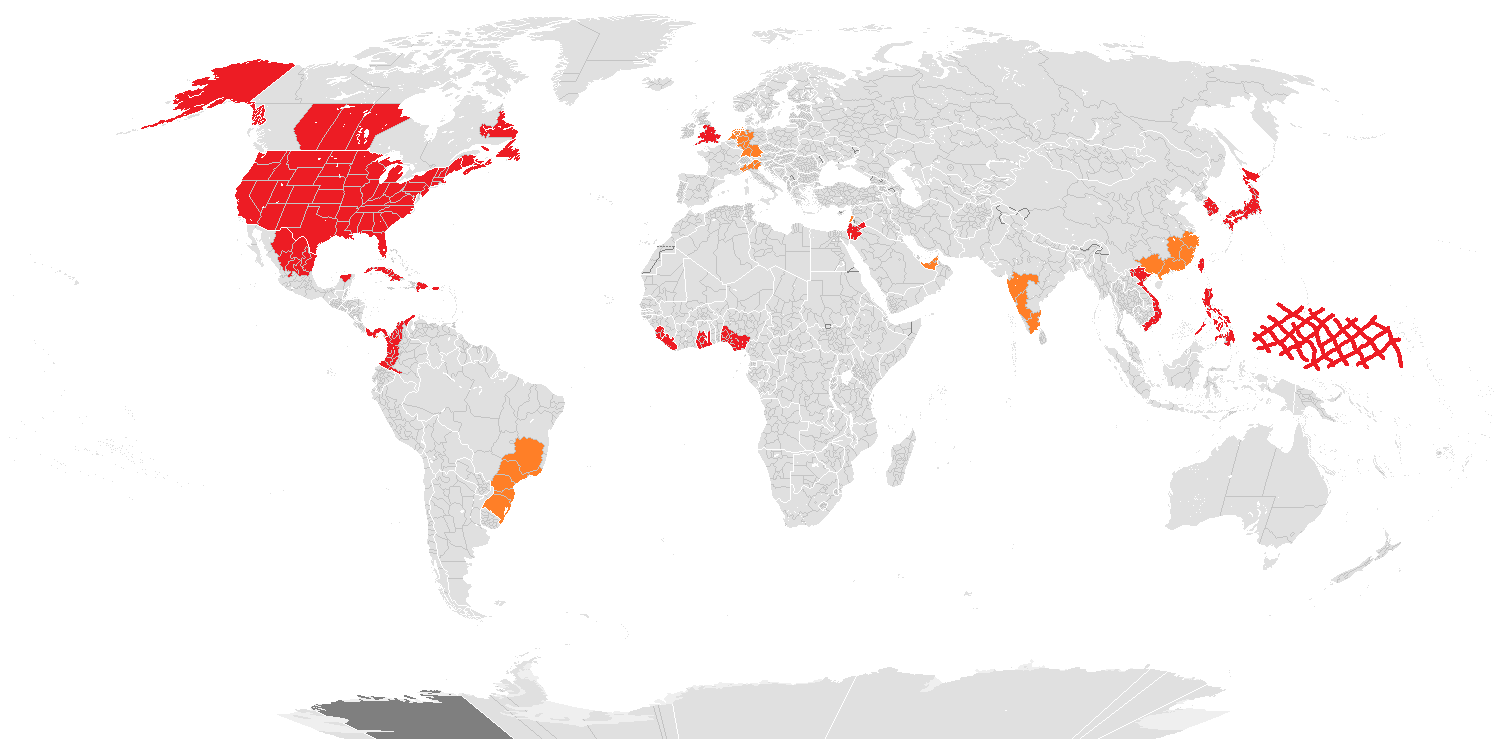
Lagos and Los Angeles joined New York, Tokyo, and London as major financial centers. The people in Canaan, England, and Wales, taking a page out of the Ashanti playbook, let their nationalist sentiments wane to a cultural level rather than a politico-legal level. The people in these “states” had finally come to terms with their place in the Philadelphian interstate order.
The German states of Bavaria, Lower Saxony, North Rhine-Westphalia (how ironic!), Baden-Württemberg, and Rhine-Hesse (a combination of the current states of Hesse and Rhineland-Palatinate) all joined the federation.
The Netherlands joined as is. The Dutch provinces have a long, proud history of republicanism, and it was not an easy choice to make. But by themselves, they were just too small to join the federation, so they banded together a la the Nigerian states of 2045, and joined as a single unit, where they enjoy two Senate seats and roughly the same amount of representatives in Congress as New York or Pennsylvania.
Five Italian provinces joined: Veneto, Lombardy, Trentino-South Tyrol, Piedmont, and Liguria. Piedmont’s membership in the Philadelphian union is all the more remarkable given its role in forming Italy as a nation-state.
The Baltic states and many parts of Poland applied for membership, but the Baltic states could not, in the end, give up their Westphalian sovereignty, and the Polish voivodeships, too small to be admitted on their own, could not come up with a suitable agreement for merging and forming new “states” to join the Philadelphian union.
The United Arab Emirates joined as is.
Three of the wealthiest Indian states joined the federation: Karnataka, Tamil Nadu, and Maharashtra. India was upset, but it’s long history of democratic and federal government, along with its close relationship with the West and relative military weakness compared to the union, prevented a war over the three states leaving for the compound republic.
War did not come to China, either, when the federation of free states poached five southern provinces and two special administrative units: Zhejiang, Jiangxi, Fujian, Guangxi, and Guangdong (which merged with Macau and Hong Kong). The provinces were in almost open rebellion against the CCP. They had grown tired of the Party’s paranoia and broken promises. Street protests were massive. There is a history of violent uprisings in the region. The CCP, which had turned inward when Taiwan joined the Philadelphian union in 2025, had impoverished the country. Beijing had a massive military but it was outdated, ill-disciplined, and corrupt. China had no means to fight a war over the wealthy provinces that joined the compound republic. Unlike the 19th century, when China was humiliated by the West, only the Communist Party of China was humiliated in this confrontation.
Six of Brazil’s wealthiest states also joined the Philadelphian interstate order: Rio de Janeiro, Minas Gerais, São Paulo, Paraná, Santa Catarina, and Rio Grande do Sul. Atlas shrugged, and the compound republic responded.
Lebanon gave up its sovereignty, too, but it joined Canaan so no new Senators were added. (I didn’t do the math, but Canaan might or might not get another seat in the House of Representatives.)
Secessionist movements have flowered since the experiment in self-government under the Madisonian constitutional order went global. It’s a counter-intuitive notion: the larger the Philadelphian union gets, the more secessionist movements flourish. In 2055, there were 26 more “states” that joined the compound republic, giving the union 127 members overall.
In the first volume of Law, Legislation and Liberty (1973), we will find the most daring theses of Friedrich Hayek regarding the problem between law and politics. Just as his economic work of the 1930s and 1940s had been, in his opinion, misunderstood by his colleagues; just as he was surprised to hear the fervent readers of The Road to Serfdom (1945) attribute positions to him that he had not exposed there; also his legal-political work triggered simplifying interpretations that conceal the main contributions, still relevant for this time.
In Norms and order –that is the title of that first volume- the author does not propose to abandon legislation and return to customary law, nor to replace the political decisions of the administration of state affairs by a government of judges. On the contrary, it is stated there with a clarity that leaves no room for doubt that the powers of the state must be organised and operate in accordance with the rules and procedures of public law, made up of legislative bodies endowed with rules with a clear teleological content.
On the other hand, the genuinely innovative thesis that Hayek exposes in the aforementioned volume consists in affirming that the interactions between individuals in the scope of their exchanges destined to cooperate freely and voluntarily in the coordination of their respective life plans are structured around a set of abstract rules –that is, lacking a specific purpose- and general rules whose observance could occur in practice without the need for a positive enunciation. It is for this reason that Hayek affirms that the law is not created, but discovered, and that it is not legislated, but rather evolves.
On this last point, John Gray at his time, many years after Hayek’s death, lamented that his former mentor had spent the last years of his life discussing pseudoscientific ideas around alleged evolutionary theories. However, such suspicion cannot fall in any way on the triptych of “Law, Legislation and Liberty” (1973; 1976 and 1979).
What is found in the said work is an express taking sides with a tradition of thought that extends from the Late Middle Ages, the Renaissance and the beginnings of Modernity: the school of natural law understood as something different from an ideal, derived from reason, about what should be, but to a set of normative beliefs effectively extended in a given population, which condition their behaviour, contribute to the formulation of a critical judgement about the value of actions and allow the formation of expectations about the expected behaviour of peers and, therefore, facilitate the ideation and coordination of individual plans.
For Hayek’s own epistemological conceptions, this tradition of thought acts as a kind of discovery mechanism on certain aspects of the legal phenomenon and the structural characteristics present in all human interaction and therefore his constant appeal to the history of ideas.
Hayek, in a peaceful and incontrovertible way for any specialist in the matter, syndicates Hugo Grotius as the initiator of the rationalist and idealist school of natural law, although holding him responsible, as he did, for the evolution of the identification of legislation as the only and exclusive source of law could be considered as an overly emphatic statement, which would abandon the very premises of cultural evolutionism to which Hayek himself adhered: if Grotius’ theses were so successful, it was largely due to the subsequent advent of the national states.
Although the truth is, however, that the characterization of Natural Law as a derivative of reason later allowed, in the 20th century, to receive from legal positivism the rejection of all Natural Law as “metaphysical”, thus leaving the formulation of the Law at the mercy of politics and, with it, in a serious crisis the very notion of “Rule of Law”.
It is for this reason that Hayek set out to rehabilitate the empiricist current of Natural Law, which seeks normative statements not in the derivations of reason, but in the discovery of notions about what could be considered right behaviour towards others through the investigation of patterns of behaviour actually observed in a given community that is structured around peaceful exchanges repeated over time.
The archetypal example of such kinds of normative structures given in practice, independently of their enunciation by any type of legislator, is represented by the communities of merchants: a repeated series of regular exchanges generates certain expectations about the conduct to be observed by the members of said group of merchants, which also allow to conceive and coordinate other business plans. For this reason, many times, conflicts between merchants are resolved through friendly settlers, or arbitrations, and judges resort to the opinion of specialised experts in a certain commercial area to dictate their decisions.
Such examples do not constitute proof that all law is spontaneous, but rather a powerful counterexample to the theses that hold, on the one hand, that legislation is the only possible source of law and those that, on the other, affirm that all law must be derived from reason.
Although both antithetical visions are synthesised in the figure of the rational legislator, whose legislative enunciations are derivatives of public reason, this in turn receives -in the first half of the 20th century and today- challenges from Realistic doctrines, which state that legislative activity is not a product of public reason, but of the exercise of political will.
It is in relation to this contest that Hayek plays the card of cultural evolutionism and of the legal system as a spontaneous order. In this sense “Law, Legislation and Liberty” is a new elaboration of “The Road to Serfdom”.
This theoretical controversy maintains its full validity to date: the confrontation that the predominant species of Liberalism, of an idealistic and rationalist nature, seems to be losing against Political Realism, which places political will above a system of human coexistence based on rules and not on discretionary decisions. In Hayek’s case, he sides with a rule-based political system, but what sets him apart from prevailing Liberalism is that such rules are not derived from reason, but rather emerge from experience.
This experience not only produces norms of just conduct to be discovered by the courts and enunciated by legislators, but it is also responsible for structuring the very apparatus for understanding such norms. It is for this reason that Hayek himself, in his book The Sensory Order (1952), called his particular philosophical vision “pure empiricism.”
Of course, an empiricist conception of Natural or Fundamental Rights – based on Adam Ferguson, David Hume and Edmund Burke, among others – is not exempt from difficulties, the main one being the task of identifying those empirical norms that effectively contribute to maintain a peaceful order of coexistence and provide them with the corresponding enforcement.
However, despite such difficulties, affirming that the existence of Natural Rights emerges from the experience that structure a peaceful order of coexistence and that they are the ones that legitimise the exercise of power and not vice versa, already constitutes in itself an affirmation worthy of being considered and, eventually, defended.
Climate Collaborations in the Arctic Are Frozen Amid War (Undark)
A War of World-Building (City Journal)
“Since it has been argued so far that an essentially liberal economic regime is a necessary condition for the success of any interstate federation, it may be added, in conclusion, that the converse is no less true: the abrogation of national sovereignties and the creation of an effective international order of law is a necessary complement and the logical consummation of the liberal program.”
Sciences of “Dune”: An Introduction (LA Review of Books)
A symposium on Dune’s medicine, ethnography, eugenics and others.
Why Do We Love the Brutality of “Grimdark” Fantasy? (LitHub)
Have neither read ASoIaF nor watched GoT, but I will leave the root of word “grimdark” here: In the grim darkness of far future there is only war.
On Tolkien and Orwell (Darcy Moore)
More common points than just “being peculiarly English authors with evergreen book sales“.
Ursula K. Le Guin’s biography gets a publisher and a release date (Oregon Live)
Just finished The Dispossessed, the 1974 SF novel by Le Guin. A worthy, humane read, definitely. Apart from the beautiful prose, the setting is compelling. Two planets: Urras, complete with states, money and war, and Anarres, a former mining outpost turned to colony by settlers from Urras. Governments of Urras offered to people adhering to the teachings of a semi-legendary woman (“Laia Asieo Odo”) the colony, so that they could do their thing without disrupting “civil order”. Le Guin explains:
Odonianism is anarchism. Not the bomb-in-the-pocket stuff, which is terrorism, whatever name it tries to dignify itself with; not the social-Darwinist economic “libertarianism” of the far right; but anarchism as prefigured in early Taoist thought, and expounded by Shelley and Kropotkin, Goldman and Goodman. Anarchism’s principal target is the authoritarian State (capitalist or socialist); its principal moral-practical theme is cooperation (solidarity, mutual aid). It is the most idealistic, and to me the most interesting, of all political theories.
Source
The book follows a scientist from the anarchist planet who travels to the old world. The chapters alternate between his interactions there and flashbacks from his homeland. The writer paints the capitalist state, that hosts the traveler, as funky, but sinister (she does not spare a neighboring socialist one, either), while she treats the anarchist world more generously. It even gives it some, let’s say, additional leeway, contrasting its arid, hostile landscape with the lush environment of Urras. The dichotomy is furthered by guarantees of isolation: The two worlds only do some limited communications and trade, no traveling in-between.
The outline of life in Anarres was the most interesting aspect, to me. Trust, mutuality and personal freedom are the basic elements in this anarchist society, which prides itself against those competitive, “archists”, “propertarians” of Urras. They also fear and loathe them (acknowledging that Anarres is practically defenseless at the face of tactical armies), and also need to trade with them ores for necessary goods.
The constructed language of Anarres expresses the core beliefs, for example, it uses “central” instead of “higher”, to denote significance in the absence of hierarchies. The word for “work” is the same as “play” (or was it “joy”?), and the really unpleasant tasks are shared on a rotating basis. This means that specialized and unspecialized individuals alike spend some considerable time laboring for society’s wellbeing. Professions are conducted through syndicates, which form and dissolve voluntarily. Individuals move freely across the planet’s communities. There is a unit that coordinates production, work postings and resources allocation (a Gosplan-lite, if you take away the imposing building and that 5-year fetish). It also has powers like emergency work postings in times of need (the closest thing to quasi-official “compulsion” in a society without the notion of it). Serial slackers deserve food and shelter, like anyone else, but at some point will probably get their asses kicked by their peers and/ or pressed to fuck-off to another location.

Each individual is responsible to the others. This simple standard of meeting social expectations, benevolent as it is at first, in the novel is seen as gradually taking the shape of an “orthodoxy” placed, and finally encroaching, upon individual freedom. The writer is also keen to pinpoint the effects of creeping hierarchies, even in organizations open to participation. For example, an anarchist argues that the coordination unit has assumed the bureaucratic attitude (“no to everything”). Other institutions, like research centers, are seen festering with dug-in cliques and “seniors”, that fend-off outsiders and boss around among supposedly equals. I think that anyone who has experienced office life can relate to this.
There is more, about self, relations, gender (not The Left Hand of Darkness – not read, or Tehanu – read, level), constraints and science (the last I cannot judge). A final note, the people of Anarres describe themselves as anarchists, Odonians and, of course, libertarians.
Introduction
While in recent days a lot of attention has been focused upon the political events in Pakistan (the vote of no confidence on April 3, 2022, will decide Pakistan PM Imran Khan’s fate), what was interesting to see was an address by the Pakistan Army Chief, General Qamar Javed Bajwa, at a two-day Islamabad Security Dialogue on April 2, 2022.
Imran Khan has accused the US for plotting his downfall, pointing to a ‘threat letter’ and citing his independent foreign policy (especially support for Russia) as the main reason for the same. During his address to the nation on Thursday, March 31, 2022, Khan said that the US was keen to dislodge him (though later on he said that mentioning the US specifically was a slip of tongue), and also said that the opposition was working against the national interest at the behest of certain forces abroad.
While Pakistan had summoned a US envoy to lodge a complaint against interference by Washington in its domestic affairs, the US State Department has vehemently denied this accusation.
It would be pertinent to point out that while Khan’s anti-West tirade has drawn criticism from the opposition parties, the military, too, has not been particularly happy with his remarks. Significantly, Khan’s Pakistan Tehreek E Insaaf led coalition had lost the support of the Muttahida Qaumi Movement-Pakistan (MQM-P) on March 30, 2022, and was left with the support of 164 legislators in the national assembly, while the magic number is 172.
Last month, Khan had lashed out at Islamabad-based Western envoys (including those of EU member countries) after 22 of them had written to the Pakistan Prime Minister seeking Pakistan’s support on the Ukraine issue (Pakistan had abstained from voting in favor of a UNGA resolution criticizing the Russian invasion of Ukraine). Khan had said that Pakistan is nobody’s slave.
During his address at the Islamabad Security Dialogue — which was held a day before the vote of confidence in Pakistan — Bajwa said:
We share a long history of excellent and strategic relationship with the US, which remains our largest export market. We seek to continue our ties with both countries [China and the US].
While it is true that ties between the US and Pakistan have deteriorated significantly (US President Joe Biden has not called Imran Khan after taking over), it would be pertinent to point out that there are lobbies in both Washington and Islamabad which are in favour of mending ties and at least having a working relationship. Both the US and Pakistan worked closely on the issue of Afghanistan, and given Islamabad’s economic challenges it needs to have a working relationship with the US (especially with regard to assistance from international organisations like the IMF) and the European Union (EU), and cannot look only to Beijing. In recent months, senior officials within the PTI government have repeatedly batted for improving Pakistan-US economic ties.
Interestingly with regard to the Ukraine crisis, Bajwa criticised Russia’s invasion, while batting for immediate cessation of hostilities. Said Bajwa:
despite legitimate security concerns of Russia, its aggression against a smaller country cannot be condoned.
Bajwa’s address and the criticism of Imran Khan’s anti-West/US pitch by opposition parties in Pakistan clearly points to the fact that, while in recent years due to the changing world order and the geopolitical architecture of South Asia, Islamabad may have moved closer to China and to an extent Russia, there is a realisation that Pakistan cannot further damage its relations with the West, and needs to strike a genuine balance between China/Russia and the West.
When Russia invaded Ukraine a few short weeks ago, some people began to worry that China might try to do the same thing with Taiwan. I didn’t worry about this myself, as China is mostly a paper tiger, but also because the US has close military ties with Taiwan. Taiwan has close economic relationships with several wealthy democratic states in East Asia, too. Contrast this geopolitical context with Ukraine, and the parallels, while tempting, do not add up.
The whole debate and worry over Taiwan got me thinking again about federation as a libertarian foreign policy. Why shouldn’t Taiwan just join the United States? Here are the most common objections to such a federation:
Geography. This is probably one of the strongest cases against Taiwan joining the US, since it’s so far away from not only the mainland but Hawaii, too. Aaaand it’s just off the coast of China, which would likely cause friction with the regional power were Beijing to suddenly find itself neighboring a transoceanic republic.
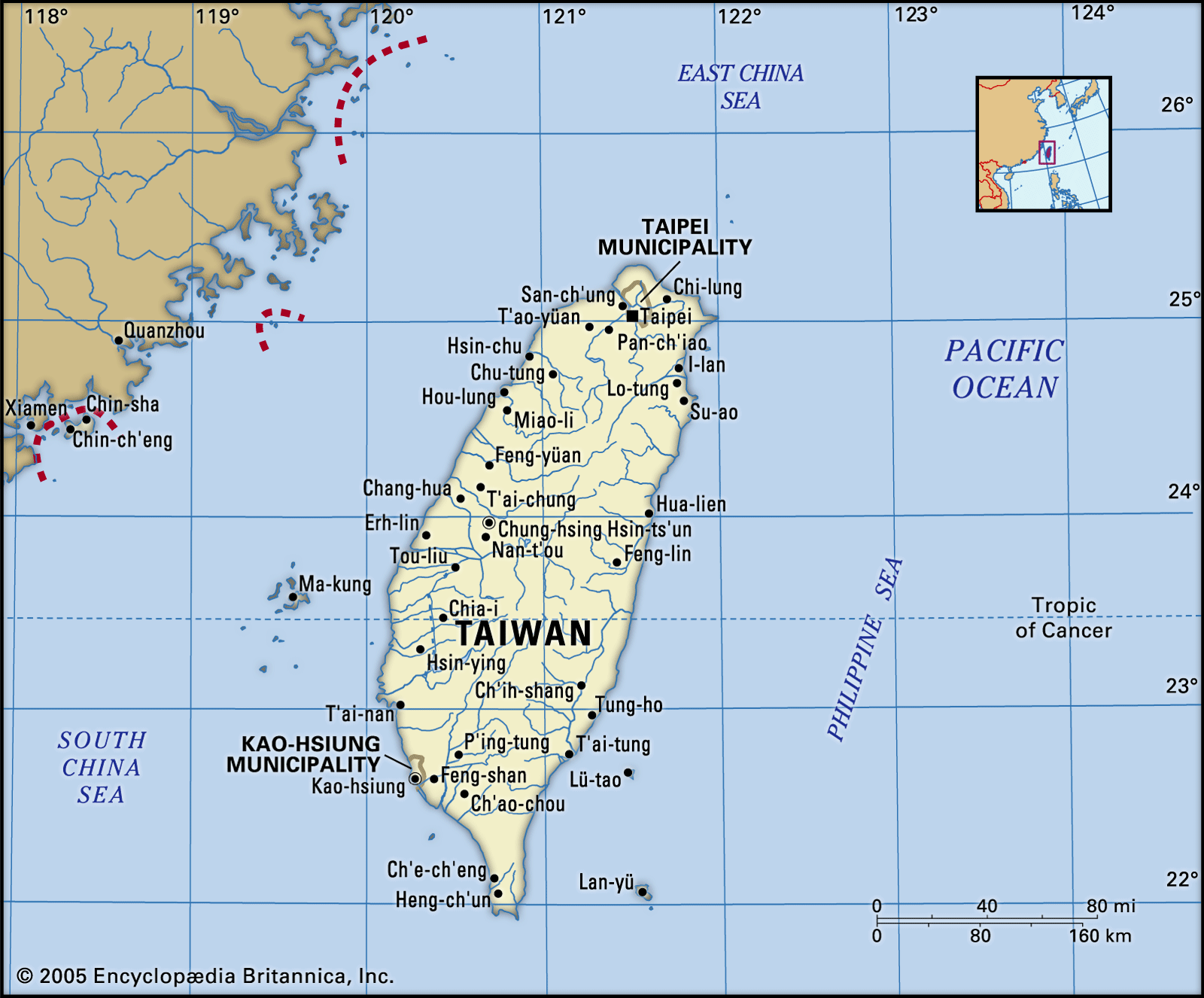
This is all much ado about nothing. A plane ride from Dallas to Taipei is 14 hours if you take out the layovers. Somebody living in Kaohsiung could send me an email after reading this essay and I could access it within minutes. Geography still matters, but its not an insurmountable barrier to a freer, more open world via the federative principles of the United States constitution.
Culture. A big complaint I see about adding “states” to the American republic is “culture.” Fellow Notewriter Edwin does this all the time, and it can make sense, on the surface, in some cases, but not in Taiwan’s, and not in the Indo-Pacific more generally.
Look at Taiwan’s 2020 presidential election results:
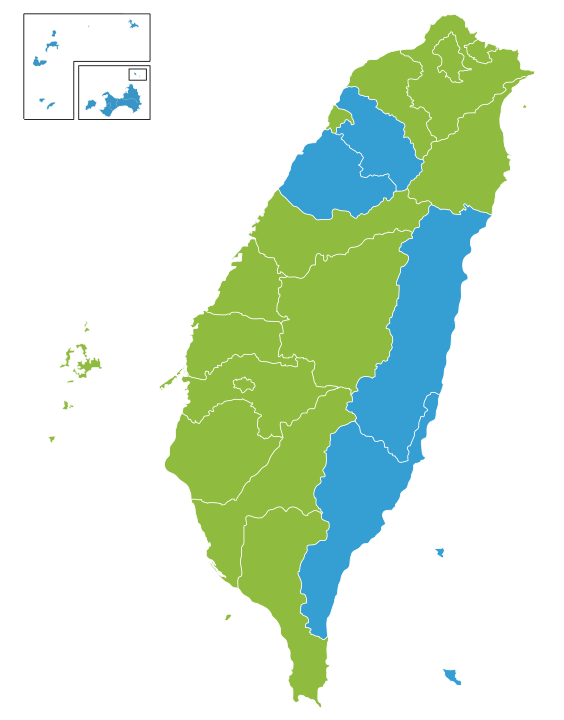
Look familiar? There’s only two colors. It’s a contest between a left-wing and right-wing, and both wings are committed to, and bound by, liberty and democracy. There are no “ethnic” parties, no “religious” parties, and no radical parties, mostly because Taiwan has the same electoral system as the US does: a “first-past-the post” one. So the cultural angle is even weaker than first imagined. Taiwan started out as a nationalist holdout against the Communist Party, but today nationalism doesn’t carry a whole lot of weight. Adding Taiwan to the republic would be like adding another California or Hawaii, albeit with more conservative votes. It’s plausible that adding Taiwan would give Democrats two more reliable seats in the senate, but this is merely cause to invite a polity that would reliably vote Republican to also join the United States.
Self-determination / cultural autonomy. There’s an argument in some circles that joining the US would be akin to losing self-determination and even cultural autonomy. I don’t see how any of this could be true. Even today, people in American states retain a “state-centric” identity when it comes to thinking about their place in the US. That Taiwanese would be able to add “American” to a plethora of other identities already at their disposal could only be a good thing.
China. Would China fight a war against the US over Taiwan statehood? Maybe, but given Russia’s poor showing in Ukraine, the war would end quickly, at least from a Taiwanese statehood perspective. The CCP’s military has no fighting experience, unproven tech, unproven hardware, and…no fighting experience. The worst that would happen, I think, is that the CCP threatens war, maybe sends some warships to the strait, maybe fires some rockets over the island and flies some fighter jets over the island, but that’s about it. The CCP just doesn’t have the muster to fight a war against the United States over Taiwan.
These four objections are so common that I can’t help but be exasperated by their banality, especially given the rich tradition of republican security theory and federalist thought over the past three or four thousand years. There are two reasons for Americans, and especially libertarians, to support Taiwan’s federation with the US:
The free riding problem. The first thing that all libertarians complain about when it comes to “foreign policy” is the free riding problem. This is a problem in political economy where agents will enjoy the benefits of a policy at the expense of other agents who are required to bear the costs. Libertarians aren’t wrong to complain about the free riding problem. It’s a big problem. Think of a Russian attack on NATO ally Lithuania.
Taiwan has a fairly hard guarantee of US military support were the Communist Party of China to attack it. This, the argument goes, allows Taiwan to be a bit more reckless than it otherwise would be when dealing with Beijing. Therefore, according to non-interventionists, the US should simply stop guaranteeing Taiwan’s military security and just trade with the people of the island instead. It would be an awful scenario to face were Taiwan to goad China into attacking it and thus draw the US into a war with China.
Federating would end the free riding problem once and for all. Taiwan’s citizens would be American citizens. They would benefit, and pay the costs, associated with such citizenship.
Sovereignty. Taiwan is not a sovereign nation-state, as China has blocked all of the island’s attempts to become so, and it never will be so long as nation-state status depends upon recognition by large states such as Russia and China (as well as the US). This actually makes it easier for Taiwan to join the republic. The American senate is a tool of international diplomacy that was utilized to bind independent states together in a federal union by trading their sovereignty for seats in a powerful upper house of Congress. Taiwan wouldn’t have to go through the arduous process of debating whether or not its sovereignty is worth the price of admission into a North American federal order, because its status as a Westphalian sovereign nation-state is non-existent.
By incorporating Taiwan into its federal order, the US could revamp the liberal world order, and it could do so by adhering to the principles which made it a beacon for liberty in the first place.
Hundreds of workers marched with the red flags of the labor unions and chanted anti-government slogans in India’s capital on Tuesday as part of a two-day nationwide strike that began Monday.
And this:
Elsewhere in the country, protests were held in eastern West Bengal state where demonstrators stopped trains at several locations. In southern Kerala, where the state government led by the opposition Communist Party of India backed the protest, streets were empty and shops shuttered.
India’s economy has bounced back after experiencing a major blow during the first two years of the pandemic. But many jobs have disappeared, with unemployment rising to 8% in December.
It’s hard to tell which parties are reactionary in India. Modi’s Hindu-centric party certainly seems to fit the bill, but it looks to me like the Communists want to turn back the clock, too. Where are India’s liberals (classical or otherwise)? Here’s the rest.
Famous Brand Logos Are Reimagined as Medieval Illustrations (My Modern MET)

The allure of cosmopolitan languages to courtiers and pop fans (Psyche)
The First Authoritarian (The Hedgehog Review)
The Korea Analogy (The Duck of Miverva)
Heading Into the Atom Age—Pat Frank’s Perpetually Relevant Novels (Quillette)
Got to appreciate the Atompunk aesthetics. I have also spent considerable time with the Fallout games (only the first two ones).

