Does the EU promote liberalization?

This is in response to Brandon’s earlier post asking for literature on the EU’s effect on promoting liberalization. The short reply is the EU promotes liberalization – sometimes. Below are two pieces of the literature on the issue.

On a quick aside, I have mixed feelings towards the recent Dutch referendum on the Ukraine-EU Association Agreement. I don’t think that the EU should extend a hand to Ukraine. Namely because I think the Russians are much more willing to use force over the issue than West Europeans. Secondly, because I think it gives peripheral countries the idea that they don’t need to join/remain in the EU to receive its protection. Moral hazard if you will.

However I disagree with co-blogger Evgeniy Grigorjev that Ukraine, and other peripheral nations, should be denied EU affiliation until they reach certain benchmarks. I’m sure that Ukrainian politicians would consider EU association a victory and feel less compelled to act. However the long term effect of EU membership would be greater trade in goods, people, and ideas. With any luck liberal ideas. I would welcome the EU expanding into North Africa and parts of the Near East if it meant the expansion of liberal ideas to those regions.


The Effect of Labor Migration on the Diffusion of Democracy: Evidence from a Former Soviet Republic {LINK}

This empirical paper looks at the effect of return migration on political attitudes in Moldova. The basic idea is that return migrants bring with them new political ideas from abroad.

In the late 1990s Moldova experienced financial trouble that encouraged many of its laborers to migrate temporarily to Russia and the west (largely Italy) in search of work. Regions with more return migrants from Italy were found to have the least support for the Communist Party in future Parliamentary elections. Regions where migrants went to Russia had increased (albeit sometimes small and/or statistically insignificant) support for the Communist Party.

There are two take aways here:

(1) Trade in ideas matter.
(2) The type of ideas you trade matter.

The EU, and the Schengen area, can promote idea trading but what makes the EU important is that it is a liberal institution. An institution that needs reform, but one worth keeping.

Anchoring Democracy from Above? The European Union and Democratic Backsliding in Hungary and Romania after Accession {LINK}

This paper looks at the different responses the EU took towards Hungary and Romania when the national governments of both respectively introduced illiberal measures. Discusses some of the weak points in the EU and how it can be reformed to improve its ability to react to similar future events. As Evgeniy points out, the EU has a weakened ability to punish illiberal policies once EU membership has been granted. Intra-EU coordination is also difficult to achieve to use those tools it does have. The EU is not however impotent and reforms could be introduced to rectify this.

Voter Participation: Something Has to Be Done

In California, 70% of eligible voters are registered, and 47% of those turned out in a recent election. Thus about a third of those who could vote do so. These are dismaying numbers.

Dismaying because they are too high.

Why? First, some more dismaying numbers:

When Newsweek recently [2011] asked 1,000 U.S. citizens to take America’s official citizenship test, 29 percent couldn’t name the vice president. Seventy-three percent couldn’t correctly say why we fought the Cold War. Forty-four percent were unable to define the Bill of Rights. And 6 percent couldn’t even circle Independence Day on a calendar.

Too many ignorant fools are casting votes. People who believe that minimum wage laws create wealth, free trade destroys wealth, or clergymen should be forced to marry gay couples, to pick just a few examples. We need to bar these ignoramuses from the voting booth.

How? For starters, ditch the 26th amendment to the Constitution and the raise the voting age to at least 30. Get the 20-somethings out of the way; too many still believe in free lunches.

Second, change the 24th amendment to require poll taxes rather than forbid them. There is no justice in forcing non-voters to pay election costs.

Third, institute stiff qualification exams. Voters need know the vice president’s name, understand the Cold War, identify July 4 as Independence Day, and a whole lot more. Informed voters would be mostly immune from pandering demagoguery.

Disenfranchisement will lead to alienation and rebellion, some will say. Perhaps, and this could be alleviated by a phase-in of the changes. But then voting will become a privilege that young people can aspire to, as they might aspire to a corporate management position.

Another objection: my proposal is elitist. Of course it is! If there’s one thing we desperately need in this country, it’s a reversal of the egalitarian sentiments that have poisoned so much public discourse. We need to encourage and acknowledge the best and the brightest. Ignorant fools should not be allowed to operate dangerous machinery or pull levers in voting booths.

The Dark Side of Polycentricity

Who’da thunk?!

This raises the question: would anyone pay attention if the federal government wasn’t such a mess? I don’t think so. Oh well… can’t win ’em all.

The European Union is Pathetic

So here we are. Prime Minister Cameron got his ‘special deal’ from the rest of the EU leaders. It is pathetic, from both sides. I like the Brits, and admire their great tradition in political thought. Because of their constant doubts about the EU, they are (potentially) the most informed about it, if the enormous flow of publications pro and con is a sign, which have seen the light since the eighties. Therefore, one questions the sincerity of Cameron, who has repeatedly said he will campaign against Brexit. His pathetic result seems a sure vote winner for the No side though. I find it hard to belief that anyone can be seriously convinced to stay in, if his four main results should do the trick.

These four are: a minor semantic thingy (Britain is exempt from striving to a closer union); a complicated procedure for a majority of national parliaments to reject or change intended European regulation (a comparable procedure has been a failure); the possibility to decrease the amount of children allowance for children who do not live in Britain to the purchase power parity level of the country concerned (especially aimed at Eastern Europeans); and finally an emergency break on social security benefits. Great results to build a campaign on…

These results are mostly symbolic, and while symbols are important in politics, it still amounts to little. So the other European leaders were not willing to change much in the way the EU is now run and its enormous amount of laws, rules and legislation. This is by far the saddest of it all. The leaders  let the moment pass to really change the EU, to not only address the British fear and frustration, but also those of the people of many other member states.

This is especially relevant for The Netherlands. On April 6 there is national referendum on the association treaty with Ukraine. The No-camp is leading the polls. If rejected (and the government acts accordingly, which it is not obliged legally), the whole treaty has to be discarded by the EU. We have been in this situation before. In 2005 the French and Dutch populations rejected the EU constitution by large margins. Only to have force fed on their throats a marginally different constitutional treaty a year later. So strange support for the EU had been decreasing for years.

The EU cannot make a fist in foreign politics, not in defense and security affairs, not in the current refugee crisis. It fails to ensure free competition in services, it still wastes billion of euros in subsidies on agriculture, regional support, industrial policies, et cetera. In short: it is a mess, the EU fosters the development of turning itself into an open air museum: admired for its culture, laughed at for its dismal politics and economics. Thanks a lot for the leadership, European Council.

I wish I could just list every idea I’ve encountered then never cite anything…

Steve Horwitz has a great piece in the Freeman that I wish I’d written. The tl;dr: Voting isn’t all there is to political participation. This is an idea that’s been bouncing around in my head as I’m constantly remound that I’m now an American citizen (sorry everyone else in the world…) and that this November I’ll be eligible to vote for who I think should foster anti-American sentiments internationally (Republicans) or  domestically (Democrats).

The other day I said I’d consider voting but I couldn’t recall whose name I’d write in (turns out it’s Willie Nelson*). But my usual response to any question about whether I’ll vote is “No, it just encourages the bastards.” When that’s countered with “blah blah blah civic engagement blah blah” I retort with,essentially, Horwitz’s point: My vote is not going to change the outcome**, but I can contribute value by trying to convince my students that economics matters and that a vote for third party candidate (even a Green Party vote) does more good than a vote for the big two.

I don’t know where I picked up that idea, but if I’d remembered, I would have posted his piece here before he did. Even better would be if I could just list a repository of everything I’ve ever read (or heard) in some public place and just write and write without worrying about citing anything.

Continue reading

What is the proper role of government? Galactic Edition

Mordanicus of Fascinating Future, a sci-fi blog, is musing over the purpose of galactic government. As Mordanicus points out, galactic empires are a staple of science fiction. They can be found in the Star Wars, Star Trek, Dune, Firefly and Foundation universes.

…the feasibility of a galactic empire is questionable.

In Asimov’s description of the galactic empire, it consists of 25 million inhabited planets and 500 quadrillion people, 20 billion per planet on average. It is hard to even imagine a planetary empire, and no such thing has ever existed in human history, let alone such enormous empire.

The fundamental issue with an empire of this size is effective control by the central government. Its sheer size makes it inevitable to delegate many administrative powers to “local” planetary official. But the more power is transferred to individual planets, the less power remains with the central government. The question is then what is the proper function of the imperial government?

What is the purpose of these empires though? In those sci-fi universes with aliens these empires serve some defensive role for our Milky Way galaxy, but in many sci-fi universes there is no clear visible external threat.  What is the purpose of the empire then? Or is it simply a way for wealth distribution by those living in the Saturn beltway?

I personally view merit in a galactic empire if it were able to maintain internal peace. I have no doubt that in a space faring civilization there will be pirates and I believe that there are economies of scale in galactic trade route policing.

There is also merit in an empire that can keep rogue planetary governments in check. A galactic empire would be restrained in its ability to govern on its own given the largess of space and would need to delegate many functions to different layers of government. An empire would however still serve as a last layer of resort for those petitioning against their planetary government.

What about NOL readers? Are you convinced that space piracy warrants an empire? Or would a space faring civilization be better government by planetary or sub-planetary governments?

Read the full post from Mordanicus here.

How to split up California?

The idea of splitting up California has been previously discussed on NOL (see here, here, and most recently). In this post I wish to consider how California could be split up.

California has a large population of 38.8 million. For comparison Canada has 35.1 million residents distributed among its 10 provinces and the New England states house 14.7 million yankees in six states. With such a large population it is not surprising that the state has several regions with distinct cultures. This in itself is not sufficient merit to split up the state. One of the wonders of a liberal republican form of government is that diverse populations can coexist so long as they are treated equally before the law and have the freedom to exercise their various cultures. The problem is when these cultural differences lead to different public policy demands.

Consider for example the issue of abortion. In most matters of religion it is sufficient to allow different faiths to practice their beliefs so long as they keep to themselves. Why should non-Jews care if Jews must follow kosher dietary restrictions? The same cannot be done with abortion though. Those who believe, often due to their religious inclinations, that abortion is murder cannot tolerate its practice among those of other faiths or atheists. What is to be done?

One option would be to break up California. Although those on both sides of the abortion debate exist across California, there is also quite a bit of spatial correlation. See here. The Central Valley and Inland Empire counties both have significant portions of their populations favoring abortion limitations. Both regions also have low support for same sex marriage, see here, so it is safe to assume that their cultural differences with the rest of California is not on just one issue but several important public policies.

I would caution those who propose splitting up California between its inland and coastal regions. Both the Central Valley and Inland Empire may be culturally conservative, but the inland northern counties do not seem to fall in line. Nor would I recommend the Coastal/Inland split for those concerned about partisanship, see here. The San Francisco Bay Area, Northern Coast and Los Angeles are liberal strongholds but the Central Coast and Orange-San Diego region aren’t.

Similarly a North/South split would do little to help address regional cultural differences. The North/South split would usually split the state apart at San Luis Obispo-Kern-San Bernardino county lines. This would lead to the conservative Central Valley being lumped into the same state as ultra-liberal San Francisco. Meanwhile the Inland Empire and Orange-San Diego counties would find themselves sharing a state with blue Los Angeles.

What would be a good split then?

I personally favor the creation of four new states. Jefferson (the northern coastal and inland counties), San Francisco (the bay area states), Los Angeles (LA County), Central Valley (everything between Fresno and Bakersfield roughly) and the rest of southern California.

Given that any division would have to be approved by Congress the new states of Jefferson, San Francisco, and Los Angeles would have to be gerrymandered in such a way as to ensure they are blue states and maintain as many electoral votes from old California as possible. The Central Coast would likely be gobbled up between LA and San Francisco.  This gerrymandering would be needed to get Democrat votes who would otherwise be against losing all those electoral votes. Although Democrats would get two more seats in the Senate the Republicans could favor the deal in order to sweep extra electoral votes from the Central Valley and Southern California.

Although the split would be less than perfect, it would still grant greater say over public policy to the conservation counties.

Thoughts? Further maps on Californian public policy opinions can be found here.

P.S. In regards to the water issue, I like to think that the split of California would lead to a revision of the Colorado River Compact and related laws in order to create a more market oriented process for water allocation. I can dream can’t I?

Is government decentralization the right answer to differences across regions?

That’s the main question being asked by Federico Boffa, Amedeo Piolatto, and Giacomo A. M. Ponzetto, all economists. I cruised through the whole paper (pdf) and have some superficial thoughts. One snippet:

Western California is more liberal, even among Republican voters and politicians; Eastern California considerably more conservative […] At a first glance, such a political divide might suggest that a break up of coastal and inland California would be optimal on preference-matching grounds […]

[H]owever [this is a] superficial assessment. [Eastern California] contain[s] a large Hispanic population that overwhelmingly prefers the Democratic party. This group is much less educated, less politically knowledgeable, and less likely to vote than Republican supporters in the region, who are on average older, whiter, and wealthier. At the same time, the left-wing Hispanic working class in the Valley shares the political leanings of highly educated liberals on the coast. This ideological alignment goes beyond mere partisanship and includes shared preferences over policies.

As a consequence, our model suggests that the political integration of California is welfare maximizing. For relatively uneducated inland minorities to have a government corresponding to their preferences, it is essential that they share a state with ideologically aligned liberal elites in the Bay area. Right-wing Californians, instead, are sufficiently educated and influential to have a voice in state-wide politics, despite being in the minority: California had a Republican governor for twenty-one of the past thirty years.

[This lesson] applies more broadly. Disadvantaged ethnic minorities— which are less educated and often politically underrepresented— should belong whenever possible to the same polity as better educated and higher-status voters having similar political preferences. Only then are politicians effectively held accountable to both groups. (29-30)

California is “welfare maximizing”? Somebody help me out here. Isn’t it also possible that poor Hispanics and rich liberals form a voting bloc in California as it is because of how the GOP is patched together? If California split into an East/West, current coalitions would be shattered and it doesn’t follow that rich liberals and poor Hispanics would share the same voting preferences in the new arrangement. It doesn’t follow that rich conservatives and poor Hispanics in a hypothetical East would be at odds, either.

The biggest weakness in the paper, if you can call it that, is that the authors are focused on the fiscal aspects of federalism rather than the diplomatic, cultural, and political aspects. Federalism binds people together and forces them to at least try to come to an agreement about some issues. That’s a big deal, though it’s obviously not sexy.

The paper is focused on the EU and the US. There are lots of interesting insights into the European Union but the US angle is kinda boring (I’m sure is vice-versa for readers living and working in Europe). (h/t Mark Koyama)

What’s the difference between Saudi Arabia and Islamic State?

One has captured the rent associated with being a state in the post-World War II world order. This means that one of these polities gets to build embassies in other states. It gets to participate in congresses. It gets to fly its flag at the United Nations and has access to the World Bank, military hardware markets (“for defense”), and FIFA tournaments.

Rent capture isn’t all good, of course. There are still costs. When Saudi Arabia beheads people, for example, it gets condemned internationally. Its reputation suffers. It has to repair relationships and launch rigorous public relations campaigns. Saudi Arabia has to do these things because if it looks intransigent to enough of its fellow states, there might be official repercussions for its actions. Saudi Arabia can’t just go around killing and looting and raping at will. It has to formalize its killing, looting, and raping through the international order by coming up with a national interest. (A national interest is also important for shoring up domestic support for such activities.)

But incorporating Islamic State into the international order is unfathomable. It’s an immoral action rewarding an immoral pseudo-polity. Besides, the sovereignty of the states of Iraq and Syria would be violated and their borders destroyed. It’s better to just keep bombing the region Islamic State claims to govern and arming the factions that claim to be its enemies. That’s been our policy towards the post-colonial world since 1945 and, while imperfect, it’s been working out well so far…

From the Comments: Military intervention, democracy, and stability

Longtime reader (and excellent blogger in his own right) Tam has an interesting response to Chhay Lin’s thoughts on the Paris terrorist attacks:

It is an interesting read indeed but there are two or even more sides to every story. What we are also noting is that many of these groups that hate Western interventionist policies also hate their own people for being different in one way or the other. However, I agree that the misplaced perception of democracy as the superior form of governance overlooks the essential internal historical and socio-political factors behind the politics of the different countries that have become victims of Western ‘sanctification’ processes fronted by bombs after daring to opt not to embrace democracy. Libya and Iraq were stable before Western intervention.

Tam’s point strikes at the heart of the difference between military interventionists and non-interventionists, I think. Libya and Iraq were indeed stable, but not everybody was free. In Iraq, Shias, Kurds, liberals, and religious Sunnis were all brutally suppressed, and this oppression stood in stark contrast to the freedoms that secularists, women, union members, some socialists, and the politically apathetic enjoyed. The sociopolitical dynamics in Libya were the same, though with different local actors.

This reality is something that both sides of the interventionist debate recognize, though the interventionist side seems to place much more faith in government when it comes to “doing something.” Jacques and Edwin, for example, have both argued that bombing ambiguous factions in Iraq, Syria, and Libya would contribute to the freedoms of the oppressed factions in those countries. Looking back on the debate makes it clear that they weren’t wrong, but look at what those freedoms have produced. Those freedoms have come at the expense of the freedoms of the factions that the dictators were protecting.

What this situation shows me is that the states of the post-colonial world are unviable. Stability comes at too steep a price (dictatorship), and democracy’s unpredictability only leads to predictably violent results in the post-colonial world.

This impasse, which I cannot be the only one in the world who recognizes, has led me to take a hard glance at two specific peace processes in the Western world: The diplomatic efforts of Europeans after the Napoleonic Wars (“Concert of Europe”) and the founding of the American republic, which is, in my mind, the most successful endeavor in the history of international relations. Neither of these efforts led to the complete abolition of war, but both have helped to maintain a relatively peaceful co-existence between large numbers of factions for long periods of time.

The Concert of Europe bought time for factions in the region to solidify their legitimacy at home, culminating in both the creation of Germany and Italy in the late nineteenth century and the infamous overseas imperial  domains of France, the UK, and the Netherlands (among a few others). While this peace process brought about prosperity for Western Europe, it was not inclusive and it still adhered to the Westphalian notion of state sovereignty. What state sovereignty means is that each state, in the context of international affairs, has a right to do whatever it pleases within the confines of its own borders (such as massacre hundreds of thousands of people in the name of stability). The Concert of Europe was also the precursor to the post-1945 peace process that created the state system that we all live with today, though I would argue that there are some elements that could be republican, such as the IMF and World Bank, provided some changes in mindset.

Aside from the problems produced by the notion of state sovereignty, the states of the post-colonial world today suffer from an issue of legitimacy, both from domestic populations and from foreign ones. Domestically, all of the factions that stability-inducing dictatorships oppress do not buy in to the argument that the states purporting to govern them are legitimate. In foreign affairs, many factions do not believe that these post-colonial states are legitimate either. Hence the calls for bombing campaigns, proxy wars, or outright invasions and occupations of states like Iraq and Libya by states like the US or France (even if these invasions come at the expense of domestic and international rule of law).

This situation, where post-colonial states claim to have sovereignty within an international state system but where domestic and international factions ignore such claims, is where we’re at today. It’s the status quo, and while it worked relatively well in a small part of the world for about hundred years or so, it’s obviously failing today.

Enter the founding of the American republic. Unlike the Concert of Europe, self-determination à la breaking away from the UK was a guiding principle of the federal system, rather than state sovereignty. Like the Concert of Europe, the statesmen who crafted the American republic were concerned about invasion, hegemony, and all of the other bad stuff that happens in the international arena. So they set up an inclusive, republican system of states rather than attempt to balance power off on each other, like they did in Europe. The republican, or federal, system tied each state up into the affairs of the other states, whereas the balance of power system contributed to the formation of rival blocs within the system. This is why Europe switched from trying to maintain yet another balancing act to building an actual confederation (though one that is far too complex than it has to be) after World War II.

From a strictly war and peace view, the republican state system has led to one war so far (dating from 1789). From the end of the Napoleonic Wars, in 1815, to today, the balance of power state system has led to numerous wars.

Now, I know what you’re thinking: Woodrow Wilson’s foreign policy was based on self-determination, and his foreign policy was a disaster. This is true, though I would argue that Wilson was simply confused about what self-determination actually implied. For Wilson, recognizing the self-determination of various groups within empires would lead to state sovereignty for these groups, and that this state sovereignty would then be protected by the institutions trying to maintain a balance of power. Wilson never entertained the notion of republicanism when it came to recognizing the self-determination of peoples living in empires, he simply thought empires were undemocratic. Thus, he was actually a proponent of state sovereignty rather than self-determination.

What I am not arguing for here is a Concert of Europe-type effort for Middle Eastern actors. I think it would be a disaster, largely because regional efforts at peace-building (rather than, say, trade agreements) are useless in today’s globalized world. The Middle East needs the West, and vice-versa. Peace will only be achieved if self-determination is embraced (by not only large swathes of Mideast factions, but Western ones as well) and the new polities can be incorporated into existing republican-esque institutions. This way, more factions have a voice, and bad actors can be more easily isolated. I am not necessarily arguing that the US or EU should welcome burgeoning Mideast states into their federations, but policymakers and statesmen from these countries should at least start thinking about how to encourage and embrace the notion of a Middle East that looks a lot like our own republican world and less like the one we gave them following the destruction of the Ottoman Empire.

Stability is overrated, especially if the notion of creative destruction is taken into account.

Are small autonomous political units economically viable?

Macau Skyline

I am at the moment enjoying my end-of-year-holidays in Macau, a micro-state next to Hong Kong and like Hong Kong also a Special Administrative Region (SAR) of China. Being a SAR basically means that Macau is allowed political and economic autonomy, but still belongs to the People’s Republic of China. This construction is also known as the “One Country, Two Systems” constitutional principle. Being here makes me realize once again the unique position of micro-states. Although I understand that GDP per capita is no measure of everyone’s personal income, I would still like to stress that Macau has the second highest GDP per capita income in the world in 2014 according to the World Bank and that the CIA has placed Macau at spot number 3. Macau has furthermore the 2nd highest life expectancy rate (CIA, 2012). Some other interesting facts about Macau:

  • 0% VAT;
  • max. personal income tax rate of professional practices is 12% and only for incomes above MOP424,000 (~ 53,000USD);
  • currently 30% of this professional tax is waived;
  • tax free income threshold stands at MOP144,000 (~ 18,000USD);
  • Macanese residence in possession of an ID-card receive a yearly refund of 60% of the professional tax paid, subject to a cap of MOP12,000 (~ 1,500USD);
  • Macau is also known as a gambling/entertainment hub of Asia with the gambling/entertainment industry making up around 50% of the economy.

It is sometimes claimed that small autonomous political units are economically unviable, but Macau – like Hong Kong, Singapore, Monaco, Liechtenstein, Luxemburg and more – disprove this claim. Two reasons that are often given for the unviability of small autonomous political units are (a) economies of scale is difficult to realize in small states, and (b) they are vulnerable to trade shocks because their size prevents the states from wide diversification in economic activities. If these reasons would hold, then we would certainly find that micro-states are generally poorer than larger states. However, Easterly and Kraay (1999) have empirically found that micro-states[1] are 40-50% richer than other states when controlled for location by continent, controlled whether they are oil producers, and controlled whether they are members of OECD. In addition, Easterly and Kraay have found that life expectancies in these states are about four years higher and that the under-five infant mortality is lower by 22 per thousand. This suggests that micro-states do not suffer from developmental disadvantages.

Micro-states have been particularly more successful, because without abundant access to land and labour they are pressured to specialize their national economies[2] and to engage in international trade. International trade is particularly important in order to acquire goods that cannot be produced nationally. This pressure to trade encourages peaceful inter-state cooperation. Moreover, due to its small size, public policies are easier to follow which tends to result in greater political transparency. It hence increases the incentives of citizens to become politically involved. The rule over a small territory makes public policy targets also more efficient, and as a result fewer taxes are required. Nevertheless, one could still argue that micro-states in Easterly and Kraay’s research are large enough to be economically viable, but that especially those states that consist of maybe as few as 100 members would suffer from developmental disadvantages. This however, is a question of what the smallest possible size is for an economically well-functioning state. It is an interesting question that I unfortunately cannot answer. I will nonetheless leave a note from Plato on the subject to emphasize the importance of the division of labour in any well-functioning state. In Plato’s Republic, Socrates asserts that the state arises from the division of labour through which goods are efficiently supplied so that its citizens’ needs are fulfilled. The smallest notion of the state, as Socrates then asserts, exists of at least four persons who can produce the greatest human necessities: a farmer, builder, weaver, and shoemaker. I do not share the opinion that these specific four occupations are necessities for a small state, but I think you get the gist: for a (minimal) state to function well, you need at least division of labour.

Reference
Easterly, W., & Kraay, A., (1999). Small States, Small Problems? The World Bank.

Footnotes
[1] Micro-states are defined by Easterly & Kraay as states with populations of 1 million or less. Some examples of the 33 investigated states are Belize, Cyprus, Gabon, Iceland, Luxemburg and Suriname.
[2] Specialization increases productivity, and hence competitiveness.

Giving Up On The Masses

In 2012, during Ron Paul’s second presidential candidacy as a Republican, I felt deflated with the masses again. Again, the masses were not going to vote a libertarian into office. It was the same year in which I read Murray Rothbard’s Ethics of Liberty and Hans-Hermann Hoppe’s Democracy: The God That Failed. What struck me at that time was the realization that democracy is actually an extremely poor political system to make society become more libertarian. Democracy is not even a guarantee whatsoever for political and economic freedoms. Its success is dependent on the uprightness of the masses, but where are the masses to stand up against war, bank bailouts, taxation, police aggression etc? If the government is truly a gang of thieves and murderers, as I believe it is, then the voting masses are advocates of theft, harassment, assault, and murder.

I do not believe that the masses are ready for freedom, because freedom means taking responsibility for one’s life and actions – a frightening prospect for the masses who lack the strength to face insecurities in life. Ingrained with fear of their own and their neighbours’ incapability to live a ‘responsible’ life, they are attracted to masters who can arrange their lives for them. The masses have also never thirsted for truth. Whoever can supply them with illusions is easily their master, and whoever attempts to destroy their illusions is always their victim. They want to be comfortable and cuddled to death. Thinking is too much hassle for the mass-man. The masses have moreover a love for egalitarianism and a disdain for those who are different, who are more successful and more beautiful. They hate freedom, because in freedom man naturally maintains his distance from his fellow human beings.

Being discontent with the masses and deflated in my philosophical views on politics and economics, I took Peter Thiel’s following dictum to heart: “The masses have given up on unregulated capitalism, so those who still support unregulated capitalism should give up on the masses.” Instead, I have put my hope on such technological advances of decentralization as cryptocurrencies, seasteading, 3D-printing, and localized energy conservation and production.

From the Comments: What is a “National Interest”? (Why not federalism?)

Michelangelo writes:

I sympathize with your pro-federation views, but it is admittedly a difficult position to argue from a purist libertarian view. I would support offering statehood to Japan and South Korea, as I mentioned earlier this week.* I would not however offer the same deal to Ukraine or the Baltic states. If pressed why I would be okay with federation with one group of countries but not another is because I consider the Ukraine/Baltic region to have little value to American interests. I can see Japan/South Korea federation helping economic growth and military might to the US and therefore in our interests. Note my use of plural pronouns.

From a purely libertarian basis what regions would you offer federation with? Or, if you’d offer federation to all of them, which regions would you offer federation with first? Taiwan might entertain an offer to join the federation tomorrow, but I suspect the PRC or Russia wouldn’t.

*I imagine they’d join as multiple states in practice. I wouldn’t offer Japan 114 seats in the senate, but I would entertain giving them 10 senators.

Why only ten? Michelangelo’s quibble about the number senators can illustrate why federation is more libertarian than isolationism (I’ll get to his question in just a minute).

The Japanese would never accept any sort of union where they give up some sovereignty for other benefits and only have ten representatives in the senate. That wouldn’t be a bargain for the Japanese; it’d be highway robbery. The key conceptual point to keep in mind in this scenario is that there are two sides bargaining and cooperating with each other in order to arrive at a mutually beneficial deal. Japan and the US cease to exist as sovereign political units but become more secure militarily, economically, and politically through a federation with each other.

Contrast this view with what, say, isolationists such as Doug Bandow or Daniel McAdams argue; they want much less cooperation and, by implication, much less choice. Cooperation would be limited to negotiating trade details, arming factions, and coordinating responses to natural disasters. This is radically different from the status quo, but not in a beneficial way. Think of all the things isolationism and the status quo exclude from their policies. People in Japan and the US are overwhelmingly in favor of a continued US presence in Japan. The reasons for this are clear, but as it stands the Japanese are taking the US for a ride. Isolationist arguments are arguably worse, as they’d remove US troops (angering vast swathes of both societies in the process), which would put Japan in a position to fend for itself. Isolationism is “doing something,” and it’s doing something uncooperative.

I agree wholeheartedly with mainstream libertarians about the unfair nature of the status quo. I just think their proposals are equally unfair (if not worse). A libertarian position should emphasize cooperation, choice, and trade-offs above all else. The current stable of libertarian foreign policy experts don’t do this, despite their pertinent critiques of the status quo.

Now, before I get to Michelangelo’s question of who (I promise it’s coming), I want to spend a little time on his proposal for 10 senators, and tie it into the concept of “national interest,” which is a fuzzy concept and hence popular to wield in public discourse.

What is the national interest (or US interest)?

Think it through and write down your answer on a piece of scratch paper you have lying around.

Go ahead. I’ll wait patiently.

Is your answer really the national interest, though? Why is your definition of the national interest true and Walter Russell Mead’s not? Here is how I defined the concept of a national interest back in 2014:

…the national interest is an excuse [scholars and activists use] for a policy or set of policies that [they believe] should be taken in order to strengthen a state and its citizens (but not necessarily strengthen a state relative to other states…)

Now go back and look at what you wrote down as “the national interest.” Am I right or am I right? There’s no such thing as a national interest. Cooperation, choice, and trade-offs do exist, though, and I think they can walk us through a hypothetical federation between Japan and the US.

Michelangelo rightly decries the fact that Japan, a country with 126 million people in it (California has 40 million) should get 114 senators. Yet 10 senators seems far too few to give up sovereignty for federation. This appears to be a stubborn impasse, right? Wrong! One of the great benefits of cooperation is having to learn new things.

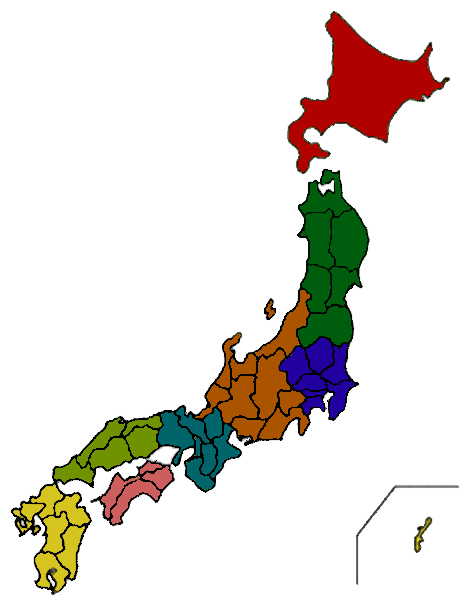
The 47+ prefectures of Japan, for example, have been in use since 1888. The prefectures had steadily been declining in number as the Meiji oligarchy began in earnest to nation-build in what is now Japan. Up until the surrender of Japan to the US, these prefectures were not representative and had little say in how each prefect was to be governed. MacArthur’s constitution gave these 47+ prefectures some autonomy in 1947, but recent attempts at reforming the administrative units of Japan have called for the abolition of these prefectures in favor of fewer administrative units that will also have much more independence from Tokyo. The policymakers who want to take this track are not creating these fewer administrative units out of thin air, either. Rather, reformists are calling for representative units to be based on the unofficial cultural areas of the country that have been around for centuries. Check out the map:

This map shows nine regions, but some people argue that there are actually 13-14 cultural regions within the country (a tough problem to have!). source: wikipedia
This map shows eight cultural areas, but some people argue that there are actually 12-14 cultural regions within the country. source: wikipedia

A cooperative approach to tackling free-riding and imperial expenses would be to reach out to the factions that want fewer administrative states with more autonomy. Adding anywhere from 8 to 14 administrative units into the Madisionian system is much more doable than, say, trying to incorporate 47 administrative units, especially since the latter units have little experience with the autonomous governance that federalism requires of its “states.” At most, there would be 28 additional members of the Senate. The costs associated with free-riding would be gone, and the Japanese people would get the benefits of being a part of the most powerful military the world has ever seen.

Would 28 Senate seats be enough to give up sovereignty? I don’t know, but I do know that the status quo is unsustainable and so, too, are current alternatives.

To finally answer Michelangelo’s question (“From a purely libertarian basis what regions would you offer federation with? Or, if you’d offer federation to all of them, which regions would you offer federation with first?”), I’d start with the Canadian provinces and Mexican states (though I would make it clear that any region is welcome to apply for membership). Then I’d approach the Caribbean islands, the administrative units in Western Europe (including the Baltic states but excluding Ukraine), and the administrative units in Japan and South Korea. Good neighbors and military allies.

My reasoning behind this approach is simply that 1) most of these regions are almost as rich as the United States, 2) they have a good history of actually being representative of their constituents, 3) they have a long history of either interacting with the Madisonian system or acknowledging its tremendous benefits, and 4) they have experience with being somewhat autonomous in a federal system (a federal system that is much less liberal than the one found in the US, but a federal system nonetheless).

Again, I’m not opposed to allowing poor regions to apply and join such a federation, but I think they would be less inclined to do so. Why? Because poorer states are more parochial, more protectionist, and more likely to be uncooperative than rich ones. If regions within these poorer states wanted to apply for membership, we should be open to it, but we’d have to recognize that these poorer regions have a long, hard slog ahead of them. They would, for example, have to market reasons for why they should no longer be a part of a poor state, and they’d have to do it under the harsh watch of the said poor state. Not an easy task, to be sure, but it can be done and the Madisonian federation should be open to the idea of picking apart post-colonial states if it means federating with an oppressed (or poorly governed) region.

Why “post-colonial”? Because of Realpolitik. Entertaining applications from the likes of Tibet or Chechnya is too risky. Entertaining applications from Baluchistan or Biafra? I’d have no problem risking the ire of Pakistan or Nigeria if it meant partnering up with people who want a better life and are willing to cooperate in order to get it.

PS: I think the dialogue in the ‘comments’ thread of this 2014 piece is also worth reading in tandem with my thoughts on Michelangelo’s comment here.

To Pledge or Not to Pledge

I attended a public meeting last night as I do from time to time. It’s a bad habit I can’t seem to shake. Like many of the more formal public meetings in this country, it started with the Pledge of Allegiance. (Foreign readers may not know that this is a 31-word quasi loyalty oath of allegiance to “the flag.”) When the time comes, everyone is supposed to stand, put their heart on their hand, face the flag, and recite the Pledge in unison, which is drummed into all schoolchildren.

My policy during the last several years has been to stand and remain silent with my hands at my side. I don’t make a spectacle of myself by staying seated, but I’m not willing to say the Pledge, for several reasons.

  • It’s too much like religion, and not just because of the “Under God” phrase
  • I don’t like feeling like a sheep following the herd
  • I don’t like the implication that we should bow and scrape to our rulers

Plenty of people would brand me a traitor for my attitude, an ingrate who doesn’t appreciate the benefits of living in the good ol’ U.S.A. In fact, I am quite grateful that I live in the U.S.A. because

  • I grew up in this culture and feel a part of it (omitting rock “music”)
  • The land is beautiful
  • Our politicians are less rapacious than in some other countries
  • We still have a reservoir of individualist sentiment that resists the “Progressives” and the neocons and their relentless push for a made-in-America brand of fascism
  • The libertarian movement has grown enormously in the years since 1971 when I signed on

I do indeed feel some kind of loyalty to the land and the people. But not to the government. And to swear allegiance to the Constitution, as the newly elected councilmen did last night, is a farce because the Constitution was shredded years ago, starting with Abraham Lincoln and perhaps earlier. At the federal level, they swear allegiance to the Constitution and then turn around and spit on it.

But wait, you might say, if you’re loyal to the people you have to be loyal to the government because we elect our leaders. But that’s a slender thread indeed. The government is controlled by unelected bureaucrats and powerful special interests. The government is not “the people.”

So, with only the mildest misgivings, I’ll go on boycotting the Pledge.

El Día que los Argentinos Superamos el Cinismo

Hace una semana que Mauricio Macri (Cambiemos) es el nuevo presidente electo de Argentina y ya todo parece distinto. A pesar de muchas y muy perjudiciales medidas del gobierno kirchnerista saliente (nombramiento de personal, sanción de leyes controvertidas, emisión de dinero, endeudamiento de último momento) la mayoría de los ciudadanos nos sentimos optimistas respecto del futuro en Argentina. Incluso ya nos hemos puesto a debatir acerca de las ventajas y desventajas de tal o cual ministro elegido por Macri, como si viviéramos en un país normal.

El domingo pasado, cuando ya era seguro que Macri había ganado las elecciones y estaba dando su discurso, lloré. No era un llanto triste, ni siquiera un llanto de emoción, era un llanto de alivio. Luego algunos amigos y familiares me confesaron que también habían llorado. Sentí (sentimos) que nos habían sacado el pie del pecho, que nos ahogaba desde hacía mucho tiempo.

Macri ganó en una segunda vuelta contra Daniel Scioli (Frente para la Victoria), candidato del gobierno kirchnerista. Pero no es la figura de Macri ni las propuestas de políticas públicas de Cambiemos (coalición del partido de Macri -Propuesta Republicana-, la tradicional Unión Cívica Radical y el partido de Lilita Carrió, Coalición Cívica) las que nos hicieron saltar las lágrimas. Era el sentir que, finalmente, podíamos descomprimir, que podíamos proyectarnos, planear; que, después de mucho tiempo, podíamos opinar sin miedo.

Y creo que esa emoción estaba conectada, a su vez, con la sensación de que los argentinos (o la mayoría al menos) habíamos dado un primer paso hacia la superación de un profundo cinismo que tiñó la política, e incluso todas las relaciones sociales en la Argentina los últimos años y que el modelo kirchnerista supo explotar y profundizar, enseñando con el ejemplo.

¿A qué me refiero con el cinismo?

Mucho se ha hablado del resentimiento argentino pero, a mi entender, el cinismo es un paso posterior y más profundo de este sentimiento. Al resentimiento lo entiendo como un derivado de la envidia en su aspecto más negativo. Es decir, como el deseo de tener lo que el otro tiene o de estar en una situación (más privilegiada) en el que el otro se encuentra y que uno no puede alcanzar. Es algo así como la suma de la envidia y la impotencia. El resentido prefiere que nadie goce de aquel “privilegio” del que él no puede gozar. Lo más insólito es que en Argentina el resentimiento se da en todas sus variedades, no sólo de los pobres a los ricos, de los viejos a los jóvenes, de los feos a los lindos, de los gordos a los flacos, sino que uno puede encontrar una persona joven, linda, flaca y rica que sea tremendamente resentida (porque los padres no lo quisieron, porque creen que no tienen las oportunidades que tendrían en otros países, porque no encuentran motivación en nada, porque quiere que alguien lo admire y no encuentran quién, etc.).

A pesar de esto, encuentro en este sentimiento todavía un resabio positivo: el resentido entiende, todavía, que alguien puede llegar a algo bueno a través de medios legítimos u honestos. No descree totalmente de la posibilidad de que a alguien (no a él) le haya ido bien, se haya hecho rico, sea admirado o tenga algún talento por derecho propio. El resentido sólo siente que él no es capaz de tal proeza y, por lo tanto, preferiría que nadie lo pueda lograr.

Creo que el cinismo implica un paso más, aquel que sostiene la idea de que nada puede ser obtenido legítimamente, de buena fe. Que no existen caminos honestos, legítimos, correctos, meritorios u honorables que nos puedan llevar a un bienestar personal o material. Para el cínico todo es engaño, trampa, privilegio o arbitrariedad. Así, se sospecha que toda persona que tiene dinero, lo obtuvo de forma ilegítima, como producto de una actividad ilegal (corrupción, negociado), o de alguna trampa o subterfugio (no pagar impuestos, estafar) o que, meramente, es una persona de suerte (herencia). Incluso si esta persona no ha realizado ninguna actividad inmoral o ilegal, probablemente la haya realizado su antecesor (padre, abuelo) o alguien por él. Pero esto no se aplica sólo a la fortuna material, el cínico argentino ya no cree que se pueda lograr nada (título, puesto, premio, honores) de forma legítima. Es seguro que detrás de ello ha habido contactos, favores, negocios ilegales, trampas.  Lo peor es que, finalmente, lleva adelante una vida plagada de mentiras, trampas y violación de las reglas, creyendo que está justificado, que así son las cosas. “Es lo que hay” reza una de las frases más horribles del vocabulario argentino actual.

El cinismo, así, se ha independizado ya del resentimiento y cuenta ahora con fuerza propia, sosteniendo toda una estructura de creencias y relaciones. Si llevamos esta cosmovisión a la política, vemos cómo ésta se ha concebido últimamente sólo como el medio particular donde se busca desembozadamente el poder (y la riqueza mal habida) y donde se habilitan todos los medios para llegar a este objetivo. En definitiva, la política representa una forma velada de violencia que ya no es quizás, física, pero si es psicológica, social, institucional. De esta manera, aquellos que (por fuerza o por azar) obtienen la mayoría, pueden, entonces, hacer lo que quieran, interpretando las reglas a su favor e incluso cambiándolas cuando no les convengan. Estoy segura que durante mucho tiempo, muchos argentinos no criticaban las formas autoritarias y, en muchos casos, delictivas del gobierno porque consideraban que, de ellos estar en su lugar, hubieran hecho lo mismo. Esto representa, en mi opinión, el sumun del cinismo. Ya no se tiene confianza ni siquiera en la constitución moral de uno mismo.  Esto nos ha llevado a la situación penosa en la que nos encontramos, no sólo de pobreza material (a causa del delito público y privado) sino de fragilidad institucional, en la cual nadie puede crear expectativas, planear, crecer, cooperar o siquiera, coordinar con los demás.

El triunfo de Macri puede leerse de muchas formas pero, independientemente de sus características como líder, hubo un gran número de personas que lo eligieron porque preferían votar cualquier candidato al candidato del kirchnerismo, Daniel Scioli. Éste, aunque al principio parecía mucho  más abierto al diálogo y  moderado que la familia Kirchner, terminó representando al “modelo” kirchnerista, un paquete muy pesado compuesto por una forma muy autoritaria de ejercicio del poder, un embrollado conjunto de consignas y prejuicios y una forma muy sospechosa de hacer negocios.

Macri se presentó como un candidato de “buena fe” (lo repetía siempre que podía) y el mero hecho de que mucha gente haya creído posible que nos gobierne una persona que se presente de esta manera ya significa, para mí, un gran paso hacia el abandono del cinismo.

Varios elementos más se suman a este panorama: más allá de las críticas, todos los candidatos de Cambiemos hicieron un gran esfuerzo por no contestar los agravios que, desde la “campaña del miedo” de Scioli, no faltaban ni un solo día. Además, la imagen franca y honesta de María Eugenia Vidal y su victoria como gobernadora de la provincia de Buenos Aires (tradicionalmente gobernada por caudillos peronistas) dejó entrever que los ciudadanos tienen un límite respecto de cuánta agresión, falta de gestión y maltrato pueden soportar. Por último, el macrismo ofrece gestión, dialogo, equipos, aprendizaje, todo un vocabulario ajeno al debate político nacional de los últimos doce años.

Por una vez, muchos votantes comenzaron a pensar que tal vez tanto descreimiento en sí mismos y en las instituciones –que, en definitiva, son el fruto de las interacciones de los individuos-, nos habían llevado a la pobreza e inseguridad en la que vivíamos.  Que quizás ya era momento de abandonar la sospecha constante, el enfrentamiento sin cuartel, la resignación frente al delito, el abandono de la libertad y el gobierno del miedo.

No sé cómo gobernará Macri a nivel nacional pero le auguro lo mejor a él y a su equipo. Ya llegará el momento de analizar sus decisiones y planes de acción. Mientras tanto, me alegro de que gran parte de los argentinos, de una vez (y espero que para siempre) hayamos comenzado a abandonar el cinismo y a creer en los caminos de esfuerzo, talento, trabajo, confianza, cooperación. Por último, espero que este camino nos lleve a confiar más en nosotros, en nuestras capacidades y valores y que gocemos del valor de ejercer nuestra libertad.