In another thought-provoking post on Facebook (does the guy ever write mediocre stuff, I wonder?) Barry raised the question of the relation between classical liberalism, nationalism and cosmopolitanism. He wrote the following:
“On the capture of classical liberal/libertarianism by anti-cosmopolitans. This is very influential at the heart of the ‘leave’ ‘elite’ in the UK, and can only be destructive of classical liberalism/libertarianism. The immediate political consequence of Leave is the elevation of Theresa May to Tory leadership/Prime Minister’s office on a much more ‘Red Tory’, communitarian, corporatist foundation than existed under Cameron. ’To the extent to which the current wave of populism maps into a conflict over national versus transnational identity (Dan Drezner is unconvinced), the problem is not an excess of cosmopolitanism but rather its absence, especially on the conservative, free-market right.”
He seems to take a positive relation between classical liberalism and cosmopolitanism as the default position. Of course Barry did not provide definitions in a FB post, but here I take cosmopolitanism to mean “the idea that all human beings, regardless of their political affiliations, belong to a common moral community. Cosmopolitans often believe that all individuals have the same basic moral status, and tend to downplay the importance or desirability of national political institutions. [They are] opposed to nationalism” (source: Matt Zwolinski (editor), Arguing About Political Philosophy, Routledge, 2009).
I argue that Barry overlooks that classical liberalism combines a cosmopolitan side, with a strong defense of national political institutions (e.g. the state). The cosmopolitan side is perhaps easiest to see, if one takes the idea of free trade as the guiding principle. Free trade is by nature morally neutral for the individuals involved, and has numerous positive economic effects; it fosters cultural exchange as well as innovation and knowledge sharing. In that sense classical liberalism is indeed related to cosmopolitanism.
Yet this stops where the national state comes into play. Classical liberals never predicted any positive political effects of trade (see my earlier notes on this topic) and, just as importantly, they actually favor a strong state, with a limited number of tasks. At the same time, from Hume and Smith onwards to Mises and Hayek, they strongly dislike the idea of transnational political institutions, because these lack any substantial emotional basis which nations do posses. Also, these large political institutions easily become a threat to individual liberty, even more so than national states with too many tasks. So, there is no really no relations between political cosmopolitanism and classical liberalism at all.
There is also no relation between nationalism and classical liberalism. A preference for the national state does not lead to nationalism, which is the vicious and poisonous belief in the superiority of one’s country, often accompanied with a dislike of allegedly inferior neighboring countries or peoples or groups. This is collectivism turned even worse, which is a double ‘no’ from a classical liberal perspective. This said, if patriotism is defined as national pride, then classical liberalism and patriotism can and will go together. There is a fine line between the two sometimes, but patriotism is not violent and dividing, but a binding force between individuals sharing a national state.
The last point is on the European Union. Hayek and Mises have been on record with strong support for a European Federation, primarily as a remedy to war-torn and nationalism-infected Europe. In these circumstances the default position of an international order as a society of states no longer functioned, so there was a need to seek an alternative. Needless to say their federation had little resemblance with the current super state we know as the European Union, which has become a classical liberal nightmare in terms of liberty and property rights violations it commits on a daily basis.
The current EU has some classical liberal traits (the imperfect common market is the single most important one), which is of tremendous use to all European individuals. It is, however, way too cosmopolitan in the bad political way. A likely consequence of Brexit is that this will become even worse, now that the French and their allies will get more room for their collectivist fallacies.
Past Friday, 51.9% of the British have voted to leave the European Union against 48.1% of those who have voted to remain. The details of the EU referendum can be found on BBC’s EU referendum page. Although it is still unclear what shape the relationship between Britain and the EU will take, I expect that the Brexit will offer good economic opportunities for Britain provided that they can reach free trade agreements with all nations within the EU and provided that they will continue to open up their markets for free trade with other countries outside of the EU.
An Exit of the Netherlands, or a Nexit, will have more consequences than a Brexit as the Netherlands are also participants in the European Monetary Union. A Nexit could therefore lead to an end of the Euro. An analysis of the EU is a political analysis and as politics is always complemented by power, this analysis should hence incorporate insights on power struggles and competing visions. Each country has its own interests within the EU, just like any politician within the EU has his own special interests that he is serving. Participation in the EU is often represented as an exercise of solidarity and political appeasement, however it is still politics with politicians’ usual desire for self-enrichment.
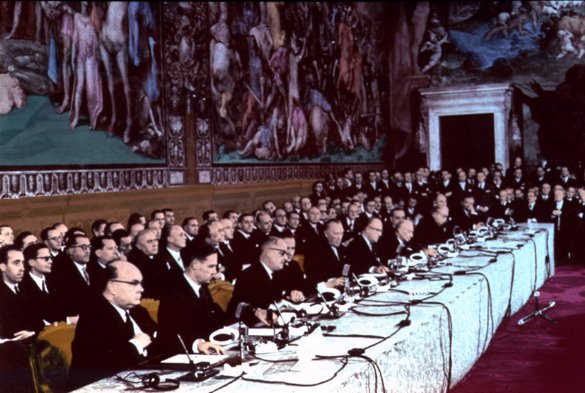
There have always been two competing visions of the EU. The first one is a classical liberal vision, led by German speaking Christian democrats Schuman (France), Adenauer (Germany) and Alcide de Gasperi (Italy) with the Treaty of Rome (1957) as the greatest achievement of this classical liberal vision for Europe. The Treaty sought to deliver the following four freedoms: free movement of goods, freedom of movement for workers, the right of establishment and freedom to provide services, and free movement of capital. The other vision was a socialist vision led by mainly French politicians, such as Jacques Delors and François Mitterrand whose goal was to create a supranational state.
Treaty of Rome.
Classical liberal vision The first vision promotes political competition between the EU’s member states by opening up borders. When a person is discontent with the excessive taxes in his country, he could leave his country for another. Competition between member states would lead to smaller governments, lower taxes, and political respect for people who would want to pursue their individual freedoms in another member state. It would represent a return to the political model that was prevalent in Europe from the Middle Ages to the 19th century when different political systems coexisted independently. There were independent cities or city states in Flanders, Germany and Northern Italy. There was the kingdom of Bavaria, the republic of Venice, and small city states like Ghent and Bruges embraced their autonomy. The German writer and poet Johann Wolfgang von Goethe (1749-1832) had expressed the beauty of such a political system as follows when he discussed a Germany that was still splintered in 39 independent states:
“I do not fear that Germany will not be united; … she is united, because the German Taler and Groschen have the same value throughout the entire Empire, and because my suitcase can pass through all thirty-six states without being opened. … Germany is united in the areas of weights and measures, trade and migration, and a hundred similar things. … One is mistaken, however, if one thinks that Germany’s unity should be expressed in the form of one large capital city, and that this great city might benefit the masses in the same way that it might benefit the development of a few outstanding individuals. … What makes Germany great is her admirable popular culture, which has penetrated all parts of the Empire evenly. And is it not the many different princely residences from whence this culture springs and which are its bearers and curators? … Germany has twenty universities strewn out across the entire Empire, more than one hundred public libraries, and a similar number of art collections and natural museums; for every prince wanted to attract such beauty and good. Gymnasia, and technical and industrial schools exist in abundance; indeed, there is hardly a German village without its own school. … Furthermore, look at the number of German theaters, which exceeds seventy. … The appreciation of music and song and their performance is nowhere as prevalent as in Germany, … Then think about cities such as Dresden, Munich, Stuttgart, Kassel, Braunschweig, Hannover, and similar ones; think about the energy that these cities represent; think about the effects they have on neighboring provinces, and ask yourself, if all of this would exist, if such cities had not been the residences of princes for a long time. … Frankfurt, Bremen, Hamburg, Lübeck are large and brilliant, and their impact on the prosperity of Germany is incalculable. Yet, would they remain what they are if they were to lose their independence and be incorporated as provincial cities into one great German Empire? I have reason to doubt this.”[1]
In addition to the advancement of political competition, the vision also promotes economic competition. A German employee would not be obstructed from working in France anymore, a Dutchman would not be taxed by the government if he transfers money from a Dutch to a Spanish bank or when he decides to buy stocks on the Italian equity market. Nobody would withhold a Belgian brewery from selling beer in other countries within the European free trade area.
Socialist vision The second vision promotes a European central state that holds the power to enact more regulations, redistribution of wealth, and harmonization of legal systems within the whole Union. A strong central political body is to coordinate such efforts. The consequence is that its member states would increasingly have to give up their sovereignty. This is clearly visible from the political events in Greece and Ireland during the financial crisis of 2008 when Brussels demanded from Greece and Ireland how they should deal with their deficits and what austerity measures they should take. The socialist vision of Europe is an ideal for the political class, bureaucrats, interest groups and the subsidized sectors that want a powerful central state for their self-enrichment. Political competition among its member states, something that the classical liberals supported, should be eliminated. Doing so, Europe becomes less democratic and political power is increasingly shifted into the hands of bureaucrats and technocrats in Brussels. Historically, such plans for concentrated political power had been realized by such figures as Charlemagne, Napoleon and Hitler. The difference with our times is that the creation of a modern European superstate does not directly require military means. The introduction of new institutes like the European Central Bank, a common currency like the Euro, and extended power of the European Commission would suffice. Similar socialist intentions were already visible from the start of the European integration in the European vision of Jean Monnet, the intellectual father of the European community. Fearing an independent and emerging Germany after the second World War, an integration of Germany into Europe was considered to be a good thing. Next to that, the French wanted to have control over the Rühr area and they wanted to keep other vital German resources out of solely German hands. After losing her colonial powers in Indochina and Africa, the French ruling elite were also looking for new influence and pride which they eventually found in the European community.[2] The French premier in 1950 had for example proposed a plan to install a European army under the leadership of the French.
Why it is good for the Netherlands to leave the European Union I believe that the EU should never have had more ambitions than the free trade zone that requires no supranational institutes, except for a European Court of Justice that is restricted to supervising conflicts between the member states and guaranteeing the four freedoms. The EU has become so far removed from the classical liberal vision of political and economic competition that it is not worthwhile anymore for the Netherlands to participate. It has declined into a malignant cartel of states that can tell its members with whom and how they should conduct their trade. A good example were the quotas and import levies on Chinese solar panels in 2013 under the disguise of ‘anti-dumping’ measures. Several countries like the Netherlands and Germany had first opposed to these measures as they would like to maintain good relationships with China. Nonetheless, the European Committee, apparently under influence of solar panel lobbyists like those of the German producer Solarworld AG, introduced ‘anti-dumping’ measures. The eventual winners of such measures are European solar panel producers and its victims are the European people that simply want to buy cheap solar panels. Another example are the sanctions that the EU had imposed on Russia since the Ukrainian conflict – a conflict that was provoked by American imperialists and NATO.[3] The deteriorating trade relationships between the EU and Russia is also detrimental to the wealth of ordinary European citizens. Another recent example is the prohibition of high-powered vacuum cleaners and possible future bans on other energy appliances such as kettles and hairdryers in order to reach environmental targets.[4] Those who profit from such measures are mainly large legacy organizations such as Bosch and Siemens that have enough capital to meet the strict EU regulations.
Another reason why a Nexit would be good for the Netherlands is that it offers an opportunity to extricate oneself from the Euro and the implicitly pledged financial aid when a future financial crisis will tear through Europe.
The tragedy of the Euro The introduction of the Euro has proven to be a huge mistake, because it has enabled fiscally irresponsible governments of such countries like Portugal, Italy, Greece, Spain etc. to conduct unsustainable economic policies. In the past, when these states had their own currency, their governments had to finance their budget deficits through the sales of government bonds which resulted in higher government debts. The higher government debts manifested itself in higher interest rates on their government bonds, and a greater money supply would lead to devaluations of their currencies.
To illustrate how the process of government bonds financing works in the European Monetary Union, we could look at the development of 10-year government bonds. The graph below shows the interest rates that governments have to pay to the financiers of their 10-year government bonds from 1995 to 2011:
Interest rates on 10-year government bonds from 1995-2011.
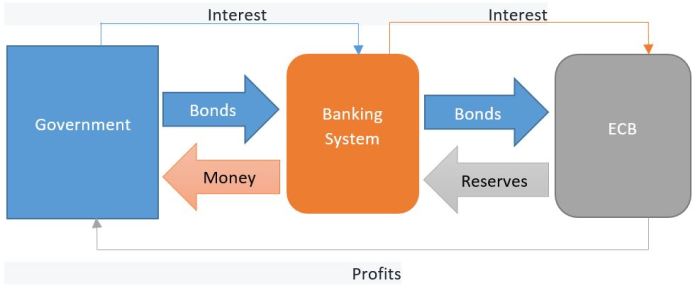
The y-axis represents the rates of interest that an investor receives from 10-year government bonds. Countries that are economically stronger and fiscally more conservative are rewarded with lower interest rates due to the smaller risk that these governments will not pay back their loans. In the case of Germany, a country with traditionally a stronger economy, a more conservative Bundesbank, and a fiscally more responsible government than many other European nations, investors received 7.5% interest on their 10-year government bonds in 1995. Greek government bonds had a yield of 18% in 1995. 1995 was the year in which the European Committee had announced that the Euro would arrive in 2002. Interest rates on government bonds consequently converged in the following years. At the end of 1997 all rates of interest on Portuguese, Irish, Spanish, Italian, French and German 10-year government bonds were more or less equal despite the fact that many of the governments of these countries still spent more than they received in tax incomes. The consequence of sharing a common currency with fiscally more responsible countries like Germany and the Netherlands is that fewer price signals in the form of higher interest rates on government bonds of fiscally irresponsible governments emerge. Irresponsible governments can issue government bonds to the banking sector that transfer these bonds as collateral to the ECB in return for loans. The interest rate that banks pay for the loans of the ECB are issued as profits to their governments. This is in short how ‘seigniorage’, the profits derived from money creation when the costs of money production and the distribution of money are lower than the value of money itself, is created.
Sovereign debt financing in the European Monetary Union.
This process leads to inflation, but the costs of inflation in the EMU are not solely borne by the respective country that issues the government bonds, but by all countries that participate in the EMU. A country like Spain can for example issue government bonds that traditionally would correspond with 10% inflation. However, when other countries like the Netherlands and Germany issue an amount of bonds that corresponds with 5% inflation, Spain benefits from seigniorage as the inflation created by Spain is higher and borne partly by the Netherlands and Germany. A Euro in this regard is beneficial for fiscally irresponsible governments. It is actually a “Tragedy of the commons”. Abusing the Euro in this way is exactly what countries like Portugal, Italy, Ireland, Greece, Spain and France have done. This works until a financial crisis shows how insolvent the governments of these countries actually are. That has happened in 2008, the moment when interest rates on European government bonds started diverging. The ECB had even decided to buy up Greek government debts in May 2010 in order to lower the interest rates on Greek government bonds. In June 2010, a temporary European Financial Stability Facility (EFSF) was founded with guarantees of up to €440 billion to combat the European sovereign debt crisis. It has provided financial assistance to Ireland, Portugal and Greece. The EFSF was later replaced by the European Stability Mechanism (ESM) in October 2012 with a total described capital of around €700 billion of which the Netherlands has pledged €40 billion in capital participation. The Dutch prime minister, Mark Rutte, had promised the Dutch in 2011 that the Netherlands would receive back the money it has loaned out to Greece in May 2010.[5] The total sum that was loaned to Greece by the Dutch was €3.2 billion. However, in 2012 when the Netherlands loaned out €14.5 billion of the second financial aid package of €130 billion that was pledged by Europe and the IMF to Greece, the Dutch minister of Finance, Jeroen Dijsselbloem, admitted that the Netherlands were losing money. Rutte also admitted that he could not guarantee that the Dutch loans to the Greeks would not be forgiven.[6] Three years later, on July 13 2015, the Netherlands loaned out another €22.6 billion to Greece.[7] It has become clear that such financial pledges of the Netherlands to fiscally irresponsible governments like that of Greece are not beneficial for the Dutch. Even in the long run it is not beneficial for the EU as it supports and prolongs a socialist European system that is deeply rotten to its core and destined to fail. What the EU needs is a radical return to decentralization and political competition.
The EU has become a sinking ship. It appears to me that the Netherlands should leave the Union as soon as possible. I do not see how Europe can maneuver itself safely through the next financial crisis that is at the point of breaking out as more banks are on the brink of collapse.[8] I also expect greater centralization of political power within the EU and a greater loss of individual member countries’ sovereignty. On June 27, 2016, the Polish media had reported that France and Germany were taking matters into their own hands and are using the Brexit to unveil their plan to morph the continent’s countries into one giant superstate. Under their radical proposals,
“EU countries will lose the right to have their own army, criminal law, taxation system or central bank, with all those powers being transferred to Brussels.”[9]
Conclusion
A sensible Netherlands would leave the European Union and the European Monetary Union in order to preserve political and economic sovereignty. They would have free trade agreements with all countries within and outside of the EU. EenVandaag, a popular Dutch TV programme, had published the results of their 27,000 large online poll on Sunday June 26, 2016 in which 54% of the Dutch would like to hold a referendum about the Netherlands’ participation in the EU. 48% of the poll wanted the Netherlands to leave the EU against 45% who would like to remain in the EU.[10] In the meantime, the Remain camp will continue their nauseating snobbery accusing the Leave camp of being racist, nationalistic, isolationist or simply ignorant.
References Bagus, P. (2010). The Tragedy of the Euro.
Footnotes [1] From Johann Peter Eckermann’s Conversations with Goethe (1836-1848).
[2] Tony Judt writes in Postwar: A History of Europe Since 1945 (2006) that “[U]nhappy and frustrated at being reduced to the least of the great powers, France had embarked upon a novel vocation as the initiator of a new Europe” (p. 153). He also writes that “[F]or Charles de Gaulle, the lesson of the twentieth century was that France could only hope to recover its lost glories by investing in the European project and shaping it into the service of French goals (p. 292).”
[3] See for example Prof. John McMurtry’s “Ukraine, America’s ‘Lebensraum’. Is Washington prepared to wage war on Russia?” for an analysis how Washington had provoked the Ukrainian conflict with Russia.
[4] See “First they came for the vacuum cleaners: will it be kettles next?”
Leaving the European Union would not be a gain for liberty in the United Kingdom. This is true as a matter of general principles and is reinforced by the nature of the Leave campaign which has targeted sections of the population hostile to immigration, open markets, and free trade. Much of the Leave campaigning which has not appealed to such base arguments has at the very least appealed to a version of populist democratic sovereignty at odds with the restraints on government and the state at the heart of classical liberal and libertarian thought.
Even if we try to separate some pure classical liberal version of the Leave campaign from the crudity of the campaign, as some natural supporters of leave wish had happened to the extent they ate voting for Remain rather than go along with such an obnoxious campaign, we are still left with the question of why it liberty advocates should support Leave.
I have sometimes seen references to national sovereignty as a classical liberal doctrine. If this means never sharing sovereignty at a transnational level, then it is simply a false claim. Immanuel Kant advocated a world federation to prevent war. Kant is not often put at the centre of the history of classical liberal thought. His ideas about political institutions, individual rights, and the limits of government certainly belong in the classical liberal sphere. We should distinguish between what Kant said and what later German Idealists said, a rather big issue, and appreciate how close he is to the way of thinking of Montesquieu and Smith and even advances upon them in showing a clearer understanding of the role of representative assemblies in modern politics.
More recently F.A. Hayek advocated federation between liberal democracies. The creation and evolution of the European Union has been and continues to be supported by European political parties of a classical liberal persuasion, those liberal parties which remained most true to the principles of their nineteenth century founders and precursors. Thinkers on the left, like Albert Camus and George Orwell, known for their particular commitment to liberty and their opposition to an authoritarian state were enthusiasts for European integration. Many conservatives of the more free market and limited government sort like Ludwig Erhard (founder of Germany’s post-war, post-Nazi market economy) and John Major (UK Prime Minister from 1990 to 1997, who went further than Margaret Thatcher in privatisation and deregulation) have been and are advocates of the European Union.
The unrestrained sovereignty of the nation-state is not only not an inherently liberal idea, it is dangerous to liberalism. There is nothing illiberal in transnational rules and institutions that restrain states from violence against their own citizens, attacks on individual rights, economic protectionism, and market rigging. The European Union is particularly successful with regard to the economic and market issues at the national level. It adds huge institutional weight to the work of the Council of Europe which promotes human rights through its court in Strasbourg. The existence of the European Court of Justice is of profound importance in ensuring that national governments and peoples are accustomed to regarding the decisions of nation states as subordinate to and accountable to a judicial process enforcing transnational laws.
The EU is open to a great deal of criticism with regard to its tendencies towards over-regulation, but this represents the median attitude of the member governments, not an imposition on the nation-states of Europe. Since the UK economy is at the more free market deregulated end of the European Union, there is some plausibility in saying the UK might go further down that road if it left the EU. However, before it joined the EU it was looking less market oriented than the EU states of the time. The period during which the UK has moved from the more statist to the more limited state end of the European nations has been during the period of EU membership. The precedents do not favour the UK becoming more classically liberal because it leaves the EU and the Leave campaign has appealed to the most insular, nationalist, anti-immigrant, anti-foreigner, and anti-free trade sections of the UK population.
It is possible to imagine the UK as a more libertarian kind of place in the EU, but a much more plausible use of the liberal imagination is to think of ways in which the UK can work with allies in the EU for a a less regulatory and centralised EU. This has already worked as in the adoption of the European Single Market and the diminishing role of the European Commission, the ‘bureaucratic’ part of the EU. The Commission employs as many bureaucrats as the larger local government units in the UK and is tiny compared with any national bureaucracy. Its members are nominated by national governments subject to confirmation of the European Parliament. Power has shifted from the Commission to the bodies in which national government representatives meet, the European Council and the Council of the European Union.
The Leave campaign in the UK, including self-styled free marketers in the Conservative Party, is committed to leave the Single Market as well as the European Union itself, in large part to terminate free movement of EU citizens across its borders. The reasoning offered to prevent this movement of human capital is in terms of anti-foreigner sentiment. This is not something than can be recognised as a pro-liberty program. The pro-liberty choice is to keep free movement of goods, investment, and labour within the EU while working to reform the more interventionist tendencies of the European Union, to stymie the regulatory drift which started hitting industrial market economies decades before the EU was created and which cannot be solved by smashing up the EU.
Five Thirty Eight had a disappointing discussion of an interesting issue: the cost of child care for working parents. The basic issue is that kids are expensive in time and money. Unfortunately, the discussion mostly revolved around questions of how to engage in economic engineering by government in order to expand access to child care and parental leave.
The hosts see these policies as having costs and benefits, and they see the value in studying alternatives empirically, but they miss an important issue: providing these sorts of goods doesn’t require screwing up markets by adding an extra layer of complexity to the tax code. If these goods are worth providing (that’s another couple of cans of worms) then just give money to new parents. Better yet, move to a basic income guarantee.
Another important point they miss is that if some good is difficult to get, it’s worth figuring out what to do about the root problem rather than just throwing money at the issue and hoping someone will figure out the important stuff later.
This is a follow up to part one, where I discuss under what conditions a libertarian can engage in foreign policy beyond pursuing free trade and so whether the creation of a NOL Foreign Policy Quiz is even worthwhile.
In this post I outline how to design a foreign policy quiz.
For starters I imagine two major axis:
Soft vs. Hard Power and,
Nationalist vs. Internationalist
The first axis corresponds to whether an individual prefers using soft non-coercive actions to achieve their foreign policy goal or hard coercive actions. The second axis would correspond to whether someone prefers to act unilaterally, a “Nationalist”, or through multilateral institutions such as the United Nations, an “Internationalist”. Combined the two axis produce the below spectrum.
The questions themselves would be formatted something like the below:
Question: A foreign policy question on defense, trade, or resources/environment.
Answer 1: Nationalist, Hard Power action.
Answer 2: Nationalist, Soft Power action.
Answer 3: Internationalist, Hard Power action.
Answer 4: Internationalist, Soft Power action.
Answer 5: Do nothing.
On each question respondents would be given two points, one for the Soft/Hard axis and another for the Nationalist/Internationalist axis. A respondent’s coordinates would be the average score for the two respective axis.
For simplicity I think we ought to limit the NOL quiz to ten or so questions, but if a longer version were developed we could also assign scores on whether the question was about defense, trade or resources/environmental issues. That way we could further distinguish foreign policy views dependent on the type of issue at stake.
Note the inclusion of a fifth answer for all questions – to do nothing. This is an essential option as there are times, especially for the libertarians among us, where all available options are just awful. In those scenarios it may be better to simply not act at all.
I suspect that most of us who are based in the United States will tend to be most ‘nationalist’ than others all else held constant. Beyond that I am not sure where most libertarians would fall on spectrum. To be sure I think many would elect the fifth answer – “Do nothing” often and gravitate towards the center, but I’m doubtful many would be perfectly in the center.
Thoughts? Opinions?
In part 3 I will hopefully have an actual quiz developed so that we can have fun calling one another statists.
Over at EconLog, Italian political theorist Alberto Mingardi has a great post up on defining national socialism. Here is the money shot:
So, the nationalists are going to be more socialist, because they want to vindicate the power of the nation state in taking control of the national economy, and the socialists are going to be more nationalist, because strengthening regulation and advancing redistribution is all the more difficult in supranational arrangements, where a cooperative understanding is seldom reached.
My own mind was drawn to this insight, though:
I fear there is a symmetric problem for libertarians. If we take Applebaum’s points seriously, as we should, we are put in a very awkward position: which is defending the status quo, made of relatively free international trade plus relatively weak supranational institutions, as the least bad of all possible worlds. And yet libertarians are highly critical of the status quo and won’t feel well in the company of the current global elites.
This is largely correct. Libertarians are right, I think, to be critical of the status quo (even though it is the least bad of all possible worlds, and has been for the last three decades), but they veer off in the wrong direction when they start emphasizing exit and autonomy over entrance and interconnectedness.
This is not just a complaint about rhetoric, either. When libertarians constantly focus on exit and autonomy, a tendency begins to develop where these two concepts become harder and harder to critique and develop into more coherent ideas about liberty and freedom. Just look at all the support for Brexit by libertarians, or the support still given to the Confederate States of America (!). These libertarians have become so obsessed with exit and autonomy that they end up failing to even entertain the notion that you can’t have exit without entrance, or autonomy without interconnectedness.
Widespread strikes in France, many turning violent. There are big-time shortages of gasoline so that many people can’t go to work if they want to. The strikes are not directed against “the corporations.” They are directed squarely at the government. What government? The government of the French Socialist Party. That’s an instance of “democratic socialism” if there was ever one.
What did the Hollande government do to attract such working class anger? It has tried to modify slightly the labor laws, to make it easier for example, for employers to offer more than 35 hours a week to their employees if the latter want them (IF they want them).
France is a country with around 10% unemployment for about twenty years. For the young it’s been around 25% . Also, there has not been real economic growth for about ten years (+1% GDP annual is a cause for celebration). Meanwhile, Germany and Switzerland next door are thriving. A great deal of French public opinion is simply in bad faith and refuses to see the obvious: If it’s too difficult to fire people, employers don’t hire and even suppress growth to avoid hiring.
The Minister of Labor in charge of making the French kiss and even swallow that frog is a woman with an Arab name, a Muslim name. Do I think the French Socialist Party is twisted? I am not sure.
Please, thing of sharing, especially with Sanderites.
That’s the subject of my newest paper, which was just published by India Quarterly. Here is the abstract:
Both the Bangladesh state and society are yet to settle the questions over and narratives related to the Liberation War of 1971. Broadly, there are two groups with contradictory and conflicting interpretations of the events related to that war. This has also led to the mushrooming of militant groups in the country. The beginning of trial of perpetrators of Liberation War crimes since 2010 and the execution of a few of the leaders has further polarised the society and politics of Bangladesh. The existing debates over the Bangladesh Liberation War cannot be studied without looking into the roles of India and Pakistan. The two countries have their own interpretations and political fallout of the 1971 liberation war.
In the previous part of my democracy series, I took note how the notion of democracy as a “deliberative” means of policymaking is a myth. Contrary to John Dewey, Sidney Hook, and Joshua Cohen, who characterize democracy as an application of the scientific method to political problems and as deliberative “intelligence” directing society, democracy is really the rule of the irrational and ignorant, as public choice theory teaches. Deliberative reasoning does not determine policy in democracies, but rather whoever can cater the best to systemically biased and rationally ignorant voters. Voters don’t give deliberative reasons for their policies, and if they do they, contra Cohen, clearly do not have an equal say in the formation of policies as, according to public choice theory, special interests have the most control over it.
However, I neglected one important other reason why actual political democracies are anything but “deliberative:” voters rarely chose their candidates based off of careful deliberation of issues; they instead chose candidates based off of cultural associations with the candidates. Christopher Achen and Larry Bartels recently took note of this in the New York Times:
The notion that elections are decided by voters’ carefully weighing competing candidates’ stands on major issues reflects a strong faith in American political culture that citizens can control their government from the voting booth. We call it the “folk theory” of democracy.
…But wishing so does not make it so. Decades of social-scientific evidence show that voting behavior is primarily a product of inherited partisan loyalties, social identities and symbolic attachments. Over time, engaged citizens may construct policy preferences and ideologies that rationalize their choices, but those issues are seldom fundamental.
That last note is very reminiscent of another point made in my last article on democracy about how evidence from moral psychology, specifically Jonathan Haidt’s The Righteous Mind, shows that voters do not use reason to determine their political or moral views, but rather reason serves as a servant to the passions. In this case, far from deliberatively and intelligently choosing policy preferences, it seems voters are letting their deliberation serve passions that are influenced by social and cultural affiliations rather than actually informed policy stances.
Achen and Bartels show how this is in action specifically in the recent Democratic Primary:
…It is very hard to point to differences between Mrs. Clinton and Mr. Sanders’s proposed policies that could plausibly reflect account for such substantial cleavages [in polls]. They are reflections of social identities, plausible commitments and partisan loyalties.
Yet commentators who have been ready and willing to attribute Donald Trump’s success to anger, authoritarianism, or racism rather than policy issues have taken little note of the extent to which Mr. Sanders’s support [sic]is concentrated not among liberal ideologues but among disaffected white men.
More evidence casts further doubt on the notion that support for Mr. Sanders reflects a shift to the left in the policy preferences of Democrats. In a survey conducted for the American National Election Studies in January, supporters of Mr. Sanders were more pessimistic than Mrs. Clinton’s supporters about “opportunity in America today for the average person to get ahead” and more likely to say that economic inequality had increased.
However, they were less likely than Mrs. Clinton’s supporters to favor concrete policies that Mr. Sanders has offered such as remedies for these ills, including a higher minimum wage, increasing government on health care and an expansion of government services financed by higher taxes. It is quite a stretch to view these people as the vanguard of a new, social-democratic-trending Democratic Party.
Achen and Bartels further note that, despite the enthusiastic support from young Democrats, these younger voters actually disagree more with Sanders on specific policy issues than older democratic voters, noting that “even on specific issues championed by Mr. Sanders” such as “increased government funding of healthcare,” “a higher minimum wage,” and “expanding government services,” younger Democrats tend to disagree with Sanders’ more than older ones. In fact, I would be willing to bet that most of Sanders’ voters that Achen and Bartels write about are completely rationally ignorant of their disagreements with their favorite candidate in the first place. I also would add these cultural influences on voting at the expense of policy deliberation to Caplan’s theory of “irrational rationality;” cultural associations and symbolic commitments decrease the costs of holding an irrational political belief.
It is clear, then, that this “folk theory of democracy” in which voters deliberately consider policy alternatives and make reasoned, rational decisions for why they prefer one candidates’ policies to another is a myth. If it is the case that voters are not only rationally ignorant and irrational, that democracy is more controlled by concentrated interests at the expense of the public good, and that voters make their electoral decisions based off of cultural associations rather than deliberations about policy, what can be said about political democracy’s aim at philosophical democracy? What can be said of the existence, or possibility, of intelligent, deliberately directed democratic institutions? It seems that democratic institutions in reality completely undermine democratic aspirations in theory.
PS: No, this is not the fourth part of the democracy series, should be up this weekend.
[H/T Jason Brennan]
Je suis en contact intermittent avec un copain de lycée (presque 60 ans plus tard!) Dernièrement, il m’ a écrit ceci:
“…c’est vrai que je n’ai pas récemment formulé d’avis sur tes dernières livraisons [sur Facebook et sur mon blog-J.D.] dont beaucoup se rapportent à des sujets typiquement américains sur lesquels je n’ai pas d’opinion très argumentée. Je m’intéresse cependant beaucoup aux élections avec la crainte que Donald (un président avec un nom de canard!) finisse par l’emporter. Simplement çà serait tellement du n’importe quoi à tous les étages que çà serait passionnant à observer. Si cet événement terrible se réalisait il répondrait probablement hélas à une question que je me pose régulièrement:qu’est ce qui initiera le déclin de l’Amérique.”
Je comprends que les Francais, y compris mon copain qui connait bien l’Anglais – soit éberlués. Je vais essayer d’expliquer un peu ce qui se passe y compris mes propres actions à venir. Mais avant tout, je dois répondre à sa question sur le déclin de l’Amérique: Indubitablement, c’est la présidence de Barak Obama, un homme médiocre, vaguement gauchiste, élu seulement parce qu’il est noir (et encore, pas tellement -une remarque que j’expliquerai volontiers si on me le demande).
La popularité de Donald Trump auprès d’une grosse partie de l’électorat, autant que son impopularité pour une encore plus grosse partie, ressortent du même phénomène psycho-social. Curieusement, il y a un recouvrement considérable entre la popularité de Trump et celle du Démocrate de gauche Bernie Sanders, des révolte populistes.
Apres 8 ans de marasme économique – pas très grave selon les critères français mais inhabituels ici – après huit ans de déclin géopolitique américain, assaisonné du spectacle pitoyable de marins à genoux, les mains croisées sur la tête dans le Golfe Persique, apres un “accord” nucléaire catastrophique autant qu’extra-constitutionnel avec la meurtrière République Islamique d’Iran, après de nombreux autres débordements extra-constitutionnels de l’administration Obama (dont “l’accord” en question n’est qu’un exemple), beaucoup de conservateurs habituellement modérés sont furieux. Ils se demandent pourquoi le Congrès a servi a M. Obama sur un plat d’argent tout ce qu’il voulait après deux victoires consécutives du Parti Républicain aux élections partielles. A quoi sert d’avoir une majorité aux deux chambres si le président continue à faire ce qu’il veut sans se soucier des voeux de plus de la moitié des électeurs, ses concitoyens, on se demande?
Le phénomène Trump est donc surtout et avant tout un rejet massif d’une classe politique Républicaine jugée trop passive. Le parallèle avec les progrès du Front National en France est limité mais foncièrement valide. Trump exprime un ras-le-bol politique dont Sanders est le pendant à gauche, (pour des raisons seulement partiellement différentes).
Etant donné le caractère emotionel de ce phénomène, les débordements de Trump, ses déclarations loufoques, même sa fréquente grossièreté, ne le desservent moins qu’il ne renforcent sa popularité auprès de la grosse minoritédes conservateurs qui ressentent le plus ce ras-le-bol. On respecte son espèce de franc-parler, en quelques sorte, même si on trouve qu’il va un peu loin.
Que faire quand on est un conservateur, un “ultra-libéral” rationaliste et peu sujet aux engouements – comme moi, par exemple? L’analyse pertinente n’est pas si compliquée qu’on peut le penser.
Aux élections présidentielles de Novembre, bien que d’autres partis soient representés, seulement deux candidats auront la moindre chance de gagner, Trump et Clinton*. Mon copain de lycée a raison: un Président Trump risque de faire un peu n’importe quoi. En plus, de mon point de vue “d’ulta-libéral” ce n’est même pas un vrai conservateur. Ses positions hostiles vis-à-vis des accords de commerce international, par example, en eux mêmes me sont complètement inacceptables. Bien qu’il s’en défende, c’est un protectioniste de la vieille école. En plus, son ignorance macro-économique est choquante, même pour un ancien prof comme moi, endurci par l’expérience et que les étalages d’ignorance choque rarement.
De l’autre côté, nous avons l’ex-Première Dame, protectrice des ignominies adultères de son mari et de son parejure public, sous-serment, et dont le bref passage au Senat est passé (heureusement) inaperçu, l’ex-Secrétaire d’Etat (Ministre des affaires étrangères) au mandat à la fois incompétent et mensonger. Nous avons aussi en elle une escroque garantie et déjà vendue par avance àplusieurs pays étrangers par le biais de la fondation- machine-à-soux qu’elle a créee avec son mari Bill, un véritable repaire de voleurs.
Dans mon esprit, voter pour Trump c’est voter pour l’inconnu plus un peu de connu que je n’aime pas du tout. Voter pour Clinton, c’est voter pour l’incurie garantie et pour la malhonnêtetée systémique. (Je constate bien sur que m’abstenir est une sorte de vote pour Clinton.) Pas un choix facile. Heureusement, Trump a fait dernièrement ce qu’il fallait pour trancher le noeud gordien.
Les commentateurs avertis nous disent que le prochain président se verra dans l’obligation de nommer, deux, trois et même peut-être quatre juges de la Court suprême fédérale. Or, la Court suprême legifère de plus en plus, un fait contraireà la Constituion et que je regrette vivement, ce qui ne m’empêche pas d’ être conscient de ses profondes implications socio-politiques. (Ces juges sont nommes a vie.)
On sait d’avance qui Clinton nommerait, essaierait de nommer à la Cour Suprême: des gens choisis pour leur apartenance à une catégorie sociale donnée(fille-mère noire et lesbienne d’origine asiatique, par example; je plaisante mais pas beaucoup). Surtout des juristes qui continueraient la dérapade anti-constitutionnelle et le glissement vers une société américaine ressemblant aux sociétes bloqués et inertes de l’Europe. (Oui, comme la France, par example).
Trump lui, a produit il y a quelques jours une liste de onze candidats potentiels àla Court Suprême. Après examen par des périodiques conservateurs sérieux, dont le Wall Street Journal et le Weekly Standard, tous me seraient acceptables. Pour moi, c’est la fin du dilemme. Je voterai pour Trump, que je n’aime toujours pas du tout. Vote du moindre mal s’il en fut!
Un écart possible: Si les sondages indiquent juste avant les élections un ras-de-marée probable en faveur de Clinton, je donnerai mon vote au petit parti Libertarian qui n’a aucune chance de gagner mais dont le programme constitue un recherche intellectuelle et morale sur la réduction de la surface de l’Etat vis-à-vis de la société civile. Ce serait donc un vote de principe sans portée politique directe.
*Bernie Sanders: La seule chance que M. Sanders devienne le candidat Democrate serait que l’enquête actuelle du FBI aboutisse enfin et que M. Obama autorise sa copine la Ministre fédérale de la justice (“Attorney General”) àinculper Mme Clinton pour ses divers délits. Ça m’étonnerait, ça étonnerait tout le monde, surtout Mme Clinton d’ailleurs. Si l’impossible arrivait, j’aurais une longue conversation avec moi-même sur la possibilité de voter pour un crypto-communiste. J’aime bien le Senateur Sanders. Il a mon âge. C’est indéniablement un homme intègre. Et puis, il croit virtuellement tout ce que je croyais à l’âge de 25 ans! Il n’a pas changé d’une virgule. Si par extraordinaire, il devenait président, ce serait chouette, le retour de 1968!
Sen. Sanders got a huge pass this primary season. Captivated by the deep dishonesty of one probable nominee and the crude ignorance of the other (not to mention his plain crudeness), the media, and informal commentators like myself, have not given the Democratic candidate and his program the attention they deserve. Also, in the current primary contest, it’s difficult not to like the guy. I have said several times that he inspires in me a kind of twisted affection. Plus, he has real pluck. But, let’s face it: He is probably done, or done for.
Sen. Sanders has gone very far into the primary while maintaining perfect dignity in his demeanor. He has seldom stooped to personal insults even when he was being severely tried by a Ms Clinton who seems to consider the man’s very candidacy a grave offense, an offense against the natural order of things, a crime of lèse-majesté, even a form of woman abuse. In the meantime Mr Sanders will have single-handedly rehabilitated the word “socialism.” This matters for the future of this nation. Time to look at it critically.
I, personally, especially like Sanders the man. I have reasons to. We are the same age; we went to college at about the same time, both in good universities. He took a fairly active part in the desegregation movement. I did not because it was too early in my American sojourn. (I wish I had taken part.) Nevertheless at age 25, Sanders and I were both leftists. The main difference between us is this: Fifty years later, he has remained impeccably faithful to the ideals of our youth while I walked away, faster and faster, really. I learned to understand the invisible hand of the market. I did some good readings. I was lucky enough to observe my leftists academic colleagues in action at close range early on. Cannily, I observed that the victorious Vietnamese Communist Party did not establish a workers’ paradise in its part of the world. I loathed authoritarianism in any guise. The Senator, meanwhile, spent his honeymoon in the Soviet Union.
When that latter country fell apart and its archives were open, the Senator had nothing to say about the eighty years of mass atrocities they revealed. I am guessing he did not think he had to because he believed in the democratic brand of socialism. It’s hard to tell how much history he knows. (I think that liberals in general are ignorant, including academic liberals. I could tell you stories about them that would raise the hair on the back of your neck.) It does not take much knowledge though to guess that Lenin and the 1916 Bolsheviks did not originally set out deliberately to create a tyranny. Too bad they had to come to power by overthrowing by force of arms a democratically elected government. (See “Kerensky.”) Still, they named the new country “The Union of Socialist Soviet Republics,” and the word “soviet” means “council,” and “republic” means what it means. But, building socialism wasn’t working out; too many people with bad attitudes. So Lenin had to nudge History a little bit with bayonets, with barbed wire, with organized famines and soon, with a bullet to the back of the head of those who stood in the way. The Bolsheviks were forced to choose between socialism and democracy. They chose the former and they got neither. There is no record of Sen. Sanders making any relevant comment. (As always, I am eager to correct my errors.)
It’s less clear whether the Communist Party of China ever had a democratic plan. The unauthorized biography of Mao by his personal doctor reads like a tissue of horrors right from the start. (Dr. Li Zhisui. The Private Life of Chairman Mao, 1994) The Communist Parties of Eastern Europe simply came to power in the wagon train of the Red Army occupying their countries. None of them ever got close to getting there through free elections. The most interesting is the case of East Germany, ruled by a fusion of a native communist party and of preexisting democratic socialist parties. Together, they achieved a fair degree of material success for the East German people yet, they never managed to make do without a police state. Today, Sanders’ backers may not remember or they may not know that the German Democratic Republic, as it was called with a straight face, disappeared overnight. Someone had left a back door open to this paragon of socialist success and the people immediately started voting with their feet by the tens of thousands.
This is all irrelevant, Senator Sanders’ supporters would claim. You are describing a grave perversion of socialism; again, we only want democratic socialism.
During much of my adult life, the ill-defined words “socialism” and “socialist” were used with all kinds of modifiers: “African socialism,” “Arab socialism.” In all cases, the regimes so named led their countries straight to poverty, usually accompanied by official kleptocracy. In India, a really democratic country, the mild Ghandian-Nehruan form of socialism produced deep poverty for two generations including in the large, educated Indian middle class . (Just compare and contrast with un-socialist South Korea which started in 1953, after a devastating war, much poorer than India had been in 1949 when it became independent.) Socialism – whatever that is – is normally the road sign that points toward generalized poverty. Perhaps, this is only the result of a fateful case of reverse magic naming: Call something good, reasonable “socialist” and it begins degrading and sinking! Go figure!
OK, this is all about ancient times, they say. So, let’s look at current examples.
In Venezuela, socialism started under unusually favorable conditions because the country had considerable oil income that minimized the need for high taxation, a major reason for discontent in most socialist experiments. Yet, the socialists in power there made such a mess of it that today, only a few years later, the country suffers about 400% inflation (in 2016). If you had a dollar’s worth of local money there 12 months ago, it now only buys about a quarter’s worth of milk or bread. The skilled middle-class is leaving or trying to. They may return later; or, they may not. If they don’t, it will take a couple of generations at best to rebuild the country’s human capital after the socialist experiment ends.
Note that the sharp drop in world oil prices has affected many countries. It’s only in “Bolivarian” socialist Venezuela that you will see mass exodus and severe shortages of necessities.
In Brazil, The Workers’ Party is in power. The sitting president is a woman whose bona fide, whose socialist credentials are not in question. When she was young, she was imprisoned and even tortured for her belief in socialism, or because she was a guerrilla. (That’s the name for a left-wing terrorist.) She would now be impeached for making up optimistic economic figures for her country, except for the fact that the man constitutionally designated to replace her is also under indictment for corruption. It was bound to happen. The federal government in Brazil eats up 40% of GDP. The huge national oil company, Petrobras is nationalized; it belongs to the government, a favorite socialist arrangement. So oil revenues belong to everyone which means they belong to no one. Why not help myself a little, generations of Brazilian politicians have figured? There are no shareholders to keep tabs and to complain, after all. Socialism and kleptocracy are like father and son.
But, but, you say, those are Third World countries that have not yet recovered from the corrupting influence of colonialism (200 years later). Point well taken. Here is another case I know well, of a socialist country that has not been colonized since about 50 (BC.) France has been under the guiding hand of the French Socialist Party for nearly five years this time around. By the way, France is a democratic country with fair elections and a free press. The Socialists won fair and square. They were in power for 23 of the 35 years since 1981. They largely implemented their program and there were few rollbacks – except by themselves, a few times when they understood the disastrous effects of the reforms they had implemented. I am thinking of a broad de-nationalization of banks in 1981-82. (This is directly relevant to Sen. Sanders’ thinking.)
The French Socialist Party in power never tried to restrict freedom of the press and it did not fill the prisons with its opponents. (Instead, it emptied them hastily of violent criminals, according to its security critics.) By and large, its rule has been quite civilized. There is just that pesky problem of chronic unemployment which never dips much below 10% (25% for the young; sky is the limit if you are young and your name is “Mohamed”). There is also the fact that economic stagnation is now seen as normal by the young. Has been for a couple of generations, now. And then, there is the unbelievable cultural sterility of French society (another story, obviously that I partially tell elsewhere on this blog. Ask me.)
True story: a few months ago, members of the socialist government celebrated loudly. That was because the government office of economic analysis had revised upward its estimate of annual economic growth from GDP: + 0.4% to +0.6% ! (Yes, that’s 6 tenth of one per cent. It’s true that today, in the spring of 2016, it’s at a respectable annual 2% plus.)
“No, no,” cries Sen. Sanders ( and I can almost hear him from here) “I don’t mean ‘socialist’ as in ‘Union of Socialist Soviet Republics,’ and I don’t mean Red China, and I don’t mean North Korea, certainly, and I don’t mean Cuba (although…), and I don’t mean Venezuela today, or Brazil. And, I don’t even mean France although I could not explain why exactly. (Bad call here, Senator. The French single-payer health care system works well; it’s cheaper than US health care, and French men live two years longer than American men.) I mean socialism as in Denmark and Sweden. Now, here we are at last. In part Two, we will look at what passes for Swedish “socialism.” (Denmark is too small to be an example, perhaps.)
The concept of a “safe space” has dominated the discourse in identity politics for the last several years. Proponents of safe space, mostly left-leaning millennials are now demanding that colleges, schools, corporations, and various other institutions remove potentially offensive or triggering ideas or images that might harm minorities. Much of the time, this leads to hilariously captious nitpicking over things like Halloween costumes and ethnic food. Other times, it leads to what critics (mostly conservatives and libertarians) see as threats to free speech. It has led to violent reactions to opposing candidates, the ridiculous firing of college presidents, and censoring of speakers at universities.
Largely, the conservatives and libertarians are right. College and society as a whole are not and should not be “safe spaces.” Especially in education, one should be exposed to offensive, radically different ideas and world views. The reason free speech and academic freedom exists, as JS Mill argued in On Liberty, is because stifling freedom of expression robs humanity of potentially true ideas in the future. There is a similarity the merits of freedom of speech and entrepreneurship in the market; dissenters with public opinion are essentially ideological entrepreneurs who are discovering better vocabularies and better ways of thinking. If we stifle the free market, we are stuck with the same suboptimal products, services, technologies and methods of production; if we stifle free speech we risk being stuck with the same false ideas.
There is little I can say in defense of free speech on college campuses that hasn’t been said before. How coddling the youth leads to intellectual stagnation, or how tolerance is a two-way street and if we are to tolerate liberal point of views, we should tolerate bigotry. However, there are two points that are too often overlooked in the debate over safe spaces by the right wing critics.
First, the idea that the drive for safe spaces and censorship of ideas is solely a left-wing phenomenon is a complete and total myth. Conservatives like to fashion themselves as the “strong” defenders of free speech and inquiry, and the wimpy leftists as fascists seeking to protect their fragile little feelings. Beyond the fact that these are over-generalizations, it is a fact that conservatism is occasionally as much an enemy to free speech in trying to create “safe spaces” for people who agree with conservative, Christian values as the leftists are in trying to create safe spaces for minorities. I might have selection bias in that I recently left the ultra-conservative Hillsdale College, but there were many comical attempts there to censor ideas of those who disagreed with the college’s overwhelming conservatism; whether it was the administration’s banning of an LGBT group, students protesting a theatrical performance that included gay characters, or the students throwing a fit over the college using Starbucks because their CEO is a liberal. Look no further than some of the policies at colleges like Bob Jones, Patrick Henry, or Liberty University (my mother’s alma mater, for the record) where free speech is regularly suppressed to support conservative propaganda. Or the events which bear an uncanny resemblance to the recent incident at Claremont at William and Mary last decade.
As a further anecdote, I was a co-founder of the Gadfly Group at Hillsdale which sought to intellectually provoke Hillsdale students by promoting non-conservative political and philosophical viewpoints. One day, the president of the college (Dr. Larry Arnn) flat out told me and the group’s main founder that he didn’t think the group should or needed to exist on campus. While we were forming, at least according to Arnn, one of the deans had attempted to stop our approval by the administration (though, thankfully, the provost disagreed). After the group’s formation, though we had a number of popular events and many of the students were supportive of us, many students ridiculed us as “pseudo-intellectuals” engaging in “intellectual masturbation” (actual words said to me), calling us “angry libertarians” (even though I was the only libertarian in the group and we did events on people like Rawls), and some students were extremely offended by our presence and said the group should be banned. If that’s not evidence of right-wing censorship on college campuses, I don’t know what is. It’s enough that I’d consider writing a book in the spirit of Buckley entitled Ubermensch and Man at Hillsdale College.
Second, despite the problems with safe spaces when applied to macro level social institutions, freedom of association is consistent with a limited concept of safe spaces when applied to micro level social organizations. Though I detest their means, I do sympathize with many of the ends of these so-called “social justice warriors.” I am a liberal in the Rortian sense that I think cruelty is the worst thing you can do, and much of this attempt to create “safe spaces” is an attempt to what they perceive reduce cruelty to minority groups. Of course, they take it way too far in complaints about cultural appropriation which are not cruel to anyone, but it doesn’t diminish the fact that safe spaces are a potentially useful construct if done correctly.
The biggest problem that the Social Justice Warriors commit is a problem that Hayek pointed out so eloquently in The Fatal Conceit. As Hayek points out, modern man exists in “two worlds at once.” One, we live in the micro-level war world of intimate social relations such as families, immediate communities, and friends. (The type of people who are included in Dunbar’s number.) But we also exist in the “extended order,” the macro-level relationships that include humans we interact with and know, but only distantly; like trading partners in a large market, other citizens of a nation, or other members of our larger culture. Hayek’s writings on this are worth quoting at length:
Moreover the structures of the extended order are made up not only of individuals but also of many, often overlapping, sub-orders within which old instinctual responses, such as solidarity and altruism, continue to retain some importance by assisting voluntary collaboration, even though they are incapable, by themselves, of creating a basis for the more extended order. Part of our present difficulty is that we must constantly adjust our lives, our thoughts and our emotions, in order to liver simultaneously within different kinds of orders according to different rules. If we were to apply the unmodified, uncurbed rules of the micro-cosmos (ie., of the small band or troop, or of, say, our families) to the macro-cosmos (our wider civilization), as our instincts and sentimental yearnings often make us wish to do, we would destroy it. Yet if we were to apply the rules of the extended order to our more intimate groupings, we would crush them. So we must learn to live in two sorts of worlds at once. (Bold mine, Italics his)
Those who would seek to create a safe space out of the entire university or society at large are applying the rules of our macro-cosmos to our micro-cosmos. The idea that we should not bring up certain topics or ideas in certain social situations out of considerations for our fellow human beings is the truth behind the safe space. But to apply that principle to every social situation within a university or nation is a huge mistake. Safe spaces make sense for some of those overlapping sub-orders and micro-level organizations, but not for the extended order of society. So while it is a huge mistake and assault to make a safe space out of an entire college campus, perhaps it is reasonable to make safe spaces out of a dorm room, or a professor’s office, or a meeting for a student group. While it is obviously a huge act of the most heinous form of censorship to ban people from questioning the morality of homosexuality, perhaps it makes sense to not bring up that topic at a college GSA meeting where many of the LGBT students are just seeking a place to belong, or when talking to a group of LGBT students who are facing severe psychological issues while being discriminated against.
If you think applying the concept of safe spaces everywhere and anywhere is always wrong, you’re probably apt to attack me for being “politically correct” for defending the concept in some situations. I agree, we shouldn’t be “politically correct” in the way that term is typically used, but perhaps we should be decent human beings and allow people to freely associate.
I have recently returned home from 4 days of Prague, Czech Republic, where I attended two conferences: Austrian Economics Meeting Europe and the Prague Conference on Political Economy. After having been secluded from Austrian economists and Libertarians for almost 2 years, it felt like a homecoming to be surrounded again by people who share similar thoughts. This was after all the only place in the last two years where I was able to fully express my (´controversial´) ideas about society. Being surrounded by tremendously smart people – you have to be rather smart and geeky to give up part of your free time or professional work in order to visit conferences and discuss philosophy, politics and economics – within the beautiful city of Prague made it a wonderful experience.
The AEME came about after the summer of 2014 when those from Europe who visited Mises University that year decided to come together again to discuss classical liberal ideas in the spirit of Carl Menger, Ludwig von Mises, Friedrich von Hayek and Murray Rothbard. The first AEME event took place in 2015 in Vienna, Austria, the city where the Austrian School of economic thought emerged from the works of Carl Menger, Eugen von Böhm-Bawerk, Friedrich von Wieser, and others. The Austrian School is famous for its methodological struggle against the Prussian Historical School and their idea that economics is culture- and time-specific and therefore does not contain universal validity. The Austrian School is also famous for such theoretical contributions as the subjective theory of value (as opposed to Marx’ labour theory of value), theory of marginal utility, opportunity cost doctrine, Austrian business cycle theory, the time structure of production and consumption, methodological individualism and the economic calculation problem that was first formulated by Ludwig von Mises in 1920 and later expanded upon by Friedrich von Hayek to show that pricing systems in socialist economies were necessarily deficient. From a socio-political perspective, the School argues for limited government and some even for libertarian anarchism.
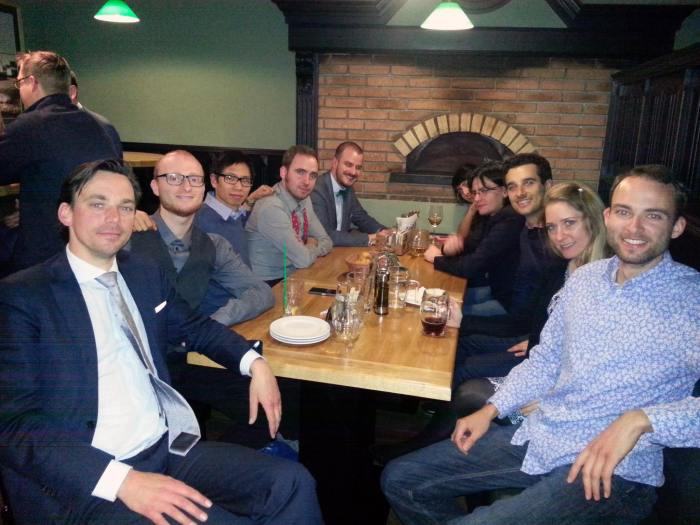
AEME participants sharing their last evening in Prague in a local pub
What was great about the second AEME is that it took place right before the PCPE conference at the CEVRO Institute. Most of us who attended AEME have stayed two extra days to attend the PCPE conference as well. The CEVRO Institute is a private university founded in 2005 that is located in the very centre of the city of Prague. The university prides itself in its emphasis on freedom, markets, and its innovative character that is for example manifested in its PPE (Philosophy, Politics, Economics) programme taught by such international illustrious professors as Michael Munger who is also director of Duke University’s PPE programme, Peter Boettke who is the director of the F.A. Hayek Program at George Mason University, David Schmidt who is director of the Center for the Philosophy of Freedom at the University of Arizona, Boudewijn Bouckaert who was the former dean of the Faculty of Law at the University of Ghent, and Josef Sima who is the president of the CEVRO Institute. The institute has invited several prominent speakers for its conference. Prof. Mark Pennington (London School of Economics) was for example invited to present “Why most things should probably be for sale”. Prof. Benjamin Powell who is the director of the Free Market Institute at Texas Tech University, the University to which I almost applied to to pursue my PhD in the academic year of 2015 but eventually decided to work as a software engineer, was there as well to speak about “Migration, Economic Calculation, and the European Situation.” Prof. Mario Rizzo (New York University) had the honour to be the keynote speaker and spoke about “The four pillars of new paternalism” which was followed by commentaries from Prof. Pascal Salin, former president of the Mont Pelerin Society.
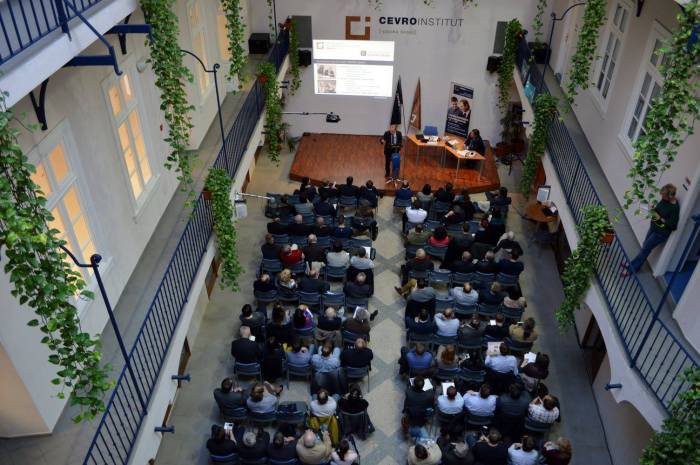
Mario Rizzo’s welcome speech to PCPE
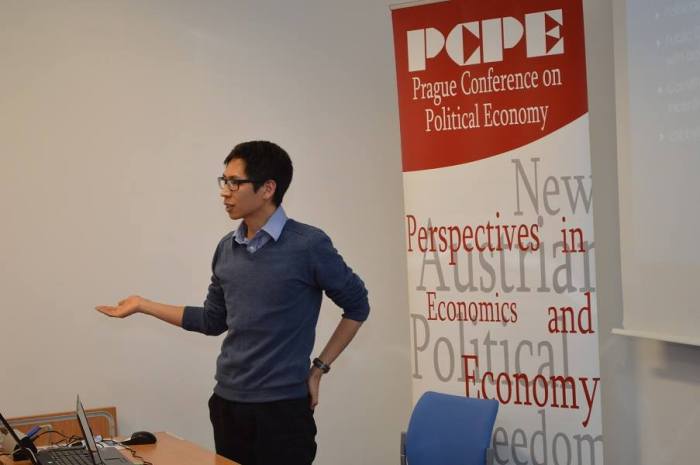
The second day of the PCPE conference, there were 27 speakers spread over 9 sessions on such topics as economic theory, anarcho-capitalism, the Austrian School, entrepreneurship, cryptocurrencies, the role of family and more. I was one of the speakers and spoke on the “Philosophical investigation of seasteading as the means to discover better forms of social organization”. The thesis of my talk was that one core focus of political philosophy is to deal with the realities of value pluralism and political disagreements. I contended that the most common form of social organization, representative democracy, does not satisfactorily deal with these realities. Therefore, we should look for political possibilities beyond representative democracies and that in order to discover these possibilities, we should experiment with new forms of social organizations. By approaching the issue from a meta-system level perspective and realizing that governments are resistant to structural societal changes we should then introduce competition into the industry of governments. Seasteading, the creation of habitable dwellings on the oceans, could serve as a means to introduce more competition in the industry and lessen political tensions between citizens who hold different comprehensive doctrines.
Me speaking at PCPE about Seasteading as the means to deal with such political realities as value pluralism and political disagreements
If I could mention one thing that has made the most remarkable impression on me, it would be the warning issued by Prof. Stephen Baskerville (Patrick Henry College, USA) that the most immediate threat to our liberties is feminism and the social justice movement. He maintained in his talk that there is an ensuing crisis of the family which is perpetuated by the state. According to Prof. Baskerville, family courts can enter homes uninvited, take away people’s children, confiscate their property, and incarcerate them without trial, charge or counsel. With over 50% of all first marriages ending in divorce and more than half of all these divorces involving children, the greatest threat to our liberties is the colluding social work state bureaucracies with radical feminism. These groups have colluded to suppress information on such injustices. Listening to Baskerville’s talk, I felt the great urgency to engage in an intellectual battle against feminism and the social justice movement.
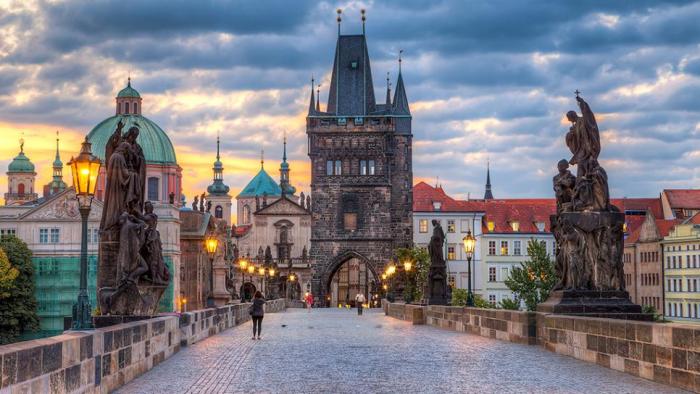
Other than the many intellectually invigorating moments, the city itself provided many magnificent sites. To mention several sights: we visited a beer garden, experienced a classical music concert at the Mirror Chapel, walked over the Charles Bridge, and visited the Prague Castle.
The beautiful Charles Bridge crossing the river Vltava
All in all, the city of Prague, AEME and PCPE were an unforgettable experience! It has already been decided that next year’s AEME conference will take place in Krakow, Poland. The conference will be open for anyone who is interested in Austrian economics and libertarianism. For more information on AEME and the papers that were presented in the previous editions, you can find our website here. In case you are interested in studying at the CEVRO Institute and its MA PPE programme with specializations in “Austrian Economics”, “Studies of Transition”, and “International Politics”, you can visit their website here.
John McAfee’s latest political campaign ad is inspiring as it asks voters to vote libertarian. It is an homage to Apple’s “Think Different” ad as well as to individual freedoms, creativity and intellect.
The video shows ‘rebels’ and game-changers who have moved the world forward. You do find Steve Jobs, Elon Musk, Edward Snowden, Julian Assange, Peter Thiel, Bradley Manning, Ross Ulbricht, Martin Luther King, Ayn Rand and many more. You even see Bitcoin and crypto-capitalism which is simply another form of libertarian anarchism. Ending with the lift-off of a spaceshuttle, the ad presents a message of hope for libertarians and a message of progress as long as we “let life live”.
The same celebration of human individualism and message of hope was also apparent in McAfee’s earlier campaign ad that was released two weeks ago.
Samuel Hammond, a friend of a friend, has recently written a blog post musing about whether trade between Mars and Earth should be discouraged. The basic premise is that the case for colonizing Mars is to decrease the likelihood of a catastrophe leading to the extinction of humanity due to a black crow event.
Inter-planetary trade would allow both planets to minimize the harms of minor to moderate events, Samuel seems to acknowledge this. This is how international trade today helps nations minimize the harms of localized events. The harm of the ongoing drought in California has been lessened due to ability of consumers to tap into markets elsewhere to meet their demands. What Samuel is concerned about is those events whose danger increases in proportion to the inter-connectivity of markets. Samuel gives the example of financial markets, but allow me to introduce another similar danger: the Mule.
The Mule, primary antagonist in I. Asimov’s Foundation & Empire
In Isaac Asimov’s sci-fi universe much of the known galaxy in the distant future comes under the rule of the Foundation Federation. The Foundation is a liberal galactic government that promotes intra-galactic trade, but grants each planet wide freedom to settle its internal matters. It has waged wars of defense, but is notable in that it has never waged a war of conquest and its members have all joined voluntarily. I would go as far to say it is an ideal form of galactic government. However the Foundation’s promotion of galactic inter-connectivity backfires when the Mule, a mutant human with the ability to influence minds, takes control of the government elite. The Mule is a single man but, due to the hyper-connectivity of the Foundation, can assume control with a few well placed followers. Almost overnight the Mule transform the liberal Foundation into his personal dictatorship. The last bastions of freedom are those regions of space controlled by pirates free traders.
Eventually the Mule is defeated and liberal government restored, but only because of the efforts of those polities outside the Foundation’s control. If the Foundation had been a monopolis, a government that controlled all of humanity, then it is doubtful the Mule would have been defeated. Inter-connectivity can yield significant benefits, but as outlined above it can also maximize the damage of black crow events.
Does this mean that Samuel is correct and that any further space colonies must be separated from Earth in terms of trade and governance? Not quite. Although I think Samuel’s concerns serve as an argument against extreme inter-connectivity between worlds, I do not think it is sufficient to justify actively building barriers between worlds. Rather I interpret black crow events as arguments in favor of tolerating the existence of rogue nations, such as North Korea, Somalia, and other contemporary nations that exist outside the primary world system.
As space exploration becomes a reality I think all efforts should be made to promote inter-connectivity between the various worlds. We should promote Earth-Mars relations. We should not however oppose those who wish to live in the asteroid belt and minimize their contact with the rest of us. This break away colonies will arise naturally and need not be actively created, only tolerated. These break away colonies will be founded by an assortment of pirates, religious zealots, political dissidents, and other outcasts. By tolerating their existence we will reap the benefit of space exploration while minimizing the likelihood of black crow events to destroy all of humanity.