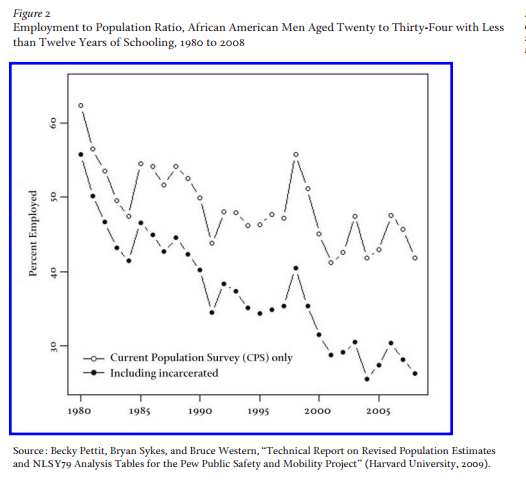
A few years ago, I was teaching at HEC Montréal and I explained that putting people in prison – by statistical definition – did reduce unemployment. My students were shocked that I would say that. I told them that it was important to know definitions like that because you can then analyze the BS that politicians and pundits can spew.
And the case of Black-Americans is the best example, especially with regards to the wage gap. In recent years, I have seen pundits (left and right) use the slightly increasing ratio of black-to-white wages as a tool to promote their favored political narrative (i.e. the BS that I am referring to).
But, at the same time, the incarceration rates of Blacks has increased dramatically. Tell me, do you think that the socio-economic features of blacks in jail are distributed the same way as the socio-economic features of blacks not in jail? Of course not, criminals tend to be clustered disproportionately at the bottom of the income ladder. However, when its time to collect the wage statistics for blacks and whites, you are basically considering only the wages of blacks not in jail (i.e. blacks who are in the top centiles of the wage distribution). So, you’re basically committing a sin of statistical composition.
When I look at this evidence, I understand why some people are pissed off at the conditions of Black Americans. It throws in doubt the contention that there has been racial convergence in America. At the same time, I wonder if the lack of recognition given to this statistical issue is a form of cognitive dissonance. If you claim that the convergence is mostly an artifice of composition fallacies, then what does it say about the policies of the last 30-40 years?
The recent Carrier deal has caused some controversies in liberty-oriented circles. For example, The Mises Institute published a defense of the deal, arguing (along other lines, please read the article yourself):
there is nothing inherently wrong with an administration focused on keeping jobs in America — especially if this is accomplished by relieving tax and regulatory burdens.
The point I wish to make here is a general point, so I won’t go into the specifics of the Carrier deal. Among other reasons: I don’t know the specifics of the deal (I don’t know the content and I don’t know how the deal came to pass.) What I wish to do here is to argue the general case on how to view these kinds of tax exceptions.
The point we ought to remember, I think, is that there are a trade offs between two important liberal values, although they are important in different ways. On the one hand, we have the idea of rule of law, the idea that the law is general, not specific, applies to everyone rather than some, and that it’s not designed to favor some because it should serve an open-ended order. Things that contribute to such a legal order are ipso facto prima facie good, things that take away from such a legal order are ipso facto prima facie bad.
On the other hand we have the idea that taxes are bad. Things that lower taxes are prima facie good, things that increase taxes are prima facie bad.
But neither of these things trump all other considerations. Let me give you two examples.
Suppose there was a law that said that the taxes on, for example, business started by family members of politicians are automatically exempted from taxes. Would this be a good law?
Suppose there was a law that said that everyone has to be drafted and has to serve mandatory military service overseas, except the family members of politicians. Again: would this be a good law?
In both of these questions, the answer depends on the liberty-inspired framework you use to answer the question. If you think the value of the rule of law outweighs the value of individual liberty of those family members (who are, after all, not responsible for the actions of their political family members) than you think these are bad laws. If you think the increase in individual liberty for those family members is more important than the violation of a rule of law principle, than you think these are good laws. My point is not to say how one should determine this, my point is that there are two liberty-inspired frameworks that can justify an outcome, and both of these frameworks are relevant in determining what kind of laws we ought to support.
To make the issue slightly more applicable: is the increaseddamage on the rule of law (created by allowing a specific exception on the general laws on taxes) larger or smaller than the benefits that allow a company to have less taxes?
Some people have tried to argue by analogy – for example, comparing it to the draft. The problem is that analogies quickly run into the problem of changing the relative values of the two important concepts. For example: is it a good thing that women are exempted from the draft? Yes, this seems like obviously a good thing. Would it be a good thing that male children of politicians would be automatically exempted from the draft? This seems like less obviously a good thing.
Would it be a good thing if white people were automatically exempted from the draconian drug laws? Maybe it would, but maybe that also lowers the chance of getting rid of the drug laws altogether. Different margins matter in these kinds of evaluations.
The wrong thing to think is that all policies are pro tanto good just because they increase liberty on some margin for some people, especially if this allows for the prolonging of bad policies by the current ruling class. Some policies can be bad on some margins and good on others and reasonable people can disagree whether the complete net effect of this is good for all.
Maybe it’s a good thing that some people are exempted from evil laws (such as taxes), but it’s not good that the political class gets to choose who does so. Because those who will be exempted will be those who are connected to the political class. So one can absolutely like lower taxes, oppose politicians’ power to choose who is exempted and oppose that, and still be happy for a company that they got a tax cut. (Unless, of course, the company itself is evil. This is certainly possible if they are partners in, for example, the wars that the USA commits.)
So tl;dr. As I posted somewhere on facebook:
Rule of law and lower taxes are two good things. A president (or important person connected to the ruling class such as the president elect) getting to pick and choose winners isn’t desirable, but a tax break is. A higher tax isn’t desirable, but a rule of law is.
Trying to argue the case based on principle seems wrong. It depends on the margins. In the case of the draft, the margin *against* rule of law seems important enough to say it’s a clear victory for liberty to not have women included.
In the case of tax breaks, this is less obvious and reasonable people can come out on different sides of this, I think.
Fake news! The new plague that besets mankind! That is largely the new name given to what 19th century folks would have called “yellow journalism“.
Yellow journalism was sensationalist to the point of distorting the news in order to carry a very emotional message. Generally embedded in that message was a political narrative supporting progressive reforms (not all yellow journalists were progressive but it seems that most were).
The aim of many progressives was to design a new society, to reform the old society by getting rid of old institutions. In many cases, economic historians have documented that these reforms (like with prohibition, workers compensation, antitrust) ended up serving very narrow interest groups who either allied themselves with reforming zealots (as in bootleggers helping baptists pass Sunday sales bans), gained through the restriction of competition or gained at the expense of future workers and minorities. But it is not as if the “previous” order was paradise. The postbellum era prior to the progressive era was highly protectionist, used public funds to bailout poorly performing railways and solicited the federal army to deal with natives rather than peacefully deal with them. Basically, both eras had their political entrepreneurs who found their way in the political process to obtain favors.
Progressives who indulged in yellow journalism merely wanted to replace one set of political entrepreneurs with another. Just like the Alt-Right, from which emanates most of the fake news. In a way, both are exactly the same. Many members of the Alt-Right are not interested in restraining government abuses, they’re in favor of redirecting government indulgences towards them (Trump did promise less immigration with paid maternity leaves and no reduction in social transfers). Some are well-meaning like the baptists of lore. But there are still bootleggers (example: Steven Mnuchin from Goldman Sachs) who co-opt the process in order to continue indulging in rent-seeking just as they did before.
Are we about to swap one bad set of institutions for another? Given that all I see is the same type of political entrepreneurs (after all, Bannon from the flagship of the fake news alt-right outlet Breitbart is now a member of the government) as those we saw during the progressive era, I am inclined to respond “yes”.
When Fidel Castro died he was totally alone. It doesn’t matter if relatives or friends were standing beside him: in the end, we are all alone. We experience the world through our sense of perception. Of the things themselves we have no experience. On the other hand, all humans have perception of themselves. We just know that we are. This self awareness is a fundamental aspect of what it is to be human. Castro’s death already received a lot of attention, but I believe it is a moment really worthy of reflection. Under his half-century regime millions died or suffered, and it’s always important to remember that we are talking about a little country, an island in the Caribbean. Cuba was one of the most prosperous nations in the Americas, and today it is one of the most miserable.
It is really sad to see that most of my colleagues are unable to call evil by its name. In the mid-nineteenth century Karl Marx predicted that capitalism was going to collapse because of its internal contradictions. He was not saying that he wanted capitalism to collapse. He was saying that this was a scientific fact, as sure as the next eclipse predicted by an astronomer. Capitalism, of course, didn’t collapse. Marx’s economic theory was simply nonsensical, and was contradicted by logic and facts. But Marxists couldn’t admit it. Instead they replaced economics with culture, and the working class with Others as the oppressed. Blacks, women, Native Americans, underdeveloped countries and many others became the new oppressed class. Fidel Castro fit beautifully in the Marxism of the New Left. He was the charismatic dictator of the charming island nation of Cuba. The US, ruled by leftists in the 1960s and 1970s, was unable to give a consistent answer to it. Latin America, ruled by dictatorships that the left called “right” (no one wants to take their dictators home), was also not in place to contrast the evils of the Castro regime. A perfect storm.
Castro, for all we know, died with no regrets for the evils he committed in life. Political commentators say that history will judge him. But this is a lie. History can’t judge anyone. Only people can judge people. And it is fundamental that political commentators today judge Castro for all the evil he has done. Castro didn’t kill people in Cuba only. He supported, in one way or another, brutal regimes all over the world, mostly in Latin America. To this day he is partly responsible for the evils of Foro de São Paulo. But many political commentators insist in the lie that in Cuba there’s true freedom: they have enough to eat, universal healthcare and universal education. Why would they want freedom?
Freedom is the fundamental state of human beings. We are, in the end, all alone. Of what goes in our hearts, only we are aware of. Sometimes not even us. All of us make choices based on knowledge that’s unique. Circumstances of time and space shape the choices that we make. And life is made of choices. Marxism, socialism, and all forms of statism go against these fundamental truths.
People in Cuba are not free. They are all slaves to the Castro family. Some people want to have life in a cage, as long as they receive food every day. Of course this is a lie. In order to live in a cage you need to have someone outside the cage bringing the food. Someone has to be free. This person becomes your slave as well, and this constitutes a fundamental contradiction of socialism: Alexis de Tocqueville mentioned that socialism is just a new form of slavery. In slavery someone is forced to work for somebody else under the threat of physical violence. Under socialism everybody is forced to work for everybody else. Let’s hope that Castro’s death may help put socialism in the past, where slavery is, and that Latin America may finally see the light of freedom.
What has been widely feared is about the happen, it seems. President Assad’s troops, supported by the Russians, are winning the battle over Aleppo. That is not great from a lot of perspectives. To name just a few: first of all for the civilians, who are killed and bombed continuously. Secondly, the crushing of the rebel forces there means the further weakening of what are ‘natural’ allies of the West, as they are against Assad and against ISIS. Thirdly, this victory (if it all continues this way, of course) strengthens Assad’s position, making it even more unlikely that he will disappear from the scene anytime soon. The only good thing seems to be the further weakening of ISIS.
Like many others, I do not like this development at all. I think Assad is a ruthless murderer of his own people and should therefore be taken to justice, preferably in its most definitive form. I wish the Syrian people all the best and would like them to decide over their own fate in liberty. I also deeply hate ISIS and all that it stands for. And the interference of foreign powers (either Russian, Turkish, Iranian, Western) certainly does not do much good either, although I also think it has been inevitable. Public opinion, perceived and real interests, and the defence of allies all foster these kind of interventions. These are of course just a few of the important variables in an enormously complex war.
So what to do, or aim for, as Western countries? Obviously, most Syrians are better off in a stable situation without war, than with any currently viable alternative. This means that negotiations about cease fires should commence, or at least be fostered, which will then hopefully lead to a permanent settlement. I do not dare to predict how long it will take for this approach to be successful. Yet any alternative is worse. These negotiations, whenever feasible, should have all parties at the table, Assad included. No vetoes against him being part of future talks, as has previously been the case. The man will stay around for a while, and we better get used to the idea. This is surely deplorable, yet inevitable. The situation in Syria shows once again the ugliness of international politics, with very limited roles for international law and justice.
Let it be a lesson for those within the liberal tradition who still think differently.
On Black Friday, one of the few remaining tyrants in the world passed away (see the great spread of democracy in the world since 1988). Fidel Castro is a man that I will not mourn nor will I celebrate his passing. What I mourn are the lives he destroyed, the men and women he impoverished, the dreams he crushed and the suffering he inflicted on the innocents. When I state this feeling to others, I am told that he improved life expectancy in Cuba and reduced infant mortality.
To which I reply: why are you proving my point?
The reality that few people understand is that even poor countries can easily reduce mortality with the use of coercive measures available to a centralized dictatorship. There are many diseases (like smallpox) that spread because individuals have a hard time coordinating their actions and cannot prevent free riders (if 90% of people get vaccinated, the 10% remaining gets the protection without having to endure the cost). This type of disease is very easy to fight for a state: force people to get vaccinated.
However, there is a tradeoff to this. The type of institutions that can use violence so cheaply and so efficiently is also the type of institutions that has a hard time creating economic growth and development. Countries with “unfree” institutions are generally poor and grow slowly. Thus, these countries can fight some diseases efficiently (like smallpox and yellow fever), but not other diseases that are related to individual well-being (i.e. poverty diseases). This implies that you get unfree institutions and low rates of epidemics but high levels of poverty and high rates of mortality from tuberculosis, diarrhea, typhoid fever, heart diseases, nephritis.
This argument is basically the argument of Werner Troesken in his great book, The Pox of Liberty. How does it apply to Cuba?
First of all, by 1959, Cuba was already in the top of development indexes for the Americas – a very rich and healthy place by Latin American standards. A large part of the high levels of health indicators were actually the result of coercion. Cuba actually got its very low levels of mortality as a result of the Spanish-American war when the island was occupied by American invaders. They fought yellow fever and other diseases with impressive levels of violence. As Troesken mentions, the rate of mortality fell dramatically in Cuba as a result of this coercion.
Upon taking power in 1959, Castro did exactly the same thing as the Americans. From a public choice perspective, he needed something to shore up support. His policies were not geared towards wealth creation, but they were geared towards the efficient use of violence. As Linda Whiteford and Laurence Branch point out, personal choices are heavily controlled in Cuba in order to achieve these outcomes. Heavy restrictions exist on what Cubans can eat, drink and do. When pregnancies are deemed risky, doctors have to coerce women to undergo abortion in spite of their wishes. Some women are incarcerated in the Casas de Maternidad in spite of their wishes. On top of this, forced sterilization in some cases are an actually documented policy tool. These restrictions do reduce mortality, but they feel like a heavy price for the people. On the other hand, the Castrist regime did get something to brag about and it got international support.
So, yes, Cuba has been very good at reducing mortality from communicable diseases and choice-based outcomes (like how to give birth) that can be reduced by the extreme use of violence. The cost of that use of violence is a low level of development that allows preventable diseases and poverty diseases to remain rampant. Hardly something to celebrate!
Finally, it is also worth pointing two other facts. First of all, economic growth in Cuba has taken place since the 1990s (after decades of stagnation in absolute terms and decline in relative terms). This is the result of the very modest forms of liberalization that were adopted by the Cuban dictatorship as a result of the end of Soviet subsidies. Thus, what little improvements we can see can be largely attributed to those. Secondly, the level of living standards prior to 1990 was largely boosted by the Soviet subsidies but we can doubt how much of it actually went into the hands of the population given that Fidel Castro is worth 900$ million according to Forbes. Thus, yes, Cubans did remain dirt poor during Castro’s reign up to 1990. Thirdly, doctors are penalized for “not meeting quotas” and thus they do lie about the statistics. One thing that is done by the regime is to categorize “infant deaths” as “late fetal deaths” – its basically extending the definition in order to conceal a poorer performance.
Overall, there is nothing to celebrate about Castro’s dictatorship. What some do celebrate is something that was a deliberate political action on the part of Castro to gain support and it came at the cost of personal freedom and higher deaths from preventable diseases and poverty diseases.
In this article, I will explore the latest science on how our genetic makeup is correlated to our ‘life success’. This post is not for egalitarians who believe that everyone is equally beautiful and talented or that everyone can become an Aristotle through immense self-effort. No, this post argues that our genetic differences result in different expected life outcomes.
We are living in extremely interesting times. We may have reached a tipping point in genomic research. It seems that we can now weakly predict life outcomes based on genetic tests. Daniel Belsky from Duke University and his team of researchers have recently released a paper asserting that genetic tests can predict adult life outcomes. The magnitude of correlation between genomic tests and adult life outcomes is still very modest, but I believe that the predictions will grow more accurate once we gain more knowledge about the genetic makeup of ‘success’. I believe that this is big news, since this is the first well-developed psychometric/genetic research I have read so far that asserts that life success is to some extent related to our genetic makeup.
When Belsky et al looked at the genetic profiles and the people they studied, they found that people with higher polygenic scores did not only have greater educational attainments, but also had more prestigious occupations, higher incomes, more assets, greater upward social mobility, and were more likable and friendly.
Main research findings
The main research findings can be summed up as follow:
polygenic scores predicted adult economic outcomes even after accounting for educational attainments;
genes and environments were correlated: Children with higher polygenic scores were born into better-off homes;
children’s polygenic scores predicted their adult outcomes even when analyses accounted for their social-class origins; social-mobility analysis showed that children with higher polygenic scores were more upwardly mobile than children with lower scores;
polygenic scores predicted behavior across the life course, from early acquisition of speech and reading skills through geographic mobility and mate choice and on to financial planning for retirement;
polygenic-score associations were mediated by psychological characteristics, including intelligence, self-control, and interpersonal skill.
Belsky’s main research question
In 2013, Rietveld et al reported the first successful genome-wide association study (GWAS) of educational attainment. They analyzed millions of genetic variants in more than 100,000 individuals and found a genetic map that was related to people’s educational attainment. This genetic map could even explain differences in educational attainment between siblings in the same family.
The main research question that Belsky et al ask is: “do genetic discoveries for educational attainment predict outcomes beyond schooling?”
If so, what are the developmental and behavioral pathways that connect differences in DNA sequences with divergent life outcomes?
1,037 people born between April 1972 and March 1973 in Dunedin, New Zealand, were tracked through a 38-year assessment of their socioeconomic development. This study became known as ‘the Dunedin study’. The cohort represented the full range of socioeconomic status (SES).
The researchers derived polygenic scores from the approximately 2.3 million genotypes that according to Rietveld et al would make up the genetic predisposition to educational attainment. In addition, adult-attainment scores were derived from extensive analyses of Dunedin members’ life developments. See table 1 for developments that were tracked and the methods through which these developments were measured.
The researchers have for example measured SES, determined from the higher of either parent’s occupational status throughout the Dunedin Study members’ childhoods. Educational attainment was measured, looking at the highest obtained degree. Attainment beyond education were measured by members’ reports of occupation, income, assets, credit problems when they were 38 years old and from social welfare and credit-score records. Reading abilities, taken when the Dunedin Study members were 7, 9, 11, 13, 15, and 18 years old, were measured as well. What I find extremely interesting is the fact that the researchers have measured not only cognitive ability through picture vocabulary tests and IQ tests, but also certain personal traits like self-control, impulsive aggression, hyperactivity, lack of persistence, inattention and interpersonal skills.
More substantive research results
I will list all research results here:
people with higher polygenic scores tended to achieve higher degrees;
people with higher polygenic scores tended to be more socioeconomically successful, holding more prestigious occupations, earning higher incomes, having more assets, relying less on social-welfare benefits, having higher credit scores and reporting fewer difficulties paying expenses;
children with higher polygenic scores tended to come from families with higher SES;
children with higher polygenic scores tended to attain more regardless of whether they began life in a family of low SES or high SES. Children from low SES with high polygenic scores tended to have greater upward social mobility than their low SES peers with low polygenic scores;
children with higher polygenic scores were more likely to talk earlier and quicker to begin communicating using sentences;
children with higher polygenic scores were able to read at younger ages;
adolescents with higher polygenic scores had higher educational aspirations at the age of 15;
adolescents with higher polygenic scores performed better academically and outperformed their peers on standardized tests;
people with higher polygenic scores were more likely to pursue occupational opportunities outside of New Zealand;
people with higher polygenic scores were more financially planful;
people with higher polygenic scores tended to find partners with higher socioeconomic attainments;
people with higher polygenic scores were not more satisfied with their lives;
people with higher polygenic scores performed better on IQ tests and showed more rapid cognitive development during childhood;
people with higher polygenic scores had stronger noncognitive skills, such as self-control, friendliness, confidence, being cooperative and communicative;
children with higher polygenic scores were no healthier than their peers.
Tough questions
Knowing that our genetic makeup partly determine our success in life, would it be ethical to screen embryos for genetic signs of success in life? In some cases, embryologists already check embryos for major diseases, but should we allow parents to select embryos with the greatest genetic odds of future success?
These are interesting questions that, I believe, we will be facing in the near future.
This is in response to Will’s response to my initial post on safe places. I’d add it to the comments section, but that area has already been bloated.
If I understand Will correctly he is pointing out that in order to be harmed by words one must to an extent cooperate. If we were, for example, to mail the site’s founder with USC memorabilia the act in itself would be meaningless unless he decided to interpret the act to be an attack on his UCLA background. There are exceptions to this rule, such as those with certain mental conditions (e.g. PTSD).
If this is the point Will is making, I agree with him. I do however feel compelled to add that there is another group of individuals, besides those with mental disorders, who cannot willingly change how they react to certain words or cues – children. Why do I bring children into this discussion? Isn’t the safe place discussion mostly about their inclusion in universities? Let me make the case that a large portion of a university’s student body is composed of children; and to be clear I do not say this with malice towards said students.
The concept of childhood is relatively new in human society. It used to be that once a toddler was old enough to move around they were given work to do, be it helping around the farm or the factory. Delaying entrance into the job market required having parents able to ‘buy’ children’s time and so childhood was only possible following the industrial revolution. I’m sure everyone has heard of a version of this story before. If not I recommend the Cunningham book on the subject.
What if these calls for safe spaces are a response to the development of new period between childhood and adulthood? By all means the students on university campuses are physically adults, just look at their facial hair and sexual activity. They aren’t meeting the traditional landmarks of becoming adults mentally though. They are pushing back having children. Many of them are returning to live back home or never left to begin with. I know of several 20-30 somethings who are still trying to get on a career path.
Many, myself included, have seen safe places as infantilizing students. What if it’s the reverse though? It could be that students were already infantilized to begin with and that safe places are a symptom of universities having to respond to that.
If that is the case it is tempting to want to find out who is behind this. As with the development of childhood though the source of this post-childhood stage is our wealth. Our wealth has increased life expectancy. Our wealth has allowed parents to ‘buy’ more and more of their children’s time. Our wealth has allowed us to subsidize institutions (e.g. universities) that give these post-children a place to go and further delay their entrance into the labor force.
Should we really be angry then? We will have to adapt certainly. We will have to stop thinking of universities, most universities at least, as places populated by adults. We need to update our institutions. Should non-adults have the vote? Etc. Etc.
What is our alternative? Destroy our wealth so that this post-childhood pre-adulthood stage can’t exist?
I am against the idea of safe places (see my previous post on the issue), especially in academia. I believe that if an idea is worthwhile it should be able to survive critic from all sides and safe places, regardless of their intent, hamper that process. How can you critic something if you aren’t supposed to even acknowledge its existence?
I also believe that, if our pluralistic society is to continue, we need to be able to empathize with those who are our intellectual opponents. I’m not saying we should become Marxists and rename the site The People’s Notes. Nor should we become Trumpistas. However we should be able to break bread with non-liberals and hear their side of the story out. We can continue to disagree with them, but we need to be careful to not de-humanize someone because of their ideological leanings. Safe places make this hard to do. If X group isn’t politically correct to talk about, much less with, how can we learn about them?
Safe places are, in more than one way, harmful to a free society.
-But they may still have a place in a free society.
Why the change of heart? It is this whole Trump fiasco. If you haven’t read them yet, several NoL bloggers have written about it here, here, here, etc.
I have seen several extreme reactions to the election of Trump, including quite a bit of anger and sadness. I cried for a good six hours myself when I saw the election results; as I’ve mentioned before I’m an illegal alien and so there is a very real chance I’ll be deported and torn away from the country I’ve loved since childhood. After drying up my eyes though I put that aside and went back to work. How I see it, as liberals we are constantly fighting against anti-liberal forces.
Am I sad that Trump won? Yes, but Hillary wasn’t an angel either. Before Trumpistas we had to fight Communists, Fascists, and every other type of ‘ists’ imaginable. After the Trumpistas are defeated we will have new enemies pop up. I am optimistic that in the grand scheme of things the future is better than the past, but I don’t think we will ever be rid of anti-liberal thought. Equilibrium is an illusion.
But I digress. I went back to work after my crying session, but many others around me didn’t. They couldn’t. And we shouldn’t try to force them to.
I still think safe places are a bad idea in so far that we are concerned about promoting free discussion and would never want to go into one. However maybe I can tolerate one or two of them if they help others improve their mental health. Maybe I can use ‘undocumented’ instead of ‘illegal’ if people are really that emotionally disturbed by it. Maybe I can use someone’s preferred pronoun if ‘he’ really hurts them that much. Maybe I can keep my mouth shut and just listen to someone who is in pain.
I think that in the long run we need to be able to stand up to our critics. If you’re gay, you’ll eventually find someone who goes out of their way to tell you your leading a sinful life. If you’re a woman and feel that the patriarchy is why you’re paid less, an economist will eventually lecture you on why that’s wrong. Infantilizing people doesn’t help them. The world is tough, and you need to be rough to survive it.
However if someone needs a bit more time before they go out and face that world, is it wrong to provide a safe place for them until they feel ready? If I want to make a controversial remark, maybe I shouldn’t do so in the middle of the class. Maybe I should just blog it on NoL.
As always thoughts and comments are always appreciated.
Para qualquer um que acompanhou as notícias pela grande mídia brasileira (leia-se especialmente Globo e Globonews) a eleição de Donald Trump para a presidência dos EUA parece ter sido em primeiro lugar uma surpresa imprevisível e em segundo lugar a maior desgraça que poderia se abater sobre aquele país e o mundo, quando ao mesmo tempo estes perderam a chance de serem agraciados com a primeira mulher presidente dos EUA, a imaculável Hillary Clinton. Para responder a esta avaliação, faço aqui algumas observações a respeito do sistema político e eleitoral dos EUA.
Há basicamente dois partidos políticos nos EUA: Democratas e Republicanos. Diferente de algumas bobagens que vi nos principais canais de notícias, o Partido Democrata não remonta a Thomas Jefferson. Remonta sim a Andrew Jackson, primeiro presidente populista dos EUA e notório assassino de índios. Ao longo do século 19 o Partido Democrata foi o grande defensor da escravidão, e com a abolição desta nefasta instituição tornou-se o grande defensor da segregação. Woodrow Wilson e Franklin Delano Roosevelt, famigerados presidentes democratas, muitas vezes tratados como grandes heróis da democracia, foram grandes expansores do governo federal e enfraquecedores da economia americana. Na década de 1960 o Partido Democrata criou uma versão norte-americana de Welfare State que desde então mais prejudica do que ajuda os mais pobres. Do século 19 ao 21, o Partido Democrata está sempre ao lado dos mais poderosos e contra os mais pobres, não importa se dizem o contrário.
A origem do Partido Republicano é menos antiga. O GOP (grand old party), como é chamado, foi formado pela união de vários movimentos abolicionistas, e seu primeiro presidente foi Abraham Lincoln. Em resposta à eleição de Lincoln, estados escravistas do sul dos EUA romperam com a União, dando início à Guerra Civil. Embora a história do GOP esteja cheia de controvérsias, o fato é que ao longo do tempo este partido foi mais inclinado ao livre mercado, defensor mais forte dos direitos individuais e menos populista do que seu adversário Democrata.
Para além dos partidos, a população dos EUA se divide basicamente em duas correntes políticas: liberais e conservadores. Diferente do que ocorre no Brasil ou na Europa, o termo liberal é utilizado nos EUA para indivíduos de esquerda. O termo liberal passou por uma mudança na virada do século 19 para o 20, sendo adotado por indivíduos do movimento progressivista (notoriamente o já citado presidente Woodrow Wilson), que defendia a expansão dos poderes do estado e menor liberdade de mercado. Eventualmente o termo liberal tornou-se associado aos Democratas.
Conservadores nos EUA são as pessoas que querem conservar o país como este foi fundado no final do século 18. Conservadores são mais constitucionalistas do que os liberais, defendem um governo mais limitado e maior liberdade de mercado. Em outras palavras, conservadores são liberais clássicos, enquanto que liberais deturparam este termo, quando deveriam se chamar de progressivistas (embora seja altamente questionável se sua posição promove algum progresso). Eventualmente conservadores também se tornou um termo ligado a cristãos, embora esta ligação seja menos necessária do que possa parecer. Conservadores estão particularmente ligados ao Partido Republicano.
Evidentemente é impossível que a população de um país grande como os EUA se encaixe perfeitamente em somente dois partidos políticos ou duas tendências ideológicas. Os liberais em geral defendem liberdades sociais (como legalização das drogas e união civil de homossexuais), mas são contra liberdades econômicas (como contratos livres entre trabalhadores e empregados). Conservadores são contra liberdades sociais e favoráveis a liberdades econômicas. Pessoas favoráveis aos dois tipos de liberdade sentem-se pouco representadas nos dois principais partidos, e, embora em geral optem pelo GOP, também tem como opção o Partido Libertário ou o movimento Tea Party (não um partido político formal, mas sim um movimento de protesto contra o crescimento do estado, em favor do retorno aos parâmetros constitucionais). Há também socialistas, ambientalistas, comunistas, e todo o tipo de tendência política nos EUA. O fato é apenas que somente dois partidos possuem uma representatividade nacional.
O fato de que os EUA possuiriam somente dois partidos políticos expressivos foi previsto bastante cedo por James Madison, um dos Pais Fundadores e principal autor da Constituição. No final do século 18, Madison previu que devido ao tamanho do país (ainda pequeno se comparado com as dimensões atuais) e sua diversidade, um partido de projeção nacional precisaria evitar extremismos e se focar em posições moderadas, que pudessem atender à população como um todo. Foi o que aconteceu. Ao longo de toda a sua história os EUA tiveram um sistema bipartidário, variando apenas os partidos que compõem este sistema. Republicanos e Democratas tem sido estes dois partidos desde meados do século 19.
Na primeira metade do século 19 outros partidos compuseram o sistema bipartidário previsto por Madison. Mudanças variadas levaram partidos antigos a perder relevância e serem substituídos por novos. É possível que o mesmo fosse ocorrer com Democratas e Republicanos, mas mudanças na lei eleitoral realizadas especialmente na década de 1970 tornaram mais difícil a entrada de competidores nas eleições. Estas mudanças são em parte responsáveis pela animosidade de grande parte do eleitorado, que não se sente representado por nenhum dos partidos, e consequentemente não se importa em votar. Este quadro é um alerta para pessoas que defendem uma genérica reforma política no Brasil, particularmente uma que limite a entrada de novos partidos.
Há em geral uma grande distância entre o que políticos falam em uma campanha e o que fazem uma vez nos cargos. Isto é particularmente verdade a respeito de Hillary Clinton. Graças à sua vasta experiência em cargos públicos, podemos dizer com segurança que Clinton é uma política profissional que busca angariar votos com argumentos que não necessariamente irão guiar suas ações uma vez no cargo. Trump é um político novato, e assim esta mesma avaliação torna-se impossível de fazer, mas há a impressão de que sua campanha foi conduzida como um dos reality shows de que ele fazia parte anos atrás: trata-se de uma realidade produzida com o objetivo de alcançar audiência, não de realidade real. É bastante provável que Trump presidente seja bem mais moderado do que Trump candidato, para o bem ou para o mal. Simpatizantes de Hillary podem se impressionar, assim como eleitores de Trump podem se sentir traídos.
We could have elected Hitler and it wouldn’t have turned out significantly worse than if Clinton had won.
The left and right aren’t speaking the same language, and whoever fails to take the first step (which is to not blame the other side) shares the larger share of the blame.
I just listened to the post election episode of the excellent series, The United States of Anxiety. Two interviews stand out: the Trump supporter who fails (I think) to understand the genuine (albeit overblown) fear of a black teenager, and the Trump opponent who fails to understand that trump supporter. (There was also a notably boring interview with another Trump opponent, some hand wringing by the hosts, and some genuinely insightful commentary from Chris Arnade stuffed into the back corner of the episode.)
Maybe I’m in a privileged position because I used to see myself as part of the right and now see myself as part of the left (what’s left of it). Many people on the left are being sore losers about this election and they’re making things worse. I’m talking about humans, not (necessarily) politicians. That’s what’s really disappointing.
To be fair, it’s a common pool problem. We each get social capital brownie points for being angry (“10 reasons you should be angry” gets more Internet points than “difficult social science that requires you to do things you don’t like“), and we don’t get the same rewards for sober reflection (or maybe NOL is a sensible echo chamber? Agree with me in the comments.).
The fact remains that in-group signalling trumps ideological inclusion. The result could mean wild swings of power between the right and the left with due process (and the blessings of civilization… like tolerance, economic growth, freedom, and social mobility) being steamrolled in the process.
It’s fun to blame Facebook, the media, politicians, or anyone else but ourselves. The truth is, consumer sovereignty is far stronger a force than is commonly accepted. We aren’t the victims, we’re the perpetrators. It feels good to have an ideologically tight-knit Internet cocoon and so we spend more time listening to our podcasts (talk radio) while driving our Priuses (pickups) past the coast (vast ocean of farms).
And we’ll always have some of that, but we’ve got important disagreements that we have to resolve… not permanently, but for the next generation or so. All sides (libertarians have to participate too; I don’t think we’re to blame, but some people do) have to eat some humble pie and try to genuinely understand what the others are talking about. They aren’t all morons (and we aren’t all geniuses).
What really struck me in those interviews (mostly the second, longer, better quality one by the well spoken liberal academic) was that they weren’t speaking as though they were really trying to convince their intellectual opponents. Patty (Trump supporter) was happy and felt like she was finally part of the decision making process in DC (whether that’s true is another issue). He was speaking to a liberal
Both sides need to try to adopt the language of the other side. You should be trying to convince them! Why should you expect any degree of success when you say shit like “just look at the evidence [you big dummy!]” as though they don’t think they’ve been looking at legitimate evidence. You’re both falling for confirmation bias.
The way forward is intellectual humility. Will that happen? Not a chance, but that’s all the more reason for me to shout into the void. Culture changes slowly.
People will always disagree, and always should. Ideologies have blind spots and need to depend on critics from the other ideologies to account for them. The policy we get reflects the desires of those who might do something about it. Even dictators have to walk a thin line to stay in power. What seems to be at issue here is meta-policy (Buchananian constitutional issues… not the literal constitution, but informal shared understandings about how government wields power). Right now the position from the two big camps is “to the victor go the spoils.” That’s happening because each camp has closed themselves off to the other. It’s similar to what Bastiat said; when we don’t get gains from ideological trade and cooperation, we get political strife.
Everything will be fine
Eight years ago I identified more with the right. Obama represented a charismatic leader with scary ideologies and an uncertain background. (McCain represented a very old man who didn’t seem to care much about freedom.) Obama had a cult of personality and looked ready to dismantle society.
What do I think now? I think he’s handled his position gracefully (though I haven’t been following too closely… gov’t is ~1/5 of the economy and I intend to keep it <1/5 of my life), and he’s done a good deal of harm (further entrenching the role of insurance in health care finance, drone strikes, etc.). But I don’t think he did any more harm than a Republican candidate in his position. The world didn’t end, and despite a big recession, freedom ultimately proved to be a hearty weed rather than a delicate flower.
I think Trump will follow a similar trajectory. He’ll make things worse, but the outcome won’t be dramatically different (overall) than if Clinton had won. Different special interests will be rewarded, and different special interest groups will suffer. But overall, four years from now we’ll be a little less free, a bit more rich (though probably going through a recession… that would have happened under either candidate), and ready for some more political change.
Bill Burr’s got it right: nothing’s going to change. Meet the new boss, same as the old boss.
What’s that you say? The election is over? In fact, the presidential election will be held on December 19, at which time each state’s chosen electors will meet in their respective state capitals to cast their votes. The results are due in Washington about a week later.
Did you really think you voted for President? In California, you voted for a slate of 55 electors who were appointed by your favorite party. You can find their names online.
The number 55 comes from the number of senators plus representatives. In Maine and one or two other states, each congressional district picks its own elector, and two more are selected at large. Maine’s delegation is split 3/1 for Clinton. That seems like a fair way to go. California, like most other states, is a winner-take-all state. Boo!
Does all this make any difference? I say it ain’t over till it’s over. There have been a few scattered instances of electors jumping ship, most recently Roger McBride, a Republican elector who changed his vote from Republican to Libertarian in 1972. Trump now has 290 electoral votes plus 16 more likely for a total of 306. If 37 of those people could be persuaded to change their votes, Trump would fall below the 270 needed to win. If that put Clinton over 270, she would win. If some of the votes went to Johnson or Sanders or Donald Duck, the election would be thrown into the House where each state would get one vote. Then the fireworks would start!
Why would they change their votes? I wouldn’t put it past the Clintonistas to resort to bribes or threats. A long shot to be sure, but stay tuned!
These are my obligatory thoughts about this Trump fiasco;
These past twenty four hours have been an emotional roller coaster for me.
I am an illegal alien. I have been able to do accomplish some great things these past few years because I was granted deferred action, a temporary suspension of deportation, and work authorization by the Obama administration. This has allowed me to work with the Cato Institute, the Reason Foundation, the Property and Environment Research Center, among others. I have been able to meet several of my intellectual heroes. I went from having been stuck to Los Angeles to travelling through most of the United States (with the notable exception of the south). I have formed countless friendships that would have been unimaginable to me a few years prior. I am today one of a handful of illegal aliens who have gone to do their doctoral study. If you read through NoL’s archives you’ll quickly realize I’m not terribly bright and I have a long way to go intellectually, but I’ve done well for myself I think.
Prior to deferred action I was in a dark place mentally. I was about to finish my undergraduate studies, but had no work experience unless you counted under the table odd jobs. How could I have any experience? Up till then it had been illegal to employ me. Once I graduated I had no idea what I could do. Become a gardener? I had no future. It didn’t help me that the longest romantic relationship I had been in ended because my significant other couldn’t stand my (lack of) legal status anymore. Deferred action gave me the chance to give my life meaning.
It is highly likely that, due to its discretionary nature, Trump will cancel deferred action once he enters the White House. I honestly don’t know what I will do. It is very likely that my life has reached a dead end. Upon hearing that Trump had won I spent several hours crying. I wept for all the things that I am likely to never have. I wept for the fact that I am unlikely to ever become a US citizen. I wept for the fact that I am unlikely to ever find a wife or have children. After crying though I decided that it was pointless to let myself be consumed by it any further.
I think it better to concentrate on counting my blessings.
I am not a US citizen, and I am likely to never become one. Truth be told though I don’t feel like a stranger in this country. I have friends, family, and work colleagues that have extended a helping hand to me in the worst of times. I am grateful beyond words for that. Thank you. I love you all for it.
I may never be recognized as a son of America and I cannot claim to be a blood descendant from American heroes like Thomas Jefferson, Frederick Douglas, or Milton Friedman. I am however an intellectual descendant of them. I am a son of liberty.
Mind you an American conception of liberty. I think that government, in so far as it exists, should exist to minimize social conflict by promoting disputes to be resolved through non-violence. I think that society should judge people by their actions, not incidents of birth. I think that the market is the best mechanism for peaceful coordination of production of goods, services, ideas, and love. I emphasize that word because love only matters when it is felt voluntarily. Forced love is not love.
The common interpretation of Trump’s victory is that his supporters were a collection of racists, bigots, and pigs. While I am sure there are genuine racists mixed among his supporters, I think such a view too simplistic because it fails to consider why this racism has fermented.
Racism, in its many forms, is an inherit condition of man. Due to evolution we human beings have a built-in system of distinguishing between in and out groups, between those who are ‘us’ and those who are alien. This trait was necessary to allow early hunter-gatherers to form bands and survive. I do not pretend to be exempt from this; I’ve told my share of racist jokes over the years and am more inclined to help others that share similarities to myself. Racism, to the extent we see currently, however is not due to natural conditions.
I think that today’s level of racism is due to us forcing fake love down people’s throats. There is nothing wrong with celebrating diversity. Pizza, one of mankind’s greatest achievements, is the ultimate symbol of diversity. It’s core ingredients could not have been combined until relatively recently. Pizza is born of the union of the old world (Europe, Africa and Asia) and the new world (the Americas). There is nothing wrong with praising pizza.
The problem is that when we try to force others to eat a specific type of pizza. If someone won’t eat pineapple with their pizza we consider them bigots and exclude them from our social group. We tell them they’re subhuman and banish them far away. Should we be surprised then if, upon being ostracized, they come to resent pineapple pizza? In the past they simply didn’t care for pineapple, but now they hate it because it reminds them of how they were rejected in the past for holding unpopular views.
In our pursuit of celebrating pizza we ended up forgetting the great thing about pizza – choice. Pizza comes in countless varieties from plain cheese to pepperoni or a mix of vegetables and meats. Pizza doesn’t even need to have tomato sauce or cheese to be a pizza. Pizza is the ultimate manifestation of choice. It is no wonder that we Americans, in our love for liberty, love pizza.
Diversity is great. However if someone doesn’t like to be around blacks, homosexuals, or Jews we are not advancing the cause by making them feel like awful people. They may come from a background where they only interacted with others like themselves. They may feel uncomfortable in diverse environments, but we should not presume it to be because of bigotry. It is better to give them the benefit of the doubt. If diversity is great it will win them over time – they will voluntarily come to love diversity.
If we force them to love something however we deny them the opportunity to fully understand why diversity matters. We also force them to be hypocrites that claim to love something they don’t care for. We set up the groundwork for someone to come along and offer them a chance to get back at those who dehumanized them if they vote for him.
It is easy to want to punch people and force them to agree with you. I know full well the temptation of violence. Again, in the past day my life has come to an end. It would be easy to fuel my emotions into anger. It wouldn’t solve things though.
If we want to live in a better world we need to break this cycle of hatred and concentrate on what brings us together, our love for pizza.
Although President Dilma Rousseff was impeached, and the PT (the Worker’s Party) suffered great losses in the municipal elections some weeks ago, it is still clear that PT in particular and socialism at large still has strong support among the population, especially in intellectual, cultural, and political circles. The Brazilian political spectrum often intrigues observers both from inside and outside the country: among the 35 registered political parties, almost none presents itself consistently as liberal or conservative. The only one to do so is the newly created Partido Novo (literally New Party). Other parties present themselves as socialist, social democrats, or don’t talk about this at all. To use the infamous left-to-right political spectrum, all political parties present themselves either as left or center. To present itself as right is still taboo for Brazilian political parties. Things surely seem to be changing as the already mentioned Partido Novo enters the scene and some individual politicians, such as Jair Bolsonaro, present themselves openly as right-wing. Also, social movements such as Movimento Brasil Livre and think tanks such as and Instituto Von Mises Brasil help create momentum for a new right in the country. It is possible that in future elections conservative and liberal candidates will gain seats, especially in the legislative chamber, but as parties are concerned, the right is still mostly a wasteland in Brazil. But why is that so?
Many analysts blame two factors for the lack of party representation for the Brazilian right. First, there’s the military government, from 1964 to 1985. Although statist both in political and economical terms (as it would be expected in a military government), this period was consistently identified as “right.” Therefore, to identify someone as right is still usually understood as to identify as a supporter of the military regime. Second, there is the successful work of the left, especially in the propaganda arena. The main reason for the 1964 coup was the threat of a communist revolution, such as in Cuba. The military was successful in fighting the communist guerrilla insurgency in the countryside, but were mostly unaware of the intellectual struggle in schools, universities, and other places (despite much talk of censorship to this day). Related to that or not, the fact is that the right is still underrepresented in intellectual and cultural spheres.
I’m not saying that either of the above explanations is wrong, but I’d like to suggest an alternative that goes much further in the past: Brazil is the country of socialism today because it was the country of slavery yesterday. When slavery was abolished in 1888, Brazil was the last country in the Western world to do so. An estimated four million slaves had been imported from Africa to Brazil, 40% of the total number of slaves brought to the Americas. This is ten times as many as were trafficked to North America and far more than the total number of Africans who were transported to all of the Caribbean and North America combined. According to the only national census accomplished during the monarchy, in 1872, Brazil had a population of about 10 million people. 15.24% were slaves, and 84.8% were free. It is most likely that this census doesn’t reflect the reality of the whole monarchical period, as successive laws against slavery, immigration, and other factors moved these percentages over time.
José Bonifácio de Andrada e Silva, a major figure in Brazilian politics of the time, praised freedom in his writings, but kept slavery in place, even with British pressure to abolish it and subsequent promises to help. He did that because he needed the slave owners’ money and thought that abolition wasn’t politically wise. Bernardo Pereira de Vasconcelos, founder of the Conservative Party, was a slave owner and even rented his slaves for public works. Many subsequent leaders of the Conservative Party, such as Paulino José Soares de Sousa, were part of the Fluminense slave-owning aristocracy either by birth or by marriage. Anyway, the Conservative Party wasn’t in a hurry to abolish slavery. The lack of revenue and the political implications were matters of much greater concern than the humanitarian cause. When they finally passed the gradual laws for abolition (and ironically they passed them all) it was to appease the liberal opposition, not for the sake of the cause. Conservatives were also unwilling to employ the Africans as free workers or to treat immigrants as free individuals: their plan was to gradually abolish slavery and to substitute it with a cheap immigrant labor force in large estates through laws restricting access to land. To their surprise, this plan never succeeded. Their last effort, to bring supposedly naïve Chinese in to substitute slaves, was barred by the liberals.
The legacy is that the country of slavery yesterday is the country of socialism today. As Herbert Spencer once said, “All socialism involves slavery.” Even better, Alexis de Tocqueville said that “Socialism is a new form of slavery.” Both share the same thought: slavery is forced labor of one individual to another. Socialism is forced labor of everyone to everyone else. When “rights” abound, it’s worth asking how they will be paid. Brazil is a country of rights, but not of duties or responsibilities. Just as it was the right of the elites of the past to have the slaves working for them, it’s the right of people today to receive social benefits from everyone else. People can (maybe naïvely) defend socialism as much as people in the past defended slavery, but to treat adults as infants is neither moral nor wise. Sure, Brazil still has a population that suffers from the mistakes of the past. But two wrongs don’t make a right.
In 1991, sixteen Khmer families from Cambodian refugee camps (mostly from Khao I Dang) received asylum in the Netherlands. This Saturday, November 5, we will celebrate the 25th anniversary. To commemorate our stay in the Netherlands, I would like to share some of my early childhood memories about being born in a Cambodian refugee camp in 1986.
I understand that my story is just one small, but essential part of my family’s overall journey for safety from the civil war (1967-1975), Khmer Rouge (1975-1979) regime, and the subsequent Vietnamese occupation. According to some estimates, 2 million out of 8 million people died during this long period. This figure has been contested many times. I don’t think anyone knows how many people have actually died, but if I look at the family members of my parents’ households: 40% from my mum’s side died and 25% from my dad’s side.
Khao I Dang, the refugee camp where I was born
My parents were forced to work in labour camps in the countryside in Battambang by the Khmer Rouge. They eventually met each other while fleeing from Battambang to the Thai border when the Vietnamese invaded Cambodia. As with most fleeing Cambodians, my parents decided to get together – not out of love, but more out of the need and desire to share their hardships. This was after all, a months-long journey through the heart of the Cambodian jungle in which my father lost his father, the granddad I never came to know. My mother lost her brother and her father. As my mother was separated from her brother early on during the Khmer Rouge regime and never witnessed his death, she had always held hope that one day she would find him again.
My parents’ long journey towards Thailand brought them to the Sa Kaeo camp which was the first organized refugee camp that opened in 1979. Within just 8 days, the refugee population grew to 30,000. The camp eventually closed down half a year later, because of unfavorable conditions. The drainage in the campsite was for example so poor that several refugees, too weak to lift their heads, drowned from a flood as they laid on the floor in tents made of plastic sheets.
One month after the opening of Sa Kaeo, the Khao I Dang camp was opened and many people were repatriated into Khao I Dang. My parents eventually ended up there as well.
Khao I Dang camp
Khao I Dang was a refugee camp on the Thai-Cambodian border where I was born. It was a bamboo village with dirt roads, barbed wire, and armed guards. Within just 5 months, the camp’s population reached 160,000. Population wise, this would make the camp the 11th largest municipality in the Netherlands.
Although the camp gave us more safety, violence and theft ran rampant.
Religion and death
People continued their religious activities and some houses were transformed into places for Buddhist ceremonies. In this picture you see my two brothers, my father, and I wearing our best clothes. We just came back from a visit to a local ‘temple’. The husband of my aunty, who had just been allowed to find refuge in Australia, had recently died in the camp.
My two brothers, me, and my father
Behind me is a grave of him. My father hired a photographer to take this picture so that he could send it to my aunty. I am the one barefooted.
Hospital
My father worked at the hospital. The hospital was a large hall with beds placed next to each other. I remember that I visited the hospital where I was given a doctor’s gloves to play with. I would blow it and enjoy a child’s kick out of it.
Hospital in Khao I Dang
Night raids
I remember that during some nights, rebels with guns would raid people’s houses to steal their belongings. Often, the word about night raids spread faster than the rebels themselves, and so most of the times we were warned before the rebels reached us. I remember very well one incident when we did not flee early enough.
My brothers and I ran after my father, while my mother took my baby sister in her arms to flee in separate directions. My father brought us into a nearby canal to hide there. When the Thai patrolling soldiers within the camp arrived at the scene, shooting between the two groups erupted. When I think back to this moment, I can still clearly feel the fear I had. I wanted to cry, but my father put his hands tightly on my mouth so that I would not make any sound. We then fled to the hospital where my father was working, and stayed there during the night. We were too afraid to go back home, and waited until the next morning.
In another incident, our neighbors were too late to flee and somehow for reasons unknown, a rebel threw a hand grenade inside their little home that killed the whole family.
Kindergarten
Despite the violence and misery, people tried to rebuild their normal lives. I went to kindergarten and remember so well one incident that I played hooky.
I was 4 years old and walking to school by myself, I stopped and decided to return home to my mother’s small shop. This is an incident that I am personally extremely proud of. As long as I can remember, I have always detested school. I hated to sit still and to be told what to do and what not to do. I took this attitude with me to the Netherlands, and still today I am very critical of schooling. My mother, a soft young woman, let me stay with her at the shop. But then my father came by, got angry with me, and spanked me for not going to school. Until this day I still don’t think that I did anything wrong.
Our little shop
Trade went on. Although it was illegal, industrious people were trying to make money by starting small businesses. This shows to me that entrepreneurship is natural to us human beings, and that economics and trade are naturally emerging processes as people are always looking for ways to improve their lot and to fulfill their needs.
Thai merchants would come to the fences, away from the Thai soldiers who were patrolling, in order to sell food to the refugees inside. Such activities occurred during night-time. When Thai soldiers would find out that we were trading with outsiders, they would beat us and take away our belongings. We, refugees, were also not allowed to get outside of the camp or we would risk being shot dead by Thai soldiers.
My mother, my brothers and I at our little shop. I am the one in the blue jersey
During day-time, people inside the camp would expose their new belongings and small shops would emerge. My mother sold small products of convenience. Some of it was smuggled by Thai people into the camps that we, Cambodians, were selling to other Cambodians. Other things like oil and sugar were given to us as part of a food relief program that we used sparingly so that we could sell it further. With the money we earned, we could then buy other goods that we needed more.
Other ways through which we made money was by brewing alcohol made from rice and apples. Although alcohol was illegal, it did not stop my parents from brewing it. Whenever a Thai soldier would come to our house for inspection – I don’t think you can really hide the alcoholic odor that was surrounding our little house when we were brewing alcohol – my parents would bribe him with money so that he would leave us alone.
Continuing story
These are some of my childhood memories of our lives in Khao I Dang. Maybe next time I can tell more about our life in the camp, share some of my older brothers’ memories, our cat that was lost, killed and eaten by someone or my first encounter with inspiring Superman and Spider-Man comic books. Maybe, I will also write about our continuing journey to the Netherlands and the psychological impact my experiences in Khao I Dang had on me. I can tell about the nightmares that haunted me until my teenage years, how I always felt alienated from the people here and the inferiority complex towards Dutch people that I developed as a little child for feeling different. Feeling different made me feel insecure. Every time I met someone, and I think it lasted until my later teenage years, I would always ponder whether the person would kill me if he would be put in similar circumstances as those many killers from the Khmer Rouge period. In other words: as a child, I already wondered excessively about the “banality of evil”. These thoughts were of course extremely unhealthy, especially when you are as young as 4 or 5 years old.
The biggest lesson I have learned from my childhood is that both good and bad experiences are important in our lives. Happiness, in my opinion, is very much overrated and hardship is at least as valuable.
I have not written this so that people pity me. Pity, and in particular self-pity, is an extremely damaging emotion. It multiplies our suffering and reveals an extremely pathological egoism. When I look back at the hardships my family has overcome, I like to remind myself of Haruki Murakami’s saying that “only assholes feel sorry for themselves”.


 Notes On Liberty