Minarchism, Anarchism, and Democracy: A Shared Challenge

Minarchism–basically as small a government as we can get away with–is probably the most economically efficient possible way to organize society. A night watchman state providing courts of last resort and just enough military to keep someone worse from taking over.

The trouble (argues my inner anarchist) is that if we’ve got a government–an organization allowed to force/forbid behaviors–we’re already on the slippery slope to abuse of powers through political trading. Without an entrenched culture that takes minarchism seriously it’s only a matter of time before a) the state grows out of control and you’re no longer in a minarchist Utopia, or b) a populace unwilling to do their part allows violent gangs to fill the power vacuum.

Having a government at all is a risky proposition from the perspective of someone worried about the abuse of that power. Better not to risk it at all.

Anarchism relies on the right culture in a similar way. This is clear to critics of anarchism (basically it’s just the minarchists who are willing to take anarchists seriously at all) and is the crux of an important argument against anarchism. Without the right culture, what’s to stop people from just creating some new government? Nothing at all.

In fact, we face the same problem in the military-industrial-nanny-state complex of our imperfect real world. For any government–or lack of government–to work, the ideological framework of the people living in that society has to line up properly. To the extent people are ignorant, distracted, short-sighted, biased, or mean-spirited, we get governance that reflects those flaws.

If we want to live in a better world, we can argue all day about what sort of government we do or don’t want. But ultimately we have to work on improving the culture, because the median voter is still in charge.

A Little More on “Price Gouging”

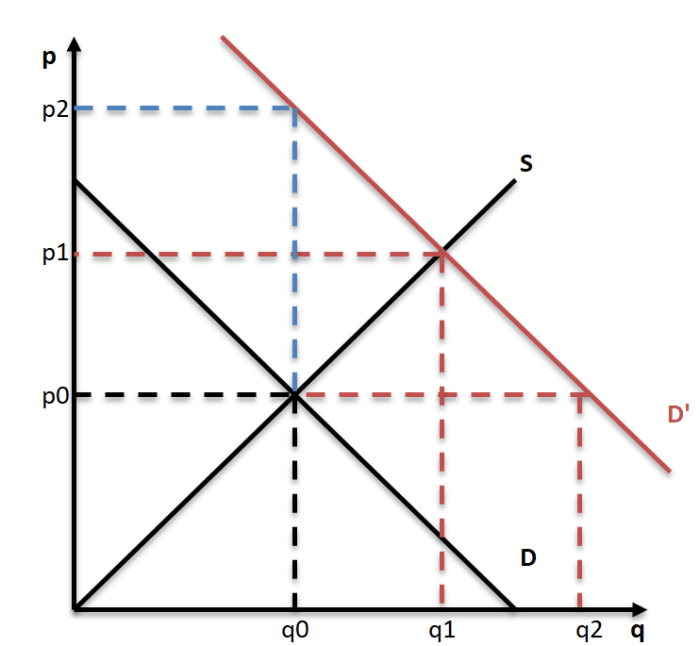
In my previous post on this subject I argued that the critics of “anti price-gouging laws” are mistakenly assuming that is possible to satisfy demand at the pre-natural disaster price. That is, sadly of course, fiction. It it not our reality anymore and we are better accepting the new situation than blindly deny it. As many economists are explaining these days, to not let prices increase after a natural disaster does more harm than letting prices increase. This can easily be seen in a demand and supply graph.

Prige gouging

Consider first just the lines in black. Those lines represent the pre natural disaster situation. What is considered “normal prices”. At price p0, a quantity q0 of a good is traded in the market (i.e. bottles of water.)

Now there is a shock. A hurricane hits this region and demand increases (shifts to the right). This is the demand line in color red. The red dotted line that extends to the right shows the size of the shortage (q2 – q1) at the “normal and fair” price.

Price gouging is an emotional loaded word, but it doesn’t have any specific economic meaning. How does “price gouging” show up in this graph? It is the increase in price from p0 to p1. This is the increase in price required to satisfy the higher demand and provide the extra number of goods (q1 – q0). No… supply is not horizontal.

What happens if price increases are banned? Then at the pre-crisis quantity (q0), consumers are willing to pay p2, a price even higher than price gouging. This means two things. First, a number of people in need will be unable to acquire the goods (the empty shelf problem). Second, that the actual total cost (to those who acquire the quantity q0) is p2, not p0. The difference between the price in the store and total cost falls into waiting in long lines, visiting a long number of stores, bribing producers (yes… with natural disaster price controls also lead to black markets), calling favors., etc. Any principles of microeconomic textbook has plenty of more examples under the price ceiling discussion.

There are three scenarios being discussed here.

  1. Quantity q0 at price p0
  2. Quantity q1 at price p1
  3. Quantity q0 at price p2

The natural disaster makes scenario 1 impossible. And it is not clear that scenario 3 is better for those in need than scenario 2. Less goods are provided at a higher total cost than in scenario 2.

One final remark. Note that in this analysis the natural disaster only affected demand. Of course, it is quite likely that supply would also be affected. The point, however, is to show that prices are not pushed up only by produces. As we can see in this case, it is consumers who are increasing the price and producers reacting to the new behavior of consumers.

The language of the economy: prices

50 Things That Made the Modern Economy is looking for a 51st thing. Below is the email I sent them.

Continue reading

A short note on ideological neutrality

William‘s excellent post on dishonesty reminded me of an equally excellent post by John McGinnis over at Liberty Law Blog on the ACLU and free speech. The post ended, though, with the following sentence:

It would be a tragedy for our nation if the ACLU’s decision begins to dissolve the strong social fabric supporting the ideologically neutral First Amendment.

Ach. There is nothing neutral about the First Amendment. It’s a law based on liberal ideology. The idea of free speech is based on liberal ideology. The other ideologies out there pay great lip service to free speech, but there’s no First Amendment in the post-colonial states of Africa and Asia. Free speech is trumped by an ambiguous form of censorship called “hate speech” in other OECD countries (Western Europe, Australia-New Zealand, Japan). There is no First Amendment in Russia or China or Venezuela.

Liberalism is the only ideology out there that actually encourages rival ideologies to attack it, not with provocative laws but with one specific law that allows all factions the same space for their platform. The First Amendment is not neutral at all; it is instead an aggressive flaunting of liberalism’s staying power and ability to deliver freedom.

When libertarians start thinking of their preferred values as “neutral” or “centrist” they begin to echo the Left, which has been dishonest with itself for the past 45-50 years. That’s a road I’d hate to the movement plod through.

Cycling in Amsterdam

I just got back from a week in London and a week in Amsterdam. Probably the most striking thing I encountered was the wonderful dutch cycling culture. Any transit system involves some implicit negotiation between motorists, pedestrians, and others. On Long Island the motorists won. In Amsterdam, cyclists won.

I’m on a bit of a Dutch cycling high, despite only spending about 2 hours on 2 wheels while in Amsterdam. The dutch take their bicycles seriously and they shape their environment to that end. The Airbnb I stayed at had frontage on a bicycle road but no direct access to a motorway. I’m not 100% on this, but I think the Netherlands’ liability laws make the faster vehicle strictly liable for accidents which serves as an implicit subsidy for bikes.

100_4514
A typical Dutch cycle path

Here are some things I like about this culture:

  • The engineering. I really like the way they do bike locks… nearly every bike has a built in lock that disables the rear wheel. Most of these locks also have a chain to lock the bike to a fence, but that chain locks with the same key for the rear wheel.
  • It encourages enough density to get people interacting with each other, but still expands your plausible travel distance. They’ve got a nice balance between closeness and congestion.
  • It’s easier on the environment (excluding the costs of building bikes and bike roads).
  • Light physical exercise feels great.
  • The infrastructure involved in managing bike traffic is pretty minimal. Speeds are slow enough that human judgement works well outside of the busiest areas.

Why should libertarians care? Well, most of them probably have better things to focus on. But those of us living in or near dense cities, this is an example of a way of life that fits nicely with our broader goal of a peaceful, prosperous, liberal order. If Manhattan tried to be more like Amsterdam it could be a huge boon (I think… based on my preferences and zero scientific analysis) to human flourishing.

Inventions that didn’t change the world

Have you ever learned about an amazing invention–whether it was the Baghdad battery or the ancient Roman steam engine or Chinese firecrackers–and wondered why it didn’t do more to change the world? In this podcast, we examine a selection of curiosities and explore hypotheses for why their inventors didn’t use them to full effect.

We move VERY quickly through a range of fascinating examples and hypotheses, and therefore leave a lot up to discussion. We hope to see your thoughts, feedback, and additions in the comments section!

For any invention that you want to learn more about, see the links below:

Knossos’ toilets

In the 2nd millennium BC, a “palace” (now thought to be a building that served as administrative, trade, and gathering hub) had running-water toilet flushing. Much like the Roman Cloaca Maxima, likely a HUGE public-health benefit, but basically died out. Does this show that military protection/staving off the “Dark Ages” was the only way to maintain amazing inventions?

Link: http://www.nature.com/news/the-secret-history-of-ancient-toilets-1.19960;

The Nimrud lens

Whether it was a fire-starter, a magnifying glass, or (for some overeager astronomy enthusaists), the Neo-Assyrian ground-crystal Nimrud lens is an invention thousands of years out of place. While the Egyptians, Greeks, and Romans all used lenses of different sorts, and glass-blowing was certainly popular by the 1st century BC in Roman Egypt, no glass lenses were made until the Middle Ages and the potential scientific and engineering uses of lenses–that can hardly be understated even in their 16th-to-18th-century applications–had to wait another couple millennia. Many devices like the Baghdad battery and Antikythera device are heralded for their possible engineering genius, but this seems like a simple one with readily available applications that disappeared from the historical record.

https://en.wikipedia.org/wiki/Nimrud_lens

Hero of Alexandria’s steam engine

In the 1st century AD, Hero was a master of simple machines (that were mostly used for plays) and also invented a force pump, a wind-powered machine, even an early vending machine. However, he is likely most famous for his Aeolipile, a rotating steam engine that used heated water to spin an axle. The best attested use of this is for devotion to the divine and party tricks.

https://en.wikipedia.org/wiki/Aeolipile

The ancient mechanical reaper

Ancient Gallo-Romans (or just Gauls) invented a novel way of grain harvesting: rather than using sickles or scythes, they used a mechanical reaper, 1700 years before Cyrus McCormick more than tripled the productivity of American farmers. This antiquated device literally but the cart before the oxen and required two men to operate: one man to drive the beasts, and another to knock the ears off the stalk (this reaper was obviously far less sophisticated than McCormick’s). This invention did not survive the Volkswanderung period.

http://www.gnrtr.com/Generator.html?pi=208&cp=3

http://reapertakethewheel.blogspot.com/2013/03/impacts-of-invention.html

Note: the horse collar (which allowed horses to be used to plow) was invented in 1600-1400 BC in China AND the Levant, but was not applied widely until 1000 AD in Europe. https://en.wikipedia.org/wiki/Horse_collar.

Inoculation

Madhav, an Indian doctor, compiled hundreds of cures in his Nidana, including an inoculation against smallpox that showed an understanding of disease transmission (he would take year-old smallpox-infected flesh and touch it to a recently made cutaneous wound). However, the next 13 centuries did not see Indian medical understanding of viruses or bacteria, or even copied techniques of this, development. https://books.google.com/books?id=Hkc3QnbagK4C&pg=PA105&lpg=PA105&dq=madhav+indian+smallpox+inoculation&source=bl&ots=4RFPuvbf5Y&sig=iyDaNUs4u5N7xHH6-pvlbAY9fcQ&hl=en&sa=X&ved=0ahUKEwic8e-1-JXVAhUp6IMKHfw3DLsQ6AEIOjAD#v=onepage&q=madhav%20indian%20smallpox%20inoculation&f=false

At least, thank god, their methods of giving nose jobs to those who had had their noses cut off as a punishment survived: https://en.wikipedia.org/wiki/History_of_rhinoplasty

The Chinese:

List of all chinese inventions:

https://en.wikipedia.org/wiki/List_of_Chinese_inventions#Four_Great_Inventions

Gunpowder

Gunpowder was discovered by Chinese alchemists attempting to discover the elixir of life (irony, no?)

https://www.thoughtco.com/invention-of-gunpowder-195160

https://en.wikipedia.org/wiki/Four_Great_Inventions

(maybe a good corollary would be Greek fire, which was used effectively in naval warfare by the Byzantines, but which was not improved upon and the recipe of which is still secret: https://en.wikipedia.org/wiki/Greek_fire)

Printing

The Chinese invented the printing press possibly as early as the 6th century. However, unlike the explosion of literacy seen in much of Europe (particularly Protestant Europe–see our last podcast), the Chinese masses never learned to read. In fact, in 1950 fewer than 20% of Chinese citizens were literate. Compare this to Europe, where some societies saw literacy rates of as high as 90% (Sweden, Male population) in some societies within a few centuries of the introduction of the printing press. Why? There may be several reasons–cultural, religious, political–but in our opinion, it would have to be the characters: 100,000 blocks were needed to create a single set.

http://www.nytimes.com/2001/02/12/news/chinas-long-but-uneven-march-to-literacy.html

https://en.wikipedia.org/wiki/History_of_printing_in_East_Asia

They also invented pulped paper by the 2nd century BC: https://en.wikipedia.org/wiki/List_of_Chinese_inventions.

The compass

Invented by 200 BC for divination and used for navigation by the Song dynasty; despite this and the availability of easily colonizable islands within easy sailing distance, the Chinese did not colonize Indonesia, Polynesia, or Oceania, while the Europeans did within the century after they developed the technology and first sailed there.

https://en.wikipedia.org/wiki/History_of_the_compass.

The rudder

While they did not invent the rudder, they invented the “medial, axial, and vertical” sternpost rudder that would become standard in Europe almost 1,000 years before it was used in Europe (1st century AD vs 11th century).

Natural gas

The Chinese discovered “fire wells” (natural gas near the surface) and erected shrines to worship there.

https://link.springer.com/referenceworkentry/10.1007%2F978-1-4020-4425-0_9568

They even understood their potential for fuel, but never developed beyond primitive burning and bamboo piping despite having advanced mining techniques for it by the 1st century BC.

Chinese miscelleni:

Hydraulic powered fan: https://en.wikipedia.org/wiki/Fan_(machine)#History

Cuppola furnace for smelting and molding iron: https://en.wikipedia.org/wiki/Cupola_furnace.

Coke as a fuel source: https://en.wikipedia.org/wiki/Coke_(fuel).

Belt-drive spinning wheel: https://en.wikipedia.org/wiki/Coke_(fuel).

The Precolumbian wheel

The pre- and early Mayans had toys that utilized primitive wheels, but did not use them for any labor-saving purpose (even their gods were depicted carrying loads on their backs). This may have been because scaling up met with mechanical difficulties, but the potential utility of wheels in this case with a bit of investment literally sat unrealized for centuries.

https://tcmam.wordpress.com/2010/11/11/did-pre-columbian-mesoamericans-use-wheels/

The Tucker:

http://www.smithsonianmag.com/history/the-tucker-was-the-1940s-car-of-the-future-135008742/

The following book contained some of our hypotheses:

https://books.google.com/books?id=ynejM1-TATMC&pg=PA399&lpg=PA399&dq=roman+and+greek+labor-saving+devices&source=bl&ots=BI6GVGTrxC&sig=8ZJqirOVUyjH7TNq0fcW6UUPn1k&hl=en&sa=X&ved=0ahUKEwj55O7395XVAhVqwYMKHSb2Dy4Q6AEIKTAB#v=onepage&q=roman%20and%20greek%20labor-saving%20devices&f=false


The rest of our hypotheses were amalgamated from our disparate classes in economics and history, but none of them are our own or uncommon in academic circles. Thanks for listening!

Make neo-Nazis flop off Broadway: public choice and Tina Fey’s sheetcaking

tumblr_n2evlqgunn1sbf1mqo4_500

A week ago a white supremacist rally in Charlottesville protesting the taking down of Confederate Memorial statues turned fatally violent. Other protests were due to take place this weekend in multiple U.S. cities, including New York (now postponed). How should citizens and public authorities deal with this upsurge in violent neo-Nazi protest? I am with Tina Fey on this one: don’t show up, have some cake, and encourage the NYPD to prevent violence.

Some on the left have tried opportunistically and mistakenly to associate Virginian school public choice scholarship with the far-right. This is a sadly missed opportunity because James Buchanan’s theory of club goods helps explain how far-right street protests emerge and suggest how authorities might best subdue them. I draw on John Meadowcroft’s and Elizabeth Morrow’s analysis of the far-right English Defence League (EDL).

Continue reading

Public choice and market failure: Jeffrey Friedman on Nancy MacLean

Screen Shot 2017-08-09 at 23.25.50

Jeffrey Friedman has a well-argued piece on interpreting public choice in the wake of Nancy MacLean’s conspiratorial critique of one of its founding theorists, James Buchanan. While agreeing that MacLean is implausibly uncharitable in her interpretation of Buchanan, Friedman suggests that many of Buchanan’s defenders are themselves in an untenable position. This is because public choice allows theorists to make uncharitable assumptions about political actors that they have never met or observed. In this sense, MacLean is simply imputing her preferred own set of bad motives onto her political opponents. What is sauce for the goose is good for the gander.

I think Friedman’s arguments are a valid critique of the way that public choice is sometimes deployed in popular discourse. A lot of libertarian commentary assumes that those seeking political power are uniquely bad people, always having self-interest and self-aggrandisement as their true aim. Given that this anti-politics message is associated with getting worse political leaders who are becoming progressively less friendly to individual liberty, this approach to characterising politicians seems counterproductive. However, I don’t think Friedman’s position is such a good fit for Buchanan himself or most of those working in the scholarly public choice tradition.

Continue reading

The case of James Damore: defending the Google engineer who was fired over a ‘controversial memo’

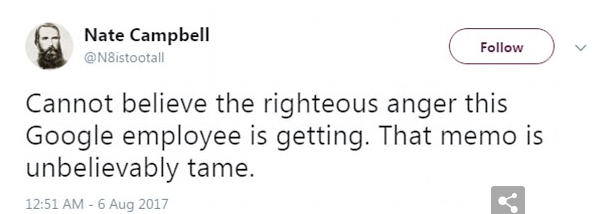
Yesterday, news broke out that Google had fired their engineer James Damore for disseminating a memo which was meant to be an invitation for open and honest discussion on Google’s left bias. CEO Sundar Pichai said the engineer had violated Google’s code of conduct by ‘advancing harmful gender stereotypes’.

DasKapital calls Damore a ‘diversity hater’, and Metro News calls him ‘anti-women’. The Guardian calls the memo ‘sexist’ and shamelessly maintains that the memo argues for the “biological inferiority of his female colleagues, and how this made them less suitable for tech.”

Reading through the 10-page memo myself, I find the memo very reasonable and I stand behind it 100%. Like Damore, I believe that we should stop assuming that gender gaps imply sexism.

What is Damore arguing against?

Damore argues that “Google’s left bias has created a politically correct monoculture that maintains its hold by shaming dissenters into silence.”

The several discriminatory practices that Google has instituted as a result of their left bias are:

  • Programs, mentoring, and classes only for people with a certain gender or race.
  • A high priority queue and special treatment for “diversity” candidates.
  • Hiring practices which can effectively lower the bar for “diversity” candidates by decreasing the false negative rate.
  • Reconsidering any set of people if it’s not “diverse” enough, but not showing that same scrutiny in the reverse direction (clear confirmation bias).
  • Setting org level OKRs for increased representation which can incentivize illegal discrimination.

In short, Damore argues that:

  • Google’s political bias has equated the freedom from offense with psychological safety, but shaming into silence is the antithesis of psychological safety.
  • This silencing has created an ideological echo chamber where some ideas are too sacred to be honestly discussed.
  • The lack of discussion fosters the most extreme and authoritarian elements of this ideology.
  • Extreme: all disparities in representation are due to oppression.
  • Authoritarian: we should discriminate to correct for this oppression.
  • Differences in distributions of traits between men and women may in part explain why we don’t have 50% representation of women in tech and leadership. Discrimination to reach equal representation is unfair, divisive, and bad for business.

What did Damore write about women?

Damore writes that women and men differ biologically and that this results in different personality traits, preferences they hold, and the career choices they make.

On biological differences

Damore writes that men and women differ biologically in many ways and that not all differences are socially constructed:

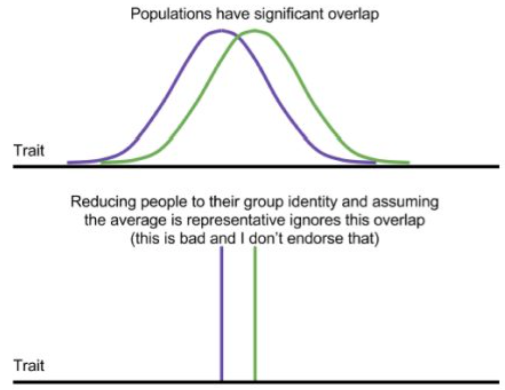
I’m simply stating that the distribution of preferences and abilities of men and women differ in part due to biological causes and that these differences may explain why we don’t see equal representation of women in tech and leadership. Many of these differences are small and there’s significant overlap between men and women, so you can’t say anything about an individual given these population level distributions.

On personality differences

Damore writes that women, on average, have more openness directed towards feelings and aesthetics rather than ideas. This makes them have a stronger interest in people rather than things and explains in part why women relatively prefer jobs in social or artistic areas.

In addition, women express their extraversion as gregariousness and agreeableness rather than assertiveness.

Women, on average, also have higher anxiety, and lower stress tolerance which makes high stress jobs less attractive to women.

Compared to men, women on average also look for more work-life balance.

Damore’s overall message

Damore explains his overall message as follows:

I hope it’s clear that I’m not saying that diversity is bad, that Google or society is 100% fair, that we shouldn’t try to correct for existing biases, or that minorities have the same experience of those in the majority. My larger point is that we have an intolerance for ideas and evidence that don’t fit a certain ideology. I’m also not saying that we should restrict people to certain gender roles; I’m advocating for quite the opposite: treat people as individuals, not as just another member of their group (tribalism).

Again, I think this is extremely reasonable. Unfortunately, in a world driven by irrational and zealous egalitarians, those who use logic and reason are easily labeled bigots.

Reference

Damore, J. (2017). Google’s Ideological Echo Chamber

Freedom of Conscience and the Rule of Law

Of course the concept of “freedom of conscience” was forged in Europe by Spinoza, Locke, Voltaire, John Stuart Mill, and many other philosophers. But the freedom of conscience as an individual right that belongs to set of characteristics which defines the rule of law is an American innovation, which later spread to Latin America and to the Old Continent.

This reflection comes from the dispute which has been aroused in Notes On Liberty about the Protestant Reformation and freedom of conscience. Now, my intention is not to mediate between Mark and Bruno, but to bring to the Consortium a new line of debate. What I would like to polemize is what defines which rights to be protected by the rule of law. In this sense, might we regard a political regime that bans freedom of conscience as based on the rule of law? I am sure that no one would dare to do so. But, instead, would anyone dare to state that unification of language in a given country hurts the rule of law? I am afraid that almost nobody would.

Nevertheless, this is a polemical question. For example, the current Catalan independence movement has the language of Catalan as one of its main claims, so tracing the genealogy of the rights that constitutes the concept of rule of law is a meaningful task —and this is why the controversy over the Protestant Reformation and the origin of Freedom of Conscience at NOL is so interesting.

Before the Protestant Reformation, the theological, philosophical, scientific, and political language of Europe was unified in Latin. On the other hand, the languages used by the common people were utterly fragmented. A multiplicity of dialects were spoken all over Europe. The Catholic Kings of Spain, for example, unified their kingdom under the same religion, but they did not touch the local dialects. A very similar situation might be found in the rest of Europe: kingdoms with one religion and several dialects.

There was a strong reason for this to be so. Before the Medieval Ages Bibles in vernacular had existed, but the literacy rate was so low that the speed of evolution and fragmentation of the dialects left those translations obsolete and incomprehensible. Since printing books was extremely costly (this was before the invention of  the printing press), the best language to write and print books and constitutional documents was Latin.

The Evangelical movement, emerged out of the Protestant Reformation, meant that final authority of religion was not the Papacy any more but the biblical text. What changed was the coordination problem. Formerly, the reference was the local bishop, who was linked to the Bishop of Rome. (Although with the Counter-Reformation, in some cases, like Spain, the bishops were appointed by the king, a privilege obtained in exchange for remaining loyal to the Pope). On the other hand, in the Reformation countries, the text of the Bible as final authority on theological matters demanded the full command of an ability not so extended until that moment: literacy.

It is well-known that the Protestant Reformation and the invention of printing expanded the translations of the Bible into the vernacular. But always goes completely unnoticed that by that time the concept of a national language hardly existed. In the Reformist countries the consolidation of a national language was determined by the particular vernacular which was chosen to translate the Bible into.

Evidently, the extension of a common language among the subjects of a given kingdom had reported great benefits to its governance, since the tendency was followed by the monarchies of France and Spain. The former extended the Parisian French over the local patois and, in Spain of the XVIII Century, the Bourbon Reforms imposed Castilian as the national Spanish language. The absolute kings, who each of them had inherited a territory unified by a single religion, sowed the seeds of national states aggregated by a common language. Moreover, Catholicism became more dependent on absolute kings than on Rome —and that is why Bruno finds some Catholics arguing for the separation of Church from the state.

Meanwhile, in the New World, the Thirteen Colonies were receiving the European immigration mostly motivated on the lack of religious tolerance in their respected countries of origin. The immigrants arrived carrying with them all kind of variances of Christian confessions and developed new and unexpected ones. All those religions and sects had a common reference: the King James Bible.

My thesis is that it was the substitution of religion for language as the factor of cohesion and mechanism of social control that made possible the development of the freedom of conscience. The political power left what was inside of the mind of their subjects a more economical device: language. Think what you wish, believe what you wish, read what you wish, write what you wish, say what you wish, as long as I understand what you do and you can understand what I mean.

Moreover, an official language became a tool of accountability and a means of knowing the rights and duties of an individual before the state. The Magna Carta (1215) was written in Medieval Latin while the Virginia Declaration of Rights (1776), in English. Both documents were written in the language that was regarded as proper in their respective time. Nevertheless, the language which is more convenient to the individual for the defense of his liberties is quite obvious.

Often, the disputes over the genealogy of rights and institutions go around two poles: ideas and matter. I think it is high time to go along the common edge of both of them: the unintended consequences, the “rural nomos,” the complex phenomena. In this sense, but only in this sense, tracing the genealogy – or, better, the “nomology” – of the freedom of conscience as an intended trait of the concept of “rule of law” is worth our efforts.

AI: Bootleggers and Baptists Edition

“Elon Musk Is Wrong about Artificial Intelligence and the Precautionary Principle” – Reason.com via @nuzzel

(disclaimer: I haven’t dug any deeper than reading the above linked article.)

Apparently Elon Musk is afraid of the potential downsides of artificial intelligence enough to declare it “a rare case where we should be proactive in regulation instead of reactive. By the time we are reactive in AI regulation, it is too late.”

Like literally everything else, AI does have downsides. And, like anything that touches so many areas of our lives, those downsides could be significant (even catastrophic). But the most likely outcome of regulating AI is that people already investing in that space (i.e. Elon Musk) would set the rules of competition in the biggest markets. (A more insidious possible outcome is that those who would use AI for bad would be left alone.) To me this looks like a classic Bootleggers and Baptists story.

In Search of Firmer Cosmopolitan Solidarity: The Need for a Sentimentalist Case for Open Borders

Most arguments for open borders are phrased in terms of universalized moral obligations to non-citizens. These obligations are usually phrased as “merely” negative (eg., that Americans have a duty to not impede the movement an impoverished Mexican worker or Syrian refugee seeking a better life) rather than positive (eg., that the first obligation does not imply that Americans have a duty to provide, for example, generous welfare benefits to immigrants and refugees), but are phrased as obligations based on people in virtue of their rationality rather than nationality nonetheless.

Whether they be utilitarian, moral intuitionist, or deontological, what these arguments assume is that nation of origin isn’t a “morally relevant” consideration for one’s rights to immigrate and rely on some other view of moral relevance implicitly as an alternative to try and cement a purely moral solidarity that extends beyond national border. They have in common an appeal to a common human capacity to have rights stemming from something metaphysically essential to our common humanity.

Those arguments are all coherent and possibly valid and are even the arguments that originally convinced me to support open borders. The only problem is that they are often very unconvincing to people skeptical of immigration because they merely beg the question of that moral obligation is irrelevant with respect to nationality. As one of my critics of one of my older pieces on immigration observed, most immigration skeptics are implicitly tribalist nationalists, not philosophically consistent consequentialists or deontologists. They have little patience for theoretical and morally pure metaphysical arguments concluding any obligation, even merely negative, to immigrants. They view their obligations to those socially closer to them as a trump card (pardon the pun) to any morally universalized consideration. So long as they can identify with someone else as an American (or whatever their national identity may be) they view their considerations as relevant. If they cannot identify with someone else based on national identity, they do not view an immigrant’s theorized rights or utility functions as relevant.

There are still several problems with this tribalist perspective, given that nation-states are far from culturally homogenous and cultural homogeneity often transcends borders in some important respects, why does one’s ability to “identify” on the basis of tribal affiliation stop at a nation-state’s borders? Further, there are many other affinities one may have with a foreigner that may be viewed as equally important, if not more important, to one’s ability to “identify” with someone than national citizenship. They may be a fellow Catholic or Christian, they may be a fellow fan of football, or a fellow manufacturing worker, or a fellow parent, etc. Why is “fellow American” the most socially salient form of identification and allows one to keep a foreigner in a state tyranny and poverty, but not whether they are a “fellow Christian” or any of the many other identifiers people find important?

However, these problems are not taken seriously by those who hold them because tribalist outlook isn’t about rational coherence, it is about non-rational sentimental feelings and particularized perspectives on historical affinities. Even if a skeptic of immigration takes those problems seriously, the morally pure and universalizing arguments are no more convincing to a tribalist.

I believe this gets at the heart of most objections Trump voters have to immigration. They might raise welfare costs, crime, native jobs lost, or fear of cultural collapse as post-hoc rationalizations for why they do not feel solidarity with natives, but the fact that they do not feel solidarity due to their nationalist affinities is at the root of these rationalizations. Thus when proponents of open borders raise objections, be it in the form of economic studies showing that these concerns are not consistent with facts or by pointing out that these are also concerns for the native-born population and yet nobody proposes similar immigration restrictions on citizens, they fall on deaf ears. Such concerns are irrelevant to the heart of anti-immigrant sentiment: a lack of solidarity with anyone who is not a native-born citizen.

In this essay, drawing from the sentimentalist ethics of David Hume and the perspective on liberal solidarity of Richard Rorty, I want to sketch a vision of universalized solidarity that would win over tribalists to the side of, if not purely open borders, at least more liberalized immigration restrictions and allowance for refugees. This is not so much a moral argument of the form most arguments for open borders have taken, but a strategy to cultivate the sentiments of a (specifically American nationalist) tribalist to be more open to the concerns and sympathies of someone with whom they do not share a national origin. The main goal is that we shouldn’t try to argue away people’s sincere, deeply held tribalist and nationalist emotions, but seek to redirect them in a way that does not lead to massive suffering for immigrants.

Rorty on Kantian Rationalist and Humean Sentimentalist Arguments for Universalized Human Rights

In an article written by American pragmatist philosopher Richard Rorty called “Rationality, Sentimentality, and Human Rights,” he discusses two strategies for expanding human rights culture to the third world. One, which he identifies with philosophers such as Plato and Kant, involves appealing to some common faculty which all humans have in common—namely rationality—and claim all other considerations, such as kinship, custom, religion, and (most importantly for present purposes) national origin “morally irrelevant” to whether an individual has human rights and should be treated as such. These sort of arguments, Rorty says, are the sort that try to use rigorous argumentation to answer the rational egoist question “Why should I be moral?” They are traced back to Plato’s discussion of the Ring of Gyges in the Republic through Enlightenment attempts to find an algorithmic, rational foundation of morality, such as the Kantian categorical imperative. This is the sort of strategy, in varying forms, most arguments in favor of open borders try to pursue.

The second strategy, which Rorty identifies with philosophers such as David Hume and Annette Baier, is to appeal to the sentiments of those who do not respect the rights of others. Rather than try to answer “Why should I be moral?” in an abstract, philosophical sense such that we have a priori algorithmic justification for treating others equal, this view advocates trying to answer the more immediate and relevant question “Why should I care about someone’s worth and well-being even if it appears to me that I have very little in common with them?” Rather than answer the former question with argumentation that appeals to our common rational faculties, answer the latter with appealing to our sentimental attitudes that we do have something else in common with that person.

Rorty favors the second Humean approach for one simple reason: in practice, we are not dealing with rational egoists who substitute altruistic moral values with their ruthless self-interest. We are dealing with irrational tribalists who substitute more-encompassing attitudes of solidarity with less-encompassing ones. They aren’t concerned about why they should be moral in the first place and what that means, they are concerned with how certain moral obligations extend to people with whom they find it difficult to emotionally identify. As Rorty says:

If one follows Baier’s advice one will not see it as the moral educator’s task to answer the rational egoist’s question “Why should I be moral?” but rather to answer the much more frequently posed question “Why should I care about a stranger, a person who is no kin to me, a person whose habits I find disgusting?” The traditional answer to the latter question is “Because kinship and custom are morally irrelevant, irrelevant to the obligations imposed by the recognition of membership in the same species.” This has never been very convincing since it begs the question at issue: whether mere species membership is, in fact, a sufficient surrogate closer to kinship. […]

A better sort of answer is the sort of long, sad, sentimental story which begins with “Because this is what it is like to be in her situation—to be far from home, among strangers,” or “Because she might become your daughter-in-law,” or “Because her mother would grieve for her.” Such stories, repeated and varied over the centuries, have induced us, the rich, safe and powerful people, to tolerate, and even to cherish, powerless people—people whose appearance or habits or beliefs at first seemed an insult to our own moral identity, our sense of the limits of permissible human variation.

If we agree with Hume that reason is the slave of the passions, or more accurately that reason is just one of many competing sentiments and passions, then it should come as no surprise that rational argumentation of the form found in most arguments for open borders are not super convincing to people for whom reason is not the ruling sentiment. How does one cultivate these other sentiments, if not through merely rational argumentation? Rorty continually comments throughout his political works that novels, poems, documentaries, and television programs—those genres which tell the sort of long sad stories commented on above—have replaced sermons and Enlightenment-era treatises as the engine of moral progress since the end of the nineteenth century. Rational argumentation may convince an ideal-typical philosopher, but not many other people.

For Rorty, the application of this sentimental ethics had two main purposes, the first of which is mostly irrelevant for present purposes and the second of which is relevant. First, Rorty wanted to make his vision of a post-metaphysical, post-epistemological intellectual culture and a commonsensically nominalist and historicist popular culture compatible with the sort of ever-expanding human solidarity necessary for political liberalism; a culture for which the sort of algorithmic arguments for open borders I mentioned in the first half of this article would not seem convincing for more theoretical reasons than the mere presence of nationalist sentiment. Though that is an intellectual project with which I have strong affinities, one need not buy that vision for the purposes of this article—that of narrowly applying sentimental ethics to overcome nationalist objections to immigration.

The second, however, was to point out a better way to implement the liberal cultural norms to prohibit the public humiliation of powerless minorities. The paradigmatic cases Rorty says such a sentimental education has application are how Serbians viewed Muslims, how Nazis viewed Jews, or how white southern Confederates viewed African-American slaves. Though those are far more extreme cases, it is not a stretch to add to that list the way Trump voters view Muslim refugees or Mexican migrant workers.

A Rortian Case against Rortian (and Trumpian) Nationalism

Though Rorty was a through-and-through leftist and likely viewed most nationalist arguments for restricting immigration and especially keeping refugees in war-zones with scorn, there is one uncomfortable feature of his views for most radical proponents of immigration. It does leave very well open the notion of nationalism as a valid perspective, unlike many of the other arguments offered.

Indeed, Rorty—from my very anarchist perspective—was at times uncomfortably nationalist. In Achieving Our Country he likens national pride to self-respect for an individual, saying that while too much national pride can lead to imperialism, “insufficient national pride makes energetic and effective debate about national policy unlikely.” He defended a vision of American national pride along the lines of Deweyan pragmatism and transcendentalist romanticism as a nation of ever-expanding democratic vistas. Though radically different from the sort of national pride popular in right-wing xenophobic circles, it is a vision of national pride nonetheless and as such is not something with which I and many other advocates of open borders are not sympathetic with.

Further, and more relevant to our considerations, is he viewed national identity as a tool to expand the sort of liberal sentiments that he wanted. As he wrote in Contingency, Irony, and Solidarity:

Consider, as a final example, the attitude of contemporary American liberals to the unending hopelessness and misery of the lives of the young blacks in American cities. Do we say these people must be helped because they are our fellow human beings? We may, but it is much more persuasive, morally as well as politically, to describe them as our fellow Americans—to insist it is outrageous that an American to live without hope. The point of these examples is that our sense of solidarity is strongest when those with whom solidarity is expressed are thought of as “one of us,” where “us” means something smaller and more localized than the human race.

It is obvious why many critics of immigration restrictions would view this attitude as counterproductive. This type of description cannot be applied in many other scenarios at all relevant to questions of immigration at all. Liberalism, in the sense Rorty borrowed from Shklar (and also the sense which I think animates much of the interest in liberalized immigration policies), as an intense aversion to cruelty is concerned with merely ending cruelty as such. It wants to end cruelty whether it be the cruelty of the American government to illegal immigrants or suffering of native-born African-Americans as a result of centuries of cruelty by racists. This is surely something with which Rorty would agree as he writes elsewhere in that same chapter:

[T]here is such a thing as moral progress and that progress is indeed in the direction of greater human solidarity. But that solidarity is not thought of as recognition of a core self, the human essence, in all human beings. Rather, it is thought of as the ability to see more and more traditional differences (of tribe, religion, race, customs, and the like) as unimportant when compared to the similarities with respect to pain and humiliation—the ability to think of people wildly different from ourselves in the range of ‘us.’

Surely, that moral progress doesn’t stop at the unimportant line of a national border. The problem is that appeals to national identity of the sort Rorty uses, or of mythologized national histories, do stop at the border.

Rorty is right that it is easier for people to feel a sense of solidarity with those for whom there are fewer traditional differences, and that no amount of appeal to metaphysical constructions of human rationality will fully eclipse that psychological fact. However, the problem with forms of solidarity along national identity is it is much easier for people to stop there. In modern pluralistic, cosmopolitan societies such as America, it is hard for someone to stop their sense of solidarity at religion, tribe, custom and the like. This is because the minute they walk out the door of their home, the minute they arrive at their workplace, there is someone very close to them who would not fit that sense of solidarity yet someone for whom they would still feel some obligation, just based off of seeing the face of that person, off of mere proximity.

Stopping the line at national identity is much easier since many Americans, particularly those in the midwestern and southeastern states which gave Trump his presidency, will rarely interact with non-nationals on a regular basis while they will more likely interact with someone who is more distant from them in other ways. While other forms of solidarity are unstable for most because they are too localized, nationalism is stable because it is too general to be upset by experience of others while not general enough to be compatible with liberalism. Moral progress, if we pursue Rorty’s explicitly nationalist project, will halt at the national borders and his liberal project of ending cruelty will end with it. There is an inconsistency between Rorty’s liberalism and his belief in national pride.

Further, insisting “because they are American” leads people to ask what it means to “be American,” a question which can only be answered, even by Rorty in his description of American national pride, by contrast with what isn’t American (see his discussion of Europe in “American National Pride). It makes it difficult to see suffering as the salient identifier for solidarity, and makes other ‘traditional’ differences standing in the way of Rorty’s description of moral progress as more important than they should be. Indeed, this is exactly what we see with most xenophobic descriptions of foreigners as “not believing in American ideals.” Rorty’s very humble, liberalized version of national pride faces a serious danger of turning into the sort of toxic, illiberal nationalism we have seen in recent years.

Instead, we should substitute the description Rorty offers as motivating liberal help for African-Americans in the inner city ,‘because they are American,’ with the redescription Rorty uses elsewhere: ‘because they are suffering, and you too can suffer and have suffered in the past.’ This is a sentimental appeal which can apply to all who are suffering from cruelty, regardless of their national identity. This is more likely to make more and more other differences seem unimportant. As Rorty’s ideas on cultural identity politics imply, the goal should be to replace “identity”—including national identity—with empathy.

Thus, in making an appeal to Rorty’s sentimentalism for open border advocates, I want to very clearly point out how it is both possible and necessary to separate appeals to solidarity and sentiment from nationalism to serve liberal ends. This means that the possibility of nationalist sentiments of seeming acceptable to a non-rationalist form of ethics should not discourage those of us skeptical of nationalism from embracing and using its concepts.

Sentimental Ethical Appeals and Liberalized Immigration

The application of this form of sentimental ethics for people who merely want to liberalized immigration should be obvious. Our first step needs to be to recognize that people’s tribalist sentiments aren’t going to be swayed by mere rationalist argumentation as it merely begs the question. Our second step needs to be to realize that what’s ultimately going to be more likely to convince them aren’t going to get rid of people’s tribalist sentiments altogether, but to redirect them elsewhere. The goal should be to get people to see national identity as unimportant to those sentiments compared to other more salient ones, such as whether refugees and immigrants are suffering or not. The goal should be for nationalists to stop asking questions of immigrants like “Are immigrants going to be good Americans like me?” and more “Are they already people who, like me, have suffered?”

This does not mean that we stop making the types of good academic philosophical and economic arguments about how immigration will double the global GDP and how rights should be recognized as not stopping with national identity—those are certainly convincing to the minority of us to whom tribalism isn’t an especially strong sentiment. However, it does mean we should also recognize the power of novels like Under the Feet of Jesus or images like the viral, graphic one of a Syrian refugee child who was the victim of a bombing which circulated last year. The knowledge that Anne Frank’s family was turned down by America for refugee status, the feelings of empathy for Frank’s family one gets from reading her diary, the fear that we are perpetuating that same cruelty today are far more convincing than appeals to Anne Frank’s natural rights in virtue of her rational faculties as a human being.

Appeals to our common humanity in terms of our “rational faculties” or “natural rights” or “utility functions” and the like are not nearly as convincing to people who aren’t philosophers or economists as appeals to the ability of people to suffer. Such an image and sentimental case is far more likely to cultivate a cosmopolitan solidarity than Lockean or Benthamite platitudes.

References:

Rorty, Richard. “American National Pride: Whitman and Dewey.” Achieving our Country: Leftist Thought in Twentieth Century America. Rpt. in The Rorty Reader. Ed. by Christopher J. Voparil and Richard J. Bernstein. Malden: Blackwell Publishing Ltd, 2010. 372-388. Print.

Rorty, Richard. “Human Rights, Rationality, and Sentimentality.” On Human Rights: The Oxford Amnesty Lectures. Rpt. in The Rorty Reader. Ed. by Christopher J. Voparil and Richard J. Bernstein. Malden: Wiley-Blackwell Publishing Ltd, 2010.
352-372. Print.

Rorty, Richard. Contingency, Irony, and Solidarity. Cambridge: Cambridge University Press, 1999. Print.

 

Trump Jr.

Last school year I had to deal with a pair of students (Tweedledee and Tweedledum) I caught cheating on a takehome final. When confronted with the evidence, each insisted that it was the other’s fault, and that only that other student should face any consequences.

Bear in mind that if they complete their degrees, they would be in the top 30% of the population in terms of educational attainment. In today’s world, that basically means they’re among the best and brightest, they’re high status, and they’re “the future”. If we could meaure status on a linear scale, getting a college degree still pushes you high up on that scale. 

At the time I figured that they were at least towards the bottom of that top 30%. Certainly, I still hope they’ll grow out of it. Unfortunately, Draco Malfoy’s Junior’s latest scandal shows that being bad at cheating isn’t the social hinderance we might have hoped for.

Related link: http://reason.com/blog/2017/07/13/how-trump-apologists-will-defend-the-ind

Minimum Wages: Where to Look for Evidence (A Reply)

Yesterday, here at Notes on Liberty, Nicolas Cachanosky blogged about the minimum wage. His point was fairly simple: criticisms against certain research designs that use limited sample can be economically irrelevant.

To put you in context, he was blogging about one of the criticisms made of the Seattle minimum wage study produced by researchers at the University of Washington, namely that the sample was limited to “small” employers. This criticism, Nicolas argues, is irrelevant since the researchers were looking for those who were likely to be the most heavily affected by the minimum wage increase since it will be among the least efficient firms that the effects will be heavily concentrated. In other words, what is the point of looking at Costco or Walmart who are more likely to survive than Uncle Joe’s store? As such, this is Nicolas’ point in defense of the study.

I disagree with Nicolas here and this is because I agree with him (I know, it sounds confused but bear with me).

The reason is simple: firms react differently to the same shock. Costs are costs, productivity is productivity, but the constraints are never exactly the same. For example, if I am a small employer and the minimum wage is increased 15%, why would I fire one of my two employees to adjust? If that was my reaction to the minimum wage, I would sacrifice 33% of my output for a 15% increase in wages which compose the majority but not the totality of my costs. Using that margin of adjustment would be insensible for me given the constraint of my firm’s size. I might be more tempted to cut hours, cut benefits, cut quality, substitute between workers, raise prices (depending on the elasticity of the demand for my services). However, if I am a large firm of 10,000 employees, sacking one worker is an easy margin to adjust on since I am not constrained as much as the small firm. In that situation, a large firm might be tempted to adjust on that margin rather than cut quality or raise prices. Basically, firms respond to higher labor costs (not accompanied by greater productivity) in different ways.

By concentrating on small firms, the authors of the Seattle study were concentrating on a group that had, probably, a more homogeneous set of constraints and responses. In their case, they were looking at hours worked. Had they blended in the larger firms, they would have looked for an adjustment on the part of firms less to adjust by compressing hours but rather by compressing the workforce.

This is why the UW study is so interesting in terms of research design: it focused like a laser on one adjustment channel in the group most likely to respond in that manner. If one reads attentively that paper, it is clear that this is the aim of the authors – to better document this element of the minimum wage literature. If one seeks to exhaustively measure what were the costs of the policy, one would need a much wider research design to reflect the wide array of adjustments available to employers (and workers).

In short, Nicolas is right that research designs matter, but he is wrong in that the criticism of the UW study is really an instance of pro-minimum wage hike pundits bringing the hockey puck in their own net!

More simple economic truths I wish more people understood

There are only four ways to spend money:

  1. You spend your money with yourself.
  2. You spend your money with others.
  3. You spend other’s money with yourself.
  4. You spend other’s money with others.

Just think about it for one second and you will agree: these are the only possible ways to spend money.

The best way to spend money is to spend your money with yourself. The worst is when you spend other’s money with others.

When you spend your money with yourself, you know how much money you have and what your needs are.

When you spend your money with others, you know how much money you have but you don’t know as well what other’s needs are.

When you spend other’s money with yourself you know your needs but you don’t know how much money you can actually spend. In a situation like this, some people will shy away from spending much money (when they actually could) and will end up not totally satisfied. Other people will have no problem like that and will spend as crazy, not noticing that they are spending too much. It doesn’t matter what kind of person you are: the fact is that this is not a good way to spend money.

When you spend other’s money with others you have the worst case scenario: you don’t know other’s needs as well as they know and you also don’t have a clear grasp of how much money you can actually spend.

In a true liberal capitalist society, the majority of the money is spent by individuals on their own needs. The more a society drifts away from this ideal, the more people spend money that is not actually theirs on other people. The more money is misused.

The government basically spend money is not theirs on other people. That’s why government spending is usually bad. Even the most well-meaning government official, more in line with your personal beliefs, will probably not spend your money as well as you could yourself.