Economics and the Mirror of Nature

Editorial Note: This is an old and longform essay I wrote on the philosophy of economics and economic methodology originally for a history of economic thought class as a sophomore undergraduate at Hillsdale College back in April of 2015. I am uploading it here mostly for posterity as a historical interest in my own intellectual development and for any curious onlookers interested in what interpretive economic social theory could look like–at least at a high, sketchy and not detailed level.

It is worth noting that there is an obvious thing I should have done differently: it really should have treated the “ecological rationality” of figures like Vernon Smith and the later FA Hayek as a fourth alternative paradigm to the sort of rationality practiced by neoclassicals, the interpretive rationality practiced by some Austrians and the Bounded Rationality practiced by behavioral economists. This ecological notion of rationality which makes room for neoclassical-style constructivist theories of rationality–so long as they are understood as maps and not the terrain–is something I am more sympathetic towards these days alongside the intepretive, hermeneutic sort of rationality argued for in this essay.

I still think it gets a lot of the genealogical and psychological diagnosis of what historically has gone wrong in economic questions about rationality as developed by neoclassical, behavioral, and Misesean Austrian economics by relying too much on an unquestioned epistemic foundationalism , but I think normative pragmatists like Robert Brandom offer us a more constructively and ecologically critical way forward than I was aware of when I penned this paper.

The essay is presented here largely as it was originally written, with only minimal editing. Its sophomoric sketchiness, grand but unrealized ambitions, and rough edges are intact.

Economics and the Mirror of Nature: Richard Rorty’s Hermeneutics as an Approach to the Historical Study of Rationality in Relation to Economic Theory and Method

The conception of man as a “rational actor” is one of the key foundations of modern economic thinking. However, what exactly economists mean by “rationality” in the technical sense has historically been a fairly sticky issue that has evolved as economic theory has evolved. In some ways, rationality is tied up with epistemological problems in economic methodology. In other ways, it has been tied to value theory, expectations theory, and a host of other issues that seem like pure theoretical theory than meta-economic questions of method. However, a historical treatment of how economists have come to understand rationality deserves sensitivity to how economists have understood internal problems to economics itself and the relationship to the nature of the economic science.

FA Hayek (1952) lays out the potential for a progressive research program in the history of thought in the social sciences in his work Counterrevolution of Science. For Hayek, “scientism,” viewing the research program of the social sciences as essentially the same as the natural sciences, is prevalent the intellectual discourse about the social sciences. Hayek objects to “the objectivism of the scientistic approach” insofar as it treats the data of the social sciences as fundamentally the same as the data of the physical sciences, objective, measurable phenomena. For Hayek, this leads to “rationalist constructivism” in approach to solving the problems of society. Examples of “rationalist constructivism” include most primarily August Comte’s approach to social engineering and sociology and socialist attempts to design economies.

In a similar vein, Richard Rorty’s Philosophy and the Mirror of Nature (1980) objects to what he calls the “Platonic Kantian” approach to philosophy. For Rorty, the “image of the mind as a great mirror, containing various representations—some accurate, some not—and being capable of being studied by pure, nonempirical methods” (12) has lead philosophy astray into a series of non-constructive topics such as philosophy of mind and philosophy of language in which philosophers tried to “ground” all of knowledge in a way that every rational being could agree.

This paper proposes that FA Hayek’s program of “rational constructivism” should be viewed as a complementary approach to Richard Rorty’s program in the history of philosophy as laid out in the Mirror of Nature. Following the tradition of Lavoie (1990), this paper argues that a hermeneutical exegesis of economics as a whole, not simply one or the other tradition, might help bring the various “schools” of economics into better dialogue with each other. The first part lays out a partial history of one subject, utility theory, in which economics has attempted to objectify itself into the realm of natural science drawing heavily off of Zouboulakis’ Varieties of Economic Rationality (2013). The second part argues that Rorty’s hermeneutical approach can explain the historical narrative in a Hayekian way. A concluding section reflects on areas needed for further research.

Part 1: Our Utilitarian Essence
One of the fundamental assumptions, especially of the English school during the marginal revolution, in the formation of the economics science as we know it today was presupposing a fairly simple psychology of utilitarianism drawing from Bentham. However, this idea of utility theory as foundational to economics was eventually replaced by Pareto’s ordinal approach to utility theory. The title of this section draws from the title of the first section of Rorty’s Mirror of NatureL “Our Glassy Essence,” which reflects on how the image of “the mind as mirror” came into existence. This section lays out how utility came to be viewed as “essential” to the meaning of economics

Rationality as Utility Maximization: Jevons and the English Marginal Revolution
When economists say “rationality,” they have always intended it as a term of art. Thus phrases such as “rational action,” “rational actor,” and “rationality” in the technical economic sense have never really meant what is thought by these phrases in the everyday sense. In the everyday sense, what is typically meant by “rational” is that one is holding a belief based on reasonable evidence. However, for early economists rationality has always been tied up with some sense of individualized self-interest.

The most primitive version of rationality as an economic term of art was found in the work of classical political economist and utilitarian philosopher Jerome Bentham. For the early nineteenth century economists, to be rational was to maximize utility in the Benthamite sense; to maximize pleasure and minimize pain in a very broad sense. Thus early economic ideas of a rationally self-interested actor were intimately related to utility. An example of this idea of rationality as pursuit of utility is the work of William Jevons. Though Jevons never used the term “rationality,” it is clear in his work that the concept today called “rationality” is very central to Jevon’s work. Jevons adopted a very strong conception of rationality in line with homo economicus.

In order to understand how Jevons conceived of economics, it is important to understand its place in his broader context of economic thought on economic method. In his Theory of Political Economy (1871/2013),Jevons claimed that “Economics, if it is to be a science at all, must be a mathematical science” (434). This is largely because Jevons had a strong commitment to making economics analogous to physics. As he wrote in the first edition of TPE (1871/2013):

The theory of economy, thus treated, presents a close analogy to the science of Statistical Mechanics, and the Laws of Exchange are found to resemble the Laws of Equilibrium of a lever as determined by the principle of virtual velocities. (cited in Zouboulakis 2013,  26).

Unlike physics, however, Jevons claimed economics was “peculiar” because “its ultimate laws are known to us first by intuition, or at any rate they are furnished to us ready made by other mental or physical sciences” (cited in  Zouboulakis 2013, 30).

As Zouboulakis (2013) notes, a very strong conception of rationality Jevons insisted upon almost axiomatically was necessary to give economics this extreme level of mathematical and scientific rigor. In order to make rationality such a strong concept, Jevons would rely upon a Benthamite utilitarian theory with a heavily scientific flavor. He argued the idea that people maximize pleasure and avoid pain is an “obvious psychological law” on which “we can proceed to reason deductively with great confidence” (cited in Zouboulakis 2013, 30-31). For Jevons (1871/2013), “pleasure and pain bare undoubtedly the ultimate objects of the Calculus of Economics” (440). Utility, therefore, is the the central object of Jevon’s economic inquiry. Jevons, quoting Bentham, defines as “that property in any object, whereby it tends to produce benefit, advantage, pleasure, good, or happiness” (1871/2013, 438). Jevons maintains a concept of “total utility (440) that may be “estimated in magnitudes” (435). This idea of rationality is, to quote Herbert Simon (1978) “omniscient,” meaning is there is little to no concept of uncertainty, limited information, or psychological error taken into account in how people pursue rational self-interest, it is simply a law of psychology that people always seek to maximize utility, a law that is central for his understanding of economics as a science.

Jevons was not alone in his strong conception of understanding of rationality as a maximization principle. Zouboulakis (2013) argues that Cournot, Walras, and Marshall, all shared a similar conception of rationality to Jevons (35). In fact, Walras (Zouboulakis 2013) in line with Jevons adopted a strong conception of economics as another sort of mathematical physics. Edgeworth (1881/2013), though he doubted that Jevons was entirely correct on to what extent total utility was quantifiable still generally adopted the utilitarian outlook Jevons had assumed, as well as the mathematical outlook as he extensively compared it to physics (504-505).

To summarize, the concept of rationality as formulated by Jevons consists of the following four unique theoretical features:

  1. Defined as a maximization of total cardinal utility
  2. United with a psychological hypothesis
  3. Irrefutable, obviously true about human nature
  4. Assumes omniscience

It is dependent on another methodological feature: that economics is to be viewed mathematically and analogous to physics on some important level. It is important to note, however, that the early neoclassical economists were not wholly homogeneous in their outlook of economics as a science. Alfred Marshall argued that “economics cannot be compared with the exact physical sciences: for it deals with the ever changing and subtle forces of human nature” (qtd. in McKenzie 2009). Though Marshall’s conception of rationality was still largely in line with Jevons, his softer methodological positions would allow for a softening of rationality as a concept after the marginal revolution.

Rationality asInstrumentalism: Pareto’s Departure from Utility Theory
In addition to the concept of economics as a completely mathematical science, other assumptions that led to Jevon’s omniscient conception of rationality would be threatened. After the marginal revolution, primary cornerstones of how Jevons conceived of rationality, cardinal utility as a quantifiable concept, would be rejected by the economics profession. The key insight from Jevon’s subjective utility theory was his marginal analysis, his insight from the theory of exchange that consumers seek to equilibrate the ratios between the marginal utilities (what Jevons calls the “degree of utility”) of goods.

Though Jevon’s conception of total utility “constituted the metaphysical foundation of utilitarian economics, neither [its] measurement nor even their existence was central to their methods” (Read 2004). At the dawn of the twentieth century, Pareto had brought about the ordinal revolution. Any reference to “cardinal utility,” that is utility as a measurable concept, was completely removed. Instead, for Pareto, any measurable cardinal utility was replaced by ordinal utility—utility as a relative comparison of some basket of goods (cited in Read 2004).

With the change in utility followed a change, in the conception of rationality. Since one of the key theoretical implications of Jevon’s rationality thought was disproven, economists could greatly weaken what they meant by rationality. First, Pareto distanced rationality from being any sort of an axiomatic psychological claim. He did this by adopting a more positivist, experimental approach to economics, he declared “I am a believer in the efficiency of experimental methods. For me there exist no valuable demonstrations except those that are based on facts” (cited in Zouboulakis 2013, 37). However, given his rejection of cardinal utility, the hypothesis that rational actors can maximize utility becomes meaningless and untestable since it is unclear what they are maximizing (Zouboulkis 2013, 38). As Pareto said, “Let us suppose that we have a schedule of all possible choices indicating the order of preference. Once this schedule is available, homo œconimicus can leave the scene” (cited in Zouboulakis 2013, 38).

Instead, Pareto focuses only on the “facts” which he asserts are “the sales of certain goods and certain prices” (cited in Zouboulakis 2013, 38). In other words, Pareto is only concerned with the impact of rational choice theory in a market setting, not with the psychology behind those facts. For Pareto, then, “rationality is simply a choice of efficient means for serving any independently given objective,” Zouboulakis (2013) calls Pareto’s an “instrumental” conception of rationality (38).

For Pareto, contra Jevons, the extent to which rationality was wholly applicable to all of humanity was extremely limited. In his later works, he made a strong distinction between “logical” and “non-logical actions.” As Zaboulkis (2013, 39-41) puts it, logical actions are those in which the “subjective aim of the actor is reasonably connected with the action’s objective goal,” whereas everything else are things that man do not have control other such as psychological factors that an economist takes as given. This greatly limits the extent of human action that economics studies from Jevon’s attempts to universalize utilitarian psychological hypotheses.

To summarize, Pareto’s conception of rationality has the following theoretical features:

  1. Non-psychological
  2. Given within a means-ends framework (Instrumental)
  3. Non-universal, non-omniscient

Rationality as Purposeful Action: Mises’ Austrian Tautology

While Pareto had developed a fairly weak conception of rationality in contrast to Jevons, a separate tradition in the Austrian school of economists had developed a similar, though different, conception of rationality. This latter type of rationality is the conception primarily taken up by Ludwig von Mises and Carl Menger. In order to understand the Austrians, it is important to understand the historical context it was born out of in contrast to Pareto. Pareto was primarily influenced by Anglophonic and Francophonic marginalists, and had inherited from that tradition a strong conception of rationality wedded to cardinal utility that he had to soften with ordinal utility. In contrast, Mises had inherited the marginal utility theories of Menger (which included no reference to “total utility” as a cardinal concept to begin with), and had participated in the climate of the Methodenstreit which had placed heavy emphasis on theoretical methodology. Because of this, Mises’ idea of rationality bears resemblance to Pareto in important ways, however differs because of Mises’ and Pareto’s differing methods.

For Mises, to say that man is a rational actor is a tautological truth, he claims that “[h]uman action is necessarily rational” (1949/1998 18-19).[1] Though this sounds like a universalist claim found in Jevons, it is fundamentally different. For Mises to be a rational actor is not a psychological hypothesis, it simply means that man acts, or that he “the employment of means for the attainment of ends” (13). To be rational is simply to act purposefully, not to choose anything that an economist would normatively say one should chose such as maximization of cardinal utility.

It is important to note that unlike Jevons, the Austrian school adopted from the outset that rational actors are not omniscient. As Menger argued in his first statement of subjective value theory:

Even individuals whose economic activity is conducted rationally, and who therefore certainly endeavor to recognize the true importance of satisfactions in order to gain an accurate foundation for their economic activity, are subject to error. Error is inseparable from all human knowledge. (148)1

Likewise, Mises devoted a whole chapter of his magnum opus (1949/1998) to the concept of uncertainty (105-118).

It may be seen that there is a certain overlap between Mises’ idea of rationality and Pareto’s. Both have significantly weaker ideas of rationality than is implied by the utilitarians, and both distinguish economic rationality very carefully from psychology. For Mises, this means defining action as rational and defining its opposite “not irrational behavior, but a reactive response to stimuli” (1949/1998, 20). For Pareto, this means distinguishing between logical action and non-logical action and applying economic rationality only to the former.

However, there are important differences between Pareto and Mises: namely, Mises universalizes rationality as applied to all human action, Pareto does not. This is primarily due to differences in what is meant by “action,” Mises tautologically defines all action as rational, whereas Pareto simply makes action an instrument that is applied to a means-end framework. Thus, for Mises rationality defines the means-ends framework, for Pareto it is a tool that helps men pursue ends. The reason for this difference lies in their different views on economic methodology. Recall that Pareto is only concerned with facts that can be experimentally derived. However, Mises includes tautologies as an important part of his economic method which he calls “methodological a priorism” (1949/1998). Mises claims “tautologies” are helpful in providing “cognition” and “comprehension of living and changing reality” (38). Whereas Pareto would have scoffed at Mises idea of rationality as useless, for Mises it was a helpful a priori assumption for economic analysis, or in his terms “praxeological reasoning.”

To summarize, Mises’ weaker idea of rationality is marked by the following three qualities and assumes an a priorist methodological background:

  1. Rationality defines a means-end framework (is tautological)
  2. Is universal by a non-omniscient definition
  3. Non-psychological

The extent to which Mises’ idea of theory can be thought of as “foundational” to the rest of his social science is disputable. Clearly, Mises thought his theory was absolutely foundational, however that need not be the “foundation” of the rest of his economics. Zoboukalis seems to oversimplify in claiming that there’s a fundamental difference between Weber’s conception of an “ideal type” of rationality as universal and Mises’ conception of rationality as to some extent tautological. Boettke and Leeson (2006) claim that Mises rejected the analytic/synthetic distinction, thereby placing him in a more complex position than simple Kantian epistemology. However, Boettke, Lavoie, and Storr (2001) claim that Mises’ distinction between theory and history was “arbitrary” and use the philosophy of John Dewey to argue against it.

Rationality: How Lionel Robbins Misunderstood Mises, How Hayek Challenged Mises

The extent to which there is a universal “Austrian” conception of rationality is also disputable. Zaboukalis understands this in comparing the rationality of FA Hayek to Mises. Zaboukalis argues that Robbins presented Mises’ concept of rationality as “consistency” for a normative ideal in his work The Nature and Significance of Economic Science. This is supportable when Robbins (1932/2005 140) says:

There is nothing in its generalisations which necessarily implies reflective deliberation in ultimate valuation. It relies upon no assumption that individuals act rationally. But it does depend for its practical raison d’etre upon the assumption that it is desirable that they should do so. It does assume that, within the bounds of necessity, it is desirable to choose ends which can be achieved harmoniously.

Mises’ welfare economics clearly do not include all the presumptions that consistent action is “normative” that Robbins’ neoclassical misinterpretation of Mises presupposes. Mises explicitly says in Human Action that man’s preferences are situated in time and therefore are inconsistent over time. Mises places emphasis on man’s preferences as situated in time and uncertainty, Robbins makes the preferences sound as if they are independent of time and uncertainty in every sense.

Rizzo (2013) puts emphasis on how Mises postulated the meaning of economics to be primary. This passage is worth quoting at length:

First, we must distinguish between the meaning of behavior and criteria for the rationality of behavior. Abstract criteria of rationality cannot be applied without first understanding what individuals mean by what they do. Getting the meaning wrong may result in inaccurately labeling the behavior as irrational.

In Zoboukalis’ presentation, this lead Samuelson (1938) to present his revealed theory of preferences, which included the assumption of invariance, in Economica. Samuelson seems to have misunderstood Robbin’s misunderstanding of Mises on an even deeper level. In 1937 which Zoboukalis presents as “the year of uncertainty,” there were several challenges to Mises, one of which included Hayek’s challenge to Mises in Economics and Knowledge (cited in Zoboukalis, 1938). Kirzner (2001 81-89) argues that Hayek misunderstood what Mises thought about rationality. Mises did not take invariance through time to be normative, he took it to be positive at a particular instance.

Economics without Constancy in Utility: Preference Theory, Behavioral Economics as Paradigms aiming to be “Successor Subjects”

In response to the challenges to invariance raised by Hayek, Friedman and Samuelson, Zoubakalis argues, made a defense of the normative criterion of rationality, which became standard in the “neoclassical synthesis.” This was primarily the “as-if” methodology of Friedman which Austrians find so objectionable. In the research program of this paper, Lavoie’s (1980) hermeneutical way of dealing with the problem of pure methodological instrumentalism will be an issue. Lavoie argues for a way of doing economics without epistemic foundationalism, drawing directly off Rorty. The extent to which there is a balance established between what Lavoie sees as the crude epistemic foundationalism of Freidman’s positivist approach and the possibly foundationalist a priori approach of Mises will be perhaps the main focus of further research in this program. However, unlike Lavoie, the Hermeneutics will be more likely drawn directly from Rorty than Gadamer.

After Freidman, the invention of behavioral economics in Kahneman and Tverskey challenged several of the positive assumptions of neoclassical theory. Kahneman (2012) describes the Chicago school’s views on the matter in relation to the behavioral economic one as follows:

The only test of rationality is not whether a person’s beliefs and preferences are reasonable, but whether they are internally consistent. A rational person can believe in ghosts so long as all her other beliefs are consistent with the existence of ghosts. A rational person can prefer being hated or being loved, so long as his preferences are consistent. Rationality is logical coherence, reasonable or not. Econs are rational by this definition but there is overwhelming evidence that humans cannot be.

In modern neo-classical economics, which has incorporated Kahneman’s theories of loss aversion and hyperbolic discounting as mathematically as possible, this is an oversimplification. However, there is reason to believe that the rigid formalism of modern Chicago economics may or may not be consistent with the best means of developing a research program, however useful it might be in many contexts.

Recent scholarship on the relationship between behavioral economics and neoclassical theory has tried to figure out how to get past utility without invariance through time. This issue suggests there is no such thing as “true preferences” as Pareto, Samuelson, and Friedman implicitly assumed. Stigler (1977), in violation of typical Chicago school method posited a way of assuming there were “true preferences” by making appeal to the possibility that our preferences are developed into some preferences everyone could agree on in time. For example, one who tastes wine initially might not know what they are doing; however, with time, they become a wine connoisseur, and in general wine connoisseur agree on their preferences. Drawing of Stigler, Robb (2009) draws of Nietzsche’s psychology to further support Stigler’s theories. Heckman (2009), in a comment on Robb’s paper responded in typical neoclassical fashion, claiming the psychological theories of Neitzsche can be made endogenous in the neoclassical model with some mathematical tweaks. Robb made some amazingly insightful comments in response:

However, I am not prepared to take the easy way out and fully accept (R1) as Nietzschean Economics. Sticking with Occam’s razor, I would propose, as an alternative to (R1), that our engagement with time is twofold and a portion of it lies outside of pleasure maximization. While lacking the precision of fully specified models, the WTP approach gives specific predictions that are useful in practical problems in economics. Nietzsche, along with Heraclites, Kierkegaard, Hegel and Bergson, was the philosopher of becoming – whether I have expressed the point with any useful clarity at all, he should have a great deal to teach us.

I should acknowledge that Nietzschean Economics has a personal objective beyond explaining various phenomena in economic life. I wanted to arrive at a “framework for modeling intertemporal choice that is more closely aligned with our immediate experience.” A formative event for me was a yearlong spell of unemployment in 2001 after leaving a job managing the global derivatives and securities business of Japan’s largest bank. I was looking forward to inputting some ti, ei, Xi and realizing U(Z). But when my unexamined faith in U(Z) was put to the test, it did not turn out like I expected. Without obstacles to overcome, I discovered that the day is long. I got back to work. I believe my experience is not uncommon.

Rizzo (2012), meanwhile, draws on three ways Austrians in general have tried to reconcile the balance between psychology and economics. Rizzo draws off of Wittgenstein’s philosophy of language, Schutz’s phenomenological sociology, and Hayek’s gestalt psychology in The Sensory Order.

What is striking about Robb’s “Nietzschean economics” and Rizzo’s work on Austrian economics is they are two economists from two very different schools doing the same exact thing Rorty attempted to do with epistemology in the 70s. Much as there was an aversion to psychology in economics throughout the early formulations of utility theory, in philosophy there was an eversion to implementing psychology into epistemology because epistemology conceived of itself as the epistemic foundation on which all of philosophical knowledge stood. Likewise, economists have been reluctant to let any psychology into their utility theories at all. Rorty proposed a form of “behavioral epistemology” modeled after the work of William James, however Rorty proposed that “behavioral epistemology” should not be thought of as foundational to the philosophical project as a whole. “Behavioral economics” has, from a neo-pragmatist perspective, committed the sin Rorty avoided in trying to be the new foundation of preference theory and choice theory.

Just as Rorty was skeptical extensively in Philosophy and the Mirror of Nature” about “successor subjects” such as philosophy of mind and language attempting to be substitutes for Kantian epistemology as the foundation of all of philosophical, economists should be skeptical of possible “successor subjects” to Jevons-style utility theory in economics. Pareto once famously described his war against the English School as a war against “(t)hose who have a hankering for metaphysics” (McLure 199 312). Preference theory, behavioral experiments, and even Neitzschean psychology in Robb’s formulation could be viewed as merely “successor subjects” to Jevon’s ordinal utility theory. Just as Rorty claimed philosophers clung to “our glassy essence” in Kantian epistemology by postulating a whole bunch of “successor subjects” to epistemology, economists may need to be careful in clinging to “our utilitarian essence” in trying to relegate the “foundation” of the social sciences to other realms.

Part II: Utility Theory to Hermeneutics

It is striking that many of the philosophers that the economists who are trying to figure out where to go in the neoclassical and Austrian traditions are appealing to the same philosophers Rorty did. Lavoie (1990) appealed to Heiddeger and Gadamer under Rorty’s influence to rid economics of its foundationalism in the way I described. Boettke is appealing to Quine and Dewey, two pragmatists to understand Mises’ apriori assumption of rationality over human action. Rizzo is appealing to Wittgenstein, one of Rorty’s “heroes” of Philosophy and the Mirror of Nature for his philosophy of language. Robb is appealing to Neitzsche, another one of Rorty’s major influences. Rorty is in some sense what got Lavoie going in the Hermaneutic research program to begin with. Perhaps, a return more specifically to the manner in which Rorty presented hermeneutics is what is necessary for economists to approach the question of rationality at this point, this section aims to more narrowly analyze Rorty’s hermeneutics, a concluding section suggests general lessons from the history of rationality out of a Rortian Hermeneutic research program in the subject of economic rationality.

Kuhn, Rorty, and Incommensurability

In chapter seven of Philosophy and the Mirror of Nature, Rorty appeals most fully to Thomas Kuhn’s philosophy of science. Kuhn’s philosophy of science includes the idea of “paradigms” in research, that is basic fundamental assumptions that go into a scientist’s work. Khun then carefully distinguishes between “commensurable paradigms,” those fundamental assumptions that can work together, and “incommensurable paradigms,” those fundamental assumptions that cannot. If there are two incommensurable paradigms at once, there will be a “paradigm shift.” The most famous and widely cited example is the shift from Newtonian physics to Quantum Mechanics in physics.

Rorty posits the new place of philosophy should be to “edify,” to be therapeutic in some sense on the personal level of the philosopher. To some extent, that idea of an “edifying philosophy” seems to be going on in the back of Robb’s mind in his response to Heckman on Nietzsche. But not only is philosophy to edify, it is also possible to use philosophy as hermeneutics to commensurate seemingly incommensurable paradigms. It may be the case that this is the direction economics in which must go.

In Vernon Smith’s Nobel Prize lecture (2002), he laid out a way in which paradigms could be thought to relate to each other in this question of rationality in economics. Smith distinguishes between “constructivist rationality,” drawing off Hayek’s program mentioned at the outset of this paper in The Counterrevolution of Science, and “ecological rationality.” “Constructivist rationality,” to Smith, is rationality stems from Cartesian rationalism (506) and “provisionally assumes or ‘requires’ agents to possess complete payoff and other information—far more than could ever be given to one mind.” Ecological rationality, on the other hand, is rationality that is identified with Hayek and the Scottish enlightenment. It is a “concept of rational order, as an undersigned ecological system that emerges out of cultural and biological evolutionary process” (508).


Vernon Smith thought that the research paradigms between the two are somehow commensurable. Though this is likely the case, most economists researching the literature in the behavioral and neoclassical traditions seem to disagree. Most of the economists in the hermeneutic tradition researching the issue seem to have Lakatos’ philosophy of science more prominent in their minds than Kuhn’s (Cachanosky 2013). Perhaps, for the moment, economics is in a place that is closer to Kuhn’s philosophy of science than Lakatos, and we need to assume that the paradigms between “ecological rationality” and “constructivist rationality” are incommensurable in some sense, though agree with Vernon Smith that they need not be. Further research in the Rortian hermeneutic tradition may help commensurate those paradigms.

Conclusion: Open-Mindedness in Rational Economic Discourse

Often, debate over rationality gets extremely heated thanks to its connection at times to politics and the nature of capitalism. For an example, in Nudge Thaler and Sunstein primarily place blame for the financial crisis on behavioral factors (2009 255-260). New Keynsians might respond to this by yelling at the top of their lungs that they’re ignoring aggregate demand, Austrians might respond by yelling at the top of their lungs that they’re ignoring the interest rate and business cycle theory. But perhaps a combination of the three, a pluralism, is necessary for the explanation. The problem with economic debates is too often when it gets associated with the political spheres, the arguments get personally provocative and nasty. This is how incommensurable paradigms occur, and that is likely what has occurred with the debate about rationality. Thaler and Sunstein are probably oversimplifying the complex myriad of institutional factors that went into causing the recession, but yelling that your business cycle theory explains it is not the right solution.

Zouboulakis ends Verities of Economic Rationality by proclaiming “What is Rational after all?” Rorty would say something like, ‘Rationality is not a human faculty, it’s a social virtue.’ In order to maintain open-minded discussion and approach a point when there can be normal discourse in the economics profession, perhaps this is the answer that is needed. Perhaps all the actors in a market economy are the “rational” ones in Rorty’s use of the term, and economists are not.

References:

Allen, R.G.D., and J.R. Hicks. 1934. “A Reconsideration of the Theory of Value.” Economica 1(1) (Feb. 1934): 52-76.

Arrow, Kenneth J. 1959. “Rational Choice Functions and Orderings.” Economica 24(102) (May): 121-27.

Boettke, Peter and Peter Leeson. 2006 “Was Mises Right?” Review of Social Economy 64(2). (June): 247-265.

Boettke, Peter J., Don Lavoie, and Virgil Henry Storr. 2004. “The Subjectivist Methodology of Austrian Economics and Dewey’s Theory of Inquiry.” Pp. 327–56 in Dewey, Pragmatism, and Economic Methodology, ed. Elias
L. Khalil. London: Routledge.

Edgeworth, Francis. “Mathematical Physics.” 2013. In The History of Economic Thought: A Reader edited by Steven G. Medema and Warren J. Samuels. New York, NY: Routledge. (Originally published 1881).

Hammond, Peter J. 1997. “Rationality in Economics.” Unpublished. http://web.stanford.edu/~hammond/ratEcon.pdf.

Hayek, Friedrich. 1952. The Counterrevolution in Science. Indianapolis, Indiana: The Free Press.

Jevons, William S. “The Theory of Political Economy.” 2013. In The History of Economic Thought: A Reader edited by Steven G. Medema and Warren J. Samuels. New York, NY: Routledge. (Originally published in 1871).

Kahneman, Daniel. 2003. “Maps of Bounded Rationality: Psychology for Behavioral Economics.” American Economic Review 93 (December): 1449-75.

Lavoie, Donald. 190. “Economics and Hermeneutics.” In Economics and Hermeneutics ed. by Don Lavoie. Abidingdon, Oxfordshire: Routledge.

—. 2011. Thinking Fast and Slow. New York, NY: Farrar, Straus and Giroux.

McKenzie, Robert B. 2009. “Rationality in Economic thought: From Thomas Robert Malthus to Alfred Marshall and Philip Wicksteed.” In Predictably Rational, edited by Robert McKenzie. Berlin Heidelberg: Springer. http://link.springer.com/chapter/10.1007%2F978-3-642-01586-1_4?LI=true.

Menger, Carl. 1976. Principles of Economics. Auburn, AL: Ludwig von Mises Institute. http://mises.org/sites/default/files/Principles%20of%20Economics_5.pdf. (Originally Published in 1871.)

Mises, Ludwig. 1998. Human Action. Auburn, AL: Ludwig von Mises Institute. (Originally published in 1949).

—. 2013. Epistemological Problems in Economics. Indianapolis: Liberty Fund, Inc. http://oll.libertyfund.org/titles/2427. (Originally published in 1933).

Read, Daniel. 2004. “Utility theory from Jeremy Bentham to Daniel Kahneman.” LSE Department of Operational Research Working Paper LSEOR 04-64.

Rizzo, Mario. 2012. “The Problem of Rationality: Behavioral Economics Meets Austrian Economics.” Unpublished. http://econ.as.nyu.edu/docs/IO/28036/BEHAVIORAL_ECONOMICS.pdf.

Robb, Richard. 2009. “Nietzsche and the Economics of Becoming.” Capitalism and Society. 4(3) (January). < http://papers.ssrn.com/sol3/papers.cfm?abstract_id=2209313>

Robbins, Lionel. An Essay on the Nature and Significance of Economic Science.

Rorty, Richard. 1979. Philosophy and the Mirror of Nature. Princeton, NJ: Princeton University Press.

Samuelson, Peter. 1938. “A Note on the Pure Theory of Consumer’s Behaviour.” Economica, New Series, 5(17) (February): 61-71.

Thaler, Richard and Cass Sunstein. 2009. Nudge. Penguin Books.

Simon, Herbert A. 1972. “Theories of Bounded Rationality.” In Decision and Organization edited by C.B. McGuire and Roy Radner. Amsterdam: North Holland Publishing. http://mx.nthu.edu.tw/~cshwang/teaching-economics/econ5005/Papers/Simon-H=Theoriesof%20Bounded%20Rationality.pdf.

—. 1978. “Rational Decision-Making in Business Organizations.” Paper Presented at Nobel Prize Memorial Lecture Pittsburg, PA.

Zouboulakis, Michel. 2013. The Varieties of Economic Rationality. New York, NY: Routledge.


[1] Though Mises’ 1949 work Human Action is cited here, it is important to note that he had laid out very similar positions much earlier (1933/2013).


The Cruel, Conceited Follies of Trump’s Foreign Policy: 2026 Edition

A neo-expressionist painting of Trump jamming an American Flag into the Globe with "Yours Win Ours" written in blood in the background, a bald eagle, and pastiches of factories and oil refineries.

Trump has now taken extralegal military action in Venezuela. Trump is strongly considering such action in Iran. And Trump keeps flirting with aggressive globally destabilizing military annexation of Greenland, a NATO ally. Many people are acting perplexed. After all, didn’t libertarian “genius” and totally-not-delusional-reactionary Walter Block tell us back in 2016 that libertarians should vote for Trump because he is anti-war? After this proved to be false the first term, didn’t totally-not-delusional-reactionary Walter Block then tell us again case for libertarianism was that he was anti-war and anti-foreign intervention, and that he was super cereal this time?

Sarcasm aside, I think it is worth revisiting why Trump’s foreign policy turn towards a radical sort of imperialist interventionism is so evil and unsurprising. I was confident back in 2016 that he was always going to be an old-school imperialist who uses US military conquest purely for resource extraction in a way that would be far worse than neocon warmongering. I wrote at the time, following Zach Beauchamp (who continues to emphasize this point), that Trump’s foreign policy was neither the neo-conservative interventionism of the Clintons and Bushes of the world, nor the principled anti-interventionism of libertarian scholars like Christopher Coyne and Abigail Hall, nor even the nationalist isolationism of paleoconservatives like James Buchanan. Instead, Trump’s foreign policy has always (quite consistently, since he was still a pro-choice democrat in the 90s) been about advancing inchoate national economic and political interestswhich really just means the interests of the politically connected.

This connection between Trump’s completely crankish economic nationalism and his imperialist foreign policy is even tighter now than it was then. It seems Trump is likely facing a rejection of his unconstitutional overreach of unilaterally applying economically suicidal tariffs from SCOTUS. The tariffs, which originally, might I add, were based on perhaps the single dumbest attempt to do economics I have ever seen, appeared to be lifted straight from ChatGPT, given that his main economic advisor on these matters, Peter Navarro, is literally a fraudster. As a result, he now seems to be manufacturing a national security crisis so he can impose tariffs without congress’ blessing.

But I do not want to revisit Trump’s imperialist foreign policy just to gloat. I also want to revisit and restate why this foreign policy is unbelievably unjust and self-destructive. What I wrote back in 2016 is still worth reposting at length:

First, Trump’s style of Jacksonian foreign policy is largely responsible for most of the humanitarian atrocities committed by the American government. Second, Trump’s economic foreign policy is antithetical to the entire spirit of the liberal tradition; it undermines the dignity and freedom of the individual and instead treats the highest good as for the all-powerful nation-state (meaning mostly the politicians and their special interests) as the end of foreign policy, rather than peace and liberty. Finally, Trump’s foreign policy fails for the same reasons that socialism fails. If the goals of foreign policy are to represent “national interest,” then the policymaker must know what that “national interest” even is and we have little reason to think that is the case, akin to the knowledge problem in economic coordination.

… This is because the Jacksonian view dictates that we should use full force in war to advance our interests and the reasons for waging war are for selfish rather than humanitarian purposes. We have good reason to think human rights under Trump will be abused to an alarming degree, as his comments that we should “bomb the hell out of” Syria, kill the noncombatant families of suspected terrorists, and torture detainees indicate. Trump is literally calling for the US to commit inhumane war crimes in the campaign, it is daunting to think just how dark his foreign policy could get in practice.

To reiterate: Trump’s foreign policy views are just a particularly nasty version of imperialism and colonialism. Mises dedicated two entire sections of his chapter on foreign policy in Liberalism: The Classical Tradition to critiquing colonialism and revealing just how contrary these views are to liberalism’s commitment to peace and liberty. In direct opposition to Trump’s assertions that we should go to war to gain another country’s wealth and resources and that we should expand military spending greatly, Mises argues:

“Wealth cannot be won by the annexation of new provinces since the “revenue” deprived from a territory must be used to defray the necessary costs of its administration. For a liberal state, which entertains no aggressive plans, a strengthening of its military power is unimportant.”

Mises’ comments on the colonial policy in his time are extremely pertinent considering Trump’s calls to wage ruthlessly violent wars and commit humanitarian crises. “No chapter of history is steeped further in blood than the history of colonialism,” Mises argued. “Blood was shed uselessly and senselessly. Flourishing lands were laid waste; whole peoples destroyed and exterminated. All this can in no way be extenuated or justified.”

Trump says the ends of foreign policy are to aggressively promote “our” national interests, Mises says “[t]he goal of the domestic policy of liberalism is the same as that of its foreign policy: peace.” Trump views the world as nations competing in a zero-sum game and there must be one winner that can only be brought about through military conquest and economic protectionism, Mises says liberalism “aims at the peaceful cooperation between nations as within each nation” and specifically attacks “chauvinistic nationalists” who “maintain that irreconcilable conflicts of interest exist among the various nations[.]” Trump is rabidly opposed to free trade and is horrifically xenophobic on immigration, the cornerstone of Mises’ foreign policy is free movement of capital and labor over borders. There is no “congruence” between Trump and any classically liberal view on foreign policy matters in any sense; to argue otherwise is to argue from a position of ignorance, delusion, or to abandon the very spirit of classical liberalism in the first place.

…Additionally, even if we take Trump’s nationalist ends as given, the policy means Trump prefers of violent military intervention likely will not be successful for similar reasons to why socialism fails. Christopher Coyne has argued convincingly that many foreign interventions in general fail for very similar reasons to why attempts at economic intervention fail, complications pertaining to the Hayekian knowledge problem. How can a government ill-equipped to solve the economic problems of domestic policy design and control the political institutions and culture of nations abroad?  Coyne mainly has the interventionism of neoconservatives and liberals in mind, but many of his insights apply just as well to Trump’s Jacksonian vision for foreign policy.

The knowledge problem also applies on another level to Trump’s brand of interventionism. Trump assumes that he, in all his wisdom as president, can know what the “national interest” of the American people actually is, just like socialist central planners assume they know the underlying value scales or utility functions of consumers in society. We have little reason to assume this is the case.

Let’s take a more concrete example: Trump seems to think one example of intervention in the name of national interest is to take the resource of another country that our country needs, most commonly oil. However, how is he supposed to know which resources need to be pillaged for the national interest? There’s a fundamental calculation problem here. A government acting without a profit signal cannot know the answer to such a problem and lacks the incentive to properly answer it in the first place as the consequences failure falls upon the taxpayers, not the policy makers. Even if Trump and his advisors could figure out that the US needs a resource, like oil, and successfully loots it from another country, like Libya, there is always the possibility that this artificial influx of resources, this crony capitalist welfare for one resource at the expense of others, is crowding out potentially more efficient substitutes.

For an example, if the government through foreign policy expands the supply of oil, this may stifle entrepreneurial innovations for potentially more efficient resources in certain applications, such as natural gas, solar, wind, or nuclear in energy, for the same reasons artificially subsidizing these industries domestically stifle innovation. They artificially reduce the relative scarcity of the favored resource, reducing the incentive for entrepreneurs to find innovative means of using other resources or more efficient production methods. At the very least, Trump and his advisors would have little clue how to judge the opportunity cost of pillaging various resources and so would not know how much oil to steal from Libya. Even ignoring all those problems, it’s very probable that it would be cheaper and morally superior to simply peaceably trade with another country for oil (or any other resource) rather than waging a costly, violent, inhumane war in the first place.

Having said all that, there is plenty I got wrong in picturing Trump as an old-school imperialist. During Trump’s first term, I underestimated the extent to which institutional constraints would stop him from acting on his worst nationalist and imperialist impulses. But this term, those constraints are gone. The Mattises, Tillersons, Boltons, and Pences of the world have been replaced with the Vances, Noems, Rubios, and Hegseths. As a result, thinking of Trump as an old-school imperialist and nationalist is becoming more accurate since he is allowed to act on his irrational, deranged impulses.

Second, I failed to distinguish sufficiently between resource extraction through indirect means of violent regime change, tariffs, weapons supply, and 19th-century colonialist-style direct annexation versions of it. I do still think that if Trump really did what he most consistently wants he would do quite a bit of annexation and old school colonialism (see his comments on Greenland and Canada), but he seems a bit more content than I projected back then to use military force to install stooges and puppet regimes for resource extraction (as he has sought to do in both Gaza and now Venezuela). Which, to your point, is not as different from the Nixon/Bush/Clinton/Reagan type intervention as reactionary centrists would have you believe, but the nakedness of the extractive nationalist motivation does mark a difference that encourages even more brazenly cruel, more illegal, and more strategically incoherent and unpredictable interventionist warmongering.

Thirdly, and most obviously, I greatly overestimated his coherence on foreign policy. Whether it is him handicapping US influence in the Pacific by withdrawing from the TPP while implementing tariffs on Chinese goods to seem tough in the first term, which just gave China more leverage in the region. Or whether it’s his delusional flip-flopping on Russia and Ukraine based on who he talked to last, constantly this term. Or whether it’shis random provocation against Iran in 2019 by killing one of their generals. Or whether it’s his insane flip-flopping between Nuclear War talk and sychophancy with North Korea. Or the total randomness of his attacking Venezuela for more domestic than foreign policy reasons now. He is simply far more impulsive and deranged than I would have predicted in 2016. This part of that old article seems especially stale now:

After all, it doesn’t matter so much the character of public officials as the institutional incentives they face. But in matters of foreign policy problems of temperament and character do matter because the social situation between foreign leaders in diplomacy can often make a huge difference.

I did hedge that by allowing that Trump may be a uniquely unfit person so as to constitute a sui-generis case. But I should have been more emphatic about that: Trump really is a uniquely world-historically dangerous monster, and he has gotten more and more incoherent and impulsive over the years with his cognitive decline.

Finally, the biggest miss in my analysis of Trump’s foreign policy back then is that I put far too much emphasis on Trump’s focus on material goods, thinking he really just thought of geopolitics like a 12-year-old approaches a turn-based strategy game like Risk in just accruing more stuff. But in reality, his approach is far more disturbing and vile than even that. It is not simply about getting oil for US oil companies. In the case of Venezuela, oil execs do not seem so gun-ho. As one private equity investor told the Financial Times last week, “No one wants to go in there when a random fucking tweet can change the entire foreign policy of the country.” Indeed, the political risk is so big there Exonn’s CEO has called Venezuela “uninvestable” and Trump is trying to force oil companies to misallocate capital to Venezuela.

Narrow left-wing materialists’ critiques like mine misfire because they treat material resources as the main thing. It is not the oil per se that Trump wants, but what the oil represents. He is instead approaching international geo-politics like an 8-year-old driven by malignant narcissism: he wants symbols of nationalist masculine domination. Indeed, when asked why he wanted Greenland, Trump was quoted as saying:

Because that’s what I feel is psychologically needed for success. I think that ownership gives you a thing that you can’t do, whether you’re talking about a lease or a treaty. Ownership gives you things and elements that you can’t get from just signing a document.

Indeed, the fact that Greenland looks big on a Mercator projection of the earth has as much to do with why Trump wants it as the oil. As Trump continues his authoritarian assaults on individual liberty domestically and pursues semiotic nationalist domination internationally, one can only vainly pray that something keeps his dark, demonic, twisted sadist fantasies in check without devolving into a true civilization-level threat.

Against Hayek’s globalism

Ignacio, from X, put forth an objection that captures well the spirit of animosity towards worldwide federation under a Hayekian (or, dare I say, Madisonian?) constitutional order:

With Hayek’s globalism we cannot agree: national sovereignties are necessary because:

a) there are different ethnic groups;

b) although free trade does not help to erase deep cultural differences;

c) Where to go into exile if the world were a federation?

I’ve heard these same types of objections over and over again with small minor differences.

Here are some rebuttals, by no means extensive, that may be of interest to those of us who clamor for a much better world.

a) Ethnic groups and national sovereignty don’t go together. In Europe, some ethnic groups have managed to secure for themselves sovereign nation-states, but not without first squashing the rights of other ethnic groups within these territorial borders and forcing the others to become like them. In most of the world outside of Europe, including in the United States, ethnic groups have been incorporated into existing territorially-defined states to varying degrees of success. Some of the ethnic groups, such as Jews in Europe or Palestinians in Israel, have been exterminated, removed, or persecuted harshly, while others have managed to carve out spheres of influence within the existing state’s apparatus of power. These multi-ethnic nation-states are the norm throughout the world, and the world is a lot poorer, a lot more violent, and a lot less free than the United States.

b) It is true that free trade does not erase cultural differences. Free trade doesn’t lead to peace, either. Hayek (and Mises) both recognized these facts, which is why they advocated for a federalist world order to replace the multipolar world from whence they came. Free trade by itself cannot overcome cultural diversity or violence, but free trade coupled with the political, legal, and military integration of two or more polities does squelch cultural chauvinism and intergroup violence. Just ask the Americans.

c) Hayekian globalism doesn’t insist on incorporating every one and everything into its federal world order. Those who want to join, can and should. Those who don’t want to join, don’t have to. Hayekian globalism simply advocates for these policy options to be on the table, and for constitutions to have processes for entrance and exit. Why should Singapore, London, or Tokyo have to federate? Why shouldn’t Malaysia and London-less Britain or Tokyo-less Japan have the option of joining a federation?

Objections to Hayekian globalism and its federal world order are important because they are popular, but that doesn’t make them rooted in fact. The libertarian’s task in our time is to rid our own faction of these pernicious myths, and then go forth boldly and call for a globalism that would actually work.

Hayek, or the Recursive Model of the Rule of Law

What Friedrich A. Hayek sought with his three volumes of Law, Legislation and Liberty was to propose a legal-political system in which the Rule of Law principle would not be de facto replaced by the rule of men through laws (Rule by Law).

To do this, he built a recursive model of a legal system whose initial conditions were the legal customs as the only source of law. Thus, in such a system, the rule of recognition  –in the sense of H.L.A. Hart’s concept– would initially regard the customary law as the only set of rules to be enforced by the government.

In the said model of legal system, the law is separated from the state, which enforces the former and legitimises itself by that enforcement. Sovereignty resides in the law and the state is its agent and executor – but, without the said enforcement, the customary law -the initial condition of the recursive model- would only be natural law.

From a genealogical point of view, in Middle Ages monarchs were entitled as rulers by a law of succession derived from customary norms and it is from that mediaeval period that the term “Rule of Law” comes: Since their prerogative of ruling had come from legal customs, the rulers had the moral duty of enforcing them – which, in turn, acted as a limit to the power of the rulers, or at least to their legitimacy.

Evolutionarily, the administration of public affairs -as related by Max Weber in his General Economic History– ceased to be in the hands of wise men and mandarins, advisers to the monarchs, to become a matter managed by jurists, who incorporated for the decision-making and its justification the procedures and figures of private law: the social contract, the commission, decisions based on evidence, etc.

Such evolutionary emergence of the public law set new boundaries to the legitimate use of power by the rulers, in many occasions needing a written document to warrant them, such as the Magna Carta, the Bills of Rights or the declarations inserted in the Modern constitutions.

Consequently, successive layers of legality were added to the initial conditions of Hayek’s model of political legal system: constitutional laws, declarations of rights, principles and guarantees, procedural laws and statutes. It was these same legal concepts of private law that allowed giving a legal foundation to the nascent republics of the Late Middle Ages, for example, the legal figures of association, representation, etc..

However, Hayek already complained in The Constitution of Liberty –and later in Law, Legislation and Liberty again- about the consequences of the sovereignty of parliaments, that is, the competence of the legislative chambers to enact laws, replacing legal customs. It was the principle of popular sovereignty that rendered obsolete the principle according to which customary law acted as a limit to the rulers separated from the people, since the people went on to govern themselves and make their own laws.

This emancipatory narrative -in terms of Jean Francois Lyotard- collides with the evidence that, on numerous occasions, we do not obtain in return the Rule of Law but rather the rule of men through laws emanating from political will. Consequently, the path is open for critics of the Rule of Law to denounce its inconsistencies: a government of laws created by the rulers themselves is a mere masking of the political will, which is not legitimated by law but by the pure imposition of the force.

That is why the ultimate message of Hayek’s legal and political works consists of a sort of return to initial conditions of his model of relations between law and politics: legal norms are ineffective without the enforcement provided by the public force, but the process of creating them can be disentangled from that enforcement.

Of course, the choice by the political system on which norms to enforce -that is, the enunciation of a rule of recognition- can mean in itself an act of creation of law; but if, on the other hand, a constitutional system foresees the separation of the legislative functions from the functions of government, obliging the latter to enforce the laws emanating from the former, the distinction between the Rule of Law over the rule of the men is restored.

As Hayek himself recognized in his work, his proposal to create two separate assemblies, one legislative and the other governmental, is not really a proposal intended to be put into practice, but rather an ideal model that exemplifies a concept that is as fundamental as it is abstract and elusive: the separation between law and political power.

Beyond the feasibility of Hayek´s model, it does provide a demarcation criterion between liberal democracy and authoritarianism: the one that indicates that the main duty of a government towards its citizens is to enforce the rules of peaceful coexistence that respect the so-called fundamental rights, such as life, personal liberty and property, and that any program of social transformation or economic development can never justify their abrogation. Thus, any rulers who do not take into account such institutional restrictions to their policies would be involved in a true road to serfdom.

Stimuli For Your Moral Taste Buds [June 2022 Edition]

Today’s food-for-thought menu includes Eco-Feminism, Indics of Afghanistan, the Fetus Problem, a Mennonite Wedding, the Post-Roe Era, and the Native New World. I’m confident the dishes served today will stimulate your moral taste buds, and your gut instincts will motivate you to examine these themes in greater depth.

Note: I understand that most of us are unwilling to seek the opposing viewpoint on any topic. Our personal opinions are a fundamental principle that will not be altered. However, underlying this fundamental principle is our natural proclivity to prefer some moral taste buds over others. This series represents my approach to exploring our natural tendencies and uncovering different viewpoints on the same themes without doubting the validity of one’s own fundamental convictions. As a result, I invite you to reorder the articles I’ve shared today using moral taste buds that better reflect your convictions about understanding these issues. For instance, an article that appeals to my Care/Harm taste bud may appeal to your Liberty/Oppression taste bud. This moral divergence reveals different ways to look at the same thing.

The Care/Harm Taste Bud: Eco-feminism: Roots in Ancient Hindu Philosophy

The Nature-Culture Conflict Paradigm today reigns supreme and seeks to eradicate cultures, societies, and institutions that advocate for and spread the Nature-Culture Continuum Paradigm. Do you see this conflict happening? If so, can you better care for the environment by adopting a Nature-Culture Continuum paradigm? Is there anything one may learn from Hindu philosophy in this regard?

The Fairness/Cheating Taste Bud: 9/11 FAMILIES AND OTHERS CALL ON BIDEN TO CONFRONT AFGHAN HUMANITARIAN CRISIS

Due to a focus on other issues in Afghanistan, such as terrorism, food and water shortages, and poverty, the persecution of religious minorities in the nation is not as generally known, despite the fact that it has been a human rights crisis for decades. Ignorance of this topic poses a serious risk to persecuted groups seeking protection overseas. Western governments have yet to fully appreciate the risks that Afghan Sikhs and Hindus endure. I also recommend this quick overview of the topic: 5 things to know about Hindus and Sikhs in Afghanistan.

The Liberty/Oppression Taste Bud: Biological Individuality and the Foetus Problem

As I’ve discovered, abortion was one of the earliest medical specialties in American history when it became entirely commercialized in the 1840s. As a result, the United States has been wrestling with moral issues about abortion for 182 years! The abortion debate has gone through rights-based assertions and advanced to claims about the policy costs and benefits of abortion and now appears to have returned to rights-based arguments in the last 50 years. Regardless of where you stand on this debate, this much is clear: in the U.S., the circle of moral quandary surrounding abortion never closes. Nevertheless, what is the source of the moral ambiguity surrounding abortion? Can the philosophy of biology help us better comprehend this moral quandary?

Some philosophers would argue that the issue of biological individuality is central to this moral dispute. But why is biological individuality even a point of contention? Counting biologically individual organisms like humans and dogs appears straightforward at first glance, but the biological world is packed with challenges. For instance, Aspen trees appear to be different biological units from above the ground; nonetheless, they all share the same genome and are linked beneath the ground by a sophisticated root system. So, should we regard each tree as a distinct thing in its own right or as organs or portions of a larger organism?

How Aspens Grow?

Similarly, humans are hosts to a great variety of gut bacteria that play essential roles in many biological activities, including the immune system, metabolism, and digestion. Should we regard these microorganisms as part of us, despite their genetic differences, and treat a human being and its germs as a single biological unit?

NIH scientists find that salmonella use intestinal epithelial cells to colonize the gut

Answers to the ‘Problem of Biological Individuality’ have generally taken two main approaches: the Physiological Approach, which appeals to physiological processes such as immunological interactions, and the Evolutionary Approach, which appeals to the theory of evolution by natural selection. The Physiological Approach is concerned with biological individuals who are physiological wholes [Human + gut bacteria = one physiological whole], whereas the Evolutionary Approach is concerned with biological individuals who are selection units [Human and gut bacteria = two distinct natural selection units].

Is a fetus an Evolutionary individual or a Physiological individual? If we are Evolutionary individuals, we came into being before birth; if we are Physiological individuals, we come into being after birth. While the Physiological Approach makes it evident that a fetus is a part of its mother, the Evolutionary Approach makes it far less clear. But is there an overarching metaphysical approach to solving the problem of biological individuality? Can metaphysics (rather than organized monotheistic religion) lead us to a pluralistic zone where we can accept both perspectives with some measure of doubt?

Philosophy and Phenomenological Research

The Loyalty/Betrayal Taste Bud: What I Found at a Mennonite Wedding

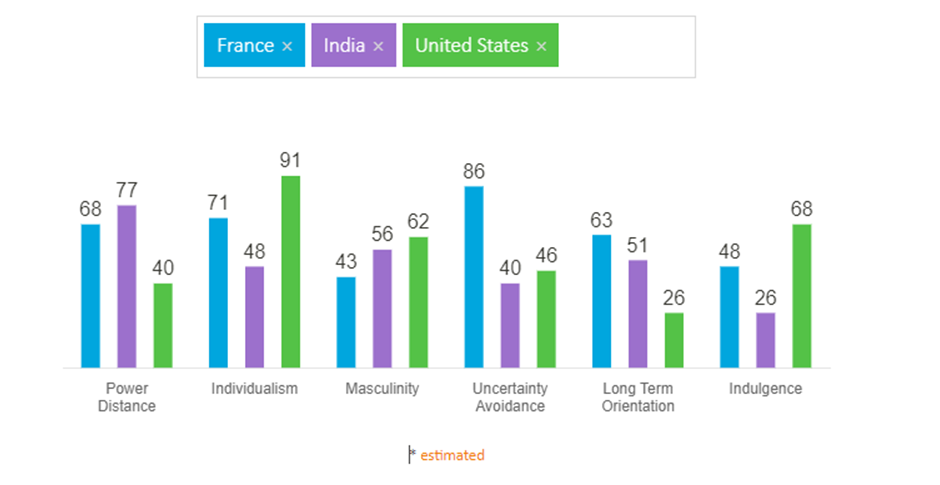
Do you consider the United States to be a high-power-distance or low-power-distance culture? Coming from India, I used to see the U.S. as the latter, but in the last 12 years of living here, it is increasingly becoming the former.

Does your proximity to an authority strengthen or lessen your loyalty?

https://www.hofstede-insights.com/country-comparison/france,india,the-usa/

The Authority/Subversion Taste Bud: The Post-Roe Era Begins Political and practical questions in an America without a constitutional right to abortion.

[In the link above, make sure to listen to both Akhil Amar and Caitlin Flanagan]

I also recommend reading Why Other Fundamental Rights Are Safe (At Least for Now)

Is there a flaw in the mainstream discussion of the U.S. Constitution that the abortion debate has brought to light? In my opinion, although predating the U.S. federal constitution and being significantly more involved in federal politics and constitutional evolution, each American state’s constitution is widely ignored. Keep in mind that state constitutions in the United States are far more open to public pressure. They frequently serve as a pressure release valve and a ‘pressuring lever’ for fractious U.S. national politics, catalyzing policy change. Regrettably, in an era of more contentious national politics, mainstream U.S. discourse largely ignores changes to state constitutions and spends far too much time intensely debating the praise or ridicule the federal Constitution receives for specific clauses, by which time the individual states have already shaped how the nation’s legal framework should perceive them. Altogether, a federal system, where individual state constitutions are ignored, and conflicts are centralized, is the American political equivalent of Yudhishthira’s response to the world’s greatest wonder in the thirty-three Yaksha Prashna [33 questions posed by an Indic tutelary spirit to the perfect king in the Hindu epic of Mahabharata].

The Sanctity/Degradation Taste Bud: The Native New World and Western North America

The emergence of a distinctly Native New World is a founding story that has largely gone unrecorded in accounts of early America. Here’s an excerpt from the article:

To round off this edition, a Western movie question: Are there any examples of American Westerns developed with the opposing premise—valuing the First Nation’s People’s agency, which has gained historical support? Why not have a heroic Old World First Nation protagonist who safeguards indigenous practices and familial networks in a culturally diverse middle ground somewhere in the frontier country, shaping and influencing the emerging New World? Can this alternate perspective revitalize the jaded American Western movie genre?

[Here’s the previous edition of Stimuli For Your Moral Taste Buds]

On Persons, Individuals, and Humans

It is only from a notion of the human, common to all men, that the concept of person can be dissolved into the idea of individual.

The relevance of the concept of person lies in its ability to describe functional relationships with its environment: sui juris or alieni juris, noble, patrician, commoner, serf or lord, father, minor, capable, incapable, etc. In pre-modern times, according to each function, a normative system exclusive to caste, position or estate, known as “privilege”, corresponded.

Rather, Modernity dissolves fixed personal relationships into an undifferentiated diagram of spheres of individual autonomy. Each human being ceases to be a person attached to a certain fixed function in the social fabric and, by the mere fact of being human, is the holder of his sphere of individual autonomy, equal to that of any other human being.

The legal system ceases to govern particular relationships between people to become a structure empty of intentions and purposes, which only determines procedures and delimits equal and predictable fields of interaction and clear methods for the resolution of disputes among the holders of the different spheres of individual autonomy.

The principle ceases to be that of difference to become that of equality. The difference becomes the exception, to be justified on a functional basis that results in a public benefit.

However, in the non-political sphere, that of civil society, the difference does not disappear, but is expressed in each of the individual exceptionalities, within each respective sphere of individual autonomy, while it is accidental and irrelevant to the legal-political system.

There are certain special situations framed within specific legal regimes, such as minority and intra-family relations, which enshrine assistance obligations, usufruct rights and a system of representation and guardianship.

Consequently, the role of the public sphere within civil society is defined by the procedure to be followed to settle the conflicts that could arise from the collision of the different spheres of individual autonomy.

From the moment in which each human being is an autonomous individual, the legitimate exercise of power in relation to the population does not consist in giving specific orders to subjects but in administering a set of procedures whose specific purpose is to serve as a means for different individuals settle their disputes peacefully.

Of course, in Modernity and in liberal democracies relations of command and political obedience subsist, but within the governmental structures themselves, which in turn incorporated procedural rules that limit discretion in the exercise of power and establish functions and hierarchies that define competencies and delimit individual responsibilities.

However, both modern government structures and the legal consecration of a social structure composed of equal individuals in dignity and respect are not the result of an invention but the consequence of a historical evolution whose becoming does not cease and whose hindrances persist in the field of the aforementioned civil society.

That the differences between people are exclusively functional and that such functions report a benefit to all the individuals involved, in such a way that none of them is used exclusively as a means, but is seen as an end in itself, is an imperative for the public sphere, but only a programmatic aspiration in the field of civil society.

In turn, that each person deserves equal consideration and respect is a discovery in the true sense of the word. Quentin Skinner in “The Foundations of Modern Political Thought” recounts the role played in the Late Middle Ages by the discussion that every person was endowed with an immortal soul, deserving of salvation, for the subsequent conceptualization that every human being is worthy also of legal protection regarding their fundamental interests, such as their life, their personal freedom, or their possessions.

Regarding the natural law doctrine of human rights, which states that human beings enjoy a certain set of guarantees and rights against the state and against other people, it is usually dismissed as metaphysical.

However, such statement can be understood more clearly if it is related to its historical evolution: the different freedoms already existed but assigned to different people according to their caste or status, who had an immediate and specific interest in their protection.

To cite an example, in the Partidas of Alfonso X of Castille, we find every detail of social life regulated: some had the right to bear arms but not to work, since they had to be available to the king in his court to eventually go to war; others had the right to exercise a certain trade or profession, excluding those who did not belong to their corporation, but they were not free to change their activity, neither in terms of their subject matter nor their geography. In the pre-modern world, the holders of freedoms had a specific interest in defending them, but their ownership depended on circumstances that, in the vast majority of cases, were out of their control and, in others, obsolete in terms of their functionality.

Given that this legal-political system had very little plasticity to adapt to changes in the surrounding circumstances, it was generally inefficient, stagnant, and unstable and, therefore, conflicts manifested themselves in recurrent revolts.

Modernity consisted in the universalization of liberties. This means that freedoms – or immunities against power – that already existed and whose entitlement was limited to reasons of belonging to certain castes or estates, to the exclusion in many cases of one another, began to be extended to all human beings by the mere fact of being such.

That is to say, there is nothing metaphysical in the natural law doctrine of human rights. It actually consists of the universalization of rights that already existed and were recognized.

The novelty that this brought is that each human being ceased to be considered as a person in relation to his family, his social status or his caste, to be considered as an autonomous individual and equal in rights to any other, holder of rights that he was actively interested in exercising as well as others whose content he hardly had any news or specific interest.

In turn, men exchanged differentiated rights that protected certain personal interests in exchange for new abstract freedoms, the same for each of the remaining individuals. As a result, each person gained potential spheres of action and saw specific regions of power restricted.

The nobleman gained a freedom to work and trade that he may or may not have an interest in exercising, but he lost the power he had over his serfs or was displaced by commoner bureaucrats in government functions. The shoemaker gained the freedom to emigrate to other cities or to change his trade to that of a blacksmith, in which he may or may not be interested, but he also received competition in his own town from other new shoemakers who emigrated from other latitudes, who effectively exercised such rights.

Such transformations and their discontents can be verified in the conservative authors of the beginnings of the Contemporary age, as is the case of Charles Dickens, among others.

That is why the universalization of fundamental rights -for the English tradition- or natural rights -for the American conception- constitutes both a discovery of intellectual research on historical evolution and a political program.

Whether such an extension is desirable and to what extent it should be continued or reversed largely defines political positioning from right to left. For this reason, historical evolution is not a legitimizing device in itself, but a process of discovery of various forms of social and political organization that is subject to a critical evaluation regarding which institutions and practices to incorporate, preserve, resist or modify.

On the open texture of conflicts

Just as language carries with it a phenomenon of open texture, according to which the reference and meaning of some of its terms are modified in response to changes in the environment — for example, saying that the head of state is commander in chief of the armed forces implies different denotations and connotations as war machines, communications, and command styles evolve -, conflicts that are prolonged over time also undergo changes in the terms that define them, as their surrounding context varies.

Thus, a dispute between individuals about the ownership of a certain asset, such as that of two heirs in dispute over the award of a property that is part of the hereditary heritage, will have to vary in intensity according to the changes in the market value of the said asset and according to the changes in the needs of those heirs as well.

Note, likewise, that the said transformation of the conditions in no way affects the conformation of the hereditary rights, but rather it is in the interest of each of the parties to enforce them.

Under certain circumstances, some of the said heirs will have to prefer to maintain the undivided inheritance and under others they will have to activate the dissolution of the hereditary community, generating a conflict in case of disparity among the heirs.

Although rights protect interests -such as life, personal liberty or stability upon possession-, not all interests deserve legal protection -such as the claim of an individual to hold a monopoly in the production of a certain good- and, among those interests which do enjoy legal protection, it will be relative and hierarchical.

Given that a legal system forms a set of consistent normative parameters, the changes in the decisions of individuals are motivated by variations in the relative value of the interests protected by said legal system, also assuming that such individuals are rational agents – i.e., they have transitive preferences.

As a corollary of the above, the normative system, while remaining identical to itself, will have to be neutral for the dynamics of the conflict, since the parties will have shaped their plans and expectations in accordance with their prescriptions.

That is why we often find analyses devoid of axiological and merely descriptive approaches. This does not mean that the rules, be they positive or natural, are not observed, but rather that a degree of compliance and constant enforcement is verified, which makes it possible to look for the reason for the changes in the decisions of the agents in other conditioning factors, such as the technology, the relative prices of goods, climatic phenomena, etc., etc..

Nor does this mean that the law does not evolve or undergo disruptive changes: there are legislative changes and judicial precedents that are modifying the content of the norms and, in turn, the norms themselves suffer the consequences of the open texture of the language in which they are expressed.

When these changes do not respond to a change in the value of the interests, but respond to a need of the legal system itself to maintain a stable and predictable order of events, the legal system maintains its neutrality, since it is transformed, jurisprudential or legislatively, when its formulations – even when they have a high degree of enforcement – are not sufficient to maintain a peaceful order of human interaction and, therefore, legal innovation has the function of reinforcing the maintenance of peace.

At this point in the discussion, it is appropriate to venture into the consequences of a legislative or jurisprudential change that had in view a different purpose than strengthening the function of law as a mechanism of social control aimed at maintaining peace between individuals who interact with each other.

If the change is jurisprudential, many times the law solves such a phenomenon endogenously: any jurisdictional pronouncement by a judge or court that departs from the content of the legal norms or that such departure is motivated by the transgression of its legal duty of impartiality with respect to of the parties to the conflict will render such pronouncement null and void and the judges will have incurred prevarication.

However, when a law is sanctioned by the legislature in contravention of its duty to dictate general and abstract norms and, instead, has the aim of favouring vested interests, little can be done beyond achieving a declaration of unconstitutionality, either by part of a constitutional court or by an ordinary court in the exercise of diffuse control of constitutionality.

This is for those cases in which the law in question also violates laws of a higher rank such as the Constitution.

Notwithstanding, when a norm is constitutional and, however, it was not enacted for the purpose of legislating in general and abstract terms, but instead sought with its sanction to favour certain vested interests to the detriment of others or public interests, little can be done for the legal system to correct itself according to an endogenous mechanism and the law, therefore, will have lost its neutral character.

It is this lack of neutrality of the legal system that delegitimizes it as a peaceful means of resolving disputes between individuals and, consequently, sharpens the intensity of conflicts, whether they consist of disputes between individuals or escalate into political questioning regarding the legitimacy of the legal-political system itself.

It was not for nothing that there were revolutions, such as the French one, which led to the enactment of civil codes, as a way of crystallising the reestablishment of a neutral normative order, generally described as fair. Note, likewise, that the Napoleonic Code did not contain any innovations, but rather consecrated –and synthesised- legislatively the jurisprudential evolution of the previous centuries.

Similarly, a territorial dispute between two countries could remain diplomatic for decades and, under a change of circumstances, escalate the conflict to a warlike stage.

This change in circumstances may be due to a redefinition of the interests of one or both countries, discoveries of wealth in the disputed territories, or technological innovations that modify the relationship of the respective countries with the geography of the disputed territory.

Note that in no way do these changes in the conditions surrounding the conflict affect a change in the titles of sovereignty over the disputed territory, but what changes is the intensity of the interest in it and the calculation of the chances of success in the event of a war escalation.

However, at the international level we find a plurality of normative sources -international custom, treaties, the norms of international organisations-, without courts of application in most cases and without a clear enforcement system to guarantee impartiality.

Despite arbitral awards can be found among small nations, which submit a territorial issue to the arbitration of a third power or institution that enjoys prestige between both countries, an issue that the parties involved do not consider of vital importance to them; but in most cases we are faced with conflicts or claims that will last over time, as long as the war alternative is disadvantageous for both parties.

Sustaining the principle that all agents who make decisions are rational, it is appropriate to ask under what conditions for such agents it is still reasonable to maintain a negotiation and under what others the most reasonable indicates escalation in the intensity of the conflict.

When the controversy occurs between two parties subject to the jurisdiction of a state and the object of the controversy has a certain relevance, the options of the parties follow one another between negotiating or going to trial.

On the other hand, among sovereign nations, although there is the alternative of submitting to an arbitration award, when the disputed issue interferes with a vital interest or makes the country’s own survival, the military confrontation constitutes the option to negotiation.

Paradoxically, when two individuals have a confrontation that is so insignificant as to be taken to court, the options also lie between negotiation or the deployment of violence -verbal or moderately physical, below the threshold of what the law would consider a crime. This occurs because both the international sphere and certain spheres of human interaction are naturally regulated.

From our point of view, this is one of the most relevant theoretical controversies: if such a natural system can be entirely deduced from reason -as maintained from Hugo Grotius onwards- and, therefore, can be stated and agreed upon by the consensus of the parties through a rational discussion, or if we can characterize natural law as an empirical normative system -as conceived by David Hume in the 18th century and later rescued by Friedrich A. Hayek- that grows spontaneously.

This last conception about the empirical character of the international rule-based order can be a convincing alternative to both realism and idealism. Even more so when the question of the neutrality of the liberal international order is questioned, both from realism and from critical currents. Since the empirical rule system emerges at the same time as the expectations of the agents, the neutrality of the resulting order will be highly probable.

Therefore, in accordance with this vision, the variation in the intensity of the conflicts will not have to be sought or justified in a modification of the rules of the game, but in a change in the relative weight of the interests in dispute, that is, in the open texture of the nature of conflicts.

A short reflection on the unintended political consequences of the right of due process

Some days ago, The Economist published an article about the spread of the morality councils in the villages of China, whose members meet to praise the ones who they regard as well-behaved and humiliate the others who don’t. The publication used its characteristic sense of irony by pointing out that, finally, the highest ranks of the villagers found a way to exercise their “right to speak”.

Nevertheless, the said irony might lead us to a different kind of reflection on the political right to speak and the rights of due process, such as public hearings, an impartial tribunal, and an opportunity to be heard. Public hearings and impartiality are interrelated since it would be much harder for a tribunal to deliver an arbitrary adjudication if it is overseen by the society. But the public watch of the trials and the right to be heard are even more interrelated. Through these devices, the whole civil society wields the power to take notice of both the claims of the prosecution and of the ones of the prosecuted individuals, and, thus, form its judgment about the impartiality of the tribunal.

Moreover, public hearings endow the prosecuted individuals with the opportunity to exert their political right to speak without any restraint. In a political context of heavy or increasing authoritarianism, any procedures -even the one of a morality council- could resound with the voice of the contrarian. Thus, the right of due process could have -although unintended- political consequences.

Daron Acemoglu and James A. Robinson relate a poor justice system with the causes of why nations fail, exemplified by government exerting their interference over the judiciary power. Thus, extractive political institutions encroach upon the economic institutions, turning them extractive as well. Nevertheless, defending the procedural rights of the due process could work as a way to contribute to restore both inclusive political and economic institutions.

Of course, a tight authoritarian regime, such as China’s, is aware of the political consequences of free speech, even in the realm of a judiciary process. However, this insight could be profited by the countries where democracies are feeble but still exist. Promoting oral and public judiciary procedures, even for the most insignificant matters, and the right of the prosecuted individual to be heard is not just an issue of lawyers, but acquire a political dimension. The rights of due process endow the civil society with powerful tools to get familiar with main strands of the Rule of Law and the dissidents with the opportunity to exercise their own right to speak.

The immunities of the due process have a long history of discovery and extension to all human beings, beginning with the Magna Carta Libertarum of 1215, that is not fulfilled to this day. It should be something to be pondered that they are historically previous to Modern democracy. Surely, they are a logical condition as well.

Some derivations from the uses of the terms “knowledge” and “information” in F. A. Hayek’s works.

In 1945, Friedrich A. Hayek published under the title “The Use of Knowledge in Society,” in The American Economic Review, one of his most celebrated essays -both at the time of its appearance and today- and probably, together with other studies also later compiled in the volume Individualism and Economic Order (1948), one of those that have earned him the award of the Nobel Prize in Economics, in 1974.

His interpretation generates certain perplexities about the meaning of the term “knowledge”, which the author himself would clear up years later, in the prologue to the third volume of Law, Legislation and Liberty (1979). Being his native language German, Hayek explains there that it would have been more appropriate to have used the term “information”, since such was the prevailing meaning of “knowledge” in the years in which such essays had been written. Incidentally, a similar clarification is also made regarding the confusions raised around the “spontaneous order” turn, which he later replaced by that of “abstract order”, with further subsequent replacements:

Though I still like and occasionally use the term ‘spontaneous order’, I agree that ‘self-generating order’ or ‘self-organizing structures’ are sometimes more precise and unambiguous and therefore frequently use them instead of the former term. Similarly, instead of ‘order’, in conformity with today’s predominant usage, I occasionally now use ‘system’. Also ‘information’ is clearly often preferable to where I usually spoke of ‘knowledge’, since the former clearly refers to the knowledge of particular facts rather than theoretical knowledge to which plain ‘knowledge’ might be thought to prefer” . (Hayek, F.A., “Law, Legislation and Liberty”, Volume 3, Preface to “The Political Order of a Free People”.)

Although it is already impossible to substitute in current use the term “knowledge” for “information” and “spontaneous” for “abstract”;  it is worth always keeping in mind what ultimate meaning should be given to such concepts, at least in order to respect the original intention of the author and perform a consistent interpretation of his texts.

By “the use of knowledge in society”, we will have to refer, then, to the result of the use of information available to each individual who is inserted in a particular situation of time and place and who interacts directly or indirectly with countless of other individuals, whose special circumstances of time and place differ from each other and, therefore, also have fragments of information that are in some respects compatible and in others divergent. 

In the economic field, this is manifested by the variations in the relative scarcity of the different goods that are exchanged in the market, expressed in the variations of their relative prices. An increase in the market price of a good expresses an increase in its relative scarcity, although we do not know if this is due to a drop in supply, an increase in demand, or a combined effect of both phenomena, which vary joint or disparate. The same is true of a fall in the price of a given good. In turn, such variations in relative prices lead to a change in individual expectations and plans, since this may mean a change in the relationship between the prices of substitute or complementary goods, inputs or final products, factors of production, etc. In a feedback process, such changes in plans will in turn generate new variations in relative prices. Such bits of information available to each individual can be synthesized by the price system, which generates incentives at the individual level, but could never be concentrated by a central committee of planners. In the same essay, Hayek emphasizes that such a process of spontaneous coordination is also manifested in other aspects of social interactions, in addition to the exchange of economic goods. They are the spontaneous –or abstract- phenomena, such as language or behavioral norms, which structure the coordination of human interaction without the need for a central direction.

“The Use of Knowledge in Society” appears halfway through the life of Friedrich Hayek and in the middle of the dispute over economic calculation in socialism. His implicit assumptions will be revealed later in his book The Sensory Order (1952) and in the already mentioned Law, Legislation and Liberty (1973, 1976 and 1979). In the first of them, we can find the distinction between relative limits and absolute limits of information / knowledge. The relative ones are those concerning the instruments of measurement and exploration: better microscopes, better techniques or better statistics push forward the frontiers of knowledge, making it more specific. However, if we go up in classification levels, among which are the coordination phenomena between various individual plans, which are explained by increasingly abstract behavior patterns, we will have to find an insurmountable barrier when configuring a coherent and totalizer of the social order resulting from these interactions. This is what Hayek will later call the theory of complex phenomena.

The latter was collected in Law, Legislation and Liberty, in which he will have to apply the same principles enunciated incipiently in “The Use of Knowledge in Society” regarding the phenomena of spontaneous coordination of individual life plans in the plane of the norms of conduct and of the political organization. Whether in the economic, legal and political spheres, the issue of the impossibility of centralized planning and the need to trust the results of free interaction between individuals is found again.

In this regard, the Marxist philosopher and economist Adolph Löwe argued that Hayek, John Maynard Keynes, and himself, considered that such interaction between individuals generated a feedback process by itself: the data obtained from the environment by the agents generated a readjustment of individual plans, which in turn meant new data that would readjust those plans again. Löwe stressed that both he and Keynes understood that they were facing a positive feedback phenomenon (one deviation led to another amplified deviation, which required state intervention), while Hayek argued that the dynamics of society, structured around values such like respect for property rights, it involved a negative feedback process, in which continuous endogenous readjustments maintained a stable order of events. Hayek’s own express references to such negative feedback processes and to the value of cybernetics confirm Lowe’s assessment.

Today, the dispute over the possibility or impossibility of centralized planning returns to the public debate with the recent developments in the field of Artificial Intelligence, Internet of Things and genetic engineering, in which the previous committee of experts would be replaced by programmers, biologists and other scientists. Surely the notions of spontaneous coordination, abstract orders, complex phenomena and relative and absolute limits for information / knowledge will allow fruitful contributions to be made in such aspects.

It is appropriate to ask then how Hayek would have considered the phenomenon of Artificial Intelligence (A.I.), or rather: how he would have valued the estimates that we make today about its possible consequences. But to adequately answer such a question, we must not only agree on what we understand by Artificial Intelligence, but it is also interesting and essential to discuss, prior to that, how Hayek conceptualized the faculty of understanding.

Friedrich Hayek had been strongly influenced in his youth by the Empirical Criticism of his teacher Ernst Mach. Although in The Sensory Order he considers that his own philosophical version called “pure empiricism” overcomes the difficulties of the former as well as David Hume’s empiricism, it must be recognized that the critique of Cartesian Dualism inherited from his former teacher was maintained by Hayek -even in his older works- in a central role. Hayek characterizes Cartesian Dualism as the radical separation between the subject of knowledge and the object of knowledge, in such a way that the former has the full capabilities to formulate a total and coherent representation of reality external to said subject, but at the same time consists of the whole world. This is because the representational synthesis carried out by the subject acts as a kind of mirror of reality: the res intensa expresses the content of the res extensa, in a kind of transcendent duplication, in parallel.

On the contrary, Hayek considers that the subject is an inseparable part of the experience. The subject of knowledge is also experience, integrating what is given. Hayek, thus, also relates his conception of the impossibility for a given mind to account for the totality of experience, since it itself integrates it, with Gödel’s Theorem, which concludes that it is impossible for a system of knowledge to be complete and consistent in terms of its representation of reality, thus demolishing the Leibznian project of the mechanization of thought.

It is in the essays “Degrees of Explanation” and “The Theory of Complex Phenomena” –later collected in the volume of Studies in Philosophy, Politics, and Economics, 1967- in which Hayek expressly recognizes in that Gödel’s Theorem and also in Ludwig Wittgenstein’s paradoxes about the impossibility of forming a “set of all sets” his foundation about the impossibility for a human mind to know and control the totality of human events at the social, political and legal levels.

In short, what Hayek was doing with this was to re-edit the arguments of his past debate on the impossibility of socialism in order to apply them, in a more sophisticated and refined way, to the problem of the deliberate construction and direction of a social order by part of a political body devoid of rules and endowed with a pure political will.

However, such impossibility of mechanization of thought does not in itself imply chaos, but on the contrary the Kosmos. Hayek rescues the old Greek notion of an uncreated and stable order, which relentlessly punishes the hybris of those who seek to emulate and replace the cosmic order, such as the myth of Oedipus the King, who killed his father and married his mother, as a way of creating himself likewise and whose arrogance caused the plague in Thebes. Like every negative feedback system, the old Greek Kosmos was an order which restored its lost inner equilibrium by itself, whose complexities humiliated human reason and urged to replace calculus with virtue. Nevertheless, what we should understand for that “virtue” would be a subject to be discussed many centuries later from the old Greeks and Romans, in the Northern Italy of the Renaissance.

A Note on “Hayekian” Empirical Normative Systems

In the first volume of Law, Legislation and Liberty (1973), we will find the most daring theses of Friedrich Hayek regarding the problem between law and politics. Just as his economic work of the 1930s and 1940s had been, in his opinion, misunderstood by his colleagues; just as he was surprised to hear the fervent readers of The Road to Serfdom (1945) attribute positions to him that he had not exposed there; also his legal-political work triggered simplifying interpretations that conceal the main contributions, still relevant for this time.

In Norms and order –that is the title of that first volume- the author does not propose to abandon legislation and return to customary law, nor to replace the political decisions of the administration of state affairs by a government of judges. On the contrary, it is stated there with a clarity that leaves no room for doubt that the powers of the state must be organised and operate in accordance with the rules and procedures of public law, made up of legislative bodies endowed with rules with a clear teleological content.

On the other hand, the genuinely innovative thesis that Hayek exposes in the aforementioned volume consists in affirming that the interactions between individuals in the scope of their exchanges destined to cooperate freely and voluntarily in the coordination of their respective life plans are structured around a set of abstract rules –that is, lacking a specific purpose- and general rules whose observance could occur in practice without the need for a positive enunciation. It is for this reason that Hayek affirms that the law is not created, but discovered, and that it is not legislated, but rather evolves.

On this last point, John Gray at his time, many years after Hayek’s death, lamented that his former mentor had spent the last years of his life discussing pseudoscientific ideas around alleged evolutionary theories. However, such suspicion cannot fall in any way on the triptych of “Law, Legislation and Liberty” (1973; 1976 and 1979).

What is found in the said work is an express taking sides with a tradition of thought that extends from the Late Middle Ages, the Renaissance and the beginnings of Modernity: the school of natural law understood as something different from an ideal, derived from reason, about what should be, but to a set of normative beliefs effectively extended in a given population, which condition their behaviour, contribute to the formulation of a critical judgement about the value of actions and allow the formation of expectations about the expected behaviour of peers and, therefore, facilitate the ideation and coordination of individual plans.

For Hayek’s own epistemological conceptions, this tradition of thought acts as a kind of discovery mechanism on certain aspects of the legal phenomenon and the structural characteristics present in all human interaction and therefore his constant appeal to the history of ideas.

Hayek, in a peaceful and incontrovertible way for any specialist in the matter, syndicates Hugo Grotius as the initiator of the rationalist and idealist school of natural law, although holding him responsible, as he did, for the evolution of the identification of legislation as the only and exclusive source of law could be considered as an overly emphatic statement, which would abandon the very premises of cultural evolutionism to which Hayek himself adhered: if Grotius’ theses were so successful, it was largely due to the subsequent advent of the national states.

Although the truth is, however, that the characterization of Natural Law as a derivative of reason later allowed, in the 20th century, to receive from legal positivism the rejection of all Natural Law as “metaphysical”, thus leaving the formulation of the Law at the mercy of politics and, with it, in a serious crisis the very notion of “Rule of Law”.

It is for this reason that Hayek set out to rehabilitate the empiricist current of Natural Law, which seeks normative statements not in the derivations of reason, but in the discovery of notions about what could be considered right behaviour towards others through the investigation of patterns of behaviour actually observed in a given community that is structured around peaceful exchanges repeated over time.

The archetypal example of such kinds of normative structures given in practice, independently of their enunciation by any type of legislator, is represented by the communities of merchants: a repeated series of regular exchanges generates certain expectations about the conduct to be observed by the members of said group of merchants, which also allow to conceive and coordinate other business plans. For this reason, many times, conflicts between merchants are resolved through friendly settlers, or arbitrations, and judges resort to the opinion of specialised experts in a certain commercial area to dictate their decisions.

Such examples do not constitute proof that all law is spontaneous, but rather a powerful counterexample to the theses that hold, on the one hand, that legislation is the only possible source of law and those that, on the other, affirm that all law must be derived from reason.

Although both antithetical visions are synthesised in the figure of the rational legislator, whose legislative enunciations are derivatives of public reason, this in turn receives -in the first half of the 20th century and today- challenges from Realistic doctrines, which state that legislative activity is not a product of public reason, but of the exercise of political will.

It is in relation to this contest that Hayek plays the card of cultural evolutionism and of the legal system as a spontaneous order. In this sense “Law, Legislation and Liberty” is a new elaboration of “The Road to Serfdom”.

This theoretical controversy maintains its full validity to date: the confrontation that the predominant species of Liberalism, of an idealistic and rationalist nature, seems to be losing against Political Realism, which places political will above a system of human coexistence based on rules and not on discretionary decisions. In Hayek’s case, he sides with a rule-based political system, but what sets him apart from prevailing Liberalism is that such rules are not derived from reason, but rather emerge from experience.

This experience not only produces norms of just conduct to be discovered by the courts and enunciated by legislators, but it is also responsible for structuring the very apparatus for understanding such norms. It is for this reason that Hayek himself, in his book The Sensory Order (1952), called his particular philosophical vision “pure empiricism.”

Of course, an empiricist conception of Natural or Fundamental Rights – based on Adam Ferguson, David Hume and Edmund Burke, among others – is not exempt from difficulties, the main one being the task of identifying those empirical norms that effectively contribute to maintain a peaceful order of coexistence and provide them with the corresponding enforcement.

However, despite such difficulties, affirming that the existence of Natural Rights emerges from the experience that structure a peaceful order of coexistence and that they are the ones that legitimise the exercise of power and not vice versa, already constitutes in itself an affirmation worthy of being considered and, eventually, defended.

The Federation of Free States: Growing pains

We’re continuing our thought experiment on adding more states to the American republic.

Our initial experiment added 29 states to the union in 2025. After a few decades of relative success (the entire world grew economically from 2025 to 2045), the bicameral Congress of free states was willing to accept several new members, who in turn were willing to trade their sovereignty for two seats in the Senate. The polities that joined the federation of free states in the second peaceful geographic expansion of the Philadelphian federal order were varied, but only somewhat predictable. The Madisionian compound republic rearranged the map once again. Here is what it looks like in 2045:

The red places were “states” in 2025, the orange places are new “states” in 2045.

As you can see, most of the expansion came in North America, East Asia, and West Africa. The experience of Canaan, England, and Wales hasn’t been bad, but enough nationalist-secessionist sentiments remain in these three “states” that none of their neighbors thought that giving up their sovereignty for Senate seats was worth it. All three economies grew, and peace finally came to Canaan, but if peace, wealth, and security from predation were the only things that people wanted then we wouldn’t be people. We’d be something else entirely. People want freedom, and the compound republic – the federation of free states – did not yet show in 2045 it was capable of extirpating the menace of nationalism from human existence.

The success of the ranching states of Mexico – Coahuila, Tamaulipas, and Nuevo León – within the United States prompted several more Mexican states to apply for statehood, but the pushback against too many states joining the union was stern. Yucatán and Chihuahua were added as is, giving the Senate four more seats, but the states of Zacatecas, Durango, and San Luis Potosí had to combine into one state (they called it San Luis Potosí, and it’s about the size of Nevada) in order to join the Philadelphian world order.

The prairie provinces of Canada also did well for themselves since 2025. So well, in fact, that five more provinces applied to join. However, Congress did not want to add five more states with such sparse populations, so the Atlantic provinces of Nova Scotia, Prince Edward Island, New Brunswick, Newfoundland, and Labrador merged to become a state that they called Nova Scotia, a massive landmass with enough people for only one or maybe two representatives. By the way, from 2025 to 2045, several old American states — Washington, Oregon, and Vermont – all held referendums on whether to leave the Madisonian republic and join Canada (or go it alone), but the referendums have proved to be unsuccessful.

Liberia’s success in the American federation is perhaps the most encouraging progress of all. Crime rates skyrocketed once Liberia joined the union, but this only shows how the American legal system does such a wonderful job of protecting property rights. Violent crime dropped, but crimes involving property rights reached an all-time high, which means that property rights in Liberia are finally being protected by a state strong enough to do so. The GDP (PPP) per capita of Liberia quadrupled from 2025 to 2045. Several neighboring states took notice, but only one, Sierra Leone, joined the federation outright.

Several Nigerian and Ghanaian polities joined the republic. All of the polities started out as administrative units within Ghana and Nigeria, and there were too many that wanted to join. So, they borrowed from San Luis Potosí’s playbook and merged with each other before applying for statehood as larger polities. From Nigeria, the states of Oyo (made up of five Nigerian states), Biafra (made up of eight states), Benin (made up of four states), and Bayelsa (three states) all joined. The states are all from the south of Nigeria.

Ghana sent three states to the republic: Ashanti (made up of five Ghanaian provinces), Volta (made up of three provinces), and Cape Coast (three provinces). The 11 provinces that made up the three new states were all from Ghana’s south. It should be noted the the Ashanti region had a relatively strong sense of nationalism when it applied for membership to the federation, and that the extirpation of this nationalism in exchange for self-government in a compound republic was not a problem for its inhabitants.

Colombia and Panama. The Caribbean experience has had less of a “wow factor” than Liberia or Mexico. Economic growth in Antilles was a little bit better than the regional average, but not by much. The big change was demographics, as many seniors from the original 50 states moved to Antilles, and many young people from Antilles moved to the original 50 states. The crime rate was similar to that of Liberia, too, with violent crimes dropping but property crimes increasing a little bit. Most of the countries in Central America (sans Costa Rica) and all of the Pacific countries in South America applied for membership in one form or another. However, only four states were added in 2045: three from Colombia and the whole of Panama. The four states got together and pulled out a map of 19th century Gran Colombia to put together a plan for federation. Isthmo (Panama), Cundinamarca (made up of eight Colombian states), Magdalena (made up of six states), and Cauca (five states) all joined the federation of free states.

Things went so well in East Asia and the Pacific that the entire country of Vietnam applied lock, stock, and barrel. Like Japan, South Korea, and the Philippines in 2025, Vietnam had too many states for the federation so six regions joined instead: Bắc Trung Bộ, Bắc Bộ, Tây Nguyên, Đông Nam Bộ, Tây Nam Bộ, and Đồng Bằng Sông Hồng. The Vietnamese now enjoy the military and economic benefits that come with being federated with the compound republic of the United States.

Further thoughts

The Canadian and West African states are the only ones with English-language speakers. Nevertheless, English continues to be employed as the lingua franca of the federated polity. This has produced a class division between those who can speak English and those who cannot, and eventually English will be spoken by nearly everybody in the polity (now numbering just over one billion souls), but the native languages are unlikely to disappear. They’ll continue to evolve on their own lines, and most people in the federation will simply be able to speak more than one language. The English of the Constitution and Bill of Rights will no doubt become antiquated as English evolves, but it’s already pretty antiquated today (2022) and there’s been no real challenge in 250 years to English’s status as the lingua franca of the republic.

Reactions to the compound republic from other states

Perhaps the most interesting aspect of the United States’ decision to apply federation to its foreign policy is the reaction of other states. The Russians, who it could be argued had an alternative to the Westphalian order in the 19th century (and this is why it pursued its own foreign policy agenda throughout the Cold War, rather than for the exportation of the Revolution), are still doing what they’ve been doing since 2000: recognizing small states along their vast border and slowly chipping away at the losses of their empire. States such as Donetsk, South Ossetia, and Crimea are recognized as states by Russia, Belarus, and, say Kazakhstan, but in 2045 the compound republic decided to build upon its foreign policy of federation by recognizing these claims to independence. This means that post-Soviet states like Ukraine and Georgia lose territory, but it doesn’t necessarily make Russia stronger and it doesn’t mean freedom is in decline. Out of two states (in this example), five now exist, and there’s nothing to suggest that they won’t lean on the compound republic rather than the Russian Federation.

The CCP turned inward, especially once the compound republic called its bluff on Taiwan. Like Russia, it has been argued that an alternative state system to Westphalia existed prior to 19th century European imperialism. The Belt and Road Initiative was supposedly part of the Tianxia state system, but regardless of whether or not you buy this argument (I don’t), China’s expansion ceased once Japan, South Korea, and Taiwan joined the Philadelphian union. The CCP became even more repressive and paranoid. The non-Han grew more despondent, and the non-Mandarin speaking Chinese, especially those living along the wealthy seaboard of the South China Sea, grew angry.

The Europeans and their interstate system continued to try to keep the Westphalian European Union alive, but without the abrogation of state sovereignty, the EU continued to be ineffectual. The French, taking a page from the American playbook, revived an old effort to federate with its former colonies. The French continued to adhere to a Westphalian logic in this effort, and the French Union floundered as badly as the European Union. The key to Madisonian compound republic’s success has been its abrogation of state sovereignty (which is “traded” for seats in the Senate). Portugal reached out to Brazil and Angola to discuss a Lusophone federation, and ties became closer, but Westphalian sovereignty trumped all discussions of cooperation and the Portuguese found themselves in the same situation as the French: members of two ineffectual confederations that are built upon Westphalian nation-state sovereignty.

The remnants of the British and Spanish Empires (Peru, Argentina, Australia, India, Pakistan, Sri Lanka, New Zealand, Iraq, Egypt, Saudi Arabia, the British Caribbean, etc.) continued along the same path as the Europeans. Economic growth continued at its slow pace, but compared to the societies living within the compound republic, it was becoming clear that the Westphalian remnants were losing ground, especially in regards to liberty, equality under the law, and democratic governance.

In 2045, the American republic added 22 more states, making the federation a conglomerate of 101 “states” and the District of Columbia. Liberty is on the rise, and despotism is getting cornered.

Monday’s Vintage Whines

  1. Brilliant metal puns shall not be forgotten
  2. I generally like Noah Smith’s economics made simple explanations and have read him since his old blog days (I still check his substack, and Bloomberg, pieces)
Skyclad rocked (never got interested in their pagan tendencies and gibberish fonts, though) – Source

So, NS reposted The liberty of local bullies, a decade-old critique of libertarianism (using, in perfect economist style, a completely libertarian world as the basic assumption). I am sure almost everything is already said and done (late to the party!), but here goes anyway (from “theoretical” to “real-world” order):

  1. Those cartels that will push anyone not to their liking aside would not necessarily be invincible. Cartels/ trusts/ consortia/ whatever (probably) use government regulations to dig-in even more solidly. Take away the government’s heavy hand, and they get more exposed to competition.
  2. The high transaction costs of moving/ working elsewhere also go the same way.
  3. Liberal thought is not blind to misuses of private power (the usual quote here being *the* Adam Smith). Αt least one European liberal strand requires active trust-busting policies as a prerequisite for protection against such consolidations (ordoliberalism of 1930s-50s). Also, the mother of legislative trust-busting, the US Sherman Act of 1890, was signed by a Republican President. Since NS hedges as he gears his offensive to American expressions of the liberty creed, I am at a loss if this law could claim a liberal (libertarian?) root.

Monday Links and unders – NOLite te bastardes

Also, armchair public policy analysis. Caveat emptor: may contain BS

Not posting here could be due to good reasons, or nasty reasons. Fortunately, it was a very good reason that kept me from posting for few weeks (hint: it was expected, and involves diapers). The (invisible to the naked eye) gap was covered via a spontaneous, à la WWE tag team display by Brandon (who, btw, restarted nightcapping, yay! And then got tarpitted again, nay).

Has the U.S. Supreme Court Effectively Overruled Roe v. Wade? (Verfassungsblog)

A take on the recent abortions slugfest. A decisive overturn of the post – 70s judicial status will probably spell similar changes elsewhere. The shadows have been stirring, the battlefront is wide, the divisions remain deep. Only recently, a proxy “skirmish” took place in Greece: A so-called “1st Panhellenic Conference on Fertility” or something got cancelled, after its anachronistic/ derogatory undertones provoked a digital uproar:

Ovaries and Outrage: How Social Media Took Down Greece’s Fertility Conference (MDI)

This metal feminist slogan came to mind:

Nolite te bastardes carborundorum

The Handmaid’s Tale

I have not read the book (nor watched the series), but this mock-Latin line rings timely and has an interesting history itself.

Lynn Parramore at INET argues that modern libertarians tend to overlook the subject, while the likes of Ayn Rand and Murray Rothbard were assertive in defending the right to abortion as part of the self-determination of one’s body/ life in general:

Why Aren’t Libertarians Protesting the Freedom-Busting Texas Abortion Law? (Institute for New Economic Thinking)

INET is not particularly fond of the liberty creed, but still, the picture is disheartening. What’s worse, it fits my own troubling perception (incomplete as it is, based on limited observations) that this kind of intrusion into individual freedom ranks lower than others. The whole issue seems mostly relegated to a “feminist” or “gender” only thing, bogged down by religion and politics, an underdog among individual rights (Scott Lemieux over at Lawyers, Guns & Money also notes something along this lines. LGM has been consistently slamming the Texas law and the SCOTUS response). And that’s why I did not exactly lament the conference cancellation, even if it borderline breached freedom of speech. It rhymed with an underway underhand undoing of that underdog.

A post in RCL (picked by Brandon here) makes an interesting case regarding the feasibility of free choice for both parts of the equation, doctor and patient. However, it also reminded me of this haunting story, and the possibility of a gap between elegant theory and brutal reality:

Italian doctors on trial for manslaughter after refusing abortion (Financial Times)

The FT article also showcases the heavy information asymmetries that plague healthcare services-at-large, which serve as a foundation for state intervention, be it regulation, public supply or whatnot. At least in the realm of textbook econ as I remember it.

Dismantling government policy – source

The other day, I used the same apparatus – old reliable econ – peppered with some basic public choice insights to smite a couple of state initiatives (in my head, that is).

(1) The Greek government recently ramped-up the vaccination push through mandates, prohibitions and fines. More heavy – handed intervention will beget more bottom-up webs that game the system, I decreed (right, late Mancur Olson documented this in his Power and Prosperity book, especially if the public’s trust is lacking, just pushing open an already unbarred door here). As it turns out:

Ten vaccination centers scrutinized over suspected fake Covid certificates (eKathimerini)

(2) A law enacted in early 2020 awards a one-off allowance of EUR 2,000 (that would be like four times the Greek minimum wage) for every childbirth (there are some conditions to be met, income level, residence etc, but they are quite lax). So, a generous gesture, meant to incentivize people to have children, and also to offer support with child-rearing costs, according to the relevant explanatory memorandum. The law is seated in the state’s duty to protect “family…motherhood and childhood”, somewhere in the underbelly of our Constitution’s list of individual and social rights.

At the face of all these, the free-market credo in my econ grasp whispered:

I will not fail in my strike, warrior. I will not fail in my strike.

The Last Mythal

I unfolded my offensive in two lines. First, the smell test: Nudging a life-changing decision with just a hand-out seems overstretched (a scheme of consistent financial aid is a different beast). And second, the econ-kick-in: This subsidy (you can actually feel my contempt here) will have the fate of other transfers that mess with the price mechanism. Will not the maternity services providers just jack-up prices to take a slice? Presto! (I left the actual cost – organizing/ funding – of implementing the policy plus the arbitrariness of the sum out, as too easy targets).

Well, the jury is still out about the first part, since it’s mostly an issue of empirical analysis. It surely made a nice PR exercise (that could also have a positive effect, and maybe this was the main point from the start). My price call went out of the window, though. The relevant costs have barely budged from the last time we needed maternity services, few years ago. First-hand observation is not statistics, but it did the trick. Nice, neat and clean inferences can still be BS, obviously.

Some Monday Links – Of bloody summer stains, busted hopes and laundries

Also lingo. And beards.

Why Cuba is having an economic crisis (Noahpinion)

The Language of Totalitarian Dehumanization (Quillette)

On the Cuba events. Governments and protests, now that’s a strained relationship. Talking about the so-called “Second World” countries, Nikita Khrushchev did not even know what booing is, until he encountered it in his visit to London in 1956.

Few years later, during a massive strike in the Russian city of Novocherkassk, a crowd stormed the central police station. Whether it was a genuine assault, or a naive display of defiance from a people inexperienced in protesting, the government’s fearful puzzlement turned to cold, brutal aggression. Unarmed protesters at the center of the city, mistakenly thinking that those days were over, remained steadfast at the face of warnings to disperse. That is, until security forces opened direct fire against them. The ensuing massacre was covered-up for three decades. Since this was an à la Orwell un-event, no high-ranking officials’ records were stained.

Khrushchev’s aloof ignorance strikes a nerve, contrasted with the people’s heartbreaking one. Both glimpses are captured in the brilliant (though somewhat uneven) Red Plenty, by Francis Spufford.

All things said, Karl Marx Loved Freedom (Jacobin). More beards.

The Greek government, like its French counterpart, is escalating the push for vaccinations. As constitutional scholars argue the limits of state power regarding personal freedom and the public good, historical precedents are brought forth (for the US, c. early 1900s), involving mandatory vaccinations, quarantines and discrimination. The discussion draws from equal protection of the laws jurisprudence and smoothly led me to Yick Wo v. Hopkins (1886):

Yick Wo v. Hopkins established fair implementation of statutes (History Net)

The decision set a milestone and has been cited some 150 times.

The backdrop of the case is rich. As it turns out,

An 1880 ordinance of the city of San Francisco required all laundries in wooden buildings to hold a permit issued by the city’s Board of Supervisors. The board had total discretion over who would be issued a permit. Although workers of Chinese descent operated 89 percent of the city’s laundry businesses, not a single Chinese owner was granted a permit.

Oyez

The regulation was one in a series of many that reflected the anti-immigrant (especially anti-Chinese) sentiment, following the influx due to the Gold Rush (1849).

An illustration of the time, echoing the 3-day pogrom vs Chinese immigrants, San Francisco Jul. 1877 – Source

Yick Wo: How A Racist Laundry Law In Early San Francisco Helped Civil Rights (Hoodline)

A particularly badass line, from the unanimous opinion authored by Justice Stanley Matthews, shows that the Court did not hold back:

Though the law itself be fair on its face and impartial in appearance, yet, if it is applied and administered by public authority with an evil eye and an unequal hand, so as practically to make unjust and illegal discriminations between persons in similar circumstances, material to their rights, the denial of equal justice is still within the prohibition of the Constitution.

Caging the leaders of the future

My journey back to school has made me realize the skill school forbade me from learning is the single most important one I use in my job: delegation.

I have been running a research company I founded for 5 years now, and no single skill I have learned matters to my leadership abilities more than delegation. The only reason our company thrives is that other people do things I could never do myself, and it would be self-destructive and short-sighted to even try to hog the work on any task.

However, I returned to law school to finish my degree, and felt the limitations of my student life fall again squarely on my shoulders. Every assignment, every class felt uncomfortably heavy almost immediately, not because they were meaningless or useless, but because I could not treat them like a problem seeking a solution. Like an obstacle for me to overcome with my greatest asset–my team.

This simple rule, that I must turn in only my own work, makes sense only in the sterile world of the bean counting metric junkies, who worry not about whether I build great things but whether I built them alone. No client has ever peered suspiciously over my work, suggesting that perhaps I may have gotten outside, illicit assistance. Or worse, Googled and found someone else’s solution.

I’m not saying that all schools must immediately revise their grading systems to teach leadership or fit my needs. Far from it–I am telling anyone else struggling under the burdens of leadership, your school simply cannot help you. Recognize that there is no way to prepare for real challenges by getting high grades on fake ones. And learn to value the skills of others, lest you drown in your own inbox and incompetence.