Some derivations from the uses of the terms “knowledge” and “information” in F. A. Hayek’s works.

In 1945, Friedrich A. Hayek published under the title “The Use of Knowledge in Society,” in The American Economic Review, one of his most celebrated essays -both at the time of its appearance and today- and probably, together with other studies also later compiled in the volume Individualism and Economic Order (1948), one of those that have earned him the award of the Nobel Prize in Economics, in 1974.

His interpretation generates certain perplexities about the meaning of the term “knowledge”, which the author himself would clear up years later, in the prologue to the third volume of Law, Legislation and Liberty (1979). Being his native language German, Hayek explains there that it would have been more appropriate to have used the term “information”, since such was the prevailing meaning of “knowledge” in the years in which such essays had been written. Incidentally, a similar clarification is also made regarding the confusions raised around the “spontaneous order” turn, which he later replaced by that of “abstract order”, with further subsequent replacements:

Though I still like and occasionally use the term ‘spontaneous order’, I agree that ‘self-generating order’ or ‘self-organizing structures’ are sometimes more precise and unambiguous and therefore frequently use them instead of the former term. Similarly, instead of ‘order’, in conformity with today’s predominant usage, I occasionally now use ‘system’. Also ‘information’ is clearly often preferable to where I usually spoke of ‘knowledge’, since the former clearly refers to the knowledge of particular facts rather than theoretical knowledge to which plain ‘knowledge’ might be thought to prefer” . (Hayek, F.A., “Law, Legislation and Liberty”, Volume 3, Preface to “The Political Order of a Free People”.)

Although it is already impossible to substitute in current use the term “knowledge” for “information” and “spontaneous” for “abstract”;  it is worth always keeping in mind what ultimate meaning should be given to such concepts, at least in order to respect the original intention of the author and perform a consistent interpretation of his texts.

By “the use of knowledge in society”, we will have to refer, then, to the result of the use of information available to each individual who is inserted in a particular situation of time and place and who interacts directly or indirectly with countless of other individuals, whose special circumstances of time and place differ from each other and, therefore, also have fragments of information that are in some respects compatible and in others divergent. 

In the economic field, this is manifested by the variations in the relative scarcity of the different goods that are exchanged in the market, expressed in the variations of their relative prices. An increase in the market price of a good expresses an increase in its relative scarcity, although we do not know if this is due to a drop in supply, an increase in demand, or a combined effect of both phenomena, which vary joint or disparate. The same is true of a fall in the price of a given good. In turn, such variations in relative prices lead to a change in individual expectations and plans, since this may mean a change in the relationship between the prices of substitute or complementary goods, inputs or final products, factors of production, etc. In a feedback process, such changes in plans will in turn generate new variations in relative prices. Such bits of information available to each individual can be synthesized by the price system, which generates incentives at the individual level, but could never be concentrated by a central committee of planners. In the same essay, Hayek emphasizes that such a process of spontaneous coordination is also manifested in other aspects of social interactions, in addition to the exchange of economic goods. They are the spontaneous –or abstract- phenomena, such as language or behavioral norms, which structure the coordination of human interaction without the need for a central direction.

“The Use of Knowledge in Society” appears halfway through the life of Friedrich Hayek and in the middle of the dispute over economic calculation in socialism. His implicit assumptions will be revealed later in his book The Sensory Order (1952) and in the already mentioned Law, Legislation and Liberty (1973, 1976 and 1979). In the first of them, we can find the distinction between relative limits and absolute limits of information / knowledge. The relative ones are those concerning the instruments of measurement and exploration: better microscopes, better techniques or better statistics push forward the frontiers of knowledge, making it more specific. However, if we go up in classification levels, among which are the coordination phenomena between various individual plans, which are explained by increasingly abstract behavior patterns, we will have to find an insurmountable barrier when configuring a coherent and totalizer of the social order resulting from these interactions. This is what Hayek will later call the theory of complex phenomena.

The latter was collected in Law, Legislation and Liberty, in which he will have to apply the same principles enunciated incipiently in “The Use of Knowledge in Society” regarding the phenomena of spontaneous coordination of individual life plans in the plane of the norms of conduct and of the political organization. Whether in the economic, legal and political spheres, the issue of the impossibility of centralized planning and the need to trust the results of free interaction between individuals is found again.

In this regard, the Marxist philosopher and economist Adolph Löwe argued that Hayek, John Maynard Keynes, and himself, considered that such interaction between individuals generated a feedback process by itself: the data obtained from the environment by the agents generated a readjustment of individual plans, which in turn meant new data that would readjust those plans again. Löwe stressed that both he and Keynes understood that they were facing a positive feedback phenomenon (one deviation led to another amplified deviation, which required state intervention), while Hayek argued that the dynamics of society, structured around values such like respect for property rights, it involved a negative feedback process, in which continuous endogenous readjustments maintained a stable order of events. Hayek’s own express references to such negative feedback processes and to the value of cybernetics confirm Lowe’s assessment.

Today, the dispute over the possibility or impossibility of centralized planning returns to the public debate with the recent developments in the field of Artificial Intelligence, Internet of Things and genetic engineering, in which the previous committee of experts would be replaced by programmers, biologists and other scientists. Surely the notions of spontaneous coordination, abstract orders, complex phenomena and relative and absolute limits for information / knowledge will allow fruitful contributions to be made in such aspects.

It is appropriate to ask then how Hayek would have considered the phenomenon of Artificial Intelligence (A.I.), or rather: how he would have valued the estimates that we make today about its possible consequences. But to adequately answer such a question, we must not only agree on what we understand by Artificial Intelligence, but it is also interesting and essential to discuss, prior to that, how Hayek conceptualized the faculty of understanding.

Friedrich Hayek had been strongly influenced in his youth by the Empirical Criticism of his teacher Ernst Mach. Although in The Sensory Order he considers that his own philosophical version called “pure empiricism” overcomes the difficulties of the former as well as David Hume’s empiricism, it must be recognized that the critique of Cartesian Dualism inherited from his former teacher was maintained by Hayek -even in his older works- in a central role. Hayek characterizes Cartesian Dualism as the radical separation between the subject of knowledge and the object of knowledge, in such a way that the former has the full capabilities to formulate a total and coherent representation of reality external to said subject, but at the same time consists of the whole world. This is because the representational synthesis carried out by the subject acts as a kind of mirror of reality: the res intensa expresses the content of the res extensa, in a kind of transcendent duplication, in parallel.

On the contrary, Hayek considers that the subject is an inseparable part of the experience. The subject of knowledge is also experience, integrating what is given. Hayek, thus, also relates his conception of the impossibility for a given mind to account for the totality of experience, since it itself integrates it, with Gödel’s Theorem, which concludes that it is impossible for a system of knowledge to be complete and consistent in terms of its representation of reality, thus demolishing the Leibznian project of the mechanization of thought.

It is in the essays “Degrees of Explanation” and “The Theory of Complex Phenomena” –later collected in the volume of Studies in Philosophy, Politics, and Economics, 1967- in which Hayek expressly recognizes in that Gödel’s Theorem and also in Ludwig Wittgenstein’s paradoxes about the impossibility of forming a “set of all sets” his foundation about the impossibility for a human mind to know and control the totality of human events at the social, political and legal levels.

In short, what Hayek was doing with this was to re-edit the arguments of his past debate on the impossibility of socialism in order to apply them, in a more sophisticated and refined way, to the problem of the deliberate construction and direction of a social order by part of a political body devoid of rules and endowed with a pure political will.

However, such impossibility of mechanization of thought does not in itself imply chaos, but on the contrary the Kosmos. Hayek rescues the old Greek notion of an uncreated and stable order, which relentlessly punishes the hybris of those who seek to emulate and replace the cosmic order, such as the myth of Oedipus the King, who killed his father and married his mother, as a way of creating himself likewise and whose arrogance caused the plague in Thebes. Like every negative feedback system, the old Greek Kosmos was an order which restored its lost inner equilibrium by itself, whose complexities humiliated human reason and urged to replace calculus with virtue. Nevertheless, what we should understand for that “virtue” would be a subject to be discussed many centuries later from the old Greeks and Romans, in the Northern Italy of the Renaissance.

Hayek the globalist

“Since it has been argued so far that an essentially liberal economic regime is a necessary condition for the success of any interstate federation, it may be added, in conclusion, that the converse is no less true: the abrogation of national sovereignties and the creation of an effective international order of law is a necessary complement and the logical consummation of the liberal program.”

How This Paris Boy Became an American Scholar (Plus a Disquisition on Language Learning)

Here is another escapist story. If the autobiographical genre annoys you, I don’t blame you and don’t read this story.

First of all, don’t wince or grimace. I just said “scholar,” not “eminent scholar,” nor “famous scholar,” not even “respected scholar.” It’s just a descriptive term; the word describes much of what I did for a living. Period.

I grew up on the unglamorous east side of Paris where visitors never go, or didn’t then. My family’s apartment was in a government subsidized project. It was really a project but a good one, well built, well maintained, with central heating and full bathrooms, but no elevators. Graffiti had not been invented yet. I shared a room with two brothers. There was only enough space for one small desk, an important detail in my story.

My family was not poor but it definitely wasn’t rich. Everyone was unimaginably poor in the forties and fifties by the standard of 2022 anyway but, fortunately, we didn’t know what 2022 would be like. France was in a period of economic expansion for much of the time I was growing up. We could almost feel the tide that was going to raise our boats too. We did not have phone service but we never went hungry; we had good medical care. (I did realize though until the French Navy clothed me that I had been cold every winter of my childhood and youth. It was normal.)

And then, there were the schools. It seems to me, seventy years later, that the elementary schools did a more than adequate job. I am guessing that almost all of us came out reading, writing and doing a little more than basic math (including trigonometry). Elementary education was adequate and more for people who were going, in their vast majority, to rise but modestly in the social scale of the time. I seem to recall that half my fellow students quit school at fourteen to become apprentices. The rest -including my three sibling – went on to a variety of schools, many of them more or less vocational. Not me.

When I was twelve, a miracle happened in my family. I passed an exam that got me accepted in a respected, prestigious academic school in central Paris (Lycée Condorcet). It was a combined junior high and high school It’s hard to explain to Americans but it was a public school; there was no tuition. It was a feeder school for the best French universities. Many famous people were alumni. Few children from my part of Paris made it there. (In fact, I never met one in six years.)

As you might guess, there was a social class aspect to this respectability although it was a free public school. I would guess that as many as two thirds of the students there came from bourgeois families, as conventionally defined. Their parents were top managers in big corporations, attorneys for same, or they owned one, or they were doctors, and high-level engineers. (I know quite a bit about those bourgeois kids because around age 14, I began going to parties at their apartments where I discovered wall-to-wall carpeting.) There was even a sprinkling of foreign kids whose parents were diplomats. Some of the bourgeois kids came from private elementary schools; many more came from public schools that were just better then mine that, perhaps, maintained higher standards. Their home environment was probably more propitious to studying in ways that I still don’t understand well. After all my own home environment favored and rewarded studying hard and getting good grades and even “prizes” at the end of the year.* (But maybe, they each had their own desk where they could stack up their books.)

So, at twelve, I had pretty much the run of Paris by subway because the school was far from where I lived. It was good for my maturation. Classes began at 8:30 five days a week, they ended at 11:30 then, began again at 1 to finish at 4:30 four days a week . We had lunch at school. On Wednesday, or Thursday, there was no class at all. There was school on Saturday but only in the morning. On full school days, I chose to stay after class at study hall until 6 or 6:30. That added up to eight hours or more inside the walls of the school, a long time for a young boy.

The study hall was a large single room with ten rows of desks. It served without distinction students from age 12 to 18. You could do pretty much what you wanted in study hall except that you were not allowed to make noise because it might disturb others who were actually studying. So, no talking allowed. For three, or maybe four years, study hall was nearly always proctored by the same man. He was apparently qualified to teach English but he was not part of the faculty. In that elite school, it was not enough to be formally and practically qualified, you had to carry prestige or, at least, the seed of prestige in your attaché case. I think most or all of my instructors had achieved a scholarly degree pretty close to a PhD (“l’aggréegation”). My Spanish professor did not have one but he was a ranking Spanish Republican refugee. My first math instructor possessed that degree and he was also a well published author of fiction. My second geography professor was an expert on American science fiction. And so on.

The study hall proctor was the nicest of men whose function put him in a difficult position: Sometimes, he had to discipline students. As far as I now, he had only one punishment. He made you copy the three main forms of English irregular verbs: “go, went, gone.” How many verbs you had to copy depended on the depravity of your transgression: twenty verbs, fifty verbs, uncommonly, one hundred verbs. After so many hours at school and, perhaps, I was hungry, had low blood sugar, I did not maintain the silence discipline very well. In the course of several years, I must have copied five times three hundred irregular English verbs. Somehow, I did not mind. A part of my brain was smarter than I. (Happens all the time if you pay attention.)

After my second year in that good school, my general performance began to slip. I am not sure exactly how it started but I became gradually disengaged from several disciplines. I often cut the corresponding classes. As befits an elite institution, my school operated on the basis of a loose, ill-defined honor system. It was such that my parents were never made aware of my delinquency. And, no, puberty did not particularly trouble me except for the fact that it took me a while to figure out whether girls liked boys who looked a lot like them or rather, hairy rough types with broad shoulders and even some acne. In those years, there were events and developments in my nuclear family that bothered me and distracted me and these may have played a role in my long and slow fall from academic grace. It started with math which became too difficult for me and on which I just gave up. Then, physics and then, chemistry also dropped off my radar. No one said anything, in part because I was earning the equivalent of straight As in French, later in Spanish and, of course, in English. I was also doing quite well in History and in Geography. I was thus an excellent student to half the instructors; that was good enough for the other half.

Things went from bad to worse. It did not help that when I was seventeen, I had a hot hot girlfriend. She had many assets. One of those was that both her parents weren’t home one day of the week. That was a day when physics and chemistry were scheduled. Of course, I cut school on that day! What would you have me do? In those times, there was a high school graduation exam that also served as an admission ticket to most universities. The exam was then difficult and deliberately selective. I went to take the exam like a sheep to the slaughter. I failed, of course but with excellent grades in History, in French, in Spanish and… in English. I repeated a senior class in high school with the same predictable outcome. In the France of then, it was like social death. I had not been apprenticed to a pork butcher, or attended a graphics high school like my older brother and my younger brother. I had nothing. I was no one.

By some concourse of circumstances right out of a reverse morality tale, about the same time, I received a scholarship to spend one year in high school in California. It was a merit scholarship. I hightailed it to the US. There, I did quite well. I spoke English badly but I understood everything. If I had not been blinded by the humility surprisingly common among young men, I would have noticed that I wrote English better than many of my American classmates. In California, I noticed with interest the wonderful American institution of the community college where just about anyone can go in and the good ones come out to transfer to a real university. So, yes, in case you are counting, I spent three years total as a senior in high school. Nothing to brag about, really!

Fast forward: I am twenty-one and about to be released from the French Navy into which I had been drafted. I have no skills, no particular revealed talent, no diploma, no nothing. I apply for a visa to go and study in a California junior college near where I had spent a year. Long story short: At the community college, I discover I am a late bloomer. I do well, better than well, in fact. I win a full tuition scholarship to Stanford where I transfer as a junior. I do well there too. After graduating in four years flat, I go back to France for a year to work in a very good job, in urban planning. There, I decide I want to study some more. I apply to graduate school, also at Stanford. I get accepted with full tuition fellowship and a stipend.

I performed well in graduate school also, in large part because I could write well. I earned a PhD. A fairly normal and quite respectable academic career followed. (Go ahead, Google me.) The fact that I wrote well and easily had everything to do with the good course of my academic research. My writing made me attractive to others with research skills far superior to mine. They recruited me eagerly throughout. I became a member of star research teams without striving, or even trying. I was very productive with the other guys. I might not have been otherwise. Hard to tell: I only have one single authored scholarly article. It has had a very long shelf life but still, that’s only one.

What does this have to do with my French high school study hall proctor, you might ask at this point? Well, it does; bear with me. Remember that nearly all of my scholarly career took place in a language other than my native tongue. As an immigrant in polyglot and multicultural California, I became well aware of the struggles of diverse categories of immigrants to operate in a foreign language: English. A teacher for thirty years, I also witnessed at close range the struggle of hundreds of US-born college students to learn languages other than English, mostly Spanish and French. I also saw several of my fellow professors try and fail. As a matter of fact, other than teachers of modern languages, I only ever met one (1) Anglo reared in the US who had mastered a foreign language. (The language instructors I encountered were all competent.)

I had many occasions to ask myself: What do the students who fail to learn a language (beyond knowing how to ask for more beer), the monolingual Mexican immigrants who earn half of what they otherwise would, and my few colleagues who tried in vain, have in common? The answer came to me a little at a time and then, it became blindingly clear: They failed to clamber over the wall of irregular verbs conjugations. It’s simple: Those who do go on to learn everything else; who who don’t just give up, mostly forever.

But now, a digression. I am completely convinced that, contrary to an idea that is very widespread in the USA, living in the country of the language one studies is not a necessary precondition to learning it nor is it a miracle cure for monolingualism. If it were, immigrants would learn quickly the

language of the country where they live. In fact, few if any learn it without formal schooling. And, I hate to tell you, college parents, but your children’s expensive “study abroad” stays almost never bear that particular kind of fruit. (they may be useful in other respects.) Your children never come back “fluent in _____,” whatever “fluent” means. How do I know? I interviewed dozens, perhaps hundreds of them (over thirty years) in the weeks and months following their return. None of them could ever say, “If I had known it was going to be like this, I wouldn’t have gone.” None! (“Si j’avais su que cela allait être comme ça, je n’y serais pas allé.” “Si hubiera sabido que hubiera sido asi, no hubiera ido.”None!

The main, all-important reason people fail to learn a foreign language is that they give up when the time comes to master more than handful of irregular verbs, or even earlier. Here are two natural and fully representative examples; you may notice that they are about verbs everyone uses in everyday life:

Spanish: Verb to go: Ir

Present: Yo voy

Tu vas

El va (You formal address: Usted va)

Nosotros vamos

Vosotros vais (You, plural)

Ellos van (Ustedes van)

Simple past: Yo fuí

Tu fuíste

El fue (Usted fue) Watch the spelling!

Nosotros fuímos

Vosotros fuísteis

Ellos fueron (Usted fueron)

French: Verb to be: Être

Present Je suis

Tu es

Il est

Nous sommes

Vous êtes

Ils sont

Well, you get the idea!

In summary: There is no articulate sentence without a verb. Verbs have to be conjugated, person by person (I, you, he). In European languages, there are tenses to indicate timing (I am, I was, I will be). If you don’t control both person and tense you can often still communicate but it will be at the level of a five-year-old: “I go yesterday.” That is neither encouraging nor rewarding for adults. It’s also quite limiting.

Now, in my dotage, I think back at my early life. If my study hall proctor in Paris had been a less mild man, he would have imposed a less fruitful punishment; I wouldn’t be an American scholar. If I had been more disciplined, he wouldn’t have had occasion to punish me the way he did; I wouldn’t be an American scholar. If I had been worse, he would have had me expelled from study hall; I wouldn’t be an American scholar. If the boys room in our small apartment in Paris had been larger, I might have had my own desk; I would then probably not have attended study hall; I wouldn’t then be an American scholar. Go figure!

Sometimes though, I can’t help but feel some regret. I am pretty sure I would have made a really good pork butcher. I think I would have been an inspired designer of esoteric pâtés, for example. That’s if my parents had not blindly pushed me toward a classical education. That’s if that study hall proctor had not meddled in my destiny!

© Jacques Delacroix 2022


* In the 1940s, at the end of each school year, the best students in each class of 30-40, were ranked. Those best students, perhaps 1st to 6, st –received a prize in a formal ceremony everyone else hated. The prizes were well chosen books. Books were still expensive then. Once, I received the French translation of Gulliver’s Travels. (Just bragging.)

A Bloody Hawaiian Paradise

I have been away from this blog because I was busy with politics on Facebook (my bad). Also, I have been struggling to produce a new book. It’s a collection of stories:”Astonishing Women.” Wish me luck. Below is another story not in that collection. It’s an escapist story, of course. Don’t we need one, right now?

I am moving idly on the surface looking for I don’t know what. I am in the ocean, at the bottom of a cliff close to my house near Hilo on the big island of Hawaii. At that time, I have under my belt (weight belt, of course) ten years of intense diving in the cold, murky waters of California, and a little less in the warm, clear waters of Mexico. Here is an important detail: I am a free diver; I go down holding my breath. Scuba (based compressed air tanks) is kind of wimpy and it involves too much equipment that will distract you from your real goal. The real goal is catching something good to eat, of course. I don’t want to sound like I am bragging but OK, I don’t really care so, here goes: I have become such a proficient spear fisherman that I rely entirely on a sling, a long, light aluminum handle with a steel trident at one end and a strong rubber loop at the other. It’s a far cry from a spear gun. The sling requires that you get real close to the prey.

On that day, I am just exploring. I am new to Hawaii and the spot I have chosen is not promising by conventional standards. It’s just close to the house I am renting. There is plenty of sea life in the fairly opaque water but nothing to get excited about. I notice a surfer in the water. I can tell from afar that he is a brown skinned native Hawaiian. Soon, he is gliding by me shouting something. I did not catch what he said but I guessed that he was yelling at me to get the f… out of his way. He told me later, on land, that he had come by to re-assure me, to tell me that there was a big shark in the water nearby but that he had talked to the shark and asked him to leave me alone. He also said he knew I would be fine because his family had the same shark as a clan totem, and thus, he had influence. When he told me all this, I don’t know if he was in earnest or he he was putting me on. I have to admit that with the constant flux and re-flux of naive continentals, haoles, on his island, the temptation must have been great. Whatever the case, I forgive him and the fact is that I was not bothered by any shark.

I swim away in another direction and soon find myself in a patch of clear water where I can see the bottom. I dive down to explore some scree of fallen rocks, the kind of formation that provides hiding places for sea creatures. Sure enough, on the third dive, I make it to the bottom and look under a rock where a large gray pointy mouth with beady eyes on both sides faces me. It’s so big that at first, I don’t recognize what it is. And yes, I know, I am beginning to sound like a typical fisherman; so be it! Back on the surface, I catch my breath and my train of thought and I realize there is a conger eel in that hole, a big one. I have caught conger in France before but the size of that tropical specimen has thrown me off. I arm the rubber band on my spear, drop down head first and shoot the fish right in the mouth. It convulses wildly but, in the process gets out of its hole. I swim up vigorously holding the spear straight up with the eel writhing wildly on it. Fortunately, the water depth is modest and the shore close. I land on a grassy edge of the water and there, I am afraid, put the poor conger out of its misery with a large rock.

More fish story: The largest conger eels ever caught according to Google weighed 300lbs; it was taken by net. Mine wasn’t even close to that because I was able to half-carry it, half-drag it up the cliff to where my pick-up truck was parked. I observed that it was a little longer than I was tall, maybe six feet. I guessed that its weight may have approximated mine, 180 lbs at the time, or perhaps less. Anyway, I drive the few minutes to my house. I had just rented it a couple of days before. A newcomer to Hawaii, I had resisted the temptation of the small, expensive condos lining the lagoon that borders the south face of the small city of Hilo. I am on a teaching sting, not well paid enough for such luxury and anyway, my adventurer’s heart has told me there must be more interesting housing arrangements. Guided by a local young man, a student, I ended up renting a big house in a plantation village ten miles from downtown. My house had been used to shelter cane cutters in the days when there were still many cane cutters. Then, the sugar industry quickly mechanized and the houses became useless almost overnight. An adventurous Filipino immigrant had bought one as a rental. My new home has six bedrooms arranged along a central corridor, a big kitchen, and a toilet. The shower is in a separate hut outside. My house is one of twelve or so disposed around an oval dirt path surrounding a grassy area where kids play baseball.

I have not yet met any of the adults in the settlement but like everywhere, children have the run of outside and of much of inside. As soon as I park in front of my house, a swarm of kids surrounds my truck. When they spot the big conger eel in the back, there are many shouts, most in their dialect I do not understand. Two ten-year-old run to another house all excited. Shortly afterwards, an old lady comes out of the same house carrying a hatchet. She crosses the grass to my truck and without a word, without even looking at me, opens the back-gate and instructs several children to carry the big fish next to a log stump nearby. When this is done she proceeds to hack the fish, my fish, into a dozen or so chunks. The chunk she leaves for me is plenty enough. The kids all run home carrying big pieces of my big fish in recycled vegetable plastic bags the old lady has brought along. I am so stupefied, I have no idea what to say. Yet, since I am already somewhat of a social scientist at the time, I recognize that I have witnessed a demo of what Karl Marx has called “primitive communism.” OK, I know, I know, there isn’t much to this story so far but wait, I am going somewhere with it.

The conger eel’s flesh is dense and a little flaky. It tastes very good. It’s reminiscent of lobster if you don’t overcook it. I eat a big piece parboiled for dinner, hot, with rice. I have more, cold, with pineapple from the backyard, for lunch the next day. (I had to resort to pineapple because I couldn’t remember how to prepare from scratch the mayonnaise the cold conger was entitled to by French right.)

The next day is a Friday. Around six, two men in their late twenties knock at my door. One is the normal mixed brownish color common on the Big Island. The other has flaming blond hair and green eyes. (He is a descendant of the many Portuguese imported from the Azores to cut cane, after the Chinese and the Japanese and before the current Filipino immigration. Detour on Hawaii’s demographic history: The island’s planters kept bringing in people from different parts of the world for the arduous job of cutting cane. Every group’s children snubbed the cane fields and the planter had to try again with another group.) Both guys say hello. One begins talking to me in a dialect I do not understand well. At any rate, I gather that they have come to invite me to go hunting the next day. They will pick me up at 5 am sharp. I know it’s “sharp” because the guy keeps hitting his wristwatch with his index finger. I do not know anything about hunting in Hawaii but I am game pretty much for any game.

In the morning, I am up and waiting with my first cup of coffee and a piece of bread inside of me. I am wearing strong shoes and a thick shirt, with jeans. I am holding the shotgun I have brought to Hawaii on the off-chance I will be able to hunt birds with my gifted Labrador. A big SUV rolls by and stops. The guy from the day before comes out. He barely says “Hi”, and mentions to me to return the shotgun inside the house. He hands me instead a nice, visibly well oiled rifle. He spends all of two minutes making sure that I know how to load and unload the gun and how to put on the safety. We get into the car where two other guys are waiting, including Blondie. They all say “Hi.” We take off toward the top of the volcano. Twenty minutes later, I still don’t know what I am going hunting for. So, I ask and it turns out one of the others speaks standard English. “Goat” he says, “feral goat.” I am a man of immense culture so, I remember that “feral” designates animals once domesticated that have returned to the wild. But, “goats”? To me, they are kind of nice animals living near a farm from which one gets goat cheese. I am perplexed but I say nothing.

After thirty minutes or so, we stop and get out. There are two dogs with us. We walk and stop, walk and stop in the foothills that line the volcano. Few words are exchanged. The dogs, nose to the ground, seem to be searching in vain. Then one guy swears softly. We are on the edge of a sort of shallow valley. The hill on its other side is one large meadow. There, right there, on that the side, is a herd of ten or twelve goats. There is more muttering from which I gather that the animals are too far to shoot and that there is no way to approach them without being seen, heard, or smelled. The others begin to turn away with more swearing. I don’t know the rules so, I tell myself, “Why not?” I stop, click a shell into the barrel, shoulder, aim at a white goat, easily the most visible, and shoot. The animal goes down, the others flee uphill.

The other guys turn back and more swearing erupts, loud swearing, this time. We all run across the little valley to go up and retrieve the white goat. What can I say? Beginner’s luck, probably but still, I am in good health, I have perfect vision, I am steady on my feet, I don’t get excited easily, I know enough to press the trigger slowly and steadily. (Believe it or not, I had a bit of training, in the French Navy, of all places.) I was good in California at taking down ducks and geese in flight with a shotgun. So, there is a chance I am a good rifle shot who does not yet know it. And, in case you are wondering: My companions are not spiteful; they seem glad to not have to go home empty-handed. It seems they hunt for the larder rather than for the glory. My goat is good and dead with a bullet through the chest. In twenty minutes, my buddies have gutted, dressed and quartered the animal and apportioned it to the plastic garbage bags they have brought along. I ask for the pelt but they tell me it has too much lice.

Back at the village, I receive my share, more than enough for me alone. For lack of more culinary knowledge, I barbecue it the next day. I am a Paris boy, after all; where would I have learned to cook goat meat? I wouldn’t even know people ate goat if I were not such an eclectic reader. Anyway, several children invite themselves and bring their own Coke. The meat is pretty good, tough but tasty, kind of gamy. Afterwards, I have to nap in my hammock outside, overwhelmed as one can be after gorging on large quantities of animal protein.

Life goes on; I teach my classes during the week but the next Friday, the same guys come to invite me to hunt. This time, I ask point-blank what we are going for. My brain is getting used to the Hawaiian dialect but I can’t believe the answer: Tomorrow, we are going for feral sheep. Part of me is a little worried at this mention of yet another farm animal. What is it going to be the next time around, feral donkey? We drive to another part of the volcano early the next morning. Long story short: We kill two small brown sheep. The second is downed by two shots. I am pretty sure mine was the first shot but I don’t make an issue of it (obviously!) This time, I get a whole hind leg. I invite two of my university acquaintances from the mainland – fellow haoles – to join me the next day. I bake the meat the way I would any leg of lamb. It smells strongly but it has more fat than the goat did. I enjoy myself. My guests less so. They are a little too effete for the experience, it seems. They think of meat as coming wrapped in cellophane. It doesn’t matter; we have plenty of beer and they brought dessert. They are at least intrigued.

The next weekend, two older men invite me to go fishing with them. They tell me they can lend me a rod but that I am welcome to try to spear fish in their area. We leave the village at a decent hour in their four-wheel drive, go a short distance on a dirt road near the shore and then, straight cross-country. I have never done this before. We ride over big boulders and muddy areas at the speed of a man’s pace. It’s uncomfortable and worrisome but the old dudes obviously know what they are doing. Finally, we stop in a clearing on the edge of a low cliff. The men lay out their gear while I put on my light wetsuit. Once in the extremely clear water, holding my thin spear, the thought strikes me that probably no one ever has dived in this spot, never, ever! It’s a warm feeling. There are plenty of fish around, including giant multicolored parrot fish with protruding rabbit teeth, that must taste awful but also several species I know to be edible. A part of my brain tells me this is a time for exploring, not for bagging ordinary fish. I go up and down looking under rock formations when I am down. (Remember that I am free diving, diving on my own air.) After an hour, I have caught three nice sized spiny lobsters (with small claws, langousteslangostas.) They are difficult to see in the penumbra under rocks because, unlike the reddish California and Caribbean lobsters’, their carapace is dark blue and yellow mottled.

I am also bringing back a cowrie the size of my fist. It’s sitting on my desk as I write. It’s not different from one you would find in any good curios shop yet, it almost cost me my life (another story). The old guys have caught by hook and line all the fish they wanted. We drive home slowly. They give me some fish, I give each a lobster. They protest energetically, which suggests that lobster is not often on Hawaiians’ menus. I eat the third lobster by myself, like the pig I am!

Speaking of diet, at the time, I am diving several times a week. Sometimes, I even spear fish between classes. Actually, I bring home a lot of fish that I usually share in the village. Having been reared in surprisingly cold and rainy Paris, I enjoy a lot tropical living. The water where I dive is often warm and clear. I love picking a banana off my own tree every morning before breakfast, and the super-ripe pineapples the landlord sends my way every other day. I collect easily four or five kilos of ripe wild guavas whenever I want just stopping my car on the side of the road on my way to work. Everything is expensive in Hawaii but I don’t buy much, just gasoline to go to work and to explore the island a bit, also rice, bread and beer, and coffee. (The locally grown coffee – Kona – is the best in the world, I think. Of course, I can’t afford it.) I eat mostly fish and wild meat, and the occasional small lobster, with a little rice and fresh fruits from around the village. I am in the best shape in my life.

But, soon and with regrets, I am preparing to leave. I actually want to stay in Hawaii for at least one year but my doctoral dissertation is stuck and there is a nasty divorce coming over the horizon. I just have to return to California where I have lived for most of fifteen years. I have a plane ticket for a Wednesday. On my last Friday in the village, my buddies show up to invite me to go hog hunting. Of course, it’s feral hog! The wild boar of Asia and Europe does note exist in the Pacific. The Polynesians who first settled the Hawaiians islands brought small domesticated pigs on their giant canoes. They must have fed them coconut flesh and fish leftovers on the long journey from Tahiti. Some pigs escaped and established themselves happily in the Hawaiian fruit-rich bush. There, they grew in size and grew and grew and they have never stopped growing. Now, they tend to be huge.

We leave earlier in the morning than usual, when it’s still dark. Today is different. No one hands me a rifle so, I go back inside and grab my shotgun. “Don’t take it,” one guy says. There are three SUVs this time. Astoundingly, in each one are a man or two and six or seven dogs of all kinds and sizes. There is even a large, blond French poodle. I recognize only two dogs from around the village. We drive to another area of the volcano, one covered by old lava and exposed to weather so it’s almost forested. As soon as we stop, the dogs are let out. I notice vaguely that still, no one is carrying a firearm. I am puzzled, but it’s my place to observe and learn, not to question. Within a few minutes, a dog gives voice and the whole pack leaves off barking and running in the same direction except two that seem too busy to sniff the ground to join in. All the men follow the pack. Fortunately, we are running almost all downhill on the uneven ground.

In a short while, the dogs sound louder and we join them in a sort of natural circus. They have a pig trapped there against a lava wall. It’s a big black beast with a huge head. The dogs keep it harried so it does not pay the several of us men much attention. Our leader pulls a long knife off his belt and hands it to me. “Are you out of your mind?” I shout. He shrugs lightly and walks forward, kneeing the dogs out of his way. He steps straight to the hog and cuts its throat in a single swift gesture. The blood spurts; the dogs surge forward to get a taste. I catch my breath and examine the animal. I am transfixed by the double set of curved teeth jutting out of its mouth, like in the movies. The guys let the dogs lick the fresh blood for a while then, they kick them out of the way to begin doing what needs to be done. In less than a half hour, the beast is gutted, skinned and butchered; the meat is neatly divided into five black plastic garbage bags for each of us to carry up the hill. When we get back to the cars, the dogs that had stayed behind are nowhere to be seen. We just abandon them as we hustle the other dogs back into the vehicles.

Back in the village, I get my largely unearned share in the form of what looks like a big roast. My hunting buddies have noticed my interest in the set of curved teeth and they sort of know I am leaving. So, they hand me today’s trophy in the form of a lower jaw with four curved fangs still in. I still have to ask them about the mysterious thing appeared out of nowhere, a ready-made hunting dogs pack, although I have already half guessed. It turns out that whenever they want to go hunting for hog, the preceding Friday night, the guys visit their buddies who are in charge of the dog pound. Now, it’s a special dog pound. It does not hold stray dogs captured on the streets. Nobody cares about stray dogs in Hawaii. (It’s America but also the Third World, then.) Instead, the municipal/county pound houses dozens of dogs at one time that are in quarantine while their owners prepare to join them from somewhere or other on the mainland. (My own Labrador had spent two months there, I believe, at great expense to me. Somehow, she got pregnant there. Another story.) So, as it happens, the inventive islanders have developed a system whereas impounded dogs can be paroled for a weekend. The hunters pay a small fee and take charge of however many dogs they can transport. The hunters return the dogs on Monday morning. The pound supervisors get an income supplement; the hunters have an instant pack they couldn’t possible support; the dogs no doubt enjoy the vacation. How about the owners who are paying through the nose for their dogs’ maintenance? Well, what they don’t know can’t hurt them. There is still the small matter of the dogs who got lost on the volcano. Well, they must be declared dead of cardiac arrest. Their owners will get another pet and recover eventually.

Back home, I rub whatever I have on the roast, including Coke in addition to salt and pepper and I place it the oven at moderate heat. Then I roll up my sleeves and consider the big pig jaw. Now, remember, I am a Paris boy. Not much prepares me for the task. I quickly figure out nonetheless that pliers are not the way to go because they might break the trophies. I figure that bone is softer than ivory so, I decide to boil the whole jaw. It stinks to high heaven but the jaw does seem to soften a little. I let it boil for ten hours, all windows open. My landlord is an amiable guy and tolerant. Plus, he says he is sorry to lose me. He would like me to come back. I eat the pig roast with a lady neighbor who brings cooked sweet potatoes. The roast is tough but tasty. The neighbor goes home with half of the remaining half, for her nephew, she says. The next morning, I repeat the stinky jaw softening operation for another five or six hours. Passers-by smile knowingly: haoles!

The Monday preceding the Wednesday when I am flying to California, I eye an old couple walking up the path toward my house. Somehow, they seem dressed up. I am puzzled, of course, but I go back inside. In minutes, there is a knock at my door. I open and the old Asian couple says good morning while bowing deeply, Japanese-style. (More than half of the population of Hawaii is of Japanese origin; at the time, some are even immigrants from before World War II.) I bid the old couple in, sit them down and ask them if they want coffee; they assent. They are silent while I boil the water and prepares the coffee. I have never met those people although I am not surprised they are neighbors. “I am Mr Yamoto,” says the old guy, “and this is my wife, Mrs Yamoto. We speak for the Japanese in Papaiku.” -Silence – “We heard that you are leaving, maybe. If it is true, we hope you will change your mind. If you do not, we hope you will return soon. You see, among us, we need sashimi all the time, for Christmas, for weddings, for birthday parties, for almost all occasions. The past couple of years, with the new big hotels opening downtown, we have not been able to get all the fresh fish we want. With all your spearfishing and all, we were hoping you could become our regular sashimi provider. We think it’s an honor but we would pay you well too.” I am instantly flattered like I have seldom been but also instantly saddened. I confirm that I am going back to California, unfortunately.

Then, the old lady pipes in with a voice I barely hear, “If you come back, we will make sure you are elected to [ ].” The last word eludes me but I get the drift. The Big Island has an exotic political system, a mixture of straight California political science design and of exotic Third World additions. The latter include a plethora of tiny elective positions that bring the incumbent some social honor and sometimes also a small stipend. I have gathered that it’s common for the factions to stand a haole for such elections as a convenient way to avoid direct clashes between the different ethnic groups. (I think the Japanese-Americans could probably win all the elections if they wanted to; they are careful not to.) I promise to write if and when I plan to come back. The old people get up to leave with contrite smiles.

On Tuesday morning, finally, I manage to pry all curved hog teeth from the softened jaw. I celebrate silently while I pack them carefully in plastic. Then, I go dig a hole in the backyard for the jaw. (Won’t 22nd century anthropologists be puzzled when they find the remains?) I have time to pack and take a long last swim in the warm Pacific. In the evening, some of my university colleagues give me a skeptical going-away party. They are skeptical because they don’t really believe I am leaving this job and this liefstyle for good. Half of them half think I will be back for the next semester. My boss is miffed because he had recruited me personally. He will have to recruit all over again. Sorry. On Wednesday, I am lucky to the end. As my plane lifts off, it’s raining heavily over Hilo which saves me from strong regrets at having to leave.


Reel forward eight months. I am now living in Indiana where I have obtained a tenure-track position. Indiana wasn’t my first choice, being so far from any sea. But the university there has promised to help me solve a serious problem I have with the United States Immigration and Naturalization Service. (It will, eventually, yet another story.) In California, back from Hawaii, I had found lodgings in a converted wood water tank. (Would I make this up?) It belonged to an old black lady who treated me like her white pet. (Not complaining, here; could do worse.) Soon after arriving, I had looked for someone with drill bits small and hard enough to pierce my hog teeth. Then, I did the obvious and got a dentist to drill four neat holes in four minutes in return for an abalone dinner. Contrary to what you might think, I did not hang the trophies on a thin gold chain; I am too well-bred for this. Instead I threaded a fine, ordinary string through them and tied a square knot in the back to close the loop. As I was finishing my thesis, I allowed myself a handful of parties in town. Against my manly tanned chest, the necklace seemed to make an impression on some of the women, an animal impression, if I dare say so. Well, I had to leave for a real job. I don’t even remember what I lived off during those few months without a job.

My doctoral dissertation is in the can finally, not gloriously but not ignominiously either. I drove from California to Indiana in the same old pick-up truck, the truck of the conger eel. My smart Labrador went with me, of course. I hauled a small trailer across country with my five sticks of furniture. I began teaching almost before I could find my bearings. I found a place to live easily, a little out of town. The cost of living is low here. The local people are pleasant and polite. Still, the divorce has now rolled over unto my side of the horizon. I am saddened and alone. One evening, instead of driving straight home, I stop at Papa Bear’s for a drink. I meet someone who buys me a drink just because I am new in town; I reciprocate, of course. Several of his friends join us because it’s past six pm. One of the friends is pretty girl with a flared skirt. I happen to be wearing my hog tusks necklace that evening. (May have been premeditation; I don’t put it past me.) The new girl shows an interest in it and I tell her half the story. Of course, she thinks of Hawaii as impossibly exotic. She beams at me.

We have several more drinks. Then, I realize that everyone has left except the girl. She and I get even more drinks and we become cozy, thigh against thigh on our bar stools, with little kisses on the neck. The girl is in her early or mid-twenties. I can tell from her speech that she is not a student, or faculty member, but a local girl. Soon, I tell her it’s time for me to go home to feed my dog. I don’t exactly invite her but I explain to her how to reach my little duplex near the lake. The Hoosier girl makes it there right after me. (Yes, we drove drunk a lot in those days. The figures show that we also died a lot.) I am barely getting out of my clothes; I am hanging the hog tusks necklace on its nail in the bedroom when she comes through the door.

I don’t want to go into details because I sincerely hope this story is going to make it to Family Story Hour. Let’s just say we do what healthy young people will do when they are a little lonely and a little needy, and more than a little liquored up. We stop long enough to feed my dog, after all, and to make sandwiches for ourselves. She leaves early in the morning because she has to go home to prepare for work. We have exchanged neither vows, of course, nor phone numbers but it’s a small town and I have told her in what academic department I work at the university; and she knows where I live, obviously. She also knows the scar high on my left thigh. I wake up with a hangover, naturally. I get up for a remedial cup of coffee. Then, I take a shower, hot, cold, hot. When I re-enter my room to put on my clothes, I vaguely detect that something is a little bit off. Then, it hits me: The tusks necklace is not hanging from its nail above the bed. I look inside the bed and turn back the sheets. I look under the bed. Nothing! I have to face the obvious: The girl with the flared skirt has stolen my necklace.

The Hawaiian hog tusks have become a trophy for the second time. This time, the winner earned it fair and square (unlike me with the original win), if you know what I mean. In any event, I never bumped into the girl again, not at Papa Bear’s, not in any other bar, not at the small downtown, not on campus perchance. Her evil deed done, she has vanished into thin air. I recovered from the loss in the end. Nowadays, there is even a good spot in my heart where I think of her. I imagine that there is a sweet young girl in southern Indiana who received a baroque, primitive necklace made of curved animal teeth from her grandmother who was smiling warmly and knowingly as she handed it to her.

© Jacques Delacroix 2022

The Misdiagnosis That Continues To Save Lives: Origin Story Of The War On Cancer

In 1969, Colonel Luke Quinn, a U.S. Army Air Force officer in World War II, was diagnosed with inoperable gallbladder cancer. Surprisingly, he was referred to Dr. DeVita, the lymphoma specialist at National Cancer Institute, by the great Harvard pathologist Sidney Farber — famous for developing one of the most successful chemotherapies ever discovered. Nobody imagined back then that Colonel Luke Quinn, a wiry man with grey hair and a fierce frown with his unusual and likely incurable cancer, would significantly impact how we look at cancer as a disease.

Vincent DeVita Jr, MD; Author: The Death of Cancer

Having been coerced to take up the case of Colonel Luke Quinn, despite gallbladder cancers not being his specialty, Dr.DeVita began to take a routine history, much to the annoyance of Luke Quinn who was used to being in command. Though Quinn glared at Dr.DeVita for reinitiating another agonizing round of (im)patient history, he said he had gone to his primary care physician in D.C. when his skin and the whites of his eyes had turned a deep shade of yellow — jaundice. Suspecting obstructive jaundice—a blockage somewhere in the gallbladder, Quinn was referred to Claude Welch, a famous abdominal surgeon at Mass general who had treated Pope John Paull II when he was shot in 1981. Instead of gallstones, the renowned surgeon found a tangled mass of tissue squeezing Quinn’s gallbladder—gallbladder cancer was pretty much a death sentence. On the pathologist’s confirmation, Quinn, being declared inoperable, was sent to Dr.DeVita at NCI as he wanted to be treated near his home. 

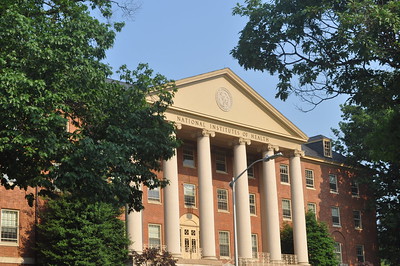
James H. Shannon Building (Building One), NIH campus, Bethesda, MD

Dr.DeVita, however, noticed something quite odd when he felt Quinn’s armpits during a routine examination. Quinn’s axillary lymph nodes—the cluster of glands working as a sentinel for what’s going on in the body—under his arms were enlarged and rubbery. These glands tend to become tender when the body has an infection and hard if it has solid tumors—like gallbladder cancer; they become rubbery if there is lymphoma. Being a lymphoma specialist, the startled Dr. DeVita questioned the possibility of a misdiagnosis—what if Quinn had lymphoma, not a solid tumor wrapping around his gallbladder leading to jaundice?

On being asked for his biopsy slides to be reevaluated, the always-in-command Colonel Luke Quinn angrily handed them over to the pathologist at NCI and sat impatiently in the waiting room. Costan Berard, the pathologist reviewing Quinn’s biopsy slides, detected an artifact in the image that had made it difficult to differentiate one kind of cancer cell from the other. Gallbladder cancers are elliptical, whereas Lymphoma cells are round. The roundish lymphoma cells can look like the elliptical gallbladder cancer cells when squeezed during the biopsy. This unusual finding by Berard explained why Quinn’s lymph nodes were not hard but rubbery. The new biopsy showed without a doubt that Quinn had non-Hodgkin’s lymphoma —the clumsy non-name we still go by to classify all lymphomas that are not Hodgkin’s disease. 

COSTAN W. BERARD, MD (1932-2013)

The NCI was working on C-MOPP, a new cocktail of drugs to treat non-Hodgkin’s lymphoma that had shown a two-year remission in forty percent of aggressive versions of this disease. The always-in-command WW II veteran had somehow landed in the right place by accident! It was a long three months for the nurses though, as they hated him for leaning on the call button all-day, for complaining bitterly about the food, for chastising anyone who forgot to address him, Colonel Quinn, and for never thanking anyone. But incredibly, he was discharged without any sign of his tumor; he had gone from certain death to a fighting chance. 

The fierce and unpleasant Colonel Quinn is crucial because his initial misdiagnosis unknowingly spurred the creation of a close network of influential people during his remarkable escape from certain death. He could do this because he was a friend and employee of the socialite and philanthropist Mary Lasker—the most consequential person in the politics of medical research. Read my earlier piece on her

Mary Lasker on her living room sofa; Mid 1950s. Courtesy of the Albert and Mary Lasker Foundation.

Mary Lasker, the timid, beehived socialite circumvented all conventions of medical research management and got the U.S. Congress to do things her way. Mary’s mantra was: Congress never funds a concept like “cancer research,” but propose funding an institute named after a feared disease, and Congress leaps on it. Her incessant lobbying with the backing of her husband, Albert Lasker and her confidante, Florence Mahoney, wife of the publisher of The Miami News, helped create the National Cancer Institute, the National Heart Institute, the National Eye Institute, the National Institute of Mental Health, the National Institute of Dental and Craniofacial Research, the National Institute of Arthritis and Metabolic Diseases, the National Institute of Aging, and the National Institute of Child Health and Human Development. 

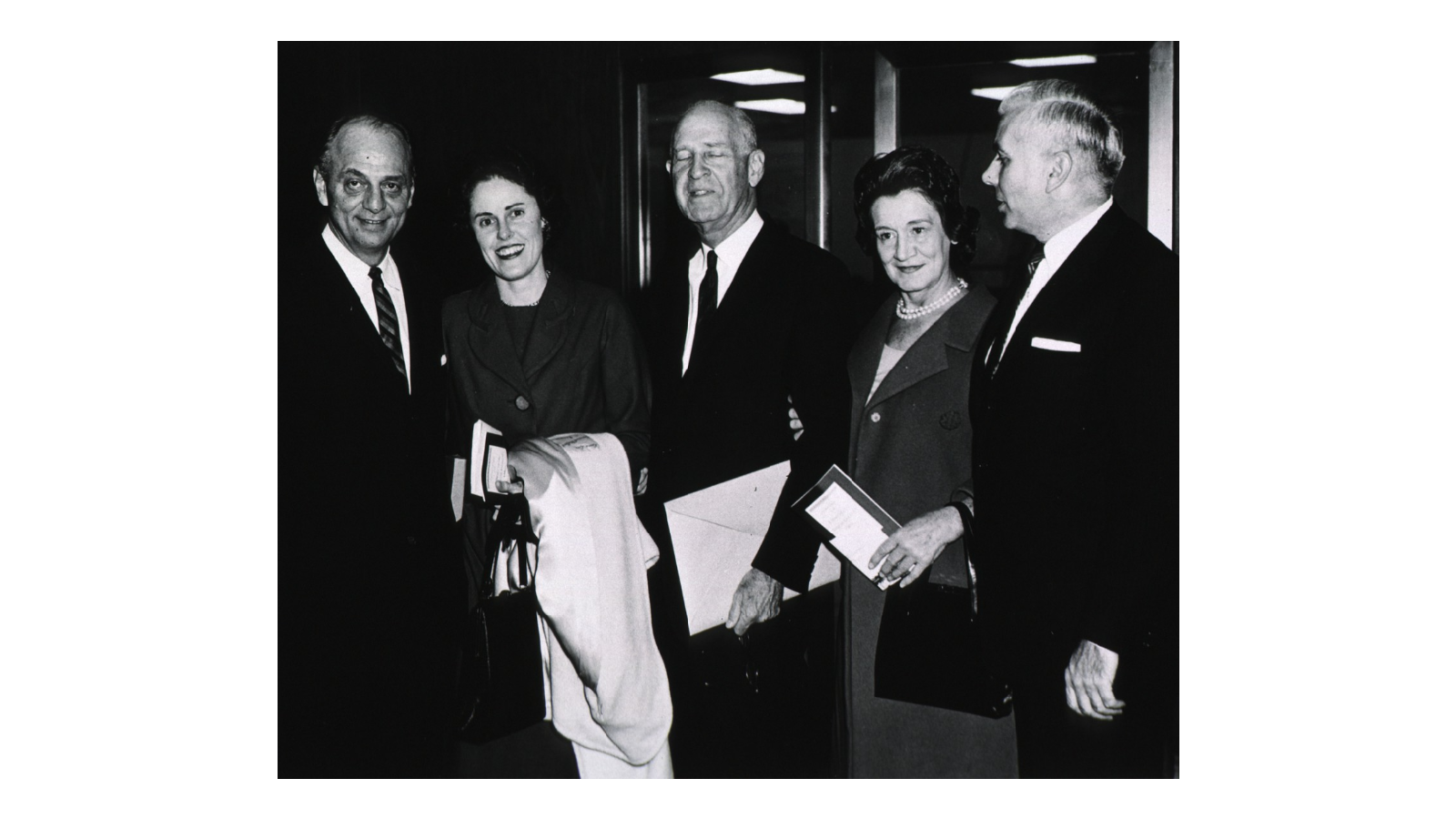
From Left to Right: Luther Terry, Mary Lasker, Lister Hill, Florence Mahoney, and Boisfeuillet Jones [Credit: The National Library of Medicine]

Though Mary Lasker knew the value of independent investigators pursuing their unique research interests, she supported projects only when a clinical goal was perceptible, like curing tuberculosis. In 1946, Mary, having noticed microbiologist Selman Waksman’s work on streptomycin—a new class of antibiotics effective against microbes resistant to penicillin—persuaded him and Merck pharmaceutical company to test the new drug against TB. By 1952 Mary’s instinct had won over Waksman’s initial skepticism as the widespread use of streptomycin halved the mortality from TB! Mary Lasker’s catalytic influence on basic research leading to a Nobel Prize-winning discovery is a case in point.

Her clout over Congress was in its prime through the 1950s and 60s when the National Cancer Institute (NCI) was developing the first cancer cures. It was also the period when Colonel Luke Quinn became her influential lieutenant. The Congress believed Luke Quinn represented the American Cancer Society, but he was Mary’s lobbyist in reality. When Quinn got sick, Mary used her contacts to get Welch and Sidney Farber, but it got her special attention when Quinn’s incurable torment was overcome. The ongoing public concern for cancer and Albert Lasker’s death due to pancreatic cancer made it an ideal disease for Mary to draw the battle lines. Quinn’s recovery convinced her that the necessary advance in basic research had occurred to justify taking the disease head-on. In April 1970, she began building bipartisan support by having the Senate create the National Panel of Consultants on the Conquest of Cancer. She prevailed over the Texas Democrat senator Ralph Yarborough to appoint her friend, a wealthy Republican businessman Benno C. Schmidt —the chairman of Memorial Sloan Kettering board of managers—to be the chairman on the conquest of cancer panel. She backed him up by arranging Sidney Farber as the co-chairman. The panel also included Colonel Luke Quinn and Mary herself.

In just six months, the panel issued “The Yarborough Report.” The report, mainly written by Colonel Luke Quinn and Mary Lasker, made far-reaching recommendations, including an independent national cancer authority. It recommended a substantial increase in funding for cancer research from $180 million in 1971 to $400 million in 1972 and reaching $1 billion by 1976. Finally, it recommended that the approval of anticancer drugs be moved from the FDA to the new cancer authority. Senator Edward Kennedy presented the recommendations as new legislation for the Ninety-Second Congress. Though not a Senate staff member, Colonel Quinn, trained by Mary in the art of testifying before the Congress, orchestrated the hearings, set the agenda, and selected the people who would testify.

Washington Post: 9 December 1969;  Citizens Committee for the Conquest of Cancer. 

The Nixon administration did not immediately embrace the bill as he wasn’t thrilled by Edward Kennedy’s involvement. Being Ted Kennedy’s close friend, Mary asked him to withdraw as a sponsor. Under Senator Pete Domenici, the bill renamed the National Cancer Act had to pass in the House. Paul Rogers, who headed the House Health subcommittee—Colonel Quinn and Mary Lasker had no influence over him—objected to removing the NCI from the NIH umbrella. He cautioned the NIH would face similar threats of separation in other disease areas. A revised bill agreed to this demand and kept the NCI under the NIH but gave it a separate budget and a director appointed by the President. 

https://ascopost.com/issues/may-25-2021/how-the-national-cancer-act-of-1971-revolutionized-cancer-care-and-what-lies-ahead/

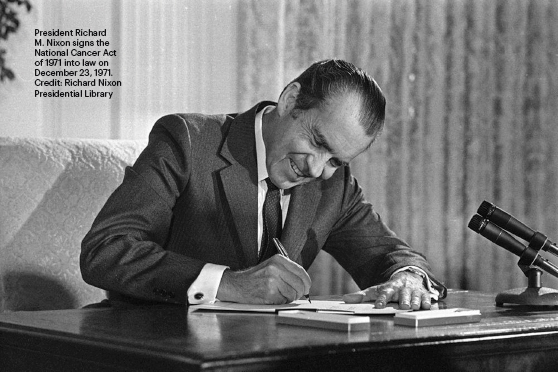
On December 23, 1971— fifty years to this day—the National Cancer Act was signed as a Christmas gift to the nation by President Richard Nixon, two years after Colonel Luke Quinn walked into the NCI with a wrong diagnosis. Though Quinn ultimately died of his relapsed cancer, a few months after the signing of the Cancer Act, the war on cancer had commenced with cancer research on the fast track. It was a victory for Mary Lasker, perhaps the most effective advocate for biomedical research that Washington had ever seen.

WASHINGTON: March 12 —Luke C. Quinn:au, a Capitol Hill spokesman, for the American Cancer Society, died of the disease yesterday in the National Institutes of Health

In hindsight, Mary Lasker’s triumph came with two significant disappointments. First, her crusade had failed in transferring the authority for approval of anticancer drugs from the FDA to the NCI—a failure that would plague the National Cancer Program well into the future. Second, the premise of the National Cancer Act that the “basic science was already there” and a quantitative boost in resources was all that was needed to bring victory was flawed. In combination, the two disappointments—the subjects of a future blog post—have spotlighted a perceived progress gap in cancer research by the tax-paying general public rather than underlining the tremendous conceptual progress made due to the War on Cancer. 

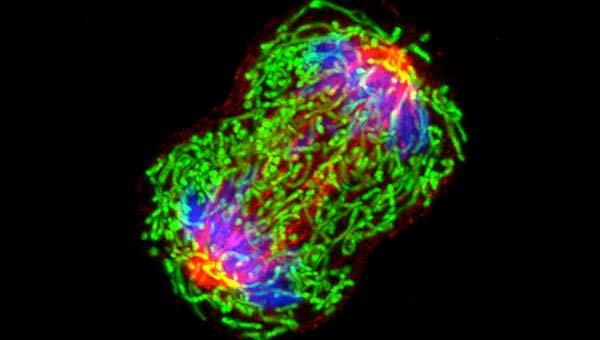
A dividing breast cancer cell.
Credit: National Cancer Institute / Univ. of Pittsburgh Cancer Institute

Ultimately, this blog is for you to appreciate the 50th anniversary of the lucky accidents and the incredible effort in creating the National Cancer Act. At the same time, personally, cancer researchers—the boots on the ground—like me who experience the non-triviality of progress in cancer will dwell on the insistence of simplistic linear views of progress in cancer research for public consumption.

“Blood is Thicker Than Water: Elite Kinship Networks and State Building in Imperial China”

A long tradition in social sciences scholarship has established that kinship-based institutions undermine state building. I argue that kinship networks, when geographically dispersed, cross-cut local cleavages and align the incentives of self-interested elites in favor of building a strong state, which generates scale economies in providing protection and justice throughout a large territory. I evaluate this argument by examining elite preferences related to a state-building reform in 11th century China. I map politicians’ kinship networks using their tomb epitaphs and collect data on their political allegiances from archival materials. Statistical analysis demonstrates that a politician’s support for state building increases with the geographic size of his kinship network, controlling for a number of individual, family, and regional characteristics. My findings highlight the importance of elite social structure in facilitating state development and help understand state building in China – a useful, yet understudied, counterpoint to the Euro-centric literature.

Read the whole thing (pdf).

(Monday’s) comic book edition

The Code is dead, to begin with. Watchmen (DC) is awesome, a near-Orwell experience. On comics historical curios and intellectual drifts. Here goes.

Vol. 1 – That other 50s scare and all

Somewhere somehow I picked up the Comics Code Authority story. It goes like this: The rise of mass-media in early 50s saw a creeping moral panic against the more “graphic” content of comic books (think horror, violence and the like). In 1954, the Senate Subcommittee on Juvenile Delinquency investigated the supposedly detrimental influence of comic books, taking into account speculative, biased evidence. The emerging threat of government regulation prompted the creation of the Code by the comic publishers, so that they could check content themselves. The self-censoring initiative could use some tuning: It was overly strict, shaking-up and aggressively downsizing the industry. Thus, a government “nudge” led to a private sector (over)reaction, with ill effects. The sector, however, adapted and continued, underground or otherwise.

*The* seal – source

Ironically, it was another government nod that galvanized a Code overhaul in 1971, as the Nixon administration asked Stan Lee of Marvel to incorporate an anti-drugs storyline in Amazing Spiderman. The arc proceeded without CCA approval in mid-1971 (funnily, just before the international monetary system entered turmoil). And it was in 1973 (say hello to the first oil crisis) that the depiction of murder in a popular comic book (Amazing Spiderman, again) marked the passage from the campy superheroes of the Silver Age (c. 1956 – 1970) to a more diverse and socially attuned bunch in the Bronze Age (c. 1970 – 1985). As the disillusionment of the 70s gave its place to cynicism in the 80s, so did the comic heroes matured, with works like Watchmen and The Dark Knight Returns. The archetypes formed in the period (Dark Age, typically 1985-1996), grim and complex, redefined the genre and are still here today.

The Code was updated again in 1989, but failed to stay relevant in the face of increasing bypassing/ sidelining via new distribution methods (all hail the market in action). Just 20 years ago, Marvel abandoned it. 10 years later, in 2011, the last adherents, DC and Archie, finally desisted, too.

Vol. 2Randian Quests & Answers

Α couple of (relatively) fresh articles flashed from The Comics Journal:

Mysterious Travelers: Steve Ditko and the Search for a New Liberal Identity

How Ayn Rand Influenced Comic Books

Not an exactly nuanced analysis, the second one (it contains a few useful links though), but still, both presented things to consider. As it turns out, the co-creator (along with aforementioned Stan Lee) of f – Spiderman, Steve Ditko, endorsed objectivist ideals in early 60s (he even contributed a piece to Reason back in 1969). Here is another scholarly short paper on his impact:

“A Is A”: Spider-Man, Ayn Rand, and What Man Ought to Be (PS: Political Science & Politics)

If mid-60s Peter Parker, “[c]old, arrogant, detached from the lives of others, but driven to follow his purpose and pursue higher ends”, seems objectivist enough, then the Question and Mr. A., Ditko’s creations in late 60s, are the real thing. These two were featured in smaller publications, and later provided the inspiration for Rorschach (Watchmen).

Fists will fly – source

The character was intended not only as a tribute to Ditko, but also as a stark criticism for randian convictions, meant to make a bad example of them. However, the controversial fictional zealot resonated (a bit too well perhaps) with the audience. Indeed, the character delivers some of the most memorable quotes ever, his unflinching crusade against the morally bankrupt (political class included) is iconic, and his damaged humanity invites some sympathy.

Depending on priors and inclinations, one can certainly discern smatterings of Rand’s ideas in Rorschach (“no gray”, believing in “a day’s work for a day’s pay”, among others). But I think that his trope could be assigned to other venues, too. For example, a fantasy aficionado will see a Paladin gone (very) wrong, maybe, or a casual will stick to the apparent right-wing leanings per se, and so on.

The other route of Rand influence is traced to Frank Miller and his Dark Knight take on Batman. The arc of a lone (capitalist) hero versus media-induced apathy and the corrupted establishment (and said establishment’s lapdog, Superman) has a libertarian facet, yes. I will get it (next week probably), read it and, then, return.

Some Monday Links – Of bloody summer stains, busted hopes and laundries

Also lingo. And beards.

Why Cuba is having an economic crisis (Noahpinion)

The Language of Totalitarian Dehumanization (Quillette)

On the Cuba events. Governments and protests, now that’s a strained relationship. Talking about the so-called “Second World” countries, Nikita Khrushchev did not even know what booing is, until he encountered it in his visit to London in 1956.

Few years later, during a massive strike in the Russian city of Novocherkassk, a crowd stormed the central police station. Whether it was a genuine assault, or a naive display of defiance from a people inexperienced in protesting, the government’s fearful puzzlement turned to cold, brutal aggression. Unarmed protesters at the center of the city, mistakenly thinking that those days were over, remained steadfast at the face of warnings to disperse. That is, until security forces opened direct fire against them. The ensuing massacre was covered-up for three decades. Since this was an à la Orwell un-event, no high-ranking officials’ records were stained.

Khrushchev’s aloof ignorance strikes a nerve, contrasted with the people’s heartbreaking one. Both glimpses are captured in the brilliant (though somewhat uneven) Red Plenty, by Francis Spufford.

All things said, Karl Marx Loved Freedom (Jacobin). More beards.

The Greek government, like its French counterpart, is escalating the push for vaccinations. As constitutional scholars argue the limits of state power regarding personal freedom and the public good, historical precedents are brought forth (for the US, c. early 1900s), involving mandatory vaccinations, quarantines and discrimination. The discussion draws from equal protection of the laws jurisprudence and smoothly led me to Yick Wo v. Hopkins (1886):

Yick Wo v. Hopkins established fair implementation of statutes (History Net)

The decision set a milestone and has been cited some 150 times.

The backdrop of the case is rich. As it turns out,

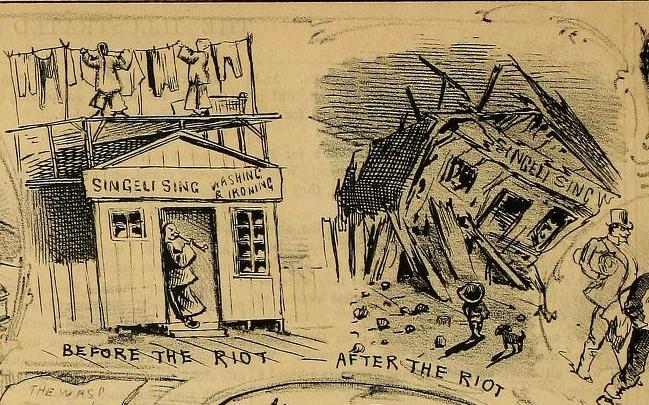
An 1880 ordinance of the city of San Francisco required all laundries in wooden buildings to hold a permit issued by the city’s Board of Supervisors. The board had total discretion over who would be issued a permit. Although workers of Chinese descent operated 89 percent of the city’s laundry businesses, not a single Chinese owner was granted a permit.

Oyez

The regulation was one in a series of many that reflected the anti-immigrant (especially anti-Chinese) sentiment, following the influx due to the Gold Rush (1849).

An illustration of the time, echoing the 3-day pogrom vs Chinese immigrants, San Francisco Jul. 1877 – Source

Yick Wo: How A Racist Laundry Law In Early San Francisco Helped Civil Rights (Hoodline)

A particularly badass line, from the unanimous opinion authored by Justice Stanley Matthews, shows that the Court did not hold back:

Though the law itself be fair on its face and impartial in appearance, yet, if it is applied and administered by public authority with an evil eye and an unequal hand, so as practically to make unjust and illegal discriminations between persons in similar circumstances, material to their rights, the denial of equal justice is still within the prohibition of the Constitution.

Monday Links, sticks and two (or maybe three) smoking sentences

Gangsters vs. Nazis (Tablet)

How the Jewish mob fought American admirers of the Third Reich. An excerpt:

Judd Teller, a reporter for a New York Jewish daily, relates how he met one day with “several men who said they were from ‘Murder, Incorporated’ and wanted a list of ‘Nazi bastards who should be rubbed out.’” Teller took the request to Jewish communal leaders. They told Teller that if the plan would be put in motion, “the police would be informed promptly.” Teller relayed this warning to his Murder, Inc. contact. Upon hearing this, the mobster angrily replied, “Tell them to keep their shirts on. OK, we won’t ice [murder] the bodies; only marinate them.” According to Teller, this is exactly what they did. He said the attacks by the Jewish mobsters was sufficient “marination” to drastically reduce attendance at Nazi Bund meetings, and discouraged Bundists “from appearing in uniform singly in the streets.”

The Inimitable Orwell (Commonweal)

On the Politics and the English Language essay. I try to stick to the six rules, but I fear I am not totally “outright barbarous”-proof. Another list with writing rules – a more light-hearted one – comes from Umberto Eco, the noted Italian scholar:

Umberto Eco’s 36 Rules for Writing Well (Openculture)

Speaking of proper phrasing, here is a passage from Lysander Spooner (Thomas L. Knapp posted it in the comments section of a NOL piece by Jacques Delacroix):

[W]hether the Constitution really be one thing, or another, this much is certain — that it has either authorized such a government as we have had, or has been powerless to prevent it. In either case it is unfit to exist.

Now, I may have found the second prospective opening for my public policy course, should I ever offer one (the absurd part is that I lack almost everything else to supply it, demand included). It is pithy, sharp and, importantly, timeless. The alternative one-liner I would possibly pen day one at the imaginary class:

Property imposes obligations. Its use by its owner shall at the same time serve the public good.

Weimar Constitution (1919), art. 153(c)

While not as punchy as Spooner’s aphorism, it has qualities and can raise eyebrows. Both phrases are metal. Independent of context, they have more or less exactly what it takes to pick and stick. Perhaps both of them should set the opening, leaving the audience free to choose the way forward.

Back to Spooner. Another prominent figure (of American individualist tradition this time) I had not heard of till this day.

Lysander Spooner (Online Library of Liberty). The particular passage comes from his No Treason. No. VI. The Constitution of No Authority (1870).

The Wings of Competition in Things Daily – Source

I took note that he challenged the government monopoly in mail services (a field with quasi-military structure, typically used as a matrix to consolidate state bureaucracy/ power, btw) with his American Letter Mail Company, on ethical and economic grounds. The state finally forced him out of business in 1851, though competition temporarily drove fees down.

(If you care about post stamps – I don’t – USPS to issue Ursula K. Le Guin stamp this month (Book Riot). I enjoyed Le Guin’s Earthsea and plan to read The Dispossessed, a veiled study of social systems I hear, before summer end)

If anything, Spooner seems to have shared the fiery convictions and language of his contemporaries at the First International. That was a time of memorable lines, obviously. This easily comes to mind:

The history of all hitherto existing society is the history of class struggles.

The Communist Manifesto (1848)

They also sported some serious beards. Those of Spooner and Marx are respectable, but I would award James Guillaume’s bonus points for the extra menacing vibe.

Monday’s frivolous, flimsy, frail flailings

Or, some Monday links on flavors, figurative flags and fails

I mean, it would be impossible to have a business like this in the States, a wood-burning fire – illegal, the meat – illegal, the dog – illegal, the cheese sitting out uncovered – illegal. Basically, everything that makes this place good would be illegal in the United States.

Anthony Bourdain: No Reservations ep. 1 – 01 France: Why the French don’t suck (Jul. 2005)

The other day, Brandon highlighted (the review of) a cultural history book, one that documents the postwar shift of cultural gravitas from Paris to New York. So, the talk is about the big league, the respectful duo of countries that gave us, among other things, modern constitutionalism and an understanding of the natural hue of fundamental rights. Here, I venture to present a sincere, if arbitrary (and somewhat superficial, since I never learned French, to my mother’s disappointment) selection of other Franco-American bites, that shadowed greater trends, or even shaped them.

160 years ago, chef Charles Ranhofer, a Frenchman, traveled to the US for a second time. A year and a false dawn at another premise after, he was hired at Delmonico’s in New York, an already established name. There, he proceeded in making it the definite flagship of American fine dining for the next 30-35 years.

A note issued by the restaurant at the time chef Ranhofer joined the team (1862) – source

His achievements include the invention of renowned dishes, innovations in the dining business model and a massive Franco-American culinary encyclopedia (The Epicurean, 1894, complete with nearly 1000 dishes and thorough guidelines for the proper tables/ menu setting, depending on the occasion). The story fits well in the Gilded Age picture, though I would guess not at front center.

Our own Escoffier (Los Angeles Times)

My pastry trilogy came a full circle only last year, having started some ten years ago: a Mississippi mud pie, a cheesecake (early 2010s, both under the guidance of my wife) and a tarte Tatin (May ‘20 lockdown, unsupervised, our then nearly-5-year old provided merry company). Of the three creations, the final was the most refined, as deserves to a French recipe from late 19th century. Like, it needed some real – if basic – technique, not the average ingredient gathering I was used to. It was also a mild failure. I followed a modern take, one to safely blame without retort. Will try again, someday. There are relevant recipes aplenty, though not in its contemporary Epicurean.

Deconstructing tarte tatin, the classic French dessert (National Geographic)

The Gilded Age was nearing its end when the famous Lochner v New York decision was delivered (1905). The Supreme Court struck down a New York state law on regulating working hours, as a breach of the liberty of contract, which was protected under the Due Process Clause of the Fourteenth Amendment. A few decades later, in United States v Carolene Products Company (1938), an interstate trade case, the Court lowered the standard of review for economic legislation, effectively demoting economic liberty vis-à-vis the other personal liberties.

Both decisions refer to the food industry, bakeries and milk manufacturers respectively. They hold vast importance and warrant further study (for starters – note to self – judicial activism in Lochner, individual rights in Carolene).

As a certain minstrel in a certain fantasy realm would have it, the truth of these decisions became something bigger than the facts. The two cases work as handy banners of the paradigm shift from “unrestrained economic liberty” to “state interventionism”, which happened as right/ left-wing totalitarianisms convincingly challenged the prewar liberal order. Liberal-minded thinkers from the two sides of the Atlantic tried to revitalize the liberal creed in the interwar years. Some of them convened at Paris – few months after the Carolene decision – to honor the visit of the American journalist/ author Walter Lippmann, a notable critic of the New Deal.

There were deep differences, but also a strong agreement on the threat posed by central planning and some tentative overlapping on the perceived failings of “old” classical liberalism and, interestingly, the potential of the state in enhancing personal freedom by pursuing limited social goals. The – middle – way forward needed free markets in a solid, impartial legal frame, which would enforce competition and even provide for a modicum of social justice. By one account, it was during this meeting that the term “neo-liberalism” took root (other ideas included “left-wing” or “constructive” liberalism. Chicago theorists – not represented at the Colloque Lippmann- had previously written about “positive” liberalism), though the term is older. The resolution led to nowhere in particular, since World War II broke out shortly after. It is nonetheless considered a kind-of precursor to the Mont Pelerin Society, the well-known organization founded after a conference in 1947, at the invitation of Hayek.

The neoliberal position is nicely summarized by Milton Friedman (who was present at the 1947 proceedings) in a short piece from 1951:

Neo-liberalism would accept the nineteenth century liberal emphasis on the fundamental importance of the individual, but it would substitute for the nineteenth century goal of laissez-faire as a means to this end, the goal of the competitive order… The state would police the system, establish conditions favorable to competition and prevent monopoly, provide a stable monetary framework, and relieve acute misery and distress.

Neo-Liberalism and its Prospects (Hoover Institution)

The term can also be found in scholarly papers from 50s-60s, but upon closer inspection they mostly focus on its German variant, “ordoliberalism”, which was closely associated with the “social market economy” – the postwar platform that defined West Germany (though voters could hardly tell what it exactly was).

My understanding is that, at some point postwar, the French involvement dwindled. Also, some German theorists fell from grace in the Mont Pelerin Society context, while US membership increased in number and clamor. The whole approach tilted closer to classical liberal/ libertarian (another note to my – European – self, Edwin van de Haar offers precious nuance regarding such terminology in a fresh post) and away from the “free market, strong state” convictions of Colloque Lippmann. However, Hayek retained cordial relations with the University of Freiburg – where the original ordoliberal theses formed.

Then the shade of neo-liberalism faded, only to be invoked as a nebulous catch-all characterization of free market policies a couple of decades later, almost devoid of its competitive and social security chops. It got a life though, since it was fleshed in the founding Treaties of the EU of the 50s. The institutional apparatus of the Union smugly radiates “free market within the properly defined lines” (the US influence is not be discounted, of course. Case in point, competition law).

EU, as with the Colloque: The French grabbed a coffee with the Americans and threw a party. Then, they took a step back as the Germans stopped being shy and hit the decks.

Back to the kitchen. Late 60s and into the 70s, gastronomic developments trace the retooling of society-at-large. That was the time various “new” national cuisines rose, with the French Nouvelle cuisine once again leading the way and the New American Cuisine taking clue from it (in Greece we usually talk about the “(new) urban cuisine” of that period, as the country experienced a rapid urbanization wave in the preceding decades).

Fantasy unchained: A cooking center in 1980 as imagined in 1973 – source

In the meantime: Political turmoil, be it protests or terrorism, there go Bretton Woods arrangements, productivity flattens, environmental concerns kick-in, enter competition from Asia, human rights against the Soviet Block, university studies expand, telecommunications and transport improve, oil crises, the lights go out in Britain and elsewhere, inflation runs, and so on and so forth. The next decade coincided with the emergence of new political leaderships across the West, as the turbulence discredited the previous guard.

The consensus got a drift for privatizations, deregulation and liberalization of international transactions, with US and Britain adhering to it (though to say that they indeed rolled-back the size and scope of State is questionable). This time, the Nobel Memorial Prizes in Economic Sciences awarded to Hayek (1974) and Friedman (1976) served as a flag (or a scarecrow) for the transition to market-based prescriptions.

The endgame was meant to play out in France. In May 1981, Mitterrand won the presidential election on a pretty standard socialist agenda. The program of nationalizations, hiked taxation, capital controls, grants and subsidies run its course till 1983, when the bad results in deficit, employment, inflation and the exchange rate – underlined by an equally poor performance in local elections – prompted a turn to anti-inflationary rigor and a realignment with more market-oriented policies (Spain and Greece, btw, more or less copycatted the French experience).

In a twist in the myth, three Mitterrand guys even went to assume head posts in international bodies, like the IMF (a member of the unholy trinity of the “Washington Consensus”), and promote capital account liberalization from there.

Endnote: The No Reservations show of late Anthony Bourdain had a role in our family’s inconsistent knack for things cooking/ baking. While writing this, I found out that a documentary on the man’s life just premiered at the Tribeca Film Festival.

‘Roadrunner: A Film About Anthony Bourdain’ Review: The Insatiable Life and Enigmatic Death of a Foodie Superstar (Variety)

Encore: To France”, Mike Oldfield’s cover by power metal band Blind Guardian, from their The Forgotten Tales album (1996). Pas mal.

Tuesday night Orwell

This comes from Michalis’ always excellent “Monday links” series:

There was a deep difference, though, between Burnham and Orwell, which Menand mentions but doesn’t make enough of. They were both notably tough-minded; that is, they shared an intense dislike of cant and wishful thinking. But Burnham was a thoroughgoing nihilist: he thought that all ideals were sentimental rubbish, that lasting peace was a pipedream, and that power was the only reality in politics. Orwell, on the other hand—though in Nineteen Eighty-Four he portrayed nihilism more brilliantly than anyone else ever has or, probably, ever will—was nevertheless the most idealistic of men, with solidarity and generosity seemingly written into his source code. 

This is from George Scialabba, a noted and popular American critic. Good find, Michalis, and the Cold War era is crazy. We’re just starting to scratch the surface of the details, but it seems like Cold War-era politics were way more divisive than they were today (Scialabba, for example, can’t help but insult his political enemies in this piece). Which is strange, because today’s pundits and politicians are always harping on and on about how we need to come together and stop being so divisive…

State formation in Korea and Japan

State formation in Korea and Japan occurred a thousand years before it did in Europe, and it occurred for reasons of emulation and learning, not bellicist competition. Korea and Japan emerged as states between the 4th and 8th centuries CE and existed for centuries thereafter with centralized bureaucratic control defined over territory and administrative capacity to tax their populations, field large militaries, and provide extensive public goods. They created these institutions not to wage war or suppress revolt – the longevity of dynasties in these countries is evidence of both the peacefulness of their region and their internal stability. Rather, Korea and Japan developed state institutions through emulation and learning from China. State formation in historical East Asia occurred under a hegemonic system in which war was relatively rare, not under a balance of power system with regular existential threats. Why? We focus here on diffusion through a combination of emulation and learning: domestic elites copied Chinese civilization for reasons of prestige and domestic legitimacy.

This is good, and it comes out of the most interesting journal in international relations today, but it doesn’t quite do it for me. I think China’s imperialism was far looser than contemporary scholars imagine, especially as China spread territorially outside of its cultural hearth. I think China’s imperial sovereigns were more akin to Emperors in the Holy Roman Empire than, say, Louis XIV. I do think that Japan and Korea mimicked China, which is exactly why both countries had relatively decentralized political systems up until the 19th and 20th centuries.

Contemporary scholarship has a soft spot for pre-modern (before 1500 AD) non-Western state systems, so you get stuff like this. Again, this is a great article, and you should read it right now, but I don’t buy it. I don’t think Japan and Korea were states that existed for centuries “with centralized bureaucratic control defined over territory and administrative capacity to tax their populations, field large militaries, and provide extensive public goods.” That’s too rich for my blood. There were cultural hearths and polities in Japan and Korea that tried to mimic China, but sovereignty was still far too fractal until the Europeans arrived with their formal imperialism. See this piece for an example of why I’m skeptical of the author’s claims.

Transaction Costs are Injustice

Every Law Professor: ‘what is justice?’

In law school, I found that the central goal of legal academics and practitioners was to construct systems of thought, regulation, and courts providing justice. In that endeavor, my peers and professors constantly asked, “what is justice?”

I think well intentioned lawyers would agree, the law should provide access to justice via a system that is generally agreeable to those subjected to it, and that matches in rules what the general public aligns on in spirit. However, beyond these generalities, I find the conversation of ‘what is justice’ to be too abstract to be useful. However, that does not mean we should give up on it, we just need to change approaches, and instead ask ‘what is injustice?’

The Via Negativa

The basis for this is that it is easier to agree on what is unjust than on what is just: injustice in the form of concrete, tangible wrongdoing can be protested to, and people from diverse viewpoints can find agreement in what they mutually despise. Through the via negativa, then, we can fill in the negative space around justice, and by recognizing what it is NOT, we can start to give it form.

I know exactly where I would start, since I spend way too much time around lawyers, and I have noticed that they are open to any discussion of how lawyers can bring justice, but get very prickly if you suggest that the cost in time, money, and lost control by delegating justice to lawyers is in any way problematic. Let’s just say, lawyers don’t like being reminded that they are rent seekers in the process of achieving justice. So, my bold assertion is:

Transaction Costs are Injustice

Let me unpack this. What I mean by this is that, whatever a just outcome may be, it is unjust to delay this outcome when speed is possible, it is unjust to have complexity and opacity when simplicity is possible, and it is unjust to demand control when voluntarism and mutuality is possible. In effect, it is unjust to make the process of finding justice costly.

The Appeal Labyrinth: The Town of Castle Rock v. Gonzales

This issue actually came up to me in a conversation about the heartbreaking case of The Town of Castle Rock v. Gonzales. In June 1999, Jessica Lenahan-Gonzales was a resident of Castle Rock whose estranged husband kidnapped her children from her house, and when she called the police and asked them to enforce an active restraining order against him (he had been stalking her and her children). They did not react quickly, and 12 hours later, her children were found murdered in her estranged husband’s car after he engaged in a deadly shootout with the police.

Now, there is no good outcome from such a situation, especially for Jessica. However, one route for her was to sue the police department under, of all things, under a law originally passed to fight the KKK. In her lawsuit, she claimed the federal government had an interest in enforcement of the restraining order and alleged that the police department had “an official policy or custom of failing to respond properly to complaints of restraining order violations.”

Jessica’s case was initially dismissed by the District Court, but she appealed and, in 2002, it was reversed by the Tenth Circuit, which said she could recover under procedural due process but denied that she had a right to recover via substantive due process (for Scalia’s take on substantive due process in general, see this amazing video). However, the Circuit court also noted that while the town was liable, the officers were covered by qualified immunity.

The town appealed and actually was granted cert by the Supreme Court. SCOTUS reversed the Circuit Court in a 7-2 decision; Scalia wrote for the majority that officers were not required by law to immediately enforce restraining orders, that even if they were it would not give individuals a right to sue (instead, the right would be with the state). Lastly, he noted that even if enforceable, this would have no monetary value and could not lead to an individual payout via Due Process.

So, in the end, SCOTUS gave Jessica nothing. Now, we can all weigh in on whether Scalia ‘did justice’ to her; I have incredible sympathy for Jessica but happen to think his argument is correct, that under the law and Constitution, a restraining order does not give her the right to get money from the town. But I will say that the court did her a great injustice, in sending her down a 6-year rabbit hole of being denied, then allowed, then denied again from recovery. How, then, can we all agree that the court was unjust? The injustice was the delay. The injustice was the tremendous cost in time, money, and emotional damage. The injustice was that the process for answering the question of how a mother should react to the murder of her children and how a town should support her gave no closure, and instead just had transaction costs in landing her, in 2005, exactly in the same spot she was in 1999.

The Lazy Counter: justice takes time!

Now, angry lawyers out there, don’t mistake me here: I am not saying appeals never bring justice. I too am in awe of the work of the Equal Justice Initiative, which uses the appeals process to fight wrongful convictions. I am not arguing appeals are unjust. I am arguing that a legal system that takes 6 years and millions of dollars to answer any question is doing an injustice to EJI’s clients as well. Was Walter “Johnny D.” McMillian served well by a justice system that put him in jail for years while his appeal stagnated?

What is obvious here is that lawyers, in their blindered vision of pursuing justice, are doing their best to get to the right outcome, and while cost may be a consideration for process improvement, it is not a consideration for justice. Maybe a simpler, more transparent, faster court process would do a worse job. But I think that every complexity, opacity, and delay is an injustice done by our system to the people who are seeking justice through it, and I would be amazed if Johnny D would have been thankful for all the technicalities that could be used to get the right outcome after what the Alabama prison system put him through.

Is “justice” trying to do too much?

Unlike in the case of Johnny D, Jessica’s case may show how we stretch the bounds of the system to get to an outcome that feels right, rather than being by the rules. Johnny D was caught up by a racist abuse of criminal justice, which is intended to keep citizens safe; there was no ‘community solution’ available for the murder of which he was falsely accused.

Jessica, however, was simply not treated right by her town. Anyone, regardless of their politics or views, would hope that the town has some level of care for their aggrieved, and that the community could pull together around her. Obviously, this did not happen–and especially not by the town’s police department, which had the opportunity to admit it was asleep at the wheel under the knowledge that they had qualified immunity. Since community solutions were lacking, she brought a civil case, which had a desirable end–helping an aggrieved mother and recognizing that her case was mishandled–but inadequate and undesirable means: lawyers lawyering.

I would be amazed if Jessica herself thought of the connection of: restraining order->Ku Klux Klan Act->federal oversight of law enforcement->property recovery under the Due Process Clause->monetary damages for police inaction. From my legal education, this sounds like the highly technical argument of a creative activist lawyer, who wants to change the law as much as he wants to help his clients. So, were Jessica’s lawyers trying to do too much through the justice system? Was the better solution, then, not to turn back to the community and use public truth-telling or even honest requests for help?

The elites-for-the-people against the people

This made me react against a phenomenon I have seen across law schools, firms, and courts. At elite law schools, the administration touts the number of Access to Justice projects and amicus briefs written by faculty in cases like Gonzales. At elite law firms, they attract top performers with huge salaries, sure, but they mostly talk about how many interesting pro bono cases their associates can take on. And on top Circuit Courts, most famously the Ninth, my classmates go on to help judges think creatively about how to reach just outcomes via legal wrangling. All of these activities are done with a mix of noblesse oblige and self-importance, but are honestly intended to help find justice for the downtrodden. I simply think these do-gooders don’t notice that all these activities are costly.

If you are not a lawyer, you may not realize how systematic this cost has become. Non-lawyers view courts as places where people with causes of action come and get answers based on the law. Lawyers know better: this certainly happens, but in parallel, dozens of groups (plaintiffs lawyers and activist groups on all sides of every issue) are targeting certain laws and certain constitutional questions, and are searching madly for standing. As in, they comb the news and low-level lawsuits to find one they can fund through as many appeals as possible to get the law changed or even just to get a ruling on a fact pattern that is friendly to them. In this, let me pick on my own team: in Carpenter v. US, in which the government used the cell phone location records of Carpenter and his friends without a warrant to arrest and convict them of robberies, there were no fewer than 16 amicus briefs by privacy activists (the CEI, EPIC, EFF, the Fourth Amendment Scholars, and the list goes on). Carpenter v. US was about many deep legal deliberations on the importance of privacy, but I have to say, long before it reached SCOTUS, it was no longer about justice for Carpenter, who had been in jail for two years and who wasn’t getting out even if he won. While it was a victory for my ‘team’ in saying that the government needs warrants if it wants cell phone location records, maybe justice isn’t just about getting victories for my team, if that victory comes at the cost of multiple appeals, dozens of lawyers and clerks, national media coverage, uncertainty for cell phone users and companies, and those 16 institutions writing briefs.

I therefore ask proponents of justice, who are trying to use their elite position to improve the system’s outcomes for the downtrodden, to be a little bit more humble and self-focused. Instead of sitting in seminars or court sessions deliberating on ‘what is justice,’ ask whether the justice system is the right way to seek the right outcome. Ask whether, maybe, it would be better to go out and act positively toward your fellow man rather than demand money, time, and attention to the causes, cases, and opinions of the (all elite and elitist) members of legal groups.

Invasiveness is Injustice

Across all legal disputes, I think the thing that rankles me–and all non-lawyers–is how prominent law is in our lives. If I need to use the justice system, I know it will become a major part of my life’s spending, but even if I never am called into court, I know that court cases are going to continue to be high-profile, lawyers are going to continue to increase their share of the economy, and professors are going to keep publishing books, seminars, articles, and blogs about ‘how can people like me bring just outcomes?’

So, maybe, we can find some justice for all if the legal system simply recognizes that ‘what is justice’ is not a question of all-encompassing, existential values, but a question of how to run an institution. Maybe what is important here is not the rights that we seek to gain for the oppressed by any means necessary, but of building and maintaining a structure (a Constitution, if you will) where anyone can engage, or not, with a system that uses just methods. High cost, delay, opacity, and central control are not just methods and show that the system is not working effectively.

We can all agree, left and right, that regardless of the answer, the system, the method of justice is itself broken if it cannot help but be a burden. Justice should not be so costly in our lives, and it is a failing of lawyers and judges to make their own jobs so important, pervasive, in control. I hope, with all the fantastically intelligent amicus-brief-writers out there, we can find a way to at least cut back that injustice.

Julian Simon’s life against the grain

I did not meet many of the postwar great thinkers of classical liberalism. There are two exceptions. In 2005 I had a chat with James Buchanan to ask him if I could translate the talk he gave to an audience of graduate students at the IHS summer seminar at the University of Virginia at Charlottesville. He agreed and I translated and published his ideas on ‘the soul of classical liberalism’ in a Dutch liberal periodical.

The other exception is Julian Simon. Perhaps not in the same league as Buchanan, he was certainly a maverick thinker and a classical liberal great. A navy officer, business man, and advertising expert who turned to academia, he is known, to name just a few, for his arguments in the field of population growth, immigration studies and of course the book The Ultimate Resource. In it he argues that all raw materials become cheaper, while humans are the ultimate resource, among many other issues. He also won a famous wager with his critic Paul Ehrlich, stating that the prices of the raw materials Ehrlich could choose (in fact copper, chromium, nickel, tin, tungsten) would decrease (inflation adjusted) over the period of a decade they agreed upon. But that is just the tip of iceberg of this most interesting man. You should really read his autobiography A Life Against the Grain, whenever you have the chance.

In 1995 a friend of mine and I founded the Dutch Benedictus de Spinoza Foundation, meant to group young people educated in (classical) liberalism. In our first public Spinoza-lecture in 1996 Simon agreed to be the speaker. If memory serves right he was on his way to or from a Mont Pelerin Society meeting in Vienna, and was willing to make a small detour. We spent two full days with him, touring The Hague, arranging an interview in a national paper, have a formal dinner with Simon as gues of honor and speaker, and so forth. He was the most congenial guest one can wish. He clearly did not want to be among the hot shots only. In fact he insisted that we should visit ‘the worst neighborhood of the city’. So we went to one of the poorest parts in town, which he found delightful, not because of the (relative) poverty, but because of the multicultural experience and multicultural food at the market.  An other remarkable feature was that in the half hour before we opened the lecture hall, he wished to take a nap on the floor right there!

In his autobiography he is open about his many rejected papers throughout his career, and the way he described how difficult it is to convince academic colleagues of a point that goes against conventional wisdom. No matter how strong the counter-evidence, people will choose to ignore the new facts or insights and keep the author out of the inner circle for as long as possible. I must say it sounds familiar to me, as an author who has attempted to change the views of (classical) liberals and IR theorists on international relations and (classical) liberalism. Even the obvious fact that trade cannot possibly foster peace seems impossible to establish. Alas, reading Simon one also learns to never give up, the truth shall be told, although there is no guarantee of success!

“The German Question” of the 19th century

I know most of NOL‘s American readers are familiar with the German question that puzzled the Allies after World War II, but there was a different German Question that puzzled statesmen and policymakers in the 19th century:

From 1815 to 1866, about 37 independent German-speaking states existed within the German Confederation. The Großdeutsche Lösung (“Greater German solution”) favored unifying all German-speaking peoples under one state, and was promoted by the Austrian Empire and its supporters. The Kleindeutsche Lösung (“Little German solution”) sought only to unify the northern German states and did not include any part of Austria (either its German-inhabited areas or its areas dominated by other ethnic groups); this proposal was favored by the Kingdom of Prussia.

And this:

While a number of factors swayed allegiances in the debate, the most prominent was religion. The Großdeutsche Lösung would have implied a dominant position for Catholic Austria, the largest and most powerful German state of the early 19th century. As a result, Catholics and Austria-friendly states usually favored Großdeutschland. A unification of Germany led by Prussia would mean the domination of the new state by the Protestant House of Hohenzollern, a more palatable option to Protestant northern German states. Another complicating factor was the Austrian Empire’s inclusion of a large number of non-Germans, such as Hungarians, Czechs, South Slavs, Italians, Poles, Ruthenians, Romanians and Slovaks. The Austrians were reluctant to enter a unified Germany if it meant giving up their non-German speaking territories.

This is from Wikipedia, and it appears that the German Question of the 20th century was still the same one as the 19th century. It took an invasion by the Soviet Union and the United States to decisively answer the question. Happy Easter!