The State in education – Part I: A History

In Beyond Good and Evil, written after breaking with composer Richard Wagner and subsequently rejecting hyper-nationalism, Friedrich Nietzsche proposed the existence of a group of people who cannot abide to see others successful or happy. Appropriately, he dubbed these people and their attitude “ressentiment,” or “resentment” in French. His profile of the resentful is most unkind, bordering on the snobbish – though Nietzsche had very little personal cause to feel superior (he was part of the minor nobility but always insisted that, due to his father’s premature death and his mother’s lack of connections, his legal rank was never of much benefit to him). Insanely proud of his classical education and remarkable, even for that time, fluency in Ancient Greek and Latin, the philosopher latched onto these languages as symbolic variables in his descriptions of society and its woes.

Much like the French philosopher Simone de Beauvoir who, a century later, attempted to prove that history was made by socio-cultural gender dynamics (Le deuxième sexe), Nietzsche proposed that all of (European) history since the fall of the Roman Empire was a battle between the cosmopolitan, classically-educated aristocracy and the technician, parochial lower classes. Unlike de Beauvoir who saw the world as oppressor-oppressed, the German believed that the lower orders, motivated by jealousy and feelings of exclusion, tried to pull their superiors down, creating a peculiar situation in which those who believed themselves the oppressed engaged in oppressive behavior.

As evidence of his theory, Nietzsche suggested in The Genealogy of Morals that the Protestant Reformation was the ultimate achievement of the resentful classes; functionaries, unable to understand the Latin of the Roman liturgy, read the writings of the ancient and medieval philosophers, or participate meaningfully in the conversations and society of the Renaissance, responded by turning the Church into the personification of all they hated – not unlike a voodoo doll – and then ousted it from their lives and countries. At least, this is what Nietzsche thought had occurred, adding that the cloddish nationalism that he had rejected would not have been possible without first banishing the Catholic Church and the refinement it introduced through fostering Latin, Greek, and Classical literature and philosophy.

On the practical plane, Nietzsche’s primary concern, post-Wagner, was the advent of Prussian hegemony and the loss of autonomy among the German member states. Before his friendship with Wagner, Nietzsche gave a lecture series on education which he intended to collect and publish as a book. The book never materialized [until 2016, when the Paul Reitter compiled the notes and lecture transcripts into book form under the title Anti-Education], but the philosopher did write a preface that he gifted to Cosima Wagner under the title “Five Prefaces to Five Unwritten Books,” which helped precipitate the quarrel since Nietzsche signaled clearly that he rejected the Wagnerian philosophy of the innate nobility of the (German) savage.

Much of Anti-Education is harsh and unyielding, moreover because there is much in it that is true. In it, one can see the early kernels of Nietzsche’s identification of ressentiment and the genesis of ideas concerning individuality and nobility that he returned to later in life. There is also much that is applicable today.

Nietzsche asked,

Why does the state need such a surplus of educational institutions and teachers? Why promote popular enlightenment on such scale? Because the genuine German spirit [that of the Renaissance princes] is so hated – because they fear the aristocratic nature of true education and culture – because they are determined to drive the few that are great into self-imposed exile, so that a pretension of culture can be implanted and cultivated in the many – because they want to avoid the hard and rigorous discipline of the great leader, and convince the masses that they can find the guiding path for themselves … under the guiding star of the state! Now that is something new: the state as the guiding star of culture!

Nietzsche wrote / spoke this on the takeover by the state of the education system, also known as the Prussian public school system, which “reformer” Horace Mann promptly imported to the United States. The false promise of public education, as Nietzsche saw it, was that state schools claimed the laurels and legitimacy of private gymnasia through deceit – speaking to a university audience, he expected everyone to know that pre-state control, there were two types of secondary schools: gymnasium, where the student received a classical education and prepared to enter university, and realschule, where the student learned the three Rs, along with some science, and entered the workforce immediately after graduation. Nietzsche claimed that while the gymnasium curriculum needed a significant overhaul, the only products of the realschule were conformity, obedience, and an inflated sense of achievement. Hence, he believed, when the government took over the education system, officials chose to model the public school on the old realschule, while claiming that graduates had the knowledge and skills of the gymnasium.

It is important to note at this juncture that Nietzsche bore a very visceral hatred of the Prussians in general and of Otto von Bismarck in particular. Viewing the former as unintelligent clods whose threat lay in their stupidity, the philosopher deemed the latter and his eponymous Bismarckian welfare state a greater threat to personal freedom. From 1888 until his nervous breakdown and descent into madness in 1899, Nietzsche called for the trial of Bismarck for treason, along with the removal of Kaiser Wilhelm II, in a sequence of letters and essays which his sister and executors suppressed, both to accommodate their own agendas and to avoid the attention of the censors.

The treason of Bismarck lay in his creation of a nation whose people were unwittingly dependent on the state. The state provided education during infancy and a pension in old age. As Nietzsche correctly saw, when the state controls the beginning of the pipeline and the end, everyone is in its employ. As he also foretold, the situation would end in violence (for Germany specifically; hence his interest in preempting war by removing its figurehead king) and heartbreak for those who placed their faith in the anti-individualistic state.

At a very fundamental level, Nietzsche believed that the public school system, with is inadequate education and contempt for classical learning and languages, was a conspiracy designed to drive a wedge among the social classes, enabling the state to increase control in the ensuing vacuum. The other aspect he identified was the use of public opinion to strip the individual of drive or thirst for a better life through a mixture of flattery and subversion of ambition. The outcome would be war and resentment, he predicted, for any country foolish enough to have faith in the Prussian system. Next week, we will examine whether Nietzsche’s predictions have come true in modern American education.

Nixon to Moscow, slavery’s toll on the economy

My latest is up over at RealClearHistory. An excerpt:

Nixon’s anti-Communist credentials were so sound that he could spend political capital making inroads with Communist enemies. His actions were viewed as safe by the American electorate because, for better or worse, the public saw Nixon as somebody who would not betray American values at the negotiating table with the Soviets. Nixon’s hawkishness provided moral cover for America’s withdrawal from Vietnam, and its peaceful overtures to the two most powerful and aggressively anti-capitalist regimes in the world (China and the USSR).

Please, read the whole thing.

Vincent has a great review up on Robert Wright’s new book about slavery, too. It’s at EH.net, a website dedicated to economic history, and here is an excerpt:

All of these amount to the same core point, those who reap the private benefits of slavery are content with their gains even though they come at a larger social cost and they will work to find ways to drive a wider wedge between the two by shifting costs onto other parties. Hence, slavery as pollution.

More here.

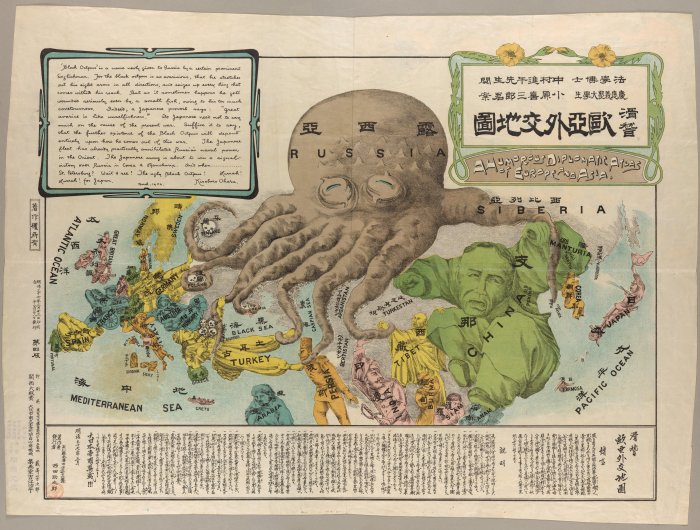
Eye Candy: Japanese anti-Russian propaganda

NOL map Japanese anti-Russia
Click here to zoom.

This dates from the late 19th or early 20th century. The Japanese won the Russo-Japanese War, but a quick glance at the casualties suggests it was more a pyrrhic victory for the Japanese.

Dictators who gave up power?

That’s the topic of my weekend column over at RealClearHistory, thanks to an extended email with Andrei. Here’s an excerpt:

10. King Juan Carlos I. Juan Carlos should be a household name in the West. The monarch of Spain upon dictator Francisco Franco’s death, Juan Carlos was expected to continue Franco’s legacy of authoritarian rule. After all, he received a military education in Spain under the Franco regime and had a clear claim to the throne (although the throne itself was a complicated legal matter). Furthermore, Juan Carlos was an active member of Franco’s staff, even stepping in to fill Franco’s void when the fascist began to fall ill due to old age. When Franco died, Juan Carlos began to dismantle the Franco regime and helped usher a smooth transition to democratic rule.

Please, read the rest.

Cities in capitalism are more beautiful

The other day I wrote about some of the reasons why I love capitalism. One of them is that cities in capitalism are more beautiful. I am convinced of this when I think about some cities I am more familiar with, including their geography and history.

Most foreigners I know have difficulty to answering correctly, when asked, “What is Brazil’s national capital?”. Most people answer Rio de Janeiro, but it is actually Brasilia. Many people say that beauty is in the eyes of the beholder, but I am very inclined to say that this is not so. I am still not 100% sure about this, but I believe that there is something objective about beauty. Maybe it is not something so strict, like a point. Maybe it is something broader, like an area. But still, I am inclined to say that there is something objective about it. At least for me, Brasilia is one of the ugliest cities conceivable. I am really glad to say that. Its architecture was designed by Oscar Niemeyer and Lucio Costa. Growing up in Brazil, questioning that Niemeyer was a genius is almost anathema, almost like saying that Maradona was better than Pelé or that Ayrton Senna was not the best Formula One pilot ever. Because of that, I was always happy to say that Niemeyer’s buildings are among the ugliest things on the surface of this planet. It was like shouting that the king is naked.

Brasilia is very beautiful from the sky. Its shape resembles an airplane or a cross. But that is the problem: the city is beautiful from heaven, but not for the people walking in it. It was made for God to see from up there. But, as Niemeyer was a convinced atheist, I am not sure who is watching his creation. My guess is that Niemeyer thought that he was a god. A very mean god, who didn’t care about people having to spend lots of time in cars driving long distances.

Niemeyer was also related, with Lucio Costa, to Barra da Tijuca, a neighborhood in Rio de Janeiro where I spent lots of time growing up. Lucio Costa, as far as I’m concerned, was not a communist. I believe he was closely connected to the Brazilian version of positivism. Because positivism and communism are basically the same, it doesn’t make much of a difference. Barra da Tijuca is very similar to Brasilia: very beautiful if looked at from the sky, but very unpleasant for the pedestrian. Very long distances to walk. Cars are mandatory.

The most pleasant neighborhoods in Rio de Janeiro are the result of spontaneous order. As Hayek noticed, spontaneous order is one of the central features of capitalism. People usually contrasted between planned economies (such as the USSR) and unplanned economies (such as the US in some moment of its history). But Hayek observed that all economies are planned. Some are centrally planned. Others are planned by several individuals who are not following a specific central plan.

I am convinced that cities that follow no plan, or a very simple plan, are more beautiful than cities that follow a very specific central plan. New York, as far as I know, followed a simple plan, a grid. But other than that, there was a lot of freedom in the use of the space for much of its history. It’s a city that I just love. I am more comfortable talking about Rio de Janeiro. It is a city that was at its best before modern architecture, positivism, socialism, Developmentalism, and other isms. It was better when Brazil had a little more classical liberalism.

“The Dutch Empire”

That’s the subject of my weekend column over at RealClearHistory. An excerpt:

6. The Dutch Empire vied for supremacy with the Portuguese empire, which, beginning in 1580 with the Iberian Union of Spain and Portugal, was a rival Catholic state attempting to establish a global hegemony of its own. The Portuguese were actually the first Europeans to establish trading forts throughout the world, but the aforementioned Iberian Union severely weakened Lisbon’s plans for global hegemony due to the fact that the union made Portugal the junior partner. The Dutch conquered and then established colonial rule at Portuguese colonies on four different continents, and unlike the Portuguese, focused on commercial interests rather than converting the natives to Catholicism and creating a politically connected empire. Because of the commercial nature of the Dutch project, many of the indigenous factions were happy to switch from Portugal to the Netherlands as business partners. And partners they were. Both the Portuguese and the Dutch (as well as the British and French later on) paid rent to local political units on the trading forts they built throughout the world. Such was the nature of power on the world scene before the end of the Napoleonic Wars in the early 19th century.

Please, read the rest.

Eye candy: Azimuthal Argentina, 1975

NOL map Argentina 1975
Click here to zoom

Azimuthal is a type of map. (Wiki) Argentina has 13 bases in Antarctica (6 permanent ones, 7 seasonal ones), with 230 people living in the 6 permanent ones, and one of only two civilian settlements on the continent (Chile supports the other one). (Wiki)

The deadliest riots in American history

That’s the subject of my weekend column over at RealClearHistory. The riots are all, by far, due to racism and nativism, but for some strange reason labor’s riots in the late 19th century get the lion’s share of the spotlight in history textbooks.

An excerpt:

6. Memphis, May 1-3, 1866. Another post-Civil War riot, the Memphis unrest was more violent and more organized than the brawl in New Orleans. Like N’awlins, Memphis was a Southern city long under Union occupation, but unlike the port city, Memphis had a large immigrant population of Irishmen who were in direct economic, political, and social competition with recently freed blacks. The Irish had such a large population in Memphis that they were able to take control of many levers of local government once Union troops banned native whites from holding office (for being Confederates), and the new group on the block was none too kind to the recently freed black population. Forty-eight people lost their lives, but the burning of homes (often with black families still inside of them) and churches, the raping of black women, and the fact that no prosecutions were carried out meant that Memphis would remain a hotbed of white supremacy for another century. (The riot enraged much of the Union, however, and led to a sweeping victory for Republicans later that year. The GOP quickly passed the First Reconstruction Act in 1867.)

Please, read the whole thing.

I’ve never been to Memphis, but it’s a city with good hip-hop music and good BBQ. Someday I’ll get up there for a long weekend or something.

“The staying power of ‘Citizen Kane'”

That’s the title of my Tuesday column over at RealClearHistory. An excerpt:

The relevant socio political commentary is more interesting, in part because people today still use the film to attack media moguls they don’t like (such as Fox News’ Rupert Murdoch). One narrative about the film’s sociopolitical impact even likens the film to a subtle anti-fascist, and pro-war, production because of the attention it draws to the immense power media moguls wield, and the incentive structures they face (and produce). This argument has at least some bite to it, as one of America’s most powerful media moguls in the 1940s, William Randolph Hearst, refused to give the film any sort of advertisement in any of his many publications. This blackballing on the part of the powerful led, of course, to the Citizen Kane’s relative flop at the box office.

Read the rest, baby!

Explaining current Brazilian politics to known-Brazilians and why I believe this is time for optimism

It seems that many observers believe that Brazil’s current political situation is one of instability and uncertainty. Since the mid-1990s the national political scene has been dominated by two parties: the Worker’s Party (Partido dos Trabalhadores, PT, in Portuguese) and PSDB. Now, with the main leader of the PT imprisoned – former president Lula da Silva – the PSDB also seems to have lost its rationale. It is clear that this party never had faithful voters, only an anti-PT mass who saw in it the only viable alternative. Given these factors, it is true that a political cycle that began in the 1990s is coming to an end, but far from being a moment of uncertainty and pessimism, this may be the most fruitful moment in the country’s history, as it seems that finally classical liberalism is being vindicated in Brazil.

Brazil began its political history as a semi-parliamentary monarchy. As one observer of the time put it, the country had a “backward parliamentarism”: instead of parliament controlling the monarch, it was the emperor who controlled parliament. Moreover, the Brazilian economy was extremely based on slavery. In theory, Brazil was politically and economically a liberal country. In practice, it was politically and economically a country controlled by oligarchies.

With the proclamation of the republic in 1889, little changed. The country continued to be theoretically a liberal country, with a constitution strongly influenced by the North American one and a tendency to industrialization. In practice, however, Brazil continued to be politically and economically dominated by oligarchic interests.

The republic instituted in 1889 was overthrown in 1930 by Getúlio Vargas. Vargas was president from 1930 to 1945, and his political circle continued to dominate the country until 1964. Once again, political language was often liberal, but in practice the country was dominated by sectorial interests.

Vargas committed suicide in 1954, and his political successors failed to account for the instability the country went through after World War II. The Soviet Union had been trying to infiltrate Brazil since the 1920s, and this was intensified with the Cold War. The communist influence, coupled with the megalomaniacal administrative inability of Vargas and his successors, led the country to such an instability that the population in weight clamored for the military to seize power in 1964.

The military that governed Brazil between 1964 and 1985 were influenced mainly by positivism. In simple terms, they were convinced they could run the country like a barracks. For them, the motto “order and progress” written on the Brazilian flag was taken very literally. One great irony in this is that Auguste Comte’s positivism and Karl Marx’s communism are almost twin brothers, products of the same anti-liberal mentality of the mid-19th century. The result was that Brazilian economic policy for much of the military period was not so different from that of the Soviet Union at many points in its history: based on central planning, this policy produced spectacular immediate results (the period of the “Brazilian miracle” in the early 1970s), but also resulted in the economic catastrophe of the 1980s.

However, the worst consequence of the military governments was not in the economy but in the political culture. The military fought against communism in a superficial way, overpowering only the guerrillas and terrorist groups that engaged in armed struggle. But in the meantime, many communists turned to cultural warfare, joining schools, universities, newsrooms, and even churches. The result is that Brazilian intellectual life was taken over by communism.

Fernando Henrique Cardoso, elected president in 1994, is an important Brazilian intellectual. Although not an orthodox Marxist, his lineup is clearly left-wing. The difference between FHC (as he is called) and a good part of the Brazilian left (represented mainly by the PT) is that he, like Tony Blair in England and Bill Clinton in the US, opted for a third way between economic liberalism and more explicit socialism. In other words, FHC understood, along with leading PSDB leaders, that the Washington Consensus is called a consensus for good reason: there is a set of economic truths (pejoratively called neo-liberals) that are no longer the subject of debate. FHC followed these ideas, but he was heavily opposed by the PT for this.

Since the founding of the PT, in the late 1970s, Lula’s speech was quite radical, explicitly wishing to transform Brazil into a large Cuba. But Lula himself surrendered to the Washington Consensus in the early 2000s, and only then was he able to be elected president. Once in office, however, Lula commanded one of the greatest corruption scandals in world history. In addition, his historical links to the left were never erased. Although in his first term economic policy was largely liberal, this trend changed in his second term and in the presidency of his successor, Dilma Rousseff.

Today Brazil is still living in an economically difficult period, but an ironic result of more than a decade of left-wing government (especially the PT) is the strengthening of conservative and libertarian groups in Brazil. In the elections from 2002 to 2014 it was virtually impossible to identify candidates clearly along these lines. In this year’s election, we expected several candidates to explicitly identify themselves as right-wing. Jair Bolsonaro, the favorite in contention, is not historically a friend of the free market, but his more recent statements demonstrate that more and more he leans in this direction.

It is possible that in 2018 Brazil will not yet elect an explicitly libertarian president. But even so, the economic transformations initiated by FHC seem now to be vindicated. Only with the strengthening of the Internet did Brazilians have real access to conservative and libertarian ideas. With that, one of the most important political phenomena in Brazil in the last decade is the discovery of these ideas mainly by young people, and it is these young people who now cry for a candidate who defends their ideas. Bolsonaro seems to be the closest to this, although there are others willing to defend similar economic policy. After more than a decade of governments on the left, it seems that Brazil is finally going through a well-deserved right turn.

“10 little-known fascist governments”

That’s the subject of my weekend’s RealClearHistory column. An excerpt:

7. Romania and the Iron Guard. Sandwiched between the communist Soviet Union and the fascist Axis powers of central Europe, Romanian society struggled to find its footing after a comparatively wonderful campaign during World War I, but Bucharest eventually chose to side with Berlin and Rome instead of Moscow. Romanian fascism was known for including the Orthodox Church into its anti-communist, anti-Semitic, and anti-capitalist rhetoric. Romania’s fascists almost made the Nazis look like boy scouts, especially when the Iron Guard organized and implemented one of Europe’s bloodiest pogroms, ever: the Iași pogrom. Just over 13,000 Jews, along with their liberal and Orthodox defenders in the city of Iași, were butchered on the streets where they once plied their trades. Romania, a member of the Axis for most of the war, was second only to Germany in the number of Jews it killed during World War II.

Please, read the rest.

Oh, and I wrote about America’s greatest maritime disaster on Tuesday for RCH‘s blog, the Historiat.

“Top 10 Things That Tipped Off Revolutionary War”

That’s the title of my weekend column over at RealClearHistory. Check it out:

5. The continued quartering of British soldiers. Imagine, for a moment, an Iraqi household being forced to give room and board to an American or a Polish soldier in 2005. That’s not quite what happened in the North American colonies but it’s not a far cry, either. The colonists of North America considered themselves to be British subjects of the Crown, and most were proud to be. (In fact, a little further down the list, you’ll see why the Americans, as rebels, were so adamant about liberalizing citizenship laws.) A much better analogy would be to imagine the LAPD or the Texas National Guard forcing households to give quarter to soldiers. The analogy is better, but the picture is still a frightening one.

Please, read the rest. The other 9 are also good. Heck, you might even learn something new…

The problem with Brazil (and it’s not socialism)

The problem with Brazil is not Luis Inacio Lula da Silva. It’s not the Worker’s Party. It’s not Socialism.

Certainly one of the most important politicians in Brazilian History was Getulio Vargas. Vargas came to power in a coup (that symptomatically most Brazilian historians call a revolution) in 1930. He ended up staying in power, without ever being elected by popular vote, until 1945. Then he peacefully resigned, not without electing his chosen successor, Eurico Gaspar Dutra. Vargas came back to power immediately after Dutra, and committed suicide while in office. Almost all Brazilian presidents from 1945 to 1964 were from Vargas’ close circle.

Brazilians to this day are still taught that Vargas was a hero, persecuted by an evil opposition. Initially, Vargas was some kind of Brazilian positivist. He was anti-liberal because liberalism is weak and slow. We need a strong technical government, able to identify problems and come with solutions fast. However, while in office, he became “the father of the poor,” a defensor of the lower classes. Nothing could be farther from the truth, of course, but that’s how Vargas is remembered by many.

One of my favorite interpretation of Brazil comes from Sergio Buarque de Holanda. According to Holanda, the problem with Brazil is that Brazilians are cordial. What he means by that is this: using Weber’s models of authority, he identified that Brazilians were never able to support a Legal-Rational authority. Vargas was seen as “a father.” not a president. The country is seen as a big family. Lula used a very similar vocabulary and tried to reenact Vargas’ populism.

As I mentioned, Holanda’s interpretation is Weberian. Weber’s most famous book is The Protestant Ethic and the Spirit of Capitalism. The problem with Brazil is that it never went through a protestant reformation. And because of that, it never developed the “spirit of capitalism” that Weber describes. Brazil is still, to a great degree, stuck with traditional and charismatic forms of authority.

To be sure, Brazil has many features of a modern liberal state. Since late 18th century Portugal tried to copy these from more advanced nations, especially England. Brazil followed suit. But you can’t have the accidents without the substance. Unless Brazil actually goes through a transformation in its soul, it will never become the modern liberal state many want it to be. Quoting Domingo Faustino Sarmiento, “An ignorant people will always choose Rosas.”

Monarchical Brazil was not a conservative paradise

Seems to me that there is a strong tendency between contemporary Brazilian conservatives to consider the Brazilian Empire (1822-1889) a golden age in Brazilian history. Many Brazilian conservatives are now defending the monarchy as an ideal form of government for Brazil.

As someone said, “the more we change, the more we remain the same.” Brazil became independent from Portugal in 1822. The independence was officially proclaimed by Dom Pedro I, son of Dom João VI, the king of Portugal. I think that maybe Brazilians are so acquainted with this fact that they don’t realize how crazy it is: the prince of Portugal declared the independence of Brazil! That didn’t happen because Dom Pedro fought with his father. By all accounts, father and son enjoyed the best relationship possible. Dom Pedro declared Brazil’s independence because if he didn’t, someone else would.

Dom Pedro’s independence was just one among many others. Tiradentes tried to proclaim the independence of [at least part of] Brazil in 1789, basically 30 years before Dom Pedro! And this is just one example! Tiradentes independence was not successful because it was averted by Portugal. Dom Pedro’s independence was successful because he was Portugal (ok, he wasn’t Portugal, but he was part of it)!

The fact that Brazil’s independence was proclaimed by a Portuguese monarch gives a very special meaning to what means to be conservative in Brazil. Today, in the US, one may call himself a conservative because he defends the ideas of Thomas Jefferson. But in his day Thomas Jefferson was a radical! A rebel who revolted against the British monarchy. Dom Pedro was not exactly a rebel. He wanted, to a great degree, to maintain things just the way they were. Certainly, many of his supporters were afraid of a more radical independence movement. To say the least, Brazil’s independence was a compromise between radicals and conservatives.

Brazilian monarchy avoided many reforms, inspired by classical liberalism, that were happening in other places. To give just one example (in my personal view, the most glaring), Brazil was the last country in the Western Hemisphere to abolish slavery (in 1888). I don’t blame Dom Pedro I for this. I also don’t blame his son, Dom Pedro II, who ended up being emperor for the majority of the monarchical period (1840-1889). But the fact is that the monarchy maintained many of the privileges inherited from Portugal, and avoided reforms that Anglo-American conservatives would support.

Brazilian conservatives have to be careful with the use of this word. To be a conservative in Brazil is not necessarily the same as being a conservative in England or the US.

On the rift between economics and everything else

The line is often heard: economists are “scientific imperialists” (i.e. they seek to invade other fields of social science) jerks. All they try to do is “fit everything inside the model”. I have this derisive sneer at economists very often. I have also heard economists say “who cares, they’re a bunch of historians” (this is the one I hear most often given my particular field of research, but I have heard variations involving sociologists and anthropologists).

To be fair, I never noticed the size rift. For years now, I have been waltzing between economics and history (and tried my hand at journalism for some time) which meant that I was waltzing between economic theory and a lot of other fields. The department I was a part of at the London School of Economics was a rich set of quantitative and qualitative folks who mixed history of ideas, economics, economic history and social history. To top it all, I managed to find myself generally in the company of attorneys and legal scholars (don’t ask why, it still eludes me). It was hard to feel a big rift in that environment. I knew there was a rift. I just never realized how big it was until a year ago (more or less).

There is, however, something that annoys me: the contempt appears to be self-reinforcing.  Elsewhere on this blog (here and here) (and in a forthcoming book chapter in a textbook on how to do economic history), I have explained that economists have often ventured into certain topics with a lack of care for details. True, there must be some abstraction of details (not all details are useful), but there is an optimal quantity of details. And our knowledge grows, the quantity of details necessary to answering each question (because the scientific margin is increasingly specialized) should grow. And so should the number (and depth) of nuances we make to answer a question.  There is a tendency among economists to treat a question outside the usual realm of economics and ignore the existing literature (thus either rushing through an open door or stepping in a minefield without knowing it).  The universe is collapsed into the model and, even when it yields valuable insights, other (non-econs) contributors are ignored.  That’s when the non-econs counter that economists are arrogant and that they try to force everything into a mold rather than change the mold when it does not apply. However, the reply has often been to ignore the economists or criticize strawmen versions of their argument. Perceived as contemptuous, the economists feel that they can safely ignore all others.

The problem is that this is a reinforcing loop: a) the economists are arrogant; b) non-economists respond by dismissing the economists and ridiculing their assumptions; c) the economists get more arrogant. The cycle persists. I struggle to see how to break this cycle, but I see value in breaking it. Elsewhere, I have made such a case when I reviewed a book (towards which I was hostile) on Canadian economic history. Here is what I said for the sake of showcasing the value of breaking the vicious circle of ignoring both sides:

These scholars (those who have been ignored by non-economists) could have easily derived the same takeaways as Sweeny. Individuals can and do engage in rent-seeking, which economists define as the process through which unearned gains are obtained by manipulating the political and social environment. This could be observed in attempts to shape narratives in the public discourse. According primacy to the biases of sources is a recognition that there can be rent-seeking in the form of actors seeking to generate a narrative to reinforce a particular institutional arrangement and allow it to survive. This explanation is well in line with neoclassical economics.

This point is crucial. It shows a failing on both sides of the debate. Economists and historians favorable to “rational choice” have failed to engage scholars like Sweeny. Often, they have been openly contemptuous. The literature has evolved in separate circles where researchers only speak to their fellow circle members. This has resulted in an inability to identify the mutual gains of exchange. The insights and meticulous treatments of sources by scholars like Sweeny are informative for those economists who consider rational choice as if the choosers were humans, with all their flaws and limitations, rather than mechanistic utility-maximizing machines with perfect foresight (which is a strawman often employed to deride the use of economics in historical debates) . In reverse, the rich insights provided by rational choice theorists could guide historians in elucidating complex social interactions with a parsimony of assumptions. Without interaction, both groups loose and resolutions remain elusive.

See, as a guy who likes economics, I think that trade is pretty great. More importantly, I think that trade between heterogeneous groups (or different individuals) is even greater because it allows for specialization that increases the value (and quantity) of outputs.  I see the benefits of trade here, so why is this “circle of contempt” perpetuating so relentlessly?

Can’t we just all pick the 100$ bill on the sidewalk?