Battling Time and Ignorance: Mario Rizzo at 70

Last week my friend and colleague Mario Rizzo, a scholar central to the revival of  contemporary Austrian economics, turned 70. This occasion prompted a spontaneous outpouring of praise for his work, as well as messages of gratitude for his support of students and fellow academics over his decades as an intrepid professor with his home firmly at NYU. They are collected over at ThinkMarkets. Jeffrey Tucker has written an excellent summary of Mario’s intellectual contributions at the American Institute for Economic Research. Below is a segment of my birthday message:

In my home, the United Kingdom, classical liberal thought has until recently been virtually unheard within much of academia. As a student and think-tank researcher ravenous for liberal approaches to public policy, I gorged on Mario’s blog posts from ThinkMarkets. Together with Marginal Revolution and Cafe Hayek, ThinkMarkets was a critical lifeline for me facing an intellectual world dominated by various visions of authoritarianism and only slightly more benign variants of paternalism.

Thanks to Mario’s selfless contributions to the revival of Austrian economics, that intellectual world is changing, even in the UK. His co-founding of the Society for the Development of Austrian Economics and hosting the Program on the Foundations of the Market Economy at NYU has provided support and inspiration for countless young scholars.

I am very fortunate to be among that multitude.

IMG_5104


Brexit Breakdown

Ir has been obvious for at least a month now that soft Brexit has won out in the UK, though the Prime Minister Theresa May would never admit such a thing directly. Government discussion of access to the EU internal market at its existing level, or very close, and keeping the border open between the Republic of Ireland and Northern Ireland (a fundamental of the peace settlement in the north) would at the very least require continuing regulatory alignment in goods (that is, following the rules made by the European Union).

It seems very likely that negotiations of the terms of exit with the EU itself would make even this partial alignment with the internal market inadequate in order to get the desired level of access. At the very least EU negotiators would demand some inclusion of services (financial services are the big issue here) and something at least resembling free movement of labour.

That inclusion would be full UK access to the internal market after exiting and would require at least a Swiss style relationship with the EU, in which there is full market access in exchange for accepting EU rules and something close to free movement of labour. Such a relationship would mean accepting judgments of the European Court of Justice even if they are not incorporated into UK law. The UK might not follow Switzerland into EFTA (European Free Trade Association, see paragraph below).

It has even been suggested that the UK might find it necessary to adopt a ‘Norway’ solution, in which the UK is directly a member of the European Economic Area. Norway has free movement but opts out of common agricultural and fisheries agreements. It is not part of the EU customs agreement. Like Iceland, Lichtenstein, and Switzerland, it is a member of the European Free Trade Area, which essentially harmonises regulations between these countries and the EU; that is, EU regulations are enforced by EFTA institutions.

It is clear that most Conservative MPs and businesses (though more large business than small business) regard something like the arrangements above, soft Brexit, as preferable to hard Brexit (trade agreement with the EU as a completely external country, possibility of no deal). These MPs and business people, along with most Treasury economists and economists in general, believe that keeping complete access to EU markets is more valuable than vague claims of a trade boom through deals with non-EU states across the world.

Hard Brexiteers believe that economic growth of other parts of the world requires breaking free of EU shackles on global free trade. The soft Brexit, as well as Remain, argument is that membership of the EU does not prevent trade with the rest of the world and that some EU countries are already doing that very well compared with the UK. On this argument, geographical proximity will always make EU trade disproportionately important so that limiting access to EU markets in the hope that non-EU countries will want free trade agreements is unnecessary and probably very damaging.

May’s drift towards soft Brexit after presenting herself as the guardian of hard Brexit has the support of most of the Cabinet, and Conservative MPs, but has been disappointing hard Brexiteers for some time. An agreement of the full cabinet at the Prime Minister’s country residence for soft Brexit has led to the resignation of the two most hard Brexit-oriented ministers.

It seems unlikely this this will deter May from a soft Brexit policy, which everyone agrees can only become more soft in negotiations with the EU to achieve an agreed exit. It also seems unlikely that most Conservative MPs will resist this policy. The biggest problem for May could be that the opposition parties want to vote against the government in call circumstances, so could vote with hard Brexit Conservative MPs to bring down any Brexit agreement.

At this point Brexit might completely break down, with the UK becoming a full member of EFTA, so in practice a member of the EU which exchanges some opt-outs for absence from the decision making processes and institutions. It might even lead to a suspension of Brexit, or a second referendum in which the electorate chooses between the exit package and staying in the EU.

At present, the most likely options in descending order are: 1. soft Brexit, outside formal association with the EU, but like that in practice, 2. formal association with the EU, maybe meaning membership of EFTA, 3. the complete breakdown of Brexit. This could change and so far change has been to move further and further away from hard Brexit.

Personally I support continuing membership of the EU. It is inevitable that large parts of the UK economy will ‘align’ with EU regulations, so it is best to be part of the institutions and processes which decide on these regulations. That is the most pragmatic version of my argument.

I am also a strong European integrationist, even a federalist romantic. The qualification of this idealism is that integration should not go further than public opinion or institutional capacity can accept at any one moment and that economic realities should guide the relationship with Europe for and against the kind of integration I favour at heart.

My own ideal is a kind of revival of the medieval dreams of ‘universal’ (i.e. European) Empire. The poet Dante was a great exponent of such a vision in his classic of political thought On Monarchy, which does not exclude city republics, even favours them under a high European sovereign. We can join it with Marsiglio of Padua’s slightly later call for an empire with elections to have something like democratic federation for Europe.

Leaving my European romanticism aside for the moment, the current realities are that the UK’s exit from the EU has become more and more complicated by the disadvantages of disentangling complex and far reaching institutional and economic links, particularly when most people involved want to keep an open border with the Republic of Ireland and keep 100% of the current level of access to the internal market.

Turkey at the start of one-man rule

1. Yesterday (Monday) Recep Tayyıp Erdoğan took office under the system of executive presidency, which gives him arbitrary personalised powers, based on the claim that a system of such extreme powers for one person is the most democratic system if that person is elected. The changes came about as the result of a referendum last year, which gave a narrow victory for the constitutional changes. It seems to me, and many others, that rigging allowed victory in the election. For the first time in Turkey, all ballot papers unstamped by an electoral officer were counted, allowing unlimited fraud. There are other issues about intimidation and irregularities, but this is not the moment to go into further detail, but I will just point out that radical changes to the constitution were ‘legitimised’ by pseudo-democratic fraud.

2. The constitutional changes enable the President to: legislate by decree, appoint most Constitutional court judges, appoint the army chiefs, appoint police chiefs, appoint all higher level members of the bureaucracy, appoint government ministers and vice-presidents without reference to the National Assembly. There is no Prime Minister. The President, Vice-Presidents, and Ministers are not obliged to answer questions in the National Assembly. In principle the National Assembly can reverse decrees as laws, but to allow the President to legislate in such an unaccountable way in the first place undermines all understanding of what a national assembly is for and what the limits on the head of government or head of state (now the same person) should be in a state which is constitutional and democratic.

3. Ministerial appointments have most notably included the elevation of Erdoğan’s son-in-law, Berat Albayrak, to the Ministry of Treasury and Finance. Albayrak is a major businessman whose rise in business and then politics have taken place since Erdoğan became the most powerful man in Turkey in 2002.

4. Other appointments have given business people ministerial posts for areas of the economy in which they have a dominant market position. Erdoğan’s own family doctor who owns a medical business is health minister. The education minister owns a private college.

5. The appointments of business people and a son-in-law show carelessness about propriety in the separation of the administration of public affairs from private and family interests, to put it in the mildest way possible. It also suggests that Erdoğan thinks he is too big for the party which brought him to power, AKP. It has been clear for some time that the most powerful people in the AKP are this son-in-law and one of the sons. That is, the AKP exists as a vehicle of one family, and its businesses associates. In this case, it is hardly a properly functioning democratic party.

6. The appointments were preceded by a presidential decree on the appointment of the governor and vice-governors of the central bank, which reduces its autonomy and makes it more vulnerable to Presidential pressure. Erdoğan has clearly been struggling to live with central bank decisions to raise interest rates in response to inflation and the falling value of the Turkish Lira. Anyway, the currency lost 20% of its value and inflation is at nearly 16% though the central bank’s target is 5%.

7. Market confidence in Turkey, even of a very minimal kind, was resting on one man, Mehmet Şimşek, who has western training in economics and is the last remnant of the days when the AKP appeared to many to be a centre-right reformist party, and did manage to behave in part like such a party. Şimşek appears to have been increasingly unhappy with his situation, putting a rational face on polices he knows are going in the wrong direction, occasionally winning battles to raise interest rates. One of Erdoğan’s main obsessions is that interest creates inflation. He has found it necessary to curtail that belief on occasions. Şimşek apparently wanted to resign from government recently, but no one ‘betrays’ Erdoğan in that way. Şimşek was bullied into staying and has now been sacked. His replacement is Erdoğan’s son-in- law. The markets have been spooked and the lira fell very sharply yesterday evening.

8. The Erdoğanists do have a solution to lack of international market confidence in Turkey. It is to create a Turkish ratings authority which will rate Turkish government credit as the government wishes! This absurd proposal, which will only reduce the credibility of the lira and government debt, shows the depths to which economic policy run on political paranoia has sunk in Turkey. Political paranoia because low credit ratings are due to foreign conspiracies!

9. Going back to last month’s election, about 2% of ballots cast have been declared invalid by the Supreme Electoral Council. HDP (Kurdish rights and leftist party) has pointed out that most ‘invalid’ ballots are from polling stations where it did not have observers. The HDP is defined as ‘terrorist’ by the followers of Erdoğan and its presidential candidate is in prison on ‘terrorism’ charges. This is all based not on credible evidence of co-operation with the PKK, which does have common roots with HDP, but on absurdly broad definitions of terrorism which take in people who do not oppose the PKK enough or which offer any criticism of state policy towards the PKK.

10. Based on point 9, it looks very much like 2% of votes cast were spoiled to take votes from the HDP. It hardly seems likely that would be the limit of fraud. As mentioned in point 1, all ballots were counted which did not have the basic security guarantee of a stamp from an electoral official on the ballot itself or the envelope containing the ballot. It is inherently difficult to arrive at accurate figures in this matter, but it looks very much like at least 4% of the ballot was fixed (that would merely double the most obvious form of rigging, which I do not think is an extravagant assumption, after all most rigging will take place in very hidden ways). If I am correct then the pro-Erdoğan electoral list for the National Assembly did not get a majority of votes and Erdoğan did not get a majority of votes in the presidential election.

11. The government-state machine extends claims that the HDP is terrorist to the main opposition party, CHP, on the grounds that the CHP has offered some criticisms of the detention of the HDP presidential candidate, and that some CHP supporters voted HDP to help it overcome fraud and reach the 10% of votes necessary to enter the National Assembly. CHP provincial leaders have been banned from attending the funerals of soldiers killed by the PKK, soldiers who in some cases will be CHP supporters, showing the kind of spite, vengefulness, and abuse of state power driving the AKP.

12. The Istanbul municipal government has announced that public transport will be ‘only’ half price during next month’s Kurban Bayram (Sacrifice Festival; religious festival and public holiday) instead of free as has been normal for a long time. This shows the strains that public finances are under in Turkey. The AKP are specialists in providing ‘free’ benefits to electors, along with favours for individuals and families, building up a base in local government in this way before they came to power nationally. The Istanbul news is a small thing in itself, but is suggestive of a decline in the capacity of the AKP to use public money to buy votes.

13. Given increasing personal indebtedness, rising inflation, the falling value of the currency, the decline of foreign investment and the credibility of government debt instruments, we could see some very difficult economic times in Turkey. It is clear that this process was important in holding the recent election 18 months early. The loyalty of the AKP and Erdoğanist base is intense, but was formed at a time of economic growth and expanding public services. We see going to see what happens to loyalty in less happy circumstances.

Eye Candy: Each (American) state’s biggest export trading partner

NOL map US state trading partners
Click here to zoom

Those tariffs will work wonders for the economy, I’m sure…

The minimum wage induced spur of technological innovation ought not be praised

In a recent article at Reason.comChristian Britschgi argues that “Government-mandated price hikes do a lot of things. Spurring technological innovation is not one of them”. This is in response to the self-serve kiosks in fast-food restaurants that seem to have appeared everywhere following increases in the minimum wage.

In essence, his argument is that minimum wages do not induce technological innovation. That is an empirical question. I am willing to consider that this is not the most significant of adjustment margins to large changes in the minimum wage. The work of Andrew Seltzer on the minimum wage during the Great Depression in the United States suggests that at the very least it ought not be discarded.  Britschgi does not provide such evidence, he merely cites anecdotal pieces of support. Not that anecdotes are bad, but those that are cited come from the kiosk industry – hardly a neutral source.

That being said, this is not what makes me contentious towards the article. It is the implicit presupposition contained within: that technological innovation is good.

No, technological innovation is not necessarily good. Firms can use two inputs (capital and labor) and, given prices and return rates, there is an optimal allocation of both. If you change the relative prices of each, you change the optimal allocation. However, absent the regulated price change, the production decisions are optimal. With the regulated price change, the production decisions are the best available under the constraint of working within a suboptimal framework. Thus, you are inducing a rate of technological innovation which is too fast relative to the optimal rate.

You may think that this is a little luddite of me to say, but it is not. It is a complement to the idea that there are “skill-biased” technological change (See notably this article of Daron Acemoglu and this one by Bekman et al.). If the regulated wage change affects a particular segment of the labor (say the unskilled portions – e.g. those working in fast food restaurants), it changes the optimal quantity of that labor to hire. Sure, it bumps up demand for certain types of workers (e.g. machine designers and repairmen) but it is still suboptimal. One should not presuppose that ipso facto, technological change is good. What matters is the “optimal” rate of change. In this case, one can argue that the minimum wage (if pushed up too high) induces a rate of technological change that is too fast and will act in disfavor of unskilled workers.

As such, yes, the artificial spurring of technological change should not be deemed desirable!

Is minimalism immoral?

I came across a simple but important question on Quora: Is it wrong to aspire to be a minimalist? Doesn’t this negatively affect the country’s GDP?

I see two big lessons here: 1) wise use of metrics requires wisdom… i.e. appropriate interpretation and critical thinking. 2) Maximization is just one version of one part of the whole story. (There are also important questions to ask about what we can expect from others, but I’ll leave that for the comments.)

Readers of NOL should be familiar with the notion that GDP is only an imperfect proxy for well being. But not everyone is so we have to repeat ourselves. There’s what we’re after, and there’s what we can measure, and the two are not the same. GDP is a really clever way to aggregate total production in an economy, but production is only valuable to the extent we’re producing the things that actually improve people’s lives. It’s easy for busy people to confuse a proxy measure for the latent variable we actually care about, so we need someone whispering in the emperor’s ear “the metric is not the mission.

Economics is easier to describe using the simplifying assumption that people want more stuff. It’s easy to forget that people also want more leisure (and so less work). This is a subtle reappearance of the seen and unseen. We can see when someone gets a cool new car and we can’t see when someone has a fun evening with friends and family. We have to check our bias towards trying to get more stuff and remember that reducing work is another feature of human flourishing.

On “strawmanning” some people and inequality

For some years now, I have been interested in the topic of inequality. One of the angles that I have pursued is a purely empirical one in which I attempt to improvement measurements. This angle has yielded two papers (one of which is still in progress while the other is still in want of a home) that reconsider the shape of the U-curve of income inequality in the United States since circa 1900.

The other angle that I have pursued is more theoretical and is a spawn of the work of Gordon Tullock on income redistribution. That line of research makes a simple point: there are some inequalities that are, in normative terms, worrisome while others are not. The income inequality stemming from the career choices of a benedictine monk and a hedge fund banker are not worrisome. The income inequality stemming from being a prisoner of one’s birth or from rent-seekers shaping rules in their favor is worrisome.  Moreover, some interventions meant to remedy inequalities might actually make things worse in the long-run (some articles even find that taxing income for the sake of redistribution may increase inequality if certain conditions are present – see here).  I have two articles on this (one forthcoming, the other already published) and a paper still in progress (with Rosolino Candela), but they are merely an extension of the aforementioned Gordon Tullock and some other economists like Randall Holcombe, William Watson and Vito Tanzi. After all, the point that a “first, do no harm” policy to inequality might be more productive is not novel (all that it needs is a deep exploration and a robust exposition).

Notice that there is an implicit assumption in this line of research: inequality is a topic worth studying. This is why I am annoyed by statements like those that Gabriel Zucman made to ProMarket. When asked if he was getting pushback for his research on inequality (which is novel and very important), Zucman answers the following:

Of course, yes. I get pushback, let’s say not as much on the substance oftentimes as on the approach. Some people in economics feel that economics should be only about efficiency, and that talking about distributional issues and inequality is not what economists should be doing, that it’s something that politicians should be doing.

This is “strawmanning“. There is no economist who thinks inequality is not a worthwhile topic. Literally none. True, economists may have waned in their interest towards the topic for some years but it never became a secondary topic. Major articles were published in major journals throughout the 1990s (which is often identified as a low point in the literature) – most of them groundbreaking enough to propel the topic forward a mere decade later. This should not be surprising given the heavy ideological and normative ramifications of studying inequality. The topic is so important to all social sciences that no one disregards it. As such, who are these “some people” that Zucman alludes too?

I assume that “some people” are strawmen substitutes for those who, while agreeing that inequality is an important topic, disagree with the policy prescriptions and the normative implications that Zucman draws from his work. The group most “hostile” to the arguments of Zucman (and others such as Piketty, Saez, Atkinson and Stiglitz) is the one that stems from the public choice tradition. Yet, economists in the public-choice tradition probably give distributional issues a more central role in their research than Zucman does. They care about institutional arrangements and the rules of the game in determining outcomes. The very concept of rent-seeking, so essential to public choice theory, relates to how distributional coalitions can emerge to shape the rules of the game in a way that redistribute wealth from X to Y in ways that are socially counterproductive. As such, rent-seeking is essentially a concept that relates to distributional issues in a way that is intimately related to efficiency.

The argument by Zucman to bolster his own claim is one of the reason why I am cynical towards the times we live in. It denotes a certain tribalism that demonizes the “other side” in order to avoid engaging in them. That tribalism, I believe (but I may be wrong), is more prevalent than in the not-so-distant past. Strawmanning only makes the problem worse.

Fogel on economics and ideology

Many, upon reading the conclusions of economists, believe that economics has an ideological bent. I often respond that this is not the case. True, the “window” of political opinions in economics is narrower but that is largely because the adhesion of economists to methodological individualism precludes certain ideological views that rest on holistic approaches or concepts. However, when you consider more complex situations than “party affiliation”, you will find economists all over the place. They will often cross ideological lines or even have a foot in two antagonistic camps.

Recently, I was reading Robert Fogel’s lectures on the “Slavery debates” which retells the intellectual history of American slavery from U.B. Phillips to … well … Fogel himself. One must remember that Fogel was, and remained from what I can tell, a quite strongly left-leaning economist for most of his life (see here). As such, it is hard to consider Fogel as an ideologue preaching for free market economics. Yet, in the lectures, Fogel (p.19) makes a point that supports the contention that I often make regarding economists and ideology that I believe must be shared:

The ability to view Phillips (NDLR: the dominant interpretation of slavery pre-1960) in a new light was facilitated by the sudden intrusion of a large corps of economists into the slavery debates during the 1960s. This intrusion was welcomed by neither the defenders of the Phillips tradition nor the neoabolitionist school led by Stampp (NDLR: Kenneth Stampp, author of The Peculiar Institution). The cliometricians, as they were called, refused to be bound by the established rules of engagement, and they blithely crossed ideological wires in a manner that perplexed and exasperated traditional historians on both sides of the ideological divide.

Given that the source of this quotation is Fogel, I admit that I am particularly fond of this passage. Maybe the distrust towards economists is because economists can be both friend and foes to established interlocutors in a given discussion.

ICE as Education Planners

Yale recently reclassified economics as a STEM (science, technology, engineering, and math), and other schools may follow suit. It’s a public-spirited regulatory arbitrage–by reclassifying to “Econometric and Quantitative Economics” they make it easier for international students to continue working in the U.S. after graduation. But by capitulating to regulatory nonsense, they’re sacrificing the long-run vitality of the field.

Here’s how this whole classification thing works: Immigration and Customs Enforcement (ICE) has a “STEM Designated Degree Program List” that specifies which programs on the Department of Education’s list of degree programs qualify as STEM. Students with degrees in these fields get special status as far as immigration. ICE’s list includes (among others) several psychology programs and three social science programs: Archaeology; Cyber/Computer Forensics and Counterterrorism; and Econometrics and Quantitative Economics.

What can we infer from this? That the feds are defining STEM narrowly, with a greater emphasis on engineering than science. STEM is about training people to do science-y work with practical applications. Basic research gets lip service, but only really matters so far as it’s likely to have clear applications in the future.

Economics has some parts that fit into such a view of STEM. Even I’ll admit (controversially for Austrians and Anarcho-Capitalists) that positive-sum social engineering a) is possible (in modest increments), and b) has something to learn from economics. But to include all of econ in STEM would require using a broader definition of STEM.

So what’s the upshot? High profile departments will focus more on a narrower part of economics pushing much of the field to the periphery. This is a retreat into more isolated academic silos. “Economics, general” leaves a vague space around a department, but taking a more specific designation means they can be held to more specific expectations. It might have little impact on the day-to-day life of a department, but in the long run they’re hamstringing themselves.

The problem these departments are trying to address is that ICE has too much power. But by playing this game they’re letting ICE play central planner in the education industry!

Divergence and Convergence within Italy

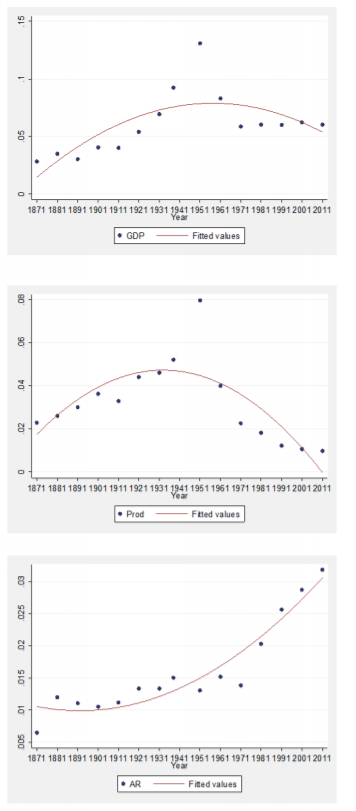
Two years, I wrote a post on this blog on the process of regional convergence in Italy. In that post, I made the observation that it seems that, economically, Italy was as fragmented at the time of the unification as it is today which made it an oddity in terms of regional convergence. To make that claim, I used this table of relatively sparsed out observations produced by Emanuele Felice: which was published in the Economic History Reviewitaliangdp


As one can see, there is a pronounced “lack” of integration for the Italy in terms of living standards. This is reinforced by a more “continuous” set of estimates produced, again, by Emanuele Felice (this time, its a working paper of the Bank of Italy) that now include the 1870s and go to 2011 (as opposed to 2001). This is the result, which I find fascinating. The first graph shows GDP per capita – for which there is divergence to 1951 and then a mild convergence thereafter but still well above the levels at the time of unification.  More fascinating is the fact that productivity is at its most integrated since unification (2nd figure) suggesting a divergence in levels of labor activity (3rd figure). In these three graphs, you have a neat summary of Italian labor markets since 1870.

Italian Convergence

The great global trend for the equality of well-being since 1900

Some years ago, I read The Improving State of the World: Why We’re Living Longer, Healthier, More Comfortable Lives on a Cleaner Planet by Indur Goklany. It was my first exposition to the claim that, globally, there has been a long-trend in the equality of well-being. The observation made by Goklany which had a dramatic effect on me was that many countries who were, at the time of his writing, as rich (incomes per capita) as Britain in 1850 had life expectancy and infant mortality levels well superior to 1850 Britain. Ever since, I accumulated the statistics on that regard and I often tell my students that when comes the time to “dispell” myths regarding the improvement in living standards since circa 1800 (note: people are generally unable to properly grasp the actual improvement in living standards).

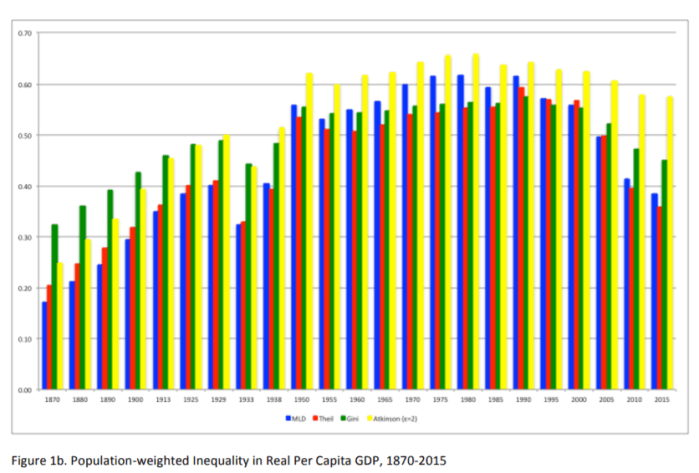
Some years after, I discovered the work of Leandro Prados de la Escosura who is a cliometrician who (I think I told him that when I met him) influenced me deeply in my work regarding the measurement of living standards and who wrote this paper which I will discuss here.  His paper, and his work in general, shows that globally the inequality in incomes has faltered since the 1970s.  That is largely the result of the economic rise of India and China (the world’s two largest antipoverty programs). Figure1Leandro

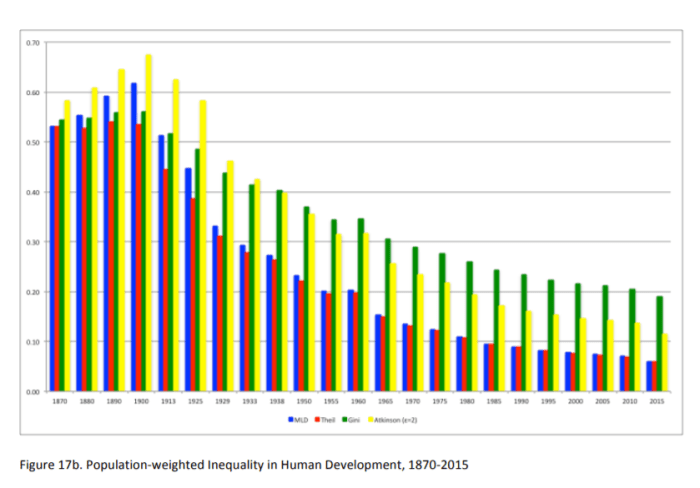
However, when extending his measurements to include life expectancy and schooling in order to capture “human development” (the idea that development is not only about incomes but the ability to exercise agency – i.e. the acquisition of positive liberty), the collapse in “human development” inequality (i.e. well-being) precedes by many decades the reduction in global income inequality. Indeed, the collapse started around 1900, not 1970!

Figure2LEandro.png

In reading Leandro’s paper, I remembered the work of Goklany which had sowed the seeds of this idea in my idea. Nearly a decade after reading Goklany’s work well after I fully accepted this fact as valid, I remain stunned by its implications. You should too.

Economists vs. The Public

Economics is the dismal science, as Thomas Carlyle infamously said, reprising John Stuart Mill for defending the abolishment of slavery in the British Empire. But if being a “dismal science” includes respecting individual rights and standing up for early ideas of subjective, revealed, preferences – sign me up! Indeed, British economist Diane Coyle wisely pointed out that we should probably wear the charge as a badge of honor.

Non-economists, quite wrongly, attack economics for considering itself the “Queen of the Social Science”, firing up slurs, insults and contours: Economism, economic imperialism, heartless money-grabbers. Instead, I posit, one of our great contributions to mankind lies in clarity and, quoting Joseph Persky “an acute sensitivity to budget constraints and opportunity costs.”

Now, clarity requires one to be specific. To clearly define the terms of use, and refrain from the vague generality of unmeasurable and undefinable concepts so common among the subjects over whom economics is the queen. When economists do their best to be specific, they sometimes use terms that also have a colloquial meaning, seriously confusing the layman while remaining perfectly clear for those of us who “speak the language”. I realize the irony here, and therefore attempt my best to straighten out some of these things, giving the examples of 1) money and 2) investments.

An age-old way to see this mismatch is measuring the beliefs held by the vast majority of economists and the general public (Browsing the Chicago IGM surveys gives some examples of this). Bryan Caplan illustrates this very well in his 2006 book The Myth of the Rational Voter:

Noneconomists and economists appear to systematically disagree on an array of topics. The SAEE [“Survey of Americans and Economists on the Economy”] shows that they do. Economists appear to base their beliefs on logic and evidence. The SAEE rules out the competing theories that economists primarily rationalize their self-interest or political ideology. Economists appear to know more about economics than the public. (p. 83)

Harvard Professor Greg Mankiw lists some well-known positions where the beliefs of economists and laymen diverge significantly (rent control, tariffs, agricultural subsidies and minimum wages). The case I, Mankiw, Caplan and pretty much any economist would make is one of appeal to authority: if people who spent their lives studying something overwelmingly agree on the consequences of a certain position within their area of expertise (tariffs, minimum wage, subsidies etc) and in stark opposition to people who at best read a few newspapers now and again, you may wanna go with the learned folk. Just sayin’.

Caplan even humorously compared the ‘appeal to authority’ of other professions to economists:

In principle, experts could be mistaken instead of the public. But if mathematicians, logicians, or statisticians say the public is wrong, who would dream of “blaming the experts”? Economists get a lot less respect. (p. 53)

Money, Wealth, Income

The average public confusingly uses all of these terms interchangeably. A rich person has ‘money’, and being rich is either a reference to income or to wealth, or sometimes both – sometimes even in the same sentence. Economists, being specialists, should naturally have a more precise and clear meaning attached to these words. For us Income refers to a flow of purchasing power over a certain period (=wage, interest payments), whereas Wealth is a stock of assets or “fixed” purchasing power; my monthly salary is income whereas the ownership of my house is wealth (the confusion here may be attributable to the fact that prices of wealth  shares, house prices etc  can and often do change over short periods of time, and that people who specialize in trading assets can thereby create income for themselves).

‘Money’, which to the average public means either wealth or income, is to the economist simply the metric we use, the medium of exchange, the physical/digital object we pass forth and back in order to clear transactions; representing the unit of account, the thing in which we calculate money (=dollars). That little green-ish piece of paper we instantly think of as ‘money’. To illustrate the difference: As a poor student, I may currently have very little income and even negative wealth, but I still possess money with which I pay my rent and groceries. In the same way, Bill Gates with massive amounts of wealth can lack ‘money’, simply meaning that he would need to stop by the ATM.

Investment

A lot like money, the practice of calling everything an ‘investment’ is annoying to most economists: the misuse drives us nuts! We’re commonly told that some durable consumption good was an investment, simply because I use it often; I’ve had major disagreements friends over the investment or consumption status of a) cars, b) houses, c) clothes, and d) every other object under the sun. Much like ‘money’, ‘investment’ to the general public seem to mean anything that gives you some form of benefit or pleasure. Or it may more narrowly mean buying financial assets (stocks, shares, derivatives…). For economists, it means something much more specific. Investopedia brilliantly explains it: The definition has two components; first, it generates an income (or is hoped to appreciate in value); secondly, it is not consumed today but used to create wealth:

An investment is an asset or item that is purchased with the hope that it will generate income or will appreciate in the future. In an economic sense, an investment is the purchase of goods that are not consumed today but are used in the future to create wealth.

This definition clearly shows why clothes, yoga mats and cars are not investments; they are clearly consumption goods that, although giving us lots of joy and benefits, generates zero income, won’t appreciate and is gradually worn out (i.e. consumed). Almost as clearly, houses (bought to live in) aren’t investments (newsflash a decade after the financial crisis); they generate no income for the occupants (but lots of costs!) and deteriorates over time as they are consumed. The only confusing element here is the appreciation in value, which is an abnormal feature of the last say four decades: the general trend in history has been that housing prices move with price inflation, i.e. don’t lose value other than through deterioration. In fact, Adam Smith said the very same thing about housing as an investment:

A dwelling-house, as such, contributed nothing to the revenue of its inhabitant; and though it is no doubt extremely useful to him, it is as his cloaths and household furniture are useful to him, which however make a part of his expence, and not his revenue. (AS, Wealth of Nations, II.1.12)

Cars are even worse, depreciating significantly the minute you leave the parking lot of the dealership. Where the Investopedia definition above comes up short is for business investments; when my local bakery purchases a new oven, it passes the first criteria (generates incomes, in terms of bread I can sell), but not the second, since it is generally consumed today. Some other tricky example are cases where political interests attempt to capture the persuasive language of economists for their own purposes: that we need to invest in our future, either meaning non-fossil fuel energy production, health care or some form of publicly-funded education. It is much less clear that these are investments, since they seldom generate an income and are more like extremely durable consumption goods (if they do classify on some kind of societal level, they seem like very bad ones).

In summary, economists think of investments as something yielding monetary returns in one way or another. Either directly like interest paid on bonds or deposits (or dividends on stocks) or like companies transforming inputs into revenue-generating output. It is, however, clear that most things the public refer to as investments (cars, clothes, houses) are very far from the economists’ understanding.

Economists and the general public often don’t see eye-to-eye. But improving the communication between the two should hopefully allow them to – indeed, the clarity with which we do so is our claim to fame in the first place.

Revised version of blog post originally published in Nov 2016 on Life of an Econ Student as a reflection on Establishment-General Public Divide.


George Halm against Common Wisdom on Currency Boards

Motivated by the recent decision of Argentina’s government to ask for an stand-by loan to the I.M.F., after a run on the peso, the last The Economist’s Bello section gives an account of the history of the relationship between them and makes a remark about the Argentine currency board experience between 1991-2002 that today is almost common wisdom: Since convertibility meant forgoing exchange-rate flexibility and an independent monetary policy, fiscal discipline was all-important for its success.”

But by the time the I.M.F. was being created, that was not an unanimous opinion. We have the example of George N. Halm who, in his book Economics of Money and Banking, stated that every Currency Board must implement a countercyclical policy on reserve requirements to be held by the commercial banks. Thus, the Currency Board could neutralize or mitigate an expansion or contraction of the base money by alternatively increasing or lowering the reserve requirements of the banks. For George Halm, a Currency Board could be almost in full command of monetary policy -and even more with respect to any other system, since it retains its political independence.

It is hard to imagine a Halm’s Currency Board that promotes a rapid economic growth which, in turn, could bring any popularity to its implementation. But it is as hard to imagine as the probability that a monetary system as such could end up in a bank run.

Cultural marxism and the Overton window

According to all accounts, Karl Marx was not an easy person. Basically, he had the habit of making the life of all around him miserable. However, as Joseph Schumpeter (himself far from being a Marxist) loved to point out, he was extremely well read. This allowed him to build a complex economic theory focused on factory workers, without ever (or almost ever, at least) stepping into a factory. Life for a factory worker in 19th century Britain was not easy, and Marx was very able in pointing that out. His economic theory, however, was a complete failure, as Ludwig von Mises aptly pointed out.

Marxism should have died in the mid-20th century when it became clear that all socialist countries are poor and oppressive. However, it survived as cultural Marxism. People like Antonio Gramsci, Michel Foucault, Jacques Derrida, and everybody in the Frankfurt School were not interested in economics. Instead, they wanted to study culture. The oppressed were not the factory workers anymore, but the social minorities. Libertarians and Conservatives should sympathize with that. It is true that women, non-whites, and homosexuals suffered a great deal in the masculine, white, heterosexual West. To point out that they suffer even more outside the West is not particularly helpful. We don’t have to throw the baby out with the bathwater. However, as with much of original Marxism, cultural Marxism is only good at pointing the problems, not at offering solutions. Modern civilization, as Sigmund Freud very well observed, is full of discontents. This is an old argument. Rousseau points out how modern civilization is cruel. Voltaire answers that, as cruel as it might be, it is still better than the alternative.

Our problem today is that cultural Marxism was successful in pushing the Overton window in their favor. That was precisely Gramsci’s objective: to fight “bourgeois” cultural hegemony with Marxist cultural hegemony. To a great degree, he succeeded. We need to fight the cultural war. As much as modern life can be bittersweet, I still haven’t heard a better alternative. Besides, as a Christian, I have to say with Saint Augustine that men have a “God-shaped hole” that no civilization – Modern, pre-modern or postmodern – can fill. But still, I enjoy the things that capitalism, capitalism that originated from the Protestant ethic, has to offer.

Low-Quality Publications and Academic Competition

In the last few days, the economics blogosphere (and twitterverse) has been discussing this paper in the Journal of Economic PsychologySimply put, the article argues that economists discount “bad journals” so that a researcher with ten articles in low-ranked and mid-ranked journals will be valued less than a researcher with two or three articles in highly-ranked journals.

Some economists, see notably Jared Rubin here, made insightful comments about this article. However, there is one comment by Trevon Logan that gives me a chance to make a point that I have been mulling over for some time. As I do not want to paraphrase Trevon, here is the part of his comment that interests me:

many of us (note: I assume he refers to economists) simply do not read and therefore outsource our scholarly opinions of others to editors and referees who are an extraordinarily homogeneous and biased bunch

There are two interrelated components to this comment. The first is that economists tend to avoid reading about minute details. The second is that economists tend to delegate this task to gatekeepers of knowledge. In this case, this would be the editors of top journals. Why do economists act as such? More precisely, what are the incentives to act as such? After, as Adam Smith once remarked, the professors at Edinburgh and Oxford were of equal skill but the former produced the best seminars in Europe because their incomes depended on registrations and tuition while the latter relied on long-established endowments. Same skills, different incentives, different outcomes.

My answer is as such: the competition that existed in the field of economics in the 1960s-1980s has disappeared.  In “those” days, the top universities such as Princeton, Harvard, MIT and Yale were a more or less homogeneous group in terms of their core economics. Lets call those the “incumbents”. They faced strong contests from the UCLA, Chicago, Virginia and Minnesota.  These challengers attacked the core principles of what was seen as the orthodoxy in antitrust (see the works of Harold Demsetz, Armen Alchian, Henry Manne), macroeconomics (Lucas Paradox, Islands model, New Classical Economics), political economy (see the works of James Buchanan, Gordon Tullock, Elinor Ostrom, Albert Breton, Charles Plott) and microeconomics (Ronald Coase). These challenges forced the discipline to incorporate many of the insights into the literature. The best example would be the New Keynesian synthesis formulated by Mankiw in response to the works of people like Ed Prescott and Robert Lucas. In those days, “top” economists had to respond to articles published in “lower-ranked” journals such as Economic Inquiry, Journal of Law and Economics and Public Choice (all of which have risen because they were bringing competition – consider that Ronald Coase published most of his great pieces in the JL&E).

In that game, economists were checking one another and imposing discipline upon each other. More importantly, to paraphrase Gordon Tullock in his Organization of Inquiry, their curiosity was subjected to social guidance generated from within the community:

He (the economist) is normally interested in the approval of his peers and and hence will usually consciously shape his research into a project which will pique other scientists’ curiosity as well as his own.

Is there such a game today? If in 1980 one could easily answer “Chicago” to the question of “which economics department challenges that Harvard in terms of research questions and answers”, things are not so clear today. As research needs to happen within a network where the marginal benefits may increase with size (up to a point), where are the competing networks in economics?

And there is my point, absent this competition (well, I should not say absent – it is more precise to speak of weaker competition) there is no incentive to read, to invest other fields for insights or to accept challenges. It is far more reasonable, in such a case, to divest oneself from the burden of academia and delegate the task to editors. This only reinforces the problem as the gatekeepers get to limit the chance of a viable network to emerge.

So, when Trevon bemoans (rightfully) the situation, I answer that maybe it is time that we consider how we are acting as such because the incentives have numbed our critical minds.