On the rift between economics and everything else

The line is often heard: economists are “scientific imperialists” (i.e. they seek to invade other fields of social science) jerks. All they try to do is “fit everything inside the model”. I have this derisive sneer at economists very often. I have also heard economists say “who cares, they’re a bunch of historians” (this is the one I hear most often given my particular field of research, but I have heard variations involving sociologists and anthropologists).

To be fair, I never noticed the size rift. For years now, I have been waltzing between economics and history (and tried my hand at journalism for some time) which meant that I was waltzing between economic theory and a lot of other fields. The department I was a part of at the London School of Economics was a rich set of quantitative and qualitative folks who mixed history of ideas, economics, economic history and social history. To top it all, I managed to find myself generally in the company of attorneys and legal scholars (don’t ask why, it still eludes me). It was hard to feel a big rift in that environment. I knew there was a rift. I just never realized how big it was until a year ago (more or less).

There is, however, something that annoys me: the contempt appears to be self-reinforcing.  Elsewhere on this blog (here and here) (and in a forthcoming book chapter in a textbook on how to do economic history), I have explained that economists have often ventured into certain topics with a lack of care for details. True, there must be some abstraction of details (not all details are useful), but there is an optimal quantity of details. And our knowledge grows, the quantity of details necessary to answering each question (because the scientific margin is increasingly specialized) should grow. And so should the number (and depth) of nuances we make to answer a question.  There is a tendency among economists to treat a question outside the usual realm of economics and ignore the existing literature (thus either rushing through an open door or stepping in a minefield without knowing it).  The universe is collapsed into the model and, even when it yields valuable insights, other (non-econs) contributors are ignored.  That’s when the non-econs counter that economists are arrogant and that they try to force everything into a mold rather than change the mold when it does not apply. However, the reply has often been to ignore the economists or criticize strawmen versions of their argument. Perceived as contemptuous, the economists feel that they can safely ignore all others.

The problem is that this is a reinforcing loop: a) the economists are arrogant; b) non-economists respond by dismissing the economists and ridiculing their assumptions; c) the economists get more arrogant. The cycle persists. I struggle to see how to break this cycle, but I see value in breaking it. Elsewhere, I have made such a case when I reviewed a book (towards which I was hostile) on Canadian economic history. Here is what I said for the sake of showcasing the value of breaking the vicious circle of ignoring both sides:

These scholars (those who have been ignored by non-economists) could have easily derived the same takeaways as Sweeny. Individuals can and do engage in rent-seeking, which economists define as the process through which unearned gains are obtained by manipulating the political and social environment. This could be observed in attempts to shape narratives in the public discourse. According primacy to the biases of sources is a recognition that there can be rent-seeking in the form of actors seeking to generate a narrative to reinforce a particular institutional arrangement and allow it to survive. This explanation is well in line with neoclassical economics.

This point is crucial. It shows a failing on both sides of the debate. Economists and historians favorable to “rational choice” have failed to engage scholars like Sweeny. Often, they have been openly contemptuous. The literature has evolved in separate circles where researchers only speak to their fellow circle members. This has resulted in an inability to identify the mutual gains of exchange. The insights and meticulous treatments of sources by scholars like Sweeny are informative for those economists who consider rational choice as if the choosers were humans, with all their flaws and limitations, rather than mechanistic utility-maximizing machines with perfect foresight (which is a strawman often employed to deride the use of economics in historical debates) . In reverse, the rich insights provided by rational choice theorists could guide historians in elucidating complex social interactions with a parsimony of assumptions. Without interaction, both groups loose and resolutions remain elusive.

See, as a guy who likes economics, I think that trade is pretty great. More importantly, I think that trade between heterogeneous groups (or different individuals) is even greater because it allows for specialization that increases the value (and quantity) of outputs.  I see the benefits of trade here, so why is this “circle of contempt” perpetuating so relentlessly?

Can’t we just all pick the 100$ bill on the sidewalk?
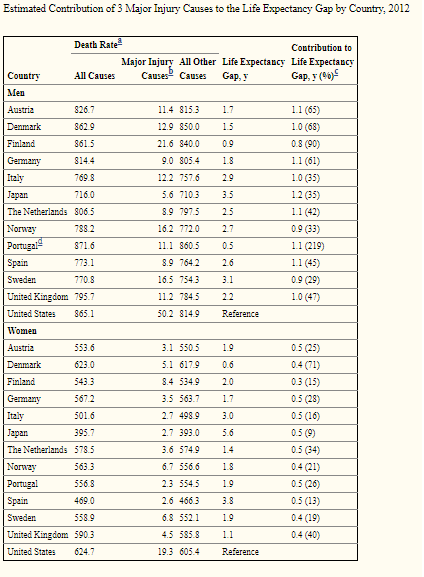
Life expectancy at birth is not a predictor of health care efficiency…

This is going to be a short post to argue that pundits (and some economists) need to stop quoting life expectancy figures to argue for/against a particular health care system. This belief is best exemplified in a recent paper in the Journal of the American Medical Association where Papanicolas et al. (2018)  point out that the United States “spent nearly twice as much as 10 high-income countries (…) and performed less well on many population health outcomes”. While the authors make good points about administrative costs, they point out that the US has a low level of life expectancy.

Sure, that is actually true – but Americans tend to die in greater proportions from homicides, drug overdoses and car accidents (Americans drive more than Europeans) than in other rich countries. While these factors of mortality are tragic (except car accidents since Americans seem to prefer the benefits of mobility to the safety of not driving), they are in no way related to the efficiency of health care provision. How much of a deal are these in explaining differences with other industrialized countries? A pretty big deal.  For example, these three factors alone account for 64% of the male life expectancy gap between Austria and the United States (see table reproduced below). For women, 26% of the gap between Austria and the United States is explained by these three factors.

The study I cite here only includes three factors. If you add in other factors like drownings among youths (Americans tend to have more drownings than several industrialized countries) which is a result of the fact that Americans are richer and can afford pools (while Europeans tend not to), then you keep explaining away the difference.  This is not to say that American health care is great. However, this says that American health care is not as bad as life expectancy outcomes suggest.

Mortality


A quick thought on UBI

I’m still not sure where I land on the issue of Universal Basic Income (UBI), but I just thought of a bit of clarifying language that lead to a thought. I’m sure this thought isn’t original, but I’m also sure it doesn’t come up as often as it ought to.

A UBI system’s appeal stems from the fact that it’s a minimal welfare state (kinda sorta). We all know the old debate between proponents of a minimal state–and the debates about what exactly that constitutes–and those of a welfare state–and again, there’s plenty of disagreement on what that actually means.

On a 0-10 spectrum of “how important should the government be? / how important is the government currently” a UBI is a lateral move with obvious efficiency gains. It strips out all the bureaucracy in our current welfare state, provides a wide safety net, and allows the poor to exercise their own agency using their local knowledge about their particular circumstances and opportunities. No cookie cutter solutions, no lines, just a modest check in the mail and an entire population looking for good ways to use it.

On the other hand, it lays bare some of the worst case scenarios of a maximal welfare state. Subsidizing sloth and dependency, enormous costs, reduction in savings, net negative cultural effects, and who knows what else!

But still, perhaps UBI with some minimal modifications is an improvement over what we’ve got now?

2×2 matrix (robust vs thin welfare state and broad vs targeted welfare state).

The maximal welfare state is robust, and broad. There’s a housing bureau, a food bureau, a work bureau, and nearly everyone is waiting in line at one of them at some point each week.

The minimal state would have no welfare, but the minimal welfare state would have a thin and targeted system. No social workers, no bureaucrats, just a check. And unlike a UBI, this would only apply to the poor. Which might cost it political support.

A UBI is thin but broad. That might require it to be less generous, but could (literally) buy it some votes. On the other hand, what do I know about what makes people vote?

The thinness and breadth of a UBI makes it startling next to the old dichotomy. It simultaneously opens up whole new realms of possibilities–it dramatically increases the opportunity cost of drudgery and bureaucracy and provides an easy enough safety net to allow widespread entrepreneurial activity. If we had the right culture we could do anything! But (!) we don’t get to choose the culture.

That breadth is pretty scary when we consider some of the negative behaviors it will surely breed. The lunatic fringe will be funded by the rest of us. A cult is easy to finance when all your members sign over a government check to you every month.

Here’s a possibility: Imagine a vastly simpler tax code. “What’s your income? Scan your tax/employment card that isn’t as stupid as a Social Security Number.” $X “Thank you, give us f(X). Insert cash or card into the machine.” You could file taxes every month (or more or less frequently if you prefer). In that world, we could just give a refundable tax credit to anyone who had a low enough income.

Mind you, I’m assuming away the issue of designing the right marginal tax rates and setting the level of the tax credit. But such a system could be simultaneously broad (it kicks in for anyone as soon as you need it) and narrow (you only get it if you’re poor… and you end up paying it back if you get rich). I think a simpler tax system would be necessary to make a minimal UBI workable

Revisiting Epstein’s Freedom and Growth


I was fortunate to be invited give the Epstein Lecture at LSE this March. The series is named after the great LSE economic historian Larry (Stephen) Epstein. Here I’ll summarize why it was such an honor to give the lectures. The content of the lecture will be another post.

Epstein was a historian whose origin field of expertise was medieval Italy. I encountered him through Freedom and Growth. Published in 2000, I first read it a couple of years later, perhaps in 2002 or 2003. At the time I was devoted to a story of economic growth shaped by Douglass North, particularly Structure and Change in Economic History (1981).

The focus of Structure and Change was on transaction costs. High transaction costs limited market exchange and kept societies poor for most of history. Sustained economic growth could only occur once transaction costs fell to a level that allowed markets to expand and the division of labor to develop. On this view, market expansion or Smithian growth was itself a stimulus to technological innovation. But what kept transaction costs high?

One answer North gave was the state. To paraphrase: the state had the ability to both keep a society mired in poverty through predatory behavior and to provide the preconditions for growth by securing property rights. The origins of sustained economic growth for North lay in institutional changes that occurred secured property rights and lowered transaction costs. The most important such institutional change was the Glorious Revolution of 1688.


North’s account received many challenges, but the issue that Epstein honed in on was the assumption that there was such a state, able to either revoke or secure property rights. It was assumed that “rulers rule”. Epstein contested this arguing that New Institutional Economists

“project backwards in time a form of centralised sovereignty and jurisdictional integration that was first achieved in Continental Europe during the nineteenth century; they therefore fundamentally misrepresent the character of pre-modern states.”

North, Wallis, and Weingast would address this in their 2009 Violence and Social Orders. But Epstein’s criticism was spot on in 2000. Epstein argued that alongside the problem of predatory states, a central problem was the lack of integrated markets. He attributed market disintegration to coordination and prisoners’ dilemma problems between political authorities. In so doing, Epstein set the agenda for the subsequent “state capacity” research agenda.

Epstein made several points which continued to be expanded upon by current research (see here). First, he documented that the lower interest rates that the British state paid after 1688 were characteristic of city republics from the middle ages onwards. He argued that the English monarchy in the 17th century was characterized by an anomalously backwards financial system. Lower interest rates after 1688 partly represent a convergence to the Republican norm achieved by Italian city-states centuries earlier.

Second, he challenged the argument that monarchies “overtaxed” cities. There was “no evidence that townspeople paid higher taxes under monarchies than republics”. Per capita taxes were likely higher in Republican city-states.

Third, he disputed that Republican city-states like Florence brought economic freedom noting that “republican subjects faced several limitations to their economic and political freedoms that monarchical subjects did not”. All of this challenged generalizations made by historical sociologists like Charles Tilly and economic historians like North.


Epstein’s historical evidence came from medieval Italy. Late medieval Italy was highly urbanized and prosperous by pre-industrial standards. According to Broadberry’s estimates, per capita GDP in Italy in 1450 was not matched by England until 1750. Like growth elsewhere in the premodern world, it was Smithian growth, driven by trade, market integration, and the division of labor. But unlike in England, this Smithian growth did not continue and blossom into modern growth. Epstein’s explanation for why this did not take place was that late medieval Italy suffered an “integration crisis”.

He saw the late medieval period as characterized by new opportunities for growth and innovation. Urbanization increased. Capital markets expanded and deepened. Interregional trade developed. Proto-industrialization took place. But Epstein contended these opportunities were only seized in areas where political authority was centralization.

In reference to proto-industrialization, he observed that

“Crucially, the success of regional crafts was inversely proportional to the concentration of economic and institutional power in the hands of a dominant city.”

With respect to the establishment of permanent fairs, he noted that

In fifteenth-century Lombardy, new fairs proliferated only after the balance of power shifted decisively from the former city-states to the territorial prince with Francesco Sforza’s victory in 1447.

Market integration was complemented and perhaps driven by political integration. Integrated urban hierarchies were themselves the product of political centralization.

“Centralisation underlies all the major institutional changes to market structures previously described. It lowered domestic transport costs, made it easier to enforce contracts and to match demand and supply, intensified economic competition between towns and strengthened urban hierarchies, weakened urban monopolies over the countryside, and stimulated labour mobility and technological diffusion.”

The more centralized parts of Italy — notably Lombardy — were better able to benefit from these trends than was Tuscany. But in general, political fragmentation and regional diversity were “distinctive features of pre-modern Italy” in general and an impediment to its long-run growth prospects.

Unlike in his analysis of interest rates, Epstein brought little data to bear on these claims and I am unaware of subsequent research on late medieval Italy. As such, the thesis of a late medieval integration crisis laid out in Freedom and Growth remains speculative. Epstein would no doubt have fill in the details had he lived longer. Subsequent research has mostly focused on early modern rather than medieval Europe (see here).  But the larger message: the importance of the state for premodern economic development has been central to subsequent research, including my own work (e.g. here).

Electricity in Quebec before Nationalization (1919 to 1939)

A few weeks ago, I mentioned that  I am generally skeptical of “accepted wisdom” on many topics. “Accepted wisdom” is a construction of a stylized fact by a party with intense preferences that is gradually able to remove nuances over time to solidify its preferred narrative. The example I gave a few weeks ago concerned antitrust laws. There are many more. One of those concerns a research agenda that I laid claim to in a recent article in Atlantic Economic Journal (co-authored with my dear friend Germain Belzile): the nationalization of electricity in Quebec.

My home province of Quebec is basically one giant network of rivers well-suited for the production of hydro-electricity – a potential that was noticed in the late 19th century and led to a rapid expansion of the network. Historians (and some economists) have depicted the early electrical industry in Quebec as a “trust” (a cartel) that gouged consumers and could only be resolved, as witnessed by the neighboring province of Ontario, by nationalization (which occurred in two waves – one in 1944 and one in 1962).

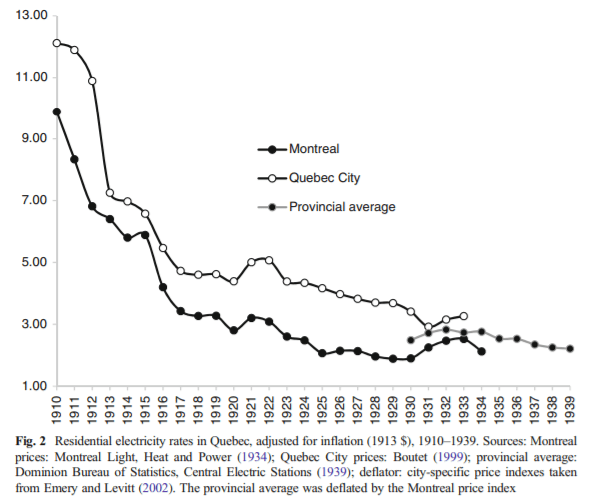
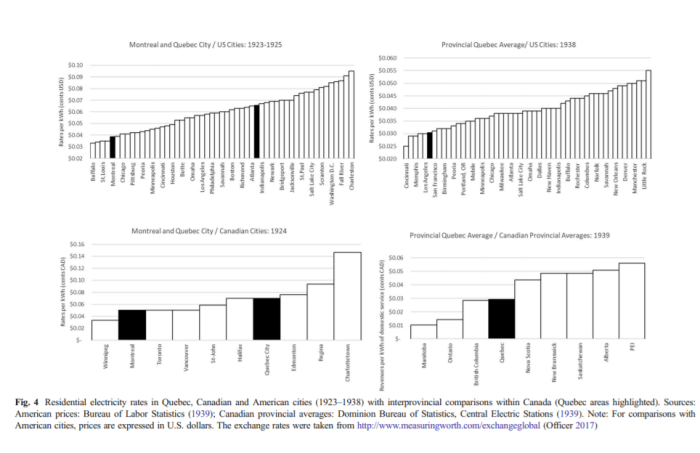
In the article I published with Belzile, I argue that this narration is largely incorrect. First, before nationalization prices in Quebec were falling and were low by North American standards (see figures below). Second, production was expanding rapidly. This is in spite of the fact that taxes imposed on the electrical industry grew rapidly over time from less than 10% of total expenditures to close to 30%.  Moreover, we point out that looking at residential prices is bound to yield bad comparisons (if we can call those made above as “bad”) if there is price discrimination. The industry price discriminated and offered incredibly low prices for industrial customers (large power) than in Ontario or anywhere else in Canada  (in spite of the taxes it was operating under and the fact that Ontario subsidized its own).

We also point out that there was a dynamics of interventionism problem. The neighboring province of Ontario (more populous and richer than Quebec) nationalized its industry and set prices well below the market level which is an implicit subsidy. However, at the subsidized rate, Ontario could not supply its own demand and had to buy at the market price in Quebec. Its over-equilibrium quantity of energy demanded was transferred on the freer Quebec market, thus increasing prices on that market.

We also argue that there was wide heterogeneity of rates in Quebec that relate to the structure of municipal regulation (the level at which electricity was regulated pre-1935). The price differences depended on the political games involving rent-seeking firms and politicians (best exemplified by the case of Quebec City). Cities with high prices were places where the electrical market was heavily politicized and franchises (i.e. the contracts fixing rate schedules over long periods of time to recoup capital investment) were short and subject to holdups.

This latter point is meant for us (me and Germain) to stake a claim on future research to document the nationalization and regulation process at the municipal level and see what the effects on prices and outputs were. In a certain way, I am trying to establish a research agenda extending the skepticism of “accepted wisdom” that has emerged with the economic history of antitrust in the United States to the case of electricity trusts in Quebec. This first article is, I believe, a promising start for such an inclusion.


Figure2Electricity

Figure4Electricity


Rosenbloom on the Colonial American Economy

Joshua Rosenbloom is an economic historian worth following if you are interested in American economic history during the colonial era. He has recently published what appears to be an overview article of the topic (probably for a book or an invited symposium) which perfectly summarizes the current state of the research. I believe that this should be widely read by interested parties.  Here are key excerpts for some of the topics he discusses. I provide some comments to enrich his contribution, but these should be understood as complements rather than substitutes to this excellent overview of the American economy during the colonial era.

On Economic Growth 

Mancall and Weiss (…) concluded that likely rates of per capita GDP growth could not have been higher than 0.1 percent per year and were likely closer to zero. In subsequent work, Mancall, Rosenbloom and Weiss (2004) and Rosenbloom and Weiss (2014) have constructed similar estimates for the colonies and states of the Lower South and the Mid-Atlantic regions, respectively. Applying the method of controlled conjectures at a regional level allowed them to incorporate additional, region-specific, evidence about agricultural  productivity and exports, and reinforced the finding that there was little if any growth in GDP per capita during the eighteenth century. Lindert and Williamson (2016b) have also attempted to backcast their estimates of colonial incomes. Their estimates rely in part on the regional estimates of Mancall, Rosenbloom and Weiss, but the independent evidence they present is consistent with the view that economic growth was quite slow during the eighteenth century.

This is still a contentious point (see notably this article by McCusker), but I believe that they are correct. In my own work, using both wages and incomes, I have found similar results for Canada and Leticia Arroyo Abad and Jan Luiten Van Zanden have found something roughly similar for the Latin American economies (Mexico and Peru).

It is also consistent with even simplistic accounts of the neoclassical growth model. The New World was an economy of abundant land input whose outputs (agricultural produce) were mostly meant for local consumption. If one wanted to increase his income, all he had to do was use more inputs at really low costs. There is very little in this situation to invest in increasing total factor productivity and incomes would only increase at the dis-aggregated level (following the same region over time) as we are capturing the extent of inputs included over time (e.g. the long-settled farmer has a high income because he has had the time to build his farm, but the short-settled farmer brings the average down because he is just starting that process).

On Monetary History and Monetary Puzzles

In lieu of specie, the colonists relied heavily on barter for local exchange. In the Chesapeake transactions were often denominated in weights of tobacco. However, tobacco was not used as a medium of exchange. Rather merchants might advance credit to planters for the purchase of imported items, to be repaid at harvest with the specified quantity of tobacco. Elsewhere book credit accounts helped to facilitate transactions and reduce the need for currency. The colonists regularly complained about the shortage of specie, but as Perkins (1988, p. 165) observed, the long run history of prices does not suggest any tendency of prices to fall, as would be expected if the money supply was too small. (…) With only a few exceptions the colonies issuance of these notes did not give rise to inflationary pressures. There is by now a large literature that has analyzed the relationship between note issuance and prices, and finds little evidence of any correlation between the series (Weiss 1970, 1974; Wicker 1985; Smith 1985; Grubb 2016. As Grubb (2016) has argued, this suggests that while the circulation of bills of credit may have facilitated exchange by substituting for book credit or other forms of barter, they did not assume the role of currency.

In this, Rosenbloom summarizes a puzzle which has been the subject of debates since the 1970s (starting with West in 1978 in this Economic Inquiry article). In many instances (like South Carolina and Pennsylvania), the large issues of paper money had no measurable effect on prices.  This is a puzzle given the quantity theory of the price level. The proposition to solve the puzzle is that as the paper money printed by colonies tended to be backed by future assets, they were securities that could circulate as a medium of exchange. If properly backed and redeemed, people would form expectations that these injections were temporary injections and there would be no effect on the price level all else being equal. Inflation would only occur if redemption promises were not held or were believed to be humbug. This proposition has been heavily contested given the limited information we hold for the stock of other media of exchange and trade balances. I have my own take on this debate on which I weigh using a similar Canadian monetary experiment (see here), but this is a serious debate. Basically, it is a historical battleground between the proponents of the fiscal theory of the price level (see notably the classical Sargent and Wallace article) and the proponents of the quantity theory of the price level.  Anyone interested in the wider macroeconomic debate should really focus on these colonial experiments because they really are the perfect testing grounds (which Rosenbloom summarizes efficiently).

On Mercantilism, the Navigation Acts and American Living Standards

The requirement that major colonial exports pass through England on their way to continental markets and that manufactures be imported from England was the equivalent of imposing a tax on this trade. The resulting price wedge reduced the volume of trade and shifted some of the producer and consumer surplus to the providers of shipping and merchant services. A number of cliometric studies have attempted to estimate the magnitude of these effects to determine whether they played a role in encouraging the movement for independence (Harper 1939; Thomas 1968; Ransom 1968; McClelland 1969). The major difference in these studies arises from different approaches to formulating a counterfactual estimate of how large trade would have been in the absence of the Navigation Acts. In general, the estimates suggest that the cost to the colonists was relatively modest, in the range of 1-3 percent of annual income. Moreover, this figure needs to be set against the benefits of membership in the empire, which included the protection the British Navy afforded colonial merchants and military protection from hostile natives and other European powers.

The Navigation Acts were often cited as a burden that the colonists despised, but many economic historians have gone over their impact and they appear to have been minimal. It does not mean that they were insignificant to political events (rent-seeking coalitions tend to include small parties with intense preferences). However, it does imply that the action lies elsewhere if someone wants to explain the root causes of the revolution or that one must consider distributional effects (see notably this article here).

These are the sections that I found the most interesting (as they relate to some of my research agendas), but the entire article provides an effective summary for anyone interested in initiating research on the topic of American economic history during the colonial era. I really recommend reading it even if all that you seek is an overview for general culture.

On demography and living standards in the colonial era

This is a topic that has been bugging me. Very often, historians will (accurately) point out mortality statistics in the United States, Canada (Quebec) and the Latin America during the colonial era were better than in the comparable Old World (comparing French with French, British with British, Spanish with Spanish). However, they will argue that this is evidence that living standards were higher. This is where I wish to make an important nuance.

Settlement colonies (so, here there is a bigger focus on North America, but it applies to smaller extent to Latin America which I am more tempt to label as extractive – see here) are generally frontier economies. This means that they are small economies because of small populations.  This means that labor and capital are scarce relative to land. All outputs that come from the relatively abundant factor will thus tend to be cheaper if there is little international trade for the goods that they are best at producing. The colonial period pretty much fits that bill. The American and Canadian colonies were basically agricultural colonies, but very few of those agricultural outputs actually crossed the Atlantic. As such, agricultural produces were cheap. This is akin to saying that nutrition was cheap.

This, by definition, will give settlement colonies an advantage in terms of biological living standards. As they are not international price takers, wheat is cheaper than in the old world. This is why James Lemon spoke of the New World as the “Best poor man’s country” (I love that expression) : it was easy to earn subsistence. However, beyond that it is very hard to go beyond. For example, in my dissertation (articles still in consideration at Cliometrica and Canadian Journal of Economics) I found that when wages were deflated by a subsistence basket containing very few services and manufactured goods and which relied heavily on untransformed foods, Canada was richer than the richest city of France. Once you shifted to a basket that marginally increased transformed goods and manufactured goods, the advantage was wiped away.

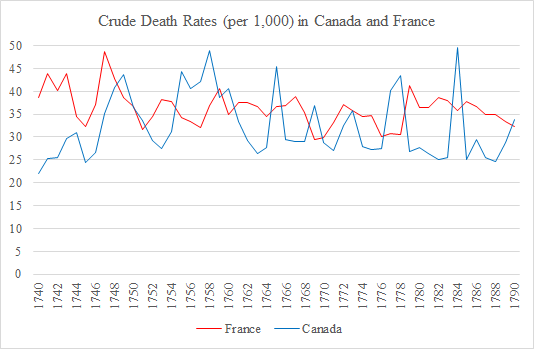
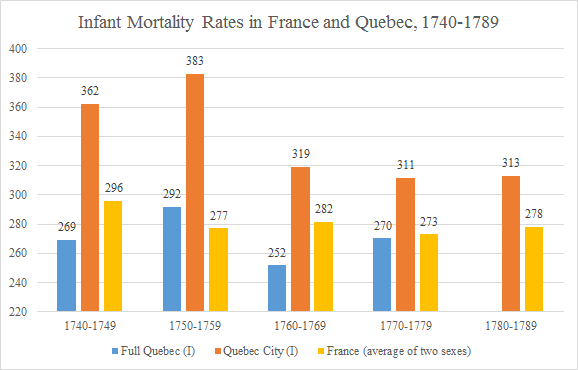
Yet, everything indicates that mortality rates were greater in Paris and France and than in Quebec City and Quebec as a whole (but not by a lot) (see images below).  Similar gaps seem to exist for the United States relative to Britain, but the data is not as rich as for Quebec. However, the data that exists for New England suggests that death rates were lower than in England but the “bare bones” real incomes measured by Lindert and Williamson show that New England may have been poorer than Great Britain (not by much though).

Crude Death Rates

IMR

I am not saying that demographic and biological data is worthless. Quite the contrary (even I wanted to, I could not since I have a paper on the heights of French-Canadians from 1780 to 1830)! The point is that data matters in context.  The world is full of small non-linearities between variables. While “good” demographic outcomes are generally tracking “good” economic outcomes, there are contexts where this may be a weaker relation (curvilinear relations between variables). I think that this is a good example of that point.

On why complexity from simple rules is counterintuitive

“… normally we start from whatever behavior we want to get, then try to design a system that will produce it. Yet to do this reliable, we have to restrict ourselves to systems whose behavior we can readily understand and predict–for unless we can foresee how a system will behave, we cannot be sure that the system will do what we want.

“But unlike engineering, nature operates under no such constraint. So there is nothing to stop systmes like those at the end of the previous section from showing up. And in fact one of the important conclusions of this book is that such systems are actually very common in nature.

“But because the only situations in which we are routinely aware both of the underlying rules and overall behavior are ones in which we are building things or doing engineering, we never normally get any intuition about systems like the ones at the end of the previous section.”

Stephen Wolfram

The deeper you dig into math and computer science, the more Hayekian things look. The impossibility of economic calculation under socialism has important counterparts in Godel and Turing/Church.

On Antitrust, the Sherman Act and Accepted Wisdom

I am generally skeptical of “accepted wisdom” on many policy debates. People involved in policy-making are generally politicians who carefully craft justifications (i.e. cover stories) where self-interest and common good cannot be disentangled easily.  These justifications can easily become “accepted wisdom” even if incorrect. I am not saying that “accepted wisdom” is without value or that it is always wrong, but more often than not it is accepted at face value without question.

My favorite example is “antitrust”.  In the United States, the Sherman Act (the antitrust bill) was first introduced in 1889 (passed in 1890). The justification often given is that it was meant to promote competition as proposed by economists. However, as often pointed out, the bill was passed well before the topic of competition in economics had been unified into a theoretical body.  It was also rooted in protectionist motives. Moreover, the bill was passed after the industries most affected saw prices fall faster than the overall price level and output increase faster than the overall output level (see here here here here and here). Combined, these elements should give pause to anyone willing to cite the “accepted wisdom”.

More recently, economist Patrick Newman provided further reason for caution in an article in Public Choice. Interweaving political history and the biographical details about senator John Sherman (he of the Sherman Act), Newman tells a fascinating story about the self-interested reasons behind the introduction of the act.

In 1888, John Sherman failed to obtain the Republican presidential nomination – a failure which he blamed on the governor of Michigan, Russell Alger. Out of malice and a desire of vengeance, Sherman defended his proposal by citing Alger as the ringmaster of one of the “trusts”. Alger, himself a presidential hopeful for the 1892 cycle, was politically crippled by the attack (even if it appears that it was untrue). Obviously, this was not the sole reason for the Act (Newman highlights the nature of the Republican coalition which would have demanded such an act). However, once Alger was fatally wounded, Sherman appears to have lost interest in the Act and left others to push it through.

As such, the passage of the bill was partly motivated by political self-interest (thus illustrating the key point of behavioral symmetry that underlies public choice theory). Entangled in the “accepted wisdom” is a wicked tale of revenge between politicians. At such sight, it is hard not to be cautions with regards to “accepted wisdom”.

A quote

The most profound technologies are those that disappear. They weave themselves into the fabric of everyday life until they are indistinguishable from it.

Mark Weiser

Hayek would have liked this quote about computers. On his behalf, I’m going to co-opt it as a description of the miracle of markets.

WP: Does Bitcoin Have the Right Monetary Rule?

The growing literature on Bitcoin offers little more than passing mentions to Bitcoin’s monetary rule. This is the topic of this short paper.

The growing literature on Bitcoin can be divided in two groups. One performs an economic analysis of Bitcoin focusing on its monetary characteristics. The other one looks takes a financial look at the price of Bitcoin. Interestingly, both of these groups have not given much more than passing comments to the problem whether or not Bitcoin has the right monetary rule. This paper argues that Bitcoin in particular, and cryptocurrencies in general, do not have a good monetary rule, and that this shortcoming seriously limits its prospect of becoming a well-stablished currency.

Download from SSRN.

If causality matters, should the media talk about mass shootings?

My answer to that question is “maybe not” or at the very least “not as much”. Given the sheer amount of fear that can be generated by a shooting, it is understandable to be shocked and the need to talk about it is equally understandable. However, I think this might be an unfortunate opportunity to consider the incentives at play.

I assume that criminals, even crazy ones, are relatively rational. They weigh the pros and cons of potential targets, they assess the most efficient tool or weapon to accomplish the objectives they set etc. That entails that, in their warped view of the world, there are benefits to committing atrocities. In some instances, the benefit is pure revenge as was the case in one of the famous shooting in my hometown of Montreal (i.e. a university professor decided to avenge himself of the slights caused by other professors). In other instances, the benefit is defined in part by the attention that the violent perpetrator attracts for himself. This was the case of another infamous shooting in Montreal where the killer showed up at an engineering school to kill 14 other students and staff. He committed suicide and also left a suicide statement that read like a garbled political manifesto. In other words, killers can be trying to “maximize” media hits.

This “rational approach” to mass shootings opens the door to a question about causality: is the incidence of mass shootings determining the number of media hits or is the number of media hits determining the incidence of mass shootings. In a recent article in the Journal of Public Economicsthe possibility of the latter causal link has been explored with regards to terrorism.  Using the New York Times‘ coverage of some 60,000 terrorist attacks in 201 countries over 43 years, Michael Jetter used the exogenous shock caused by natural disasters to study they reduced the reporting of terrorist attacks and how this, in turn, reduced attention to terrorism. That way, he could arrive at some idea (by the negative) of causality. He found that one New York Times article increased attacks by 1.4 in the following three weeks. Now, this applies to terrorism, but why would it not apply to mass shooters? After all, there are very similar in their objectives and methods – at the very least with regards to the shooters who seek attention.

If the causality runs in the direction suggested by Jetter, then the full-day coverage offered by CNN or NBC or FOX is making things worse by increasing the likelihood of an additional shooting. For some years now, I have been suggesting this possibility to journalist friends of mine and arguing that maybe the best way to talk about terrorism or mass shooters is to move them from the front page of a newspaper to a one-inch box on page 20 or to move the mention from the interview to the crawler at the bottom. In each discussion, my claim about causality is brushed aside with either incredulity at the logic and its empirical support or I get something like “yes, but we can’t really not talk about it”. And so, the thinking ends there. However, I am quite willing to state that its time for media outlets to deeply reflect upon their role and how to best accomplish the role they want. And that requires thinking about causality and accepting that “splashy” stories may be better left ignored.

Do risk preferences account for 1.4 percentage points of the gender pay gap?

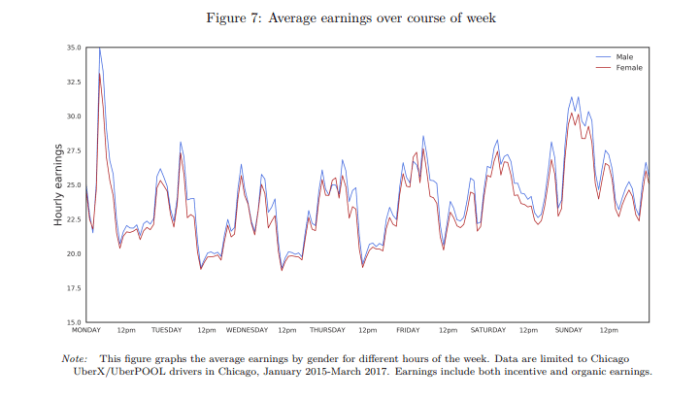
A few days ago, this study of gender pay differences for Uber drivers came out. The key finding, that women earned 7% less than men, was stunning because Uber uses a gender-blind algorithm. The figure below was the most interesting one from the study as it summarized the differences in pay quite well.

DataUber

To explain this, the authors highlight a few explanations borne out by the data: men drive faster allowing them to have more clients; men have spent more time working for Uber and have more experience that may be unobserved; choices of where and when to drive matters. It is this latter point that I find fascinating because it speaks to an issue that I keep underlining regarding pay gaps when I teach.

For reasons that may be sociological or biological (I am agnostic on that), men tend to occupy jobs that have high rates of occupational mortality (see notably this British study on the topic) in the forms of accidents (think construction, firemen) or diseases (think miners and trashmen). They also tend to take the jobs in further removed areas in order to gain access to a distance premium (which is a form of risk in the sense that it affects  family life etc.). The premiums to taking risky jobs are well documented (see notably the work of Kip Viscusi who measured the wage premium accruing to workers who were employed in bars where smoking was permitted). If these premiums are non-negligible but tend to be preferred by men (who are willing to incur the risk to be injured or fall sick), then risk preferences matter to the gender wage gap.

However, there are hard to properly measure in order to assess the share of the wage gap truly explained by discrimination. Here with the case of Uber, we can get an idea of the amplitude of the differences. Male Uber drivers prefer riskier hours (more risks of having an inebriated and potentially aggressive client), riskier places (high traffic with more risks of accidents) and riskier behavior (driving faster to get more clients per hour).  The return to taking these risks is greater earnings. According to the study, 20% of the gap stems from this series of choices or roughly 1.4 percentage points.

I think that this is significantly large to warrant further consideration in the future in the debate. More often than not, the emphasis is on education, experience, marital status, and industry codes (NAICS code) to explain wage differences. The use of industry codes has never convinced me. There is wide variance within industries regarding work accidents and diseases. The NAICS codes industries by wide sectors and then by sub-sectors of activities (see for example the six-digits codes to agriculture, forestry, fishing and hunting here). This does not allow to take account of the risks associated with a job. There are a few study that try to account for this problem, but there are … well … few in numbers. And rarely are they considered in public discussions.

Here, the Uber case shows the necessity to bring back this subtopic in order to properly explain the wage gap.

Prices in Canada since 1688

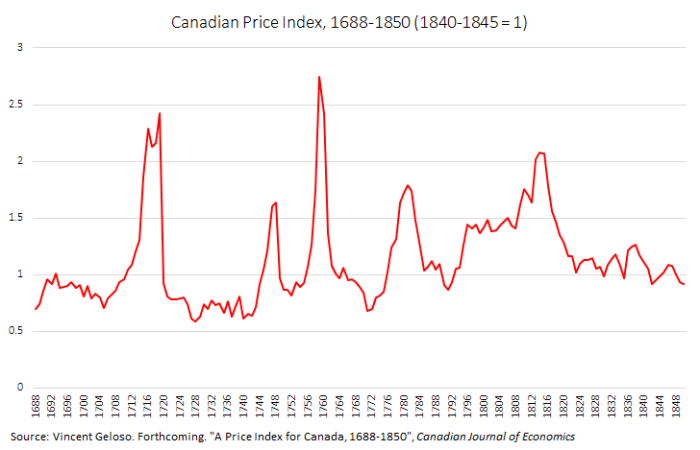
A few days ago, I received goods news that the Canadian Journal of Economics had accepted my paper that constructed a consumer price index for Canada between 1688 and 1850 from homogeneous sources (the account books of religious congregations). I have to format the article to the guidelines of the journal and attach all my data and it will be good to go (I am planning on doing this over the weekend). In the meanwhile, I thought I would share the finalized price index so that others can see it.

First, we have the price index that focuses on the period from 1688 to 1850.  Most indexes that exist for pre-1850 Canada (or Quebec since I assume that Quebec is representative of pre-1850 Canadian price trends) are short-term, include mostly agricultural goods and have no expenditures weights to create a basket. Now, my index is the first that uses the same type of sources continuously over such a long period and it is also the first to use a large array of non-agricultural goods. It also has a weights scheme to create a basket.

PriceIndexCanada

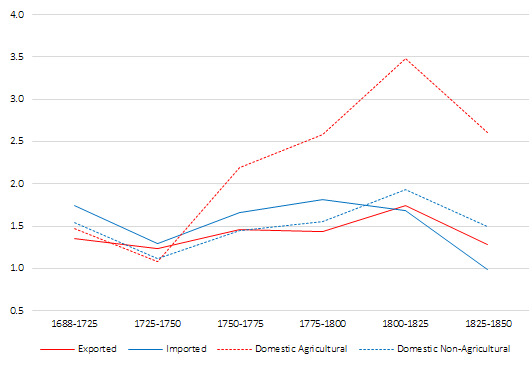
The issue of adding non-agricultural goods was especially important because there were important differences in the evolution of different types of goods. Agricultural goods, see next image, saw their nominal prices continually increase between the 17th and 19th centuries. However, most other prices – imported goods, domestically produced manufactured goods etc. – either fall or remain stable. These are very pronounced changes in relative prices. It shows that reliance on agricultural goods price index will overstate the amount of “deflating” needed to arrive at real wages or incomes.  The image below shows the nominal price evolution of groupings of goods as described above.

PriceIndexCanada2

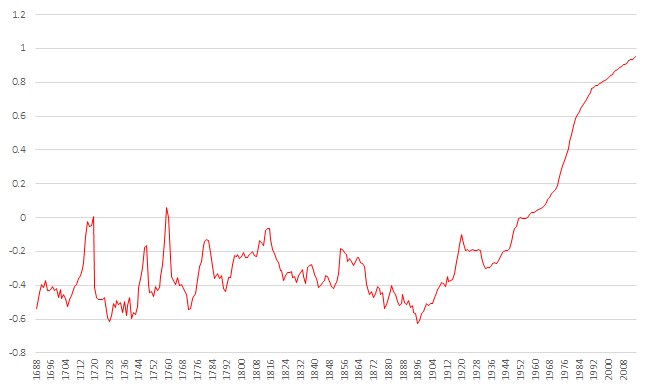
And finally, the pièce de résistance! I link my own index to other existing post-1850 index so as to generate the evolution of prices in Canada since 1688. The figure below shows the evolution of the price index over … 328 years (I ended the series at 2015, but extra years forward can be added). In the years to come, I will probably try to extend this backwards as much as possible at least to 1665 (the first census in Canada) and will probably try to approach Statistics Canada to see if they would like to incorporate this contribution into their wide database of macroeconomic history of Canada.

PriceIndexCanada3

2018 Hayek Essay Contest

The 2018 General Meeting of the Mont Pelerin Society will take place from September 30 – October 6, 2018 at ExpoMeloneras and Lopesan Hotels in Meloneras, Gran Canaria, Canary Islands. As with past general meetings, the Mont Pelerin Society is currently soliciting submissions for Friedrich A. Hayek Fellowships. The fellowships will be awarded through the Hayek Essay Contest.

The Hayek Essay Contest is open to all individuals 36 years old or younger. Entrants should write a 5,000 word (maximum) essay that addresses the quotation(s) and question(s) detailed on the contest announcement (available at the above link). The deadline for submissions is May 31, 2018. The winners will be announced on July 31, 2018. Essays must be submitted in English only. Electronic submissions should be sent in PDF format to this email address (mps.youngscholars@ttu.edu). Authors of winning essays must present their papers at the General Meeting to receive their award. The essays will be judged by an international panel of three members of the Society.

Please feel free to share this announcement with any individuals who may have an interest in submitting an essay for consideration of a fellowship award. All questions may be directed to the MPS Young Scholars Program Committee by email at mps.youngscholars@ttu.edu or phone at +1.806.742.7138.

MPS Young Scholars Program Committee