The World Health Organization Revisited; Individual Rights

Two things today (4/17/20). First, there is a vast misunderstanding of the World Health Organization around the US. (WHO) It’s been promoted unwittingly by the President’s own seeming ignorance.

WHO operates on two different gears. In times of crisis, like now, it’s usually found wanting. That’s because the top of its hierarchy takes over at such times and the top is composed of political appointees. Their appointment is the object of backroom negotiations between various Third World tyrants, China, and others, included the US, who are usually distracted. The current head is an Ethiopian communist. How did that happen?

Most of the time, the work of WHO is performed by professionals with no strong or visible political inclinations. With them, WHO managed to practically eliminate the scourge of small-pox, to reduce greatly the reach and danger of malaria. WHO has also been the main force behind campaigns of vaccination, including in areas where strong resistance exists. (No, I don’t mean loopy Santa Cruz, where I live; I was thinking more of Pakistan.) The pennies WHO costs me personally each year are undoubtedly one of the best investments I have ever made, its recent missteps notwithstanding.

I think, and I hope, that the president’s suspension of the major American contributions to WHO is only a pleasantly devious way to get the head of its head.

Second topic. For what it’s worth, here are the two things that triggered me to make the C-virus second fiddle in the concert in my mind. First was, the prohibition on surfing in Santa Cruz. Now, I am a water man but I never surfed and my surfing days would be quite behind me anyway. That prohibition demonstrated the sheer irrationality presiding over such decisions. And the panic among officials. Alternatively, as several FB friends have pointed out, the prohibition might have been a hypocritical way to keep “outsiders” out of Santa Cruz. That would have been a gross abuse of power: Punish me for the evil others might do which the authorities probably don’t have the right to repress anyway. (Go ahead, speak it aloud.)

The other thing that turned my head around was the growing impression that governments at the state and local levels were demonstrating a royal contempt for civil rights. The prohibition of surfing in my town was a first signal. (See above.) Then I began to realize that denials of civil rights were happening all over this great country. This very morning, Rush Limbaugh played a recording of the governor of New Jersey declaring that questions about civil rights were “above his pay grade,” a governor of a large state. (And his political affiliation is…?)

What worked most into the deep recesses of my lazy mind were the mention of several prohibitions of religious gatherings in different parts of the country. Yes, they sounded reasonable, sort of, in health terms. And, yes I am an atheist (even though I actually am in a foxhole). But look, the First Amendment does not say, ” …except when there is a risk of sickness.” And, if you disagree you should openly ask for a suspension of the Constitution and let those who ask for and implement it eventually pay the political price.

There can be no unspoken exceptions to the constitutional democratic order. Can there be?

Grocery shopping in Texas

This past weekend I finally got to go to the grocery store and, like Rick, I was hoping to catch a glimpse of what my neighbors valued.

All of the shelves were fully stocked, except for the toilet paper aisle. Diaper wipes are being limited, too. The grocery store I shop at, H-E-B, actually opens the boxes of diaper wipes and sells the packs in singles. (A box will usually have 6 to 8 packs in it.) I got the maximum number of single packs allowed (2), just in case.

For diapers and wipes, we have a pre-paid automated thing with Amazon, and it has worked smoothly, but we’ve also tried to stock up just in case.

I tend to buy in bulk, so we still don’t need any toilet paper. The last time I bought butt paper was in January, and we’re still pretty stocked. But being a bulk buyer has made me anxious in the grocery store. I don’t like it when some of the stuff I always buy in bulk is being limited because some people want to hoard.

The pasta sauce and pancake mix is mostly gone, too. Texas has the best food and the best amateur cooks in the republic, but when you’ve got 4 or 5 or 6 people crammed into the house all day, ain’t nobody wanna cook.

The surgical masks don’t bother me. I lived in west LA for years (Go Bruins!) and people shopped in those masks all the time. The gloves don’t bother me. The employees are friendly, as usual, but I would have quit. I know some of them feel the same way.

Last Time You Heard of “Flattening the Curve”?

We were told that many or most Americans workers had to be idled to “flatten the curve” of contaminations. This means simply that it was desirable to avoid having a sudden upsurge of people infected so that hospitals would not be overwhelmed. Officials – including the president and the Gov of California, Nancy’s nephew – never gave us any other reason for confinement.

Notably, limiting the total, final number of contaminations was not the reason. Instead, and since no vaccine is in our short sights – herd immunity will save us. But the slower the rate of contamination, the later we will enjoy herd immunity. Thus, a policy of confinement may cause more deaths that it avoids. I am not saying it’s the case; I don’t know. It’s just plausible based on the info I am given, including by my government(s).

Well, I am reasonably sure that to-date, C-virus patients have not overwhelmed American hospitals except in New York City. How do I know? The end-of-time loving, Trump-hating media would make sure I would know it if any American hospital were in a catastrophic situation caused by an unexpected influx of patients. That main danger seems past. It does not mean that individuals should not take common sense precautions, including social distancing. I know I do (but I am old).

In the meantime, the American economy is undergoing an unprecedented disaster; I mean, unprecedented in my lifetime. No mystery: When people don’t work, wealth is not being generated. The solution to this problem is as obvious as it seems: More people have to go back to work. In this connection, I think it’s time to discuss something that should also be obvious: Working at close quarters leads to contamination, and thus, for some categories of the population, to death. Economic contraction leads to sectorial poverty which also kills people. Panic also kills people: surgeries and other medical interventions are being re-scheduled all over the country. No doubt, patients are dying as a result, indirect victims of the pandemics. (And many doctors are complaining of loss of income.)

Who should go back to work? A is always the case, this issue must be resolved as close as possible to those most directly concerned. In this case, it’s the employees themselves and their employers. This principle does not necessarily lead to the wisest decisions; it makes bad decisions less consequential than would be the case for decisions taken by government at the federal level. It makes rolling back bad decisions more likely.

During all this confinement period, my fellow-citizens’ general submissiveness horrified me. (I had two postings on this.) It seems that submission is over. There is a mass automobile protest going on in Lansing, Michigan as I write. It’s directed at the governor of that state, an extreme example of schoolmarmism gone mad. (“Why do I have to do it?” “Because I say so!”)

By the way, if you fear the rise of America fascism, don’t look for guns, look for ballpoints.

The view from New Delhi: Pakistan and the coronavirus

Introduction

The number of cases arising out of coronavirus in Pakistan continues to rise steadily. As of April 14, 2020, there were well over 5,000 cases (5,716) and deaths due to the virus totaled 96. China is providing assistance to Pakistan in dealing with the virus, and apart from medical assistance in the form of materials (including ventilators, masks, test kits, protective clothes), a team of medical experts reached Pakistan on March 28 for a period of two weeks. The team of Chinese medical experts argued for the extension of the lockdown in Pakistan (especially the province of Punjab, which has been hardest hit by the epidemic), arguing that one of the factors which helped China in controlling the further spread of the outbreak was the lockdown.

While the Chinese delegation laid great emphasis on extending the lockdown, and greater ‘social distancing’, one of the major challenges for the Pakistan PM, Imran Khan, has been the state of Pakistan’s economy. It is for this reason that he was reluctant to go in for a lockdown, but eventually pressure from opposition parties (the province of Sindh went for a lockdown even before the Federal Government) and, more importantly according to some, from the Army was what finally compelled Khan to go in for the lockdown.

On April 12, in an appeal on social media to the international community, the United Nations Secretary General, and the world’s international financial institutions, Khan appealed for ‘debt relief’ to developing countries.

Khan also pointed to the fact that the challenges faced by developing and developed countries were markedly different. Said the Pakistan PM:

While in the developed world, the main dilemma is containing with the coronavirus through lockdowns and then dealing with the economic impact, in the developing world, apart from containing the virus and dealing with the economic crisis, our biggest worry now is people dying of hunger.

He also pointed to the need for an initiative with a thrust on ‘Global Debt Relief’, one where all stakeholders are brought on board for coming up with a well-thought out economic and health response to the pandemic.

Welfare measures by the government

As the number of cases has been rising continuously, Khan has warned people to take the necessary precautions, saying that the country’s hospitals may not be able to cope with the rising number of cases. The Pakistan PM – who had earlier announced a stimulus package (to the tune of Rupees 1.2 Trillion Pakistan) to provide relief to labourers, businessmen, as well as the middle class – also stated that the government would start distributing cash to poor families through a program: ‘Ehsas Emergency Cash Program’. According to this program, Rs. 144 billion (Pakistani) would be distributed amongst 12 million low income families.

Chinese Assistance

While Chinese assistance to Pakistan has been drawing attention, with both countries laying emphasis on the point that the bilateral relationship is an all weather one and that the ‘Pakistan-China All-weather Strategic Cooperative Partnership’ has grown under the leadership of Chinese President Xi Jinping and Khan. Pakistan Foreign Minister, Shah Mehmood Qureshi, while receiving the team of Chinese medical doctors which arrived in Pakistan on March 28 stated:

Chinese have once again shown to the world that they are friends of Pakistan. They care for us. We stand with each other in difficult times. This is a unique relationship and such testing times tell us how close we are to each other.

China on more than one occasion has thanked Pakistan for the assistance, which it had provided when the coronavirus outbreak had begun and has assured full support to Pakistan. Pakistan’s President, Arif Alvi, had also undertaken a trip to China in March, in order to show solidarity with it’s ‘all weather’ ally (he was the first head of state to visit China after the outbreak of the deadly epidemic). Alvi’s China visit took place days before the lockdown was initiated in Pakistan, and a number of MOU’s were signed between both sides to counter the deadly epidemic. While Pakistan wanted to extend its solidarity with China, something which was acknowledged by Beijing, it also got assurance regarding its own fight against the coronavirus.

Commenting on his China visit, Alvi said:

China trip was very beneficial to show support & counter propaganda. We also need to get technical help from them for biggest health crisis Pakistan is going to face. Their experience is unique. Six hours of exhaustive meetings took place. Signed many MOUs for #iFightCorona.

Assistance from other quarters

While it is true that Beijing has been quick to provide logical assistance to Pakistan, China’s financial assistance would not have been sufficient for Pakistan to provide much-needed relief to the not-so-privileged in Pakistan. In this context, the International Monetary Fund has acceded to Pakistan’s request of $1.4 billion (under the Rapid Finance Instrument for fighting the coronavirus) according to sources. This amount would help Pakistan to increase it’s foreign exchange reserves as well as provide budgetary support at a time when the country faces a serious economic slowdown. The World Bank and Asian Development Bank (ADB) have also provided Pakistan aid – to the tune of $1 billion and $1.5 billion, respectively. The Pakistan PM had referred to the assistance provided by international financial institutions in his social media recording on Sunday.

It would be pertinent to point out that Pakistan is already working with the IMF on a three year program called the Extended Fund Facility Program (EFF). The organization had sanctioned $6 billion and, according to analysts and rating agencies, it is the reform program of the IMF, which had played a key role in Pakistan being able to stabilize its economy (in December 2019, Moody’s Investors Services had raised Pakistan’s credit rating to ‘stable’ from negative). Pakistan has reiterated its commitment to the EFF (due to the current crisis, the IMF will be unable to release the third trance, $450 million, of the $6 billion total loan).

Not only has the assistance from IMF, ADB, and World Bank come as a major relief for Pakistan as it battles the coronavirus, Islamabad will also be heaving a sigh of relief after the review of Pakistan’s greylisting by the  FATF (Financial Action Task Force) has been pushed from June to August/September 2020. Pakistan, which was put on the watchdog’s greylist in 2018, was given 27 points to comply with, and it has only been given two extensions after failing to convince FATF on 13 of the 27 points (Beijing has been extending support to Pakistan). While Islamabad was supposed to submit its progress in April 2020, it has now got time till July 2020 to address the points it needs to comply with. In the long run, it will need to address the points raised by FATF if it wants access to international financial institutions and needs to carry out transactions without any problem.

Imran Khan’s dilemma with regard to the lockdown

In the last few months, Pakistan’s economy was beginning to show some signs of a revival, and this was acknowledged by international agencies and a number of countries who had begun to show interest in investing in the country. There is no doubt whatsoever that the coronavirus has come as a sudden setback. With the number of cases steadily rising, Khan’s challenges are only going to increase and the dilemma for the Khan administration will be the length of time of the lockdown. Businesses have been opposed to the lockdown and sooner or later are likely to pressure Khan to lift lockdown orders (a decision has already been taken to open some companies, which supply to brands like Puma and Nike, with only essential employees, while taking key precautions such as ensuring regular disinfection), as well as a more comprehensive package which Khan’s government may not be able to provide. Opposition parties, the Pakistan army (which has not been on the same page as Khan on a number of issues, including the handling of the coronavirus), and China, upon whom Pakistan is dependent, have of course been backing the lockdown. Given the lack of medical facilities, there may not be any other option but to lockdown.

Conclusion

In the midst of all these challenges, there is some relief for Pakistan:

First, while Islamabad may publicly hail China for its assistance, the assistance from multilateral bodies like the IMF, World Bank, and ADB has been what’s helped Pakistan deal with the coronavirus crisis. The assistance provided by these institutions also raises the point of whether the obituary of ‘internationalism’ and ‘multilateralism’ and the relevance of international institutions, with all their flaws, was rather premature.

Second, the delay in the FATF gives Pakistan some more time, though it will have to address the remaining points and can not be evasive in the long run. Turning a blind eye to the activities of terror groups and their financing is not likely to benefit Pakistan in any way.

Islamabad’s task is cut out however, and it remains to be seen how the government deals with the multiple problems arising out of the coronavirus (Pakistan’s growth forecast for 2020 has been reduced from 2.6% to 0.8% for the current fiscal year). In the short run, it may be able to weather the storm, albeit with great difficulty, but in the longer run it is in for some serious problems. Pakistan’s government would however be relieved with the above two developments at this point of time.
Authoritarianism in Tiny Steps

All the power in both the County and the City of Santa Cruz (where I live) now resides in the hands of a County health official. Yesterday, she just closed all parks and all beaches in the county for at least a week. She had the courtesy to post a long letter explaining her reasons.

The letter contains this gem: “…too many of us were visiting the beach for leisure rather than recreation.”

I just can’t figure out the distinction. I am sure I don’t know when I am enjoying leisure from when I am recreating.

Now, I have been using the English language daily for about fifty-five years; it’s my working language; I write in it; I read at least a book a week in that language. Nevertheless, I don’t get the distinction. I even tried the old trick of translating the relevant phrase into my native language, French, like this:

Trop nombreux etaient ceux, entre nous qui se rendaient a la plage pour y jouir de leurs loisirs plutot que dans un but de recreation.

Still don’t know what the difference is!

The problem with George Orwell, the poor man’s libertarian theoretician, is that he keeps cropping up not matter how hard I try to shut him out of my mind. Way to go George! You were on to something.

Addendum the next day: I almost forgot. The county of Santa Cruz also explicitly forbade surfing (SURFING). Now, surfers hate even gliding past one another. They don’t congregate. They are sometimes suspected of attempting murder to get more space on the waves.

Two explanations come to mind for this strange interdiction. First, this is a devious way to stop many young people from nearby, very populated Silicon Valley to come over to Santa Cruz and enjoy their forced vacation on the waves. Or, second, this is an unconscious expression of the puritanism that always accompanies petty tyranny: Times are hard; you may not enjoy yourself, period!

A Reflection on Information and Complex Social Orders

In the year 2020, occidental democracies face a time of lock-downs, social distancing, and a sort of central planning based on epidemiological models fueled by testing methodologies. An almost uniform consensus on the policy of “flattening the curve and raising the line” spread worldwide, both in the realms of politics and science. Since the said public policy is not for free, but nevertheless it is out of discussion, the majority of the efforts are focused on gathering data concerning the rate of infection and fatalities and on achieving accurate and fast methods of early detection of the disease (COVID-19). The more the data is collected, the more efficient the policy of “flattening the curve” will be, i.e.: minimizing the economical costs. Technology -in a broad sense- seems to be the key ingredient of every successful policy.

Nevertheless, since the countries that undertook the said task are democracies -and they were urged to do so because they are democracies-, there is a lot more than data provided by technology to take into account. Science and technology could reach a conclusive study about infection and fatality rates, but the outcomes of the societal discussions about the value of life and the right of every individual to decide upon the way of conducting their own plans of life will always remain inconclusive. Those discussions are not only philosophical and, fundamentally, are not only to be conducted in the terms of an academic research, since the values at stake entitle every human being to have their own say and, at the same time, are so deeply rooted in the upbringing of the individuals that seldom they might be successfully articulated -and surely that is why such questions are of philosophical interest.

In the race to determine the political agenda, technology plays with a significant advantage over philosophy: in times of emergency, conclusive assertions -despite proving right or wrong afterwards- enable political leaders with a sense of determination that any philosophy can hardly achieve. It is true that philosophical considerations mark the legitimate limits of science and its uses, but the predictable models and plausible scenarios depicted by the technology might lift the barriers of what had been considered at the time as politically illegitimate, i.e.: to describe a given situation as a state of exception.

However, there is still a dominion in which philosophical considerations might have high expectations of winning the competition against technology: the making of the abstract criteria to judge the fulfillment of the due procedures to be followed by the authorities given the account of the data gathered by the technology. Such philosophical considerations on which base authorities should personally account for their decisions, despite having been discussed by academics and writers, have being treated for centuries in particular legal procedures that crystallized the standards of conduct of the Civil Law (the diligence of a good father of a family, or of a good businessman, etc) or Common Law concepts (the reasonable person, the ordinary prudent man of business) or more recent -in terms of the evolution of the law- formulae, such as the Hand’s rule.

Such legal standards, concepts or formulae do not oblige the political authorities in their public sphere, but they perform as an incentive to be taken into account by the agent who is invested with the public authority; since he, eventually, will be personally accountable for his decisions. Moreover, those legal parameters to judge the personal responsibility of the agent in charge of the political authority are a true guarantee for the public servants, more reliable than the changing public opinion measurements to be provided by the technology.

Notwithstanding the Realist assertion about the division between law and politics might earn certain relevance in times of turmoil, individual rights and legal procedures should endure in the long run, in order to work as a benchmark to judge the personal performance of the political agents.

Such times of political and social upheaval are useful to test political theories and doctrines as well. Certain strains of Political Liberalism -particularly Classical Liberalism- have been largely criticized for -supposedly- trying to replace the political with the law. However, the law is there to remind the political agents that the state is an abstraction run by individuals who are expected to be personally accountable for their decisions. In this case, the true function of the law, although conceding that it should remain outside of the political sphere, is to provide the correct incentives for the political agents, who are not mere abstractions -and so, maximize their own plans- to take their own decisions. If technological devices might be the key instruments for public policy, the rule of law is its inescapable framework -or at least so it is, of course, for every democracy.

Everyone understands what your GPA this semester means

In my industry there’s been a ton of discussion about how to handle grading for this spring semester. Campuses shifted to online instruction mid-semester. Students are losing jobs, struggling with home responsibilities, and otherwise being utterly thrown into the deep end of an unfair situation.

Here’s the thing: we all get it. C+ this semester will be a mighty impressive accomplishment for a lot of students this year. Nobody looking at and subjectively interpreting a transcript will fail to appreciate that. If I’m looking at your transcript, I’m going to look at your GPA for before this and heavily discount this semester’s GPA if it’s anything different than it was in the fall.

For some students, this pandemic will be a minor hiccup, or even a chance to rise to the occasion and excel. Good for them. For other students, it will be such a significant disruption that they won’t be able to learn the material they’re ostensibly in school for. And if they can’t pass the class, that sucks. Pandemics suck, and their impact on people’s educational progress is part of that suckiness.

We absolutely should look for ways to reduce the impact on those students. We need to grant exceptions for things like scholarships requiring certain timelines and GPAs (like my favorite NY state program). But life happens, and a if grades are worth having at all (which we should debate), then we shouldn’t abandon them now. We should just abandon the stakes we’ve attached to them.

Damned Models and Cutting off the Chinese

I have a good eye for what ought to be there but isn’t. Don’t congratulate me; it’s a natural talent. I am retired so, I usually spend hours listening to the radio, reading newspapers and, watching television and, (Oops) on the internet. Nowadays, I do more of the same.

Today’s lecture is going to be a little longer than usual, on the one hand. On the other hand, there will not be a test. Bear with me; it’s going to be worth it (if I say so myself).

The first thing that’s missing from the endless and frankly a little sickening commentary on the C-virus epidemic is a good explanation of what’s a “model.” I mean the kind of models that are being blamed a little bit everywhere and especially in the conservative media for seemingly wildly inflated predictions (of infections, of deaths, of anything connected to this illness). Just from listening to talk radio, I think that some, or many, believe that with “computer models,” computers actually do the thinking instead of people. It’s not so.

The second thing missing is a clear description of the downside of national economic self-sufficency that appears so tempting now that we are extra-sensitive to both the comparative incompetence of our China-based suppliers, and to the possible ill-will of the Chinese Communist authorities.

First, first: a model is logically pretty much the same thing as we do when we say, ” On the one hand, on the other hand.” That’s as in, “One the on hand, If have saved $20, I will buy a nice cake; on the other hand, if I manage to save $200, I will look for a good used bike.”

The problems are: 1 that we have only so many hands; if we had one hundred each, and remembered each, we could produce mental models that cover more possibilities; 2 that we are not agile at combining possibilities, like this: “If the third hand and the fortieth hand are combined with the fifty-first then, this will happen.”

Models – designed by humans working slowly – can be entered into computers with many values and many combinations of values to tell us what would (WOULD) happen if… That’s all, folks.

Don’t blame the models, don’t blame those who build the models, in this capacity, rather, blame those who don’t do the needful to explain to decision-makers what actual models do and don’t do. (It’s true that they are often the same as those who actually construct the models but in a different role.)

Also, blame American universities and colleges that should have been in the business of teaching this stuff to all students since the late sixties and that have only done it for a tiny elite minority. A big missed opportunity. Even high school students could learn, I believe.

Second undiscussed issue. Under normal circumstances, self-sufficiency has a certain intuitive appeal: Let’s not count on others because they might fail, or fail us and, at any rate, distance makes the best linkages vulnerable. Now that we worry about running out of essential medical supplies made in China, now that we fear a shortage of the raw materials that go into our medical drugs, our intuition seems broadly vindicated. It did not help that a highly placed Chinese Communist official actually threatened the US aloud, about a month ago, with withholding medications. (I am guessing he is not going to have a happy retirement.)

Much about our intuition is correct, of course. As I never tire of stating (wittily, if you ask me), we should not count on steel deliveries from China to build the naval ships we would use in a war with China. The steel deliveries might be too late.

That’s on the one hand. On the other hand, there is a downside to national self-sufficiency. It violates the general principle that specialization makes for efficiency. Just imagine that you had to grow all your own grain, harvest it, mill it, raise your own cattle, slaughter it, butcher it, skin it, preserve the meat, treat the skins (and cut and sew clothes out of them). You would do a bad job of some of these tasks, at least, possibly of all. You would have much less to consume than is true now. You would be poor.

And that’s the downside: National self sufficiency is a sure path to poverty. I am not speaking of small differences but of big ones. I remember clearly when the cheapest hammer at the hardware store cost $20, five years later, the cheapest hammer cost only $5. What happened in between was expanded imports from China. (Don’t even begin to talk about quality; the difference among the cheapest items of a kind is largely illusory anyway, or much exaggerated.) And if you think this is a special case, ask your self if the Canadians – who love bananas – should grow their own in the name of self-sufficiency.* (For an expanded view of international trade, see my series of articulated short essays beginning here: “Protectionism; Free Trade, Step-by-Step.”)

Here again, American colleges and universities deserve strong blame. First, many don’t even require a course in economics to graduate. One of the best undergraduates I have known personally, an honors students who is now very successful in her career, never heard a single lecture on anything pertaining to economics. Second, economics professors, by and large, do a piss-poor job of teaching international trade. Across 25 years of teaching in a business school, I have met a fair number of good MBA students who had taken three courses in international trade and still did not see the possible downside of self-sufficiency. So, this simple idea is not widespread among the educated populace. It’s not well anchored enough in the opinion media for many to push back intelligently against the wave of demands that the US minimize its dependency on what we obtain from abroad in general. (A national policy designed to induce American companies to source in Vietnam, for example, rather than in China is a different and defensible proposition.)

So, here you have it: Models are not to blame, confusion about them is; economic self-sufficiency is the road to poverty though it might be worth it. Knowing these two things does not prevent us from taking action collectively. It makes for more rational action in these irrational times.

* Those of you who received a decent education in economics might wonder here if I have just dealt improperly with the topic of Comparative Advantage. I haven’t, I have not even begun.

Be Our Guest: “Rights and Government Confiscation During COVID-19”

John A Lancaster has a new guest post up. Peep an excerpt of his definition of rights:

When extended into the realm of human contact, rights must be expressed through voluntary exchange. Any exchange that is not the product of consent necessarily entails an entity seizing use of facilities outside the entity’s personal vessel, which they have no right to do (theft).

Click here to read the thought-provoking rest. And don’t forget: if you’ve got something to say, and nowhere to say it, Be Our Guest!

Coddle the Old, Spoil Them; Everybody Else, Back to Work!

I am more worried by the day about the economic consequences of the current isolation policy intended to change the shape (not the numbers) of the corona-virus epidemic in America. This, in spite of the a large infusion of (national debt) money, that I would approve regretfully if it were my sole decision. (Note: I am not an economist but I have been reading the Wall Street Journal daily for thirty years. I am also a scholar of organizations including businesses.) What inspires most of my fear is that the issue of small-scale entrepreneurship is seldom discussed, as if it did not exist.

I believe that the larger businesses, those that survive the current crisis, may well come back with a roar (as the president seems to predict for the whole US economy.) The problem is that small businesses, restaurants, but also dry cleaning establishments, hair dressers, bookstores, and the like, have short financial lifelines. Many must be dying like flies, right now. It will be difficult or impossible for them to make a comeback once the health emergency is gone. Also we can’t count on fast replacement of those failed business by new entrepreneurs. The collection of small business that accrued over many years at a particular location is not going to be replaced in the course of a few months, I think. (Yes, I know something about this topic. Ask me.)

All the above, in spite of large infusion of my granddaughter’s money by the federal department. (She is 11.) And, repeating myself, I would do it too if it were my decision, but regretfully.

The ruinous strategy of idling much of the workforce could have been avoided and could still be modified quickly, it seems to me. The alternative solution would be to confine all the sick and most of the aged, and to keep children out of school (because they are veritable cesspools, as everyone knows).

Everyone else would be invited to go back to work by agreement with his employer. Some financial dispositions should be offered at state’s expense to help parents who lose income because they must stay home to care for their children. Under such conditions, the economy would grow again and many irreplaceable small businesses would survive. Sweden is currently trying something like this policy. That country never ordered most people to stay home. I hope this experiment stays in the news. It may not because the liberal media are afraid of rational responses and of responses that don’t proceed from panic.

I only know two people who have consistently advocated for an American policy and a California policy of confining only the old and the sick. The two are myself and Jimmy Joe Lee, a singer composer musician from Boulder Creek, near Santa Cruz. Both of us are old dudes. We are both close to the center of virus’ target. I am 78 and Jimmy Joe may be even slightly older. (OK, let the whole truth come out: He is taller, straighter than I am and a much, much sharper dresser.) I am just pointing to the obvious: neither of us is speaking out of selfishness.

Now, let’s imagine the old are confined from, say, the age of 65, even 60. First, some of them wouldn’t even know anything has changed because they don’t go out much anyway. For the rest of us, all you would have to do is serve us promptly two hot meals a day. They would have to be of gourmet quality. That would be easy to achieve because so many expensive restaurants are idle and hurting. It would be a nice touch if the meals were brought and served by a youngish woman wearing a short skirt. We may not remember why we like it but we do. Yes, and speaking for myself and I am sure, for Jimmy Joe, don’t forget to send along each meal a couple of glasses of really, really good old wine. I assure you that however extravagant you went with that last component of our confinement regimen, it would be a lot cheaper than what you are currently doing. At least, promise to think about it.

The state as the illusionary Deus Ex Machina

The 20th century was a century in which societies consolidated the belief that governments should provide certainty and protection from collective risks and developed the expectation that governments are well equipped to do so through large-scale interventions in the social environment.

The image of the state was transformed from that of an alien and often hostile apparatus in the service of the king and nobility to that of a collective organization entrusted with society’s safety and prosperity. This view grew stronger in the years of war-like economy and post-war reconstruction during the 21st century. Nationalism gave it the face of a father taking care of his extended family. Socialism gave it the image of a collective machine serving the interests of the working class. Democracy promised to tame its power, make it accountable to its subjects and harness it for the provision of public goods, whose definition was open to public deliberation.

The image of the state was also shaped by a growing belief in the use of science to give meaning to the ‘common good’ and offer prescriptions as to how a powerful central planner should work to achieve it. The state and science together provided a replacement for the loss of divinity. They offered a rationalization of power as enlightened parenthood. They created a secular Deus Ex Machina. Governments cultivated this paradigm as they were strengthening their role and clout over society through increasing levels of taxation, regulation and distribution, which in turn fostered public expectations for state effectiveness and political accountability. Recurrent failures led to policy re-adjustments some of which were historical political transitions. Yet all these transitions were responses that complied with this paradigm and sought to re-establish confidence in it.

Consider one of the most discussed economic and political transitions, the neoliberal turn. In light of recurrent economic crises, most prominently long-standing stagflation in the 1970s, neoliberalism best describes a re-adjustment of the role of government in the economy through privatizations, a drift away from Keynesianism to monetarism, and the re-regulation of economic structure. In the field of ideology, there was an effort to reshape public perceptions of what the state should not do with the promotion of economic freedom. Governments – most of them very reluctantly, such as both the Conservative and Labour governments in the late 1970s and the Ford and Carter administrations, while others very enthusiastically such as the Reagan and Thatcher governments – adopted versions of a ‘take some economic decisions back to you’ approach.

In the so-called neoliberal era, the state did not become less interventionist overall. Instead, governments redefined the nature of interventions in some areas to forms of surveillance of the responsibilities and individual risks that were given back to businesses and workers. Neoliberalism was a large-scale intervention in itself. It was an effort to revamp the economy and protect the capacity of states to extract resources from the market for political allocation. Governments preserved interventions that privileged the few and maintained those that continued to offer a safety net for the many (such as health insurance, progressive taxation and welfare state spending).

A remarkable juncture occurred when the 2009 crisis posed a systemic threat. Governments intervened to patch the financial system from a sequence of cascading events – partly the result of imbalances attributed to its own macroeconomic policies. The management of collective risk came center stage.

Terrorism is another case of the interventionist state. Spectacular terrorist attacks triggered a war-like response that combined the use of the criminal justice system with extra-judicial actions, including the mobilization of security and military forces and the introduction of new intrusive norms of intelligence collection and surveillance.

It is easy to discern that, over time, demand for drastic state action is more pronounced in the presence of dramatic single-source events or cascading events that are traceable as a single sequence. While millions are killed by car accidents and diseases, large-scale massacres such as the 9/11 or unravelling developments from the collapse of a major bank trigger a collective alarm. The public expects the state to intervene and give a heroic fight against the visible threat on behalf of society.

The most extreme version of the protective state is the current general lockdown. Not knowing any way out, governments can only deliver a form of collective protection that requires a general population quarantine. They offer society the kind of shield that a medieval wall and a locked gate offers in times of siege. Society both expects and accepts this.

Yet in the current pandemic governments still cannot deliver a cure. If a safe vaccine is not found, if the epidemic does not recede with growing immunity, if seasonal change doesn’t make any difference with contagion and if an effective anti-viral treatment is not found, governments will oversee their economies in rapid collapse and will soon have to make tough choices about how to turn the epidemic into a chronic manageable condition. For the time being, citizens remain disciplined in their lock-down and are the ones demanding strict measures. Governments know that, like in terrorism, citizens can be overwhelmed by fear as well as managed through fear.

In our efforts to understand what has happened and to make informed guesses about what could happen, metaphors can help or distort our perception. Societies have subscribed to an ideal image of political power that metaphorically resembles the biblical God: omnipotent, omniscient and benevolent. They call for a divine intervention, they express their dissatisfaction when they see no signs of it but they never question its raison d’ être. But there is an ontologically different metaphor. In Greek mythology gods are superhuman creatures struggling for domination and survival with their own moral regards, vices and ignorance as they mess around with the world of humans. They struggle to rule based more on terror than wisdom, imposing justice that serves their order. Humans have to worship them in order to appease them. I find this imagery closer to a realist depiction of government.

A Timely Agent Based Model

I’m going to play economic imperialist and declare that epidemiology is partly within the domain of economics. I’m not sure how big the overlap is, but certainly there are economic questions that bear epidemiological type modeling. The movement of ideas is, in the long run, as important as the movement of a virus is in the short run. In any event, economists should be using this sort of methodology more often.

Crisis, governments and the micro-macro conundrum

Layoffs and salary cuts are individual firm responses to a crisis that may make sense from a micro perspective- it is about saving money – but they will have dire consequences on the macro level.

I lived through this in Greece. Ten years ago, every firm was expecting the worst to come from the memorandum. They started making people redundant, pulling out from planned investment and cutting salaries. Unemployment went up, demand collapsed, public revenue went down, more austerity measures were needed and the downward spiral deepened. The country ended up losing one third of its economy in just four years.

Will it now be Greece on steroids everywhere?

The side effects of myriads of micro adaptations appear on the macro level. This is a key problem for economics and is particularly challenging for Austrian economics. Entrepreneurs creatively respond to a crisis by adopting a cautious and defensive approach long before some of them could spot new opportunities for investment and take positive action to exploit them. But if they all choose to first play ‘defense’, they shape the macro-environment in patterns that keeps telling most of them “keep on protecting yourself”, “there are more risks than opportunities out there”. Both supply and demand are on a continuous downward spiral. While some discerning entrepreneurs will spot some opportunities even in the direst of the circumstances, their plans need time to materialise and some may never come to fruition. In the meantime, most economic actors are not well positioned to start what they know to do well, and many have already lost their money in activities that went downhill.

On the other hand, the side effects of a large top down intervention such as the global lock down confirms the Austrian critique that central planning is also a risky endeavour. In an effort to control a complex reality, radical top-down interventions can divert investment to the specific activities they prop up, which appear sustainable for as long as this diversion lasts. Restrictive measures can also backfire, such as Greece’s shock austerity that was intended to balance the budget in Greece, or can prolong a precarious environment, such as the debt-fuelled bailouts elsewhere to save the banking system.

The problem is that policymakers do not have the tools to gain a full grasp of any potential unintended or undesired consequences from their actions. When they focus on one range of analysis, such as preventing a spike of deaths during the epidemic, the measures they take can generate a cascade of negative side effects in areas off their alarmed radar which they may have no idea how to arrest or fix.

I don’t see this micro-macro antithesis as an automatic validation of post Keynesianism in the sense that capitalism is always inherently unstable. It is unstable in periods of crisis when the micro and the macro can become a contradiction.

Exogenous shocks periodically happen. But it is worth studying what post Keynesians state: a crisis can emerge endogenously as in the financial markets.

The way out may be to think in terms of resilience rather than stability. I am inspired by Hilton Root’s forthcoming book Network Origins of the Global Economy. Resilience is the capacity of a system to accommodate turbulences and absorb shocks in recurrent episodes of instability. The system is unstable but can withstand the stresses.

Are multiple adjustments by adaptive agents able to bring about resilience in a system? Or do we need a central node to gain control and bring about order? Is a centrally-induced order a structure of relations that can be resilient over time, given that it depends on the health of the central node and knowing that the capacity of governments to understand and predict is limited?

Life

Screenshot 2020-03-26 at 12.15.15

No matter how old, frail or vulnerable it may be, a life isn’t something to take or risk at another’s discretion. Nor does it undermine culpability when someone dies as a result of negligence. The common law ‘eggshell skull’ rule reflects this moral principle.

During the Coronavirus pandemic, some erstwhile defenders of the famous Non-Aggression Principle (NAP) appear to have forgotten that natural rights are conceived to protect life as well as liberty and property. They seem to think that the liberties we ordinarily enjoy have priority over the right to life of others. The environment has changed and, for the time being, many activities that we previously knew to be safe for others are not. They are not part of our set of liberties until a reformed set of rules, norms and habits establishes a sufficiently hygienic public environment. To say that bans on public gatherings violate natural rights a priori is as untenable as G.A. Cohen’s claim that a prohibition on walking onto a train without a valid ticket is a violation of one’s freedom.

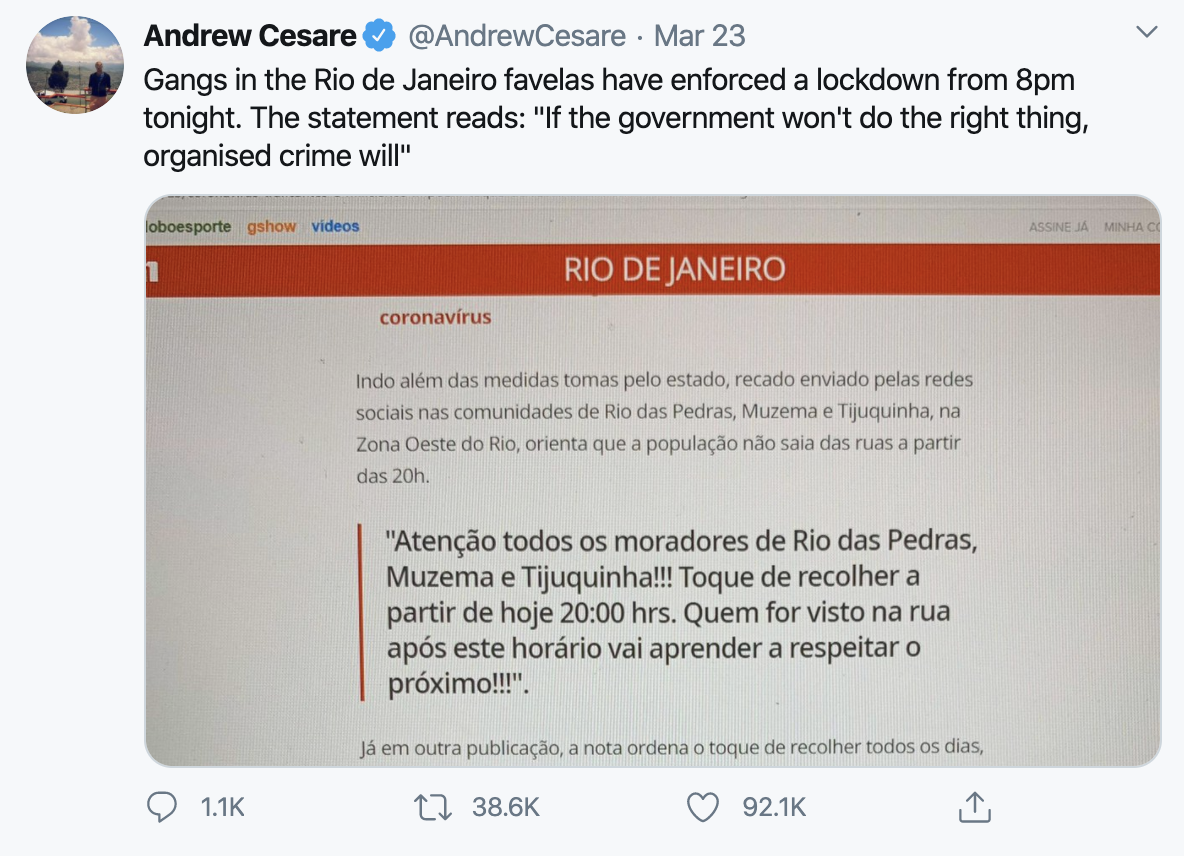
The clue for anarcho-capitalist state-sceptics that this is a genuine shift in social priorities is that even organized criminal gangs are willing to enforce social distancing. You do not have to believe that the state itself is legitimate to see that the need for social distancing is sufficiently morally compelling that it can be enforced absent free agreement, just as one does not need free agreement to exercise a right to self-defense.

Not every restriction is going to be justified, although erring on the restrictive side makes sense while uncertainty about the spread of infection persists. Ultimately, restrictions have to balance genuine costs with plausible benefits. But rejecting restrictions on a priori grounds does not cohere with libertarian principles. Right now, our absolute liberties extend to the right to be alone. Everything else must be negotiated under uncertainty. Someone else’s life, even two-weeks or so in the future, is a valid side-constraint on liberty. People can rightfully be made to stay at home if they are fortunate enough to have one. When people have to travel out of necessity, they can be temporarily exempted, compensated or offered an alternative reasonable means of satisfying their immediate needs.

The Vexing Libertarian Issue of Transition

I have appointed myself an old sage to the world. When your knees are creaky and every snotty eighteen-year-old treats you patronizingly, the least you can do to compensate is award yourself wisdom. Anyway, long story short, it’s a good excuse to spend much time on Facebook. I feel I am rendering a public service. I am continuing my teaching career there. It’s unpaid but the conditions are much better and all the students actually want to be in class.

Of course, it’s also true that Facebook is addictive. It’s not a bad addiction. For this old guy, it’s almost incredible to have frequent conversations with an MD in Pakistan, my niece in India, an old girlfriend in Panama, a young friend’s wife in Japan, and of course, many different kinds of French people. I even have a Facebook friend who lives in the mountains of Algeria; we have lively talks in French. Recently, a young woman who described herself as a Myanmar village girl reached out. (I know what you are thinking but if she is really one of those internet sex trolls, I salute the originality of her marketing strategy.) At all times a day and night, I have at least one Facebook friend who is not asleep. It’s pleasant in these days of confinement.

The same confinement, perhaps, slows me down and makes me more likely to tally up everything. As a result, a new impression has pierced my consciousness. Expressing contempt for democracy seems to be in vogue among people who identify as libertarians (with a small “l,” big “L” Libertarians have nearly vanished from my world. It could just be me.) This contempt reminds me that I have been asking the same question of libertarianism for now about fifty years, all with not much success.

I refer to the question of transition. I mean, what is it supposed to look like moving from wherever we are, in terms of governance, to a society with a drastically diminished government interference in individual lives? I have been receiving evasive answers, answers that don’t make even superficial sense, and swift escapes effected by changing the subject.

Let me say right away that I am not looking for a crushing reading assignment (a common punitive, passive-aggressive maneuver among intellectuals). Mine is a simple question. One should be able to sketch a rudimentary answer to it. Then, it would be up to me to follow through. Then, no excuse!

To my mind, there are only two extreme transition scenarios. One is the Somali scenario. The state falls apart under its own incapacity to limit internal aggression. It disappears or nearly so. When the point is reached where government authority extends only three blocks from the presidential palace to the north and east, and one block from the south and west, you pretty much have a stateless society. Goal reached!

The second scenario is a gradual change from the current “democratic” arrangements. I mean by this fair and reasonably honest elections followed by a peaceful transfer of power. I mean freedom of expression. And, disturbingly, this also includes courts of law. This is disturbing because courts without enforcement of their decisions are not really courts. This fact implies the threat of coercion, of course.

Now, I can imagine a situation like right now with the Corona Virus epidemic when governments (plural) demonstrate on a large scale their inability to do the obvious. The citizens often react to this sort of demonstration by asking for better and more government. However, it does not have to be that way. The combination of wide communication through the internet and – like now – of enforced leisure – may switch the dial. It’s conceivable that large numbers will get the idea that government that is at once heavy-handed, expensive, and incapable is not a good answer to much of anything. With that scenario one can imagine a collective demand for less government.

Strangely, this sort of scenario may be on display in France now, as I write. Well, this is not so strange after all. A deeply statist society where govt absorbs 55% of GDP and up may be exactly the best place to figure out that more government is not the answer. From this thought to the idea that less government may be the answer there is but one step. My intuition though is that it’s a big step. That’s because few people understand markets. No one but a handful of college professors seems to have read the moral philosopher Adam Smith. (Tell me that I am wrong.)

So, I would like for those who are more advanced than I am on this issue of transition (a low bar) to engage me. I am not interested in the same old ethical demonstrations though. Yes, the state is an instrument of coercion and therefore, evil. I already know this. In the meantime, the First Amendment to the Constitution of the United States does a fair job of protecting my freedom of speech, my freedom, of thought, my freedom of religion. I am not eager to leave this behind for the complete unknown. Are you? Why? How?