Is it Thanksgiving without the turkey?

I was recently talking to a friend about Thanksgiving dinner. He was complaining about the difficulty of cooking turkey and asked how my household dealt with the issue. My response? We just serve chicken instead. It’s cheaper, easier to make, and frankly turkey isn’t significantly better.

That begs the question though: can you have Thanksgiving without the turkey? What makes Thanksgiving, Thanksgiving? Being around loved ones is necessary, but not sufficient. We’re, presumably, around loved ones for most holidays. What distinguishes today from other days?

I think it’s the pumpkin pie, but what about my fellow note writers?

#microblogging

Why Immigrants Are Superior

I am endlessly interested in issues of emigration/immigration. In part, this is because it’s the place where my personal experience, and my wife’s, intersect with my training and with my professional life as a sociologist. There is a deeper reason I try to explain below a little circuitously; bear with me.

I think that how humans form into groups is the central question about our species. The question arises because every adult individual without exception is simultaneously a member of several groups and categories. Thus, I am a husband (member of a very small group, at least under monogamous conditions), a member of the sociological discipline/ profession, a member of the teaching professions broadly defined (but never an “educator”!), a small-time member of a local radio station (KSCO Santa Cruz, 1080AM), a Republican but nevertheless, a libertarian (with a small “l”), and an American. Yet, as a former Frenchman I am also a member, though somewhat passive, of a culture group, roughly the francophone group.

All the above memberships are in groups. I also belong to several categories that don’t qualify as groups because they never meet and because they have little sense of themselves as belonging together. So, I am a male (decidedly so), a moderately overweight person past middle age (but athletic!), a parent, a tax-payer, and I also belong to the secret, vast, worldwide category of humans who lack hair on the second phalanx of their index finger. In America, I am also a white man. The latter category is a little problematic because it’s ill-defined, like all matters that have to do with race. It means that most Americans on looking at me would guess, probably correctly, that all or most of my ancestors lived in Europe ten thousand years ago. Do the count of your own memberships for yourself and you will be amazed.

Memberships are not all equal, especially at a given time. Some memberships become activated while others lie dormant. Individuals activate one membership over the others depending on circumstances and often, depending on their stage in the life cycle. The presence of others frequently triggers the activation of long-dormant membership, as when a thirty-something bumps into a couple of old high-school buddies. Finally, sometimes, individuals are forced to activate one membership to the near-exclusion of others. This happens most often in connection with the nation and religious denominations, including secular religions such as Communism in the old days. The penultimate sentence is a description of totalitarianism, political, religious, and other. It’s the most parsimonious definition I know.

Emigration matters because every act of emigration implies a reasonably conscious decision to de-activate a group membership that is salient in much, but not in all, the world: nationality. Emigrants may not be completely clear about how definitive their decision to move is but they always know that it entails an abrupt shutting off of whatever comfort one derives from being inside that particular group.

Emigration, immigration, after one begins to live in another country, typically remains emotionally costly for a long time. Besides, frequently, distance from others one loves, there are subtle issues of self-worth I cannot discuss here (but that I will discuss at some future time, especially if asked). In the classical age of worldwide, and American, emigration, it tended to be final. Travel was slow and expensive. If you did not like it in the new place, often, you just had to suck it up. (This is broadly true although turn-of-the-century American records show that surprising numbers of recent European immigrants left the US every year.) Today, the extraordinarily low cost of air travel means that nearly every dissatisfied immigrant may go home. In 2009, there were very few parts of the world for which a one-way ticket cost more than a thousand dollars. That would be under seven weeks worth of after-taxes minimum wage at worst. Tickets from the US to Europe, for example cost less than one third that amount off-season. In the same year, the average US wage was about $20 per hour. Estimating deductions of 25%, the net hourly wage was thus around $15. Hence, there were few if any parts of the world that could not be reached at the cost of net savings amounting to 70 hours of average wages (less than two weeks).

For emigrants to contiguous countries or proximate countries, such as Turks to Germany, Romanians to France, or Mexicans to the US, the option of going home is even more open, of course.

What I am trying to establish here is that emigration is normally a doubly voluntary act. Immigrants first volunteer to be in the country of immigration. Then, they keep volunteering by not taking up the option of moving back home, of re-emigrating.

Two things should follow from this volunteer condition: First, if they don’t like the country to which they have moved, immigrants have no one to blame but themselves. I know I am repeating myself but the imagery is so attractive, I can’t resist: If you come to the party, especially if you come uninvited (99% of immigrants, I would guess), don’t criticize the food, or the interior decoration, or the guests’ intellectual level.

Although there is a widespread impression to the contrary, it seems to me that few immigrants break this simple rule of their own accord. Rather, more commonly, they fall under the sway of political organizations who presume to speak on their behalf. These organizations are often political in nature. They seek to exploit the voting power of people unfamiliar with the national political customs. It’s in their interest to create and inflame feelings of deprivation. Moreover, since immigrants more often than not enter the host social structure near the bottom, they are frequently taken over by labor unions who do the same. In the US, specifically, recent immigrants are sometimes annexed by radical organizations with a long history of America-hatred. These influences confuse some immigrants, putting them in mental contradiction with their own choices. They do a great deal of damage by retarding immigrants’ emotional integration into American society. Note that I refer to integration rather than to “assimilation,” a cultural construct. Societies differ in the extent to which they expect immigrants to fit into the national culture, Canada little, France a great deal, with the US somewhere between the two.

Finally, organizations led by native-born who pretend to speak for immigrants also do the latter a great deal of harm by creating false impressions in the general public. The main false impression is that immigrants are more difficult to integrate than they really are. In the US, you seldom hear about the millions of immigrants who think that everything is just peachy or better.

The second consequence from the voluntary nature of the status of immigrants is seldom discussed: Immigrants make better citizens than the average native-born. Over 90% of Americans, for example, only took the trouble to be born in the right country. That’s akin to choosing your parents carefully. There is not much merit in it, first because it just happened. Secondly, most native-born citizens of any country would not have enough information to choose the land of their birth over others if the thought crossed their minds. Here again, the exception proves (“tests”) the rule: It’s possible to make such a choice since millions do, by emigrating, precisely. This would include the tens of thousands of Americans who live abroad more or less permanently.

Immigrants, by contrast, choose and keep choosing merely by staying put. Their choice is deliberate, conscious and informed. Their appreciation for the country of their immigration is a form of adult love. It should be superior to the baby-love of many of the native-born who only know one mother. If I were still a scholar, I would have a topic for a good study here. I would begin to endeavor to find data to test what is now a compelling hypothesis. But I am not, so it will remain this as far as I am concerned.

Immigrants into the US, specifically, possess superior qualities, whatever their national origin. First, they are usually hard workers, because this country offers some of the least generous social benefits (“welfare”) in the developed world. To sponge off “the system” in this country takes a great deal of skill. (A pregnant idea but I won’t go there in this essay.) Immigrants into this country must also comprise a large proportion of enterprising people, for the same reason. (There, I think data exist that demonstrate the validity of this claim.) Moreover, immigrants into the US have to be more adventurous, braver, than the native-born, on average. To change one’s living conditions drastically takes more courage, more tolerance of risk, and more imagination than moving to the next suburb.

I believe, accordingly, that American exceptionalism is rooted in exceptional institutions but that it is fertilized by wave after wave of immigration of a superior kind.

The following link will take you to an article about illegal immigration specifically that I published in the Independent Review with Russian immigrant Sergey Nikiforov: “If Mexicans and Americans could Cross the Border…“.

“The Impossibility of a University”

I was just reading David Friedman’s The Machinery of Freedom. He published the first edition in 1973. Amidst the wild ride of the contemporary American university (Evergreen State College being the most heinous single episode), one passage seems especially prescient.

From chapter twelve in the third edition:

The modern corporate university, public or private, contains an implicit contradiction: it cannot take positions, but it must take positions [sides]. The second makes the demand for a responsible university appealing, intellectually as well as emotionally. The first makes not merely the acceptance of that demand but its very consideration something fundamentally subversive of the university’s proper ends.

It cannot take positions because if it does, the efforts of its members will be diverted from the search for truth to the attempt to control the decision-making process. If it takes a public position on an important matter of controversy, those on each side of the controversy will be tempted to try to keep out new faculty members who hold the other position, in order to be sure that the university makes what they consider the right decision. To hire an incompetent supporter of the other side would be undesirable; to hire a competent one, who might persuade enough faculty members to reverse the university’s stand, catastrophic. Departments in a university that reaches corporate decisions in important matters will tend to become groups of true believers, closed to all who do not share the proper orthodoxy. They so forfeit one of the principal tools in the pursuit of truth — intellectual conflict.

A university must take positions. It is a large corporation with expenditures of tens of millions of dollars and an endowment of hundreds of millions. It must act, and to act it must decide what is true. What causes high crime rates? Should it protect its members by hiring university police or by spending money on neighborhood relations or community organizing? What effect will certain fiscal policies have on the stock market, and thus the university’s endowment? Should the university argue for them? These are issues of professional controversy within the academic community.

A university may proclaim its neutrality, but neutrality as the left quite properly argues, is also a position. If one believes that the election of Ronald Reagan or Teddy Kennedy would be a national tragedy, a tragedy in particular for the university, how can one justify letting the university, with its vast resources of wealth and influence, remain neutral?

The best possible solution within the present university structure has been not neutrality but the ignorance or impotence of the university community. As long as students and faculty do not know that the university is bribing politicians, investing in countries with dictatorial regimes, or whatever, and as long as they have no way of influencing the university’s actions, those acts will not hinder the university in its proper function of pursuing truth, however much good or damage they may do in the outside world. Once the university community realizes that the university does, or can, take actions substantially affecting the outside world and that students and faculty can influence those actions, the game is up.

There is no satisfactory solution to this dilemma within the structure of the present corporate university. In most of the better universities, the faculty has ultimate control. A university run from the outside, by a state government or a self-perpetuating board of trustees, has its own problems. A university can pretend to make no decisions or can pretend that the faculty has no control over them, for a while. Eventually someone will point out exactly what the emperor is wearing.

With an activist culture in place, the university endures more and more blows to its truth-seeking abilities. UC Berkeley spent an estimated $600,000 on security for Ben Shapiro a couple months ago, after the chaos and protests of the past year. Staff cut seating in half, worried that protesters would dismantle chairs and throw them onto the audience on the bottom floor. Now, so I hear, student clubs are having difficulty hosting evening meetings on campus, as the administration makes up for the expenses by cutting down on electricity usage and janitorial services. Club stipends, of course, are down. All of this damages the educational environment.

My friends went to see Ben, and watched a woman with a “Support the First Amendment! Shalom Shapiro!” sign get dragged into a crowd and beat up. (Not reported by major media; falsely reported as a knifing by right-wing media.) David identified the internal problem of the corporate university, which I believe we see escalating; the external problem is when outsiders — most of the violent rioters in Berkeley since the beginning of 2017 — understand the political power of the university and the speech that goes on there, and seek to control the process of intellectual conflict through physical force. Both are advanced in accordance with the political involvement of the students as well as the teachers.

Minarchism, Anarchism, and Democracy: A Shared Challenge

Minarchism–basically as small a government as we can get away with–is probably the most economically efficient possible way to organize society. A night watchman state providing courts of last resort and just enough military to keep someone worse from taking over.

The trouble (argues my inner anarchist) is that if we’ve got a government–an organization allowed to force/forbid behaviors–we’re already on the slippery slope to abuse of powers through political trading. Without an entrenched culture that takes minarchism seriously it’s only a matter of time before a) the state grows out of control and you’re no longer in a minarchist Utopia, or b) a populace unwilling to do their part allows violent gangs to fill the power vacuum.

Having a government at all is a risky proposition from the perspective of someone worried about the abuse of that power. Better not to risk it at all.

Anarchism relies on the right culture in a similar way. This is clear to critics of anarchism (basically it’s just the minarchists who are willing to take anarchists seriously at all) and is the crux of an important argument against anarchism. Without the right culture, what’s to stop people from just creating some new government? Nothing at all.

In fact, we face the same problem in the military-industrial-nanny-state complex of our imperfect real world. For any government–or lack of government–to work, the ideological framework of the people living in that society has to line up properly. To the extent people are ignorant, distracted, short-sighted, biased, or mean-spirited, we get governance that reflects those flaws.

If we want to live in a better world, we can argue all day about what sort of government we do or don’t want. But ultimately we have to work on improving the culture, because the median voter is still in charge.

The language of the economy: prices

50 Things That Made the Modern Economy is looking for a 51st thing. Below is the email I sent them.

Continue reading

Cycling in Amsterdam

I just got back from a week in London and a week in Amsterdam. Probably the most striking thing I encountered was the wonderful dutch cycling culture. Any transit system involves some implicit negotiation between motorists, pedestrians, and others. On Long Island the motorists won. In Amsterdam, cyclists won.

I’m on a bit of a Dutch cycling high, despite only spending about 2 hours on 2 wheels while in Amsterdam. The dutch take their bicycles seriously and they shape their environment to that end. The Airbnb I stayed at had frontage on a bicycle road but no direct access to a motorway. I’m not 100% on this, but I think the Netherlands’ liability laws make the faster vehicle strictly liable for accidents which serves as an implicit subsidy for bikes.

100_4514
A typical Dutch cycle path

Here are some things I like about this culture:

  • The engineering. I really like the way they do bike locks… nearly every bike has a built in lock that disables the rear wheel. Most of these locks also have a chain to lock the bike to a fence, but that chain locks with the same key for the rear wheel.
  • It encourages enough density to get people interacting with each other, but still expands your plausible travel distance. They’ve got a nice balance between closeness and congestion.
  • It’s easier on the environment (excluding the costs of building bikes and bike roads).
  • Light physical exercise feels great.
  • The infrastructure involved in managing bike traffic is pretty minimal. Speeds are slow enough that human judgement works well outside of the busiest areas.

Why should libertarians care? Well, most of them probably have better things to focus on. But those of us living in or near dense cities, this is an example of a way of life that fits nicely with our broader goal of a peaceful, prosperous, liberal order. If Manhattan tried to be more like Amsterdam it could be a huge boon (I think… based on my preferences and zero scientific analysis) to human flourishing.

Social noble lies

In the Republic, Socrates introduced the “noble lie”: governmental officials may, on occasion, be justified in propagating lies to their constituents in order to advance a more just society. Dishonesty is one tool of the political class (or even pre-political — the planning class) to secure order. This maxim is at the center of the debate about transparency in government.

Then, in the 20th century, when academic Marxism was in its prime, the French Marxist philosopher Louis Althusser became concerned with the issue of social reproduction. How does a society survive from one generation to the next, with most of its moors, morals and economic model still in place? This question was of particular interest to the Orthodox Marxists: their conflict theory of history doesn’t illuminate how a society is held together, since competing groups are always struggling for power. Althusser came up with “Ideological State Apparatuses”: institutions, coercive or purely ideological, that reinforce societal beliefs across generations. This necessarily includes all the intelligence agencies, like the CIA and FBI, and state thugs, like the Gestapo and NKVD, but it also includes the family unit (authorized by a marriage contract), public education and the political party system. “ISAs” also include traditions in the private sector, since for Althusser, the state exists primarily to protect these interests.

It’s rarely easy enough to point to a country and say, “This is the dominant ideology.” However, and here the Marxists are right, it can be useful to observe the material trends of citizens, and what sorts of interests people (of any class) save up money for, teach their children to admire, etc. In the United States, there is a conditional diversity of philosophies: many different strains abound, but most within the small notecard of acceptable opinion. Someone like Althusser might say there is a single philosophy in effect — liberal capitalism — getting reproduced across apparatuses; a political careerist might recognize antagonists across the board vying for their own particular interests. In any case, the theory of ISAs is one answer to conflict theory’s deficiencies.

There is no reason, at any time, to think that most of the ideas spreading through a given society are true. Plenty of people could point to a lesson taught in a fifth grade classroom and find something they disagree with, and not just because the lessons in elementary school are simplified often to distortion. Although ideas often spread naturally, they can also be thrusted upon a people, like agitprop or Uncle Sam, and their influence is either more or less deleterious.

Those outlooks thrust upon a people might take the form of a noble lie. I can give qualified support for noble lies, but not for the government. (The idea that noble lies are a right of government implies some sort of unique power for government actors.) There are currently two social lies which carry a lot of weight in the States. The first one comes from the political right, and it says: anyone can work their way to financial security. Anyone can come from the bottom and make a name for themselves. Sentiment like this is typically derided as pulling oneself up from the bootstraps, and in the 21st century we find this narrative is losing force.

The second lie comes from the left, and it says: the system is rigged for xyz privileged classes, and it’s necessarily easier for members of these groups to succeed than it is for non-members. White people, specifically white men, all possess better opportunities in society than others. This theory, on the other hand, is increasingly popular, and continues to spawn vicious spinoffs.

Of the two, neither is true. That said, it’s clear which is the more “socially useful” lie. A lie which encourages more personal responsibility is clearly healthier than one which blames one’s ills all on society and others. If you tell someone long enough that their position is out of their hands because the game is rigged, they will grow frustrated and hateful, and lose touch with their own creative power, opting to seek rent instead. Therefore one lie promotes individualism, the other tribalism.

Althusser wrote before the good old fashioned class struggle of Marxism died out, before the postmodernists splintered the left into undialectical identity politics. God knows what he would think of intersectionality, the ninth circle in the Dante’s Inferno of progressivism. These ideas are being spread regardless of what anyone does, are incorporated into “apparatuses” of some sort, and are both false. If we had to choose one lie to tell, though, it’s obvious to me the preferable one: the one which doesn’t imply collectivism in politics and tribalism in culture.

Inventions that didn’t change the world

Have you ever learned about an amazing invention–whether it was the Baghdad battery or the ancient Roman steam engine or Chinese firecrackers–and wondered why it didn’t do more to change the world? In this podcast, we examine a selection of curiosities and explore hypotheses for why their inventors didn’t use them to full effect.

We move VERY quickly through a range of fascinating examples and hypotheses, and therefore leave a lot up to discussion. We hope to see your thoughts, feedback, and additions in the comments section!

For any invention that you want to learn more about, see the links below:

Knossos’ toilets

In the 2nd millennium BC, a “palace” (now thought to be a building that served as administrative, trade, and gathering hub) had running-water toilet flushing. Much like the Roman Cloaca Maxima, likely a HUGE public-health benefit, but basically died out. Does this show that military protection/staving off the “Dark Ages” was the only way to maintain amazing inventions?

Link: http://www.nature.com/news/the-secret-history-of-ancient-toilets-1.19960;

The Nimrud lens

Whether it was a fire-starter, a magnifying glass, or (for some overeager astronomy enthusaists), the Neo-Assyrian ground-crystal Nimrud lens is an invention thousands of years out of place. While the Egyptians, Greeks, and Romans all used lenses of different sorts, and glass-blowing was certainly popular by the 1st century BC in Roman Egypt, no glass lenses were made until the Middle Ages and the potential scientific and engineering uses of lenses–that can hardly be understated even in their 16th-to-18th-century applications–had to wait another couple millennia. Many devices like the Baghdad battery and Antikythera device are heralded for their possible engineering genius, but this seems like a simple one with readily available applications that disappeared from the historical record.

https://en.wikipedia.org/wiki/Nimrud_lens

Hero of Alexandria’s steam engine

In the 1st century AD, Hero was a master of simple machines (that were mostly used for plays) and also invented a force pump, a wind-powered machine, even an early vending machine. However, he is likely most famous for his Aeolipile, a rotating steam engine that used heated water to spin an axle. The best attested use of this is for devotion to the divine and party tricks.

https://en.wikipedia.org/wiki/Aeolipile

The ancient mechanical reaper

Ancient Gallo-Romans (or just Gauls) invented a novel way of grain harvesting: rather than using sickles or scythes, they used a mechanical reaper, 1700 years before Cyrus McCormick more than tripled the productivity of American farmers. This antiquated device literally but the cart before the oxen and required two men to operate: one man to drive the beasts, and another to knock the ears off the stalk (this reaper was obviously far less sophisticated than McCormick’s). This invention did not survive the Volkswanderung period.

http://www.gnrtr.com/Generator.html?pi=208&cp=3

http://reapertakethewheel.blogspot.com/2013/03/impacts-of-invention.html

Note: the horse collar (which allowed horses to be used to plow) was invented in 1600-1400 BC in China AND the Levant, but was not applied widely until 1000 AD in Europe. https://en.wikipedia.org/wiki/Horse_collar.

Inoculation

Madhav, an Indian doctor, compiled hundreds of cures in his Nidana, including an inoculation against smallpox that showed an understanding of disease transmission (he would take year-old smallpox-infected flesh and touch it to a recently made cutaneous wound). However, the next 13 centuries did not see Indian medical understanding of viruses or bacteria, or even copied techniques of this, development. https://books.google.com/books?id=Hkc3QnbagK4C&pg=PA105&lpg=PA105&dq=madhav+indian+smallpox+inoculation&source=bl&ots=4RFPuvbf5Y&sig=iyDaNUs4u5N7xHH6-pvlbAY9fcQ&hl=en&sa=X&ved=0ahUKEwic8e-1-JXVAhUp6IMKHfw3DLsQ6AEIOjAD#v=onepage&q=madhav%20indian%20smallpox%20inoculation&f=false

At least, thank god, their methods of giving nose jobs to those who had had their noses cut off as a punishment survived: https://en.wikipedia.org/wiki/History_of_rhinoplasty

The Chinese:

List of all chinese inventions:

https://en.wikipedia.org/wiki/List_of_Chinese_inventions#Four_Great_Inventions

Gunpowder

Gunpowder was discovered by Chinese alchemists attempting to discover the elixir of life (irony, no?)

https://www.thoughtco.com/invention-of-gunpowder-195160

https://en.wikipedia.org/wiki/Four_Great_Inventions

(maybe a good corollary would be Greek fire, which was used effectively in naval warfare by the Byzantines, but which was not improved upon and the recipe of which is still secret: https://en.wikipedia.org/wiki/Greek_fire)

Printing

The Chinese invented the printing press possibly as early as the 6th century. However, unlike the explosion of literacy seen in much of Europe (particularly Protestant Europe–see our last podcast), the Chinese masses never learned to read. In fact, in 1950 fewer than 20% of Chinese citizens were literate. Compare this to Europe, where some societies saw literacy rates of as high as 90% (Sweden, Male population) in some societies within a few centuries of the introduction of the printing press. Why? There may be several reasons–cultural, religious, political–but in our opinion, it would have to be the characters: 100,000 blocks were needed to create a single set.

http://www.nytimes.com/2001/02/12/news/chinas-long-but-uneven-march-to-literacy.html

https://en.wikipedia.org/wiki/History_of_printing_in_East_Asia

They also invented pulped paper by the 2nd century BC: https://en.wikipedia.org/wiki/List_of_Chinese_inventions.

The compass

Invented by 200 BC for divination and used for navigation by the Song dynasty; despite this and the availability of easily colonizable islands within easy sailing distance, the Chinese did not colonize Indonesia, Polynesia, or Oceania, while the Europeans did within the century after they developed the technology and first sailed there.

https://en.wikipedia.org/wiki/History_of_the_compass.

The rudder

While they did not invent the rudder, they invented the “medial, axial, and vertical” sternpost rudder that would become standard in Europe almost 1,000 years before it was used in Europe (1st century AD vs 11th century).

Natural gas

The Chinese discovered “fire wells” (natural gas near the surface) and erected shrines to worship there.

https://link.springer.com/referenceworkentry/10.1007%2F978-1-4020-4425-0_9568

They even understood their potential for fuel, but never developed beyond primitive burning and bamboo piping despite having advanced mining techniques for it by the 1st century BC.

Chinese miscelleni:

Hydraulic powered fan: https://en.wikipedia.org/wiki/Fan_(machine)#History

Cuppola furnace for smelting and molding iron: https://en.wikipedia.org/wiki/Cupola_furnace.

Coke as a fuel source: https://en.wikipedia.org/wiki/Coke_(fuel).

Belt-drive spinning wheel: https://en.wikipedia.org/wiki/Coke_(fuel).

The Precolumbian wheel

The pre- and early Mayans had toys that utilized primitive wheels, but did not use them for any labor-saving purpose (even their gods were depicted carrying loads on their backs). This may have been because scaling up met with mechanical difficulties, but the potential utility of wheels in this case with a bit of investment literally sat unrealized for centuries.

https://tcmam.wordpress.com/2010/11/11/did-pre-columbian-mesoamericans-use-wheels/

The Tucker:

http://www.smithsonianmag.com/history/the-tucker-was-the-1940s-car-of-the-future-135008742/

The following book contained some of our hypotheses:

https://books.google.com/books?id=ynejM1-TATMC&pg=PA399&lpg=PA399&dq=roman+and+greek+labor-saving+devices&source=bl&ots=BI6GVGTrxC&sig=8ZJqirOVUyjH7TNq0fcW6UUPn1k&hl=en&sa=X&ved=0ahUKEwj55O7395XVAhVqwYMKHSb2Dy4Q6AEIKTAB#v=onepage&q=roman%20and%20greek%20labor-saving%20devices&f=false


The rest of our hypotheses were amalgamated from our disparate classes in economics and history, but none of them are our own or uncommon in academic circles. Thanks for listening!

Some thoughts on the ivory tower; part 1: discrimination

I entered academia in 2009 when I started my bachelor’s degree and began graduate studies in 2014 when I entered a master’s program. I have been in the ivory tower in some form for almost a decade. Others have spent much more time in the tower than I, but I am hardly a newcomer. I hope then that I can offer thoughts on discrimination and mental health in the ivory tower.

In the past few years I have noted an increased self-aware discussion on the lack of diversity, both in terms of phenotype and ideology, in the ivory tower. The tower is full of center-left white men. I have seen various formal (e.g. #womenalsoknowstuff ) and informal groups groups advocate for greater inclusion in the tower. For the record there are non-leftist groups involved in this as well. CU Boulder has a program to increase conservative intellectuals. The Institute of Humane Studies (IHS) essentially serves to advocate for classical liberals in the tower. 

There is nothing wrong with these goals. Women also knows stuff tries do this by advertising the work of female scholars. IHS does it by inviting classical liberals to book discussions – and providing beer. Both approaches sound sensible to me. My concern is that ultimately the pipeline isn’t being fixed. Not really. Both approaches help those who managed to enter, at minimum, graduate school but do little to help solve more structural reasons for why there respective groups are rare in the tower.

Why are there so few women and classical liberals (and especially so few classical liberal women!) in academia? It’s partly cultural and partly institutional.

Minorities get made fun of in academia. Academics like to think of themselves as cosmopolitan, but it’s a big lie. A recent undergrad thesis by a Berkeley student looked at misogynistic discussions on an online forum frequented by economists. I disagree with the research design of the paper, but I believe the general argument that the tower is filled with misogyny. I also believe it’s filled with dislike for conservatives, Christians, atheists, whites, blacks, Arabs, Chinese, etc.

I don’t think the tower is unique in this. Human beings divide themselves by groups and I don’t see why that will ever change. I think the academy is just a bit whiter and a bit more lefty because of sorting effects. You can see this happening even within the tower. Classical liberals sort into economics – how many classical liberal anthropologists do you know? Not counting NoL’s chief editor? Some minorities sort into ethnic studies. How many black game theorists do you know? Native American psychometricians?

What can we do? I’m not sure. We can improve the pipeline so that grad students, and eventually faculty, get more diverse. However I suspect the sorting problem will remain. Superficially we will have more diversity, but is it really diversity if we’re sorted by discipline and subfields? Should we force new classical liberals to enroll in sociology grad programs? I don’t know. Maybe we should give up on diversity all together and focus on abolishing the state. Maybe? Who knows? What do you  all think?

By the way if you want to know what true cosmopolitanism is, visit an inner city. True cosmopolitanism is seeing blacks, Mexicans and Koreans eating pupusas made by a Honduran. Everything else is a GAP commercial concoted by HR people.

When Should Intellectuals be held Accountable for Popular Misrepresentations of their Theories?

Often an academic will articulate some very nuanced theory or ideological belief which arises out of a specialized discourse, and specialized background knowledge, of their discipline. It is not too surprising that when her theory gets reprinted in a newspaper by a non-specialist journalist, taken up by a politican to support a political agenda, or talked about on the street by the layman who doesn’t possess specialized knowledge, the intellectual’s theory will be poorly understood, misrepresented, and possibly used for purposes that are not only not justified but the exact opposite of her intentions.

This happens all the time in any discipline. Any physicist who reads a You Tube thread about the theory of relativity, an economist who opens a newspaper, biologist who reads the comments section of a Facebook post on GMOs, psychologist who hears jokes about Freud, or philosopher who sees almost any Twitter post about any complex world-historical thinker knows what I’m talking about. Typically, it is assumed that a popularizer or layperson who misunderstands such complex nuanced academic theories always must be answerable to their most intellectually responsible, academic articulation. It is usually assumed that an intellectual theorist should never be concerned with the fact that her theories are being misunderstood by popular culture, and certainly, she shouldn’t change a theory just because it is being misunderstood.

For many disciplines in many contexts, this seems to be true. The theory of relativity shouldn’t be changed just because most people do not possess the technical knowledge to understand it and popularizers often oversimplify it. Just because people do not understand that climate change means more than rising temperatures doesn’t mean it is not true. The fact that some young earth creationist thinks that the existence of monkeys disproves revolution doesn’t mean an evolutionary biologist should care.

Further, it’s not just natural sciences to which these apply, but also the social sciences. Just because methodological individualism is often misunderstood as atomistic, reductive ethical individualism doesn’t mean economists should abandon it any more than people’s various misunderstandings of statistical methods mean scientists should abandon those methods. Likewise, the fact that rational choice theory is misunderstood as meaning people only care about money, or that Hayek’s business cycle theory is misunderstood as meaning only central banks can cause recessions, or that a Keynesian multiplier is misunderstood as meaning that all destructive stimulus is desirable because it equally increases GDP does not mean that economists who use them should abandon those theories based on non-substantive criticisms based on over simplified or straw man misunderstandings of those theories.

On the other hand, there are other times where it seems that popular misunderstandings of some academic writings do matter. Not just in the sense that a layperson not understanding science leads them to do unhealthy things, and therefore the layperson should be educated on what scientific theories actually say, but in the sense that popular misunderstandings point out some deficiencies in the theory itself that the theorist should correct.

To take an example (which I’m admittedly somewhat simplifying) from intellectual history. Early in his career John Dewey advocated quasi-Hegelian comparisons of society to a “social organism.” For example, in an 1888 essay he defended democracy because it “approaches most nearly the ideal of all social organization; that in which the individual and society are organic to each other.” Though Dewey never meant such metaphors to undermine individuality and imply some form of authoritarian collectivism, he did want to emphasize the extent to which individuality was constituted by collective identifications and social conditions and use that as a normative ideological justification for democratic forms of government.

By 1939, after the rise of Bolshevism, fascism, and various other forms of Hegelian-influenced illiberal, collectivist, authoritarian governments, he walked back such metaphors saying this:

My contribution to the first series of essays in Living Philosophies put forward the idea of faith in the possibilities of experience at the heart of my own philosophy. In the course of that contribution, I said, “Individuals will always be the center and the consummation of experience, but what the individual actually is in his life-experience depends upon the nature and movement of associated life.” I have not changed my faith in experience nor my belief that individuality is its center and consummation. But there has been a change in emphasis. I should now wish to emphasize more than I formerly did that individuals are the final decisive factors of the nature and movement of associated life.

[…] The fundamental challenge compels all who believe in liberty and democracy to rethink the whole question of the relation of individual choice, belief, and action to institutions, and to reflect on the kind of social changes that will make individuals actually the centers and the possessors of worthwhile experience. In rethinking this issue in light of the rise of totalitarian states, I am led to emphasize the idea that only the voluntary initiative and voluntary cooperation of individuals can produce social institutions that will protect the liberties necessary for achieving development of genuine individuality.

In other words, Dewey recognized that such a political theory could be easily misunderstood and misapplied for bad uses. His response was to change his emphasis, and his use of social metaphors, to be more individualistic since he realized that his previous thoughts could be so easily misused.

To put a term to it, there are certain philosophical beliefs and social theories which are popularly maladaptive, that is regardless of how nuanced and justifiable it is in the specialized discourse of some intellectual theorist they will very often be manipulated and misused in popular discourse for other nefarious purposes.

To take another example, some “white nationalist” and “race realist” quasi-intellectuals make huge efforts to disassociate themselves with explicitly, violently racist white supremacists. They claim that they don’t really hate non-whites and want to hurt them or deprive them of rights, just that they take pride in their “white” culture and believe in (pseudo-)scientific theories which purport to show that non-whites are intellectually inferior. It is not very surprising, to most people, that in practice the distinction between a “peaceful” race realist and a violently racist white supremacist is extremely thin, and most would rightly conclude that means there is something wrong with race realism and race-based nationalist ideologies no matter how much superficially respectable academic spin is put on them because they are so easily popularly maladaptive.

The question I want to ask is how can we more explicitly tell when theorists should be held accountable for their popularly maladaptive theories? When does it matter that public misinterpretation of a somewhat specialized theory points to something wrong with that theory? In other words, when is the likelihood of a belief’s popularly mal-adaptivity truth-relevant?  Here are a few examples where it’s a pretty gray area:

  1. It is commonly claimed by communitarian critics of liberalism that liberalism reduces to atomistic individualism that robs humanity of all its desire for community and family and reduces people to selfish market actors (one of the original uses of the term “neoliberal”). Liberals, such as Hayek and Judith Shklar, typically respond by saying that liberal individualism, properly understood, fully allows individuals to make choices relevant to such communal considerations. Communitarians sometimes respond by pointing out that liberalism is so often misunderstood publicly as such and say that this shows there is something wrong with liberal individualism.
  2. It is claimed by critics of postmodernism and forms of neo-pragmatism that they imply some problematic form of relativism which makes it impossible to rationally adjudicate knowledge-claims. Neo-pragmatists and postmodernists respond by pointing out this is misunderstanding their beliefs, the idea that our understanding of truth and knowledge isn’t algorithmically answerable to correspondence doesn’t mean it’s irrational, postmodernism is about skepticism towards meta-narratives not skepticism towards all rational knowledge itself, and (as Richard Bernstein argued) these perspectives often make hardcore relativism as incoherent as hardcore objectivism. The critic sometimes responds by citing examples of lay people and low-level academics using this to defend absurd scientific paradigms and relativistic-sounding theories of morality or epistemology and this should make us skeptical of postmodernism or neo-pragmatism.
  3. Critics of Marxism and socialism often point out that Marxism and socialism often transform into a form of authoritarianism, such as in the Soviet Union or North Korea. Marxist and socialists respond by saying that all these communist leaders misused Marxist doctrine, Marx doesn’t really imply anything that would lead of necessity to authoritarianism, and socialism can work in a democratic, more free context. The critic (such as Don Lavoie) will point out that the institutional incentive-structure of socialism ncessarily require a sort of militarism due to the economic incentives faced by socialist governments regardless of the good intentions of the pure intentions of the socialist theorist, in other words they claim that socialism is inherently popularly maladaptive due to the incentives it creates. The socialist still thinks this isn’t the case and, regardless, the fact that socialism has turned authoritarian in the past was because it was in the hands of irresponsible revolutionaries/popularizers and that isn’t relevant to socialism’s truth.
  4. Defenders of traditional social teachings of Christianity with respect to homosexuality claim there is nothing inherently homophobic about the idea that homosexual acts are a sin. In the spirit of “Love the sinner, hate the sin,” they claim that being gay isn’t a sin but homosexual acts are the sin. Christians should show love and compassion for gay people, they say, while still condemning their sexual behavior. Secular and progressive Christian critics respond by pointing out how, in practice, Christians do often act very awfully towards gay people. They point out it is very difficult for most Christians who believe homosexual acts are sinful to separate the “sin” from the “sinner” in practice regardless of the intellectually pure intentions of their preacher, and that such a theological belief is often used to justify homophobic cruelty. Since you will judge a faith by its fruits (a pretty Christian way of saying that popular mal-adaptivity is truth-relevant), we should be skeptical of traditional teachings on homosexuality. The traditionalist remains unconvinced that this matters.

It is important to distinguish between two questions: whether these beliefs are popularly maladaptive empirically (or, perhaps, just very likely to be) and whether the possibility of them being popularly maladaptive is relevant to their truth. For example, a liberal could respond to her communitarian critic by pointing out empirical evidence that individuals engaging in market exchange in liberal societies aren’t selfish and uncaring about their communities to undermine the claim that their individualism is popularly maladaptive in the first place. But that response is different from a liberal saying that just because their individualism has been misunderstood means that they shouldn’t care about it.

We should also distinguish the question of whether beliefs are likely to be maladaptive from whether their mal-adaptivity is truth-relevant. For example, it is conceivable that a popularized atheism would be extremely nihilistic even if careful existentialist atheists want to save us from nihilism. An atheist could say that appears unlikely since most non-intellectual atheists aren’t really nihilists (which would answer the former question), or by saying that people’s misunderstanding of the ethical implications of God’s non-existence is not relevant to the question of whether God exists (which would answer the latter question). For now, I am only concerned with when maladaptivity is truth-relevant.

There are a couple of responses which seem initially plausible but are unconvincing. One potential response is that positive scientific theories (such as evolution and monetary economics) do not need to worry about whether they are likely to be popularly maladaptive, but normative moral or philosophical theories (such as liberal individualism or theological moral teachings) do not.

However, this confuses the fact that scientists do often make normative claims based on their theories which seem irrelevant to their popular interpretation. For an instance, it’s not clear that a monetary economist, who makes normative policy conclusions based on their theories, should care if the layman does not understand how, for example, the Taylor Rule, Nominal Income Target, or Free Banking should work. Further, there are philosophical theories where popular maladaptively doesn’t seem to matter; for example, Kantians shouldn’t really fret if an introductory student doesn’t really grasp Kant’s argument for the synthetic a priori, and analytic philosophers shouldn’t care if most people don’t understand Quine’s objections to the analytic/synthetic distinction.

I’m unsure exactly how to answer this question, but it seems like answering it would clear up a lot of confusion in many disagreements.

The case of James Damore: defending the Google engineer who was fired over a ‘controversial memo’

Yesterday, news broke out that Google had fired their engineer James Damore for disseminating a memo which was meant to be an invitation for open and honest discussion on Google’s left bias. CEO Sundar Pichai said the engineer had violated Google’s code of conduct by ‘advancing harmful gender stereotypes’.

DasKapital calls Damore a ‘diversity hater’, and Metro News calls him ‘anti-women’. The Guardian calls the memo ‘sexist’ and shamelessly maintains that the memo argues for the “biological inferiority of his female colleagues, and how this made them less suitable for tech.”

Reading through the 10-page memo myself, I find the memo very reasonable and I stand behind it 100%. Like Damore, I believe that we should stop assuming that gender gaps imply sexism.

What is Damore arguing against?

Damore argues that “Google’s left bias has created a politically correct monoculture that maintains its hold by shaming dissenters into silence.”

The several discriminatory practices that Google has instituted as a result of their left bias are:

  • Programs, mentoring, and classes only for people with a certain gender or race.
  • A high priority queue and special treatment for “diversity” candidates.
  • Hiring practices which can effectively lower the bar for “diversity” candidates by decreasing the false negative rate.
  • Reconsidering any set of people if it’s not “diverse” enough, but not showing that same scrutiny in the reverse direction (clear confirmation bias).
  • Setting org level OKRs for increased representation which can incentivize illegal discrimination.

In short, Damore argues that:

  • Google’s political bias has equated the freedom from offense with psychological safety, but shaming into silence is the antithesis of psychological safety.
  • This silencing has created an ideological echo chamber where some ideas are too sacred to be honestly discussed.
  • The lack of discussion fosters the most extreme and authoritarian elements of this ideology.
  • Extreme: all disparities in representation are due to oppression.
  • Authoritarian: we should discriminate to correct for this oppression.
  • Differences in distributions of traits between men and women may in part explain why we don’t have 50% representation of women in tech and leadership. Discrimination to reach equal representation is unfair, divisive, and bad for business.

What did Damore write about women?

Damore writes that women and men differ biologically and that this results in different personality traits, preferences they hold, and the career choices they make.

On biological differences

Damore writes that men and women differ biologically in many ways and that not all differences are socially constructed:

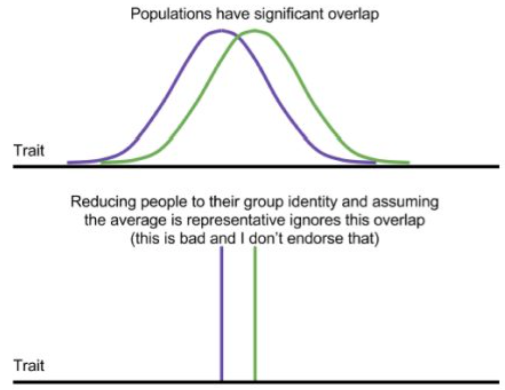
I’m simply stating that the distribution of preferences and abilities of men and women differ in part due to biological causes and that these differences may explain why we don’t see equal representation of women in tech and leadership. Many of these differences are small and there’s significant overlap between men and women, so you can’t say anything about an individual given these population level distributions.

On personality differences

Damore writes that women, on average, have more openness directed towards feelings and aesthetics rather than ideas. This makes them have a stronger interest in people rather than things and explains in part why women relatively prefer jobs in social or artistic areas.

In addition, women express their extraversion as gregariousness and agreeableness rather than assertiveness.

Women, on average, also have higher anxiety, and lower stress tolerance which makes high stress jobs less attractive to women.

Compared to men, women on average also look for more work-life balance.

Damore’s overall message

Damore explains his overall message as follows:

I hope it’s clear that I’m not saying that diversity is bad, that Google or society is 100% fair, that we shouldn’t try to correct for existing biases, or that minorities have the same experience of those in the majority. My larger point is that we have an intolerance for ideas and evidence that don’t fit a certain ideology. I’m also not saying that we should restrict people to certain gender roles; I’m advocating for quite the opposite: treat people as individuals, not as just another member of their group (tribalism).

Again, I think this is extremely reasonable. Unfortunately, in a world driven by irrational and zealous egalitarians, those who use logic and reason are easily labeled bigots.

Reference

Damore, J. (2017). Google’s Ideological Echo Chamber

Why I’m No Longer a Christian: An Autobiographical/ Philosophical/ Therapeutic Explanation to Myself

Note: This was written about 18 months ago and posted on my now-defunct blog. I figure it might be worth reposting, mostly for posterity.

Throughout most of my youth, like the majority of middle-class Americans, I was raised as a Christian. As an argumentative and nerdy teenager, much of the intellectual energy throughout my adolescence was dedicated to the fervent apologetics of the Christian faith. In my eyes, I was trying to defend some deep, correspondent truth about the Lord. Today, I realize that was mostly youthful self-deception. I was trying to make beliefs I had made an epistemic and personal commitment to due to my social situation work with the experiences of the modern world I was thrust into. There is nothing wrong with my attempts to find some reason to cling to my contingent religious beliefs, and there is nothing wrong with people who succeed in that endeavor, but it was wrong for me to think I was doing anything more than that—something like defending eternal truths I knew certainly through faith, which I did so dogmatically.

As the title of this post suggests, my quest to make my religious beliefs work was ultimately unsuccessful, or at least have been up until this point (I’m not arrogant enough to assume I’ve reached the end of my spiritual/religious journey). For a variety of personal and intellectual reasons, I have since become a sort of agnostic/atheist in the mold of Nietzsche, or more accurately James (not Dawkins). Most of the point of this post is to spell out for my own therapeutic reasons the philosophical and personal reasons why I have the religious beliefs I have now at the young age of twenty. To the readers, this is ultimately a selfish post in that as the target audience is myself, both present and future. Nonetheless, I hope you enjoy this autobiographical/religious/philosophical mind vomit. Please, read it as like you would a novel—albeit a poorly written one—and not a philosophical or religious treatise.

Perhaps the best place to start is at the beginning of my childhood. But to understand that, I guess it’s better to start with my mother and father’s upbringing. My mother came from an intensely religious Baptist household with a mother who, to be blunt, used religion as a manipulative tool to the point of abuse. If her children disobeyed her, it was obviously the influence of Satan. Of course, any popular culture throughout my mother’s childhood was regarded as the work of Satan. I’ll spare you the details, but the upshot is this caused my mother some religious struggles that I inherited. My father came from a sincere though not devoted Catholic family. For much of my father’s young adulthood and late adolescence, religion took a backseat. When my parents met my father was an agnostic. He converted to Christianity by the time they married, but his religious beliefs were always more intimately personal and connected with his individual, private pursuit of happiness than anything else—a fact that has profoundly influenced the way I think about religion as a whole.

Though neither of my parents were at all interested in shoving religion down my throat, I kind of shoved it down my own throat as a child. I was surrounded by evangelical—for want of better word—propaganda throughout my childhood as we mostly attended non-denominational, moderately evangelical churches throughout my childhood. My mother mostly sheltered me from my grandmother’s abuses of religion, and she reacted to her grandmother’s excesses appropriately by trying to make my religious upbringing centered on examples of God’s love. However, her struggles with religion still had an impact on me as she wavered between her adult commitments to an image of an all-loving deity with the remnants of her mother’s conception of good as the angry, vengeful, jealous God of the Old Testament. She never really manifestly expressed the latter conception, but it was implicit, just subtlety enough for my young mind to notice, in the way some of the churches we chose in my youth expressed the Gospel.

At the age of seven, we moved from Michigan to the heart of the Bible belt in Lynchburg, VA, home to one of the largest evangelical colleges in the world: Liberty University. Many of the churches we attended in Virginia had Liberty professors as youth leaders, ministers, and the like, so Jerry Falwell’s Southern Baptist conception of God which aligned closely with my grandmother’s was an influence on me through my early teenage years. Naturally, religion was closely linked with political issues of the day. God blessed Bush’s war in Iraq, homosexuality was an abhorrent sin, abortion was murder, and nonsense like that was fed to me. Of course, evolution was an atheist lie and I remember watching creationist woo lectures with my mother while she was taking an online biology course from Liberty (she isn’t a creationist, for the record, and her major was psychology, which Liberty taught well enough).

Though it certainly wasn’t as extreme, some of the scenes in the documentary Jesus Camp are vaguely like experiences I had around this time. I was an odd kid who got interested in these serious “adult” issues at the age of nine while most of my friends were watching cartoons, so I swallowed the stock evangelical stance hook, line, and sinker. But there was something contradictory between my mother’s reservations about an angry God and refusal to push my religious beliefs in any direction thanks to the influence of her mother, my father’s general silence about religious issues unless the conversation got personal or political, and the strong evangelical rhetoric that the culture around me was spewing.

Around seventh grade, we moved from Virginia to another section of the Bible-Belt, Tennessee. For my early high school years, my interest in evangelical apologetics mostly continued. However, religion mostly took a backseat to my political views. With the beginning of the recession, I became far more interested in economics: I wanted an explanation for why there were tents with homeless people living in them on that hill next to Lowe’s. My intellectual journey on economics is a topic for another day, but generally, the political component of my religious views was slowly becoming less and less salient. I became more apathetic about social issues and more focused on economic issues.

It was around this time I also became skeptical of the theologically-justified nationalistic war-mongering fed to me by the Liberty crowd in Virginia. We lived near Ft. Campbell and I had the displeasure of watching family after family of my friends ruined because their dad went to Afghanistan and didn’t come back the same, or didn’t come back at all. The whole idea of war just seemed cruel and almost unjustifiable to me, even though I still would spout the conservative line on it externally I was internally torn. I would say I was beginning to subconsciously reject Christianity’s own ontology of violence (apologies to Millbank).

It was also around this time, ninth grade, that I began more systemically reading the Old Testament. War is a common theme throughout the whole thing, and all I could think of as I read about the conquer of Israel, the slaying of Amalekites, the book of Job, and the like were my personal experiences with my friends who were deeply affected by the Wars in Iraq and Afghanistan. At this point, there was skepticism and doubt about how God could justly wage war and commit cruel mass-killings in Biblical times.

Around tenth grade, I became immaturely interested in philosophy. I’m ashamed to admit it today, but Ayn Rand was my gateway drug to what would become an obsession of mine up until now. I loved elements of Rand’s ethics, her individualism, her intense humanism (which I still appreciate on some level), and of course her economics (which I also still appreciate, though they are oversimplified). But her polemics against religion and her simplistic epistemological opposition between faith and reason put me in an odd position. What was I, a committed evangelical Christian, to do with my affinities with Rand? Naturally, I should’ve turned to Aquinas, whose arguments for the existence of God and his unification of faith and reason I now can appreciate. However, at the time, I instead had the misfortune of turning to Descartes, whose rationalism seemed to me seemed to jive with what I saw in Rand’s epistemology (today, I definitely would not say that about Rand and Descartes at all as Rand is far more Aristotelian, ah the sophomoric follies of youth). Almost all of my subsequent intellectual journey with religion and philosophy could be considered a fairly radical reaction to the dogmas that I had bought at this time.

I had fully bought perhaps the worst of Rand and Descartes. Descartes’ philosophical method and “proofs” of God, with all the messy metaphysical presumptions of mind-body dualism (though I might’ve implicitly made a greater separation between “mind” and “spirit” than Descartes would’ve), the correspondence theory of truth, quest for certainty, and spectator theory of knowledge, the ego theory of the self, and libertarian free will. From Rand I got the worst modernist presumptions she took from Descartes, what Bernstein calls the “Cartesian Anxiety” in her dogmatic demand for objectivism, as well as her idiosyncratic views on altruism (though I never really accepted ethical egoism, or believed she was really an ethical egoist). The flat, horribly written protagonists of Atlas Shrugged and Fountainhead I took to be somehow emblematic of the Christian conception of God (don’t ask me what in the hell I was thinking). Somehow, I couldn’t explain it then coherently and cringe at it now, I had found a philosophical foundation of sorts for a capital-C Certain belief in protestant Christianity in God and a watered down Randian ethics. Around this time, I also took an AP European History class, and my studies (and complete misreadings of) traditional Lutheranism and Catholicism reinforced my metaphysical libertarianism and Cartesian epistemological tendencies.

Around this time, my parents became dissatisfied with the aesthetic and teachings of evangelical non-denominational churches, and we started attending a run-of-the-mill, mainline PCUSA church my mom had discovered through charity programs she encountered as a social worker. I certainly didn’t buy Presbyterianism’s lingering affinities for Calvinism inherited from Knox (such as their attempt to retain the language of predestination while affirming Free Will), but the far more politically moderate to apolitical sermons, as well as focus on the God of the New Testament as opposed to my Grandmother’s God, was a refreshing change of pace from the evangelical dogmatism I had become accustomed to in Virginia. It fit my emerging Rand-influenced transition to political libertarianism well enough, and the old-church aesthetic and teaching methods fit well with the more philosophical outlook I had taken on religion.

In eleventh grade, we moved back to Michigan in the absolute middle of nowhere. Virtually every single protestant church within a twenty-mile radius was  either some sort of dogmatically evangelical nondenominational super-church where the populist, charismatic sermons were brought to you buy Jesus, Inc.; or an equally evangelical tiny rural church with a median age of 75 where the sermons were the somewhat incoherent and rabidly evangelical ramblings of an elderly white man. Our young, upper-middle-class family didn’t fit into the former theologically or demographically and certainly didn’t fit into the later theologically or aesthetically. After about a year of church-shopping, our family stopped going to church altogether.

Abstaining from church did not dull my religion at all. Sure, the ethical doubts I was having at the time and the epistemological doubts caused by my philosophical readings were working in the background, but in a sense, this was my most deeply religious time. I had taken up fishing almost constantly all summer since we lived on a river, and much of my thoughts while sitting with the line in the water revolved around religion or politics. When my thoughts turned religious, there was always a sense of romantic/transcendentalist (I was reading Thoreau, Emerson, and Whitman in school at the time) sublimity in nature that I could attribute to God. Fishing, romping around in the woods, hunting, and experiencing nature became the new church for me and was a source of private enjoyment and self-creation (you can already see where my affinities for Rorty come from) in my late teens. Still, most of my intellectual energy was spent on political and economic interests and by now I was a fully committed libertarian.

Subconsciously earlier in my teens, but very consciously by the time I moved to Michigan, I had begun to realize I was at the very least on the homosexual spectrum, quietly identifying as bisexual at the time. The homophobic religious rhetoric of other Christians got on my nerves, but in rural northern Michigan I was mostly insulated from it and it never affected me too deeply. Since I assumed I was bi, it wasn’t that huge a deal in terms of my identity even if homosexuality was a sin, which I doubted it was though I couldn’t explain why, so I never really thought too deeply about it. However, it did contribute to my ethical doubts about Christianity further; if God says homosexuality is a sin, and Christians are somehow justified in oppressing homosexuality, how does that bode for God’s cruelty? It became, very quietly, an anxiety akin to the anxieties I was having about war when I moved to Tennessee.

Though abstaining from church didn’t cheapen my experience of religion, my exposure to my grandmother’s angry God did.  Up until that point, I had mostly been ignorant of her religious views because we lived so far away; but moving back to Michigan, as well as some health issues she had, thrust her religious fervor back into my—and my mother’s—consciousness. The way she talked about it and acted towards non-Christians reeked of the worst of I Samuel, Johnathan Edwards, John Calvin, and Jerry Falwell rolled into one. My skepticism towards the potential cruelty of the Christian God caused by my experiences with war and homophobia were really intensified by observing my maternal grandmother.

The year was 2013, I had just graduated from High School, I had just turned eighteen, and I had chosen my college. I had applied to some local state school as a backup which I only considered because it was a full-ride scholarship, my father’s alma-mater, the University of Michigan, and Hillsdale College. After the finances were taken care of, I’m fortunate enough to be a member of the upper-middle class, the real choices were between Michigan and Hillsdale. For better or for worse, I chose the latter.

My reasons for choosing Hillsdale were mostly based on misinformation about the college’s mission. Sure, I knew it was overwhelmingly conservative and religious. But I thought there was far more of a libertarian bent to campus culture. The religious element was sold to me as completely consensual, not enforced by the college at all other than a couple vague comments about “Judeo-Christian values” in the mission statement. I wanted a small college full of intellectually impassioned students who were dedicated to, as the college mission statement said, “Pursuing Truth, Defending Liberty.” The “defending liberty” part made me think the college was more libertarian, and the “pursuing truth” part made me assume it was very open-minded as a liberal arts education was supposed to be. I figured there’d probably be some issues about my budding homosexuality/bisexuality, but since it wasn’t a huge deal at the time for me personally, and some students I’d talked to said it wasn’t a big deal there, I thought I could handle it. Further, I suspected my major was going to be economics, and Hillsdale’s economics department—housing Ludwig von Mises’ library—is a dream come true (my opinion on this hasn’t changed).

If I ever had problems misunderstanding the concept of asymmetric information, the lies I was told as an incoming student to Hillsdale cleared them up. The Hillsdale I got was far more conservative than I could ever imagine and in a ridiculously dogmatic fashion. It was quickly revealed to be not the shining example of classical liberal arts education I had hoped for, but instead little more than a propaganda mill for a particularly nasty brand of Straussian conservatism. The majority of the students were religious in the same sense of my grandmother. Though they would intellectually profess to a different concept of God than my grandmother’s simplistic, lay-man Baptist understanding of God as an angry, jealous judge, the fruits of their faith showed little difference. My homosexual identity—by this point I’d abandoned the term “bisexual”—quickly became a focal point of my religious anxiety. Starting a few weeks in my freshman year, I began to fall into a deep depression, largely thanks to my treatment by these so-called “Christians”—that would cripple me for the next two years and that I am still dealing with the after-shocks of as I write this.

Despite the personal issues I had with my peers at Hillsdale, the two years I spent there were hands-down the two most intellectually exciting years of my life until that point. My first semester, I took an Introduction to Philosophy class. My professor, James Stephens, turned out to be a former Princeton student and had Richard Rorty and Walter Kauffman as mentors. His introductory class revolved first around ancient Greek philosophy, in particular, Plato’s Phaedo, then classical epistemology, particularly Descartes, Kant, and Hume, and a lot of experimental philosophy readings from the likes of Stephen Stitch and Joshua Knobe. The class primarily focused on issues in contemporary metaphysics which I had struggled with since I discovered Rand—like libertarian free will and theories of the self—epistemological issues, and metaphilosophical issues of method. Though only an intro class outside of my major, no class has changed my worldview quite as much as this.

In addition to the in-class readings, I read philosophy prolifically and obsessively outside of class as a matter of personal interest. That semester I had finished Stitch’s book The Fragmentation of Reason (which I wouldn’t have understood without extensive talks with Dr. Stephens in office hours), worked through most of Kant’s Critique of Pure Reason, basically re-learned Cartesianism, and read Hume’s Treatise. By the end of the class, I had completely changed almost every element of my philosophical world view. I went from a hardcore objectivist Cartesian to a fallibilist pragmatist (I had also read James due to Stitch’s work with him), from a fire-breathing metaphysical libertarian to a squishy compatibilist, from someone who had bought a simple referential view of language to a card-carrying Wittgensteinianist (of the Investigations, that is).

Other classes I took that first semester also would have a large impact on me. In my “Western Heritage” class—Hillsdale’s pretentious and propagandized term for what would usually be called something like “History of Western Thought: Ancient Times to 1600”—I essentially relearned all the theology I had poorly understood in my high school AP Euro class by reading church fathers and Catholic saints like Augustine, Tertullian, and, of course, Aquinas as well as rereading the likes of Luther and Calvin. Additionally, and this would have the most profound intellectual influence on me of anything I have ever read, I read Hayek’s Constitution of Liberty in my first political economy class cemented my epistemological fallibilism (although, I also read Fatal Conceit for pleasure which influenced me even more).

Early on that year, after reading Plato and Augustine, I began to become committed to some sort of Platonism, and for a second considered some sort of Eastern Orthodoxy. By this point, I was a political anarchist and saw the hierarchical and top-down control of Catholicism as too analogous to coercive statist bureaucracy. By contrast, the more communal structure of Orthodoxy, though still Hierarchical, seemed more appealing. To paraphrase Richard Rorty on his own intellectual adolescence, I had desperately wanted to become one with God, a desperation I would later react to violently. I saw Plato’s ideas of the Forms and Augustine’s incorporation of them into Christianity as a means to do that. But as I kept reading, particularly James, Hume, Kant, and Wittgenstein, the epistemological foundations of my Platonist metaphysical and theological stances crumbled. I became absolutely obsessed with the either-or propositions of the “Cartesian anxiety” and made a hobby of talking to my classmates in a Socratic fashion to show that they couldn’t be epistemically Certain in the Cartesian sense, much to the chagrin of most of my classmates. You could’ve played a drinking game of sorts during those conversations in which you took a shot every time I said some variation “How do you know that?” and probably give your child fetal alcohol syndrome, even if you weren’t pregnant or were a male.

In the second semester of my freshman year, I had turned more explicitly to theological readings and topics in my interests. (Keep in mind, I was mostly focusing on economics and math in class, almost all of this was just stuff I did on the side. I didn’t get out much in those days largely due to the social anxiety caused by the homophobia of my classmates.) My fallibilist/pragmatist epistemic orientation, as well as long with conversations with a fellow heterodox Hillsdale student from an Evangelical background, wound up with me getting very interested in “radical theology.” That semester, John Caputo had come to Hillsdale to discuss his book The Insistence of God. I attempted to read it at the time but was not well-versed enough in continental philosophy to really get what was going on in it. Nonetheless, my Jamesean orientation had me deeply fascinated in much of what Caputo was getting across.

My theological interests were twofold: first, more of an epistemic question, how can we know God exists? My conclusion was that we can’t, but whether God exists or not is irrelevant—what matters is the impact the belief of God has on our lives existentially and practically. This was the most I could glean out of Caputo’s premise “God doesn’t exist, he insists” without understanding Derrida, Nietzsche, Hegel, and Foucault. I began calling myself terms like “agnostic Christian,” “ignostic Christian,” or “pragmatist Christian” to try and describe my religious views. This also led me to a thorough rejection of Biblical literalism and infallibility, I claimed it was more a historical document on man’s interaction with God from man’s flawed perspective.

But, now in the forefront, were questions of Christianity’s ethical orientation that had lingered at the back of my mind since the early teens: why did the Christian God seem so cruel to me? I had resolved most of it with my rejection of Biblical infallibility. Chances are, God didn’t order the slaughter of Amalekites, or Satan’s torture of Job, or any of the other cruel acts in the Old Testament—the fallen humans who wrote the Bible misunderstood it. Chances are, most of the Old Testament laws on things like homosexuality were meant specifically for that historically contingent community and were not eternal moral laws and God of the New Testament, as revealed by Jesus, was the most accurate depiction of God in the Bible. Paul’s prima facie screeds against homosexuality in the New Testament, when taken in context and hermeneutically analyzed, probably had nothing to do with homosexuality as we know it today (I found this sermon convincing on that note). God sent Jesus not as a substitute for punishment but to act as an exemplar for how to love and not be cruel to others. I could still defend the rationality of my religious faith on Jamesean grounds, I was quoting Varieties of Religious Experience and Pragmatism more than the Bible at that point.  I also flirted with some more metaphysically robust theologies. Death of God theology seemed appealing based off of the little I knew about Nietzsche, and process theology to me bore a beautiful resemblance to Hayek’s concept of spontaneous order. Even saying it now, much of that sounds convincing and if I were to go back to Christianity, most of those beliefs would probably remain in-tact.

But still, there was this nagging doubt that the homophobic, anti-empathetic behavior of the Hillsdale “Christians” somehow revealed something rotten about Christianity as a whole. The fact that the church had committed so many atrocities in the past from Constantine using it to justify war, to the Crusades, to the Spanish conquistadors, to the Salem witch trials, to the persecution of homosexuals and non-believers throughout all of history still rubbed me the wrong way. Jesus’ line about judging faith by its fruits became an incredibly important scripture for me with my interest in William James. That scripture made me extremely skeptical of the argument that the actions of fallen humans do not reflect poorly on the TruthTM about the Christian God. What was the cash value of Christian belief if it seemed so obviously to lead to so much human cruelty throughout history and towards me personally?

That summer and the next semester, two books, both written by my philosophy professor’s mentors coincidentally enough as I had independently come across them, once again revolutionized the way I looked at religion. The first was Richard Rorty’s Philosophy and the Mirror of Nature, the second was William Kaufmann’s Nietzsche: Psychologist, Philosopher, Antichrist which I had read in tandem with most of Nietzsche’s best-known work (ie., Beyond Good and Evil, Thus Spake Zarathustra, Genealogy of Morals, and, most relevant to this discussion, The Antichrist).

Rorty had destroyed any last vestiges of Cartesianism or Platonism I had clung to. His meta-philosophical critique of big-P Philosophy that tries to stand as the ultimate judge of knowledge claims of the various professions around me completely floored me. His incorporation of Kuhnian philosophy of science and Gadamer’s hermeneutics was highly relevant to my research interests in the methodology of economics. Most importantly for religion was his insistence, though more explicit in his later works I had noticed it fairly heavily in PMN, that we are only answerable to other humans. There is no world of the forms to which we can appeal to, there is no God to whom we are answerable to, there is no metaphysical concepts we can rely on to call a statement true or false. The measurement of truth is the extent to which it helps us cope with the world around us, the extent to which it helps us interact with our fellow human beings.

Nietzsche’s concept of the Death of God haunted me, and now that I was beginning to read more continental philosophy some of the concepts in Caputo that flew over my head began to make sense. The Enlightenment Project to ground knowledge had made God, at least for much of the intellectual class who were paying attention to the great philosophical debates, a forced option. No longer could we rely on the Big Other to ground all our values, we had to reevaluate all our values and build a meaningful life for ourselves. Additionally Nietzsche’s two great criticisms of Christianity in the Antichrist stuck in my mind. Nietzsche’s critique that it led to the inculcation of slave morality, a sort of resentiment for the “lower people” didn’t quite stick because it seemed cruel. But his view that Christianity’s command to  “store our treasures in heaven” took all the focus off of this world, it ignored all those pragmatic and practical results of our philosophical beliefs that had become so important to me thanks to Matthew 7:16 and William James, and instead focused on our own selfish spiritual destiny did stick.The first critique didn’t quite ring with me because Nietzsche’s anti-egalitarian, and to be honest quite cruel,  attitude seemed as bad as what I saw the Christians doing to me. But his criticism of Christianity’s afterworldly focus on the afterlife rather than the fruits of their faith in this life posed a serious threat to my beliefs, and helped explain why the empathetic, homophobic hatred I was experiencing from my classmates was causing so much religious anxiety and cognitive dissonance.

(Note: Clearly, I’m violently oversimplifying and possibly misreading both Nietzsche and Rorty in the previous two paragraphs, but that’s beside the point as I’m more interested in what they made me think of in my intellectual development, not what they actually thought themselves.)

Still, through most of my sophomore year, I tried to resist atheism as best I could and cling to what I saw as salvageable in Christianity: the idea of universal Christian brotherhood and its potential to lead people to be kind to each other was still promising. Essentially, I still wanted to salvage Jesus as a didactic exemplar of moral values of empathy and kindness, if not in some metaphysical ideal of God, at least in the narrative of Jesus’s life and his teaching. Ben Franklin’s proto-pragmatic, yet still virtue ethical, view on religion in his Autobiography lingered in my mind very strongly during this phase. I still used the term “agnostic Christian” through most of that time and self-identified as a Christian, but retrospectively the term “Jesusist” probably better described the way I was thinking at that time.

I came to loathe (and still do) what Paul had done to Christianity: turning Jesus’ lessons into absolutist moral laws rather than parables on how to act kinder to others. See, for example, Paul’s treatment of sexual ethics in 1 Corinthians. Paul represented the worst slave-morality tendencies Nietzsche ridiculed to the extreme, and the way he acted as if there was only one way—which happened to be his what I saw as very cruel way—to experience Jesus’ truth in religious community in all his letters vexed me. Additionally, I loathed Constantine for turning Christianity into a tool to justify governmental power and coercion, which it remained throughout the reign of the Holy Roman Empire, Enlightenment-era absolutism, and into modern social conservative theocratic tendencies in America.

But the idea of an all-loving creator, if not a metaphysical guarantee of meaning and morality, sending his son/himself as an exemplar for what humanity can and should be still was extremely—and in many ways still is—attractive to me. I flirted with the Episcopalian and Unitarian Universalist churches, but something about their very limited concept of community rubbed me the wrong way (I probably couldn’t justify it or put my finger on it).

Clearly, my religious and philosophical orientation (not to mention my anarchist political convictions) put me at odds with Hillsdale orthodoxy. I started writing papers that were pretty critical of my professor’s lectures at times (though I still managed to mostly get A’s on them). These essays were particularly critical in my Constitution (essentially a Jaffaite propaganda class) and American Heritage (essentially a history of American political thought class, which was taught very well by a brilliant orthodox Catholic Hillsdale grad) classes. I was writing editorials in the student paper subtlety ridiculing Hillsdale’s homophobia and xenophobia, and engaging in far too many Facebook debates on philosophy, politics, and religion that far too often got far too personal.

In addition, in the beginning of my sophomore year, I came out as gay publicly. With the Supreme Court decision coming up the following summer, never had Hillsdale’s religiously-inspired homophobia reached such a fever-pitch. I could hardly go a day without hearing some homophobic slur or comment and the newspaper was running papers—often written by professors—claiming flat out false things about gay people (like comparing it to incest, saying that no society has ever had gay marriage and the like). The fruit/cash value of Jesus’ teachings was quite apparently not turning out to be the empathetic ethos I had hoped for, the rotten elements of the Old Testament God which my grandmother emphasized, the Pauline perversions, and Constantine’s statism were instead dominating the Christian ethos.

At the end of that academic year (culminating with this) I suffered a severe mental breakdown largely due to Hillsdale’s extreme homophobia. By the beginning of the next school year, I was completely dysfunctional academically, intellectually, and socially; I was apathetic about all the intellectual topics I had spent my entire thinking life occupied with, completely jaded about the future, and overall extraordinarily depressed. I’ll spare the dirty details, but by the end of the first month of my Junior year, it became clear I could no longer go on at Hillsdale. I withdrew from Hillsdale, and transferred to the University of Michigan.

That pretty much takes me up to present day. But coming out of that depression, I began to seriously pick back up the question of why Christianity—even the good I saw in Jesusism—no longer seemed true in the pragmatic sense. Why was this religion I had spent my whole life so committed to all of a sudden utterly lacking in cash value?

I found my answer in Rorty and Nietzsche one cold January day while I took a weekend trip to Ann Arbor with my boyfriend. I sat down at a wonderful artisan coffee shop set in a quaint little arcade tucked away in downtown Ann Arbor, and was re-reading Rorty’s Contingency, Irony, and Solidarity. Rorty’s continued insistence that “cruelty is the worst thing you can do,” even if he couldn’t metaphysically or epistemically justify it, seemed to be a view I had from the very beginning when my doubts about the Christian faith started thanks to my experiences with the victims of war.

Now, I can say that the reason I’m not a Christian—and the reason I think it would be a good idea if Christianity as religion faded out as a public metanarrative (though not as a private source for joy and self-creation that my dad exemplified)—is because Christianity rejects the idea that cruelty is the worst thing you can do. According to Christian orthodoxy (or, at least, the protestant sola fide sort I grew up with), you can be as outrageously, sadistically, egomaniacally cruel to another person as you want, and God will be perfectly fine with it if you believe in him. If Stalin would “accept God into his heart”—whatever that means—his place in paradise for eternity is assured, even if he had the blood of fifty million strong on his hands.

I have no problem with that per se, I agree with Nietzsche that retributive justice is little more than a thinly veiled excuse for revenge. Further, I agree with Aang from Avatar: The Last Airbender in saying “Revenge is like a two-headed rat viper: while you watch your enemy go down, you’re being poisoned yourself.” As an economist, the whole idea of revenge kind of seems to embrace the sunk cost fallacy. I still regard radical forgiveness and grace as among the best lessons Christianity has to offer, even forgiveness for someone like Stalin.

What seems absurd is that while Stalin could conceivably get a pass, even the kindest, most genuinely empathetic, and outstanding human being will be eternally damned and punished by God simply for not believing. For the Christian, the worst thing you can do is not be cruel, the worst thing you can do is reject their final vocabulary. When coupled with Nietzsche’s insights that Christianity is so focused on the afterlife that it ignores the pragmatic consequences of actions in this life, it is no wonder that Christianity has bred so much cruelty throughout history. Further, the idea that we are ultimately answerable to a metaphysical Big Other rather than to our fellow human beings (as Rorty would have it) seems to cheapen the importance of our other human beings. The most important thing to Christians is God, not your fellow man.

Of course, the Christian apologist will remark that “TrueTM” Christianity properly understood does not necessarily entail that conclusion. No true Scotsman aside, the point is well taken. Sure, the concept of Christian brotherhood teaches that since your fellow man is created in God’s image harming him is the same as harming God. Sure, Jesus does teach the most important commandment is essentially in line with my anti-cruelty. Sure, different sects of Christianity have a different view of divinity that are more nuanced than the one I gave.

But, again, if we judge this faith by its fruits, if we empirically look at the cash value of this belief, if we look at the revealed preference of many if not most Christians, it aligns more with my characterization than I would like. Between the emphasis on the afterlife, the fundamentally anti-humanist (in a deep sense) ethical orientation, and the belief that cruelty is not the worst thing you can do, I see little cash value to Christianity and a whole bunch of danger that it is highly apt—and clearly has been empirically—to be misused for sadistic purposes.

This is not to say Christianity is completely (pragmatically) false. I also agree with Rorty when he says the best way to reduce cruelty and advance human rights is through “sentimental education.” The tale of Jesus, if understood the way we understand a wonderful work of literature—like Rorty himself characterizes writers like Orwell—should live on. It may sound corny and blasphemous, but if “Christian” were simply the name of the Jesus “fandom,” I’d definitely be a Christian. I also certainly don’t think Christianity is something nobody should believe. The cash value of a belief is based on the myriad of particular contingencies of an individual or social group, and those contingencies are not uniform to my experience. However, from my contingent position, I cannot in good faith have faith.

Perhaps it is a sad loss, perhaps it is a glorious intellectual and personal liberation, and perhaps it is something else. Only time will tell. Anyways, 6,325 words later I hope I have adequately explained to myself why I am not a Christian.


Some Thoughts on Best of Enemies

I’ve been making an unnatural effort to stay abrest of American politics the last few months and I’m reaching the end of my rope. A while back I added Best of Enemies: Buckley vs. Vidal to my queue, and now seemed like a good time to watch it. I don’t know much about either but based on some vague recollection of offhanded comments by older professors, I expected I would be watching political discussion with class and/or depth.

I would not. 

While both are eloquent and poetical, neither seemed to offer much more than insults for each other. Their bickering was entertaining. But it was not enlightening. They were a fancier version of a modern poli-tainmemt show. 

The world’s definitely going to hell in a hand basket, but it always has been.

Update: I just finished the movie. The producers have a clear message: Buckley/Vidal was the beginning of the end. They are ending the documentary with clips of both men expressing skepticism at the wisdom of their now famous 1968 debates.

Vidal (in the 10th debate):

I think these great debates are absolutely nonsense. The way they’re set up, there’s almost no interchange of ideas, very little, even, of personality. There’s also the terrible thing about this medium that hardly anyone listens. They sort of get an impression of somebody, and they think that they’ve figured out just what he’s like by seeing him on television. 

Buckley (in some other context):

Does television ruin America? There is an implicit conflict if interest between that which is highly viewable and that which is highly illuminating.

There’s also a clip from this gem:

Update 2: I fixed some grammar and missing words after initially posting… Still figuring out the Android app for WordPress…

In Search of Firmer Cosmopolitan Solidarity: The Need for a Sentimentalist Case for Open Borders

Most arguments for open borders are phrased in terms of universalized moral obligations to non-citizens. These obligations are usually phrased as “merely” negative (eg., that Americans have a duty to not impede the movement an impoverished Mexican worker or Syrian refugee seeking a better life) rather than positive (eg., that the first obligation does not imply that Americans have a duty to provide, for example, generous welfare benefits to immigrants and refugees), but are phrased as obligations based on people in virtue of their rationality rather than nationality nonetheless.

Whether they be utilitarian, moral intuitionist, or deontological, what these arguments assume is that nation of origin isn’t a “morally relevant” consideration for one’s rights to immigrate and rely on some other view of moral relevance implicitly as an alternative to try and cement a purely moral solidarity that extends beyond national border. They have in common an appeal to a common human capacity to have rights stemming from something metaphysically essential to our common humanity.

Those arguments are all coherent and possibly valid and are even the arguments that originally convinced me to support open borders. The only problem is that they are often very unconvincing to people skeptical of immigration because they merely beg the question of that moral obligation is irrelevant with respect to nationality. As one of my critics of one of my older pieces on immigration observed, most immigration skeptics are implicitly tribalist nationalists, not philosophically consistent consequentialists or deontologists. They have little patience for theoretical and morally pure metaphysical arguments concluding any obligation, even merely negative, to immigrants. They view their obligations to those socially closer to them as a trump card (pardon the pun) to any morally universalized consideration. So long as they can identify with someone else as an American (or whatever their national identity may be) they view their considerations as relevant. If they cannot identify with someone else based on national identity, they do not view an immigrant’s theorized rights or utility functions as relevant.

There are still several problems with this tribalist perspective, given that nation-states are far from culturally homogenous and cultural homogeneity often transcends borders in some important respects, why does one’s ability to “identify” on the basis of tribal affiliation stop at a nation-state’s borders? Further, there are many other affinities one may have with a foreigner that may be viewed as equally important, if not more important, to one’s ability to “identify” with someone than national citizenship. They may be a fellow Catholic or Christian, they may be a fellow fan of football, or a fellow manufacturing worker, or a fellow parent, etc. Why is “fellow American” the most socially salient form of identification and allows one to keep a foreigner in a state tyranny and poverty, but not whether they are a “fellow Christian” or any of the many other identifiers people find important?

However, these problems are not taken seriously by those who hold them because tribalist outlook isn’t about rational coherence, it is about non-rational sentimental feelings and particularized perspectives on historical affinities. Even if a skeptic of immigration takes those problems seriously, the morally pure and universalizing arguments are no more convincing to a tribalist.

I believe this gets at the heart of most objections Trump voters have to immigration. They might raise welfare costs, crime, native jobs lost, or fear of cultural collapse as post-hoc rationalizations for why they do not feel solidarity with natives, but the fact that they do not feel solidarity due to their nationalist affinities is at the root of these rationalizations. Thus when proponents of open borders raise objections, be it in the form of economic studies showing that these concerns are not consistent with facts or by pointing out that these are also concerns for the native-born population and yet nobody proposes similar immigration restrictions on citizens, they fall on deaf ears. Such concerns are irrelevant to the heart of anti-immigrant sentiment: a lack of solidarity with anyone who is not a native-born citizen.

In this essay, drawing from the sentimentalist ethics of David Hume and the perspective on liberal solidarity of Richard Rorty, I want to sketch a vision of universalized solidarity that would win over tribalists to the side of, if not purely open borders, at least more liberalized immigration restrictions and allowance for refugees. This is not so much a moral argument of the form most arguments for open borders have taken, but a strategy to cultivate the sentiments of a (specifically American nationalist) tribalist to be more open to the concerns and sympathies of someone with whom they do not share a national origin. The main goal is that we shouldn’t try to argue away people’s sincere, deeply held tribalist and nationalist emotions, but seek to redirect them in a way that does not lead to massive suffering for immigrants.

Rorty on Kantian Rationalist and Humean Sentimentalist Arguments for Universalized Human Rights

In an article written by American pragmatist philosopher Richard Rorty called “Rationality, Sentimentality, and Human Rights,” he discusses two strategies for expanding human rights culture to the third world. One, which he identifies with philosophers such as Plato and Kant, involves appealing to some common faculty which all humans have in common—namely rationality—and claim all other considerations, such as kinship, custom, religion, and (most importantly for present purposes) national origin “morally irrelevant” to whether an individual has human rights and should be treated as such. These sort of arguments, Rorty says, are the sort that try to use rigorous argumentation to answer the rational egoist question “Why should I be moral?” They are traced back to Plato’s discussion of the Ring of Gyges in the Republic through Enlightenment attempts to find an algorithmic, rational foundation of morality, such as the Kantian categorical imperative. This is the sort of strategy, in varying forms, most arguments in favor of open borders try to pursue.

The second strategy, which Rorty identifies with philosophers such as David Hume and Annette Baier, is to appeal to the sentiments of those who do not respect the rights of others. Rather than try to answer “Why should I be moral?” in an abstract, philosophical sense such that we have a priori algorithmic justification for treating others equal, this view advocates trying to answer the more immediate and relevant question “Why should I care about someone’s worth and well-being even if it appears to me that I have very little in common with them?” Rather than answer the former question with argumentation that appeals to our common rational faculties, answer the latter with appealing to our sentimental attitudes that we do have something else in common with that person.

Rorty favors the second Humean approach for one simple reason: in practice, we are not dealing with rational egoists who substitute altruistic moral values with their ruthless self-interest. We are dealing with irrational tribalists who substitute more-encompassing attitudes of solidarity with less-encompassing ones. They aren’t concerned about why they should be moral in the first place and what that means, they are concerned with how certain moral obligations extend to people with whom they find it difficult to emotionally identify. As Rorty says:

If one follows Baier’s advice one will not see it as the moral educator’s task to answer the rational egoist’s question “Why should I be moral?” but rather to answer the much more frequently posed question “Why should I care about a stranger, a person who is no kin to me, a person whose habits I find disgusting?” The traditional answer to the latter question is “Because kinship and custom are morally irrelevant, irrelevant to the obligations imposed by the recognition of membership in the same species.” This has never been very convincing since it begs the question at issue: whether mere species membership is, in fact, a sufficient surrogate closer to kinship. […]

A better sort of answer is the sort of long, sad, sentimental story which begins with “Because this is what it is like to be in her situation—to be far from home, among strangers,” or “Because she might become your daughter-in-law,” or “Because her mother would grieve for her.” Such stories, repeated and varied over the centuries, have induced us, the rich, safe and powerful people, to tolerate, and even to cherish, powerless people—people whose appearance or habits or beliefs at first seemed an insult to our own moral identity, our sense of the limits of permissible human variation.

If we agree with Hume that reason is the slave of the passions, or more accurately that reason is just one of many competing sentiments and passions, then it should come as no surprise that rational argumentation of the form found in most arguments for open borders are not super convincing to people for whom reason is not the ruling sentiment. How does one cultivate these other sentiments, if not through merely rational argumentation? Rorty continually comments throughout his political works that novels, poems, documentaries, and television programs—those genres which tell the sort of long sad stories commented on above—have replaced sermons and Enlightenment-era treatises as the engine of moral progress since the end of the nineteenth century. Rational argumentation may convince an ideal-typical philosopher, but not many other people.

For Rorty, the application of this sentimental ethics had two main purposes, the first of which is mostly irrelevant for present purposes and the second of which is relevant. First, Rorty wanted to make his vision of a post-metaphysical, post-epistemological intellectual culture and a commonsensically nominalist and historicist popular culture compatible with the sort of ever-expanding human solidarity necessary for political liberalism; a culture for which the sort of algorithmic arguments for open borders I mentioned in the first half of this article would not seem convincing for more theoretical reasons than the mere presence of nationalist sentiment. Though that is an intellectual project with which I have strong affinities, one need not buy that vision for the purposes of this article—that of narrowly applying sentimental ethics to overcome nationalist objections to immigration.

The second, however, was to point out a better way to implement the liberal cultural norms to prohibit the public humiliation of powerless minorities. The paradigmatic cases Rorty says such a sentimental education has application are how Serbians viewed Muslims, how Nazis viewed Jews, or how white southern Confederates viewed African-American slaves. Though those are far more extreme cases, it is not a stretch to add to that list the way Trump voters view Muslim refugees or Mexican migrant workers.

A Rortian Case against Rortian (and Trumpian) Nationalism

Though Rorty was a through-and-through leftist and likely viewed most nationalist arguments for restricting immigration and especially keeping refugees in war-zones with scorn, there is one uncomfortable feature of his views for most radical proponents of immigration. It does leave very well open the notion of nationalism as a valid perspective, unlike many of the other arguments offered.

Indeed, Rorty—from my very anarchist perspective—was at times uncomfortably nationalist. In Achieving Our Country he likens national pride to self-respect for an individual, saying that while too much national pride can lead to imperialism, “insufficient national pride makes energetic and effective debate about national policy unlikely.” He defended a vision of American national pride along the lines of Deweyan pragmatism and transcendentalist romanticism as a nation of ever-expanding democratic vistas. Though radically different from the sort of national pride popular in right-wing xenophobic circles, it is a vision of national pride nonetheless and as such is not something with which I and many other advocates of open borders are not sympathetic with.

Further, and more relevant to our considerations, is he viewed national identity as a tool to expand the sort of liberal sentiments that he wanted. As he wrote in Contingency, Irony, and Solidarity:

Consider, as a final example, the attitude of contemporary American liberals to the unending hopelessness and misery of the lives of the young blacks in American cities. Do we say these people must be helped because they are our fellow human beings? We may, but it is much more persuasive, morally as well as politically, to describe them as our fellow Americans—to insist it is outrageous that an American to live without hope. The point of these examples is that our sense of solidarity is strongest when those with whom solidarity is expressed are thought of as “one of us,” where “us” means something smaller and more localized than the human race.

It is obvious why many critics of immigration restrictions would view this attitude as counterproductive. This type of description cannot be applied in many other scenarios at all relevant to questions of immigration at all. Liberalism, in the sense Rorty borrowed from Shklar (and also the sense which I think animates much of the interest in liberalized immigration policies), as an intense aversion to cruelty is concerned with merely ending cruelty as such. It wants to end cruelty whether it be the cruelty of the American government to illegal immigrants or suffering of native-born African-Americans as a result of centuries of cruelty by racists. This is surely something with which Rorty would agree as he writes elsewhere in that same chapter:

[T]here is such a thing as moral progress and that progress is indeed in the direction of greater human solidarity. But that solidarity is not thought of as recognition of a core self, the human essence, in all human beings. Rather, it is thought of as the ability to see more and more traditional differences (of tribe, religion, race, customs, and the like) as unimportant when compared to the similarities with respect to pain and humiliation—the ability to think of people wildly different from ourselves in the range of ‘us.’

Surely, that moral progress doesn’t stop at the unimportant line of a national border. The problem is that appeals to national identity of the sort Rorty uses, or of mythologized national histories, do stop at the border.

Rorty is right that it is easier for people to feel a sense of solidarity with those for whom there are fewer traditional differences, and that no amount of appeal to metaphysical constructions of human rationality will fully eclipse that psychological fact. However, the problem with forms of solidarity along national identity is it is much easier for people to stop there. In modern pluralistic, cosmopolitan societies such as America, it is hard for someone to stop their sense of solidarity at religion, tribe, custom and the like. This is because the minute they walk out the door of their home, the minute they arrive at their workplace, there is someone very close to them who would not fit that sense of solidarity yet someone for whom they would still feel some obligation, just based off of seeing the face of that person, off of mere proximity.

Stopping the line at national identity is much easier since many Americans, particularly those in the midwestern and southeastern states which gave Trump his presidency, will rarely interact with non-nationals on a regular basis while they will more likely interact with someone who is more distant from them in other ways. While other forms of solidarity are unstable for most because they are too localized, nationalism is stable because it is too general to be upset by experience of others while not general enough to be compatible with liberalism. Moral progress, if we pursue Rorty’s explicitly nationalist project, will halt at the national borders and his liberal project of ending cruelty will end with it. There is an inconsistency between Rorty’s liberalism and his belief in national pride.

Further, insisting “because they are American” leads people to ask what it means to “be American,” a question which can only be answered, even by Rorty in his description of American national pride, by contrast with what isn’t American (see his discussion of Europe in “American National Pride). It makes it difficult to see suffering as the salient identifier for solidarity, and makes other ‘traditional’ differences standing in the way of Rorty’s description of moral progress as more important than they should be. Indeed, this is exactly what we see with most xenophobic descriptions of foreigners as “not believing in American ideals.” Rorty’s very humble, liberalized version of national pride faces a serious danger of turning into the sort of toxic, illiberal nationalism we have seen in recent years.

Instead, we should substitute the description Rorty offers as motivating liberal help for African-Americans in the inner city ,‘because they are American,’ with the redescription Rorty uses elsewhere: ‘because they are suffering, and you too can suffer and have suffered in the past.’ This is a sentimental appeal which can apply to all who are suffering from cruelty, regardless of their national identity. This is more likely to make more and more other differences seem unimportant. As Rorty’s ideas on cultural identity politics imply, the goal should be to replace “identity”—including national identity—with empathy.

Thus, in making an appeal to Rorty’s sentimentalism for open border advocates, I want to very clearly point out how it is both possible and necessary to separate appeals to solidarity and sentiment from nationalism to serve liberal ends. This means that the possibility of nationalist sentiments of seeming acceptable to a non-rationalist form of ethics should not discourage those of us skeptical of nationalism from embracing and using its concepts.

Sentimental Ethical Appeals and Liberalized Immigration

The application of this form of sentimental ethics for people who merely want to liberalized immigration should be obvious. Our first step needs to be to recognize that people’s tribalist sentiments aren’t going to be swayed by mere rationalist argumentation as it merely begs the question. Our second step needs to be to realize that what’s ultimately going to be more likely to convince them aren’t going to get rid of people’s tribalist sentiments altogether, but to redirect them elsewhere. The goal should be to get people to see national identity as unimportant to those sentiments compared to other more salient ones, such as whether refugees and immigrants are suffering or not. The goal should be for nationalists to stop asking questions of immigrants like “Are immigrants going to be good Americans like me?” and more “Are they already people who, like me, have suffered?”

This does not mean that we stop making the types of good academic philosophical and economic arguments about how immigration will double the global GDP and how rights should be recognized as not stopping with national identity—those are certainly convincing to the minority of us to whom tribalism isn’t an especially strong sentiment. However, it does mean we should also recognize the power of novels like Under the Feet of Jesus or images like the viral, graphic one of a Syrian refugee child who was the victim of a bombing which circulated last year. The knowledge that Anne Frank’s family was turned down by America for refugee status, the feelings of empathy for Frank’s family one gets from reading her diary, the fear that we are perpetuating that same cruelty today are far more convincing than appeals to Anne Frank’s natural rights in virtue of her rational faculties as a human being.

Appeals to our common humanity in terms of our “rational faculties” or “natural rights” or “utility functions” and the like are not nearly as convincing to people who aren’t philosophers or economists as appeals to the ability of people to suffer. Such an image and sentimental case is far more likely to cultivate a cosmopolitan solidarity than Lockean or Benthamite platitudes.

References:

Rorty, Richard. “American National Pride: Whitman and Dewey.” Achieving our Country: Leftist Thought in Twentieth Century America. Rpt. in The Rorty Reader. Ed. by Christopher J. Voparil and Richard J. Bernstein. Malden: Blackwell Publishing Ltd, 2010. 372-388. Print.

Rorty, Richard. “Human Rights, Rationality, and Sentimentality.” On Human Rights: The Oxford Amnesty Lectures. Rpt. in The Rorty Reader. Ed. by Christopher J. Voparil and Richard J. Bernstein. Malden: Wiley-Blackwell Publishing Ltd, 2010.
352-372. Print.

Rorty, Richard. Contingency, Irony, and Solidarity. Cambridge: Cambridge University Press, 1999. Print.


Trump Jr.

Last school year I had to deal with a pair of students (Tweedledee and Tweedledum) I caught cheating on a takehome final. When confronted with the evidence, each insisted that it was the other’s fault, and that only that other student should face any consequences.

Bear in mind that if they complete their degrees, they would be in the top 30% of the population in terms of educational attainment. In today’s world, that basically means they’re among the best and brightest, they’re high status, and they’re “the future”. If we could meaure status on a linear scale, getting a college degree still pushes you high up on that scale. 

At the time I figured that they were at least towards the bottom of that top 30%. Certainly, I still hope they’ll grow out of it. Unfortunately, Draco Malfoy’s Junior’s latest scandal shows that being bad at cheating isn’t the social hinderance we might have hoped for.

Related link: http://reason.com/blog/2017/07/13/how-trump-apologists-will-defend-the-ind