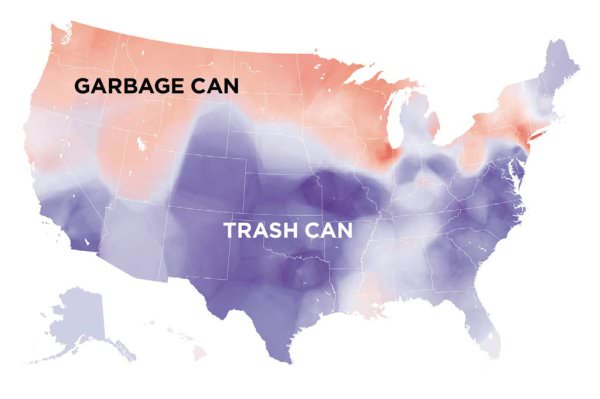
I’ve always said “garbage,” but down here in Texas they use the word “trash.” I have no idea where I found this, and I can’t verify the source, but it looks right to me.
Any contrary arguments about this map?
I’ve always said “garbage,” but down here in Texas they use the word “trash.” I have no idea where I found this, and I can’t verify the source, but it looks right to me.
Any contrary arguments about this map?
I’ve been so busy I forgot about my Tuesday column over at RealClearHistory (I have a Friday column, too). Last week’s column was about the trial and execution of two Italian-born anarchists in Massachusetts:
The anarchism of Nicola Sacco and Bartolomeo Vanzetti was left-wing and violent. Very violent. The two young men were admirers of Luigi Galleani, an Italian anarchist who advocated violence as the best way to achieve a more anarchist world. Sacco and Vanzetti, the executed, were part of an American syndicate dedicated to Galleani’s ideals. This syndicate was responsible for bombings, assassination attempts, printing and distributing bomb-making books, and even mass poisonings in the United States. The Galleanists were so violent that they sat atop a list of the federal government’s most dangerous enemies. On April 15, 1920, an armed robbery at the Slater and Morrill Shoe Company in Braintree, Mass., went awry and two men, a guard and an accountant (“paymaster”) were killed by the robbers. Sacco and Vanzetti were accused, convicted, and sentenced to death.
This week’s column focused on Shays’ Rebellion:
The Shaysites, as supporters of Daniel Shays came to be known, eventually grew to thousands of men, and the movement grew confident enough that it planned to seize a federal armory. However, the governor of Massachusetts, James Bowdoin, directed a local militia leader (William Shepard) to protect the armory. The armory, though, was federal property, and the militia was operating under state direction, so the seizure of the armory in the name of protecting it from rebels had the potential to ignite a powder keg of legal ramifications throughout the war-torn eastern seaboard.
Y’all stay sane out there!
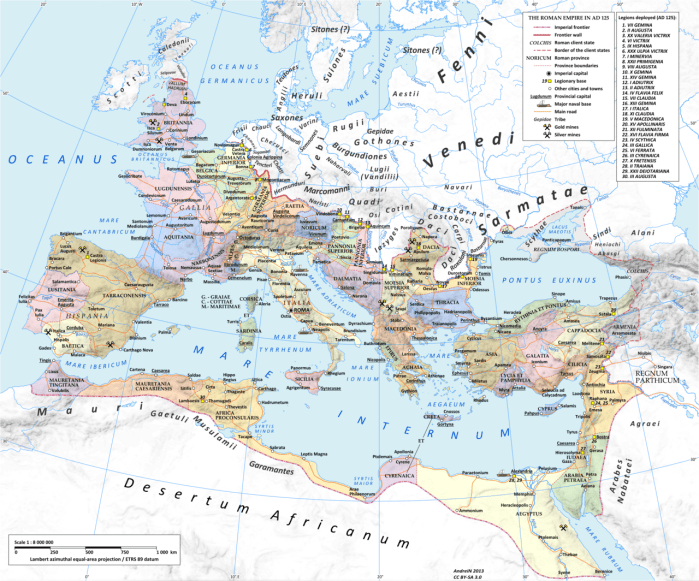
This is a beautiful map of Rome’s administrative units. There’s not much more to say, really.
Here is Barry on Roman law. Here is Mark on the Roman economy. Have a good week!
I went there. I did it. I dropped a doo-doo right in the middle of August, for all the world to see. An excerpt:
5. Shout-outs to Alexis de Tocqueville and Joseph Smith. Alexis de Tocqueville wrote the best book on America, ever. Joseph Smith founded the “American religion” (to quote Leo Tolstoy). Both men also saw that the north-south divide in the United States was bound to lead to future calamity. It wouldn’t be accurate to call their thoughts on the American divide “predictions,” but both men were outsiders in one form or another, and both men have etched their names into history. The French, who had lost Tocqueville just two years prior to the beginning of the Civil War, approach to the American bloodbath was to remain neutral (after consulting with the United Kingdom), and instead invade Mexico. Napoleon III invaded Mexico, in the name of free trade, late in 1861 and established a puppet monarchy, which angered the United States as it violated the Monroe Doctrine. However, there was not much the U.S. could do and Napoleon III did not abandon his puppet until early 1866, when it became apparent which side was victorious in the American Civil War. The French preferred normalized relations with the American republic to a puppet monarch in the Mexican one. The Mormons, for their part, largely sat out the Civil War. Volunteers from Utah helped guard the mail routes from Indian attacks, but other than that, the Mormons, who had not yet been assimilated into American society (indeed, they had only fled from violence in Missouri to Utah a few decades prior to the Civil War), were content to let both sides bleed.
Please, read the rest.
 Notes On Liberty