- 9/11: Lessons Irfan Khawaja, Policy of Truth
- Thwarting Trump, or the voters? Ross Douthat, NY Times
- The role of religion in Anglophone democracies Bruce Clark, Erasmus
- A tale of two Asia policies Zack Cooper, War on the Rocks
Author: Brandon Christensen
Nightcap
- Nationalism, Israel, and Hitler Alberto Mingardi, EconLog
- How Russia became Russia Harish Yagneshwar, Pragati
- Europe’s deep localism and populism Angelo Codevilla, Hoover
- Steve Bannon in Bosnia Krithika Varagur, NY Review of Books
Eye Candy: the states in India’s federation
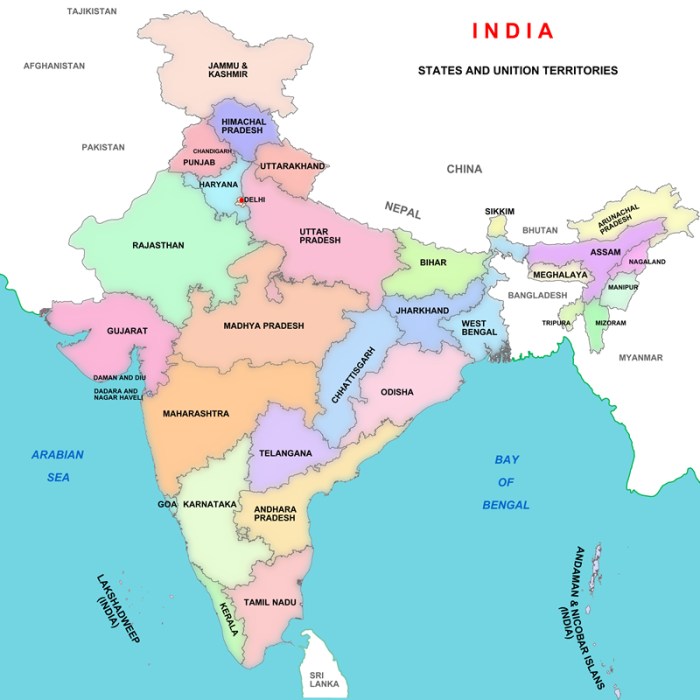
Stay tuned for more on India from a sub-state perspective. I’m going to find the GDP (PPP) per capitas of these states. I’m going to find their population densities. I’m going to find their literacy rates and their life expectancy rates. I’m going to find out much more about India over the coming 12 to 16 months.
In the meantime, here are all of NOL‘s posts from Tridivesh, a resident of New Delhi. And here are all of NOL‘s posts from Shree, a resident of New York.
Nightcap
- Why don’t Japanese and Taiwanese militaries talk to each other? Katsuya Yamamoto, National Interest
- The fraud of foreign aid Kenan Malik, Guardian
- What V. S. Naipaul taught me about posturing P. Kishore Saval, American Affairs
- India’s stealth war on liberal democracy Shikha Dalmia, the Week
Nightcap
- The Cause and Mechanisms of American De-Industrialization John Mueller, Law & Liberty
- Against moral crusades Chris Dillow, Stumbling & Mumbling
- A test with Imran Khan Nitin Pai, Pragati Express
- The De-Industrialization of the U.S.: A String of Enlightening Fallacies Jacques Delacroix, NOL
Nightcap
- Don’t say that to me Stephen Cox, Liberty Unbound
- Misconceptions about religiously radicalized women Chelsea Daymon, War on the Rocks
- Ukrainian autocephaly Bruce Clark, Erasmus
- Why liberalism’s critics fail Deirdre McCloskey, Modern Age
A shift in the Great Conversation
I was alerted to this piece in n+1, a left-wing publication, on the decline of reading and writing in Western societies thanks to the newfound power of Twitter and the prominence this power gives to the op-ed (h/t John Holbo over at Crooked Timber).
There is one really good point in an otherwise predictable piece, but first I’d like to highlight why I continue to maintain that the Left is still the reactionary ideology of our times. The editorial’s complaints about technology (Twitter) giving a voice to radical factions (right-wingers like Andrew Sullivan and the Fox News brigade) are just the same ol’ excuses served up by the Leftists of yore to censor views they don’t like. It’s ho-hum all the way down.
At any rate, here is the part that really grabbed me:
Back then, we could not have imagined feeling nostalgic for the blogosphere, a term we mocked for years until we found it charming and utopian. Blogs felt like gatherings of the like-minded, or at least the not completely random. Even those who stridently disagreed shared some basic premises and context — why else would they be spending time in the comments section of a blog that looked like 1996? Today’s internet, by contrast, is arbitrary and charmless.
I find myself in aesthetic agreement with these reactionaries, again. I’ve always found myself more drawn to the tastes of leftists than conservatives, whose tastes are often too crass for me. (A dead animal’s head on your wall? Really?) And today, I find the internet arbitrary and charmless. Op-eds, and their charmless cousin, the jargon-laden academic paper, are everywhere.
This is part of the reason why I continue to blog. I know that blogging is becoming less and less popular. I understand that clicks and traffic and attention are more important to most people who take time out of their lives to write. I get it.
The intimacy that a blog affords, though, is too good to pass up, especially for someone like me. I like reading voices from Argentina like Federico’s. I enjoy Jacques’ posts on sex and politics. (A true Frenchman, that one, no matter how hard he tries to be otherwise.) Rick, the Canadian-turned-American living in New York, always manages to bring a smile to my face. I like being able to read Michelangelo, an authentic voice from Los Angeles, the crown jewel of the American Empire.
The conversational nature of the blog is not in vogue right now, but that doesn’t mean it’s not important. Indeed, if anything, it means that the conversations that continue to play out over what’s left of the blogosphere will be far more important to far more people in far more places than the latest Twitterstorm. Twitter is an incredibly useful place for mining knowledge, but it’s worthless for shaping that knowledge into something useful and precious for today and tomorrow. Only writing can do that.
Op-eds aren’t going anywhere. There’s no use trying to delegitimize them, or ban them. You can choose to ignore them. That’s what I do. Instead of reading an op-ed, I continue to browse the blogosphere, where conversation about ideas and events remains as boisterous, and relevant, and as ever.
PS: I hope you are enjoying my “nightcaps.” The Notewriters have all reached out to me to let me know they’ve got something in the pipeline. Life gets hectic. People get busy. But writing notes on liberty will never get old.
Nightcap
- A new history of Islamic Spain Peter Gordon, Asian Review of Books
- A Palestinian perspective on Labour’s anti-Semitism row Nimer Sultany, Disorder of Things
- The crumbling of French culture Guillaume de Thieulloy, Law & Liberty
- Can Asia and Europe make America’s alliances great again? Tongfi Kim, the Diplomat
Vox on Puerto Rican statehood
Vox, a left-wing publication founded by a fellow Bruin (Ezra Klein), has a pretty good piece up on Puerto Rico’s inability to “gain statehood,” i.e. to become a full-fledged member of the American federation. I say “pretty good” instead of great because the author, Alexia Fernández Campbell, does too much Trump-bashing and not enough focusing on the issue at hand.
Look, I didn’t vote for Trump. I don’t like Trump. But the Left’s infatuation with him is unhealthy, the way the Right’s infatuation with Obama was unhealthy. When Obama was president, I wanted so badly to rely on the right-leaning press for excellent opposition coverage of the Obama administration but, with few exceptions, all I got was garbage. The experience jaded me, and I expect less of the press, so the Left’s inability to look at the Trump administration’s many wrongdoings with clear-eyed sobriety is annoying rather than disheartening.
For instance, Campbell points out many problems facing the pro-statehood faction in Puerto Rico: a century-old racist SCOTUS ruling, the lack of a clearly-defined process for gaining statehood, anti-statehood factions in Puerto Rico, Washington’s lack of interest in adding another state, and Donald Trump being A Very Bad Man. One of these problems doesn’t fit into Puerto Rico’s decades-long campaign to gain statehood. Can you guess which one? Annoying!
At any rate, Campbell misses one of the problems facing pro-statehood factions: Puerto Rico would be a “blue” state (overseas readers: “blue state” means a reliable vote for the Democratic Party). If Puerto Rico really wants to become a member of the American federation, its policymakers would do well to start looking for a “red” state (reliable vote for the Republican Party) lobbying partner.
Nightcap
- Examining the state of German identity Sebastian Hammelehle, Der Spiegel
- Tadao’s war memory manga Ryan Holmberg, NY Review of Books
- The Buddhist monk who became an apostle for sexual freedom Donald Lopez, Aeon
- Denmark’s most innovative city Simon Willis, 1843
RCH: the Peace of Paris (1783)
My latest at RealClearHistory is up. An excerpt:
The Americans did not like this proposal one bit, and they went around the French and their Spanish allies and negotiated a separate treaty with the British, who were all too happy to give up some land in exchange for sticking a thumb in France’s eye. The French foreign minister at the time of the treaty negotiations, Charles Gravier, Count of Vergennes, bitterly complained that “the English buy peace rather than make it.” London also anticipated a rapprochement between itself and its now-former colonies, and a favorable treaty with the rebels would buy the British some much-needed diplomatic capital down the road. The American diplomats who negotiated such a generous truce were led by Benjamin Franklin, John Jay, and John Adams.
Please, read the rest.
LARB can’t figure out why South Korea’s government is so bad at marketing campaigns
Colin Marshall is a blogger for the Los Angeles Review of Books (LARB), a great publication that has featured NOL‘s own Barry Stocker before. Marshall is puzzled by the fact that Seoul’s best marketing comes from independent filmmakers rather than the South Korean government. I guess I shouldn’t say “puzzled” because Marshall has a theory as to what is to blame, but I thought the piece was interesting because it highlights so well why libertarianism is so important.
Here is a link to Marshall’s piece. It is filled with lamentations about the Korean government’s inability to produce good marketing for the country. Instead of going for the jugular, though, and pointing out that incentives matter, here is where Marshall pins the blame:
I often wonder whether the problem has to do with the difficulty Koreans have in seeing Korea clearly, at least when looking for its good points; when dwelling on the negative, they suffer from no such lack of perceptual acumen. Many an acquaintance here has asked me, indeed insisted I reveal to them, what displeases me about Korea. For years I didn’t have a straight answer, but then I realized that nothing bothers me quite so much as Korea’s culture of complaint itself.
Got that? Marshall is wondering aloud (blaming) Korean culture for the bland marketing campaigns of the Korean government, even though he recognizes the brilliant marketing campaign of the independent filmmaker in the beginning of his piece. Not only does he blame Koreans for a problem that affects all governments, he attacks the “culture of complaint” that Koreans are well-known for.
Complaining, critiquing, one’s culture is a necessary component for a free and open society (Chhay Lin wrote about this at NOL awhile back, regarding Cambodia).
Am I engaging in bad faith here? Is Marshall really that ignorant of markets and alternative orders that he fails to understand why the Korean government cannot produce anything creative? Is Marshall so stupefied by the predictable failure of the Korean government to produce anything creative that he would stoop to insulting his hosts? Help me out here, folks.
Nightcap
- ISIS never went away in Iraq Krishnadev Calamur, the Atlantic
- In search of “real” socialism Kristian Niemietz, CapX
- Localism and its trade-offs Jason Sorens, Law & Liberty
- Latin America’s greatest storyteller Thomas Meany, Claremont Review of Books
RCH: 10 rivalries that shaped world history
My weekend column for RealClearHistory, in case you missed it, was fun to write. An excerpt:
4. The Mughals versus the Persians (1600s -1739). The Mughal Empire, an Indian polity that ruled over much of the subcontinent, fought three wars against two Persian dynasties (Safavids and Afsharids) and lost all of them. Much of the fighting was done around the city of Kandahar, in what is now Afghanistan. Kandahar was for a long time an important fortress for empires and dynasties that lorded over both Persia and India. While the Mughals had their pride stung by the losses, they could at least find solace in the fact their realm was the most economically successful on the planet at the time. India and Iran have long been weary regional rivals and sometime allies, but geographic distance and terrain have made outright wars between the two civilizations rare and limited. The rivalry between Iran and India has been a cultural one rather than a military one.
Read the rest (if you haven’t already!).
Nightcap
- Thinking about the Holodomor Flagg Taylor, Law & Liberty
- Neoliberalism is not dead Scott Sumner, EconLog
- Social generativity and complexity Daniel Little, Understanding Society
- We don’t need the UN to regulate baby formula Ryan McMaken, Mises Wire
 Notes On Liberty