- The conversations that cryptocurrency kills Sonya Mann, Jacobite
- How and why the 1st Amendment became a weapon for the right Jedediah Purdy, the Nation
- Are libertarians crazy? Pierre Lemieux, EconLog
- As Venezuelans starve, Maduro gives oil away to Cuba Jorge Carrasco, CapX
Author: Brandon Christensen
RCH: 10 corporations that gave capitalism a bad name
That’s the subject of my weekend column over at RealClearHistory. An excerpt:
5. Dutch East India (1602-1799). The VOC, as the Dutch East India Company was known, exemplified corporate plunder and colonial oppression in the 17th and 18th centuries. Its demise was only met after Napoleon’s revolutionary armies conquered the Netherlands, and for nearly 200 years the VOC brutally oppressed and exploited Asian lands in the name of monopoly and Dutch interests of state. The VOC was created to give the Netherlands a presence in the burgeoning world of global trade that had been started by Spain and Portugal after the former’s colonization efforts in the New World. The VOC wanted to cut off Spain and Portugal (and, later, the U.K., France, and U.S.) from world trade, and monopolize industries in order to benefit Dutch society. This logic led directly to not only the horrible things that happened in VOC-governed territory, but also to the corruption and unnecessary wars that happened in the Netherlands.
Please, read the rest.
Nightcap
- How a Huguenot philosopher realised that atheists could be virtuous Michael Hickson, Aeon
- Christian Pentecostalism has crept to the center of public life in Nigeria Ebenezer Obadare, Africa is a Country
- Last words about Nancy MacLean’s attack on James Buchanan Henry Farrell, Crooked Timber
- Are tariffs a big threat to China? Scott Sumner, EconLog
Nightcap
- Meet “Ninja,” electronic gaming’s first big star Elaine Teng, ESPN
- India’s response to China’s rise TV Paul, War on the Rocks
- The Dutch in Java Jenny Watson, Berfrois
- Nancy MacLean’s bad faith is getting tiresome Steven Teles, Niskanen
Nightcap
- How Buddha became a popular Christian saint Blake Smith, America
- Russia, Germany at loggerheads over Idlib Yekaterina Chulkovskaya, Al-Monitor
- Arab melancholia Thomas Patier, Los Angeles Review of Books
- Does Locke’s entanglement with slavery undermine his philosophy? Holly Brewer, Aeon
Nightcap
- On “Madison’s nightmare” Ilya Somin, Volokh Conspiracy
- Good parenting versus good citizenship Gina Schouten, Crooked Timber
- The birth of the British East India Company Francis Sempa, Asian Review of Books
- The bitterness of Adam Smith Branko Milanovic, globalinequality
Nightcap
- Identity: the lies that bind Laura Miller, Slate
- Puzzles about college Javier Hidalgo, Bleeding Heart Libertarians
- Nike is winning the culture war David French, National Review
- Oslo is dead. Long live Oslo! Martin Indyk, the Atlantic
RCH: 10 Dead Nazis You’ve Never Heard Of
Yup, dead Nazis. That’s the subject of my weekend column for RealClearHistory. An excerpt:
8. Karl Haushofer (died 1946). While it is perhaps unfair to include Haushofer in this list (he denied being a Nazi and his wife and son were, under Nazi law, considered to be “half-Jews”), his ideas about the world and how he went about promoting them are too important to leave out of the Nazi story. Haushofer became a geopolitical theorist after World War I and is credited with introducing to the German public (including the Nazis) the idea of “Lebensraum,” or “living space.” According to Haushofer, Germany could only compete with the Western powers if it had control over areas of Europe stretching from Norway to the Caspian Sea. Once the German military controlled this geographic space, the Nazis could begin exterminating the indigenous people there to make room for German colonists. Haushofer also viewed Japan as a natural ally of Germany and was instrumental in convincing the Nazis to partner up with Tokyo. One of Haushofer’s former students, Rudolf Hess, was one of Hitler’s closest confidants, and it’s unlikely that Haushofer, bitter about the terms of peace imposed on Germany by France and the U.K. after World War I, did not exploit his former student’s position as Deputy Führer. He and his wife committed suicide together in 1946. Their son had been murdered by the S.S. in April of 1945.
Please, read the rest (if you haven’t already!).
Eye Candy: France’s 50 largest islands
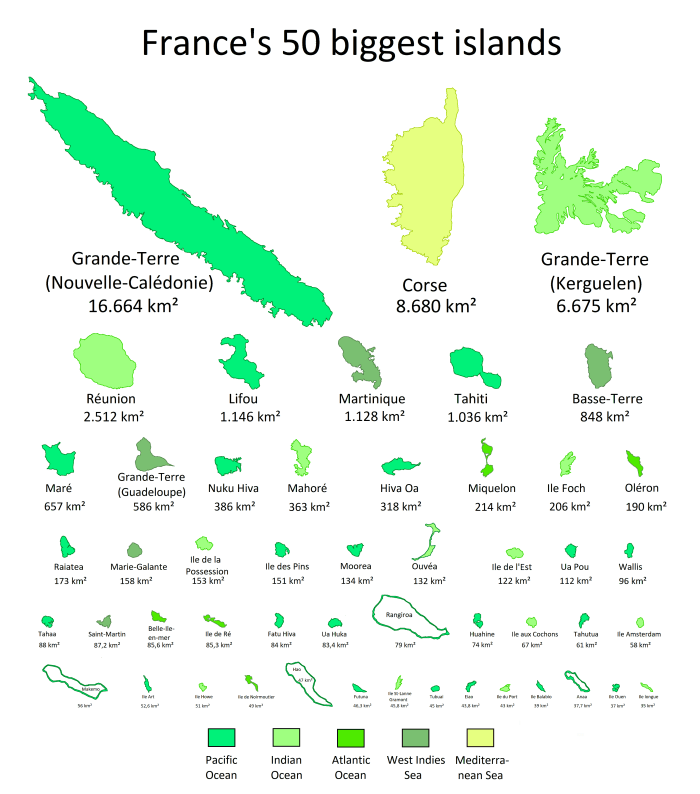
This is pretty cool. France still has an overseas presence in the Pacific, the Caribbean, the Mediterranean, the Indian and Antarctic oceans, and the Atlantic (including St. Pierre and Miquelon, an archipelago just off the coast of Newfoundland, a province of Canada). Here’s a good Wikipedia list of France’s islands. It’s in French. Translate it to English, if you must. Browse and soak it all in. Here is Jacques at NOL on all things French. And here is Vincent at NOL on all things Quebec, which is a French-speaking province in Canada.
Nightcap
- Is Heaven’s Gate really a bad movie? Rick Brownell
- You can’t go home again, America Emma Ashford, War on the Rocks
- Nostalgia and democracy Seth Cotlar, Age of Revolutions
- Aleppo after the fall Robert Worth, New York Times Magazine
Nightcap
- The Alps Rhys Griffith, History Today
- London: imploding with cool Ian Jack, NY Review of Books
- Should you start your day at 2:30 am? Bryan Lufkin, BBC
- Bringing back the Sabbath (against work) William Black, Aeon
Nightcap
- The lost cause of the confederation Michael Koplow, Ottomans and Zionists
- When Concorde was the future Stuart Nathan, 1843
- Young and Russian in DC Ben Schreckinger, Politico
- The 50-year fall of the American middle class Regina Munch, Commonweal
Nightcap
- Liberals don’t know much about conservative history Geoffrey Kabaservice, Politico
- The American right wing Arnold Kling, askblog
- In defense of endless war Christopher Hitchens, Slate
- Remembering the French war in Afghanistan Olivier Schmitt, War on the Rocks
RCH: The United States and the Middle East
My latest for RealClearHistory is all about ‘Murica and the Mideast. An excerpt:
2. The Iranian Regime. During the Cold War, the U.S. government supported a number of regimes that were illiberal in the name of fighting communism. The necessity of such tactics are beyond the scope of this article, but the Pahlavi “dynasty” of Persia was one such illiberal regime. The Pahlavis were anti-Communist and pro-Western, which meant that women could dress how they pleased and go to university, and that religion was pushed to the sidelines of political life. This made the Pahlavi’s enemies of not only the socialist reformers of Persia, but also the majority of the conservative religious clergy. One Pahlavi was ousted by a joint British-Soviet invasion in 1925, and his son was deposed in the 1979 revolution that turned Persia into Iran. After the British-Soviet invasion, the United States became heavily involved in Persia and supported the secular autocrat almost blindly, which is why the anti-Shah revolution of 1979 was also anti-American.
Please, read the rest.
Nightcap
- The criminal as entrepreneur Cedric Muhammad, American Affairs
- Did the British Empire depend on separating families? Sumit Guha, Not Even Past
- What does nationalism mean in a contested state? Daniel Solomon, New Republic
- ‘In the long run we are all dead’ Adam Tooze, London Review of Books
 Notes On Liberty