- A history of true civilisation is not one of monuments David Wengrow, Aeon
- Feminism in Saudi Arabia Lindsey Hilsum, New York Review of Books
- The artwork of proto-Surrealist JJ Grandville Patricia Mainardi, Public Domain Review
- The other protest: Gazans against Hamas Shlomi Eldar, Al-Monitor
Author: Brandon Christensen
RCH: Religion in the USSR
That’s the topic of my weekend column at RealClearHistory. An excerpt:
4. Buddhism was also outlawed and persecuted to the fullest extent of the Soviet law. Buddhism was practiced by a few different non-Russian ethnic groups in central Asia, and these small ethnic groups were given more leniency than most, but Buddhism came to be viewed by the Soviet intelligentsia as extremely dangerous, due to the fact that many left-leaning scholars abandoned socialism for Buddhist principles. The work of Andrei Znamenski, a historian of religion and ideology at the University of Memphis, is particularly useful for finding out why this happened.
Please, read the rest. Dr Znamenski, of course, blogs here on occasion, but I do wish he’d do so more often…
Nightcap
- The dark side of German reunification Marcel Fürstenau, Deutsche Welle
- Kurdish rebels join anti-Iran lobbying fray Jack Detsch, Al-Monitor
- God, Man, and the Law according to Judge Kavanaugh Mark Movsesian, Law & Liberty
- The obligation to smile Irfan Khawaja, Policy of Truth
Nightcap
- Kingdoms of Faith: A New History of Islamic Spain Nicola Clarke, History Today
- After Rushdie’s The Satanic Verses Kenan Malik, Guardian
- The labor theory of value, explained Branko Milanovic, globalinequality
- The closest exoplanet to Earth could be “highly habitable” Adam Mann, Scientific American
Nightcap
- American Indian? Bruno Cortes, Claremont Review of Books
- Italy is the new Argentina Alberto Mingardi, Politico
- The case for Kavanaugh Randy Barnett, Volokh Conspiracy
- Israel’s Russia problem is dangerous Michael Koplow, Ottomans & Zionists
RCH: law schools and Thurgood Marshall
Yesterday’s RealClearHistory article was all about law schools, with a little bit of Thurgood Marshall thrown in for good measure (he took his seat on the US’ highest court Oct 2, 1967):
If the Supreme Court’s liberal and conservative justices all come from one of two law schools, the prevailing mode of thinking about the law is going to be not only out of touch with most of the legal profession (and general populace), but also with the idea of a judicial branch dedicated to overseeing the laws of a vast, continent-spanning republic. Marshall’s supreme courts were elitist and aristocratic, which is what they were supposed to be, but what do you call a court that is so insular and so self-selecting that only two law schools are represented?
This is not a plea to lower standards in order to broaden the field, but there are a lot of good law schools in America, which is, after all, a republic governed by laws, not men. If the Kavanaugh debacle proves too much of a problem for federal politicians (Kavanaugh went to Yale’s law school), perhaps President Trump should think of looking elsewhere for a nominee.
Please, read the rest. In it, I include 3 people who would be good SCOTUS Justices. Feel free to add your own…
Nightcap
- Police tailgating as entrapment Irfan Khawaja, Policy of Truth
- The mandatory canteens of communist China Hunter Lu, Atlas Obscura
- Will Shiite militias become Iraqi Basij? Hamdi Malik, Al-Monitor
- When details matter (Brexit) Chris Dillow, Stumbling & Mumbling
Nightcap
- The fantastic truth about China Alec Ash, ChinaFile
- Civilization in the wilderness (Argentina) JN Nielsen, The View from Oregon
- Giving psychiatry another look Pierre Joseph, Aeon
- Immigration and the Commerce Clause Ilya Somin, Cato Unbound
Eye Candy: Gay marriage in Europe (2018)
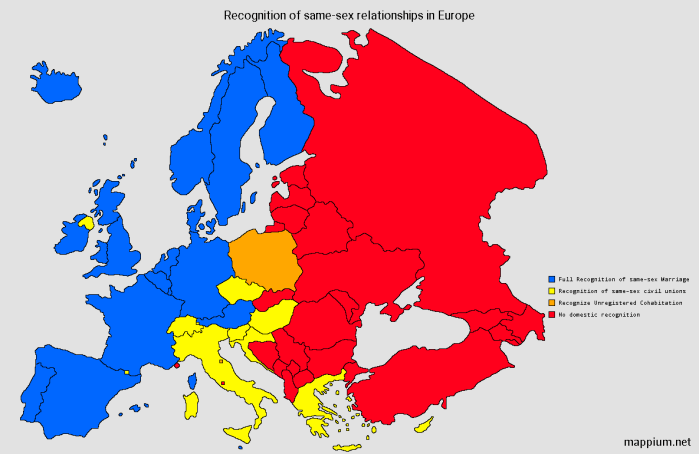
Opponents of gay marriage might have trouble explaining this one, at least in the free world.
Too many shadows whispering voices. Faces on posters too many choices. If when why what how much have you got…
Nightcap
- A nationalism untethered to history Mark Koyama, Liberal Currents
- The virtue of nationalism? Alberto Mingardi, Cato Journal
- America desperately needs a healthy conservatism Andrew Sullivan, Daily Intelligencer
- After racism, the Left struggles to find a new menace Robert Merry, American Conservative
Nightcap
- The Tlatelolco massacre of 1968 Lorna Scott Fox, Times Literary Supplement
- Western Civilization “not welcome” in Australia Bella d’Abrera, Quillette
- Umber: The color of debauchery Kelly Grovier, BBC
- An interview with VS Naipaul Patrick Marnham, Literary Review
RCH: 10 most divisive Supreme Court justices in American history
It turns out that SCOTUS appointments have had a long history of dividing American society. An excerpt:
9. Roger Taney (1836-64). Taney rose up the political ranks as Andrew Jackson’s right-hand man. Jackson tried to get him on the Supreme Court in 1835 but his nomination was rejected by anti-Jacksonian Whigs in the Senate. After the Whigs were swept away in the 1836 election campaign, Jackson renominated Taney, but this time for the position of Chief Justice, and he was confirmed 21-15 after a bitter debate in the Senate. The Taney court is responsible for the Dred Scott case that tore the fledgling republic apart, and for helping Jackson abolish the national bank. Taney and Lincoln clashed often, too, as Taney ruled that Lincoln’s suspension of habeas corpus was unconstitutional, but Taney never did go home during the Civil War and served out his term as Chief Justice until his death in 1864. He holds the second-longest tenure of any Chief Justice.
Please, read the rest, and try to remember: this divisiveness is a feature of the system, not a bug.
Nightcap
- Legendary fart battles in the Samurai Era Richard Farrell, Vintage News
- The other side of Weimar (Germany) art David Bennun, 1843
- India’s ingenuous approach to life Christian Koch, BBC
- Revisiting the American Century Ronald Radosh, Claremont Review of Books
Nightcap
- Neoliberalism is making the world much more equal Scott Sumner, EconLog
- How effective are Islamic states at satisfying the religious needs of their citizens? Nile Green, Los Angeles Review of Books
- Socialism won’t get rid of bosses, either Christopher Freiman, Bleeding Heart Libertarians
- Hayekian communism Branko Milanovic, globalinequality
Nightcap
- Understanding Homo Economicus in Deeper Terms Garreth Bloor, Law & Liberty
- The Homo Economicus is “The Body” of the Agent Federico Sosa Valle, NOL
- Worker ownership: threat or promise? Chris Dillow, Stumbling & Mumbling
- Flower Fires Setsuko Adachi, Berfrois

