- Notes on Frantz Fanon Branko Milanovic, globalinequality
- Why some countries come together and others fall apart Andreas Wimmer, Aeon
- Ethiopia is already “the China of Africa” Tyler Cowen, Bloomberg View
- Israel and the parable of Samson the Weakling Michael Koplow, Ottomans and Zionists
Month: May 2018
On “strawmanning” some people and inequality
For some years now, I have been interested in the topic of inequality. One of the angles that I have pursued is a purely empirical one in which I attempt to improvement measurements. This angle has yielded two papers (one of which is still in progress while the other is still in want of a home) that reconsider the shape of the U-curve of income inequality in the United States since circa 1900.
The other angle that I have pursued is more theoretical and is a spawn of the work of Gordon Tullock on income redistribution. That line of research makes a simple point: there are some inequalities that are, in normative terms, worrisome while others are not. The income inequality stemming from the career choices of a benedictine monk and a hedge fund banker are not worrisome. The income inequality stemming from being a prisoner of one’s birth or from rent-seekers shaping rules in their favor is worrisome. Moreover, some interventions meant to remedy inequalities might actually make things worse in the long-run (some articles even find that taxing income for the sake of redistribution may increase inequality if certain conditions are present – see here). I have two articles on this (one forthcoming, the other already published) and a paper still in progress (with Rosolino Candela), but they are merely an extension of the aforementioned Gordon Tullock and some other economists like Randall Holcombe, William Watson and Vito Tanzi. After all, the point that a “first, do no harm” policy to inequality might be more productive is not novel (all that it needs is a deep exploration and a robust exposition).
Notice that there is an implicit assumption in this line of research: inequality is a topic worth studying. This is why I am annoyed by statements like those that Gabriel Zucman made to ProMarket. When asked if he was getting pushback for his research on inequality (which is novel and very important), Zucman answers the following:
Of course, yes. I get pushback, let’s say not as much on the substance oftentimes as on the approach. Some people in economics feel that economics should be only about efficiency, and that talking about distributional issues and inequality is not what economists should be doing, that it’s something that politicians should be doing.
This is “strawmanning“. There is no economist who thinks inequality is not a worthwhile topic. Literally none. True, economists may have waned in their interest towards the topic for some years but it never became a secondary topic. Major articles were published in major journals throughout the 1990s (which is often identified as a low point in the literature) – most of them groundbreaking enough to propel the topic forward a mere decade later. This should not be surprising given the heavy ideological and normative ramifications of studying inequality. The topic is so important to all social sciences that no one disregards it. As such, who are these “some people” that Zucman alludes too?
I assume that “some people” are strawmen substitutes for those who, while agreeing that inequality is an important topic, disagree with the policy prescriptions and the normative implications that Zucman draws from his work. The group most “hostile” to the arguments of Zucman (and others such as Piketty, Saez, Atkinson and Stiglitz) is the one that stems from the public choice tradition. Yet, economists in the public-choice tradition probably give distributional issues a more central role in their research than Zucman does. They care about institutional arrangements and the rules of the game in determining outcomes. The very concept of rent-seeking, so essential to public choice theory, relates to how distributional coalitions can emerge to shape the rules of the game in a way that redistribute wealth from X to Y in ways that are socially counterproductive. As such, rent-seeking is essentially a concept that relates to distributional issues in a way that is intimately related to efficiency.
The argument by Zucman to bolster his own claim is one of the reason why I am cynical towards the times we live in. It denotes a certain tribalism that demonizes the “other side” in order to avoid engaging in them. That tribalism, I believe (but I may be wrong), is more prevalent than in the not-so-distant past. Strawmanning only makes the problem worse.
On Household Size and Economic Convergence
A few days ago, one of my papers was accepted for publication at the Scottish Journal of Political Economy (working paper version here). Co-authored with Vadim Kufenko and Klaus Prettner, this paper makes a simple point which I think should be heeded by economists: household size matter. To be fair, economists are aware of this when they study inequality or poverty. After all, the point is pretty straightforward: larger households command economies of scale so that each dollar goes further than in smaller households. As such, adjustments are necessary to make households comparable.
Yet, economists seem to forget it when times come to consider paths of economic growth and convergence across countries. In the paper, we try to remedy this flaw. We do so because there was a wide heterogeneity of household size throughout history – even within more homogeneous clubs such as the countries composing the OECD. If we admit, as the economists who study poverty and inequality do, that income per person adjusted for household size is preferable to income per person, then we must recognize that our figures of income per capita will misstate the actual differences between countries. In addition, if households grew homogeneously smaller over a long period of time, figures of income per capita will overstate the actual improvements in living standards. As such, we argue there is value in modifying the figures to reflect changing household sizes.
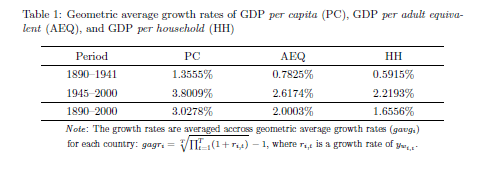
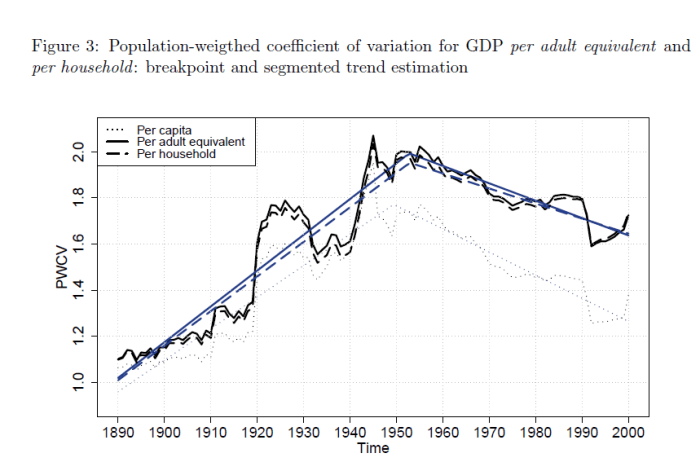
For OECD countries, we find that the adjusted income figures increased a third less than the unadjusted per capita figures (see table below). This suggests a more modest growth trend. In addition, we also find that up to the structural break in variations between countries (NDLR: divergence between OECD countries increased to around 1950) there was more divergence with the adjusted figures than with the unadjusted figures (see figure below). We also find that since the break point, there has been less convergence than previously estimated.
While the paper is presented as a note, the point is simple and suggests that those who study convergence between regions or countries should consider the role of demography more carefully in their work.
Nightcap
- The world’s first political risk consultants John Hulsman, Aeon
- Why We Should Say Yes to Drugs Andrew Sullivan, Daily Intelligencer
- A primer on fentanyl(s) Mark Kleiman, Reality-Based Community
- Moral responsibility Scott Sumner, EconLog
Fogel on economics and ideology
Many, upon reading the conclusions of economists, believe that economics has an ideological bent. I often respond that this is not the case. True, the “window” of political opinions in economics is narrower but that is largely because the adhesion of economists to methodological individualism precludes certain ideological views that rest on holistic approaches or concepts. However, when you consider more complex situations than “party affiliation”, you will find economists all over the place. They will often cross ideological lines or even have a foot in two antagonistic camps.
Recently, I was reading Robert Fogel’s lectures on the “Slavery debates” which retells the intellectual history of American slavery from U.B. Phillips to … well … Fogel himself. One must remember that Fogel was, and remained from what I can tell, a quite strongly left-leaning economist for most of his life (see here). As such, it is hard to consider Fogel as an ideologue preaching for free market economics. Yet, in the lectures, Fogel (p.19) makes a point that supports the contention that I often make regarding economists and ideology that I believe must be shared:
The ability to view Phillips (NDLR: the dominant interpretation of slavery pre-1960) in a new light was facilitated by the sudden intrusion of a large corps of economists into the slavery debates during the 1960s. This intrusion was welcomed by neither the defenders of the Phillips tradition nor the neoabolitionist school led by Stampp (NDLR: Kenneth Stampp, author of The Peculiar Institution). The cliometricians, as they were called, refused to be bound by the established rules of engagement, and they blithely crossed ideological wires in a manner that perplexed and exasperated traditional historians on both sides of the ideological divide.
Given that the source of this quotation is Fogel, I admit that I am particularly fond of this passage. Maybe the distrust towards economists is because economists can be both friend and foes to established interlocutors in a given discussion.
The State in education – Part II: Social Warfare
In the article The State in education – Part I: A History, we examined Friedrich Nietzsche’s opinion of the Prussian public school system and his concern when it became the model framework for public schools, both in Germany and in the world. To summarize quickly, the philosopher held that state-funded schooling was an act of social warfare – students, taught to aspire beyond their capabilities, would become resentful and angry, making them susceptible to propaganda and manipulation. Although Nietzsche did not use the term “welfare state” in the educational context, his predicated his denouncement of public education on the idea that it was a form of welfarism and increased state control.
For historical placement, it is important to understand what resources existed for parents pre-public schools. More importantly, it is also important to understand the difference in curricula and their final goals. Before the late 18thcentury, Jean Jacques Rousseau, and the advent of educational “experts,” there were only privately funded schools – many of which were free to those in need – which provided a classical education.
There are two definitions, both equally correct, of “classical education.” The first literally signifies an education based on Latin and Ancient Greek and all the literature in those languages; associated with this definition are skills in music, art, drama, declamation, oratory, and debate, all of which the Romans considered essential to a well-rounded education and which they included as formal subjects in their schools. By the early 19thcentury, this education also carried the expectation that the student could easily acquire most modern European languages since to varying degrees they were all based on the classical languages.
The second definition of “classical education” focuses on the acquisition of a mental toolkit with the goal of enabling the student to think deeply and carefully throughout his life. This system is divided into the trivium and the quadrivium, roughly corresponding to the primary and secondary school levels of the modern system.
As Dr. Peter Lynch of University of Dublin explained,
The organisation of the quadrivium was formalised by Boethius, and this structure endured for more than a millennium. It was the mainstay of the medieval monastic system of education, which had a structure of seven subjects – the seven liberal arts – comprising the quadrivium and the trivium. The trivium was centered on three arts of language: grammar, for ensuring proper structure of language; logic, for arriving at the truth; and rhetoric, for the beautiful use of language. Thus the aim of the trivium was goodness, truth, and beauty.
Dorothy L. Sayers (1893 – 1957), an Oxonian classicist and author, explained in her 1947 essay “The Lost Tools of Learning” that the trivium is the more crucial of the two since it provides all the skills needed to be an independent thinker and learner. In her essay, she also detailed a scheme whereby the modern institutional schools could implement the trivium in place of contemporary curricula. She recognized, though, the unfortunate tendency of 20thcentury society to prefer for “education” to have a concrete banality, with parents focusing on what their children could “do” with a subject.
The quadrivium, though elucidated by Boethius (480 – 524 AD), was based on the writings of the philosopher Proclus (412 – 484 BC), whom the Renaissance men and women relied upon when they incorporated the quadrivium into formal education. The subjects of the quadrivium are: arithmetic, music, geometry, and cosmology (sometimes listed as astronomy). As Dr. Lynch noted, mathematician Morris Klein described these subjects as “pure,” studying as they do, the abstract and the relationship between the concrete and the metaphysical. In philosophical terms, the trivium is aristotelian and the quadrivium is platonic.
Before turning to the subject of Nietzsche’s Cassandra-like predictions and the loss of classical learning in America, we must briefly look at the history of institutional education since it is the primary component of the American version. As Dr. Lynch remarked, the classical education remained alive in the European Catholic monasteries and convents, which acted as an early form of boarding school.
The schools associated with religious houses were open to all, regardless of rank or income, and did not necessitate a commitment to religious life at the end. That said, it was primarily the nobility who took advantage of the monastic and convent schools, more, in all honesty, because the principle of religious sanctuary meant that the children were secure from predation in times of unrest than from any love of learning. Although there was no prestige associated with this type of education, under these conditions, it became a noble prerogative but not necessarily ennobling in itself. Despite aristocratic mamas and papas seeing education as much less important than sanctuary, the result of this symbiotic relationship was that the upper classes really were better educated than the middle and lower ones, laying the foundation for the educational class war that Nietzsche identified in the 1800s.
Let us fast forward past the Renaissance, the Reformation, and the Enlightenment, all of which had profound effects on education, though always within the classical framework, and look at the roots of American public education. The concept of publicly funded education occupied Thomas Jefferson, who initially supported it unilaterally, then opposed it, then compromised (Hegel would be proud) by suggesting that grammar schools might be locally funded and universal but anything beyond that had to be either private or competitive entry, if publicly funded. In general, the Founding Fathers took a laissez-faire view on education, focusing on the aspects of freedom and personal choice. This truly enlightened attitude did not last.
By the 1830s, progressives, including Horace Mann, fell under the spell of the Prussian system. In the 1840s, Mann used his position as Secretary of the (Massachusetts) Board of Education to introduce public schooling. Post-Civil War, in the 1860s, he used his position as a US Congressman to make public schooling compulsory, while homeschooling his own children in a stunning display of “for thee but not for me” hypocrisy. In 1848, as Secretary of the nascent Board of Education, Mann opened his report with these words:
According to the European theory, men are divided into classes, – some to toil, others to seize and enjoy. According to the Massachusetts theory, all are to have an equal chance for earning, and equal security in the enjoyment of what they earn. The latter tends to equality of condition; the former, to the grossest of inequalities. Tried by any Christian standard of morals, or even by any of the better sort of heathen standards, can any one hesitate, for a moment in declaring which of the two will produce the greater amount of human welfare, and which, therefore, is more conformable to the divine will? The European theory is blind to what constitutes the highest glory as well as the highest duty of a State …
The truth is that Mann openly declared that the public school’s purpose is to render control to the state. The awful truth is neatly dressed in a virtue signaling garb that makes reference to religion and God (I challenge anyone to find a single passage in the Bible where God says “go build a public school.”). Buried in this paragraph is one of the major fallacies that afflicts contemporary American society: linking formal education to earning power and social worth. This particular problem we will address in a subsequent article, but it is important to know that promoting this fallacy was a crucial part of the mandate of state-run education.
At the same time as Mann was advocating mass education and social equalization on one side of the Atlantic, on the other side, Nietzsche exposed its flaws:
Let me tell you what I think characterizes the vital and pressing educational and pedagogical questions of today. It seems to me that we need to distinguish between two dominant tendencies in our educational institutions, apparently opposed but equally ruinous in effect and eventually converging in their end results. The first is the drive for the greatest possible expansionand disseminationof education; the other is the drive for the narrowingand weakening of education. For various reasons, education is supposed to reach the widest possible circle – such is the demand of the first tendency. But then the second tendency expects education to give up its own highest, noblest, loftiest claims and content itself with serving some other form of life, for instance, the state (Anti-Education, Lecture I).
The conflation that most concerned Nietzsche was that mass literacy did not equal mass education since the connection between reading and thinking was lost. For him, nothing epitomized this more than newspapers and journalism – “Journalism fulfills its task according to its nature and as its name suggests: as day labour.” Everyone learning to pretend to the laurels of the literate, through simply being able to decipher words on a page, created a societal need for professional intellectual caulkers:
It is in journalism that the two tendencies converge: education’s expansion and its narrowing. The daily newspaper has effectively replaced education, and anyone who still lays claim to culture or education, even a scholar, typically relies on a sticky layer of journalism – a substance as sturdy and permanent as the paper it’s printed on – to grout the gaps between every form of life, every social position, every art, every science, every field. The newspaper epitomizes the goal of today’s education, just as the journalist, servant of the present moment, has taken the place of genius, our salvation from the moment and leader for the ages.
Systemic education was the death of the Renaissance man. It created a strange world where everyone could read but no one was learned. This intellectual world is the United States today.
After Mann forced compulsory education on the American people, the literacy rate, previously rising, declined, an event which occurred in Europe as well when Great Britain and France followed Germany’s lead. When angry parents, appalled at the poor quality of the new “free” education, withdrew their children to place them in private schools, Mann launched a media war against them, branding them un-American elitists and/or social malingerers and starting a social shouting match that continues to the present. Discovering that parents, naturally, disregarded name-calling when their children’s future was at stake, the progressives brought the state apparatus in the form of taxation to bear.
Today, the United States ranks in the middle percentiles in education internationally. The nation is behind all of east Asia, even very poor countries like Vietnam, and most of Europe, including poor Eastern European countries. According to the report, over 40% of American high school seniors rate “below basic” for science and mathematics, which by extension indicates an inability to read and reason adequately (both subjects are more tests of those two skills than anything else at that level). Yet the nation houses the greatest number of elite universities and institutions of higher education in the world. The American people have known since the early 20thcentury that public school graduates could not enter these institutions and thrive – Sinclair Lewis’ book Babbitt describes beautifully the dichotomy existing between 1920s middle-America and the push for an elite education – yet only now has the public decided that this is a problem, but only on superficial grounds. No one is interested in discussing the foundational flaws that result in American students lagging behind their European and Asian counterparts.
We are aware through personal experience that the skills of the seven liberal arts of the trivium and quadrivium are gone. We can cry in vain after the American reading public, which, before the advent of public schools and their version of literacy, created one of the first best seller phenomena with James Fenimore Cooper and later devoured the works of Edgar Allen Poe – during his life writing high literature was lucrative. Just as extinct is the British public that devoured Jane Austen with such an insatiable hunger that she could not keep up. The people whose appetite induced Charles Dickens to exploit it with publishing deals that paid him by the word are gone; for that matter, the ability of the reading public to recognize and delight in Dickens’ colorful language and skillful use of words is moribund – alas the trivium! The rage for reading and, by extension, autodidacticism in Britain reached such a pitch that, in the words of a Mises Institute commentator,“England eventually passed a paper tax [raising the cost of books] to quell a public the leaders felt was too smart.” A public too interested in books is not a contemporary problem.
In his inaugural speech, President Donald Trump described the public school system as having “failed so many of our beautiful young people.” In context, the sentence implied that the public school is supposed to turn out competitive, educated smart people. There is a question to this statement, though: Is it really a failure if a system cannot accomplish that which it was never designed to do? On the contrary, if one takes Mann’s opening report as a plan of action, the American public school has succeeded fantastically. Now everyone is equal in mediocrity and lack of knowledge. One of its missions has not been achieved: forcible creation of a classless society. We will examine the causes of this failure next since it relates to Nietzsche’s predictions of unhappiness for those who believed in state-mandated educational equality.
Serey: a Cambodian blockchain-based social media platform inspired by Friedrich Hayek’s theory of dispersed knowledge

Serey is a new Social Media platform that specifically targets the Cambodian market. The country that saw nearly a quarter of the population decimated during the civil war of the 60’s and 70’s, the Khmer rouge regime, and the subsequent famine, has gone through rapid economic developments in the past two decades due to its friendliness to free markets. Accompanying this development is the adoption of new information technologies. One such technology is blockchain.
The team behind Serey has now created a blockchain-based social media platform called Serey. It rewards content creators, such as writers, for their creativity. The platform now has 400-500 users who all contribute by writing content ranging from short fictional stories to history, philosophy, and technology. Users can post any content they want. There is no central authority that can censor the posts in any way. The system is based on a democratic voting system in which every user can vote on articles. Dependent on the votes, the content creators are rewarded with the platform’s native cryptocurrency called Serey coin (SRY).
What does Serey stand for?
The name of the platform, Serey (សេរី in Khmer), is derived from the Khmer word seripheap (សេរីភាព) which stands for liberty or freedom. The platform is built on the philosophy of liberty and is inspired by Friedrich Hayek’s theory of dispersed knowledge. Realizing that every individual knows just a fraction of what is collectively known and that our collective knowledge is therefore decentralized, Serey is looking to encourage the sharing of the unique information that individuals possess through the Serey platform. It wants to create an open platform where everyone is free to enter, to exercise their creativity without fear of being coerced into silence or conformity, and to engage in thoughtful, civilized discussions.
There was no such online platform in Cambodia yet. Cambodia, at this moment, also doesn’t have a culture of reading and writing. Serey is aiming to transform this so there is also an educational component to it.

The mission statement of Serey is as follows:
“Rewarding self-expression and creativity.”
Why is Serey run on a blockchain?
The Serey blockchain allows the storage of content – actually only the actual text of the article and no pictures or videos to keep block sizes minimal – in a distributed manner. Anything written on Serey is stored on a blockchain that is shared among many other servers, called witnesses, that run an exact copy of the blockchain. This makes all content tamper-proof and censorship nearly impossible. This is in line with Serey’s belief that everyone should have the right to free expression.
In addition, a blockchain serves the people’s right to keep the fruits of their labour. Serey cannot take away any of its users Serey coins. All earnings are rightfully theirs and they can spend it in any way they want.
What are the features of Serey?
Serey is principally a fork of Steemit – another social media platform on the blockchain – and therefore essentially makes use of the Graphene technology that also powers Steemit and Bitshares. However, whereas Steemit is trying to create a one-size-fit-all approach with their platform, Serey is entirely dedicated to the people of Cambodia. They believe that regional differences require different user interfaces and functionalities that match the people’s cultural makeup and level of sophistication with blockchain technology.
Compared to Steemit, Serey has a different layout, a market place section, a Khmer language option, an free advertisement section, and a simplified reward system.

In addition, the Serey Decentralized Exchange is currently being built in cooperation with developers close to Steemit and Bitshares. It will be a full-fledged decentralized exchange that is accessible by anyone, anywhere in the world. Users will then be able to trade Serey coins (SRY) among 15-20 other cryptocurrencies such as Bitcoin, Ethereum, Dash, Bitshares etc.
Other features that Serey users can look forward to in the next six months are an online betting system, improvements of the market place section, an integrated chat feature similar to that of Messenger, and a mobile app.
If you are interested in Serey, please feel free to visit the website and to register for free. Most articles are written in Khmer, but English articles are welcome as well.
Nightcap
- Thoughts on Strauss and Machiavelli Jerry Weinberger, Law & Liberty
- Rationalism, rationality & reasonableness Chris Dillow, Stumbling and Mumbling
- Dialogue with the Public and Academic Snobbery Carole McGranahan, Savage Minds
- 1983: the year the world nearly ended Julie McDowall, Spectator
ICE as Education Planners
Yale recently reclassified economics as a STEM (science, technology, engineering, and math), and other schools may follow suit. It’s a public-spirited regulatory arbitrage–by reclassifying to “Econometric and Quantitative Economics” they make it easier for international students to continue working in the U.S. after graduation. But by capitulating to regulatory nonsense, they’re sacrificing the long-run vitality of the field.
Here’s how this whole classification thing works: Immigration and Customs Enforcement (ICE) has a “STEM Designated Degree Program List” that specifies which programs on the Department of Education’s list of degree programs qualify as STEM. Students with degrees in these fields get special status as far as immigration. ICE’s list includes (among others) several psychology programs and three social science programs: Archaeology; Cyber/Computer Forensics and Counterterrorism; and Econometrics and Quantitative Economics.
What can we infer from this? That the feds are defining STEM narrowly, with a greater emphasis on engineering than science. STEM is about training people to do science-y work with practical applications. Basic research gets lip service, but only really matters so far as it’s likely to have clear applications in the future.
Economics has some parts that fit into such a view of STEM. Even I’ll admit (controversially for Austrians and Anarcho-Capitalists) that positive-sum social engineering a) is possible (in modest increments), and b) has something to learn from economics. But to include all of econ in STEM would require using a broader definition of STEM.
So what’s the upshot? High profile departments will focus more on a narrower part of economics pushing much of the field to the periphery. This is a retreat into more isolated academic silos. “Economics, general” leaves a vague space around a department, but taking a more specific designation means they can be held to more specific expectations. It might have little impact on the day-to-day life of a department, but in the long run they’re hamstringing themselves.
The problem these departments are trying to address is that ICE has too much power. But by playing this game they’re letting ICE play central planner in the education industry!
More on the Turkish Elections
This is a sequel to my recent post Turkish Elections: Some Hope, so is best read after reading its predecessor.
In the last post, I covered the National Assembly elections on the 24th June. The first round of the presidential elections will take place on the same day and there will be a run-off between the two main candidates on the 8th July, if no candidate gets more than 50% on the first round.
As by far the strongest personality in Turkish politics over the last 15 years, Recep Tayyıp Erdoğan was no doubt expecting to win in the first round easily. He did so in 2014 when he was first elected to the presidency at a time when the president’s powers were much smaller. The two largest opposition parties of the time (CHP and MHP) put up a joint presidential candidate little known to the public and who did become much better known during the campaign. The campaign was in fact a surrender to Erdoğan who went on to ignore the constitutional limits on the presidency and push through plans for a presidential republic with little of the checks and balances known in other presidential republics, at least those in established democracies.
This presidential campaign has been an unpleasant surprise for Erdoğan. He has turned the MHP into a satellite party which supports him for the presidency. The cost of that, however, is that he has tied himself to a declining party in an attempt to compensate for a weakening of AKP (Erdoğan’s party) support since the days when it got 50% and over of the electorate.
The opposition has now found an energy unprecedented during the Erdoğan-AKP years (since 2002). It has turned the first round of the presidential election into a run-off to decide who will face Erdoğan in the second round, maximising opposition strength as its candidates enthuse different sectors of Turkish society against the current regime. It now looks impossible for Erdoğan to win the first round (without the help of rigging which is a real danger).
Some thought the opposition had already failed the presidential election when Abdullah Gül, who was President before Erdoğan, declined to run as a candidate of the small opposition religious conservative party SP. The idea around was that the two main opposition parties would accept him as a joint candidate. It is not clear this would have ever happened, and anyway Gül declined to run. He had been a founder of the AKP, but has not re-joined since leaving the office of President in 2014. At that time the President was required to resign from any political party. Gül has made indirect criticisms of the AKP under Erdoğan, but is a non-confrontational politician who has not put himself in clear opposition to Erdoğan and few expected he ever would. Some had the attitude that Gül was the only chance of the opposition winning the presidential election. I was never convinced myself. Adopting an AKP politician central to the AKP’s colonisation of the state and parts of civil society, particularly the main media companies, would have been a defeatist gesture, particularly given Gül’s own lack of energy in very stark contrast with Erdoğan.
The four largest opposition parties will all run presidential candidates, though three of these parties have formed a joint list for the National Assembly elections. Two of these candidates have a real chance to win. That is Meral Akşener and Muharrem İnce. Akşener is the leader of the second opposition party, İYİ, which broke away from the MHP. It has overtaken the MHP as the largest nationalist party. Though it has a clearly nationalist orientation, mixing Atatürk republicanism with nostalgia for the Ottomans and pre-Ottoman Turkish leaders, it has a a milder version of this than the MHP. İnce is a centre-left secularist CHP politician who previously tried to replace Kemal Kılıçdaroğlu as leader of the CHP.
Kılıçdaroğlu is not a strong public personality and has often been dismissed even by CHP sympathisers. However, he did a good job of keeping the CHP relevant in the period after the coup attempt of July 2016, when Erdoğan seemed to be achieving even more complete domination of Turkish public life. Kılıçdaroglu most famously led a Justice March from Ankara to Istanbul last summer, usefully turning his anti-charisma reputation into an image of quiet decency and endurance, marching for many days under a hot Turkish sun, though he is in his late 60s and there were constant fears of state promoted violence against the march.
Kılıçdaroğlu was again dismissed as too passive at the time Gül declined to run, and Kılicdaroğlu ruled himself out of the Presidential contest. It has turned out that he has maximised his strengths and weaknesses, by showing the inner self-confidence to allow his rival İnce to run for the most powerful office in Turkey. İnce has been a great campaigner so far and is doing better than I expected.
I thought Akşener would easily be the strongest opposition candidate, and she is doing well, but is very close to İnce, both for getting through to the second round and defeating Erdoğan. The latest opinion polls suggest Erdoğan would beat both but by a very small margin, meaning that a strong campaign by İnce or Akşener could win in the end, particularly if supporters of rival parties turn out in a spirit of unity for change.
The general thinking in Turkey now is that the opposition is likely to win the National Assembly but not the Presidency. Nevertheless the presidential contest is going far better than expected for the opposition and Erdoğan could look very diminished running in the second round after the AKP-MHP electoral list loses the National Assembly (where it currently has a two-thirds majority). İnce represents the most leftist and most nationalist element of the CHP. This combination is not unusual in Turkey, though left-nationalists prefer to identify themselves through the Turkish word for patriot rather than nationalist. I thought this would be a problem for İnce, in that he might be a negative both for Kurdish and centrist voters, but he has shown a capacity to reach out and make gestures to these sectors. Since the CHP National Assembly list has reduced the number of left-nationalists, his presidency would not be the unconstrained triumph of that particular point of view.
Nightcap
- The managerial state and rule by the perfectly unjust man Nick Nielsen, The View from Oregon
- What do left-liberal abusers really think? Bryan Caplan, EconLog
- Cthulhic tendrils lubricated by oil Xenogoth
- How Robert E. Lee’s home became Arlington National Cemetery Rick Brownell, Historiat
Turkish Elections: Some Hope
What with being rather exhausted by an accumulation of projects in recent months, I have been extremely absent from Notes On Liberty. Teaching is over for the summer and I hope to make up for lost ground across a few areas, but first I must address the current situation in Turkey.
There will be early elections on 24th June for the National Assembly and the Presidency. If no candidates win an overall majority for the presidency, there will be a run off between the two leading candidates on 8th July. The National Assembly is elected through proportional representation (d’Hondt system, if you’re interested in the details). The elections were scheduled for November next year, so they are very early. The reason offered by the government is the need to complete the transition to a strongly presidential system in view of supposed administrative uncertainty interfering with government until the last stage of the constitutional change, which is triggered by the next election after last year’s constitutional referendum, and the supposed need for ‘strong’ presidential government to deal with the present situation in Syria and Iraq.
However, anyone who is not a hopelessly naive follower of regime publicity knows that the real reasons are the decline in the economy and the rise of a right-wing party opposed to the current regime, which could erode the regime’s electoral base. I use the term ‘regime’ deliberately to refer to the fusion of the AKP (dominant political power), the personalised power of President Erdoğan and the state apparatus, including the judiciary. There is no state independent of a party power which itself has become subordinate to the will of one man. The police, judiciary, and prosecution service are quite obviously biased towards the government. Civil society has not escaped the hegemonising pressure. All the main media companies are controlled by cronies of Erdoğan and the AKP. Both state media and the main commercial media present a government point of view with little coverage of the opposition. Private media companies are of course entitled to push their own opinions, but these opinions are in reality dictated by Erdoğan, with the calculated intention of excluding opposition points of view except in highly parodic and manipulated terms. The construction industry is forced to support Erdoğan in order to obtain contracts for the endless pubic projects and projects officially or de facto guaranteed by the tax payer. This instrument of political control is enhanced through endless, often grandiose projects regardless of the state of public and private debt. In this politics, interest rates are artificially low with the consequence that inflation is rising and the currency is constantly devalued in international markets.
A lot of the above will be already understood by readers, but particularly after a long break in writing I think it is important to set the scene for the elections. Whatever the AKP says in public about economic performance, officials have admitted in private that they are worried about an economic crisis before the regular date for the elections. It is also clear that the AKP hoped to keep the new right-wing party IYI (Good) out of the elections because of the complex registration process to participate in elections, amongst other things requiring registration of a minimum number of provincial branches. IYI is a break away from the well established Nationalist Action Party (MHP), and is already larger in members with more opinion poll support, so its exclusion would be particularly absurd.
The IYI Party’s problems with registration were resolved in ways that are part of the hope that does exist in this election. The main opposition party (and oldest party in Turkey), the leadership of the Republican People’s Party (CHP), which has a left-wing and secularist identity, allowed (or maybe insisted) that enough of its deputies in the National Assembly join the small group of IYI defectors from the MHP to guarantee an automatic right to electoral participation.
President Recep Tayyıp Erdoğan was only able to change the constitution to make it a very strongly presidential system, rather than a parliamentary system as it had been, because the MHP changed its position after years of critcising Erdoğan. The pretext was ‘unity’ after the attempted coup of 2016, though it was clear the whole country was against it anyway. The real reason was that the MHP has been losing support under a leader who has become unpopular and the only hope of staying in the National Assembly, given a 10% threshold, was an electoral deal with the AKP (which stands for Justice and Development Party). The election law was changed so that parties can form joint electoral lists in which voters can choose between parties in the list when voting, and the party concerned can have deputies so long as the votes within the list allow at least one to get into the National Assembly. In effect, the percentage threshold to enter the National Assembly has been reduced to less than 1%. This seemed to the AKP to be a great achievement allowing them to compensate for declining support of both AKP and MHP by joining them in one list and bringing in another small nationalist party.
However, the opposition has moved to make more use of the new rules. The CHP and IYI have formed a joint list, which also include SP (Felicity Party), a religious conservative party which has common roots with the AKP and is the sixth party in Turkey in support (about 2.5 % in recent polls). A small centre right party has candidates on the IYI list within the joint list. The Liberal Democrat Party, which is classical liberal and libertarian in orientation, but is very small, has a candidate who used to be LDP leader on the CHP list within the list. This is a bit complicated, but the success of putting this complex alliance together shows there is hope of various forces opposed to the authoritarian slide for various reasons uniting around common goals of a more restrained state, rule of law, less personalisation of power and a more consensual institutionally constrained style of government.
The other important force is HDP (People’s Democratic party), itself an alliance of small leftist groups with a Kurdish identity and leftist party which has strong support in the southeast. The HDP promotes peace in the southeast through negotiation between the state and the PKK (Kurdistan Workers’ party) armed insurgent/terrorist group. There is no organic link I can see between the HDP and the PKK, but the overlapping aims of the PKK and HDP for Kurdish autonomy and political recognition of the PKK has always made it easy to label the HDP as terrorist. It is simply not possible in these circumstances to include it in a broad opposition list, particularly given the attempts of the regime to block the HDP from any political activity: labeling it “terrorist,” arresting its leaders and many mayors leading to central government take over of HDP municipalities in the southeast. However, the opposition on current poll ratings needs the HDP to get past the 10% threshold to deprive the AKP-MHP list of a majority in the National Assembly. The main list might do it on its own, but this is less than certain. There is a risk of electoral rigging influencing the result, particularly in the southeast which is under even more authoritarian security state conditions than the rest of the country. It is therefore important for the HDP to get clearly more than 10% and to get votes from people who might otherwise vote CHP, outside the southeast to get pass any dirty tricks.
This is already long so I will stop and return to the Turkish elections soon. I hope readers have got to the end of this and have a reasonable background now for future posts.
Divergence and Convergence within Italy
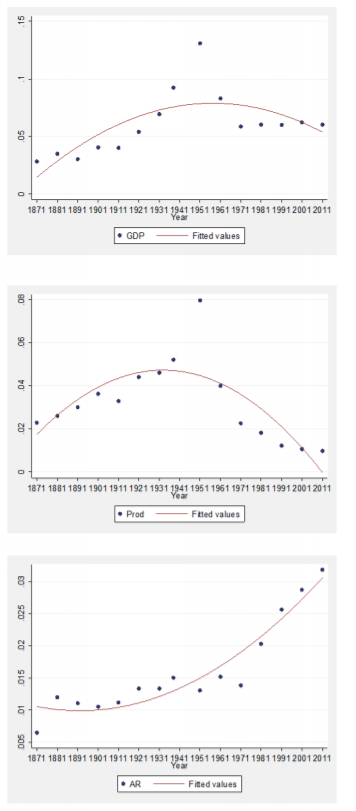
Two years, I wrote a post on this blog on the process of regional convergence in Italy. In that post, I made the observation that it seems that, economically, Italy was as fragmented at the time of the unification as it is today which made it an oddity in terms of regional convergence. To make that claim, I used this table of relatively sparsed out observations produced by Emanuele Felice: which was published in the Economic History Review: 
As one can see, there is a pronounced “lack” of integration for the Italy in terms of living standards. This is reinforced by a more “continuous” set of estimates produced, again, by Emanuele Felice (this time, its a working paper of the Bank of Italy) that now include the 1870s and go to 2011 (as opposed to 2001). This is the result, which I find fascinating. The first graph shows GDP per capita – for which there is divergence to 1951 and then a mild convergence thereafter but still well above the levels at the time of unification. More fascinating is the fact that productivity is at its most integrated since unification (2nd figure) suggesting a divergence in levels of labor activity (3rd figure). In these three graphs, you have a neat summary of Italian labor markets since 1870.
Nightcap
- Lost in translation: Native American mascots in Europe Andrew Keh, NY Times
- Zanele Muholi: The dark artist of South Africa Mark Gevisser, 1843
- Aristocrats have always been internationalist Blake Smith, Aeon
- Frayed transatlantic ties are weakening NATO Azita Raji, War on the Rocks
Jordan Peterson’s Ignorance of Postmodern Philosophy
Up until this point, I’ve avoided talking about Jordan Peterson in any serious manner. In part because I thought (and continue to hope) that he’s the intellectual version of a fad diet who will shortly become irrelevant. My general impression of him is that when he’s right, he’s saying rather banal, cliché truisms with an undeserved bombastic air of profundity, such as his assertions that there are biological differences between men and women, that many religious myths share some similar features, or that taking personal responsibility is good. When he’s wrong, he’s talking way out of the depth of his understanding in his field (like the infamous lobster comment or this bizarre nonsense). Either way, it doesn’t make for a rather good use of time or opportunity for interesting, productive discussion—especially when his galaxy-brained cult-like fanboys are ready to pounce on anyone who criticizes their dear leader.
However, since everyone seems to be as obsessed with Jordan Peterson as he is with himself, I guess it’s finally time to talk about one example of him ignorantly bloviating that particularly annoys me as a philosophy student: his comments on postmodernism. There’s a lot one can talk about with Jordan Peterson because he says almost anything that comes to his mind about any topic, but for the present purposes you can pretend that I think everything he’s ever said that isn’t about postmodern is the deepest, most insightful thing ever said by any thinker in the history of western thought. I’m not interested in defending any overarching claims about him as a thinker. At the very least, his work on personality psychology does seem rather well respected and he surely got to his prestigious academic position with some merit, though I am not qualified to really appraise it. I am, however, more prepared to talk about his rather confused comments on philosophy which might shed light on why people are generally frustrated with his overly self-confident presence as a public intellectual.
Postmodernism, According to Peterson
Peterson often makes comments about “postmodern neo-Marxism,” which he calls a “rejection of the western tradition.” Now the very phrase “postmodern neo-Marxism” strikes anyone remotely familiar with the academic literature on postmodernism and Marxism as bizarre and confused. Postmodernism is usually characterized as skepticism towards grand general theories. Marxism is a grand general theory about how class struggle and economic conditions shape the trajectory of history. Clearly, those two views are not at all compatible. As such, much of the history of twentieth century academia is a history of Marxists and postmodernists fighting and butting heads.
Many commentators have pointed out this error, but Jordan Peterson now has a response. In it he tries to offer a more refined definition of postmodernism as two primary claims and a secondary claim:
Postmodernism is essentially the claim that (1) since there are an innumerable number of ways in which the world can be interpreted and perceived (and those are tightly associated) then (2) no canonical manner of interpretation can be reliably derived.
That’s the fundamental claim. An immediate secondary claim (and this is where the Marxism emerges) is something like “since no canonical manner of interpretation can be reliably derived, all interpretation variants are best interpreted as the struggle for different forms of power.”
He then goes on to concede to the criticism that Marxism and postmodernism can’t be described as theoretically aligned, but moves the goal posts to say that they are practically aligned in politics. Further, he contends postmodernisms’ commitment to analyze power structures is just “a rehashing of the Marxist claim of eternal and primary class warfare.”
It is worth noting that this attempt at nuance is surely an improvement at Peterson’s previous comments that postmodern a Marxism are a coherent “doctrine” that just hated logic and western values. But his attempt at a “definition” is unsatisfactorily way too restrictive for every thinker who gets called “postmodern,” and the attempt to link the politics of postmodernism up with the politics of Marxism is a complete mischaracterization. Further, his attempt to “critique” this position, whatever one wants to call it, is either (at best) vague and imprecise or (at worst) utterly fails. Finally, there really is no alliance between postmodernists and Marxists. Whether or not a thinker is called a “postmodernist” or not is not a very good predictor of their political views.
Why Peterson’s Definition isn’t what Postmodernists Believe and his Critique Fails
First of all, I am really not interested in dying on the hill of offering a better “definition” of postmodernism. Like any good Wittgensteinian, I tend to think you can’t really give a good list of necessary and sufficient conditions that perfectly captures all the subtle ways we use a word. The meaning of the word is the way it is used. Even within academia postmodernism has such broad, varied usage that I’m not sure it has a coherent meaning. Indeed, Foucault once remarked in a 1983 interview when asked about postmodernism, “What are we calling postmodernity? I’m not up to date.” The best I can give is Lyotard’s classic “incredulity toward metanarratives,” which is rather vague and oversimplified. Because this is the best I think one can do given how wildly unpredictable the usage of postmodernism is, we’re probably better off just not putting too much stock in it either as one’s own philosophical position or as the biggest existential threat to western civilization and we should talk about more substantive philosophical disagreements.
That said, Jordan Peterson’s definition is unsatisfactory and shows a poor understanding of postmodernism. While the first half of the fundamental claim is a pretty good stab at generalizing a view most philosophers who get labeled as postmodern agree with, the second half is rather unclear since it’s uncertain what Peterson means by “canonical.” If he takes this to mean that we have no determinate way of determining which interpretations are valid, then that would be a good summary of most postmodernists and an implication of Peterson’s own professed Jamesian pragmatism. If what he thinks it means is that all perspectives are as valid as any other and we have no way of deciphering which ones are better than the other, then nobody relevant believes that.
Peterson objects to is the implication “that there are an unspecifiable number of VALID interpretations.” He tries to refute this by citing Charles Pierce (who actually did not at all hold this view) and William James on the pragmatic criterion of truth to give meaning to “valid interpretations.” He says valid means “when the proposition or interpretation is acted out in the world, the desired outcome within the specific timeframe ensues.” However, it doesn’t follow from this view that you can specify the number of valid interpretations. It just begs the question of how we should understand what “the desired outcome” means, which just puts the perspectivism back a level. Even if we did agree on a determinate “desired outcome,” there are still multiple beliefs one could have to achieve a desired outcome. To put it in a pragmatically-minded cliché, there is more than one way to skin a cat. This is why, in fact, William James was a pluralist.
Perhaps by “specifiable,” he doesn’t mean we can readily quantify the number of valid interpretations, just that the number is not infinite. However, nobody believes there are an infinite number of valid perspectives we should consider. The assertion that a priori we cannot quantify the number of valid perspectives does not mean that all perspectives are equally valid or that there are an infinite number of valid perspectives. Peterson’s argument that we have limited cognitive capacities to consider all possible perspectives is true, it’s just not a refutation of anything postmodernists believe. On this point, it is worth quoting Richard Rorty—one who was both a Jamesian pragmatist and usually gets called postmodern—from Philosophy and the Mirror of Nature:
When it is said, for example, that coherentist or pragmatic “theories of truth” allow for the possibility that many incompatible theories would satisfy the conditions set for “the truth,” the coherentist or pragmatist usually replies this merely shows that we have no grounds for choice among thse candidates for “the truth.” The moral to draw is not to say they have offered inadequate analyses of “true,” but that there are some terms—for example, “the true theory,” “the right thing to do”—which are, intuitively and grammatically singular, but for which no set of necessary and sufficient conditions can be given which will pick out a unique referent. This fact, they say, should not be surprising. Nobody thinks that there are necessary and sufficient conditions which will pick out, for example, the unique referent of “the best thing for her to have done on finding herself in that rather embarrassing situation,” though plausible conditions can be given as to which will shorten a list of competing incompatible candidates. Why should it be any different for the referents of “what she should have done in that ghastly moral dilemma” or “the Good Life for man” or “what the world is really made of?” [Emphasis mine]
The fact that we cannot readily quantify a limited number of candidates for interpretations or decide between them algorithmically does not that we have absolutely no ways to tell which interpretation is valid, that all interpretations are equally valid, nor does it mean there are an infinite number of potentially valid interpretations. Really, the view that many (though not all) postmodernists actually hold under this “primary claim” is not all that substantially different from Peterson’s own Jamesian pragmatism.
As for the secondary claim, which he thinks is Marxist, that “since no canonical manner of interpretation can be reliably derived, all interpretation variants are best interpreted as the struggle for different forms of power.” This view is basically just one just Foucault might have held depending on how you read him. Some would argue this isn’t even a good reading of Foucault because such sweeping generalizations about “all interpretations” is rather uncharacteristic of a philosopher who’s skeptical of sweeping generalizations. However, you read Foucault (and I’m not really prepared to take a strong stand either way), it certainly isn’t the view of all postmodernists. Rorty criticized this habit of Foucault (Contingency, Irony, and Solidarity, p. 63), and thought that even if power does shape modern subjectivity it’s worth the tradeoff in the gains to freedom that modern liberalism has brought and thus is not the best way to view. It’s also telling that Peterson doesn’t even try to critique this claim and just dogmatically dismisses it.
Postmodernism’s Alleged Alliance with Marxism
So much for his vague, weak argument against a straw man. Now let’s see if there’s any merit to Peterson’s thought that Marxism and postmodernism have some important resemblance or philosophical alliance. Peterson says that the secondary claim of postmodernism is where the similarity to Marxism comes. However, Marx simply did not think that all theories are just attempts to grab power in the Foucauldian sense: he didn’t think that dialectical materialism the labor theory of value were just power grabs, and predicted a day when there was no competition for power in the first place at the end of history since a communist society would be classless. If anything, it’s the influence of Nietzsche’s Will to Power on Foucault, and oddly enough Peterson thinks rather highly of Nietzsche (even though Nietzsche anticipated postmodernism in rather important ways).
The only feature that they share is a narrative of one group trying to dominate another group. But if any attempt to describe oppression in society is somehow “Marxist,” that means right libertarians who talk about how the state and crony capitalist are oppressing and coercing the general public are “Marxist,” evangelicals who say Christians are oppressed by powerful liberal elites are “Marxist,” even Jordan Peterson himself is a “Marxist” when he whines about these postmodern Marxist boogeymen are trying to silence his free speech. He both defines “postmodernism” too narrowly, and then uses “Marxism” in such a loose manner that it basically means nothing.
Further, there’s Peterson’s claim that due to identity politics, postmodernists and Marxists now just have a practical political alliance even if it’s theoretically illogical. The only evidence he really gives of this alleged “alliance” is that Derrida and Foucault were Marxists when they were younger who “barely repented” from Marxism and that courses like critical theory and gender studies read Marxists and postmodernists. That they barely repented is simply a lie, Foucault left all his associations with Marxist parties and expunged his earlier works of Marxist themes. But the mere fact that someone once was a Marxist and then criticized Marxism later in their life doesn’t mean there was a continuing alliance between believers in their thought and Marxism. Alasdair MacIntyre was influenced by Marx when he was young and became a Catholic neo-Aristotelian, nobody thinks that he “barely repented” and there’s some overarching alliance between traditionalist Aristotelians and Marxists.
As for the claim that postmodernists and Marxists are read in gender studies, it’s just absurd to think that’s evidence of some menacing “practical alliance.” The reason they’re read in those is mostly courses is to provide contrast for the students of opposing perspectives. This is like saying that because Rawlsian libertarians are taken seriously by academic political philosophers there’s some massive political alliance between libertarians and progressive liberals.
Really, trying to connect postmodernism to any political ideology shows a laughably weak understanding of both postmodernism and political theory. You have postmodernists identifying as everything from far leftists (Foucault), to progressive liberals (Richard Rorty), to classical liberals (Deirdre McClosky), to anarchists (Saul Newman), to religious conservatives (like Peter Blum and James K.A. Smith). They don’t all buy identity politics uniformly, Richard Rorty criticized the left for focusing on identity issues over economic politics and was skeptical of the usefulness of a lot of critical theory. There really is no necessary connection between one’s highly theoretical views on epistemic justification, truth, and the usefulness of metaphysics or other metanarratives and one’s more concrete views on culture or politics.
Now Peterson can claim all the people I’ve listed aren’t “really” postmodern and double down on his much narrower, idiosyncratic definition of postmodernism which has very little relation to the way anyone who knows philosophy uses it. Fine, that’s a trivial semantic debate I’m not really interested in having. But it does create a problem for him: he wants to claim that postmodernism is this pernicious, all-encompassing threat that has consumed all of the humanities and social sciences which hates western civilization. He then wants to define postmodernism so narrowly that it merely describes the views of basically just Foucault. He wants to have his cake and eat it too: define postmodernism narrowly to evade criticism that he’s using it loosely, and use it as a scare term for the entire modern left.
Peterson’s Other Miscellaneous Dismissals of Postmodernism
The rest of what he has to say about postmodernism is all absurd straw men with absolutely no basis in anything anyone has ever argued. He thinks postmodernists “don’t believe in logic” when, for example, Richard Rorty was an analytic philosopher who spent the early parts of his career obsessed with the logic of language. He thinks they “don’t believe in dialogue” when Rorty’s whole aspiration was to turn all of society into one continuous dialogue and reimagine philosophy as the “conversation of culture). Or that they believe “you don’t have an individual identity” when K. Anthony Appiah, who encourages “banal ‘postmodernism’” about race, believes that the individual dimensions of identity are problematically superseded by the collective dimensions. This whole “definition and critique” of postmodernism is clearly just a post-hoc rationalization for him to continue to dishonestly straw man all leftists with an absurd monolithic conspiracy theory. The only people who are playing “crooked games” or are “neck-deep in deceit” are ignorant hucksters like Peterson bloviating about topics they clearly know nothing about with absurd levels of unmerited confidence.
Really, it’s ironic that Peterson has such irrational antipathy towards postmodernism. A ton of the views he champions (a pragmatic theory of truth, a respect for Nietzsche’s use of genealogy, a naturalist emphasis on the continuity between animals and humans, etc.) are all views that are often called “postmodern” depending on how broadly one understands “incredulity towards metanarratives,” and at the very least were extremely influential over most postmodern philosophers and echoed in their work. Maybe if Peterson showed a fraction of the openness to dialogue and debate he dishonestly pretends to have and actually read postmodernists outside of a secondary source, he’d discover a lot to agree with.
[Editors note: The last line has been changed from an earlier version with an incorrect statement about Peterson’s source Explaining Postmodernism.]
 Notes On Liberty