James Buchanan on racism

McLean

Ever since Nancy MacLean’s new book came out, there have been waves of discussions of the intellectual legacy of James Buchanan – the economist who pioneered public choice theory and won the Nobel in economics in 1986. Most prominent in the book are the inuendos of Buchanan’s racism.  Basically, public choice had a “racist” agenda.  Even Brad DeLong indulged in this criticism of Buchanan by pointing that he talked about race by never talking race, a move which reminds him of Lee Atwater.

The thing is that it is true that Buchanan never talked about race as DeLong himself noted.  Yet, that is not a sign (in any way imaginable) of racism. The fact is that Buchanan actually inspired waves of research regarding the origins of racial discrimination and was intellectually in line with scholars who contributed to this topic.

Protecting Majorities and Minorities from Predation

To see my point in defense of Buchanan here, let me point out that I am French-Canadian. In the history of Canada, strike that, in the history of the province of Quebec where the French-Canadians were the majority group, there was widespread discrimination against the French-Canadians. For all intents and purposes, the French-Canadian society was parallel to the English-Canadian society and certain occupations were de facto barred to the French.  It was not segregation to be sure, but it was largely the result of the fact that the Catholic Church had, by virtue of the 1867 Constitution, monopoly over education. The Church lobbied very hard  in order to protect itself from religious competition and it incited logrolling between politicians in order to win Quebec in the first elections of the Canadian federation. Logrolling and rent-seeking! What can be more public choice? Nonetheless, these tools are used to explain the decades-long regression of French-Canadians and the de facto discrimination against them (disclaimer: I actually researched and wrote a book on this).

Not only that, but when the French-Canadians started to catch-up which in turn fueled a rise in nationalism, the few public choice economists in Quebec (notably the prominent Jean-Luc Migué and the public choice fellow-traveler Albert Breton) were amongst the first to denounce the rise of nationalism and reversed linguistic discrimination (supported by the state) as nothing else than a public narrative aimed at justifying rent-seeking attempts by the nationalists (see here and here for Breton and here and here for Migué). One of these economists, Migué, was actually one of my key formative influence and someone I consider a friend (disclaimer: he wrote a blurb in support of the French edition of my book).

Think about this for a second : the economists of the public choice tradition in Quebec defended both the majority and the minority against politically-motivated abuses. Let me repeat this : public choice tools have been used to explain/criticize attempts by certain groups to rent-seek at the expense of the majority and the minority.

How can you square that with the simplistic approach of MacLean?

Buchanan Inspired Great Research on Discrimination and Racism

If Buchanan didn’t write about race, he did set up the tools to explain and analyze it. As I pointed out above, I consider myself in this tradition as most of my research is geared towards explaining institutions that cause certain groups of individuals to fall behind or pull ahead.  A large share of my conception of institutions and how state action can lead to predatory actions against both minorities and majorities comes from Buchanan himself!  Nevermind that, check out who he inspired who has published in top journals.

For example, take the case of the beautifully written articles of Jennifer Roback who presents racism as rent-seeking. She sets out the theory in an article in Economic Inquiry , after she used a case study of segregated streetcars in the Journal of Economic HistoryA little later, she consolidated her points in a neat article in the Harvard Journal of Law and Public PolicyShe built an intellectual apparatus using public choice tools to explain the establishment of discrimination against blacks and how it persisted for long.

Consider also one of my personal idols, Robert Higgs who is a public-choice fellow traveler who wrote Competition and Coerciowhich considers the topic of how blacks converged (very slowly) with whites in hostile institutional environment. Higgs’ treatment of institutions is well in line with public choice tools and elements advanced by Buchanan and Tullock.

The best case though is The Origins and Demise of South African Apartheid by Anton David Lowenberg and William H. Kaempfer. This book explicitly uses a public choice to explain the rise and fall of Apartheid in South Africa.

Contemporaries that Buchanan admired were vehemently anti-racist

Few economists, except maybe economic historians, know of William Harold Hutt. This is unfortunate since Hutt produced one of the deepest and most thoughtful economic criticism of Apartheid in South Africa, The Economics of the Colour Bar This book stands tall and while it is not the last word, it generally is the first word on anything related to Apartheid – a segregation policy against the majority that lasted nearly as long as segregation in the South.  This writing, while it earned Hutt respect amongst economists, made him more or less personae non grata in his native South Africa.

Oh, did I mention that Hutt was a public choice economist? In 1971, Hutt published Politically Impossible which has been an underground classic in the public choice tradition. Unfortunately, Hutt did not have the clarity of written expression that Buchanan had and that book has been hard to penetrate.  Nonetheless, the book is well within the broad public choice tradition.  He also wrote an article in the South African Journal of Economics which expanded on a point made by Buchanan and Tullock in the Calculus of Consent. 

Oh, wait, I forgot to mention the best part. Buchanan and Hutt were mutual admirers of one another. Buchanan cited Hutt’s work very often (see here and here) and spoke with admiration of Hutt (see notably this article here by Buchanan and this review of Hutt’s career where Buchanan is discussed briefly).

If MacLean wants to try guilt by (inexistent) association, I should be excused from providing redemption by (existent) association.  Not noting these facts that are easily available shows poor grasp of the historiography and the core intellectual history.

Simply Put

Buchanan inspired a research agenda regarding how states can be used for predatory purposes against minorities and majorities which has produced strong interpretations of racism and discrimination. He also associated with vehement and admirable anti-racists like William H. Hutt and inspired students who took similar positions. I am sure that if I were to assemble a list of all the PhD students of Buchanan, I would find quite a few who delved into the deep topic of racism using public choice tools. I know better and I did not spend three years researching Buchanan’s life. Nancy MacLean has no excuse for these oversights.

BC’s weekend reads

  1. […] many Chinese people believe it should be the United States, European states, or at least Arab states that resettle Middle Eastern refugees, based on the logic of ‘punishing’ those who caused the problem in the first place.
  2. ‘It was the biggest explosion I have ever experienced.’
  3. Why Saudi Arabia hates Al-Jazeera
  4. The money spent on Aboriginal language television programming could have been spent on something else, and that something else would also have created jobs. What is special about Aboriginal language television programming?
  5. Cool map, bro

The Old Deluder Satan Act: Literacy, Religion, and Prosperity

So, my brother (Keith Kallmes, graduate of the University of Minnesota in economics and history) and I have decided to start podcasting some of our ideas. The topics we hope to discuss range from ancient coinage to modern medical ethics, but with a general background of economic history. I have posted here our first episode, the Old Deluder Satan Act. This early American legislation, passed by the Massachusetts Bay Colonists, displays some of the key values that we posit as causes of New England’s principal role in the Industrial Revolution. The episode: 

We hope you enjoy this 20-minute discussion of the history of literacy, religion, and prosperity, and we are also happy to get feedback, episode suggestions, and further discussion in the comments below. Lastly, we have included links to some of the sources cited in the podcast.


Sources:

The Legacy of Literacy: Continuity and Contradictions in Western Culture, by Harvey Graff

Roman literacy evidence based on inscriptions discussed by Dennis Kehoe and Benjamin Kelly

Mark Koyama’s argument

European literacy rates

The Agricultural Revolution and the Industrial Revolution: England, 1500-1912, by Gregory Clark

Abstract of Becker and Woessman’s “Was Weber Wrong?”

New England literacy rates

(Also worth a quick look: the history of English Protestantism, the Puritans, the Green Revolution, and Weber’s influence, as well as an alternative argument for the cause of increased literacy)

Immigration and States’ Rights

Bryan Caplan (arguing the affirmative) and Christopher Wellman recently debated whether immigration is a human right.

Wellman won the debate according to audience votes, but I think his argument was significantly weaker. He made confused arguments that, when given second thought lend credence to Caplan’s position. But through hand waving he transitioned to “and therefore states’ rights!” I am far from convinced that state’s rights are valid, but I do want to explore an interesting issue he raised: the moral weight of collective phenomena.

Markets generate economic information more intelligently than any individual participant. Competition and collaboration in cultural spaces generate more and better art than any individual on their own. Society is the outcome of individual choices, but the collective is something apart from those individuals.

We have various collectives (e.g. cultural regions, markets, local communities, families, national identities, sports fandom, science, etc.), many of which are special. They provide club goods (sometimes club bads), and require the support of their members. These networks exhibit emergent properties–the whole is more than the sum of its parts.

So surely those members should have some say in the management of the collective?

This is where Wellman went off track. Yes, these collectives are important. Yes, they require some form of governance. But that doesn’t unambiguously imply involvement of government.

Consider an excellent example Wellman gives: families. Families are an essential part of the structure of society and one we are each deeply familiar with. If there’s a collective entity with moral weight, surely it’s the family.

Wellman posed the hypothetical around the 32:45 mark: what if he returned home and found that his wife had unilaterally adopted a new child? Clearly this is freedom of association run amok! But the example doesn’t imply the need for state involvement; it implies the need for couples therapy! If he and his wife together decide to adopt, then the question remains, “why should the government have a say in this?” Currently it does, which means that whatever the median voter is cool with is acceptable, even if that means preventing this adoption that clearly doesn’t affect them. That seems untenable unless we have strong evidence that adoptions tend to create large negative spillovers.

The moral weight of a family doesn’t imply either state involvement or democratic decision making. Members can be added to a family through birth or marriage. The decision is made by the one or two individuals most directly involved (perhaps with some role for other family members). And those decisions are made non-coercively. Parents may intervene to prevent teenage Romeos and Juliettes from getting married, but adults are basically allowed to make their own decision.

I’m guessing here, but I’d bet that 90% of people would agree that the way we do freedom of association in families is basically the right way to do things.

Polycentrism!

The scope of a family does not fit neatly into the boxes drawn on a map, nor do most other collective phenomena. Red Sox Nation isn’t just Boston. Regional cultures overlap. Languages cross borders.

We want the collective decision making institutions to reflect the area of spill-overs. Decisions affecting a family should be made within the family. I shouldn’t be directly involved in decisions about how to provide local public services in San Diego. Global spillovers justify global decision making, but local spillovers don’t.

When it comes to immigration, we have to ask:

  1. What collectives will they affect? (certain labor markets, local communities)
  2. Are they likely to create large negative spillovers?
  3. What is the current form of institutions governing those collectives?

There are high stakes for many potential immigrants (especially those coming from places typical Americans are most afraid of), so we should probably go a step further: if there’s a solution to some potential spillover problem that isn’t significantly more costly than immigration restrictions, we should feel obliged to use that solution. For example, it should be easier to come here to live and work than it is to get welfare benefits (although getting that policy to work raises a host of other questions).

Rights imply action

Let’s agree on this: there are collective phenomena that are special. We want to take care of these phenomena which means figuring out the appropriate form of governance for each case.

Wellman gives another family example that blows his own argument out of the water: what if he was put in an arranged marriage? This would deny him important scope for self-determination. And therefore (he argues) states, being important collective phenomena, have a right to self-determination.

How did the audience not notice this?! Immigration restrictions deny me choice over who to voluntarily associate with and so deny me scope for self-determination.

Even if it feels weird from a rational-individualist perspective, there is something special about (e.g.) a country. But that doesn’t mean we should abandon methodological individualism. We know that only individuals make choices, even if they make those choices for the sake of collectives. A collective can have moral weight but still lack the ability to choose. To my mind, this kills the idea of states’ rights (as in “right to do x” or “right to self-determination”) in general.

What we’re left with is the original question: how do we manage the collective? What decisions do we make collectively, and what do we decide piecemeal?

For many (most?) collectives, including the most important ones, we allow freedom of (dis)association and leave the state out of it. Wellman did not answer the question of “why should immigration be different?” I suspect there are strong arguments to be made, but the closest I heard in this debate is that we can think of this as a question of governance, and that government sometimes provides governance.

As Wellman points out (around the 30:00 mark) there is (sometimes) a tension between rules favoring individual freedom and rules requiring collective decision making. There are plenty of examples of scenarios where we uncontroversially prefer to limit some individual rights–we do this automatically with negative rights by denying you the freedom to murder in support of your right to life.

It’s not clear to me that the expected effects of immigrants are widespread enough to justify as sweeping a policy as “only the following people are allowed in these particular thousands of square miles.” For immigration (but not access to the welfare state), the presumption of liberty seems the way to go.

tl;dr: We have various collective goods that are special (e.g. the “character” of a community). This calls for some form of governance to allow the individuals directly involved to manage collective goods. This frequently calls for constraints on individual freedoms for the benefit of the community, but that doesn’t mean that the special collective identity of a country justifies a presumption of closed borders.

The debate over whether the nation state is violating human rights by restricting immigration (with caveats made for “obviously” reasonable restrictions like keeping out known murderers) is not closed by pointing out that there is a collective good associated with the nation state. States can be special without having states’ rights.

A Right is Not an Obligation

Precision of language in matters of science is important. Speaking recently with some fellow libertarians, we got into an argument about the nature of rights. My position: A right does not obligate anyone to do anything. Their position: Rights are the same thing as obligations.

My response: But if a right is the same thing as an obligation, why use two different words? Doesn’t it make more sense to distinguish them?

So here are the definitions I’m working with. A right is what is “just” or “moral”, as those words are normally defined. I have a right to choose which restaurant I want to eat at.

An obligation is what one is compelled to do by a third party. I am obligated to sell my car to Alice at a previously agreed on a price or else Bob will come and take my car away from me using any means necessary.

Let’s think through an example. Under a strict interpretation of libertarianism, a mother with a starving child does not have the right to steal bread from a baker. But if she does steal the bread, then what? Do the libertarian police instantly swoop down from Heaven and give the baker his bread back?

Consider the baker. The baker indeed does have a right to keep his bread. But he is no under no obligation to get his bread back should it get stolen. The baker could take pity on the mother and let her go. Or he could calculate the cost of having one loaf stolen is low to expend resources to try to get it back.

Let’s analyze now the bedrock of libertarianism, the nonaggression principle (NAP). There are several formulations. Here’s one: “no one has a right to initiate force against someone else’s person or property.” Here’s a more detailed version, from Walter Block: “It shall be legal for anyone to do anything he wants, provided only that he not initiate (or threaten) violence against the person or legitimately owned property of another.”

A natural question to ask is, what happens if someone does violate the NAP? One common answer is that the victim of the aggression then has a right to use force to defend himself. But note again, the right does not imply an obligation. Just because someone initiates force against you, does not obligate you or anyone else to respond. Pacifism is consistent with libertarianism.

Consider another example. Due to a strange series of coincidences, you find yourself lost in the woods in the middle of a winter storm. You come across an unoccupied cabin that’s obviously used as a summer vacation home. You break in, and help yourself to some canned beans and shelter, and wait out the storm before going for help.

Did you have a right to break into the cabin? Under some strict interpretations of libertarianism, no. But even if this is true, all it means is that the owners of the cabin have the right, but not obligation, to use force to seek damages from you after the fact. (They also had the right to fortify their cabin in such a way that you would have been prevented from ever entering.) But they may never exercise that right; you could ask for forgiveness and they might grant it.

Furthermore, under a pacifist anarchocapitalist order, the owners might not even use force when seeking compensation. They might just ask politely; and if they don’t like your excuses, they’ll simply leave a negative review with a private credit agency (making harder for you to get loans, jobs, etc.).

The nonaggression principle, insofar as it is strictly about rights (and not obligations), is about justice. It is not about compelling people to do anything. Hence, I propose a new formulation of the NAP: using force to defend yourself from initiations of force can be consistent with justice.

This formulation makes clear that using force is a choice. Initiating force does not obligate anyone to do anything. “Excessive force” may be a possibile injustice.

In short, justice does not require force.

BC’s weekend reads

Paradoxical Geniuses: “Let us burn the ships”

In 1519, Hernán Cortés landed 500 men in 11 ships on the coast of the Yucatan, knowing that he was openly disobeying the governor of Cuba and that he was facing unknown numbers of potential enemies in an unknown situation. Regardless of the moral implications, what happened next was strategically extraordinary: he and his men formed a local alliance, and despite having to beat a desperate retreat on La Noche Triste, they conquered the second largest empire in the New World. As the expeditionary force landed, Cortés made a tactically irrational decision: he scuttled all but one of his ships. In doing so, he hamstrung his own maneuverability, scouting, and communication and supply lines, but he gained one incredible advantage: the complete commitment of his men to the mission, for as Cortés himself said, “If we are going home, we are going in our foes’ ships.” This strategic choice highlights the difference between logic and economists’ concept of “rationality,” in that illogical destruction of one’s own powerful and expensive tools creates a credible commitment that can overcome a serious problem in warfare, that of desertion or cowardice. While Cortés certainly increased the risk to his own life and that of his men, the powerful psychology of being trapped by necessity brought out the very best of the fighting spirit in his men, leading to his dramatic victory.

This episode is certainly not unique in the history of warfare, and was not only enacted by leaders as a method of ensuring commitment, but actually underlay the seemingly crazy (or at least overly risky) cultural practices of several ancient groups. The pervasiveness of these psychological strategies shows that, whether each case was because of a genius decision or an accident of history, they conferred a substantial advantage to their practitioners. (If you are interested in how rational choices are revealed in the history of warfare, please also feel free to read about hostage exchanges and ransoming practices from an earlier blog!) I have collected some of the most interesting examples that I know of, but the following is certainly not an exhaustive list and I encourage other episodes to be mentioned in the comments:

  • Julian the Apostate
    • Julian the Apostate is most famous for his attempt to reverse Constantine the Great’s Christianization of the Roman Empire, but he was also an ambitious general whose audacity gained him an incredible victory over Germanic invaders against steep odds. He wanted to reverse the stagnation of Roman interests on the Eastern front, where the Sasanian empire had been challenging the Roman army since the mid-3rd century. Having gathered an overwhelming force, he marched to the Euphrates river, took ships from there to the Sasanian capital, while the Sasanians used slash-and-burn tactics to slow his advance. When Julian found the capital (Ctesiphon) undefended, he worried that his men would want to loot the capital and return homeward, continuing the status quo of raiding and retreating. To prevent this, in a move much like that of Cortés, he set fire to his ships and forced his men to press on. In his case, this did not end with stunning victory; Julian overextended his front, was killed, and lost the campaign. Julian’s death shows the very real risks involved in this bold strategy.
  • Julius Caesar
    • Julian may have taken his cue from a vaunted Roman historical figure. Dramatized perfectly by HBO, the great Roman general and statesman Julius Caesar made huge gamble by taking on the might of the Roman Senate. Despite being heavily outnumbered (over 2 to 1 on foot and as much as 5 to 1 in cavalry), Caesar committed to a decisive battle against his rival Pompey in Greece. While Pompey’s troops had the option of retreating, Caesar relied on the fact that his legionaries had their backs to the Mediterranean, effectively trapping them and giving them no opportunity to rout. While Caesar also tactically out-thought Pompey (he used cunning deployment of reserves to stymie a cavalry charge and break Pompey’s left flank), the key to his victory was that Pompey’s numerically superior force ran first; Pompey met his grisly end shortly thereafter in Egypt, and Caesar went on to gain power over all of Rome.
  • Teutones
    • The impact of the Teutones on the Roman cultural memory proved so enduring that Teutonic is used today to refer to Germanic peoples, despite the fact that the Teutones themselves were of unknown linguistic origin (they could very well have been Celtic). The Teutones and their allies, the Cimbri, smashed Roman armies which were better trained and equipped multiple times in a row; later Roman authors said they were possessed by the Furor Teutonicus, as they seemed to posses an irrational lack of fear, never fleeing before the enemy. Like many Celtic and Germanic peoples of Northern Europe, the Teutones exhibited a peculiar cultural practice to give an incentive to their men in battle: all of the tribe’s women, children, and supplies were drawn up on wagons behind the men before battles, where the women would take up axes to kill any man who attempted to flee. In doing so, they solved the collective action problem which plagued ancient armies in which a few men running could quickly turn into a rout. If you ran, not only would you die, but your wife and children would as well, and this psychological edge allowed a roving tribe to place the powerful Roman empire in jeopardy for a decade.
  • The Persian emperors
    • The earliest recorded example of paradoxical risk as a battle custom is the Persian imperial practice of bringing the women, children, and treasure of the emperor and noble families to the war-camp. This seems like a needless and reckless risk, as it would turn a defeat into a disaster in the loss of family and fortune. However, this case is comparable to that of the Teutones, in that it demonstrated the credible commitment of the emperor and nobles to victory, and used this raising of the stakes to incentivize bravery. While the Persians did conquer much of the known world under the nearly mythical leadership of Cyrus the Great, this strategy backfired for the last Achaemenid Persian emperor: when Darius III confronted Alexander the Great at Issus, Alexander’s crack hypaspist troops routed Darius’ flank as well as Darius himself! The imperial family and a great hoard of silver fell into Alexander’s hands, and he would go on to conquer the entirety of the Persian empire.

These examples show the diversity of cultural and personal illustrations of the rational choice theory and psychological warfare that typified some of the most successful military leaders and societies. As the Roman military writer Vegetius stated, “an adversary is more hurt by desertion than slaughter.” Creating unity of purpose is by no means an easy task, and balancing the threat of death by frontline combat with the threat of death during a rout was a problem that plagued leaders from the earliest recorded histories forward (in ancient Greek battles, there were few casualties on the line of battle and the majority of casualties took place during flight from the battlefield. This made the game theoretical choice for each soldier an interesting balance of possibly dying on the line but living if ONLY he ran away, but having a much higher risk of death if a critical mass of troops ran away–perhaps this will be fodder for a future post?). This was a salient and even vital issue for leaders to overcome, and despite the high risks that led to the fall of both Julian and Darius, forcing credible commitment to battle is a fascinating strategy with good historical support for its success. The modern implications of credible commitment problems range from wedding rings to climate accords, but very few modern practices utilize the “illogical rationality” of intentional destruction of secondary options. I continue to wonder what genius, or what society, will come up with a novel application of this concept, and I look forward to seeing the results.

P.S.–thanks to Keith Kallmes for the idea for this article and for helping to write it. Truly, it is his economic background that leads to many of these historical questions about rational choice and human ingenuity in the face of adversity.

Adam Smith: a historical historical detective?

9781107491700

Adrian Blau at King’s College London has an on-going project of making methods in political theory more useful, transparent and instructive, especially for students interested in historical scholarship.

I found his methods lecture, that he gave to Master’s students and went onto publish as ‘History of political thought as detective work’, particularly helpful for formulating my approach to political theory. The advantage of Blau’s advice is that it avoids pairing technique with theory. You can be a Marxist, a Straussian, a contextualist, anything or nothing, and still apply Blau’s technique.

Blau suggests that we adopt the persona of a detective when trying to understand the meaning of historical texts. That is, we should acknowledge

  • uncertainty associated with our claims
  • that facts of the matter will almost certainly be under-determined by the available evidence
  • that conflicting evidence probably exists for any interesting question
  • that interpreting any piece of evidence through any exclusive theoretical lens is likely to lead us to error

To make more compelling inferences in the face of these challenges, we can use techniques of triangulation (using independent sources of evidence together). This could include arguing for an interpretation of a thinker’s argument based on a close reading of their text, while showing that other people in the thinker’s social milieu deployed language in a similar way (contextual), and also showing how helpful that argument was for achieving a political end that was salient in that time and place (motivation).

Continue reading

Is the U-curve of US income inequality that pronounced?

For some time now, I have been skeptical of the narrative that has emerged regarding income inequality in the West in general and in the US in particular. That narrative, which I label UCN for U-Curve Narrative, simply asserts that inequality fell from a high level in the 1910s down to a trough in the 1970s and then back up to levels comparable to those in the 1910s.

To be sure, I do believe that inequality fell and rose over the 20th century.  Very few people will disagree with this contention. Like many others I question how “big” is the increase since the 1970s (the low point of the U-Curve). However, unlike many others, I also question how big the fall actually was. Basically, I do think that there is a sound case for saying that inequality rose modestly since the 1970s for reasons that are a mixed bag of good and bad (see here and here), but I also think that the case that inequality did not fall as much as believed up to the 1970s is a strong one.

The reasons for this position of mine relates to my passion for cliometrics. The quantitative illustration of the past is a crucial task. However, data is only as good as the questions it seek to answer. If I wonder whether or not feudal institutions (like seigneurial tenure in Canada) hindered economic development and I only look at farm incomes, then I might be capturing a good part of the story but since farm income is not total income, I am missing a part of it. Had I asked whether or not feudal institutions hindered farm productivity, then the data would have been more relevant.

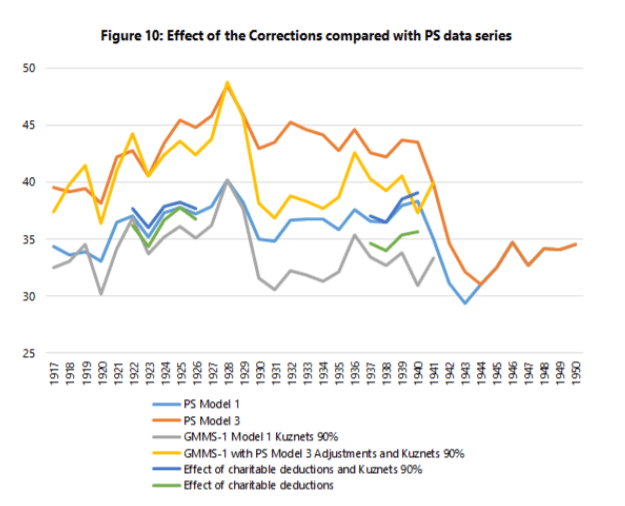
Same thing for income inequality I argue in this new working paper (with Phil Magness, John Moore and Phil Schlosser) which is a basically a list of criticisms of the the Piketty-Saez income inequality series.

For the United States, income inequality measures pre-1960s generally rely on tax-reporting data. From the get-go, one has to recognize that this sort of system (since it is taxes) does not promote “honest” reporting. What is less well known is that tax compliance enforcement was very lax pre-1943 and highly sensitive to the wide variations in tax rates and personal exemption during the period. Basically, the chances that you will report honestly your income at a top marginal rate of 79% is lower than had that rate been at 25%. Since the rates did vary from the high-70s at the end of the Great War to the mid-20s in the 1920s and back up during the Depression, that implies a lot of volatility in the quality of reporting. As such, the evolution measured by tax data will capture tax-rate-induced variations in reported income (especially in the pre-withholding era when there existed numerous large loopholes and tax-sheltered income vehicles).  The shift from high to low taxes in the 1910s and 1920s would have implied a larger than actual change in inequality while the the shift from low to high taxes in the 1930s would have implied the reverse. Correcting for the artificial changes caused by tax rate changes would, by definition, flatten the evolution of inequality – which is what we find in our paper.

However, we go farther than that. Using the state of Wisconsin which had a tax system with more stringent compliance rules for the state income tax while also having lower and much more stable tax rates, we find different levels and trends of income inequality than with the IRS data (a point which me and Phil Magness expanded on here). This alone should fuel skepticism.

Nonetheless, this is not the sum of our criticisms. We also find that the denominator frequently used to arrive at the share of income going to top earners is too low and that the justification used for that denominator is the result of a mathematical error (see pages 10-12 in our paper).

Finally, we point out that there is a large accounting problem. Before 1943, the IRS provided the Statistics of Income based on net income. After 1943, there shift between definitions of adjusted gross income. As such, the two series are not comparable and need to be adjusted to be linked. Piketty and Saez, when they calculated their own adjustment methods, made seemingly reasonable assumptions (mostly that the rich took the lion’s share of deductions). However, when we searched and found evidence of how deductions were distributed, they did not match the assumptions of Piketty and Saez. The actual evidence regarding deductions suggest that lower income brackets had large deductions and this diminishes the adjustment needed to harmonize the two series.

Taken together, our corrections yield systematically lower and flatter estimates of inequality which do not contradict the idea that inequality fell during the first half of the 20th century (see image below). However, our corrections suggest that the UCN is incorrect and that there might be more of small bowl (I call it the Paella-bowl curve of inequality, but my co-authors prefer the J-curve idea).

InequalityPikettySaez.png

Highly recommended work on Ayn Rand

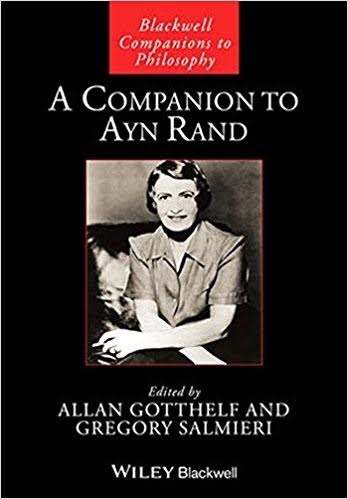
Most scholarship on Ayn Rand has been of mediocre quality, according to Gregory Salmieri, the co-editor of A Companion to Ayn Rand, which is part of the series “Blackwell Companions to Philosophy.” The other co-editor of the volume is the late Allan Gotthelf, who died during it’s last preparatory stages.

The reasons for the poor scholarship are diverse. Of course Rand herself is a large element. She hardly ever participated in regular academic procedures, did not tolerate normal academic criticism on her work and strictly limited the number of people who could authoritatively ‘explain’ her Objectivist philosophy to herself and Nathaniel Branden. Before her death she appointed Leonard Peikoff as ‘literary heir’. She inspired fierce combat against the outside world among her closest followers, especially when others wrote about Rand in a way not to their liking. The result was that just a small circle of admirers wrote about her ideas, often in a non-critical way.

blog ayn rand

On the other hand, the ‘rest of the academy’ basically ignored her views, despite her continued popularity (especially in the US), her influence, particularly through her novels, and large sales, especially after the economic crisis of 2008. For sure, Objectivists remain a minority both inside and outside academia. Yet despite the strong disagreement with her ideas, it would still be normal to expect regular academic output by non-Randians on her work. Suffice it to point to the many obscure thinkers who have been elevated to the academic mainstream over the centuries. Yet Rand remains in the academic dark, the bias against her work is strong and influential. This said, there is a slight change visible. Some major presses have published books on Rand in the past years, with as prime examples the books by Jennifer Burns, Goddess of the Market: Ayn Rand and the American Right (2009), and Anne C Heller, Ayn Rand and the World She Made (2010). And this volume is another point in case.

One of the strong points of The Blackwell Companion on Ayn Rand is that the contributions meet all regular academic standards, despite the fact that the volume originates from the Randian inner circle. It offers proper explanation and analysis of her ideas and normal engagement with outside criticism. The little direct attack on interpretations or alleged errors of others is left to the end notes, albeit sometimes extensively. Let us say, in friendly fashion, that it proves hard to get rid of old habits!

It should not detract from the extensive, detailed, clearly written and plainly good quality of the 18 chapters in this companion, divided in 8 parts, covering overall context, ethics and human nature, society, the foundations of Objectivism, philosophers and their effects, art and a coda on the hallmarks of Objectivism. The only disadvantage is the large number of references to her two main novels, The Fountainhead and Atlas Shrugged, which makes some acquaintance with these tomes almost prerequisite for a great learning experience. Still, as a non-Randian doing work on her political ideas, I underline that this companion offers academically sound information and analysis about the full range of Rand’s ideas. So, go read it if you are interested in this fascinating thinker.

“Fuck Your Vote!”

That’s what I have been hearing ever since the morning after the presidential election. That what I keep hearing on most cable television and on National Public Radio. That’s what I see in most of what I read, and that’s what I am told is being published in the liberal print media I stopped reading long ago. That’s also what I find when I go slumming in left-wing sectors of Facebook.

No one has actually told me directly, in those exact words, “Fuck your vote,” not yet, but that’s what the ceaseless hounding of Pres. Trump means: My vote for him ought to be ignored; it can’t possibly count. If you had not had any news for six months, you would think that there had been a coup in the United States; that a horrid, caricature capitalist had taken over the country by stealth and by force, both. You would guess that the intellectually and morally live segments of American society were resisting a brutal takeover as best as they could. You would not guess there had been a hotly disputed election, fielding 16 viable candidates on one side.

A grass-root movement with a strategy

The verbal lynching to which Pres. Trump is subjected on a 24-hr cycle is not a conspiracy. There is no secrecy to it. It’s all overboard. It’s a regrouping of the political establishment, of the 90% leftist media, of the 90% leftist academia, of the vast tribe of government bureaucrats, of the many others who live off tax revenue, of the labor unions leaders, of the teachers’ unions, especially. So, after a fashion, it’s a genuine grass root movement. It’s a grass root movement of the well-bred and of the semi-educated who spend all their time – always did – feeling “appalled.”

It’s not a conspiracy but it’s a deliberate plot. It has a strategy: Hound him until he loses his cool completely. Harass him to the point where he cannot govern at all. At worst, we can keep him so busy his intended policies kind of vanish. The Santa Cruz AM station where I had a political show for three years has its own well-known, semi-official leftist caller, “Billy.” Billy thinks he is well informed and a genuine, deep-thinking intellectual because he is leisurely. In fact, he does not work for a living; he lives off his rich wife instead. (I would not make this up.) He called the station about two weeks before this writing to sound off on one thing or another that the president had done or said. Then, he declared straightforwardly, “We are hounding him out of office,” and also, with commendable clarity, “It’s a slow coup.” I would not have dared used these words in my conservative (“libéral” en Français) polemical writing, too provocative, possibly exaggerated.

Or take this short, childishly coded message I picked out from from an ordinary left-liberal’s Facebook page:

“47 could end up being Pelosi if we drag it out til 18.”

Translation: the current minority leader in the House could become the next president (the 47th). If we drag what out? For overseas readers and for American readers who went to the beach when the US Constitution was taught in high school: What has to happen before the minority leader of the House of Representatives becomes president outside of a presidential election? The constitutional order of succession if the president dies, in any way of manner, or becomes incapacitated, or is remove from office for any reason is this: Vice-President, Speaker of the House. In the partial elections of 2018, Nancy Pelosi may become Speaker of the House again. She would automatically become president if and only if both President Trump and Vice-President Pence were eliminated. Hence the FB message: Keep up the harassment. Note: Some readers might think I am making this up. I will give the name and FB address of the person from whom this is taken to anyone asking me privately.

What does not revolt me: Donald Trump is a bad person

What is it that makes me angry? Let me begin by telling you what does not make me deeply angry.

First, everyone here and abroad has every right to dislike Mr Trump personally, Trump the man. There is a lot I don’t like about the man myself. He talks too much; he is ignorant of many things; his ignorance does not stand in the way of his having strong opinions about the very same things; he often talks before he thinks; he brags too much; he is too frequently crude. (Actually, I am of two minds about the latter. Official crudeness may be the form that starting to roll back political correctness must take.)

I did not vote for Donald Trump because I loved him but mostly because of the character of the only, single alternative to him at the time of the presidential election. (Keep in mind that Sen. Sanders was not on the ballot. Remember what happened to him?) I had no illusions from day one. I knew that Mr Trump is not at all like suave President Obama, for example, who was awarded a Nobel Peace Prize within barely ten months of taking office.* I voted for Trump also for policy reasons. I thought there was a good chance he would appoint a conservative Supreme Court Justice, as promised. He did, within days. I thought he would deregulate to some extent. He is doing just that. I thought we stood a better chance of having serious tax cuts with him than with the Democratic candidate. I still think so. Tax cuts are the most direct path to vigorous economic growth, I believe. (Shoot me!)

A short digression: As I was writing this cri du coeur, the liberal media were exulting about President Trump’s loss of a few points of general approval. (Actually, it’s about the same as Bill Clinton’s at the same period in their presidencies.) They don’t mention that there is zero evidence that he has lost any ground among those who voted for him, that they feel any voter remorse. Myself, I like him better than I did when I voted for him. He has begun to make America stand up again. He has been a bulwark against several forms of hysteria – including Endofworldism – to a greater extent than I counted on.

What does not revolt me: Opponents trying to stop and sink his program

The second thing to which I do not object in the treatment of President Trump is legislative maneuvering. Democrats and dissident Republicans have every right to block and undermine Mr Trump’s legislative programs, be they tax cuts or “the wall.” (Personally, I want the first ones and think of the second as a silly idea.) The media have every right and sometimes an obligation to support this exercise in checks and balances between executive and legislative that is at the heart of the US constitution. No problem there either. I understand that when you win the presidency, in the American system, that’s all you have got, the presidency. After that, you have to convince Congress to pay for what you want, for what you (conditionally) promised.

What annoys me without revolting me: the courts’ usurpation

The Founding Fathers decided that courts had to be able to curtail or block just about any executive or legislative action. This, to make extra sure that neither branch of government could ever create unconstitutional law. This, to avoid the tyranny of the majority. It often rankles but that’s how our constitutional democracy works. Accordingly, the third going on that annoys me but that I accept is the several courts’ endeavors to stop the president from taking the measures he thinks necessary to keep the country safe. (I try to distinguish between dislike and a negative judgment of illegitimacy. This distinction is a the heart of the problem about which I am writing.) I accept, for example the decisions of the two or three courts who stopped the presidential executive order banning the admission of peoples from a handful of countries. I accept them, although:

Public opinion and – I think – one court, call it a ban “on Muslims,” even if only 9% of all Muslims worldwide would be affected; although half of those are citizens of a country – Iran – that is the declared enemy of the US and officially a sponsor of terrorism as far as we (Americans) are concerned.** and ***.

I accept it although there is nothing in the Constitution that prevents the executive branch from stopping people entering the US based on their religion.

I accept it although there is no part of the US Constitution that recognizes any rights to foreigners who are neither under American jurisdiction nor at war with the US.

I accept it although there is a statute, a law, that explicitly gives the president the right to ban the entry of anyone for any reason.

I accept these court orders but my acceptance is a testimony to my strong commitment to constitutional democracy.

Now, on to what I object to deeply and irreversibly in the attacks on the president.

Extirpating electoral legitimacy

What really, really disturbs me are the nearly daily attempts at removing, at extirpating the legitimacy of the 2016 presidential election results, the desperate and brutal, unscrupulous attempts to make people believe that Mr Trump is not really president. They make me livid because they are not attacks on Mr Trump but rather, they are attacks on me. They are assaults on my right to exercise my constitutional right to cast my vote and to have it counted. And also the rights of sixty-three million Americans**** who voted as I did. The slow coup against Mr Trump defies reason and it resembles nothing I have seen in fifty years in this country. It does remind me of several historical precedents though. (Look up “March on Rome,” you will be amazed.)

More than the mechanics of democracy is at stake. The principle of government by the consent of the governed itself is under assault, the attack is systematic and unrelenting. When I cast one of approximately sixty-three million votes for Donald Trump, I thought I was choosing the lesser of two evils. That’s nothing new; I don’t remember ever voting in a national election for someone who inspired enthusiasm in me. And perhaps, that’s the way it should be. Enthusiasm about a person may not be even compatible with democracy. Free men and women don’t need saviors and they are leery of leaders, even of leadership itself. Be it as it may, I cast my vote as I did and no one (that’s “no”) has the right to try and nullify it, to cancel it. As I write this self-evident truth, I fear that many of the people still having hysteria about the 2016 Democrats’ failure are not sophisticated enough to understand the difference between opposing the consequences of my vote through accepted, traditional parliamentary and judicial maneuvers on the one hand, and nullifying my vote, on the other hand.

Fascism is neither of the left or of the right. It thrives on moral confusion and on bad logic. Hysteria is its main sustenance.

“The Russians” made them lose everything

The daily assault on the Trump legitimacy changes form almost every day. Right now, it has been focusing for several weeks on alleged Russian intervention in the presidential election.

It matters not to the Trump haters that in 2016 Democrats lost everything they could lose besides the presidential election: governor races, state legislatures, Congress. This swath of defeats seems to me to indicate that the Democratic Party in general was not popular, forget Trump. If “the Russians” had actually handed out the presidency to Mr Trump, there would still be a need to explain the Democrat routs at all other levels. Did “the Russians” also organize the rout, including of county boards of supervisors, and at all other minute local levels?

It does not matter that Mrs Clinton was never made to explain how and why she caused to erase or ditch 30,000 emails belonging to the government, a cynical suppression of evidence if there was ever one.

A considerable work of imagination

Thus far, the mud has been thrown at Mr Trump and at his whole team, at any one who has ever met him perhaps in connection with “Russian” interference in the presidential election. Mud has no shape; it’s amorphous. I don’t know about him but when I suspect someone of something, the something has a shape, at least a rough description. You never say, “I suspect you,” but, “I suspect you of X or of Y.” The Trump accusers have never been able to reach even that primitive level of concreteness. None of them has (yet) been stupid enough to suggest that the Russian secret services hacked or tricked up the voting machines in the hundreds of jurisdictions that would be needed to make a difference. So, what have “the Russians” done, really?

The most tangible thing they have against the Trump campaign to-date is a supposition, a product of the collective imagination, and it need not even involve Trump or his agents at all. What we know is that someone hacked the Democratic National Committee emails. Some contents were leaked by Wikileaks which did not say where it got it from. Wikileaks has friendly links with Russia. It’s possible Russians hackers gave it the info. If this is what happened, here is what we still don’t know:

We don’t know that those imagined Russian hackers worked for Pres. Putin. Entrepreneurial Russian hackers have been dazzling us for twenty years. The DNC email seems to have been poorly protected, anyway. A Putin intervention is superfluous in this story.

Furthermore: Do you remember what Wikileaks disclosed (thanks to “the Russians.”)? It showed that the Democratic establishment engineered, by cheating, the defeat of candidate Sanders in the Democratic primary elections. In my book, the anonymous, perhaps Russian, hackers deserve a medal, an American medal for casting light on dysfunction and plain dishonesty within an American political party. The Congressional Medal of Honor is not out of the question, in my book.

Moreover: The leftist media keep referring to “collusion” between members of the Trump campaign and some unnamed Russians. Sounds sinister, alright. But as the Harvard Law Professor Alan Dershowitz, – a Democrat – pointed out recently, “collusion” is not illegal. It’s what you collude to do (rob a bank) that makes it criminal. Colluding to eat a pizza is not criminal. Mr Trump and his entourage are daily accused -without proof – of having committed acts that are not illegal.

The first Comey testimony

The 06/08/17 open, public Senate Judiciary hearing of dismissed FBI Director Comey was awaited by the left and media, and also by some genteel Republicans, like the Roman plebe awaited the lions’ feasting on the Christians. That hearing was a disappointment too. I am writing here as if I thought every word uttered by Mr Comey were exactly true (100% true) although there is no reason to do so. The hearing showed ex-FBI Director to be a leaky wimp, of shaky integrity caught in corrupt and difficult circumstances, first under Obama with the Clinton Follies, then with the unpredictable Trump presidency. It did showcase a great deal of inappropriate behavior by President Trump. But the hearing did not even begin to point to any illegal behavior on the part of the president, not to a single whiff of illegality. If you don’t trust my legal judgment (although I watch many crime shows on TV), refer again to Democrat and Harvard Law School professor Dershowitz who thinks as I do on this issue. The fact is that hardly anyone, possibly no one, voted for Mr Trump because of the appropriateness of his behavior or of his statements. If anyone was about to do so during the election, the airing by the Clinton campaign of a tape describing Mr Trump’s manual approach to seduction would have cured that illusion.

Next?

Personally, I think there is nothing to investigate. Nevertheless, I hope the Special Counsel (a friend of Comey’s, it turns out) will do his job of investigating the possibility that President Trump did whatever he is supposed to have done with I know not what Russians. There is a chance that merely having a single person in charge – what the left demanded – will reduce the daily din of anti-Trump insults. There is even a possibility that it will allow Pres. Trump to get to work on some more of the projects***** for which I gave him my vote. If the investigation reveals real illegal behavior by Mr Trump, felony-level crimes, I think he should be peaceably removed from office, with Vice-President Pence taking over as required by the US Constitution. Anything else, any other succession would be a form of fascism. Any other scenario of Trump removal turns my attention to the Second Amendment (me and hundreds of thousands of gun-crazy, church going “deplorables.”)

How it will end

I don’t see a reasonable finish to all this unless the president is found guilty of something. When the smoke finally clears, when the investigation of President Trump’s collusion to do whatever with whatever Russians ends, I think there is no chance that the matter will be finally put to rest. If the Special Counsel that liberals clamored for concludes that Mr Trump and his whole entourage never committed any illegal act in connection with the 2016 election, there will still be voices pointing out that an intern on Trump’s campaign once ate Russian caviar on a date, which raises serious questions! Or something.

The undisputed fact, that Mr Trump’s improprieties revolt many who voted for the only real alternative, is not an argument for overthrowing an elected government. They are the same people who tried to elect – directly or indirectly – an old woman apparently in failing health, a lackluster former Secretary of State, at best, a person who campaigned incompetently, a candidate for the highest office who never managed to articulate her vision of government, a person who cheated during the primary election, one who ended up losing against a rank political amateur who spent less than half the money she spent on campaigning. With a large majority of voters guilty of such a poor choice, this country has bigger fish to fry, I would think, than presidential rudeness and/or insensitivity.

Conclusion

Dear Trump–hating fellow citizens: One thing that did not cross my mind when I voted was that should my candidate win – a long shot at the time – there would be a massive, multi-pronged endeavor to make believe that I had not voted, or that I had voted other than the way I voted, or that my vote somehow did not count. I thought I was living in a democracy. I assumed the democracy was lodged not only in the rules we follow to form governments but in the hearts of my fellow-citizens. I assumed that the rules were internalized, that they were part of the moral baggage of everyone including those whose vote countered mine.

If you will not accede to the modest wish that my vote should be honored, why bother with elections at all? They are costly and disruptive, they often disappoint, sometimes more than half of the population, and they provide many opportunities for the expression of deplorable taste. Why not, for example, convene a governing directory selected by an assembly of university professors, of well-bred employees’ union leaders, of Democratic politicians, and of media personalities (excluding Fox, and also Rush Limbaugh, of course), all chaired by the Editor-in-Chief of the New York Times?


* Just because you ask, I will tell you that I am guessing that the silly old men of the Norwegian Nobel Committee actually thought they were giving the Prize to the American left electorate for electing a Negro (“neger,” in Norwegian). It’s also a fact that Mr Obama always looks good in a suit.

** To my overseas readers: It was not Pres. Trump who designated officially Iran as a sponsor of terrorism. It happened several presidential administrations back, many years ago.

*** I wonder if the said executive order would have been acceptable to the courts if President Trump had thrown in say, a Buddhist country or two, and a pair of Catholic countries from South America, for example, like this: ban on admission to the US for citizens of Somalia, Yemen, Laos, Syria, Paraguay, Iran, etc.

**** Note to my overseas readers: That’s 2.8 million fewer than won by candidate Clinton. In the US system the candidate who obtains the largest number of votes cast by citizens (the “popular vote”) does not necessarily win the presidency. We have indirect elections instead. This may seem strange but the fact is that neither big party has ever really tried to change the constitution in this respect. So, after the two Obama victories, no one in the Democratic party said, “We have to change this system to make sure the popular vote prevails.” And if we had a popular vote system, all candidates would have campaigned differently. Mr Trump might have won the popular vote handily, or Mrs Clinton may have won with a margin of ten million votes or more; or the Libertarian Party may have received enough votes to deny either candidate a majority. There are many other possibilities in the world of “what if….”

***** Some of his campaign promises are being fulfilled at a fast clip in spite of the ceaseless persecution to which the president is subjected. The loosening of the regulatory hands of the Federal Government on the economy’s neck, for example, is going well.

Could the DUP push UK Conservatives towards a ‘Norway Option’?

Last year, Britain voted to leave the European Union under a banner of anti-immigration and protectionism. Since then, both social democrats and classical liberals have been waiting to catch a break. Ever the optimist, I hope they may have just got one, from an unlikely source, the Democratic Unionist Party. They are a Northern Ireland-based Protestant party that is usually at the margins of national British politics. Thanks to the outcome of the latest general election, they may be in a position to force the British Conservatives towards a more trade and immigration friendly Brexit.

In April, Prime Minister (for now) Theresa May called a snap election. She didn’t need to face the electorate until 2020, but decided to gamble, thinking that she would increase her working majority of Conservative MPs. Instead, as we discovered yesterday after the polls closed, she did the opposite, reducing the slim majority that David Cameron won in 2015 to a mere plurality. This was against one of the most radically left-wing opponents in decades, Jeremy Corbyn.

This was a dismal failure for the Conservatives but the result is a relatively good sign for liberals. I feared that Theresa May’s conservative-tinged anti-market, anti-human rights, authoritarian corporatism was exactly what centrist voters would prefer. It turns that Cameron’s more liberal conservativism actually won more seats. Not only is an outward-looking liberalism correct, de-emphasizing it turns out not be a popular move after all.

Without a majority, the Conservatives need to form a coalition or come to an informal agreement with another party. This seems likely impossible with Labour, the Scottish Nationalists or the Liberal Democrats who have all campaigned heavily against the Conservatives and disagree on key issues, such as whether Britain should leave the European Union at all. This leaves the DUP.

In terms of ideology, the DUP is far to the right of most British Conservatives. Their opposition to gay marriage, abortion, and occasional support for teaching creationism, means that they have more in common with some Republican Christian groups in the United States than the secular mainstream in the rest of the United Kingdom. Historically, at least, they have links with pro-unionist paramilitaries that have terrorized Irish Catholic separatists.

There is, however, one way in which the DUP are comparatively moderate. While content with the UK leaving the European Union, they want to keep the land border between Northern Ireland and the Republic of Ireland (an EU member) open. Closing it would reduce critical cross-border trade with an economically dynamic neighbor and re-ignite violent tensions between the Protestant and Catholic communities in Northern Ireland.

How could this be achieved? Leaving the EU while keeping a relatively open trading and immigration relationship is similar to the so-called Norway Option. Norway is within the single market but can exempt itself from many parts of EU law. In return, it has no direct representation in EU institutions. If the EU could accept such an arrangement, then the DUP may be able to make Conservatives commit to it.

Of course, the DUP will extract other perks from their major partners as part of any deal. But their social policy preferences are so far to the right of people in England, Wales and Scotland that this will hopefully have to take the form of fiscal subsidies to their home region (economically damaging but could at least avoid infringing civil liberties).

It might seem paradoxical that an extreme party may have a moderating influence on overall policy. However, social choice theory suggests that democratic processes do not aggregate voter, or legislator, preferences in a straightforward way. Because preferences exist along multiple dimensions, they are neither additive nor linear. This can produce perverse and chaotic outcomes, but it can also generate valuable bargains between otherwise opposed parties. In this case, one right-wing party produces an authoritarian Brexit. But two right-wing parties could equal a more liberal outcome.

That’s the theory. Has something like this ever happened in practice? Arguably, Canada is an outstanding example of how a minority party with many internally illiberal policy preferences produces liberal outcomes (see the fascinating Vaubel, 2009, p.25 for the argument). There, the need to placate the separatist movement in Quebec involved leaving more powers to the provinces in general, thus keeping Canada as a whole much more decentralized than Anglo-Canadian preferences alone could have assured. Will the DUP do the same for Britain? We can but hope.

Pittsburgh, not Paris: What’s a libertarian response?

A lot has been said about Trump pulling the US out of the Paris Accords. Leftists have been apoplectic, foaming at the mouth even. Conservatives are baffled, if they have anything to say at all. What should libertarians think?

Libertarians in the United Kingdom, States, and Provinces are generally unilateralists (not isolationists), whereas libertarians in Europe, South Africa, and Latin America are generally multilateralists. I’m of the opinion that American libertarians are wholly wrong to claim that their foreign policy is libertarian. It’s not libertarian at all. Unilateralism is combative rather than cooperative and relies on nationalism rather than internationalism to make its arguments.

Multilateralism forces factions to come to a consensus, thus slowing down government action at the international level, while also forcing factions to interact with each other in a diplomatic manner at that same international level. Unilateralism allows states to do whatever they want, regardless of what others may think. Now let me remind you of what libertarianism stands for: peace, prosperity, and freedom through mutually beneficial exchange and agreed-upon rules that can be changed provided they go through the proper channels (legislation, judiciary, executive). (Am I wrong here?)

Which sounds more libertarian to you?

Now that we have issues of doctrine out of the way, what’s really interesting to note is the Left’s inability to see what Trump is actually doing: wagging the dog. Trump’s term as executive is not going well (surprise, surprise). And so, he does a mean-spirited thing that he hopes will distract.

Here’s how I see the Paris Accords (chime in if you disagree):

  • They (it?) have not, and will not – ever – accomplish anything in regard to climate change, but
  • because of this it is also an organization that is wholly non-threatening. It’s just a bunch of countries getting together, in good faith, to solve a problem (real or imagined)

Some hardline factions on the conservative wing in the US didn’t like that the Paris Accords are essentially glorified intern conventions, and some Leftist factions on the American Left absolutely revere green initiatives (even if they’re no good at greening anything other than lobbyist’s pocketbooks), so Trump pulled the plug.

#covfefe

The death of reason

“In so far as their only recourse to that world is through what they see and do, we may want to say that after a revolution scientists are responding to a different world.”

Thomas Kuhn, The Structure of Scientific Revolutions p. 111

I can remember arguing with my cousin right after Michael Brown was shot. “It’s still unclear what happened,” I said, “based soley on testimony” — at that point, we were still waiting on the federal autopsy report by the Department of Justice. He said that in the video, you can clearly see Brown, back to the officer and with his hands up, as he is shot up to eight times.

My cousin doesn’t like police. I’m more ambivalent, but I’ve studied criminal justice for a few years now, and I thought that if both of us watched this video (no such video actually existed), it was probably I who would have the more nuanced grasp of what happened. So I said: “Well, I will look up this video, try and get a less biased take and get back to you.” He replied, sarcastically, “You can’t watch it without bias. We all have biases.”

And that seems to be the sentiment of the times: bias encompasses the human experience, it subsumes all judgments and perceptions. Biases are so rampant, in fact, that no objective analysis is possible. These biases may be cognitive, like confirmation bias, emotional fallacies or that phenomenon of constructive memory; or inductive, like selectivity or ignoring base probability; or, as has been common to think, ingrained into experience itself.

The thing about biases is that they are open to psychological evaluation. There are precedents for eliminating them. For instance, one common explanation of racism is that familiarity breeds acceptance, and infamiliarity breeds intolerance (as Reason points out, people further from fracking sites have more negative opinions on the practice than people closer). So to curb racism (a sort of bias), children should interact with people outside of their singular ethnic group. More clinical methodology seeks to transform mental functions that are automatic to controlled, and thereby enter reflective measures into perception, reducing bias. Apart from these, there is that ancient Greek practice of reasoning, wherein patterns and evidence are used to generate logical conclusions.

If it were true that human bias is all-encompassing, and essentially insurmountable, the whole concept of critical thinking goes out the window. Not only do we lose the critical-rationalist, Popperian mode of discovery, but also Socratic dialectic, as essentially “higher truths” disappear from human lexicon.

The belief that biases are intrinsic to human judgment ignores psychological or philosophical methods to counter prejudice because it posits that objectivity itself is impossible. This viewpoint has been associated with “postmodern” schools of philosophy, such as those Dr. Rosi commented on (e.g., those of Derrida, Lacan, Foucault, Butler), although it’s worth pointing out that the analytic tradition, with its origins in Frege, Russell and Moore represents a far greater break from the previous, modern tradition of Descartes and Kant, and often reached similar conclusions as the Continentals.

Although theorists of the “postmodern” clique produced diverse claims about knowledge, society, and politics, the most famous figures are nearly almost always associated or incorporated into the political left. To make a useful simplification of viewpoints: it would seem that progressives have generally accepted Butlerian non-essentialism about gender and Foucauldian terminology (discourse and institutions). Derrida’s poststructuralist critique noted dichotomies and also claimed that the philosophical search for Logos has been patriarchal, almost neoreactionary. (The month before Donald Trump’s victory, the word patriarchy had an all-time high at Google search.) It is not a far right conspiracy that European philosophers with strange theories have influenced and sought to influence American society; it is patent in the new political language.

Some people think of the postmodernists as all social constructivists, holding the theory that many of the categories and identifications we use in the world are social constructs without a human-independent nature (e.g., not natural kinds). Disciplines like anthropology and sociology have long since dipped their toes, and the broader academic community, too, relates that things like gender and race are social constructs. But the ideas can and do go further: “facts” themselves are open to interpretation on this view: to even assert a “fact” is just to affirm power of some sort. This worldview subsequently degrades the status of science into an extended apparatus for confirmation-bias, filling out the details of a committed ideology rather than providing us with new facts about the world. There can be no objectivity outside of a worldview.

Even though philosophy took a naturalistic turn with the philosopher W. V. O. Quine, seeing itself as integrating with and working alongside science, the criticisms of science as an establishment that emerged in the 1950s and 60s (and earlier) often disturbed its unique epistemic privilege in society: ideas that theory is underdetermined by evidence, that scientific progress is nonrational, that unconfirmed auxiliary hypotheses are required to conduct experiments and form theories, and that social norms play a large role in the process of justification all damaged the mythos of science as an exemplar of human rationality.

But once we have dismantled Science, what do we do next? Some critics have held up Nazi German eugenics and phrenology as examples of the damage that science can do to society (nevermind that we now consider them pseudoscience). Yet Lysenkoism and the history of astronomy and cosmology indicate that suppressing scientific discovery can too be deleterious. Austrian physicist and philosopher Paul Feyerabend instead wanted a free society — one where science had equal power as older, more spiritual forms of knowledge. He thought the model of rational science exemplified in Sir Karl Popper was inapplicable to the real machinery of scientific discovery, and the only methodological rule we could impose on science was: “anything goes.”

Feyerabend’s views are almost a caricature of postmodernism, although he denied the label “relativist,” opting instead for philosophical Dadaist. In his pluralism, there is no hierarchy of knowledge, and state power can even be introduced when necessary to break up scientific monopoly. Feyerabend, contra scientists like Richard Dawkins, thought that science was like an organized religion and therefore supported a separation of church and state as well as a separation of state and science. Here is a move forward for a society that has started distrusting the scientific method… but if this is what we should do post-science, it’s still unclear how to proceed. There are still queries for anyone who loathes the hegemony of science in the Western world.

For example, how does the investigation of crimes proceed without strict adherence to the latest scientific protocol? Presumably, Feyerabend didn’t want to privatize law enforcement, but science and the state are very intricately connected. In 2005, Congress authorized the National Academy of Sciences to form a committee and conduct a comprehensive study on contemporary legal science to identify community needs, evaluating laboratory executives, medical examiners, coroners, anthropologists, entomologists, ontologists, and various legal experts. Forensic science — scientific procedure applied to the field of law — exists for two practical goals: exoneration and prosecution. However, the Forensic Science Committee revealed that severe issues riddle forensics (e.g., bite mark analysis), and in their list of recommendations the top priority is establishing an independent federal entity to devise consistent standards and enforce regular practice.

For top scientists, this sort of centralized authority seems necessary to produce reliable work, and it entirely disagrees with Feyerabend’s emphasis on methodological pluralism. Barack Obama formed the National Commission on Forensic Science in 2013 to further investigate problems in the field, and only recently Attorney General Jeff Sessions said the Department of Justice will not renew the committee. It’s unclear now what forensic science will do to resolve its ongoing problems, but what is clear is that the American court system would fall apart without the possibility of appealing to scientific consensus (especially forensics), and that the only foreseeable way to solve the existing issues is through stricter methodology. (Just like with McDonalds, there are enforced standards so that the product is consistent wherever one orders.) More on this later.

So it doesn’t seem to be in the interest of things like due process to abandon science or completely separate it from state power. (It does, however, make sense to move forensic laboratories out from under direct administrative control, as the NAS report notes in Recommendation 4. This is, however, specifically to reduce bias.) In a culture where science is viewed as irrational, Eurocentric, ad hoc, and polluted with ideological motivations — or where Reason itself is seen as a particular hegemonic, imperial device to suppress different cultures — not only do we not know what to do, when we try to do things we lose elements of our civilization that everyone agrees are valuable.

Although Aristotle separated pathos, ethos and logos (adding that all informed each other), later philosophers like Feyerabend thought of reason as a sort of “practice,” with history and connotations like any other human activity, falling far short of sublime. One could no more justify reason outside of its European cosmology than the sacrificial rituals of the Aztecs outside of theirs. To communicate across paradigms, participants have to understand each other on a deep level, even becoming entirely new persons. When debates happen, they must happen on a principle of mutual respect and curiosity.

From this one can detect a bold argument for tolerance. Indeed, Feyerabend was heavily influenced by John Stuart Mill’s On Liberty. Maybe, in a world disillusioned with scientism and objective standards, the next cultural move is multilateral acceptance and tolerance for each others’ ideas.

This has not been the result of postmodern revelations, though. The 2016 election featured the victory of one psychopath over another, from two camps utterly consumed with vitriol for each other. Between Bernie Sanders, Donald Trump and Hillary Clinton, Americans drifted toward radicalization as the only establishment candidate seemed to offer the same noxious, warmongering mess of the previous few decades of administration. Politics has only polarized further since the inauguration. The alt-right, a nearly perfect symbol of cultural intolerance, is regular news for mainstream media. Trump acolytes physically brawl with black bloc Antifa in the same city of the 1960s Free Speech Movement. It seems to be the worst at universities. Analytic feminist philosophers asked for the retraction of a controversial paper, seemingly without reading it. Professors even get involved in student disputes, at Berkeley and more recently Evergreen. The names each side uses to attack each other (“fascist,” most prominently) — sometimes accurate, usually not — display a political divide with groups that increasingly refuse to argue their own side and prefer silencing their opposition.

There is not a tolerant left or tolerant right any longer, in the mainstream. We are witnessing only shades of authoritarianism, eager to destroy each other. And what is obvious is that the theories and tools of the postmodernists (post-structuralism, social constructivism, deconstruction, critical theory, relativism) are as useful for reactionary praxis as their usual role in left-wing circles. Says Casey Williams in the New York Times: “Trump’s playbook should be familiar to any student of critical theory and philosophy. It often feels like Trump has stolen our ideas and weaponized them.” The idea of the “post-truth” world originated in postmodern academia. It is the monster turning against Doctor Frankenstein.

Moral (cultural) relativism in particular only promises rejecting our shared humanity. It paralyzes our judgment on female genital mutilation, flogging, stoning, human and animal sacrifice, honor killing, Caste, underground sex trade. The afterbirth of Protagoras, cruelly resurrected once again, does not promise trials at Nuremberg, where the Allied powers appealed to something above and beyond written law to exact judgment on mass murderers. It does not promise justice for the ethnic cleansers in Srebrenica, as the United Nations is helpless to impose a tribunal from outside Bosnia-Herzegovina. Today, this moral pessimism laughs at the phrase “humanitarian crisis,” and Western efforts to change the material conditions of fleeing Iraqis, Afghans, Libyans, Syrians, Venezuelans, North Koreans…

In the absence of universal morality, and the introduction of subjective reality, the vacuum will be filled with something much more awful. And we should be afraid of this because tolerance has not emerged as a replacement. When Harry Potter first encounters Voldemort face-to-scalp, the Dark Lord tells the boy “There is no good and evil. There is only power… and those too weak to seek it.” With the breakdown of concrete moral categories, Feyerabend’s motto — anything goes — is perverted. Voldemort has been compared to Plato’s archetype of the tyrant from the Republic: “It will commit any foul murder, and there is no food it refuses to eat. In a word, it omits no act of folly or shamelessness” … “he is purged of self-discipline and is filled with self-imposed madness.”

Voldemort is the Platonic appetite in the same way he is the psychoanalytic id. Freud’s das Es is able to admit of contradictions, to violate Aristotle’s fundamental laws of logic. It is so base, and removed from the ordinary world of reason, that it follows its own rules we would find utterly abhorrent or impossible. But it is not difficult to imagine that the murder of evidence-based reasoning will result in Death Eater politics. The ego is our rational faculty, adapted to deal with reality; with the death of reason, all that exists is vicious criticism and unfettered libertinism.

Plato predicts Voldemort with the image of the tyrant, and also with one of his primary interlocutors, Thrasymachus, when the sophist opens with “justice is nothing other than the advantage of the stronger.” The one thing Voldemort admires about The Boy Who Lived is his bravery, the trait they share in common. This trait is missing in his Death Eaters. In the fourth novel the Dark Lord is cruel to his reunited followers for abandoning him and losing faith; their cowardice reveals the fundamental logic of his power: his disciples are not true devotees, but opportunists, weak on their own merit and drawn like moths to every Avada Kedavra. Likewise students flock to postmodern relativism to justify their own beliefs when the evidence is an obstacle.

Relativism gives us moral paralysis, allowing in darkness. Another possible move after relativism is supremacy. One look at Richard Spencer’s Twitter demonstrates the incorrigible tenet of the alt-right: the alleged incompatibility of cultures, ethnicities, races: that different groups of humans simply can not get along together. The Final Solution is not about extermination anymore but segregated nationalism. Spencer’s audience is almost entirely men who loathe the current state of things, who share far-reaching conspiracy theories, and despise globalism.

The left, too, creates conspiracies, imagining a bourgeois corporate conglomerate that enlists economists and brainwashes through history books to normalize capitalism; for this reason they despise globalism as well, saying it impoverishes other countries or destroys cultural autonomy. For the alt-right, it is the Jews, and George Soros, who control us; for the burgeoning socialist left, it is the elites, the one-percent. Our minds are not free; fortunately, they will happily supply Übermenschen, in the form of statesmen or critical theorists, to save us from our degeneracy or our false consciousness.

Without the commitment to reasoned debate, tribalism has continued the polarization and inhumility. Each side also accepts science selectively, if they do not question its very justification. The privileged status that the “scientific method” maintains in polite society is denied when convenient; whether it is climate science, evolutionary psychology, sociology, genetics, biology, anatomy or, especially, economics: one side is outright rejecting it, without studying the material enough to immerse oneself in what could be promising knowledge (as Feyerabend urged, and the breakdown of rationality could have encouraged). And ultimately, equal protection, one tenet of individualist thought that allows for multiplicity, is entirely rejected by both: we should be treated differently as humans, often because of the color of our skin.

Relativism and carelessness for standards and communication has given us supremacy and tribalism. It has divided rather than united. Voldemort’s chaotic violence is one possible outcome of rejecting reason as an institution, and it beckons to either political alliance. Are there any examples in Harry Potter of the alternative, Feyerabendian tolerance? Not quite. However, Hermione Granger serves as the Dark Lord’s foil, and gives us a model of reason that is not as archaic as the enemies of rationality would like to suggest. In Against Method (1975), Feyerabend compares different ways rationality has been interpreted alongside practice: in an idealist way, in which reason “completely governs” research, or a naturalist way, in which reason is “completely determined by” research. Taking elements of each, he arrives at an intersection in which one can change the other, both “parts of a single dialectical process.”

“The suggestion can be illustrated by the relation between a map and the adventures of a person using it or by the relation between an artisan and his instruments. Originally maps were constructed as images of and guides to reality and so, presumably, was reason. But maps, like reason, contain idealizations (Hecataeus of Miletus, for examples, imposed the general outlines of Anaximander’s cosmology on his account of the occupied world and represented continents by geometrical figures). The wanderer uses the map to find his way but he also corrects it as he proceeds, removing old idealizations and introducing new ones. Using the map no matter what will soon get him into trouble. But it is better to have maps than to proceed without them. In the same way, the example says, reason without the guidance of a practice will lead us astray while a practice is vastly improved by the addition of reason.” p. 233

Christopher Hitchens pointed out that Granger sounds like Bertrand Russell at times, like this quote about the Resurrection Stone: “You can claim that anything is real if the only basis for believing in it is that nobody has proven it doesn’t exist.” Granger is often the embodiment of anemic analytic philosophy, the institution of order, a disciple for the Ministry of Magic. However, though initially law-abiding, she quickly learns with Potter and Weasley the pleasures of rule-breaking. From the first book onward, she is constantly at odds with the de facto norms of the university, becoming more rebellious as time goes on. It is her levelheaded foundation, but ability to transgress rules, that gives her an astute semi-deontological, semi-utilitarian calculus capable of saving the lives of her friends from the dark arts, and helping to defeat the tyranny of Voldemort foretold by Socrates.

Granger presents a model of reason like Feyerabend’s map analogy. Although pure reason gives us an outline of how to think about things, it is not a static or complete blueprint, and it must be fleshed out with experience, risk-taking, discovery, failure, loss, trauma, pleasure, offense, criticism, and occasional transgressions past the foreseeable limits. Adding these addenda to our heuristics means that we explore a more diverse account of thinking about things and moving around in the world.

When reason is increasingly seen as patriarchal, Western, and imperialist, the only thing consistently offered as a replacement is something like lived experience. Some form of this idea is at least a century old, with Husserl, still modest by reason’s Greco-Roman standards. Yet lived experience has always been pivotal to reason; we only need adjust our popular model. And we can see that we need not reject one or the other entirely. Another critique of reason says it is fool-hardy, limiting, antiquated; this is a perversion of its abilities, and plays to justify the first criticism. We can see that there is room within reason for other pursuits and virtues, picked up along the way.

The emphasis on lived experience, which predominantly comes from the political left, is also antithetical for the cause of “social progress.” Those sympathetic to social theory, particularly the cultural leakage of the strong programme, are constantly torn between claiming (a) science is irrational, and can thus be countered by lived experience (or whatnot) or (b) science may be rational but reason itself is a tool of patriarchy and white supremacy and cannot be universal. (If you haven’t seen either of these claims very frequently, and think them a strawman, you have not been following university protests and editorials. Or radical Twitter: ex., ex., ex., ex.) Of course, as in Freud, this is an example of kettle-logic: the signal of a very strong resistance. We see, though, that we need not accept nor deny these claims and lose anything. Reason need not be stagnant nor all-pervasive, and indeed we’ve been critiquing its limits since 1781.

Outright denying the process of science — whether the model is conjectures and refutations or something less stale — ignores that there is no single uniform body of science. Denial also dismisses the most powerful tool for making difficult empirical decisions. Michael Brown’s death was instantly a political affair, with implications for broader social life. The event has completely changed the face of American social issues. The first autopsy report, from St. Louis County, indicated that Brown was shot at close range in the hand, during an encounter with Officer Darren Wilson. The second independent report commissioned by the family concluded the first shot had not in fact been at close range. After the disagreement with my cousin, the Department of Justice released the final investigation report, and determined that material in the hand wound was consistent with gun residue from an up-close encounter.

Prior to the report, the best evidence available as to what happened in Missouri on August 9, 2014, was the ground footage after the shooting and testimonies from the officer and Ferguson residents at the scene. There are two ways to approach the incident: reason or lived experience. The latter route will lead to ambiguities. Brown’s friend Dorian Johnson and another witness reported that Officer Wilson fired his weapon first at range, under no threat, then pursued Brown out of his vehicle, until Brown turned with his hands in the air to surrender. However, in the St. Louis grand jury half a dozen (African-American) eyewitnesses corroborated Wilson’s account: that Brown did not have his hands raised and was moving toward Wilson. In which direction does “lived experience” tell us to go, then? A new moral maxim — the duty to believe people — will lead to no non-arbitrary conclusion. (And a duty to “always believe x,” where x is a closed group, e.g. victims, will put the cart before the horse.) It appears that, in a case like this, treating evidence as objective is the only solution.

Introducing ad hoc hypotheses, e.g., the Justice Department and the county examiner are corrupt, shifts the approach into one that uses induction, and leaves behind lived experience (and also ignores how forensic anthropology is actually done). This is the introduction of, indeed, scientific standards. (By looking at incentives for lying it might also employ findings from public choice theory, psychology, behavioral economics, etc.) So the personal experience method creates unresolvable ambiguities, and presumably will eventually grant some allowance to scientific procedure.

If we don’t posit a baseline-rationality — Hermione Granger pre-Hogwarts — our ability to critique things at all disappears. Utterly rejecting science and reason, denying objective analysis in the presumption of overriding biases, breaking down naïve universalism into naïve relativism — these are paths to paralysis on their own. More than that, they are hysterical symptoms, because they often create problems out of thin air. Recently, a philosopher and mathematician submitted a hoax paper, Sokal-style, to a peer-reviewed gender studies journal in an attempt to demonstrate what they see as a problem “at the heart of academic fields like gender studies.” The idea was to write a nonsensical, postmodernish essay, and if the journal accepted it, that would indicate the field is intellectually bankrupt. Andrew Smart at Psychology Today instead wrote of the prank: “In many ways this academic hoax validates many of postmodernism’s main arguments.” And although Smart makes some informed points about problems in scientific rigor as a whole, he doesn’t hint at what the validation of postmodernism entails: should we abandon standards in journalism and scholarly integrity? Is the whole process of peer-review functionally untenable? Should we start embracing papers written without any intention of making sense, to look at knowledge concealed below the surface of jargon? The paper, “The conceptual penis,” doesn’t necessarily condemn the whole of gender studies; but, against Smart’s reasoning, we do in fact know that counterintuitive or highly heterodox theory is considered perfectly average.

There were other attacks on the hoax, from SlateSalon and elsewhere. Criticisms, often valid for the particular essay, typically didn’t move the conversation far enough. There is much more for this discussion. A 2006 paper from the International Journal of Evidence Based Healthcare, “Deconstructing the evidence-based discourse in health sciences,” called the use of scientific evidence “fascist.” In the abstract the authors state their allegiance to the work of Deleuze and Guattari. Real Peer Review, a Twitter account that collects abstracts from scholarly articles, regulary features essays from the departments of women and gender studies, including a recent one from a Ph. D student wherein the author identifies as a hippopotamus. Sure, the recent hoax paper doesn’t really say anything. but it intensifies this much-needed debate. It brings out these two currents — reason and the rejection of reason — and demands a solution. And we know that lived experience is going to be often inconclusive.

Opening up lines of communication is a solution. One valid complaint is that gender studies seems too insulated, in a way in which chemistry, for instance, is not. Critiquing a whole field does ask us to genuinely immerse ourselves first, and this is a step toward tolerance: it is a step past the death of reason and the denial of science. It is a step that requires opening the bubble.

The modern infatuation with human biases as well as Feyerabend’s epistemological anarchism upset our faith in prevailing theories, and the idea that our policies and opinions should be guided by the latest discoveries from an anonymous laboratory. Putting politics first and assuming subjectivity is all-encompassing, we move past objective measures to compare belief systems and theories. However, isn’t the whole operation of modern science designed to work within our means? The system by Kant set limits on humanity rationality, and most science is aligned with an acceptance of fallibility. As Harvard cognitive scientist Steven Pinker says, “to understand the world, we must cultivate work-arounds for our cognitive limitations, including skepticism, open debate, formal precision, and empirical tests, often requiring feats of ingenuity.”

Pinker goes for far as to advocate for scientism. Others need not; but we must understand an academic field before utterly rejecting it. We must think we can understand each other, and live with each other. We must think there is a baseline framework that allows permanent cross-cultural correspondence — a shared form of life which means a Ukrainian can interpret a Russian and a Cuban an American. The rejection of Homo Sapiens commensurability, championed by people like Richard Spencer and those in identity politics, is a path to segregation and supremacy. We must reject Gorgian nihilism about communication, and the Presocratic relativism that camps our moral judgments in inert subjectivity. From one Weltanschauung to the next, our common humanity — which endures class, ethnicity, sex, gender — allows open debate across paradigms.

In the face of relativism, there is room for a nuanced middleground between Pinker’s scientism and the rising anti-science, anti-reason philosophy; Paul Feyerabend has sketched out a basic blueprint. Rather than condemning reason as a Hellenic germ of Western cultural supremacy, we need only adjust the theoretical model to incorporate the “new America of knowledge” into our critical faculty. It is the raison d’être of philosophers to present complicated things in a more digestible form; to “put everything before us,” so says Wittgenstein. Hopefully, people can reach their own conclusions, and embrace the communal human spirit as they do.

However, this may not be so convincing. It might be true that we have a competition of cosmologies: one that believes in reason and objectivity, one that thinks reason is callow and all things are subjective.These two perspectives may well be incommensurable. If I try to defend reason, I invariably must appeal to reasons, and thus argue circularly. If I try to claim “everything is subjective,” I make a universal statement, and simultaneously contradict myself. Between begging the question and contradicting oneself, there is not much indication of where to go. Perhaps we just have to look at history and note the results of either course when it has been applied, and take it as a rhetorical move for which path this points us toward.

BC’s weekend reads

  1. the Economist endorses the Liberal Democrats in UK election (in Europe, a liberal democrat is roughly the same thing as a libertarian in the US)
  2. One of the most important lessons of Trump’s success is that classically liberal rhetoric and positions were not very important to voters.
  3. It turns out that Westerners are rational, virtuous, and liberty-loving, while Orientals are irrational, vicious, and slavish.
  4. The West is indifferent to Afghanistan and Iraq’s world of terror
  5. Roman slavery, revolution, and magic mushrooms
  6. What the fuck?