On granting the Nobel to Kirzner

In a little over a week, the Nobel Prize in economics will be unveiled. A part of me wishes that Robert Barro wins or maybe Dale Jorgenson or even William Baumol. However, I would be thrilled if Israel Kirzner won. Back in 2014, he was mentioned for the prize and it was the year that Jean Tirole, deservedly, won the prize. Since then, I have been dreaming of it as it would cement into the mainstream the best that the Austrian school of economics can offer.

Unlike many of colleagues, I have always had sympathies for numerous points made by the Austrians. Throughout my training, the Austrian school of economics was largely derided as cranks. Initially, I jumped on the bandwagon and I believed the Austrians to be crazy. However, I became exposed to many of their key points and like Edmund Phelps, I felt that the “best of the Austrians” could not be rejected so easily. True, there is some wheat to sort from the chaff, but the same applies for every school of thought.  I realized that most of their inputs in macroeconomics were largely incorporated in models like Lucas’ Islands Model or in Prescott’s Time to Build. However, what most intrigued me was how they used general equilibrium as a teaching tool, but not as a research tool. General equilibrium is useful for understanding key axiomatic assertions, but when you have an “applied economics” question, it is a hard tool to use – especially for an economic historian like me.

Kirzner is the perfect representation of the best that the Austrian school has to offer. In a way, his entire work can be summarized as such: it is the process leading to (new) equilibrium(s) that is the most interesting aspect of economics.

It is when I understood that insight that I finally grasped the deeper meaning of Hayek’s claim that “competition is a discovery process”. Entrepreneurs are people who look for the $100 bill on the sidewalk by innovating, by exploiting arbitrage opportunities and by discovering what consumers really want. They are constantly heading towards an equilibrium point. But as they try to do so, they shift the ability to produce and consume to greater levels and, in doing so, they generate a new equilibrium. And the process continues as long as human beings are humans.

For someone who studies economic history like I do, this is the most fruitful way of looking at social interactions. After all, the industrial revolution is everything except an equilibrium and the industrial revolution is most momentous structural break in history. The search for equilibrium and the creation of new equilibriums are by far more useful tools for questions like the end of “Malthusian pressures” or the beginning of the Industrial Revolution.

Of course, I am veering into excessive simplification of Kirzner’s contribution. But consider his book, Competition and Entrepreneurship. Alone, it has 7,362 citations (according to google scholar).  This is half the citations obtained by the most cited article in the American Economic Review (Armen Alchian and Harold Demsetz’s Production, Information Costs and Economic Organization). It’s close to 3,000 more citations that Deaton and Muellbauer’s “Almost Ideal Demand System” (4,775 citations). And Deaton won the Nobel last year!

By virtue of being affiliated with the Austrians, mainstream economists could have relegated him to obscurity. However, for such a citation count to be achieved, he must have been to showcase the best that the Austrian school has to offer. Just for that, maybe his contribution should be recognized.
O capitalismo explora os trabalhadores?

Um dos argumentos contra o liberalismo econômico que tenho ouvido recentemente (ou contra a liberdade de mercado, com pouca ou nenhuma intervenção do estado) é que as relações entre patrões e trabalhadores são desiguais, e logo então desfavoráveis para os trabalhadores; cabe ao estado intervir a favor dos trabalhadores; o liberalismo econômico não é bom para os trabalhadores. Tenho dificuldade com este argumento, pois ele passa a ideia de que os patrões não trabalham. Seja como for, acredito que posso aceitar parte do que está sendo dito: é lógico que alguns patrões irão tentar pagar o pior salário possível aos trabalhadores para conseguir os maiores lucros possíveis. É lógico que muitos patrões irão ver qualquer investimento em segurança, bem estar, saúde e outros “direitos” como gastos incômodos, e irão tentar evitar estes gastos. É lógico que o trabalhador está pleiteando a vaga, e neste sentido está à mercê do patrão que a oferece. Tudo isto é não apenas lógico, mas empírico. Pessoalmente já vi estas coisas acontecendo “com estes olhos que a terra há de comer”. Há patrões que irão tentar fazer todas estas coisas e outras ainda, aproveitando-se da situação vulnerável dos trabalhadores. Irão tentar. Mas irão conseguir?

Segundo me parece, uma forma de evitar que patrões se aproveitem da situação vulnerável dos trabalhadores é apelar para a caridade dos patrões. Embora eu suspeite que esta abordagem possa soar romântica para muitos, o fato é que empiricamente ela funciona com alguma frequência. Historicamente, foi o cristianismo de muitos empresários que possibilitou a melhora das condições de trabalho na Europa e Estados Unidos durante o primeiro século de Revolução Industrial. Portanto, esta é uma abordagem que, acredito, não deve ser desconsiderada.

Uma segunda forma de evitar que patrões se aproveitem da situação vulnerável dos trabalhadores é criar leis trabalhistas. Ao invés de esperarmos que os patrões sejam voluntariamente bons, podemos usar a violência legítima do estado para força-los a serem bons. Esta abordagem possui efeitos positivos, mas também muitas consequências inesperadas. Basicamente o objetivo de qualquer lei é tornar os relacionamentos humanos mais padronizados. Uma maneira mais negativa de dizer a mesma coisa é falar que leis engessam a sociedade. Leis trabalhistas criam “direitos”, mas também impedem que trabalhadores e empregadores negociem voluntariamente outras possibilidades de relacionamento. Um exemplo bastante conhecido é o salário mínimo, que contra intuitivamente prejudica os trabalhadores mais do que os ajuda. Finalmente, leis só fazem sentido caso sejam amparadas por um estado. E com mais leis, mais estado. Nossa relação com o estado já é por definição desigual: o estado possui o monopólio do uso legitimo da violência; nós não. Aumentar o tamanho do estado é aumentar nossa vulnerabilidade dentro de uma relação desigual, o que vai contra exatamente o que está sendo discutido aqui.

Uma terceira forma de evitar que patrões se aproveitem da situação vulnerável dos trabalhadores é a liberdade econômica. Sim, como eu comecei dizendo, é lógico e empírico que alguns patrões irão tentar se aproveitar de situações de vulnerabilidade dos empregados. Mas irão conseguir? Numa sociedade orientada pela liberdade de mercado, é mais provável que não. Com liberdade de mercado, a tendência é o surgimento de concorrência, além de uma maior diversidade de atividades econômicas. Neste cenário, patrões que procurem abusar dos trabalhadores correm o rico de perder os trabalhadores para outros patrões. Mesmo no cenário improvável de todos os patrões serem abusivos, tratar bem os trabalhadores torna-se um imperativo para manter os lucros. A alternativa seria um acordo geral dos patrões abusivos, mas isto tornasse empiricamente infactível numa sociedade progressivamente marcada por liberdade de escolha. Uma última observação nesta lista muito longe de exaustiva de benefícios do livre mercado para o trabalhador é que no livre mercado a tendência é de aumento da produtividade. E nada está mais ligado a aumentos de salários do que aumento de produtividade. De fato, onde há liberdade de mercado os salários aumentam, assim como o poder de compra.

Em resumo, sim, há patrões que se aproveitam das relações desiguais com trabalhadores para exercer poder sobre estes mesmos trabalhadores. Isto é não apenas lógico, mas empírico. Mas qual é a melhor solução para este problema? Apelar para a boa vontade dos patrões? Criar leis que deem aos trabalhadores mais direitos? Favorecer uma maior liberdade de mercado? Minha resposta é: criar leis que favoreçam maior liberdade de mercado, e ao mesmo tempo apelar para a boa vontade dos patrões, até porque num cenário de maior liberdade econômica, patrões abusivos estão indo contra seus próprios interesses.


Referências:

O capitalismo explora os trabalhadores?

The Great Blessings of Cash

Paper money offers the benefits of anonymity, immediate payment, no identity theft, and no transaction charges. Government also benefits by printing notes with much greater value than the cost of the paper. However, some economists argue that cash has social costs that outweigh these blessings, and advocate the reduction and eventual elimination of paper cash. Several countries are planning to discontinue their largest currency notes. The European Central Bank is phasing out its 500-euro note; it will stop issuing new ones in 2018. The Scandinavian countries are reducing their paper cash.

Kenneth Rogoff, professor at Harvard University, has written a book, The Curse of Cash, in which he argues that the elimination of large-denominations of paper money would be good for society. Cash is a curse, he says, because criminals use the large bills, and because it limits the ability of central banks to have negative interest rates.

The use of cash by the underground economy is a symptom of bad policy, and the elimination of cash treats the effects rather than the causes. The reason economic activity goes underground is that governments have prohibited economic transactions.

Although some U.S. states have decriminalized medical marijuana, the substance remains illegal in federal law, which prevents the sellers from using the normal banking system. Therefore they use paper money. The prohibition of drugs generally drives the industry towards the use of large denominations, especially “Benjamins,” the US $100 bill depicting Benjamin Franklin. The elimination of Benjamins would make it less convenient to sell illegal drugs. The higher cost would raise the price of illegal drugs, but since the quantity demanded by addicts is not very responsive to a change in price, the drug dealers would find ways to do their transactions.

The legalization of drugs would eliminate the cause of the high demand for paper cash. Just as with alcohol, producers would then use the normal banking system.

The underground economy uses cash also for activities that are legal if taxes are paid on the income and sales. Again, the elimination of cash would make tax evasion less convenient, but not eliminate the incentives to evade having substantial amounts of gains taxed away. Rogoff thinks that if the government prohibits the legal use of Benjamins, the remaining notes would lose value, as they would no longer be legally convertible into small denominations and not be legally payable for goods. But large notes could circulate as a medium of exchange within the underground economy as an alternative currency. Moreover, there are underground currency traders in all countries that impose artificial currency exchange rates.

The problem originates in evadable taxation. The remedy that eliminates the cause is to make taxation unevadable. The main resource that cannot hide is land. The taxation of land value, based on its best possible use regardless of current use, cannot be evaded. The elimination of all other taxes would bring production, trade, and consumption above ground and eliminate the current high demand for paper cash.

Another “curse of cash” argued by Rogoff is that paper money prevents central banks from lowering the transaction rate of “interest” much below zero. Suppose a bank has a negative 5 percent charge on deposits, so that the depositor has to pay $5 per year per $100 deposited. Many people would withdraw the money and hold it in paper cash. Companies would offer to securely store your cash in insured vaults. If all notes above $10 were made illegal, the storage and insurance costs would rise substantially, and the banking system would be better able to have the negative rates.

The alleged benefit of negative rates is that, because the banks also pay negative rates on their deposits with central banks, financial institutions would scramble to loan out the money to investors who would pay a positive rate, or become partners in ventures.

It is bad enough now that savers, especially retired folks, are getting close to a zero return on their retirement savings. Negative returns on, say, large certificates of deposit would further ruin those who depend on income from savings. Again, the artificial device of pushing the nominal rate of interest below zero is an attempt to treat the symptoms rather than cure the causes.

Some blame a glut of global savings for the low rates of interest. But technology is marching forward, to artificial intelligence, robots, medical advances, better batteries, and many other frontiers. There is no shortage of possible investment projects. But governments world-wide stifle investment with taxes and restrictions. The USA, for example, has choked investment since 2008 with tighter banking restrictions and higher costs such as medical mandates.

What is needed is the ultimate supply-side policy, cutting marginal tax rates on labor and investment yields to zero, with a prosperity tax shift, replacing all other taxes with a single tax on land value. The land-value tax would also push land to its most productive use, stimulating productive investment and employment.

As to money, attempts to skew markets almost always fail, so it would be best to eliminate central banks and their manipulations of nominal interest rates. Let markets set the money supply and restore the positive natural rate of interest based on the human-nature tendency to prefer to have goods sooner rather than later.

Controlled market manipulations are failing, and so statist advocates propose even more artificial controls such as eliminating paper money and pushing interest rates below zero. But the further we get from economic freedom, the worse the outcome. Interest rates and money evolved in markets; let them return to their natural base.

Note: this article is also in http://www.progress.org under the title The Blessings of Cash.

BC’s weekend reads

  1. Racism in Brazil, and American academic imperialism
  2. A quick lesson on race and class in Brazil
  3. Unlike Their Parents, Black Millennials Aren’t A Lock For Clinton
  4. The Rise of the Libertarian Technocrats
  5. Property versus Democracy
  6. Our Friendly Visitors

Another Race Riot

Note: This is written for my overseas readers mainly. If you live in the US, you will probably find that you already know most of what I am writing about.

A couple of days ago, a police officer shot to death a black man in full daylight in Charlotte, North Carolina, very much the Old South, former home of abject slavery.

This is happening in the last months of the second administration of the first black American president, after more than seven years of his being in charge. “Being in charge” is an exaggeration of sorts though. The President of the United States exercises no constitutional authority over local police forces (or state police forces). His federal Department of Justice only has jurisdiction when a violation of civil rights is at stake and only over that specific putative violation. Homicide is not in itself a civil rights violation. It’s true that Pres. Obama cannot pick up the phone and tell the Charlotte police what to do or how. Yet, Mr Obama is responsible to some extent although indirectly for the violence, an idea I will develop below.

Cop kills black man: familiar story, right?

I forgot to give you important information. The police officer who did the shooting is black and a woman. She answers to a black police chief. He is squarely in charge of training officers and making rules for their behavior, including their use of firearms. The Chief of Police is appointed and answers to the mayor of Charlotte. The mayor is a white woman and a prominent Democrat. She is assisted by a city council of eleven, four or whom are black. As far as I can tell, there are zero, or one, or two Republican city councilors. The rest are Democrats.

The police says the victim had a gun. His family says in was sitting in his car reading a book while waiting for his child to come out of school. Disturbingly different stories, for sure.

There have been three nights or protests in Charlotte, that quickly became riots, with demonstrators throwing heavy objects at police officers and much destruction of property. One demonstrator was shot, apparently not by a police officer. And, of course, there was much looting of stores. It’s nearly always like this: One young black man dies, fifteen young black men acquire brand new mountain bikes.

Watching the riots on TV, I notice something that television channels and printed press journalist don’t comment on: Some of the most aggressive rioters are young white men who seem to me to know what they are doing and who are not distracted by broken store windows. I should use the word cautiously but they seem to me almost professional in their approach to rioting. The white young rioters are not mentioned I think because they cannot be fitted in the prevailing liberal narrative: It’s a race riot, it’s a demonstration against racial injustice by black people who have just had enough. How about the young white guys? Irrelevant, they are just lovers of justice who happen to be there. Yet, I can’t claim that I recognize any of them on TV but there are young white men just like them in every race riot I have watched in the past two years. If they are absent the first day, they are plainly present the second day and the next few days.

The show on my TV looks a bit like a movie because it’s not well connected to reality, the reality that everyone knows: On the whole, young black men don’t die because cops shoot them, they die because other young black men kill them. They also kill the occasional child and lately, even a young mother pushing her baby carriage. The percentage of violent deaths of black men at police hands that are legally unjustified, must be minuscule. No one in Chicago demonstrates against this continuing mass killing by African-Americans. I think blacks and whites alike don’t because it would contradict the main, tired old liberal narrative: Injustice and racial oppression are the source of all evils in American society.

Young black men kill one another in gang wars for turf (for possession of a piece of ground.) The turf, the ground, is an important asset in the retail sale of illegal drugs. I would be curious of what would happen if Congress decriminalized all drug sales to adults and if a rational president signed the bill into law. I would bet that young black men’s death rate would plummet by 90% in a few weeks. I have no explanation as to why this is not done. It’s not as if the 40-year old so-called “War on Drugs” were working in reducing drug use!

After seven+ years of Obama, the economic gap between whites and blacks – however you measure it – has increased. African-Americans are worse off in relative terms than they were under Pres. Bush. This is no surprise to me. It’s a Democratic administration. The worst place for a black man to live in America is in Democratic-ruled big cities. It begins with Chicago, a Democratic city for 85 years. And then, there is Detroit, a war zone with no war. All this being said, we must not forget that most African-Americans lead lives that are both normal and peaceful, in crying contradiction to the narrative of continued racial oppression. There is a large minority of young black men however who have never had a job, who don’t look for one, who may have never known a person with a job except teachers and cops.

Democratic politicians have been promising salvation in the form of “social programs” paid for by those who do work. They have done so for fifty years. They have not implemented them, or the programs have done little good, or even worse. It’s time for a revolutionary new idea, one that’s very old, in fact. When there is rapid economic growth, employers compete for labor, even for the labor of the inexperienced, even for the labor of those usually seen as unemployable. Black Americans in ghettos need the same thing that all Americans need: vigorous and fast economic growth. This may be hard to believe but the United States has few problems that could not be solved by ten years of 3.5% annual GDP growth.

There is no sign of a search for economic development in the Democratic presidential candidate’s program. Donald Trump, by contrast, promises to reduce taxes and to rid business of many regulations. Historically, it’s usually enough to produce growth. Black Americans need less abstract “justice” and more of a fair chance. The left wing of the Democratic Party hates the very idea.

Inherited wealth and size of government

In the debate over inequality, I have long argued that governments are much better at creating inequality than at reducing them (see my paper here with Steve Horwitz). Through rent-seeking and regulatory capture, interest groups manage to redistribute wealth in the “wrong” direction. There are a great many cases of large fortunes amassed thanks to government favors (think of the Bombardier family in Canada or Carlos Slim in Mexico).

Yet, as many scholars have pointed out, large fortunes can be rapidly consumed by squabbling heirs and poor investments (see this paper here notably). Thus, the fortunes gathered by parents who earned government favors can melt away over time. Nonetheless, governments do protect the fortunes of the heirs if they continue in business. For example, the heirs of the Bombardier family in Canada continued their ancestor’s work and remained relatively well-off. This is in part because governments continue to rescue that firm from its misfortunes. In a way, government may act to limit the erosion of fortunes. We can phrase this differently by asking whether or not the size of government is correlated with the share of wealth from the “ultra-rich” that is gained through inheritance.

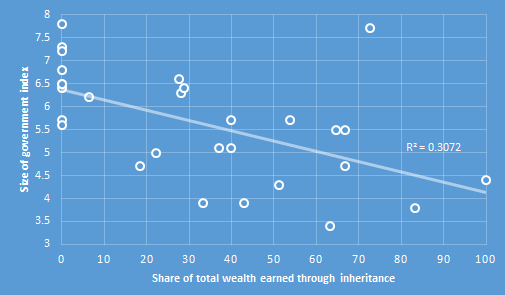
Using a working paper from the Peterson Institute for International Economics titled The Origins of the Superrich: The Billionaire Characteristics Database authored by Caroline Freund and Sarah Oliver and the Economic Freedom Index of the World produced by the Fraser Institute (released this week), we can check for the existence of this correlation. The paper by Freund and Oliver documents the share of the total wealth of billionaires that was earned through inheritance.

Unsurprisingly (for me), the lower the index for the size of government, the greater the share of wealth earned through inheritance. Using all OECD and European countries, we can very well see that the size of government is negatively correlated with the share of wealth from inheritance. untitled

Maybe, just maybe, those who believe that the solution to rising inequality is more government redistribution should be willing to reconsider their proposed cure. This is, I believe, an additional cause for skepticism regarding remedies.

Some afterthoughts on Rio Paralympics

Paralympics are over, and with them the cycle of Olympic Games in Rio de Janeiro. Once again the city was able to put up a good show, and thankfully all went well in the Cidade Maravilhosa. But not everything is alright in Rio: even more than the Olympics, the Paralympics were able to show the contradictions between the city where we live everyday and the city of the event: Rio is not welcoming for people with disabilities.

At least in Brazilian Portuguese, political correctness has done a mess with vocabulary concerning the kind of people who compete in Paralympics. We are not supposed to say they are disabled (don’t even think about saying they are crippled!). I think the correct vocabulary today is, as I used, “people with disabilities.” But even that is under political correct scrutiny, so it seems. All this discussion about words springs from cultural Marxism, postmodernism, relativism and the belief that there’s nothing objective beyond our vocabulary. But words can’t hide the reality: Rio is unequal. The way it treats the blind, the lame, and even the elderly or the young, is completely different from the way it treats people in middle-age and more able to walk. And all that despite strong legislation in this area.

One of the greatest debates in political philosophy in the 20th century happened between American philosophers John Rawls and Robert Nozick. Trying to build on classical liberal foundations (but moving to egalitarian liberalism), Rawls pointed out that “equality was supposed to be the moral benchmark for social and political institutions, and that any deviation from equality had to be specially justified.” Nozick answer was that liberty upsets patterns. Even if we have a starting point in society where we have a perfectly equal distribution of goods or assets, the moment that we allow people to be free to make their own choices (as liberalism prescribes) they are going to make choices we cannot possibly predict, and these choices are going to upset any kind of pattern we established in the first place. That happens because each one of us is unique in its own right: each one of us have a specific set of values, preferences and circumstances that upsets any would-be planner. So, if you want to respect human liberty to make choices, you have to give up on any plan for material equality.

Nozick’s answer to Rawls has a lot of Adam Smith in it. In The Theory of Moral Sentiments (1759) (preceding the more famous Wealth of Nations both in time and argument) Smith presented a character called “man of system.” This person sees society as an architect sees a blueprint for a construction. Smith says such person is “apt to be very wise in his own conceit; and is often so enamored with the supposed beauty of his ideal plan of government that he cannot suffer the smallest deviation from any part of it.” The problem is that humans have free will, the ability to make choices. And as such, they will upset any blueprint prepared for them. In other words, “individual people are not chess pieces you can move on a board with their dreams and desires ignored.” To the eyes of the would-be planner, “society must be at all times in the highest degree of disorder.”

So, material equality of outcomes (or at least of opportunities) is totally out of reach? Should we disregard it completely? Should the “invisible hand” prevail in spite of the weakest in our society? I don’t think so. Just the opposite! One of the very reasons I find classical liberalism morally appealing is the fact that no economic or political system ever conceived helps the weakest as it does. In other words, contrary to (what seems to me is) the popular belief, classical liberalism defends social justice more than any of its intellectuals alternatives. Answering John Rawls’s famous claim that “a just society will be one whose rules tend to work to the maximum advantage of the least well-off classes,” Friedrich Hayek pointed out exactly this. In The Constitution of Liberty, Hayek agreed with Rawls about the end at which social institutions should aim: the welfare of the least advantaged. He simply disagreed about the means Rawls thought would get us there.

Instead of thinking of us as chess pieces on a board, when can use the analogy of a soccer game (or football, or basketball – suit yourself). The outcome of the game is the result of the player’s individual abilities, but it is also the outcome of the rules. In other words, in a free society, where people are free to choose, the outcomes are not just the result of the innumerable decisions of countless individuals. They are also the result of the rules enforcing property rights, contracts, taxation, and so on. So, it’s important to think about the justice of these rules, as well as the outcomes they might have. The point is that we can embrace a theory of social justice, but that just tells us the end we are heading to, not the means to get there.

Contrary to egalitarians, progressivists and socialists claims, no theory “tends to work to the maximum advantage of the least well-off classes” as classical liberalism does. And that’s a great reason I support it. As I said in the beginning, Rio is very unequal, despite decades of egalitarian policies in the city and in Brazil as a whole. On the other hand, there’s plenty of evidence that classical liberal policies tend to help the very people others accuse it of ignoring. When it comes to doing social justice, it’s important to have not just the heart, but also the mind in the right place. And I believe classical liberal policies are this place.

References:
What’s Right about Social Justice?
Rawls and Nozick on Liberty & Equality
Adam Smith and the Follies of Central Planning
Fight of the Century

Trump for president?

I will vote for Gary Johnson knowing full well my vote doesn’t matter, since Hillary has a lock on California. But between Trump and Clinton, whom to root for? Trump is an empty suit with a filthy mouth. Clinton is pure evil, hell-bent on extinguishing what remains of our freedom and prosperity. Fascist dictatorship is her goal, draped in red-white-and-blue bunting. Will someone please write an update of the Sinclair Lewis novel, “It Can’t Happen Here”?

Forced to choose, I’d have to go with Trump. His election would be a much needed kick in the teeth to the Eastern establishment. We would have to hope he would listen to cool-headed advisors once in office. Or maybe get bored and resign.

But as I write, I remind myself that there is precious little any president can do, even Gary Johnson, to alter major trends that have so much momentum. You can recite the list as well as I can: government debt and unfunded liabilities, nuclear proliferation, race and class divisions, climate change hysteria to name a few.

To hell with them all. I’m going outside to enjoy the sunshine while I can.

A short note on minorities and the Left

Lately I have been thinking about how minorities affect the Democratic Party here in the US. Basically, all minorities vote for the Democrats in national elections, but minorities tend to be conservative culturally. This has the effect of pulling the Leftist party waaaaay to the center (a fact that makes it hard for me to complain about Democrats’ pandering tactics).

Sure, the GOP will always be the party of old white people, but if the Democrats’ left-wing is essentially neutered due to minority voting blocs within the Party, who cares?

The fact that the Democrats pine for minorities explains why the US has never had a very powerful socialist movement. Socialists will often blame “neoliberals,” “capitalists,” “reactionaries,” and other assorted boogeymen, but doesn’t the minority insight make much more sense?

This minority insight has also got me thinking about demographic changes in Europe over the past 30 years. Basically, Europe has had a huge influx of immigrants since the fall of socialism. In the old days, Sweden was for Swedes, France was for the French, Germany was for Germans, etc. etc. This  mindset helps to explain why European states had such overbearing welfare states and why economic growth was so limited up until the late 1980s.

As immigrants moved into these welfare states, the Left-wing parties began to pander to them. This had the same effect as it did in the United States: culturally conservative voting blocs diluted the Leftism of traditionally Left-wing parties. As a result, these welfare states became less robust and economic growth became attainable again.

A big underlying point about my musings on this subject is that socialism relies on nationalism in the area of popular politics and policymaking. Without Sweden for the Swedes-type sloganeering, socialism becomes ridiculous to the masses. This underlying point, along with the straightforward fact that immigrants dilute socialist power (economic, political, and cultural), suggests to me that libertarians who pay close attention to popular politics should relax when it comes to the fact that minorities don’t find libertarian ideals all that appealing.

Minorities and Economic Growth: Evidence from Jewish Communities in Premodern Europe

Urban theorist Richard Florida is celebrated for arguing that cities today succeed by attracting members of the “creative class.”  In a similar spirit I have a recent paper with Noel D. Johnson where we investigated whether or not cities in medieval and early modern Europe grew faster if they possessed a Jewish community.

Scholars have long noted the role of minority groups in economic development. This is particularly true for the the premodern period. The great scholar of long-run historical development in Europe, Fernand Braudel, observed that “successful merchants who controlled trade circuits and networks often belonged to foreign minorities.” These minorities could be other nationalities or religious minorities, for example, “the Jews, the Armenians, the Banyans, the Parsees, the Raskolniki (Old Believers) in Russia or the Christian Copts in Muslim Egypt” (Braudel, 1979, 1982, 165).

Hornung (2014) studies the impact of the Huguenot migration to Prussia. Since the nineteenth century, scholars like Friedrich List linked the presence of Huguenots with the transmission of human capital, skills, and innovation. Hornung (2014) is able to test this hypothesis using Prussian immigration lists from 1700 that document the location of Huguenot settlements and firm-level data on input and output for all 750 textile manufactories in Prussia in the year 1802. Approximately 16,000 to 20,000 Huguenots fled France to Prussia at the end of the seventeenth century.  Hornung finds that the presence of Huguenots significantly increased firm productivity. Specifically, a 1 percentage point increase in the share of Huguenots was associated with 1.5 percentage points higher productivity in 1802.

Jewish Communities and City Growth

In our paper we take a broad sweep of European history from 1400 to 1850.  We have a total of 1,792 cities in our panel data from the Bairoch (1988) dataset and 1,069 Jewish communities that appear in the Encyclopedia Judaica. The figure below shows both the cities in the Bairoch dataset and the Jewish communities mentioned in the Encyclopedia Judaica.


bairochandjewishcitiesgreyscale

To understand the relationship between the presence of a Jewish community and subsequent city growth we conduct a difference-in-differences style regression analysis.

The fact that we have data on city populations every century means we can hold constant the identity of a city using city fixed effects and see whether or not it grew faster in the centuries when it had a Jewish community in comparison to those centuries when it did not. We can also control for the possibility that overall city growth was faster in some centuries in comparison to others using century fixed effects.

We are also able to hold constant other factors that could plausibly have affected city growth. We control for local geography including cereal suitability, proximity to rivers, and proximity to coast, as these factors likely affected city growth in different ways over time. We also control for local infrastructure including presence of university and distance to a medieval trade route.

Our  analysis suggests that, indeed, cities with Jewish communities grew faster on average between 1400 and 1850. The effect we find suggests that cities with Jewish communities grew about one third faster than those that did not have Jewish communities. This analysis remains a correlation, however. We do not know if the presence of a Jewish community brought with it economic benefits or if Jews merely choose to settle in faster growing cities.

Instrumenting the Presence of a Jewish Community

We model the network of Jewish communities as one way to see whether the effect of Jews on city growth was indeed casual. By examining how Jewish communities expanded we hope to isolate a source of exogenous variation in the presence of a Jewish community.

We assume that a Jewish community is more likely to be established close to another Jewish community because of trade networks, financial relationships, or cultural linkages. We then calculate the closest travel path between Jewish communities using our information about the location of roads and river networks and estimates of premodern transport costs. The important assumption we make is that if cities with Jewish communities share certain “unobservable” characteristics that might make them more likely to grow rapidly, these characteristics become less correlated with distance.

We then divide Europe into 5km x 5km grids and assign the lowest travel cost to each grid. We apply Djikstra’s algorithm to determine the lowest cost of travel between all 3,211,264 city pairs (van Etten, 2012). This allows us to create a measure of ‘Jewish network access’ for each city.

Jewish network access itself is, of course, correlated with the unobservable characteristics of the city for which it is calculated. To overcome this we adopt two strategies to create valid instruments out of the network access measures. First, we calculate Jewish network access for cities that are only more than a certain distance away from each other. Second, we use information on expulsions to weight our measure of Jewish network access. The intuition behind this is that Jewish expulsions consist of an exogenous “push” factor leading to Jews settling in new cities close to the existing network of Jewish communities. Using these two strategies we obtain similar (though larger in magnitude) effects from the presence of a Jewish community on city growth. This provides further suggestive evidence that the correlation we found in our baseline analysis was indeed causal.

The Relationship Between Urban Growth and the Presence of a Jewish Community Over time

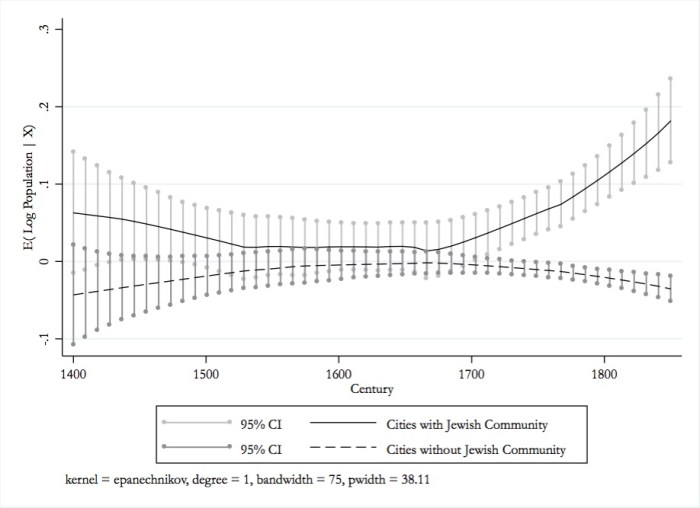
Across specifications, we find that cities with Jewish communities experienced no growth advantage in the 15th and 16th centuries. After 1600, however, they began to grow significantly faster.

motivationlpoly

The relationship we observe in the Figure does not appear to be inline with a pure human capital story. Jews had higher human capital than Christians throughout the medieval and early modern period. But the growth advantage of cities that had Jewish communities only became evident after 1600. This raises the possibility that something else changed around  17th century that made the human capital and skills of Jews more complementary to economic growth.

Two Mechanisms: Jewish Emancipation and Market Access

The two factors that stand out in explaining the emergence of a growth advantage for cities with Jewish communities after 1600 but not before are: (1) Jewish Emancipation after 1750; and (2) a complementarity between the presence of a Jewish community and market access.

The process of Jewish emancipation began in continental Europe after 1780. It was a major institutional break that signified a major change in the economic, social, and political status of the Jews in Europe. In work with Jean-Paul Carvalho, I’ve shown that Jewish emancipation lead to a religious schism and the emergence of both Reform and Ultra-Orthodox Judaism.

In the period before Jewish emancipation, legal barriers limited the ability of Jews to put their labor to its highest value use. Jewish businesses were prevented from hiring non-Jewish workers. Jews could not attend universities. Moreover, Jews and Christians were culturally isolated. This changed with emancipation, and we expect to see it reflected in the contribution of Jewish communities to city growth in the post-1750 period.

The second factor we study is the complementarity between the presence of a Jewish community and the development of markets. The historical literature points to the importance of Jewish trading and financial networks. But, while economic historians have conducted numerous studies of market integration during the early modern period, with a few exceptions these have focused on the grain trade with little systematic study of other markets due to data limitations. Jewish merchants in medieval and early modern Europe, however, did not play a prominent role in the grain trade but, rather, were involved in the transport of diamonds, sugar, silks, tobacco, and other luxury products in addition to playing a large role in banking and finance. Therefore, rather than looking at grain markets, we explore a more general measure of market integration based on market access.

Market access depends on the population size of nearby cities weighted by the cost associated with the least cost travel path. We show that market access was increasing for all cities after 1700. We find evidence that cities with Jewish communities were better able to take advantage of this increase in market access. As we detail in the paper, our findings are consistent with the argument made by numerous historians that Jewish trading and finance networks help to knit together the European economy, particularly in the period 1650 to 1800 (Israel, 1985).


Our analysis provides support for the accounts of historians who have emphasized the important role played by Jewish traders in 17th and 18th century Europe (such as Fortune, 1984; Israel, 1985; Trivellato, 2009). Furthermore, our story is in line with institutional arguments such as those developed by Douglass North, John Wallis and Barry Weingast, and Daron Acemoglu and James Robinson.  In the Middle Ages, the presence of Jewish communities was part of an institutional arrangement that extracted rents from society and distributed them among members of the ruling elite. The eradication of these rent-seeking arrangements and the liberalization of Jewish economic activity, first in the Netherlands and England and then in the rest of Europe following Jewish Emancipation, was of critical importance as it is in those cities that possessed emancipated Jewish communities that we observe the strongest relationship between the presence of Jews and economic growth.

Alguns mitos, equívocos e objeções comuns ao capitalismo

No meu último post ofereci uma definição de capitalismo baseada nos conceitos de escolha pessoal, trocas voluntárias, liberdade de competição e direitos de propriedade privada. Em resumo, um capitalismo liberal ou uma sociedade de livre mercado. Neste post eu gostaria de começar a desfazer alguns mitos, equívocos e objeções comuns ao capitalismo (se entendido nos termos que defini anteriormente). A lista não é exaustiva, mas acredito que cobre bastante terreno da discussão. Aí vai:

  1. Ser pró-capitalismo é ser pró-grandes corporações.

Adam Smith observou que empresários dificilmente se encontram para eventos sociais, mas que quando se encontram não conseguem evitar combinar meios de evitar a mútua concorrência. Empresários (especialmente donos de grandes corporações) tendem a não gostar de concorrência. É compreensível. A maioria de nós também preferira não ter colegas de trabalho com quem competir, assim como vários corredores hoje gostariam que Usain Bolt não existisse. O capitalismo liberal, no entanto, é um sistema de perdas e ganhos. Numa economia verdadeiramente livre de intervenção do estado é improvável que corporações se tornem desproporcionalmente grandes. A tendência é ao nivelamento.

  1. O capitalismo gera uma distribuição de renda injusta

Uma das grandes objeções ao livre mercado é a desigualdade de renda. No entanto, nenhum sistema econômico na história foi tão eficiente em retirar pessoas da pobreza quanto o capitalismo. Numa economia verdadeiramente livre a desigualdade existe e é basicamente inevitável, mas não é nada quando comparada a sociedades que optam pelo controle estatal da economia. China, URSS e Cuba são os países mais desiguais da Terra.

  1. O capitalismo é responsável por crises econômicas, incluindo a mais recente

A crise de 2008 foi causada por intervenção do governo norte-americano nos setores bancário e imobiliário. Sem intervenção do governo, instituições financeiras teriam um comportamento mais cuidadoso e a crise seria evitada. A mesma observação vale para basicamente qualquer crise econômica dos últimos 200 anos.

  1. Capitalismo explora os pobres

A livre concorrência, por definição, não é um sistema de exploração. Quando eu pago cem reais por um par de sapatos, isso significa que eu valorizo mais o par de sapatos do que os cem reais. O sapateiro, por sua vez, valoriza mais os cem reais do que o par de sapatos. Isso não quer dizer que não existam vendedores inescrupulosos, ou que não existam compradores injustos. Mas numa sistema de livre concorrência as possibilidades de fraude são mitigadas justamente pela concorrência: se o produto ou serviço não agrada ao consumidor, há sempre a possibilidade de procurar a concorrência. Em resumo, no capitalismo o consumidor é rei. Para concluir este ponto, apenas uma observação: o salário é nada mais do que o preço que se paga pelo trabalho de uma pessoa. E as mesmas observações se aplicam.

  1. Capitalismo é injusto

Algumas pessoas nascem com deficiências. Algumas pessoas nascem em famílias pobres ou desestruturadas. Isso é injusto? Por quê? Uma definição clássica de justiça é “dar a cada um o que lhe é devido”. O que nós é devido? O que nós merecemos? Eu merecia ter nascido com boa saúde? O que eu fiz para merecer isso? Estas perguntas facilmente nos levam a grandes indagações filosóficas e teológicas, e logo demonstram o quanto a acusação de injustiça numa economia livre é superficial. Ainda assim, nenhum sistema político ou econômico permite a ajuda aos desfavorecidos como o capitalismo. Se você considera injusto que existam pessoas sem dinheiro, sem saúde ou sem famílias estruturadas, sugiro que seja coerente e use mais do seu tempo e dinheiro para ajudar estas pessoas. 

  1. Capitalismo não traz felicidade

Pensando num sentido aristotélico, felicidade possui significados diferentes para cada um. Para um cristão significa ter um relacionamento pessoal com Deus através de Jesus Cristo. Provavelmente um não cristão não irá concordar com este conceito de felicidade. Dito isto, a liberdade econômica não tem como objetivo trazer felicidade para qualquer pessoa, e assim é injusto culpá-la por algo que não propõe fazer. Porém, dentro de um sistema de liberdade econômica a tendência é que a liberdade para a busca da felicidade também esteja presente. Além disso, com liberdade econômica é mais provável que consigamos buscar nossa felicidade através da criação de uma família, do envolvimento com instituições religiosas, ou mesmo ficando ricos simplesmente.

  1. Capitalismo não é estético e é poluidor

Os países mais poluidores do século 20 foram URSS e China. Proporcionalmente ao tamanho da sua população, EUA está longe do topo desta lista. Quanto ao fator estético, sugiro pesquisar por imagens da Alemanha Ocidental e da Alemanha Oriental, ou da Coreia do Sul e da Coreia do Norte. Dizem que a beleza está nos olhos de quem vê, mas me parece bastante óbvio que esta acusação estética é simplesmente falsa.

  1. Corporações são cheias de escândalos e extorsão

Com certeza elas são. Mas possuem o mesmo nível de corrupção de governos? A matemática é bastante simples: quanto mais governo, mais corrupção. Além disso, com uma corporação é possível simplesmente levar o dinheiro embora dali. Governos não são tão permissivos com evasão de impostos. A proposta de criação de mais sistemas de vigilância governamental apenas aumenta o tamanho do governo e as possibilidades de corrupção. A ideia de transparência e de consulta popular também é simplesmente falsa: a não ser que possamos passar 24 horas de nossos dias vigiando os governantes, estes sistemas simplesmente não terão possibilidade de funcionar. A solução mais simples continua sendo menos governo.

Há mais alguns tópicos que podem ser acrescentados e que deixarei para um futuro post. Por enquanto basta dizer que capitalismo (definido como livre mercado) pode ser bastante diferente daquilo que popularmente se entende.

Para saber mais:

https://www.youtube.com/watch?v=KGPa5Ob-5Ps

https://www.youtube.com/watch?v=ZgiLF48w7uQ

Immigrants’ Complaints

I can’t watch or listen to the liberal media without hearing reports of immigrants complaining about how badly they are treated by the wider American society. (Yes, I listen to National Public Radio nearly every afternoon. It’s my intellectual duty and also my secret vice.) Something does not add up in the oppressed immigrant narrative though. First, before I explain, forgive me in advance because I am about to transgress on good manners in two different ways.

First transgression first. I spent much of five years of my youth in graduate school learning not much more than the following: My own experience, basically a collection of anecdotes, proves nothing. Point well taken. But the anecdotes within my reach can sometimes pile up to the point that they make some questions unavoidable. Below is one such question.

I know many immigrants, and different kinds of immigrants. First, like everyone else who lives in California, I know many Mexican immigrants. I understand Spanish perfectly. (I mean, as well as English; you be the judge.) I speak it well because, like French, my native language, it’s just a dialect of Latin. I hang around the abundant Spanish language media often. If Mexican immigrants complained, it would have come to my attention. I only remember one such case, a young woman who had come to this country as a child. She confided that she thought my colleagues, her professors, favored “Caucasians” in grading. She was actually failing because her English was poor. I made her do an assignment in Spanish and I understood why she was frustrated. My colleagues were not unfair to her. Her English language self’s IQ was stuck at room temperature  (in F degrees) while her Spanish self must have been jumping around the 120 mark. No one had bothered to tell her the obvious: “You need to learn English better.” Not American society’s fault, except for having tolerated her without adequate language training, and for the university that had admitted her, ditto. (Incidentally that school’s affirmative action program was a success overall, I thought.)

The foreign-born Hispanics I know and meet are all in a wonderful mood in public. Of course earning in one hour what would take you a day in Mexico and two days in El Salvador would put anyone in a good mood. There are three or four bastards of them, Hispanics, who force me to wake at 6 every morning because they walk under my window guffawing and laughing loudly. As I have written elsewhere, on this blog, the evidence for Hispanics’ satisfaction is easy to find.

I also know Asian and European immigrants, who are mostly middle-class, and a handful of Middle Easterners. The latter, mostly Muslims, feel under siege, of course; it would be a miracle if they did not. It’s not really American society’s fault that nearly all the mass murderers of civilians in recent years insisted on shouting “Allahu Akbar.” Yet, even those immigrants sure as hell are not packing their bags, or, if they do, it’s in minute numbers. I would bet there is no exodus out of the country.

The Asian and Europeans I know tend to exult in their American residence; they often act smugly about it although all of them miss something from their country of origin, at least their relatives. (For me, it’s not so much relatives as blanquette de veau; look it up.) Nevertheless, many of those middle-class immigrants find a political home on the left of the American spectrum because they have never been exposed to the ideal of small government. Even the smart ones usually don’t realize that government is a predator. More anecdotic transgression: If I ask myself who seems to be happier, on the average of those I meet more or less daily, immigrants or native born Americans, the answer comes loud and clear: the immigrants.

So, I am seriously beginning to consider if the reporting of widespread complaints by immigrants is not fabricated, with the help of a handful of fairly sophisticated minority members of the media. I mean, for example, the blond, lying CNN Mexican-born anchor who can’t open his mouth without proffering a vicious untruth.

Here is my second violation of convention. I am only doing it because being an immigrant gives me special privileges (and being old also does). If there are really, really many immigrants with serious grievances I don’t worry much because they are all citizens, citizens of some other country, that is. It seems to me, most of them could pack up and leave and go home to where they are citizens. That’s except for the refugees from war. The latter don’t have much of a leg to stand on however. Whatever shortcomings American society has, at least, here, we don’t kill you on purpose unless we know you personally.

That’s a real advantage.

I wish we had a national program to pay for one-way tickets for disgruntled immigrants. It might not even require taxpayer money. There must be tens of thousands like me. I give money voluntarily to save tigers in the wild. Sending back bad immigrants into the wilderness is a good cause too. So, it could be done by free public subscription. Or this country could institute a small tax on in-coming immigrants to constitute a fund that finances one-way tickets on demand. It would be fair, like an assigned risk insurance pool is fair. My guess is that it would be one of the few government programs that does not overspend its budget. It would have, at least ,the merit of putting an end to the BS* in the liberal media.

Ah, but the Democratic Party won’t allow it! It would never permit such practical innovativeness because malcontents are its bread and butter.

Incidentally, the ambitious guy inside me wonders if we couldn’t have a second one-way ticket program, one for native-born Americans who hate America. Of course, I am thinking only about a voluntary program. It would have the merit of ranking all the dissatisfied who don’t avail themselves of the offer of  a one-way ticket as at least moderately satisfied. It would stop some of the implicit blackmail of America. It’s not a cruel proposal, I think the Canadians would take them.

* Note for my overseas readers: B.S. are the discreet initials for “bullshit” a colloquial term for an argument without merit. It’s unfair to bulls  that mostly mind their business and don’t argue much.

Liberals and Conservatives should stop talking about guns

I’ve come across some great journalism on guns and gun control recently. Here’s the key points:

  • Most gun deaths are suicides. Many of these suicides would have happened were a gun not available, but many of them wouldn’t have.
  • Most gun homicides mostly affect young black men.
  • More guns does not equal less crime.
  • Gun accidents affect very few people.
  • Cost-benefit analysis would likely suggest improving safety other places would save more lives, given limited budgets. (e.g. changing attitudes on vaccinations)

A basic theme seems to be that government can do little on the margin to reduce gun deaths. Crime rates are uncorrelated with number of guns, or regulations in place. Upright citizens do not turn into Rambo when they see dastardly criminals mug little old ladies. Guns are actually sort of boring in practice.

It’s possible that the government could affect gun deaths with a comprehensive gun control policy backed by public opinion (the Australian option). But it would likely cost so much that you’d lose the budget and/or political capital to enact other reforms that would be less controversial and save more lives.

MrPB-prince-Cordova-one-of-amendments.png
We don’t torture people in America, Todd. That’s called one of the amendments.

What about the second amendment? The real argument for the second amendment is that having armed Americans around is pretty practical in general, but also important to prevent tyranny. In practice, guns aren’t half as practical, in terms of personal or national defense as back then. The capability of America’s military is so extraordinary that American’s don’t stand a chance of fighting a corrupt American government.

Let’s acknowledge that the Bill of Rights, though surely important, is ultimately a piece of paper that is neither sacrosanct nor a practical guarantee of anything in particular. The founders were brilliant, but fallible. The constitution is frequently ignored by governments, and citizens often do little to discipline such governments. Second amendment advocacy is mostly a symbolic gesture that probably comes at the expense of using political capital to protect the fourth amendment (the one that should protect you when the government decides to take your guns, cold dead fingers or no).

Conclusion

There are weak arguments to made in favor of gun control and weak arguments to be made in favor of protecting the second amendment. But mostly this whole debate seems like a distraction from more important issues. Symbolically valuable? Sure, but at what cost? The cost is the political will to make a bigger difference somewhere else. There are more valuable freedoms to protect, better interventions to pursue, and more lives to be saved.

BC’s weekend reads

  1. Doug Bandow on Australia’s geopolitical options
  2. The moral perils of Being Polish
  3. The moral perils of sect-coding (Shi’a forces, Iraqi armed forces)
  4. Can the militarization of the police in the US be a good thing?
  5. Warfare and economic growth in the preindustrial world

O que é capitalismo?

O Brasil é capitalista? O capitalismo é culpado por vários problemas que observamos no Brasil? E outros países? A China é hoje um país de economia capitalista, ainda que com política socialista (ou comunista)? O capitalismo prejudica os mais pobres enquanto beneficia os mais ricos? Estas são algumas questões com as quais me esbarro regularmente. Algumas pessoas mais sofisticadas observam que não há apenas um capitalismo, mas vários: o capitalismo brasileiro é diferente do sueco, que é diferente do japonês, que é diferente do norte-americano, e assim por diante. Vejo alguma pertinência nesta observação, mas penso que ela ainda deixa de lado a questão mais básica e fundamental: o que é capitalismo?

Suponho que sem recorrer a qualquer fonte podemos concluir que capitalismo é algo relacionado a capital. Segundo o Palgrave Macmillan Dictionary of Political Thought, de Roger Scruton, “o capitalismo é um arranjo econômico, definido pela existência predominante de capital e trabalho assalariado”. De acordo com esta definição, no capitalismo alguns ganham salários e outros ganham lucros. Capital por sua vez é definido como “os meios de produção produzidos, ou seja, commodities que foram produzidas e que por sua vez podem ser empregadas na produção de outras commodities”. Em outras palavras: capital são recursos que são empregados na produção de mais recursos. Capitalismo é um sistema econômico (e não predominantemente político ou social ou cultural) que gira em torna da alocação destes recursos.

Partindo de uma forma de pensar semelhante, Milton Friedman observou que todos os países são capitalistas. Os EUA são capitalistas. A China é capitalista. A URSS é capitalista (Friedman estava fazendo esta observação ainda no período da Guerra Fria). Não há país (ou sociedade) onde não haja capital e onde não ocorram decisões sobre como alocar o capital. Há bastante tempo Max Weber fez uma observação semelhante, afirmando que alguma forma de capitalismo esteve presente em todas as civilizações, com a diferença que mais recentemente o Ocidente produziu um capitalismo moderno, com características peculiares. Mas voltando para Friedman: todos os países são capitalistas. A questão é: quem controla o capital?

A pergunta de Friedman lembra uma observação de Friedrich Hayek: durante o período da Guerra Fria era comum afirmar que a economia da URSS era planejada, enquanto que a economia dos EUA não era. Mas esta afirmação está errada: ambas economias eram planejadas. A da URSS por um pequeno grupo de pessoas em Moscou; a dos EUA por milhões de indivíduos espalhados pelo país. O ponto de Hayek é que uma economia necessariamente envolverá decisões sobre como alocar capital (ou recursos). A questão é: quem tomará estas decisões? Um grupo de governantes num comitê centralizado, em nome de toda a população? Ou a própria população, numa esfera mais modesta, dentro de suas próprias vidas?

Adam Smith é popularmente considerado o pai do capitalismo (e também da Economia como disciplina acadêmica, além do liberalismo econômico. Adam Smith teve muitos filhos). Curiosamente, Smith não usou o nome capitalismo em seus escritos (este nome seria cunhado mais tarde por marxistas – o próprio Marx também não usou este nome, ao menos não regularmente), mas falava sobre sociedade de mercado. A observação de Smith era que em tempos recentes mais pessoas estavam se tornando mercadores. Em tempos antigos (sobretudo na Antiguidade Clássica de Grécia e Roma) as relações econômicas eram dominadas por donos de terras e escravos. Havia mercadores (ou comerciantes), mas estes ocupavam um espaço menor na sociedade (e também eram vistos com desconfiança por não produzirem nada – apenas trocarem o que outros produziram). Na Inglaterra do final do século 18 mais pessoas eram comerciantes, isto é, trocavam alguma coisa, ainda que “alguma coisa” fosse sua força de trabalho em troca de salários. Neste sentido, Smith não inventou o capitalismo moderno: apenas observou e descreveu seu nascimento – além de suas vantagens diante de outros arranjos econômicos.

Partindo de Adam Smith e chegando a Friedman e Hayek, podemos observar quatro elementos fundamentais do capitalismo moderno (ou do liberalismo econômico, ou as sociedade de mercado, ou do livre mercado): escolha pessoal; trocas voluntárias; liberdade para competir em mercados; direito de propriedade privada. A escolha pessoal se refere às decisões individuais que se toma a respeito dos recursos individuais (devo sair para trabalhar hoje? Ou devo ficar em casa?). Trocas voluntárias se refere ao fato de que posso livremente trocar meus recursos com outra pessoa que queira fazer o mesmo (havendo uma coincidência de vontades). Liberdade para competir significa que posso oferecer meus serviços (ou produtos, ou talentos) e aguardar que haja interessados. Propriedade privada se opõe a propriedade coletiva ou comunal, geralmente sob controle do estado.

Uma forma mais direta de sistematizar a teoria de Smith (e neste ponto de Friedman e Hayek) é dizer que no livre mercado a propriedade é privada (e não coletiva ou comunal) e o trabalho e assalariado (e não escravo). Mais simples ainda, o livre mercado opera pela máxima de “não faça aos outros o que você não gostaria que fizessem com você”, ou “não mexa com quem está quieto”. No livre mercado os indivíduos são livres para fazer trocas voluntariamente com outros indivíduos – que queiram voluntariamente fazer estas trocas, havendo coincidência de vontades.

Há muitos economistas que consideram que a sociedade de mercado é mais um tipo ideal do que uma realidade. Alguns países estão mais próximos desta ideal do que outros, e neste sentido é válida a observação de que há variedades de capitalismo. O capitalismo praticado no Brasil (ou na China) não é (nunca foi e nunca chegou perto de ser) o capitalismo liberal descrito ou almejado por Smith, Friedman e Hayek. O capitalismo praticado nos EUA está mais próximo disso, embora esteja num franco afastamento deste ideal há várias décadas.

Saber o que é capitalismo é um primeiro passo para sabermos se este é um modelo que desejamos ou não. Pretendo nos próximos posts continuar este assunto. Por ora, digo apenas que quando falo a respeito de capitalismo estou pensando na sociedade de mercado descrita ou almejada pela tradição liberal. Caso o que temos no Brasil seja capitalismo, certamente não é este capitalismo que defendo.