Fourteen-Year Old Girl in Bikini Threatens Armed Cop

For those of you, my conservative friends, who believe police brutality is just a collection of deliberate made up tales, there is a video on the major cable networks today I hope you see.

It shows a normal size adult in a blue or black uniform putting his knee in the back of a fourteen-year old girl in a bikini to force her down. The girl is crying out for her Mamma. The same cop then draws his gun on a couple of teenage boys in swim shorts who are trying to help the girl. There are other teenagers around, all in swimming attire where one couldn’t hide a weapon. Does the cop think they are going to gang up on him and beat him to death? It’s difficult to see how his life is threatened. In fact, it’s impossible.

A private person gave a pool party on a hot day. Although I understand it took place in a semi-public pool, it was by invitation only. Predictably, some teenagers tried to crash the party. Someone called the police. At that point no blows had been struck; there may have been no violence. I say “may” because, according to some reports but not all, some girls had been pulling one another’s hair. The horror! Cat fights used to be considered free entertainment. The cops who first arrived felt out of their depth and apparently lost their cool and quickly became the worst threat to citizens‘ safety anywhere around.

This is the point where the media and everyone should ask the obvious question:

Suppose the cop had retreated and done nothing? What would be the worst case scenario. Answer 1: Uninvited teenagers swimming in a public pool that had been reserved. Answer 2: Possibly some hair pulled off. (When was the last time a teenage girl did serious damage to another with her bare hands? The stereotype is right: Girls don’t know how to fight.)

Is there an alternative universe where avoiding these calamities is worth brutalizing a young girl and pulling a gun on boys in bathing suits?

Is it even likely that the use of pepper spray was justified? Yes, I am double-guessing the cops on the scene. It’s becoming easier thanks to amateur video. If the cop who pulled his gun is unable to restrain himself or if he does not have the good judgment to do it, he shouldn’t be in charge of protecting us. Yes, that simple!

Was what I saw on the video a racial incident? I don’t think so although the main cop was white and the teenagers black. Likewise, when I see a white man sell a used tool to a black man at the flea market, I don’t think of it as a “racial transaction.” The assertion that white cops kill black men because white cops (and society in general) are racist is a simplistic idea invented and sustained by the scum sliver fringe of the dying civil rights movement to prolong its unearned privileges (including not paying millions of dollars in owed taxes).

I won’t believe that racial animus presides over the shooting of black men or any other kind of brutalization of black people by police until I see appropriate comparative figures: How many whites shot by white cops, how many blacks killed by black cops, etc. This would have to take into account the superior propensity of black to commit crimes. The number exists; the study is not difficult to do; any sociologist, any statistician could do it. The fact that it has either not been done or not publicized speaks to me of massive censorship, or self-censorship, of paralyzing political correctness.

The cop who put his knee in the middle of the back of a fourteen-year old girl may not be a racist; as I said; I think he is probably not. He just should not be a police officer. Given that he is a veteran, it’s not his training that’s defective, it’s him. Perhaps he should not have ever been on any force to begin with. Perhaps he has been on the job too long. If it’s the latter, I am guessing union rules prevent his superiors from doing anything about it or even from noticing that something is awry with that guy. Whatever is the case, the man is not a protector, he is a public danger.

He does not belong on the street with a gun but working in a church basement at something innocuous. His working buddies could be, for example, young women who think a smile is sexual harassment and a tap on the shoulder, rape. They deserve one another.

And, I can already hear it from my conservative friends: Peace officers have a tough job, blah, blah! You have to understand, blah, blah! Not so; the market tells the truth. There is is no shortage of police recruits nationwide. People are flocking to the job. The California Highway Patrol is currently recruiting young interns. Candidates must have no drug conviction (which does not make much sense if you think about it). They must have at least a 2.00 GPA in high school. Let me think, with grade inflation that would be a D- or an F+?

In the meantime, the Santa Cruz Sheriff is offering $5,200 a month for trainees with an immediate raise following graduation from the police academy. High school diploma required, or an associate degree. (There are also tests but…) Good time to weed out the inept and the used up. Or, the selection standards could be changed: You might go easier on the brawn and become more demanding on self-control and on ordinary common sense.

And, by the way, I hate affirmative action but…. (I hate it because it gave us among other things, the current Fascist-leaning administration that is also inept.) Yet, I don’t have trouble imagining that female cops may possess a superior ability to defuse potentially explosive situations. I believe that, in daily police practice, there are many cases where small physical size and low testosterone are assets.

There is no – I repeat – no reason to tolerate police brutality. Conservatives are morally bound to distrust the government there too. It’s our constitutional tradition.

PS I have no animus against police officers. My father was one, a good one. In my whole life, I have only had two moving violations; one was for driving too slowly.

Creeping illiteracy in the media: I heard with my own auditory ears and saw with my own visualizing eyes an MSNBC commentator refer to a “canine dog.” It makes me hunker for a “feline dog,” or even for an “avian dog.” That would be cool. Fortunately, it was on MSNBC, not on Fox.

The Fog of Foreign Policy

The Fog of Foreign Policy: Why only ‘least bad’ options are available in Syria, Iraq and other global hotspots

rr4

Sound libertarian analysis, highly recommended!

Here’s why you should default on your student loans. And here’s why you shouldn’t.

This article popped up on my newsfeed the other day and I (as always) read the headline (“Why I defaulted on my student loans”), looked to see if it was posted by one of my sane or insane Facebook friends (no idea…), then promptly forgot about. Then I saw this response: “The New York Times Should Apologize for the Awful Op-Ed It Just Ran on Student Loans” (posted by a sane friend). Okay, let’s give this some thought.

Lee Siegel (of the first article) writes that he made some bad decisions and faced the prospect of either living a life he didn’t want, or defaulting on his obligation. The question then is “should more people follow his example?”

Choosing a major is essentially an entrepreneurial decision. You are investing in a set of human capital goods that you hope will provide a return in the future sufficient to justify the cost of the investment. One thing we know about entrepreneurship is that it usually fails. We also know that this failure is often not socially wasteful but simply a cost of experimentation. America was lucky to end up with a system of bankruptcy that is uniquely easy on defaulters… why lucky? Because it turns out that this system meant to merely shift resources towards farmers also allows entrepreneurs to quickly dust themselves off and get back to work on their next experiment. Some turn out to be brilliant and ultimately outweigh the costs of past failures.

But this wasn’t what Siegel was advocating. His decision was to not pay his debt but to stay in the line of work he trained for. His thinking was “sunk cost, and now it’s someone else’s problem.” Yes, the higher-ed industry is screwy on all sorts of margins, and yes, he probably didn’t have great information beforehand. But rather than learn from his mistake, he simply ignored it.

Using bankruptcy to subsidize risky experimentation turns out to make sense in some cases (it’s hard to believe, but there it is). And this might be justified in some cases in schooling… it might be worth it to subsidize 100 post-secondary schools that try all sorts of crazy methods on the chance that we learn something useful from the experience. And I think we can justify defaulting on student loans that were made in fraudulent circumstances (“Hey Buddy, wanna get a degree?”). It might be sensible to allow loan forgiveness for students who get a degree in a field that turns out to be obsolete by the time they graduate… as long as it’s paired with a policy requiring student loan applicants to watch a 12 hour long video course on employment projections and labor economics.

We might even justify subsidies by partial loan forgiveness for students studying art or some other field that might generate positive spill overs–but if we do, the decision shouldn’t be left to those who already owe a lot of money for attending an expensive school. It’s not up to Siegel to determine that he should get a subsidy. He wasn’t suggesting walking away from his mistake and starting fresh, he was suggesting letting someone else pay for the cost of his mistake while he reaped the rewards.

If there’s anything to learn from Siegel’s decision, it’s that understanding costs isn’t a requirement for writing in high profile news papers and so we should be leery of policy advice given by journalists. I think the second article I linked to makes a compelling case that Siegel is a bum.

New issue of Econ Journal Watch is out

For those of you just tuning in to NOL, Fred is an editor for the journal, and Warren is its math reader.

Evolution, moral sentiments, and the welfare state: Many now maintain that multilevel selection created a sympathetic species with yearnings for social solidarity. Several evolutionary authors on the political left suggest that collectivist politics is an appropriate way to meet that yearning. Harrison Searles agrees on evolution and human nature, but faults them for neglecting Hayek’s charge of atavism: The modern polity and the ancestral band are worlds apart, rendering collectivist politics inappropriate and misguided. David Sloan Wilson, Robert Kadar, and Steve Roth respond, suggesting that new evolutionary paradigms promise to transcend old ideological categories.

Evidence of no problem, or a problem of no evidence? In 2009, Laura Langbein and Mark Yost published an empirical study of the relationship between same-sex marriage and social outcomes. Here Douglas Allen and Joseph Price replicate their investigation, insisting that conceptual problems and a lack of empirical power undermine any claim of evidence on outcomes. Langbein and Yost reply.

The progress of replication in economics: Maren Duvendack, Richard W. Palmer-Jones, and W. Robert Reed investigate all Web of Science-indexed economics journals with regard to matters concerning replication of research, including provision of the data and code necessary to make articles replicable and editorial openness to publishing replication studies. They explain the value of replication as well as the challenges, describe its history in economics, and report the results of their investigation, which included corresponding with journal editors.

A Beginner’s Guide to Esoteric Reading: Arthur Melzer describes techniques and devices used in esoteric writing.

Symposium:
Classical Liberalism in Econ, by Country (Part I): Authors from around the world tell us about their country’s culture of political economy, in particular the vitality of liberalism in the original political sense, historically and currently, with special attention to professional economics as practiced in academia, think tanks, and intellectual networks.

Chris Berg: Classical Liberalism in Australian Economics

Fernando Hernández Fradejas: Liberal Economics in Spain

Mateusz Machaj: Liberal Economics in Poland

Patrick Mardini: The Endangered Classical Liberal Tradition in Lebanon: A General Description and Survey Results

Miroslav Prokopijević and Slaviša Tasić: Classical Liberal Economics in the Ex-Yugoslav Nations

Josef Šíma and Tomáš Nikodým: Classical Liberalism in the Czech Republic

All the links are pdfs. The website is here.

Contra Argumentation Ethics

The proposition in argumentation ethics is that “arguing for any political position other than libertarian anarchism is logically inconsistent” (wiki).  This proposition was set forth in 1988 by Professor Hans-Hermann Hoppe of the University of Nevada at Las Vegas. The basic idea is that the non-aggression principle is a premise implied in every argument, and so it cannot be logically denied in any doctrine. The concept of argumentation or discourse ethics had been developed by several German philosophers, such as Jürgen Habermas.

The non-aggression principle is that aggression – the initiation of force or fraud against a person –  is morally evil. The argumentation proposition is that non-aggression is a presupposition of every argument, and so the concept cannot be logically denied within an argument. If a person argues that slavery is justified, the contradiction is that by engaging in argument with another person, he is implying that they are both seeking to arrive at truth by persuasion as equal independent non-slave parties. Since the person who argues for slavery is not using force to make the other person a slave, that implies that he is thereby rejecting slavery. It is then logically and performatively inconsistent for him to argue that enslaving any other person would be justified.

The prevailing argument for a libertarian ethic, based on natural moral law, is based on human nature applied to human action, rather than argumentation. The two premises set forth by John Locke in his Second Treatise of Government are human independence and equality.

Independence is the biological statement that persons think and feel as independent beings. Equality means that human beings have an equal moral worth, which is the basis of Jefferson’s statement that we are created equal, and is the basis of equality before the law. The equality premise is based on the observation that there is no inherent master-slave relation among human beings, and so equality is more consistent with human biology than any inherent moral superiority of any race, sex, or culture.

Hoppe states that concept of human nature is too diffuse to provide a determinate set of premises for natural law. Locke’s premises of independence and equality indeed have fuzzy edges, such as for beings not yet born, but they seem to be clear enough for practical purposes. Libertarians have no consensus on issues such as abortion, capital punishment, land value subsidies, the use of the military, and the justification of imposed government, but argumentation does not resolve such issues either. One needs additional premises to solve issues such as personhood, e.g. under which conditions is a human organism a person with rights. After all, one cannot have discourse with a newly born baby.

The concept of argumentation ethics has been rejected by several libertarian scholars, for example the article in The Journal of Libertarian Studies (Spring 2006) by Robert Murphy and Gene Callahan. They point out that at most, argumention establishes self-ownership only to one’s mind and mouth, and only during the argument. A slave owner can argue with a slave while the slave is in chains, and then murder the slave. The superiority of the slave owner is not refuted by the owner’s asking the slave whether he prefers to be strangled or shot with a bullet.

As pointed out by Murphy and Callahan, a statist may believe that under particular conditions, the initiation of force is justified, even though when this is discussed, the parties are equally in their ability to argue.

Another refutation was made by Jason Brennan in “Hoppe’s Argumentation Ethics Argument Refuted in Under 60 Seconds.” Brennan first presents two definitions. “A liberty right is something that grants me permission to do something. A claim right is something that entails others have obligations, responsibilities, or duties toward me.”

He then writes:

“all I need to avoid a performative contradiction here is for me to have a liberty right to say, ‘I propose such and such.’ I need not presuppose I have a claim right to say ‘I propose such and such.’ Instead, at most, I presuppose that it’s permissible for me to say, ‘I propose such and such’. I also at most presuppose that you have a liberty right to believe what I say. I do not need to presuppose that you have a claim right to believe what I say. However, libertarian self-ownership theory consists of claim rights… Hoppe’s argument illicitly conflates a liberty right with a claim right, and so fails.”

Yet another refutation of argumentation is made in “Justopia” by Justin:

“That flaw is revealed by showing that intent matters. This flaw eliminates the performative contradiction aspect because one cannot, without further information, determine whether many of the statements that Hoppe would claim are performative contradictions actually are performative contradictions.”

The Lockean foundation for natural moral law does not suffer from such flaws. Based on its premises from human nature, the universal ethic has three basic rules:

  1. Acts which are welcomed benefits are good.
  2. All acts, and only those acts, which coercively harm others are evil.
  3. All other acts are neutral.

It is curious why some natural-law libertarians have not accepted Locke’s libertarian ethic and have instead turned to German discourse philosophy. Perhaps the answer involves psychology and sociology rather than pure philosophy. At any rate, argumentation ethics is not the answer.

(This article also appears in http://www.progress.org )

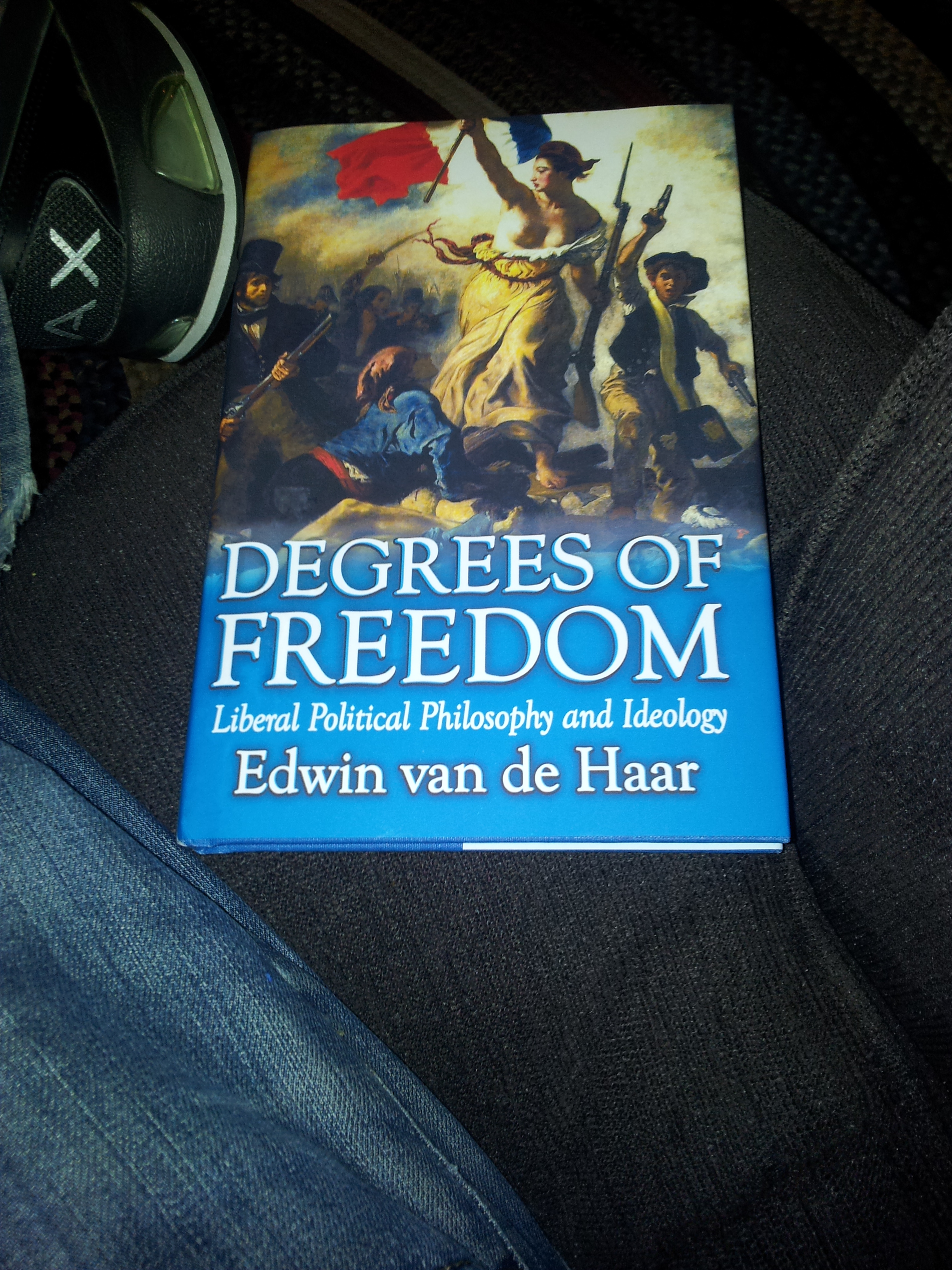
Look at what just arrived in my hands

Van de Haar's "Degrees of Freedom: Liberal Political Philosophy and Ideology"
Van de Haar’s “Degrees of Freedom: Liberal Political Philosophy and Ideology”

It’s Dr van de Haar’s newest book, straight from the Netherlands. You can pick up your own copy here (mine was a gift from Dr V, one of the many perks of being an annoying blog editor!). He’s got more books that you can find either on his ‘About…’ page here at NOL or on the sidebar. Thanks Dr van de Haar!

I know Dr Khawaja (of Policy of Truth infamy) was thinking of getting this book reviewed for Reason Papers, too. I don’t have the training in political philosophy to do the job, but I can say, just by reading through the first couple of pages in his introduction, that I could have benefited immensely from this book if I had been introduced to it in Political Science 101.

Aside from the introduction, I also briefly read through Edwin’s section near the back of the book (pgs. 120-126) titled ‘The Neoliberal Phantom’, and believe that it would be very useful for liberals of all stripes when confronted with poorly constructed anti-liberal arguments (the geographer – NOT anthropologist – David Harvey, for example, gets the full Dutch treatment from Dr van de Haar). It should be noted that this section is probably (again, I don’t have any training in this area) a little less useful for academics confronting more sophisticated attacks against liberalism, but it’s a very good primer for intense undergraduates and graduate students who have to deal with the relentless, poorly reasoned attacks on liberalism in their studies and at seminars.

When I read the whole thing I’ll be sure to post a review here at the blog. If I get word of somebody who wants to review Dr van de Haar’s book for Reason Papers (check out what’s on tap right now, by the way), I’ll try to post the good news here, too.

Secession in Europe (but not the EU)

NOL‘s roster has blogged about secession within the EU before, but what about dissatisfied regions joining Switzerland’s cantons instead of the EU? Read more, from the WSJ, to find out…

Around the Web

  1. Olivier Roy on Laicite as Ideology, the Myth of ‘National Identity’ and Racism in the French Republic
  2. Prague ’68 and the End of Time
  3. How To Spot And Critique Censorship Tropes In The Media’s Coverage Of Free Speech Controversies
  4. The Swamping that Wasn’t: The Diaspora Dynamics of the Puerto Rican Open Borders Experiment
  5. A Voice Still Heard: Irving Howe
  6. Borders and Bobbing Heads: Postcoloniality and Algeria’s Fiftieth Anniversary of Independence (so close, and yet so far…)
  7. The New Yorker on the recent scientific fraud, with its epicenter at my alma mater. (Delacroix remains startlingly relevant because of it.)

The GOP as a Homosexual Cabal

Reading the capital letters between the stately lines of today’s Wall Street Journal, I conclude that Speaker of the House Dennis Hastert paid 3.5 million dollars in hush money to a blackmailer with whom he had homosexual relations before he joined Congress. (They may also have been pedophilic relations.) As the WSJ relates, Hastert’s elevation to the Speakership was followed by a period when he was reproached for his limp handling of  the case of Mark Foley, a Florida Republican (GOP) who admitted to sending sexually charged messages to a House page (un page, en Francais). The page was a handsome young man.

All this leads me to wonder whether the GOP – for which I normally vote –  was not for a while simply a homosexual conspiracy. I might not mind but I would have liked to know. And I don’t like this closet business (I don’t mind simple discretion.)

All this wondering leads me to wonder whether gay activists will claim Hastert as one of their own. Of course, it’s disturbing that the politically active element of the gay movement did not claim Foley, as they have failed largely to claim thousands of pedophile priests. Yes, of course, gays are not necessarily pedophile but male pedophiles who specialize entirely in boys are homosexuals, it seems to me. I think a male homosexual is a man or boy who is sexually stimulated by other men or boys. Shoot me!

How about war, Professor Wall?

The Cambridge Companion to Liberalism

There is a lot of truth, insight and wisdom in this Cambridge Companion to Liberalism. But how on earth is it possible that there is no substantial mentioning, let alone analysis, of the political philosophy of liberalism and international relations? At least a weird omission by the editor, Professor Steven Wall, I must say….

Bernard Lewis, Edward Said, Facts, Ideology, and the Middle East

I recently came across an excellent interview conducted by Evan Goldstein, who is the editor of Arts & Letters Daily and the Chronicle of Higher Education, with Bernard Lewis, who is an eminent historian of the Middle East from Princeton. There were three things that stood out to me in the interview: 1) the potential for ideological rigidity in academia, 2) the importance of history for analysis of recent events, and 3) the astonishing, obstinate ignorance of foreign policy ideologues when it comes to understanding enemies. Three excerpts from Goldstein’s interview with Lewis can best illustrate my points.

On the potential for ideological rigidity, Lewis – who I first came across from reading Edward Said’s infamous postmodern polemic Orientalism – has much to tell us:

Age has not mellowed Lewis, especially on the topic of the late Edward Said, whose 1978 polemic, Orientalism, upended Middle East studies and placed Lewis in the position of having to defend his scholarship against charges of racism and imperialism. Lewis vividly remembers reading Orientalism for the first time. “Apart from Said’s ill will,” he says, “I was appalled by his ignorance.” […] Lewis and Said met only once, in 1986, for a debate at the annual conference of the Middle East Studies Association. Dubbed the “shoot-out at the MESA corral,” the event drew 3,000 spectators. Whether or not Lewis thinks he won that day’s battle, however, he seems to be under no illusion that he lost the war.

“Middle Eastern studies in this country is dominated by the Saidians,” he says, his voice rising in indignation. “The situation is very bad. Saidianism has become an orthodoxy that is enforced with a rigor unknown in the Western world since the Middle Ages.” This groupthink, he says, taints everything: jobs, promotions, book reviews. “If you buck the Saidian orthodoxy, you’re making life very difficult for yourself.”

In 2007, Lewis and some like-minded scholars, including Fouad Ajami, of the Johns Hopkins University, founded the Association for the Study of the Middle East and Africa. The idea, Lewis says, was to create space for opinions that deviate from the MESA mainstream, “to maintain an independent academic integrity in Middle Eastern studies.”

This is an important argument. I minored in MENAS at UCLA, which has one of the most prestigious MENAS programs in the world, and was never required to read the work of Bernard Lewis. How can this be, especially given Lewis’ towering influence on MENAS in the scholarly world? The answer is, of course, orthodoxy. Dogma. What is most disturbing about orthodoxies that gain a monopoly in a field of study is that truth becomes a political agenda rather than an aim for scholarly research. Those who, as Lewis notes, dedicate their lives to answering questions as best they can are necessarily at odds with the dogmas of the field. Postmodern Saidians have imposed the worst sort of orthodoxy, too: If you are not from the Middle East, or if you are not Muslim, then you are by default an agent – willing or otherwise – of imperial aggression and Western chauvinism. Those who question, or dismiss, Saidian insights into the Middle East and North Africa are “being political” while those who do not question Saidian insights are performing scholarly research. Can anybody else see the fallacy here?

This orthodoxy dominates MENAS scholarship. While interacting with my professors at UCLA I was given plenty of opportunities to subtly acknowledge my adherence to Saidism. I did not. I did not question Saidianism, either. I only expressed an innocent desire to gain insights into the work of the guy called out so often in Orientalism, Bernard Lewis. I was told, on numerous occasions, that Lewis had not been read, though of course it never hurts to gain the other side’s perspective. Could the orthodoxy Lewis identifies and assails be any clearer? (Here is the website to Lewis’ Association for the Study of the Middle East and Africa, by the way.)

Aside from vehemently disagreeing with the patron saint of MENAS, Lewis has also gained notoriety for his connection to the second Bush administration’s illegal invasion and subsequent occupation of Iraq. I don’t want to get into the details of his participation here (Goldstein does a good job of that in the interview itself, and I actually lost a little bit of respect for Lewis because of his evasive answers to Goldstein’s questions about his relationship with the Bush administration), but his insights into how the Middle East actually works should be of particular interest to libertarians and especially libertarians who sometimes read me for my quirky (even by libertarian standards) take on American foreign policy. Careful readers can hopefully recognize my overall argument in Lewis’ intricate understanding of the Middle East:

His disagreement with the Bush administration, he explains with a sigh, was not over the goal (regime change), but the tactic (full-scale invasion). Lewis says he argued for recognizing the leadership in northern Iraq as the country’s legitimate government and arming those forces if necessary. In the decade since the first Persian Gulf war, he says, Kurds and Arabs had managed to build a nascent democracy under the protection of the no-fly zone.

“That was the way to do it,” he says. “Simply to invade was the wrong way to do it, and I thought so and said so at the time.” Why didn’t he speak out before the invasion? “I didn’t feel at that crucial moment that it was right to take a public stance against the war.”

Aside from his inability to own up to his mistaken support for the Bush administration (or making his opposition to its policies public), Lewis is spot on. Look at what he is saying, and remember that his analysis is sharpened by a lifetime of prestigious scholarship on the Middle East: the West should have recognized that the illegitimate borders of Iraq had produced differing modes of governance in different regions, and that it would be morally acceptable to recognize the claims of sovereignty then being shouted out by the peoples of northern Iraq.

I am not even in the same ballpark as Lewis when it comes to understanding the Middle East. He is a retired-but-prestigious historian from Princeton; I am a potential graduate student with a B.A. from UCLA; yet he and I have come to the same conclusion, and it’s not hard to see why (it is also worth asking yourself the following question: Is Lewis right?):

  1. The Middle East is a region of the world with lots of different cultures (this is a truth that many foreign policy experts flatly ignore).
  2. The borders drawn up by the victors of World War I do not line up with these cultures anywhere in the Middle East, save perhaps Saudi Arabia.
  3. These artificial borders, and the international governing institutions that sanctify them, make necessary the presence of a strong man to keep these borders from collapsing.
  4. Since strong men are bad, and bottom-up institutions are good, it makes perfect sense – from a realist perspective and from an idealist perspective – for the West to recognize and incorporate the claims of sovereignty made by these bottom-up, nascent states.
  5. Invading and occupying a country, with the goal of molding it into a democracy, is a stupid idea because…
  6. …democracy cannot do for artificial states what strong men can: namely, keep borders in place without affecting the regional balance of power.

Yet the power balancers, and the realists who think that strong men serve Western interests better than democracies do, cannot adequately explain why these same strong men are so hard to control, and indeed often end up as enemies of the West (Saddam Hussein, anyone?). Lewis’ scholarship explains this well. The ideologues – the Western chauvinists and the postmodern Saidians – cannot explain this or, more likely, are unable to explain this because it flatly debunks their dogmas.

Speaking of dogmas, I have given too much attention to the orthodoxy currently strangling MENAS programs around the world, and not enough to those harbored by Western chauvinists. Goldstein reports:

Lewis pulls a Russian book off the shelf and slowly reads his name, in Cyrillic, on the cover. He smiles. His books have been translated into 29 languages. The Middle East and the West, published in 1964, was even translated into Arabic by the Muslim Brotherhood. Lewis is particularly fond of that edition’s preface: “I don’t know who this person is,” the translator wrote, “but one thing is clear. He is, from our point of view, either a candid friend or an honest enemy, and in any case one who disdains to distort the truth.” Lewis chuckles at that.

There is a common trope in many conservative Western circles that Islamists are so beholden to ideology and hatred of all things Western that they are incapable of understanding other modes of thought. Yet it is very clear from this excerpt that Islamists are interested in understanding other ideologies. Islamists, like socialists in the West, are more interested in molding better human beings than in making us freer. Instead of acknowledging this, many experts in foreign policy circles simply pretend that their opponents are savages and incapable of thinking like a true civilized individual. This mindset, too, contributes to the ongoing violence in the Middle East.

The West has a role to play in the Middle East. If it wants to reduce violence and raise standards of living, then policymakers in Washington and Brussels need to accept the fact that their conceptions of the Middle East have largely been shaped by dogma. Muslims are capable of doing bad things. So are Westerners. The West needs to support bottom-up decentralization in the Middle East until it is no longer possible to distinguish a West from a Middle East or, at least, until the West and the Middle East are as similar as Texas and California (or Germany and France). Until policymakers realize that the Middle East’s autocrats are a direct result of central planning efforts made elsewhere, and until MENAS scholars own up to the fact that their dogmas do more harm than good, peace and prosperity will elude the region.

Reply: Radical Democracy

I would have written this in reply to the blog post itself, but I must admit that I’m unsure if videos can be embedded in the comment section.

Despite the seeming radicalism of Fred’s proposal for a neighborhood-based democracy, it isn’t radical at all! It’s mainstream enough that it was the subject of an episode of Yes, Prime Minister and, as Fred himself reported, there was a serious ballot proposition in California a while back to implement something similar.

None of this should be taken to mean that Fred’s proposal is bad. To the contrary, it’s a fantastic idea that improves on democracy as is. By re-aligning districts to include only a few households, an individual’s vote matters sufficiently and there is an incentive to be knowledgeable about political affairs.

My concern is how legislation that was unpopular at the district level, but popular at the regional or national level, would get through. Take for example transportation issues, which oftentimes are unpopular at the local level despite popularity at the regional level.

In my native Los Angeles, attempts to build additional roads between the San Fernando Valley and the Los Angeles basin have been repeatedly thwarted by a few small ultra-rich enclaves that fear that people might be more easily able to visit their neighborhoods if the roads were built. Similarly, in the greater Washington DC area, the expansion of the light rail system was originally opposed in richer parts that feared the poor would gain access to their neighborhoods.

On a quick aside, if you haven’t watched Yes, Minister and its sequel Yes, Prime Minister, go watch it right now. It is several decades old now, but still holds up as a great political comedy.

Health Insurance is Illegal

Health insurance is a crime.  No, I’m not using a metaphor.  I’m not saying it’s a mess, though it certainly is that.  I’m saying it’s illegal to offer real health insurance in America.  To see why … (more)

Radical Democracy

Going to its roots, democracy is kratos, rule, by demos, the people. Pure democracy is the rule by all the people, not just some of the people. The only way to implement absolute democracy is for each participant to voluntarily agree to the governance structure, and be able to exit when one no longer agrees.

Democracy can be divided into mass democracy versus “cellular” or small-group democracy. Mass democracy occurs when the voting group is so large that the people cannot individually know the candidates. In a small-group democracy, the voters are able to join meetings with candidates in groups small enough so that every person is able to fully participate. In a small group, a candidate may distribute literature at a low cost. Although money can play a role in a small group, the influence of moneyed interests is limited by the ability of other candidates and promoters of propositions to counter large spending with personal contacts. A small voting group solves the problem of having both free speech and the will of the people.

The German sociologist Max Weber, writing in the late 1800s and early 1900s, wrote that “bureaucracy inevitably accompanies modern mass democracy in contrast to the democratic self-government of small homogenous units.” Mass democracy cannot be pure, radical, and absolute. “The demos itself, in the sense of an inarticulate mass, never ‘governs’ larger associations.”

A mass democracy is governed by how the leaders are elected. The politicians must use the mass media to send their messages to the public in order to curry their votes. These messages have to be condensed and simple, as most of the public will not pay attention to detailed issue analysis. The messages are often negative attacks on opponents. And the messages have to be paid for, which generates an inherent demand for large amounts of campaign funds. While individuals do send contributions to parties and candidates, much of the financing comes from special interests such as corporations, labor unions, lawyers, and the financial and real estate industries.

Economists use the odd term “rent seeking” for the seeking of subsidies, privileges, and protection from competition. The classical economists recognized that land rent is a surplus. They generalized the concept to “economic rent,” any payment beyond what is needed for production. Subsidies to special interests are economic rents.

Governments today practice imposed representative mass democracy. The implied ideology is the moral supremacy of the majority in each particular issue. The majority imposes its will by force on the minority. As Weber stated in his essay “Politics as a Vocation,” “He who lets himself in for politics, that is, for power and force as a means, contracts with diabolical powers.”

Many people think that democracy is based on equality, since each person has an equal vote. But Weber wrote, “The propertyless masses especially are not served by a formal ‘equality before the law.’” The poor believe that justice requires compensation for their economic deprivation. But the political process determines how this is done, and “under the conditions of mass democracy, public opinion is communal and born of irrational ‘sentiments.’” The sentiments of the poor tend to seek a forced redistribution of wealth in their favor, since that is the superficial solution.

The radical alternative to imposed mass democracy is voluntary small-group voting. The political body is divided into tiny neighborhood cells, just as the human body is composed of small cells. The population of a neighborhood cell should be about 1000, small enough to know the candidates and meet personally to discuss issues. Citizens vote only for a neighborhood council.

Then a group of neighborhood councils, say about 20 or 30, elect, from their members, representatives to the next higher or broader council. The second-level council elects the next higher level legislature, and so on, all the way to the highest level parliament or Congress. That legislative body then elects the president.

Such cellular democracy can replace the mass democracies that prevail today, and that would be a major improvement, in extricating money from politics. But radical democracy also requires another change: replacing imposed democracy with voluntary democracy. The neighborhood cells would be voluntary contractual organizations.

In law, the written contract is required for major decisions, such as the purchase of real estate. The American political philosopher Lysander Spooner wrote in The Constitution of No Authority:

“It is a general principle of law and reason, that a written instrument binds no one until he has signed it… The laws holds, and reason declares, that if a written instrument is not signed, the presumption must be that the party to be bound by it, did not choose to sign it, or to bind himself by it…. Neither law nor reason requires or expects a man to agree to an instrument, until it is written; for until it is written, he cannot know its precise legal meaning. And when it is written, and he has had the opportunity to satisfy himself of its precise legal meaning, he is then expected to decide, and not before, whether he will agree to it or not.”

If a signed contract is needed for real estate transactions, how much more important is the political transaction of governance? If one joins a residential or condominium association, the law requires a display of the laws governing that association, and the new member must sign if he is to join. How much more important, then, is this principle for general governance? Radical democracy requires the signed consent of each member to the written contract.

The rule of all the people begins with the recognition of individual sovereignty, a contract among equal sovereigns for governance, and then implements small-group multi-level governance to let the people govern and minimize transfer-seeking by special interests.

Of course, even radical democracy does not guarantee liberty. A free society must have a constitution that protects individual liberty from the tyranny of the majority. But without genuine democracy, a constitution is an unsigned document that becomes manipulated to provide the appearance of equality and freedom. Behind it is the reality of imposed “diabolical powers,” the tyranny of both majorities and minorities.

(This article is also at http://www.progress.org)

Milton on Freedom of Printing: Areopagitica

Areopagitica 

A Speech of Mr John Milton for the Liberty of Unlicensed Printing to the Parliament of England (1644).

(For my general introduction to Milton, click here)

‘We turn for a short time from the topics of the day, to commemorate, in all love and reverence, the genius and virtues of John Milton, the poet, the statesman, the philosopher, the glory of English literature, the champion and martyr of English liberty’, Thomas Babington Macaulay (Whig-Liberal historian, writer and government minister), 1825.

The digitised text of Areopagitica can be found at the Online Library of Liberty here.

The strange sounding title is a reference to one of the key institutions of ancient republican and democratic Athens, the court of Areopagus. Appropriately, as we are looking at an essay on politics by a great poet, the Areopagus and its mythical foundation was celebrated as the core of Athenian justice in Aeschylus’ tragic trilogy, the Oresteia. The Areopagus was itself an aristocratic institution preceding democracy in Athens and as such can be seen as what balanced the changeable majorities of the citizens’ assembly with enduring standards of justice, which have meaning in all ways of constituting political institutions.

What Milton looks for in this great institution of early experiments in constituting liberty is a standard for freedom of publication and finds that it offered a very tolerant standard, at least in the context of the seventeenth century. Milton suggests that the only restrictions the Areopagus placed on books of the time (all handwritten manuscripts of course) was with regard to atheism and libel. We are not going to look back at Milton or the Areopagus now as the most advanced instances of liberty when they prohibit expressions of atheism, but these are times when the idea that a good and rational person could not be an atheist were all pervasive and the assumption can still be found later in the seventeenth century in John Locke, one of the general heroes of modern thinking about liberty.

The restraint on libel applies in all societies and all political thinking I am aware of, but one should never discount the possibility of an interesting exception. Leaving aside possible interesting radical alternatives, there is nothing repressive by the standards of general thinking about liberty in restraining libel. Milton’s interest in the standards of pagan Greece is itself a tribute to a spirit of pluralism and open mindedness in someone generally inclined to take moral and political guidance from the religious traditions of Hebrew Scripture and the Gospels, along with the writings of early Christians, and the Protestant thinkers of the sixteenth century Reformation.

The Reformation, as Milton himself emphasises, relied on the printed word, and it is no coincidence that Protestantism emerged soon after Europe discovered printing (after the Chinese of course), as a weapon against the institutional authority of the Catholic Church and its hierarchy. The structure of the Catholic Church was not just a matter of church offering a choice to people seeking a faith-based life, it was connected with state power and pushed onto societies as the only allowable life philosophy. The politics of religion comes up in Milton’s essay, including the issue of the relation of the state to the church hierarchy.

While England had a Protestant Reformation in the sixteenth century (England including Wales, but excluding Scotland which had its own distinct Reformation before union with England), it had retained a state church, the Church of England, with Bishops. Milton, like many on the side of Parliament in the Civil War, was against Bishops, referred to as prelates, as part of the old Catholic hierarchy in which the ‘truth’ was given from above to the mass of believers.

Inspired by the pamphlets of and books of Protestant reformers, Milton argues that truth can have many forms and that while Christianity may require acceptance of central truths, they can be expressed in more ways than the Catholic hierarchical state-backed tradition allows. State backing, of course, included the imprisonment, torture, and burning to death of ‘heretics’ by the Inquisition.

Milton refers to the last pagan Roman Emperor, Julian ‘the Apostate’ (reigned 361-363) with regard to his policy of banning Christians from pagan education. Milton argues that this was the biggest possible blow to Christianity, because it deprived believers of the intellectual capacity and credibility to influence pagan inhabitants of the Empire. Christian truth could only be convincingly understood, communicated, and taught if it drew on all areas of learning including what had been produced by pagans.

Truth benefits from being tested in argument and contestation, something undermined by state-enforced church power as well as by the monarchical institution of courts full of sycophants and yes-sayers. Political liberty requires republican representative institutions and truth, including the truths of religion, require testing in conditions of liberty.

Unfortunately, Milton supported legal discrimination against Catholics, but as with prohibitions on expressions of atheism, this was part of the general understanding of a just state at the time, and Milton was more tolerant than many on the Protestant as well as Catholic sides. His arguments make up a part of the general movement to tolerance and freedom of speech, making very powerful points on behalf of liberty, enabling us to take them beyond the limits within which he constrained them.

Next post, Milton on political institutions