Another Belated Warm Welcome

Readers have been enjoying Rick’s contributions for a while, but I just realized I haven’t formally introduced him yet. So finally:

Rick Weber received his B.S. in economics at San Jose State University and his M.S. in economics at Suffolk University, where he is currently working on his Ph.D. He is fascinated by the beauty of spontaneous order, and constantly astounded by the inexpressible wealth bestowed on him by the division of labor.

I met Rick at an IHS summer seminar waaaaay back in 2009. He was the toast of the town back then, and I’m really stoked that he’s blogging with us here at the consortium. Scroll through his musings. You won’t be disappointed. He also kicks it with the Free Market Institute gang at Texas Tech.

A Belated Warm Welcome

Readers,

Allow me to introduce notewriter Matthew Strebe to the team:

Matthew Strebe is a senior undergraduate student at the University of California in Santa Cruz, double majoring in Philosophy and Classical Studies. His areas of interest include political and ethical theory from antiquity to the present, particularly concerning the pre-Socratic philosopher Heraclitus and the classical philosopher Aristotle, along with the modern philosophers Kant, Schopenhauer, Nietzsche, and Heidegger. He considers political labels unnecessarily stifling, and contrary to a spirit of open exchange and inquiry, but nonetheless will provide a few: he is a member of Young Americans for Liberty, a registered libertarian, with viewpoints that are conservative to some and liberal to others. If you really want to know what he thinks, it is best to ask.

His debut post can be found here, and his most recent post is here. Please join me in giving him a warm welcome, and – as our small community is apt to do – be sure to keep him on his toes in the ‘comments’ section.

Fractional Reserves in Free Banking

by Fred Foldvary

A bank is a firm that accepts funds as deposits. The generic term “bank” includes various institutional types, such as credit unions. The bank is an intermediary between savers and borrowers. The interest paid by borrowers pays the expenses of the bank, and what remains is paid to the depositors.

There are two ways to organize a banking system. The first is with central banks, such as the Federal Reserve (the “Fed”) in the USA. The central bank issues the currency and regulates the private banks. In the USA, the Fed includes regional Federal Reserve Banks, which are the bankers’ banks. The private banks hold accounts with a Federal Reserve Bank; the funds are called “reserves.” The Fed creates money by buying bonds: it pays the seller a check, the seller deposits the check into a bank, the bank presents the check to the Federal Reserve Bank, and the Federal Reserve Bank covers the check by increasing the reserves of that bank, thus creating money out of nothing. The interest income from bonds pays the expenses of the Fed, and the remaining interest is paid back to the US Treasury.

The other method of banking is with free-market banking, or “free banking,” whereby there is no central bank; the private banks issue their own currencies and are not restricted other than by laws that prohibit fraud. The banks would usually use the same unit of account, such as the dollar or euro.

There are two ways to do banking. The first is called “one hundred percent reserves” or “full reserve” banking. In that method, the bank may not loan out the funds that are deposited. One of the challenges of banking is that with checking accounts, also called “demand deposits,” the account holders may withdraw their money at any time. In contrast, loans are typically long term, such as for mortgages or business loans or car loans. So if depositors suddenly want to withdraw much of their funds, the money will not be there. With full-reserve banking, the money is always there, but the bank get no interest payments. The depositors pay a fee to have their money stored at the bank.

The workings of a banking system also depend on the money system. The three basic types of money are 1) commodity money, where a commodity such as gold or silver is used as a general medium of exchange, 2) a fiat money system, in which the currency has no fixed convertibility to any natural commodity, and 3) an artificial-commodity system, where the unit of account is constructed in a way that limits the supply.

With commodity money, banks create money substitutes convertible to the real money at a fixed rate. For example, if gold is the real money, banks issue paper currency convertible into gold, so that, for example, a $20 paper note can be exchanged for a $20 gold coin with $20 worth of gold. All government-created money today is fiat. With fiat money, the real money is paper currency and coins, and bank deposits are money substitutes. The prime example of artificial-commodity money today is the bitcoin, an electronic currency created by computer programs.

The other method of banking is called “fractional reserve banking.” With that method, a bank holds only a small fraction of deposit funds in its reserves. Governments typically impose some minimum of required reserves. The remainder are “excess reserves,” which may be loaned out.

For example, suppose Samantha deposits $100 of currency into her account, and the required reserves are ten percent. The bank keeps $10 in reserve, and loans out the other $90 to Ralph. The loan consists of an account created by the bank. The loan therefore creates $90 in new money, since Samantha still has her $100 in the bank. With the $90 account, the bank again keeps 10%, or $9, and loans out $81. This money creation can continue until all the excess reserves are fully loaned out, in which case the original $100 deposit is multiplied into the creation of $1000.

With all reserves loaned out, if the depositors seek to withdraw their money, the bank will not have sufficient currency. A bank can deal with this liquidity problem in several ways. One is to have most of the funds in time deposits, funds that are held for a fixed period of time, unless the account holder pays a large penalty. Another method is for a bank to be able to borrow funds from other banks or from a central bank. A third way is for the bank to have contracts that state that the bank may not be able to provide withdrawals at times when it has insufficient funds.

Critics of fractional reserve banking claim that the private banks are a private monopoly cartel that inflates the money supply by making loans and obtains interest that robs the economy of money and goes to privileged bank owners.

With fiat money and central banking, there is indeed a potential for inflation, as there is no limit to money creation. The main problem with central banking is that there is no scientific way to know in advance the optimal money supply, and historically, the Fed created destructive deflation in the 1930s, high inflation in the 1970s, and the cheap credit that generated the real estate bubble and the Crash of 2008.

Some critics of central banks want the government to directly issue money. But if the Treasury or Finance department can issue money at will, political influences can induce inflation, and even hyperinflation as happened in Zimbabwe.

However, with free banking and commodity money, these problems do not arise. Banking would not be a monopoly cartel, since new banks, including credit unions can be created. The convertibility of money substitutes into real money prevents inflation, as the quantity of money substitutes is limited by the demand by the public to hold them. Competition among banks limits their profit to normal returns, as the rest of the debt service paid by borrowers goes to interest payments to depositors. Fractional-reserve free banking generates a flexible yet stable money supply. Free banking does not generate inflation, because new deposits into the banking system come from additional real money, such as from gold mining, which is costly to produce.

The failures of central planning in the economy include the failure of central banks to successfully manage the money supply and optimally manipulate interest rates. Free banking worked well where tried, such as in Scotland until 1844, when the Bank of England took over its money system. A pure free market would let the market determine both the money supply and the natural rate of interest. In Scotland, the banks formed an association to lend funds to banks that needed more liquidity. With free banking, the market’s natural rate would avoid the distortions that arise from either cheap credit or a shortage of credit.

The boom-bust cycle will only be eliminated by the prevention of the fiscal and monetary subsidies to real estate. Sustainable economic progress requires both the public collection of land rent and a free market in money and banking.

Note: this article appeared as “Fractional Reserve Banking” in the Progress Report.

The Power of Propaganda and the Japanese Empire

Economist Kurt Schuler has a fascinating post on the various currencies that were used in mainland East Asia during World War II over at the Free Banking group blog.

Unfortunately, there are three paragraphs in the post that attempt to take libertarians to task for daring to challenge both the narrative of the state and the narrative of the nation regarding that horrific reminder of humanity’s shortcomings. He is writing of the certainty of the US’s moral clarity when it came to fighting Japan (the post was published around Pearl Harbor remembrance day):

The 1940 U.S embargo of certain materials frequently used for military purposes was intended to pressure Japan to stop its campaign of invasion and murder in China. The embargo was a peaceful response to violent actions. Japan could have stopped; it would have been the libertarian thing to do. For libertarians to claim that the embargo was a provocation is like saying that it is a provocation to refuse to sell bullets to a killer.

Then, in December 1941, came not just the Japanese bombing of Pearl Harbor, but an attack on the whole of Southeast Asia: Hong Kong, Singapore, what is now Malaysia (British colonies), Indonesia (a Dutch colony), the Philippines (scheduled under American law to become independent in 1945), Thailand (independent). In 1942 there followed the invasion of Burma, a bit of India, and a few of the Aleutian Islands, plus the bombing of Darwin, Australia.

With that history in mind, how can anybody think that the United States could have made a durable peace with Japan? It would have lasted as long as would have been to Japan’s military advantage, no longer. Japan was hell-bent on conquest. Nothing since its emergence as a major international power suggested a limit to its ambitions. It only ceded in the face of superior force. Even as Allied forces retook territory, Japanese fanaticism was such that the government did not surrender until after the U.S. military dropped two atomic bombs. To ignore the long pattern of Japanese aggression as quite a few libertarians are wont to do is not just historically ignorant but dangerous, because it closes its eyes to the hard truth that some enemies are so implacable that the only choice is between fighting them and being subjugated by them. It took a prolonged U.S. military occupation to turn Japan from the aggressor it was to the peaceful country it has become. (source)

This is an unfortunate mischaracterization of what went on in World War 2, but it also does a fairly good job of demolishing some of the arguments that libertarians have come up with in regards to this debate. You see, the issue of World War 2 is one that is usually foisted upon libertarians as an example of the benevolence of the State: Washington crushed two powerful, evil war machines in one fell swoop and then stood up to a third evil empire for forty years.

Libertarians often get confronted with this interpretation of history and they get bothered by it. This argument gets under their skin. They often make up excuses for Japan’s actions, or they avoid dealing with what actually happened in the time period. This response is also unfortunate because the general principles of libertarianism – individual freedom, strong property rights, internationalism – explain the events of World War 2 well, but only once the facts are looked at clearly and thoroughly. The power of propaganda is immense. The fact that so many people believe that the United States was the good guy in the war against Japan is astounding, and I think the heavy weight that is placed upon the shoulders of those who dare to defy the standard account of the US’s war with Japan flusters the seeker of truth.

Even though libertarians get hot-headed on this issue and stumble, thus making Schuler right in a sense, his argument is absolutely wrong. What follows is an attempt to calm things down, and to explain why Schuler is wrong and what libertarians need to get right.

Tokyo did not want to expand beyond a certain point, due to the ideological consensus of the governing party at the time. The narrative of the governing party was that great civilizations had natural territories over which they naturally lorded. For the Japanese, this natural territory (which was, of course, entirely arbitrary and ahistorical) was called, amongst other things, the East Asia Co-Prosperity Sphere. It included the Korean peninsula, Manchuria, Southeast Asia, Indonesia, the Philippines, coastal China, Mongolia, Malaysia (including Singapore and Brunei), and a separatist region in India known as Azad Hind. Any territory beyond these lands were inhabited by – again according to the ideology of the dominant political party at the time – peoples who did not conform to the standards set by the Japanese people (and those ranked directly beneath them; the ones I just mentioned). These foreign peoples were treated accordingly, especially in Melanesia.

What this suggests is that, contra Schuler, the Japanese were not “hell-bent on conquest.” Rather they simply wanted to carve out a territorial space that has obvious parallels with the German conception of Lebensraum. This is not a coincidence, by the way, for the ideologies of the dominant parties in Germany and Japan were cut from the same racist cloth.

Hawaii might have been a target for the Japanese military eventually, due to the large number of people living there with Japanese ancestry, but even this is stretching the limits of generosity. Hawaiians of Japanese ancestry considered themselves to be Hawaiians, or Americans, before Japanese (this probably due to the fact that the Japanese government sent some of its citizens over to Hawaii by force, but that is another story for another day; hopefully you can see why loyalty to Hawaii and the US was a given to people of Japanese ancestry on the islands). A Japanese invasion of the US mainland is simply an incredibly silly notion, which is why I think Dr Schuler relies upon the irrefutable fact of Japanese lust for conquest. Can you not see where propaganda is at work here?

Now, obviously the Japanese were warmongering at the time. There is no doubt about this. However, it hardly follows that the Japanese were a threat to the American republic.

For instance, look at what the Japanese military ended up attacking:

  • European and American colonies (which were burdens rather than boons for both the colonized and the colonizing)
  • Thailand, a kingdom with a long history of playing foreign powers off on each other
  • and parts of China (which could hardly lay claim to much of its territory anyway)

If I’m not mistaken, Europe and the United States are thousands of miles away from Japan, and yet they had militaries occupying foreign lands in East Asia. Again, Japan was certainly an aggressive state in the early 20th century, but it seems extremely unfair to ignore the military occupation – by Western states – of Asian lands and the Jim Crow-esque political regimes that they enacted and enforced. Notice, too, that the military incursions of the Japanese Empire do not stray too far from the official ideology of the governing political party. This is also true of Nazi Germany and Fascist Italy. It was also true of Soviet Russia, but for different reasons. The Soviets engaged in worldwide imperial ambitions (“spreading the revolution”) after solidifying their rule at home, and this imperialism was part and parcel of the dominant ideology of Leninism. I am digressing.

Japan did declare war on the US, so I think Washington’s war was just, but it hardly follows that Japan was “hell-bent on conquest,” or that its military would have invaded the United States, or that Tokyo’s decision not to curl up in the fetus position and simply accept US economic warfare was “unlibertarian.” Suppose Japan had conquered the US. What would its armies have uncovered?

Think of it this way: What incentive would Japan have to conquer the United States? Where were the plans to do so? Doesn’t it make more sense to look at Japan’s war on the US as part of its broader effort at creating and maintaining its hold over the territory it deemed to be the natural lord over? Why waste so many resources invading and occupying a territory dominated by people who were part of another race (as per the prevailing ideology of Tokyo at the time)? Oh, that’s right: Because Japan was “hell-bent on conquest.”

Propaganda is very powerful, but it’s also important not to label everything you disagree with as propaganda. That makes you sound like a crackpot. For instance, I don’t think anything Dr Schuler argues is driven by pure propaganda. Such an insinuation on my part would simply be garbage, and (rightly) treated as such in the public sphere. However, the notion that the US military stopped a war machine “hell-bent on conquest” is a product of propaganda. This notion is strengthened by personal and cultural narratives, and in time it takes on a life form of its own.

One last thing: Dr Schuler argues that the embargo Washington placed on Tokyo “was a peaceful response to violent actions,” but surely you can see how that policy was actually a violent response to violent actions. Whether that violence to counter other violence was a good thing or not is a question that cannot be answered in this already-too-long post.

(One more last thing: Here is an excellent essay on ideology in developing states that might be worth checking out; it doesn’t deal directly with the Japanese Empire but does deal with some of the concepts [especially nationalisms] that confront us when thinking about the rise of the Japanese Empire.)

A Zoo in the Streets

A couple of years ago the kind of youngish women who spend two hours a day seven/seven at the beach starting showing up in the streets in tights, with nothing on top. Before I could catch my breath, the same streets were turned into zoos. I mean women who don’t spend two hours a day at the gym, or an hour a week, began joining the fad. Then, it was camels on one side (camel toes, actually), hippopotamuses on the other side.

The total horror! It makes you wonder if American women have any real girlfriends, friends close enough to say, “Don’t do it honey,” or boyfriends men enough to say, “Who do you think you are going with in this outfit, honey?”

I am almost sure this does not happen in France because French women have mean girlfriends.

I have been neglecting this blog because I am busy with the nth proofing of my manuscript: I Used to Be French: An Immature Autobiography. I will be back soon, I think.

African development and mismeasuring economies (two separate topics)

Sorry I’ve been away for so long. I’ve been much busier than I wanted to be. I’ve been reading an essay by an economic anthropologist (Keith Hart) on African development that is definitely worth your time, though be sure to grab a cup of coffee first.

I liked this blog post from economist Ed Dolan on GDP versus GDP per capita measurements (I myself like to use the GDP (PPP) per capita measurement).

Addendum: Be sure to read Warren’s blog post on informal economies in the post-colonial world before reading the economic anthropologist’s essay. Warren’s post is a great primer for the topic.

О российском телеканале “Дождь”, особом пути, менталитете и памяти

Привет, друзья. Сегодня хочу вам рассказать одну неприятную историю, которая приключилась с российским телеканалом “Дождь”. Историю, замешанную на патриотизме, особом “русском пути”, памяти и банальном незнании истории.

Для начала давайте вернемся в нашей памяти на 70 лет назад во время Второй Мировой Войны и вспомним такое жуткое событие, как блокада Ленинграда, длившаяся почти 900 дней, и ставшая причиной голода и смерти сотен тысяч мирных жителей. Доподлинно известно, что у Гитлера было несколько планов на будущее города Ленинграда. Первоначально он планировал просто захватить город, потом же принял решение о полном уничтожении “Северной Венеции”. Стереть город с лица земли любым способом, не заботясь о мирном населении… Не ввязываясь в кровопролитные уличные бои, практически единственный способ сделать это – организовать полную блокаду и бомбежки. Тогда те, кто не умрут при артобстреле – умрут от голода. Я не буду сейчас рассказывать про беспрецедентные случаи человеческого мужества и верности Отечеству, которые проявили обычные горожане, и сразу перейду к смыслу: Гитлер не планировал сохранять нынешний Санкт-Петербург вообще. Любой ценой.

Недавно на одном из наших телеканалов появился опрос примерно следующего содержания: “Надо ли было сдавать город Ленинград врагу и тем самым избежать сотен тысяч смертей от голода, или же надо было защищаться до конца?” Из всего того, что я написал выше, ответ очевиден: сдача города врагу не сохранила бы ни его население, ни собственно сам город.

Перед нами обыкновенное незнание определенных фактов истории администрацией канала, ну или тем, кто отвечает за наполнение эфира информацией. Опрос этот вызвал широкий общественный резонанс, и вскоре был удален, а администрация канала извинилась.

Казалось бы, и забыть про это все надо – но нет. Отдельная категория людей, заседающих в нашем правительстве решила дать этому “вопиющему и кощунственному делу” дальнейший ход и написала заявление в прокуратуру, хотя по факту-то проблемы уже и нет. Однако канал начали везде закрывать и блокировать, и это лишний повод задуматься.

Что из всего этого лично я вынес? Существуют определенные события, категории знаний, факты и вообще “всякие понятия”, ошибки в которых недопустимы не при каких обстоятельствах. Не несущие никакого материального вреда, они могут оказаться бомбой замедленного действия в умах граждан, и вызвать совершенно непредсказуемую реакцию…

Думайте о том, что говорите, и о том, что пишете. Анализируйте свои слова и взвешивайте каждое слово.

New issue of Econ Journal Watch is out

You can find it here, and here is the summary:

One Swallow Doesn’t Make a Summer: In a 2014 AER article, Zacharias Maniadis, Fabio Tufano, and John List grapple with the problem of the credibility of empirical results by presenting a framework for statistical inference. Here Mitesh Kataria discusses some of the assumptions and restrictions of their framework and simulation, suggesting that their results do not, in fact, allow for general recommendations about which inference approach is most appropriate. Maniadis, Tufano, and List reply to Kataria.

Should the modernization hypothesis survive the research of Daron Acemoglu, Simon Johnson, James Robinson, and Pierre Yared? New evidence and analysis is provided by Hugo Faria, Hugo Montesinos-Yufa, and Daniel Morales, supporting the hypothesis that there is a long-run positive relation between socio-economic development and political democracy.

Ill-Conceived, Even If Competently Administered: In a 2013 JEP article, Stuart Graham and Saurabh Vishnubhakat argue that the Patent and Trademark Office (PTO) is doing a good job of interpreting patent law, and suggest that the “smart phone wars” and related disputes are not evidence that the patent system is broken. Here Shawn Miller and Alexander Tabarrok argue that the main problem is not with the PTO but with patent law as it has been applied, particularly to software, resulting in patents that are overly broad and ambiguous, and hence vexing and stifling.

Ragnar Frisch and NorwayArild Sæther and Ib Eriksen contend that for several decades bad policy derived in part from the climate of opinion among the country’s eminent economists.

The ideological evolution of Milton FriedmanLanny Ebenstein explores developments in Friedman’s thinking, particularly after the mid-1950s.

EJW AudioLanny Ebenstein on Milton Friedman’s Ideological Evolution

I might add that notewriter Fred Foldvary is an Editor for the journal, and notewriter Warren Gibson is its math reader, so give the newest issue some family love!

Kant och kapitalismen

Immanuel Kant (1724–1804) är en av de mest framstående filosoferna genom tiderna. Han skrev bland annat inom etiken och kunskapsteorin, men också inom den politiska filosofin. Jag tänker här inte redogöra fullständigt för hans tankar utan endast snudda vid några av de huvudsakliga dragen.

Anledningen till att jag skriver om Kant är att jag den senaste veckan har mötts av tre av varandra oberoende misstolkningar, ja, rena missbruk, av Kants filosofi. Man har mot bakgrund av ett av hans mest kända påståenden hävdat att Kant var antikapitalist. Så var inte fallet. I sin bok Groundwork of the Metaphysics of Morals skriver Kant såhär:

“All handel, alla hantverk och alla skickligheter har gynnats av arbetsfördelningen, alltså då en person inte gör allt utan att varje person begränsar sig till en specifik uppgift som skiljer sig markant från andra i sättet det utförs, så att hen erhåller förmågan att utföra det så perfekt som möjligt och med största lätthet. Där arbete inte är så avgränsat och fördelat, där alla är sin egen allt-i-allo, förblir handeln barbarisk.”

(Stycket är fritt översatt från engelska, avsnitt 4:388, Groundwork.)

Kant var samtida med moralfilosofen och ekonomiteoretikern Adam Smith, som bland annat är känd för sin redogörelse av arbetsfördelningen som Kant skriver om. Som stycket visar, tillsammans med Kants vurm för frihet (se nedan), påstod Kant att andra system än det som vi idag kallar för marknadsekonomi är barbariskt (”greatest barbarism”). Den som påstår att Kants filosofi är antikapitalistisk måste förklara sin ståndpunkt väldigt väl.

Antikapitalistiska tolkningar av Kant bygger ofta på det välkända ”agera så att du använder mänskligheten (inklusive dig själv) som ett mål i sig, och aldrig endast som ett medel” (förkortat och omformulerat från avsnitt 4:429). Den antikapitalistiska tolkningen brukar då heta att när folk byter varor och tjänster med varandra använder de sina medmänniskor som medel för sina egna ändamåls skull, vilket ska strida mot Kants filosofi. Vad denna tolkning förbiser är att i en marknadsekonomi använder båda parter frivilligt varandra för att tillsammans uppnå ett tillstånd som de båda anser är bättre än det föregående. Ett brott mot moralen uppstår endast om denna ömsesidiga överenskommelse förvandlas till exploatering genom att den ena parten tvingar den andre till ett byte.

I det efterföljande avsnittet skriver Kant att principen enklast förstås om man föreställer sig ett ”angrepp på andras frihet eller egendom” (”freedom and property of others”, 4:430). Det ska alltså bli tydligt och lätt att förstå, menar Kant, att det moraliska ligger i fullständig ömsesidig respekt om man tänker sig kapitalismens två grundpelare – frihet och privat egendom. När någon bryter mot dessa ska man omedelbart se att handlingen är omoralisk.

Det finns goda skäl att kalla Kant för kapitalist. Han skrev ju också om institutionen att låna och låna ut saker till varandra. Om man inte lämnar tillbaka det man är skyldig faller tilliten sönder. Kant förespråkade alltså kapitalismens motor – arbetsfördelningen; dess två grundpelare – frihet och privat egendom; och dess klister – tillit och ömsesidig respekt. Vill man göra ett case av Kant som antikapitalist får man bita hårt i böckerna. Det mesta tycks tala åt motsatsen: laissez faire, laissez faire.

SOTU: a Masterwork of Co-option.

Sheila Broflovski ‘solves’ the ‘problem’ of ‘obscenity’.

A professor of Political Science at my school described the modern left-right paradigm for the class today — to paraphrase, he summed up the political landscape of the US with the all-too familiar perspective: ‘conservatives want less government, and liberals want more government’.

I opined, silently, in my seat.  Sensing my disapproval, the professor asked if anyone had a differing perspective on the country’s political spectrum.  I raised my hand and pointed out the perspective of this oft-regurgitated axiom of political theory.  rephrased the point: Conservatives want liberty, and Liberals want safety.  When it was suggested by a classmate that I was coloring the axiom to suit my political bent, I defended my choice of language.  This phrasing, I argued, is the happy middle ground between the original, popular formulation that the professor used, and a statement that more closely aligns with my actual opinion: Conservatives want freedom, and Liberals want slavery.

When placed together, these three phrasings of the same observation illustrate the powerful effect nomenclature can have on a statement — and sheds a pinhole of light onto the vastness of the power of language analysis with respect to ideology:

Conservatives want less government, and Liberals want more government.

Conservatives want liberty, and Liberals want safety.

Conservatives want you to be free, and Liberals want you to be a slave. 

The words we chose to use when we frame our thoughts betray our underlying perspective.  Language is the seat of understanding, and can be deconstructed to suggest motivation and perspective.  Analyzing the language used by self-styled ‘progressive liberals’  (forgive the quotes — the term itself is completely removed from cogency as a representation of meaning, as is ‘conservative’.  These two terms as used in modern US politics do not come anywhere near connoting accurate definitions) yields a lexicon that I dub the language of Co-option.  This liberal dictionary is used by a vast majority of the public out of rote; most people do not consider deeply the meaning of the language they use.  Those that speak this dialect knowingly craft the language, and therefore, the thinking, of the larger public who adopts the dialect and spreads the meme and built-in collectivist programming therein.

This Language of Co-option is the language of our classrooms.  It is the language of our politicians.  It is Hegel.  It is Sociology.

Let’s vivisect the following liberal sociological speech pattern:

is bad for society.  We should do so that happens instead.”

To make the point that much clearer, let’s translate the above formulation into political rhetoric:

“For American families, x is a real problem, so our administration is committed to policy so that z will result.”

To define our terms:  the value in this construction represents a ‘problem’ — to be specific, some suggested verifiable disadvantageous phenomena, that would be mitigated by taking action.  These instances exist; we can plug in some terms for our variables to create cogent statements:  Suffocating is problematic for humans, therefore humans should breathe.  This construction is cogent because human beings need to breathe in order to avoid suffocation, which is indeed, harmful to humans.  However, such statements rarely provide people with new insights, because cause and effect tend to be plainly apparent; most everyone knows that they need to breathe to live.  It seems tedious to think such obvious statements would warrant comment, let alone, say, a State of the Union address.

The power of this statement only manifests when coupled with action — the y variable.  The point of x, of stating an obvious ‘problem’, is merely to gain the agreement of the audience to the that will follow.  In fact, in political speech, and need not have any real connection at all.  This effect has been pointed out by others, including the research of behaviorist Ellen Langer, who’s research suggests merely by adding any explanation to a request one can improve the chance of a ‘yes’ in response.

For example, take this phrase from the State of the Union Address last night:

“There are other steps we can take to help families make ends meet, and few are more effective at reducing inequality and helping families pull themselves up through hard work than the Earned Income Tax Credit.”

to simplify:  “Poverty (x) is a problem for people, and we can fix inequality (z) with the EITC (y).”

Let’s break it down critically.  Poverty is always a problem for a family, as it is averse to survival.  If you don’t eat, you starve — as obvious as the sun shining in the sky.  This statement alone is almost as bereft of importance as ‘nice day, huh?’ or ‘how about those (insert local sports team name)!’ The President must have had a reason to make the comment.  The statement made in this way implies poverty is a fixable problem in society, rather than a product of the human condition or the laws of our natural world.  The first law of the human condition is scarcity; there is never enough of any resource to satisfy demand in any economy.  When coupled with the Second Law of Thermodynamics, any natural system in the universe behaves the same way.  POTUS makes the statement about poverty implying a collective problem that can be solved by some action.

The showstopper for libertarians is usually y.  The solution to the problem offered by the state is ALWAYS aggressive force.  In the above example, that aggression is in the form of extortion — specifically, theft of property through threat of violent action via taxation.  This is stated in a positive light as phrased; the Earned Income Tax Credit is sold to the public as a tax break for some people, but comes at the expense of everyone else.  The fact that your government is extorting less money from some than from others is aptly defined as ‘inequality’, but this obvious truth is distorted and reversed completely with Co-optive language to masquerade as benevolence, yielding the aberration cited.

This construct is the essence of the Hegelian ‘crisis, reaction, solution’, and is a hallmark of Co-optive speech and thought, and permeates our zeitgeist.  Freedom-minded individuals hear this language and know just how ubiquitous it is in society — keep it in mind the next time you hear someone spray about what ‘We’ must ‘do’.  Co-option is built in to the culture and mindset of authoritarianism, and in fact, the democratic process itself as naked tyranny of the supposed majority.

Please, feel free to post your co-optive, authoritarian quotes in response below!

Narrating the Decline from a Classroom Desk,

L.A.Repucci

The State of the Union and the State of our Liberties

Nevertheless it is important not to fall into the delusion that President Obama presents the greatest danger to the culture of liberty. A historian looking back a hundred years from now is likely to group the Reagan, Bush I, and Clinton presidencies together as an era when the state receded or at least did not grow, as measured by regulatory and fiscal burdens on our lives. But Bush II relentlessly increased domestic spending and created more government involvement in health care with the Medicare D program for prescription drugs. It was President Bush who initiated many of the NSA programs.

In short, there are more similarities between Bush II and Obama than their supporters or detractors care to acknowledge. And almost all of the similarities suggest that the risks to our liberty today transcend the actions of any particular politician.

From John McGinnis. Read the rest.

From the Comments: More on Property Rights

Rick chimes in on my musings about political entrepreneurship:

Reducing competition *is* a way to reduce competition. A company can invest effort in increasing value or reducing availability of substitutes (both shifting demand) or in reducing costs or shifting costs onto others (supply shifts).

(Okay, now I’m going to go into some philosophical stuff purely for my own benefit…)

That’s the high level story, but it rests on a foundation of property rights; by which I mean the de facto property rights that actually matter, not some rights assigned by Santa, or rights that are just and proper as defined by very sensible arguments by libertarians. “Society” generally accepts that the government holds particular property rights that touch on a number of possible exchanges in order to promote–we can tell that that’s the case because people aren’t willing to undergo the cost of stripping those rights away. The hotel lobby has recognized that to be the case and so has asked the state to exercise those rights in a way that benefits the hotel lobby and they have offered some sort of exchange (which may be as vague as “social capital”/reasonable expectation of future political support, or as explicit as bribes, but probably something in between). This exchange has altered the shape of the socio-political-economic environment in which similar exchanges may occur in the future.

Addendum: Pretty much all of the ‘comments‘ in Warren G’s post on the seven rhetorical weak spots of libertarians are worth re-reading, too.

Rick Weighs on Intellectual Property: More Questions Than Answers

Adam recently posted that the British government is contemplating pretty outrageous penalties for Internet pirates. Naturally I wanted to chime in with an outrageously long comment about the nature of property and the (im)possibility of intellectual property (IP) rights. That’s just the libertarian thing to do! There’s a lot to say and it will take more than a few beers to sort this whole thing out, so I’m going to limit myself which means I’ll just raise more questions than I answer…

So let’s start with why IP doesn’t make a lot of sense. IP is information and information wants to be free. My use of a song doesn’t prevent you from using it. IP isn’t scarce in the way a car is. Besides, there’s some evidence that government enforcement of IP does more harm than good. And pirates end up spending more to buy IP than other people anyways (I usually listen to music for free on Grooveshark, but the other day I thought, “I’d really like to tell Willie Nelson that I think his music is great,” so I bought an album even though I could have listened to it for free!). And besides, musicians can make money by performing live.

But just because it isn’t a tangible thing, doesn’t mean we are forbidden from attaching rights to it, even in anarchy. Property rights are a “bundle of sticks.” I own my land, but you might have a right to the sunshine I would block if I built a skyscraper. Likewise, a society can come to some sort of quasi-unanimous agreement that the creator of a song has the right to control its use, even in the form of digital files.

Now, government enforcement of IP laws is fraught with difficulties even before we get to public choice issues. Should a patent be 20 years or 19.5? If the optimal patent length is 16 years, then the current system is a net subsidy and so creates economic inefficiency. But determining the optimal length in a world of benevolent political actors is an incredibly complex problem. How stringently should patents be enforced? How do we account for the differences in conditions that affect different patents (or copyrights, etc.)? This argument doesn’t say “don’t do IP,” it just says, “hey, this whole venture has its own set of costs we need to account for. It’s conceivable that we conclude that the optimal patent is probably between 5 and 20 years, but if we’re off by more than 4 years the costs of the error will outweigh the net benefits of the patent.

Then there’s the public choice problems. We don’t want IP law to be some Mickey Mouse operation set up to hurt consumers.

But (and that’s a big but!) we have to return to this issue of property rights. When I buy an apple, I’m concerned with the physical thing, but really I’m buying a bundle of rights. The rights are what’s being exchanged, and then later exercised. These rights are socially determined and often-but-not-always-or-even-mostly enforced by government. Yes, if I steal your car the government will probably get involved. Yes, the government provides a back-stop to rights enforcement in a lot of areas. But rights are ultimately a social-political construct that can exist in anarchy. What does this mean? First, it means that we could conceivably have intellectual property rights . Second, it means that we could have such rights in a state of anarchy.

Obviously the nature of the good will affect the viability of such a system. Enforcing IP laws is difficult enough when some third-party can come in and say “you’re a pirate and you’re going to jail.” In a common law situation where you have to make the plaintiff whole, it’s difficult to say what that means. Reputation plus property rights might keep comics from stealing others’ material, but it might just separate the comedy industry into auteurs with sophisticated audiences and Carlos Mencia with less sophisticated audiences.

We can safely label a law or institution as legitimate if it is unanimously accepted. In the case of IP, such unanimity seems unlikely. In any case, I still suspect that government involvement in IP does net harm although I’ll grant that it’s a (probably impossible to answer) empirical question.

Gratitude to a Power Pole

Image

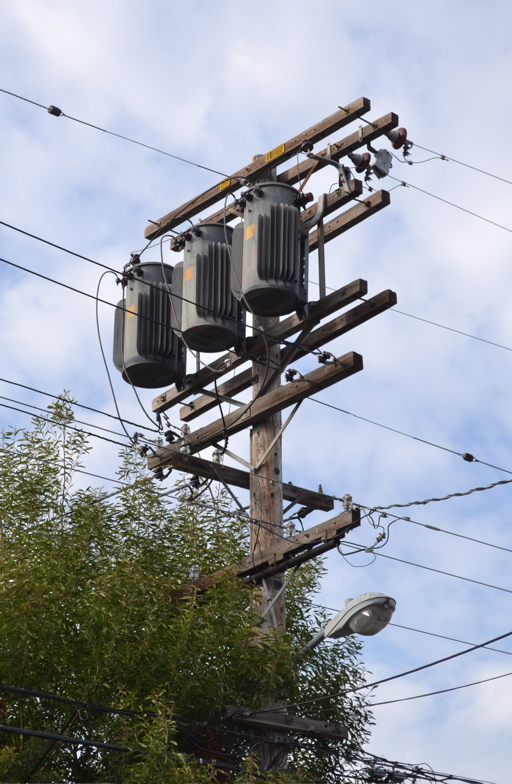
Whilst ambling around San Carlos recently, I came upon the power pole shown here. Ugly, isn’t it? Or maybe not. In fact, my reaction was one of gratitude, prompted in part by the “Gratitude” chapter in Joel Wade’s excellent book, Mastering Happiness (available at drjoelwade.com). I had listened to the chapter the previous evening.

What is there about this power pole that warrants gratitude, and to whom? The answer lies in really looking at the pole and pondering the devices, wires and cables attached to it.

The top crossbar holds wires that provide the electrical supply, probably three-phase 440 volts. I know the supply comes from a substation a mile away which in turn is fed from very high voltage transmission lines east of the freeway. Three transformers on the pole step the 440 down to 220 and feed it to surrounding buildings.

Ugly grey boxes? Not to me. Some anonymous engineers put their heart and soul into designing those transformers. The basic idea of a transformer has been known for years: use a pair of coils with different winding densities to convert electrical energy into magnetic energy and then back to electrical at a desired voltage. But to design a really good transformer requires careful attention to fabrication costs, reliability, safety, and operating efficiency. No transformer is perfect; some energy gets lost as waste heat, and heat must be dissipated even in the hottest weather lest temperatures exceed safe operating levels. (Notice the cooling fins on each transformer.) The fluid bath which enhances efficiency must never leak – or more precisely, the probability of leakage must be kept extremely low. Nice job, guys (maybe gals, too). Thanks!

I see telephone wires. Of course, wireline telephone service is declining but still there is a lot to ponder. Four blocks away is a big windowless AT&T building which I believe houses switching equipment that was a marvel in its day.

I see coaxial cables that transmit television and internet signals. Just think of the torrent of information coursing through those cables. These days we all take megabit download speeds as a God-given right. Try to picture millions, perhaps hundreds of millions of bits traversing one of those cables every second. In addition, the cables entering those poles from Comcast’s central office, wherever that may be, carry a mix of packets destined for different recipients. They must be sorted and delivered on time and in the proper sequence to the various recipients served by our pole. I see three small boxes on the pole that may perform that function. The Post Office is a block away. Imagine the sorters there sorting a million letters per second!

I see a small device which may be an antenna for the new wireless electric and gas meters. Predictably, there have been complaints about health effects from these devices, likely from people who have no clue about the difference between ionizing radiation and RF radiation. Others have complained about privacy. I personally feel no need to hide the details of my electrical usage. I look forward to the advent of time-of-day pricing that these meters will enable. The resulting incentives should save money for many people including me. In addition, PG&E will be able to forestall increases in peak power capacity.

The pole itself is a tree trunk treated with creosote. Aluminum is used in substation structures and transmission towers but is evidently uneconomical for street poles. Wooden poles eventually rot and require replacement. But replacing a pole requires far less time and labor than in past times because of the improved equipment and procedures that have been developed.

Now I grant you that such poles will remain ugly in the eyes of many beholders no matter how much they may learn about their function. So why not put all the wires underground? Just dig a trench and move them, right? Not so fast, it’s nowhere near that easy. Of course it can be done and has been done but there are many complex and expensive details. For one thing, most of the buildings served by the relocated lines would require interior modifications to accept cables from underground rather than overhead. It wouldn’t do, as part of a beautification project, just to run cables down the outside of a building from the old rooftop connection point to the new underground point. Underground transformers are costlier and harder to access. The old service must be kept running until the new service is ready, and the switchover must be done quickly and near-perfectly. The costs and benefits of an undergrounding project should be carefully weighed before it is undertaken.

Gratitude to a power pole? No, in the spirit of Leonard Read’s I, Pencil I owe my gratitude to the countless individuals who made it possible. I think of Faraday and Maxwell who gave us the keys to understand electromagnetism. Edison and Tesla who pioneered power generation. Anonymous engineers and linemen who make it happen. Bold thinkers of the Enlightenment who paved the way for what McCloskey calls bourgeois dignity and the consequent explosion of Western living standards in the last three centuries.

Some people are moved to gratitude by religious iconography. Good for them. For me, a power pole does the trick.

Trade and cruelty

Time for me to geek out on basic economics again. I’ve been on a Top Gear kick and I’m currently watching the North Pole special. Richard is taking a sled dog team to the north pole and Jeremy and James are racing him in a truck (in order to be the first people to drive a car to the North Pole).Their big advantage is that they can drive as hard as they want, whereas Richard is limited by how hard the dogs can go. Hypothetically he could push them harder and get their faster, but to do so would be cruel. This got me thinking.

The car is what economists call capital, whereas the dogs are labor. Strictly speaking the dogs are capital as well, but due to our enlightened modern ethical precepts we’re morally concerned with their welfare. Remember Planet of the Apes? Those damn, dirty apes had been thought of like chattel slaves, and the folly of that was shown by their taking over the earth. Legally, if your sled dogs won’t run, you can get rid of them. Putting them down might be considered cruelty to animals and thus illegal (I’m not sure), but it would certainly be considered immoral by many westerners. If we think about a labor-capital continuum, dogs are closer to the labor side than cattle, and a car is all the way over at capital.

So capital has a different moral standing than labor (or “quasi-labor” like dogs), but does that mean there’s no possibility of cruelty?Running the truck into the side of a glacier won’t make an engineer cry, but it would create work for a mechanic and wrecker operator (assuming they decide to recover it). “But wait,” you say, “jobs are awesome! JOBS!”

But I put it to you: jobs aren’t good. If they don’t pay the mechanic, then they’re making him (or her) suffer. To make someone work is to be cruel. But in the real world nobody makes mechanics do their work, people induce them to do that work by making it worth their time. Mutually advantageous trade is beautiful and kind. (Okay, that’s only certain with euvoluntary exchange).

Oh! And an I, Pencil moment: The truck made it to the north pole, allowing two middle aged, out of shape men, to make a journey that otherwise probably would have killed them. Through gains from trade, and capital that both represented and applied embedded knowledge, in order to reach a destination that has been visited by no more than a few dozen humans.