The Real Cost of National Health Care

Around early August 2018, a research paper from the Mercatus Center at George Mason University by Charles Blahous made both the Wall Street Journal and Fox News within two days. It also attracted attention widely in other media. Later, I thought I heard sighs of satisfaction from conservative callers on talk show radio whenever the paper came up.

One figure from the study came and stayed at the surface and was quoted correctly many times (rare occurrence) in the electronic media. The cost of what Senator Sanders proposed with respect to national health care was:

30 trillion US dollars over ten years (actually, 32.6 over thirteen years).

This enormous number elicited pleasure among conservatives because it seemed to underscore the folly of Senator Bernie Sanders’ call for universal healthcare. It meant implicitly, federal, single-payer, government-organized health care. It might be achieved simply by enrolling everyone in Medicare. I thought I could hear snickers of relief among my conservative friends because of the seeming absurdity of the gigantic figure. I believe that’s premature. Large numbers aren’t always all they appear to be.

Let’s divide equally the total estimate over ten years. That’s three trillion dollars per year. It’s also a little more than $10,000 per American man, woman, child, and others, etc.

For the first year of the plan, Sanders’ universal health care amounts to 17.5% of GDP per capita. GDP per capita is a poor but not so bad, really, measure of production. It’s also used to express average gross income. (I think that those who criticize this use of GDP per capita don’t have a substitute to propose that normal human beings understand, or wish to understand.) So it’s 17.5% of GDP/capita. The person who is exactly in the middle of the distribution of American income would have to spend 17.5% of her income on health care, income before taxes and such. That’s a lot of money.

Or, is it?

Let’s imagine economic growth (GDP growth) of 3% per years. It’s optimistic but it’s what conservatives like me think is a realistic target for sustained performance. From 1950 to 1990, GDP per capita growth reached or exceeded 3% for almost all years. It greatly exceeded 3% for several years. I am too lazy to do the arithmetic but I would be bet that the mean annual GDP growth for that forty-year period was well above 3%. So, it’s realistic and probably even modest.

At this 3% growth rate, in the tenth year, the US GDP per capita will be $76.600. At that point, federal universal health care will cost – unless it improves and thus becomes more costly – 13% of GDP per capita. This sounds downright reasonable, especially in view of the rapid aging of the American population.

Now, American conservative enemies of nationalized health care are quick to find instances of dysfunctions of such healthcare delivery systems in other countries. The UK system was the original example and as such, it accumulated mistakes. More recently, we have delighted in Canadian citizens crossing the border for an urgent heart operation their nationalized system could not produce for months: Arrive on Friday evening in a pleasant American resort. Have a good but reasonable dinner. Check in Sat morning. Get the new valve on Monday; back to Canada on Wednesday. At work on the next Monday morning!

The subtext is that many Canadians die because of a shortage of that great free health care: It nice if you can get it, we think. Of course, ragging on the Canadians is both fair and endlessly pleasant. Their unfailing smugness in such matters is like a hunting permit for mental cruelty!

In fact, though, my fellow conservatives don’t seem to make much of an effort to find national health systems that actually work. Sweden has one, Denmark has one; I think Finland has one; I suspect Germany has one. Closer to home, for me, at least, France has one. Now, those who read my blogging know that I am not especially pro-French or pro-France. But I can testify to a fair extent that the French National Healthcare works well. I have used it several times across the past fifty years. I have observed it closely on the occasion of my mother’s slow death.

The French national health system is friendly, almost leisurely, and prompt in giving you appointments including to specialists. It tends to be very thorough to the point of excessive generosity, perhaps. Yes, but you get what you pay for, I can hear you thinking – just like a chronically pessimistic liberal would. Well, actually, Frenchmen live at least three years longer on the average than do American men. And French women live even longer. (About the same as Canadians, incidentally.)

Now, the underlying reasoning is a bit tricky here. I am not stating that French people live longer than Americans because the French national healthcare delivery system is so superior. I am telling you that whatever may be wrong with the French system that escaped my attention is not so bad that it prevents the French from enjoying superior longevity. I don’t want to get here into esoteric considerations of the French lifestyle. And, no, I don’t believe it’s the red wine. The link between drinking red wine daily and cardiac good health is in the same category as Sasquatch: I dearly hope it exists but I am pretty sure it does not. So, I just wish to let you know that I am not crediting French health care out of turn.

The weak side of the French system is that it remunerates doctors rather poorly, from what I hear. I doubt French pediatricians earn $222,000 on the average. (Figure for American pediatricians according to the Wall Street Journal 8/17/18.) But I believe in market processes. France the country has zero trouble finding qualified candidates for its medical schools. (I sure hope none of my current doctors, whom I like without exception, will read this. The wrong pill can so easily happen!)

By the way, I almost forgot to tell you. Total French health care expenditure per person is only about half as high as the American. Rule of thumb: Everything is cheaper in the US than in other developed countries, except health care.

And then, closer to home, there is a government health program that covers (incompletely) about 55 million Americans. It’s not really “universal” even for the age group it targets because one must have contributed to benefit. (Same in France, by the way, at least in principle.) It’s universal in the sense that everyone over 65 who has contributed qualifies. It’s not a charity endeavor. Medicare often slips the minds of critical American conservatives, I suspect, I am guessing, because there are few complaints about it.

That’s unlike the case for another federal health program, for example the Veterans’, which is scandal-ridden and badly run. It’s also unlike Medicaid, which has the reputation of being rife with financial abuse. It’s unlike the federally run Indian Health Service that is on the verge of being closed for systemic incompetence.

I suspect Medicare works well because of a large number of watchful beneficiaries who belong to the age group in which people vote a great deal. My wife and I are both on Medicare. We wish it would cover us 100%, although we are both conservatives, of course! Other than that, we have no complaints at all.

Sorry for the seeming betrayal, fellow conservatives! Is this a call for universal federal health care in America? It’s not, for two reasons. First, every country with a good national health system also has an excellent national civil service, France, in particular. I have no confidence, less than ever in 2018, that the US can achieve the level of civil service quality required. (Less in 2018 because of impressive evidence of corruption in the FBI and in the Justice Department, after the Internal Revenue Service).

Secondly, when small government conservatives (a redundancy, I know) attempt to promote their ideas for good government primarily on the basis of practical considerations, they almost always fail. Ours is a political and a moral posture. We must first present our preferences accordingly rather than appeal to practicality. We should not adopt a system of health delivery that will, in ten years, attribute the management of 13% of our national income to the federal government because it’s not infinitely trustworthy. We cannot encourage the creation of a huge category of new federal serfs (especially of well-paid serfs) who are likely forever to constitute a pro-government party. We cannot, however indirectly, give the government most removed from us, a right of life and death without due process.

That simple. Arguing this position looks like heavy lifting, I know, but look at the alternative.

PS I like George Mason University, a high ranking institution of higher learning that gives a rare home to conservative American scholars, and I like its Mercatus Center that keeps producing high-level research that is also practical.

RCH: Imperialism and the Panama Canal

Folks, my latest over at RealClearHistory is up. An excerpt:

The political ramifications for Washington essentially stealing a province from Colombia were huge. The United States had just seized a number of overseas territories from Spain in 1898, and the imperial project was frowned upon by numerous factions for various reasons. The U.S. foray into imperialism led to governance issues in the Caribbean, where Washington found itself supporting anti-democratic autocrats, and confronting outright ethical problems in the Philippines, where the United States Army was ruthlessly putting down a revolt against its rule. So acquiring a “canal zone” in a country that was baited into leaving another country was scandalous, especially since Colombia’s reluctance to cooperate with France and the U.S. was viewed as democratic (the Colombian Senate refused to ratify several canal-related treaties with France and the U.S.), and the two Western powers were supposedly the torchbearers of democracy. To make matters worse, many elites in Panama, after agreeing to secede in exchange for protection from Colombia, felt betrayed by the terms of the Panama Canal Zone, which granted the United States sole control over the zone in perpetuity.

Please, read the rest.

The Helsinki Follies

Myself, my wife, Rush Limbaugh, and a couple of others on FB, alone of those who express themselves publicly, have taken leave of their senses. The obvious has stopped waiving at the American intelligentsia (Russian word, on purpose).

Mr Mueller, in charge of demonstrating that Russia gave Mr Trump the election, announces three days before a president’s meeting with Mr Putin that he has charged 12 Russian military intelligence officers with crimes (presumably, violations of American law).

Several things are wrong with this picture.

First, is it a surprise that Russian military intelligence is trying to mess with us? Is this new? Did they used not to? Why make a major announcement of it? It’s routine stuff. Catch them; slap them! Is it the case that US intelligence agencies never tried to mess with Mr Putin’s endless re-elections? What’s their excuse if they did not? Is it the case that our intelligence agencies are not interfering with, say, Venezuela’s political processes today? Really? I liked better the days when our CIA had balls and was the scourge of everything and everyone progressive and socialist.

Second, ignoring the futility of the charges, what’s the chance any of the twelve is going to show up to be tried in America? Not great? Reminder, tentative reminder: Kidnapping them on foreign soil to bring them to American justice would probably violate someone’s law. So, why bother; why indict them? What was the purpose? What was the purpose, a couple of days before President Trump was to meet Mr Putin publicly? Was the purpose other than satisfying justice? Was the purpose to cover up and distract from something more important? Did it have to do with Mrs William Clinton?

Mr Putin offered – short of extraditing the twelve – several compromise solutions so that Mr Mueller could interrogate the Russian intelligence officers named. Will Mr Mueller accept any of those offers? Why not? Give a good reason why he should not.

Reminder: Extradition treaties between countries are always reciprocal: I send you the people you charge; you send me the people I charge. There are really good reasons the US should not want to have such a treaty with Russia.

Does Mueller really want to interrogate the Russian intelligence officers he charged, really? Does he want the truth? (Isn’t it already known?)

How was Mr Trump supposed to respond to such a brutal and vicious attack on his honesty, proffered by Mr Mueller while he was going to be on foreign soil? Was he supposed to lower his eyes, smile sweetly and keep mute? I would not have! He should not have! Should he not have allowed doubt about our intelligence agencies pass his lips, after what the FBI, for example, did? Is he crazy; is he stupid?

Putin is a brutal dictator, a meddler, and probably a murderer. With its nuclear arsenal, his country is the only one really capable of hurting us irreversibly. Good reason to talk to him. We don’t have to be friends but some formal courtesy is required.

The collective reactions of the American political class to the Helsinki meeting tells me that it has lost touch with elementary reality. It’s folly; it’s in a state of collective hysteria. I remember being there before. That was in the eighties.

Warning: If you are sensitive, please, don’t read the next sentences.

In the 80s, the media were awash with denunciations of brutal sex abuse of small children by Satanic cults. People were charged, convicted and sentenced on the testimony of four-year-old coached by eager, man-hating social workers. I remember well, especially, a story in The Atlantic. A father of two confessed to nailing his small daughters to the floor of his living room so his buddies could rape them. The next day, the girls would go to school as usual. No problem! I believe no apologies were ever issued. The justice system was very reluctant to let go of the imprisoned.

A senior Wall Street Journal journalist, Dorothy Rabinowitz, had a solitary struggle of several years to get the wrongs righted.

Wake up, America; get a grip! Those are wooden nickels you are taking!

Eye Candy: Each (American) state’s biggest export trading partner

NOL map US state trading partners
Click here to zoom

Those tariffs will work wonders for the economy, I’m sure…

Separation of Children: an American Tradition

Many Americans deplore the forced separation of children from their parents when they attempt an unauthorized entry into the USA. The recorded crying of children traumatized from having their parents taken away is terrible to hear for anyone with empathy. Administrations excuse this by claiming that they are only enforcing a legally mandated zero tolerance, that this separation acts as a useful deterrent to immigration, and that the law is ordained by God.

The claim by those opposing this policy is that this cruel separation is un-American. But in fact, the forced separation of children is an American tradition. Under slavery prior to the end of the Civil War, children were sold separately from their parents. This action too was presumably a law ordained by God.

The separation of children from their parents was also imposed on native American Indians. Children were forcibly removed from their homes and put into boarding schools, the aim being the assimilation of Indians into Euro-American culture. Indian children were not allowed to speak in their native languages. Rather than being un-American, this physical and cultural separation was seen as an Americanization. Canada had a similar program for its Indians.

This separation continued the genocide of Indians by having a high rate of death. The misery that children felt in their familial and cultural separation was compounded by abusive treatment and a high mortality rate.

Since the current child separation is a continuation of past policies, we can expect similar outcomes: abuse, death, and suicides. Feeling no hope of ever seeing their parents again, confined to small cages, suffering from boredom, and constantly hearing other children crying, there could be substantial illness and even suicide in these detention camps. It would at first be covered up, and then exposed, and denied as “fake news.”

This anti-family policy is supported by many Republicans and conservatives. The conservative claim of supporting “family values” has now been shown to be fake. The real conservative stance is the imposition of traditional European culture and supremacy. Most of the migrants from Central America and Mexico are of native Indian ancestry. When they are rejected and sent back to their home countries to get killed by the violence from which they fled, this is in accord with the American tradition of European racial supremacy over native American Indians. If those seeking to immigrate were Norwegians, those families would not be split up.

Indeed, those subjected to forced family separation were races that were conquered and regarded as inferior. A large immigration from Mexico and Central America would repopulate the USA with native Indian “blood,” unacceptable to Euro-American supremacists.

Therefore the forced separation of native Indians from their parents and the rejection of further immigration is as American as one could get.

Trump’s personal game might work in China

In spite of all the economic and strategic differences between the US and China, personal relationships play an important role in bilateral relations between Washington DC and Beijing.

Trump’s Ambassador to China 

One of the first appointments made by US President Donald Trump was that of Terry Branstad as US Ambassador to China. The key reason was Branstad’s personal rapport with Chinese President Xi Jinping. This began in 1985, when Branstad was Governor of Iowa, while Xi Jinping an official from Hebei was visiting Iowa. In 2011, Branstad visited Beijing, and met with Xi at the Great Hall of the People. In February 2012, when he was vice-president, Xi stopped in Muscatine, Iowa, where he met not just with Branstad but with big industrialists and farmers from the states.

The US President, commenting on the reason for appointing Branstad, stated:

Governor Branstad’s decades of experience in public service and long- time relationship with President Xi Jinping and other Chinese leaders make him the ideal choice to serve as America’s ambassador to China.

During US President’s China visit in November 2017, Branstad, who shares a good rapport with Trump, did the groundwork for the visit. While in recent weeks tensions between both countries have escalated, with Trump imposing tariffs on Chinese goods worth $60 billion, the American president was delighted with the welcome he had received during his trip and had even told the Chinese President: “My feeling towards you is incredibly warm.”

It would be pertinent to point out that Trump’s decision to appoint Branstad as Ambassador to China (December 2016) came as a relief to the Chinese, given the fact that the US President took Taiwanese President Tsai-Ing Wen’s phone call, much to the chagrin of Beijing (since this went against established US policy).

If one were to look beyond the role of personal relationships in the very complex but important Beijing-Washington relationship, China lays a lot of emphasis on experience (educational, professional) in the US. If one were to examine the credentials of some of the top officials in Xi Jinping’s administration, US education as well as experience in dealing with economic issues pertaining to the US, has played a key role in some of the Chinese President’s appointments.

For instance, Liu He, whom Xi Jinping has appointed as a Vice Premier for overseeing the economy and financial sector, is US educated. Liu, who speaks fluent English, obtained a master’s degree in public administration from the Kennedy School of Government (Harvard University) in 1995. Apart from his in-depth understanding of the Chinese economy, Liu has also been involved in important discussions with US leaders.

Another significant appointment by Xi Jinping is that of Yi Gang, who has been named as Governor of the People’s Bank of China (PBOC). Yi obtained a business degree from the Hamline University in St. Paul, Minnesota, and a Ph.D. in economics at the University of Illinois, before moving to Indiana University at Indianapolis as a professor in 1986. He taught later at the Peking University in Beijing, before moving to the PBOC in 1997.

While economic and strategic issues are too complex to be driven by personal relationships or chemistry (though Trump seems to be a keen believer in personal chemistry given the emphasis he lays on individual ties) alone, an in-depth  understanding of the culture, politics, and economics of one’s interloctutors is especially handy. Given the current tensions between both countries over tariffs, this dynamic may prove to be especially useful.

The populist right in India, and the US

All eyes in India have understandably been on some important political developments over the past few days.

First, the by-election results of 3 parliamentary seats and 2 legislative seats were made more interesting by fact that BJP (Bharatiya Janata Party, a Hindu nationalist party, and India’s largest) had to face a surprising rout in the strongholds (Gorakhpur, Phulpur) of Uttar Pradesh’s Chief Minister (Yogi Adityanath) and Deputy Chief Minister (Keshav Prasad Maurya).

Second, there has been talk of other regional parties joining hands and forming an Anti-Congress Front. Two days after the election results, the exit of the Telugu Desam Party (TDP) from the BJP-led National Democratic Alliance (NDA) and its decision to pass a no confidence motion (which BJP is likely to win) has certainly made the fight for 2019 more interesting.

While it remains to be seen whether the opposition parties in 2019 can give the BJP a run for its money, those interested in US politics will have closely followed the result of a Congressional by-election (18th District) where Democrat candidate Connor Lamb (a 33 year old Marine) defeated Republican Candidate Rick Saccone in a close contest. This is a significant win after the triumph of Senator Douglas Jones in Alabama. Jones became the first Democrat to win a Senate Seat in Alabama (a Republican stronghold referred to as “Ruby Red”) since 1997.

The US President, who is quick to comment on virtually every issue, on Twitter, remained silent on the result of the 18th District.

The US President did state, at a private fundraiser for Missouri Senate candidate Josh Hawley, that the Democrat candidate’s stance on key economic issues was akin to that of Trump:

The young man last night that ran, he said, ‘Oh, I’m like Trump. Second Amendment, everything. I love the tax cuts, everything.’ He ran on that basis, Trump said. He ran on a campaign that said very nice things about me. I said, ‘Is he a Republican?’ He sounds like a Republican to me.

Lamb conservative on social and economic issues?

Trump’s views were echoed by a number of other Republicans. House Speaker Paul Ryan called Lamb a “pro-gun, anti-Nancy Pelosi conservative.”

While Republican Representative Chris Collins of New York said that he doesn’t “think you’ll see another candidate like Lamb,” another representative from the state of Pennsylvania, Mike Kelly, argued that Lamb was “more like a Republican.”

There is some truth in the President’s assertions, because Lamb did support the President’s imposition of tariffs on aluminium and steel imports. Said Lamb: “we have to take some action to level the playing field.” Even on issues like gun control and abortion, his views were to the right of conventional Democrats, though not absolutely in sync with the Republicans.

Why Trump can not ignore this defeat

Irrespective of what US President Donald Trump may say, the fact is that he had won the state by 20 points in the US Presidential election of 2016, and his economic agenda had found strong resonance. Trump, along with Vice President Mike Pence, had also campaigned for Saccone.

Significantly, in the last two Congressional elections, Democrats had not even bothered to field candidates in PA 18.

The announcement to impose tariffs on aluminium and steel had been made one week before the election, clearly with an eye on reaching out to large sections of ‘blue collar workers’. The US President calculated that he would be able to regain his popularity, but the results clearly show that Trump’s ‘ultra nationalism’ and economically inward looking policies by themselves will not suffice. He will also need to change his style of functioning and not continuously sack individuals.

Republican Speaker Paul Ryan himself had dubbed this verdict as a ‘wake up call’. Other Republicans have been forthright in their analysis of the defeat and blame Trump’s approval ratings for the same.

Doug Heye, a Republican strategist and former spokesman for the Republican National Committee, said:

There is a very real problem facing Republicans in the months ahead and that problem is Donald Trump’s approval rating.

What does Lamb’s win mean for the Democrats

Lamb’s victory may also result in some changes within the Democrats. Lamb has been pitching for a change in leadership and does not get along particularly well with Nancy Pelosi, Minority Leader of the US House of Representatives:

I have said, and I continue to say, that I think we need new leadership at the top of both parties in the House.

Pelosi however was quick to deny that Lamb’s criticism of her had anything to do with the outcome:

I don’t think that that really had that much impact on the race […] He won. If we hadn’t won, you might have a question, but we won — the ‘D’ next to his name was very significant.

The electoral verdicts in India and US have one common message: ‘economic insularity’,  and the whipping up of ultra-nationalist emotions can not make up for vacuous policies.

There are messages for the opposition in both the US and India; in spite of right wing nationalism having failed to address substantive issues, the voter is looking for new options — leaders with imaginative ideas outside of the cozy club .

If one were to specifically look at India, the fence sitters may not be particularly happy with the existing order, but does that imply that they will automatically tilt towards the opposition? The politics of doles and sops will not work. A progressive social agenda, which is in sync with the diverse ethos of this country, has to be complemented by a pro-reform economic agenda (which is of course inclusive, and sensitive to the concerns of the poorest).

Conclusion

What is clear however is that Trump’s re-election in 2020 and Modi’s in 2019, are not a done deal. One would have to say though, that in spite of the recent UP verdict, there is a higher probability of Modi being re-elected than Trump.

It remains to be seen whether the current populist right narrative, which is a lethal cocktail of inward looking economic thinking and conservative social policies, can be countered effectively, and defeated at the hustings, by a progressive, forward looking agenda. Will India and the US take the lead in challenging this narrative?

3 key problems with Trump’s style of functioning

The removal of Rex Tillerson as Secretary of State (who was replaced by Mike Pompeo, Director of the CIA) reiterates three key problems in US President Donald Trump’s style of functioning: First, his inability to get along with members of his team; second, impulsive decisions driven excessively by ‘optics’ and personal chemistry between leaders; and, finally, his inability to work in a system even where it is necessary.

Tillerson, who had differences with Trump on issues ranging from the Iran Nuclear Deal (which Trump has been wanting to scrap, though his stance was moderated by Tillerson) to the handling of North Korea, is not the first member (earlier senior individuals to be sacked are, amongst others, Michael Flynn, who was National Security Adviser, and Chief Strategist Steve Bannon) to exit hurriedly. Gary Cohn, Director of the National Economic Council, quit recently after opposing the US President’s tariffs on imports of steel and aluminium.

The US President tweeted this decision:

Mike Pompeo, Director of the CIA, will become our new Secretary of State. He will do a fantastic job! Thank you to Rex Tillerson for his service! Gina Haspel will become the new Director of the CIA, and the first woman so chosen. Congratulations to all!

The US President admitted that Tillerson’s style of functioning was very different from his own (alluding to the latter’s more nuanced approach on complex issues).

Interestingly, the US President did not even consult any of his staff members, including Tillerson, before agreeing to engage with North Korean Dictator Kim Jong Un. The South Korean National Security Advisor, Chung Eui Yong, had met with Trump and put forward the North Korean dictator’s proposal of a Summit.

The US President agreed to this proposal. Commenting on his decision to engage with Kim Jong Un, Trump tweeted:

Kim Jong Un talked about denuclearization with the South Korean Representatives, not just a freeze. Also, no missile testing by North Korea during this period of time. Great progress being made but sanctions will remain until an agreement is reached. Meeting being planned!

While Chung stated that the Summit would take place before May 2018, White House has not provided any specific dates.

There is absolutely no doubt that, at times, bold steps need to be taken to resolve complex issues like North Korea. Trump’s impulsive nature, however – refusing to go into the depth of things or seeking expert opinion – does not make for good diplomacy.

In fact, a number of politicians and journalist have expressed their skepticism with regard to where North Korean negotiations may ultimately lead. Ed Markey a Democratic Senator from Massachusetts, stated that Trump “must abandon his penchant for unscripted remarks and bombastic rhetoric to avoid derailing this significant opportunity for progress.”

In a column for the Washington Post, Jeffrey Lewis makes the point that there is a danger of Trump getting carried away by the attention he receives. Says Lewis in his column:

Some conservatives are worried that Trump will recognize North Korea as a nuclear-weapons state. They believe that an authoritarian North Korea will beguile Trump just as it did his erstwhile apprentice, American basketball player Dennis Rodman. They fear that Trump will be so overjoyed by the site of tens of thousands of North Koreans in a stadium holding placards that make up a picture of his face that he will, on the spot, simply recognize North Korea as a nuclear power with every right to its half of the Korean peninsula.

All Trump’s interlocutors have realized that while he is unpredictable, one thing which is consistent is the fact that he is prone to flattery. During his China visit, for instance, Trump was so taken aback by the welcome he received and the MOU’s signed with Chinese companies that he started criticizing his predecessors.

Finally, while Trump, like many global leaders, has risen as a consequence of being an outsider to the establishment, with people being disillusioned with the embedded establishment, the US President has still not realized that one of Washington’s biggest assets has been strategic alliances like NATO and multilateral trade agreements like NAFTA. The United States has also gained from globalization and strategic partnerships; it has not been one way traffic.

It remains to be seen how Tillerson’s removal will affect relations with key US allies. If Trump actually goes ahead with scrapping the Iran nuclear deal (2015), it will send a negative message not just to other members of the P5 grouping, but also India. In the last three years, India has sought to strengthen economic ties with Iran and has invested in the Chabahar Port Project. New Delhi is looking at Iran as a gateway to Afghanistan and Central Asia. If Tillerson’s successor just plays ball, and does not temper the US President’s style of conducting foreign policy, there is likely to be no stability and consistency and even allies would be skeptical.

Japan on its part would want its concerns regarding the abduction of Japanese citizens by Pyongyang’s agents, decades ago, to not get sidelined in negotiations with North Korea. (13 Japanese individuals were abducted in 2002, 5 have returned but the fate of the others remains unknown.) Prime Minister Shinzo Abe has made the return of the abductees a cornerstone of his foreign policy, and his low approval ratings due to a domestic scandal could use the boost that is usually associated with the plight of those abductees.

The removal of Tillerson underscores problems with Trump’s style of functioning as discussed earlier. The outside world has gotten used to the US President’s style of functioning and will closely be watching what Tillerson’s successor brings to the table.

On demography and living standards in the colonial era

This is a topic that has been bugging me. Very often, historians will (accurately) point out mortality statistics in the United States, Canada (Quebec) and the Latin America during the colonial era were better than in the comparable Old World (comparing French with French, British with British, Spanish with Spanish). However, they will argue that this is evidence that living standards were higher. This is where I wish to make an important nuance.

Settlement colonies (so, here there is a bigger focus on North America, but it applies to smaller extent to Latin America which I am more tempt to label as extractive – see here) are generally frontier economies. This means that they are small economies because of small populations.  This means that labor and capital are scarce relative to land. All outputs that come from the relatively abundant factor will thus tend to be cheaper if there is little international trade for the goods that they are best at producing. The colonial period pretty much fits that bill. The American and Canadian colonies were basically agricultural colonies, but very few of those agricultural outputs actually crossed the Atlantic. As such, agricultural produces were cheap. This is akin to saying that nutrition was cheap.

This, by definition, will give settlement colonies an advantage in terms of biological living standards. As they are not international price takers, wheat is cheaper than in the old world. This is why James Lemon spoke of the New World as the “Best poor man’s country” (I love that expression) : it was easy to earn subsistence. However, beyond that it is very hard to go beyond. For example, in my dissertation (articles still in consideration at Cliometrica and Canadian Journal of Economics) I found that when wages were deflated by a subsistence basket containing very few services and manufactured goods and which relied heavily on untransformed foods, Canada was richer than the richest city of France. Once you shifted to a basket that marginally increased transformed goods and manufactured goods, the advantage was wiped away.

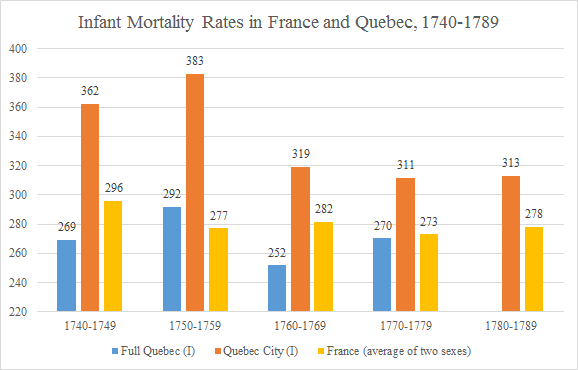
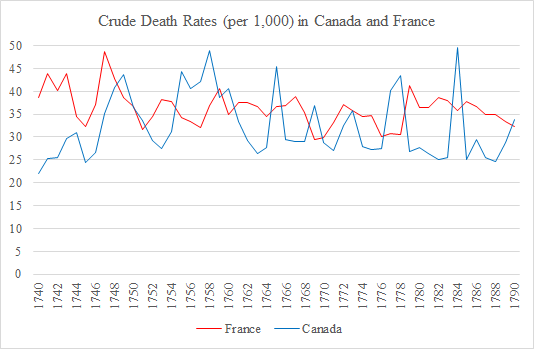
Yet, everything indicates that mortality rates were greater in Paris and France and than in Quebec City and Quebec as a whole (but not by a lot) (see images below).  Similar gaps seem to exist for the United States relative to Britain, but the data is not as rich as for Quebec. However, the data that exists for New England suggests that death rates were lower than in England but the “bare bones” real incomes measured by Lindert and Williamson show that New England may have been poorer than Great Britain (not by much though).

Crude Death Rates

IMR

I am not saying that demographic and biological data is worthless. Quite the contrary (even I wanted to, I could not since I have a paper on the heights of French-Canadians from 1780 to 1830)! The point is that data matters in context.  The world is full of small non-linearities between variables. While “good” demographic outcomes are generally tracking “good” economic outcomes, there are contexts where this may be a weaker relation (curvilinear relations between variables). I think that this is a good example of that point.

Trump’s humor is not very funny to the world’s liberal democracies

The Chinese Communist Party, on February 25, 2018, made a significant announcement — that the two-term limit for Presidency will be abolished through an amendment to the constitution. This means that current President Xi Jinping will be President for life. This amendment was tabled on March 6, 2018 by the Communist Party during the two week National People’s Congress (which began on Monday, March 5, 2018).

According to a CNN recording, Donald Trump, while reacting to this development, stated:

He’s now president for life, president for life. And he’s great. And look, he was able to do that. I think it’s great. Maybe we’ll have to give that a shot someday.

The US President also called Xi a “gentleman,” and said that the latter had treated Trump very well during his China visit in November 2017. Trump’s reaction to Xi’s decision has been criticized by some politicians in the US, while other major Western democracies have not commented on the decision.

Trump’s inconsistency on China

Trump’s views with regard to China have not been consistent, as is the case on many other issues. Candidate Trump had used tough language for China; at one campaign rally, for example, candidate Trump stated:

We can’t continue to allow China to rape our country and that’s what they’re doing. It’s the greatest theft in the history of the world.

During his visit to China in November 2017, the US President had, interestingly enough, criticized his predecessors, and said that he does not hold China responsible for the skewed trade relationship:

[…] I don’t blame China. After all, who can blame a country for taking advantage of another country for the benefit of its own citizens? I give China great credit […] I do blame past [US] administrations for allowing this out of control trade deficit to take place and to grow. We have to fix this because it just doesn’t work […] it is just not sustainable.

While the US President is unpredictable, the criticism of his predecessors on foreign soil came as a shock to everyone.

Trump’s myopic approach towards complex economic and strategic issues has helped China

Trump’s recent praise of the constitutional change which will enable Xi to be President for life may have embarrassed many Americans and Liberals in other parts of the world. They would have perhaps expected the US President to raise a red flag.

The fact is, however, that many of Trump’s foreign policy decisions – withdrawing from the Trans Pacific Partnership (TPP) trade deal in January 2017, or repeatedly criticizing NATO (North Atlantic Treaty Organization) and stating that members are not meeting their ‘financial obligations’ or, more recently, the imposition of tariffs on imports of aluminium and steel – are embarrassing steadfast allies in Asia and Western Europe. All these decisions have sent a message globally that Trump’s view of the outside world is driven by domestic politics and transactionalism – and not realism as some would have us believe. This is in contrast to his predecessors, who valued relationships but also understood the relevance of common democratic values as a binding thread. Trump on the other hand is quite comfortable with authoritarian leaders.

Trump has often expressed admiration for authoritarian leaders like Vladimir Putin, and Phillipines President Rodrigo Duterte. Duterte, who is controversial for using extrajudicial methods to deal with a Filipino drug problem, has presided over a drug war that has cost the lives of more than 4,000 people. While praising Duterte, Trump said:

I just wanted to congratulate you because I am hearing of the unbelievable job on the drug problem. Many countries have the problem, we have a problem, but what a great job you are doing.

During their meeting on the sidelines of the ASEAN Summit in Manila (November 2017), Trump did not sufficiently raise US human rights concerns, and was criticized by many American politicians, including Republican Senator John McCain. The US-Philippines Joint Statement, while speaking about the challenge of the drug problem, did refer to a human rights issue (issued after the meeting between Trump and Duterte):

The two sides underscored that human rights and the dignity of human life are essential, and agreed to continue mainstreaming the human rights agenda in their national programs to promote the welfare of all sectors, including the
most vulnerable groups.

It would be pertinent to point out that the previous administration had criticized Duterte for adopting such measures. In return, Duterte used offensive language aimed at President Obama.

While the US has been in bed with authoritarian regimes in the past and turned a blind eye on many occasions to human rights violations, no one can deny the fact that even transactionalist Presidents like Ronald Reagan paid lip service to democracy and human rights. In a speech at Westminster, Reagan stated:

Democracy is not a fragile flower […] Still it needs cultivating. If the rest of this century is to witness the gradual growth of freedom and democratic ideals, we must take actions to assist the campaign for democracy.

Similarly, George W Bush, who was often thought of as being very simplistic, spoke about the importance of democratic values as a common binding factor with many of its allies.

Conclusion

In conclusion, while reasonable ties between Washington and Beijing are good news, Trump’s public appreciation of authoritarian leaders and their methods is worrying because at the global level there is a feeling that authoritarian leaders and systems deliver better results compared to chaotic democracies.

The US has always been the flagbearer of democracy, liberal values, and human rights. It is a matter of concern, then, when the leader of such a country pays little attention to these issues. In a way, Trump has played a pivotal role in wrecking the liberal order, and by doing so has created a situation where Beijing will not have to change its ways, but may well create a parallel order which many countries will be willing to join due to China’s economic prowess.

Quad: The way ahead and the key challenges

The Quadrilateral Security Dialogue (QSD) consisting of India, Australia, Japan, and the US has been pitching in favor of a ‘Free and Fair Indo-Pacific’ ever since the first meeting between representatives of member states in November 2017.

Shinzo Abe, the current Prime Minister of Japan, actually proposed this arrangement about a decade ago. Diplomatic engagement began, and joint military exercises were even held, but a change in guard in Australia, as well as Chinese complaints to member states, resulted in the end of the arrangement. Given the increasing focus on the ‘Indo-Pacific’ region and the strengthening of strategic ties between all four countries, reticence was finally shed and representatives of the four countries met in November 2017, on the eve of the East Asia Summit in Manila. The main aim of the alliance, thus in other ways, has been to check China’s assertiveness, especially in the South China Sea, and democracy has been one of the key binding factors between the Quad. The U.S. State Department, after the meeting in November 2017, issued a statement that the United States is “committed to deepening cooperation, which rests on a foundation of shared democratic values and principles.”

More recently, the joint statement issued after the meeting between Trump and Australian Prime Minister Malcolm Turnbull in February 2018, reiterated the point about a Free and Open Indo-Pacific. Said the joint statement between both countries: Continue reading

The Gradual, Eventual Triumph of Liberty

Today I’d like to write a few words of hope and encouragement to those who already understand liberty’s value. I read a speech from 1853 that stood out to me. It’s easy to be caught up in the daily news cycle and feel that liberty is constantly under attack and threatened at every hand, that every gain is clawed back as liberties are eroded one at a time. At times like that, it is good to step back and took a better look at the broader history of the world.

The speech I read was by a gentleman named Parley P. Pratt, an apostle of the Church of Jesus Christ of Latter-day Saints in the Utah territory. This was just a few years after the Mormons, including Pratt and his family, had been driven from their homes by mobs and by indifferent and sometimes hostile state and federal governments in the United States proper to find freedom and refuge in the Rocky Mountains. There they still held 4th of July celebrations, honoring the sacrifices for liberty their fathers had made. Pratt, by this point in his life, had traveled through England and parts of Europe, much of the US, Canada, and along the Pacific into Mexico, and met with many people from Asia as well – a remarkably well-traveled man.

Despite the very real failures of the government to protect their individual rights or redress their grievances, he spoke in praise of the Constitution. The main thrust of his address was that the cause of liberty would expand and someday fill the world:

The longer I live, and the more acquainted I am with men and things, the more I realize that … the Constitution of American Liberty was certainly dictated by the spirit of wisdom, by a spirit of unparalleled liberality, and by a spirit of political utility. And if that Constitution be carried out by a just and wise administration, it is calculated to benefit not only all the people that are born under its particular jurisdiction, but all the people of the earth … . It seems broad enough, and large enough, to receive and protect all that may be in any way deprived of the common rights of man. …. [The principles of the Constitution] embrace eternal truths, principles of eternal liberty, not the principles of one peculiar country, or the sectional interest of any particular people, but the great, fundamental, eternal principles of liberty to rational beings – liberty of conscience, liberty to do business, liberty to increase in intelligence and in improvement […]

There is a day coming when all mankind upon this earth will be free. When they will no longer be shackled, either by ignorance, by religious or political bondage, by tyranny, [or] by oppression (Journal of Discourses, Vol. 1, p. 137-143)

Pratt claimed this would not happen predominantly by revolution and violence, but by America being a beacon light to the world. He spoke of throngs of people who would sit in his day enjoying to hear of our freedoms, our institutions, and our scientific and cultural progress. He spoke of the immigrants coming to this country from all parts of the world specifically to find that freedom, and that once enlightened by being allowed to think and reason and act for themselves without the bondage of kings, state religions, or other powers they would blossom and rise up in greatness. Whether they eventually returned to their native lands or not, this would act as an “indirect influence … on those despotic nations” of Europe and Asia.

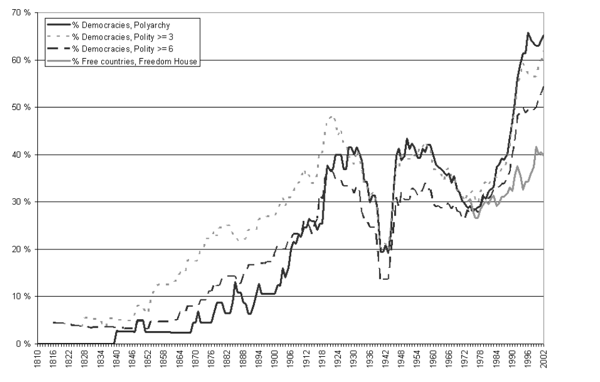
Recognizing that our liberty is remarkably multi-faceted, I will focus on the same categories Pratt mentioned. At the time he spoke, there were exactly 3 nations that were in some measure democracies, where at least some large percentage of the populace had the liberty of choosing their leaders. You can see for yourself how this has grown in the intervening 160+ years:

NOL Watson 1
source: Our World in Data

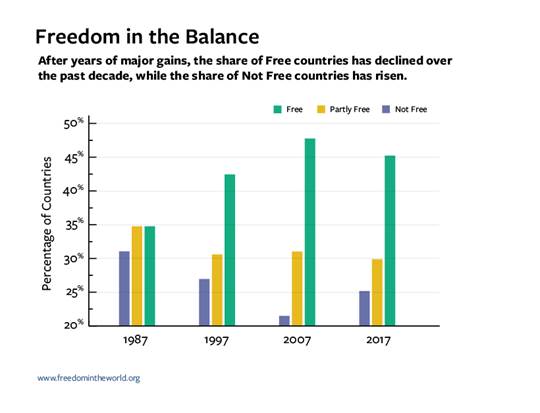
Billias’ 2009 work on how the principles of American constitutionalism were “heard round the world” shows that waves of influence gradually spread the principles of self-determination, liberty, separation of powers, and checks and balances into the freedom movements and constitutions of most of the world. Even while warning that the last ten years have seen declines in liberty overall worldwide, Heritage shows us that the last thirty years still show remarkable improvement:

NOL Watson 2

From a time when the US was one of very few countries to legally protect religious liberty, today nearly three-fourths of all the countries in the world have a constitution that specifically protects freedom of belief, and two-thirds permit some religious proselytism – which preserves freedom of expression (Pew Global Restrictions on Religion). There is still much to do to improve and preserve religious liberty around the world, both in legally acknowledged protections and in fostering an actual peaceful society where religious groups are not subject to violence and persecution.

Despite the distance left to go, the cause of liberty has clearly moved forward in great ways in the last 160 years. Much as Pratt predicted, much of this was accomplished without great revolutions and civil wars, but through the power of example as free nations and free people proved themselves a beacon to the world. There is still good cause to believe in that fundamental converting power from setting the right example and allowing free people to govern themselves.

Adam Smith on the character of the American rebels

They are very weak who flatter themselves that, in the state to which things have come, our colonies will be easily conquered by force alone. The persons who now govern the resolutions of what they call their continental congress, feel in themselves at this moment a degree of importance which, perhaps, the greatest subjects in Europe scarce feel. From shopkeepers, tradesmen, and attornies, they are become statesmen and legislators, and are employed in contriving a new form of government for an extensive empire, which, they flatter themselves, will become, and which, indeed, seems very likely to become, one of the greatest and most formidable that ever was in the world. Five hundred different people, perhaps, who in different ways act immediately under the continental congress; and five hundred thousand, perhaps, who act under those five hundred, all feel in the same manner a proportionable rise in their own importance. Almost every individual of the governing party in America fills, at present in his own fancy, a station superior, not only to what he had ever filled before, but to what he had ever expected to fill; and unless some new object of ambition is presented either to him or to his leaders, if he has the ordinary spirit of a man, he will die in defence of that station.

Found here. Today, many people, especially libertarians in the US, celebrate an act of secession from an overbearing empire, but this isn’t really the case of what happened. The colonies wanted more representation in parliament, not independence. London wouldn’t listen. Adam Smith wrote on this, too, in the same book.

Smith and, frankly, the Americans rebels were all federalists as opposed to nationalists. The American rebels wanted to remain part of the United Kingdom because they were British subjects and they were culturally British. Even the non-British subjects of the American colonies felt a loyalty towards London that they did not have for their former homelands in Europe. Smith, for his part, argued that losing the colonies would be expensive but also, I am guessing, because his Scottish background showed him that being an equal part of a larger whole was beneficial for everyone involved. But London wouldn’t listen. As a result, war happened, and London lost a huge, valuable chunk of its realm to hardheadedness.

I am currently reading a book on post-war France. It’s by an American historian at New York University. It’s very good. Paris had a large overseas empire in Africa, Asia, Oceania, and the Caribbean. France’s imperial subjects wanted to remain part of the empire, but they wanted equal representation in parliament. They wanted to send senators, representatives, and judges to Europe, and they wanted senators, representatives, and judges from Europe to govern in their territories. They wanted political equality – isonomia – to be the ideological underpinning of a new French republic. Alas, what the world got instead was “decolonization”: a nightmare of nationalism, ethnic cleansing, coups, autocracy, and poverty through protectionism. I’m still in the process of reading the book. It’s goal is to explain why this happened. I’ll keep you updated.

Small states, secession, and decentralization – three qualifications that layman libertarians (who are still much smarter than conservatives and “liberals”) argue are essential for peace and prosperity – are worthless without some major qualifications. Interconnectedness matters. Political representation matters. What’s more, interconnectedness and political representation in a larger body politic are often better for individual liberty than smallness, secession, and so-called decentralization. Equality matters, but not in the ways that we typically assume.

Here’s more on Adam Smith at NOL. Happy Fourth of July, from Texas.

Is the U-curve of US income inequality that pronounced?

For some time now, I have been skeptical of the narrative that has emerged regarding income inequality in the West in general and in the US in particular. That narrative, which I label UCN for U-Curve Narrative, simply asserts that inequality fell from a high level in the 1910s down to a trough in the 1970s and then back up to levels comparable to those in the 1910s.

To be sure, I do believe that inequality fell and rose over the 20th century.  Very few people will disagree with this contention. Like many others I question how “big” is the increase since the 1970s (the low point of the U-Curve). However, unlike many others, I also question how big the fall actually was. Basically, I do think that there is a sound case for saying that inequality rose modestly since the 1970s for reasons that are a mixed bag of good and bad (see here and here), but I also think that the case that inequality did not fall as much as believed up to the 1970s is a strong one.

The reasons for this position of mine relates to my passion for cliometrics. The quantitative illustration of the past is a crucial task. However, data is only as good as the questions it seek to answer. If I wonder whether or not feudal institutions (like seigneurial tenure in Canada) hindered economic development and I only look at farm incomes, then I might be capturing a good part of the story but since farm income is not total income, I am missing a part of it. Had I asked whether or not feudal institutions hindered farm productivity, then the data would have been more relevant.

Same thing for income inequality I argue in this new working paper (with Phil Magness, John Moore and Phil Schlosser) which is a basically a list of criticisms of the the Piketty-Saez income inequality series.

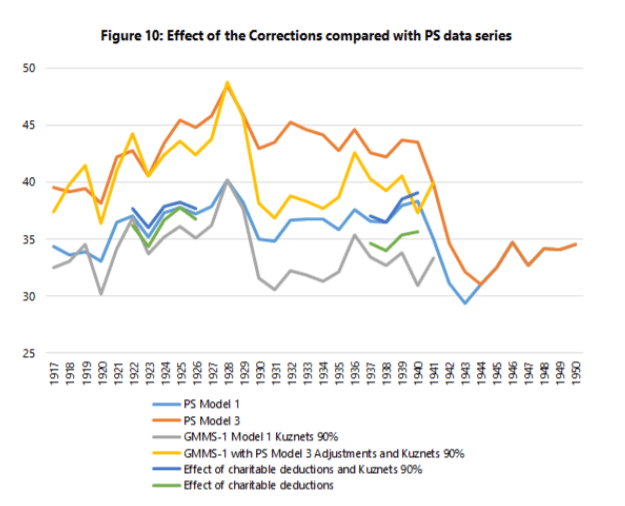
For the United States, income inequality measures pre-1960s generally rely on tax-reporting data. From the get-go, one has to recognize that this sort of system (since it is taxes) does not promote “honest” reporting. What is less well known is that tax compliance enforcement was very lax pre-1943 and highly sensitive to the wide variations in tax rates and personal exemption during the period. Basically, the chances that you will report honestly your income at a top marginal rate of 79% is lower than had that rate been at 25%. Since the rates did vary from the high-70s at the end of the Great War to the mid-20s in the 1920s and back up during the Depression, that implies a lot of volatility in the quality of reporting. As such, the evolution measured by tax data will capture tax-rate-induced variations in reported income (especially in the pre-withholding era when there existed numerous large loopholes and tax-sheltered income vehicles).  The shift from high to low taxes in the 1910s and 1920s would have implied a larger than actual change in inequality while the the shift from low to high taxes in the 1930s would have implied the reverse. Correcting for the artificial changes caused by tax rate changes would, by definition, flatten the evolution of inequality – which is what we find in our paper.

However, we go farther than that. Using the state of Wisconsin which had a tax system with more stringent compliance rules for the state income tax while also having lower and much more stable tax rates, we find different levels and trends of income inequality than with the IRS data (a point which me and Phil Magness expanded on here). This alone should fuel skepticism.

Nonetheless, this is not the sum of our criticisms. We also find that the denominator frequently used to arrive at the share of income going to top earners is too low and that the justification used for that denominator is the result of a mathematical error (see pages 10-12 in our paper).

Finally, we point out that there is a large accounting problem. Before 1943, the IRS provided the Statistics of Income based on net income. After 1943, there shift between definitions of adjusted gross income. As such, the two series are not comparable and need to be adjusted to be linked. Piketty and Saez, when they calculated their own adjustment methods, made seemingly reasonable assumptions (mostly that the rich took the lion’s share of deductions). However, when we searched and found evidence of how deductions were distributed, they did not match the assumptions of Piketty and Saez. The actual evidence regarding deductions suggest that lower income brackets had large deductions and this diminishes the adjustment needed to harmonize the two series.

Taken together, our corrections yield systematically lower and flatter estimates of inequality which do not contradict the idea that inequality fell during the first half of the 20th century (see image below). However, our corrections suggest that the UCN is incorrect and that there might be more of small bowl (I call it the Paella-bowl curve of inequality, but my co-authors prefer the J-curve idea).

InequalityPikettySaez.png

Immigration and Jobs

A couple of thoughts about immigration. It seems that there is a widespread belief in the US that immigrants take jobs from Americans. It makes superficial sense if you also assume that the number of jobs to be filled is fixed and that just about anyone can do any kind of work.

Both assumptions are mostly false. Here is an example that illustrates why.

I keep hearing native-born Americans trained in various high-tech fields who claim that they are unemployed because of competition from low-cost H1B visa holders. H1B visas go to foreigners with skills deemed to be needed by the American economy. A large number of H1B visa holders are from India and many are from China; they also come from a wide variety of other countries, including Russia, France, Bulgaria, etc. The implicit affirmation is that were such visas stopped completely, those who complain would step right into the vacant jobs.

Two things. First the claim that foreign H1B visa holders work for less is largely unsubstantiated although it should be easy to investigate such abuse. Second, I think it’s illegal to pay H1B holders less than Americans. Why would many employers risk a distracting lawsuit? Of course, a few might because there are irrational people everywhere.

Next and last: Hundreds of thousands of high-tech jobs are going begging as I write. Are employers so vicious that they would rather have the work not done at all than to give it to a credentialed American? Or is it more likely that the unemployed native-born high-tech workers have skills that do not match demand? If the second supposition is correct, ending the H1B visa program would cause even more high-tech positions to remain empty. Of course, this would have a negative effect on everyone, on every American’s prosperity.

Missing from this narrative: the possibility that high power, accelerated re-training programs would bring unemployed Americans the skills the high-tech sector requires.

I have to begin a confession that’s going to make me even more unpopular locally than I already am. I mean unpopular among my conservative friends. I taught in an MBA program in the middle of Silicon Valley for 24 years, two quarters each year. It was an evening program squarely directed at the ambitious hard-working. During that span of time, I must have had 150 students from India. I remember only one who was a bad student. I was intrigued, so I made inquiries. Sure enough, he had an Indian first name and last name, and the corresponding appearance but he was born in the US.* I cannot report so glowingly about other, non-Indian students that sat in my classroom through the years.

This little narrative proves nothing, of course. Consider it food for thought. Do it especially if you voted for Pres. Trump – as I did.

Reminder: H1B visas are awarded to individuals with an occupational qualification deemed to be in short supply in the US. Right now, it’s likely that most of those who get an H1B are trained in some IT area but that’s not all. For a long time, farriers from everywhere could easily get one. (If you don’t know what a farrier is, shame on you and look it up.)

There are other – presumably non-specialized – categories of immigrants who are widely suspected of taking jobs from Americans. The truth is not always easy to discern, not even conceptually. Five or six miles from where I live in Santa Cruz, there are growers who are tearing off their hair. Their problem is that they can’t figure out who is going to pick the crops they are now putting into the ground. As I have said repeatedly, the Mexicans they counted on in years past have largely stopped coming.

A quarter of a mile from where I live, and in the same direction, there are dozens of perfectly healthy US-born Americans who are working as “sales associates.” The apparent conceptual issue is this: sales associates earn $10/hr while a moderately experienced crop picker earns $15. The question arises of why we don’t see a full exodus from the sales positions to jobs that pay 50% more?

I think it’s lazy to call the US-born sales associates “lazy.” The reality is that the Mexicans who came, and are still coming, to pick vegetables and fruits in California overwhelmingly came from a rural population. They were reared under conditions where almost everyone around them labored in the fields. When they arrive in the US – legally through family reunion – or illegally, they are ready to take picking jobs. They then just do here more or less the same work they would do at home but for five times the pay or more.

In American society that kind of population disappeared several generations ago through mechanization and, of course, through the importation of foreign labor, precisely. Native-born Americans won’t do the work because it’s alien to their background. I think US-born people of Mexican ascendancy whose parents labored in the field won’t do the work either. Their parents do what they can to make their own work experience alien to their children. I am not surprised, that’s another expression of the American dream. It’s  what many would do back in Mexico but then, why emigrate?

I am pretty sure that any immigration reform should include a temporary agricultural program, a sort of H1A ( “A” for “Agriculture”) visa. It would allow foreigners to come to the US legally, just to work in the fields and for a set period only. It would not lead to permanent residency, nor, of course, to citizenship. Such a program existed between the forties and the early sixties, if memory serves. It was called the “Bracero program.” I don’t know why it was terminated. (Perhaps a reader can tell us.)

Mexicans would be the first to take advantage of such a program. As Mexico’s economy develops, they may be replaced by Central Americans and, eventually, by Africans. Such a program would sidestep the kind of assimilation problem France, for example, is facing right now with its North African population.

PS Personally, I think Mexicans make good immigrants to the US. I would bet than in ten years we will be begging them to come.


* Disclosure: I am married to an Indian woman. She is not in high-tech unfortunately.