Ferguson: the Problem is Collectivism

We Austrians emphasize the fact that only individuals act.  This may sound like a dry academic pronouncement, but sometimes events bring its meaning dramatically to the fore.  The Ferguson story is one such event.

While lunching in Palo Alto recently, I looked outside to see the street briefly blocked by demonstrators chanting and carrying signs with slogans like “black lives matter.”  I wished I could confront one of them with a few facts, but then again, facts matter little to such folk, even in trendy Palo Alto.

The racially mixed grand jury took seventy hours of testimony.  That’s a lot.  They know what happened better than you or I or anyone besides the officer involved.  The shooting was justifiable.  Another fact that seems to have gotten buried: Michael Brown was a criminal, just having completed a robbery when he was shot.  It’s too bad that he died, but hey, criminal activity is risky.

In light of these simple facts, how can people propound such irrationality as the demonstrators exhibited?  The answer lies in the fallacy of collective guilt, a sub-species of collective action.  Because white police officers sometimes shoot innocent black citizens, the fallacy implies that any white police officer who shoots a black civilian is necessarily guilty.

Now I want to extend this piece to the idea of reparations for slavery, a grotesque bit of nonsense that pops up from time to time, most recently, sad to say, in a piece by our own Brandon Christensen, albeit in passing.

Let me get this out of the way: slavery was a vicious, horrible institution.  The idea of reparations or restitution has some rationality on the face of it.  In general, people should be compensated, where possible, for violations of their rights, and what could be a more vicious form of rights violation than slavery?

From an individualist point of view, the idea of reparations is preposterous.  I for one know pretty well who my ancestors were, and I’m quite sure none of them held slaves.  But suppose I did have such an ancestor.  The next question is how much benefit I might have received from his slaveholding.  To answer that, we have to examine the counterfactual situation in which my ancestor did not hold slaves.  How much bigger was the bequest that he passed on (if any) versus what it would have been without slaves?  How much of that bequest filtered down to me, among possibly dozens of his descendents.  Clearly this is a preposterous undertaking, especially at this late date.

Well then, why not force all white people to pay something to all black people?  This of course is the idea of collective guilt, an idea nearly as repulsive as slavery itself.  But let’s carry on with it anyway.  Now we have to decide who is a white person and who is black.  Does Barack Obama count, being half white and half black?  Is one quarter black enough?  One eighth?

Carrying on, where will the loot come from?  White people will have to reduce their consumption and/or savings.This will exacerbate unemployment, at least temporarily, and reduce future productivity.  What would black people do with the money?  Some would judiciously save and invest it but most would not.  I say this because studies have shown that the majority of the winners of large lottery prizes blow the money, unaccustomed as most of them are to saving and investing.  Most blacks, I contend, would blow their reparations windfall on short-term consumption and possibly, like many lottery winners, end up in debt to boot.

Let’s keep things in perspective.  Racism is a minor problem in our society compared to the crushing burden of the welfare-warfare state that we all bear.

Slavery and the footnotes

I came across this old essay on slavery by economist Gordon Tullock (h/t Tyler Cowen) and what struck me (aside from an excellent presentation of the economics of slavery) was this footnote on the inevitable dissolution of Marxism (this paper was written in 1967):

It may be that the dissolution is not the first step toward the total elimination of this powerful religion, but merely a breaking away of the talmudic encrustation of the true scribes and pharisees of the Second and Third Internationals. Such a development is not uncommon in the history of other religions. My personal opinion is that the disintegration which we now see is more fundamental, however, and I doubt that Marxism will survive the century as a living faith.

In my own experience in the classrooms of powerful and plebeian universities alike, Marxism has indeed disintegrated into virtually nothing. Marxism has, rather, become a sort of an embarrassing older uncle that professors chuckle about in a manner that is more reminiscing than bitter. They all realize that Marxism led to very bad things, but they are unable to acknowledge that capitalism – Marxism’s Other – has brought about peace and prosperity for untold billions.

It would be wise for us, therefore, to continue to focus on this dead religion. Deep-seated beliefs are hard to let go of, even after these beliefs have been shown – theoretically and empirically – to lead to horrors of the worst kind. “Yes,” the embarrassed former adherents grudgingly admit, “communism has failed miserably, but socialism has not. It has not even been tried, and besides, it is capitalism that is responsible for the world’s ills today.”

This is not obstinance. This is deceit, plain and simple.

So how do we go about combating obvious deceit (rather than the sophisticated theories of 20th century Marxists)?

I think the answer is to just debunk their examples on a case by case basis, in as public as a forum as you can muster. Famines in east and central Africa, for example, have often been attributed to capitalism because of the policies of the World Bank and IMF. Libertarians ought to agree with most of this, and then simply point out that the World Bank and the IMF are central planning agencies designed, created, and supported by governments in the West. Once this fact -which is not quite as simple as it appears – is acknowledged, you can go from there and take a public choice route, an Austrian route, or even a populist libertarian route to explain why capitalism is not responsible for famines.

Wars, genocides, ethnic cleansing campaigns, etc., can all be explained (and eliminated) if libertarians focus on the role of the State in all of these ills rather than on the theoretical or empirical weaknesses of socialist explanations and proposals.

Debunking the Wage Slavery Myth

By Adam Magoon

It is often stated by those who are ignorant of economics that work is not a voluntary endeavor even when a wage is agreed upon voluntarily by both parties.  The rationale behind this claim is that a human being must eat, drink, and have shelter and therefore the employer has this leverage to use in order to strangle wealth from the poor worker.  In order to examine this erroneous belief we must start as we do with all economic examination with the Robinson Crusoe scenario.

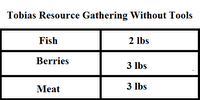
Assume a shipwrecked sailor (Tobias) on an island with no resources but his own two hands and his ingenuity.  To survive he has a number of options:  He can gather fruit/berries for a return of 3 pounds of berries per day, he can fish in the shallows(without tools) for a return of 2 pounds of fish per day, or he can hunt wildlife(without tools) for a return of 3 pounds of meat per day.
wageslavery1

Tobias requires 2 pounds of consumer goods per day to survive.  On this island consumer goods are either Berries, Meat, or Fish and given Tobias’ productive capacity of either 2 pounds of berries or 3 pounds of the other two consumer goods any intake of resources allows him to maintain his existence (subsistence).  It is at this point we must examine whether Tobias’ work is slave labor.

The definition [1] of a slave is:

1.

a person legally owned by another and having no freedom of action or right to property

2.

a person who is forced to work for another against his will

In our scenario is Tobias the property of anyone other than himself?  The answer is clearly “no” since Tobias is quite literally the only person on this island.  While he is “forced” to work due to his innate need for sustenance it would be counter-factual to claim he is somehow a slave to himself since the definitions of slave-master and slave are incompatible with another [2].  It is also absurd to say that because they provide his method of survival that Tobias is somehow slave to the ocean or the land [3].  So as we can see; when Tobias is alone on the island working to survive he is a slave to no one.

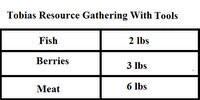
To this point we have been dealing with Tobias merely using his nature given resources to obtain and consume consumer goods.  However by collecting berries or hunting for two days (6pounds collected – 4 pounds consumed) he obtains 2 pounds of excess goods he can save.  Through this method of saving and then consuming the saved goods on the third day he can then use that time to create capital goods.  This means that on the third day, instead of hunting he can fashion himself a spear from collected wood.  The spear allows him to take on larger game and thus increases his collection of meat to 6 pounds per day.

 wageslavery2

At this point we need to examine two things.  First, at this point it would be foolish for Tobias to do anything other than hunt.  He has a decisive gain in resources due to his construction of the Spear and can use the vast amount of saved food to create even more goods (extra spears, traps, shelter, etc…).  As foolish as it may be objectively that diagnosis ignores his subjective valuations; perhaps he finds it distasteful to kill animals even in his situation, or simply prefers to pick berries due to the relative safety.  The reasons are irrelevant, just keep in mind that despite the obvious advantage of hunting in this scenario he can always choose not to.

The second thing we need to examine is whether Tobias is now a slave.  All of the evidence from the previous examination applies; he is still not a slave to himself.  The only thing that has changed is the creation of a spear from the saving of consumer goods.  It is clear that Tobias cannot be a slave to either the spear or his own saved consumer goods, again due to their nature as objects.  So we have seen that a worker working, both with and without capital goods, is a slave to no one.

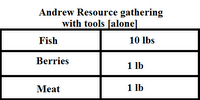
Now here is where the hypothesis comes into question.  Let us assume a second person becomes stranded on the island; except this person (let’s call him Andrew) has been able to scavenge from his wrecked ship a small life boat and netting that is suitable for fishing.  Using his tools while alone Andrew can Hunt for 1 pound of meat, gather 1 pound of berries, or gain 10 pounds of fish.

 wageslavery3

In this economy Tobias will gain the most by hunting and Andrew will gain the most by fishing and they both are likely to pursue those activities [4].  Now we must again identify if this change in circumstance has resulted in slavery.  Tobias’ situation has not changed at all, so he is not a slave to anyone.  Andrew is not interacting with Tobias in any way, he cannot be a slave to his boat, his net, the ocean, or himself so he is also obviously a slave to no one either.

However Andrew soon comes to believe that if he had someone to operate the net while he piloted the boat he could obtain 20 pounds of fish per day, this may be an erroneous prediction but that is the entrepreneurial risk Andrew must take to earn a profit.  For the sake of this examination we will assume that Andrew is an amazing entrepreneur and his prediction is exactly right; but to obtain the 20 pounds of fish Andrew needs an employee.

Here we reach the concept of wages.  In the economy where both Andrew and Tobias work alone they obtain 10 pounds and  6 pounds of consumer goods respectively for a total of 16 pounds.  Andrew, as an entrepreneur, sees that if he employed Tobias they would obtain 20 pounds of total consumer goods which is an increase in the size of their economy by 4 pounds of consumer goods.    At this point Andrew needs to hire Tobias.

If you remember; the subsistence level for Tobias is 2 pounds of consumer goods per day; so any attempt to hire Tobias for less than that will be ignored since he could not survive at that wage.  Currently though Tobias is producing 6 pounds of meat using just his own intelligence and skill so any attempt to hire Tobias below that rate will also be denied.

Andrew would obtain 10 pounds of goods without Tobias’ help so he would be amiss in paying Tobias more than that since then Andrew would then be taking a loss.  Using our final profit of 20 pounds if Tobias agrees to work for Andrew the wage rate must be between 6 and 10 pounds of goods per day.

In this scenario let’s assume Andrew offers to pay Tobias 7 pounds of goods in exchange for his work operating the net [5].   Tobias would then be gaining 1 pound of goods over his efforts if he worked alone.  Andrew would be gaining 3 pounds of goods compared to his work alone.  Tobias agrees to this arrangement and both parties are better off.  Here is where the proponent of wage slavery points to the fact that Tobias is seemingly generating 10 pounds of goods but only obtaining 7 pounds and thus he is being exploited by the capitalist-pig Andrew but let’s examine whether there is a master-slave arrangement here.

Andrew has freely chosen to hire Tobias at the cost of 7 pounds of consumer goods with the expectation of gaining 13 pounds for his own use.  He is free to terminate this agreement at any time.   Tobias is in a voluntary agreement to help Andrew obtain a total of 20 pounds of consumer goods in exchange for a payment of 7 pounds of goods.  He is free to leave at any time if the agreement becomes unsatisfactory and hunt for himself, though he would suffer a net loss of 1 pound of consumer goods to do so.

There is nothing here that fits the definition of slavery, Tobias is not forced to work against his will and Andrew is not forced to hire him.  Both parties own their own property and neither owns the other in part or in whole.  Even though Tobias would be taking a loss by leaving Andrew’s employment the loss to Andrew would be even greater!  Andrew would be losing 3 pounds of profit and Tobias would only be losing 1 pound.  Therefore despite Tobias’ innate need to work this does not cause a master-slave arrangement or “exploitation”.  It is true Tobias has to work to survive but he does not need to work for Andrew; but he voluntarily will continue to do so as long as it benefits him.

Finally, what of the “missing” 3 pounds of goods that Tobias is somehow losing?  The answer is obvious; it is the price put on Tobias’ use of Andrew’s capital goods which in this scenario are his boat and net.  Without these capital goods Tobias would not be able to generate 10 pounds of consumer goods and therefore there is a premium placed upon them by Andrew; after all they are his property and he must maintain them.  If Andrew’s boat was to spring a leak or his net tear Tobias would not have any responsibility to fix them and could happily take his 1 pound loss and go back to hunting while Andrew (if he had not achieved some profit) would suffer the far greater loss of both his 3 pounds of goods and the destruction of his capital goods.

It is worthwhile to note how this scenario compares to the classic opinion that people born into wealth have somehow acquired it illegitimately.  In our scenario Andrew did not need to save consumer goods like Tobias did in order to obtain capital goods, he simply has them due to luck, or fate, or what-have-you.  This does not change the fact that he does indeed own them and can utilize them how he wishes and that utilization is totally legitimate.  Would anyone scoff if Tobias handed down the hunting spear to a future son for his protection and livelihood?  To remain consistent we cannot then harry Andrew for passing down his fishing equipment for the sole reason that it would give his own heirs an “unfair competitive advantage”.

It is evident by now that the entire concept of wage slavery is simply a misunderstanding of economic principles.  Even the myth that somehow the wage earner does not get “his fair share” has been debunked.  The simple reason why so many find these concepts hard to extrapolate in the real world is due to the hundreds of years of savings, production of capital goods, and the highly specialized division of labor that has made worker productivity increase to such an extent that the fall to subsistence seems unfathomable.

The productivity of the workers in the industrialized world has become so great that any work outside of this world, such as gathering berries or fishing to feed an entire family, would require a massive drop in quality of life.  This is somehow turned around to be a slight on employers when they are the ones who have made this increase in the quality of life possible.

If we had replaced Andrew’s life boat in our scenario with a commercial fishing trawler that allowed Tobias to obtain 500 pounds of fish per day would we then say he is Andrew’s slave because he would be “forced” to return to hunting only 6 pounds of meat per day should he choose to leave?  Would Andrew be a villain for hiring Tobias and paying him such a vast increase over the wage he could obtain by working alone?  No! Of course not! It doesn’t logically follow!  Yet that is the accusation from the proponents of wage-slavery and it is clearly absurd.

[1] http://dictionary.reference.com/browse/slave?s=t

[2]  It is true that a slave could himself be the master of a third slave, but a slave master logically cannot be a slave to his own slave since either one slave or the other would end his own involuntary servitude.

[3] By their nature as objects they cannot own other objects.

[4] Whether they actually trade goods at this point is irrelevant because both parties are satisfying their base needs through their own effort.

[5] We are also assuming that the number of hours worked are the same and subjective preferences of hunting over fishing or vice versa are non-existent.
Obama’s Haitian Policy

A strange symmetry of irrationality and meanness in the news about Haiti: Pat Robertson declares that God is punishing the Haitians for their sins; two days latter, Denis Glover, the activist of all Leftist causes observes that the Haiti earthquake is somehow connected to the failure of the climate conference in Copenhagen. It turns out that Gaia is just as mean as God the Father! Why bother to switch, I wonder. I have been telling you, friends, for a long time that climate warmism is a cult.

I have cool thoughts about the human catastrophe in Haiti, almost inhumane thoughts. I suspect the Haitians will end up coping better than many others would have under the same terrible circumstances. The population is so damned poor that it’s trained to do with little. I worry about water mostly because humans can’t make do without it but for a short time.

Parallel reasons lead me to predict that the 2010 earthquake will turn out to be a blessing in disguise for the survivors. Port-au-Prince and the rest of the country were so dismal that it would be impossible to restore them to their former awfulness if you tried. It’s difficult to rebuild massive quantities of housing without accompanying infrastructures, including roads, water pipes, and sewers (which are almost lacking today). I am betting, of course, that there is going to be a serious international effort to “rebuild.”

Another uncharitable thought: I will be curious to see how the population of Haiti stacks up, in energy and in entrepreneurship, with the population of New-Orleans post-Katrina. In case, you wonder, my money is on the Haitians. Continue reading

From the Comments: Red State Blue State Edition

Now that I have a trusty laptop again, I can answer questions and discuss comments a bit more efficiently. Hank Moore asked the following question in response to a link I provided on Left-wing secessionist sentiment:

That California piece was good. What’s your take on the whole red states mooching off the blue states thing? I keep hearing this whenever the secession question comes up. Those few libs who don’t want to confiscate Texas from the Texans say “good riddance, you’re a tax burden anyways!”

It doesn’t quite fit into my version of the conventional wisdom for some reason. [1] Are the blue states paying more than their “fair share” simply because they are underrepresented and thus the fault is the constitution, or [2] is it because they already have large populations they naturally attract big businesses in spite of the fact they aren’t as friendly to free enterprise, and because of this there is more tax revenue to be collected? [3] And then there’s the fact that some red states may in fact still be feeling the effects of being on the losing side of the Civil War (scorched earth warfare, unconditional surrender, reconstruction). These are the three possible explanations that fit with my way of thinking. Maybe its just that I’m cherry-picking “evidence” for a conclusion I’ve already arrived at.

Any thoughts?

All three of Hank’s reasons are good, but I’d like to zoom in on the last one about the Civil War. I think has the gist of why many red states are poorer than blue states, but with a couple of tweaks. Continue reading

Race and Ethnicity

My Facebook friend, VXA who is a disgruntled Afghan immigrant but quite smart some of the time asks this question: What’s the difference between race and ethnicity?

I am a sociologist by trade and I think I know the answer.

Both are vague terms. Race is a well established habit to classify people according to certain selected physical characteristics. The physical features are selected generally according to their usefulness within a given social agenda. Thus the presence or absence of  hair on the second knuckle of the index finger never is selected because it’s not useful. Skin color and hair shape often are because they allow for quick classification.  Medieval Europeans had no category “negro.” They would describe people in physical terms without assigning them to a  social category “Du Guesclin, the Marshall, was very dark of skin and hair.” It turns out that famous French historical figure was probably a man of some African blood. He would have been considered “colored” in Georgia in 1850. Same goes for Pushkin, the Russian national poet. Continue reading

Around the Web: Consortium Edition

Co-editor Fred Foldvary points out that slavery is alive and well today.

Historian Michael Adamson compares the debacle in Iraq to South Vietnam rather than Germany or Japan.

Mark Brady gives us a well-written, brief biography of a little-known (and hence important) individual in the liberty movement.

Ninos Malek explains how property rights are the key to environmental conservation efforts.

Jeffrey Rogers Hummel takes on anthropologist David Graeber.

Links From Around the Consortium

Over at the Progress Report, Dr. Fred Foldvary writes on how we can extirpate poverty from the world.

Jacques Delacroix calls out Ron Paul’s statement about Iran being surrounded by the U.S. government.

Professor Jeffrey Rogers Hummel tackles the issue of slavery head-on in a Freeman article.

Brian Gothberg writes about the potential technology has to start protecting the ocean’s resources through property rights.

And our newest blogger, Dr. Ninos Malek, defends stereotyping (defending the undefendable is why I love being a libertarian!).