Libertarians and Pragmatists on Democracy Part 1: What is Democracy?

Note:  This is part of a series of posts critiquing democracy. I plan on writing this series in four parts. First, in this post, I plan on introducing the various nuances to the term “Democracy.” Second, I will give a brief summary of classical liberalism’s skeptical attitude towards democracy. Third, I’ll summarize the insights into the benefits of democracy from the perspective of the American pragmatists. Finally, I’ll argue that the dialectical synthesis of these perspectives on democracy leads to a plausible defense of market anarchism.

Democracy has tended to occupy a bizarre position in the history of classical liberal and libertarian thought. Particularly in recent decades, here’s a sense of ambivalence amongst libertarians towards democracy the last couple decades even though the prevalence of democratic institutions in the west is almost a direct result of our intellectual ancestors. There are also a diversity of perspectives on democracy amongst libertarians, from fanatically opposed, such as Hoppe, to ambivalently supportive, such as Hayek, to fairly supportive, such as the younger Jefferson. Fellow note writers here at NOL have recently been showing a far more negative view on democracy typical of more modern libertarians.

My personal attitude is further complicated by other intellectual influences. Whereas there’s a tendency in my thought to be very skeptical of democracy, for many of the reasons anti-democratic libertarians are apt to emphasize, the other main intellectual tradition that influences my thinking—that of American pragmatism—is extremely pro-democratic. Democracy is arguably the very center of the philosophy of John Dewey, who has had a profound influence on my philosophical and political views (despite my extreme disagreements with his statist policy agenda). As a result, if someone were to ask me “What do you think of democracy?” I’d probably give a very wishy-washy response. In this series, I’ll attempt to reach a sort of dialectical synthesis between the variety of classical liberal opinions of democracy and the radically pro-democratic ideas of the Deweyan pragmatists.

Before critiquing it, perhaps understanding what the term “democracy” even means is in order. There are four main ways I see the term used in modern discourse. The first, trivially, is thrown around as an empty term of political praise; in popular political discourse, the term “democratic” is uttered as an almost meaningless praise when a politician does something the speaker likes that happens to agree with the majority consensus and the term “anti-democratic” is thrown around as an insult if a politician does something that the speaker disagrees with and happens to be against the majority consensus. The fact that democracy is now a term of empty praise is especially ironic as it is a pretty recent development; prior to the nineteenth century, democracy was a term with strongly negative connotations since Aristotle used it to describe tyrannical rule of the majority in his Politics and Plato critiqued the “democratic soul” in the Republic. This use of the term in America has been particularly abused since the age of Andrew Jackson, who committed a jihad (see what I did there?) on the concept of America as a republic by turning the idea of democracy into a national religion. Clearly, this use of the term is mostly (although not altogether) unrelated to the issues I’ll be addressing in this series.

The second way the term “democracy  is used, most obviously, is as a simple description of a mode of political decision making or constitutional design. In this most literal sense, democracy is defined as the election of political leaders or policies by majority vote. Third, democracy is used as kind of a generic term for the system of government that has dominated the west since World War II—even though terms such as “parliamentarian” or “republican” are probably more accurate.

Finally, and perhaps most interestingly, democracy is used in some circles (particularly by the pragmatists) to describe a social epistemology, an overarching philosophical orientation, or—to quote Sidney Hook and John Dewey—a “way of life.” As Dewey writes in the Democracy and Educational Administration “Democracy is much broader than a special political form, a method of conducting government…it is something broader and deeper than that.” Dewey describes this deeper meaning of democracy “as the necessity for the participation of every mature human being in the formation of the values that regulate the living of men together[.]”  This notion of democracy is characterized by a thoroughgoing experimentalism and Dewey himself essentially sees democracy as the application of the spirit of the scientific method to social relations. I will have much more to say about this conception of democracy later, but for now note that it is possible to affirm many of the epistemic and philosophical commitments to the democracy of the pragmatists without necessarily affirming democracy as a political constitution.

In the next post, I’ll analyze what political democracy means in the tradition of classical liberalism; in particular, I’ll focus on some of the unease about democracy’s potential for tyranny occupied by earlier classical liberals such as Mill and De Tocqueville, and some of the criticism of democracy in more recent libertarian thought inspired by the insights of public choice theory. By the end of the series, I argue the criticisms that classical liberals and libertarians have had may be devastating to the argument that a predominately democratically (in the second sense) oriented government is the best possible political system; however, those criticisms do not necessarily apply to the fourth understanding of democracy extolled by the pragmatists. In fact, if we take into account the flaws of democracy pointed out by libertarians, some form of market anarchy may perhaps be the best way to fulfill the democratic goals of the pragmatists.

BC’s weekend reads

  1. Dank Federalism
  2. What About Capitalism? Jürgen Habermas’s Project of a European Democracy
  3. The IDF gets leaner as its enemies evolve (the US should do the same, by the way)
  4. A moderate defense of extremism in defense of liberty
  5. Why I lean libertarian
  6. Backlash grows to Schengen backlash

Go Broncos

NOL Foreign Policy Quiz, Part One

The goal of this post is to discuss the purpose of a NOL Foreign Policy Quiz. It is the first in a series of posts discussing the details of how to actually devise and distribute this quiz. Reader input is encouraged.


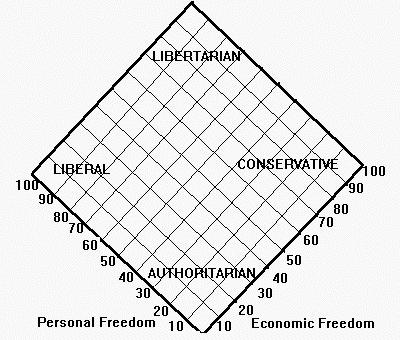
The Nolan Chart is a short political quiz developed by David Nolan, the Libertarian Party founder. The Nolan quiz plots individuals along two axes, asking them their preferences towards issues of personal and economic freedom (both Rick and Warren have blogged about the Nolan Chart here at NOL, too). Libertarians are those individuals who favor both personal and economic freedom.

nolanchart

The benefit of the Nolan Chart is that it moves us away from the left–right spectrum and towards a two-dimensional understanding of politics. The limitation of the Nolan Chart is that it only views politics through these two limitations. The Nolan Chart at best tells us what end policies we favor, but it fails to address how to achieve these goals.

This is problematic, as even political groups that agree on end goals differ substantially on how to best achieve them. Among libertarians, the largest debate is probably between those who believe a minimal state is needed (minarchists), and those who believe no state can be tolerated (market anarchists) to achieve maximum liberty. There is also, to a lesser extent, a debate on the form of government* and foreign policy.

It is possible to be a libertarian and believe that monarchy is superior to republicanism or democracy in upholding the law and maximizing liberty. Likewise, it is possible to be a libertarian and desire an active foreign policy beyond promoting free trade agreements. I know that I stir controversy with my latter comment, but give me a moment to defend it.

The standard libertarian foreign policy is one of non-intervention. It is a policy of wishing to sever military ties with foreign nations and instead promoting free trade with all. It is a policy consistent with the non-aggression principle.

However, this standard policy is not the only policy consistent with libertarianism. It is possible to believe that, although the loss of any human life is horrible and that the state is illegitimate, the best option to minimize human life and protect liberty is to attack, embargo, or annex another state.

I do believe that there are several tests that must be met before one adopts a foreign policy beyond the standard libertarian creed. Specifically:

  1. Loss of human life and liberty must be weighed for both sides.
    1. Discounting should not occur on national basis.
  2. All reasonable peaceful solutions must be acted on beforehand.
  3. The long-term consequences of the action must be considered and weighed for both sides.

Additionally, if actions are taken, then all precautions must be taken to minimize loss of human life and liberty on both sides.

Minarchist libertarians may see the state as a tool to maximize freedom, but I do not believe this grants them the authority to kill others. There may be a scenario where the murder of one man is outweighed by it leading to the protection of ten men, but the one man has still been murdered and his death must be felt as a regrettable action. The value of a man is not dependent on whether he was born in New York City or Tehran. A libertarian cannot be a jingoist.

At no point may a foreign policy action be taken if a reasonable peaceful action is still available. If a man enters your home with a gun and clearly intends to harm you, by all means it is justified to attack him, even if he has not yet shot or aimed at you.

And finally, the long-term consequence of a foreign policy action must be considered. Even if the first two rules are met, if there is not a long-term plan that is likely to succeed, no action should be taken.

For a long time, I wrestled with my stance on the Iraq war. I believed in the past that the first two requirements had been met and that the US invasion of Iraq was justified despite the loss of life and liberty on both sides. The Iraq war did not, however, meet the third hurdle. There was no viable long-term plan, and the latest consequence of this is the rise of ISIS and other militant groups in the MENA region.

Meeting these three conditions is difficult, but possible.

For example, I believe that expanding the US to include South Korea and Japan would be a proactive foreign policy stance consistent with my the rules I outlined above. Such an expansion would harm Okinawan residents, whose land is currently used for US bases. Such an expansion would also lead to retaliation from the PRC and North Korea. It would, however, lead to a net win for liberty. South Koreans and Japanese residents would have a stronger defense against a rising PRC seeking to dominate the region militarily. US residents would benefit from having defense costs, both in monetary and human life terms, more equitably shared. Although I am hopeful the PRC will liberalize in the future, its actions towards Hong Kong makes me doubtful that that will occur in the foreseeable future.

It is possible that I am wrong of course, and that adding South Korea and Japan would lead to a great loss of life and/or liberty. I am still a libertarian, however. I am not discounting the lives or liberty of non-US residents. I am not ignoring another peaceful solution – the current foreign policy scenario in East Asia is not sustainable for much longer, the PRC has clear intent to assert itself in the region, and it’s extremely doubtful that it will liberalize in the foreseeable future. I am considering the future: the PRC and North Korea are sure to retaliate, but I do not see either of them going to war over it. I do see the PRC being more likely to go to war over annexing Taiwan, even if not immediately, or otherwise I would promote Taiwanese annexation as well.

Hopefully I have successfully shown that it is possible to be a libertarian and favor a policy beyond the standard libertarian foreign policy. In which case, there is merit in discussing foreign policy beyond this standard.

There have been proposals to incorporate a foreign policy dimension to the extant Nolan Chart, but these proposals take it for granted that a non-interventionist policy is the only libertarian prescription. Over at FEE, Richard Fulmer proposes the following five questions:

  1. The United States should cease serving as the world’s policeman.
  2. The United States should not engage in nation building.
  3. The United States should not pledge to defend other countries.
  4. The United States should withdraw its troops currently stationed around the world.
  5. U.S. foreign policy should not be tied to that of the United Nations.

Unless one believes only a non-interventionist foreign policy is compatible with libertarianism, it is clear that these questions are insufficient. They also highlight that a NOL foreign policy quiz should seek to complement, but be independent of, the Nolan Chart. Otherwise, any attempt to add a foreign policy dimension will end with in fighting over who is a libertarian and who is a statist.

Again, the standard non-interventionist libertarian foreign policy view is a consistent and legitimate view point. It is however possible to favor foreign policy interventions under certain conditions and still be a consistent libertarian.

In the next post I will be proposing the foundation for a NOL foreign policy quiz.


Foot Notes:

*Even market anarchists who reject the need for a state debate on what type of organizations would exist and how the law would operate. For example, Murray Rothbard’s early vision for market anarchism presumed that a unitary law would exist, and that private defense associations (PDAs) would compete to best to carry out this unitary law. This unitary law would be based on ‘natural law.’ David Friedman’s vision for market anarchism does not presume a unitary law, and instead imagines competition for the law, as opposed to competition for the application of the law itself. My understanding is that there are also Rothbardians who have moved away from PDAs and towards dispute resolution organizations (DROs). It has been quite some time since I actively followed this debate among market anarchists, so I will defer to anyone who has more up-to-date information.

Further Reading:

Ian Bremmer’s American Foreign Policy Quiz [NOL Post] – The post that initiated the idea of a NOL Foreign Policy

A Three Dimensional Nolan Chart Extension Focusing on Form of Government (e.g. Anarchy v. Monarchy)

Giving Up On The Masses

In 2012, during Ron Paul’s second presidential candidacy as a Republican, I felt deflated with the masses again. Again, the masses were not going to vote a libertarian into office. It was the same year in which I read Murray Rothbard’s Ethics of Liberty and Hans-Hermann Hoppe’s Democracy: The God That Failed. What struck me at that time was the realization that democracy is actually an extremely poor political system to make society become more libertarian. Democracy is not even a guarantee whatsoever for political and economic freedoms. Its success is dependent on the uprightness of the masses, but where are the masses to stand up against war, bank bailouts, taxation, police aggression etc? If the government is truly a gang of thieves and murderers, as I believe it is, then the voting masses are advocates of theft, harassment, assault, and murder.

I do not believe that the masses are ready for freedom, because freedom means taking responsibility for one’s life and actions – a frightening prospect for the masses who lack the strength to face insecurities in life. Ingrained with fear of their own and their neighbours’ incapability to live a ‘responsible’ life, they are attracted to masters who can arrange their lives for them. The masses have also never thirsted for truth. Whoever can supply them with illusions is easily their master, and whoever attempts to destroy their illusions is always their victim. They want to be comfortable and cuddled to death. Thinking is too much hassle for the mass-man. The masses have moreover a love for egalitarianism and a disdain for those who are different, who are more successful and more beautiful. They hate freedom, because in freedom man naturally maintains his distance from his fellow human beings.

Being discontent with the masses and deflated in my philosophical views on politics and economics, I took Peter Thiel’s following dictum to heart: “The masses have given up on unregulated capitalism, so those who still support unregulated capitalism should give up on the masses.” Instead, I have put my hope on such technological advances of decentralization as cryptocurrencies, seasteading, 3D-printing, and localized energy conservation and production.

BC’s weekend reads

  1. The Criminalization of Curiosity
  2. Britain needs Christianity – just ask Alan Partridge
  3. Libertarians have nowhere to turn
  4. In light of ongoing events in Poland, this October piece by Dr Stocker here at NOL is worth reading again
  5. The West in the Arab world, between ennui and ecstasy

A Quick PSA: Putting “boots on the ground” in Syria is still a dumb idea

Readers might be mistaken into thinking that I am some kind of statist or rabid interventionist because I often put forth arguments that are nowhere to be found at the Cato Institute or the Mises Institute when it comes to American foreign policy.

I have argued that the federation of countries would be a good idea. I have argued that multilateralism is of the utmost importance when it comes to solving problems. I have no problem using IGOs like the UN or the IMF to bolster diplomacy. I have entertained the notion that the US should take a back seat in hot spots in order to better bait autocratic states into committing blood and treasure to the said hot spot, and then unleashing hell. Sanctions are dumb and never work, but building closer trading ties with an adversary’s enemies is a underdeveloped path.

Statist AF, right?

Wrong!

I am trying to put forth alternatives to “boots on the ground.” I understand that military interventions are a bad thing. I don’t want “boots on the ground.” I understand that the costs far outweigh the benefits. I understand that war is the health of the state. What I don’t understand is how “doing nothing” is a libertarian position. Dogmatic slogans made us lazy a century ago. We lost our claim to the title “liberal” because of it. Dogmatic slogans made us lazy a century and a half ago, and we lost our claim to the title “internationalist” because of it. What will our laziness cost us today?

Boots on the ground? We should be so lucky.

Theory versus Common Sense? The case of the Dutch

Since the fifteenth century, [the Netherlands] has had several features which later liberal thinkers, such as David Hume and Adam Smith, enviously referred to. Compared to other countries, economic freedom was an important issue, just as the larger degree of religious freedom. Trade, tolerance, and cultural developments turned the Dutch into an early manifestation of liberalism. However, with the possible exception of Erasmus, Spinoza, and perhaps the Rotterdam-born but London-based Bernard Mandeville, the Dutch lacked great thinkers who could provide this liberal practice with a theoretical base.

This is from the introduction (page 2) to Dr van de Haar‘s excellent new book, Degrees of Freedom: Liberal Political Philosophy and Ideology, and I think it makes a good argument in favor of the “common sense” approach to the political. This common sense approach, for those of you wondering, is often contrasted in American libertarian circles with the theoretical approach espoused by academics. Common sense libertarians tend to be more socially conservative and more parochial than theoretical libertarians who, in turn, are less socially conservative and more cosmopolitan in outlook. This difference in outlook between the two factions leads to the former camp appealing to “the people” in arguments, whereas the latter often appeal to the authority of a scholar or school of thought. Dudes like Ron Paul and Lew Rockwell are in the former camp; dudes like Steve Horwitz and Eugene Volokh are in the latter. This is not a tension limited to American libertarians, of course. You can find it just about anywhere, but libertarians have made it interesting, mostly because – once they have acquired facts like the one Edwin reports on above – they ask questions like this:

How is it possible for a society like the Netherlands to exist when it had no great thinkers to claim as its own?

The common sense faction will reply with something like this: “That’s easy: because the Dutch people were left alone they were able to prosper. With no busybody do-gooder class of intellectuals around to make rules for the peons, folks were able to thrive thanks largely to personal freedoms and self-interest.” This line of reasoning has a lot of merit to it. In fact I buy it, even though it’s not complete.

I think the Dutch had plenty of good theorists whose work contributed to the peculiar nature of the 15th century Dutch republic, but it is also true that the high theory of guys like Smith and Hume is largely absent from Dutch political thought (I don’t remember reading any Dutch philosophers in my introductory philosophy courses in college, for example). I can clarify this in my own mind by drawing parallels with American political theorists up until the end of World War 2, when the US suddenly became a superpower and has received a great influx of the Really Smart People from around the world. Like the good Dutch political thinkers, nobody outside of the US knows who James Madison or Alexander Hamilton are (specialists excepted, of course). A few quirky weirdos out there might know who Ben Franklin is, but they won’t know him for his political theory.

Maybe this also had to do with the fact that the Dutch (and American) theorists were more concerned with keeping Spain (or other scheming Great Powers) at bay, and this could only be accomplished with a heavy does of pragmatism to supplement ideals; pragmatism is, of course, something that high theory avoids.

The great thinkers, who we all know (even if we have not all read), in contrast, don’t seem to have a lot of experience in policy and diplomacy. Furthermore, these guys all seemed to be in well-integrated outposts of cosmopolitan empires that were largely populated by minorities. Scotland, for example, was part of the British Empire, or Kant’s Prussia, which was technically independent of the Austro-Hungarian Empire but still very much a cultural and economic junior partner to Vienna at the time.

Here is my big question, though: If the Dutch had no Great Thinkers, how were they able to create the richest, most extensive overseas empire the world had ever seen?

Common sense libertarians, 1

Theoretical libertarians, 0

By the way, my answer to that last question goes something like this: the Dutch, as former subjects of the Spanish Empire, had intimate access to Madrid’s trading networks (cultural access as well as economic and political) and this, coupled with the federal republic that Dutch statesmen were able to cobble together, gave lowlanders just enough breathing room to raise the bar of humanity. Again, you can find Dr van de Haar’s new book here.

Philosophical Research on Seasteading

The Seasteading Institute has recently published my philosophical dissertation on ‘Seasteading’. You can find it in the key research section of their Law and Policy page: http://www.seasteading.org/law-and-policy/.

Wayne Gramlich and Patri Friedman[1] founded the Seasteading Institute in 2008 in order to promote the seasteading movement, which has intellectually attracted mostly libertarian-minded individuals. The institute has also attracted funding from Paypal cofounder and early facebook investor Peter Thiel.[2]

A seastead is a permanent habitable dwelling on the ocean that preferably lies outside governmental waters. The Seasteading Institute believes that the creation of permanent societies on the seas can provide an experimentation space for innovative forms of socio-political organizations. The ultimate aim of seasteading is that newly emerging societies will inspire social changes around the world and contribute to human flourishing. First seasteads will be small-scale projects and they may even be constructed within existing governmental territories. However, seasteads could expand organically as technologies improve and innovative ideas of the functions of seasteads would emerge. One of the core ideas of seasteading is that an open experimentation space for social organizations will lead to progress in social rules and legislations, just as an experimentation space for new technologies leads to technological progress.

It is undeniable that social rules and legislations heavily influence all aspects of life, including technological progress and social well-being. One could for example compare North and South Korea, two countries that separated from each other in 1945. Both countries have had more or less the same culture and similar natural resources. However, what differs is their form of social organization; the North came under communist rule, whereas the South embraced western-style capitalism and democracy. Almost 70 years later, the differences in wealth, technological advancement, and social well-being are striking. South-Korea’s GDP per capita is for example 18 times larger, its internet penetration is more than 815 times greater, its life expectancy rate is 10 years longer, and the heights of South Korean pre-school boys are on average 4 centimeters longer. (Taylor, 2013, April 8).

The Seasteading Institute believes that, given that social progress and well-being heavily depend on how society is structured, mankind could make a huge step forward by letting social entrepreneurs start up seasteads to compete with governments in the industry of law-making and by letting millions engage in the experimentation with new forms of social organization.

In the paper, I provide a philosophical investigation of the concept of seasteading from a libertarian anarchist perspective. My investigation revolves around the following research question: “given that governments are resistant to structural changes of governance, how can mankind discover better forms of social organization?”

I argue that seasteading can fulfill that important role of moving mankind forward by experimenting with and finding new forms of social organizations that are best for human flourishing.

In the first chapter, I maintain that one core focus of political philosophy is to deal with the realities of value pluralism and political disagreements. I also contend that the most common form of social organization, representative democracy, does not satisfactorily deal with these realities. Hence, we should look for political possibilities beyond representative democracies. In order to discover these possibilities, we should experiment with new forms of social organization.

Chapter two discusses why there is currently little experimentation with social orders. I approach the issue from a meta-system level perspective and contend that all land on earth is more or less already claimed by states, which leaves little opportunity for people to start new societies on land. By applying the theory of monopoly economics, I maintain that the state’s monopoly on jurisdiction and coercion does not encourage them to provide good rules of law. It rather makes states extremely resistant to large-scale social changes. The obvious solution for finding better forms of governance then would be the introduction of competition into the industry of governments.

Chapter three deals with the epistemological attitude required for the experimentation space. I maintain that this attitude consists of having a sociological imagination, being epistemologically modest, realizing that social order can emerge spontaneously, and that the utopian dream of a single perfect society is impossible.

Chapter four discusses seasteading as the means by which the experimentation space could be realized. By homesteading the seas, a community can build and test new forms of social organization outside the scope of current governments’ control. It could generate new knowledge on social orders, thereby contributing to political philosophy and the social sciences. It could moreover also ease political tensions between citizens with different comprehensive doctrines.

Finally, I raise two objections to seasteading and address them accordingly.

If you would like to see an awesome seastead design, you should watch this video here:

Footnotes
[1] It may be interesting to know that Patri Friedman is the grandson of Milton Friedman and the son of libertarian anarchist David Friedman.

[2] Peter Thiel, previously a student of Political Philosophy at Stanford University, is also founder of the libertarian-minded newspaper The Stanford Review. He is a venture capitalist who is very much influenced by the Austrian School of Economics. With this in mind, it may not be surprising that the early mission of PayPal was to give its users more control over their money by enabling them to switch currencies. The goal of PayPal was to make it, in Thiel’s words (1999), “nearly impossible for corrupt governments to steal wealth from their people through their old means [inflation and wholesale currency devaluations] because if they try the people will switch to dollars or Pounds or Yen, in effect dumping the worthless local currency for something more secure” (Jackson, 2004).

References
Jackson, E.M. (2004). The PayPal Wars: battles with eBay, the media, the mafia, and the rest of planet earth. Los Angeles: World Ahead Publishing, Inc.
Taylor, A. (2013, April 8). A Crazy Comparison of Life in North Korea and South Korea. Retrieved from http://businessinsider.com
Thiel, P. (2009). The Education of a Libertarian. Retrieved from http://cato-unbound.org

Notes On Liberty ART

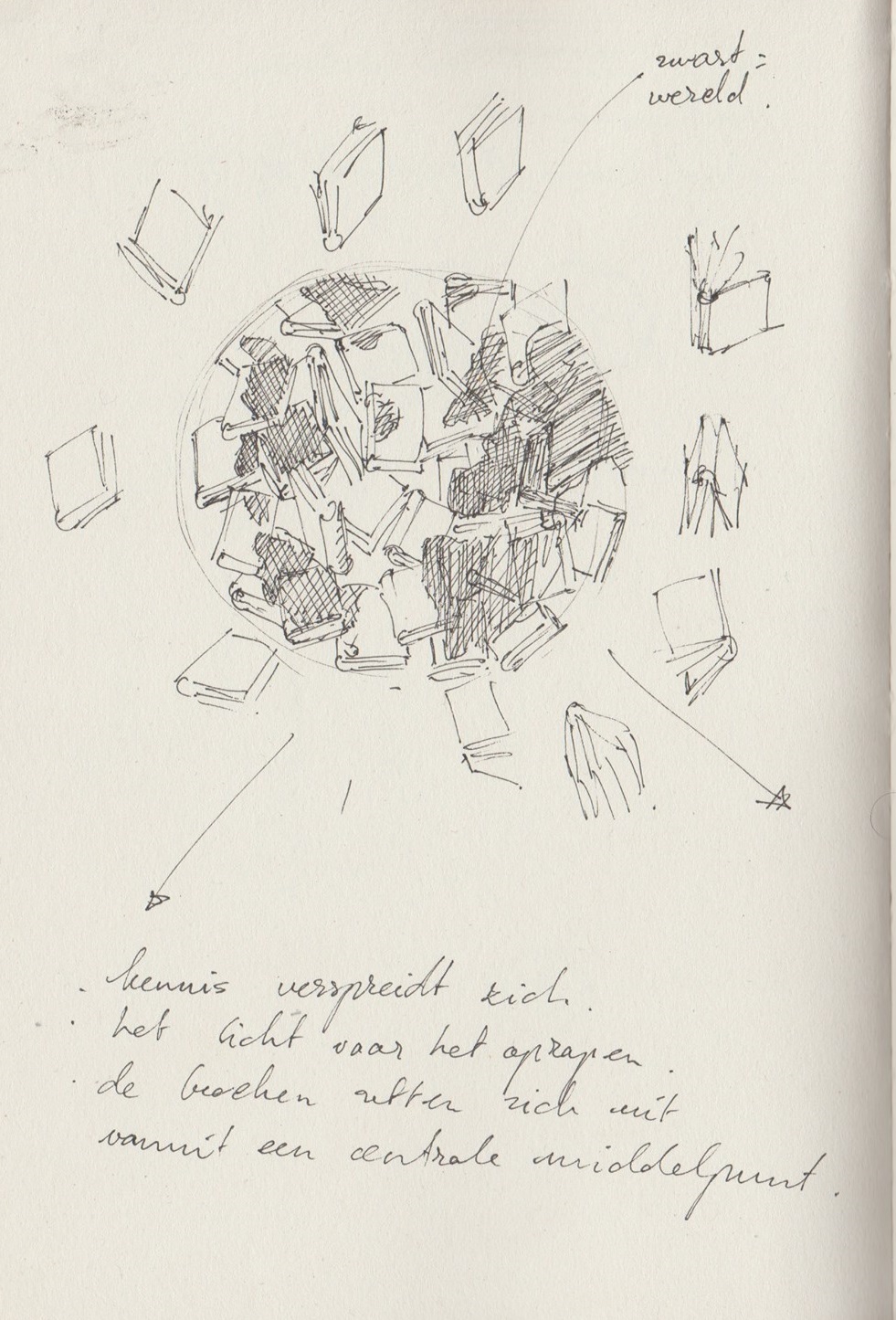
Cheerted Keo, who is a friend of mine and an aspiring Cambodian artist by way of Holland, is in the process of creating a banner or logo for our “Notes On Liberty” website. Inspired by the subtitle ‘Spontaneous thoughts on a humble creed’ and by Friedrich Hayek’s insights on ‘dispersed knowledge’, he has come up with an art work that represents our libertarian philosophy. His work symbolizes Hayek’s key observation that information is decentralized and that each individual knows just a small fraction of what is collectively known. The result of that, as Hayek has clearly stated in his seminal work The Use of Knowledge in Society (1945), is that it is best to let those with local knowledge make their own decisions in how to plan their own lives.

Although I know that the product is not finished yet, I would already like to share his work in progress with you – click on the images to enlarge them.

Cheerted Keo Notes on Liberty sketchCheerted Keo Notes On Liberty wipCheerted Keo Notes on Liberty wip 2

Please share your thoughts with us about the work. He is making the art work for free, but I thought it would be great to give him some exposure in return. Thus, if you appreciate his work, please spread word about this awesome up-and-coming artist.

If you would like to know more about Cheerted Keo’s works, you can visit his website here: www.ckeo.nl. He is quickly building up his portfolio, has had several exhibitions and is also selling some of his art works.

‘The Bitcoin Gospel’ and its Critiques

Last weekend, November 1st 2015, a Dutch television network broadcast a splendid documentary on Bitcoin entitled ‘The Bitcoin Gospel’ (Het Bitcoin Evangelie). It started off with Roger Ver, also known as Bitcoin Jesus in the Bitcoin community for his active promotions of the cryptocurrency, who is standing in his living room in Tokyo sending Bitcoins to the value of 100 Euros into the living rooms of the Dutch. The first person who scans the QR code of the ‘private key’ gets access to a Bitcoin wallet which holds 100 Euros worth of Bitcoins. At the moment of writing, that same amount of Bitcoin has more than doubled to 217.28 Euros. It is a powerful demonstration of how easy currency flows from one side of the planet to the other. If he would have made the transaction through the traditional way, it would have taken several days and it could have cost him up to 30 Euros. Using Bitcoins, he could send the money practically costless, and almost instantly without the need of any intermediaries.

You can watch the full documentary here:

If I could point out my two most favorite scenes, it would be the beginning scene (0:00 – 2:14) in which we can see Roger Ver’s impressive demonstration of Bitcoin transactions and the ending scene (43:43 – 48:24) where the myth making of its founder, Satoshi Nakamoto, is discussed and where an emotional and teary-eyed Roger Ver talks about the subversive nature of Bitcoins against political injustices.

The documentary however, also featured critics of the cryptocurrency – hence providing a balanced perspective of Bitcoins. Its main critic was Izabella Kaminska, a financial blogger at the Financial Times. She has offered several interesting critiques to which I would like to respond in this article.

1) The first critique that Kaminska offers is that Bitcoin prices are too volatile.
Kaminska reminds the viewers of the turbulent swings in Bitcoin prices. Indeed, if one would take a look at the price chart one would see that Bitcoin did rise 800 percent from $129.46 to $1,165.89 in the three month period from September to November 30 in 2013. Within the next four months, the price would plumb to $344.24. The value of Bitcoin is still extremely volatile – it has ranged between $184.32 and $481.51 in the year 2015.

Bitcoin Chart

In my opinion however, Bitcoin’s volatility is not necessarily deplorable. Its volatility is due to its small market and the experimental phase it is still in. The total market capital of Bitcoins currently stands at $5,676,100,709. It effectively means that only a small amount of money flows into or out of the market can already have huge implications for its price movements. It is therefore only natural that its price is still volatile. Volatility also offers prospects of possible gains, hence attracting more capital from investors. Total investments into Bitcoin related projects in 2015 is already more than double that for 2014. (Coindesk, 2015) The more investments are made into Bitcoin related projects, the greater the chance that Bitcoin will be widely accepted so that eventually in the long run products and services can be denominated in Bitcoins. Hopefully, this will make Bitcoins gain the same relatively low-volatility attribute of many fiat currencies.

2) Kaminska’s second critique is that buying Bitcoins does not benefit the economy as it is not loaned out to provide entrepreneurs with investment capital.
Kaminska contends that Bitcoins are simply sitting idly in people’s wallets – it has no interest, it has no yield, and she even claims that the persons who hold them believe that they have “a right to future income flows as if they are investing.” The statement that those who hold Bitcoins think that they have a right to future income flows is quite bold. Bitcoins are like any other investments in that they are always subjected to uncertainties. No serious investor believes that he has a right to profits. The Bitcoin investor is like an entrepreneur – he knows that he can only make a profit if he anticipates future conditions correctly. The notion that one should not hoard Bitcoins or cash or gold corresponds with the false notion that

“Unspent dollars means reduced sales, and as sales decline, profits drop, layoffs increase, and the total social income decreases, making less money available for consumption. Hoarding induces more hoarding as the economy sinks into a downward spiral.” (Smith, 2009)

What this notion does not take into account is that hoarding is an expression of people’s freedom to achieve personal goals or to deal with economic uncertainties. As George Ford Smith (2009) writes in ‘The Case for Hoarding’, the increased demand for money also makes prices fall. Those who are not hoarding are therefore actually benefitting from the decline in prices.

3) Kaminska’s third critique is that Bitcoin has transferred power from the existing elite to the new 1% of the Bitcoin economy, thereby going against the ‘democratization’ effects of Bitcoins that has been preached by its prononents.
In my view, it is only justified that those who have done the research into Bitcoins and who have taken the high risk to invest in new inventions also have a higher rate of return. Similarly, those who were pioneers by investing in Facebook or Microsoft during their inception period also deserve potentially higher rates of return as these companies were running higher risk of failures. If the first adopters of Bitcoins would not have had the opportunity to make enormous amounts of money, they would not have had investment incentives, it would not have got this successful and this critique of Kaminska would not even have been possible.

4) Kaminska had also argued that the Bitcoin community is extremely absolutist and driven by political ideology which is thrusted on everyone else.
She maintains that when she is paying for coffee she just wants the benefits of a working payment network and smooth transactions, not support for a certain political ideology. The idea that payment systems can be apolitical is an illusion. Governments have always had vested interests in the moneys of its citizens as its existence is entirely dependent on taxation and money creation. Any decision to meddle with the government’s schemes of taxation and manipulation of the money supply is hence always politically charged. It seems to me that she is holding an idealized view of our society if she believes that using USD does not support any political-economic system. Her statement that the Bitcoin community is thrusting their political ideology on everyone else is highly arguable as well. The government is an institution that holds the unjust power to determine which currency can serve as legal tender and which goods – including currencies – can be traded or should be outlawed. Unlike governments, the Bitcoin community does not hold the power to initiate force upon the people. It cannot thrust the adoption of the payment network on all citizens. Indeed, Bitcoin is a free market invention that allows, but not forces, anyone to join the payment network voluntarily.

Kaminska is right, when one uses Bitcoins one is supporting the libertarian political ideology. If one pays with Bitcoins, one is supporting a decentralized payment network through which transaction costs have virtually fallen to zero and through which it is much more difficult for governments and banks to track one’s financial transactions. The really relevant question however is not whether you are supporting a political ideology. The question that should be asked is: should we prefer to give our governments, and central banks the power to manipulate the value of our currency or should we prefer the separation of state and money?

References
Coindesk, (2015). State Of Bitcoin. Retrieved from http://www.coindesk.com/research/state-of-bitcoin-q3-2015/
Smith, G.F., (2009). The Case For Hoarding. The Free Market. Retrieved from https://mises.org/library/case-hoarding

The Crypto Anarchist Manifesto (1988)

Crypto-anarchism is a subversive philosophy that extends anarchism into the world of cyberspace. Crypto-anarchists attempt to protect their privacy and political freedom through the use of information technologies. Timothy May, one of the co-founders of Cypherpunk and writer of the ‘Crypto Anarchist Manifesto’, describes Crypto-anarchism as

“the cyberspatial realization of anarcho-capitalism, transcending national boundaries and freeing individuals to make the economic arrangements they wish to make consensually.”

In this article I would like to post Timothy May’s ‘Crypto Anarchist Manifesto’, which was first spread among like-minded tech-anarchists in mid-1988 at the “Crypto ’88” conference. The Manifesto was also discussed at the first physical Cypherpunk meeting in 1992. Most people have never heard of Cypherpunk, but they might know their most notable member: Julian Assange, founder of Wikileaks.

See here the full Manifesto:

A specter is haunting the modern world, the specter of crypto anarchy.[1]

Computer technology is on the verge of providing the ability for individuals and groups to communicate and interact with each other in a totally anonymous manner. Two persons may exchange messages, conduct business, and negotiate electronic contracts without ever knowing the True Name, or legal identity, of the other. Interactions over networks will be untraceable, via extensive re- routing of encrypted packets and tamper-proof boxes which implement cryptographic protocols with nearly perfect assurance against any tampering. Reputations will be of central importance, far more important in dealings than even the credit ratings of today. These developments will alter completely the nature of government regulation, the ability to tax and control economic interactions, the ability to keep information secret, and will even alter the nature of trust and reputation.

The technology for this revolution–and it surely will be both a social and economic revolution–has existed in theory for the past decade. The methods are based upon public-key encryption, zero-knowledge interactive proof systems, and various software protocols for interaction, authentication, and verification. The focus has until now been on academic conferences in Europe and the U.S., conferences monitored closely by the National Security Agency. But only recently have computer networks and personal computers attained sufficient speed to make the ideas practically realizable. And the next ten years will bring enough additional speed to make the ideas economically feasible and essentially unstoppable. High-speed networks, ISDN, tamper-proof boxes, smart cards, satellites, Ku-band transmitters, multi-MIPS personal computers, and encryption chips now under development will be some of the enabling technologies.

The State will of course try to slow or halt the spread of this technology, citing national security concerns, use of the technology by drug dealers and tax evaders, and fears of societal disintegration. Many of these concerns will be valid; crypto anarchy will allow national secrets to be trade freely and will allow illicit and stolen materials to be traded. An anonymous computerized market will even make possible abhorrent markets for assassinations and extortion. Various criminal and foreign elements will be active users of CryptoNet. But this will not halt the spread of crypto anarchy.

Just as the technology of printing altered and reduced the power of medieval guilds and the social power structure, so too will cryptologic methods fundamentally alter the nature of corporations and of government interference in economic transactions. Combined with emerging information markets, crypto anarchy will create a liquid market for any and all material which can be put into words and pictures. And just as a seemingly minor invention like barbed wire made possible the fencing-off of vast ranches and farms, thus altering forever the concepts of land and property rights in the frontier West, so too will the seemingly minor discovery out of an arcane branch of mathematics come to be the wire clippers which dismantle the barbed wire around intellectual property.

Arise, you have nothing to lose but your barbed wire fences!

Footnote

[1] This is clearly a wordplay on the opening sentence of Karl Marx’ and Friedrich Engels’ The Communist Manifesto which reads: “A spectre is haunting Europe—the spectre of communism.”

Chuang Tzu: The natural disposition of man is Political Anarchism

Chuang Tzu

I just read this great article on ‘Anarchism and Taoism’. I find the Taoist case for anarchism extremely compelling. They sought after the harmonious nature of spontaneous order, the Tao, and internalized it into a tremendously rich personal philosophy of life. It makes me wonder: can a person ‘live’ a Libertarian life? Libertarianism is mostly regarded as a political philosophy in the west, but can it, like the Taoists believe, be regarded as a way of life that is most fulfilling on a personal level as well? These are questions that I still have to find out for myself.

After reading the article on Anarcho-Taoism, I’d like to share a small part of Chuang Tzu’s thoughts on the natural disposition of man here:

Horses live on dry land, eat grass and drink water. When pleased, they rub their necks together. When angry, they turn round and kick up their heels at each other. Thus far only do their natural dispositions carry them. But bridled and bitted, with a plate of metal on their foreheads, they learn to cast vicious looks, to turn the head to bite, to resist, to get the bit out of the mouth or the bridle into it. And thus their natures become depraved.

As with horses, so it is with human beings. Left to themselves they live in natural harmony and spontaneous order. But when they are coerced and ruled, their natures become vicious. It follows that princes and rulers should not coerce their people into obeying artificial laws, but should leave them to follow their natural dispositions. To attempt to govern people with manmade laws and regulations is absurd and impossible: ‘as well try to wade through the sea, to hew a passage through a river, or make a mosquito fly away with a mountain!’. In reality, the natural conditions of our existence require no artificial aids. People left to themselves will follow peaceful and productive activities and live in harmony with each other and nature.

In an essay ‘On Letting Alone’, Chuang Tzu asserted three hundred years BC the fundamental proposition of anarchist thought:

There has been such a thing as letting mankind alone; there has never been such a thing as governing mankind. Letting alone springs from fear lest men’s natural dispositions be perverted and their virtue left aside. But if their natural dispositions be not perverted nor their virtue laid aside, what room is there left for government?

Lao Tze, The First Libertarian

Lao TzeFrom the very first moment I read into Taoist philosophy, 5 years ago, I had grown extremely fond of Taoism. It also bears many similarities with the political philosophy of libertarianism. In this post I would like to trace the libertarian concept of Spontaneous Order to the Tao.

Lao Tze (~6th century BC) is regarded as the founder of Taoism. He is also the writer of the Tao Te Ching, one of the most translated books in history, which consists of 81 short chapters about leadership, modesty, and how to live in accordance with your own nature.

From the perspective of a personal philosophy of life, the Tao Te Ching teaches you to flow with life and to be in touch with your inner self so that your actions never contradict your personal being, and so that you can live a truly authentic and enriched life. This may sound too lofty to some, but reading the book one will realize how practical the philosophy actually is. To illustrate the practicality of Taoism, I have written about an interesting application of Taoism in Bruce Lee’s Jeet Kune Do – the martial arts that Bruce Lee had developed – in this post of mine.

One can also read the Tao Te Ching from the perspective of political philosophy. Taoism proposes a society in which there is little or even no central authority (government), since the government is counterproductive and the grand source of social misery. Taoism is therefore libertarian, and stands very much in contrast with Confucianism with its multifarious laws and regulations. Mr. Libertarian, Murray Rothbard, had recognized that Lao Tze was the first libertarian intellectual who saw the government as “a vicious oppressor of the individual, and ‘more to be feared than fierce tigers’” (Rothbard, 1995, p. 23). Taoists and Libertarians believe that society functions most efficient and most just when the government does not meddle and regulate the people.

The skeptics may ask: how can there be order without a central authority? Some modern philosophers, like for example Hobbes, have referred to this anarchistic state as the ‘state of nature’; a state of “a mere war of all against all; and in that war all men have equal right unto all things” (Hobbes, 1651, p. 34). Taoists and Libertarians however, believe that this view is wrong. They believe that it is in the nature or instinct of individuals to be collectivist, because the person who lives in solitude is hardly able to survive in nature. In order to survive, human beings will naturally develop collective customs and laws to work out their disputes. The collective coordination of human beings has therefore always “depended decisively on instincts of solidarity and altruism” (Hayek, 1988, p. 12).

What, according to the Taoist and the Libertarian encourages society to become well-functioning? The Taoist calls it the ‘Tao’, and the libertarian calls it ‘Spontaneous Order’.

Tao and Spontaneous Order

The two concepts, Tao and Spontaneous Order, are similar to one another. Spontaneous Order is a spontaneous emergence of self-organized order out of seeming chaos. One can find such examples in language, the internet, the free market etc. Without any central authority we have realized language, internet, and productive orders that are so complex that not a single person would have been able to create by himself. No one can predict how the order will look like, because it is forever in flux. It can therefore only be experienced and observed. From our observation we can find that the Spontaneous Order is better than any artificial human construct.

Likewise, the Tao is an underlying natural order of the universe whose essence cannot be described in words, but which can only be experienced and observed in nature. In the first verse of the Tao Te Ching, Lao Tze writes:

The Tao that can be told is not the eternal Tao.
The name that can be named is not the eternal name. (Tao Te Ching, Chapter 1).

The Tao is neither a thing nor a substance. It is a universal trend that flows in the natural world. According to the Taoist, one can be in touch with the Tao and achieve most when one does not act against the nature of things (‘wu wei’). Lao Tze therefore writes:

Whenever you advise a ruler in the way of Tao,
Counsil him not to use force to conquer the universe.
For this would only cause resistance.
Thorn bushes spring up wherever the army has passed.
Lean years follow in the wake of a great war. (Tao Te Ching, Chapter 30)

Tao abides in non-action,
Yet nothing is left undone.
If kings and lords observed this,
The ten thousand things [world] would develop naturally. (Tao Te Ching, Chapter 37)

The more laws and restrictions there are,
The poorer people become.
The sharper men’s weapons,
The more trouble in the land.
The more ingenious and clever men are,
The more strange things happen.
The more rules and regulations,
The more thieves and robbers.

Therefore the sage says:
I take no action and people are reformed.
I enjoy peace and people become honest.
I do nothing and people become rich.
I have no desires and people return to the good and simple life. (Tao Te Ching, Chapter 57)

Why are the people starving?
Because the rulers eat up the money in taxes.
Therefore the people are starving.
Why are the people rebellious?
Because the rulers interfere too much.
Therefore they are rebellious.
Why do the people think so little of death?
Because the rulers demand too much of life.
Therefore the people take death lightly.
Having little to live on, one knows better than to value life too much. (Tao Te Ching, Chapter 75)

The Taoists have this concept called ‘mutual arising’, which means that order comes into being through a harmonious interplay of different forces. This is expressed as follows by Lao Tze:

The Tao begot one. One begot two. Two begot three.
And three begot the ten thousand things.
The ten thousand things carry yin and embrace yang.
They achieve harmony by combining these forces. (Tao Te Ching, Chapter 42)

We, human beings, are incapable of understanding how these forces play out against each other. Every time we interfere with the Tao, unintended consequences will happen. Since we cannot apprehend what forces have led to the unintended consequences, we will create more unintended consequences by trying to offset the previous unintended consequences. Man can therefore fall into a state of perpetual interference with nature and become evermore unnatural. Is that not the state we are in right now; the state of unnaturalness due to our thousandfold petty laws that attempt to regulate our conduct, relationships, and ethics?

Is it realistic to have no central government and expect spontaneous orders to emerge?

It certainly is realistic. Bruce Benson has written an insightful book called The Enterprise Of Law: Justice Without The State (2011) in which he discusses historic examples of how law and order emerged spontaneously. Many scholars are currently acknowledging that during the time of the expansion of the American frontier, those areas where people moved faster westward than the central government was not wild or lawless. It was actually more peaceful than modern day America. For an interesting read into this issue, see Anderson & Hill’s ‘An American Experiment in Anarcho-Capitalism: The Not So Wild, Wild West’ (1979).

See also this talk of Thomas Woods on the ‘not so wild, wild west’:

Bibliography

Anderson, T.L. & Hill, P.J. (1979). An American Experiment in Anarcho-Capitalism: The Not So Wild, Wild West. Journal of Libertarian Studies, 3, 1, 9-29.

Benson, B. (2011). The Enterprise Of Law: Justice Without The State. San Francisco: Independent Institute.

Hayek, F.A. (1988). The Fatal Conceit: the errors of socialism. London: Routledge.

Hobbes, T. (1651). De Cive. (H. Warrender, Ed.) New York: Oxford University Press.

Lao Tze. Tao Te Ching. Retrieved from http://www.schrades.com/tao/taotext.cfm?TaoID=1

Rothbard, M.N. (1995). Economic Thought Before Adam Smith: An Austrian Perspective on the History of Economic Thought Volume I. Retrieved from http://mises.org

“What every 21st century American should ‘know'”

Over at Policy of Truth, Dr Khawaja has an interesting post up on cultural literacy:

The journal Democracy is running an article revisiting E.D. Hirsch’s idea of cultural literacy, and looking for readers to help generate an updated list like the one at the end of Hirsch’s 1987 book, Cultural Literacy: What Every American Needs to Know

Here’s the list I came up with, completely off the top of my head (i.e., involving less than a minute of thought, since that’s all the time for thought I currently have).

  1. Wounded Knee 1890
  2. Wounded Knee 1973
  3. The Fort Laramie Treaty (1868)
  4. Russell Means and/or Dennis Banks
  5. AIM (American Indian Movement)
  6. Ayn Rand
  7. Atlas Shrugged
  8. The Fountainhead
  9. libertarianism
  10. BDS (Boycott, Divestment, Sanctions)

I added my own list in the ‘comments’ thread, but still haven’t had time to address critiques. My list:

My quick list:
1) black conservatism
2) the whole Pahlavi-Mossadegh affair
3) libertarianism (people still have trouble conceptualizing it’s right-left crossover appeal)
4) Latin America’s Western culture
5) Dutch history
6) South Asian-East African literature (lots of historical links between the two regions that could help conceptualize current US role in the world)

Lists are fun. They are an easy way to start a conversation and they are time friendly. Add your own and don’t forget to justify your positions! Here is how I justify #1: it’s a storied, intellectually-robust tradition that has suffered greatly in the public sphere due to vulgar demagogic practices associated with the black Left. #2: C’mon, why shouldn’t every American know that their government overthrew an elected government in Iran and paved the way for the current anti-American regime?#3: see what’s between the parenthesis. #4: knowing that Latin Americans are by and large Western (save for the Natives still living in the Andean highlands) would do wonders for better relations between North and South. #5: Dutch (and Swiss) history can teach us far more about our own institutions than anything the UK has to offer. #6: see parenthesis.

Lots of foreign policy implications on my list, as well as stuff that can help to better understand why the US works the way it works. (This is a charitable assumption on my part, of course.)

Asylum Seekers and Western Military Intervention

Recently, Brandon Christensen, the capable Editor here tried to take me behind the woodpile, again! (Note for our overseas readers: To take someone behind the woodpile usually a child – is to spank him to try to improve his attitude.) This is what happened: NOL re-published two of my essays “Hypocrisy” and “Muslim Refugees in Perspective” where I asserted (again) that many Muslim societies are failed societies or otherwise sick. Brandon asserted (again) that any apparent linkage between Islam in general and social pathologies is just that, an appearance. Instead he seems to argue, Muslim societies that are in any kind of trouble owe their trouble mostly (or much?) to Western intervention in general and to American intervention in particular, with a special emphasis (I am guessing) on military intervention.

There is a partial test of these competing beliefs in an examination of refugee applications to Germany during a recent period.

Between January and August 2015, Germany received 147,500 applications for asylum from the top ten countries of origin of the applicants. (I am rounding numbers to the next hundred.)* Of these, 79% came from predominantly Muslim countries.

Almost half of the asylum seekers from Muslim countries – 48% – came from Syria, a mostly Muslim country where the US and the West had notably not intervened (or only superficially) by August 2015, the end of our period of observation. If you will recall, the US president has earlier drawn a red line beyond which the Syrian dictator couldn’t go on waging war on his people. The Syrian dictator ignored the warning and nothing happened. That’s as non-interventionist as it gets!

Of the asylum seekers from predominantly Muslim countries, 23% came from Iraq and from Afghanistan together, two countries that have in fact experienced American and Western (even international) military intervention in the past twenty years.

Reminder: It’s worth remembering that the intervention in Afghanistan was launched to dislodge a regime installed by force of arms that sheltered terrorists, according to the Al Qaida terrorists themselves, and according to the regime itself. Several years earlier, the same terrorist group sheltered by Afghanistan – Al Qaida – had declared war on the United States, incidentally.

Of the remainder of asylum seekers from predominantly Muslim countries, 29% came from Kosovo. That’s more than from Iraq and Afghanistan combined.

Reminder: In 1998, the national Communist Serbian dictator Milosevic ordered all ethnic Albanians of Kosovo, more than 90% of the population to leave under threat of death. This episode of ethnic cleaning cost about 10,000 lives. NATO, led by the US quickly intervened militarily and forced Milosevic to leave the (overwhelmingly Muslim) Kosovar in peace.

NATO had previously intervened militarily in Bosnia, another part of the dissolving Yugoslav Republic, to save the non-Serb population from Serb ethnic cleansing . Of the total population, a plurality, about 40%, were Muslims. (There are no Bosnian asylum seekers visible in the sample I am discussing here. Bosnia is mentioned only as a reminder of the diversity of Western military interventions.)

Following these Western military interventions, both Bosnia and Kosovo became independent Republics with strong Western backing. They remained Muslim or mostly Muslim.

Would anyone dare argue that Western action to stop the massacres of first Bosnians and then Kosovar are responsible for the fact that now almost entirely Muslim Kosovo is currently producing many asylum seekers? I suppose, this is defensible: Had NATO not intervened militarily, Kosovars would been massacred by Milosevic in larger numbers, and then, they would have fewer people, – mathematically available – to contribute as asylum seekers.

Continued:

Of the asylum applicants from Muslim countries, 45% came from Albania, Eritrea, Pakistan, and Nigeria together, all countries with no US or other Western intervention of any kind in recent years ( I mean since 1950, the earliest I really remember!)

Albania alone contributed more asylum seekers, 33,900, than Iraq and Afghanistan together, 26,700. There have been no US or Western intervention in Albania.

Of course, distance alone makes it easier for Albanians than for Iraqis and for Afghans to reach Germany. But, by the same reasoning, why are there few asylum seekers from Croatia that is even closer to Germany, or from Romania. that isn’t much farther? (Croatia and Romania all have tiny Muslim populations.) Contrary to this line of reasoning, I must say, there were 21,000 asylum seekers from Serbia, a country with a small Muslim minority. Muslim dominated societies do not have a monopoly on severe social pathologies. I never asserted otherwise.

We know from the cut-off point of the table of the ten countries that were the largest suppliers of asylum applicants that the highest possible number of asylum seekers from non-Muslim Croatia, or from Romania (or from non-Muslim Bulgaria, or from troubled Greece) would be 3,976. That would be about 1/10 of asylum seekers from mostly Muslim Albania.

I see in these figures moderate support for the idea of the sickness of Muslim societies. I find little support, on the other hand, for the competing idea that Western and American intervention are responsible for the difficulties those societies are encountering.

I anticipate several criticisms of this provisional conclusion.

First, quantitative association like these don’t “prove” anything. Of course they don’t. Perhaps, there is a third factor, or series of factors not related to either Islam or Western intervention that explain why Muslim societies are such rich providers of asylum seekers. I am listening.

Second, the short recent period January to August 2015, maybe historically unrepresentative. There is a near- infinity of other possible periods the examination of which might show no disproportionate numbers of refugees from Muslim counties. (Ask me why a “near infinity.”)

Third, Germany is not the whole world. A more inclusive data base showing all asylum applications from all countries to all countries might demonstrate no preponderance of refugees from Muslim countries. In fact, such a data base might indicate that refugees from Muslim countries are actually under-represented among asylum seekers world-wide.

I hope someone performs one or the other study. I would easily change my mind according to the results. I am not wedded to the idea of widespread sickness of Muslim societies. Frankly, I don’t even like it. I surely have no ideological investment in this view. It’s just that there is currently no other view that is even modestly supported by anything but ideological intransigence.

Finally, there are probably those who would argue that large numbers leaving their countries at great personal risk to seek refuge in an alien country the language of which they probably don’t even know, that such an exodus says nothing about the countries of origin. Go ahead, say it; make my day! I can’t wait.

The conclusions of this simple analysis is difficult for many otherwise intelligent people to accept, even provisionally. Three reasons that I see for the rejection.

First it seems politically incorrect. We have become so confused by leftists identity politics that many are unable to distinguish between race, an unchanging attribute of a person, and religion, an individual choice. He used to be black; he still is. I used to be a Catholic. I am not anymore. That simple! (Of course, I did not risk the death penalty as do Muslims in some Muslim countries for committing apostasy.)

Second, professional intellectuals – who may or may not be very intelligent – have a horror of being caught believing the same things as do the great unwashed masses. It’s bad enough that they must assent to the assertion that the sun rises in the east, same as a plumber or a cop! The masses are “Islamophobic;” I must stay away regardless of the evidence!

Third, and much more subtly, my discussion with Brandon is part of an ongoing discreet struggle taking place on the edge of the libertarian movement. Libertarians of all stripes believe that war is a major factor in increasing the power and the scope of the state vis-à-vis civil society. (I share this belief.) Libertarian purists like Brandon end up becoming a kind of qualified pacifist, like this:

Perhaps, if I am completely sure that people who have sworn to disembowel me are actually climbing over the back wall of my property after having set my neighbor’s house on fire with my neighbors inside, perhaps, then, I will think of defending myself.

A handful of libertarians of that ilk keep failing to recruit the millions of moderate conservatives who both want small government and believe the yoke of government will never be alleviated in a society that feels threatened. Let me repeat myself: The task of first halting the growth of government and then, of rolling back its scope and power can only be accomplished in a very well defended society. Much of this rolling back has been achieved in Somalia, by the way yet, Somalia is not a model.

In their desire to reject all kinds of war that are not obviously and dangerously defensive, libertarian purists will find fault with all wars, almost at any cost. If necessary, they will blind themselves to the obvious. The act of blaming on American and or Western intervention the self evident multiple failure of Muslim societies (with major exceptions), is just the latest example of this tendency to gauge out one’s own eyes to avoid the horrors of the truth.

“We sleep soundly in our beds because rough men stand ready in the night to visit violence on those who would do us harm. – W. Churchill”

* The data on seekers of asylum from Germany are from the German Federal Office for Migrations and Refugees published in the Wall Street Journal of 9/25/15, p. A12