Freud and property rights

In a recent, short discussion of property rights, I offered that property is an extension of the body, and therefore property rights can be naturally assumed as equal to our bodily rights. It was responded to highly critically. The body is intrinsically tied to our identity, as most recently stated with Sosa-Valle’s article; most people would agree to that. I feel similarly about personal property, even if proving this is somewhat more difficult.

The question of property comes up in an infinite number of discussions. If I own a Sharpie, acquiring it through legitimate transaction, I can legally prohibit another from using it. Isn’t this more of an intrusion on another’s freedom to explore the world than it is a utility of my freedom to protect this object? Why is this Sharpie mine such that I may disallow others its use? How is it within my freedom to prohibit it from others?

Where property rights actually come from, and what concerns, aside from economic or consequentialist, validate their protection, is a fundamental question. Here is a perspective from a Freudian dissection of ego relations, and historical-technological advance.

Technology is fundamentally an extension of human attributes. What is a record, but an upgrade of human auditory memory; what is a video, but an upgrade of human visual memory or imagination; “materializations of the power [man] possesses of recollection”? “With every tool man is perfecting his own organs, whether motor or sensory, or is removing the limits to their functioning. Motor power places gigantic forces at his disposal, which, like his muscles, he can employ in any direction,” and so on (Civilization and Its Discontents, p. 43).

It’s not remarkable to consider that material objects may take precedence over actual limbs, given technology is simply human advancement. When a woman loses her ability to walk, and is outfitted with a mobility scooter or likewise, the apparatus takes the place of natural walking endowments; prosthetic advancements, still infantile in Freud’s time, increasingly distort what are “legs” and what are not. We wouldn’t lessen the strength of the legal bodily autonomy just because her legs are composed of different material than the organic.

Our accessories, aside from restoring us from disable- to able-bodied, take us far beyond what the human was ever capable of accomplishing, creating “prosthetic Gods.” The modern cellphone contains the entire world of knowledge in its hardware and software. Many people feel more connected to their tablets than their hidden organs. (Or maybe, more accurately, people are more connected to the functionality of their tablets, than the automatic, reflexive actions of their organs. This is clear because tablets are replaceable but the overall attached feeling persists.) The ego, per a Freudian perspective, is extended to the external world, through some fulfillment of instinct that technology allows in an otherwise impossible situation (see instinct displacement, Instincts and Their Vicissitudes, p. 121, James Strachey translation). It becomes difficult to delineate what is attached to “me” and what is not, contrary to the simplistic, phenomenological dichotomy of body and world.

How is it anyway that our body is even connected to our psyche? For an extremely brief discussion, consider that our sense of self, as a straightforward consciousness, is not immediately crippled by, say, the removal of an appendage through a freak accident. The attachment that we feel, then, is cerebral and historical, and functional. These same conditions in and of themselves are equally possible for relating the sense of self to foreign, i.e. materially external, objects. Indeed, the “connection” we feel to our body is perfectly capable of being transferred onto other objects. See, for instance, Freud’s discussions in An Analysis of a Case of Hysteria (this point of transference could be argued to be the central pillar of the classical psychoanalytic perspective on childhood and ego-formation); David Chalmers’ arguments for the phone as a part of our mind via cognitive extension; and recent psychological studies of “joint action,” through dancing and the like.

Given these instances, I think it’s more sensible than not, at least providing one accepts even a little Freud, to perceive property rights as on the same ground as bodily autonomy.

Of course, Freud never argued for property rights from his analysis of technology as ego-engagement. His political views were mostly impersonal and disinterested. He left Vienna after his daughter was summoned by Gestapo in 1938, to live in London, but unfortunately left no direct commentary on totalitarianism, and most of his political views have to be derived.
On Robots and Personal Identity

When I came across this documentary on robots and their ability to carry on a conversation between each other, the well-known ideas on the spontaneous emergence of language inevitably crossed my mind. The resemblances to Hayek’s Sensory Order are obvious as well, notwithstanding his later remarks on negative feedback processes, which involve spontaneous orders that are borrowed, precisely, from cybernetics. But what grabbed my attention the most was the importance attached to the fact that the robots had a body. According to the documentary, the shape of the body of the robots allows them to develop certain patterns of classification for facts and behavior that would be different if their bodies were different as well. In this sense, “to have a body” is a requisite characteristic of the robots to make possible artificial intelligence; to evolve following a process of negative feedback.

That brought me back the works of Peter Geach on personal identity. He confronted John Locke’s notion of personal identity as mere memory and stated, instead, that the body was essential to the said concept. Memory and human body are, in order to develop an individual personality, inherent to each other.

This is relevant to our discussions about the definition of individual freedom. If the body is inherent to our personal identity, there are not much place left for Spinoza’s freedom of thought, or inner liberty, as the ultimate definition of individual liberty. Besides freedom of thought, we need freedom to move in order to be regarded as free individuals, and our sphere of individual autonomy should be extended to our body and its surroundings. Moreover, it would be impossible to exercise any freedom of thought and expression if such individual liberties are not protected.

Group Privileges No, Detriments Yes

The concept of “privilege” has become common in political discourse, while the term “detriment” is seldom used. One incurs a detriment, and is detrimented, when one is harmed, offended, displeased, or disadvantaged, unrelated to merit. One obtains a privilege, and is privileged, when a person or group is advantaged, benefitted, pleased, or favored relative to other groups, when the gain is unrelated to merit.

Some socialists emphasize “white privilege.” Suppose a white man is able to walk down a street without being harassed, while a black man will be stopped and questioned by the police. The socialist will say that the white man is privileged in being free of harassment. But actually, the ability of an innocent person to walk without being stopped and frisked is a natural right, not a special favor. The black man has suffered a violation of his natural rights, a detriment not suffered by the white man.

The socialist will also claim that there is “male privilege.” Suppose a man can walk down the street in peace, while a woman walking down the same street will be whistled at, aggressively approached, and may even be physically attacked. Does the man have a privilege? No, one has a natural right to be free of aggression. The woman suffers a violation of her rights, a detriment.

Women suffer many detriments because of social custom and culture, rather than governmental law. Wives tend to do more household work, even when they are working for wages as many hours as the husband. In some fields of work, men have more prestige and authority, unrelated to merit. The culture is not so much giving males privileges as it imposes on women various detriments.

Some detriments are mandated by law. In most places in the US, men are free to remove their shirts, while a bare-breasted woman would get arrested. The men do not have a privilege; the women have a legal detriment.

Female detriments can become tragic in cultures where male children are preferred. A boy is not privileged by not being aborted or killed. Rather, the girls suffer a lethal detriment. In my judgment, more progress can be made to stop this anti-female bias by calling it a detriment rather than saying the boys are privileged. Boys as well as girls have a right to not be murdered.

Female detriments have been lethal in India, where rape and violence has made headlines. But there is substantial rape in the US and throughout the world, which clearly makes being female a detriment in much of the world.

The trouble with saying there is a male privilege is that men do not feel privileged by not being attacked or disfavored. It should be normal to be left in peace, and to be respected. By identifying the problem as a detriment, we can then raise more awareness and support for remedies. We can also then better deal with the real privileges, favors to those who get subsidies from government because of political clout.

The language of privilege versus detriments influences policy. “Privilege” implies special favors that should be removed. “Detriment” implies harms and disadvantages that should be stopped. For the problem of infanticide, for example, it is not that privileged boys should be killed in an equal ratio, but that girls should not be murdered for being female.

Let’s speak less of racial and gender privilege, and more of detriments!

Colonialism and Identity in Wasolon (and everywhere else, too)

The notion of the person is constantly renegotiated and is at stake between groups situated within the same political entity as well as between neighboring political entities. With advent of [France’s colonial] district register and the resulting written registration of identity, the notion of a person acquired a greater fixity. It became much more difficult to change identity or even to modify the spelling of one’s first or last name. Since it could no longer affect the components of the person, the negotiation of identity shifted, as in the case of the West, onto other sectors of social and individual life. (135)

This is from the French anthropologist (and high school friend of our own Jacques Delacroix) Jean-Loup Amselle, in his book Mestizo Logics: Anthropology of Identity in Africa and Elsewhere. The book is hard to read. The English translation (the one I’m reading) was published by Stanford University Press in 1998, but the original French language version came out in 1990. Between the translation and the fact that the book was written for specialists in the field of political anthropology and the region of French Sudan, strenuous effort was required on my part to stay focused and motivated to finish the book. The preface alone is worth the price of admission, though, especially if you’ve been following my blogging with any great interest over the years.

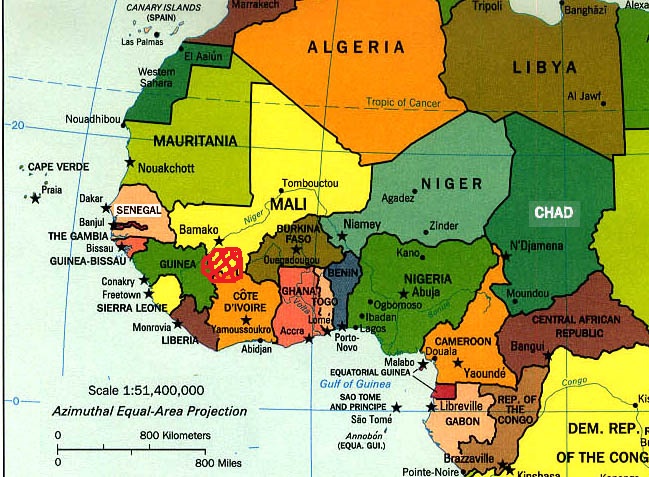
My intent is not to write a review, but rather to build off Amselle’s work and present some of my efforts in blog form here at NOL. But first, a map of the region, Wasolon, that Amselle specializes in:

Wasolon is that big red marking that I've drawn on the map. You can see that it's about as big as Sierra Leone.

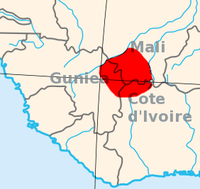
Wasolon is that big red marking that I’ve drawn on the map. You can see that it’s about as big as Sierra Leone. Just for clarity’s sake, here is a second map with a closer view of Wasolon:

blog wasolon 2
Notice the rivers? source: wikipedia

Amselle’s argument for why his approach to identity is superior to others’ is convincing. He performed all of his fieldwork (15 years’ worth as of 1990) in Wasolon, or briefly in neighboring areas, reasoning that “research within numerous regions of a well-circumscribed area […] has allowed me to observe systems of transformation [in] societies that have been in contact for centuries. This has protected me from being forced into large analytical leaps and from engaging in [the current anthropological trends of] abstract comparativism and the identification of structures (xii-xiii).” This defense of his methodology, coupled with his insights on French colonial administration in the late 19th and early 20th centuries, gives me reason to believe that Amselle’s work is an excellent blueprint for better understanding the complete and utter failure of post-colonial states and the violence these collective failures have produced.

I want to take a specific route using the introductory quote, even though I could take a number of different routes using that passage. I could, for example, focus on the invention of the individual and muse about its consequences in regards to the rise of the West. I could go on and on about how other societies had writing – but not the individual- and therefore did not have the institutions necessary for “capitalism” that the West did around the 16th century. Et cetera, et cetera. Instead, I’m going to take a geopolitical route (the West is still practicing colonialism) that has a decidedly philosophical direction to it (nationalism and ethno-nationalism are both bullhooey).

First, the geopolitical context. Wasolon was basically a war zone in the 18th and 19th centuries. It was an important producer of cotton, a minor producer of rubber and ivory, and a net exporter of slaves. Wasolon was unfortunate enough to be caught between Saharan empires backed by Arabic culture, money, and technology, and coastal empires recently enriched through cultural, economic, and technological exchange with rapidly-expanding European populations. Caught between these two geographic poles, polities in Wasolon oscillated between being decentralized chiefdoms, small independent states, empire builders themselves, and vassals of empires. In such an uncertain setting, the identity of people themselves necessarily oscillated as often as their political systems did.

When the French arrived militarily on the scene (there was already a long history of economic, political, and cultural exchange between the “French” and Wasolonians; I put French in quotation marks because, of course, many Europeans found it to be much easier to use “French” as an identity in French Sudan rather than their own), Wasolon was home to many decentralized chiefdoms, and they were all in the midst of a protracted and brutal war with the Samori Empire, a Saharan polity that rose quickly and ruthlessly to prominence in the late 19th century.

The Samori Empire – which the French military was in contact with due to its centralized political structure (it had a bureaucracy and an organized military, for example) – claimed Wasolon as a vassal state and the French, out of ignorance or expediency (to attribute it to malice gives French central planners too much credit), simply took Samori at its word (a policy that continues to play out to this day in international affairs, but more on this below).

The French military commanders and, later, colonial administrators eventually figured out that Wasolon was not a loyal vassal. From the French perspective, the resisting chiefdoms in Wasolon had formed an alliance against the Samori Empire, and this alliance was based on an ethnic solidarity shared by all Fulani. Amselle labors to make the point that this alliance  was based on a “mythical charter” long prominent in Fula oral traditions (and has some basis in the historical accounts of Arab and European travelers). This “mythical charter” served as the basis for the French colonial understanding of the Fula and eventually for the notion of a Fulani ethnic identity. The problem here is that the “mythical charter” was just that: a myth.

I’ll start by extracting an insight from the footnotes:

As we saw in Chap. 5, colonial ethnology merely reproduces this local political theory by taking it literally, thereby assimilating these “mythical charters” to a real historical process. Such a reproduction is what makes this ethnology truly colonial. (179)

In the Chapter 5 that Amselle alludes to in his footnotes, Mestizo Logics explains how the Fula people of Wasolon adopted fluid political identities over the centuries, depending on who was in power and who was about to be in power. This fluidity played, and continues to play, a much more important role in how people identified themselves politically (“local political theory”) than either culture or language.

Amselle illustrates this point best by pointing out that a number of chiefdoms in Wasolon claimed to be Fula at the time of the French conquests in the late 19th century, but that the populations spoke a different language than the Fula and were culturally distinct from the Fula (these Wasolon chiefdoms claiming Fulaniship were Banmana and Maninka in language and culture rather than Fula). Amselle then points out that Fula chiefdoms existed outside of Wasolon that don’t claim to be Fula – even though they are culturally and linguistically Fula – and instead identified as something more politically expedient (he doesn’t elaborate on what those non-Fula Fulani identify as, only that they did, and still do).

The French state’s act of writing down and categorizing this “mythical charter” as a distinct feature of Wasolon’s Fulani thus created the Fula ethnic group and, through imperial governance, ensconced this new group into its empire’s hierarchy based on traits that ethnographers, colonial administrators, historians, and managers of state-run corporations had recorded (accounts written by merchants not connected to the state in some way could not be trusted, of course).

Basically, when the French showed up to build their empire in west Africa they bought the narrative espoused by a couple of the factions in the region and based their empire (which was only feasible with the advent of peace in Europe after the Napoleonic Wars) on that narrative. The results of this policy are eye-opening. Aside from the fact that the present-day states of Mali, Cote d’Ivoire, and Guinea are failures, the old rules of fluid identity used by Wasolonians for political and economic reasons were erased and new rules, based on bureaucratic logic (“ethnicity”), were wrested into place by the French imperial apparatus. These new ethnic identities soon took on characteristics, ascribed to them by others, that quickly became stereotypes. The ethnic groups with good stereotypes (like being hard-working) ended up – you guessed it – in positions of power, first in France’s imperial apparatus and then for a short time after independence.

Sound familiar?

If it doesn’t, think about international governing institutions (IGOs) like the United Nations or the World Bank for a moment. Why don’t these institutions recognize the likes of Kurdistan, Baluchistan, or South Ossetia? Is it because these IGOs are evil and oppressive, or simply because these bureaucracies cannot adapt quickly enough to a world where identity and the necessities of political economies are always in flux?

This phenomenon is not limited to post-colonial Africa, either. Think about African-Americans here in the United States and the stereotypes attributed to them. Those stereotypes – good and bad – are a direct result of bureaucracy.

Individualism, to me, is the best way to tackle the long-standing problem created by colonial logic abroad, and racism at home. Government programs that seek to help groups by taking from one and giving to another are just an extension of the bureaucratic logic revealed by Amselle’s work in French West Africa. But what is a good way to go about implementing a more individualized world? Open borders? Federation?

What’s wrong with migrating?

This is a response to Irfan Khawaja over at the Policy of Truth blog.

I am of Jewish descent. I am not a JewI was baptized a Catholic as a baby and have no plan to convert in the foreseeable future. I am nonetheless of Jewish descent. My paternal grandfather is a rabbi and my cousins from that side of the family are Jews.

My family patriarch migrated from Germany to Mexico during the turn of the 20th century. He migrated long before the Holocaust, but I wouldn’t be surprised if he was motivated to migrate to escape prosecution in Europe.

I also have slaves in my family tree. My great grand mother (Or was it great great? I forget.) was a black Cuban and my parents thought I might be born with dark skin. Blacks, for those who are keeping score at home, are not native to Cuba. Slavery in Cuba did not end till 1886. My great grandmother migrated to Mexico to escape prosecution in Cuba.

I myself migrated to the United States at the age of two. I might have been born in Mexico, but I was a libertario at birth. I loved Mexican food but that was not sufficient reason to stay in a country with such a poor conception of personal liberty. So I kissed my mother good bye, packed my bags, and crossed the border. I ended up settling down in Los Angeles, where I could have Mexican food and liberty.

What I am getting at here is that there is nothing wrong with migrating.

Had I stayed in Mexico I would likely be dead now. If a cartel member asked me to pay protection tax I would have refused and instead given him a speech on why we should legalize drugs. My town of birth, Morelia, is one of the capitals of the drug trade so you can imagine how long I would have lasted.

Had my great grandmother stayed in Cuba she would have to live with left over discrimination against slaves and their descendants. Worse still her descendants would be living in Castro’s Cuba!

My family patriarch might have survived the Holocaust if he had stayed in Europe. Or he might have been baked.

I agree with Irfan Khawaja that one should be assured of their personal safety and liberty regardless of any incidents of birth. I also agree with him that Benjamin Netanyahu, current Israeli Prime Minister, is wrong to urge European Jews to migrate to Israel. Israel is hardly a safer country for Jews than Europe.

Where I disagree is that I see nothing with migrating or urging others to migrate in pursuit of safety or liberty. There are times when one should hold strong and defend themselves. There are also times when one should realize that your neighbors are bigots and they won’t stop being bigots during your lifetime. If you can improve your quality of life by migrating, why not do so?

For any European Jews who might be reading this: forget about Israel and come to the United States! Specifically come over to my hometown, the San Fernando Valley.  The San Fernando Valley is a lovely community within Los Angeles. The original Karate Kid series, and countless other films, take place in the Valley. The film industry is actually located in the Valley, not Los Angeles itself. Best of all, the valley is filled with Jews. My undergraduate university, Cal State Northridge, has one of the largest concentration of Jews in America. Did I mention that there is plenty of Mexican food to go around?

I’ll be honest, there are some drawbacks to the valley. We are ruled over by the incompetent authorities in Los Angeles city hall and attempts to form our own city have been thwarted over the years. Real estate prices are also high. Despite this though I love the valley and welcome others to migrate there if their current home is undesirable.

Nationality, Ethnicity, Race, Culture, and the Importance of Citizenship for the Individual

Judging by some of the fruitful dialogues that have gone on here in the distant past and just the other day, I’d say that there is still a lot of work to do regarding a few concepts that seem to have meaning to them but are not really well-defined or well-understood.

I am writing about nationality, ethnicity, race, and culture, of course.

Dr Stocker and myself have taken aim at nationality before, and Michelangelo has taken aim at ethnicity while Jacques has taken a few cracks at race and ethnicity. Mike has some notes on ethnic identity as well. Culture has been discussed here at NOL before, but an effort to systematically define it has not been undertaken. (Update 12/8/14: Matthew has also taken a crack at ethnicity.)

The problem of these concepts can best be illustrated with a hypothetical (with apologies to Matthew!): There is a tribe in the state of Kenya known as the Maasai. In Kenya the Maasai are more than a tribe, though. The Maasai are considered by both the Maasai themselves and their neighbors to be an ethnic group. The Maasai and their neighbors within Kenya also consider themselves to be Kenyans. The Maasai have a distinct culture that sets them apart in some way from other ethnic groups in Kenya. Most Kenyans, including the Maasai, consider themselves to be racially black.

Now suppose that a single Maasai man from Kenya goes to Syria, or Belgium, or Canada, or China for a vacation. The Maasai man is suddenly no longer Maasai, for all intents and purposes. He still has a nationality, and an ethnic, a cultural, and a racial component to him, though. The Maasai man’s ethnicity suddenly becomes Kenyan rather than Maasai abroad. So, too, does his culture become Kenyan or simply African. He is still black racially. Notice, though, that these concepts mean different things in different contexts.

Suppose further that our Maasai man goes to Ghana for a vacation. Ghana is in west Africa, whereas Kenya is on the east coast. Africa is huge, and the gulfs between societies on the west coast and east coast of sub-Saharan Africa are cavernous. Nevertheless, our Maasai man is likely to be able to identify ethnically as a Maasai in Ghana. He is likely to be able to identify as part of the Kenyan nation. Culturally, though, our Maasai man is also going to be identified as Kenyan rather than Maasai.

Confused? Yeah, me too.

Here is another way to confuse you. The Ashanti people of Ghana are considered by others in the region to be a nation, but not an ethnic group. The Ashanti belong, instead, to a pan-regional group of people known as the Akan, and the Akan are considered to be the ethnic group while the smaller Ashanti group is considered to be a nation. This, of course, comes into conflict with what it means to be a Ghanaian. In Europe or Asia or the New World, a member of the Ashanti nation would be considered instead as a member of the Ghanaian nation.

In sub-Saharan Africa everybody who is not black is white. So Persians, Arabs, Eskimos, Armenians, Koreans, Japanese, French, English, Dutch, and Brahmins are all racially white to Africans. Africans base their distinctions between whites on their different behavioral patterns. So a Sudanese man may be working with two groups of white people but he only distinguishes them (suppose one is Chinese and one is English) by how they behave toward each other, toward him and his associates, and in relation to the rules of the game established in Sudan. Race is the most prominent feature of foreigners in Africa, but curiosity about differences between whites abounds.

The combinations for confusion are endless. I have not even broached the topic of what is means to be ‘American’, for example.

This is where the importance of viewing the world as made up of individuals comes into play. This is where the abstract legal notion of individual rights becomes an important component of good governance and internationalism.

I think we could all agree that is does no good to ignore these confusing identities and attempting instead to cram them into a specific framework (“Western individualism”). This is where economists go wrong, but paradoxically it’s also where they are most right.

As I noted a couple of days ago, economics as a discipline tends to be more hierarchical but also more successful than the other social science disciplines. I didn’t have enough space to note there that this hierarchy is limited to a very small segment of society. Is it at all possible to establish a hierarchy of sorts, a unified code of laws that protects the individual but prevent this hierarchy of last resort from becoming the norm in other ways? A hierarchy that leaves plenty of space for independent networks and fragmented communities of choice?

I don’t even know how these question tie in to my title. I simply know that they do. Somehow.

Libertarian as Ethnicity

The past few months have been busy, to say the least. The Obama administration announced a series of executive actions regarding immigration and that has taken up most of my time. Meanwhile in my day job as a graduate student I’ve been overwhelmed with midterms and finals; I am sure my fellows in NoL can sympathize with this. The few moments of peace I have enjoyed have gone towards pondering one question: Who is an American? 

The question is not isolated. By asking who an American is, I’m really asking what ethnicity, and other social groups, really are. The best answer to my question was an old Cato blog post appropriately titled, What is an American? In it Edward Hudgins discusses what makes an American. It is not, as some believe, a common language, creed, or ancestry. What makes an American is his love for liberty. It is in his closing remarks that Hudgins hits on something amazing, there is no meaningful thing as ‘American’.

Unfortunately, the American spirit has eroded. Our forebears would look with sadness at the servile and envious character of many of our citizens and policymakers. But the good news is that there are millions of Americans around the world, living in every country. Many of them will never make it here to the United States. But they are Americans, just as my grandpop was an American before he ever left Italy.

There exists those individuals who can prefix themselves as Americans, but at best this only tells us that they are somehow affiliated with the American continent. There exists a group of people who yearn for liberty and are willing to fight for it, but many of them were neither born or live in the United States. Likewise there are those who were born and live in the United States who are no friends of liberty. And so my initial question has lead me to a new one. Why not promote being a libertarian as an ethnicity? Why not introduce ourselves as ‘Libertarios’ instead of Americans, Germans, or Turks?

At first my proposal may sound strange to some. Would it not be silly to define an ethnicity by political views? I don’t think so. Few ethnic groups have a concrete basis in reality and are based more on fiction than anything else. I was born in Mexico, raised in the United States, and am directly descended from Germans, Jews, and Cubans. I feel little fraternity to these latter groups though. Why should I? I didn’t elect to have Jewish or Mexican ancestry, but I did elect to be a libertarian. Anyone who proclaims to be a libertarian automatically has my sympathy and support, even if I know nothing else about them. As this is the case I would prefer to be identified as a Libertario than any other ethnic group.

I am sure that there are those who would prefer not to be identified by any collective label at all. For those of you who fall into this category I would offer a pragmatic case for identify as Libertario.

I hope it can be taken for granted that, as libertarians, we wish there to be more libertarians. In the best scenario more libertarians in the world might lead to better public policy. In the worst scenario we at least have more potential friends. By promoting our existence as an ethnic group we would encourage more people to remain as libertarians. I have often found people who have libertarian political views, but who withdraw from participation if they become discouraged about the hope for change in their lifetimes. If we were an ethnic group though these individuals would continue to promote liberty, if only to signal their membership in the group. An ethnic group therefore not only encourages members to remain active, but produces positive externalities to promote the group’s message.

For comparison consider the Mormon people. Many Mormons spend time advocating on behalf on their religion, with several even going abroad on missionary work. From anecdotal experience I’ve noticed that many of them are ill treated when they perform their advocacy. Why do they bother to do so then? Because, as I’ve noted above, it signals their membership in the Mormon community. The average Mormon may not particularly enjoy being harassed for their beliefs, but they do it anyway to tell other Mormons a simple message, “I’m one of you.”

It goes without saying that there must be a benefit to belonging to a given group for this to work.

Additionally the existence of an ethnic libertario community would make raising children to be libertarians much easier. I side with Bryan Caplan in the belief that a relatively easy way to grow the movement is by simply having more children than the general population. It doesn’t matter if you believe children’s political beliefs, and by extension their ethics and other characteristics, are shaped by genetics or their nurturing, a libertario community would help with producing children. If you believe in the genetic argument, then an ethnic community reduces the cost of finding a spouse who shares your political beliefs. If you believe in the nurture argument, then surely a child raised among libertarians is more likely to end up being one himself.

Thoughts? Am I just crazy? Or do you have a counter proposal to ‘Libertario’ as our ethnic label? Comment below.

Nations, States, and Foreign Policy Fantasies

Below is my attempt to make sense of the world, especially that of the Middle East. It’s best viewed in tandem with two earlier posts on the subject, and deals with military intervention (as opposed to outright war).

This post concerns the issue of scholars, journalists, intelligent laymen, and activists continually evoking the nation-state as their point of reference for discussing and analyzing foreign affairs. Here are two general examples:

I don’t think all nation-states are morally equal.

And,

The list of nation-states involved in the Syrian fiasco are few in number.

This is logical as far as it goes, and there is something to be said for using the nation-state as a tool for better understanding the world around us, but in the post-colonial, developing world there are no nations attached to the states there.

Let me see if I can explain. The nation-state is a rare and parochial political unit found only in Europe and in parts of East Asia. Notice the hyphenation of the words “nation” and “state.” These are two very different concepts, and yet they are applied – together – nonchalantly in nearly every study or report to be found on international relations.

The interwar economist and patron saint of the present-day libertarian movement, Ludwig von Mises, studied nations after World War I out of a desire to better understand why large-scale violence occurs and how it can be prevented. I appeal to the authority of Mises on this matter because of the attempt by some libertarians today to simply disparage understandings of collectivist concepts such as “nation” with a brusque “the world is composed of individuals and nothing else, so your argument is invalid as well as incoherent.” It is true that individuals should be at the forefront of any question asked about society, but attempting to do so with tabula rasas won’t get you anywhere.

Here is Mises on nations, in the first chapter of his excellent 1919 book Nation, State, and Economy (pdf; and one of only two books I’ve read by Mises), making my point for me much better than I could ever hope to do:

If we wish to gain insight into the essence of nationality, we must proceed not from the nation but from the individual. We must ask ourselves what the national aspect of the individual person is and what determines his belonging to a particular nation. (34)

When a libertarian points out that the world is composed of individuals he is correct, but when he brushes aside any and all attempts to understand collectivist ideas such as nationalism he puts himself at an intellectual disadvantage. Perhaps this is because many libertarians, especially the post-Ron Paul 2008 ones, don’t want to think things through anymore. Perhaps it’s power they crave, rather than liberty and truth.

At any rate, Mises continues his thoughts on nationality with this sentence: “We then recognize immediately that this national aspect can be neither where he lives nor his attachment to a state. (34)” Nationalism isn’t even a phenomenon that can be tied to a specific geographical location, much less a specific state. (It’s worth noting that this is still the rough understanding of “nation” that sociologists and anthropologists have today. Many other theories about the “nation” have been swept away into the dustbin of history. I point this out because classical liberals tend to produce works that stand the test of time, and this is because of their commitment to the individual.) How can a conception of “nationhood” not be directly tied to territorial or political attachment?

I don’t claim to know, but here is how I break this recognition down. The tie-in to US foreign policy is coming, I promise.

The New World (Canada, the US and Latin America) is home to a small number of large republics that broke away from an imperial center at some point in the past. This is a very different arrangement from the large number of small nation-states in Europe and Japan/Korea mentioned earlier. There is no Brazilian nation to speak of. No American nation or Colombian nation to brag about. Only Brazilian, or American, or Colombian citizens are found in the republics of the New World.

While there are arguments to be made about the seriousness of nationalism in the New World republics, I don’t pay them much heed because the distinction between ‘citizen’ and ‘nation’ explains well Europe’s and Japan’s inability to assimilate immigrants as successfully as the republics of the New World.

The chronic bouts of fascism afflicting Latin America (and FDR’s United States) are largely the result of attempts to create a nation out of citizens.

In the Old World not consisting of Europe and Japan/Korea (i.e. the developing, post-colonial world), there is a small number of Western-educated elites who have been attempting, like the caudillos of Latin America, to create nations where there are none. These nation-builders are, consistent with their conformist Western education, national socialists. They borrow from liberalism its secularism but not its other laissez-faire underpinnings.

The advocates of Western military intervention, including Dr van de Haar and Dr Delacroix here at NOL, firmly believe that replacing the “bad” national socialists, such as Saddam Hussein, Hosni Mubarak, and Bashar al-Assad, with “good” national socialists will bring about viable, meaningful change in the region. Just sprinkle some fairy dust and – poof! – the new batch of national socialists will behave differently.

When pressed on this inevitable scenario, libertarian-ish military interventionists will renege on removing a dictatorship and replacing it with an alternative (which, again, will itself inevitably become a dictatorship). They recognize the futility of such an enterprise. Instead, they change tact and argue that a protracted bombing campaign would be a better option. This option, of course, has the effect of prolonging a conflict, which is blatantly at odds with the supposed humanitarianism of a military intervention in the first place.

The military interventionist simply assumes that a nation actually exists in these post-colonial, developing states, but nationhood is a concept that is limited to a small elite. An elite, I might add, that is just as illiberal as its Islamist (and other conservative) enemies.

Historians have long attributed the rise of the nation-state in Europe to wars and the absence of a hegemonic power. The decentralized nature of Eurasia’s backwater western region created the nations and states of Europe. Wars forced states to harness the potential of their citizens through political, economic and social nation-building. The lack of a hegemon forced these same states to compromise in otherwise uncompromisable situations.

Prolonging the war in Syria through a protracted bombing and arming campaign against ISIS, as military interventionists advocate, will not only keep the blood flowing, it will prevent a clear winner from emerging. “Humanitarian” intervention will prevent dialogue about what it means to be a nation. Indeed, it will prevent dialogue period.

If military interventionists truly want freedom and a lasting peace for the Middle East (and it is not clear that this is what they want) they would do well to stop relying upon the logical inconsistencies that they have fed to themselves over the past century. No amount of fairy dust or unicorn shit will be able to compensate for their fatal conceit.

What is missing from the Middle East is a vibrant sense of nationhood. It is no accident that the peoples in the Middle East with a strong sense of nationhood – the Turks, the Palestinians, the Kurds, and the Israelis – have had to fight for survival over the last 100 years or so to create, to retain, and to promote the cause of their nations.

Preventing dialogue, preventing compromise, and preventing victory in Syria by inadvertently playing different sides off on each other is not a humanitarian option. It’s not even a good “smart power” option. The military power of the West has been overrated for about a hundred years now. Its true power rests in the international institutions – international governmental organizations (IGOs) – it has been creating piecemeal over the past five hundred years. I blogged about wielding this influence most recently here and here. (and here is an older one). Also, open borders is an option that is never entertained by the international relations community (which is probably because it can only be implemented with some sort of political integration).

Around the Web

  1. Free Baluchistan! More on secession, this time in Pakistan. I’d highly recommend taking a gander at this one.
  2. The Economist has great article critiquing France’s “new” relationship with Africa. It appears to be just like the old one.
  3. Six Nations passports, issued in Canada for the indigenous, are more than just travel documents. Or are they?
  4. Bacevich has an article at Foreign Policy suggesting that NATO should become an all-European alliance.
  5. More on secession: Welcome to New Bohemia (this time from the Left).

Dr D. on Sex, Homosexuality, Language Usage

A reader, MM, sent a comment criticizing an off-hand, snide remark I had made in my micro-essay, “Sex Advice.” I welcome the opportunity MM gives me to take him into the alley and beat him to a pulp. His full comment:

Though usually considered much of a stick-in-the-mud regarding language, and especially neologisms, I must offer a cordial disagreement regarding the word “gender” when used instead of “sex.”

Ordinarily I despise changing the language (you should see, for example, my battles with the ignorami who say “healthy” when they mean “healthful”), but when a change improves and clarifies, then I can not only accept but embrace it.

You are right that “gender” was originally intended for language references — more important in French and other furrin tongues — but since “sex” has become such an important, or at least such an ever-present, part of everyday life, having a separate word, such as “gender,” keeps the meaning clear.

I mean, I have compromised my formerly inviolate principles so that now I even use the word “gay” rather than “homosexual,” after swearing I would never degrade the language in that fashion.

But, after all, “gay” is the polite term, the one preferred by the people to whom it applies.

So, if I can change, linguistically, so can you.

MM’s justification for the widespread substitution of “gender” for “sex”makes sense. I agree that it clarifies. However, it ignores the fact that such a change rarely occurs as a result of a technical-rational process. Such changes, this one in particular, are loaded with sociological and, with political importance. To ignore them is to assent. Winning the substitution of one word for another is like winning an election forever, an election in which the winning party never even ran and the opposition never campaigned. What I am going to say about “gender” applies even better to “gay.” Continue reading

The American Parade

In the United States, a strong indigenous form of theater has not developed (middle-brow and high-brow forms were both imported from Europe when already mature). Had a specifically American variety of theater arisen, it would probably not have become tied to locality because of the high geographic mobility of the population. So, instead of theater, Americans have invented their own, strikingly direct kind of identity-enhancing performance: the parade.

In lesser American towns, parades are often a disorderly or downright messy mixture of military spit-and-polish, of crass commercial advertising, of ideological propaganda, of politicking, and of public declarations of self-satisfaction with one’s hobbies. In one very small, prosperous town on the West Coast, the last 4th of July parade included, among other attractions, the Kazoo Club, the Folding Lawn Chairs Marching and Drill Team, Zero Population Growth, the local Democratic Club, a grassroots group intent on gaining school district autonomy, and two old car buff clubs. These were followed by a lone couple (a pair) of tap dancers. There was also a moms’ club, whose sole purpose appeared to be Momaffirmation. (They did not seem to be bragging either about themselves or about their kids, who incidentally, were not even dressed up for the occasion.) Of course, there were several musical marching bands – at various levels of proficiency, from the superb to the pathetic – all much and equitably applauded. Continue reading