Nightcap

  1. How conservatives won the law Steven Teles (interview), Wall Street Journal
  2. Libertarians in the Age of Trump Ross Douthat, NY Times
  3. Political theory for an age of climate change Alyssa Battistoni, the Nation
  4. Nationalists versus empire: A brief history of the African university Mahmood Mamdani, London Review of Books

The Helsinki Follies

Myself, my wife, Rush Limbaugh, and a couple of others on FB, alone of those who express themselves publicly, have taken leave of their senses. The obvious has stopped waiving at the American intelligentsia (Russian word, on purpose).

Mr Mueller, in charge of demonstrating that Russia gave Mr Trump the election, announces three days before a president’s meeting with Mr Putin that he has charged 12 Russian military intelligence officers with crimes (presumably, violations of American law).

Several things are wrong with this picture.

First, is it a surprise that Russian military intelligence is trying to mess with us? Is this new? Did they used not to? Why make a major announcement of it? It’s routine stuff. Catch them; slap them! Is it the case that US intelligence agencies never tried to mess with Mr Putin’s endless re-elections? What’s their excuse if they did not? Is it the case that our intelligence agencies are not interfering with, say, Venezuela’s political processes today? Really? I liked better the days when our CIA had balls and was the scourge of everything and everyone progressive and socialist.

Second, ignoring the futility of the charges, what’s the chance any of the twelve is going to show up to be tried in America? Not great? Reminder, tentative reminder: Kidnapping them on foreign soil to bring them to American justice would probably violate someone’s law. So, why bother; why indict them? What was the purpose? What was the purpose, a couple of days before President Trump was to meet Mr Putin publicly? Was the purpose other than satisfying justice? Was the purpose to cover up and distract from something more important? Did it have to do with Mrs William Clinton?

Mr Putin offered – short of extraditing the twelve – several compromise solutions so that Mr Mueller could interrogate the Russian intelligence officers named. Will Mr Mueller accept any of those offers? Why not? Give a good reason why he should not.

Reminder: Extradition treaties between countries are always reciprocal: I send you the people you charge; you send me the people I charge. There are really good reasons the US should not want to have such a treaty with Russia.

Does Mueller really want to interrogate the Russian intelligence officers he charged, really? Does he want the truth? (Isn’t it already known?)

How was Mr Trump supposed to respond to such a brutal and vicious attack on his honesty, proffered by Mr Mueller while he was going to be on foreign soil? Was he supposed to lower his eyes, smile sweetly and keep mute? I would not have! He should not have! Should he not have allowed doubt about our intelligence agencies pass his lips, after what the FBI, for example, did? Is he crazy; is he stupid?

Putin is a brutal dictator, a meddler, and probably a murderer. With its nuclear arsenal, his country is the only one really capable of hurting us irreversibly. Good reason to talk to him. We don’t have to be friends but some formal courtesy is required.

The collective reactions of the American political class to the Helsinki meeting tells me that it has lost touch with elementary reality. It’s folly; it’s in a state of collective hysteria. I remember being there before. That was in the eighties.

Warning: If you are sensitive, please, don’t read the next sentences.

In the 80s, the media were awash with denunciations of brutal sex abuse of small children by Satanic cults. People were charged, convicted and sentenced on the testimony of four-year-old coached by eager, man-hating social workers. I remember well, especially, a story in The Atlantic. A father of two confessed to nailing his small daughters to the floor of his living room so his buddies could rape them. The next day, the girls would go to school as usual. No problem! I believe no apologies were ever issued. The justice system was very reluctant to let go of the imprisoned.

A senior Wall Street Journal journalist, Dorothy Rabinowitz, had a solitary struggle of several years to get the wrongs righted.

Wake up, America; get a grip! Those are wooden nickels you are taking!

Nightcap

  1. Is fasting good for you? S. Abbas Raza, Aeon
  2. French Catholicism: A Eulogy Rod Dreher, American Conservative
  3. Iran’s (literary) sexual revolution Pardis Mahdavi, Times Literary Supplement
  4. How Trump is reshaping American foreign policy Paul Pillar, National Interest

Nightcap

  1. Leaving Saigon Peter Gordon, Asian Review of Books
  2. On neoliberalism Chris Dillow, Stumbling and Mumbling
  3. Obama’s legacy has already been destroyed Andrew Sullivan, Daily Intelligencer
  4. Harmless or harassment? Conor Friedersdorf, the Atlantic

A Confession: I Voted for Trump

A younger friend of mine, an immigrant like me, keeps having trouble understanding why I voted for President Trump, toward whom she drips with hatred. She produces so much hatred of the president you might think she knows him personally. He might even be an ex-husband of hers. This is a little hard for me to understand. Here is my honest reconstruction of how I came to vote for Donald Trump in 2016. May it be useful to her and, if not, to others.

During the 2016 campaign, I was mostly sad and resigned. It looked like the Dems had the wind in their sails. The Republican contest between 16 viable candidates had ended in the victory of the least viable of them, Donald Trump. For the record, my candidate was Marco Rubio, who dropped off early.

Donald Trump was loud and ignorant, and loudly ignorant. His statements about international trade were those of a lazy undergraduate who has barely skimmed the relevant chapter, and got it all wrong. His project for a southern wall struck me as the wrong solution to the wrong problem at the wrong time. Illegal immigration through the Mexican border has been dropping for years. A good wall might even end up trapping more illegal Mexicans wanting to go home than keep illegals out. Besides, no wall would stop visitors from entering legally and then overstaying their visa. Finally, I don’t even think illegal immigration is a pressing problem although it must be stopped for reasons of sovereignty. Mr Trump wanted less immigration of all kinds; I think this country needs more immigration but better regulated.

There is no doubt, (there was none then) that Mr Trump has impossibly bad manners (although that makes part of me smile). I think he has a personality disorder (as I have) which causes him to speak out of turn, to think only after he opens his mouth, and to open his mouth even when his brain tells him he shouldn’t. He gives the cultural elite heartburn. I am not sure how I feel about this though because I know the cultural elite well since I spent thirty years in academia. They are mostly a bunch of half-literate pretenders who richly deserve the occasional heartburn.

At any rate, it wasn’t obvious I would vote for Mr Trump; I kept looking over the fence. I did this in spite of the fact that the Dems keep enlarging government against civil society, the reverse of what I want to see. I did it in spite of the Democratic Party’s promotion of identity politics which are bad for America, I believe, and bad even for the Democratic Party. (As I write, even African Americans are deserting the party.)

There, on the Dem side, for a while, it looked like Sen. Sanders had a fighting chance. I don’t like socialism – whatever that means – but here was an honest man with a clear record. Sanders is my age. I feel as if we had gone to college together. He has not changed since 1968. Everything about him feels familiar, even his college president wife with the short hair. I thought that if elected, he would only attempt modest reforms that would easily be frozen out by a Republican Congress. The result would be a kind of federal immobility, not the worst scenario, in my book. If Mr Sanders had become the Dem candidate, I would at least have had a serious talk with myself about voting for him. That’s at least.

Mr Sanders was eliminated from the Dem race in a way that revived all my aversion for the Democratic Party as an organization. The thoroughly dishonest manner of his removal would have been enough to ensure that I would not vote for the actual Dem candidate, pretty much whoever that candidate was. The fact that Sanders protested but feebly the gross cheating against him makes cold sweat run down my back because of what it implies about the Dem culture.

The actual candidate was not just anyone (“whoever”). Mrs Clinton was a caricature of the bad candidate. She was a feminist previously elected on her husband’s coattails, and a career politician with no political achievements of her own. Her main contribution as Secretary of State was to get the US militarily involved in the events in Libya. (I was in favor of such involvement myself at the beginning, I must confess.) She ran for president with no economic program – which normally implies the continuation of the predecessor’s program. But Mr Obama’s economics were very bad; what was not bad could be credited to the independent Fed. I did not want more of this. Then, there was the personal issue. It’s a little difficult to explain but I developed the idea in my mind that even her supporters did not like her. So, how could I?

Mrs Clinton’s campaign was naturally an embodiment of the Dem Party’s silly identity politics which I think are bad for American democracy in ways I won’t develop here: “Vote for me,” she said, “because I am a woman.” So, what? So are 52% of the adult American population; many of those are brilliant. Mrs Clinton is not brilliant, not even close. By contrast, take Prof. Condoleeza Rice, the former Secretary of State, for example. (Plus, she is black; you get a two for one; plus, she is probably a closeted lesbian too, that’s a three for one!)

Donald Trump throughout his campaign was attacked for being a racist. I saw and heard many imprudent statements, some rude statements, and many goofy declarations but I did not notice racist statements. That’s if “racist” means attributing to a whole class of people negative moral qualities or objectionable behaviors based solely on their race (whatever race is, another story). My common sense also says you can’t live as a prominent New Yorker in various guises for a whole adult lifetime and not be called out for racism if you act like a racist. It’s jut a little late to do it when the man is seventy. It’s ridiculous, in fact. Or, perhaps, I have just stopped paying attention to charges of racism coming from the left. Leftists intemperate verbal habits may have trivialized racism the way they trivialized so many serious social problems, including sexual violence.

There was no doubt in my mind though that Donald Trump would be dangerous as president because he is unpredictable, does not readily listen to advice, and does not understand well how our institutions work. So, I was never enthusiastic about voting for him. I even took a detour through the Libertarian campaign. It was based on the assumption that any Dem, including Clinton, would carry California, where I vote, and that I could therefore afford the luxury of a symbolic ballot. However, after a short time, I became convinced that the Libertarian candidate was not even libertarian. So, end of story here.

During the period preceding the campaign, when Clinton was Secretary of State, and during the campaign itself, I paid increasing attention to the goings-on around the Clinton Foundation, including the pattern of donations. I came out convinced that Mrs Clinton’s eagerness to sell the Republic and her disregard for the law (30,000-plus lost emails) made her a political gangster of the same ilk and magnitude as Vladimir Putin.

So, you might say that I voted for Donald Trump because I thought he was unpredictable. Clinton, by contrast, was horribly predictable. It’s fair to add that I did not think my vote would carry the day. Like just about everyone else, I thought my side had lost until about 7 pm, Pacific Time on election day.

One year and a half later, I feel no buyer’s remorse; instead, I am pleasantly surprised. Pres. Trump has not really done any of the things I feared – such as dismantle the modern world system of fairly free world trade; he has not built a wall. When he does, I think it will be a small elegant one with viewing balconies over Mexico. Mexican tourists will gladly pay for the privilege of going up its exterior elevator. There will be a lounge and bar with overpriced drinks on the last floor.

Pres. Trump has done a couple of the things I wanted him to do, beginning with the appointment of a conservative Supreme Court Justice. He also instigated and carried out a major tax reform which will fuel good economic growth for years to come. (I am dissatisfied with the current rate. I think anything under 3.5% is not good enough. But, it’s a start.) The tax cut may even make up for the disastrous spending bill which he signed reluctantly but did sign.

Pres. Trump has also done the deliciously unexpected. I am not holding my breath (writing on 5/9/18 ) but I am amazed and delighted he has gone so far on the road to the denuclearization of North Korea. The fact that the thaw is largely a product of his bullying the North Korean bully makes this even sweeter.

After more than a year of unlimited investigation with limitless resources, the only Russian collusion in sight is that of the Clinton campaign buying from a shady international operative grotesque stories about Trump in Russia. The only shadow on this bright picture is that I am not completely sure that Mr Trump did not have sex with a porn queen several years before running for office. The horror!

Nightcap

  1. The West’s bombing of Syria meets some approval from Muslims Bruce Clark, Erasmus
  2. Should the Italian Prime Minister support the Democrats? Michelangelo Landgrave, NOL
  3. The ugliness of international politics Edwin van de Haar, NOL
  4. Rent-Seeking Rebels of 1776 Vincent Geloso, NOL

Midweek Reader: The Folly of Trump’s Tariffs

With stocks plummeting this week upon an announcement of retaliatory tariffs by China in response to a recent spate of steel and aluminum tariffs from the Trump administration, it seems a midweek reader on the situation is appropriate.

  • At the Washington Post, Rick Noack explains how Trump is going into unprecedented territory since the WTO was founded, and why existing trade norms probably can’t stem a trade war. A slice:

    But while China has used the WTO to accuse the United States of unfairly imposing trade restrictions over the last months, Trump does not appear interested in being dragged into the dispute settlement process. In fact, Trump appears to be deliberately undermining the legitimacy of that process by saying that his tariffs plan was based on “national security” concerns. WTO rules mandate that a member state can claim exceptions from its trade obligations if the member’s national security is at stake.

    That reasoning has long been a no-go among WTO member states, because they understand  that triggering trade disputes under a “national security” framework could eventually render the WTO meaningless.

  • Last month at the Chicago TribuneSteve Chapman had a good op-ed showing why Trump’s justification of steel and aluminum tariffs on national security grounds is bogus:

    But putting tariffs on all imports to prevent dependence on China or Russia is like throwing away your library card to avoid bad books. It would make more sense to focus on the guilty countries rather than deploy a sprayer that also soaks the innocent.

    The national security risk is minuscule, though. Imports make up only one-third of the steel we use, and the Pentagon requires less than 3 percent of our domestic output. No enemy has us over a barrel, because we buy steel from 110 different countries.

    Most of what we import comes from allies and friends, including Canada, South Korea and Mexico, which would have no reason to cut us off in a crisis. If China stopped shipping to us, friendlier countries would leap to grab the business.

  • Also at the Washington Post last month, historian Marc-William Palen gives numerous historical examples of how nobody wins in trade wars and how they can threaten our national security by arousing populist resentment of the US abroad. A slice:

    The trade wars that followed the Republican passage of the protectionist Smoot-Hawley Tariff Act of 1930, which raised duties on hundreds of imports, similarly contain illustrative lessons for today. Canada responded with tariff increases of its own, for example, as did Europe.

    In a widely cited study from 1934, political economist Joseph M. Jones Jr. explored Europe’s retaliation. His study provided a warning about the trade wars that can arise when a single nation’s tariff policy “threatens with ruin” specialized industries in other countries, arousing “bitterness” throughout their populations.

  • At Cato’s At LibertyDaniel Ikeson explains how Trump’s tariffs establish a dangerous international precedent that will threaten US interests elsewhere:

    By signing these tariffs into law, President Trump has substantially lowered the bar for discretionary protectionism, inviting governments around the world to erect trade barriers on behalf of favored industries.  Ongoing efforts to dissuade China from continuing to force U.S. technology companies to share source code and trade secrets as the cost of entering the Chinese market will likely end in failure, as Beijing will be unabashed about defending its Cybersecurity Law and National Security Law as measures necessary to protect national security.  That would be especially incendiary, given that the Trump administration is pursuing resolution of these issues through another statute—Section 301 of the Trade act of 1974—which could also lead the president to impose tariffs on China unilaterally.

  • The Independent Institute’s Robert Higgs reminds us that citing trade deficits is misleading:

    In reality, individuals, firms and other organizations, and governments trade with other such entities, some of which are located in the same country and others of which are located in other countries. The location of the trading partners has no economic significance whatsoever. Trading entities enter into exchanges voluntarily, each one in each transaction anticipating a gain from the trade. Hence, in expectational terms, every such trade entails a gain from trade, or in other words an addition to the trader’s wealth.

  • At American Greatness, Henry Olsen tries to give a communitarian justification of protectionism:

    So-called populist movements around the world are gaining strength because their voters no longer feel like valued members of their nations. They do not believe their worth should decline because the owners of capital say so, nor do they think their life dreams or values should be denigrated simply because the most educated have different visions.

    Populists like Trump address this spiritual yearning and fulfill the deepest need every human has, to be valued and to belong to a group that values you. In this, and perhaps in this need alone, all men are truly created equal. Tariffs are simply an economic means to fulfill this spiritual need. Tariff opponents can only win if they first recognize this need and promise a more effective way to fulfill it.

  • At Bleeding Heart Libertarians, Jason Brennan explains why communitarianism cannot justify protectionist policies:

    Second, if tariffs don’t actually succeed in helping these workers, then the symbolic argument falls flat. Imagine an artist said, “I’m so concerned about the plight of people living in tenements, I’m going to do a performance art project where I burn down all their homes and leave them on the street. Sure, that will make them even worse off, but my heart is in the right place, and I thereby express my concern for them.” This artist would be…a contemptible asshole.

  • Finally, given its relevance at the moment, it’s worth revisiting Paul Krugman’s classic essay “Ricardo’s Difficult Idea” which remains the best account of why non-economist intellectuals have a hard understanding free trade:

    (i) At the shallowest level, some intellectuals reject comparative advantage simply out of a desire to be intellectually fashionable. Free trade, they are aware, has some sort of iconic status among economists; so, in a culture that always prizes the avant-garde, attacking that icon is seen as a way to seem daring and unconventional.

    (ii) At a deeper level, comparative advantage is a harder concept than it seems, because like any scientific concept it is actually part of a dense web of linked ideas. A trained economist looks at the simple Ricardian model and sees a story that can be told in a few minutes; but in fact to tell that story so quickly one must presume that one’s audience understands a number of other stories involving how competitive markets work, what determines wages, how the balance of payments adds up, and so on.

Can Elizabeth Warren help turn the populist tide?

During her recent visit to China, a Democratic Senator from Massachusetts, Elizabeth Warren (perceived by many as a potential Presidential Candidate of the Democratic Party in 2020), came down heavily on US President Donald Trump’s approach towards foreign policy, arguing that it lacks substance, is unpredictable, and does not pay much attention to liberal values and human rights, which according to her has been the cornerstone of US foreign policy for a long time.

Trump’s unpredictability

Commenting on Trump’s unpredictable approach towards Asia, Warren stated:

This has been a chaotic foreign policy in the region, and that makes it hard to keep the allies that we need to accomplish our objectives closely stitched-in.

Critical of US approach towards China

Warren met with senior Chinese officials including Liu He, vice-premier for economic policy, Yang Jiechi, a top diplomat, and the minister of defense, Wei Fenghe, and discussed a number of important issues including trade and the North Korea issue.

Warren criticised China for being relatively closed, and stated that the US needed to have a more realistic approach towards Beijing. She also spoke of the need for the US to remain committed to raising Human Rights issues, and not skirt the issue, while dealing with China.

Said the Democratic Senator: Continue reading

The President’s commission on opioids (2/2)

Here’s the second half of an abridged essay I wrote for a public policy course. First half is here, and next week I’ll write about the FDA’s new enemy, kratom.


Epidemic status

The DEA’s 2015 declaration of an opioid epidemic was the first sign of large-scale federal attention to prescription analgesics, to my knowledge. On the CDC’s official glossary, “outbreak” and “epidemic” are interchangeable: “the occurrence of more cases of disease than expected in a given area or among a specific group of people over a particular period of time.”

The classification of addiction as a disease is sometimes controversial. (See also Adam Alter’s Irresistible for a popularized form of the psychological takes on addiction.) For the opioid problem to be an epidemic, the focus must be the addition rate, and not the overdose or death rate alone. The federal government usually refers to the opioid situation as an epidemic or emergency (which presupposes a value judgment), and when media has covered it (as with the deaths of Philip Seymour Hoffman, Heath Ledger and Prince) they use the same language. One definitive media moment might have been last year, when John Oliver announced for a young progressive crowd that “America is facing an epidemic of addiction to opioids.”

Oliver was referring specifically to addiction — criticizing companies like Purdue Pharma (creator of OxyContin) for misleading or misinformative advertising about addictiveness. But usually it does not seem like the focus is on addiction. As stated, nonmedical usage of opioids is generally down or stabilized from the last couple years, and the problem is mostly overdoses. (True, these are intimately connected.) This might indicate that cutting the pills with other drugs or general inexperienced use are greater problems than general addiction. So, there is an epidemic in the colloquial usage — extensive usage of something which can be harmful — but only questionably in the CDC’s medical definition, as the usage rates are expected to be up as synthesized morphine-, codeine- or thebaine-based pain relievers diversified, and these have mostly stabilized except for heroin (thought as often beyond opioid status) and fully synthetic derivatives which get less attention (fentanyl, tramadol).

Why the standard of abuse fails

John Oliver — worthy to talk about because much of the public plausibly started paying attention after his episode — noted that the pills are assigned to patients and then, even if the patient doesn’t develop an addiction, they end up in the “wrong hands.” What happens at this point? The Commission recommends that companies design their prescription drugs for “abuse-deterrent” formulations (ADF). After spikes in opioid abuse, Purdue Pharma and other companies began researching mechanisms to prevent abusers from easily obtaining a recreational high by tampering with the pill or capsule. In a public statement, FDA commissioner Scott Gottlieb asserted that the administration’s focus is on “decreasing unnecessary exposure to opioids,” but, recognizing the real role that prescription opioids play in pain relief, Gottlieb continues that “until we’re able to find new nonopioid forms of pain management … it’s critical that that we also continue to promote the development of opioids that are harder to manipulate and abuse, and take steps to encourage their use over opioids that don’t offer any form of deterrence.” Some of these abuse-deterrent options are crush resistance or wax coating to make dissolving more difficult.

However, opioid abuse comes in two forms which are conflated by the legal language. The first is when a patient takes more than their recommended allocation or takes it in the wrong way. The second is when someone with or without a prescription consumes them purely for recreation. Many drug savvy abusers of the second variety have adapted methods to get a recreational high but avoid potential health risks, the most popular method being “cold water extraction” (CWE). Most opioid pills contain both a synthesized opium alkaloid (from morphine, codeine or thebaine) and acetaminophen: Percocet contains oxycodone and paracetamol; Vicodin contains hydrocodone and paracetamol. The acetaminophen or APAP has no recreational benefits (a pure pain reliever/fever reducer) and can cause severe liver problems in large quantities, so recreational users will extract the opium alkaloid by crushing the pill, dissolving it in distilled water, chilling it to just above freezing, and filtering out the uncrystallized APAP from the synthesized opium. This way a greater quantity of the opioid can be ingested without needlessly consuming acetaminophen. Other recreational users that want less of the opium derivative can proceed without CWE and insufflate or orally ingest the particular pills.

ADFs might be able to dent the amount of abusers of the second variety. If the pills are harder to crush (the route of Purdue’s 2010 OxyContin release) or, for capsules, the interior balls are harder to dissolve (the route of Collegium Pharmaceutical’s Xtampza), amateur or moderately determined oxycodone enthusiasts may find the buzz is not worth the labor. As the Commission observes, more than 50% of prescription analgesic misusers get them from friends and family (p. 41) — these are not hardcore aficionados, but opportunists who might be dissuaded by simple anti-abuse mechanisms. Abusers of the first variety, though, are unaffected: at least in the short term, their abuse rests on slightly-over-the-recommended doses or a natural tendency to develop an addiction or non-medical physical dependency. And, if the political core of the opioid emergency is patients that develop an addiction accidentally (those that stay addicted to pharmaceuticals and those that graduate to heroin), abuse-deterrent focuses are unlikely to create real change in addiction rates. It could even have the unintended consequence of higher overdose deaths for amateur narcotics recreationalists, who aren’t skilled enough to perform extractions and opt to consume more pills in one sitting instead.

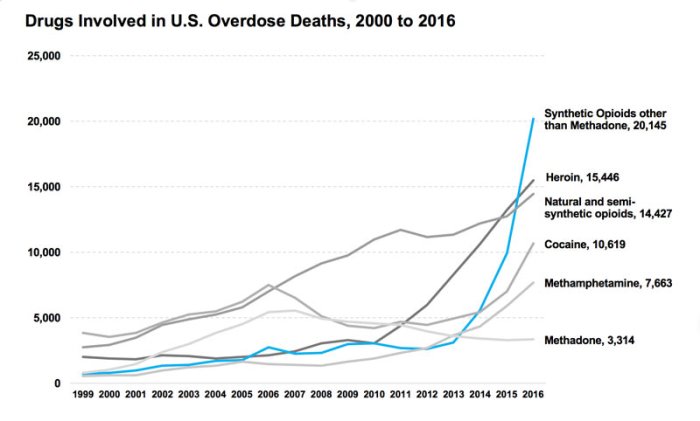
And furthermore, ADFs can be incorporated into the naturals and synthetics that are usually bonded with APAP like codeine, oxycodone, hydrocodone and tramadol, but cannot for the drugs that come in pure form like heroin or fentanyl. And those are the problem drugs. The NIDA research on drugs involved in overdose deaths across the board, for one, shows that overdose deaths are on the rise as a whole (except for methadone), and also that the synthetic opioids are much more deadly than the naturals and semi-synthetics: fentanyl is the biggest prescription analgesic killer (it’s much more potent than morphine, and tramadol is not very good for recreation).

drugoverdosedeaths

(This graph also shows, however, that the natural/semi-synthetic usage rate was possibly leveling out but resuscitated in 2015.) So ADFs are useless for the drugs most massively causing the “opioid epidemic.” Making them harder to abuse only dents the second category of abuser, and does not limit their addictiveness for those prescribed them for postsurgical pain or otherwise.

Moreover, from a libertarian standpoint, the second category of abuser does not really belong in the “public health crisis” discussion. Those who knowingly consume opioids for recreation are not a problem, they are participants in a pleasure-seeking activity that doesn’t tread on others. So long as their costs are not imposed on other people, it might be better to separate them from the “epidemic” status. Blurring the lines between the groups that fall under “abusive” means that those with a side-interest in OxyContin on Friday nights are lumped in with addicts suffering from physical dependency. Someone who has a glass of wine each night is not “abusing” alcohol, but we can recognize someone who is an alcoholic; the same distinction should be applied medically to opioid users. By painting all consumers outside of direct medical usage as “abusers,” there can be no standard for misuse, and thus no way for a recreationalist to know how much is too much, when health problems might set in, if they are really trapped in their recreation, etc. Research and knowledge are threatened by the legal treatment and classification.

Conclusion

To summarize, the government terminology of “abuse” obscures a legitimate distinction that is justified on both medical-political and civil liberty grounds. Some of the approaches in the Commission report, like the market-based CMS package recommendation, will likely succeed at quelling opioid exposure (and thus addiction and overdoses), while other maneuvers like an education campaign or ADFs should be treated with cautious skepticism. The trends show that heroin and fentanyl are actually the biggest contributors to the opioid epidemic, although semi-synthetics are climbing again in overdose deaths after leaning toward stabilization two years ago. Evidence that prescription abuse and street use are linked, as well as testimony from former addicts, indicates that drug users easily swing between the legal and black market.

The President’s commission on opioids (1/2)

Given Zachary’s post on the drug war and opioid crisis, I thought I would share parts of an essay I wrote for a class last semester about Trump’s commission on opioids, which is the first policy step the new administration took in dealing with the issue. It’s edited for links and language and whatnot.


One of the more recent executive steps to combat the opioid crisis — the “abuse” of prescription and illegal opioid-based painkillers — was the creation of The President’s Commission on Combating Drug Addiction and the Opioid Crisis (hereafter, the Commission) two years ago by the Trump administration. The commission, led by Chris Christie, was instituted to investigate the issue further and produce recommendations for the government and pharmaceutical industry. It released its final report in November and seems set to work on opioid use with the same sort of strategies the federal government always treats drugs, except maybe a little more progressive in its consideration of medicinal users. Looking at the Commission’s report, I argue that a refusal to treat unlike cases dissimilarly will lead to less than effective policy.

The President’s Commission

The DEA first asserted that overdose deaths from opioids had reached an epidemic in 2015. In March of last year, Donald Trump signed an executive order establishing the policy of the executive branch to “combat the scourge of drug abuse” and creating The President’s Commission. The Commission is designed to produce recommendations for federal funding, addiction prevention, overdose reversal, recovery, and R&D. Governor Chris Christie of New Jersey served as Chairman alongside Gov. Charlie Baker (R-MA), Gov. Roy Cooper (D-NC), representative Patrick J. Kennedy (D-RI), former deputy director of the Office of National Drug Policy and Harvard professor of psychobiology Bertha Madras, and Florida Attorney General Pam Bondi.

Included in the final report is a short history of opioid use in the United States, characterized by a first crisis in the mid- to late-19th century of “unrestrained … prescriptions,” eventually reversed by medical professionals “combined with federal regulations and law enforcement.” A public distrust of opioids developed afterward, but this was “eroded,” and now the new crisis, traceable to 1999, has become more perilous by innovations since the 19th century: large production firms for prescription drugs, a profitable pharmaceutical industry, cheaper and purer heroin, new fentanyl imports from China.

Since the Commission’s report, several bills have been introduced in the House or Senate currently awaiting judgment (e.g., H.R.4408, H.R.4275, S.2125). Declaring widespread addiction and overdoses to be a national emergency in August, Trump fulfilled one of the interim steps proposed by Christie in an early draft of the report; since, the President has met with drug company executives to discuss nonopiate alternatives for pain relief. Within the next few months we should start to see large scale moves.

Through all of this, the treatment of opioids by the Commission and the US government uses a traditional framing. The National Institute on Drug Abuse (NIDA) defines drug abuse in the following way:

[Use of substances] becomes drug abuse when people use illegal drugs or use legal drugs inappropriately. This includes the repeated use of drugs to produce pleasure, alleviate stress, and/or alter or avoid reality. It also includes using prescription drugs in ways other than prescribed or using someone else’s prescription. Addiction occurs when a person cannot control the impulse to use drugs even when there are negative consequences—the defining characteristic of addiction.

This definition by the federal government does not discriminate between various levels of damaging consumption behavior. The weakness of this definition is that, because all illicit drug consumption is categorized as abuse, there can be no standard for misuse of a black market drug for recreation. An entry-level dose of heroin qualifies as equally “abusive” as a lethal dose because of the binary character of the definition. Other federal agencies give similar definitions; in its report on recommendations for abuse-deterrent generic opioids (see below), the HHS and FDA use a definition of abuse characterized by the “intentional, nontherapeutic use of a drug product or substance, even once, to achieve a desired psychological or physiological effect.” This terminology still characterizes any and all recreational consumption of opioid analgesics as abuse, and not misuse, regardless of dosage or long-term dependency. It will be seen that this is a problem for the success of any sort of policy aimed at quelling usage, and particularly hazardous for the opioid problem.

Legal Background

First, the legal background and a more extensive history. The category “opioid” covers much drug terrain both prescription and illegal. Opioids in the most expansive sense are synthetic derivatives of alkaloids in the opium of the West Asian poppy species Papaver somniferum. Opium resin contains the chemicals morphine, codeine and thebaine. Morphine is the basis for powerful pain relievers like heroin and fentanyl. Codeine is considered less powerful for pain relief but can be used to produce hydrocodone; it also doubles as a cough suppressant. Lastly, thebaine is similar to morphine and is used for oxycodone. 90% of the world’s opium production is in Afghanistan.

All opioids are criminalized under federal Drug Scheduling. Heroin is a Schedule I drug as part of the Controlled Substances Act. Several synthetic opioid drugs that contain hydro- or oxycodone are Schedule II (Vicodin, Dilaudid, OxyContin). Fentanyl is also a Schedule II drug. Heroin is just a brand name for the chemical diacetylmorphine (invented by Bayer), still used as treatment in plenty of developed nations like the United Kingdom and Canada; after heroin was completely criminalized in the United States (“no medical benefits”), synthesized opiate drugs became more popular for prescriptions.

The Pure Food and Drug Act of 1906 introduced labels on medicine containing codeine and opium in general after Chinese immigrant workers introduced the drug to the states. Through 1914, various federal laws restricted opium further until the Harrison Narcotics Tax Act on opium and coca products (which are not narcotics, and the colloquial language has been messed up ever since) effectively criminalized the prescription of opioid products to addicted patients. Shortly afterward, the amount of heroin in the U.S. skyrocketed. Only in recent decades have synthesized opiates occupied the public mind, however. Between 1999 and the present, deaths from overdoses of opioids and opioid-based painkillers like OxyContin, Vicodin, morphine and street heroin have risen almost fourfold.

The data on overdoses and deaths does not paint a straightforward picture, and the group “opioid” obscures the different trends between drugs. The CDC classifies data according to four varieties of opioids: natural/semi-synthetic opioid analgesics like morphine, codeine, oxy- or hydrocodone, and oxy- or hydromorphone; synthetic opioid analgesics like tramadol and fentanyl; methadone; and heroin. The last is the only completely illegal opioid. Overdose deaths that have included heroin and completely synthetic opioids have increased exponentially from 2010 and 2013, respectively, while deaths from natural/semi-synthetic opioids and methadone have roughly stabilized or gone down over the last decade. Taken altogether, the deaths from opioid overdoses per 100,000 from 2000 to 2015 have increased from three to eleven people. (As of 2016, natural/semi-synthetic opioid deaths have actually started to go up again, but its still recent in the trend.)
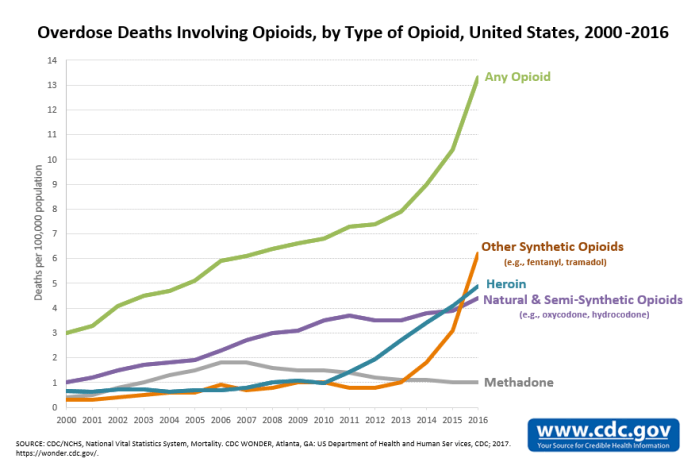
OpioidDeathsByTypeUS

In 2016, the CDC issued guidelines for treating chronic pain that warned physicians against prescribing high dose opioids and suggested talking about health risks. It also advised to “start low and go slow” — a slogan later mocked by John Oliver in a segment on opioids. And, according to a CDC analysis, prescriptions for the most dangerous opioids have dropped 41% from 2010 to 2015, and so have opioid prescriptions in general dropped. This has resulted in patients with physical dependency suffering withdrawal, often without programs to ease the transition to nonopioid pain relievers. Opioid dependants with withdrawal, or average citizens in need of pain relief, often turn to stronger street narcotics, since heroin is the cheaper and stronger alternative to oxycodone. For example, with the drop in first-time OxyContin abuse since 2010, heroin use has spiked. In Maine, a 15% decrease in opioid analgesic overdoses came with a 41% increase in heroin overdoses in 2012. The use of prescribed opioids, then, looks like it might be strongly connected to the use of street narcotics. The Commission, for its credit, notes that “the removal of one substance conceivably will be replaced with another.”

One fact lost in the discussion is that the use of nonmedical opioids has decreased but the amount of overdose deaths has increased. And “opioid epidemic” when discussing overdoses highly obscures that heroin is the major contributor alongside fentanyl — not merely prescription analgesics. We hear a lot about OxyContin and Vicodin, which are actually leveling out (or were until 2015), and less about the drugs which are already policed more, have been policed longer, and cause more physical problems.

What the Commission proposes

In its report, the Commission concludes the goals of its recommendations are “to promote prevention of all drug use with effective education campaigns and restrictions in the supply of illicit and misused drugs.” The President’s Commission doesn’t want to interfere too strongly, despite all of Trump’s suggestions of a revamped drug war. The report notes that coming down hard on opioids will hurt patients with real needs, as has already happened, and, in a way, has happened since 1924. Much of the Commission’s recommendations come from a market approach, e.g. the suggestion (Rec. 19) to reimburse nonopioid pain treatments. The current Centers for Medicare and Medicaid Services (CMS) policy for reimbursement for healthcare providers treats nonopioid, postsurgical pain relief treatments the same as opioid prescriptions, issuing one inclusive payment for all “supplies” at a fixed fee. Nonopioid medications and treatments cost more, and so hospitals opt for dispensing opioids instead. The Commission recommends “adequate reimbursement [for] a broader range of pain management” services, changing the bundle payment policy to accommodate behavioral health treatment, educational programs, “tapering off opioids” and other nonopioid options.

Trump himself suggested an educational approach in a public announcement, which triggered critical comparisons to the failed D.A.R.E. program and “your brain on drugs” commercials. Educational programs are a less coercive option than direct regulation of opioids, but their effectiveness seems to be hit and miss. The Commission cites the Idaho Meth Project from 2007 (ongoing), conducted by a private nonprofit to inform young adults on the health problems associated with methamphetamine use, as a success story: “The Meth Project reports that 94% of teens that are aware of the anti-meth campaign ads say they make them less likely to try or use meth, and that Idaho has experienced a 56% decline in teen meth use since the campaign began.” This meth project is one success story out of many failures. For instance, the Montana Meth Project from 2005, on which the Idaho project was modelled, “accounting for a preexisting downward trend in meth use,” was determined to have “effects on meth use [that] are statistically indistinguishable from zero,” according to an analysis by the National Library of Medicine. Then again, one large scale anti-drug educational campaign, truth, which encourages youth to avoid tobacco, might be having success. Their modern guerrilla tactics are a major improvement on the old model of Partnership for a Drug-Free America. 

In another market approach to help recovering addicts reenter society, the Commission recommends decoupling felony convictions and eligibility for certain occupations (Rec. 50). The report cites Section 1128 of the Social Security Act, which prohibits employers that receive funding from federal health programs from hiring past convicts charged with unlawfully manufacturing, distributing or dispensing controlled substances. Any confrontation with law enforcement is a barrier to landing a job — a protected area of discrimination — and government laws that specifically ban their hiring make it worse on ex-users and -dealers trying to get clean. Recommendations like these lessen the role that the state has in keeping ex-convicts out of work. 

Much of the funding requested by the President’s Commission is authorized by the Obama administration’s major contribution to combating opioid usage, the Comprehensive Addiction and Recovery Act (CARA), signed into law July 2016 and credited as the “first major federal addiction legislation in 40 years.” CARA helped implement naloxone (an opioid overdose-reversal nail spray) in firefighting departments and strengthen drug monitoring programs. 


I’ll post the second half soon, and then a bonus post on my personal favorite solution.
Trump’s personal game might work in China

In spite of all the economic and strategic differences between the US and China, personal relationships play an important role in bilateral relations between Washington DC and Beijing.

Trump’s Ambassador to China 

One of the first appointments made by US President Donald Trump was that of Terry Branstad as US Ambassador to China. The key reason was Branstad’s personal rapport with Chinese President Xi Jinping. This began in 1985, when Branstad was Governor of Iowa, while Xi Jinping an official from Hebei was visiting Iowa. In 2011, Branstad visited Beijing, and met with Xi at the Great Hall of the People. In February 2012, when he was vice-president, Xi stopped in Muscatine, Iowa, where he met not just with Branstad but with big industrialists and farmers from the states.

The US President, commenting on the reason for appointing Branstad, stated:

Governor Branstad’s decades of experience in public service and long- time relationship with President Xi Jinping and other Chinese leaders make him the ideal choice to serve as America’s ambassador to China.

During US President’s China visit in November 2017, Branstad, who shares a good rapport with Trump, did the groundwork for the visit. While in recent weeks tensions between both countries have escalated, with Trump imposing tariffs on Chinese goods worth $60 billion, the American president was delighted with the welcome he had received during his trip and had even told the Chinese President: “My feeling towards you is incredibly warm.”

It would be pertinent to point out that Trump’s decision to appoint Branstad as Ambassador to China (December 2016) came as a relief to the Chinese, given the fact that the US President took Taiwanese President Tsai-Ing Wen’s phone call, much to the chagrin of Beijing (since this went against established US policy).

If one were to look beyond the role of personal relationships in the very complex but important Beijing-Washington relationship, China lays a lot of emphasis on experience (educational, professional) in the US. If one were to examine the credentials of some of the top officials in Xi Jinping’s administration, US education as well as experience in dealing with economic issues pertaining to the US, has played a key role in some of the Chinese President’s appointments.

For instance, Liu He, whom Xi Jinping has appointed as a Vice Premier for overseeing the economy and financial sector, is US educated. Liu, who speaks fluent English, obtained a master’s degree in public administration from the Kennedy School of Government (Harvard University) in 1995. Apart from his in-depth understanding of the Chinese economy, Liu has also been involved in important discussions with US leaders.

Another significant appointment by Xi Jinping is that of Yi Gang, who has been named as Governor of the People’s Bank of China (PBOC). Yi obtained a business degree from the Hamline University in St. Paul, Minnesota, and a Ph.D. in economics at the University of Illinois, before moving to Indiana University at Indianapolis as a professor in 1986. He taught later at the Peking University in Beijing, before moving to the PBOC in 1997.

While economic and strategic issues are too complex to be driven by personal relationships or chemistry (though Trump seems to be a keen believer in personal chemistry given the emphasis he lays on individual ties) alone, an in-depth  understanding of the culture, politics, and economics of one’s interloctutors is especially handy. Given the current tensions between both countries over tariffs, this dynamic may prove to be especially useful.

3 key problems with Trump’s style of functioning

The removal of Rex Tillerson as Secretary of State (who was replaced by Mike Pompeo, Director of the CIA) reiterates three key problems in US President Donald Trump’s style of functioning: First, his inability to get along with members of his team; second, impulsive decisions driven excessively by ‘optics’ and personal chemistry between leaders; and, finally, his inability to work in a system even where it is necessary.

Tillerson, who had differences with Trump on issues ranging from the Iran Nuclear Deal (which Trump has been wanting to scrap, though his stance was moderated by Tillerson) to the handling of North Korea, is not the first member (earlier senior individuals to be sacked are, amongst others, Michael Flynn, who was National Security Adviser, and Chief Strategist Steve Bannon) to exit hurriedly. Gary Cohn, Director of the National Economic Council, quit recently after opposing the US President’s tariffs on imports of steel and aluminium.

The US President tweeted this decision:

Mike Pompeo, Director of the CIA, will become our new Secretary of State. He will do a fantastic job! Thank you to Rex Tillerson for his service! Gina Haspel will become the new Director of the CIA, and the first woman so chosen. Congratulations to all!

The US President admitted that Tillerson’s style of functioning was very different from his own (alluding to the latter’s more nuanced approach on complex issues).

Interestingly, the US President did not even consult any of his staff members, including Tillerson, before agreeing to engage with North Korean Dictator Kim Jong Un. The South Korean National Security Advisor, Chung Eui Yong, had met with Trump and put forward the North Korean dictator’s proposal of a Summit.

The US President agreed to this proposal. Commenting on his decision to engage with Kim Jong Un, Trump tweeted:

Kim Jong Un talked about denuclearization with the South Korean Representatives, not just a freeze. Also, no missile testing by North Korea during this period of time. Great progress being made but sanctions will remain until an agreement is reached. Meeting being planned!

While Chung stated that the Summit would take place before May 2018, White House has not provided any specific dates.

There is absolutely no doubt that, at times, bold steps need to be taken to resolve complex issues like North Korea. Trump’s impulsive nature, however – refusing to go into the depth of things or seeking expert opinion – does not make for good diplomacy.

In fact, a number of politicians and journalist have expressed their skepticism with regard to where North Korean negotiations may ultimately lead. Ed Markey a Democratic Senator from Massachusetts, stated that Trump “must abandon his penchant for unscripted remarks and bombastic rhetoric to avoid derailing this significant opportunity for progress.”

In a column for the Washington Post, Jeffrey Lewis makes the point that there is a danger of Trump getting carried away by the attention he receives. Says Lewis in his column:

Some conservatives are worried that Trump will recognize North Korea as a nuclear-weapons state. They believe that an authoritarian North Korea will beguile Trump just as it did his erstwhile apprentice, American basketball player Dennis Rodman. They fear that Trump will be so overjoyed by the site of tens of thousands of North Koreans in a stadium holding placards that make up a picture of his face that he will, on the spot, simply recognize North Korea as a nuclear power with every right to its half of the Korean peninsula.

All Trump’s interlocutors have realized that while he is unpredictable, one thing which is consistent is the fact that he is prone to flattery. During his China visit, for instance, Trump was so taken aback by the welcome he received and the MOU’s signed with Chinese companies that he started criticizing his predecessors.

Finally, while Trump, like many global leaders, has risen as a consequence of being an outsider to the establishment, with people being disillusioned with the embedded establishment, the US President has still not realized that one of Washington’s biggest assets has been strategic alliances like NATO and multilateral trade agreements like NAFTA. The United States has also gained from globalization and strategic partnerships; it has not been one way traffic.

It remains to be seen how Tillerson’s removal will affect relations with key US allies. If Trump actually goes ahead with scrapping the Iran nuclear deal (2015), it will send a negative message not just to other members of the P5 grouping, but also India. In the last three years, India has sought to strengthen economic ties with Iran and has invested in the Chabahar Port Project. New Delhi is looking at Iran as a gateway to Afghanistan and Central Asia. If Tillerson’s successor just plays ball, and does not temper the US President’s style of conducting foreign policy, there is likely to be no stability and consistency and even allies would be skeptical.

Japan on its part would want its concerns regarding the abduction of Japanese citizens by Pyongyang’s agents, decades ago, to not get sidelined in negotiations with North Korea. (13 Japanese individuals were abducted in 2002, 5 have returned but the fate of the others remains unknown.) Prime Minister Shinzo Abe has made the return of the abductees a cornerstone of his foreign policy, and his low approval ratings due to a domestic scandal could use the boost that is usually associated with the plight of those abductees.

The removal of Tillerson underscores problems with Trump’s style of functioning as discussed earlier. The outside world has gotten used to the US President’s style of functioning and will closely be watching what Tillerson’s successor brings to the table.

Trump’s humor is not very funny to the world’s liberal democracies

The Chinese Communist Party, on February 25, 2018, made a significant announcement — that the two-term limit for Presidency will be abolished through an amendment to the constitution. This means that current President Xi Jinping will be President for life. This amendment was tabled on March 6, 2018 by the Communist Party during the two week National People’s Congress (which began on Monday, March 5, 2018).

According to a CNN recording, Donald Trump, while reacting to this development, stated:

He’s now president for life, president for life. And he’s great. And look, he was able to do that. I think it’s great. Maybe we’ll have to give that a shot someday.

The US President also called Xi a “gentleman,” and said that the latter had treated Trump very well during his China visit in November 2017. Trump’s reaction to Xi’s decision has been criticized by some politicians in the US, while other major Western democracies have not commented on the decision.

Trump’s inconsistency on China

Trump’s views with regard to China have not been consistent, as is the case on many other issues. Candidate Trump had used tough language for China; at one campaign rally, for example, candidate Trump stated:

We can’t continue to allow China to rape our country and that’s what they’re doing. It’s the greatest theft in the history of the world.

During his visit to China in November 2017, the US President had, interestingly enough, criticized his predecessors, and said that he does not hold China responsible for the skewed trade relationship:

[…] I don’t blame China. After all, who can blame a country for taking advantage of another country for the benefit of its own citizens? I give China great credit […] I do blame past [US] administrations for allowing this out of control trade deficit to take place and to grow. We have to fix this because it just doesn’t work […] it is just not sustainable.

While the US President is unpredictable, the criticism of his predecessors on foreign soil came as a shock to everyone.

Trump’s myopic approach towards complex economic and strategic issues has helped China

Trump’s recent praise of the constitutional change which will enable Xi to be President for life may have embarrassed many Americans and Liberals in other parts of the world. They would have perhaps expected the US President to raise a red flag.

The fact is, however, that many of Trump’s foreign policy decisions – withdrawing from the Trans Pacific Partnership (TPP) trade deal in January 2017, or repeatedly criticizing NATO (North Atlantic Treaty Organization) and stating that members are not meeting their ‘financial obligations’ or, more recently, the imposition of tariffs on imports of aluminium and steel – are embarrassing steadfast allies in Asia and Western Europe. All these decisions have sent a message globally that Trump’s view of the outside world is driven by domestic politics and transactionalism – and not realism as some would have us believe. This is in contrast to his predecessors, who valued relationships but also understood the relevance of common democratic values as a binding thread. Trump on the other hand is quite comfortable with authoritarian leaders.

Trump has often expressed admiration for authoritarian leaders like Vladimir Putin, and Phillipines President Rodrigo Duterte. Duterte, who is controversial for using extrajudicial methods to deal with a Filipino drug problem, has presided over a drug war that has cost the lives of more than 4,000 people. While praising Duterte, Trump said:

I just wanted to congratulate you because I am hearing of the unbelievable job on the drug problem. Many countries have the problem, we have a problem, but what a great job you are doing.

During their meeting on the sidelines of the ASEAN Summit in Manila (November 2017), Trump did not sufficiently raise US human rights concerns, and was criticized by many American politicians, including Republican Senator John McCain. The US-Philippines Joint Statement, while speaking about the challenge of the drug problem, did refer to a human rights issue (issued after the meeting between Trump and Duterte):

The two sides underscored that human rights and the dignity of human life are essential, and agreed to continue mainstreaming the human rights agenda in their national programs to promote the welfare of all sectors, including the
most vulnerable groups.

It would be pertinent to point out that the previous administration had criticized Duterte for adopting such measures. In return, Duterte used offensive language aimed at President Obama.

While the US has been in bed with authoritarian regimes in the past and turned a blind eye on many occasions to human rights violations, no one can deny the fact that even transactionalist Presidents like Ronald Reagan paid lip service to democracy and human rights. In a speech at Westminster, Reagan stated:

Democracy is not a fragile flower […] Still it needs cultivating. If the rest of this century is to witness the gradual growth of freedom and democratic ideals, we must take actions to assist the campaign for democracy.

Similarly, George W Bush, who was often thought of as being very simplistic, spoke about the importance of democratic values as a common binding factor with many of its allies.

Conclusion

In conclusion, while reasonable ties between Washington and Beijing are good news, Trump’s public appreciation of authoritarian leaders and their methods is worrying because at the global level there is a feeling that authoritarian leaders and systems deliver better results compared to chaotic democracies.

The US has always been the flagbearer of democracy, liberal values, and human rights. It is a matter of concern, then, when the leader of such a country pays little attention to these issues. In a way, Trump has played a pivotal role in wrecking the liberal order, and by doing so has created a situation where Beijing will not have to change its ways, but may well create a parallel order which many countries will be willing to join due to China’s economic prowess.

Is Trump turning the US into the Biggest Loser?

US President Donald Trump has been quick to change his stance on complex issues like US relations with other countries, including China. Trump has also been unpredictable in his approach towards important multilateral organizations like the North Atlantic Treaty Organization (NATO) and US ties with important allies in the Indo-Pacific, especially Japan and South Korea.

The most recent instance of Trump yet again changing his views was his statement on the Trans Pacific Partnership (TPP) during the Davos Summit, saying that the US was open to a rethink, provided the provisions were fair. While the US pulled out of the TPP agreement much to the chagrin of other signatories, eleven countries (they are, in alphabetical order, Australia, Brunei, Canada, Chile, Japan, Malaysia, Mexico, New Zealand, Peru, Singapore and Vietnam) have agreed on signing the deal in March in Chile.

While speaking at Davos, Trump said that the US was not averse to negotiating trade deals with its TPP partners. In an interview with CNBC, on the eve of his address, the US President had said:

….we would do TPP if we were able to make a substantially better deal. The deal was terrible, the way it was structured was terrible. If we did a substantially better deal, I would be open to TPP.

The US President sensed the pitch at Davos, which was firmly in favor of globalization and a more open economic world order. During his address, while speaking of American interests, Trump made it a point to state that watching out for US interests did not imply that his administration would prefer America to become more insular. Said the US President:

America First does not mean America alone. When the United States grows, so does the world. American prosperity has created countless jobs all around the globe and the drive for excellence, creativity, and innovation in the US has led to important discoveries that help people everywhere live more prosperous and far healthier lives.

Mr Trump is not the only world leader to have won competitive elections by appealing to insularity, only to realize that economic interdependence between countries today is incredibly entrenched. For instance, Indian PM Narendra Modi, while arguing in favour of globalization, had said:

Instead of globalization, the power of protectionism is putting its head up.

Modi had gone to the extent of saying that inward looking tendencies were an important challenge, arguing that:

 …such tendencies can’t be considered lesser risk than terrorism or climate change.

Interestingly, Modi’s remarks on globalisation were welcomed by the Chinese, with the Chinese Foreign Ministry spokesman, Hua Chunying, arguing in favour of China and India working together to promote globalisation. Said Hua:

China would like to enhance coordination and cooperation with all countries including India to steer the economic globalisation towards benefiting world economic growth and well-being of all countries.

Last year in his address at the Davos Summit, Chinese President Xi Jinping had spoken in favour of globalization, saying:

Pursuing protectionism is like locking oneself in a dark room […] Wind and rain may be kept outside, but so is light and air.

While some flexibility is welcome, excessive unpredictability and Trump’s woolly approach on serious issues is confusing the outside world. A business-like approach is good to an extent, but to deal with complex geostrategic issues purely from the prism of US short-term financial interests as opposed to long term geopolitical interests is a disastrous idea.

Every country has to watch its own interests, and the US is no exception, and there is absolutely no doubt that domestic public opinion cannot be ignored. Yet if the US wants to be a leader, it cannot be as transactional as Trump. US dreams of a “Free and Open Indo-Pacific” – a key aim of the US Defense Strategy – will remain a mere dream if the US sends confusing signals to its allies in the region and is not willing to take a clear leadership role. While the Strategy identifies China as a threat, Trump’s continuous somersaults on relations with US allies are only emboldening Beijing.

While it is unfair to single out Trump for being insular he has been the mascot for inward looking protectionist economic policies and an anti-immigration sentiment. While the US President did tell the global audience at Davos that “America First does not mean America alone,” it will indeed end up alone if he does not start thinking like a US President.

Currently he is thinking purely like the head of a company, and running a business is different from running a country, which has long sought to be the flag bearer of democratic, liberal values and globalization. While Trump’s isolationism and short sightedness may cause some discomfort for other countries, and groupings like the TPP, the latter will find other alternatives as has been the case with the signatories of the TPP, and America will be the bigger loser.

Shitholes: Where the President is Wrong

I am both a brilliant social scientist and a sensitive moralist. Both facts force me to wade into the “shithole” controversy. I will try to diverge from what has been said ad nauseam in the media but I cannot avoid some repetition.

First, I would bet 60/40 that he said it, just as reported. The president is a sort of verbal pervert, an addict. He gets so much pleasure from scandalizing the prim liberals that he can’t stop himself. Policy successes only encourage him; they give him room to maneuver, so to speak. I can certainly empathize. So, I don’t want to deny him but I wish he had not said it. See why below.

Second, yes, some countries are shitholes. That’s why so many, NOT displaced by war, are eager to risk drowning in the cold winter Mediterranean to escape. That’s why some escape a couple of unnamed countries in the Caribbean by floating on inner tubes. That’s why Venezuelan border guards are unequal to the task of keeping immigrants out. (I made this up. I want to make sure you are paying attention.) All the same, there are plenty of good people who live in shithole countries, friends and potential friends of America. The president should avoid making them feel worse than they already do.

Third, there was rush, a veritable melee, to charge President Trump with racism because of the comment. Rude and crude is not enough because not enough Americans care. (Many of us are both; many more are one or the other, at least occasionally.) The president has to be a racist; that’s important. So, this leaves me pondering: If Mr Trump had called, say, Russia a shithole it would have been OK because Russians are 97% white? Do you see the credibility problem here?

What provided the steam, the power in this matter is Mr Trump’s infatuation with merit-based immigration. His eruction took place shortly after Mr Trump had declared the US needs more immigrants from countries such as Norway (where many people must have merit, obviously).

I think that here his logic is dead wrong or, at least, mostly wrong.

For whatever historical reasons or because of their own current virtues, or because of their oil deposits, Norwegians live very well. I think it’s all Norwegians. Even poor Norwegians have it good. Possibly, it’s especially poor Norwegians who have it good because of an insanely generous social safety net. I hate to tell you but Norwegians have both a GDP/capita higher than Americans AND a welfare state. The only weak spot is the climate but then, they are used to it, what, after centuries, and many are rich enough to go south for part of the winter anyway.

Given all this, what kind of Norwegians would think of emigrating to the US? I think, two kinds. First, there would be adventurers and very ambitious entrepreneurs. Second, there would be the scum of Norwegian society, including a large criminal element not satisfied with the lifestyle the dole provides.*

Now, think of a society that is less than rosy. (I won’t call it a bad name because I follow my own advice.) I am thinking of a society where there is no escape from garbage and even from human feces except deep in the tropical forest. Would the well educated, decent people with middle-class aspirations from such a society wish to come to the US? You bet! That society has given us thousands of quality entrepreneurs, many dedicated and hard workers, and talent in every segment of American society, including academia, the judiciary, and literature. I am thinking of India, of course.

So, here is the question: Would we rather have the cream of an objectionable society such as India or the scum of a good society such as Norway**. I think that’s the real choice and Mr Trump does not begin to understand it.


* I use the conditional here because there is currently practically no way for a Norwegian to emigrate to the US except by marrying an American.

** I understand that there are moral objections to skimming off the cream of poor societies such as India. Another topic, obviously.