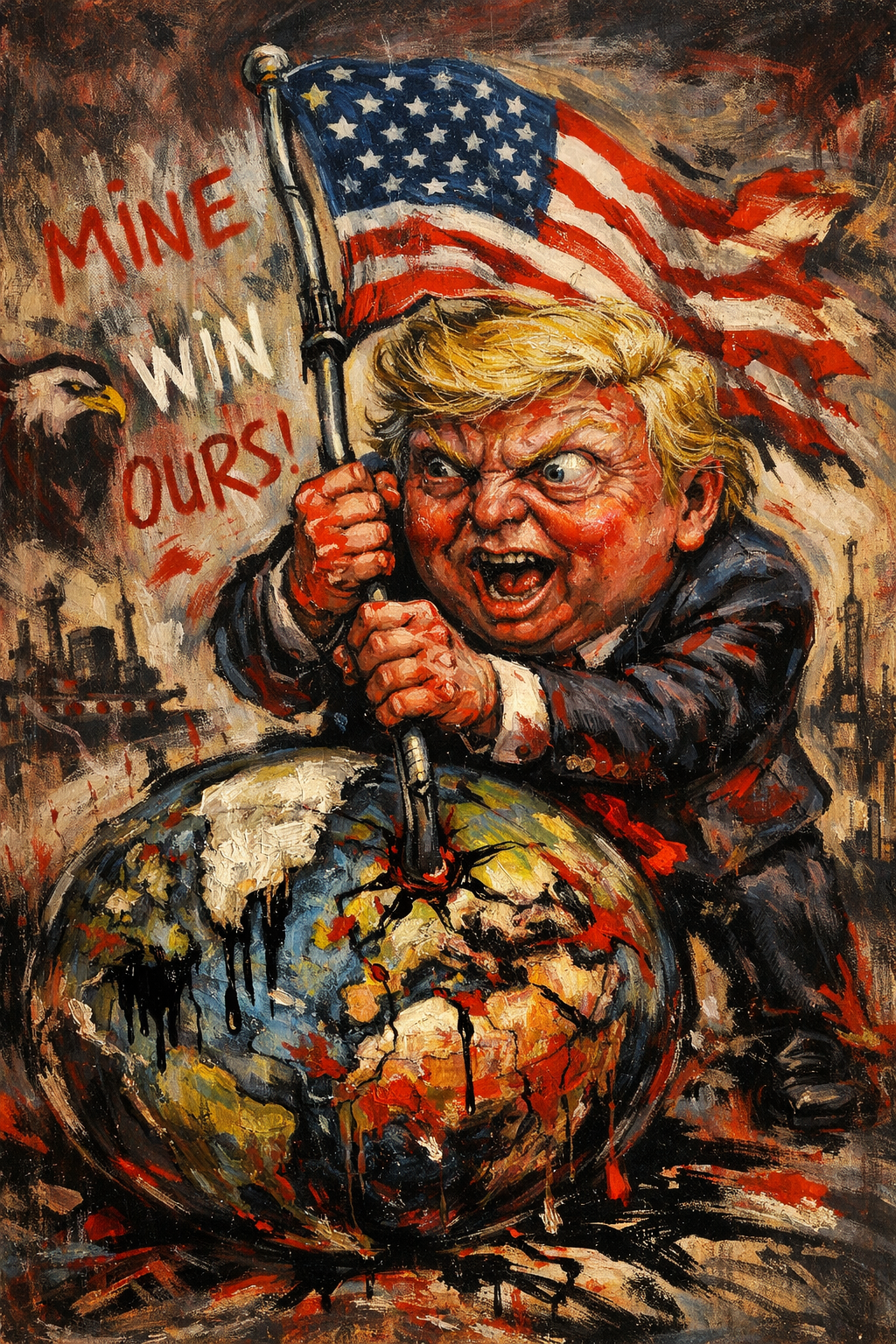
In the Ruins of Public Reason, Part III: When the Barbarians Are at the Gates; Fascism, Bullshit, and the Paradox of Tolerance

Note: This is the third in a series of essays on public discourse. Here’s Part 1 and Part 2

Three years ago, I started this essay series on the collapse of public discourse. At the time, I was frustrated by how left-wing and progressive spaces had become cognitively rigid, hostile, and uncharitable to any and all challenges to their orthodoxy. I still stand by most everything I said in those essays. Once you have successfully identified that your interlocutors are genuinely engaging in good faith, you must drop the soldier mindset that you are combating a barbarian who is going to destroy society and adopt a scout mindset. For discourse to serve any useful epistemic or political function, interlocutors must accept and practice something like Habermas’ rules of discourse or Grice’s maxims of discourse, where everyone is allowed to question or introduce any idea to cooperatively arrive at an intersubjective truth. The project of that previous essay was to therapeutically remind myself and any readers to actually apply and practice those rules of discourse in good-faith communication.

However, at the time, I should have more richly emphasized something that has been quite obviously true for some time now: most interlocutors in the political realm have little to no interest in discourse. I wish more people had such an interest, and still stand by the project of trying to get more people, particularly in leftist and libertarian spaces, to realize that when they speak to each other, they are not dealing with barbarian threats. However, recent events have made it clear that the real problem is figuring out when an interlocutor is worthy of having the rules of discourse applied in exchanges with them. Here is an obviously non-exhaustive list of such events in recent times that make this clear: 

  1. The extent to which Trump himself, as well as his advisors and lawyers, engage in lazy, dishonest, and bad-faith rationalizations for naked, sadistic, unconstitutional executive power grabs.
  2. The takeover of the most politically influential social media by a fascist billionaire rent-seeker has resulted in a complete fragmentation and breakdown of the online public square
  3. The degree to which most on the right and many on the left indulge in insane conspiracy theories, which have eroded and destroyed the epistemic norms of society, for reasons of rational irrationality.
  4. Even the Supreme Court, the institution that ostensibly is most committed to publicly justifying and engaging in good-faith reasoning about laws, is now giving blatantly awful, authoritarian opinions so out of step with their ostensibly originalist and/or textualist legal hermeneutics and constitutionalist principles (not to mention the opinions of even conservative judges in lower courts). It certainly seems the justices are just as nakedly corrupt and intellectually bankrupt as rabble-rousing aspiring autocrats. Indeed, the court is in such a decrepit state of personalist capture by an aspiring fascist dictator that they aren’t even attempting to publicly justify ‘shadow docket’ rulings in his favor. One can only conclude conservative justices are engaging in bad-faith power-grabs for themselves, whether they intend to or not. Although this has always been true of statist monocentric courts to some extent, recent events have only further eroded the court’s pretenses to being a politically 

All these were obvious trends three years ago and have very predictably only gotten more severe.  You may quibble with the extent of my assessment of any individual example above. Regardless, all but the most committed of Trumpanzees can agree that there is a time and place to become a bit dialogically illiberal in times like these. Thus, it is time to address how one can be a dialogical liberal when the barbarians truly are at the gates. The tough question to address now is this: what should the dialogical liberal do when faced with a real barbarian, and how does she know she is dealing with a barbarian? 

This is an essay about how to remain a dialogical liberal when dialogical liberalism is being weaponized against you. This essay isn’t for the zealots or the trolls. It’s for those of us who believed, maybe still believe, that democracy depends on dialogue—but who are also haunted by the sense that this faith is being used against us.

Epistemically Exploitative Bullshit

I always intended to write an essay to correct the shortcomings of the original one. I regret that, for various personal reasons, I did not do so sooner. The sad truth is that a great many dialogical illiberals who are also substantively illiberal engage in esoteric communication (consciously or not). That is, their exoteric pretenses to civil, good-faith communication elide an esoteric will to domination. Sartre observed this phenomenon in the context of antisemitism, and he is worth quoting at length:

Never believe that anti‐Semites are completely unaware of the absurdity of their replies. They know that their remarks are frivolous, open to challenge. But they are amusing themselves, for it is their adversary who is obliged to use words responsibly, since he believes in words. The anti‐Semites have the right to play. They even like to play with discourse for, by giving ridiculous reasons, they discredit the seriousness of their interlocutors. They delight in acting in bad faith, since they seek not to persuade by sound argument but to intimidate and disconcert. If you press them too closely, they will abruptly fall silent, loftily indicating by some phrase that the time for argument is past. It is not that they are afraid of being convinced. They fear only to appear ridiculous or to prejudice by their embarrassment their hope of winning over some third person to their side.

If then, as we have been able to observe, the anti‐Semite is impervious to reason and to experience, it is not because his conviction is strong. Rather, his conviction is strong because he has chosen first of all to be impervious.

What Sartre says of antisemitism is true of illiberal authoritarians quite generally. Thomas Szanto has helpfully called this phenomenon “epistemically exploitative bullshit.” 

One feature of epistemically exploitative bullshit that Szanto highlights is that epistemically exploitative bullshit need not be intentional. Indeed, as Sartre implies in the quote above, the ‘bad faith’ of the epistemically exploitative bullshitter involves a sort of self-deception that he may not even be consciously aware of. Indeed, most authoritarians (especially in the Trump era) are not sufficiently self-aware or intelligent enough to consciously realize that they are deceiving others about their attitude towards truth by spouting bullshit. As Henry Frankfurt observed, bullshit is different from lying in that the liar is intentionally misrepresenting the truth, but the bullshitter has no real concern for truth in the first place. Thus, many bullshiters (especially those engaged in epistemically exploitative bullshit) believe their own bullshit, often to their detriment.

However, the fact that epistemically exploitative bullshit is often unintentional, or at least not consciously intentional, creates a serious ineliminable epistemic problem for the dialogical liberal who seeks to combat it. It is quite difficult to publicly and demonstrably falsify the hypothesis that one’s interlocutor is engaging in epistemically exploitative bullshit. This often causes people who, in their heart of hearts, aspire to be epistemically virtuous dialogical liberals to misidentify their interlocutors as engaging in epistemically exploitative bullshit and contemptuously dismiss them. I, for one, have been guilty of this quite a bit in recent years, and I imagine any self-reflective reader will realize they have made this mistake as well. We will return to this epistemic difficulty in the next essay in this series.

To avoid this mistake, we must continually remind ourselves that the ascription of intention is sometimes a red herring. Epistemically exploitative bullshit is not just a problem because bullshitters intentionally weaponize it to destroy liberal democracies. It is a problem because of the social and (un)dialectical function that it plays in discourse rather than its psychological status as intentional or unintentional. 

It is also worth remembering at this point that it is not just fire-breathing fascists who engage in epistemically exploitative bullshit. Many non-self-aware, not consciously political, perhaps even liberal, political actors spout epistemically exploitative bullshit as well. Consider the phenomenon of property owners—both wealthy landlords and middle-class suburbanites—who appeal to “neighborhood character” and environmental concerns to weaponize government policy for the end of protecting the economic rents they receive in the form of property values. Consider the similar phenomenon of many market incumbents, from tech CEOs in AI to healthcare executives and professionals, to sports team owners, to industrial unions, to large media companies, who all weaponize various seemingly plausible (and sometimes substantively true) economic arguments to capture the state’s regulatory apparatus. Consider how sugar, tobacco, and petrochemical companies all weaponized junk science on, respectively, obesity, cigarettes, and climate change to undermine efforts to curtail their economic activity. Almost none of these people are fire-breathing fascists, and many may believe their ideological bullshit is true and tell themselves they are helping the world by advancing their arguments. 

The pervasive economic phenomenon of “bootleggers and Baptists” should remind us that an unintentional form of epistemically exploitative bullshit plays a crucial role in rent seeking all across the political spectrum. This form of bullshit is particularly hard to combat precisely because it is unintentional, but its lack of intentionality in no way lessens the harmful social and (un)dialectical functions it severe.

Despite those considerations, it is still worth distinguishing between consciously intentional forms of aggressive esotericism and more unintentional versions because they must be approached very differently. Unintentional bullshitters do not see themselves as dialogically illiberal. Therefore, responding to them with aggressive rhetorical flourishes that treat them contemptuously is very unlikely to be helpful. For this reason, the general (though defeasible) presumption that any given person spouting epistemically exploitative bullshit is not an enemy that I was trying to cultivate in the second part of this essay series still stands. In the next essay, I will address how we know when this presumption has been defeated. However, for now, let us turn our attention to the forms of epistemically exploitative bullshit common today on the right. We have now seen how epistemically exploitative bullshit can appear even in technocratic, liberal settings. But that phenomenon takes on a more virulent form when fused with authoritarian intent. This is what I call aggressive esotericism.

Aggressive Esotericism

The corrosiveness of these more ‘liberal’ and technocratic forms of epistemically exploitative bullshit discussed above, while serious, pales in comparison to more bombastically authoritarian forms of it. The truly authoritarian epistemically exploitative bullshiter aims at more than amassing wealth by capturing some limited area of state policy. While he also does that, the fascist aims at the more ambitious goal of dismantling democracy and seizing the entire apparatus of the state itself.

 Let us name this more dangerous form of epistemically exploitative bullshit. Let us call this aggressive esotericism and loosely define it as the phenomenon of authoritarians weaponizing the superficial trappings of democratic conversation to elide their will to dominate others. This makes the fascistic, aggressive esotericist all the more cruel, destructive, and corrosive of society’s epistemic and political institutions.

It is worth briefly commenting on my choice of the words “aggressive esotericism” for this. The word “esoteric” in the way I am using it has its roots in Straussian scholars who argue that many philosophers in the Western tradition historically did not literally mean what their discursive prose appears to say. Esoteric here does not mean “strange,” but something closer to “hidden,” in contrast to the exoteric, surface-level meaning of the text. We need not concern ourselves with the fascinating and controversial question of whether Straussians are right to esoterically read the history of Western philosophy as they do. Instead, I am applying the general idea of a distinction between the surface level and deeper meaning of a text, the sociological problem of interpreting both the words and the deeds of certain very authoritarian political actors. 

I choose the word “aggressive” to contrast with what Arthur Melzer calls “protective,” “pedagogical,” or “defensive” esotericism. In Philosophy Between the Lines Melzer argues that historically, philosophers often hid a deeper layer of meaning in their great texts. In the ancient world, Melzer argues, this was in part because they feared theoretical philosophical ideas could disintegrate social order (hence the “protective esotericism”), wanted their young students to learn how to come to philosophical truths themselves (hence the “pedagogical esotericism”), or else wanted to protect themselves from authorities for ‘corrupting the youth’  (as Socrates was accused) with their heterodox ideas. 

As the modern world emerged during the Enlightenment, Melzer argues esotericism continued as philosophers such as John Locke wrote hidden messages not just for defensive reasons but to help foster liberating moral progress in society, as they had a far less pessimistic view about the role of theoretical philosophy in public life (hence their “political esotericism”). Whether Melzer is correct in his reading of the history of Western political thought need not concern us now. My claim is that many authoritarians (both right-wing Fascists and left-wing authoritarian Communists) invert this liberal Enlightenment political esotericism by engaging—both in words and in deeds, both consciously and subconsciously, and both intentionally and unintentionally—in aggressive esotericism. Hiding their esoteric will to domination behind a superficial façade of ‘rational’ argumentation.

Aggressive esotericism is a subset of the epistemically exploitative bullshit. While aggressive esotericism may be more often intentional than more technocratic forms of epistemically exploitative bullshit, it is not always so. You might realize this when you reflect on heated debates you may have had during Thanksgiving dinners with your committed Trumpist family members. Nonetheless, this lack of intention doesn’t cover up the fact that their wanton wallowing in motivated reasoning, rational ignorance, and rational irrationality has the selfish effect of empowering members of their ingroup over members of their outgroup. This directly parallels how the lack of self-awareness of the technocratic rentseeker ameliorates the dispersed economic costs on society.

Aggressive Esotericism and the Paradox of Tolerance

Even if one suspects one is encountering a true fascist, one should still have the defeasible presumption that they are a good-faith interlocutor. Nonetheless, fascists perniciously abuse this meta-discursive norm. This effect has been well-known since Popper labelled it the paradox of tolerance.  

The paradox of tolerance has long been abused by dialogical illiberals on both the left and the right to undermine the ideas of free speech and toleration in an open society, legal and social norms like academic freedom and free speech, and to generally weaken the presumption of good faith we have been discussing. This, however, was far from Popper’s intention. It is worth revisiting Popper’s discussion of the Paradox of Tolerance in The Open Society and Its Enemies:

Unlimited tolerance must lead to the disappearance of tolerance. If we extend unlimited tolerance even to those who are intolerant, if we are not prepared to defend a tolerant society against the onslaught of the intolerant, then the tolerant will be destroyed, and tolerance with them. In this formulation, I do not imply, for instance, that we should always suppress the utterance of intolerant philosophies; as long as we can counter them by rational argument and keep them in check by public opinion, suppression would certainly be most unwise. But we should claim the right even to suppress them, for it may easily turn out that they are not prepared to meet us on the level of rational argument, but begin by denouncing all argument; they may forbid their followers to listen to anything as deceptive as rational argument, and teach them to answer arguments by the use of their fists. We should therefore claim, in the name of tolerance, the right not to tolerate the intolerant. We should claim that any movement preaching intolerance places itself outside the law, and we should consider incitement to intolerance and persecution as criminal, exactly as we should consider incitement to murder, or to kidnapping, or as we should consider incitement to the revival of the slave trade.

His point here is not so much to sanction State censorship of fascist ideas. Instead, his point is that there are limits to what should be tolerated. To translate this to our language earlier in the essay, he is just making the banal point that our presumption of good-faith discourse is, in fact, defeasible. The “right to tolerate the intolerant” need not manifest as legal restrictions on speech or the abandonment of norms like academic freedom. This is often a bad idea, given that state and administrative censorship creates a sort of Streisand effect that fascists can exploit by whining, “Help, help, I’m being repressed.” If you gun down the fascist messenger, you guarantee that he will be made into a saint. Further, censorship will just create a backlash as those who are not yet fully-committed Machiavellian fascists become tribally polarized against the ideas of liberal democracy. Even if Popper himself might not have been as resistant to state power as I am, there are good reasons not to use state power.

Instead, our “right to tolerate the intolerant” could be realized by fostering a strong, stigmergically evolved social stigma against fascist views. Rather than censorship, this stigma should be exercised by legally tolerating the fascists who spout their aggressively esoteric bullshit even while we strongly rebuke them. Cultivating this stigma includes not just strongly rebuking the epistemically exploitative bullshit ‘arguments’ fascists make, but exercising one’s own right to free speech and free association, reporting/exposing/boycotting those, and sentimental education with those the fascists are trying to target. Sometimes, it must include defensive violence against fascists when their epistemically exploitative bullshit manifests not just in words, but acts of aggression against their enemies. 

The paradox of tolerance, as Popper saw, is not a rejection of good-faith dialogue but a recognition of its vulnerability. The fascists’ most devastating move is not to shout down discourse but to simulate it: to adopt its procedural trappings while emptying it of sincerity. What I call aggressive esotericism names this phenomenon. It is the strategic abuse of our meta-discursive presumption of good faith.

Therefore, one must be very careful to guard against mission creep in pursuing this stigmergic process of cultivating stigma in defense of toleration. As Nietzsche warned, we must be guarded against the danger that we become the monsters against whom we are fighting. I hope to discuss later in this essay series how many on the left have become such monsters. For now, let us just observe that this sort of non-state-based intolerant defense of toleration does not conceptually conflict with the defeasible presumption of good faith.

In the next part of this series, I turn to the harder question: when and how can a dialogical liberal justifiably conclude that an interlocutor is no longer operating in good faith?

Nightcap

  1. Modern war in the age of identity politics Annie Jacobsen, Wired
  2. Most thoughtful piece on the Trump presidency (so far) Arnold Kling, askblog
  3. Perfect capitalism, imperfect human beings (pdf) Quinn Slobodian, CEH
  4. The ongoing struggle for our liberties Samuel Goldman, Law & Liberty

Nightcap

  1. American elections: what’s at stake? Branko Milanovic, globalinequality
  2. Covid-19, risks, and rights violations Irfan Khawaja, Policy of Truth
  3. Reading 150 books on Donald Trump Alex Shephard, New Republic

The View from New Delhi: Trump vs. Biden

Introduction

In the run-up to the US elections, presumptive Democrat candidate Joe Biden’s lead over Donald Trump has been steadily rising, and is well over 10%, according to various polls. There are four months to the election, however, and it is too early predict the outcome. Many believe that the mercurial Trump is likely to have an ace up his sleeve, and that his popularity within his core constituency is very much intact. Interestingly, one area where Trump has a lead over Biden is confidence with regard to handling the US economy. Trump also scores over Biden in terms of enthusiasm. The current President is lagging behind Biden in terms of important issues like law enforcement and criminal justice issues, foreign policy, the coronavirus outbreak, race relations, and keeping the country united.

Commentators, strategic analysts, and policymakers the world over are keeping a close watch on the US election. The question on everybody’s mind is whether Biden’s foreign policy will be similar to earlier Democrat Presidents like Clinton and Obama, or distinct given the massive economic and geopolitical changes which have taken place globally. According to Trump’s former National Security Advisor, John Bolton – whose memoirs The Room Where it Happened: A White House Memoir have stirred up controversy and come at the wrong time for Trump – a Biden Presidency would essentially mean ‘another four years’ of Obama’s foreign policy.

It is true that Biden has been part of what is dubbed as the ‘Beltway.’ and would be preferred by US liberals and the class of ‘East Coast Intellectuals’ who are dominant not just in academic circles, but the policy circuit as well, given the fact that he may not be as isolationist as Trump, and is likely to be less abrasive vis-à-vis US allies.

In the changed economic and geopolitical environment, globally, the former Vice President will need to tweak his approach on complex economic and geopolitical issues. We may thus witness a significant departure from the policies of Bill Clinton and Barack Obama, for example, as attitudes towards trade had already begun to change during the Obama presidency.

One strong reiteration of the above point is Biden’s stand on the Trans Pacific Partnership (TPP), which was former President Barack Obama’s brainchild, and an important component of what had been dubbed the ‘Pivot to Asia’ policy, which sought to contain China’s growing role in the Asia-Pacific region. (The Trump Administration has sought to build strategic partnerships in Asia through the ‘Free and Open Indo-Pacific’ narrative.) Biden said that he would only join a ‘re-negotiated TPP’ (one of the first steps which Donald Trump had taken when elected to office was to pull the US out of the TPP).

On China, too, Biden is likely to be more hawkish than Obama, though maybe he is less predictable and abrasive than Trump. Biden has already referred to some anecdotes in Bolton’s memoirs, where the Former NSA highlights the point that Trump, in a meeting with Chinese President Xi Jinping on the sidelines of the G20 Summit in Osaka, lent support to draconian measures against the Uighur minority in Xinjiang

Interestingly, in spite of Trump’s tough stance against China on economic issues, such as the imposition of trade tariffs as well as sanctions against Huawei (only recently, Chinese telecom vendors Huawei and ZTE Corporation were declared ‘national security’ threats), a number of Chinese commentators seem to prefer Trump, mostly because he has a simplistic approach, with US business interests being his primary concern. The US President has also not been very vocal on Human Rights Issues. Apart from this, Trump has given mixed signals vis-à-vis US allies. On the one hand, the Administration has spoken about the US working closely with its allies to take on China, and on the other hand Trump has taken measures which have riled allies. A recent instance being the Trump Administration’s announcement of withdrawing US troops stationed in Germany.

Similarly, Trump’s call for reforming the G7 and including Russia was not taken too kindly by countries like Germany and Canada, who believe that an expanded G7 should consist of democracies.

Trump’s rapport with authoritarian leaders

While Trump’s lack of gravitas in foreign policy has had an adverse impact on relations with US allies, he has got along well with authoritarian rulers like Russian President Vladimir Putin, North Korean dictator Kim Jong-un, and Chinese President Xi Jinping, and even praised them. Trump has not just turned a blind eye to human rights violations in Xinjiang, but looked the other way when it came to the brutal killing of Egyptian journalist Jamal Khashoggi in 2018 (the CIA concluded that the Saudi Crown Prince, Muhammad Bin Salman, with whom Trump shares a close rapport, was involved in the killing of Khashoggi).

In the midst of the pandemic, and India’s escalating tensions with China, the US President also suspended non-immigrant work visas, including H1Bs (in recent years, Indians have received well over two-thirds of the total H1B visas which have been issued) until the end of the year. Biden, on the other hand, has been an ardent advocate for closer economic ties with India. The former Vice President had also backed the Indo-US Nuclear deal in 2008 (Biden was then a Senator), and during his visit to India in 2013 he also spoke in favour of a greater role for India in Asia, and the need for both countries to work closely towards this goal.

What has irked many in India, however, is Biden’s criticism of the CAA (Citizenship Amendment Act), NRC (National Register of Citizens), and his support for the restoration of liberties in Kashmir on Biden’s campaign website. It would be important to note that not just Democrats, but even many Republicans, have criticised the increasing religious polarization in India in recent years, and a US government report also underscored the need for religious pluralism in India, highlighting cases of discrimination against minorities. Many right-thinking Indians, too, have been emphasizing on the point that India can not progress without social cohesion and warned against the perils of religious polarization and social divisions.

Conclusion

No US administration can afford to be soft on China any longer, and neither can India with its rising clout be ignored. The US under Biden is likely to cement ties with countries like India and Vietnam while ensuring that allies like Germany, France, and Australia are kept in good humor. What could change is the simplistic approach of Trump, where even links with allies are driven by short term economic gains. It is important to realize that US-India relations are driven by mutual interests, not just individual chemistry between leaders.

Nightcap

  1. The seen and the unseen Chris Dillow, Stumbling & Mumbling
  2. Donald Trump doesn’t want authority Ross Douthat, New York Times
  3. Richard Rorty as a post-Straussian David Kretz, JHIblog
  4. Ancient and modern liberty Daniel Mahoney, Claremont Review of Books

A Rare Civilized Exchange with the Other Side

I had an unusual experience yesterday and today, a civilized exchange with a liberal. It was on Facebook. I think it’s worth sharing, maybe only as curiosity.


Jacques Delacroix to S.R.S.: I am reading you and your accomplices between the lines. Is it true that you have trouble imagining any Trump supporter as reasonably intelligent, reasonably well informed, and well aware of Mr Trump’s rather obvious shortfalls? Just asking.

S.R.S. to Jacques Delacroix: Speaking only for myself: I don’t have trouble imagining that at all. It helps that I have maintained FB friendships with a number of them, obviously including you, but also others, some of whom I know (or once knew) in real life and not just on FB. I certainly understand that there are those out there who like tax cuts for corporations and individuals (even when slanted toward the already wealthy), who generally want to repeal government regulations on business, and who want highly conservative judges and Justices–all standard Republican fare and key accomplishments of the Trump administration.

I assume many of these conservatives are well aware that Trump has a “room temperature IQ” (quoting you, I believe, but I’m not positive of that), that Trump talks before he thinks (let alone consults with actual experts), and that his rhetoric borders on xenophobic and authoritarian. The mantra is: “don’t worry; he’s not DOING those things, and his talk won’t hurt anything; or at least it will hurt less than if a Democrat were in the White House.”

I’m deeply opposed on the policy positions, and I’m sometimes baffled by some typical conservative positions (e.g., deficits are anathema except when it is a Republican President), but I know there are intelligent people on both sides.

As I said (earlier in this post or somewhere similar), I’m more concerned than those conservatives about the long-term damage being done by the authoritarian and arguably xenophobic rhetoric coming straight from the highest office in the land.

And in general, I’m very concerned about the demonization of political opponents (“Cheatin’ Obama” is one case in point, or calling his political opponents and the reporters in the press “evil” people). Trump didn’t invent it, and the Democrats do some of it too. But I believe the rhetoric has grown exponentially under Trump (after all, a constant refrain of his campaign was that he would imprison his opponent), and I think it is highly corrosive to the possibility of genuine democracy. I am saddened, and scared, by the fact that most conservatives in power and their supporters on the ground either don’t see this as a problem, or see it as less concerning than the possibility of a moderate Democrat in the White House.

Jacques Delacroix to S.R.S. Thanks for taking the trouble. I recognize most of what you are saying and I even agree with some. Certainly, this includes the deficit spending pre-dating the epidemic. Mr Trump is certainly not my idea of a good conservative. (More on this below.) I am baffled by your description of him as authoritarian. He has used executive orders much less than his predecessor. (“I have a pen and a phone.” Obama) He has not bragged about doing so. He has not tried to circumvent the constitutional order. (Whatever he has said, including recently, he has not tried.) I am open to instruction on authoritarianism. It really matters to me. There is nothing I detest more. But, please, limit yourself to deeds; I already know about the logorrhea. As for his being “xenophobic,” it’s one of those political correctness inspired statements I suspect is devoid of meaning. I am obviously a foreigner. “Yes but you are white.” My wife is a woman of color. She voted for him; she will again, without compunction. I feel (feel, don’t know to corroborate it) that your distaste and that of your tribe, and shared by some Republicans, is something else, something like caste rejection. I stated that Mr Trump is not my idea of a good conservative. In this connection, I, but also you, are faced with the following two quandaries about the functioning of our political institutions.

First, how could Mr Trump -with his obvious personal shortcomings – have so easily triumphed in a field of 18 other Rep. candidates, most of whom looked viable? In this connection, I think his ascendancy among blue-collar workers needs to be explained. The Dem Party should do the explaining.

Second, how could the Dem end up producing the enormously damaged good that is Mrs Clinton in 2016. (I know you don’t appreciate name calling, but she is obviously a major crook, in my book.) How could the higher ranks of the Dem Party openly scheme against Sen. Sander? (He is a man I know well because I used to be him, when we were both 25.) I think he is a little dumb but no doubt honest. Plus, his program was clear. He would have given Mr Trump a run for his money, including among people like me who are used to choosing between the lesser of two or more evils. Furthermore, how can the Dem Party, only three years later, come up for a candidate with the mental shipwreck that is Mr Biden? This is downright strange. Conventional explanations just won’t do. As I explained recently [hereBC] , I smell a rat, here again.

PS I don’t think I said that Mr Trump had a room temperature IQ because I don’t believe it for a second. Rather, I must have attributed this belief to liberals. PS2. There are different kinds of name calling. Mr Trump’s schoolyard variety is entertaining and rather innocent as compared to everything else. If it makes his adversaries lose their cool, that’s fine with me. In the 19th century, there was an inspired politician who claimed that his opponent’s sister was a “Thespian.” I like that. Thank for your attention.


S.R.S. declined to pursue this further. He mentioned two books.

Expect a new, decentralized narrative in the post-Coronavirus world

Introduction

Many analysts have argued that the US and China will continue to be the two most important global players in a post-corona world, but they will not be the sole drivers of the narrative with regard to economic and geopolitical issues. While the US has become insular under Trump and has failed to foster a spirit of international cooperation even during the midst of the coronavirus pandemic, China’s suppression of crucial information with regard to the coronavirus has been criticized by a number of countries – not just the US.

During the midst of the coronavirus pandemic itself, many countries have risen to the occasion not just in terms of dealing with the pandemic, but also providing assistance to other countries. This includes the Asian countries of South Korea, Taiwan and Vietnam, and Western countries like Germany and France, which have both risen to the occasion by speaking up for removal of sanctions against Iran, and also providing financial assistance.

Increasing importance of South Korea, Taiwan, and Vietnam

If one were to look at the instance of Asia, countries like South Korea, Taiwan, and even Vietnam, which has been successful in controlling the virus, are likely to enhance their stature globally, and will become even more relevant in the economic and strategic sense not just in Asia, but on the global stage.

All three countries have provided medical assistance to a number of countries, including the US. Taiwan and Washington have also joined hands to carry out research and to develop a vaccine for finding a cure for the virus.

The success of South Korea and Taiwan blunts the narrative about authoritarian governments being in a position to control the epidemic better, an argument which Beijing has been trying to push. The success of Vietnam has shown that resources are helpful, but not necessary, for handling situations like pandemics. Even with meagre resources, the ASEAN nation has restricted the number of cases and not recorded a single death so far. This has been attributed to the timely response by the country’s leadership. Vietnam has also been able to relax the lockdown and open certain businesses.

India too has been able to contain the spread of the virus and has provided aid and assistance to a number of countries in spite of a paucity of responses.

In a post-corona world, China is not likely to drive the Asian narrative.

Western narrative: Not driven by the US

In the West, while Trump has been criticised for his handling of the coronavirus, Germany has been relatively successful in containing the outbreak of the virus compared to other EU member states. What is interesting is that while Germany has publicly criticised China it has not taken the US stand on a number of issues.

First, along with the UK and France, Germany provided medical assistance to Iran via the Special Purpose Vehicle (SPV), which had been set up to circumvent sanctions imposed against Iran (the medical assistance reached Iran on March 31, 2020).

Second, when Trump reduced US funding to the World Health Organisation (WHO), Merkel spoke in favor of greater international cooperation, and support to WHO at this point of time, while also indirectly criticizing the step taken by Trump. Even in the past, Merkel has been at variance with Trump on numerous issues including the US approach to Iran and Trump’s approach towards globalization.

Emmanuel Macron too has been critical of China, but not necessarily echoing the US line. Both leaders have also been emphasizing the need for revival of the European Union (EU) and making it relevant.

Conclusion

In a post-corona world, a number of changes are likely to occur in the world order. First, if smaller countries have been successful in dealing with the pandemic their stature will rise, and they will benefit both in economic terms as well as geopolitical clout.

Second, the belief that a democratic system is incapable of dealing with a crisis like the coronavirus has also been challenged.

Third, the international world order will have numerous layers, and the influence of both Washington and Beijing on the narrative are likely to reduce with new players likely to speak up on crucial economic, environmental, and strategic issues. While trade and travel may be restricted, there is a possibility of greater ‘international cooperation’ and a new narrative which does not emanate merely from Washington or Beijing, but collectively from a number of countries.

Finally, cooperation will not be restricted merely to regional blocs or geography. In a number of instances, medical aid and assistance has been extended by one country to another far flung country. The new world order promises to be an interesting one, though it will be complex.

Nightcap

  1. Pandemics as an externality Robin Hanson Overcoming Bias
  2. The 21st century sucks Scott Sumner, MoneyIllusion
  3. Farewell, Mr President Irfan Khawaja, Policy of Truth
  4. Tolstoy wrote stories for children John Kuhner, LARB

Bernie fans should want Bernie to lose the primary

In politics, sometimes it’s best to play the long game.
 
Pro-liberty people, and everyone else, will have two options in November. They will have Donald Trump, of farm subsidies, bump stock bans, and tariffs fame, who has overseen us first run a trillion-dollar federal deficit, and they will have Democratic Candidate-Chemical X, who is probably going to be mostly for free college, radically centralized health care, injected with nuclear levels of woke ideological steroids, and will have a “B” somewhere in their name.
 
Of Buttigieg, Beth, Biden and Bernie, only one has a grassroots, large-scale, young-and-old movement behind them, and far more meaningful for the long game of politics is going to be this movement, not the person with their name on the campaign. Leftists are fighting to capture the eternal soul of the States, and therefore the effective ones will use weapons that puncture more than flesh, build infrastructure that survives short-term failure, and mobilize voters past one election cycle.
 
The 2016 Bernie primary voters came back to Bernie at a remarkable rate. This animation is the sign of a movement, and it rings a bell for libertarians from 2008 and 2012. Now, the best case scenario for a Bernie voter is for Bernie to win the nomination. But the best case scenario for a Bernie revolutionary is for Bernie to lose the primary, far before the election.
 
If Bernie wins the nomination, he will certainly lose to Trump in the election. When he loses to Trump in the election, the Democrats will slide more toward centrism, having seen populist leftism crash and burn when it’s on the big stage. There’ll be a bifurcation of the socialists and moderates, with the socialists losing all their Sisyphean-gained infrastructure, and the establishment Democrats disavowing the radicals just like the conservatives disavowed the ethnonationalists last season (notice how right now, Bernie is the most untouchable candidate in the debates — the DNC is seeing how it goes). The momentum of the socialists’ movement will take a huge hit; it almost certainly won’t last four years later. This way, their ideas simply lose. They get close, then they give up.
 
However, if Bernie loses the nomination, another candidate will move forward and take the beating. And no one else pulls off Bernie’s brand and essentializes American socialism like he does. Bernie losing is American socialism losing, just like Labour and Corbyn’s defeat is British socialism losing; Warren or Buttigieg or Biden losing is respectively less and less symbolic. Inversely, Klobuchar, Buttigieg, and Biden taking the punch in November would seem to be a dramatic indictment of the moderate Democrats.
 
Sanders is very popular with a very young crowd. This group has the stamina for a grassroots movement that lasts. And that’s the long game. The American government-electing machine is a gigantic servo, absorbing constituent stress in armored heat baths, depressurizing with fluctuations between Democrat and GOP success, pulling in billions of minute feedback points and stabilizing itself against any revolutionary change. What happens if Sanders does get elected President this year? Four years max — there’s no way he runs at 82. And then another Republican, much, much more conservative than Trump, to undo the welfare additions. The movement dies either way if Bernie proceeds.
 
Bernie fans should want their candidate to lose the primary, so that the base feels cheated by their own, so that another candidate takes the fall against the Emperor, so that the young people voting in their first election get disillusioned with the polls — so that they decide there’s more to instituting reform than checking a box for one person every four years. The Presidency is not necessary to the movement. The influx of successful hard-leftists in lower and federal office came from Bernie’s defeat and the anger thereof — Ocasio-Cortez might never have made it to office without the group Justice Democrats, half of which the founders came directly from the 2016 Bernie Sanders for President campaign.
 
It’s obvious the analogy here. Ron Paul lost painfully twice in a row; if he had beat McCain or Romney, we probably would have had President Obama either way. But him losing to McCain — getting his voice to the millions, with coerced delegates exposing the party corruption, legions of supporters birthed out of thin air, committed to a vast litany of pro-liberty pursuits that exist to this day — was the real victory. President Paul lasts eight years maximum, and might have the prestige of Reagan today (how many Reagan-esque Presidents have we had since?). Failed candidate Paul, on the other hand, is a God.
 
I think some of Sanders’ staff, especially Briahna Joy Gray, know this on an intuitive level. They’re committed to the movement after the man, not the man. But we’ll see where it goes.
 
The most important thing this time, though, will be Bernie not making the mistake of endorsing the DNC candidate, as he did with Clinton. 

Nightcap

  1. Inclined to putrefaction (surviving the plague) Erin Maglaque, LRB
  2. Is Trump the low point of conservatism? Rachel Lu, the Week
  3. Friends like these… Jon Baskin, the Point
  4. On commercial density and cheap rent Addison del Mastro, TAC

New thorns in the Special Relationship: Persian, Chinese, and populist

The past few days have been witness to some important statements made in the context of the Joint Comprehensive Program for Action (JCPOA) — also referred to as the Iran Nuclear deal. US allies, including the UK and some EU member states, do not seem to be in agreement with the US President’s Iran policy in general, and especially his inclination towards scrapping entirely the JCPOA.

Boris Johnson’s interviews and his comments on the JCPOA

In an interview to the BBC on January 14, 2020, British Prime Minister Boris Johnson stated that the JCPOA could be renegotiated, and seemed to be accommodative towards Trump. Said Johnson: ‘Let’s work together to replace the JCPOA and get the Trump deal instead.’ Johnson’s remarks came a day after the UK, Germany, and France had issued a joint statement announcing that all three countries were totally in favor of keeping the JCPOA alive. The UK, Germany, and France had also said that they were keen to ensure that the nuclear non-proliferation regime is kept intact, and that Iran is prevented from developing nuclear weapons.

Earlier, in a telephonic conversation last week with Johnson, US President Donald Trump told him that the deal was ‘foolish‘ and that the other signatories should also walk out of it.

During the course of his interview with the BBC, which happened to be Johnson’s first interview with the media after the victory of the Conservative Party in the UK’s recent general election. Johnson, while having a dig at Trump, said that the US President thought himself of as a good negotiator, as did many others. Johnson also made the point that the current deal had been negotiated by Trump’s predecessor, Barack Obama, and alluded that this was one of the key reasons why Trump wanted to renegotiate the JCPOA.

Members of Johnson’s cabinet and their comments on the Iran deal

UK Foreign Secretary Dominic Raab, while criticizing Iran for failing to meet with the compliances related to the JCPOA, also stated that the UK is keen to keep the deal intact. Before Raab, another member of Johnson’s cabinet, British Defence Secretary Ben Wallace, had also indulged in some straight talk, lambasting the Trump administration for its increasingly isolationist approach towards global issues, and Trump’s tendency of taking Washington’s allies for granted. Wallace had also stated that US support for the UK’s coalition should not be taken for granted.

Responses of Trump and Rouhani to Johnson’s remarks

Trump’s response to Johnson’s suggestion regarding a fresh JCPOA was predictable: he welcomed it. Meanwhile, Iranian President Hassan Rouhani, in an aggressive address on January 15, 2020, lashed out at the EU and UK, saying that all Trump knew was violation of contracts, so there was no question of a new Iran deal.

UK-US relations

Interestingly, Johnson in his interview to the BBC, had also said that there was no real need for the UK to have been informed in advance by the US with regard to the killing of Iranian General Qasem Soleimani. It would be pertinent to point out that not just members of the Labor Party, but even a senior Tory MP, Tom Tugendhat, who is also a former chairman of the Commons Foreign Affairs Committee, criticized the US for not consulting the UK.

This brings us to another important point. While Johnson’s main challenge is perceived to be the withdrawal of the UK from the EU by January 31, 2020, there are likely to be important differences between Washington and London over dealing with Iran. A close advisor of Trump, Richard Goldberg, who until recently was a member of the White House national security council (NSC), has already stated, for example, that if Johnson wants a UK-US Free Trade deal, the UK should immediately pull out of the Iran deal.

US-UK FTA and Trump’s support for the same

Trump has been in favor of a Free Trade Agreement (FTA) with the UK (which happens to be the 5th largest trading partner of the US) for some time. In fact, in his congratulatory tweet to Johnson after his victory in December 2019, Trump had said that Britain and the U.S. will now be able to forge a significant new trade deal after Brexit. At the G7 Summit in 2019, Trump had spoken about how the US would sign a pathbreaking trade deal with the UK, post Brexit.

It has been argued that while the conservative lobby in both the US and UK has been in favor of bilateral FTA, there are lobbies in both countries which are fervently opposed to such an idea. It also remains to be seen whether the Trump Administration is serious about imposing conditionalities on the UK regarding the FTA — such as, supporting the US stance vis-à-vis Iran. Given the reactions by some members of Johnson’s cabinet (to Trump’s handling of the Iran issue), it is tough to really predict the UK’s reaction.

Not just Iran, US-UK also differ over Huawei

Another issue that could be an impediment to the further consolidation of economic and strategic relations between the US and the UK is the British use of Huawei’s hardware for the development of next-generation 5G wireless networks. Johnson’s predecessor, Theresa May, had stated that non-core technologies of 5G were acceptable while core parts would be banned. At a meeting of the National Security Council (NSC) in 2019, some of May’s colleagues, including Jeremy Hunt (then Foreign Secretary), Sajid Javid (then Home Secretary and now treasury secretary), Gavin Williamson (then Defence Secretary), and Penny Mordaunt (then international development secretary), had opposed May’s decision. Interestingly, Williamson had been sacked for allegedly leaking the proceedings of the meeting.

Johnson’s approach towards Huawei

In the interview to BBC, Johnson stated that he did not want to jeopardize cooperation with any of the other “5 Eyes Intelligence alliance partners” (Australia, Canada, New Zealand, and the US are the other members of this network). While hinting at the US stand on Huawei, Johnson said that those criticizing one technology also needed to provide an alternative.

Differences between US and other allies over other crucial economic and strategic issues

It is not just the UK but other allies, like India, who will be closely watching Trump’s approach on crucial geopolitical issues. For instance, the US had earlier stated that India would get a waiver from CAATSA (Countering America’s Adversaries Through Sanctions Act) even if it went ahead with the purchase of S400 missiles from Russia, but a State Department spokesperson recently commented on the waiver to India and stated that there was no blanket waiver. Of course later, the State Department spokesperson did clarify that the US views these issues on a case by case basis.

Conclusion

If one were to look at the scenario for bilateral relations between the UK and the US (defined as a ‘special relationship’ first by Winston Churchill in 1946), there are numerous challenges. There is a tendency to oversimplify bilateral relationships by looking to the personal chemistry of leaders or to leaders’ ideological inclinations, as in the case of Johnson and Trump. There are likely to be a number of obstacles which may come in the way of the bilateral relationship (discussed above).

In addition to this, there is a note of caution for other allies like EU member states (especially Germany and France), Canada, and Japan, which have already borne the brunt of Trump’s insular economic policies, and his myopic and transactional approach towards complex geopolitical issues.

Nightcap

  1. Confessions of a confused ex-libertarian Irfan Khawaja, Policy of Truth
  2. Big Coal: Can Warren succeed where Trump failed? Scott Sumner, EconLog
  3. Warren’s health care albatross Ross Douthat, New York Times
  4. What, if anything, is neoliberalism? John Quiggan, Crooked Timber

The North Syria Debacle as Seen by One Trump Voter

As I write (10/22/19) the pause or cease-fire in Northern Syria is more or less holding. No one has a clear idea of what will follow it. We will know today or tomorrow, in all likelihood.

On October 12th 2019, Pres. Trump suddenly removed a handful of American forces in northern Syria that had served as a tripwire against invasion. The handful also had the capacity to call in air strikes, a reasonable form of dissuasion.

Within hours began an invasion of Kurdish areas of Syria by the second largest army in Europe, and the third in the Middle East. Ethnic cleansing was its main express purpose. Pres Erdogan of Turkey vowed to empty a strip of territory along its northern border to settle in what he described as Syrian (Arab) refugees. This means expelling under threat of force towns, villages, and houses that had been occupied by Kurds from living memory and longer. This means installing on that strip of territories unrelated people with no history there, no housing, no services, and no way to make a living. Erdogan’s plan is to secure his southern border by installing there a permanent giant refugee camp.

Mr Trump declared that he had taken this drastic measure in fulfillment of his (three-year old) campaign promise to remove troops from the region. To my knowledge, he did not explain why it was necessary to remove this tiny number of American military personnel at that very moment, or in such haste.

Myself, most Democrats, and a large number of Republican office holders object strongly to the decision. Most important for me is the simplistic idea that

Continue reading

La Destitution présidentielle aux EU: quelques faits et deux opinions.

Les medias francophones, du moins les quelques uns qui m’arrivent en Californie, sont surexcités à l’idée de la destitution prochaine du President Trump. J’ai l’impression que c’est parce qu’ils ne comprennent pas ce qui se passe. Un coup de main.

D’abord, il faut passer au-delà des faux-amis contre lesquels nos profs d’anglais ne cessaient jadis de nous prévenir.

Impeachment” signifie à peu près “accusation,” ou “inculpation,” je crois, pas “destitution.”

La Chambre des représentants est en mesure de décider sur simple vote majoritaire d’accuser le président en exercise de tel ou tel délit, ou d’une liste de délits. Il n’est pas obligatoire que les délits soient des infraction en droit, vis-à-vis de la loi.

En entamant cette simple procédure, la Chambre obtient de vastes pouvoirs d’enquête, y compris sur la correspondance officielle de la branche exécutive.

La Chambre ayant ainsi voté d’inculper, le liste officielle des délits supposés passe au Sénat qui agit alors en tant que jury. Le président est condamné pour tel ou tel délit par une majorité des deux tiers du Sénat.

Au moment ou j’écris (10/14/19) on ne sait pas si la phase inculpation (impeachment) de la procédure de destitution a même commencé. Les Démocrates affirment que oui, sur simple déclaration de la cheffe de la majorité à la Chambre, Nancy Pelosi.

Les Républicains et la Maison Blanche maintiennent que non, en l’absence d’un vote initiatif de la Chambre. La tradition donne raison aux derniers. La Constitution, par son mutisme, donne raison aux premiers.

En fin de compte, un tribunal decidera sûrement de qui a raison, peut- être assez vite.

En attendant, l’administration Trump oppose un mur à toutes les demandes de documents et de comparution de témoins issues de la Chambre.

Maintenant, mes opinions. D’abord, il est presque impossible d’imaginer qu’un nombre suffisant de Républicains au Sénat s’aligne sur les Démocrates pour condamner Mr Trump. La majorité des deux tiers n‘est même pas à l’horizon.

Alors, pourquoi les Démocrates s’obstinent-ils?

C’est un cirque dont l’objectif est de masquer leur incurie et leur panique bien réaliste devant la campagne pour les élections de 2020. Ils n’ont rien de sérieux à proposer, alors ils jettent de la poudre aux yeux. Je crois qu’il y aura des émeutes en Novembre 2020 car les Démocrates auront vraiment trop souffert.

Iran-US tensions: Why Tokyo and New Delhi should arbitrate (But will they?)

After the drone attacks on Saudi oil facilities

Iran’s ties with the rest of the world, especially Washington, have witnessed some interesting developments in recent weeks. While there was a possibility of a thaw between Washington and Tehran after the G7 Summit (held in August 2019 at Biarritz, France) with both sides making the right noises.

Tensions between both countries have risen yet again after two oil facilities, Abqaiq and Khurais, of Saudi Aramco (a Saudi state-run company) were attacked by drones and missiles on September 14, 2019. The Houthis of Yemen have claimed responsibility for the attack, though the Saudis and the US blamed Iran. US President Donald Trump warned of retaliatory action against Iran (the US also sent troops to the Gulf to prevent further escalation), while US Secretary of State Mike Pompeo described the attack as an ‘act of war’.

Iranian reactions to US statements

If one were to look at Iranian reactions to US statements, Iranian Foreign Minister Javad Zarif, in an interview on September 19, stated that if the US or Saudi Arabia launched a military attack on Iran, in retaliation for the strikes on the Saudi oil facilities, he did not rule out an ‘all out war’. Zarif did say that Iran wanted to avoid conflict and was willing to engage with Saudi Arabia and the United Arab Emirates.

On September 22, the anniversary of Iraq’s invasion of Iran, Iranian President Hassan Rouhani warned against the presence of foreign troops in the Gulf, saying that this would lead only to more apprehensions and insecurities. The Iranian President also stated that Tehran had extended its hand of friendship towards countries in the region for maintenance of security in the Gulf, as well as the Strait of Hormuz. On the same day, Zarif made a much more measured statement, arguing that Tehran wanted to make September 22 a day of peace not war. Referring to Saddam Hussein’s invasion in 1980, he stated that this act, which received support of global powers, has been one of the reasons for turmoil in the region. Hours before Rouhani’s speech, Zarif, in an interview with the American media company CNN, stated that Iran was ready for a re-negotiated deal, provided Donald Trump lifted economic sanctions. The Foreign Minister made a telling remark:

We continue to leave the door open for diplomacy. In the meantime, our campaign for economic pressure will continue.

Rouhani had expressed his openness towards meeting Trump on the sidelines of the United Nations General Assembly (UNGA). Hours before his speech, one of his spokespersons stated that Tehran was willing to give commitments with regard to not expanding its nuclear program, provided the US lifted sanctions. During his speech, Rouhani made it clear that while he was willing to engage with the US, he would not do so under any sort of pressure, and Tehran would only engage with Washington if the US-imposed economic sanctions are removed. Rouhani dubbed these sanctions as economic terrorism.

Statement (and remarks) issued by France, the UK, and Germany with regard to the attack on Saudi’s oil facilities

What was significant, however, was the statement issued on September 23 by the UK, Germany, and France that Tehran was responsible for the attack on the oil facilities run by Aramco. The three countries, which have been firmly backing greater engagement with Iran, and have been so far critical of Trump’s approach, in a statement held that Iran was responsible for the attacks, and that these could lead to greater conflict in the region. The statement issued by the three countries did make the point that these countries supported the Iran and P5+1 nuclear agreement/JCPOA (Joint Comprehensive Plan of Action), asking Tehran to comply with the deal and adhere to the commitments.

Significantly, British PM Boris Johnson spoke in favor of Trump renegotiating the JCPOA, while French President Emmanuel Macron stated, in a conversation with reporters, that he was not ‘married to the JCPOA’. German Chancellor Angela Merkel, while speaking in favor of talks between Tehran and Washington, stated that Tehran’s conditionality of sanctions being lifted before talks take place was unrealistic.

Why France’s statement was especially surprising

Statements made by Macron came as a surprise, given that he has played a pivotal role in keeping the JCPOA intact and differed with Trump’s approach towards Tehran. Apart from fervently supporting the JCPOA, the UK, Germany, and France had also set up a Special Purpose Vehicle (SPV) to circumvent sanctions from Iran. This move had been criticized by senior officials of the Trump Administration, including Mike Pence, John Bolton, and Pompeo.

Macron also attempted to organize a meeting between Zarif and G7 Ministers on the sidelines of the G7 Summit held at Biarritz (the French President did meet Zarif, with G7 leaders giving him a go ahead to negotiate with Iran). A statement made by Trump, where he stated that he was willing to meet with Rouhani and described Iran as a country of great potential, raised hopes of possible engagement with Iran. Trump in his usual style did put forward conditionalities, and did state that he was not party to a joint statement by G7 on Iran.

It would be pertinent to point out that Macron even attempted a meeting between Rouhani and Trump on the sidelines of the UNGA meeting, though this did not work out. The French President did meet with the Iranian President on the sidelines of the UNGA. A tweet by the Iranian representative to the UN stated that apart from bilateral relations, Macron and Rouhani discussed ways in which the JCPOA could be saved.

Trump’s approach towards Iran: Back to square one?

The removal of John Bolton, a known Iran hawk, as National Security Adviser also raised hopes with regard to US engagement with Iran. In fact, Bolton’s approach vis-à-vis Iran was cited as one of the main reasons for growing differences between Bolton and Trump.

The attacks on the oil facilities have made Trump more aggressive

The attack on Saudi facilities however acted as a spoiler, and has given Trump the opportunity to act aggressively and put more pressure on France, Germany, and the UK to adopt a tough stance vis-à-vis Iran. Washington has already imposed sanctions on Iran’s Central Bank, and while Iran has warned of retaliations in case there is any sort of military action, US cyber attacks on Iran can not be ruled out. At the UNGA, Trump attacked Iran by saying it is a security threat to ‘peace-loving nations’. The US President also said that there was no chance of lifting sanctions as long as Tehran’s ‘menacing’ behavior continued.

With the UK, Germany, and France also backing US claims with regard to Iran being responsible for the attacks on Saudi oil facilities, Trump has become further emboldened.

Role of countries like Japan and India

While the reactions of European countries and the UK are important, one country, which has been very cautious in its reaction, has been Japan. Japan’s Defence Minister Toro Kono, in fact, stated that ‘We are not aware of any information that points to Iran’.

Japan has close economic ties with Iran. Earlier, Shinzo Abe had made efforts to intervene between Iran and the US. Abe, who visited Iran in June 2019, met with Iran’s supreme leader, Ayatollah Ali Khamenei, stating that it was a major step toward peace. The Japanese PM had also sought the release of US citizens detained by Iran.

Interestingly, Brian Hook, US Special Envoy to Iran, while alluding to Japan, China, and other Asian countries, stated that countries must not shy away from unequivocally acknowledging that Iran was responsible for the September 14th attack on Saudi oil facilities. Hook gave the example of the UK, France, and Germany. He also sought Asian participation, especially Japan and South Korea, in Washington’s maritime initiative to protect oil shipments through the Strait of Hormuz.

It would be important to point out that Japan, which has close economic ties with Iran, has already started looking at other sources of oil given the situation in the Middle East.

It is not just Japan. Even India would not like escalation of conflict with Iran, though so far it has stayed out. While New Delhi is looking to various sources for its oil needs (during Modi’s recent visit, one of the issues high on the agenda was closer energy ties with the US), the Chabahar Port, in which New Delhi has invested, is of strategic importance. Some recent statements from the Iranian side suggest a growing impatience with New Delhi, not merely due to toeing the US line with regard to the importation of oil from Iran (India had stopped buying oil from Iran, after the US removed the temporary waiver which it had given), but also slow progress on the Chabahar Port.

During the G7 Summit, Macron had urged the US to allow India to import oil from Iran, while Modi, during his meeting with Trump, also is supposed to have raised the Iran issue. While India has not made any statement with regard to the attack on Saudi oil facilities, Indian Foreign Secretary Vijay Gokhale visited Iran days after the attack (a number of issues, such as the progress of the Chabahar Port, and issues pertaining to trilateral connectivity between India, Afghanistan, and Iran, were discussed). The Indian PM also met with the Iranian President on the sidelines of the UNGA. Both of them are supposed to have discussed issues of bilateral and regional importance.

Conclusion

It is time that countries which have close ties with the US and robust economic engagement with Iran find common ground, rather than speaking in different voices. While at the G7 meeting, there was an opportunity for the same, but this was short lived. This is essential, not just for economic and strategic purposes, but also to ensure that Iran does not become totally dependent upon China. Beijing’s recent commitments of investing over $400 billion in Iran are a clear indicator of the point that, as a result of economic isolation, Tehran is left with limited options, and is tilting towards Beijing.

China has not just made important commitments in oil and infrastructure projects, but Beijing will also be stationing its troops to protect it’s investments in the oil sector. It is not just European countries (Germany, France and the UK) but countries like Japan and India, which should be wary of the growing proximity between Tehran and Beijing. New Delhi and Tokyo would be advised to work in tandem, to get both Washington and Iran to moderate their stance. While this is no mean task, given Trump’s unpredictability it is absolutely imperative.