The Cruel, Conceited Follies of Trump’s Foreign Policy: 2026 Edition

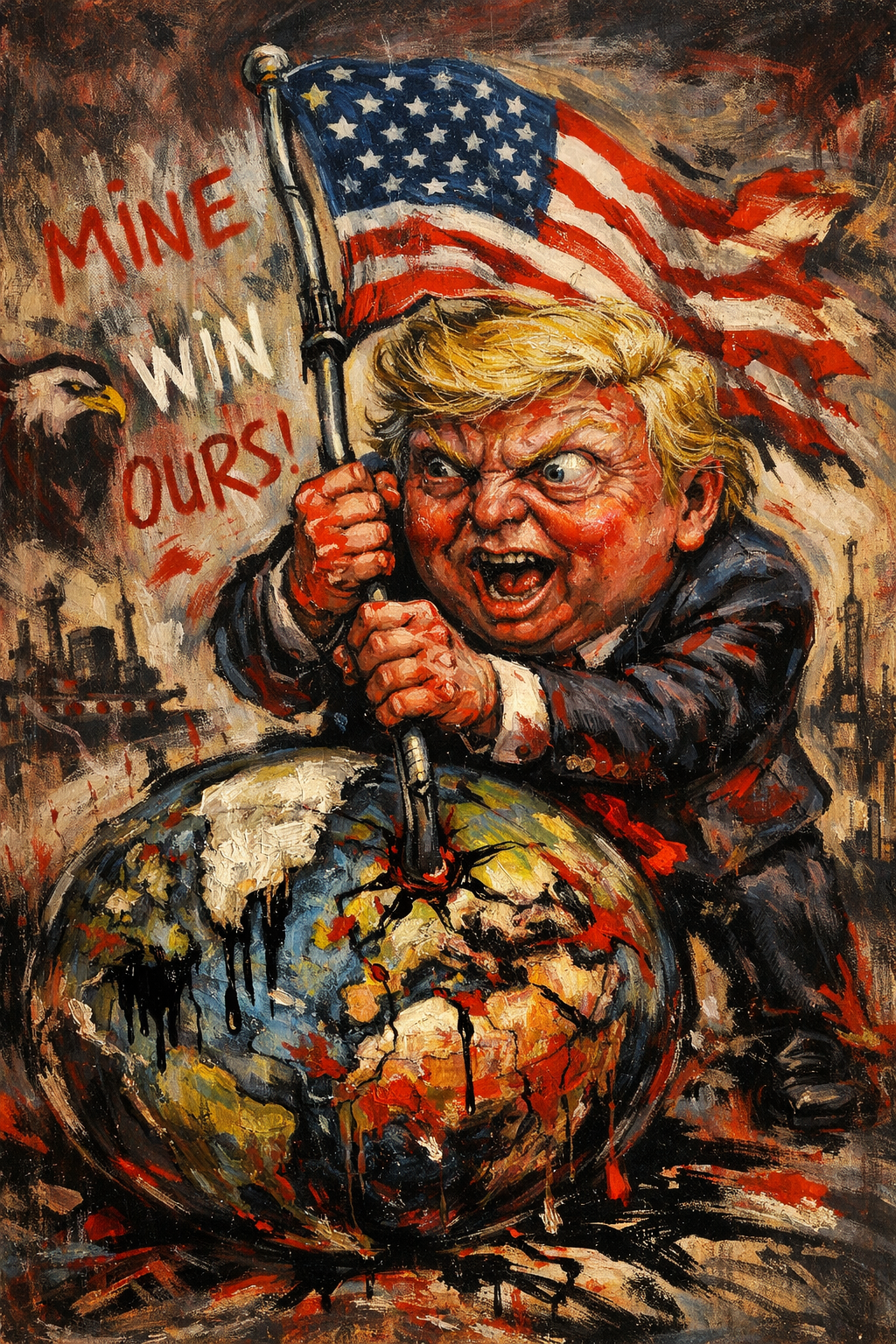
A neo-expressionist painting of Trump jamming an American Flag into the Globe with "Yours Win Ours" written in blood in the background, a bald eagle, and pastiches of factories and oil refineries.

Trump has now taken extralegal military action in Venezuela. Trump is strongly considering such action in Iran. And Trump keeps flirting with aggressive globally destabilizing military annexation of Greenland, a NATO ally. Many people are acting perplexed. After all, didn’t libertarian “genius” and totally-not-delusional-reactionary Walter Block tell us back in 2016 that libertarians should vote for Trump because he is anti-war? After this proved to be false the first term, didn’t totally-not-delusional-reactionary Walter Block then tell us again case for libertarianism was that he was anti-war and anti-foreign intervention, and that he was super cereal this time?

Sarcasm aside, I think it is worth revisiting why Trump’s foreign policy turn towards a radical sort of imperialist interventionism is so evil and unsurprising. I was confident back in 2016 that he was always going to be an old-school imperialist who uses US military conquest purely for resource extraction in a way that would be far worse than neocon warmongering. I wrote at the time, following Zach Beauchamp (who continues to emphasize this point), that Trump’s foreign policy was neither the neo-conservative interventionism of the Clintons and Bushes of the world, nor the principled anti-interventionism of libertarian scholars like Christopher Coyne and Abigail Hall, nor even the nationalist isolationism of paleoconservatives like James Buchanan. Instead, Trump’s foreign policy has always (quite consistently, since he was still a pro-choice democrat in the 90s) been about advancing inchoate national economic and political interestswhich really just means the interests of the politically connected.

This connection between Trump’s completely crankish economic nationalism and his imperialist foreign policy is even tighter now than it was then. It seems Trump is likely facing a rejection of his unconstitutional overreach of unilaterally applying economically suicidal tariffs from SCOTUS. The tariffs, which originally, might I add, were based on perhaps the single dumbest attempt to do economics I have ever seen, appeared to be lifted straight from ChatGPT, given that his main economic advisor on these matters, Peter Navarro, is literally a fraudster. As a result, he now seems to be manufacturing a national security crisis so he can impose tariffs without congress’ blessing.

But I do not want to revisit Trump’s imperialist foreign policy just to gloat. I also want to revisit and restate why this foreign policy is unbelievably unjust and self-destructive. What I wrote back in 2016 is still worth reposting at length:

First, Trump’s style of Jacksonian foreign policy is largely responsible for most of the humanitarian atrocities committed by the American government. Second, Trump’s economic foreign policy is antithetical to the entire spirit of the liberal tradition; it undermines the dignity and freedom of the individual and instead treats the highest good as for the all-powerful nation-state (meaning mostly the politicians and their special interests) as the end of foreign policy, rather than peace and liberty. Finally, Trump’s foreign policy fails for the same reasons that socialism fails. If the goals of foreign policy are to represent “national interest,” then the policymaker must know what that “national interest” even is and we have little reason to think that is the case, akin to the knowledge problem in economic coordination.

… This is because the Jacksonian view dictates that we should use full force in war to advance our interests and the reasons for waging war are for selfish rather than humanitarian purposes. We have good reason to think human rights under Trump will be abused to an alarming degree, as his comments that we should “bomb the hell out of” Syria, kill the noncombatant families of suspected terrorists, and torture detainees indicate. Trump is literally calling for the US to commit inhumane war crimes in the campaign, it is daunting to think just how dark his foreign policy could get in practice.

To reiterate: Trump’s foreign policy views are just a particularly nasty version of imperialism and colonialism. Mises dedicated two entire sections of his chapter on foreign policy in Liberalism: The Classical Tradition to critiquing colonialism and revealing just how contrary these views are to liberalism’s commitment to peace and liberty. In direct opposition to Trump’s assertions that we should go to war to gain another country’s wealth and resources and that we should expand military spending greatly, Mises argues:

“Wealth cannot be won by the annexation of new provinces since the “revenue” deprived from a territory must be used to defray the necessary costs of its administration. For a liberal state, which entertains no aggressive plans, a strengthening of its military power is unimportant.”

Mises’ comments on the colonial policy in his time are extremely pertinent considering Trump’s calls to wage ruthlessly violent wars and commit humanitarian crises. “No chapter of history is steeped further in blood than the history of colonialism,” Mises argued. “Blood was shed uselessly and senselessly. Flourishing lands were laid waste; whole peoples destroyed and exterminated. All this can in no way be extenuated or justified.”

Trump says the ends of foreign policy are to aggressively promote “our” national interests, Mises says “[t]he goal of the domestic policy of liberalism is the same as that of its foreign policy: peace.” Trump views the world as nations competing in a zero-sum game and there must be one winner that can only be brought about through military conquest and economic protectionism, Mises says liberalism “aims at the peaceful cooperation between nations as within each nation” and specifically attacks “chauvinistic nationalists” who “maintain that irreconcilable conflicts of interest exist among the various nations[.]” Trump is rabidly opposed to free trade and is horrifically xenophobic on immigration, the cornerstone of Mises’ foreign policy is free movement of capital and labor over borders. There is no “congruence” between Trump and any classically liberal view on foreign policy matters in any sense; to argue otherwise is to argue from a position of ignorance, delusion, or to abandon the very spirit of classical liberalism in the first place.

…Additionally, even if we take Trump’s nationalist ends as given, the policy means Trump prefers of violent military intervention likely will not be successful for similar reasons to why socialism fails. Christopher Coyne has argued convincingly that many foreign interventions in general fail for very similar reasons to why attempts at economic intervention fail, complications pertaining to the Hayekian knowledge problem. How can a government ill-equipped to solve the economic problems of domestic policy design and control the political institutions and culture of nations abroad?  Coyne mainly has the interventionism of neoconservatives and liberals in mind, but many of his insights apply just as well to Trump’s Jacksonian vision for foreign policy.

The knowledge problem also applies on another level to Trump’s brand of interventionism. Trump assumes that he, in all his wisdom as president, can know what the “national interest” of the American people actually is, just like socialist central planners assume they know the underlying value scales or utility functions of consumers in society. We have little reason to assume this is the case.

Let’s take a more concrete example: Trump seems to think one example of intervention in the name of national interest is to take the resource of another country that our country needs, most commonly oil. However, how is he supposed to know which resources need to be pillaged for the national interest? There’s a fundamental calculation problem here. A government acting without a profit signal cannot know the answer to such a problem and lacks the incentive to properly answer it in the first place as the consequences failure falls upon the taxpayers, not the policy makers. Even if Trump and his advisors could figure out that the US needs a resource, like oil, and successfully loots it from another country, like Libya, there is always the possibility that this artificial influx of resources, this crony capitalist welfare for one resource at the expense of others, is crowding out potentially more efficient substitutes.

For an example, if the government through foreign policy expands the supply of oil, this may stifle entrepreneurial innovations for potentially more efficient resources in certain applications, such as natural gas, solar, wind, or nuclear in energy, for the same reasons artificially subsidizing these industries domestically stifle innovation. They artificially reduce the relative scarcity of the favored resource, reducing the incentive for entrepreneurs to find innovative means of using other resources or more efficient production methods. At the very least, Trump and his advisors would have little clue how to judge the opportunity cost of pillaging various resources and so would not know how much oil to steal from Libya. Even ignoring all those problems, it’s very probable that it would be cheaper and morally superior to simply peaceably trade with another country for oil (or any other resource) rather than waging a costly, violent, inhumane war in the first place.

Having said all that, there is plenty I got wrong in picturing Trump as an old-school imperialist. During Trump’s first term, I underestimated the extent to which institutional constraints would stop him from acting on his worst nationalist and imperialist impulses. But this term, those constraints are gone. The Mattises, Tillersons, Boltons, and Pences of the world have been replaced with the Vances, Noems, Rubios, and Hegseths. As a result, thinking of Trump as an old-school imperialist and nationalist is becoming more accurate since he is allowed to act on his irrational, deranged impulses.

Second, I failed to distinguish sufficiently between resource extraction through indirect means of violent regime change, tariffs, weapons supply, and 19th-century colonialist-style direct annexation versions of it. I do still think that if Trump really did what he most consistently wants he would do quite a bit of annexation and old school colonialism (see his comments on Greenland and Canada), but he seems a bit more content than I projected back then to use military force to install stooges and puppet regimes for resource extraction (as he has sought to do in both Gaza and now Venezuela). Which, to your point, is not as different from the Nixon/Bush/Clinton/Reagan type intervention as reactionary centrists would have you believe, but the nakedness of the extractive nationalist motivation does mark a difference that encourages even more brazenly cruel, more illegal, and more strategically incoherent and unpredictable interventionist warmongering.

Thirdly, and most obviously, I greatly overestimated his coherence on foreign policy. Whether it is him handicapping US influence in the Pacific by withdrawing from the TPP while implementing tariffs on Chinese goods to seem tough in the first term, which just gave China more leverage in the region. Or whether it’s his delusional flip-flopping on Russia and Ukraine based on who he talked to last, constantly this term. Or whether it’shis random provocation against Iran in 2019 by killing one of their generals. Or whether it’s his insane flip-flopping between Nuclear War talk and sychophancy with North Korea. Or the total randomness of his attacking Venezuela for more domestic than foreign policy reasons now. He is simply far more impulsive and deranged than I would have predicted in 2016. This part of that old article seems especially stale now:

After all, it doesn’t matter so much the character of public officials as the institutional incentives they face. But in matters of foreign policy problems of temperament and character do matter because the social situation between foreign leaders in diplomacy can often make a huge difference.

I did hedge that by allowing that Trump may be a uniquely unfit person so as to constitute a sui-generis case. But I should have been more emphatic about that: Trump really is a uniquely world-historically dangerous monster, and he has gotten more and more incoherent and impulsive over the years with his cognitive decline.

Finally, the biggest miss in my analysis of Trump’s foreign policy back then is that I put far too much emphasis on Trump’s focus on material goods, thinking he really just thought of geopolitics like a 12-year-old approaches a turn-based strategy game like Risk in just accruing more stuff. But in reality, his approach is far more disturbing and vile than even that. It is not simply about getting oil for US oil companies. In the case of Venezuela, oil execs do not seem so gun-ho. As one private equity investor told the Financial Times last week, “No one wants to go in there when a random fucking tweet can change the entire foreign policy of the country.” Indeed, the political risk is so big there Exonn’s CEO has called Venezuela “uninvestable” and Trump is trying to force oil companies to misallocate capital to Venezuela.

Narrow left-wing materialists’ critiques like mine misfire because they treat material resources as the main thing. It is not the oil per se that Trump wants, but what the oil represents. He is instead approaching international geo-politics like an 8-year-old driven by malignant narcissism: he wants symbols of nationalist masculine domination. Indeed, when asked why he wanted Greenland, Trump was quoted as saying:

Because that’s what I feel is psychologically needed for success. I think that ownership gives you a thing that you can’t do, whether you’re talking about a lease or a treaty. Ownership gives you things and elements that you can’t get from just signing a document.

Indeed, the fact that Greenland looks big on a Mercator projection of the earth has as much to do with why Trump wants it as the oil. As Trump continues his authoritarian assaults on individual liberty domestically and pursues semiotic nationalist domination internationally, one can only vainly pray that something keeps his dark, demonic, twisted sadist fantasies in check without devolving into a true civilization-level threat.
Nightcap

  1. Is this a new era of far right terrorism? Hoffman & Ware, War on the Rocks
  2. Great news on US-China trade talks Behsudi & White, Politico
  3. Chinese porn preferences Katrien Jacobs, Berfrois
  4. Denmark’s own “Lawrence of Arabia” Frederic Wehrey, New York Review of Books

Nightcap

  1. Austrian lessons for American security William Anthony Hay, Modern Age
  2. Why Denmark is not part of the Eurozone Krzysztof Mroziewicz, Power & Market
  3. Seeing like a finite state machine Henry Farrell, Crooked Timber
  4. Cheap laughs Christopher Hitchens, the Atlantic

Poverty Under Democratic Socialism — Part III: Is the U.S. Denmark?

The Americans who call themselves “socialists,” do not, by and large, think in terms of government ownership of the means of production. Their frequent muted and truncated references to Sweden and Denmark indicate instead that they long for a high guarantees, high services state, with correspondingly high taxation (at least, for the more realistic among them).

When I try to understand the quasi-programmatics of the American left today, I find several axes: End Time-ism, a penchant for demanding that one’s collective guilt be dramatically exhibited; old-style pacifism (to an extent), a furious envy and resentment of the successful; indifference to hard facts, a requirement to be taken care of in all phases of life; a belief in the virtuousness and efficacy of government that is immune to all proof, demonstration, and experience. All this is often backed by a vigorous hatred of “corporations,” though I guess that not one in ten “progressives” could explain what a corporation is (except those with a law degree and they often misuse the term in their public utterances).

I am concerned that the last three features – nonchalance about facts, the wish to be cared for, and belief in government – are being woven together by the American left (vaguely defined) into what looks like a feasible project. I think that’s what they mean when they mention “democratic socialism.” The proponents seem to know no history. They are quick to dismiss the Soviet Union, currently foundering Venezuela, and even scrawny Cuba, as utterly irrelevant (though they retain a soft spot for the latter). And truly, those are not good examples of the fusion of socialism and democracy (because the latter ingredient was and is lacking). When challenged, again, American proponents of socialism refer vaguely to Sweden and to Denmark, about which they also seem to know little. (Incidentally, I personally think both countries are good societies.)

The wrong models of democratic socialism

Neither Sweden nor Denmark, however, is a good model for an eventual American democratic socialism. For one thing, the vituperative hatred of corporations on the American left blocks the path of economic growth plus re-distribution that has been theirs. In those two countries, capitalism is, in fact, thriving. (Think Ikea and Legos). Accordingly, both Sweden and Denmark have moderate corporate tax rates of 22% (same as the new Trump rate), higher than the German rate of only 16%, but much lower than the French rate of 34%.

The two countries pay for their generous welfare state in two intimately related ways. First, their populace agrees to high personal income taxes. The highest marginal rates are 60+% in Denmark and 57+% in Sweden. (It’s 46% currently in the US.) The Danes and the Swedes agree to such high rates for two reasons. For one thing, these rates are applied in a comparatively flat manner. Everyone pays high taxes; the rich are not publicly victimized. This is perceived as fair (though possibly destructive to economic growth). For another thing, their governments deliver superb social services in return for the high taxes paid.

This is the second way in which Danes and Swedes pay for their so-called “socialism” (actually welfare for all): They trust their government and the associated civil services. They generally don’t think of either as corrupt, or incompetent, as many, or at least a large minority of Americans do. As an American, I think of this trust as a price to pay. (I am not thinking of gross or bloody dictatorship here but more of routine time-wasting, exasperating visits to the Department of Motor Vehicles.) The Danes and the Swedes, with a different modern experience, do not share this revulsion or this skepticism.

Denmark and Sweden are both small countries, with populations of fewer than six million and about ten million, respectively. This means that the average citizen is not much separated from government. This short power distance works both ways. It’s one reason why government is trusted. It makes it relatively easy for citizens’ concerns to reach the upper levels of government without being distorted or abstracted. (5) The closeness also must make it difficult for government broadly defined to ignore citizens’ preoccupations. Both counties are, or were until recently, quite homogeneous. I used to be personally skeptical of the relevance of this matter, but Social-Democrat Danes have told me that sharing with those who look and sound less and less like your cousins becomes increasingly objectionable over time.

In summary, it seems to me that if the American left – with its hatred of corporations – tries to construct a Denmark in the US, it’s likely to end up instead with a version of its dream more appropriate for a large, heterogeneous county, where government moreover carries a significant defense burden and drains ever more of the resources of society. The French government’s 55% take of GDP is worth remembering here because it’s a measure of the slow strangling of civil society, including in its tiny embodiments such as frequenting cafés. In other words, American democratic socialists will likely end up with a version of economically stuck, rigid, disappointing France. It will be a poor version of France because a “socialist” USA would not have a ready-made, honest, elite corps of administrators largely sharing their view of the good society, such as ENA, that made the unworkable work for a good many years. And, of course, the quality of American restaurant fare would remain the same. The superior French gourmet experience came about and is nurtured precisely by sectors of the economy that stayed out of the reach of statism.

Poverty under democratic socialism is not like the old condition of shivering naked under rain, snow, and hail; it’s more like wearing clothes that are three sizes too small. It smothers you slowly until it’s too late to do anything.


(5) When there are multiple levels of separation between the rulers and the ruled, the latter’s infinitely variegated needs and desires have to be gathered into a limited number of categories before being sent up to the rulers for an eventual response. That is, a process of generalization, of abstraction intervenes which does not exist when, for example, the apprentice tells his master, “I am hungry.”

[Editor’s note: Part I can be found here, Part II here, and the entire, longform essay can be read in its entirety here.]

Myths of Sovereignty and British Isolation XI, Norman, Angevin and Plantagenet England

The last post was on Anglo-Saxon England, which came to an end in 1066, soon after the death of Edward the Confessor. Harold Godwinson, King of England, was faced with two major enemies on his accession in 1066: Harold Sigurdsson, usually known as Harold Hardrada, King of Norway, and William the Bastard, Duke of Normandy (de facto Norman king under the symbolic sovereignty of the French monarchy).

Both began invasions of England. Sigurdsson landed in the northeast of England with a Viking army and his ally, Tostig, brother of Harold Godwinson (married to a Danish princess), giving a good idea of how political power in England was entangled with European power politics and centres of sovereignty. Harold marched north and defeated the Viking army, marching south again to meet the threat from Normandy which came very soon.

Harold and the Saxon army did not survives this second blow, and England was changed for ever. William earned the name he is now generally known under, Conqueror, and imposed his will in a manner which destroyed the existing Anglo-Saxon elites in one of the great massacres of English history, the Harrowing of the North. It also led to the construction of new kinds of stone castles to create military state dominance and new grandiose church architecture to create religious state domination.

The Norman dominance later became known as the Norman Yoke, a rather emotive phrase but it is true that the Saxons had less rights than the Normans, that Norman French became the language of state and the ruling class, and that institutions were recast to suit the Normans, who continued to give priority to their homeland in northwestern France. There was an evolution from expanded Norman state to Angevin Anglo-French empire, when Henry II married Eleanor of Aquitaine (southwestern France). Before that the throne was in dispute between Stephen and Matilda, known as the Empress because she had been married to the German ‘Holy Roman’ Emperor.

The Aquitaine alliance gave the King of England more land in France under his control than the French king had under effective control. The combined control of all England and most of France is often known as the Angevin Empire.  The outcome of the Norman Conquest and the Angevin Empire is a very tangled period of centuries of a variable Anglo-Norman, then English Plantagenet presence in France.

The crusader king Richard I ‘Coeur de Lion’, son of Henry and Eleanor, died in France protecting his lands there. The next king, also a son of Henry and Eleanor, John, lost nearly all the French lands. The end of of John’s reign and the beginning of Henry III’s reign included a period when Louis XIII of France claimed the English crown in alliance with part of the aristocracy, and had effective control of a large part of England.

The endless back and forth of English involvement in France will be ended here except for these brief remarks. The two most famous English battles in medieval history were the loss to Normandy at Hastings in 1066 and the Battle of Agincourt in 1415 near Calais. The latter battle was part of Henry V establishing a claim to the French monarchy, though this collapsed on his death. Calais remained English until 1588. The English monarchy kept up a symbolic claim to be monarchs of France until 1800.

There is no genuine history of medieval England which is not also a history of medieval France. The overall effect of the English monarchy failing to keep continuous control of France, leaving England as the undoubted core territory, was that over time the monarchy, state and aristocracy became more English. The language had changed considerably, partly under Norman influence, so that what the heirs of William the Conqueror and his Norman barons spoke was Middle English rather than Anglo-Saxon and unlike Anglo-Saxon is at least partly comprehensible to an educated native level speaker of modern English. There was a growth of English literature of a kind that is still read, linked with the growing tendency of the upper class to be primarily English.

The process by which the Anglo-Norman state became England with an English speaking ruling class was gradual and roughly speaking came to an end by the fifteenth century. The re-emergence of an ‘English’ England might suit the advocates of a vision of English history as an island pageant of unique independence, separation and strength, and it is not very long since popular books of history used to be written on those lines. However, the Norman, Angevin and subsequent Plantagenet period just do not fit this unless a supposed endpoint of a pure English England is given priority over what seemed most important to historical actors earlier in their own time. Centuries of English history are Norman French or Anglo-French history.

Advocates of a Sovereigntist-Eurosceptic view of British history, if they acknowledge this (and it is difficult for them to do so as the period includes Magna Carta, a topic to which we will return) are inclined to at least see English history after 1400, and particularly after the establishment of the Tudor dynasty in 1485, as the glorious path of an England, or Britain, separate from Europe. The next post will test that proposition.

Myths of Sovereignty and British Isolation, X. Anglo-Saxon England, the Scandinavian, Frankish and Norman connections

This long series of posts is now going through a survey of British history from the beginning that history to the point where the series started, that is the middle of the eighteenth century. The last post reached the Anglo-Saxon Conquest, which seems to have been more of an elite take over by chieftains and their retinues than a major displacement of population. Nevertheless the Anglo-Saxon conquest was a real cultural transformation in which the evolution of the English language retained almost no trace of the Celtic languages and dialects or even speech rhythms, leaving aside areas where the Celtic languages lingered longer and survived on a minority basis, so influencing English. The Saxon language was not just dominant in England, as it spread in Scotland outside the Gaelic ‘Irish’ speaking areas, displacing non-Celtic languages. So English became the dominant language in what is now the UK and also in what now the Republic or Ireland.

Having emphasised this linguistic transformation,  should emphasise that Irish has some distinctive speech patterns from Gaelic, that there is some modern Irish literature in Gaelic and that some Irish literature in English emphasises Gaelic Irish culture, most significantly the novels of James Joyce. Anglo-Saxon comes from the forms of Old German spoken in the areas the invaders came from in what is now the Netherlands, Denmark and intervening parts of Germany. One consequence is that the first great work of English literature Beowulf is an Anglo-Saxon, or Old English, epic poem set in what is now Denmark and southern Sweden. So the literary culture of the English speaking British is rooted in a tale from Scandinavia, though written down in England centuries after the events related, which can be given a rough historical location.

Anglo-Saxon England never established complete predominance in Britain. Viking invasions in the eighth century preceded the formation of an English state at a time when there was still an independent Celtic kingdom in Cornwall, turned into conquests and the establishment of Viking kingdoms. Though the Anglo-Saxons become predominant as far back as the sixth century, the generally accepted narrative of the English state goes back only to the ninth century. In the last decades of that century, King Alfred of Wessex (the west Saxons) in his struggles against the Vikings. Alfred, given the label ‘Great’ in the nineteenth century, a very remarkable figure in various ways, was pushed back into the hinterland of Wessex, but was able to defeat the Vikings in battle and negotiate terms that established a strong kingdom of Wessex, which came to incorporate London.

Wessex was the nucleus of the Medieval English state and Alfred’s grandson Athelston was the first all-England king, also receiving tribute and symbolic recognition of overlordship from Welsh and Scottish rulers, who nevertheless remained completely independent in practice. Athelstan was certainly not isolated from Europe, marrying his family into continental dynasties. The sense of English culture goes back further than Alfred, but not much further.

The northeastern English historian and cleric Bede, is probably the first ‘great’ English figure in Britain, dying in the early eighth century after composing a history in Latin rather than Anglo-Saxon. At roughly the same time Alcuin of York, the cleric and scholar, became an adviser to the Frankish (Franco-German) Emperor Charlemagne who dominated western and central Europe, reviving the title of Roman Emperor, or had it pushed onto him by the Pope. He was referred to as ‘father of Europe’ in his court and was the model of English monarchs including Alfred.

The only Anglo-Saxon king before Alfred who could be said to have lingered in national memory was Offa of Mercia (the centre of England) in the late eighth century, who seems to have made some symbolic claim to kingship of England, but whose kingdom was lost to the Vikings. The rise of the Kingdom of England was not completely straightforward as Vikings remained in England with their own towns, laws, and customs, and with Scandinavian princes still making claims in England. The consequence was a Danish King of England, Cnut (also known as Canute) reigning in England in the early eleventh century, along with varying parts of Scandinavia.

A rather confused period followed his death of English and Danish claims to the English crown, with other Scandinavian dynasties expressing an interest. This ended when the Saxon Edward the Confessor became king in 1042. However, this was not the triumph of isolated English sovereignty. Edward was heavily under the influence, even tutelage of the Duchy of Normandy, territory given to Viking invaders by the French king, which led to the invading Danes becoming completely French in language and other respects.

Edward was the son of Aethelred the Unready and Emma of Normany. Aethelred who was responsible both for gratuitous massacres of English Danes and losing the kingdom to the Danes, had fled to Normandy beginning an important connection. Edward died in 1066 childless, with the Duke of Normandy and the King of Norway both believing they had claims to the English throne that they fully intended to enforce through military might. The throne went in the first place to Edward’s most powerful subject, Harold Godwinson, because of the support of the Witan, the council of the king’s leading subjects, rather than inheritance or the wishes of Edward the Confessor. If there was ever a moment of isolated English sovereignty that might be it, but it was not to last more than a few months.

Next post, how England became part of a Norman and the Angevin French speaking empire

Myths of Sovereignty and British Isolation, VI. From the 1832 Reform Act to World War One

In this post, a look at comparative growth of democracy in Europe along with Britain’s role in World War One and subsequent European diplomacy.

Britain made some progress towards extending voting rights beyond a very tiny minority in the Reform Act of 1832, which was also a law to make constituency distribution relate to the population of the time, particularly the expansion of the urban population, abolish constituencies of a few voters where the MP was in practice appointed by the local dominant landlord and even out a very inconsistent voting system, reducing the number of people who could vote in at least one case. The overall right to vote was extended from about 5 per cent to about 20 per cent of the population, which did mark a genuine shift of power from the aristocracy and put Britain in a good place in terms of comparative voting rights by the standards of the time. Nevertheless, there was working class disappointment expressed in the Chartist movement which mobilised mass support, but was ignored.

The next major change came in the 1867 Reform Act, which did not introduce universal male suffrage, but did extend voting rights to a significant part of the urban working class. Universal male suffrage at the age of twenty-one did not come until after World War One, alongside suffrage at thirty for women, followed a few years later by voting rights at twenty-one for all women as well as all men. Denmark and Switzerland introduced universal male suffrage with meaningful pluralistic elections in 1848. France reverted to the lost revolutionary republican idea of universal male suffrage, though the meaning of elections was highly constrained by the rise of Louis-Napoleon Bonaparte to the presidency, which he transformed into the role of Emperor. Prussia, while reserving a powers to the monarchy and preserving the power of the aristocracy through a weighting of the electoral system to the highest tax payers, did introduce universal male suffrage in 1849.

The 1867 Reform Act in Britain still left it behind these countries, particularly as France became a pluralist democracy after 1870 and a unified Germany appeared in the same year (the events are linked by the Franco-Prussian war of 1870) with universal suffrage, but the same weighting towards the upper class within the Kingdom of Prussia, the largest and most powerful part of the new German Empire, which had a distinct and dominant status within the Empire. As we can see, discussion of the comparative growth of the suffrage and political pluralism soon gets into very complicated details, which also include questions of how much power elected bodies had in relation to hereditary monarchs, so that is the end of the examples.

Anyway, the general pattern is that though Britain was ahead of just about all of Europe outside Switzerland in giving power to elected institutions, there is nothing special or exemplary about the spread of voting rights in Britain. In the nineteenth century it was certainly republics, just Switzerland then France, which established the best situations, which certainly challenges any idea of a special virtue in the British combination of monarchy and parliament. The exemplary monarchical state was Denmark rather than Britain.

Moving onto the First World War, as has already been shown, British entry was not a re-entry into European politics after a complete absence after the Battle of Waterloo. Britain was constantly engaged in European affairs and would not have entered the Great War, if it had not been concerned enough with European politics to establish alliances and have a strong view about German armies invading France and neutral Belgium.

Who to blame for World War One and the question of whether Britain should have taken part are rather divisive questions across political distinctions, so it is difficult to talk about a unified sovereigntist Eurosceptic narrative here, or indeed any political tendency, however defined, having a unified narrative. So it can at least be said that World War One does not add to any claim to the innate superiority of Britain and if Britain was right to intervene, that cannot make it more morally admirable than France and Belgium. The intervention right or wrong certainly reflected British views of its own interests in keeping northwestern Europe, the land mass facing it across the seas, out of the control of a hegemonic European power

It can at least be said that even for those who think on balance Britain was right to come to the full aid of France and Belgium, the continuation of the naval blockade of Germany, part the armistice which ended the war into 1919 was a horrifying policy of suffering imposed on an already defeated and impoverished German population, depriving Britain of any claim to rise morally above the other European powers.  In any case there is no denying that Britain was involved in European politics during the War and after in the Paris peace treaties, the revision of the Treaty of Sèvres, signed with the Ottoman Empire, in the Treaty of Lausanne signed with the Republic of Turkey in 1926.

Next post, World War II

Another Liberty Canon: Kierkegaard

Søren Kierkegaard (1813-1855) is well known for his contributions to philosophical and religious thought, and for the literary qualities of his work in these areas. He has not been so well known as a contributor to political thought, though there is now a growing amount of scholarly commentary in this area.

Generally his politics has been seen as directed by an extreme kind of conservative reaction against changes, and particularity movements of  democratic and constitutional change in Denmark in his own time. The sense that he was conformable with the most absolute and conservative kind of monarchism possible has been accompanied by the sense that he was anti-political, that he just did not like politics, which connected with the supposed conservatism, because if there is no need for change in political structures, there is no need for political discussion and thought.

These positions might have some appeal to some libertarian-conservative fusionists, and do have some basis in some aspects of Kierkegaard’s thought. However, his thought cannot be properly characterised overall in this way, which would connect Kierkegaard at a relatively popular level with the political thinking of J.R.R. Tolkein, or at the more historical scholarly level with Robert Filmer, the English ultra-monarchist criticised at length by John Locke, or the Savoyard (French-Italian) ultra-monarchist critic of the French Revolution, Joseph de Maistre.

More justified connections can be made with David Hume, for example. Hume was cautious about both political change and claims that the authority of existing political institutions rests on either reverence for the past, or very deliberate conscious popular consent. Hume thought that though societies with political and legal institutions probably did originate with a contract of sorts between government and governed, such contracts cannot bind future generations, and the ‘contract’, or set of relations, between individuals and the state, are open to reform and renegotiation.

Kierkegaard’s comments on the politic currents of his time, suggest that he had a strong understanding both of the belief in the absolute authority of existing institutions, and of the wish to create a new absolute, in a spirit of revolution. His own view is that negotiation and renewal are desirable, and are certainly inevitable, which he saw as the need to revise historical contractual agreements.

Kierkegaard certainly did not wish for individuals to make politics the highest aspect of their lives, as this would detract from the individual relation with God, which was the central interest of this passionately religious man. However, that is not to say that Kierkegaard thought Christianity gives the answer to everything in worldly life, or that Kierkegaard had nothing else driving him. A passion for writing, which has a strong element of self-exploration even if though the medium of fiction and the pseudonyms, which are used in his books, or as fictional authors for many of his widely read books.

The writing and self-exploration converge, for Kierkegaard, in the understanding and communication of the deepest relation of the self with itself as necessarily a relation with God. The recognition of something more than momentary about the existence of the self, leads to a recognition of an absolute aspect of the self, and a struggle with any dissolution of the self into a series of moments. This was Kierkegaard’s way of exploring the value of the individual, and the word ‘individual’ is frequently and frequently orientates his writing. In this, he provided a great way of thinking about the value of the individual for any political thought concerned about the liberty of the individual, and why that should be at the centre of politics.

Kierkegaard saw in the more absolute kinds of political thought a desire for a version of God, and in doing so provided the basis for distinguishing between a politics that recognises limits to what it hopes for from the state and collective action, and a politics that tries to impose itself on society by turning the state into a substitute for God.

Kierkegaard was very critical of the state church, even though his brother had made a career in it, and suggest that dependent on the state weakened religion, as other forms of dependence create other forms of weakness. He did not argue for a pure nightwatchman state, or individualist-anarchism, but he did argue for caution about how much the state does, and for taking individual responsibility for assisting those who have met with misfortune.

In his emphasis on the individual in his understanding of Christianity, Kierkegaard also understood that Christianity places an enormous burden on the individual compared with earlier forms of thinking, in which the individual is primarily thought of as part of a family or state. Kierkegaard was particularly concerned with the ancient Greek and Roman city states in this context, including the literature they produced. He placed value on his own small city of Copenhagen for preserving some of the value of ancient city-state, where the individual can draw strength from connection with others in a very concrete community, without wanting to see the individual subsumed into any kind of communal or collective identity.

For Kierkegaard, the more worldly part of our lives rests on more than living under a state defined  by law or a society defined  by universal rights, necessary though these are. We need engagement with our social world, including its political debates. Though Kierkegaard was a great loner in some respects, he did walk regularly though crowded parts of the city, live near the centre, accept that he would be recognised,  contributed to magazines, and existed as a public figure, which was sometimes uncomfortable for him, but was never a role he excluded.  He was attacked as an eccentric in the press and condemned as a diabolical figure by some of the church establishment, but like his hero Socrates reacted with humour, intelligence and the assumption that the independent, even self-contained, individual deals with difficult public controversies. In his ways of bringing together an antique commitment to public life and a more modern sense of strong individuality, Kierkegaard made a remarkable contribution to themes which preoccupied the major classical liberal thinkers, like David, Hume, Benjamin Constant, John Stuart Mill, and many others.

It is not possible to recommend specific political theory texts by Kierkegaard, and just about everything he wrote can be read with great reward in association with the issues discussed above. A good starting point for a focus on the more political Kierkegaard though is the literary reflections in Two Agesfollowed up by the three masterpieces of 1843 that established his importance. The most immediately readable is RepetitionFear and Trembling is also relatively short. Either/Or is long and complex, but very rewarding and can itself be followed up by reading its sequel Stages on Life’s Way.

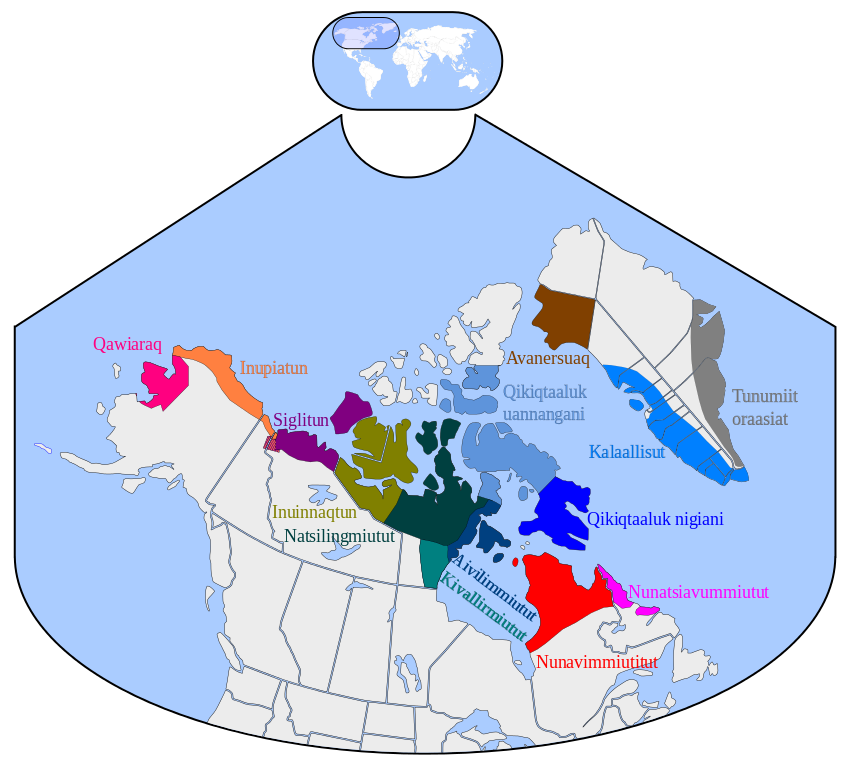
The World of the Inuktitut

Check out this sweet map of the Eskimo world today. It is broken down by linguistic groups. I wonder if these linguistic groups consider themselves ethnically distinct as well as linguistically distinct.

The Eskimo World

Here is a Wiki article on Nunavut, an experiment in Canada with indigenous self-governance (don’t get me started!).

And an article on Danish colonialism in Greenland (possibly gated).

Updated: I changed the title from ‘Eskimo’ to ‘Inuktitut’ because I just learned that the former is used as a pejorative term in Canada and Greenland (like the n-word here in the States). Inuktitut is term preferred by those highlighted in the map above. I’m not politically correct by any means, and in the US the term ‘Eskimo’ doesn’t carry any negative connotations, but being polite and being politically correct are two very different things.