Scotland, Nation, and Liberty

As I start writing voting is coming to an end in Scotland with regard to a referendum on whether Scotland should remain part of the United Kingdom. The United Kingdom comprises England, Scotland, Wales, and Northern Ireland. There are those in Cornwall, a peninsula on the extreme south-west of England who argue that is should be represented as an entity on  level with those four components of the UK, as it was regarded as distinct from England into the sixteenth century, never having being properly incorporated into Roman Britannia or Anglo-Saxon Wessex (the Old English kingdom in the south west, which became the nucleus of the Medieval English state).

From the 10th century onwards Anglo-Saxon kings asserted supremacy over Scotland with varying degrees of success in obtaining some recognition of overlordship from Scottish kings. Wars between Scotland and England led to victory for Scotland in the fourteenth century when the English monarchy ended attempts to use force to demand Scottish subordination, or even incorporation of Scotland, and European states accepted Scotland as a sovereign entity. In the early seventeenth century, Queen Elizabeth I of England died childless so that the heir to the English crown was King James VI of Scotland who became James I of England. He moved his court from Edinburgh to London, and pushed for the union of two kingdoms in his person to become a state union of England and Scotland as Great Britain. (At this time, Wales was treated as a part of England.)

The English Parliament resisted the creation of Great Britain, but by the early eighteenth century there was mutual interest in the trade and economic advantages of state union with accompany reductions on trade barriers, particularly after the failure of a brief attempt at Scottish empire building in Central America.  An Act of Union was passed by the English Parliament in 1707 and then by the Scottish Parliament in 1708, which abolished the Scottish Parliament. It also left in place major differences in laws, the legal system, education, and the state church, which have lasted until the present day.

Before the personal union of Scotland and England under James VI/I, Scotland itself went through a process of internal integration, or colonisation of the peripheral regions by the centre, as all nations have. This included the 1493  abolition of the Lord of the Isles, which indicated sovereignty over an area covering the highland and island areas of Scotland, and which has a complex history in relation to all the neighbouring powers. The incorporation  of that region, what could easily have been a separate sovereign nation if history had gone a bit differently, was not completed until 1745, that is after the Act of Union, when a British army destroyed an attempted restoration of the Stuart family of James VI/I. The attempted restoration is known as the Jacobite Rebellion. Jacobite refers to the latinised form of James, in honour of James II, who was overthrown in the Glorious Revolution of 1688 due to his Catholic religion, fears that he was attempting to enforce that religion as a state church instead of the existing Protestant established church, and fears that he was creating an absolute monarchy with a decorative role only for Parliament.

The Jacobite Rebellion itself divided Scotland between the traditional semi-feudal highland chiefs and the commercial world of the Lowlands. As a consequence of the failure of the Rebellion, British law was enforced fully for the first time beyond the Highland line, while restrictions were placed of Highland customs, clothing, and language. The language of the Highlands was Gaelic (a Celtic language relate to Irish, Welsh, Cornish, and Breton).   This was the triumph of the Scots (a dialect of English, or a language which is very close to English depending on point of view) and English speaking Lowlanders and the end of the process initiated by the early Stuart overthrow of the Lords of the Isles.

The United Kingdom was formed by the 1800 Act of Union, which abolished the Irish parliament. Most of Ireland left to form what is now the Republic of Ireland in the early 1920s, but Northern Ireland remained, now with its own parliament, which is why there is still a UK, not just Great Britain.

All this history is to indicate the long historical nature and the complexity of the  relations between England and Scotland, with regard to sovereignty, identity, and so on. Scotland like England was itself a work in progress before union, and the integration of Scotland into what might be taken as a single nation, was completed over one hundred years after the Act of Union, over two hundred years after the union of crowns, under the leadership of the British crown, which at that time was unified with the German princedom of Hanover.

Scotland was never assimilated into England, even when there was no parliament, and Scotland has always been distinct from England than Wales in at least two respects:

  1. there is a higher proportion of trade within Scotland than with England, than of internal Welsh trading activity compared with trade with England;
  2. Wales’s contact with urban centres is just as much with the nearby English cities of Bristol, Birmingham, and Liverpool as with its own cities (principally Swansea and Cardiff) while Scotland is very focused on its own cities (principally Edinburgh and Glasgow).

However, Wales is more distinct from England in language since twenty per cent  speak Welsh fluently, everyone studies Welsh at school, and Wales is officially bilingual, even gesturing towards Welsh language priority. Gaelic speakers are about one per cent of the Scottish population.

The Welsh-Scottish comparison serves to show that ways of assessing national identity and distinctness vary and that there is no one way of evaluating this, so there can be no one institutional and political strategy for accommodating national differences within a state. The level and intensity of Scottish distinctness and identity has amounted to a nation now divided almost exactly down the middle about whether it wishes to separate from the UK.

This is not just an issue of identity though, as a large part of the Scottish independence vote is based on a belief that Scotland is egalitarian, welfarist, communal, social democratic, or even socialist, in comparison with England and that the countries are polar opposites on these issues. Another part of support for independence is the hope that North Sea oil will bring more benefit to Scotland if a Scottish government is collecting the tax revenue, accompanied by the belief that taxation at the UK level is some kind of resource theft.

Building on the historical, political, and institutional account above, what conclusions am I drawing? The first thing to state is of course that Scotland has every right to leave the UK if it so wishes, that it is a good thing that a referendum is being held to test what Scots want, and that if independence is what is wanted, then the government of the residual UK use must take a positive and co-operative approach to the departure of Scotland.

However, I certainly don’t believe that Scotland should separate. Part of that is the emotional patriotism of an Englishman, call it nationalism no problem, based on centuries of shared enterprise and struggle, good (the defeat of National Socialist Germany) and bad (imperialism). The Scots took a disproportionately large part in the trading, colonising, and military aspects of that joint history, and during that history many Scots went to England and became part of English society, John Stuart Mill’s father is a notable example. One of the great flourishing moments of that history was the Scottish Enlightenment of David Hume, Adam Smith, and others, which always involved education, travel, and interaction in England as well as Scotland.

Why peace behind centuries of joint enterprise in which despite centralising processes, differences of identity and in institutions proved to be compatible with the growth of commercial society, civil society, liberty under law, parliamentary government, science and culture, and the twentieth century struggle against totalitarianism.

There’s  a lot for liberty advocates to admire there, without denying that a lot of worse things happened as well, and surely we should be disposed to favour building on that rather than destroying it. Many liberty advocates have a preference for small nations where maybe there is more chance of intelligent laws and policies, less remote from everyday reality and individual understanding of particular realities.

I can only agree with the provision that such a result can be achieved through forms of federalism which are decentralising rather than centralising so that the federal centre is largely responsible for trade, foreign and defence policy, and the lower region and national levels do everything else in an innovative, flexible, diverse, and competitive way.

There is still some benefit in the UK remaining as a unified power for defence and military purposes. It is would not be good from a liberty point of view for a country that in its military budget and capacities, its diplomatic and transnational weight, is still a match for nearly all the major powers. The UK whatever its faults is one of the more liberty  oriented parts of the world, and no good would come from lessening its strategic and diplomatic weight. Of course those liberty advocates who prefer very neutralist and almost pacifist attitudes to international relations will not be impressed, but we live in a world where states with low levels of inner liberty and little respect for the rights of others exist, and should be at least matched by powers that are more liberty oriented at home and more respectful of the rights in the international sphere. The role of liberal democracies has not always been admirable in this sphere, but better those errors than unchecked aggression from authoritarian states.

The institutions of liberty are more likely to flourish in democratic states, where a multiplicity of national and regional identities flourish, than in attempts to break away based on some inclination, of some degree of intensity, that singular national identity is better than multiplicity and that national identity needs unrestrained state sovereignty. In the particular case of Scotland, the Scottish National Party, and others for independence, are relying on the dream of a more socialist country where ‘Scottish’ oil is protected from the English to fund an expanding state, without having a plausible explanation for the currency to be used on independence, or any sense of reality about how international markets testing the prudence of a new state are likely to drive it towards high interest rates and displays of deficit reduction.

The political consequences of a subsequent disillusion with social democratic dreams mingled with existing  assumptions of a morally superior Scottish community, and related anti-English feeling, in economically disruptive circumstances could be most severe and disturbing. Even on a more optimistic assumption about the future in which Scotland moves smoothly into a more social democratic future, nothing is gained from a pro-liberty point of view. Pro-liberty commentators who think that because Hume and Smith were Scots that an independent Scotland will be guided by Enlightenment classical liberalism have completely lost the plot.
California Times Six

I live in California. It’s a great state. Too great.

A proposition to split California into six states may be on the ballot in 2016. “Six Californias” has announced that it has collected sufficient signatures. Why six? California’s population of over 38 million is six times lager than the US state average. The ruling powers may find a way to block the proposal, as some opponents claim that the signature gathering was unlawful. If “Six Californias” does get on the 2016 ballot, in my judgment, this will be a rare chance for fundamental reforms.

Many Californians have said that the state is too big to govern effectively. But the governance problem is not size, but structure. After the property-tax limiting Proposition 13 was adopted in 1978, taxes and political power shifted from the counties and cities to the state government. California could be governed well if decentralized, but the concentration of fiscal power to the state has made the state among the highest taxed and worst regulated in the USA.

There have been many attempts to reform the lengthy California constitution, but they have all failed. Attempts to replace the Proposition 13 have gone nowhere. The best option is to start over. Creating new states would provide six fresh starts.

Critics of the six-state plan say that the wealth of the new Californias would be unequal. The Silicon Valley state would include the high-tech wealthy counties of San Francisco, San Mateo, and Santa Clara, among others. The promoter of this initiative, Timothy Drapers, happens to be a Silicon Valley entrepreneur.

But the current 50 US states are also unequal in wealth. The income inequality problem is a national and global problem. Income can become more equal without hurting production by collecting the land rent and distributing it equally among the population. Since the critics of Six Californias are not proposing or even discussing this most effective way to equalize income, their complaints should be dismissed as irrelevant, immaterial, and incompetent.

US states have been split in the past. Maine was split off from Massachusetts in 1820, and West Virginia was carved out of Virginia in 1863.

If the initiative passes, a board of commissioners would draw up a plan to divide the state’s assets and liabilities among the six new states. A good way to do this would be to divide the value of the assets by population, but to divide the liabilities (including both the official debt and the unfunded liabilities such as promised pensions) by the wealth of each state. That would go a ways to deal with the inequality problem.

California’s complex water rights could be simplified by eliminating subsidies, instead charging all users the market price of water. There could continue to be a unified water system with a water commission with representatives from the six state.

If this measure is approved by the voters and by Congress, each state will design a constitution. The new constitutions should be brief, like the US Constitution, in contrast to the lengthy current California constitution that contains many provisions best left to statute law.

The new constitutions should retain the declaration of rights in the current state constitution, including Article I, Section 24: “This declaration of rights may not be construed to impair or deny others retained by the people.” This wording, similar to the US 9th Amendment, recognizes the existence of natural and common-law rights. This text should be strengthened with something like this: “These rights of the people include the natural right to do anything which does not coercively invade the properties and bodies of others, notwithstanding any state interest or police power.”

These new constitutions will be an opportunity to replace California’s market-hampering tax system with economy-enhancing levies on pollution and land value. There should be a parallel initiative stating that if Six Californias passes, the states will collect all the land rent within their jurisdictions and distribute the rent to all six states based on their populations. A tax on land value is by itself market enhancing, better than neutral, because it promotes an efficient use of land, it reduces housing costs for lower-income folks, and eliminates real-estate bubbles. Combined with the elimination of taxes on wages, business profits, and goods, the prosperity tax shift would raise wages and make California the best place in the world for labor and business.

This is all a dream, but the past dreams of abolishing slavery, having equal rights for women, and eliminating forced segregation all came true. This proposition will at least provide a platform for discussing such fundamental reforms.
—————————————-
This article was first published at http://www.progress.org/views/editorials/california-times-six/

A California Crack-Up?

We can only hope.

There has been a small flurry of news articles covering the success of a political initiative by a Silicon Valley entrepreneur to split California into six states rather than one. If this sounds familiar, it’s because many Notewriters have been advocating for more decentralization – both in the US and abroad – since NOL was founded back in 2012. Because breaking up states within free trade zones is such a sophisticated idea, many mainstream pundits have been reluctant to read up on it. Instead, Left-wing reactionaries (and really, are there any other kind?) simply resort to slandering the entrepreneur responsible for the initiative (his name is Timothy Draper, by the way, and you can look up his wiki here), slandering libertarianism, and slandering rich people (Slate, predictably, covers all of the fallacious bases in one fell swoop).

Luckily, the internet now provides people with more than three television channels.

There are two things you need to know about secession within the US free trade zone. First, it is extremely hard to break up one state into many. There is a constitutional process for the whole idea (I don’t understand why the framers, and subsequent legal experts, can respect secession within free trade zones but cannot bother to apply their reasoning to secession in matters outside of a free trade zone’s jurisdiction; Texas, for example, provides us with a great case study of what happens when an administrative polity breaks away from a federal state only to join a rival federal state; Why should this concept not be applied to the West’s foreign policies today?).

In order for a potential administrative unit (“state”) to become an actual US state, it must first be approved by state legislatures. So, in California’s case, only the California legislature needs to approve of the secession. However, there are rules in the constitution allowing for states to join up with each other, or for one region between two US states (like the hippie area in northern California and southern Oregon) to apply for statehood as well. When two or more states are involved, the legislatures of each state must approve of the secession (or marriage). Are we all clear?

Second, after the state legislature(s) approve of the secession, the move must then be approved by the US Congress (both houses). Andrew Prokop, of the Left-wing site vox.com (lest I be accused of being too ideological), explains well what this means:

The biggest difficulty of all would be getting Congressional approval. Giving California 12 Senate seats would be an extremely tough sell. Though those seats wouldn’t necessarily be overwhelmingly Democratic […] they would dilute the power of every existing senator.

Indeed. Now you can hopefully see why libertarians generally support decentralized governance (and let it be remembered that federalism – even a territorially-expansionist federalism – is likely to be the quickest, but still legally-soundest, way towards decentralized governance). As I wrote in a ‘comments’ thread last September (2013):

[…] the federal pie itself would not grow in the event of a few states splitting up.

Think of it this way: suppose the federal budget is $100 for the year. Currently, there are 100 Senators and 435 members of the House, so altogether there are 535 politicians dividing up the $100 pie.

Now suppose the number of states suddenly doubled. You now have 200 Senators and say 870 members of the House.

Numbers like this guarantee that each politician will have less power.

Additionally, you cannot grow the federal pie simply by creating new states out of thin air. If this were the case, then politicians and intellectuals who favor the government redistribution of wealth approach would have long ago advocated for more states. Advocates of redistribution recognize that more decentralization of power makes it harder to come to a consensus about policy options.

And the less government does, the better off everybody will be.

Now, with this being said, there is more than one type of pie. There are state pies and county pies and private sector pies, too. Secession would weaken the power of state-level politicians (Governor Brown could only inflict damage on northern Californians rather than all Californians, for example).

County pies may or may not grow, but in my estimation I do not think growth at the county level is all that important.

The one pie that would grow would be the private sector pie, largely due to the lack of consensus (or, in other words, the greater amount of special interests) at the federal level that decentralization brings about.

Speaking of ‘comments’ threads: One of the things I like most about blogs is the fact that many of the insights I receive about an idea or an event are found in the ‘comments’ threads rather than in an original post. The openness of the blogging platform provides not only an avenue for individuals to express their thoughts, no matter how primitive or vulgar, but also a way for people to expand their horizons and learn something new. This is one of the reasons I try to encourage readers, as well as my fellow Notewriters, to get more involved in the ‘comments’ threads, although y’all are understandably weary of trolls.

Another Liberty Canon: Nietzsche

The political interpretation of Friedrich Nietzsche (1844-1900) is a constantly fraught issue. Amongst other things he has been taken as an anti- or non-political thinker and as responsible for the worst aspects of German politics in the twentieth century. However, that latter view is not supported by any Nietzsche scholars.

The reasons for that include his opposition to the anti-Semites of his time (after a youthful leaning in that direction with regard to culture rather than race) and his opposition to the militarist-statist-nationalist aspects of Prussian and German politics in his time, again after early leanings towards culturally oriented nationalism. The tendency to put culture above the state and take it as something of a replacement for politics was constant.

The anti-politics is itself not incompatible with some kinds of libertarian and classical liberal thinking, though in Nietzsche’s case it goes along with a constant inclination to talk about power, the state, and other politically charged issues. He was stateless for most of adult life, as he had to renounce Prussian citizenship to take up a Professorship in Basel, Switzerland in 1869, not long before the King of Prussia became the Emperor of a newly unified Germany, dominated by Prussia. Nietzsche himself was in any case from a part of Saxony, annexed by Prussia early in the nineteenth century.

In any case, Nietzsche did not present himself as a Saxon or a Prussian after leaving Germany and only lived in Germany after 1889, when he was incapacitated by paralysis, now generally believed to the the result of a brain tumour, and was looked after by his mother and sister.  Nietzsche did not have any citizenship after moving to Basel and though it was easier to travel round Europe in those days  without a state issued passport, it is still a remarkable position.

Nietzsche was not completely free of racist assumptions, but hardly to a degree at all unusual for his time, and he did not see race as a suitable basis for analysing the Europe of his time, since he thought races had become completely mingled in antiquity. He was inclined towards various forms of elitism, sometimes in a quite extreme way as when he claimed admiration for the Indian caste system, though in a very brief provocative way.

On the whole his elitism was devoted towards the self-creation of an individuality of great strength, great plural possibilities and the capacity to unify those possibilities in creation and in a creatively lived life. He had anxieties about mass culture and the rise of democracy, but there is not much to separate his substantive concerns from the general concerns of liberals of the nineteenth century, as in Alexis de Tocqueville’s analysis of the ‘tyranny of the majority’ and democratic mediocrity in culture in Democracy in America.

Nietzsche is sometimes referred to as the definitive anti-liberal, but a lot of this rests on associating liberalism with egalitarian (i.e. left, progressivist) liberalism. If we look at the classical liberals from Locke to Mill (who is a bit transitional between the two broad liberal approaches), we of course see that egalitarianism at least with regard to distribution of income and property, is not a central goal. There is growing interest in expanding legal and political equality beyond an aristocratic elite to the population as a whole, and criticism of aristocratic, monarchical, guild, and merchant-financial wealth where linked to political-monopolistic-protectionist privileges.

Nietzsche regards threats to personal, intellectual and cultural excellence as a possible outcome of democracy, but is also critical of the traditional state, referring to it sometimes as monstrous, and allows for the possibility of it becoming much reduced through transferring functions to the private economy. He was concerned that liberalism might betray liberty by building institutions which constrain the original liberal ideas. So he was not a complete critic of liberalism, but rather sets out ideals of self-development and individual flouring which are likely to be constrained by the state.

Though he mentions the possibility of replacing state functions with private economic activity, he was critical of commercial spirit. He feared that commercial orientation tends to reduce individual capacities, because of the ways in which it leads to individuals concerning themselves with the wants of other individuals. For most pro-liberty people, this is Nietzsche accurately identifying something good about capitalism and then rejecting it, which does at least leave Nietzsche as a good analyst.

Beyond this though, Nietzsche who never advocates a socialist economy or a return to pre-capitalist economics, is doing something similar to his criticism of liberal political institutions. He is showing that liberal commercial society both sets up an ideal of strong individuality, which it needs and then undermines it through the constraints of economic life. So the reason for a critical attitude towards capitalism is recognition of the tension between the kind of individuality produced by earlier societies which revolves around struggling with nature for survival and often wars with other states, and the kind of individuality produced by working to provide more than the mere means of survival for others in societies based round rising economic prosperity.

This tension was recognised by classical liberal thinkers like Adam Smith and Wilhelm von Humboldt.  Nietzsche takes further the concern that individualism requires an individual self-directed struggle for increased physical and psychological capacities, and that the culture of commercial society produces an economic elite that seems hardly distinguished from the mass in its personal style and culture, so fails to provide any example of greatness and excellence in these respects.

A classical style liberal of the twentieth century, Joseph Schumpeter (most famous as author of Capitalism, Socialism and Democracy, 1942), argued that individualistic capitalism tends to undermine itself through the creation of corporate bureaucracies, where commercial constraints may become separate from much decision making, and where individual creativity is stifled. Many liberty oriented thinkers have noted the tendency of capitalists to undermine capitalism by seeking a privileged relation with the state, so accepting the mediocrity of state imposed uniformity.

Nietzsche was hyperbolic and expressive and little informed about economics, but the hyperbole has a precise aim in drawing our attention to problems, and Nietzsche’s cultural capacities (including a strong interest in natural sciences) made him sensitive to some features of capitalist and democratic societies, which need to be counteracted if excellence is to flourish.

If one thinks that liberty merely, only, and purely means lack of state constraint, Nietzsche’s thoughts may not seem so meaningful. However, if we see liberty as including not only restraints on state power, but the value of individual pursuit of excellence for its own sake and to produce individuals who are not conformist and state-centered, then Nietzsche must be one of the great thinkers about liberty.

As with Kierkegaard, it is difficult to recommend a single major Nietzsche text on political thought. On the Genealogy of Morality tends to be the starting point for discussion of his political ideas, but covers many other topics, and Human, All Too Human contains his thoughts on the possibility of a reduced state in a commercial society. Untimely MeditationsDawnThus Spoke Zarathustra, Beyond Good and Evil, Twilight of the IdolsThe Anti-Christ, Birth of Tragedy, Ecce Homo, and The Gay Science are the other books of Nietzsche, and all contain passages discussed by commentators on Nietzsche and politics.

The state alone cannot be blamed for “sham Arab democracy”

Rami Khouri has a great piece about the effects that The State has on Arab democracy in the Beirut-based the Daily Star. Khouri argues that states in the Arab world are designed for a top-down approach to governance whereas the traditional legal and political institutions of the Arab world are bottom-up (“indigenous” as well as “inclusive”) creations. The inability of Arab states to properly funnel this tension is, Khouri argues, responsible for the lack of democracy in the Arab world. Unfortunately Khouri’s piece fails to explore two complementary strands of thought.

1. The bottom-up approach to democratic governance is the only way that democracy can actually be democratic, and it took a long time to get to this point in the parts of the world that actually have democracy.

The West was able to reach this bottom-up democracy by recognizing that democracy is not an end, but rather a byproduct of a legal framework that protects individual rights and especially the property rights of individuals. Revolutionaries in Western Europe did not demand free and fair elections; they demanded liberty. Reformers in the Arab world (including Khouri) seem to treat democracy as if it were an achievable goal without having to liberalize Arab economies (domestically as well as internationally) first. Democracy is a byproduct of institutions that protect individual rights, not a catalyst that will enable states to include these rights into a post-election legal framework.

2. Like the state itself, IGOs such as the United Nations bear responsibility for the lack of democracy in the Arab world. IGOs legitimize the state as it is in the Arab world. In order to understand this argument it is useful to reach back into history a century ago and reacquaint yourself with the collapse of the Ottoman Empire and the Sykes-Picot agreement between Great Britain and France (and, initially, czarist Russia). You can read up on the developments of these two events, but for the purpose here it is important to remember that Paris and London drew up borders that more or less followed the pattern of Istanbul, and that these borders eventually became sacrosanct internationally upon the UN’s recognition of Arab states’ sovereignty.

By recognizing the legitimacy of arbitrary states and the sanctity of their borders, the UN contributes directly to the sham elections and bloodshed that have occurred as the rival, bottom-up factions Khouri identifies seek power through gaining control of the capitals of these states.

Because these states are legitimized by the UN, the rival factions can simply seize control of a capital and automatically gain leverage over their domestic and international enemies (Muammar Gaddafi, for example, was a political nobody before his ascension to power in Tripoli). Thus Arab dictators and would-be dictators are engaged in a form of rent-seeking when they attempt to obtain power through Arab capitals. In some respects, the United Nations and other IGOs have simply served to further the imperial ends of the British and French in the Middle East after World War I.

Is everybody with me? Disparate factions in Arab states seek to control their own regional territories while simultaneously seeking to stave off the influence of the capital if their man is not in power (pretty standard fare worldwide, actually). This tension – between resisting influence and seeking to exert it through governing a capital city – is driven by the realization that capturing the rent provided by IGOs will lead to leverage over enemies. This, in turn, not only keeps nationalist sentiment in Arab states strong but also ensures that only a strong man will be capable of holding these states together.

Now the nationalism that glues these failed Arab states together is one that is largely acknowledged, but the necessity of a strong man to hold these states together gets less respect.

Just think though: Strong men can earn the rent that Arab states get from IGOs by more easily being able to eliminate or suppress factions that do not wish to go along with renting the services that IGOs provide (loans, military support, etc.).

A democracy, on the other hand, is designed to incorporate as many factions within a society as possible into the political framework of a state. Democracies are less predictable than autocracies. For IGOs – created by, and for, already established democracies – this lack of predictability is unwelcome.

It is important to note that there is no explicit animosity directed towards Arab democracy from IGOs. The inability of IGOs to incorporate fledgling Arab democracies is built in to their systems. IGOs are always at the forefront of calling for free and fair elections in Arab states, for example, but institutions like the UN were implemented for a different world. Great Britain and France had overseas colonies in 1945. There were two Germanies when the UN was chartered and no academic programs devoted to exploring “post-socialism.”

Delving into why IGOs are structurally unable to support democratic initiatives in the Arab world is far beyond the scope of this post, and I think Khouri’s focus on the failures of the state is a big step in the right direction. However, if frustrated reformers wish to better understand the plight of democracy in their societies, it will not be enough to blame the autocrats who have been smart enough and ruthless enough to game the international state system that Arab states participate in.

Open Access Gary Becker papers, and a couple of thoughtful links on him

Nobel Prize-winning economist Gary Becker died Saturday. For those of you who don’t know about his work, go here. For the rest of you, economist Tyler Cowen has compiled a great list of articles by Becker that you can read:

    1. Irrational Behavior and Economic Theory.”  Can the theorems of economics survive the assumption of irrational behavior? (hint: yes)
    2. Altruism, Egoism, and Genetic Fitness: Economics and Sociobiology.”  The title says it all, from 1976.
    3. A Note on Restaurant Pricing and Other Examples of Social Influence on Price.”  Why don’t successful restaurants just raise the prices for Saturday night seatings?
    4. The Quantity and Quality of Life and the Evolution of World Inequality” (with Philipson and Soares).  The causes and importance of converging lifespans.
    5. Competition and Democracy.“  From 1958, but most people still ignore this basic point about why government very often does not improve on market outcomes.
    6. The Challenge of Immigration: A Radical Solution.”  Auction off the right to enter this country.

Cowen also linked to sociologist Kieran Healy’s fascinating take on Michel Foucault’s thoughts about Gary Becker’s work over at Crooked Timber (and here is a pdf of Becker on Foucault on Becker).

And economist Mario Rizzo shares some short thoughts about Becker’s work in relation to the Austrian School of Economics (Becker is associated with the Chicago School of Economics). Rizzo’s account of the early 1960s debate on rationality between Becker and Kirzner is worth a look.

Update: Here is Gary Becker’s 1992 Nobel Prize lecture (pdf)

Eurocraine and Russocraine

Elections are supposed to achieve social peace by providing a government that represents the people. But voting has not brought peace to Ukraine. Many people distrust the honesty of the elections, and many in Ukraine have disagreed with the policies of the government, both when policy favored association with Europe and when it favored association with Russia. The fact that many voters in the Crimea and eastern Ukraine favor union with Russia, or else independence, shows that many there do not feel well represented.

The election in Ukraine will not solve the governance problem, because it is just a continuation of the same system that some are rebelling against. Ukraine needs a new structure of government and democracy. The solution is to shift political power from the central government to the people as individuals. When a citizen of Ukraine holds power equal to that of all others, he will have nothing to rebel against.

Individual sovereignty can best be represented by a neighborhood council. The neighborhood should have a small population, such as a thousand residents. That is small enough for the people to personally know the candidates and for someone to be elected with little cost. The government of Ukraine can begin the decentralization by establishing neighborhood or village election districts. If the neighborhood population is a mixture of ethnic Ukrainians and Russians, and the people wish to have a council that is aligned with one of these groups, or other interests, then the residents may regroup their districts and have councils that best represent their individual interests. This is the level-one level of governance.

In the Russian language, “Soviet” means “council”. The Soviet Union was supposed to be a union of elected councils, and there was indeed a structure of bottom-up multi-level soviets, but in practice, the Communist Party ruled top-down. Ukraine should resurrect the old Soviet system, which actually derives from the 19th-century anarchist concept of associations of voluntary communities. The Bolshevik slogan was, “All power to the soviets!”, but instead they perpetuated the dictatorship of the proletariat, usurped by the party oligarchs.

The power of the neighborhoods has to be constrained by a constitution that recognizes and enforces natural rights. In most countries, constitutions that proclaimed liberty have failed to be implemented, mainly because the structure of mass voting facilitates plutocracy, with policies that transfer wealth from workers to the moneyed and landed interests, resulting in poverty that gets remedied by trickle-down government welfare.

But with the bottom-up system of genuine soviets, the government would much better represent the people, and constitutional rights would be more strongly protected. As the level-one councils elect level-two regional councils, and these elect the supreme soviet or national parliament, the structure would prevent the usurpation of power from the top. The president would be elected by the parliament and easily dismissed if the people are dissatisfied. Any council member could be recalled by the council that elected him.

Decentralized government gets hampered by centralized tax collection, such as an income tax or value-added tax imposed from the central government. Decentralized governance is suitable to decentralized public finance, and the source of public revenue best suited to local power is the tapping of the area’s land rent or land value. Taxing wealth and investment invites capital to flee, hide, or else it shrinks from the burden. But land cannot hide, and it does not run away, nor does land shrink when taxed. Revenue from land-value taxation can be applied by the level-two councils, with revenues sent to both the level-one and level-three governments.

Ukraine needs two things: better governance and strong economic growth. The replacement of the current complex of market-hampering taxes by taxes on land value and pollution would give the economy such a comparative advantage that investment would pour in, wages would rise, the government would be able to pay off its debts, and the economic misery that fuels much of the unrest would be replaced by an economic joy that would eliminate the economic motivation to join Russia.

With small-group voting, the residents of eastern Ukraine would have their own local Russian-speaking councils, and probably ethnic Russian level-two councils representing some 25 thousand persons. The constitution of Ukraine should devolve most government services to the level-two councils, including local security, education, and public works. The ethnic Russians would no longer feel alienated from the government, and the government of Russia would find it difficult to control the local governments, because the council members would come from the people.

As to the situation of takeovers of government buildings in eastern Ukraine, the national government should surround them with walls of troops while establishing new centers of administration in other guarded buildings. But a lasting solution needs to replace the current government with councils that people feel represents them. The one good thing about the old Soviet Union, the bottom-up multi-level system of soviets, was the element that was most discarded without any debate. Ukraine: bring back the soviets, only this time, make it “all power to the people” as individuals and their chosen councils.

Courting Campaign Money

The Supreme Court has overruled 5 to 4 the previous limit on total campaign contributions in the US. In the McCutcheon v. Federal Election Commission case, The Court eliminated the limits on the total campaign contributions an individual could make to candidates and committees per election. Previously, in the Citizens United case, the Court struck down the limits on campaign funding and electioneering by corporations, labor unions, and nonprofit organizations.

Critics of these rulings say that they transform our democracy into a plutocracy, the rule by the rich, but the United States has always been a plutocracy, and the voters have used democracy to keep the system plutocratic. Wealthy donors could already finance Super PACs – political action committees. The amount of money spent in US elections had been escalating each election for decades.

American political culture has had a mixture of two ideals. The first is democracy, the rule by the people as equals rather than by a king or an aristocracy. The second ideal is liberty, especially freedom of speech. When the rich can influence candidates and elections by spending huge amounts of money, the ideal of liberty clashes with the egalitarian ideal of democracy.

Political speech is the most important of all, and the speech that most needs to be free of restrictions. Just as the government should not limit how many times one may give a speech, or how many editorials one may write on a topic, the government should not limit how much one spends to propagate speech.

Proposals to have the government finance campaigns also clash with free speech, if private financing is again limited. Governmental funding entrenches the established parties, and it forces the taxpayers to finance political ads which they may well detest.

Unfortunately, along with democracy and liberty there has been a third political idea in the USA. Economists call it “rent seeking.” In classical political economy, “rent” meant the yield of land. The classical economists knew that landowners receive rent in exchange for nothing, since the title holders did not create the land. They broadened the term to “economic rent,” which means any gains beyond what is needed to put resources to their most productive use.

Then economists in the branch called “public choice,,” which applies economics to voting and politics, recognized that the subsidies and privileges that special interests receive from government are economic rent, since it is loot taken from the public in exchange for less than nothing. Hence, when special interests seek favors from government, they are rent seekers.

The modern use of “rent” has become so far removed from its landed origin, and the land factor so much subsumed under capital, that economists no longer appreciate that the biggest rent seekers are the landed interests who obtain the implicit subsidy as the land rent generated by public goods paid for by taxes on labor.

Because superficial appearances trump the understanding of implicit reality, the reflexive reaction to the corruption of rent seeking is to limit campaign money. That then clashes with free speech. But the reason there is a clash between free speech and democracy is that we have inherited an antiquated 19th-century model of voting that is no longer appropriate to the 21st century world of mass democracy combined with great state power.

Public-choice economists such as Mancur Olson have recognized that the way to limit the rent seeking disease of democracy is to vote in small groups rather than in large groups. In a large country, the small groups should federate rather than become a large single group.

The demand for campaign money dissolves when people vote in tiny local districts. The district councils send representatives to a higher-level (or broader-level) council. With such a bottom-up small-group voting system, we would have much fewer political ads in the mass media.

The mass-democracy model has been grafted world-wide, and it has not brought social peace, as we have witnessed in place such as Egypt and Ukraine. But one day, mass democracy will be regarded as a relic like we today regard the former power of monarchs and aristocrats.

(Note: this article is also at http://www.progress.org)

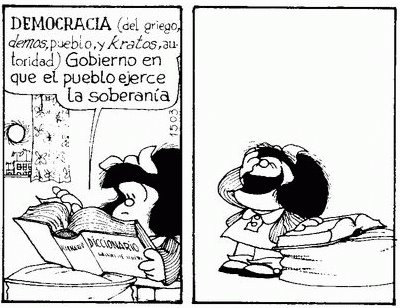
Demos sin cracia

democracia2

Las democracias modernas instituidas como “el gobierno de la mayoría” comenzaron a aparecer ya entrado el siglo XIX y se popularizaron velozmente.  Al lado de ella, la promoción de los ideales del sufragio universal, la igualdad de derechos y obligaciones entre hombre y mujer, la abolición de la esclavitud y del trabajo forzoso de curso legal, entre otros principios empezaron a dispersarse como un veloz germen en las sociedades occidentales y sus ex-colonias.  Han pasado ya 200 años desde que el germen democrático se dispersó por el mundo.  Sin embargo, los más recientes acontecimientos que han perturbado el flujo de las democracias de mayorías se ha visto afectado en Ucrania, Venezuela y desde hace dos días en El Salvador.

¿Por qué será que el ideal de la democracia ha “fallado” en estos países? 

Los argumentos a favor y en contra son muchos y muy complejos. Deben ser comprendidos desde distintas perspectivas y entender las posiciones tomadas por todos los actores que se han visto afectados de manera directa e indirecta por estos eventos.  Nosotros, el resto del mundo observador, podemos participar con ideas para ojalá descubrir más preguntas en nuestro camino. Hoy quiero compartirles una idea que cruzó por mi mente.

¿Acaso nuestro problema no ha sido que hemos tenído más “demos” que “cracia” en nuestro gobierno y en el desarrollo de nuestro rol ciudadano?

¿A qué me refiero con esto?

El término democracia es antiguo y complejo y se forma a partir de los vocablos “demos” traducido al castellano como -pueblo y/o poder- y “cracia” que indica un -gobierno o sistema-.  Así y actualizando el término desde la antigua Grecia a nuestros días, la democracia se refiere al gobierno del pueblo.

¿Pero acaso no ha sido el pueblo el que se ha volcado a la rebelión en Ucrania, Venezuela y El Salvador? Entonces, ¿la democracia reaccionó en estos países contra la democracia?

Quizás lo que ocurre en estos tres países (que son producto de la colonización y de la subyugación a los imperios durante la Guerra Fría) es que quizás no han pasado el suficiente tiempo en independencia institucional y maduración de sus gobiernos como para lanzarse desbocados a procesos democráticos que deben ir de la mano de una reforma educativa y cultural de la ciudadanía.  Pero, ¡alto! Que conste, que no me refiero a que estos países post-coloniales y post-guerra fría deban regresar bajo el control de un dictador o de una metrópoli.  Sino que, la participación del pueblo (demos) no debería avanzar cuando se ha descuidado o se ha impedido continuar el proceso de institucionalización de la democracia en la vida ciudadana.

Ucrania, Venezuela y El Salvador tienen como un común denominador la inmensa pobreza y la enorme desigualdad educativa y cultural entre la elite gobernante que heredó el poder de sus antiguos amos colonizadores y el grueso de la población. La mayoría de la población en estos países ha sido condicionada a servir como un “agente legitimador” al momento de ejercer su voto pero no se le ha permitido adquirir conciencia absoluta de su rol como “ciudadano legitimador empoderado”. Porque es su voto el que le permite exigir responsabilidad, honestidad y resultados en el equipo de gobierno que eligió en las urnas.

Titulo: 7 killed in post-election protests
Via: FoxNews

En Venezuela ha sido la población cansada y agotada de la corrupción la que ha tomado conciencia del poder de su voto al exigir la renuncia del gobierno revolucionario (aún a pesar de que recientemente había sido electo por el voto de las mayorías).  Es acá que el pueblo ha empezado a ilustrarse en su poder como votante y garante.

Titulo: Days of Protest in Ukraine
Via: The Atlantic

En Ucrania ha sido el pueblo el que también ha tomado conciencia del poder de su voto y de su derecho de autodeterminación pidiendo la anexión de Crimea y su mayoría étnica rusa a Rusia debido a sus distintos intereses económicos, políticos y culturales con el resto del país.

Titulo: El TSE pidió a los contendientes que respeten los resultados que el pueblo decida.
Via: http://www.lapagina.com.sv

Y en El Salvador desde el día lunes debido a que las elecciones presidenciales concluyeron con una cercana diferencia de votos entre los partidos ARENA y FMLN. ARENA rechazó el conteo de las elecciones luego del anuncio de su derrota. 6,000 votos marcaron la diferencia y el partido ARENA rechazó la legalidad del proceso democrático.

Espero que no sea aún tarde para extender una invitación a reflexionar a los ciudadanos salvadoreños sobre el funcionamiento del gobierno democrático y de la necesidad de estudiarlo a más profundidad y, quizás, comprender que el voto de la mayoría (aún si efectivamente ganará por 6mil votos de diferencia) no es garante suficiente de legitimidad.  Y que, es urgente que ambos partidos realicen un pacto serio, democrático y honesto antes de queso se derramé una sola gota de sangre.

En Venezuela, Ucrania y El Salvador es aún posible alcanzar acuerdo y pactos de concertación que partan del respeto al gobierno democrático y que busquen una inclusión de ideas, actores y modificaciones a los actuales procesos en los que el Pueblo (demos) colabore en la construcción y progreso del del Sistema de gobierno (cracia).

Esto evitará muertes y violaciones a los derechos individuales.  Pero más importante aún, permitirá la evolución y maduración de sistemas democráticos de gobierno en estos países que aún ahora se vieron afectados por la injerencia de los poderes imperiales en sus asuntos. Que envidia que en estos países quizás estén a las puertas de un desarrollo democrático del cual nuestros países vecinos podrían aprender mucho.

Has Nobel Laureate Gary Becker been reading NOL?

I would think so, especially after reading this:

The movement toward free trade agreements and globalization during the past 60 years has enormously reduced the economic advantages of having a larger domestic market to sell goods ands services. Small countries can sell their goods to other countries, both large and small, almost as easily as large countries can sell in their own domestic markets. For example, during the past 30 years the small country of Chile has had the fastest growing economy of Latin America, larger than Brazil and Mexico, the two largest nations of this region. This would not have been possible without the access of Chilean companies to markets in other countries, both in South America and elsewhere. As a result, Chile now exports around 40% of its GDP, compared to a ratio of exports to GDP in the United States of about 13%.

[…]

Small countries can do well with small domestic markets by taking advantage of a globalized economy by selling large fractions of its production to consumers and companies in other countries. That is why smaller countries usually export a considerably larger fraction of its production, and import a much bigger share of its consumption, than do larger countries. Size of country was much more important in the past when many countries had high tariffs, and transportation costs were much more important.

Political interest groups tend to be less able in smaller countries in distorting political decision in their favor. This is partly because smaller countries are more homogeneous, so it is harder for one group to exploit another group since the groups are similar. In addition, since smaller nations have less monopoly power in world markets, it is less efficent for them to subsidize domestic companies in order to give these companies an advantage over imports. The greater profits to domestic companies from these subsidies come at the expense of much larger declines in consumer well being.

The growth in the competitiveness of small countries on the global market is in good part responsible at a deeper level for the remarkable growth in the number of countries since 1950 from a little over 100 to almost 200 countries now. And the number of independent countries is still growing.

OMG! He has been reading us! How could he not be? Check out our thoughts on secession, decentralization, and devolution and tell me I’m wrong. Do it!

Heck, if we’re writing about the same stuff as a Nobel Laureate, and you’re reading us, what does that tell you about you? About us?

I’m curious. I also know Dr Becker doesn’t really read us. However, does the fact that we write about the same concepts and events as a Nobel Laureate have more to do with intelligence or ideological bias? Do prominent Left-wing scholars write about secession and globalization in the same way that we do?

From what I can tell, the answer to my second question is ‘no’ (the answer to my first is further below). Generally speaking, libertarians view more countries, more decentralization and more economic integration as a great thing, and we’ve got the data (increases in income, and longevity of life, and literacy rates, and…) to back it up. We’re the optimists.

Leftists and conservatives argue that all the good libertarian things happening in the world are bad, and they have some data to back it up (like Gross National Happiness). Leftists and conservatives are the pessimists.

Is this disagreement over globalization really a matter of intelligence? Of ideology? I think it’s probably a mixture of both, and also that intelligence levels affect ideological bias. You don’t hear many stupid people advocating for a more globalized world, much less for decentralized power structures and economic integration. It’s also hard to find smart people that will shun internationalism at the cultural or political level. The fact that many smart people, especially on the Left, shun economic internationalism is not so much troubling as it is amusing.

Watching intelligent people attempt to squirm out of answering questions about economic internationalism (“globalization”) can be quite the treat.

I think facts are squarely on the libertarian’s side, and that the main obstacle to attaining a more globalized, a more economically integrated, and a more politically decentralized world is rhetoric (and sheer numbers, of course). The benefits of globalization are usually seen by intelligent people very quickly (though not always thanks to clever rhetoric), but there are simply not that many intelligent people in the world (if there were, wouldn’t intelligence be rendered useless or morph into something else?).

I guess what I’m trying to say is that working towards a more libertarian world (thousands of political units with one world market) should be easy, so why isn’t it? I think the answer is ‘factions’. Farm subsidies in the West, for example, are unnecessary and can actually lead to hunger in poorer parts of the world. Getting rid of such subsidies would be a great benefit to mankind, but these subsidies persist. Why? Because of the political power of farm lobbies. If a politician representing a farm district in the West votes to eliminate subsidies, he’s gone in the next election. So unless the representatives of Western farmers somehow band together in defiance of their own interests and vote to eliminate farm subsidies, poor people will go hungry and Western citizens will pay too much for food.

Here is the real conundrum, though. If some factions gain political leverage over other factions, it does not necessarily follow that arbitrarily ending the hard-won privileges of the rent-capturing factions is the best option to take. In fact, it is often the worst option to take because of the dangers associated with arbitrary rule.

Think about it this way: Suppose a bunch of farmers in a democratic state band together and form a lobby for the purpose of protecting their interests. They gain influence (“capturing the rent”) and eventually become a nuisance to their countrymen but not a problem. Unfortunately, they are more than a nuisance to people in poor countries, but these poor people are unable to form a lobby that counters the lobbying efforts of the farmers.

The farm lobby in the rich country has followed all the rules. It has achieved its status as rent-capturer fairly, democratically and legally. What gives the government the right to suddenly change the rules on the farm lobby? Absolutely nothing. Furthermore, if the democratic government starts to ban lobbies it deems to be nuisances, it relinquishes its democratic moniker (and, more importantly, introduces arbitrary rule). Do you see the problem of ‘factions’?

Unfortunately, factions are built in to the policy-making process itself. One of the strengths of democracies is that they tend to give factions more of a voice than autocracies. In the United States, for example, Madison sought to combat the problem of factions by restricting the scope of the state to certain duties, and his system has done an excellent job (all things considered).

So I’ve got two questions I hope to be able to think about in the near term: 1) how can we make the Madisonian system better here in the United States, and 2) how can we “export” (for lack of a better term) Madisonian democracy abroad in a non-coercive manner?

California’s Neighborhood Legislature Initiative

In California, the voters are able to put proposed laws on the ballot if they gather enough signatures. This process is called an “initiative.” The legislature may also place propositions on the ballot, a process called a “referendum”.

One of the ballot propositions for 2014 is “The Neighborhood Legislature Reform Act,” which would decentralize the election of representatives in order to reduce the political power of special interests such as corporations, labor unions, and trial lawyers. This reform would shift political power to the people of California. (For the text of the initiative, see this.)

Like the US Congress, the California legislature has two houses, a Senate with 40 members and an Assembly with 80 members. The population of California is 38 million. The districts for the California Senate now have 950,000 persons, a greater number than for Congressional districts, while about 475,000 people live in each assembly district. It now takes a million dollars to win a California Senate seat.

The Neighborhood initiative would instead create Senate districts of 10,000 persons and Assembly districts of 5000. These neighborhood districts would form a greater association of 100 neighborhood districts within the current districts. The association council would elect a representative to the state legislature, thus keeping the same number of representatives in the state legislature. However, the final approval of a law would require a vote by all the neighborhood district representatives. That vote could be done on an Internet web site, as corporations now do for their elections of board members and propositions.

The Neighborhood Legislature proposition was initiated by John H. Cox, who has been a lawyer, real-estate management executive, and local office holder. The aim is to have the measure on the November 2014 ballot. That will require over 800,000 valid signatures, 8 percent of the votes cast for governor in the last election, by May 19. That is a high hurtle, which usually requires several million dollars to pay for signature gatherers. This initiative has already made a splash, with articles in the Wall Street Journal, Washington Post, The Los Angeles Times, and other media.

I have been writing for years on reforming democracy with tiny voting districts in a bottom-up structure. Back in 2007, I wrote an article, “Democracy Needs Reforming”, proposing that the political body be divided into cells of 1000 persons, each with a neighborhood council. A group of these would then elect a broader-area council, and so on up to the national congress or parliament. The state legislature would then only need one house, rather than a bicameral legislature that mimics the US Congress and British parliament. This “cellular democracy” would eliminate the inherent demand for campaign funds of mass democracy.

The Neighborhood Legislature Reform Act would not be quite as thorough a reform as a cellular democracy based on tiny districts, but it has the same basic concepts: smaller voting groups, and bottom-up multi-level representation. This initiative would indeed greatly reduce the demand for campaign funds that are needed in today’s huge California electoral districts.

It will be a great challenge to obtain the needed signatures. It could happen if the media provide editorial support and coverage. At any rate, the fact that this initiative is taking place will go a long ways to publicizing the gross corruption of democracy that is taking place, and the only effective remedy to the inherent dysfunction of mass democracy. Many reforms are needed in today’s governments, reforms in taxation, pensions, environmental protection, transit, criminal law, and economic deprivation. The main reason that useful reforms are not taking place is the subsidy-seeking and reform-blocking induced by mass democracy. The initiative process in California and other states is a way to circumvent the corrupt legislature, but in a large state like California, that process itself requires big money.

It will be interesting to watch the progress of the Neighborhood Legislature initiative, and to watch the special interests jump in with misleading negative ads. If this goes on the ballot and wins, it will be a victory for the people and a defeat for the moneyed special interests.

(Note: this article first appeared in The Progress Report)

The political Left and violence: An uncomfortable, subconscious symbiosis

I recently set up a Twitter account (you can follow me here; you can follow Notes On Liberty here) and after a couple of days of using its newsfeed I’ve decided to tally up the number of tweets from Leftists that either call for outright violence or allude to violence against their political enemies. Now obviously these guys are joking and I don’t think that any of them actually mean what they say, but the fact that this project even struck me as something to do is flabbergasting.

I think the fact that there are so many allusions to violence – against political enemies – in my newsfeed, combined with the recent labors of the media to rid the Colorado school shooter’s political leanings from the narrative of that particular story, has put me at unease* and made me particularly sensitive to the culture of ‘high’ media.

The allusions to violence harbor an authoritarian tendency that I think often goes unnoticed. I didn’t notice anything until a couple of days ago. Yet they are there, in plain sight. You can find these appeals and allusions to violence on the Right as well, but not from the people and organizations I follow on Twitter.

For example, I don’t follow rednecks or Party activists but rather professors, journalists, wonks and publication outlets that I think provide great, in-depth insights into the world around me. Most of these individuals and organizations are Left-leaning, and I have yet to ever (ever) see an appeal to violence coming from an intellectual conservative or libertarian organization. I see it from the intellectual Left so often that I am now going to start tallying such outbursts.

This is worrisome for a bunch of reasons, but three stand out to me:

  1. Joking about violence is not very funny; Jon Stewart and Stephen Colbert don’t do it, and now we know why
  2. The hypocrisy coupled with the veiled and not-so-veiled threats against political enemies is nothing short of barbarism
  3. It convincingly shows just how shallow Leftist thought has become; resorting to violence in an argument is, as we all know, a sign of defeat

Added together, these three major reasons make a solid foundation for a fascistic political movement. Look at my most recent ‘favorited’ tweet, from an assistant editor for The New Republic:

“If I were running Bloomberg View…the thing I would most want would be for Bloomberg to get hit by a bus.”

Ha. Ha. This is hilarious, right?

These are the same people who, in the wake of many mass shootings, have claimed that one of Sarah Palin’s campaign websites was indirectly responsible for senseless acts of violence (because of animated target signs that hovered over a map).

Disgusting, and yet there is a definite silver lining in all of this. Reason #3, as outlined above, is largely responsible for the intellectual Left’s impotence and fetish for domestic political violence.

Violence and the lust for power have gone virtually hand-in-hand with Leftism since the mid-19th century, of course, and this is largely because their plans for humanity are simply not feasible. And these plans, in turn, are not feasible because they are not congruent with reality.

Let me see if I can illustrate my point by digressing for a moment. Benito Mussolini was a Leftist his entire life. National socialism for German workers was a child of the Left. Maoism and Leninism were Leftist to the core. All were violent. All failed miserably and yet I see the underpinnings of these philosophies – these worldviews – in the rhetoric of the present-day American Left.

Not good. Nor is it good that the present-day Left denies its own bloodlines. Conservatives and libertarians are often quick to fess up to any historical misdeeds done in the name of their ideologies. Not so with the Left. I think this may have to do with the fact that while Leftist regimes were responsible for hundreds of millions of unnecessary deaths in the 20th century alone there are very few historical misdeeds perpetrated in the name of classical liberalism.

At any rate, I’ll keep you all updated on my tally. In the name of justice I will also keep a tally on tweets of violent fantasies that go out in the name of libertarianism or conservatism. My sampling size is small, of course. I only follow intellectuals and publications that give voice to intellectuals. This will be interesting.

* The fact that an evil person’s political views have been marginalized is not what is important. I think such views (if any) should be, as there is obviously something other than a shooter’s political leanings that is responsible for the horrific violence. What is important is the fact that if this shooter had been a self-identified conservative or libertarian it would have been plastered all over the news and it would still be getting air time as you read this.

Climate Change and the First Amendment

Like nearly everyone in the world, I don’t have the training to judge directly the pronouncements of organizations that affirm that there is:

a) Serious temperature rise on a global scale (“global warming”).

b) That it is caused by human activity (such as burning fossil fuels or keeping too many belching cattle).

c) That human beings must quickly reverse manufacturing growth and driving (and growth in cattle) or suffer devastating consequences.

Instead, I have to rely on indirect evidence to judge the claims of specialists and to decide what the appropriate action would be (including deliberate inaction). This is not a new situation. We all do this all the time. So, I am unable to assess the talent of the surgeon who is going to open up my chest but I can sure smell the booze on his breath and make the logical jump that it’s not good news. Similarly, I know little about the care of automobile engines but when I see a car mechanic banging on an engine with the back of a screwdriver, I am alerted.

The quality of specialists is not the only way indirectly to gauge the quality of a viewpoint. It’s also legitimate to infer the seriousness of a claim by assessing the quality of its believers. Thus, I am leery of so-called “alternative medicine” and other “informal” health perspectives because many of their proponents seem to live in la-la Land in matters other than health. And if marathon runners kept falling dead at 39, I would have good reason to wonder if running is that good for you. (I said “if.”) If the proponents of Chinese traditional medicine turned out to be sick all the time, I would have to think twice (thrice) about its merits. (I know, there is a causation issue in this sentence. It’s not a solution; it’s part of the problem.)

The quality of its followers say something about the credibility of a creed, I believe.

Here is an anecdote about the credibility of climate change proponents, “ccprops.” It’s only an anecdote. It may be isolated. It may represent no one but those involved. Or, it may sound familiar. Think!

I live in the Green People’s Socialist Republic of Santa Cruz. My wife and I may be the only residents with anti-Obama bumper stickers. (There is a good chance we only get away with it because leftists can’t spell: “Obamination,” mine says.) Those residents who are not greenies or leftists of some kind tend to observe a discreet silence. The voice of rationalists like me who oppose big government and the myths that support it is muffled to the point of being mostly inaudible. I am not saying that I am a victim; I am suggesting a minor degree of heroism.

One ordinary day, I am peacefully drinking coffee at my downtown coffee shop. My daughter and my five-year old grand-daughter are with me. There is a demonstration on the other side of the street, yards away, of about 200 people, most young, a few of retirement age. They have placards and they sing slogans against pipelines, all pipelines, against global warming, for the environment. I notice that some of them wear what I think is a fairly witty t-shirt sign: “Don’t frack your mother.” The usual collection of Mother-Earth loving catastroph-tropic semi-educated Santa Cruz crowd, I think.

When the demonstration disperses because of rain (the environment does not cooperate), a group of five demonstrators comes to sit under an umbrella of my coffee shop. After a while, they start making ingratiating noises toward my attractive, impossibly cute grand-daughter. I tell them in a calm voice that they may not talk to the child because I think they carry a bad, morally objectionable message.

I am just tired of letting my enemies go unchallenged. I believe they have enough influence collectively to sap what’s left of the economic life of California. They are precisely endangering my grand-daughter’s future with their anti-economic mindless message. There is no reason to waste an opportunity to show some unkindness here.

They are stupefied. This is Santa Cruz, California, after all. It’s one of the world centers of foo-foo-headedness. By locals standards, these people are 100% virtuous. More importantly, in their parochial minds, they are 100% right. They have never encountered hostility before, not even opposition. No one has ever treated them that way. They did not know anyone actually could, even legally. They kind of believe that the First Amendment protects them against criticism. They don’t know that it only enjoins the government. (“Congress shall make no law … abridging the freedom of speech, or of the press….”) They don’t know that the First does not guarantee against a private person making you cry with unkind comments. Nowhere does the First say or suggest: “Dr D shall not say hurtful things to silly Luddite greenies.”

Many young people are in the same state of ignorance nowadays. It may be because they don’t read much. It may be because they believe wrongly that they already know the Constitution. It’s the result of many years of left liberal education that is both biased and lazy. Even a friend of mine accuses me of “starting a fight.” I did no such thing. I was peacefully drinking my coffee while reading the WSJ. A bunch of strangers began yelling empty and offensive slogans near my face and I replied very moderately. “But they have a right….” Of course, they have a right; I did not say otherwise. I only instructed them to not speak to the child for whom I am responsible. I told them why in a brief and moderate way.

Immediately, the demonstrators start using religious-sounding language: You are “deniers” they say. Boy, that hurts! Boy, I am glad there is not much firewood handy! (I am not that stupid. I know well that they are trying to compare me to with theory of evolution “deniers.”)

A  frumpy woman in her forties presents herself as an expert because she is making a documentary on climate change, she says. This leaves me cold. Santa Cruz is full of self-declared, self-admiring artists. (I know this for sure, I am one.) I am thinking that if I worked on a movie about human female sexuality it would be no evidence that I know anything on the topic. Am I right?

For some mysterious reason, the film-making housewife insists on treating me as if I were a born-again Christian. Again, I have no idea what she would have done that. I don’t look the part in any way. I am sure I don’t act Christian, whatever that may be. I am absolutely certain I did not say anything leading to that kind of identification. I am an atheist of the calm, non-militant kind. Religion is not at the forefront of my preoccupations except sometimes, the silly Earth worshiping of her gang, precisely. As I said, the madness is close to the surface. The woman appears a little strange, a little twisted.

Temperatures have already risen by 1.4 degrees – the woman experts asserts in a loud voice.

Centigrade or Fahrenheit – I ask?

Yes – she says.

I ask again.

I don’t know – she brushes off my question.

In how long – I ask viciously – in what period?

I don’t know, she says with disarming honesty.

I am under the impression that her ignorance about the things she, herself, chose to evoke does not trouble her a bit.

Are you smarter than the 95.5% of scientists who believe in climate change – she challenges me with finality?

I refrain from answering out of humility. (Could well be that I am; I wouldn’t be that surprised; depends what you call a scientist; I have been reading for more than a half century; I read well; I retain better than most – not better than most at Harvard, better than most in the street. I went to an excellent or maybe just good graduate school, etc.) Also, I was seized like an overworked engine by this affirmation. I have encountered it for years with some variations in digits. I will just make again the obvious point the statement calls for:

If it were true that 95.5 % of scientists believed that there was man-made global warming that will have disastrous consequences, if it were true in reality, how in the world would anyone know this? Has there been a worldwide poll with strict definitions of who is a “scientist”? Was it conducted according to all the known intricate rules of polling including careful, neutral wording? What qualified pollster organization accomplished such a big difficult task? Why isn’t the pollster bragging about it? 95.5% is obviously a bogus number some one made up years ago and that keeps being repeated by believers. Its precision itself cries out, “Phony.” People who assert it are asserting that they don’t know what they are talking about, that they lack ordinary criticality. They are asking to not be believed.

The woman is joined by two younger people who appear to be her children. (Craziness might be hereditary.) A young man of about twenty is using the F word loudly five feet from my grand-daughter they all thought so cute three minutes ago. I am not a prude; I am not especially clean talking but there is no chance, zero chance that I would use such language in the presence of a small child. These people are insane. I don’t mean this figuratively. I mean literally. I mean that if they showed the same loud zeal in connection with say, parking, or house painting, they would risk being institutionalized.

In addition to factual waywardness and bad logic ccprops demonstrate their moral blindness in small ways as well as in big ones. They insist on their right to kill birds, for instance, including the legally protected bald eagle, in order to continue installing wind mills that contribute essentially nothing to the resolution of the imaginary problem of global warming (WSJ 10/11/13 “Fighting Climate Change by killing Eagles,” Robert Bryce.)

I listen to them calling the local talk shows. (I used to have a local talk show radio program myself.) They sound insane even if they are right. Most callers of talk shows are perfectly reasonable. Left-oriented ccprops are of a feather with rightists Bildeberg conspirators. Why do both kinds of callers sound regretful that it’s not yet technically feasible to murder over the airways?

Notice what I am not doing: They can go on demonstrating their irrationality, their lack of trustworthiness, their ignorance. It’s protected by the First Amendment. I will continue to try to make them cry every chance I get. It’s protected too.

Blind Faith

By Adam Magoon

On November, 26th Eric Liu, founder of “Citizen University”, a pro-government think-tank, wrote a telling article about having faith in government on the CNN opinion page. He begins the piece with a story about leaving his suitcase in a New York City cab saying:

“I had an experience recently that reinvigorated my faith in humanity — and bureaucracy.”

Keep that equivalency in your mind for a few minutes. Humanity and bureaucracy.

He goes on to explain that he did not even realize he left the suitcase in the cab for twenty minutes and only then began calling people for help. He explains this process in detail, emphasis mine:

“For almost three hours, various people tried to help me — two folks at my bank, whose credit card held the only record of the cab ride; three people at two yellow cab companies based in Long Island City; a service rep at the New York City Taxicab & Limousine Commission; people in my office back in Seattle.”

So Eric was helped by no less than eight individuals (counting the cab driver) in his successful search for his luggage. Eight people helped improve Eric’s business trip. He then claims this experience taught him three lessons.

First:

“Always, always get a receipt.”

This, as he says, is obvious.

Second:

“Another is that New Yorkers, contrary to popular belief and their own callous pose, are essentially nice.”

As someone born in New York I would like to think this is true, but I adhere to the maxim that terms such as “New Yorker” can only describe places where someone lives or is born. Saying “all New Yorkers are nice” is equivalent to saying “all Scots are drunks” or “all Scandinavians are attractive”. Essentially it is a non-statement that is easily refuted. There are just as many people who would have taken anything of value from his case and threw it into the nearest dumpster.

That is just the appetizer though, here is the main course.

His final lesson, and where the train totally leaves the rails, is this:

“But the third, even more deeply contrary to popular belief, is that government is not the enemy.”

Wait, what?! What kind of logic is Mr. Liu using? Of the eight people who helped him only one (the service representative at the New York City Taxicab & Limousine Commission named Valerie) even worked for a governmental organization and “she insisted she was just doing her job”. How did Mr. Liu get to “government is not the enemy” from that series of events? He goes on to claim that:

“Government is not inherently inept. It’s simply us — and as defective or capable of goodness as we are”.

Mr. Liu tries to rationalize his faith in government with a single good experience with a few select people. What he ignores though, is that many people are not “essentially nice”. If that were the case crime, corruption, and violence simply wouldn’t exist. There are people in the world who only seek to exploit and profit from the work of others and to quote the great classical liberal theorist Frédéric Bastiat:

As long as it is admitted that the law may be diverted from its true purpose — that it may violate property instead of protecting it — then everyone will want to participate in making the law, either to protect himself against plunder or to use it for plunder”

Even if we were to assume that most people in the world are “essentially nice” the very nature of government attracts precisely the opposite type; the corrupt, the malevolent and the lazy. His agenda finally becomes clear nearly two-thirds of the way through the article when Mr. Liu unabashedly asks us to not wonder what our country can do for us, but rather what we can do for our country in response to the failed Obamacare launch.

Individuals are expected to bail the government out when it fails at intruding into our lives? How can we expect the government to run healthcare without kickbacks and corruption when they cannot even get someone to build the website without it being a disaster?

Mr. Liu fails to offer any helpful advice on how to improve things but he does offer one revealing suggestion. He says that citizens should not expect the “state…to serve us perfectly” and that individuals should not “forget how to serve”.

The argument often goes that taxes pay for services provided by the government but Mr. Liu suggests we shouldn’t expect too much from those services. That we shouldn’t get upset when we pay a third of our labor to the government and it spends that money on things we do not want; in fact he implies we should fix for free the broken things they have already spent our money on.

If Mr. Liu goes out to dinner and his silverware is dirty when he sits at the table does he go back to the sink and wash them? Or does he expect more from the things he spends his money on? At least in that situation Mr. Liu could choose to spend his money elsewhere. With the government spending our money for us we aren’t even afforded that meager victory.

Bad News Bears: Ukraine, Russia and the West

No, I’m not talking about the Bruins choking in Pasadena earlier tonight. I’m talking about the Ukrainian government’s decision to balk at the latest Western offer for integration.

Well, at least I think it’s bad. The New York Times has all the relevant information on what happened between Kiev and the West. According to the Grey Lady, Kiev either balked at an IMF offer or had its arm twisted by Moscow. Both scenarios seem plausible, but I’d like to dig a bit deeper.

Ukrainians have been hit hard by this global recession, and last year they elected a government that is much more pro-Russia than it is pro-West. Unfortunately, I think the economy is only a small fragment of what ails the people in the post-colonial, post-socialist state of Ukraine (some people have started labeling “post-” states as “developmentalist” states; I like it but I’m not sure readers would). First of all, here are some relevant maps:

Ethno-linguistic map of Ukraine
2012 presidential election results in Ukraine
Map of per capita income in Ukraine

Notice a pattern? Yeah, me too. Basically, Ukraine is split along ethnic lines between Russians and Ukrainians and instead of recognizing this fact and focusing on property rights reforms first and foremost, the Ukrainians have decided to try their hand at democracy (on the inability of democracy to solve political problems in multi-ethnic states, see Ludwig von Mises’s Nation, State and Economy 72-84).

The conflation of democracy with property rights as freedom has been the single biggest mistake of all societies in the post-war world. From Ghana to Indonesia to Iraq to India to Ukraine, elites have focused their efforts on implementing democracy rather than property rights, and the inevitable, unfortunate results (“dictatorship and poverty”) continue to frustrate me. I’m sure the people who actually have to live under these conditions don’t like it much either.

Wouldn’t it be better if the current Ukrainian state  split into (at least) two independent states? I ask because it seems to me that having (at least) two different states will cut the number of losers in half (losers of elections in “post-” societies truly are losers; it’s nothing like having to “live under” Obama or Bush) and make the new, smaller governments more accountable and more accessible to the people.

The other aspect of Kiev’s rejection of Western integration that troubles my mind is that of the attitudes towards liberalization of Ukrainian society that many people obviously harbor.

For example:

  • Ukrainian-speaking Ukrainians overwhelmingly support more integration with the West. There are demonstrations (and I use this term loosely; riots may soon start) against the government’s decision to balk at the West going on right now.
  • And Russian-speaking Ukrainians (being Ukrainian can be either an ethnic thing or political thing [“citizenship”], which just goes to show you how stupid anything other than individualism is, but I digress) overwhelmingly support Moscow.

Yet it seems to me that both sides take the “pro-” and “anti-” stances that they do more out of spite for the other side than out of an understanding of what liberalization actually entails (I base this hunch on my watching of the recent elections here in the US). It’s also not clear to me that a pro-Western tilt would actually lead to more liberalization.

It may be easy for the Ukrainian-speaking Ukrainians to integrate and work with the West, but I think the Russian-speaking Ukrainians have good cause to look upon pro-Western deals with suspicion. After all, the Russian speakers are the richest faction in Ukraine, and freer trade with the West  would seriously undermine their political power (why do you think Russian-speaking Ukrainians have all the good jobs?).

Perhaps Evgeniy can enlighten us on the Russian perspective.

If Evgeniy doesn’t have the time you could just read Daniel Larison’s thoughts on the matter (Dr Larison is a historian with a PhD from the University of Chicago who specializes in the Slavic world).