Can Elizabeth Warren help turn the populist tide?

During her recent visit to China, a Democratic Senator from Massachusetts, Elizabeth Warren (perceived by many as a potential Presidential Candidate of the Democratic Party in 2020), came down heavily on US President Donald Trump’s approach towards foreign policy, arguing that it lacks substance, is unpredictable, and does not pay much attention to liberal values and human rights, which according to her has been the cornerstone of US foreign policy for a long time.

Trump’s unpredictability

Commenting on Trump’s unpredictable approach towards Asia, Warren stated:

This has been a chaotic foreign policy in the region, and that makes it hard to keep the allies that we need to accomplish our objectives closely stitched-in.

Critical of US approach towards China

Warren met with senior Chinese officials including Liu He, vice-premier for economic policy, Yang Jiechi, a top diplomat, and the minister of defense, Wei Fenghe, and discussed a number of important issues including trade and the North Korea issue.

Warren criticised China for being relatively closed, and stated that the US needed to have a more realistic approach towards Beijing. She also spoke of the need for the US to remain committed to raising Human Rights issues, and not skirt the issue, while dealing with China.

Said the Democratic Senator: Continue reading

Nightcap

  1. The working class, immigration, and the Left Kenan Malik, Guardian
  2. What if Trump wins the China IP dispute? Scott Sumner, EconLog
  3. The free speech dilemma Chris Dillow, Stumbling and Mumbling
  4. A short history of the Mongols Peter Gordon, Asian Review of Books

Nightcap

  1. Piracy in Antarctica Philip Hoare, Spectator
  2. Federalism, good (Canada) and bad (E.U.) Nick Rowe, Worthwhile Canadian Initiative
  3. Why Macedonia’s name is such a problem Nikola Zečević, National Interest
  4. How international hegemony changes hands Kori Schake, Cato Unbound

Nightcap

  1. Singapore, capitalism, and market socialism Scott Sumner, EconLog
  2. China’s Creditor Imperialism Brahma Chellaney, Project Syndicate
  3. Chairman Xi, Chinese Idol Ian Johnson, New York Review of Books
  4. Trump may be rude, but that doesn’t make him a tyrant Ted Galen Carpenter, the Skeptics

Trump’s personal game might work in China

In spite of all the economic and strategic differences between the US and China, personal relationships play an important role in bilateral relations between Washington DC and Beijing.

Trump’s Ambassador to China 

One of the first appointments made by US President Donald Trump was that of Terry Branstad as US Ambassador to China. The key reason was Branstad’s personal rapport with Chinese President Xi Jinping. This began in 1985, when Branstad was Governor of Iowa, while Xi Jinping an official from Hebei was visiting Iowa. In 2011, Branstad visited Beijing, and met with Xi at the Great Hall of the People. In February 2012, when he was vice-president, Xi stopped in Muscatine, Iowa, where he met not just with Branstad but with big industrialists and farmers from the states.

The US President, commenting on the reason for appointing Branstad, stated:

Governor Branstad’s decades of experience in public service and long- time relationship with President Xi Jinping and other Chinese leaders make him the ideal choice to serve as America’s ambassador to China.

During US President’s China visit in November 2017, Branstad, who shares a good rapport with Trump, did the groundwork for the visit. While in recent weeks tensions between both countries have escalated, with Trump imposing tariffs on Chinese goods worth $60 billion, the American president was delighted with the welcome he had received during his trip and had even told the Chinese President: “My feeling towards you is incredibly warm.”

It would be pertinent to point out that Trump’s decision to appoint Branstad as Ambassador to China (December 2016) came as a relief to the Chinese, given the fact that the US President took Taiwanese President Tsai-Ing Wen’s phone call, much to the chagrin of Beijing (since this went against established US policy).

If one were to look beyond the role of personal relationships in the very complex but important Beijing-Washington relationship, China lays a lot of emphasis on experience (educational, professional) in the US. If one were to examine the credentials of some of the top officials in Xi Jinping’s administration, US education as well as experience in dealing with economic issues pertaining to the US, has played a key role in some of the Chinese President’s appointments.

For instance, Liu He, whom Xi Jinping has appointed as a Vice Premier for overseeing the economy and financial sector, is US educated. Liu, who speaks fluent English, obtained a master’s degree in public administration from the Kennedy School of Government (Harvard University) in 1995. Apart from his in-depth understanding of the Chinese economy, Liu has also been involved in important discussions with US leaders.

Another significant appointment by Xi Jinping is that of Yi Gang, who has been named as Governor of the People’s Bank of China (PBOC). Yi obtained a business degree from the Hamline University in St. Paul, Minnesota, and a Ph.D. in economics at the University of Illinois, before moving to Indiana University at Indianapolis as a professor in 1986. He taught later at the Peking University in Beijing, before moving to the PBOC in 1997.

While economic and strategic issues are too complex to be driven by personal relationships or chemistry (though Trump seems to be a keen believer in personal chemistry given the emphasis he lays on individual ties) alone, an in-depth  understanding of the culture, politics, and economics of one’s interloctutors is especially handy. Given the current tensions between both countries over tariffs, this dynamic may prove to be especially useful.

Nightcap

  1. Islam and the European Enlightenment the Economist
  2. Tales of a female bomber Lincoln Krause, War on the Rocks
  3. Christianity in China is uncrushable Charles Horner, Claremont Review of Books
  4. What would the ideal introduction to Catholicism look like? Paul J. Griffiths, Commonweal

Nightcap

  1. China Portrays Racism as a Western Problem the Economist
  2. Pure Racism and Chinese Dining Jacques Delacroix, NOL
  3. Imagining a New China Fiammetta Rocco, 1843
  4. A German’s View of China’s Rise Peter Gordon, Asian Review of Books

Trump’s humor is not very funny to the world’s liberal democracies

The Chinese Communist Party, on February 25, 2018, made a significant announcement — that the two-term limit for Presidency will be abolished through an amendment to the constitution. This means that current President Xi Jinping will be President for life. This amendment was tabled on March 6, 2018 by the Communist Party during the two week National People’s Congress (which began on Monday, March 5, 2018).

According to a CNN recording, Donald Trump, while reacting to this development, stated:

He’s now president for life, president for life. And he’s great. And look, he was able to do that. I think it’s great. Maybe we’ll have to give that a shot someday.

The US President also called Xi a “gentleman,” and said that the latter had treated Trump very well during his China visit in November 2017. Trump’s reaction to Xi’s decision has been criticized by some politicians in the US, while other major Western democracies have not commented on the decision.

Trump’s inconsistency on China

Trump’s views with regard to China have not been consistent, as is the case on many other issues. Candidate Trump had used tough language for China; at one campaign rally, for example, candidate Trump stated:

We can’t continue to allow China to rape our country and that’s what they’re doing. It’s the greatest theft in the history of the world.

During his visit to China in November 2017, the US President had, interestingly enough, criticized his predecessors, and said that he does not hold China responsible for the skewed trade relationship:

[…] I don’t blame China. After all, who can blame a country for taking advantage of another country for the benefit of its own citizens? I give China great credit […] I do blame past [US] administrations for allowing this out of control trade deficit to take place and to grow. We have to fix this because it just doesn’t work […] it is just not sustainable.

While the US President is unpredictable, the criticism of his predecessors on foreign soil came as a shock to everyone.

Trump’s myopic approach towards complex economic and strategic issues has helped China

Trump’s recent praise of the constitutional change which will enable Xi to be President for life may have embarrassed many Americans and Liberals in other parts of the world. They would have perhaps expected the US President to raise a red flag.

The fact is, however, that many of Trump’s foreign policy decisions – withdrawing from the Trans Pacific Partnership (TPP) trade deal in January 2017, or repeatedly criticizing NATO (North Atlantic Treaty Organization) and stating that members are not meeting their ‘financial obligations’ or, more recently, the imposition of tariffs on imports of aluminium and steel – are embarrassing steadfast allies in Asia and Western Europe. All these decisions have sent a message globally that Trump’s view of the outside world is driven by domestic politics and transactionalism – and not realism as some would have us believe. This is in contrast to his predecessors, who valued relationships but also understood the relevance of common democratic values as a binding thread. Trump on the other hand is quite comfortable with authoritarian leaders.

Trump has often expressed admiration for authoritarian leaders like Vladimir Putin, and Phillipines President Rodrigo Duterte. Duterte, who is controversial for using extrajudicial methods to deal with a Filipino drug problem, has presided over a drug war that has cost the lives of more than 4,000 people. While praising Duterte, Trump said:

I just wanted to congratulate you because I am hearing of the unbelievable job on the drug problem. Many countries have the problem, we have a problem, but what a great job you are doing.

During their meeting on the sidelines of the ASEAN Summit in Manila (November 2017), Trump did not sufficiently raise US human rights concerns, and was criticized by many American politicians, including Republican Senator John McCain. The US-Philippines Joint Statement, while speaking about the challenge of the drug problem, did refer to a human rights issue (issued after the meeting between Trump and Duterte):

The two sides underscored that human rights and the dignity of human life are essential, and agreed to continue mainstreaming the human rights agenda in their national programs to promote the welfare of all sectors, including the
most vulnerable groups.

It would be pertinent to point out that the previous administration had criticized Duterte for adopting such measures. In return, Duterte used offensive language aimed at President Obama.

While the US has been in bed with authoritarian regimes in the past and turned a blind eye on many occasions to human rights violations, no one can deny the fact that even transactionalist Presidents like Ronald Reagan paid lip service to democracy and human rights. In a speech at Westminster, Reagan stated:

Democracy is not a fragile flower […] Still it needs cultivating. If the rest of this century is to witness the gradual growth of freedom and democratic ideals, we must take actions to assist the campaign for democracy.

Similarly, George W Bush, who was often thought of as being very simplistic, spoke about the importance of democratic values as a common binding factor with many of its allies.

Conclusion

In conclusion, while reasonable ties between Washington and Beijing are good news, Trump’s public appreciation of authoritarian leaders and their methods is worrying because at the global level there is a feeling that authoritarian leaders and systems deliver better results compared to chaotic democracies.

The US has always been the flagbearer of democracy, liberal values, and human rights. It is a matter of concern, then, when the leader of such a country pays little attention to these issues. In a way, Trump has played a pivotal role in wrecking the liberal order, and by doing so has created a situation where Beijing will not have to change its ways, but may well create a parallel order which many countries will be willing to join due to China’s economic prowess.

Nightcap

  1. Centuries-old German toy shop conquers internet Katrin Terpitz, Handelsblatt
  2. Interviews with Nazi Filmmakers [pdf] Gary Jason, Reason Papers
  3. Comparing Mao to Hitler and Stalin Ian Johnson, NY Review of Books
  4. 10 Weapons That Forged British Empire (my latest at RealClearHistory)

India needs to work harder, both in its own backyard and in its near-abroad

While there is absolutely no doubt that Donald Trump has on more than one occasion sent harsh warnings to Islamabad – calling upon Pakistan to give up its support for terrorist groups or face the consequences – Trump’s predecessors had begun to reduce aid to Pakistan. During the Obama years, for example, American aid to Pakistan dropped from over 2 Billion USD in 2014, to a little over 1.1 Billion USD in 2016.

In his latest tweet, Trump minced no words, saying that Pakistan had fooled the US all these years, and that US will not take this lying down:

The United States has foolishly given Pakistan more than 33 billion dollars in aid over the last 15 years, and they have given us nothing but lies & deceit, thinking of our leaders as fools. They give safe haven to the terrorists we hunt in Afghanistan, with little help. No more!

Trump tweeted early morning on New Year’s Day.

Earlier in the year, during his August speech pertaining to Afghanistan, Trump had categorically stated that it no longer could be business as usual, and that Pakistan needed to stop extending support to the Haqqani network and other groups. Said the US President:

We have been paying Pakistan billions and billions of dollars, at the same time they are housing the same terrorists that we are fighting. But that will have to change. And that will change immediately.

A number of senior officials in the Trump Administration, such as the Secretary of State Rex Tillerson, Defence Secretary Mattis, and Vice President Mike Pence have hinted that harsh steps for Islamabad are a real possibility, some of which include not just withdrawal of aid to Pakistan, but also the removal of Pakistan’s non-NATO ally status.

During his recent visit to Afghanistan, Pence stated that President had put Pakistan on notice. Said Pence: “President Trump has put Pakistan on notice. As the President said, so I say now: Pakistan has much to gain from partnering with the United States, and Pakistan has much to lose by continuing to harbor criminals and terrorists.”

In an oped written for the New York TimesTillerson stated:

Pakistan must contribute by combating terrorist groups on its own soil. We are prepared to partner with Pakistan to defeat terror organisations seeking safe havens, but Pakistan must demonstrate its desire to partner with us.

China – which has strategic and economic interests in Pakistan, with the primary one being the China-Pakistan Economic Corridor (CPEC) – has stood by Pakistan. While reacting to Trump’s August 2017 address, State Councillor Yang Jiechi said:

“We should attach importance to Pakistan’s important role in Afghanistan and respect Pakistan’s sovereignty and legitimate security concerns.”

India’s reactions

New Delhi has understandably been closely observing these events. Trump’s warnings to Pakistan are viewed as positive news for India, and the Trump Administration has also pleased New Delhi by speaking against violent groups that are targeting India. The US, for example, has lent support to India’s demand for declaring Jaish-E-Muhammed (JEM) Chief, Masood Azhar, a designated terrorist by the UN (this move has of course been stalled by China).

Realists in New Delhi will however be keeping an eye on the following issues.

First, sections of the political class in Pakistan, as well as old hands in the American administration will not allow things between Islamabad and Washington to go downhill. A number of Pakistani politicians, such as Sherry Rehman, have already stated that while Pakistan should have its own independent policy, and it should not be submissive, it need not be excessively aggressive. While such politicians may not publicly say so, the fact is that there is a large swath of the Pakistani population which may not be very comfortable with the US, but is even more uncomfortable with the increasing Chinese presence in Pakistan as a consequence of CPEC.

In the US too, there are sections in the State Department which follow the approach of engaging with moderate forces in Pakistan given the country’s strategic importance. There is a section of the US establishment which does not want Pakistan to totally drift away from Washington’s orbit, mostly because China is beginning to take a larger role in the whole of South Asia, including Afghanistan. One of the declarations of the first Foreign Minister-level trilateral dialogue between China, Pakistan, and Afghanistan was the extension of (CPEC) into Afghanistan.

Said the Chinese Foreign Minister:

So China and Pakistan are willing to look at with Afghanistan, on the basis of win-win, mutually beneficial principles, using an appropriate means to extend CPEC to Afghanistan.

Both New Delhi and Washington will closely watch this development.

Apart from Beijing, Pakistan will rely on Saudi Arabia to soften Washington’s approach vis-à-vis Pakistan. The Sharif brothers, both Nawaz and Shahbaz, have strong connections in Saudi Arabia and while there were speculations that the Saudis were trying to broker a deal between the Pakistani military and the Sharifs, there is also a view that there’s an understanding between the Pakistani army and the Sharifs, and that the latter would use their links in the Saudi establishment to soften the Trump Administration, which has strong ties with Riyadh.

In conclusion, there is an increasing awareness with regard to the nexus between the Pakistani army and terror groups targeting India. Yet New Delhi should be more realistic in its calculations, and it needs to not just bank on Washington. Instead, India should also leverage its economic ties with Riyadh and Beijing to put more pressure on Pakistan. While there is no doubt that strategic convergence with Washington has increased phenomenally, Trump’s harsh words against Pakistan are not just driven by any conviction, but also by simple transactionalism. This very transactionalism has also created space for China to become more pro-active in South East Asia and South Asia. New Delhi thus needs to be pragmatic, deft, and leverage its economic rise more effectively.

India-US relations and engaging with Trump

Ivanka Trump jointly inaugurated the GES Summit in Hyderabad (November 28-29) along with Prime Minister Narendra Modi, and she lauded the latter for his phenomenal rise. Modi had invited Ivanka during his US visit in June 2017. The US President’s daughter and Adviser was quick to accept the invite, and tweeted:

Thank you, Prime Minister Modi, for inviting me to lead the U.S. delegation to the Global Entrepreneurship Summit in India this fall.

During her address, Ivanka also highlighted India’s economic achievements in recent years, while also praising the country’s democratic credentials.

Said Trump:

‘You are celebrating it as the world’s largest democracy, and one of the fastest growing economies on earth…Through your own enterprise, entrepreneurship, and hard work, the people of India have lifted more than 130 million citizens out of poverty – a remarkable improvement, and one I know will continue to grow under the leadership of Prime Minister Modi.’

Why India reached out to Ivanka

By reaching out to Ivanka Trump, India has done the right thing, given the fact that all countries – including China, Saudi Arabia, Japan, and South Korea – have realized the importance of business interests, as well as personalized diplomacy with Trump.

Every country has to recognize its own interests, and the Trump Administration has been quite vocal on a number of issues including its tough stance on terrorism emanating from Pakistan, as well as a larger role for India in the Indo-Pacific. The US President, during his recent visit to Asia used the expression Indo-Pacific on more than one occasion (as opposed to the earlier expression Asia Pacific), while US Secretary of State Rex Tillerson has also spoken for a greater role for India in Asia Pacific. China took strong exception to the usage of ‘Indo-Pacific’ as opposed to Asia Pacific.

It is important however to bear a few points

First of all, while those who support Trump praise him for being a realist, at times what is dubbed as his transactionalism is a bit too simplistic. The US President is also not just unpredictable, but fickle. While some unpredictability is good, there are limits to this. Trump’s approach towards China, as well as other serious issues is a strong reiteration of his fickleness. While during his election campaign he used harsh language for Beijing, said Trump during an election rally in 2016:

‘We can’t continue to allow China to rape our country, and that’s what we’re doing.’

The warm reception he received in China was enough for Trump, to not only praise the Chinese, but even criticize previous US governments. While he lambasted Pakistan in a speech in August, a few weeks later he was all praise for the Pakistan army, after it helped in rescuing an American-Canadian couple who had been kidnapped by the Haqqani terrorist network. While rigidity is not good in diplomacy, and election campaigns do not translate into policy actions, it is important to understand the broad thrust of the US foreign policy.

It is not just policy issues, but even his relations with key members of his cabinet which are important to watch. The latest instance being of Rex Tillerson, the aforementioned Secretary of State who has tried to adopt a more realistic stance on issues like Iran. If Tillerson is changed as is being speculated, other countries who have built a strong rapport with him and sought to understand his orientation will need to now start from scratch.

Second, Trump is more inward looking than earlier Presidents, and that is advantageous for China in the strategic sphere, especially in the context of Asia.

While the Chinese will humor him through sweeteners such as FDI commitment, and this will help in influencing not just Trump, but even some of his key advisers like Jared Kushner, ultimately Beijing will have the last laugh in the strategic sphere, especially in the Indo-Pacific region. A number of countries in ASEAN have already subtly expressed their reservations with regard to Trump’s isolationist approach towards not only Asia but the rest of the world.

Third, unlike his predecessors, including Obama, Trump has no strong convictions with regard to democracy. While it is true that every country should see its own interests, a lot of countries have been more comfortable with the US because of the emphasis it places on democracy and civil liberties. During his recent visit to Myanmar for instance, Tillerson did refer to the Rohingya Issue, and the need for the NLD government to ensure the well being of the Rohingya committee.

Democracy and plural values drive the bilateral relationship between many countries , and in the context of India and the US, these should not be kept out. If Trump is totally indifferent to the nature of regimes, there is not much to distinguish the US from China, and American indifference towards issues such as democracy and civil liberties will only reduce an important component of its Soft Power.

What India needs to do

It is thus important for India to use innovative ways for reaching out to Trump, but also have a clear stand on key foreign policy issues. The Quad alliance (US, Japan, Australia and India), for instance, is important with Japan and Australia taking a clear stance against Chinese expansionist tendencies. While the US is part of this alliance, it is tough to predict whether the Trump Administration will really play a pro-active role, especially if Beijing objects to the alliance.

Similarly, India is doing the correct thing by maintaining an independent stance on Iran given its own strategic and economic interests. The Chabahar Port Project, which India is funding, is India’s gateway to Central Asia and Afghanistan, and by going ahead with the project even with the souring of ties between Washington and Tehran it has sent a clear message that it will not blindly tow Washington’s line.

In conclusion, while New Delhi has to see to its own interests, and explore synergies with the Trump Administration, there are likely to be some significant challenges given Trump’s simplistic approach towards complex issues, and the lack of any sort of consistency.
Lunchtime Links

  1. oil and Kurdistan
  2. after Raqqa, Iraq’s army turns on Kurdistan
  3. “There has been a common and unfortunate tendency among many analysts and policy makers to underestimate the strength of Iraqi nationalism”
  4. separatist movements in Europe don’t actually want independence
  5. GREAT topic, but poor methodology, poor theory, poor use of data, and bad faith
  6. meh (try this book review instead)
  7. Law without the State [pdf]

Lunchtime Links

  1. My country, your colony | why the Holocaust in Europe?
  2. compliance and defiance to national integration in Africa [pdf] | on doing economic history
  3. ethnonationalism and nation-building in Siberia [pdf] | cosmopolitanism and nationalism
  4. political centralization and government accountability [pdf] | decentralization in military command
  5. unified China and divided Europe [pdf] | unilateralism is not isolationism

BC’s weekend reads

  1. I thought the Nancy MacLean’s book attacking James Buchanan was great for present-day libertarianism, in that it only weakens the already weak Left. Henry Farrell and Steven Teles share my sensibilities.
  2. What is public choice, anyway? And what is it good for?
  3. One of the Notewriters reviews James C Scott’s Seeing Like A State
  4. Aztec Political Thought
  5. Turkey dismisses 7,000 in fresh purge
  6. 10 Chinese Megacities to See Before You Die

Geopolitics and Asia’s Little Divergence: State Building in China and Japan After 1850

Crossposted at the Medium

Why did Japan successfully modernize in the 19th century while China failed to do so? Both China and Japan came under increasing threat from the Western powers after 1850. In response, Japan successfully undertook a program of state building and modernization; in China, however, attempts to modernize proved unsuccessful and the power of the central state was fatally weakened. The failure to build a modern state led to China’s so-called lost century while Japan’s success enabled it to become the first non-western country to industrialize. In a paper with Chiaki Moriguchi (Hitotsubashi University) and Tuan-Hwee Sng (NUS), we explore this question using a combination of historical evidence and formal modeling.

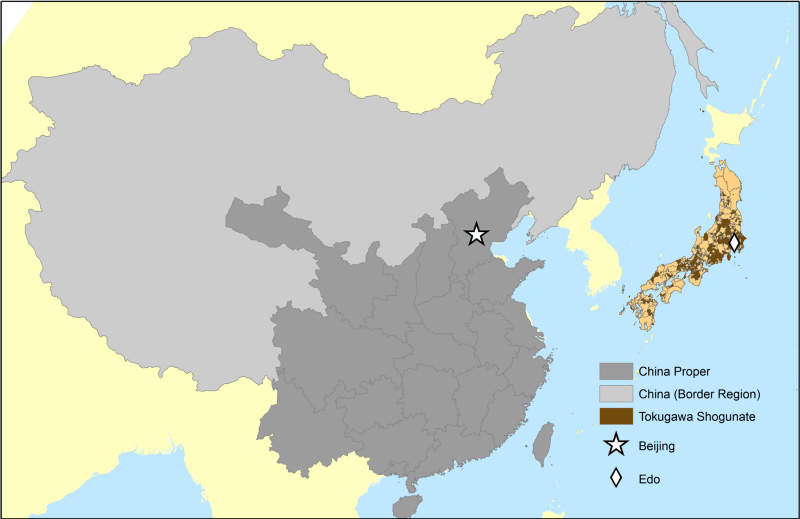
On the surface this East Asian “little divergence” is extremely puzzling. Qing China, as late as the end of the eighteenth century, was a powerful centralized empire. An impersonal bureaucracy selected by exams, and routinely rotated, governed the empire. In contrast, the institutions of Tokugawa Japan are usually described as feudal. The shogun directly ruled only 15% of the country. The remainder was divided into 260 domains ruled by lords known as daimyo who collected their own taxes, possessed their own armies, and issued their own currencies. To the outside observer China would have seemed much more likely to have been able to establish the institutions or a centralized state than Japan.

Figure 1: Qing China and Tokugawa Japan

For much of the early modern period (1500–1700) China and Japan possessed military capabilities that made them more than a match for any western power. This changed dramatically after the Industrial Revolution and their vulnerability exposed by the Opium War (1839–1840) and the Black Ships Incident of 1853, respectively. During the First Opium a small number of British ships overpowered the entire Chinese navy, while Commodore Perry’s show of force in landing in Japan in 1853 convinced the Japanese of western naval superiority. Within a few years, political elites in both countries recognized the need to modernize if only to develop the military capacity required to fend off this new danger.

* * *

koyamajapanperry
Figure 2: Commodore Perry in Japanese eyes

In China, after the suppression of the Taiping Rebellion, there were attempts at modernizing — notably the Self-Strengthening movement associated with Li Hongzhang and others. Recent scholarship has reevaluated this movement positively. At the purely military-technological level it was in fact quite successful. The Jiangnan Arsenal and the Fuzhou Shipyard saw the successful importation of western military technology into China and the Chinese were soon producing modern ships and weaponry. However, these developments were associated with a process of political decentralization as local governors took on more and more autonomy. The importation of military technology was not associated with more far-reaching societal or political reforms. There was no serious attempt to modernize the Qing state.

In contrast, Japan, following the Meiji Restoration, embarked on whole scale-societal transformation. The daimyo lost all power. Feudalism was abolished. Compulsory education was introduced as was a nationwide railway system. A new fiscal system was imposed in the teeth of opposition from farmers. The samurai were disarmed and transformed from a military caste into bureaucrats and businessmen.

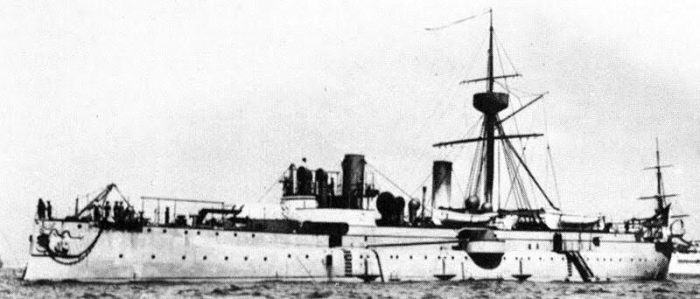
Qing China and the newly modernized Meiji Japan would collide in the first Sino-Japanese war (1894–1895). Before the war, western observers believed China would win in part because of their superior equipment. But the Chinese lacked a single national army. It was the Beiyang army and the Beiyang fleet that fought the entire Japanese military force. The fact that Japan had undergone a wholesale transformation of society enabled them to marshal the resources to win a rapid victory.


koyamabaiyanfleet
Figure 3: The Jingyuan, one of the ships in the Baiyang fleet

* * *

Why did the Japanese succeed in modernizing while Qing China failed to do so? Historians have proposed numerous explanations. In our paper, however, rather than focusing on cultural differences between Japan and China, we focus on how different geopolitical incentives shaped their decisions to invest in state capacity and state centralization.

Before the mid-19th century China only faced a threat from inner Asia from where historically nomadic invasions had routinely invaded and threatened the sedentary population of the Chinese plain. Due to this threat, historically China tended to be a centralized empire with its capital and the bulk of its professional army stationed close to the northern frontier (see Ko, Koyama, and Sng (2018)). In contrast, Japan faced no major geopolitical threats prior to 1850. This meant that it could retain a loose and decentralized political system.

After 1850 both countries faced major threats from several directions. China was threatened on its landward borders by Russian expansionism and from the coast by Britain and France (and later Germany and the United States). Japan was threatened from all directions by western encroachment.

We build a simple model which allows for multidirectional geopolitical threats. We represent each state as a line of variable length. States have to invest in state capacity to defend against external geopolitical threats. Each state can use centralized fiscal institutions or decentralized fiscal institutions.

If there is strong threat from one direction, as China faced prior to 1850, the dominant strategy is political centralization. In the absence of major geopolitical threats decentralization may be preferable as was the case in Tokugawa Japan.

The emergence of a multidirectional threat, however, changes things. A large country facing a multidirectional threat may have to decentralize in order to meet the different challenges it now faces. This is what happened in China after 1850. In contrast, for a small state with limited resources, an increase in the threat level makes centralization and resource pooling more attractive. For a small territory like Japan, the emergence of non-trivial foreign threats renders political decentralization untenable.

We then consider the incentives to modernize. Modernization is costly. It entails social dislocation and creates losers as well as winners, the losers will attempt to block any changes that hurt their interests. We show that for geographically compact polities, it is always a dominant strategy to modernize in the face of a multidirectional threat as the state is able to manage local opposition to reform. This helps to explain why all members of the Japanese political elite came around to favoring rapid modernization by the late 1860s.

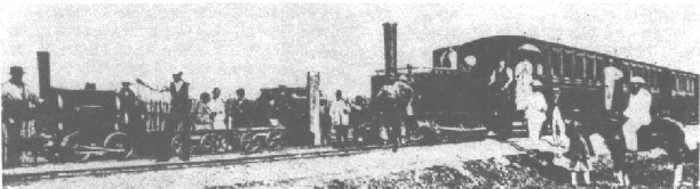
Consistent with our model, modernization was more difficult and controversial in China. The Qing government and particularly the Empress Dowager famously opposed the building of railroads. The most well-known example of this was the Wusong Road in Shanghai. Built using foreign investment it was dismantled in 1877 after locals complained about it. The Qing state remained reactive and prepared to kowtow to local powerholders and vested interests rather than confront them. Despite local initiatives, no effort was made at wholesale reforms until after China’s defeat at the hands of Japan in 1895.

koyamaindustrialization
Figure 4: The Wusong Railroad in 1876

* * *

By 1895 it was too late, however. The attempts of the Qing state to reform and modernize led to its collapse. Needless to state, East Asian’s little divergence would have lasting consequences.

Japan’s modernization program astonished foreign observers. Victory over Russia in 1904 propelled Japan to Great Power status but also set Japan on the path to disaster in the World War Two. Nevertheless, the institutional legacy of Japan’s successful late 19th century modernization played a crucial role in Japan’s post-1945 economic miracle.

Following the collapse of the Qing dynasty China fragmented further entering the so-called warlord era (1916–1926). Though the Nationalist regime reunified the country and began a program of modernization, the Japanese invasion and the Second Sino-Japanese War (1937–1945) devastated the country. The end result was that China came to be reunified by the Communist party and to experience more conflict and trauma until it began to embrace market reforms after 1979.