Almost everything has been said about that rather boring first presidential debate on Monday. One observation missing: It’s amazing how the progressive-liberal narrative categories have invaded even Republican understanding and vocabulary. Two examples.
During the first presidential debate, the moderator unambiguously presented as racist the “birther” preoccupation, the belief that Mr Barack Hussein Obama was not born in the US. It makes absolutely no sense why this should be considered racist. If a presidential candidate of Polish ancestry with blue eyes etc… had presented himself for years through his literary agent as born in Cracow, there would be those who would doubt aloud his constitutional qualification to be president. Those so inclined would be considered racist? If the answer is “no,” are we facing a situation where any negativity toward a black person is by definition racist? If a black-looking person steals a parking spot from me and I call him an “asshole” that makes me a racist although that’s exactly what I have called several white persons who have done the same to me in the past? Are we drowning in absurdity? Have we collectively lost the ability to recognize simple sense? In the parking case example above, a better case could be made, given my intemperate verbal habits, that not calling the black driver an asshole would be racist.
Second example. At the very end of the debate, when he placed the accent on the fact that Mrs Bill Clinton is the first female candidate nominated by a major party, the moderator qualified as sexist the Trump statement that Mrs Clinton does not have the stamina to be president. Same problem of logic. If Mr Trump had said this of any male opponent it would have been considered legitimate. Making the statement about a female candidate makes the statement automatically sexist. But the statement is sexist only because it concerns a female. It posed the question of whether there exists any negative statement about a female politician that is not sexist? I think the answer is quickly becoming “No!”
The wing of the Democratic Party now on the ascendant is deeply totalitarian. It shows in the small things, as in the two examples above. It knows no dissent that is legitimate when it comes down to it. It’s important to stop them even if we have to take the considerable risks inherent in the Trump candidacy. One sure thing about Donald Trump: He is not coherent enough to become a Mussolini.
I’m a great fan of the Lord of the Rings, both the books and the Peter Jackson movies. Overall I believe the movies are pretty faithful to the books. There are, of course, some differences, but I generally accept the explanation that adapting a book to a movie is hard and some changes have to be made. There is, however, a whole chapter from the books absent from the movies that I believe shouldn’t be. If you haven’t seen the movies or read the books, be warned, spoiler alert. The said chapter is called “The Scouring of the Shire.” In the movies, when the hobbits return home from the War of the Ring, hardly anything has changed. It seems like the Shire has not been affected by the events in the world around it at all. In the books, however, Saruman the White, the evil wizard, escapes to the Shire after been defeated in the battle of Isengard. He ends up governing the Shire in secret under the name of Sharkey until the events of “The Scouring of the Shire,” when the hobbits return and lead a rebellion, defeating the intruders and exposing Saruman’s role. I believe this chapter is important because it shows that evil is not somewhere far from home. We may fight a war overseas, but evil may end up lurking really close to us.
This last Sunday Brazil had municipal elections. The Workers Party (PT), the political party of impeached president Dilma Rousseff and the almost convict ex-president Luis Inácio Lula da Silva, was the great loser. Some cities will still have a second round of votes, but it is clear that in the process PT will lose a great number of prefectures, city halls, and with it many commissioned positions as well. In sum, the process of rejection that started with the impeachment goes on and well. Or almost. In Rio de Janeiro the elections will be decided in second round between Marcelo Crivella and Marcelo Freixo. Crivella is a licensed bishop of the controversial Universal Church of the Kingdom of God, and Freixo is a member of the Socialism and Freedom Party (PSOL). Crivella was Rousseff’s ally almost until the very end, when his party decided to vote for the impeachment. PSOL is a dissent from PT that left the former party in 2004, believing that Lula was too pro-market in his policies.
Saruman took refuge in the Shire and changed his name to Sharkey. The inhabitants of the Shire were too unaware of the events of the War of the Ring to understand what was going on. Saruman was the White Wizard. He was supposed to be good, but ended up being one of Sauron’s greatest allies. Freixo is Saruman: he may try to hide as much as he wants to, and even change his name, but he is an ally to the worst things in Brazilian politics. He poses as someone pure (or White), but just like Saruman he actually has a robe of many colors, depending on who he wants to impress. PT changed its name to PSOL and is now trying to hide in my Shire. I hope the cariocas will not let it happen.
PSOL is popular mostly among the young, artists, and rich people from rich neighborhoods, so I don’t actually believe Freixo will become mayor. But their plan is, following Antonio Gramsci, to create a cultural hegemony and thus to win elections on the long run. PT did exactly this, but it seems like Brazilians are beginning to understand that socialists care only for other people’s money and little else. PSOL even has liberty in its name, but of course they aren’t going to offer any liberty to the people. Slavery can be defined as forced labor to someone else’s benefit. And that is also the exact definition of socialism: you work, they take your money and they give it to someone else. As Alexis de Tocqueville said it, “socialism is a new form of slavery.” I hope people in Brazil, and especially in Rio, will realize it.
Check out Adam Smith complaining about the rent-seeking that the UK’s North American colonies were practicing back in 1776:
The expence of the ordinary peace establishment of the colonies amounted, before the commencement of the present disturbances, to the pay of twenty regiments of foot; to the expence of the artillery, stores, and extraordinary provisions with which it was necessary to supply them; and to the expence of a very considerable naval force which was constantly kept up, in order to guard, from the smuggling vessels of other nations, the immense coast of North America, and that of our West Indian islands. The whole expence of this peace establishment was a charge upon the revenue of Great Britain, and was, at the same time, the smallest part of what the dominion of the colonies has cost the mother country. If we would know the amount of the whole, we must add to the annual expence of this peace establishment the interest of the sums which, in consequence of her considering her colonies as provinces subject to her dominion, Great Britain has upon different occasions laid out upon their defence. We must add to it, in particular, the whole expence of the late war, and a great part of that of the war which preceded it. The late war was altogether a colony quarrel, and the whole expence of it, in whatever part of the world it may have been laid out, whether in Germany or the East Indies, ought justly to be stated to the account of the colonies. It amounted to more than ninety millions sterling, including not only the new debt which was contracted, but the two shillings in the pound additional land tax, and the sums which were every year borrowed from the sinking fund.
This comes from Book 4, the third (and last) part (“Part Third”) of Chapter 7 in Smith’s famous book The Wealth of Nations (TWON). (Here is a great link to the whole chapter, courtesy of the Library of Economics and Liberty. I read the Bantam Classics version for my Honors seminar on Liberty in Western Political Thought, led by Andrew Sabl, who is currently a Visiting Professor at Yale, though I don’t have it with me so I can’t cite, let alone remember, the page numbers.)
Let me throw a little bit of historical context for this excerpt at you. Smith wrote TWON before the onset of the first Anglo-American war (TWON was published in 1776, which means it did not influence the American colonists in any way, shape, or form; think about the way information spread back in those days), and the war was largely the result of a quarrel between the UK and its North American colonies over taxation. The taxation, though, was needed in order to pay for a war (the Seven Years’ War) that the colonies had initially lobbied the British government to fight for them. The British colonies in North America had much more leeway than their French, Spanish, Portuguese, and Dutch counterparts, and a number of these colonies wanted to expand westward, into the Ohio Valley, where the French state had made claims that were recognized under international treaties.
To make a long story short: Several colonial factions picked a fight with the French and their Native American allies, and this little schoolyard brawl turned into a global war (with fighting in North America, India, Africa, South America, and East Asia) that saw the United Kingdom become the world’s preeminent imperial power and France lose almost all of its North American colonial possessions.* When the war was over, the British parliament wanted to tax the colonies to pay for their fair share of the war, and the colonists said “No taxation without representation!” Smith summed up the situation as thus:
In order to put Great Britain upon a footing of equality with her own colonies […] it seems necessary, upon the scheme of taxing them by parliamentary requisition, that parliament should have some means of rendering its requisitions immediately effectual, in case the colony assemblies should attempt to evade or reject them […] The parliament of Great Britain insists upon taxing the colonies; and they refuse to be taxed by a Parliament in which they are not represented.
This is quite the conundrum, and Smith put forth a proposal that I found quite novel when I first read it as an undergraduate. But before I get to his proposal, I want to make sure that everyone understands the situation here. The UK fought an expensive war at the behest of its colonies, and the colonies, once the war was over, refused to pay for it. Sound familiar? It should. Today the United States finds itself in this situation often (just replace the word “colonies” with “allies”).
Smith proposed the following deal instead of war or civil oppression (such as economic sanctions):
If to each colony […] Great Britain should allow such a number of representatives as suited the proportion of what is contributed to the public revenue of the empire, in consequence of its being subjected to the same taxes, and in compensation admitted to the same freedom of trade with its fellow-subjects at home. [Were British America] to send fifty or sixty new representatives to parliament, […] there is not the least probability that the British constitution would be hurt by the union of Great Britain with her colonies. That constitution, on the contrary, would be completed by it, and seems to be imperfect without it. The assembly which deliberates and decides concerning the affairs of every part of the empire, in order to be properly informed, ought certainly to have representatives from every part of it. That this union, however, could be easily effectuated, or that difficulties and great difficulties might not occur in the execution, I do not pretend. I have yet heard of none, however, which appear insurmountable. The principal perhaps arise, not from the nature of things, but from the prejudices and opinions of the people both on this and on the other side of the Atlantic. […]
Why didn’t the UK just federate with its North American colonies? Smith cited British fears of an unbalanced political constitution that the North American colonies might bring to such a union, and North American fears of being completely dominated by a faraway parliament were they to join such a federation. He countered both fears well, but check out what he predicted would happen if such a federation were to actually take place:
The distance of America from the seat of government […] would not be of very long continuance. Such has hitherto been the rapid progress of that country in wealth, population, and improvement, that in the course of little more than a century, perhaps, the produce of American [taxation] might exceed that of British taxation. The seat of the empire would then naturally remove itself to that part of the empire which contributed most to the general defence and support of the whole.
Interesting, right? Smith argued that the American colonies would become so rich and so populous that the capital of his proposed British federation would “naturally” move from London to somewhere in North America.
Smith was wrong in a general way, but correct in an even more general way. Let me explain.
Smith was wrong because the United States – once separated from the United Kingdom – evolved into the wealthiest, most innovative society the world has ever known. The reason for this is the aristocratic upper house of a legislative institution (“Senate”) that the 13 states had to create in order for all of them to join a federation. If Smith had had his way, the world would have never known the American Senate, and I doubt very much that the 13 colonies would have grown to become as innovative and wealthy as they are today without this vital institution of governance.
Smith was also wrong to make his argument for such a federation to be based on tax revenue rather than principled representation (though see Warren’s infamous post arguing for just such a proposal). The tax revenue argument might be more economically efficient, but it would not give polities seeking federal bonds the guarantee of some sort of equality (two representatives in the aristocratic chamber of the legislative assembly) that they would need to join such a federation. On these two points Smith’s argument was wrong, but what did he and other republicans and federalists get right?
To answer that I think it’s best to ask another question: What would happen if the UK and the US were to federate today?
The stark difference in living standards doesn’t stop there, though. Suppose the SNP finally gets its way and Scotland leaves the UK. Even if England (intl$ 32,669), Wales (intl$ 25,947), and Northern Ireland (intl$ 27,573) were admitted into the US as three separate states, they would all be at the bottom of the living standards barrel. Were Scotland to go along with the other polities in the UK and federate with the US as a separate state, she would rank second-to-last (intl$ 33,791), just in front of Mississippi but behind Idaho. The rankings would look like this:
49. Idaho
50. Scotland
51. Mississippi
52. England
53. Northern Ireland
54. Wales
Smith’s argument suddenly looks a whole lot better, right? At least if you think living standards as they are measured by economists are a good way to gauge the overall health and wealth of a given society.
A federation is basically a huge, actual free trade zone (both capital and labor can move freely) coupled with a binding military pact and some institutions that allow factions to openly argue and contest for spoils that end up in a state’s treasury, but that’s not what the US has with any of its military allies or trading partners. What I find interesting is that the objections to federation between the UK and its North American colonies that Smith listed are essentially the same ones that crop up when such a federation is proposed between the US and its various allies and partners. The difference between now and then, though, is the Senate. Sending representatives based purely on population or tax revenue would most likely contribute to an unbalanced political constitution, but having two guaranteed representatives in a political body that’s heavily aristocratic and lightly democratic would surely guarantee an equality that all sides could eventually agree upon.
There is also an interesting cultural development to think about as well. The states in Western Europe and East Asia sans China have helped to develop a political culture that is more closely aligned with the one found in the US, Canada, and Australia/New Zealand, one where citizenship trumps ethnic identity. Identity based on citizenship is not as strong as the one found in the Anglo-Saxon world, and ethnic differences do pop up from time to time (largely due to linguistic differences), but the states of Western Europe and East Asia have taken many steps in the right direction to help eradicate the parochial tribalism that has long plagued European and Asian societies and replace it with citizenship. Take a look at the political constituencies of the following three countries:
They are largely based on a Left-Right divide rather than the ethnic ones we find in less economically-developed, less politically-integrated, post-colonial states. This Left-Right divide would fit in perfectly with the Madisonian constitution, as administrative units (i.e. Northern Ireland, Gangwon, Bavaria, or Trentino instead of the UK, South Korea, Germany, or Italy) could be added in a manner so as not to upset the balance between Left and Right currently found in the US. Political coalitions would wax and wane with time, of course, but if we want a world where the East Asians and Western Europeans pay their fair share, and where they are protected from Moscow and Beijing, then federation is as moderately radical as you can get.
For those of you who don’t already know, Warren is the math reader for EJW and one of NOL‘s co-founders, Fred Foldvary, is an editor for the journal, so this is very much a family affair. Here are some of the articles that caught my eye:
You get what you measure: Daniel Schwekendiek explains how South Korea followed a proven template of incentivizing exports to boost Web of Science publications and raise the rankings of its academic institutions.
Whither science in gender sociology?Charlotta Stern investigates whether gender sociologists blinker themselves from scientific findings about sex differences.
In a little over a week, the Nobel Prize in economics will be unveiled. A part of me wishes that Robert Barro wins or maybe Dale Jorgenson or even William Baumol. However, I would be thrilled if Israel Kirzner won. Back in 2014, he was mentioned for the prize and it was the year that Jean Tirole, deservedly, won the prize. Since then, I have been dreaming of it as it would cement into the mainstream the best that the Austrian school of economics can offer.
Unlike many of colleagues, I have always had sympathies for numerous points made by the Austrians. Throughout my training, the Austrian school of economics was largely derided as cranks. Initially, I jumped on the bandwagon and I believed the Austrians to be crazy. However, I became exposed to many of their key points and like Edmund Phelps, I felt that the “best of the Austrians” could not be rejected so easily. True, there is some wheat to sort from the chaff, but the same applies for every school of thought. I realized that most of their inputs in macroeconomics were largely incorporated in models like Lucas’ Islands Model or in Prescott’s Time to Build. However, what most intrigued me was how they used general equilibrium as a teaching tool, but not as a research tool. General equilibrium is useful for understanding key axiomatic assertions, but when you have an “applied economics” question, it is a hard tool to use – especially for an economic historian like me.
Kirzner is the perfect representation of the best that the Austrian school has to offer. In a way, his entire work can be summarized as such: it is the process leading to (new) equilibrium(s) that is the most interesting aspect of economics.
It is when I understood that insight that I finally grasped the deeper meaning of Hayek’s claim that “competition is a discovery process”. Entrepreneurs are people who look for the $100 bill on the sidewalk by innovating, by exploiting arbitrage opportunities and by discovering what consumers really want. They are constantly heading towards an equilibrium point. But as they try to do so, they shift the ability to produce and consume to greater levels and, in doing so, they generate a new equilibrium. And the process continues as long as human beings are humans.
For someone who studies economic history like I do, this is the most fruitful way of looking at social interactions. After all, the industrial revolution is everything except an equilibrium and the industrial revolution is most momentous structural break in history. The search for equilibrium and the creation of new equilibriums are by far more useful tools for questions like the end of “Malthusian pressures” or the beginning of the Industrial Revolution.
Of course, I am veering into excessive simplification of Kirzner’s contribution. But consider his book, Competition and Entrepreneurship. Alone, it has 7,362 citations (according to google scholar). This is half the citations obtained by the most cited article in the American Economic Review (Armen Alchian and Harold Demsetz’s Production, Information Costs and Economic Organization). It’s close to 3,000 more citations that Deaton and Muellbauer’s “Almost Ideal Demand System” (4,775 citations). And Deaton won the Nobel last year!
By virtue of being affiliated with the Austrians, mainstream economists could have relegated him to obscurity. However, for such a citation count to be achieved, he must have been to showcase the best that the Austrian school has to offer. Just for that, maybe his contribution should be recognized.
Um dos argumentos contra o liberalismo econômico que tenho ouvido recentemente (ou contra a liberdade de mercado, com pouca ou nenhuma intervenção do estado) é que as relações entre patrões e trabalhadores são desiguais, e logo então desfavoráveis para os trabalhadores; cabe ao estado intervir a favor dos trabalhadores; o liberalismo econômico não é bom para os trabalhadores. Tenho dificuldade com este argumento, pois ele passa a ideia de que os patrões não trabalham. Seja como for, acredito que posso aceitar parte do que está sendo dito: é lógico que alguns patrões irão tentar pagar o pior salário possível aos trabalhadores para conseguir os maiores lucros possíveis. É lógico que muitos patrões irão ver qualquer investimento em segurança, bem estar, saúde e outros “direitos” como gastos incômodos, e irão tentar evitar estes gastos. É lógico que o trabalhador está pleiteando a vaga, e neste sentido está à mercê do patrão que a oferece. Tudo isto é não apenas lógico, mas empírico. Pessoalmente já vi estas coisas acontecendo “com estes olhos que a terra há de comer”. Há patrões que irão tentar fazer todas estas coisas e outras ainda, aproveitando-se da situação vulnerável dos trabalhadores. Irão tentar. Mas irão conseguir?
Segundo me parece, uma forma de evitar que patrões se aproveitem da situação vulnerável dos trabalhadores é apelar para a caridade dos patrões. Embora eu suspeite que esta abordagem possa soar romântica para muitos, o fato é que empiricamente ela funciona com alguma frequência. Historicamente, foi o cristianismo de muitos empresários que possibilitou a melhora das condições de trabalho na Europa e Estados Unidos durante o primeiro século de Revolução Industrial. Portanto, esta é uma abordagem que, acredito, não deve ser desconsiderada.
Uma segunda forma de evitar que patrões se aproveitem da situação vulnerável dos trabalhadores é criar leis trabalhistas. Ao invés de esperarmos que os patrões sejam voluntariamente bons, podemos usar a violência legítima do estado para força-los a serem bons. Esta abordagem possui efeitos positivos, mas também muitas consequências inesperadas. Basicamente o objetivo de qualquer lei é tornar os relacionamentos humanos mais padronizados. Uma maneira mais negativa de dizer a mesma coisa é falar que leis engessam a sociedade. Leis trabalhistas criam “direitos”, mas também impedem que trabalhadores e empregadores negociem voluntariamente outras possibilidades de relacionamento. Um exemplo bastante conhecido é o salário mínimo, que contra intuitivamente prejudica os trabalhadores mais do que os ajuda. Finalmente, leis só fazem sentido caso sejam amparadas por um estado. E com mais leis, mais estado. Nossa relação com o estado já é por definição desigual: o estado possui o monopólio do uso legitimo da violência; nós não. Aumentar o tamanho do estado é aumentar nossa vulnerabilidade dentro de uma relação desigual, o que vai contra exatamente o que está sendo discutido aqui.
Uma terceira forma de evitar que patrões se aproveitem da situação vulnerável dos trabalhadores é a liberdade econômica. Sim, como eu comecei dizendo, é lógico e empírico que alguns patrões irão tentar se aproveitar de situações de vulnerabilidade dos empregados. Mas irão conseguir? Numa sociedade orientada pela liberdade de mercado, é mais provável que não. Com liberdade de mercado, a tendência é o surgimento de concorrência, além de uma maior diversidade de atividades econômicas. Neste cenário, patrões que procurem abusar dos trabalhadores correm o rico de perder os trabalhadores para outros patrões. Mesmo no cenário improvável de todos os patrões serem abusivos, tratar bem os trabalhadores torna-se um imperativo para manter os lucros. A alternativa seria um acordo geral dos patrões abusivos, mas isto tornasse empiricamente infactível numa sociedade progressivamente marcada por liberdade de escolha. Uma última observação nesta lista muito longe de exaustiva de benefícios do livre mercado para o trabalhador é que no livre mercado a tendência é de aumento da produtividade. E nada está mais ligado a aumentos de salários do que aumento de produtividade. De fato, onde há liberdade de mercado os salários aumentam, assim como o poder de compra.
Em resumo, sim, há patrões que se aproveitam das relações desiguais com trabalhadores para exercer poder sobre estes mesmos trabalhadores. Isto é não apenas lógico, mas empírico. Mas qual é a melhor solução para este problema? Apelar para a boa vontade dos patrões? Criar leis que deem aos trabalhadores mais direitos? Favorecer uma maior liberdade de mercado? Minha resposta é: criar leis que favoreçam maior liberdade de mercado, e ao mesmo tempo apelar para a boa vontade dos patrões, até porque num cenário de maior liberdade econômica, patrões abusivos estão indo contra seus próprios interesses.
Paper money offers the benefits of anonymity, immediate payment, no identity theft, and no transaction charges. Government also benefits by printing notes with much greater value than the cost of the paper. However, some economists argue that cash has social costs that outweigh these blessings, and advocate the reduction and eventual elimination of paper cash. Several countries are planning to discontinue their largest currency notes. The European Central Bank is phasing out its 500-euro note; it will stop issuing new ones in 2018. The Scandinavian countries are reducing their paper cash.
Kenneth Rogoff, professor at Harvard University, has written a book, The Curse of Cash, in which he argues that the elimination of large-denominations of paper money would be good for society. Cash is a curse, he says, because criminals use the large bills, and because it limits the ability of central banks to have negative interest rates.
The use of cash by the underground economy is a symptom of bad policy, and the elimination of cash treats the effects rather than the causes. The reason economic activity goes underground is that governments have prohibited economic transactions.
Although some U.S. states have decriminalized medical marijuana, the substance remains illegal in federal law, which prevents the sellers from using the normal banking system. Therefore they use paper money. The prohibition of drugs generally drives the industry towards the use of large denominations, especially “Benjamins,” the US $100 bill depicting Benjamin Franklin. The elimination of Benjamins would make it less convenient to sell illegal drugs. The higher cost would raise the price of illegal drugs, but since the quantity demanded by addicts is not very responsive to a change in price, the drug dealers would find ways to do their transactions.
The legalization of drugs would eliminate the cause of the high demand for paper cash. Just as with alcohol, producers would then use the normal banking system.
The underground economy uses cash also for activities that are legal if taxes are paid on the income and sales. Again, the elimination of cash would make tax evasion less convenient, but not eliminate the incentives to evade having substantial amounts of gains taxed away. Rogoff thinks that if the government prohibits the legal use of Benjamins, the remaining notes would lose value, as they would no longer be legally convertible into small denominations and not be legally payable for goods. But large notes could circulate as a medium of exchange within the underground economy as an alternative currency. Moreover, there are underground currency traders in all countries that impose artificial currency exchange rates.
The problem originates in evadable taxation. The remedy that eliminates the cause is to make taxation unevadable. The main resource that cannot hide is land. The taxation of land value, based on its best possible use regardless of current use, cannot be evaded. The elimination of all other taxes would bring production, trade, and consumption above ground and eliminate the current high demand for paper cash.
Another “curse of cash” argued by Rogoff is that paper money prevents central banks from lowering the transaction rate of “interest” much below zero. Suppose a bank has a negative 5 percent charge on deposits, so that the depositor has to pay $5 per year per $100 deposited. Many people would withdraw the money and hold it in paper cash. Companies would offer to securely store your cash in insured vaults. If all notes above $10 were made illegal, the storage and insurance costs would rise substantially, and the banking system would be better able to have the negative rates.
The alleged benefit of negative rates is that, because the banks also pay negative rates on their deposits with central banks, financial institutions would scramble to loan out the money to investors who would pay a positive rate, or become partners in ventures.
It is bad enough now that savers, especially retired folks, are getting close to a zero return on their retirement savings. Negative returns on, say, large certificates of deposit would further ruin those who depend on income from savings. Again, the artificial device of pushing the nominal rate of interest below zero is an attempt to treat the symptoms rather than cure the causes.
Some blame a glut of global savings for the low rates of interest. But technology is marching forward, to artificial intelligence, robots, medical advances, better batteries, and many other frontiers. There is no shortage of possible investment projects. But governments world-wide stifle investment with taxes and restrictions. The USA, for example, has choked investment since 2008 with tighter banking restrictions and higher costs such as medical mandates.
What is needed is the ultimate supply-side policy, cutting marginal tax rates on labor and investment yields to zero, with a prosperity tax shift, replacing all other taxes with a single tax on land value. The land-value tax would also push land to its most productive use, stimulating productive investment and employment.
As to money, attempts to skew markets almost always fail, so it would be best to eliminate central banks and their manipulations of nominal interest rates. Let markets set the money supply and restore the positive natural rate of interest based on the human-nature tendency to prefer to have goods sooner rather than later.
Controlled market manipulations are failing, and so statist advocates propose even more artificial controls such as eliminating paper money and pushing interest rates below zero. But the further we get from economic freedom, the worse the outcome. Interest rates and money evolved in markets; let them return to their natural base.
Note: this article is also in http://www.progress.org under the title The Blessings of Cash.
Note: This is written for my overseas readers mainly. If you live in the US, you will probably find that you already know most of what I am writing about.
A couple of days ago, a police officer shot to death a black man in full daylight in Charlotte, North Carolina, very much the Old South, former home of abject slavery.
This is happening in the last months of the second administration of the first black American president, after more than seven years of his being in charge. “Being in charge” is an exaggeration of sorts though. The President of the United States exercises no constitutional authority over local police forces (or state police forces). His federal Department of Justice only has jurisdiction when a violation of civil rights is at stake and only over that specific putative violation. Homicide is not in itself a civil rights violation. It’s true that Pres. Obama cannot pick up the phone and tell the Charlotte police what to do or how. Yet, Mr Obama is responsible to some extent although indirectly for the violence, an idea I will develop below.
Cop kills black man: familiar story, right?
I forgot to give you important information. The police officer who did the shooting is black and a woman. She answers to a black police chief. He is squarely in charge of training officers and making rules for their behavior, including their use of firearms. The Chief of Police is appointed and answers to the mayor of Charlotte. The mayor is a white woman and a prominent Democrat. She is assisted by a city council of eleven, four or whom are black. As far as I can tell, there are zero, or one, or two Republican city councilors. The rest are Democrats.
The police says the victim had a gun. His family says in was sitting in his car reading a book while waiting for his child to come out of school. Disturbingly different stories, for sure.
There have been three nights or protests in Charlotte, that quickly became riots, with demonstrators throwing heavy objects at police officers and much destruction of property. One demonstrator was shot, apparently not by a police officer. And, of course, there was much looting of stores. It’s nearly always like this: One young black man dies, fifteen young black men acquire brand new mountain bikes.
Watching the riots on TV, I notice something that television channels and printed press journalist don’t comment on: Some of the most aggressive rioters are young white men who seem to me to know what they are doing and who are not distracted by broken store windows. I should use the word cautiously but they seem to me almost professional in their approach to rioting. The white young rioters are not mentioned I think because they cannot be fitted in the prevailing liberal narrative: It’s a race riot, it’s a demonstration against racial injustice by black people who have just had enough. How about the young white guys? Irrelevant, they are just lovers of justice who happen to be there. Yet, I can’t claim that I recognize any of them on TV but there are young white men just like them in every race riot I have watched in the past two years. If they are absent the first day, they are plainly present the second day and the next few days.
The show on my TV looks a bit like a movie because it’s not well connected to reality, the reality that everyone knows: On the whole, young black men don’t die because cops shoot them, they die because other young black men kill them. They also kill the occasional child and lately, even a young mother pushing her baby carriage. The percentage of violent deaths of black men at police hands that are legally unjustified, must be minuscule. No one in Chicago demonstrates against this continuing mass killing by African-Americans. I think blacks and whites alike don’t because it would contradict the main, tired old liberal narrative: Injustice and racial oppression are the source of all evils in American society.
Young black men kill one another in gang wars for turf (for possession of a piece of ground.) The turf, the ground, is an important asset in the retail sale of illegal drugs. I would be curious of what would happen if Congress decriminalized all drug sales to adults and if a rational president signed the bill into law. I would bet that young black men’s death rate would plummet by 90% in a few weeks. I have no explanation as to why this is not done. It’s not as if the 40-year old so-called “War on Drugs” were working in reducing drug use!
After seven+ years of Obama, the economic gap between whites and blacks – however you measure it – has increased. African-Americans are worse off in relative terms than they were under Pres. Bush. This is no surprise to me. It’s a Democratic administration. The worst place for a black man to live in America is in Democratic-ruled big cities. It begins with Chicago, a Democratic city for 85 years. And then, there is Detroit, a war zone with no war. All this being said, we must not forget that most African-Americans lead lives that are both normal and peaceful, in crying contradiction to the narrative of continued racial oppression. There is a large minority of young black men however who have never had a job, who don’t look for one, who may have never known a person with a job except teachers and cops.
Democratic politicians have been promising salvation in the form of “social programs” paid for by those who do work. They have done so for fifty years. They have not implemented them, or the programs have done little good, or even worse. It’s time for a revolutionary new idea, one that’s very old, in fact. When there is rapid economic growth, employers compete for labor, even for the labor of the inexperienced, even for the labor of those usually seen as unemployable. Black Americans in ghettos need the same thing that all Americans need: vigorous and fast economic growth. This may be hard to believe but the United States has few problems that could not be solved by ten years of 3.5% annual GDP growth.
There is no sign of a search for economic development in the Democratic presidential candidate’s program. Donald Trump, by contrast, promises to reduce taxes and to rid business of many regulations. Historically, it’s usually enough to produce growth. Black Americans need less abstract “justice” and more of a fair chance. The left wing of the Democratic Party hates the very idea.
In the debate over inequality, I have long argued that governments are much better at creating inequality than at reducing them (see my paper here with Steve Horwitz). Through rent-seeking and regulatory capture, interest groups manage to redistribute wealth in the “wrong” direction. There are a great many cases of large fortunes amassed thanks to government favors (think of the Bombardier family in Canada or Carlos Slim in Mexico).
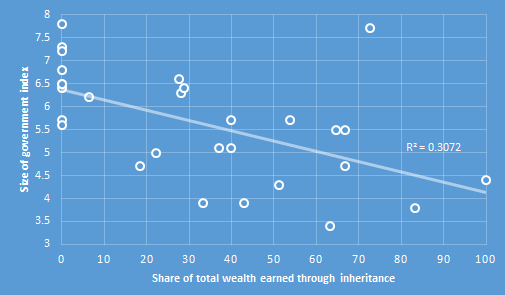
Yet, as many scholars have pointed out, large fortunes can be rapidly consumed by squabbling heirs and poor investments (see this paper here notably). Thus, the fortunes gathered by parents who earned government favors can melt away over time. Nonetheless, governments do protect the fortunes of the heirs if they continue in business. For example, the heirs of the Bombardier family in Canada continued their ancestor’s work and remained relatively well-off. This is in part because governments continue to rescue that firm from its misfortunes. In a way, government may act to limit the erosion of fortunes. We can phrase this differently by asking whether or not the size of government is correlated with the share of wealth from the “ultra-rich” that is gained through inheritance.
Using a working paper from the Peterson Institute for International Economics titled The Origins of the Superrich: The Billionaire Characteristics Databaseauthored by Caroline Freund and Sarah Oliver and the Economic Freedom Index of the World produced by the Fraser Institute (released this week), we can check for the existence of this correlation. The paper by Freund and Oliver documents the share of the total wealth of billionaires that was earned through inheritance.
Unsurprisingly (for me), the lower the index for the size of government, the greater the share of wealth earned through inheritance. Using all OECD and European countries, we can very well see that the size of government is negatively correlated with the share of wealth from inheritance.
Maybe, just maybe, those who believe that the solution to rising inequality is more government redistribution should be willing to reconsider their proposed cure. This is, I believe, an additional cause for skepticism regarding remedies.
Paralympics are over, and with them the cycle of Olympic Games in Rio de Janeiro. Once again the city was able to put up a good show, and thankfully all went well in the Cidade Maravilhosa. But not everything is alright in Rio: even more than the Olympics, the Paralympics were able to show the contradictions between the city where we live everyday and the city of the event: Rio is not welcoming for people with disabilities.
At least in Brazilian Portuguese, political correctness has done a mess with vocabulary concerning the kind of people who compete in Paralympics. We are not supposed to say they are disabled (don’t even think about saying they are crippled!). I think the correct vocabulary today is, as I used, “people with disabilities.” But even that is under political correct scrutiny, so it seems. All this discussion about words springs from cultural Marxism, postmodernism, relativism and the belief that there’s nothing objective beyond our vocabulary. But words can’t hide the reality: Rio is unequal. The way it treats the blind, the lame, and even the elderly or the young, is completely different from the way it treats people in middle-age and more able to walk. And all that despite strong legislation in this area.
One of the greatest debates in political philosophy in the 20th century happened between American philosophers John Rawls and Robert Nozick. Trying to build on classical liberal foundations (but moving to egalitarian liberalism), Rawls pointed out that “equality was supposed to be the moral benchmark for social and political institutions, and that any deviation from equality had to be specially justified.” Nozick answer was that liberty upsets patterns. Even if we have a starting point in society where we have a perfectly equal distribution of goods or assets, the moment that we allow people to be free to make their own choices (as liberalism prescribes) they are going to make choices we cannot possibly predict, and these choices are going to upset any kind of pattern we established in the first place. That happens because each one of us is unique in its own right: each one of us have a specific set of values, preferences and circumstances that upsets any would-be planner. So, if you want to respect human liberty to make choices, you have to give up on any plan for material equality.
Nozick’s answer to Rawls has a lot of Adam Smith in it. In The Theory of Moral Sentiments (1759) (preceding the more famous Wealth of Nations both in time and argument) Smith presented a character called “man of system.” This person sees society as an architect sees a blueprint for a construction. Smith says such person is “apt to be very wise in his own conceit; and is often so enamored with the supposed beauty of his ideal plan of government that he cannot suffer the smallest deviation from any part of it.” The problem is that humans have free will, the ability to make choices. And as such, they will upset any blueprint prepared for them. In other words, “individual people are not chess pieces you can move on a board with their dreams and desires ignored.” To the eyes of the would-be planner, “society must be at all times in the highest degree of disorder.”
So, material equality of outcomes (or at least of opportunities) is totally out of reach? Should we disregard it completely? Should the “invisible hand” prevail in spite of the weakest in our society? I don’t think so. Just the opposite! One of the very reasons I find classical liberalism morally appealing is the fact that no economic or political system ever conceived helps the weakest as it does. In other words, contrary to (what seems to me is) the popular belief, classical liberalism defends social justice more than any of its intellectuals alternatives. Answering John Rawls’s famous claim that “a just society will be one whose rules tend to work to the maximum advantage of the least well-off classes,” Friedrich Hayek pointed out exactly this. In The Constitution of Liberty, Hayek agreed with Rawls about the end at which social institutions should aim: the welfare of the least advantaged. He simply disagreed about the means Rawls thought would get us there.
Instead of thinking of us as chess pieces on a board, when can use the analogy of a soccer game (or football, or basketball – suit yourself). The outcome of the game is the result of the player’s individual abilities, but it is also the outcome of the rules. In other words, in a free society, where people are free to choose, the outcomes are not just the result of the innumerable decisions of countless individuals. They are also the result of the rules enforcing property rights, contracts, taxation, and so on. So, it’s important to think about the justice of these rules, as well as the outcomes they might have. The point is that we can embrace a theory of social justice, but that just tells us the end we are heading to, not the means to get there.
Contrary to egalitarians, progressivists and socialists claims, no theory “tends to work to the maximum advantage of the least well-off classes” as classical liberalism does. And that’s a great reason I support it. As I said in the beginning, Rio is very unequal, despite decades of egalitarian policies in the city and in Brazil as a whole. On the other hand, there’s plenty of evidence that classical liberal policies tend to help the very people others accuse it of ignoring. When it comes to doing social justice, it’s important to have not just the heart, but also the mind in the right place. And I believe classical liberal policies are this place.
I will vote for Gary Johnson knowing full well my vote doesn’t matter, since Hillary has a lock on California. But between Trump and Clinton, whom to root for? Trump is an empty suit with a filthy mouth. Clinton is pure evil, hell-bent on extinguishing what remains of our freedom and prosperity. Fascist dictatorship is her goal, draped in red-white-and-blue bunting. Will someone please write an update of the Sinclair Lewis novel, “It Can’t Happen Here”?
Forced to choose, I’d have to go with Trump. His election would be a much needed kick in the teeth to the Eastern establishment. We would have to hope he would listen to cool-headed advisors once in office. Or maybe get bored and resign.
But as I write, I remind myself that there is precious little any president can do, even Gary Johnson, to alter major trends that have so much momentum. You can recite the list as well as I can: government debt and unfunded liabilities, nuclear proliferation, race and class divisions, climate change hysteria to name a few.
To hell with them all. I’m going outside to enjoy the sunshine while I can.
Lately I have been thinking about how minorities affect the Democratic Party here in the US. Basically, all minorities vote for the Democrats in national elections, but minorities tend to be conservative culturally. This has the effect of pulling the Leftist party waaaaay to the center (a fact that makes it hard for me to complain about Democrats’ pandering tactics).
Sure, the GOP will always be the party of old white people, but if the Democrats’ left-wing is essentially neutered due to minority voting blocs within the Party, who cares?
The fact that the Democrats pine for minorities explains why the US has never had a very powerful socialist movement. Socialists will often blame “neoliberals,” “capitalists,” “reactionaries,” and other assorted boogeymen, but doesn’t the minority insight make much more sense?
This minority insight has also got me thinking about demographic changes in Europe over the past 30 years. Basically, Europe has had a huge influx of immigrants since the fall of socialism. In the old days, Sweden was for Swedes, France was for the French, Germany was for Germans, etc. etc. This mindset helps to explain why European states had such overbearing welfare states and why economic growth was so limited up until the late 1980s.
As immigrants moved into these welfare states, the Left-wing parties began to pander to them. This had the same effect as it did in the United States: culturally conservative voting blocs diluted the Leftism of traditionally Left-wing parties. As a result, these welfare states became less robust and economic growth became attainable again.
A big underlying point about my musings on this subject is that socialism relies on nationalism in the area of popular politics and policymaking. Without Sweden for the Swedes-type sloganeering, socialism becomes ridiculous to the masses. This underlying point, along with the straightforward fact that immigrants dilute socialist power (economic, political, and cultural), suggests to me that libertarians who pay close attention to popular politics should relax when it comes to the fact that minorities don’t find libertarian ideals all that appealing.
Urban theorist Richard Florida is celebrated for arguing that cities today succeed by attracting members of the “creative class.” In a similar spirit I have a recent paper with Noel D. Johnson where we investigated whether or not cities in medieval and early modern Europe grew faster if they possessed a Jewish community.
Scholars have long noted the role of minority groups in economic development. This is particularly true for the the premodern period. The great scholar of long-run historical development in Europe, Fernand Braudel, observed that “successful merchants who controlled trade circuits and networks often belonged to foreign minorities.” These minorities could be other nationalities or religious minorities, for example, “the Jews, the Armenians, the Banyans, the Parsees, the Raskolniki (Old Believers) in Russia or the Christian Copts in Muslim Egypt” (Braudel, 1979, 1982, 165).
Hornung (2014) studies the impact of the Huguenot migration to Prussia. Since the nineteenth century, scholars like Friedrich List linked the presence of Huguenots with the transmission of human capital, skills, and innovation. Hornung (2014) is able to test this hypothesis using Prussian immigration lists from 1700 that document the location of Huguenot settlements and firm-level data on input and output for all 750 textile manufactories in Prussia in the year 1802. Approximately 16,000 to 20,000 Huguenots fled France to Prussia at the end of the seventeenth century. Hornung finds that the presence of Huguenots significantly increased firm productivity. Specifically, a 1 percentage point increase in the share of Huguenots was associated with 1.5 percentage points higher productivity in 1802.
Jewish Communities and City Growth
In our paper we take a broad sweep of European history from 1400 to 1850. We have a total of 1,792 cities in our panel data from the Bairoch (1988) dataset and 1,069 Jewish communities that appear in the Encyclopedia Judaica. The figure below shows both the cities in the Bairoch dataset and the Jewish communities mentioned in the Encyclopedia Judaica.
To understand the relationship between the presence of a Jewish community and subsequent city growth we conduct a difference-in-differences style regression analysis.
The fact that we have data on city populations every century means we can hold constant the identity of a city using city fixed effects and see whether or not it grew faster in the centuries when it had a Jewish community in comparison to those centuries when it did not. We can also control for the possibility that overall city growth was faster in some centuries in comparison to others using century fixed effects.
We are also able to hold constant other factors that could plausibly have affected city growth. We control for local geography including cereal suitability, proximity to rivers, and proximity to coast, as these factors likely affected city growth in different ways over time. We also control for local infrastructure including presence of university and distance to a medieval trade route.
Our analysis suggests that, indeed, cities with Jewish communities grew faster on average between 1400 and 1850. The effect we find suggests that cities with Jewish communities grew about one third faster than those that did not have Jewish communities. This analysis remains a correlation, however. We do not know if the presence of a Jewish community brought with it economic benefits or if Jews merely choose to settle in faster growing cities.
Instrumenting the Presence of a Jewish Community
We model the network of Jewish communities as one way to see whether the effect of Jews on city growth was indeed casual. By examining how Jewish communities expanded we hope to isolate a source of exogenous variation in the presence of a Jewish community.
We assume that a Jewish community is more likely to be established close to another Jewish community because of trade networks, financial relationships, or cultural linkages. We then calculate the closest travel path between Jewish communities using our information about the location of roads and river networks and estimates of premodern transport costs. The important assumption we make is that if cities with Jewish communities share certain “unobservable” characteristics that might make them more likely to grow rapidly, these characteristics become less correlated with distance.
We then divide Europe into 5km x 5km grids and assign the lowest travel cost to each grid. We apply Djikstra’s algorithm to determine the lowest cost of travel between all 3,211,264 city pairs (van Etten, 2012). This allows us to create a measure of ‘Jewish network access’ for each city.
Jewish network access itself is, of course, correlated with the unobservable characteristics of the city for which it is calculated. To overcome this we adopt two strategies to create valid instruments out of the network access measures. First, we calculate Jewish network access for cities that are only more than a certain distance away from each other. Second, we use information on expulsions to weight our measure of Jewish network access. The intuition behind this is that Jewish expulsions consist of an exogenous “push” factor leading to Jews settling in new cities close to the existing network of Jewish communities. Using these two strategies we obtain similar (though larger in magnitude) effects from the presence of a Jewish community on city growth. This provides further suggestive evidence that the correlation we found in our baseline analysis was indeed causal.
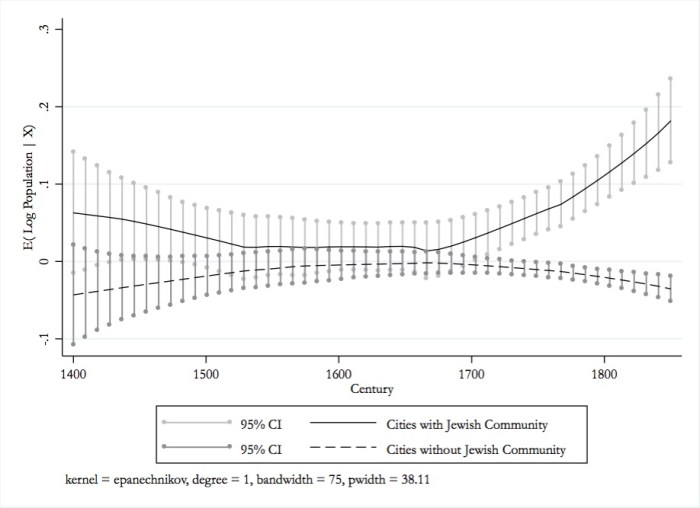
The Relationship Between Urban Growth and the Presence of a Jewish Community Over time
Across specifications, we find that cities with Jewish communities experienced no growth advantage in the 15th and 16th centuries. After 1600, however, they began to grow significantly faster.
The relationship we observe in the Figure does not appear to be inline with a pure human capital story. Jews had higher human capital than Christians throughout the medieval and early modern period. But the growth advantage of cities that had Jewish communities only became evident after 1600. This raises the possibility that something else changed around 17th century that made the human capital and skills of Jews more complementary to economic growth.
Two Mechanisms: Jewish Emancipation and Market Access
The two factors that stand out in explaining the emergence of a growth advantage for cities with Jewish communities after 1600 but not before are: (1) Jewish Emancipation after 1750; and (2) a complementarity between the presence of a Jewish community and market access.
The process of Jewish emancipation began in continental Europe after 1780. It was a major institutional break that signified a major change in the economic, social, and political status of the Jews in Europe. In work with Jean-Paul Carvalho, I’ve shown that Jewish emancipation lead to a religious schism and the emergence of both Reform and Ultra-Orthodox Judaism.
In the period before Jewish emancipation, legal barriers limited the ability of Jews to put their labor to its highest value use. Jewish businesses were prevented from hiring non-Jewish workers. Jews could not attend universities. Moreover, Jews and Christians were culturally isolated. This changed with emancipation, and we expect to see it reflected in the contribution of Jewish communities to city growth in the post-1750 period.
The second factor we study is the complementarity between the presence of a Jewish community and the development of markets. The historical literature points to the importance of Jewish trading and financial networks. But, while economic historians have conducted numerous studies of market integration during the early modern period, with a few exceptions these have focused on the grain trade with little systematic study of other markets due to data limitations. Jewish merchants in medieval and early modern Europe, however, did not play a prominent role in the grain trade but, rather, were involved in the transport of diamonds, sugar, silks, tobacco, and other luxury products in addition to playing a large role in banking and finance. Therefore, rather than looking at grain markets, we explore a more general measure of market integration based on market access.
Market access depends on the population size of nearby cities weighted by the cost associated with the least cost travel path. We show that market access was increasing for all cities after 1700. We find evidence that cities with Jewish communities were better able to take advantage of this increase in market access. As we detail in the paper, our findings are consistent with the argument made by numerous historians that Jewish trading and finance networks help to knit together the European economy, particularly in the period 1650 to 1800 (Israel, 1985).
Our analysis provides support for the accounts of historians who have emphasized the important role played by Jewish traders in 17th and 18th century Europe (such as Fortune, 1984; Israel, 1985; Trivellato, 2009). Furthermore, our story is in line with institutional arguments such as those developed by Douglass North, John Wallis and Barry Weingast, and Daron Acemoglu and James Robinson. In the Middle Ages, the presence of Jewish communities was part of an institutional arrangement that extracted rents from society and distributed them among members of the ruling elite. The eradication of these rent-seeking arrangements and the liberalization of Jewish economic activity, first in the Netherlands and England and then in the rest of Europe following Jewish Emancipation, was of critical importance as it is in those cities that possessed emancipated Jewish communities that we observe the strongest relationship between the presence of Jews and economic growth.
No meu último post ofereci uma definição de capitalismo baseada nos conceitos de escolha pessoal, trocas voluntárias, liberdade de competição e direitos de propriedade privada. Em resumo, um capitalismo liberal ou uma sociedade de livre mercado. Neste post eu gostaria de começar a desfazer alguns mitos, equívocos e objeções comuns ao capitalismo (se entendido nos termos que defini anteriormente). A lista não é exaustiva, mas acredito que cobre bastante terreno da discussão. Aí vai:
Ser pró-capitalismo é ser pró-grandes corporações.
Adam Smith observou que empresários dificilmente se encontram para eventos sociais, mas que quando se encontram não conseguem evitar combinar meios de evitar a mútua concorrência. Empresários (especialmente donos de grandes corporações) tendem a não gostar de concorrência. É compreensível. A maioria de nós também preferira não ter colegas de trabalho com quem competir, assim como vários corredores hoje gostariam que Usain Bolt não existisse. O capitalismo liberal, no entanto, é um sistema de perdas e ganhos. Numa economia verdadeiramente livre de intervenção do estado é improvável que corporações se tornem desproporcionalmente grandes. A tendência é ao nivelamento.
O capitalismo gera uma distribuição de renda injusta
Uma das grandes objeções ao livre mercado é a desigualdade de renda. No entanto, nenhum sistema econômico na história foi tão eficiente em retirar pessoas da pobreza quanto o capitalismo. Numa economia verdadeiramente livre a desigualdade existe e é basicamente inevitável, mas não é nada quando comparada a sociedades que optam pelo controle estatal da economia. China, URSS e Cuba são os países mais desiguais da Terra.
O capitalismo é responsável por crises econômicas, incluindo a mais recente
A crise de 2008 foi causada por intervenção do governo norte-americano nos setores bancário e imobiliário. Sem intervenção do governo, instituições financeiras teriam um comportamento mais cuidadoso e a crise seria evitada. A mesma observação vale para basicamente qualquer crise econômica dos últimos 200 anos.
Capitalismo explora os pobres
A livre concorrência, por definição, não é um sistema de exploração. Quando eu pago cem reais por um par de sapatos, isso significa que eu valorizo mais o par de sapatos do que os cem reais. O sapateiro, por sua vez, valoriza mais os cem reais do que o par de sapatos. Isso não quer dizer que não existam vendedores inescrupulosos, ou que não existam compradores injustos. Mas numa sistema de livre concorrência as possibilidades de fraude são mitigadas justamente pela concorrência: se o produto ou serviço não agrada ao consumidor, há sempre a possibilidade de procurar a concorrência. Em resumo, no capitalismo o consumidor é rei. Para concluir este ponto, apenas uma observação: o salário é nada mais do que o preço que se paga pelo trabalho de uma pessoa. E as mesmas observações se aplicam.
Capitalismo é injusto
Algumas pessoas nascem com deficiências. Algumas pessoas nascem em famílias pobres ou desestruturadas. Isso é injusto? Por quê? Uma definição clássica de justiça é “dar a cada um o que lhe é devido”. O que nós é devido? O que nós merecemos? Eu merecia ter nascido com boa saúde? O que eu fiz para merecer isso? Estas perguntas facilmente nos levam a grandes indagações filosóficas e teológicas, e logo demonstram o quanto a acusação de injustiça numa economia livre é superficial. Ainda assim, nenhum sistema político ou econômico permite a ajuda aos desfavorecidos como o capitalismo. Se você considera injusto que existam pessoas sem dinheiro, sem saúde ou sem famílias estruturadas, sugiro que seja coerente e use mais do seu tempo e dinheiro para ajudar estas pessoas.
Capitalismo não traz felicidade
Pensando num sentido aristotélico, felicidade possui significados diferentes para cada um. Para um cristão significa ter um relacionamento pessoal com Deus através de Jesus Cristo. Provavelmente um não cristão não irá concordar com este conceito de felicidade. Dito isto, a liberdade econômica não tem como objetivo trazer felicidade para qualquer pessoa, e assim é injusto culpá-la por algo que não propõe fazer. Porém, dentro de um sistema de liberdade econômica a tendência é que a liberdade para a busca da felicidade também esteja presente. Além disso, com liberdade econômica é mais provável que consigamos buscar nossa felicidade através da criação de uma família, do envolvimento com instituições religiosas, ou mesmo ficando ricos simplesmente.
Capitalismo não é estético e é poluidor
Os países mais poluidores do século 20 foram URSS e China. Proporcionalmente ao tamanho da sua população, EUA está longe do topo desta lista. Quanto ao fator estético, sugiro pesquisar por imagens da Alemanha Ocidental e da Alemanha Oriental, ou da Coreia do Sul e da Coreia do Norte. Dizem que a beleza está nos olhos de quem vê, mas me parece bastante óbvio que esta acusação estética é simplesmente falsa.
Corporações são cheias de escândalos e extorsão
Com certeza elas são. Mas possuem o mesmo nível de corrupção de governos? A matemática é bastante simples: quanto mais governo, mais corrupção. Além disso, com uma corporação é possível simplesmente levar o dinheiro embora dali. Governos não são tão permissivos com evasão de impostos. A proposta de criação de mais sistemas de vigilância governamental apenas aumenta o tamanho do governo e as possibilidades de corrupção. A ideia de transparência e de consulta popular também é simplesmente falsa: a não ser que possamos passar 24 horas de nossos dias vigiando os governantes, estes sistemas simplesmente não terão possibilidade de funcionar. A solução mais simples continua sendo menos governo.
Há mais alguns tópicos que podem ser acrescentados e que deixarei para um futuro post. Por enquanto basta dizer que capitalismo (definido como livre mercado) pode ser bastante diferente daquilo que popularmente se entende.