Socialism(s) – Part One

Sanders and Me and not so Democratic Socialism

Sen. Sanders got a huge pass this primary season. Captivated by the deep dishonesty of one probable nominee and the crude ignorance of the other (not to mention his plain crudeness), the media, and informal commentators like myself, have not given the Democratic candidate and his program the attention they deserve. Also, in the current primary contest, it’s difficult not to like the guy. I have said several times that he inspires in me a kind of twisted affection. Plus, he has real pluck. But, let’s face it: He is probably done, or done for.

Sen. Sanders has gone very far into the primary while maintaining perfect dignity in his demeanor. He has seldom stooped to personal insults even when he was being severely tried by a Ms Clinton who seems to consider the man’s very candidacy a grave offense, an offense against the natural order of things, a crime of lèse-majesté, even a form of woman abuse. In the meantime Mr Sanders will have single-handedly rehabilitated the word “socialism.” This matters for the future of this nation. Time to look at it critically.

I, personally, especially like Sanders the man. I have reasons to. We are the same age; we went to college at about the same time, both in good universities. He took a fairly active part in the desegregation movement. I did not because it was too early in my American sojourn. (I wish I had taken part.) Nevertheless at age 25, Sanders and I were both leftists. The main difference between us is this: Fifty years later, he has remained impeccably faithful to the ideals of our youth while I walked away, faster and faster, really. I learned to understand the invisible hand of the market. I did some good readings. I was lucky enough to observe my leftists academic colleagues in action at close range early on. Cannily, I observed that the victorious Vietnamese Communist Party did not establish a workers’ paradise in its part of the world. I loathed authoritarianism in any guise. The Senator, meanwhile, spent his honeymoon in the Soviet Union.

When that latter country fell apart and its archives were open, the Senator had nothing to say about the eighty years of mass atrocities they revealed. I am guessing he did not think he had to because he believed in the democratic brand of socialism. It’s hard to tell how much history he knows. (I think that liberals in general are ignorant, including academic liberals. I could tell you stories about them that would raise the hair on the back of your neck.) It does not take much knowledge though to guess that Lenin and the 1916 Bolsheviks did not originally set out deliberately to create a tyranny. Too bad they had to come to power by overthrowing by force of arms a democratically elected government. (See “Kerensky.”) Still, they named the new country “The Union of Socialist Soviet Republics,” and the word “soviet” means “council,” and “republic” means what it means. But, building socialism wasn’t working out; too many people with bad attitudes. So Lenin had to nudge History a little bit with bayonets, with barbed wire, with organized famines and soon, with a bullet to the back of the head of those who stood in the way. The Bolsheviks were forced to choose between socialism and democracy. They chose the former and they got neither. There is no record of Sen. Sanders making any relevant comment. (As always, I am eager to correct my errors.)

It’s less clear whether the Communist Party of China ever had a democratic plan. The unauthorized biography of Mao by his personal doctor reads like a tissue of horrors right from the start. (Dr. Li Zhisui. The Private Life of Chairman Mao, 1994) The Communist Parties of Eastern Europe simply came to power in the wagon train of the Red Army occupying their countries. None of them ever got close to getting there through free elections. The most interesting is the case of East Germany, ruled by a fusion of a native communist party and of preexisting democratic socialist parties. Together, they achieved a fair degree of material success for the East German people yet, they never managed to make do without a police state. Today, Sanders’ backers may not remember or they may not know that the German Democratic Republic, as it was called with a straight face, disappeared overnight. Someone had left a back door open to this paragon of socialist success and the people immediately started voting with their feet by the tens of thousands.

This is all irrelevant, Senator Sanders’ supporters would claim. You are describing a grave perversion of socialism; again, we only want democratic socialism.

During much of my adult life, the ill-defined words “socialism” and “socialist” were used with all kinds of modifiers: “African socialism,” “Arab socialism.” In all cases, the regimes so named led their countries straight to poverty, usually accompanied by official kleptocracy. In India, a really democratic country, the mild Ghandian-Nehruan form of socialism produced deep poverty for two generations including in the large, educated Indian middle class . (Just compare and contrast with un-socialist South Korea which started in 1953, after a devastating war, much poorer than India had been in 1949 when it became independent.) Socialism – whatever that is – is normally the road sign that points toward generalized poverty. Perhaps, this is only the result of a fateful case of reverse magic naming: Call something good, reasonable “socialist” and it begins degrading and sinking! Go figure!

OK, this is all about ancient times, they say. So, let’s look at current examples.

In Venezuela, socialism started under unusually favorable conditions because the country had considerable oil income that minimized the need for high taxation, a major reason for discontent in most socialist experiments. Yet, the socialists in power there made such a mess of it that today, only a few years later, the country suffers about 400% inflation (in 2016). If you had a dollar’s worth of local money there 12 months ago, it now only buys about a quarter’s worth of milk or bread. The skilled middle-class is leaving or trying to. They may return later; or, they may not. If they don’t, it will take a couple of generations at best to rebuild the country’s human capital after the socialist experiment ends.

Note that the sharp drop in world oil prices has affected many countries. It’s only in “Bolivarian” socialist Venezuela that you will see mass exodus and severe shortages of necessities.

In Brazil, The Workers’ Party is in power. The sitting president is a woman whose bona fide, whose socialist credentials are not in question. When she was young, she was imprisoned and even tortured for her belief in socialism, or because she was a guerrilla. (That’s the name for a left-wing terrorist.) She would now be impeached for making up optimistic economic figures for her country, except for the fact that the man constitutionally designated to replace her is also under indictment for corruption. It was bound to happen. The federal government in Brazil eats up 40% of GDP. The huge national oil company, Petrobras is nationalized; it belongs to the government, a favorite socialist arrangement. So oil revenues belong to everyone which means they belong to no one. Why not help myself a little, generations of Brazilian politicians have figured? There are no shareholders to keep tabs and to complain, after all. Socialism and kleptocracy are like father and son.

But, but, you say, those are Third World countries that have not yet recovered from the corrupting influence of colonialism (200 years later). Point well taken. Here is another case I know well, of a socialist country that has not been colonized since about 50 (BC.) France has been under the guiding hand of the French Socialist Party for nearly five years this time around. By the way, France is a democratic country with fair elections and a free press. The Socialists won fair and square. They were in power for 23 of the 35 years since 1981. They largely implemented their program and there were few rollbacks – except by themselves, a few times when they understood the disastrous effects of the reforms they had implemented. I am thinking of a broad de-nationalization of banks in 1981-82. (This is directly relevant to Sen. Sanders’ thinking.)

The French Socialist Party in power never tried to restrict freedom of the press and it did not fill the prisons with its opponents. (Instead, it emptied them hastily of violent criminals, according to its security critics.) By and large, its rule has been quite civilized. There is just that pesky problem of chronic unemployment which never dips much below 10% (25% for the young; sky is the limit if you are young and your name is “Mohamed”). There is also the fact that economic stagnation is now seen as normal by the young. Has been for a couple of generations, now. And then, there is the unbelievable cultural sterility of French society (another story, obviously that I partially tell elsewhere on this blog. Ask me.)

True story: a few months ago, members of the socialist government celebrated loudly. That was because the government office of economic analysis had revised upward its estimate of annual economic growth from GDP: + 0.4% to +0.6% ! (Yes, that’s 6 tenth of one per cent. It’s true that today, in the spring of 2016, it’s at a respectable annual 2% plus.)

“No, no,” cries Sen. Sanders ( and I can almost hear him from here) “I don’t mean ‘socialist’ as in ‘Union of Socialist Soviet Republics,’ and I don’t mean Red China, and I don’t mean North Korea, certainly, and I don’t mean Cuba (although…), and I don’t mean Venezuela today, or Brazil. And, I don’t even mean France although I could not explain why exactly. (Bad call here, Senator. The French single-payer health care system works well; it’s cheaper than US health care, and French men live two years longer than American men.) I mean socialism as in Denmark and Sweden. Now, here we are at last. In part Two, we will look at what passes for Swedish “socialism.” (Denmark is too small to be an example, perhaps.)
A Hayekian View of Safe Spaces

The concept of a “safe space” has dominated the discourse in identity politics for the last several years. Proponents of safe space, mostly left-leaning millennials are now demanding that colleges, schools, corporations, and various other institutions remove potentially offensive or triggering ideas or images that might harm minorities. Much of the time, this leads to hilariously captious nitpicking over things like Halloween costumes and ethnic food. Other times, it leads to what critics (mostly conservatives and libertarians) see as threats to free speech. It has led to violent reactions to opposing candidates, the ridiculous firing of college presidents, and censoring of speakers at universities.

Largely, the conservatives and libertarians are right. College and society as a whole are not and should not be “safe spaces.” Especially in education, one should be exposed to offensive, radically different ideas and world views. The reason free speech and academic freedom exists, as JS Mill argued in On Liberty, is because stifling freedom of expression robs humanity of potentially true ideas in the future. There is a similarity the merits of freedom of speech and entrepreneurship in the market; dissenters with public opinion are essentially ideological entrepreneurs who are discovering better vocabularies and better ways of thinking. If we stifle the free market, we are stuck with the same suboptimal products, services, technologies and methods of production; if we stifle free speech we risk being stuck with the same false ideas.

There is little I can say in defense of free speech on college campuses that hasn’t been said before. How coddling the youth leads to intellectual stagnation, or how tolerance is a two-way street and if we are to tolerate liberal point of views, we should tolerate bigotry. However, there are two points that are too often overlooked in the debate over safe spaces by the right wing critics.

First, the idea that the drive for safe spaces and censorship of ideas is solely a left-wing phenomenon is a complete and total myth. Conservatives like to fashion themselves as the “strong” defenders of free speech and inquiry, and the wimpy leftists as fascists seeking to protect their fragile little feelings. Beyond the fact that these are over-generalizations, it is a fact that conservatism is occasionally as much an enemy to free speech in trying to create “safe spaces” for people who agree with conservative, Christian values as the leftists are in trying to create safe spaces for minorities. I might have selection bias in that I recently left the ultra-conservative Hillsdale College, but there were many comical attempts there to censor ideas of those who disagreed with the college’s overwhelming conservatism; whether it was the administration’s banning of an LGBT group, students protesting a theatrical performance that included gay characters, or the students throwing a fit over the college using Starbucks because their CEO is a liberal. Look no further than some of the policies at colleges like Bob Jones, Patrick Henry, or Liberty University (my mother’s alma mater, for the record) where free speech is regularly suppressed to support conservative propaganda. Or the events which bear an uncanny resemblance to the recent incident at Claremont at William and Mary last decade.

As a further anecdote, I was a co-founder of the Gadfly Group at Hillsdale which sought to intellectually provoke Hillsdale students by promoting non-conservative political and philosophical viewpoints. One day, the president of the college (Dr. Larry Arnn) flat out told me and the group’s main founder that he didn’t think the group should or needed to exist on campus. While we were forming, at least according to Arnn, one of the deans had attempted to stop our approval by the administration (though, thankfully, the provost disagreed). After the group’s formation, though we had a number of popular events and many of the students were supportive of us, many students ridiculed us as “pseudo-intellectuals” engaging in “intellectual masturbation” (actual words said to me), calling us “angry libertarians” (even though I was the only libertarian in the group and we did events on people like Rawls), and some students were extremely offended by our presence and said the group should be banned. If that’s not evidence of right-wing censorship on college campuses, I don’t know what is. It’s enough that I’d consider writing a book in the spirit of Buckley entitled Ubermensch and Man at Hillsdale College.

Second, despite the problems with safe spaces when applied to macro level social institutions, freedom of association is consistent with a limited concept of safe spaces when applied to micro level social organizations. Though I detest their means, I do sympathize with many of the ends of these so-called “social justice warriors.” I am a liberal in the Rortian sense that I think cruelty is the worst thing you can do, and much of this attempt to create “safe spaces” is an attempt to what they perceive reduce cruelty to minority groups. Of course, they take it way too far in complaints about cultural appropriation which are not cruel to anyone, but it doesn’t diminish the fact that safe spaces are a potentially useful construct if done correctly.

The biggest problem that the Social Justice Warriors commit is a problem that Hayek pointed out so eloquently in The Fatal Conceit. As Hayek points out, modern man exists in “two worlds at once.” One, we live in the micro-level war world of intimate social relations such as families, immediate communities, and friends. (The type of people who are included in Dunbar’s number.) But we also exist in the “extended order,” the macro-level relationships that include humans we interact with and know, but only distantly; like trading partners in a large market, other citizens of a nation, or other members of our larger culture. Hayek’s writings on this are worth quoting at length:

Moreover the structures of the extended order are made up not only of individuals but also of many, often overlapping, sub-orders within which old instinctual responses, such as solidarity and altruism, continue to retain some importance by assisting voluntary collaboration, even though they are incapable, by themselves, of creating a basis for the more extended order. Part of our present difficulty is that we must constantly adjust our lives, our thoughts and our emotions, in order to liver simultaneously within different kinds of orders according to different rules. If we were to apply the unmodified, uncurbed rules of the micro-cosmos (ie., of the small band or troop, or of, say, our families) to the macro-cosmos (our wider civilization), as our instincts and sentimental yearnings often make us wish to do, we would destroy it. Yet if we were to apply the rules of the extended order to our more intimate groupings, we would crush them. So we must learn to live in two sorts of worlds at once.  (Bold mine, Italics his)

Those who would seek to create a safe space out of the entire university or society at large are applying the rules of our macro-cosmos to our micro-cosmos. The idea that we should not bring up certain topics or ideas in certain social situations out of considerations for our fellow human beings is the truth behind the safe space. But to apply that principle to every social situation within a university or nation is a huge mistake. Safe spaces make sense for some of those overlapping sub-orders and micro-level organizations, but not for the extended order of society. So while it is a huge mistake and assault to make a safe space out of an entire college campus, perhaps it is reasonable to make safe spaces out of a dorm room, or a professor’s office, or a meeting for a student group. While it is obviously a huge act of the most heinous form of censorship to ban people from questioning the morality of homosexuality, perhaps it makes sense to not bring up that topic at a college GSA meeting where many of the LGBT students are just seeking a place to belong, or when talking to a group of LGBT students who are facing severe psychological issues while being discriminated against.

If you think applying the concept of safe spaces everywhere and anywhere is always wrong, you’re probably apt to attack me for being “politically correct” for defending the concept in some situations. I agree, we shouldn’t be “politically correct” in the way that term is typically used, but perhaps we should be decent human beings and allow people to freely associate.

AEM Europe and PCPE in Prague, April 21-24 2016

I have recently returned home from 4 days of Prague, Czech Republic, where I attended two conferences: Austrian Economics Meeting Europe and the Prague Conference on Political Economy. After having been secluded from Austrian economists and Libertarians for almost 2 years, it felt like a homecoming to be surrounded again by people who share similar thoughts. This was after all the only place in the last two years where I was able to fully express my (´controversial´) ideas about society. Being surrounded by tremendously smart people – you have to be rather smart and geeky to give up part of your free time or professional work in order to visit conferences and discuss philosophy, politics and economics – within the beautiful city of Prague made it a wonderful experience.

The AEME came about after the summer of 2014 when those from Europe who visited Mises University that year decided to come together again to discuss classical liberal ideas in the spirit of Carl Menger, Ludwig von Mises, Friedrich von Hayek and Murray Rothbard. The first AEME event took place in 2015 in Vienna, Austria, the city where the Austrian School of economic thought emerged from the works of Carl Menger, Eugen von Böhm-Bawerk, Friedrich von Wieser, and others. The Austrian School is famous for its methodological struggle against the Prussian Historical School and their idea that economics is culture- and time-specific and therefore does not contain universal validity. The Austrian School is also famous for such theoretical contributions as the subjective theory of value (as opposed to Marx’ labour theory of value), theory of marginal utility, opportunity cost doctrine, Austrian business cycle theory, the time structure of production and consumption, methodological individualism and the economic calculation problem that was first formulated by Ludwig von Mises in 1920 and later expanded upon by Friedrich von Hayek to show that pricing systems in socialist economies were necessarily deficient. From a socio-political perspective, the School argues for limited government and some even for libertarian anarchism.

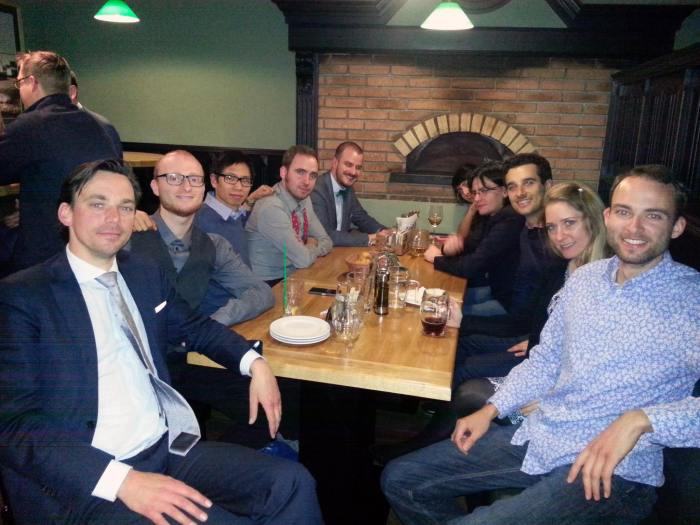
AEME pub
AEME participants sharing their last evening in Prague in a local pub

What was great about the second AEME is that it took place right before the PCPE conference at the CEVRO Institute. Most of us who attended AEME have stayed two extra days to attend the PCPE conference as well. The CEVRO Institute is a private university founded in 2005 that is located in the very centre of the city of Prague. The university prides itself in its emphasis on freedom, markets, and its innovative character that is for example manifested in its PPE (Philosophy, Politics, Economics) programme taught by such international illustrious professors as Michael Munger who is also director of Duke University’s PPE programme, Peter Boettke who is the director of the F.A. Hayek Program at George Mason University, David Schmidt who is director of the Center for the Philosophy of Freedom at the University of Arizona, Boudewijn Bouckaert who was the former dean of the Faculty of Law at the University of Ghent, and Josef Sima who is the president of the CEVRO Institute. The institute has invited several prominent speakers for its conference. Prof. Mark Pennington (London School of Economics) was for example invited to present “Why most things should probably be for sale”. Prof. Benjamin Powell who is the director of the Free Market Institute at Texas Tech University, the University to which I almost applied to to pursue my PhD in the academic year of 2015 but eventually decided to work as a software engineer, was there as well to speak about “Migration, Economic Calculation, and the European Situation.” Prof. Mario Rizzo (New York University) had the honour to be the keynote speaker and spoke about “The four pillars of new paternalism” which was followed by commentaries from Prof. Pascal Salin, former president of the Mont Pelerin Society.

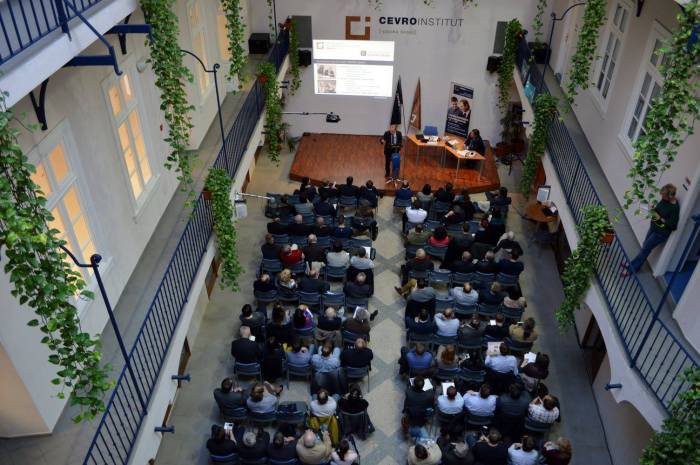
PCPE 2016
Mario Rizzo’s welcome speech to PCPE

The second day of the PCPE conference, there were 27 speakers spread over 9 sessions on such topics as economic theory, anarcho-capitalism, the Austrian School, entrepreneurship, cryptocurrencies, the role of family and more. I was one of the speakers and spoke on the “Philosophical investigation of seasteading as the means to discover better forms of social organization”. The thesis of my talk was that one core focus of political philosophy is to deal with the realities of value pluralism and political disagreements. I contended that the most common form of social organization, representative democracy, does not satisfactorily deal with these realities. Therefore, we should look for political possibilities beyond representative democracies and that in order to discover these possibilities, we should experiment with new forms of social organizations. By approaching the issue from a meta-system level perspective and realizing that governments are resistant to structural societal changes we should then introduce competition into the industry of governments. Seasteading, the creation of habitable dwellings on the oceans, could serve as a means to introduce more competition in the industry and lessen political tensions between citizens who hold different comprehensive doctrines.

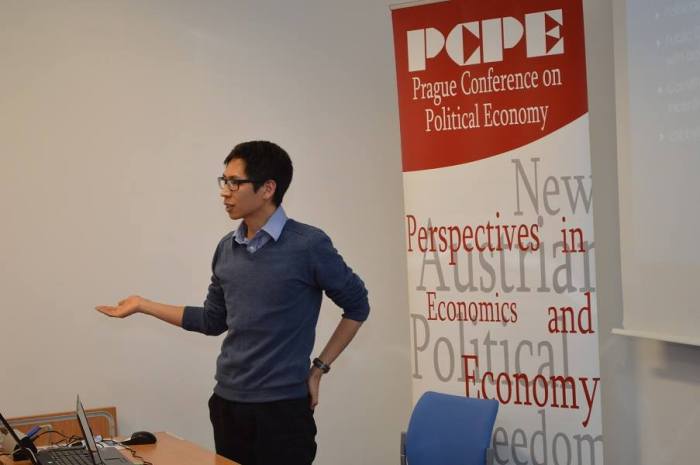
Chhay Lin - PCPE
Me speaking at PCPE about Seasteading as the means to deal with such political realities as value pluralism and political disagreements

If I could mention one thing that has made the most remarkable impression on me, it would be the warning issued by Prof. Stephen Baskerville (Patrick Henry College, USA) that the most immediate threat to our liberties is feminism and the social justice movement. He maintained in his talk that there is an ensuing crisis of the family which is perpetuated by the state. According to Prof. Baskerville, family courts can enter homes uninvited, take away people’s children, confiscate their property, and incarcerate them without trial, charge or counsel. With over 50% of all first marriages ending in divorce and more than half of all these divorces involving children, the greatest threat to our liberties is the colluding social work state bureaucracies with radical feminism. These groups have colluded to suppress information on such injustices. Listening to Baskerville’s talk, I felt the great urgency to engage in an intellectual battle against feminism and the social justice movement.

Other than the many intellectually invigorating moments, the city itself provided many magnificent sites. To mention several sights: we visited a beer garden, experienced a classical music concert at the Mirror Chapel, walked over the Charles Bridge, and visited the Prague Castle.

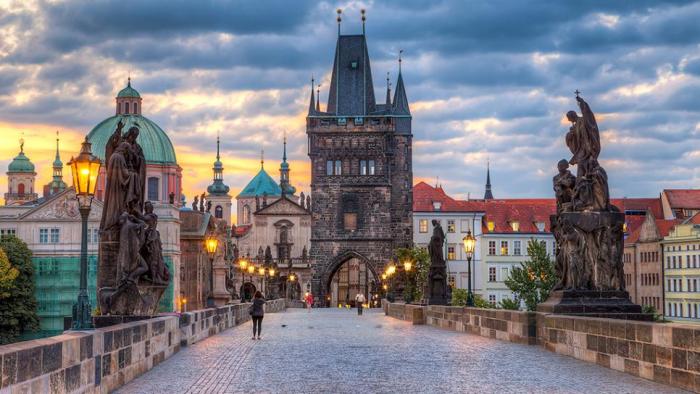
Prague Charles Bridge
The beautiful Charles Bridge crossing the river Vltava

All in all, the city of Prague, AEME and PCPE were an unforgettable experience! It has already been decided that next year’s AEME conference will take place in Krakow, Poland. The conference will be open for anyone who is interested in Austrian economics and libertarianism. For more information on AEME and the papers that were presented in the previous editions, you can find our website here. In case you are interested in studying at the CEVRO Institute and its MA PPE programme with specializations in “Austrian Economics”, “Studies of Transition”, and “International Politics”, you can visit their website here.

Vote Different. Be A Libertarian. Let Life Live

John McAfee’s latest political campaign ad is inspiring as it asks voters to vote libertarian. It is an homage to Apple’s “Think Different” ad as well as to individual freedoms, creativity and intellect.

The video shows ‘rebels’ and game-changers who have moved the world forward. You do find Steve Jobs, Elon Musk, Edward Snowden, Julian Assange, Peter Thiel, Bradley Manning, Ross Ulbricht, Martin Luther King, Ayn Rand and many more. You even see Bitcoin and crypto-capitalism which is simply another form of libertarian anarchism. Ending with the lift-off of a spaceshuttle, the ad presents a message of hope for libertarians and a message of progress as long as we “let life live”.

The same celebration of human individualism and message of hope was also apparent in McAfee’s earlier campaign ad that was released two weeks ago.

The Case Against Galactic Government?

Samuel Hammond, a friend of a friend, has recently written a blog post musing about whether trade between Mars and Earth should be discouraged. The basic premise is that the case for colonizing Mars is to decrease the likelihood of a catastrophe leading to the extinction of humanity due to a black crow event.

Inter-planetary trade would allow both planets to minimize the harms of minor to moderate events, Samuel seems to acknowledge this. This is how international trade today helps nations minimize the harms of localized events. The harm of the ongoing drought in California has been lessened due to ability of consumers to tap into markets elsewhere to meet their demands.  What Samuel is concerned about is those events whose danger increases in proportion to the inter-connectivity of markets. Samuel gives the example of financial markets, but allow me to introduce another similar danger: the Mule.

2-mule-foundation
The Mule, primary antagonist in I. Asimov’s Foundation & Empire

In Isaac Asimov’s sci-fi universe much of the known galaxy in the distant future comes under the rule of the Foundation Federation. The Foundation is a liberal galactic government that promotes intra-galactic trade, but grants each planet wide freedom to settle its internal matters. It has waged wars of defense, but is notable in that it has never waged a war of conquest and its members have all joined voluntarily. I would go as far to say it is an ideal form of galactic government. However the Foundation’s promotion of galactic inter-connectivity backfires when the Mule, a mutant human with the ability to influence minds, takes control of the government elite. The Mule is a single man but, due to the hyper-connectivity of the Foundation, can assume control with a few well placed followers. Almost overnight the Mule transform the liberal Foundation into his personal dictatorship. The last bastions of freedom are those regions of space controlled by pirates free traders.

Eventually the Mule is defeated and liberal government restored, but only because of the efforts of those polities outside the Foundation’s control. If the Foundation had been a monopolis, a government that controlled all of humanity, then it is doubtful the Mule would have been defeated. Inter-connectivity can yield significant benefits, but as outlined above it can also maximize the damage of black crow events.

Does this mean that Samuel is correct and that any further space colonies must be separated from Earth in terms of trade and governance? Not quite. Although I think Samuel’s concerns serve as an argument against extreme inter-connectivity between worlds, I do not think it is sufficient to justify actively building barriers between worlds. Rather I interpret black crow events as arguments in favor of tolerating the existence of rogue nations, such as North Korea, Somalia, and other contemporary nations that exist outside the primary world system.

As space exploration becomes a reality I think all efforts should be made to promote inter-connectivity between the various worlds. We should promote Earth-Mars relations. We should not however oppose those who wish to live in the asteroid belt and minimize their contact with the rest of us. This break away colonies will arise naturally and need not be actively created, only tolerated. These break away colonies will be founded by an assortment of pirates, religious zealots, political dissidents, and other outcasts. By tolerating their existence we will reap the benefit of space exploration while minimizing the likelihood of black crow events to destroy all of humanity.

Does the EU promote liberalization?

This is in response to Brandon’s earlier post asking for literature on the EU’s effect on promoting liberalization. The short reply is the EU promotes liberalization – sometimes. Below are two pieces of the literature on the issue.

On a quick aside, I have mixed feelings towards the recent Dutch referendum on the Ukraine-EU Association Agreement. I don’t think that the EU should extend a hand to Ukraine. Namely because I think the Russians are much more willing to use force over the issue than West Europeans. Secondly, because I think it gives peripheral countries the idea that they don’t need to join/remain in the EU to receive its protection. Moral hazard if you will.

However I disagree with co-blogger Evgeniy Grigorjev that Ukraine, and other peripheral nations, should be denied EU affiliation until they reach certain benchmarks. I’m sure that Ukrainian politicians would consider EU association a victory and feel less compelled to act. However the long term effect of EU membership would be greater trade in goods, people, and ideas. With any luck liberal ideas. I would welcome the EU expanding into North Africa and parts of the Near East if it meant the expansion of liberal ideas to those regions.


The Effect of Labor Migration on the Diffusion of Democracy: Evidence from a Former Soviet Republic {LINK}

This empirical paper looks at the effect of return migration on political attitudes in Moldova. The basic idea is that return migrants bring with them new political ideas from abroad.

In the late 1990s Moldova experienced financial trouble that encouraged many of its laborers to migrate temporarily to Russia and the west (largely Italy) in search of work. Regions with more return migrants from Italy were found to have the least support for the Communist Party in future Parliamentary elections. Regions where migrants went to Russia had increased (albeit sometimes small and/or statistically insignificant) support for the Communist Party.

There are two take aways here:

(1) Trade in ideas matter.
(2) The type of ideas you trade matter.

The EU, and the Schengen area, can promote idea trading but what makes the EU important is that it is a liberal institution. An institution that needs reform, but one worth keeping.

Anchoring Democracy from Above? The European Union and Democratic Backsliding in Hungary and Romania after Accession {LINK}

This paper looks at the different responses the EU took towards Hungary and Romania when the national governments of both respectively introduced illiberal measures. Discusses some of the weak points in the EU and how it can be reformed to improve its ability to react to similar future events. As Evgeniy points out, the EU has a weakened ability to punish illiberal policies once EU membership has been granted. Intra-EU coordination is also difficult to achieve to use those tools it does have. The EU is not however impotent and reforms could be introduced to rectify this.

Voter Participation: Something Has to Be Done

In California, 70% of eligible voters are registered, and 47% of those turned out in a recent election. Thus about a third of those who could vote do so. These are dismaying numbers.

Dismaying because they are too high.

Why? First, some more dismaying numbers:

When Newsweek recently [2011] asked 1,000 U.S. citizens to take America’s official citizenship test, 29 percent couldn’t name the vice president. Seventy-three percent couldn’t correctly say why we fought the Cold War. Forty-four percent were unable to define the Bill of Rights. And 6 percent couldn’t even circle Independence Day on a calendar.

Too many ignorant fools are casting votes. People who believe that minimum wage laws create wealth, free trade destroys wealth, or clergymen should be forced to marry gay couples, to pick just a few examples. We need to bar these ignoramuses from the voting booth.

How? For starters, ditch the 26th amendment to the Constitution and the raise the voting age to at least 30. Get the 20-somethings out of the way; too many still believe in free lunches.

Second, change the 24th amendment to require poll taxes rather than forbid them. There is no justice in forcing non-voters to pay election costs.

Third, institute stiff qualification exams. Voters need know the vice president’s name, understand the Cold War, identify July 4 as Independence Day, and a whole lot more. Informed voters would be mostly immune from pandering demagoguery.

Disenfranchisement will lead to alienation and rebellion, some will say. Perhaps, and this could be alleviated by a phase-in of the changes. But then voting will become a privilege that young people can aspire to, as they might aspire to a corporate management position.

Another objection: my proposal is elitist. Of course it is! If there’s one thing we desperately need in this country, it’s a reversal of the egalitarian sentiments that have poisoned so much public discourse. We need to encourage and acknowledge the best and the brightest. Ignorant fools should not be allowed to operate dangerous machinery or pull levers in voting booths.

The Dark Side of Polycentricity

Who’da thunk?!

This raises the question: would anyone pay attention if the federal government wasn’t such a mess? I don’t think so. Oh well… can’t win ’em all.

The European Union is Pathetic

So here we are. Prime Minister Cameron got his ‘special deal’ from the rest of the EU leaders. It is pathetic, from both sides. I like the Brits, and admire their great tradition in political thought. Because of their constant doubts about the EU, they are (potentially) the most informed about it, if the enormous flow of publications pro and con is a sign, which have seen the light since the eighties. Therefore, one questions the sincerity of Cameron, who has repeatedly said he will campaign against Brexit. His pathetic result seems a sure vote winner for the No side though. I find it hard to belief that anyone can be seriously convinced to stay in, if his four main results should do the trick.

These four are: a minor semantic thingy (Britain is exempt from striving to a closer union); a complicated procedure for a majority of national parliaments to reject or change intended European regulation (a comparable procedure has been a failure); the possibility to decrease the amount of children allowance for children who do not live in Britain to the purchase power parity level of the country concerned (especially aimed at Eastern Europeans); and finally an emergency break on social security benefits. Great results to build a campaign on…

These results are mostly symbolic, and while symbols are important in politics, it still amounts to little. So the other European leaders were not willing to change much in the way the EU is now run and its enormous amount of laws, rules and legislation. This is by far the saddest of it all. The leaders  let the moment pass to really change the EU, to not only address the British fear and frustration, but also those of the people of many other member states.

This is especially relevant for The Netherlands. On April 6 there is national referendum on the association treaty with Ukraine. The No-camp is leading the polls. If rejected (and the government acts accordingly, which it is not obliged legally), the whole treaty has to be discarded by the EU. We have been in this situation before. In 2005 the French and Dutch populations rejected the EU constitution by large margins. Only to have force fed on their throats a marginally different constitutional treaty a year later. So strange support for the EU had been decreasing for years.

The EU cannot make a fist in foreign politics, not in defense and security affairs, not in the current refugee crisis. It fails to ensure free competition in services, it still wastes billion of euros in subsidies on agriculture, regional support, industrial policies, et cetera. In short: it is a mess, the EU fosters the development of turning itself into an open air museum: admired for its culture, laughed at for its dismal politics and economics. Thanks a lot for the leadership, European Council.

I wish I could just list every idea I’ve encountered then never cite anything…

Steve Horwitz has a great piece in the Freeman that I wish I’d written. The tl;dr: Voting isn’t all there is to political participation. This is an idea that’s been bouncing around in my head as I’m constantly remound that I’m now an American citizen (sorry everyone else in the world…) and that this November I’ll be eligible to vote for who I think should foster anti-American sentiments internationally (Republicans) or  domestically (Democrats).

The other day I said I’d consider voting but I couldn’t recall whose name I’d write in (turns out it’s Willie Nelson*). But my usual response to any question about whether I’ll vote is “No, it just encourages the bastards.” When that’s countered with “blah blah blah civic engagement blah blah” I retort with,essentially, Horwitz’s point: My vote is not going to change the outcome**, but I can contribute value by trying to convince my students that economics matters and that a vote for third party candidate (even a Green Party vote) does more good than a vote for the big two.

I don’t know where I picked up that idea, but if I’d remembered, I would have posted his piece here before he did. Even better would be if I could just list a repository of everything I’ve ever read (or heard) in some public place and just write and write without worrying about citing anything.

Continue reading

What is the proper role of government? Galactic Edition

Mordanicus of Fascinating Future, a sci-fi blog, is musing over the purpose of galactic government. As Mordanicus points out, galactic empires are a staple of science fiction. They can be found in the Star Wars, Star Trek, Dune, Firefly and Foundation universes.

…the feasibility of a galactic empire is questionable.

In Asimov’s description of the galactic empire, it consists of 25 million inhabited planets and 500 quadrillion people, 20 billion per planet on average. It is hard to even imagine a planetary empire, and no such thing has ever existed in human history, let alone such enormous empire.

The fundamental issue with an empire of this size is effective control by the central government. Its sheer size makes it inevitable to delegate many administrative powers to “local” planetary official. But the more power is transferred to individual planets, the less power remains with the central government. The question is then what is the proper function of the imperial government?

What is the purpose of these empires though? In those sci-fi universes with aliens these empires serve some defensive role for our Milky Way galaxy, but in many sci-fi universes there is no clear visible external threat.  What is the purpose of the empire then? Or is it simply a way for wealth distribution by those living in the Saturn beltway?

I personally view merit in a galactic empire if it were able to maintain internal peace. I have no doubt that in a space faring civilization there will be pirates and I believe that there are economies of scale in galactic trade route policing.

There is also merit in an empire that can keep rogue planetary governments in check. A galactic empire would be restrained in its ability to govern on its own given the largess of space and would need to delegate many functions to different layers of government. An empire would however still serve as a last layer of resort for those petitioning against their planetary government.

What about NOL readers? Are you convinced that space piracy warrants an empire? Or would a space faring civilization be better government by planetary or sub-planetary governments?

Read the full post from Mordanicus here.

How to split up California?

The idea of splitting up California has been previously discussed on NOL (see here, here, and most recently). In this post I wish to consider how California could be split up.

California has a large population of 38.8 million. For comparison Canada has 35.1 million residents distributed among its 10 provinces and the New England states house 14.7 million yankees in six states. With such a large population it is not surprising that the state has several regions with distinct cultures. This in itself is not sufficient merit to split up the state. One of the wonders of a liberal republican form of government is that diverse populations can coexist so long as they are treated equally before the law and have the freedom to exercise their various cultures. The problem is when these cultural differences lead to different public policy demands.

Consider for example the issue of abortion. In most matters of religion it is sufficient to allow different faiths to practice their beliefs so long as they keep to themselves. Why should non-Jews care if Jews must follow kosher dietary restrictions? The same cannot be done with abortion though. Those who believe, often due to their religious inclinations, that abortion is murder cannot tolerate its practice among those of other faiths or atheists. What is to be done?

One option would be to break up California. Although those on both sides of the abortion debate exist across California, there is also quite a bit of spatial correlation. See here. The Central Valley and Inland Empire counties both have significant portions of their populations favoring abortion limitations. Both regions also have low support for same sex marriage, see here, so it is safe to assume that their cultural differences with the rest of California is not on just one issue but several important public policies.

I would caution those who propose splitting up California between its inland and coastal regions. Both the Central Valley and Inland Empire may be culturally conservative, but the inland northern counties do not seem to fall in line. Nor would I recommend the Coastal/Inland split for those concerned about partisanship, see here. The San Francisco Bay Area, Northern Coast and Los Angeles are liberal strongholds but the Central Coast and Orange-San Diego region aren’t.

Similarly a North/South split would do little to help address regional cultural differences. The North/South split would usually split the state apart at San Luis Obispo-Kern-San Bernardino county lines. This would lead to the conservative Central Valley being lumped into the same state as ultra-liberal San Francisco. Meanwhile the Inland Empire and Orange-San Diego counties would find themselves sharing a state with blue Los Angeles.

What would be a good split then?

I personally favor the creation of four new states. Jefferson (the northern coastal and inland counties), San Francisco (the bay area states), Los Angeles (LA County), Central Valley (everything between Fresno and Bakersfield roughly) and the rest of southern California.

Given that any division would have to be approved by Congress the new states of Jefferson, San Francisco, and Los Angeles would have to be gerrymandered in such a way as to ensure they are blue states and maintain as many electoral votes from old California as possible. The Central Coast would likely be gobbled up between LA and San Francisco.  This gerrymandering would be needed to get Democrat votes who would otherwise be against losing all those electoral votes. Although Democrats would get two more seats in the Senate the Republicans could favor the deal in order to sweep extra electoral votes from the Central Valley and Southern California.

Although the split would be less than perfect, it would still grant greater say over public policy to the conservation counties.

Thoughts? Further maps on Californian public policy opinions can be found here.

P.S. In regards to the water issue, I like to think that the split of California would lead to a revision of the Colorado River Compact and related laws in order to create a more market oriented process for water allocation. I can dream can’t I?

Is government decentralization the right answer to differences across regions?

That’s the main question being asked by Federico Boffa, Amedeo Piolatto, and Giacomo A. M. Ponzetto, all economists. I cruised through the whole paper (pdf) and have some superficial thoughts. One snippet:

Western California is more liberal, even among Republican voters and politicians; Eastern California considerably more conservative […] At a first glance, such a political divide might suggest that a break up of coastal and inland California would be optimal on preference-matching grounds […]

[H]owever [this is a] superficial assessment. [Eastern California] contain[s] a large Hispanic population that overwhelmingly prefers the Democratic party. This group is much less educated, less politically knowledgeable, and less likely to vote than Republican supporters in the region, who are on average older, whiter, and wealthier. At the same time, the left-wing Hispanic working class in the Valley shares the political leanings of highly educated liberals on the coast. This ideological alignment goes beyond mere partisanship and includes shared preferences over policies.

As a consequence, our model suggests that the political integration of California is welfare maximizing. For relatively uneducated inland minorities to have a government corresponding to their preferences, it is essential that they share a state with ideologically aligned liberal elites in the Bay area. Right-wing Californians, instead, are sufficiently educated and influential to have a voice in state-wide politics, despite being in the minority: California had a Republican governor for twenty-one of the past thirty years.

[This lesson] applies more broadly. Disadvantaged ethnic minorities— which are less educated and often politically underrepresented— should belong whenever possible to the same polity as better educated and higher-status voters having similar political preferences. Only then are politicians effectively held accountable to both groups. (29-30)

California is “welfare maximizing”? Somebody help me out here. Isn’t it also possible that poor Hispanics and rich liberals form a voting bloc in California as it is because of how the GOP is patched together? If California split into an East/West, current coalitions would be shattered and it doesn’t follow that rich liberals and poor Hispanics would share the same voting preferences in the new arrangement. It doesn’t follow that rich conservatives and poor Hispanics in a hypothetical East would be at odds, either.

The biggest weakness in the paper, if you can call it that, is that the authors are focused on the fiscal aspects of federalism rather than the diplomatic, cultural, and political aspects. Federalism binds people together and forces them to at least try to come to an agreement about some issues. That’s a big deal, though it’s obviously not sexy.

The paper is focused on the EU and the US. There are lots of interesting insights into the European Union but the US angle is kinda boring (I’m sure is vice-versa for readers living and working in Europe). (h/t Mark Koyama)

What’s the difference between Saudi Arabia and Islamic State?

One has captured the rent associated with being a state in the post-World War II world order. This means that one of these polities gets to build embassies in other states. It gets to participate in congresses. It gets to fly its flag at the United Nations and has access to the World Bank, military hardware markets (“for defense”), and FIFA tournaments.

Rent capture isn’t all good, of course. There are still costs. When Saudi Arabia beheads people, for example, it gets condemned internationally. Its reputation suffers. It has to repair relationships and launch rigorous public relations campaigns. Saudi Arabia has to do these things because if it looks intransigent to enough of its fellow states, there might be official repercussions for its actions. Saudi Arabia can’t just go around killing and looting and raping at will. It has to formalize its killing, looting, and raping through the international order by coming up with a national interest. (A national interest is also important for shoring up domestic support for such activities.)

But incorporating Islamic State into the international order is unfathomable. It’s an immoral action rewarding an immoral pseudo-polity. Besides, the sovereignty of the states of Iraq and Syria would be violated and their borders destroyed. It’s better to just keep bombing the region Islamic State claims to govern and arming the factions that claim to be its enemies. That’s been our policy towards the post-colonial world since 1945 and, while imperfect, it’s been working out well so far…

From the Comments: Military intervention, democracy, and stability

Longtime reader (and excellent blogger in his own right) Tam has an interesting response to Chhay Lin’s thoughts on the Paris terrorist attacks:

It is an interesting read indeed but there are two or even more sides to every story. What we are also noting is that many of these groups that hate Western interventionist policies also hate their own people for being different in one way or the other. However, I agree that the misplaced perception of democracy as the superior form of governance overlooks the essential internal historical and socio-political factors behind the politics of the different countries that have become victims of Western ‘sanctification’ processes fronted by bombs after daring to opt not to embrace democracy. Libya and Iraq were stable before Western intervention.

Tam’s point strikes at the heart of the difference between military interventionists and non-interventionists, I think. Libya and Iraq were indeed stable, but not everybody was free. In Iraq, Shias, Kurds, liberals, and religious Sunnis were all brutally suppressed, and this oppression stood in stark contrast to the freedoms that secularists, women, union members, some socialists, and the politically apathetic enjoyed. The sociopolitical dynamics in Libya were the same, though with different local actors.

This reality is something that both sides of the interventionist debate recognize, though the interventionist side seems to place much more faith in government when it comes to “doing something.” Jacques and Edwin, for example, have both argued that bombing ambiguous factions in Iraq, Syria, and Libya would contribute to the freedoms of the oppressed factions in those countries. Looking back on the debate makes it clear that they weren’t wrong, but look at what those freedoms have produced. Those freedoms have come at the expense of the freedoms of the factions that the dictators were protecting.

What this situation shows me is that the states of the post-colonial world are unviable. Stability comes at too steep a price (dictatorship), and democracy’s unpredictability only leads to predictably violent results in the post-colonial world.

This impasse, which I cannot be the only one in the world who recognizes, has led me to take a hard glance at two specific peace processes in the Western world: The diplomatic efforts of Europeans after the Napoleonic Wars (“Concert of Europe”) and the founding of the American republic, which is, in my mind, the most successful endeavor in the history of international relations. Neither of these efforts led to the complete abolition of war, but both have helped to maintain a relatively peaceful co-existence between large numbers of factions for long periods of time.

The Concert of Europe bought time for factions in the region to solidify their legitimacy at home, culminating in both the creation of Germany and Italy in the late nineteenth century and the infamous overseas imperial  domains of France, the UK, and the Netherlands (among a few others). While this peace process brought about prosperity for Western Europe, it was not inclusive and it still adhered to the Westphalian notion of state sovereignty. What state sovereignty means is that each state, in the context of international affairs, has a right to do whatever it pleases within the confines of its own borders (such as massacre hundreds of thousands of people in the name of stability). The Concert of Europe was also the precursor to the post-1945 peace process that created the state system that we all live with today, though I would argue that there are some elements that could be republican, such as the IMF and World Bank, provided some changes in mindset.

Aside from the problems produced by the notion of state sovereignty, the states of the post-colonial world today suffer from an issue of legitimacy, both from domestic populations and from foreign ones. Domestically, all of the factions that stability-inducing dictatorships oppress do not buy in to the argument that the states purporting to govern them are legitimate. In foreign affairs, many factions do not believe that these post-colonial states are legitimate either. Hence the calls for bombing campaigns, proxy wars, or outright invasions and occupations of states like Iraq and Libya by states like the US or France (even if these invasions come at the expense of domestic and international rule of law).

This situation, where post-colonial states claim to have sovereignty within an international state system but where domestic and international factions ignore such claims, is where we’re at today. It’s the status quo, and while it worked relatively well in a small part of the world for about hundred years or so, it’s obviously failing today.

Enter the founding of the American republic. Unlike the Concert of Europe, self-determination à la breaking away from the UK was a guiding principle of the federal system, rather than state sovereignty. Like the Concert of Europe, the statesmen who crafted the American republic were concerned about invasion, hegemony, and all of the other bad stuff that happens in the international arena. So they set up an inclusive, republican system of states rather than attempt to balance power off on each other, like they did in Europe. The republican, or federal, system tied each state up into the affairs of the other states, whereas the balance of power system contributed to the formation of rival blocs within the system. This is why Europe switched from trying to maintain yet another balancing act to building an actual confederation (though one that is far too complex than it has to be) after World War II.

From a strictly war and peace view, the republican state system has led to one war so far (dating from 1789). From the end of the Napoleonic Wars, in 1815, to today, the balance of power state system has led to numerous wars.

Now, I know what you’re thinking: Woodrow Wilson’s foreign policy was based on self-determination, and his foreign policy was a disaster. This is true, though I would argue that Wilson was simply confused about what self-determination actually implied. For Wilson, recognizing the self-determination of various groups within empires would lead to state sovereignty for these groups, and that this state sovereignty would then be protected by the institutions trying to maintain a balance of power. Wilson never entertained the notion of republicanism when it came to recognizing the self-determination of peoples living in empires, he simply thought empires were undemocratic. Thus, he was actually a proponent of state sovereignty rather than self-determination.

What I am not arguing for here is a Concert of Europe-type effort for Middle Eastern actors. I think it would be a disaster, largely because regional efforts at peace-building (rather than, say, trade agreements) are useless in today’s globalized world. The Middle East needs the West, and vice-versa. Peace will only be achieved if self-determination is embraced (by not only large swathes of Mideast factions, but Western ones as well) and the new polities can be incorporated into existing republican-esque institutions. This way, more factions have a voice, and bad actors can be more easily isolated. I am not necessarily arguing that the US or EU should welcome burgeoning Mideast states into their federations, but policymakers and statesmen from these countries should at least start thinking about how to encourage and embrace the notion of a Middle East that looks a lot like our own republican world and less like the one we gave them following the destruction of the Ottoman Empire.

Stability is overrated, especially if the notion of creative destruction is taken into account.