Bureaucracy: Yet Another View

When I write now about my naval period, I feel almost forced to apply a bit of organizational analysis to my memories. It’s a slightly disturbing experience because being a small cog in a bureaucratic organization, a state organization at that, unexpectedly fails to evoke bad feelings.

It’s disturbing because life and work within a bureaucracy is at the antipodes of libertarian utopian imagery. It’s disturbing, additionally, because government routinely acts as the principal agent of routine state oppression in societies with a constitutional government such as the US. This malaise is also an opportunity. I believe that people who think of themselves as libertarians, even those with a mere libertarian bent, don’t spend enough time thinking about disconfirming evidence, about experiences that run counter to their main existential choices. Here is a brief analysis, one that may speak a little to the issue of why some people are attached to bureaucracies in spite of their libertarian leanings.

Thus write Jacques Delacroix in Liberty magazine. Do read the whole thing. Liberty, by the way, is where I first came across Dr. Delacroix’s writings. I was living in Santa Cruz and I have always had a weird obsession with foreign-sounding libertarians, so when I stumbled across Liberty‘s pages, Dr. Delacroix’s writings were some of the first that I read.

You can find more of Dr. Delacroix’s writings in Liberty‘s publication by checking out the newly-renovated ‘recommendations’ section here on the blog!

What Good Are Mathematical Models for the Science of Economics?

This question comes from co-blogger Warren Gibson’s piece in Econ Journal Watch titled “The Mathematical Romance: An Engineer’s View of  Mathematical Economics”:

Mathematics can be very alluring. Professional mathematicians speak frequently of “beauty” and “elegance” in their work. Some say that the central mystery of our universe is its governance by universal mathematical laws. Practitioners of applied math likewise feel special satisfaction when a well-crafted simulation successfully predicts real-world physical behavior.

But while the mathematicians, some of them at least, are explicit about doing math for its own sake, engineers are hired to produce results and economists should be, too. It’s fine if a few specialists labor at the outer mathematical edge of these fields, but the real needs and real satisfactions are to be found in applications.

Western civilization has brought us an explosion of human welfare: prosperity, longevity, education, the arts, and so on. We very much need the wisdom that economists can offer us to help understand and sustain this remarkable record. What good are engineers’ accomplishments in crash simulations if the benefits are denied to the world by trade barriers, stifling regulation, congested highways, or bogus global warming restrictions? What can mathematical economics contribute to such vital issues?

You can read the whole thing here (it’s also in the newly-renovated ‘recommendations’ section). Highly, uh, recommended! Mathematics is an important aspect of economics, I think, but Dr. Gibson and other Austrian critiques are more focused on the models that economists create rather than all of the wonderful data that can be quantified for calculation purposes.

I may be wrong, and I hope that my co-bloggers or others will correct me if I am, but either way Dr. Gibson’s critique of the mathematical models employed in the economics profession needs another good look.

Life Under Fatwa

I did once visit Iran when I was 21 years old, during the time of the shah. It was wonderful. I had just graduated from university, and such was the world at that time, 1968, that I was able to drive with a friend from London to South Asia across the world. I mean, try driving across Iran and Afghanistan now! I remember it being a very cosmopolitan, very cultured society. And it always seemed to me that the arrival of Islamic radicalism in that country, of all countries, was particularly tragic because it was so sophisticated a culture — which is not to defend the shah’s regime, which was appalling. But it was one of the tragedies of history that an appalling regime was replaced by a worse one.

From Salman Rushdie.

At first I found his praise for the Obama administration to be typical of Left-wing establishment figures, but then I remembered that Rushdie is an Indian and had probably had to deal with racist legislation in one form or another while growing up. While the period of colonialism (roughly coinciding with the end of the Napoleonic Wars and the beginning of World War I) did indeed open up more places to markets, the Jim Crow-like legal barriers that European states erected no doubt helped to foster part of the suspicious climate that now pervades most globalization skeptics worldwide.

This is a shame for two reasons: Continue reading

Around the Web

How savage has European austerity (spending cuts) been?

An Invisible Nation: the Gulf’s Stateless Communities

The Moral Limit of Markets Debunked

Keynesian Obstinate Ignorance


Economic Growth in Europe: the Longer View

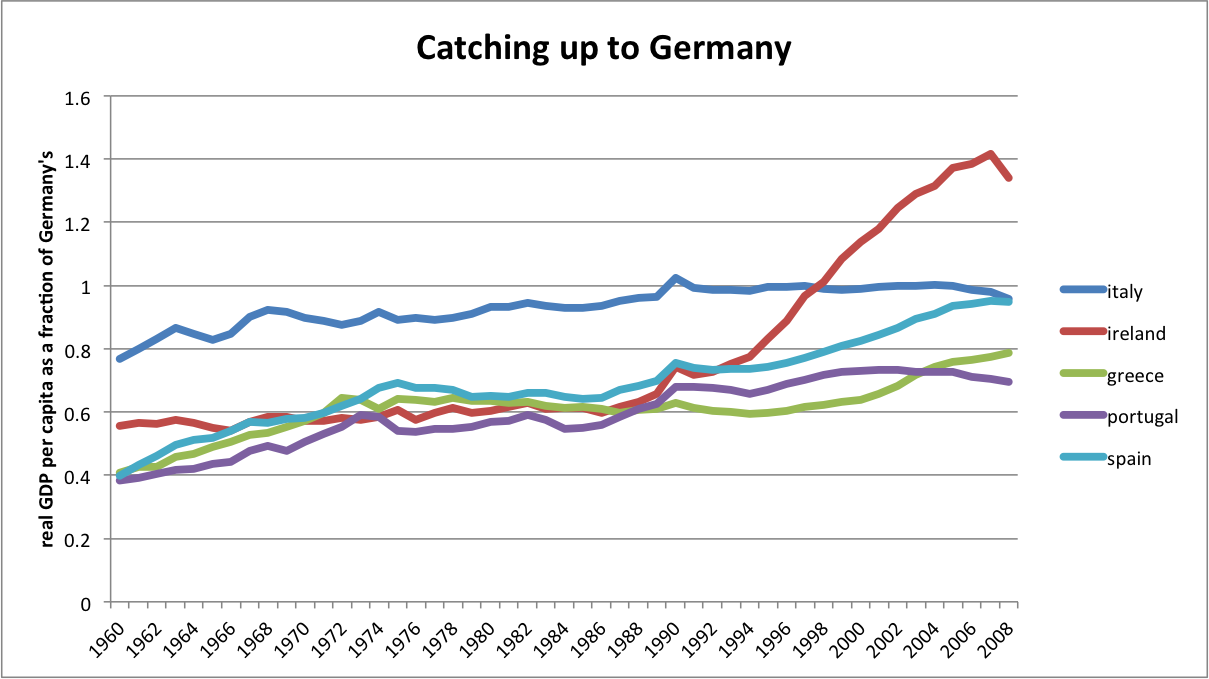
Economist Tyler Cowen has a post up on who has gained most from the Euro (as measured by state), but the economist Angus puts things into perspective:

Ireland, Spain, Portugal and Greece were all growing fast relative to Germany (and France which is not on the graph) well before the introduction of the Euro. Ireland and Spain take off somewhere around 1990 and the intro of the Euro in 2000 does not speed up their trajectory. Portugal actually falls further behind Germany in the Euro era. Greece is the only country of these 5 whose catch-up to Germany accelerates with the intro of the Euro.

Two quick thoughts:

  1. Woah! Look at Ireland!
  2. I’ll bet the acceleration of growth in the 1960’s had to do with the end of World War 2 and its rebuilding efforts.

Taking a broader historical view really puts things into perspective. If the Euro was not the catalyst for the economic growth of the 1990’s, what was? My guess is that the elimination of tariffs and labor restrictions between European states led to the growth. If the Eurozone had not implemented a central bank I think we wouldn’t be looking at all of the political problems now associated with the region.

Angus (who works at Oklahoma University) got his statistics from here. I highly recommend using it in your own studies as well.

North Dakota or Bust!

An excerpt from co-editor Fred Foldvary’s Progress Report:

In theory, productive public goods increase land rent because the supply of land is fixed. There can also be a rise in wages from more public goods, but that would be temporary. If labor becomes more productive in a location, that attracts labor from areas where wages are lower for the same skills. The increase in the labor supply will drive wages back down to normal. But the total supply of land in some region cannot expand, so the increase in rent sticks.

Just as territorial benefits raise land values, costs to landowners reduce the rent they keep, and so capitalize land value down. If the public goods are paid for by public revenue from land rent or site values, then the rise in land values would be limited. If governmental public goods are paid by labor and enterprise, then the rentalization and capitalization are implicit subsidies to landowners, at the expense of taxed labor and enterprise.

Economists have found evidence of the generation of higher land values from greater public goods. We now have an excellent case study: North Dakota.

Read the whole thing here. I’ve never been to North Dakota, but if it’s anything like South Dakota I might be tempted to settle there someday. Just kidding! California is the best state to live in, even with our terrible, fascistic-like government.

I am still having trouble wrapping my head around the concept of land value taxing, though. Someday I’m going to have to spend a couple of days with a copy of Henry George’s Progress and Poverty and see what I can figure out.

Criticizing the Right

There has been lots of attention on this blog geared towards the hypocrisy of the Left, and I think that it is justified, but all too often we have been giving the Right a pass. I think this has to do with the fact that the Left holds the presidency, but I still think it’s appropriate to remind readers that libertarianism is of neither the Left nor the Right. Philosopher Jason Kuznicki does just this in a brilliant post:

Scrutinize your own side too. Take a hard look at cushy “privatization” deals that really just funnel power and money directly into private corporations’ hands. As a certain liberal recently observed, the way to privatize a prison isn’t to give imprisonment power to a corporation. It’s to stop imprisoning so many people, then sell off the property. About which more below […]

But other restrictions exist. Many of them bite even harder.

Consider immigrants. In particular, if our free market is so great, why do you work so hard to exclude immigrants from it? Is the immigrant laborer less a moral self-fashioner than the Wall Street banker? I wouldn’t say so. He’s clearly at least as motivated. If the immigrant wants to make a life in America — why not let him?

Mr. Ryan recently proclaimed that the United States is the only nation founded on an idea. It’s a common conservative theme, and even if it’s not 100% accurate, I’m certainly sympathetic to it. But we are founded on an idea if and only if our borders remain open to all who share that idea. The moment we start checking for purity of blood, we become a tribalist nation-state just like so many others. Not founded on an idea, but on accidents of birth—and in fact standing squarely against the idea that all people should be the authors of their own lives.

You can read the rest here.

Again, I suspect that much of the vitriol aimed at the Left on this blog (mostly by myself and Dr. Delacroix and something that probably has to do with our previous, sovereign associations with that side of the aisle) is due to the fact that it currently occupies the White House, but it’s nice to remind readers that the Right is very hypocritical as well.

For more on immigration, see Hermanos* and Immigrants: A Story Pregnant with Deep Meaning.

For more on “privatization”, see Who Stole Our Trillions? and An Ominous Expansion of Eminent Domain.

For more criticism of the Right, see Ugly Conservative Sacred Cows and Blissful Ignorance….
McCloskey Review = Leftist Rhetoric in Tatters

Deirdre McCloskey has an excellent review of a new book focusing on the immorality of capitalism. An excerpt:

The poor have benefited the most from capitalism. The sheer, first-act, unanalyzed equality that Sandel advocates would have killed the modern world and kept us in the appalling poverty of the human condition down to 1800. In fact in some countries it did, such as India after 1947, under Gandhi-plus-London-School-of-Economics egalitarianism, the “License Raj” and “the Hindu rate of growth,” as the Indians themselves bitterly described their communitarian economy. When I talk to friends who think like Sandel I worry that their dispositions will kill, quite unintentionally, the only chance for the world’s poor to achieve the scope for a full human life.

[…]

Sandel worries properly that the market can crowd out the sacred. A corporate market in, say, instruction in elementary classrooms can crowd out unbiased teaching about capitalism. Yet Sandel does not tell his own classroom that state schools can crowd out unbiased teaching about, say, the environment.

Do read the whole thing. McCloskey is an expert writer and a prestigious scholar, so be sure to grab a cup of coffee before you settle in. (h/t Jason Brennan)

Paul Ryan and Ayn Rand: What’s the Connection?

I will admit up front that the only Ayn Rand novel I’ve read (so far) has been Anthem. I liked it. It reminded me of Brave New World and 1984. A lot of books came out at around the same time as Anthem that had themes of the struggle between totalitarianism and the individual. Recent commentary has focused on Rep. Ryan’s connections with the late, great author, though, and Will Wilkinson does a great job of summing them all up in a post over the Economist. An excerpt:

In practice, arguments like Mr Black’s and Ms Walsh’s tend to come to the silly idea that one’s ideological opponents are duty-bound (by their own lights!) to either unilaterally disarm or shut up. Heads, I win; tails, you lose. It’s a cheap trick. The argument as usually deployed also depends on a combination of lazy partisan Manichaeism and the naive practice of taking politicians at their word. Paul Ryan is an elected official whose views therefore fall squarely within the ambit of conventional political wisdom. Despite his professed admiration for Ayn Rand, and the ardent wishes of his admirers and detractors alike, Mr Ryan is far from a laissez faire radical.

Indeed. Do read the rest of the post here.

What are your thoughts on Ryan as Romney’s VP? Longtime reader Hank has shared his thoughts here. Personally, I agree with Hank and I don’t think the nomination matters all that much, and I share libertarian sentiments that Rep. Ryan is hardly a fiscal conservative, but I am also curious as to what you think.

Around the Web: Lazy Saturday Edition

I’m not actually being lazy, I am just doing a bunch of homework (wink wink).

Knowledge is Power, so let the WikiWar begin!

Illegally Wiretapped? In the US? Sorry, but the courts won’t help you.

Can Syria’s Christians Survive?

Public ignorance about Paul Ryan and federal spending.

Around the Web

The Images of Progressive Citizenship. Haunting.

Paul Ryan it is.

The 5 worst Olympic mascots.

Austrian themes, data, and sports economics. By co-blogger Stephen Shmanske

“Isolationism” Revisited

Socialist Zach Dorfman has a great review up over at Dissent on a recent book by a historian about American foreign policy from roughly 1890 to about 1940, Promise and Peril: America at the Dawn of a Global Age. I am really tempted to just copy and paste the whole review, but here are some juicy excerpts from Dorfman’s review (the book itself will have to wait until Christmas):

Today, isolationism is often portrayed as intellectually bankrupt, a redoubt for idealists, nationalists, xenophobes, and fools. Yet the term now used as a political epithet has deep roots in American political culture. Isolationist principles can be traced back to George Washington’s farewell address, during which he urged his countrymen to steer clear of “foreign entanglements” while actively seeking nonbinding commercial ties […] Continue reading

“The Fastest Race Ever Run”

That’s a headline piece from the Economist. An excerpt:

Nate Silver, a blogger for the New York Times and sports statistician, points out that only five world records in track and field were broken in Beijing out of 47 events. Even that was a decent tally: the previous four Olympics saw a total of just seven new world bests, compared with a whopping 22 world records in swimming. Mr Silver attributes this disparity to economic inequality. “An athlete with the perfect swimmer’s build,” he writes, “and a world-class work ethic would still stand little chance of competing in this year’s games if he happened to be born in a poor nation like Cameroon or Panama—he might never have gotten into a pool, let alone an Olympic-size one.”

Running, in contrast, is more democratic […]

Read the rest here. I’m not a big fan of the Olympics, just because of the nationalistic impulses it taps into. Why shouldn’t these sports become completely separated from the state?

With that obligatory libertarian statement out of the way, I can’t help but admire the feats accomplished by some of these athletes. A lot of hard work goes into training for the Olympics, and I think that pushing the state out of the way would help to reduce the obvious inequalities associated with national competitions. Did anybody see the US basketball team play Nigeria?

If sports were separated from the state we’d see more games like the NBA: very competitive, cosmopolitan and lucrative (unlike the bloodbath between the US and Nigeria).

Anyway, I like it when individuals from poor states win big in the Olympics. Nothing like seeing an underdog win, especially an underdog with a name like Usain Bolt!

Update: I spoke too soon about the level of competitive play at London’s basketball tourney. Check out this piece in Grantland about the semis between Spain v. Russia and the US v. Argentina. And ESPN has a brief recap of the Russia v. Spain game. I’ll keep my eye out for a more passionate recap, though. Spottieottiedopalicious!

Update 2: Spain’s leading daily newspaper, El Pais, reports on the game with Russia. The Russian press spilled a lot of ink on their team’s quarterfinal win over Lithuania, and not so much ink on their semifinal loss to Spain…

What? You don’t surf with Google’s Chrome browser? I hope you have fun looking for some sort of translating software instead having Chrome do it for you on the spot…

Aging Hippies Aren’t So Hip

This is not new to anyone under the age of 40, but this New York Times article is a nice nail in the coffin of the pernicious myth that hippies are somehow radical Leftists. It talks about how young people are becoming more fiscally conservative and socially liberal. That is to say, that most people are becoming more libertarian. The NYT doesn’t mention the “l” word, of course, but the libertarian streak is easy to see nonetheless.

Economist Steve Horwitz has a great take on this on his Facebook page. He wrote:

This is good thing. A more socially progressive GOP is a better GOP. Of course these kids are really libertarians and don’t know it. But if you really want some laughs, read the comments. See how old-fart, un-hip leftists are mystified that young people might think leftist ideas have failed and genuinely believe that there are better ways to improve the world. See the hate, see the befuddlement, see the frustration. Try some new ideas folks, maybe the young’uns will then think you’re hip again.

‘Nuff said.

The Champions of Los Angeles.

Socialism and Empire, Not Immigration, Are Destroying America.

Status Quo Biasing and Conformity Signaling.

The Dutch on Exhibit

UCLA’s library has an online exhibit (i.e. nothing too fancy) up on some of their archive material from the Dutch Golden Age. I thought I’d pass it along.

Again, there is nothing too fancy or long-winded here, but I do recommend checking them out. I would also highly recommend picking up a good book on Dutch history sometime before the summer ends. Simon Schama’s The Embarrassment of Riches… or Johnathan Israel’s The Dutch Republic… Both are magnificent and far-sighted.

The Dutch republic also plays an important role in American history, as it is the political structure of this small republic that really influenced Madison and other federal framers. Its rebellion from the Spanish monarchy and its rule over Britain cannot be discounted in the historical legacy of the United States either.