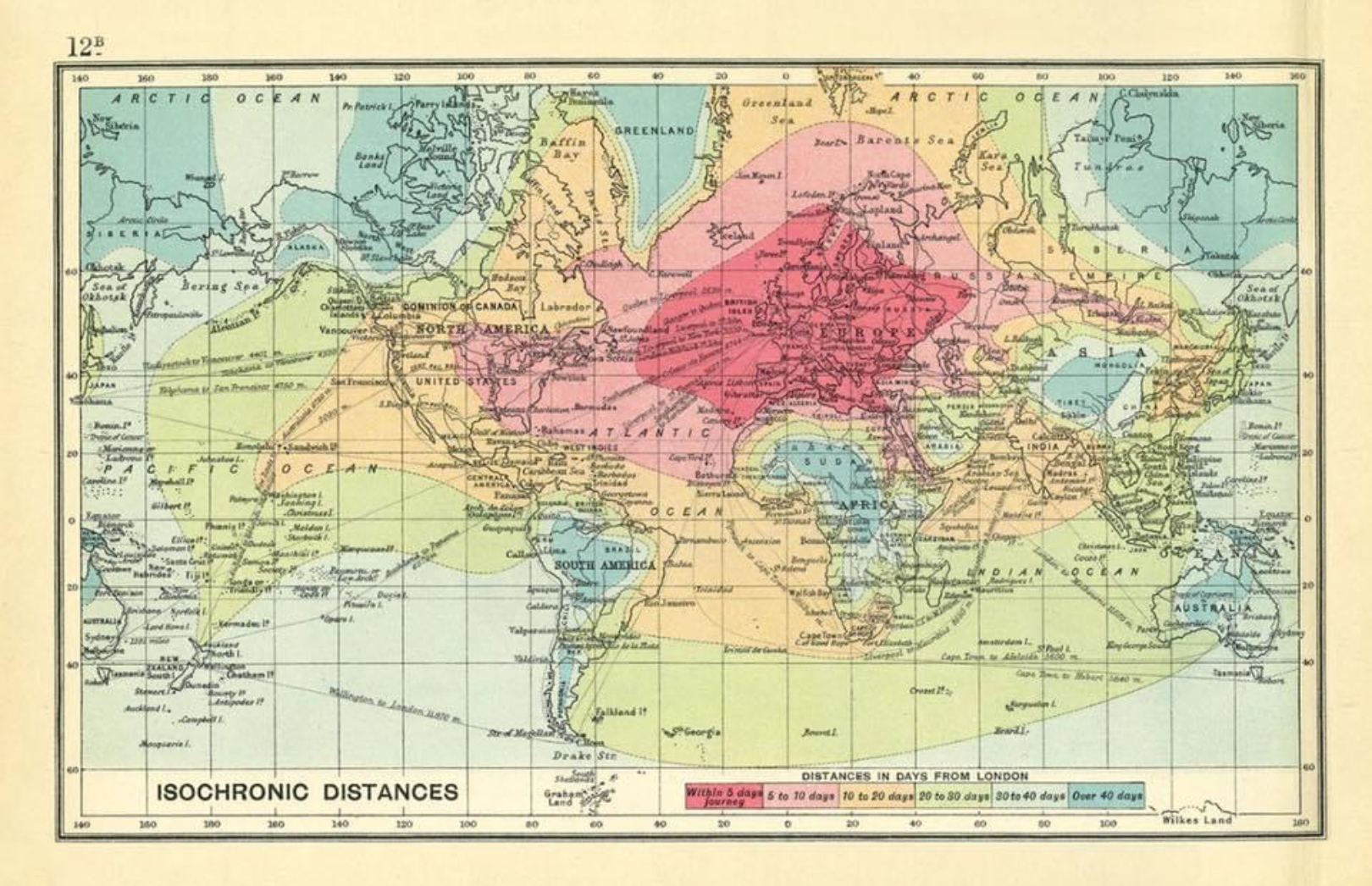
This fascinating isochrone map—how many days it took to get anywhere in the world from London in 1914—at first blush evokes the cliché that the world has now shrunk. Obviously it hasn’t shrunk. While the distance between London and New Delhi is still 4,168 miles, what has shrunk is time, and this has had profound aftermaths on our lives.
One of the great ironies in the remarkable proliferation of time-saving inventions is they haven’t made life simple enough to give us more time and leisure. By leisure, I don’t mean a virtue of some kind of inertia, but a deliberate organization based on a definite view of the meaning and purpose of life. In the urban world, the workweek hasn’t shortened. We still don’t have large swaths of time to really enjoy the good life with our families and friends.
In 1956, Sir Charles Darwin, grandson of the great Charles Darwin, wrote an interesting essay on the forthcoming Age of Leisure in the magazine New Scientist in which he argued: “The technologists, working for fifty hours a week, will be making inventions so the rest of the world need only work twenty-five hours a week. […] Is the majority of mankind really able to face the choice of leisure enjoyments, or will it not be necessary to provide adults with something like the compulsory games of the schoolboy?”
He is wrong in the first part. The world may have shrunk but cities have magnified. Travel technologies have incentivized us to live farther away and simply travel longer distances to work and attract anxiety attacks during peak hour traffic [Google Marchetti’s constant]. So, rather than being bored to death, our actual challenge is to avoid psychotic breakdowns, heart attacks, and strokes resulting from being accelerated to death.
Nonetheless, Sir Charles Darwin is accurate about “compulsory games” for adults. What else are social media platforms, compulsive eating, selfies, texts, Netflix bingeing, and 24/7 news media that dominate our lives? They are the real opiates of the masses. We have been so conditioned to search for happiness in these anodyne pastimes that defying these urges appears to be a denial of life itself. It is not surprising that we can no longer confidently tell the difference between passing pleasure and abiding joy. Lockdown or no lockdown, we are all unwittingly participating in these compulsory games with unwritten rules, believing that we are now that much closer to the good life of leisure. But are we?
‘Time is the wealth of change, but the clock in its parody makes it mere change and no wealth.’— Rabindranath Tagore
What’s the first question in the field of public policy? According to the Indian Economist Ajay Shah, “What should the state do?” is the first question. He says, “A great deal of good policy reform can be obtained by putting an end to certain government activities and by initiating new areas of work that better fit into the tasks of government.”
This question is especially essential for a weak state like India. But what if people prefer government subsidies, assertive intermediaries and a weak state? I don’t know the answer to this question. The story of the Indian farm protest is an illustrative example; it is a rebellion to stay bound to the old status quo, fearful of free choice.
Protest Timeline
04 June 2020: Union Cabinet clears three ordinances meant for reforms in the Indian Agricultural sector. These reforms upgrade farmers from being just producers to free-market traders. Agriculture is a state subject in India, but state governments have had no political will to usher in these reforms. China reformed its agriculture sector first, followed by other industries. India is doing it the other way round and thirty years late. So, the union government followed constitutional means to usher in the reforms.
04 December 2020: The Union Govt offers a work-around the dilution of MSP. By the way, MSP sets an unnaturally high price and cuts out the competition, so the middlemen club in the farmer’s association of Punjab, Haryana, and U.P. want nothing less than the scraping of these reforms.
Bottom line: A) The Ordinances aim to liberalize Agri trade and increase the number of buyers for farmers. B) de-regulation alone may not be sufficient to attract more buyers.
Almost every economist worth his salt acknowledges the merit in point A) and welcomes these essential reforms that are thirty years late but better late than never. Ajay Shah says, “We [Indians] suffer from the cycle of boom and bust in Indian agriculture because the state has disrupted all these four forces of stabilization—warehousing, futures trading, domestic trade and international trade. The state makes things worse by having tools like MSP and applying these tools in the wrong way. Better intuition into the working of the price system would go a long way in shifting the stance of policy.”
However, the middlemen argue on point B), that acts as a broad cover for their real fears of squandering their upper-hand in the current APMC/MSP system. Although nobody denies that a sudden opening of the field for competition will threaten the income of these middlemen, such uncertainties should not justify violent protests, slandering campaigns, that look to derail the entire process of upgrading the lives of a great majority of poor farmers in the country.
Even worse, these events get branded in broad strokes as state violence and human rights abuses by pre-planned Twitter and street campaigns and unnecessary road blockades. Everybody questions internet outages during these protests but no one questions the ethics of protesters blocking essential roads in the city. A section of the Indian society and diaspora hates Prime Minister Modi for sure. I have no qualms with this, but the reckless hate shouldn’t negate all nuances in analyzing perfectly sane reforms. Social justice warriors legitimize the vicious cycle of dissent without nuance because they don’t take the trouble of even reading the farm bill but make it a virtue to reason from their “bleeding hearts.”
Ordinarily, the Indian state works inadequately, experiences confusion when faced with a crisis. It comes out with a communication of a policy package that attempts to address the problem in a short-term way and retreats into indifference. So, there are two aspects to its incompetence, one, there is a lack of political will because special interest groups persuade the government towards the wrong objectives. And two, the state capacity is so weak that it fails to achieve the goal. The farm protest is a hideous third kind of difficulty: a special interest group of assertive, influential middlemen want the strong-willed, long-term thinking Indian government policy—a rare entity— to sway towards short-termism under the pretext of human rights abuse. The hard left is actually supporting the Indian state to remain weak. They will also be the first to blame the state when it comes off as weak in the next debacle.
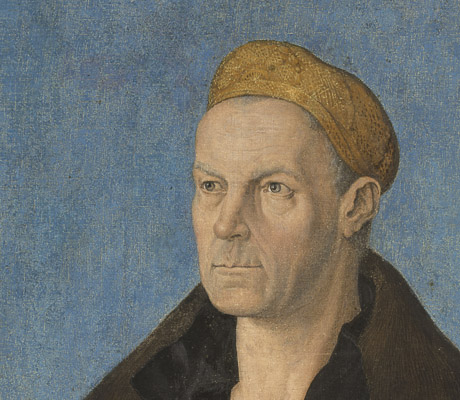
The most important historical question to help understand our rise from the muck to modern civilization is: how did we go from linear to exponential productivity growth? Let’s call that question “who started modernity?” People often look to the industrial revolution, which is certainly an acceleration of growth…but it is hard to say it caused the growth because it came centuries after the initial uptick. Historians also bring up the Renaissance, but this is also a mislead due to the ‘written bias’ of focusing on books, not actions; the Renaissance was more like the window dressing of the Venetian commercial revolution of the 11th and 12th centuries, which is in my opinion the answer to “who started modernity.” However, despite being the progenitors of modern capitalism (which is worth a blog in and of itself), Venice’s growth was localized and did not spread immediately across Europe; instead, Venice was the regional powerhouse who served as the example to copy. The Venetian model was also still proto-banking and proto-capitalism, with no centralized balance sheets, no widespread retail deposits, and a focus on Silk Road trade. Perhaps the next question is, “who spread modernity across Europe?” The answer to this question is far easier, and in fact can be centered to a huge degree around a single man, who was possibly the richest man of all time: Jakob Fugger.
Jakob Fugger was born to a family of textile traders in Augsburg in the 15th century, and after training in Venice, revolutionized banking and trading–the foundations on which investment, comparative advantage, and growth were built–as well as relationships between commoners and aristocrats, the church’s view of usury, and even funded the exploration of the New World. He was the only banker alive who could call in a debt on the powerful Holy Roman Emperor, Charles V, mostly because Charles owed his power entirely to Fugger. Strangely, he is perhaps best known for his philanthropic innovations (founding the Fuggerei, which were some of the earliest recorded philanthropic housing projects and which are still in operation today); this should be easily outcompeted by:
His introduction of double entry bookkeeping to the continent
His invention of the consolidated balance sheet (bringing together the accounts of all branches of a family business)
His invention of the newspaper as an investment-information tool
His key role in the pope allowing usury (mostly because he was the pope’s banker)
His transformation of Maximilian from a paper emperor with no funding, little land, and no power to a competitor for European domination
His funding of early expeditions to bring spices back from Indonesia around the Cape of Good Hope
His trusted position as the only banker who the Electors of the Holy Roman Empire would trust to fund the election of Charles V
His complicated, mostly adversarial relationship with Martin Luther that shaped the Reformation and culminated in the German Peasant’s War, when Luther dropped his anti-capitalist rhetoric and Fugger-hating to join Fugger’s side in crushing a modern-era messianic figure
His involvement in one of the earliest recorded anti-trust lawsuits (where the central argument was around the etymology of the word “monopoly”)
His dissemination, for the first time, of trustworthy bank deposit services to the upper middle class
His funding of the military revolution that rendered knights unnecessary and bankers and engineers essential
His invention of the international joint venture in his Hungarian copper-mining dual-family investment, where marriages served in the place of stockholder agreements
His 12% annualized return on investment over his entire life (beating index funds for almost 5 decades without the benefit of a public stock market), dying the richest man in history.
The story of Fugger’s family–the story, perhaps, of the rise of modernity–begins with a tax record of his family moving to Augsburg, with an interesting spelling of his name: “Fucker advenit” (Fugger has arrived). His family established a local textile-trading family business, and even managed to get a coat of arms (despite their peasant origins) by making clothes for a nobleman and forgiving his debt.
As the 7th of 7 sons, Jakob Fugger was given the least important trading post in the area by his older brothers; Salzburg, a tiny mountain town that was about to have a change in fortune when miners hit the most productive vein of silver ever found by Europeans until the Spanish found Potosi (the Silver Mountain) in Peru. He then began his commercial empire by taking a risk that no one else would.
Sigismund, the lord of Salzburg, was sitting on top of a silver mine, but still could not run a profit because he was trying to compete with the decadence of his neighbors. He took out loans to fund huge parties, and then to expand his power, made the strategic error of attacking Venice–the most powerful trading power of the era. This was in the era when sovereigns could void debts, or any contracts, within their realm without major consequences, so lending to nobles was a risky endeavor, especially without backing of a powerful noble to force repayment or address contract breach.
Because of this concern, no other merchant or banker would lend to Sigismund for this venture because sovereigns could so easily default on debts, but where others saw only risk, Fugger saw opportunity. He saw that Sigismund was short-sighted and would constantly need funds; he also saw that Sigismund would sign any contract to get the funds to attack Venice. Fugger fronted the money, collateralized by near-total control of Sigismund’s mines–if only he could enforce the contract.
Thus, the Fugger empire’s first major investment was in securing (1) a long-term, iterated credit arrangement with a sovereign who (2) had access to a rapidly-growing industry and was willing to trade its profits for access to credit (to fund cannons and parties, in his case).
What is notable about Fugger’s supposedly crazy risk is that, while it depended on enforcing a contract against a sovereign who could nullify it with a word, he still set himself up for a consistent, long-term benefit that could be squeezed from Sigismund so long as he continued to offer credit. This way, Sigismund could not nullify earlier contracts but instead recognized them in return for ongoing loan services; thus, Fugger solved this urge toward betrayal by iterating the prisoner’s dilemma of defaulting. He did not demand immediate repayment, but rather set up a consistent revenue stream and establishing Fugger as Sigismund’s crucial creditor. Sigismund kept wanting finer things–and kept borrowing from Fugger to get them, meaning he could not default on the original loan that gave Fugger control of the mines’ income. Fugger countered asymmetrical social relationships with asymmetric terms of the contract, and countered the desire for default with becoming essential.
Eventually, Fugger met Maximilian, a disheveled, religion-and-crown-obsessed nobleman who had been elected Holy Roman Emperor specifically because of his lack of power. The Electors wanted a paper emperor to keep freedom for their principalities; Maximilian was so weak that a small town once arrested and beat him for trying to impose a modest tax. Fugger, unlike others, saw opportunity because he recognized when aligning paper trails (contracts or election outcomes) with power relationships could align interests and set him up as the banker to emperors. When Maximilian came into conflict with Sigismund, Fugger refused any further loans to Sigismund, and Maximilian forced Sigismund to step down. Part of Sigismund’s surrender and Maximilian’s new treaty included recognizing Fugger’s ongoing rights over the Salzburg mines, a sure sign that Fugger had found a better patron and solidified his rights over the mine through his political maneuvering–by denying a loan to Sigismund and offering money instead to Maximilian. Once he had secured this cash cow, Fugger was certainly put in risky scenarios, but didn’t seek out risk, and saw consistent yearly returns of 8% for several decades followed by 16% in the last 15 years of his life.
From this point forward, Fugger was effectively the creditor to the Emperor throughout Maximilian’s life, and built a similar relationship: Maximilian paid for parties, military campaigns, and bought off Electors with Fugger funds. As more of Maximilian’s assets were collateralized, Fugger’s commercial empire grew; he gained not only access to silver but also property ownership. He was granted a range of fiefs, including Arnoldstein, a critical trade juncture where Austria, Italy, and Slovenia border each other; his manufacturing and trade led the town to be renamed, for generations, Fuggerau, or Place of Fugger.
These activities that depended on lending to sovereigns brings up a major question: How did Fugger get the money he lent to the Emperor? Early in his career, he noted that bank deposit services where branches were present in different cities was a huge boon to the rising middle-upper class; property owners and merchants did not have access to reliable deposit services, so Fugger created a network of small branches all offering deposits with low interest rates, but where he could grow his services based on the dependability of moving money and holding money for those near, but not among, society’s elites. This gave him a deep well of dispersed depositors, providing him stable and dependable capital for his lending to sovereigns and funding his expanding mining empire.
Unlike modern financial engineers, who seem to focus on creative ways to go deeper in debt, Fugger’s creativity was mostly in ways that he could offer credit; he was most powerful when he was the only reliable source of credit to a political actor. So long as the relationship was ongoing, default risk was mitigated, and through this Fugger could control the purse strings on a wide range of endeavors. For instance, early in their relationship (after Maximilian deposed Sigismund and as part of the arrangement made Fugger’s interest in the Salzburg mines more permanent), Maximilian wanted to march on Rome as Charlemagne reborn and demand that the pope personally crown him; he was rebuffed dozens of times not by his advisors, but by Fugger’s denial of credit to hire the requisite soldiers.
Fugger also innovated in information exchange. Because he had a broad trading and banking business, he stood to lose a great deal if a region had a sudden shock (like a run on his banks) or gain if new opportunities arose (like a shift in silver prices). He took advantage of the printing press–less than 40 years after Gutenberg, and in a period when most writing was religious–to create the first proto-newspaper, which he used to gather and disseminate investment-relevant news. Thus, while he operated a network of small branches, he vastly improved information flow among these nodes and also standardized and centralized their accounting (including making the first centralized/combined balance sheet).
With this broad base of depositors and a network of informants, Fugger proceeded to change how war was fought and redraw the maps of Europe. Military historians have discussed when the “military revolution” that shifted the weapons, organization, and scale of war for decades, often centering in on Swedish armies in the 1550s as the beginning of the revolution. I would counter-argue that the Swedes simply continued a trend that the continent had begun in the late 1400’s, where:
Knights’ training became irrelevant, gunpowder took over
Logistics and resource planning were professionalized
Early mechanization of ship building and arms manufacturing, as well as mining, shifted war from labor-centric to a mix of labor and capital
Multi-year campaigns were possible due to better information flow, funding, professional organization
Armies, especially mercenary groups, ballooned in size
Continental diplomacy became more centralized and legalistic
Wars were fought by access to creditors more than access to trained men, because credit could multiply the recruitment/production for war far beyond tax receipts
Money mattered in war long before Fugger: Roman usurpers always took over the mints first and army Alexander showed how logistics and supply were more important than pure numbers. However, the 15th century saw a change where armies were about guns, mercenaries, technological development, and investment, and above all credit, and Fugger was the single most influential creditor of European wars. After a trade dispute with the aging Hanseatic League over their monopoly of key trading ports, Fugger manipulated the cities into betraying each other–culminating in a war where those funded by Fugger broke the monopolistic power of the League. Later, because he had a joint venture with a Hungarian copper miner, he pushed Charles V into an invasion of Hungary that resulted in the creation of the Austro-Hungarian Empire. These are but two of the examples of Fugger destroying political entities; every Habsburg war fought from the rise of Maximilian through Fugger’s death in 1527 was funded in part by Fugger, giving him the power of the purse over such seminal conflicts as the Italian Wars, where Charles V fought on the side of the Pope and Henry VIII against Francis I of France and Venice, culminating in a Habsburg victory.
Like the Rothschilds after him, Fugger gained hugely through a reputation for being ‘good for the money’; while other bankers did their best to take advantage of clients, he provided consistency and dependability. Like the Iron Bank of Braavos in Game of Thrones, Fugger was the dependable source for ambitious rulers–but with the constant threat of denying credit or even war against any defaulter. His central role in manipulating political affairs via his banking is well testified during the election of Charles V in 1519. The powerful kings of Europe– Francis I of France, Henry VIII of England, and Frederick III of Saxony all offered huge bribes to the Electors. Because these sums crossed half a million florins, the competition rapidly became one not for the interest of the Electors–but for the access to capital. The Electors actually stipulated that they would not take payment based on a loan from anyone except Fugger; since Fugger chose Charles, so did they.
Fugger also inspired great hatred by populists and religious activists; Martin Luther was a contemporary who called Fugger out by name as part of the problem with the papacy. The reason? Fugger was the personal banker to the Pope, who was pressured into rescinding the church’s previously negative view of usury. He also helped arrange the scheme to fund the construction of the new St. Peter’s basilica; in fact, half of the indulgence money that was putatively for the basilica was in fact to pay off the Pope’s huge existing debts to Fugger. Thus, to Luther, Fugger was greed incarnate, and Fugger’s name became best known to the common man not for his innovations but his connection to papal extravagance and greed. This culminated in the 1525 German Peasant’s War, which saw an even more radical Reformer and modern-day messianic figure lead hordes of hundreds of thousands to Fuggerau and many other fortified towns. Luther himself inveighed against these mobs for their radical demands, and Fugger’s funding brought swift military action that put an end to the war–but not the Reformation or the hatred of bankers, which would explode violently throughout the next 100 years in Germany.
This brings me to my comparison: Fugger against all of the great wealth creators in history. What makes him stand head and shoulders above the rest, to me, is that his contributions cross so many major facets of society: Like Rockefeller, he used accounting and technological innovations to expand the distribution of a commodity (silver or oil), and he was also one of the OG philanthropists. Like the Rothschilds’ development of the government bond market and reputation-driven trust, Fugger’s balance-sheet inventions and trusted name provided infrastructural improvement to the flow of capital, trust in banks, and the literal tracking of transactions. However, no other capitalist had as central of a role in religious change–both as the driving force behind allowing usury and as an anti-Reformation leader. Similarly, few other people had as great a role in the Age of Discovery: Fugger funded Portuguese spice traders in Indonesia, possibly bankrolled Magellan, and funded the expedition that founded Venezuela (named in honor of Venice, where he trained). Lastly, no other banker had as influential of a role in political affairs; from dismantling the Hanseatic League to deciding the election of 1519 to building the Habsburgs from paper emperors to the most powerful monarchs in Europe in two generations, Fugger was the puppeteer of Europe–and such an effective one that you have barely heard of him. Hence, Fugger was not only the greatest wealth creator in history but among the most influential people in the rise of modernity.
Fugger’s legacy can be seen in his balance sheet of 1527; he basically developed the method of using it for central management, its only liabilities were widespread deposits from the upper-middle class (and his asset-to-debt ratio was in the range of 7-to-1, leaving an astonishingly large amount of equity for his family), and every important leader on the continent was literally in his debt. It also showed him to have over 1 million florins in personal wealth, making him one of the world’s first recorded millionaires. The title of this post was adapted from a self-description written by Jakob himself as his epitaph. As my title shows, I think it is fairer to credit his wealth creation than his wealth accumulation, since he revolutionized multiple industries and changed the history of capitalism, trade, European politics, and Christianity, mostly in his contribution to the credit revolution. However, the man himself worked until the day he died and took great pride in being the richest man in history.
If two politicians are equal in every other respect but one was better at basketball… I guess go with that one? I mean, all else equal they’re maybe a better team player or something. But that line of thinking doesn’t mean we should only ever vote for ex-NBA stars.
There are plenty of similar potentially attractive signals: veteran status, success in business and/or being a fake billionaire, academic success, acting, etc. Some signals are stronger, and some imply a smaller pool of candidates. If there are more successful business people in the world we should expect to observe more of them transitioning to politics than, say, world-class bowlers. Likewise, if the signal is more relevant (e.g. law degree vs. paleontology degree), it makes sense to see more of them in the wild.
That 18% of German politicians have PhD’s seems wild to me. Maybe I’m biased because I work in an organization full to the brim with PhD’s. But that many politicians with degrees seems about as reasonable and as likely as having half of Congress be elite athletes.
Folks, as you have probably guessed by now, NOL has a new blogger. His name is Vishnu, and you can read about him right here:
Vishnu Modur is a Ph.D. in molecular biology who works as a cancer biologist at Cincinnati Children’s Hospital. He has diverse passions outside the lab setting. He is deeply interested in Indic cultural anthropology, Indic philosophy, political philosophy, and philosophy of science. He blogs about his scientific research on Medium and writes about history, politics, and culture on NOL. He quips that as a resident-alien in the United States, he can offer a unique perspective, using his resident and sometimes his ‘alien’ viewpoints on several issues.
Of late, a growing number of Indian-Americans look to assert a South Asian identity for most of their sociopolitical and cultural expressions even though actual residents of ‘South Asia’ don’t claim this identity in any way, home or abroad. I realize that second-generation Indian-Americans embrace ‘South Asian’ forums in reaction to various domestic conditions. However, they ignore the polysemy of the term ‘South Asia’ when they project it internationally, for example, to express ‘South Asian’ pride over Kamala Devi Harris’s historic election for the Vice Presidency, instead of just Indian-American pride. Of course, I’m not talking about African-American pride here; it is beyond the purview of my discussion.
According to my understanding, increasing application of the term ‘South Asia’—just like the Middle East—precludes a nuanced perception of the particular countries that make up the region. It permits Americans to perceive the region like it is a monolith. Although the impression of the United States is striking in the Indian imagination, the image of India, as it turns out, is not very obvious for the average citizen in the United States, not even among second-generation Indian Americans, as I see it. To gauge American curiosity in a particular region, language enrollment in US universities is a decent metric. It turns out, around seven times more American students study Russian than all the Indian languages combined. The study of India compares unfavorably with China in nearly every higher education metric, and surprisingly, it also fares poorly compared to Costa Rica! As an aside, to understand India and her neighborhood, an alternate perspective to CNN or BBC on ‘South Asian’ geopolitics is WION (“World is One” News – a take on the Indic vasudhaiva kutumbakam). I highly recommend the Gravitas section of WION for an international audience.
Back to the central question: ‘South Asia’ and why Indians do not prefer this tag?
For decades, the United States hyphenated its India policy by balancing every action with New Delhi with a counterbalancing activity with Islamabad. So much so that the American focus on Iran and North Korean nuclear proliferation stood out in total contrast to the whitewashing of Pakistan’s private A.Q. Khan network for nuclear proliferation. Furthermore, in a survey conducted by the Chicago Council on Global Affairs that gauges how Americans perceive other countries, India hovered between forty-six and forty-nine on a scale from zero to one hundred since 1978, reflecting its reputation neither as an ally or an adversary. With the civil-nuclear deal, the Bush administration discarded the hyphenation construct and eagerly pursued an independent program between India and the United States. Still, in 2010, only 18 percent of Americans saw India as “very important” to the United States—fewer than those who felt similarly about Pakistan (19%) and Afghanistan (21%), and well below China (54%) and Japan (40%). Even though the Indo-US bilateral relationship has transformed for the better from the Bush era, the increasing use of ‘South Asia’ on various platforms by academics and non-academics alike, while discussing India, represents a new kind of hyphenated view or a bracketed view of India. Many Indian citizens in the US like me find this bracket unnecessary, especially in the present geopolitical context.
What geopolitical context? There are several reasons why South Asian identity pales in comparison to our national identities:
The word ‘South Asia’ emerged exogenously as a category in the United States to study the Asian continent by dividing it. So, it is a matter of post Second World War scholarship of Asia from the Western perspective.
Despite scholarship, ‘South Asia’ has low intelligibility because there is no real consensus over which countries comprise South Asia. SAARC includes Afghanistan among its members; the World Bank leaves it out. Some research centers include Myanmar—a province of British India till 1937, and Tibet, but leave out Afghanistan and the Maldives. For instance, the UK largely accepts the term ‘Asian’ rather than ‘South Asian’ for academic centers. The rest of Europe uses ‘Southeast Asia.’
Besides, geopolitically, India wants to grow out of the South Asian box; it cares a lot more about the ASEAN and BRICS grouping than SAARC.
Under Modi, India has a more significant relationship with Japan than with any South Asian neighbor. With Japan and South Korea, India plans to make Indo-pacific a geopolitical reality.
South Asia symbolizes India’s unique hegemonic fiefdom, which is viewed unfavorably by neighboring Nepal, Sri Lanka, Bangladesh, and Pakistan.
According to the World Bank, South Asia remains one of the least economically integrated regions globally.
South Asia is also among the least physically integrated (by road infrastructure) regions of the world and this disconnect directly affects our politics and culture.
Therefore, the abstract nature of ‘South Asia’ is far from a neutral term that embraces multiple cultures. It is, at best, a placeholder for structured geopolitical co-operation in the subcontinent. However, in socio-cultural terms, ‘South Asia’ used interchangeably with India signals India’s dominance over her neighborhood. Contrarily, in India’s eyes, it is a dilution of her rising aspirations on the world stage. These facts widen the gap between the US’s intentions (general public and particularly, second-generation Indian-Americans) and a prouder India’s growing ambitions.
Besides, it is worth mentioning that women leaders have already held the highest public office in Pakistan, India, Sri Lanka, Bangladesh, etc. So as you see in this video, the Indian international actress, Priyanka Chopra, tries her best to be diplomatic about this nebulous ‘South Asian’ pride thingy, but she rejoins with the more solid identity, her Indian identity. The next time, say a Nepalese-American does something incredible in the US, and you want to find out how another Nepali feels about this achievement, as a matter of experiment, refer to the accomplishment as Nepali pride, instead of South Asian pride, and see the delight on the person’s face. Repeat this with another Nepali, but this time use the ‘South Asian’ identity tag and note the contrast in the reaction.
Mr Trump is practically gone and he is not coming back. (For one thing, he will be too old in 2024. For another thing, see below.) The political conditions that got such an un-preposterous candidate elected in 2016 however, those conditions, don’t look like they are going away. (I hope I am wrong.) A large fraction of Americans will continue to be ignored from an economic standpoint, as well as insulted daily by their better. Four years of insults thrown at people like me and the hysterical outpouring of contempt by liberal media elites on the last days of the Trump administration are not making me go away. Instead, they will cement my opposition to their vision of the world and to their caste behavior. I would bet dollars on the penny that a high proportion of the 74 million+ who voted for Mr Trump in 2020 feels the same. (That’s assuming that’s the number who voted for him; I am not sure of it at all. It could be more. Currently, with the information available, I vote 60/40 that the election was not – not – stolen.)
I never liked Trump, the man, for all the obvious reasons although I admired his steadfastness because it’s so rare among politicians. In the past two years, I can’t say I liked any of his policies, though I liked his judicial appointments. It’s just that who else could I vote for in 2016? Hillary? You are kidding, right? And in 2020, after President Trump was subjected to four years (and more) of unceasing gross abuse and of persecution guided by a totalitarian spirit, would it not have been dishonorable to vote for anyone but him? (Libertarians: STFU!)
Believe it or not, if Sen. Sanders and his 1950 ideas had not been eliminated again in 2020, again through the machinations of the Dem. National Committee, I would have had a serious talk with myself. At least, Sanders is not personally corrupt, and with a Republican Senate, we would have had a semi-paralyzed government that would have been OK with me.
One week after the event of 1/6/21, maybe “the breach” of the Capitol, many media figures continue to speak of a “coup.” Even the Wall Street Journal has joined in. That’s downright grotesque. I don’t doubt that entering the Capitol in a disorderly fashion and, for many, (not all; see the videos) uninvited, is illegal as well as unseemly. I am in favor of the suspects being found and prosecuted, for trespassing, or something. This will have the merit of throwing some light on the political affiliation(s) of the window breakers. I still see no reason to abandon the possibility that some, maybe (maybe) in the vanguard, were Antifa or BLM professional revolutionaries. Repeating myself: Trump supporters have never behaved in that manner before. I am guessing the investigations and the prosecutions are going to be less than vigorous precisely because the new administration will not want to know or to have the details be known of the criminals’ identity. If I am wrong, and all the brutal participants were Trump supporters, we will know it very quickly. The media will be supine either way.
It’s absurd and obscenely overwrought to call the breaching of the Capitol on January 6th (by whomever), a “coup” because there was never any chance that it would result in transferring control of the federal government to anyone. Develop the scenario: Both chambers are filled with protesters (of whatever ilk); protesters occupy both presiding chairs, and they hold in their hands both House and Senate gavels. What next? Federal agencies start taking their orders from them; the FBI reports to work as usual but only to those the protesters appoint? Then, perhaps, the Chairman of the Joint Chiefs interrupts the sketchy guy who is taking a selfie while sitting in the VP chair. He says he wants to hand him the nuclear controls football. (Ask Nancy Pelosi, herself perpetrator of a coup, though a small one.) If you think any of this is credible, well, think about it, think about yourself, think again. And get a hold!
That the Capitol riot was a political act is true in one way and one way only, a minor way. It derailed the electoral vote counting that had been widely described as “ceremonial.” Happened after (after) the Vice-President had declared loud and clear that he did not have the authority to change the votes. The counting resumed after only a few hours. There is no scenario, zero, under which the riot would have altered the choice of the next president. If there had been, the breach would have been a sort of coup, a weak one.
On 1/9/21, an announcer, I think it was on NPR, I hope it was on NPR, qualified the events as a “deadly” something or other. He, and media in general, including Fox News, I am afraid, forgot to go into the details. In point of fact, five people died during the protest and part-riot of 1/6/21. One was a Capitol policeman who was hit with a fire extinguisher. As I write, there is no official allegation about who did it. There is no information about the political affiliation, if any, of the culprit(s). For sure, protesters caused none of three next deaths which were due to medical emergencies, including a heart attack. The fifth casualty was a protester, who was probably inside the Capitol illegally, and who was shot to death by a policeman. She was definitely a Trump supporter. She was unarmed. Many people who are busy with their lives will think that Trump supporters had massacred five people because of the mendacity of the language used on air. Disgraceful, disgusting reporting; but we are getting used to it.
Today and yesterday, I witnessed a mass movement I think I have not seen in my life though it rings some historical bells. Pundits, lawmakers, and other members of their caste are elbowing one another out of the way to be next to make extremist pronouncements on the 1/6/21 events. Why, a journalist on Fox News, no less, a pretty blond lady wearing a slightly off the shoulder dress referred to a “domestic terror attack.” With a handful of courageous exceptions, all lawmakers I have seen appearing in the media have adopted extreme vocabulary to describe what remained a small riot, if it was a riot at all. I mean that it was a small riot as compared to what happened in several American cities in the past year. The hypocrisy is colossal in people who kept their mouths mostly shut for a hundred nights or more of burning of buildings, of police cars, of at least one police precinct (with people in it), and of massive looting.
It’s hard to explain how the media and the political face of America became unrecognizable in such a short time. Two hypotheses. First, many of the lawmakers who were in the Capitol at the time of the breach came to fear for their personal safety. Four years of describing Trump supporters as Nazis and worse must have left a trace and multiplied their alarm. Except for the handful of Congressmen and women who served in the military and who saw actual combat, our lawmakers have nothing in their lives to prepare them for physical danger. They mostly live cocooned lives; the police forces that protect them have not been disbanded. (What do you know?) I think they converted the abject fear they felt for a short while into righteous indignation. Indignation is more self-respecting than fear for one’s skin.
My second hypothesis to explain the repellent verbal behavior: The shameful noises I heard in the media are the manifestation of a rat race to abandon a sinking ship. Jobs are at stake, careers are at stake, cushy lifestyles are at stake. “After Pres. Trump is gone, as he surely will be soon,” the lawmakers are thinking, “there will be a day of reckoning, and a purge. I have to establish right away a vivid, clear, unforgettable record of my hatred to try and avoid the purge. No language is too strong to achieve this end.” That’s true even for Republican politicians because, they too have careers. Trump cabinet members resigned for the same reason, I think when they could have simply declared, “I don’t approve of…. but I am staying to serve the people to the end.”
Along with an outburst of extremist public language, there came a tsunami of censorship by social media, quite a few cases of people getting fired merely for having been seen at the peaceful demonstration (all legal though repulsive), and even a breach of contract by a major publisher against a US Senator based solely on his political discourse (to be resolved in court). And then, there are the enemy lists aired by the likes of CNN, for the sole purpose of ruining the careers of those who served loyally in the Trump administration.
President-elect Bidden called for “unity.” Well, I have never, ever seen so much unity between a large fraction of the political class – soon an absolute majority in government – the big media, and large corporations. I have never seen it but I have read about it. Such a union constituted the political form called “corporatism.” It was the practical infrastructure of fascism.
As if political correctness had only been its training wheels, the vehicle of political censorship is speeding up. The active policing of political speech can’t be far behind. It won’t even require a revision of the federal constitution so long as private companies such as Twitter and Facebook do the dirty work. Soon, Americans will watch what they are saying in public. I fear that national police agencies will be turned to a new purpose. (The FBI, already proved its faithlessness four years ago, anyway.) Perhaps, there will be little collective cynicism involved. It’s not difficult to adopt liberalism, a self-indulgent creed. And what we understand here (wrongly) to be “socialism” only entails an endless Christmas morning. So, why not? The diabolical Mr Trump will soon be remembered as having incited some misguided, uneducated, unpolished (deplorable) Americans to massacre their legitimately elected representatives.
Incidentally, in spite of a near consensus on the matter, I have not seen or heard anything from Pres. Trump that amounts to incitement to do anything (anything) illegal. There are those who will retort that inviting his angry supporters to protest was tantamount to incitement to violence. The logic of this is clear: Only crowds that are not angry should be invited to protest. Read this again. Does it make any sense? Make a note that the constitutional propriety of Mr Trump’s belief that the election had been stolen is irrelevant here. One does not have to be constitutionally correct to have the right to protest.
Night has fallen over America. We are becoming a totalitarian society with a speed I could not have foreseen. Of course four years of unrelenting plotting to remove the properly elected president under false pretenses paved the way. Those years trained citizens to accept the unacceptable, to be intellectually docile. Suddenly I don’t feel safe. I am going to think over my participation in the social media both because of widespread censorship and because it now seems dangerous. As far as censorship is concerned I tried an alternative to Facebook, “Parler,” but it did not work for me. Besides, it seems that the big corporations, including Amazon and Apple, are ganging up to shut it down. The cloud of totalitarianism gathered so fast over our heads that all my bets are off about the kinds of risks I am now willing to take. I will still consider alternatives to Facebook but they will have to be very user-friendly, and reasonably populated. (If I want to express myself in the wilderness, I can always talk to my wife.) For the foreseeable future, I will still be easy to find in the blogosphere.
Best of luck to all my Facebook friends, including to those who need to learn to think more clearly, including those whose panties are currently in a twist.
STEM topics are important (duh!). Finding the future scientists who will improve my health and quality of living is important to me. I want society to cast a wide net to find all those poor kids, minority kids, and girls we’re currently training to be cute who, in the right setting, could be the ones to save me from the cancer I’m statistically likely to get.
But how much value are we really getting from 12th grade? I’m pulling a bait and switch with the title to this post–I think we should keep the norm of teaching 9th graders basic science. But by 12th grade, are we really getting enough value to warrant the millions of hours per year of effort we demand of 16-18-year olds? I’m skeptical.
There are lots of things that should be taught in school. Ask any group of people and you’ll quickly come up with a long list of sensible sounding ideas (personal finance, computer programming, economics, philosophy, professional communication, home ec., and on and on and on). But adding more content only means we do a worse job at all of it. And that means an increased chance of students simply rejecting those topics wholesale.
Society is filled with science/econ deniers of all persuasions. Anti-intellectuals have been a major constituency for at least the last decade. It’s not like these folks didn’t go to school. Someone tried to teach them. What I want to know is how things have would been different if we’d tried something other than overwhelming these people with authoritatively delivered facts (which seem to have resulted in push-back rather than enlightenment)?
The last 6+ years of trying to teach economics to college kids against their will has convinced me that art (especially literature and drama) affects us much more than dissecting frogs or solving equations. And exposing kids to more literature and drama has the added benefit of (possibly) helping them develop their literacy (which we’ve forgotten is not a binary variable).
Although casting a wide net to find potential scientists is important, ultimately, we only need scientific knowledge in the heads of those who don’t flip through it. But literature can help us develop empathy, and that is a mental skill we need in far more heads. I suspect that replacing a 12th grade physics class 98% of students forget with a literature class where you read a good book would do more to promote an enlightened society.
As we celebrate the approval of the Oxford-AstraZeneca Covid-19 vaccine, it is hard to imagine that anyone might take offense at the existence of an inexpensive, transportable solution to the pandemic. Yet this is exactly what I have encountered. A friend who is an arch-Conservative (note the capital C) responded with hostility during a discussion on differences between the Oxford and Pfizer vaccines. The issue was that my friend couldn’t accept the scientific evidence that the Oxford vaccine is superior to the Pfizer one. He fixated on the fifteen-billion-dollar subsidy Pfizer received from the US government to create their vaccine. For the Conservative, it was as if to admit the difference between the vaccines was unpatriotic since one was bought by the US taxpayer. His objections were not based on scientific evidence or ideology but upon identity and background.
During the discussion, my Conservative friend brought up the Oxford team’s continuous publication of their data as if that action somehow lessened their research’s impact or validity. The final paragraph on the Oxford research team’s webpage says:
This is just one of hundreds of vaccine development projects around the world; several successful vaccines offer the best possible results for humanity. Lessons learned from our work on this project are being shared with teams around the world to ensure the best chances of success.
The implication was “well, they’re just wacko do-gooders! They’re not going to make a profit acting like that!” The idea being that legitimate scientific research bodies behave like Scrooge McDuck with their knowledge. On a side note, this type of “Conservative” mentality has greatly damaged public perception of capitalism, a topic I’ll return to at a later point.
Members of the Oxford vaccine team are assumed to be in the running for the Nobel Prize, and for this, odds of winning are proportionate to the speed with which the broader scientific community can check findings. The Conservative could not overcome a mental block over the fifteen billion dollars. The difference is one of vision. To put it bluntly, Oxford is aware as an institution that it has existed for almost nine hundred years before the creation of Pfizer and that it will probably exist nine hundred years after Pfizer is no longer. Oxford wants the Nobel Prize; the long-term benefits – investment, grants, funding awards, etc. – far outweigh any one-time payout. As to the long-term outlook required for Nobel Prize pursuit, the willingness to pass up one benefit in favor of a multitude of others, it is alien to those whose focus is short-sighted, who are enticed by single-time subsidies or quick profits.
In general, it can probably be said that the conservative does not object to coercion or arbitrary power so long as it is used for what he regards as the right purposes. He believes that if government is in the hands of decent men, it ought not to be too much restricted by rigid rules. Since he is essentially opportunist and lacks principles, his main hope must be that the wise and the good will rule—not merely by example, as we all must wish, but by authority given to them and enforced by them. Like the socialist, he is less concerned with the problem of how the powers of government should be limited than with that of who wields them; and, like the socialist, he regards himself as entitled to force the value he holds on other people.
In the case of the vaccine, the Conservative I spoke with had the idea that since the government sponsored Pfizer’s version, Americans ought to accept placidly the Pfizer vaccine as their lot in life. Consequently, coercive policies, for instance refusing the AstraZeneca vaccine FDA approval (something which hasn’t occurred – yet), are acceptable. Behind this facile, even lazy, view lies an incomprehension when confronted with behaviors and mindsets calibrated for large scale enterprises. Actions taken to achieve long-term building – in this instance the possibility of winning a Nobel Prize – are branded as suspicious, underhanded. At an even deeper level lies a resentment of AstraZeneca’s partner: Oxford with all of its associations.
Rather than being a malaise of big C “Conservatism,” the response, detailed in this anecdote, to a comparison between the vaccines conforms to Conservative ideas. Narrowness of mind and small scope of vision are prized. As Hayek pointed out in 1960, these traits lead to a socio-cultural and intellectual poverty which is as poisonous as the material and moral poverty of outright socialism. My own recent conclusion is that the poverty of big C “Conservatism” might be even worse than that of socialism because mental and socio-cultural poverty can create circumstances leading to a longer, more subtle slide into material poverty while accompanied by a growing resentment as conformity still leads to failure. When class and ideological dynamics invade matters such that scientific evidence is interpreted through political identities, we face a grave threat to liberty.
One of my favorite classics about why big businesses can’t always innovate is Clayton Christiansen’s The Innovator’s Dilemma. It is one of the most misunderstood business books, since its central concept–disruption–has been misquoted, and then popularized. Take the recent post on Investopedia that says in the second sentence that “Disruptive technology sweeps away the systems or habits it replaces because it has attributes that are recognizably superior.” This is the ‘hype’ definition used by non-innovators.
I think part of the misconception comes from thinking of disruption as major, public, technological marvels that are recognizable for their complexity or for even creating entire new industries. Disruptive innovations tend instead to be marginal, demonstrably simpler, worse on conventional scales, and start out by slowly taking over adjacent, small markets.
It recently hit me that you can identify disruption via Nassim Nicholas Taleb’s simple heuristics of recognizing when industry players are fragile. Taleb is my favorite modern philosopher, because he actually brought a new, universally applicable concept to the table, that puts into words what people have been practicing implicitly–but without a term to use. Anti-fragility is the inverse of fragile and actually helps you understand it better. Anti-fragile does not mean ‘resists breaking,’ which is more like ‘robust;’ instead, it means gains from chaos. Ford Pintos are fragile, Nokia phones are robust, but mechanical things are almost never anti-fragile. Bacteria species are anti-fragile to anti-biotics, as trying to kill them makes them stronger. Anti-fragile things are usually organic, and usually made up of fragile things–the death of one bacterium makes the species more resistant.
Taleb has a simple heuristic for finding anti-fragility. I recommend you read his book to get the full picture, but the secret to this concept is a simple thought experiment. Take any concept (or thing), and identify how it works (or fails to work). Now ask, if you subject it to chaos–by that, I mean, if you try to break it–and slowly escalate how hard you try, what happens?
If it gets disproportionately harmed, it is fragile. E.g., traffic: as you add cars, time-to-destination gets worse slowly at first, then all of the sudden increases rapidly, and if you do it enough, cars literally stop.
If it gets proportionately harmed or there is no effect, it is robust. Examples are easy, since most functional mechanical and electric systems are either fragile (such as Ford Pintos) or robust (Honda engines, Nokia phones, the Great Pyramids).
If it gets better, it is anti-fragile. Examples are harder here, since it is easier to destroy than build (and anti-fragility usually occurs based on fragile elements, which gets confusing); bacterial resistance to anti-biotics (or really, the function of evolution itself) is a great one.
The only real way to get anti-fragility outside of evolution is through optionality. Debt (obligation without a choice) is fragile to any extraneous shock, so a ‘free option’–choice without obligation, the opposite, is pure anti-fragility. Not just literal ‘options’ in the market; anti-fragile takes a different form in every case, and though the face is different, the structure is the same. OK, get it? Maybe you do. I recommend coming up with your own example–if you are just free riding on mine, you don’t get it.
Anyway, back to Christiansen. Taleb likes theorizing and leaves example-finding to you, while Christiansen scrupulously documented what happened to hundreds of companies and his concepts arose from his data; think about it like Christiansen is Darwin, carefully measuring beaks, and recognizing natural selection, where Taleb is Wallace, theorizing from his experience and the underlying math of reality. Except in this case, Taleb is not just talking about natural selection, he is also showing how mutation works, and giving a theory of evolution that is not restricted to just biology.
I realized that you can actually figure out whether an innovation is disruptive using this heuristic. It takes some care, because people often look at the technology and ask if it is anti-fragile–which is a mistake. Technologies are inorganic, so usually robust or fragile. Industries are organic, strategies are organic, companies are organic. Many new strategies build on companies’ competencies or existing customer bases, and though they may meet the ‘hype’ definition above, they give upside to incumbents, and are thus not fragilizing. Disruption happens when a company has an exposure to a strategy that it has little to gain from, but that could cannibalize its market if it grows, as anti-fragile things are wont to do.
The questions is: is a given incumbent company fragile with respect to a given strategy? Let’s start with some examples–first Christiansen’s, then my own:
Were 3″ drive makers fragile with respect to using smaller drives in cars?
In my favorite Christiansen anecdote, a 3″ drive-making-CEO, whose company designed a smaller 1.8″ drive but couldn’t sell it to their PC or mainframe customers, complained that he did exactly what Christiansen said, and built smaller drives, and there was no market. Meanwhile, startups were selling 1.8″ drives like crazy–to car companies, for onboard computers.
Christiansen notes that this was a tiny market, which would be an 0.01% change on a big-company income statement, and a low-profit one at that. So, since these companies were big, they were fragile to low-margin, low-volume, fast-growing submarkets. Meanwhile, startups were unbelievably excited about selling small drives at a loss, just so that Honda would buy from them.
So, 3″ drive makers had everything to lose (the general drive market) and a blip to gain, where startups had everything to gain and nothing to lose. Note that disruptive technologies are not those that are hard to invent or that immediately revolutionize the industry. Big companies (as Christiansen proved) are actually better at big changes and at invention. They are worse at recognizing value of small changes and jumps between industries.
Were book retailers fragile with respect to online book sales?
Yes, Amazon is my Christiansen follow-on. Jeff Bezos, as documented in The Everything Store, gets disruption: he invented the ‘two-pizza meeting’, so he ‘gets’ smallness; he intentionally isolates his innovation teams, so he ‘gets’ the excitement of tiny gains and allows cannibalism; he started in a proof-of-concept, narrow, feasible discipline (books) with the knowledge that it would grow into the Everything Store if successful, so he ‘gets’ going from simple beginnings to large-scale, well, disruption.
The Everything Store reads like a manual on how to be disrupted. Barnes & Noble first said “We can do that whenever we want.” Then when Bezos got some traction, B&N said “We can try this out but we need to figure out how to do it using our existing infrastructure.” Then when Bezos started eating their lunch, B&N said “We need to get into online book sales,” but sold the way they did in stores, by telling customers what they want, not by using Bezos’ anti-fragile review system. Then B&N said “We need to start doing whatever Bezos does, and beat him by out-spending,” by which time he was past that and selling CDs and then (eventually) everything.
Book sellers were fragile because they had existing assets that had running costs; they were catering to customers with not just a book, but with an experience; they were in the business of selecting books for customers, not using customers for recommendations; they treasured partnerships with publishers rather than thinking of how to eliminate them.
Now, some rapid-fire. Think carefully, since it is easy to fall into the trap of thinking industry titans were stupid, not fragile, and it is easy to have false positives unless you use Taleb’s heuristic.
Car companies were fragile to electric sports cars, and Elon Musk was anti-fragile. Sure, he was up-market, which doesn’t follow Christiansen’s down-market paradigm, but he found the small market that the Nissan Leaf missed.
NASA was fragile to modern, cheap, off-the-shelf space solutions, and…yet again…Elon Musk was anti-fragile.
Hedge funds were fragile to index funds, currently are fragile to copy trading, and I hope to god they break.
Lastly, some counter-examples, since it is always better to use the via negativa, and assuming you have additive knowledge is dangerous. If you disagree, prove me wrong, found a startup, and make a bajillion dollars by disrupting the big guys who won’t be able to find a market:
There is nothing disruptive about 5G.
Solar and wind are fragile and fragilizing.
What was wrong with WeWork’s business model? Double fragility–fixed contracts with building owners, flexible contracts with customers.
On a more optimistic note, cool tech can still be sustaining (as opposed to disruptive), like RoboAdvisors or induction stoves or 3D printed shoes.
Artificial intelligence or blockchain any use you have heard of (but not in any that you don’t know yet).
So, to summarize, if a company is fragile to a new strategy, the best it can do is try to robustify itself, since it has little upside. Many innovations give upside to incumbents at the marginal cost of R&D, and thus sustain them; disruption happens when the incumbents have little to gain from adopting a strategy, but startups have a high exposure to positive impact from possible adoption of a strategy due to the potential growth from small-market, incremental/simplifying opportunities, which is definitionally anti-fragility to the strategy.
Now, I hope you have a tool for judging whether industrial incumbents are fragile. Rather than trying to predict success or failure of any, you should just use Taleb’s heuristic–that will help you sort things into ‘hyped as disruptive’ vs. ‘actually probably disruptive.’ A last thought: if you found this wildly confusing, just remember, disruptive innovations tend to steal the jobs of incumbents. So, if an incumbent (say, a Goldman Sachs/Morgan Stanley veteran writing the definition of “disruptive” for Investopedia) is talking about a banking or trading technology, it is almost certainly not disruptive, since he would hardly tell you how to render him extraneous. You will find out what is disruptive when he makes an apology video while wearing a nice watch and French cuffs.
The market for who wins the presidency closed this morning! But the Electoral College margin of victory market was still open and at 98 cents for the already certain outcome. Maxing out my position there would mean $17 for free! So I did, and the market dipped to 97 cents.
This truly is the dumbest jack in the box. We all know exactly what’s going to happen, and yet…
About six months after I graduated from Columbia, a couple who knew members of my extended family asked me to lunch unexpectedly. Not wishing to be rude, I went. As it turned out the couple had an agenda; they wanted to talk about having their daughter apply to Ivy League graduate schools.
Their daughter had recently graduated from a private liberal arts college and was having trouble finding permanent employment in a field and at a level her parents considered acceptable given the cost of her education. In fairness to her, she was interning at a non-profit in NYC. Her parents, though, had unrealistic expectations and seemed to feel that having paid for her to go to a “prestigious” private school, she should have entered the workforce at a much higher level.
The parents had some highly specific questions, ones that were so precise that I suggested they needed to contact someone in admissions at the respective universities or speak with an application consultant. In retrospect, I suspect they may already done so and the feedback hadn’t been favorable. Their questions were focused on seeing if there might be workarounds or special exemptions for the graduate program prerequisites. While there are, their daughter wasn’t eligible for any of them.
The parents were visibly angry, unable to accept that their daughter’s endless sports and community involvement, which they had so carefully funded, were meaningless in the face of program prerequisites. The graduate programs had foreign study abroad components, so the language prerequisites, which the daughter couldn’t meet, were immutable. Additionally, as the programs was designed for those interested in careers such as publishing, journalism, or policy writing, all applications demanded a large and exceptionally high-quality writing sample. To have an idea of what was expected, think of Princeton University’s standard 50,000 word (i.e. a small book) undergraduate thesis.[1] The daughter had neither the language skills nor the writing sample. In the case of the former, the private college her parents had chosen didn’t offer modern languages at anything resembling the level expected; for the writing sample, the young woman simply didn’t have one. Her parents were vague as to the reason, but I think she may have chosen an academic track which didn’t require an undergraduate thesis.
The parents weren’t completely sure which upset them more: that their capability as parents was under review, or that everything they thought was “valuable” or “worthy” had been found wanting. Sports? Irrelevant. Door-to-door political canvassing? Commonplace. The parents were proud of having provided certain experiences, such as trips to Disneyland, ski trips, and cruises. These activities have importance as symbols of a financial middle-class with enough liquidity to spend on recreation, but the daughter couldn’t include them as significant in personal statements. In this, the daughter was disadvantaged compared to Abigail Fisher and her discovery that 1,999,999 other people in any given year are Habitat for Humanity volunteers.
The episode revealed a bankruptcy of mind, culture, and outlook which is the poverty of those whose incomes are firmly middle class but whose intellectual knowledge and cultural capital is lacking. Like the person of my previous post, there was a trust in the opinions of the majority and an uninquiring faith that doing x, y, and z is guaranteed to lead to immediate status, security, and success. The financial but not social or cultural middle-class has realized that parts of life and social experiences are out of reach; Not because they were originally off limits, but because too much time has passed, and individuals, such as those in this story, are behind the curve when it comes to specific skills and types of knowledge. People, entire sections of the population, have gone so far down a particular path, it’s too late to turn back.
[1] In case readers are wondering if it is possible to access this type of writing preparation at the undergraduate level outside of the Ivy League, it is. Speaking from my own experience, most liberal arts colleges and large universities offer an Honors track or program through which participating students receive the support and guidance to write longer, more advanced papers and theses.
On voting day, with everyone tweeting and yelling and spam-calling you to vote, I want to offer some perspective. Sure, ‘your vote is your voice,’ and those who skip the election will remain unheard by political leaders. Sure, these leaders probably determine much more of your life than we probably would like them to. And if you don’t vote, or ‘waste’ your vote on a third party or write in Kim Jong Un, you are excluded from the discussion of how these leaders control you.
But damn, if that is such a limited perspective. It’s like the voting booth has blinders that conceal what is truly meaningful. I’m not going to throw the traditional counter-arguments to ‘vote or die’ at you, though my favorites are Arrow’s Impossibility Theorem and South Park’s Douche and Turd episode. Instead, I just want to say, compared to how you conduct your life, shouting into the political winds is simply not that important.
The wisdom of the stoics resonates greatly with me on this. Seneca, a Roman philosopher, tutor, and businessman, had the following to say on actions, on knowledge, on trust, on fear, and on self-improvement:
Lay hold of today’s task, and you will not need to depend so much upon tomorrow’s. While we are postponing, life speeds by. Nothing is ours, except time. On Time
Each day acquire something that will fortify you against poverty, against death, indeed against other misfortunes as well; and after you have run over many thoughts, select one to be thoroughly digested that day. This is my own custom; from the many things which I have read, I claim some one part for myself. On Reading
If you consider any man a friend whom you do not trust as you trust yourself, you are mightily mistaken and you do not sufficiently understand what true friendship means. On Friendship
Reflect that any criminal or stranger may cut your throat; and, though he is not your master, every lowlife wields the power of life and death over you… What matter, therefore, how powerful he be whom you fear, when every one possesses the power which inspires your fear? On Death
I commend you and rejoice in the fact that you are persistent in your studies, and that, putting all else aside, you make it each day your endeavour to become a better man. I do not merely exhort you to keep at it; I actually beg you to do so. On the Philosopher’s Lifestyle
Seneca goes on, in this fifth letter, to repeat the stoic refrain of ‘change what you can, accept what you cannot.’ But he expands, reflecting that your mind is “disturbed by looking forward to the future. But the chief cause of [this disease] is that we do not adapt ourselves to the present, but send our thoughts a long way ahead. And so foresight, the noblest blessing of the human race, becomes perverted.”
Good leadership requires good foresight, but panic over futures out of our control pervert this foresight into madness. So, whether you think that Biden’s green promises will destroy the economy or Trump’s tweets will incite racial violence, your actions should be defined by what you can do to improve the world–and this is the only scale against which you should be judged.
So, set aside voting as a concern. Your voice will be drowned out, and then forgotten. But your actions could push humanity forward, in your own way, and if you fail in that endeavor, then no vote will save you from the self-knowledge of a wasted life. If you succeed, then you did the only thing that matters.
I have recently shifted my “person I am obsessed with listening to”: my new guy is George Hotz, who is an eccentric innovator who built a cell phone that can drive your car. His best conversations come from Lex Fridman’s podcasts (in 2019 and 2020).
Hotz’s ideas bring into question the efficacy of any ethical strategy to address ‘scary’ innovations. For instance, based on his experience playing “Capture the Flag” in hacking challenges, he noted that he never plays defense: a defender must cover all vulnerabilities, and loses if he fails once. An attacker only needs to find one vulnerability to win. Basically, in CTF, attacking is anti-fragile, and defense is fragile.
Hotz’s work centers around reinforcement learning systems, which learn from AI errors in automated driving to iterate toward a model that mimics ‘good’ drivers. Along the way, he has been bombarded with questions about ethics and safety, and I was startled by the frankness of his answer: there is no way to guarantee safety, and Comma.ai still depends on human drivers to intervene to protect themselves. Hotz basically dismisses any system that claims to take an approach to “Level 5 automation” that is not learning-based and iterative, as driving in any condition, on any road, is an ‘infinite’ problem. Infinite problems have natural vulnerabilities to errors and are usually closer to impossible where finite problems often have effective and world-changing solutions. Here are some of his ideas, and some of mine that spawned from his:
The Seldon fallacy: In short, 1) It is possible to model complex, chaotic systems with simplified, non-chaotic models; 2) Combining chaotic elements makes the whole more predictable. See my other post for more details!
Finite solutions to infinite problems: In Hotz’s words regarding how autonomous vehicles take in their environments, “If your perception system can be written as a spec, you have a problem”. When faced with any potential obstacle in the world, a set of plans–no matter how extensive–will never be exhaustive.
Trolling the trolley problem: Every ethicist looks at autonomous vehicles and almost immediately sees a rarity–a chance for an actual direct application of a philosophical riddle! What if a car has to choose between running into several people or alter path to hit only one? I love Hotz’s answer: we give the driver the choice. It is hard to solve the trolley problem, but not hard to notice it, so the software alerts the driver whenever one may occur–just like any other disengagement. To me, this takes the hot air out of the question, since it shows that, as with many ethical worries about robots, the problem is not unique to autonomous AIs, but inherent in driving–and if you really are concerned, you can choose yourself which people to run over.
Vehicle-to-vehicle insanity: While some autonomous vehicle innovators promise “V2V” connections, through which all cars ‘tell’ each other where they are and where they are going and thus gain tremendously from shared information. Hotz cautions (OK, he straight up said ‘this is insane’) that any V2V system depends, for the safety of each vehicle and rider, on 1) no communication errors and 2) no liars. V2V is just a gigantic target waiting for a black hat, and by connecting the vehicles, the potential damage inflicted is magnified thousands-fold. That is not to say the cars should not connect to the internet (e.g. having Google Maps to inform on static obstacles is useful), just that safety of passengers should never depend on a single system evading any errors or malfeasance.
Permissioned innovation is a contradiction in terms: As Hotz says, the only way forward in autonomous driving is incremental innovation. Trial and error. Now, there are less ethically worrisome ways to err–such as requiring a human driver who can correct the system. However, there is no future for innovations that must emerge fully formed before they are tried out. And, unfortunately, ethicists–whose only skin in the game is getting their voice heard over the other loud protesters–have an incentive to promote the precautionary principle, loudly chastise any innovator who causes any harm (like Uber’s first-pedestrian-killed), and demand that ethical frameworks precede new ideas. I would argue back that ‘permissionless innovation‘ leads to more inventions and long-term benefits, but others have done so quite persuasively. So I will just say, even the idea of ethics-before-inventions contradicts itself. If the ethicist could make such a framework effectively, the framework would include the invention itself–making the ethicist the inventor! Since instead, what we get is ethicists hypothesizing as to what the invention will be, and then restricting those hypotheses, we end up with two potential outcomes: one, the ethicist hypothesizes correctly, bringing the invention within the realm of regulatory control, and thus kills it. Two, the ethicist has a blind spot, and someone invents something in it.
“The Attention”: I shamelessly stole this one from video games. Gamers are very focused on optimal strategies, and rather than just focusing on cost-benefit analysis, gamers have another axis of consideration: “the attention.” Whoever forces their opponent to focus on responding to their own actions ‘has the attention,’ which is the gamer equivalent of the weather gauge. The lesson? Advantage is not just about outscoring your opponent, it is about occupying his mind. While he is occupied with lower-level micromanaging, you can build winning macro-strategies. How does this apply to innovation? See “permissioned innovation” above–and imagine if all ethicists were busy fighting internally, or reacting to a topic that was not related to your invention…
The Maginot ideology: All military historians shake their heads in disappointment at the Maginot Line, which Hitler easily circumvented. To me, the Maginot planners suffered from two fallacies: one, they prepared for the war of the past, solving a problem that was no longer extant. Second, they defended all known paths, and thus forgot that, on defense, you fail if you fail once, and that attackers tend to exploit vulnerabilities, not prepared positions. As Hotz puts it, it is far easier to invent a new weapon–say, a new ICBM that splits into 100 tiny AI-controlled warheads–than to defend against it, such as by inventing a tracking-and-elimination “Star Wars” defense system that can shoot down all 100 warheads. If you are the defender, don’t even try to shoot down nukes.
The Pharsalus counter: What, then, can a defender do? Hotz says he never plays defense in CTF–but what if that is your job? The answer is never easy, but should include some level of shifting the vulnerability to uncertainty onto the attacker (as with “the Attention”). As I outlined in my previous overview of Paradoxical genius, one way to do so is to intentionally limit your own options, but double down on the one strategy that remains. Thomas Schelling won the “Sveriges Riksbank Prize in Economic Sciences in Memory of Alfred Nobel” for outlining this idea in The Strategy of Conflict, but more importantly, Julius Caesar himself pioneered it by deliberately backing his troops into a corner. As remembered in HBO’s Rome, at the seminal engagement of Pharsalus, Caesar said: “Our men must fight or die. Pompey’s men have other options.” However, he also made another underappreciated innovation, the idea of ‘floating’ reserves. He held back several cohorts of his best men to be deployed wherever vulnerabilities cropped up–thus enabling him to be reactive, and forcing his opponent to react to his counter. Lastly, Caesar knew that Pompey’s ace-in-the-hole, his cavalry, was made up of vain higher-class nobles, so he told his troops, instead of inflicting maximum damage indiscriminately, to focus on stabbing their faces and thus disfigure them. Indeed, Pompey’s cavalry did not flee from death, but did from facial scars. To summarize, the Pharsalus counter is: 1) create a commitment asymmetry, 2) keep reserves to fill vulnerabilities, and 3) deface your opponents.
Offensive privacy and the leprechaun flag: Another way to shift the vulnerability is to give false signals meant to deceive black hats. In Hotz’s parable, imagine that you capture a leprechaun. You know his gold is buried in a field, and you force the leprechaun to plant a flag where he buried it. However, when you show up to the field, you find it planted with thousands of flags over its whole surface. The leprechaun gave you a nugget of information–but it became meaningless in the storm of falsehood. This is a way that privacy may need to evolve in the realm of security; we will never stop all quests for information, but planting false (leprechaun) flags could deter black hats regardless of their information retrieval abilities.
The best ethics is innovation: When asked what his goal in life is, Hotz says ‘winning.’ What does winning mean? It means constantly improving one’s skills and information, while also seeking to find a purpose that changes the world in a way you are willing to dedicate yourself to. I think the important part of this that Hotz does not say “create a good ethical framework, then innovate.” Instead, he is effectively saying do the opposite–learn and innovate to build abilities, and figure out how to apply them later. The insight underlying this is that the ethics are irrelevant until the innovation is there, and once the innovation is there, the ethics are actually easier to nail down. Rather than discussing ‘will AIs drive cars morally,’ he is building the AIs and anticipating that new tech will mean new solutions to the ethical questions, not just the practical considerations. So, in summary, if you care about innovation, focus on building skills and knowledge bases. If you care about ethics, innovate.