Francophonie: encore de la connerie. (Version revue et corrigée)

Une version precedente comportait quelques erreurs et des lacunes dont je m’excuse.

Je regarde un documentaire français sur TV 5, la chaine francophone internationale, “Gharjuwa, épouse de la vallée.”  C’est sur une ethnie népalaise qui pratique la polyandrie: une femme, plusieurs maris. Le sujet est intrinsèquementintéressant, Et puis, le fait que la femme polygame ait le gros sourire aux lèvrestout le long de l’interview confirme pas mal de mes à-priori sur ce qui rend les femmes heureuses, en fin de compte! (Ce n’est pas sorcier.) Et puis, le tout se passe dans un environnement montagneux magnifique. Comme c’est le cas pour la plupart des documentaires français que je connais, la photo est excellente.

L’une des tâches de la femme polygame est de preparer la bière. Une voix masculine dit le commentaire en Français. Soyons francs: je ne sais pas si c’est le commentateur qui a rédigé les texte. En tous cas, il nous avise de ce qu’ au Népal, la bière ménagère se prépare en faisant “cuire ensemble” une céréale (ou plusieurs;maïs ou blé noir, ou les deux, je ne suis pas sûr) et de la levure. Je fais un retour en arrière mental. C’est bien ce qu’il a dit. La levure, c’est ce qui transforme les sucres des céréales en alcool et en CO2. Mais la levure se compose d’organisme vivants qui meurent vite à la chaleur. Pas question de la faire cuire avant qu’elle ait fait son travail. La description qu’on nous donne  est soit absurde soit fausse

A priori, selon son accent et sa diction, le commentateur est français ou belge. Il vient donc d’un pays célébré dans le monde entier pour ses vins et aussi pour sesbières, ou alors, massivement, seulement pour ses bières. Des pays aussi respectéspour leur pain et pour leurs pâtisseries levées. Vins, bières, pains, pâtisserie levéeesexigent la maîtrise de l’emploi des levures. Comment peut-on être aussi ignorant d’une partie aussi importante de sa culture séculaire? Et puis, je sais bien qu’en principe, l’ignorance et la connerie sont des choses différentes. Pourtant, il y a des cas ou il est difficile de distinguer l’une de l’autre. Comment peut-on avoir étéélevé dans la culture française ou belge et être aussi profondément mal informé, àmoins d’être également bête? Continue reading

The American Parade

In the United States, a strong indigenous form of theater has not developed (middle-brow and high-brow forms were both imported from Europe when already mature). Had a specifically American variety of theater arisen, it would probably not have become tied to locality because of the high geographic mobility of the population. So, instead of theater, Americans have invented their own, strikingly direct kind of identity-enhancing performance: the parade.

In lesser American towns, parades are often a disorderly or downright messy mixture of military spit-and-polish, of crass commercial advertising, of ideological propaganda, of politicking, and of public declarations of self-satisfaction with one’s hobbies. In one very small, prosperous town on the West Coast, the last 4th of July parade included, among other attractions, the Kazoo Club, the Folding Lawn Chairs Marching and Drill Team, Zero Population Growth, the local Democratic Club, a grassroots group intent on gaining school district autonomy, and two old car buff clubs. These were followed by a lone couple (a pair) of tap dancers. There was also a moms’ club, whose sole purpose appeared to be Momaffirmation. (They did not seem to be bragging either about themselves or about their kids, who incidentally, were not even dressed up for the occasion.) Of course, there were several musical marching bands – at various levels of proficiency, from the superb to the pathetic – all much and equitably applauded. Continue reading

Things You Need to Know About Germany, About French Culture

If you know this blog at all, you will not be surprised to learn that I am an expert in French culture, a merciless one. As luck would have it, I am also an expert in Europe in general and in Germany in particular. That’s because the media one uses to follow French affairs unfailingly tell you about European affairs.

Here is an example of my pan-European expertise: Do you know what German Chancellor Angela Merkel does with her old pant-suits?

She wears them!

The problem with stereotypes is not that they always carry falsehoods but that some are true but it’s hard to distinguish the correct ones from the urban legends and historical fables.

Here is a tenacious historical fable held even by lawyers: Under French law, the accused has to prove that he is not guilty.

It’s just not true, not even a little.

I read the French daily Le Figaro on-line almost daily. I see it as centrist as you can get. It’s well written (not a given with contemporary French press and the silly desire to appear with it*). It ranges far and wide.

There is a piece in it today that shows once more that the French are serious about their vacations. The title asks: “Can one copulate in the ocean?” It’ s clear  right after the third paragraph the question does not refer to fish or whales which do it all the time in the ocean, as most of us realize. The author implies the question for humans. Nevertheless, there is an allusion to dolphins who purportedly do it often and really, really enjoy it. (Damn, damn! Not only are they smarter than I am, they have a better sex life.)

Anyway, after supposedly consulting “sexologists,” author supplies a liberating positive answer to the question. Yes, she says, you can do it; it’s fun but if you do it where the water is over your head, make sure you don’t drown.

On the one hand, I exclaim: “N.S.!” On the other hand, I think: “What a way to go!”

French culture is interesting but not for the reasons you probably think. It’s a good counterpoint the better to understand American culture. Some wise man (or maybe a “wise old Latina” as a current Supreme Court Justice once said)  declared: “One who knows only one country knows no country.” You got to compare to understand.

French culture, like other contemporary European cultures, is strangely deficient in some area, in many areas, actually. Here is a link to an introduction to the topic, right on this blog:

French Movies, Sex, and the Welfare State

I don’t imply that you shouldn’t go to Europe this summer. It’s a quality museum. The food is quite good in some countries, in France, of course, and in Italy but also often, in Spain.

Of course, if you are under thirty and have no children and you vacation in Europe you are probably a wimp. When are you going to go to Burma, to Paraguay? When you are sixty-five?

* For the record: “au courant” does not mean “with it” or “edgy” as semi-lingual journalists seem to think. Those two words just mean “well informed,” and “up to date.” I don’t want to catch any of you making this mistake again.

August 15, 1971

People who were alive in 1941 can tell you right where they were on Pearl Harbor day.  I can tell you exactly where I was when I heard that President Kennedy had been shot.  We all remember 9/11.   Another day that I sticks in my memory just as clearly is one that is now remembered by few: Sunday, August 15, 1971.

There was no internet in those days and no cable news channels, so I was mercifully spared the news until the following morning at 8:15 when I opened my motel room door in Huntington Beach and saw the L.A. Times on the doorstep with a headline that said something like “Nixon Imposes Price Controls.”

I was shocked and disgusted for two reasons: though I was employed as an aerospace engineer, I was beginning to learn about free markets, having attended a FEE seminar the year before at which Mises and Hazlitt  – now saints of Austrian economics – lectured.  And I had voted for Nixon in 1968, naively believing the Republicans were the party of free markets.  The following year I signed up with the new Libertarian Party and never looked back on the Republicans until 2008 when Ron Paul ran.

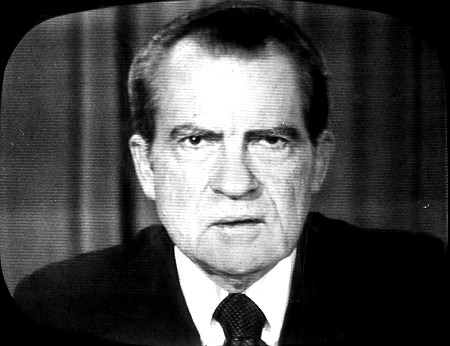
Here is a video recording of Nixon announcing a 90-day “freeze” on prices and wages. Note the Orwellian references to the evils of price controls even as he imposes them.Image

So what was the big emergency that prompted such a drastic response?  Unemployment was running about 6%; price inflation at about 5%.  Nixon’s problem was that an election was coming up in the following year.  He remembered bitterly his narrow loss to Kennedy in the 1960 election which he attributed to a mild recession of that year. Now he was determined to goose the economy and get himself re-elected. Like FDR, Nixon loved dramatic strokes and never mind the consequences. Earlier that year the man who had made his reputation as an implacable anti-communist had made a sudden and dramatic overture to communist China.  So on that sleepy Sunday Nixon delivered another bold stroke, in an end run around the Democratic opposition.  Perhaps it worked: he won 49 states in the 1972 election with considerable help from his bumbling opponent, George McGovern.

His action was quite popular.  The stock market surged that Monday morning and polls showed a 75% approval rate.  But Milton Friedman was right when he predicted “utter failure and the emergence into the open of suppressed inflation.”  Another freeze was imposed in 1973 but this time the damage to the economy became evident.  As explained in the excellent video series “The Commanding Heights,” “ranchers stopped shipping their cattle to the market, farmers drowned their chickens, and consumers emptied the shelves of supermarkets.”  Inflation reached a peak of about 14% before the decade was out and before the powers that be accepted the fact that excessive money creation is the main cause of price inflation. George Schulz, Nixon’s economic advisor and a vigorous opponent of price controls consoled himself with the thought that Nixon had demonstrated dramatically how not to fight inflation.

Nixon wasn’t finished.  During that same Sunday broadcast he slapped a 10% tariff on imported goods, accompanied by some blather about fairness.  More significantly, he ended the Bretton Woods international monetary system.  That arrangement, conceived in 1944, had the U.S. dollar convertible into gold at $35 per ounce, but only for foreign central banks.  Not only could private banks and private citizens not convert their dollars, it was even illegal to own gold (with exceptions for dentists, jewelers, etc.).  I made a point of violating that particular law on principle before the prohibition was lifted in 1974.

In all fairness, the Bretton Woods system was doomed long before that August.  The gold exchange standard had persisted only because of a gentlemen’s agreement that European central bankers would refrain from exercising their redemption rights to any significant degree.  So many new dollars had been created to finance Lyndon Johnson’s war in Vietnam and his “Great Society” at home, and so many of those dollars were parked overseas as a result of trade imbalances, that the U.S. government could not come close to honoring its Bretton Woods obligation in full.  The French under de Gaulle and his gold-bug advisor Jacques Rueff had become increasingly strident about the situation, but in early August the British ambassador showed up with $3 billion to be redeemed, and that may have been the straw that broke the camels back.

So on that same Sunday Nixon slammed the gold window shut (video here)  pushing us out of the frying pan of Bretton Woods, under which numerous wrenching devaluations had wracked international trade, into the fire of floating exchange rates, the system we have now.  The devaluations are gone but the wild swings in currency values, something that was not foreseen by Milton Friedman who was an early advocate of currency markets, are almost as bad.  Now, wonder of wonders, there is resurgent talk of some sort of gold standard.

Reagan tempted me with with some pretty inspiring rhetoric in his 1980 campaign about getting the government off our backs.  Not enough to vote for him, but I was glad he got elected and with the help of Fed chairman Paul Volcker he did break the back of inflation, but he never got spending under control and he didn’t deserve as much credit as he got for the fall of communism, which had been rotten at its core for decades.  But Bush I was terrible and in hindsight Clinton wasn’t all bad, yet I confess I was relieved when Bush II beat Gore in 2000.  I needn’t remind anyone what a disaster GWB was with his wars, his unfunded medicare expansion and his bailouts (OK, thanks for the tax cut).

I’m voting for Gary Johnson who won’t win, and I really don’t care who wins.  Gridlock is the least bad outcome, even if that means the despicable Obama stays in office facing a Republican congress.
“European Project Trips China Builder”

That is the headline of this piece in the Wall Street Journal. An excerpt:

Chinese companies have wowed the world with superhighways, high-speed trains and snazzy airports, all built seemingly overnight. Yet a modest highway through Polish potato fields proved to be too much for one of China’s biggest builders […]

It remains unfinished nearly three years after contracts were awarded to Chinese builders. The Polish government is warning there will be detours around the highway’s “Chinese sections” when the soccer championships begin […]

The project raises questions about Beijing’s strategy of pitching state-directed construction firms as the low-cost solution to the world’s infrastructure needs […]

Covec [the state-run construction company responsible for the failures] was thin on management expertise, lacked financial skills and didn’t understand the importance of regulations and record-keeping in public works projects in the West, according to numerous people involved in the project […]

Organizing actual construction proved harder. To manage the project, Covec brought in Fu Tengxuan, a 49-year-old railway engineer, who spoke only Chinese and appeared to have little authority, telling colleagues that headquarters in Beijing needed to approve even the purchase of an office copier […]

Although the funding of Chinese projects in other areas such as Africa and Asia is often murky, analysts say that Beijing regularly foots the bill […] Continue reading

Left-Liberal Hypocrisy and Bad Taste

Leftists always let their real soul slip through, somehow.

I know a young woman who lives in a country other than the US. She is not American. What she has in common with Santa Cruz, California liberals is, well, everything she says. (I can’t really know what she actually believes.) She says the world is fast coming to an end because of fossil fuels. She says, in so many words, that governments should take their money from the rich to give it to the poor (as defined by herself, of course). She says socialism is more fair than capitalism. (She has no idea what capitalism means.) Of, course, she talks as if the US government were a far worse terrorist than say, Osama Bin Laden. By the way, she does not want to talk about who was responsible for 9/11. I think she likes to feed ambiguity without paying the price deniers of terrorism pay in intelligent society.

This young woman also holds a responsible position in the service of a NATO government. She received an education from one of the very best schools in her country. Personally, I think that one-on-one, she is quite likable. At least, I like her in most respects.

Recently, I had a chance to look at her wedding pictures. They showed the bride in her bridal splendor, laughing guests, parts of a dinner party. Nothing more natural there. However, included in the set of published pictures was one of an expensive Mercedes convertible.

Why was the car treated as prominent member of a wedding party?

Weddings are about two individuals joining their lives together, in part, to rear children. It’s about their friends celebrating. It’s about people, isn’t it? Should be, especially among liberals who always act holier-than-thou in matters of material consumption, liberals who see themselves as are more spiritual than selfish, narrow-minded, gross conservatives like me.

What’s the flashy, environmentally unsound, insulting-to-the-poor, imported car doing in the middle of the wedding party? Do I detect such mind-boggling hypocrisy that the hypocrites don’t even recognize what they are?

By the way, no sour grapes here. I don’t care much about cars, never did. I only ask of a car that it protect me against highway drunks and that I don’t have to think about it. Conservatives are simplistic, for sure! I think expensive cars are the poor man’s art (and, I don’t mean financially poor! Wow, what a bitch I am!) The Mercedes in the picture did look good, not $100,000-good though. Think about how much you could do with that kind of money, for others, and even to cultivate your own self.

How utterly vulgar; how infantile; how astonishingly self-centered, how amazingly incoherent; how so very left-liberal!

The Corporate State and High Liberalism: A Love Story

I have been following the symposium on “free markets and fairness” over at Bleeding Heart Libertarians with some interest. One of the things that has always bothered me about the Left’s despicable tactics concerning liberty is its demagoguery concerning markets. As a former Marxist who has hung out with the right people in the right places, I can assure you that the Left is not so much concerned with the plight of the poor as it is with the plight of the rich.

Once I began to grasp the basic insights of economists (thanks to Ron Paul’s 2008 Presidential campaign) it became increasingly apparent that less regulations and less restrictions are needed in this world in order to help the poor. What I have not understood about my friends on the Left is why they obstinately refuse to acknowledge the facts concerning how markets and the State work. As Deirdre McCloskey has recently pointed out, the narrative of high liberalism is factually mistaken, but this in itself is not enough to convince the True Believers that control over others needs to be abolished.

Two things stand out to me whenever I argue with Leftists: 1) the thin veneer of helping the poor is often used to cover up the base desire for control over others; the high liberal is an authoritarian through-and-through and 2) the Leftist is often unaware of this authoritarianism until you either scratch or cleave him.

Consider the following example. Continue reading

The Future of NATO

The recent NATO summit in Chicago that produced absolutely nothing has opponents of the alliance smelling blood. Indeed, the only thing that the Chicago summit may have produced is a healthy recognition by many factions that the future of NATO itself is increasingly in doubt. This should come as no surprise to any of us here at the Notewriter’s consortium, but in some ways this development is surprising.

Even mainstream pundits, ensconced as they are in Beltway ideology, have begun to notice that the alliance is on its way out. From CNN’s Security Clearance blog (“security clearance”? Really?):

Europe’s collective fatigue with NATO’s globetrotting has often left the United States shouldering most of the burden, which is considered one of NATO’s greatest shortcomings. The United States now covers 75% of NATO defense budgets, while the majority of allies don’t even allocate NATO’s benchmark 2% of gross domestic product to defense.

Sharp reductions in European defense budgets have only increased dependence on the United States.

While realists have been bemoaning the alliance for decades, it has become apparent that the reality of the situation has finally smacked some sense into the Beltway consensus. This must be kind of like how libertarians felt after the collapse of the Berlin Wall in the late 1980’s.

Like the collapse of the Soviet Union, though, there are many things to be worried aboutwith the impending collapse of NATO. The major issue that the US should be worried about is deteriorating relations with Europe. While the American taxpayer got stuck subsidizing the defense of Europe for well over half a century, the relationships brought about by working together have proved fruitful, and in order to keep these relations on good terms, Washington should undertake policies that will further integrate American and European societies: freer trade.

There is no reason why there shouldn’t be a free trade zone between the whole of the US and Europe on the scale of the US itself or the EU (the same goes for the US and its nearest neighbors: Canada, Mexico, and the Caribbean).

One thing that American policymakers should not fear is the rise of a competitor in the form of a European superstate. This fear (or hope, if you are an American socialist) is off-base. Just think of Europe’s sclerotic answers to the worst economic crisis in its history, and then imagine a European Union trying to implement a common, cohesive foreign policy on a global scale like that of the US.

It isn’t possible. Not even states with highly centralized power structures like China can compete with the US in this regard, and the thought of Brussels actively trying to compete with the US in international relations is ludicrous.

The demise of NATO is ultimately a good thing. There is no need for a collective security alliance to combat a menacing Russia any longer. Moscow’s empire of Soviets is long gone, and its focus in the near future will be domestic and along its borders. NATO’s demise will also save the US a lot of money, and will spare the European people from the negative effects (like terrorist attacks) associated with supporting a worldwide hegemon. We can only hope that NATO’s demise comes sooner rather than later, and that each party involved will recognize that continued relations with each other, especially in regards to trading policy, are still vital to peace and prosperity.

Le voisinage. (C’est presque pareil partout!)

La banque, ma femme et moi possèdons une jolie maison de style victorien. Elle est située dans une petite ville côtière, à 100 kilomètres au sud de San Franciso. Notre maison, comme toutes celles du quartier, date d’environ 1900. Elle est en bois, comme presque toutes les autres, dans ce pays de tremblements de terre.

Le terrain comporte un arrière-jardin clos, avec des arbres fruitiers (qui produisent bien, merci) et un avant-jardin donnant sur la rue. De ce côté-là, nous jouissons d’une vue imprenable sur le parking de la mairie, un bâtiment long et bas, en fer-a-cheval, dans le goût faux-mexicain des années 20, plutôt agréable, à vrai-dire. En saison, un vrai train folklo (pas un tramway) passe devant chez nous, au beau milieu de la rue. Les voyageurs, en wagons ouverts, saluent de la main. On leur rend leurs saluts quand on a le temps.

Les voisins de gauche sont des gens à la cinquantaine accusée, bienveillants et serviables mais pas éclatants de beauté. Lui, est musicien de blues, amateur certes mais tout à fait actif. Elle, est en retraite, je ne sais pas de quoi ou d’où. C’est sans importance; l’étiquette sociale de “retraitée” lui va comme un gant. Elle, est gentille mais elle a l’allure de la retraitée règlementaire: pas toujours coiffée dès le matin, les espadrilles un peu éculées. Ces voisins de gauche se sâoulent plusieurs soirs par semaine, en famille, gentiment, sans troubler la tranquilité du voisinage. Quand ils ont bien bu, ils se déshabillent complètement et font trempette dans leur jaccuzi plusieurs heures d’affilée. Ils ont placé la cuve chauffée, à dessein, sous un gros arbre feuillu censé les abriter des regards, ou censé abriter les voisins du spectacle, ce n’est pas clair. Malheureusement, en Californie, la température reste douce bien après la chute des dernières feuilles. Malheureusement, mon second étage surplombe leur arrière-jardin, lieu de leurs ébats aquatiques. Continue reading

The Holographic Universe

Warning: this is not a libertarian post and I may get kicked out of this blog group for going way, way off topic! (It does have repercussions for Objectivists and others interested in ontology and epistemology.) This is an invitation to share a fascinating idea from modern physics: the holographic universe.  As I understand it, the idea is that everything within a volume of space can be thought of as encoded on the boundary of the region – like a conventional hologram.  (You can find runaway interpretations of the idea online which I suspect are bogus.)

Further warning: I am not a physicist.  I do have a Ph.D. in engineering and a decent grasp of mathematics and I have been studying modern physics with Prof. Leonard Susskind at Stanford.  His continuing education classes are just right for the likes of me – people who know elementary calculus, complex variables, etc. but cannot undertake a full-blast graduate physics course.

I commend to you Prof. Susskind’s lecture, The World as Hologram.  He is talking to a lay audience so he uses very little math.  But in his Stanford class he carefully took us through the math that leads to the conclusion that a black hole’s entropy is proportional to its surface area and not its volume as common sense would suggest.

If there’s a lesson here for a libertarian like me, perhaps it’s this: that we shouldn’t let ourselves get into a rut.  Don’t focus exclusively on libertarian issues, but stretch your mind from time to time in a new direction. Allow the possibility that you might learn something from a socialist like Lenny Susskind.  He’s someone I admire very much and I’m fortunate to have gotten personally acquainted with him.

By the way, you could hardly find a more moronic commentary on modern physics than this one, posted on the web site of the Ayn Rand Institute, from which I quote:

Today, physicists suppose that a particle can travel many different paths simultaneously, or travel backwards in time, or randomly pop into and out of existence from nothingness. They enjoy treating the entire universe as a “fluctuation of the vacuum,” or as an insignificant member of an infinite ensemble of universes, or even as a hologram. The fabric of this strange universe is a non-entity called “spacetime,” which expands, curves, attends yoga classes, and may have twenty-six dimensions.

Again, I’m not a physicist, but I have learned enough to recognize this paragraph as a preposterous know-nothing caricature of ideas that have been carefully worked out by physicists who almost without exception remain ruthlessly dedicated to experimental facts and correct logic.

Farewell Lecture (Congratulations!)

Hey everybody,

Co-editor Fred Foldvary is retiring from Santa Clara University and will be giving a farewell lecture on June 6th. The details:

Dear CSI personae,

Fred Foldvary, CSI Director, will retire from SCU on June 2012.


His farewell CSI public lecture will be held

on June 6, 7-8:30 PM, Lucas Hall 126 the Forbes Family Conference Center.


Foldvary’s lecture will be on the question:

“What gives you the right to exist?”

If you had to prove it on the penalty of death,

how would you answer?


See you there,

Fred Foldvary

ffoldvary@scu.edu

We hope everybody who is in the Silicon Valley at the allotted time can attend. Here is CSI’s website. Here is a partial list of Dr. Foldvary’s academic publications over the years (hopefully they are ungated). Here are his writings in the Freeman. Here are his writings in the Progess Report.

Congratulations Dr. Foldvary, you finished the rat race in one piece!

The Best Meal and the Worst Meal Ever

We have been working hard and we have been stressed by the unprincipled doings in Washington. So, here is a new story.

First, let me pull rank on you, reader. I was born and reared in France. I left when I was twenty-one. My godmother was a fine cook in the French tradition. She made it a point to train my palate from when I was a little kid, including with good wines. (You would be amazed to find out what two glasses of wine with lunch do to a seven-year old.) Then, I moved to San Francisco where it’s possible (though not easy) to find an excellent Chinese meal. I spent most of my adult life there, with frequent trips to Europe where I moved around as a dedicated gastronomy tourist, though not the moneyed kind. Once, for two weeks, I sampled the most expensive Japanese cuisine, possibly the best in the world overall. For a longer period, a Vietnamese lady with a fine pair of chopsticks graced my home and my kitchen with her presence. She was supplanted for thirty years following by an Indian lady who puts her pride in her cooking. I would like to tell you that the Vietnamese lady and the Indian lady had a kitchen cat-fight and that the latter won me as the prize but that would be stretching it

In any case, I am pretty sure I know more about food than anyone raised on burgers, fried chicken and Mom’s Sunday brisket and vegetables, even with Italian great-grandma’s Italian spaghetti thrown in occasionally. Yes, this sounds a little pretentious. So, what’s your point? Now that I have got you humbled, you will pay attention to the two demanding philosophical stories rolled into one below. Continue reading

Exploring Irrationality: Clusters

With great trepidation, I want to use this blog to do something that may be verging on the obscene. Don’t worry though, it does not involve my disrobing on-line, at least, not yet.

Let me explain: I style myself a strict rationalist. I have spend much of my life fighting and trying to destroy superstitions. Since I have lived in Santa Cruz, California, for more than ten years, I have been busy. Tech. note: Santa Cruz is where half digested vulgar Marxism meets endlessly with New Age beliefs, diet and exotic health practices. It’s also a major center for the cult of Gaiia. (“Gaiia” is the poetic name for that contrary bitch, Mother Nature.) I think facts matter and the people whose influence I fight every hour of the day when I am not sleeping think only beliefs and intentions matter. They are further sure that beautiful beliefs are more real than facts and that they trump facts (if any).

So, here I go: I have to speak about something I cannot quite explain and that has been puzzling me all my adult life and perhaps before. And it’s a little bit shameful:

Events that have little importance in my life and that I encounter rarely tend strongly to happen in clusters. Two interrelated examples below. Let me tell you right away: what’s below is both perplexing and fairly unimportant.

Example 1: I go to the beach with my grand-daughter who is three. It’s the same beach where we have gone fifty times this past summer. There is small concrete space there in front of a coffee shop and in front of a restaurant. That nice day, the space is jammed. I need to go to the restroom inside quickly. I scan the small crowd for a likely person or persons to whom to entrust my grand-daughter for a very few minutes. My eyes rest on a nice, hearty older couple. I ask them. They say yes with an accent I recognize as German. They confirm they are German tourists. Continue reading

Whining Instead of Sex and the Better Use of Health Insurance: A Testimony

I know how detestable it is for older men to speak about their health. First, the odds that they are going to come out alive are not good. Second, it’s true that many old geezers replace sexual pleasure with the joys of whining. I am not one of those. I have a legitimate, didactic reason to speak about my health, at least, briefly. It has to do indirectly with the underpinning of the on-going debate on and disgust with health care reform.

About five months ago, I started suffering from carpal tunnel syndrome. In a way, CTS is a happy illness. It’s the illness of writers who actually write. It come from spending too much time intensively using the keyboard. Yet, the pain was intense enough to wake me up at night. The neurologist prescribed Aleve. Then, at my insistence, he described the appropriate surgical intervention. It’s a routine operation; it does not require anesthesia; it works almost all the time. Having little patience, in my mind, I was immediately sold on the procedure.

Then, I started looking at cost. I am on one of the Bush-era, smart versions of Medicare. It’s designed to give me all that I need but not much more. I knew this in an abstract way but I had not thought it through because, frankly, who does not have something more exciting to do than reading insurance companies fine print and wooden language? So, I was shocked that my share of the cost for this simple, small operation would come to almost $2,000. I put off the decision because putting off the decision rather than making lemonade, is often the most rational thing you can do when life serves you lemons. Continue reading

Pushing Back Against the State

A friend recently brought my attention to the Orwellian American Community Survey (ACS), a 48-question survey that is sent by the Census Bureau to a random sample of households and asks whether you have difficulty concentrating, how much you paid to heat your home last year, how many times you’ve been married, whether you have a toilet, and on and on.

In 2010 (and in the previous three decades) I sent in my regular census form with the first two questions filled in, those that respond to the Census Bureau’s Constitutional authority to conduct an enumeration every ten years.  I left the rest blank.  I got one visit from a census-taker and told her to get lost.  That was the end of it.  My friend, who is less interested in matters of constitutionality, tells me he simply threw his away and ignored the people who came knocking on his door until they gave up.  I think that’s what I would do with the ACS if I ever got one.

I got my driver’s license renewed last week and they took my thumb print.  I thought of resisting, but to what end?  The DMV drones would simply deny my license, and then what?  Mount some kind of campaign?  I have no time for such a thing, and a driver’s license is a necessity.

Last fall I was summoned for jury duty.  I called the specified phone number the night before and heard that I needn’t report.  But for some reason they decided I was a no-show.  The consequence?  I got a post card scolding me, no more.  (I was prepared to quote the 13th Amendment to the judge, the one that outlaws involuntary servitude.  I was also prepared to go ahead and serve, if the case were an interesting one where I might apply jury nullification.)  My friend just ignores jury summons.

I am about to begin remodeling work on my house, including re-doing a couple of bathrooms.  The building code has gotten quite a bit more intrusive since I built my house in 1978.  My neighbors are laughing at me since both did their bathrooms without permits.  But for various reasons I am going the permit route.  And in truth, some of the provisions that I bristled at first turned out, upon reflection, to be beneficial to me.

And to round out my list of sins, I never mounted the front license plate on my Thunderbird convertible.  I just thought that would spoil its looks, but it occurred to me that I probably can’t be caught by red-light cameras.  I’m amazed that I haven’t been stopped in eight years.

So the question I ask myself (and you) is: where to draw the line — when to push back and when to go along.  The aforementioned examples suggest that the consequences of resistance are likely to be far less than what we fear.  For that we can thank bureaucratic ineptitude.  Random citizens are almost as likely to fall prey to some bureaucratic outrage as are resistors.

I guess the answer is that each of us should do our own cost-benefit analysis.  How good will I feel about resisting and what is it likely to cost me?  Of course that’s often difficult to estimate, but I know one thing: I don’t want to be just a bystander to the slide into fascist dictatorship, if that’s where we’re headed.

While freedom of speech survives we should make the best of it, as in blogs like this.  But almost all the tools are in place for government agents to persecute people for their expressed opinions.  For example, the NSA is developing a capability to intercept and decrypt almost any sort of electronic communication such as emails, phone calls or Google searches. They may well be trolling the entire internet for posts like this.

What are your thoughts?  How are you pushing back?