The legacy of autocratic rule in China

What is the long-term legacy of political persecutions? Here I want to present the main findings of my recent research with Melanie Meng Xue (UCLA Anderson). Our research is an attempt to undercover how a legacy of political persecution can shape social capital and civil society by studying imperial China. The full version of the paper is available here.

We know from other research that particular institutions, policies, and events can have a detrimental and long-lasting impact on economic and political outcomes (e.g. Nunn 2011, Voigtländer and Voth, 2012). But it is hard to find a setting where we can study the long-run impact of autocratic institutions. A key feature of autocracy is the use of persecutions to intimidate potential opponents. In our paper, Melanie and I argue that the intensification of imperial autocracy that took place in the High Qing period (1680-1794) provides an ideal setting to study the impact of such persecutions.

Qing China

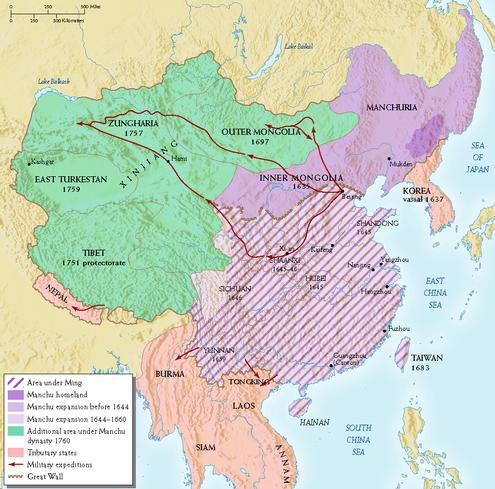
The High Qing period was one of great political stability, imperial expansion, and internal peace. Economic historians like Bin Wong and Ken Pomeranz have shown that China possessed a flourishing market economy during this period; it experienced Smithian economic growth and a massive demographic expansion. Rulers such as the Kangxi (1661-1722) and Qianlong Emperors (1735-1794) are seen as among the most successful in Chinese history. Nevertheless, as ethnic Manchus, these rulers were extremely sensitive to possible opposition from the Han Chinese. And during this period Qing tightened control over the gentry and implemented a policy of the systematic persecution of dissent. (Figure 1 depicts the Manchu conquest of China.)

chinamingqing
The Qing conquest of China

The Literary Inquisitions

The focus of our paper is on the impact of persecutions conducted by Qing China against individuals suspected of expressing disloyalty. We study the impact of these state-orchestrated persecutions on the social fabric of society. This allows us to speak to the kinds of concerns that authors like Hannah Arendt and George Orwell expressed about the long-run impact of totalitarianism in the 20th century.

These persecutions are referred to by historians as ‘literary inquisitions’. Existing scholarship suggests that the resulting fear of persecution elevated the risks facing writers and scholars, and created an atmosphere of oppression and a culture of distrust which deterred intellectuals from playing an active role in society. But these claims have never been systematically investigated. Putting together several unique datasets for historical and modern China, we explore the impact of literary inquisitions on social capital in Qing China and trace its long-run impact on modern China through its effect on cultural values.

spence
Jonathan Spence provides an excellent account of one of the most famous and unusual inquisition cases in his book Treason by the Book

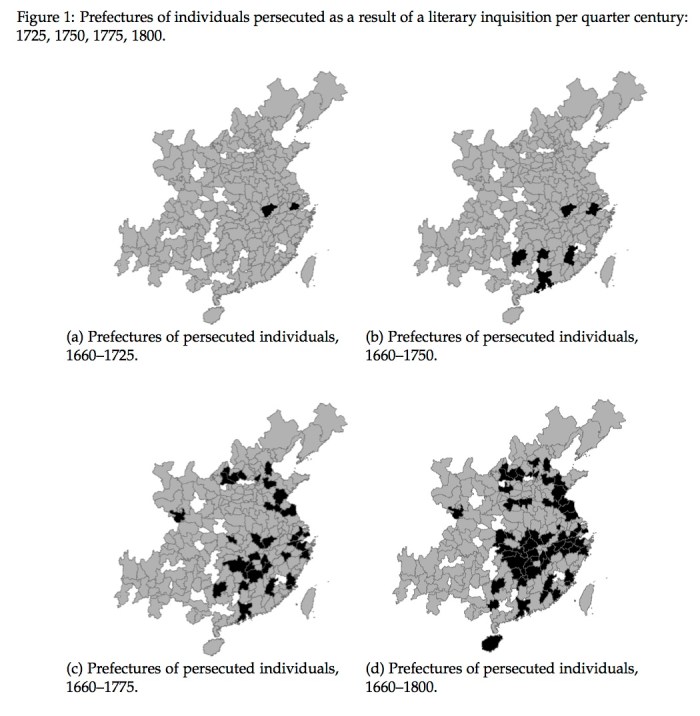
To conduct our analysis, we use data on 88 inquisition cases. We match the victims of each case (there are often multiple victims per case) to their home prefecture. This data is depicted in Figure 1. Since prefectures varied greatly in their economic, social, and political characteristics we conduct our analysis on a matched sample. This ensures that the prefectures “treated” by a literary inquisition are similar in terms of their observables to those we code as “untreated”. As our data is a panel, we are able to exploit variation across time as well as variation in space.

While individuals could be persecuted for a host of reasons, these were all but impossible to anticipate ex ante. Cases were referred to the emperor himself. Frederic Wakeman called this “the institutionalization of Imperial subjectivity.” The standard punishment in such cases was death by Lingchi or (slow slicing) and the enslavement of all one’s immediate relatives. In some cases, however, the guilty party would be executed by beheading. These persecutions aimed to deter opposition to Qing rule by signaling the ability of the Emperor to hunt down all potential critics or opponents of the regime.

Map.jpg

The Impact of Literary Inquisitions on Social Capital

We initially focus on the impact of persecution on the short and medium-run using our historical panel. We first examine the effects on the number of notable scholars.  In our preferred specification we find that a literary inquisition reduced the number of notable scholars in a prefecture by 33 percent relative to the sample mean.

We go on to show the effect of persecutions on collective participation among the gentry in China. Our measure of collective participation in civil society is the number of charitable organizations. Charitable organizations played an important role in premodern China providing disaster relief and local public goods such as repairing local roads. They were non-governmental organizations and played an important role alongside the government provision of disaster relief. In our preferred empirical specification, we find that a persecution number of charitable organizations by 38 percent relative to the sample mean.

These results are in keeping with the argument that literary inquisition had a major psychological impact on Chinese society. They are consistent with the rise of “inoffensive” literary subjects during the Qing period that have documented by historians. To reduce the risk of persecution, intellectuals scrupulously avoided activities that could be interpreted as constituting an undermining of Qing rule. Instead they “immersed themselves in the non-subversive “sound learning” and engaged in textual criticism, bibliography, epigraphy, and other innocuous, purely scholarly pursuits” (Wiens, 1969, 16).

The Impact of Literary Inquisitions on 20th Century Outcomes

We go on to examine how the effects of these persecutions can be traced into the 20th century. In particular, we focus on the provision of basic education at the end of Qing dynasty. In late 19th and early 20th century China, there was no centralized governmental provision of primary schools.  Basic education remained the responsibility of the local gentry who ran local schools.

Thus the provision of education at a local level was dependent on the ability of educated individuals to coordinate in the mobilization of resources; this required both cooperation and trust. We therefore hypothesize that if the persecution of intellectuals had a detrimental impact on social capital, it should also have negatively affected the provision of basic education.

We find that among individuals aged over 70 in the 1982 census – hence individuals who were born in the late Qing period – a legacy of a literary inquisition is associated with lower levels of literacy. This reflects the impact of literary inquisition on the voluntary schools provided by the gentry and is not associated with lower enrollment at middle school or high school. We show that result is robust to controlling for selective migration and for the number of death caused by the Cultural Revolution.

Finally, we show that literary inquisitions generated a cultural of political non-participation. Drawing on two datasets of political attitudes – the Chinese General Social Survey (CGSS) and the Chinese Political Compass (CPoC) – we show that individuals in areas in which individuals were targeted during literary inquisitions are both less trusting of government and less interested in political participation.

Finally, we find that individuals in prefectures with a legacy of literary inquisitions are less likely to agree that: “Western-style multi-party systems are not suitable for China” (Q 43.). This suggests that in areas affected by literary inquisitions individuals are also more skeptical of the claims of the Chinese government and more open to considering alternative political systems. Similarly, individuals in affected prefectures are more likely to disagree with the statement that: “Modern China needs to be guided by wisdom of Confucius/Confucian thinking.”

In summary, our analysis suggests that autocratic rule reduced social capital and helped to produce a culture of political quietism in pre-modern China. This has left a legacy that persisted into the 20th century. These findings have implications for China’s current political trajectory. Some scholars anticipate China undergoing a democratic transition as it’s economy develops (Acemoglu and Robinson, 2012). Others point to China as an example of “authoritarian resilience.” By showing that a long-history of autocratic rule and political persecutions can produce a culture of political apathy, our results shed light on a further and previously under-explored source of authoritarian resilience.

Porque privatizar (ou desestatizar) o ensino é uma das melhores reformas que se pode fazer

Talvez seja somente uma percepção subjetiva sem maior relevância objetiva, mas a impressão que tenho é que a privatização do ensino é um dos maiores tabus da sociedade brasileira. Até onde eu sei nenhum partido, figura política ou figura pública de destaque está defendendo a privatização total do ensino no Brasil. Segundo as notícias que chegam até mim, o recente anúncio de corte de gastos na educação causa uma de duas reações: indignação ou pesar. Alguns reagem com indignação, e não aceitam que qualquer corte seja feito; outros reagem com pesar, mas consideram que os cortes são necessários. Ditas estas coisas, penso que cabe a mim agir como Walter Block e “defender o indefensável”: o governo (ou o estado – use o vocabulário que lhe convir) não deveria ter qualquer papel na educação. Para isso irei expor brevemente o que é economia, como ela funciona, e o que isso tem a ver com governo, indivíduos e educação. É uma exposição breve, e pode deixar alguns pontos pouco desenvolvidos. Para uma exposição mais profunda deste tema, recomendo o livro Educação: Livre e Obrigatória, de Murray Rothbard.

Economia é a gestão de recursos necessariamente escassos que possuímos. Os recursos são necessariamente escassos porque somos seres humanos finitos, e não deuses. Alguns paradigmas econômicos (notoriamente o marxismo) partem de um pressuposto de abundancia de recursos, mas isto é falso e até mesmo perigoso: até mesmo o homem mais rico do mundo tem somente 24 horas no seu dia. Tem somente um corpo, e não pode estar em dois lugares ao mesmo tempo. Tem energia limitada, e fica cansado. Todos nós possuímos recursos limitados (ainda que alguns possuam mais recursos à sua disposição do que outros). A economia é a arte de melhor gerir estes recursos.

A gestão dos recursos limitados que possuímos é feita através de escolhas. O nome que os economistas dão a isso é “custo de oportunidade”: a não ser que você detenha infinitos recursos, gastar em uma coisa significa não gastar na segunda melhor alternativa. Exemplos: comprar o carro A significa não comprar o carro B; morar na cidade X significa não morar na cidade Y; casar com Z significa não casar com W; e escolher a carreira α significa não escolher a carreira λ. Como disse um antigo professor meu, “a vida é feita de escolhas”.

Considerando que possuímos recursos finitos e precisamos fazer escolhas, qual é mecanismo mais eficiente para tomar decisões? Certamente muitas pessoas gostariam de tomar decisões com base nos seus gostos pessoais. Gostariam de escolher aquilo de que mais gostam. Porém, aquilo de que mais gosto nem sempre está ao meu alcance. Exemplos: ainda que eu goste mais de uma Ferrari do que de um fusquinha, talvez eu precise me contentar com a segunda opção. Ou ainda que eu queira viajar, talvez eu tenha que me contentar em pagar o tratamento para um problema de saúde que acabei de descobrir que tenho. É por coisas assim que a economia ficou conhecida como “ciência triste”. Muitas vezes ela está aí para lembrar que nem sempre podemos ter o que queremos. Dito isto, a melhor forma de tomar decisões é pelos preços: os preços nos dizem se aquilo que desejamos é compatível com os recursos disponíveis.

Os preços são geralmente definidos em termos de dinheiro. Dinheiro é melhor definido por aquilo que faz do que por aquilo que é. Muitas coisas podem ser dinheiro: papel, metais preciosos, cigarros, balas ou dígitos num computador. Mas o que dinheiro faz é servir como uma linguagem: o dinheiro transmite de uma pessoa para outra o valor dos recursos envolvidos numa mercadoria ou num serviço. E valor é algo subjetivo. Contrariando a teoria do valor trabalho, é impossível saber de forma objetiva qual é o preço de uma determinada mercadoria ou serviço: é necessário que este valor seja definido por relações de oferta e procura. E é de incontáveis relações de oferta e procura que os preços são feitos. Em outras palavras, os preços nos transmitem de forma simples algo que jamais poderia ser calculado por uma pessoa: uma infinidade de relações de oferta e procura, escolhas e preferências, dentro da economia. Como disse Friedrich Hayek, “a economia somos nós”.

E assim chegamos à educação. Como eu disse acima, escolher a carreira α significa não escolher a carreira λ. Como essa decisão é feita? Certamente que muitas pessoas escolhem sua carreira com base em aptidões que percebem em si mesmas, ou em considerações sobre o que poderá ser uma atividade profissional mais prazerosa. Porém, este é um luxo que não está disponível para todos: muitas pessoas precisam escolher uma carreira com base no que pode dar mais retorno financeiro com menor investimento e menor risco. Posso escolher uma carreira que promete um grande retorno financeiro, mas com grande risco de não conseguir emprego num mercado de trabalho altamente competitivo, ou com um investimento de recursos (em tempo em dinheiro) que não posso arcar. A vida é feita de escolhas, e essas escolhas muitas vezes envolvem riscos. Escolher uma carreira é dizer não (ao menos temporariamente) para todas as outras. Algumas pessoas tem a chance de arriscar mais. Outras não têm o mesmo luxo. Considerações como relação candidato/vaga, salário médio, nível de empregabilidade e outras são semelhantes aos preços, e podem ser bons parâmetros ao se decidir por uma carreira. Mas com o governo criando vagas em universidades, determinando regras de acesso ao mercado de trabalho e adotando outras medidas, os preços não refletem a real relação de oferta e procura. Em outras palavras, a linguagem é distorcida, e as decisões não são as melhores, nem para os indivíduos, e nem para a sociedade.

Compreendo que pensar assim possa soar extremamente cínico, e pode ser um banho de água fria, especialmente para os mais jovens ou mais sonhadores. Muitas pessoas preferem tomar decisões considerando seus gostos pessoais, sua vocação, seu desejo de ajudar o próximo ou outras considerações. Não estou desmerecendo nenhuma destas considerações. Estou apenas dizendo que somos seres humanos limitados que vivem num mundo de recursos limitados. Precisamos fazer o melhor uso possível destes recursos. Embora os recursos sejam limitados, nossa criatividade para aproveitá-los não demonstra um limite óbvio. O uso criativo e sustentável dos recursos necessita de uma bússola, um guia. O sistema de preços é o melhor guia que possuímos. Sem propriedade privada não há formação de preços, e sem formação de preços o cálculo econômico é impossível. Por esta razão os gastos com educação não param de aumentar e a qualidade dos resultados não para de cair: o melhor juiz para determinar como os recursos serão empregados é o individuo fazendo uso de seus próprios recursos. A interferência do governo prejudica ou até desfaz este julgamento.

Em tempo: estou defendendo que o governo precisa sair da educação e deixá-la para a iniciativa individual (até mesmo porque somente indivíduos podem ter iniciativa). Não estou defendendo que educação precisa ser necessariamente paga pelos alunos. Como disse Milton Friedman, “não existe almoço grátis” (mais uma dessas frases que tornam os economistas – especialmente os liberais clássicos e libertários – pessoas pouco populares). Mas quando uma pessoa tem fome e não pode pagar pelo almoço, outra pode fazer isso. O nome disso é caridade, e quero incentivá-la o máximo possível. Caso você se preocupe com os pobres, sugiro que pare de mandar dinheiro para Brasília na forma de impostos, que serão necessariamente mal empregados (segundo tudo que discuti aqui), e procure pessoas que precisam. Com certeza você não terá dificuldade de encontrá-las.

Intervention for your own good

Insider trading feels unfair, but increases the efficiency of financial markets. A price should reflect an estimate of the future profitability of the underlying asset, and insider trading allows those with the most information to have more of an impact on that price.

The Supreme Court is currently considering a case that will determine how broadly to define insider trading. If the defendant loses, then cases where a family member of an insider benefits from a stock tip could be considered insider trading. If he wins, it will probably be much more difficult to prevent insider trading. But why should we?

Some argue that the possibility of insider trading creates a problem of asymmetric practicable information–insiders always know more, but if they’re allowed to act on that information, outside investors lose incentive to invest in potentially valuable projects. That may be, but does it justify prohibiting insider trading? No.

The problem of asymmetric information requires a commitment device, but that device doesn’t have to be one-size fits all. Let businesses and investors solve this problem themselves with contracts.

On granting the Nobel to Kirzner

In a little over a week, the Nobel Prize in economics will be unveiled. A part of me wishes that Robert Barro wins or maybe Dale Jorgenson or even William Baumol. However, I would be thrilled if Israel Kirzner won. Back in 2014, he was mentioned for the prize and it was the year that Jean Tirole, deservedly, won the prize. Since then, I have been dreaming of it as it would cement into the mainstream the best that the Austrian school of economics can offer.

Unlike many of colleagues, I have always had sympathies for numerous points made by the Austrians. Throughout my training, the Austrian school of economics was largely derided as cranks. Initially, I jumped on the bandwagon and I believed the Austrians to be crazy. However, I became exposed to many of their key points and like Edmund Phelps, I felt that the “best of the Austrians” could not be rejected so easily. True, there is some wheat to sort from the chaff, but the same applies for every school of thought.  I realized that most of their inputs in macroeconomics were largely incorporated in models like Lucas’ Islands Model or in Prescott’s Time to Build. However, what most intrigued me was how they used general equilibrium as a teaching tool, but not as a research tool. General equilibrium is useful for understanding key axiomatic assertions, but when you have an “applied economics” question, it is a hard tool to use – especially for an economic historian like me.

Kirzner is the perfect representation of the best that the Austrian school has to offer. In a way, his entire work can be summarized as such: it is the process leading to (new) equilibrium(s) that is the most interesting aspect of economics.

It is when I understood that insight that I finally grasped the deeper meaning of Hayek’s claim that “competition is a discovery process”. Entrepreneurs are people who look for the $100 bill on the sidewalk by innovating, by exploiting arbitrage opportunities and by discovering what consumers really want. They are constantly heading towards an equilibrium point. But as they try to do so, they shift the ability to produce and consume to greater levels and, in doing so, they generate a new equilibrium. And the process continues as long as human beings are humans.

For someone who studies economic history like I do, this is the most fruitful way of looking at social interactions. After all, the industrial revolution is everything except an equilibrium and the industrial revolution is most momentous structural break in history. The search for equilibrium and the creation of new equilibriums are by far more useful tools for questions like the end of “Malthusian pressures” or the beginning of the Industrial Revolution.

Of course, I am veering into excessive simplification of Kirzner’s contribution. But consider his book, Competition and Entrepreneurship. Alone, it has 7,362 citations (according to google scholar).  This is half the citations obtained by the most cited article in the American Economic Review (Armen Alchian and Harold Demsetz’s Production, Information Costs and Economic Organization). It’s close to 3,000 more citations that Deaton and Muellbauer’s “Almost Ideal Demand System” (4,775 citations). And Deaton won the Nobel last year!

By virtue of being affiliated with the Austrians, mainstream economists could have relegated him to obscurity. However, for such a citation count to be achieved, he must have been to showcase the best that the Austrian school has to offer. Just for that, maybe his contribution should be recognized.

O capitalismo explora os trabalhadores?

Um dos argumentos contra o liberalismo econômico que tenho ouvido recentemente (ou contra a liberdade de mercado, com pouca ou nenhuma intervenção do estado) é que as relações entre patrões e trabalhadores são desiguais, e logo então desfavoráveis para os trabalhadores; cabe ao estado intervir a favor dos trabalhadores; o liberalismo econômico não é bom para os trabalhadores. Tenho dificuldade com este argumento, pois ele passa a ideia de que os patrões não trabalham. Seja como for, acredito que posso aceitar parte do que está sendo dito: é lógico que alguns patrões irão tentar pagar o pior salário possível aos trabalhadores para conseguir os maiores lucros possíveis. É lógico que muitos patrões irão ver qualquer investimento em segurança, bem estar, saúde e outros “direitos” como gastos incômodos, e irão tentar evitar estes gastos. É lógico que o trabalhador está pleiteando a vaga, e neste sentido está à mercê do patrão que a oferece. Tudo isto é não apenas lógico, mas empírico. Pessoalmente já vi estas coisas acontecendo “com estes olhos que a terra há de comer”. Há patrões que irão tentar fazer todas estas coisas e outras ainda, aproveitando-se da situação vulnerável dos trabalhadores. Irão tentar. Mas irão conseguir?

Segundo me parece, uma forma de evitar que patrões se aproveitem da situação vulnerável dos trabalhadores é apelar para a caridade dos patrões. Embora eu suspeite que esta abordagem possa soar romântica para muitos, o fato é que empiricamente ela funciona com alguma frequência. Historicamente, foi o cristianismo de muitos empresários que possibilitou a melhora das condições de trabalho na Europa e Estados Unidos durante o primeiro século de Revolução Industrial. Portanto, esta é uma abordagem que, acredito, não deve ser desconsiderada.

Uma segunda forma de evitar que patrões se aproveitem da situação vulnerável dos trabalhadores é criar leis trabalhistas. Ao invés de esperarmos que os patrões sejam voluntariamente bons, podemos usar a violência legítima do estado para força-los a serem bons. Esta abordagem possui efeitos positivos, mas também muitas consequências inesperadas. Basicamente o objetivo de qualquer lei é tornar os relacionamentos humanos mais padronizados. Uma maneira mais negativa de dizer a mesma coisa é falar que leis engessam a sociedade. Leis trabalhistas criam “direitos”, mas também impedem que trabalhadores e empregadores negociem voluntariamente outras possibilidades de relacionamento. Um exemplo bastante conhecido é o salário mínimo, que contra intuitivamente prejudica os trabalhadores mais do que os ajuda. Finalmente, leis só fazem sentido caso sejam amparadas por um estado. E com mais leis, mais estado. Nossa relação com o estado já é por definição desigual: o estado possui o monopólio do uso legitimo da violência; nós não. Aumentar o tamanho do estado é aumentar nossa vulnerabilidade dentro de uma relação desigual, o que vai contra exatamente o que está sendo discutido aqui.

Uma terceira forma de evitar que patrões se aproveitem da situação vulnerável dos trabalhadores é a liberdade econômica. Sim, como eu comecei dizendo, é lógico e empírico que alguns patrões irão tentar se aproveitar de situações de vulnerabilidade dos empregados. Mas irão conseguir? Numa sociedade orientada pela liberdade de mercado, é mais provável que não. Com liberdade de mercado, a tendência é o surgimento de concorrência, além de uma maior diversidade de atividades econômicas. Neste cenário, patrões que procurem abusar dos trabalhadores correm o rico de perder os trabalhadores para outros patrões. Mesmo no cenário improvável de todos os patrões serem abusivos, tratar bem os trabalhadores torna-se um imperativo para manter os lucros. A alternativa seria um acordo geral dos patrões abusivos, mas isto tornasse empiricamente infactível numa sociedade progressivamente marcada por liberdade de escolha. Uma última observação nesta lista muito longe de exaustiva de benefícios do livre mercado para o trabalhador é que no livre mercado a tendência é de aumento da produtividade. E nada está mais ligado a aumentos de salários do que aumento de produtividade. De fato, onde há liberdade de mercado os salários aumentam, assim como o poder de compra.

Em resumo, sim, há patrões que se aproveitam das relações desiguais com trabalhadores para exercer poder sobre estes mesmos trabalhadores. Isto é não apenas lógico, mas empírico. Mas qual é a melhor solução para este problema? Apelar para a boa vontade dos patrões? Criar leis que deem aos trabalhadores mais direitos? Favorecer uma maior liberdade de mercado? Minha resposta é: criar leis que favoreçam maior liberdade de mercado, e ao mesmo tempo apelar para a boa vontade dos patrões, até porque num cenário de maior liberdade econômica, patrões abusivos estão indo contra seus próprios interesses.


Referências:

O capitalismo explora os trabalhadores?

The Great Blessings of Cash

Paper money offers the benefits of anonymity, immediate payment, no identity theft, and no transaction charges. Government also benefits by printing notes with much greater value than the cost of the paper. However, some economists argue that cash has social costs that outweigh these blessings, and advocate the reduction and eventual elimination of paper cash. Several countries are planning to discontinue their largest currency notes. The European Central Bank is phasing out its 500-euro note; it will stop issuing new ones in 2018. The Scandinavian countries are reducing their paper cash.

Kenneth Rogoff, professor at Harvard University, has written a book, The Curse of Cash, in which he argues that the elimination of large-denominations of paper money would be good for society. Cash is a curse, he says, because criminals use the large bills, and because it limits the ability of central banks to have negative interest rates.

The use of cash by the underground economy is a symptom of bad policy, and the elimination of cash treats the effects rather than the causes. The reason economic activity goes underground is that governments have prohibited economic transactions.

Although some U.S. states have decriminalized medical marijuana, the substance remains illegal in federal law, which prevents the sellers from using the normal banking system. Therefore they use paper money. The prohibition of drugs generally drives the industry towards the use of large denominations, especially “Benjamins,” the US $100 bill depicting Benjamin Franklin. The elimination of Benjamins would make it less convenient to sell illegal drugs. The higher cost would raise the price of illegal drugs, but since the quantity demanded by addicts is not very responsive to a change in price, the drug dealers would find ways to do their transactions.

The legalization of drugs would eliminate the cause of the high demand for paper cash. Just as with alcohol, producers would then use the normal banking system.

The underground economy uses cash also for activities that are legal if taxes are paid on the income and sales. Again, the elimination of cash would make tax evasion less convenient, but not eliminate the incentives to evade having substantial amounts of gains taxed away. Rogoff thinks that if the government prohibits the legal use of Benjamins, the remaining notes would lose value, as they would no longer be legally convertible into small denominations and not be legally payable for goods. But large notes could circulate as a medium of exchange within the underground economy as an alternative currency. Moreover, there are underground currency traders in all countries that impose artificial currency exchange rates.

The problem originates in evadable taxation. The remedy that eliminates the cause is to make taxation unevadable. The main resource that cannot hide is land. The taxation of land value, based on its best possible use regardless of current use, cannot be evaded. The elimination of all other taxes would bring production, trade, and consumption above ground and eliminate the current high demand for paper cash.

Another “curse of cash” argued by Rogoff is that paper money prevents central banks from lowering the transaction rate of “interest” much below zero. Suppose a bank has a negative 5 percent charge on deposits, so that the depositor has to pay $5 per year per $100 deposited. Many people would withdraw the money and hold it in paper cash. Companies would offer to securely store your cash in insured vaults. If all notes above $10 were made illegal, the storage and insurance costs would rise substantially, and the banking system would be better able to have the negative rates.

The alleged benefit of negative rates is that, because the banks also pay negative rates on their deposits with central banks, financial institutions would scramble to loan out the money to investors who would pay a positive rate, or become partners in ventures.

It is bad enough now that savers, especially retired folks, are getting close to a zero return on their retirement savings. Negative returns on, say, large certificates of deposit would further ruin those who depend on income from savings. Again, the artificial device of pushing the nominal rate of interest below zero is an attempt to treat the symptoms rather than cure the causes.

Some blame a glut of global savings for the low rates of interest. But technology is marching forward, to artificial intelligence, robots, medical advances, better batteries, and many other frontiers. There is no shortage of possible investment projects. But governments world-wide stifle investment with taxes and restrictions. The USA, for example, has choked investment since 2008 with tighter banking restrictions and higher costs such as medical mandates.

What is needed is the ultimate supply-side policy, cutting marginal tax rates on labor and investment yields to zero, with a prosperity tax shift, replacing all other taxes with a single tax on land value. The land-value tax would also push land to its most productive use, stimulating productive investment and employment.

As to money, attempts to skew markets almost always fail, so it would be best to eliminate central banks and their manipulations of nominal interest rates. Let markets set the money supply and restore the positive natural rate of interest based on the human-nature tendency to prefer to have goods sooner rather than later.

Controlled market manipulations are failing, and so statist advocates propose even more artificial controls such as eliminating paper money and pushing interest rates below zero. But the further we get from economic freedom, the worse the outcome. Interest rates and money evolved in markets; let them return to their natural base.

Note: this article is also in http://www.progress.org under the title The Blessings of Cash.

Inherited wealth and size of government

In the debate over inequality, I have long argued that governments are much better at creating inequality than at reducing them (see my paper here with Steve Horwitz). Through rent-seeking and regulatory capture, interest groups manage to redistribute wealth in the “wrong” direction. There are a great many cases of large fortunes amassed thanks to government favors (think of the Bombardier family in Canada or Carlos Slim in Mexico).

Yet, as many scholars have pointed out, large fortunes can be rapidly consumed by squabbling heirs and poor investments (see this paper here notably). Thus, the fortunes gathered by parents who earned government favors can melt away over time. Nonetheless, governments do protect the fortunes of the heirs if they continue in business. For example, the heirs of the Bombardier family in Canada continued their ancestor’s work and remained relatively well-off. This is in part because governments continue to rescue that firm from its misfortunes. In a way, government may act to limit the erosion of fortunes. We can phrase this differently by asking whether or not the size of government is correlated with the share of wealth from the “ultra-rich” that is gained through inheritance.

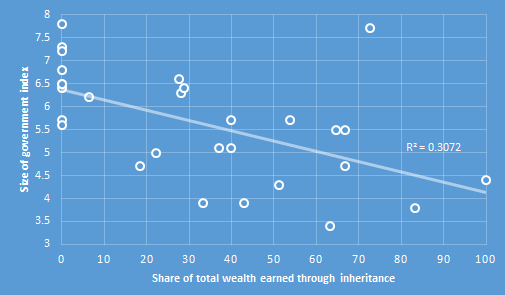
Using a working paper from the Peterson Institute for International Economics titled The Origins of the Superrich: The Billionaire Characteristics Database authored by Caroline Freund and Sarah Oliver and the Economic Freedom Index of the World produced by the Fraser Institute (released this week), we can check for the existence of this correlation. The paper by Freund and Oliver documents the share of the total wealth of billionaires that was earned through inheritance.

Unsurprisingly (for me), the lower the index for the size of government, the greater the share of wealth earned through inheritance. Using all OECD and European countries, we can very well see that the size of government is negatively correlated with the share of wealth from inheritance. untitled

Maybe, just maybe, those who believe that the solution to rising inequality is more government redistribution should be willing to reconsider their proposed cure. This is, I believe, an additional cause for skepticism regarding remedies.

Some afterthoughts on Rio Paralympics

Paralympics are over, and with them the cycle of Olympic Games in Rio de Janeiro. Once again the city was able to put up a good show, and thankfully all went well in the Cidade Maravilhosa. But not everything is alright in Rio: even more than the Olympics, the Paralympics were able to show the contradictions between the city where we live everyday and the city of the event: Rio is not welcoming for people with disabilities.

At least in Brazilian Portuguese, political correctness has done a mess with vocabulary concerning the kind of people who compete in Paralympics. We are not supposed to say they are disabled (don’t even think about saying they are crippled!). I think the correct vocabulary today is, as I used, “people with disabilities.” But even that is under political correct scrutiny, so it seems. All this discussion about words springs from cultural Marxism, postmodernism, relativism and the belief that there’s nothing objective beyond our vocabulary. But words can’t hide the reality: Rio is unequal. The way it treats the blind, the lame, and even the elderly or the young, is completely different from the way it treats people in middle-age and more able to walk. And all that despite strong legislation in this area.

One of the greatest debates in political philosophy in the 20th century happened between American philosophers John Rawls and Robert Nozick. Trying to build on classical liberal foundations (but moving to egalitarian liberalism), Rawls pointed out that “equality was supposed to be the moral benchmark for social and political institutions, and that any deviation from equality had to be specially justified.” Nozick answer was that liberty upsets patterns. Even if we have a starting point in society where we have a perfectly equal distribution of goods or assets, the moment that we allow people to be free to make their own choices (as liberalism prescribes) they are going to make choices we cannot possibly predict, and these choices are going to upset any kind of pattern we established in the first place. That happens because each one of us is unique in its own right: each one of us have a specific set of values, preferences and circumstances that upsets any would-be planner. So, if you want to respect human liberty to make choices, you have to give up on any plan for material equality.

Nozick’s answer to Rawls has a lot of Adam Smith in it. In The Theory of Moral Sentiments (1759) (preceding the more famous Wealth of Nations both in time and argument) Smith presented a character called “man of system.” This person sees society as an architect sees a blueprint for a construction. Smith says such person is “apt to be very wise in his own conceit; and is often so enamored with the supposed beauty of his ideal plan of government that he cannot suffer the smallest deviation from any part of it.” The problem is that humans have free will, the ability to make choices. And as such, they will upset any blueprint prepared for them. In other words, “individual people are not chess pieces you can move on a board with their dreams and desires ignored.” To the eyes of the would-be planner, “society must be at all times in the highest degree of disorder.”

So, material equality of outcomes (or at least of opportunities) is totally out of reach? Should we disregard it completely? Should the “invisible hand” prevail in spite of the weakest in our society? I don’t think so. Just the opposite! One of the very reasons I find classical liberalism morally appealing is the fact that no economic or political system ever conceived helps the weakest as it does. In other words, contrary to (what seems to me is) the popular belief, classical liberalism defends social justice more than any of its intellectuals alternatives. Answering John Rawls’s famous claim that “a just society will be one whose rules tend to work to the maximum advantage of the least well-off classes,” Friedrich Hayek pointed out exactly this. In The Constitution of Liberty, Hayek agreed with Rawls about the end at which social institutions should aim: the welfare of the least advantaged. He simply disagreed about the means Rawls thought would get us there.

Instead of thinking of us as chess pieces on a board, when can use the analogy of a soccer game (or football, or basketball – suit yourself). The outcome of the game is the result of the player’s individual abilities, but it is also the outcome of the rules. In other words, in a free society, where people are free to choose, the outcomes are not just the result of the innumerable decisions of countless individuals. They are also the result of the rules enforcing property rights, contracts, taxation, and so on. So, it’s important to think about the justice of these rules, as well as the outcomes they might have. The point is that we can embrace a theory of social justice, but that just tells us the end we are heading to, not the means to get there.

Contrary to egalitarians, progressivists and socialists claims, no theory “tends to work to the maximum advantage of the least well-off classes” as classical liberalism does. And that’s a great reason I support it. As I said in the beginning, Rio is very unequal, despite decades of egalitarian policies in the city and in Brazil as a whole. On the other hand, there’s plenty of evidence that classical liberal policies tend to help the very people others accuse it of ignoring. When it comes to doing social justice, it’s important to have not just the heart, but also the mind in the right place. And I believe classical liberal policies are this place.

References:
What’s Right about Social Justice?
Rawls and Nozick on Liberty & Equality
Adam Smith and the Follies of Central Planning
Fight of the Century

Minorities and Economic Growth: Evidence from Jewish Communities in Premodern Europe

Urban theorist Richard Florida is celebrated for arguing that cities today succeed by attracting members of the “creative class.”  In a similar spirit I have a recent paper with Noel D. Johnson where we investigated whether or not cities in medieval and early modern Europe grew faster if they possessed a Jewish community.

Scholars have long noted the role of minority groups in economic development. This is particularly true for the the premodern period. The great scholar of long-run historical development in Europe, Fernand Braudel, observed that “successful merchants who controlled trade circuits and networks often belonged to foreign minorities.” These minorities could be other nationalities or religious minorities, for example, “the Jews, the Armenians, the Banyans, the Parsees, the Raskolniki (Old Believers) in Russia or the Christian Copts in Muslim Egypt” (Braudel, 1979, 1982, 165).

Hornung (2014) studies the impact of the Huguenot migration to Prussia. Since the nineteenth century, scholars like Friedrich List linked the presence of Huguenots with the transmission of human capital, skills, and innovation. Hornung (2014) is able to test this hypothesis using Prussian immigration lists from 1700 that document the location of Huguenot settlements and firm-level data on input and output for all 750 textile manufactories in Prussia in the year 1802. Approximately 16,000 to 20,000 Huguenots fled France to Prussia at the end of the seventeenth century.  Hornung finds that the presence of Huguenots significantly increased firm productivity. Specifically, a 1 percentage point increase in the share of Huguenots was associated with 1.5 percentage points higher productivity in 1802.

Jewish Communities and City Growth

In our paper we take a broad sweep of European history from 1400 to 1850.  We have a total of 1,792 cities in our panel data from the Bairoch (1988) dataset and 1,069 Jewish communities that appear in the Encyclopedia Judaica. The figure below shows both the cities in the Bairoch dataset and the Jewish communities mentioned in the Encyclopedia Judaica.


bairochandjewishcitiesgreyscale

To understand the relationship between the presence of a Jewish community and subsequent city growth we conduct a difference-in-differences style regression analysis.

The fact that we have data on city populations every century means we can hold constant the identity of a city using city fixed effects and see whether or not it grew faster in the centuries when it had a Jewish community in comparison to those centuries when it did not. We can also control for the possibility that overall city growth was faster in some centuries in comparison to others using century fixed effects.

We are also able to hold constant other factors that could plausibly have affected city growth. We control for local geography including cereal suitability, proximity to rivers, and proximity to coast, as these factors likely affected city growth in different ways over time. We also control for local infrastructure including presence of university and distance to a medieval trade route.

Our  analysis suggests that, indeed, cities with Jewish communities grew faster on average between 1400 and 1850. The effect we find suggests that cities with Jewish communities grew about one third faster than those that did not have Jewish communities. This analysis remains a correlation, however. We do not know if the presence of a Jewish community brought with it economic benefits or if Jews merely choose to settle in faster growing cities.

Instrumenting the Presence of a Jewish Community

We model the network of Jewish communities as one way to see whether the effect of Jews on city growth was indeed casual. By examining how Jewish communities expanded we hope to isolate a source of exogenous variation in the presence of a Jewish community.

We assume that a Jewish community is more likely to be established close to another Jewish community because of trade networks, financial relationships, or cultural linkages. We then calculate the closest travel path between Jewish communities using our information about the location of roads and river networks and estimates of premodern transport costs. The important assumption we make is that if cities with Jewish communities share certain “unobservable” characteristics that might make them more likely to grow rapidly, these characteristics become less correlated with distance.

We then divide Europe into 5km x 5km grids and assign the lowest travel cost to each grid. We apply Djikstra’s algorithm to determine the lowest cost of travel between all 3,211,264 city pairs (van Etten, 2012). This allows us to create a measure of ‘Jewish network access’ for each city.

Jewish network access itself is, of course, correlated with the unobservable characteristics of the city for which it is calculated. To overcome this we adopt two strategies to create valid instruments out of the network access measures. First, we calculate Jewish network access for cities that are only more than a certain distance away from each other. Second, we use information on expulsions to weight our measure of Jewish network access. The intuition behind this is that Jewish expulsions consist of an exogenous “push” factor leading to Jews settling in new cities close to the existing network of Jewish communities. Using these two strategies we obtain similar (though larger in magnitude) effects from the presence of a Jewish community on city growth. This provides further suggestive evidence that the correlation we found in our baseline analysis was indeed causal.

The Relationship Between Urban Growth and the Presence of a Jewish Community Over time

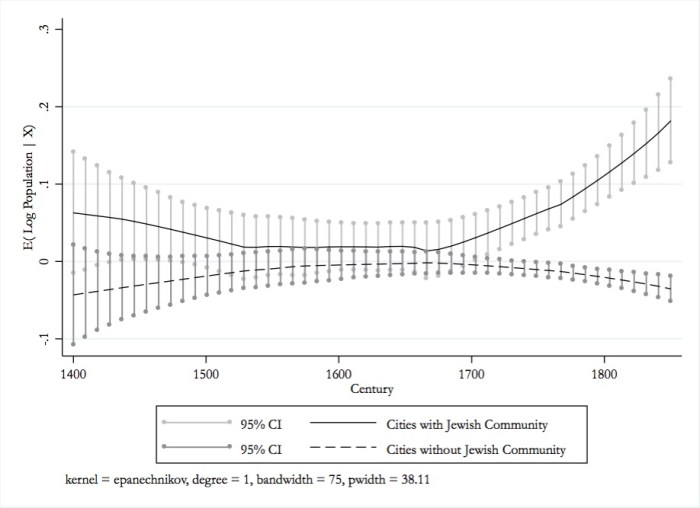
Across specifications, we find that cities with Jewish communities experienced no growth advantage in the 15th and 16th centuries. After 1600, however, they began to grow significantly faster.

motivationlpoly

The relationship we observe in the Figure does not appear to be inline with a pure human capital story. Jews had higher human capital than Christians throughout the medieval and early modern period. But the growth advantage of cities that had Jewish communities only became evident after 1600. This raises the possibility that something else changed around  17th century that made the human capital and skills of Jews more complementary to economic growth.

Two Mechanisms: Jewish Emancipation and Market Access

The two factors that stand out in explaining the emergence of a growth advantage for cities with Jewish communities after 1600 but not before are: (1) Jewish Emancipation after 1750; and (2) a complementarity between the presence of a Jewish community and market access.

The process of Jewish emancipation began in continental Europe after 1780. It was a major institutional break that signified a major change in the economic, social, and political status of the Jews in Europe. In work with Jean-Paul Carvalho, I’ve shown that Jewish emancipation lead to a religious schism and the emergence of both Reform and Ultra-Orthodox Judaism.

In the period before Jewish emancipation, legal barriers limited the ability of Jews to put their labor to its highest value use. Jewish businesses were prevented from hiring non-Jewish workers. Jews could not attend universities. Moreover, Jews and Christians were culturally isolated. This changed with emancipation, and we expect to see it reflected in the contribution of Jewish communities to city growth in the post-1750 period.

The second factor we study is the complementarity between the presence of a Jewish community and the development of markets. The historical literature points to the importance of Jewish trading and financial networks. But, while economic historians have conducted numerous studies of market integration during the early modern period, with a few exceptions these have focused on the grain trade with little systematic study of other markets due to data limitations. Jewish merchants in medieval and early modern Europe, however, did not play a prominent role in the grain trade but, rather, were involved in the transport of diamonds, sugar, silks, tobacco, and other luxury products in addition to playing a large role in banking and finance. Therefore, rather than looking at grain markets, we explore a more general measure of market integration based on market access.

Market access depends on the population size of nearby cities weighted by the cost associated with the least cost travel path. We show that market access was increasing for all cities after 1700. We find evidence that cities with Jewish communities were better able to take advantage of this increase in market access. As we detail in the paper, our findings are consistent with the argument made by numerous historians that Jewish trading and finance networks help to knit together the European economy, particularly in the period 1650 to 1800 (Israel, 1985).


Our analysis provides support for the accounts of historians who have emphasized the important role played by Jewish traders in 17th and 18th century Europe (such as Fortune, 1984; Israel, 1985; Trivellato, 2009). Furthermore, our story is in line with institutional arguments such as those developed by Douglass North, John Wallis and Barry Weingast, and Daron Acemoglu and James Robinson.  In the Middle Ages, the presence of Jewish communities was part of an institutional arrangement that extracted rents from society and distributed them among members of the ruling elite. The eradication of these rent-seeking arrangements and the liberalization of Jewish economic activity, first in the Netherlands and England and then in the rest of Europe following Jewish Emancipation, was of critical importance as it is in those cities that possessed emancipated Jewish communities that we observe the strongest relationship between the presence of Jews and economic growth.

O que é capitalismo?

O Brasil é capitalista? O capitalismo é culpado por vários problemas que observamos no Brasil? E outros países? A China é hoje um país de economia capitalista, ainda que com política socialista (ou comunista)? O capitalismo prejudica os mais pobres enquanto beneficia os mais ricos? Estas são algumas questões com as quais me esbarro regularmente. Algumas pessoas mais sofisticadas observam que não há apenas um capitalismo, mas vários: o capitalismo brasileiro é diferente do sueco, que é diferente do japonês, que é diferente do norte-americano, e assim por diante. Vejo alguma pertinência nesta observação, mas penso que ela ainda deixa de lado a questão mais básica e fundamental: o que é capitalismo?

Suponho que sem recorrer a qualquer fonte podemos concluir que capitalismo é algo relacionado a capital. Segundo o Palgrave Macmillan Dictionary of Political Thought, de Roger Scruton, “o capitalismo é um arranjo econômico, definido pela existência predominante de capital e trabalho assalariado”. De acordo com esta definição, no capitalismo alguns ganham salários e outros ganham lucros. Capital por sua vez é definido como “os meios de produção produzidos, ou seja, commodities que foram produzidas e que por sua vez podem ser empregadas na produção de outras commodities”. Em outras palavras: capital são recursos que são empregados na produção de mais recursos. Capitalismo é um sistema econômico (e não predominantemente político ou social ou cultural) que gira em torna da alocação destes recursos.

Partindo de uma forma de pensar semelhante, Milton Friedman observou que todos os países são capitalistas. Os EUA são capitalistas. A China é capitalista. A URSS é capitalista (Friedman estava fazendo esta observação ainda no período da Guerra Fria). Não há país (ou sociedade) onde não haja capital e onde não ocorram decisões sobre como alocar o capital. Há bastante tempo Max Weber fez uma observação semelhante, afirmando que alguma forma de capitalismo esteve presente em todas as civilizações, com a diferença que mais recentemente o Ocidente produziu um capitalismo moderno, com características peculiares. Mas voltando para Friedman: todos os países são capitalistas. A questão é: quem controla o capital?

A pergunta de Friedman lembra uma observação de Friedrich Hayek: durante o período da Guerra Fria era comum afirmar que a economia da URSS era planejada, enquanto que a economia dos EUA não era. Mas esta afirmação está errada: ambas economias eram planejadas. A da URSS por um pequeno grupo de pessoas em Moscou; a dos EUA por milhões de indivíduos espalhados pelo país. O ponto de Hayek é que uma economia necessariamente envolverá decisões sobre como alocar capital (ou recursos). A questão é: quem tomará estas decisões? Um grupo de governantes num comitê centralizado, em nome de toda a população? Ou a própria população, numa esfera mais modesta, dentro de suas próprias vidas?

Adam Smith é popularmente considerado o pai do capitalismo (e também da Economia como disciplina acadêmica, além do liberalismo econômico. Adam Smith teve muitos filhos). Curiosamente, Smith não usou o nome capitalismo em seus escritos (este nome seria cunhado mais tarde por marxistas – o próprio Marx também não usou este nome, ao menos não regularmente), mas falava sobre sociedade de mercado. A observação de Smith era que em tempos recentes mais pessoas estavam se tornando mercadores. Em tempos antigos (sobretudo na Antiguidade Clássica de Grécia e Roma) as relações econômicas eram dominadas por donos de terras e escravos. Havia mercadores (ou comerciantes), mas estes ocupavam um espaço menor na sociedade (e também eram vistos com desconfiança por não produzirem nada – apenas trocarem o que outros produziram). Na Inglaterra do final do século 18 mais pessoas eram comerciantes, isto é, trocavam alguma coisa, ainda que “alguma coisa” fosse sua força de trabalho em troca de salários. Neste sentido, Smith não inventou o capitalismo moderno: apenas observou e descreveu seu nascimento – além de suas vantagens diante de outros arranjos econômicos.

Partindo de Adam Smith e chegando a Friedman e Hayek, podemos observar quatro elementos fundamentais do capitalismo moderno (ou do liberalismo econômico, ou as sociedade de mercado, ou do livre mercado): escolha pessoal; trocas voluntárias; liberdade para competir em mercados; direito de propriedade privada. A escolha pessoal se refere às decisões individuais que se toma a respeito dos recursos individuais (devo sair para trabalhar hoje? Ou devo ficar em casa?). Trocas voluntárias se refere ao fato de que posso livremente trocar meus recursos com outra pessoa que queira fazer o mesmo (havendo uma coincidência de vontades). Liberdade para competir significa que posso oferecer meus serviços (ou produtos, ou talentos) e aguardar que haja interessados. Propriedade privada se opõe a propriedade coletiva ou comunal, geralmente sob controle do estado.

Uma forma mais direta de sistematizar a teoria de Smith (e neste ponto de Friedman e Hayek) é dizer que no livre mercado a propriedade é privada (e não coletiva ou comunal) e o trabalho e assalariado (e não escravo). Mais simples ainda, o livre mercado opera pela máxima de “não faça aos outros o que você não gostaria que fizessem com você”, ou “não mexa com quem está quieto”. No livre mercado os indivíduos são livres para fazer trocas voluntariamente com outros indivíduos – que queiram voluntariamente fazer estas trocas, havendo coincidência de vontades.

Há muitos economistas que consideram que a sociedade de mercado é mais um tipo ideal do que uma realidade. Alguns países estão mais próximos desta ideal do que outros, e neste sentido é válida a observação de que há variedades de capitalismo. O capitalismo praticado no Brasil (ou na China) não é (nunca foi e nunca chegou perto de ser) o capitalismo liberal descrito ou almejado por Smith, Friedman e Hayek. O capitalismo praticado nos EUA está mais próximo disso, embora esteja num franco afastamento deste ideal há várias décadas.

Saber o que é capitalismo é um primeiro passo para sabermos se este é um modelo que desejamos ou não. Pretendo nos próximos posts continuar este assunto. Por ora, digo apenas que quando falo a respeito de capitalismo estou pensando na sociedade de mercado descrita ou almejada pela tradição liberal. Caso o que temos no Brasil seja capitalismo, certamente não é este capitalismo que defendo.

Most Arguments Against Open Borders Lead to Extremely Un-Libertarian Positions

One thing that strikes me about libertarians who oppose open borders is that they approach the issue of immigration completely different from how libertarians approach nearly every other issue. Arguments against immigration typically go as follows:

  1. Bad effect x will happen if we allow open borders.
  2. Therefore, the government is justified in restricting immigration.

For example, many libertarians claim that because immigrants will increase deficits by using the welfare state, the government is justified in restricting immigration. Of course, this isn’t actually true, but even if it were true this in no way justifies immigration restrictions.

To be clear: immigration restrictions are a form of government intrusion into an individual’s freedom of movement. It is the government using its monopoly on force to restrict someone from doing something they’d otherwise be able to do, that is move across an arbitrary line we call a “border.” As Jason Brennan says:

At first glance, immigration restrictions look like rights violations. When we impose immigration restrictions, we do not simply fail to help would-be immigrants, but rather use violence and threats of violence to prevent them from making life-saving or life-changing trades with willing trading partners. We also harm our own citizens, who would benefit from interacting with those immigrants. We impose ourselves and cut off relationships that otherwise would have formed. We use violence and threats of violence to interfere with people who, if left alone, would work or live or trade together.

So libertarians who make this argument are substantially saying that if it can be shown to reduce deficits, using government force to restrict someone’s freedoms is justified.

If anti-open borders libertarians treated any other issue like they do immigration, it would lead to some pretty absurd, anti-libertarian policy positions. For an example, as long as we have government-provided Medicare programs, allowing people to eat unhealthy foods or smoke will increase the cost of those welfare programs; following the logic of the argument above, the government would be justified in implementing paternalist policies that restrict people’s right to consume what they want to reduce the burden of the welfare state. People with lower incomes are more likely to use welfare programs as well, so the government is justified in reducing their population size by restricting their right to reproduce through forced sterilization.

Obviously, both these positions are absurd from a libertarian perspective. Someone’s freedom from government force in areas of reproduction and what food they consume is more important than the fiscal costs. What makes the freedom of movement any different? Replace “people with lower incomes” with “immigrants” and “sterilization programs” with “immigration restrictions” in the sentence above, and the argument is the same. If the government cannot restrict freedoms in other areas in the name of deficit reduction, what makes freedom of movement in immigration restrictions any different?

Or take another example, many libertarians justify restricting immigration because immigrants are likely to vote for statist policies that will restrict liberty. Of course, this once again isn’t true, but even if it were it by itself is no reason for libertarians to support immigration restrictions. The operating principle here is that government is justified in restricting individual liberty if it increases the likelihood that pro-liberty politicians will be elected.

Again, that principle is not applied to any other issue by libertarians. Let’s say a particular demographic of citizens is more likely to vote for statist policies; by this argument, the government would be justified in reducing their population through sterilization programs in order to increase the likelihood that libertarians would win elections. Citizens who vocally advocate for statist policies through their speech also increase the likelihood that people will vote for those statist policies, so the government would be justified in restricting their freedom of speech. Obviously, both conclusions are absurd.

Further, as Bryan Caplan argues, it must be shown that there are policies that can reduce these ill-effects while violating fewer liberties than an all-out closed border policy. For example, we can eliminate the welfare cost of immigration by allowing for an open borders policy but make it illegal for any immigrant to receive welfare benefits. This allows for freedom of movement but eliminates the alleged ill-effect of open borders. Additionally, there are undisputable benefits from immigration, both in terms of increased liberty of movement and economic growth, and it must be shown that the negative effects outweigh the positive effects. Therefore, premise 2 is also incomplete as stated above.

So, in reality, these types of arguments against immigration are as follows:

1a. The government is justified in restricting someone’s liberties if it can be shown to stop bad effect x.

2a. X will happen if we allow for freedom of movement through immigration and there is no other way to stop x without restricting freedom of movement.

3a. Therefore, the government is justified in restricting immigration.

In reality, very few libertarians accept 1a, particularly if they believe in deontological natural rights. For consequentialists, it would depend on how bad x is. But for most arguments against open borders, they would not say that x is bad enough to allow for restrictions on nearly any other liberty. Further, as pointed out earlier, premise 2a is usually false because the empirical evidence suggests that x will not be a result of open borders, there is some other way to stop x while allowing for free migration, or both.

Another argument is that there is something distinctive about immigrants that justifies the state violating their rights but not citizens. If this is the case then we can replace 1a above with the following argument:

1b. The government is justified in restricting the rights of non-citizens if it can be shown to stop bad effect x, but would not be justified in violating the rights of citizens even if it would stop x.

This isn’t really a premise, but a conclusion; libertarians must justify some argument for why it can restrict the rights of non-citizens but not citizens. On its face, it seems like this principle is pretty absurd. For example, suppose that Greek citizens who use welfare eat unhealthily, and this is harming Germany fiscally because Germany helped bail out the Greek welfare state. The German government, therefore, passes a law restricting what Greek citizens can eat and tried to enforce it on Greek soil. Clearly, nobody, libertarian or otherwise, would call that justified. It is the burden of proof for open borders opponents, then, to prove why citizenship is in any way morally relevant to restricting liberties.

Perhaps there is an argument for why someone’s rights are all of a sudden less valuable because they were born on the wrong side of an arbitrary line that only exists because of state force. However, I doubt that there is such an argument that is in any way consistent with libertarian philosophy.

Massachusetts to let cabs tax Uber: The seen, the unseen, and the minor nuisance

There’s a simple alternative to regulation: liability. We don’t need to tell companies how to be safe if we make them legally responsible for negligence.

It’s as though Mass’s government decided that back-to-school season calls for creating real-life rent seeking examples for my class. They’re going to start taxing ride-sharing customers $0.20 per ride with five cents of that going to the taxi industry.

“The law says the money will help taxi businesses to adopt ‘new technologies and advanced service, safety and operational capabilities’ and to support workforce development.”

New technologies like an app that gets more use out of otherwise idle cars? Or an app that makes it easy to hail a ride with little wait? Or an app that brings supply into harmony with demand when demand surges? Oh wait! We’ve already got that and it’s the thing that’s being taxed!

There are a few important economic lessons that Massachusetts’ electorate is evidently in need of. Let’s start with taxes.

Taxes don’t stick

“Riders and drivers will not see the fee because the law bars companies from charging them.” They won’t see the fee, but that doesn’t mean they won’t pay it. A business only exists by collecting money from customers and paying some portion of that to suppliers. The government cannot tax a business without taxing that business’s customers and suppliers.

Granted, part of the cost will be reflected in lower profits (although profits aren’t as big as people think) which means Uber’s shareholders will face part of the tax. But what does that mean? It means 1) a little less money in pensions, and 2) potential investment capital is moved from the people who gave us the best version of taxi travel to the people who gave us the worst version of it.

Money is fungible and I don’t know how to run a cab company

Safety, new technology, and workforce development all sound good, but taxi companies (at least those that deserve to stay in business) will already be doing these things. Safety is important because accidents are costly (especially if your fleet size is limited by regulation). New technology is being adopted by every other (competitive) industry without government support. Other companies invest in their employees.*

Supporting workforce development is part of a larger trend of people supporting specific fringe benefits without appreciating the tradeoff between monetary and non-monetary compensation. And all these ideas reflect a faulty logic: just because something is good, doesn’t mean we need to force people to do it.

Voters simply aren’t in the right position to know if some good thing is good enough relative to other options. If you go into the backrooms of any industry you aren’t already familiar with you will surely learn about techniques and tools you had no idea existed before. So why should we expect that cab companies need regulators to tell them what to do? Let them learn from their trade magazines.

But there’s good news. If we mandated that cab companies use this new revenue stream to pay for new tires, they wouldn’t simply waste the money by buying superfluous tires. They’d stop buying tires out of their own revenues and start buying them from Uber’s. Telling someone to pay from their left pocket simply leaves more money in their right pocket for everything else.**

Extra money in cab company coffers could allow them to invest in better service, happier employees, “and help so taxi owners could buy ‘flagship’ vehicles like a 1940s Checker or a Porsche.” But cab companies are already free to reinvest their profits if they think doing so would create value (i.e. greater future profits). The more likely outcome is that they will simply have more money than before.

Competition is not the problem, it’s protectionism

When we see problems in the world we need to look for their root causes if we want to actually make things better. More often we act like a doctor diagnosing cancer is the cause of the cancer. Don’t want cancer? Outlaw doctors!

Cab companies aren’t as successful as they previously expected and the apparent culprit is Uber. But they only exist because an inefficiency in the market created a profit opportunity. Cab companies are doing poorly because they don’t provide as much value per dollar. And that’s largely because of regulation that prevents competition. Much of it was put in place specifically to protect incumbents from competition.

A lot of these regulations sound nice enough, but they still created the market niche that Lyft and Uber filled. And they protected cab companies from competition right up until ride-sharing became feasible.

Regulation is not the answer

Let’s give cabbies the benefit of the doubt for a minute. Let’s assume that they aren’t really in it for the cash-grab and that they just want to help people get around safely and conveniently. Let’s even assume that NYC’s medallion system is about congestion rather than competition.

If that’s the case, then there are better ways to address the root causes of the problems cabbies tell us to worry about. We don’t need to address each of these problems individually if we can find a few key causes at the root of each of them.

never-half-ass-two-things-whole-ass-one-thing

Cabs have medallions but civilians don’t, so congestion will still be a problem in cities until congestion fees are implemented that balance the demand for road access with its limited supply. Safety is important, but mandating extra inspections for only some types of cars is a half-assed way of dealing with it.

There’s a simple alternative to regulation: liability. We don’t need to tell companies how to be safe if we make them legally responsible for negligence. This is an important lesson for how we think about regulation in all industries. The basic logic is also why economists vastly prefer pollution taxes to specific regulations; it’s usually better to name the outcome we want and create a cost for failure to meet it rather than mandate specific behaviors.

Perhaps this means we should modify the laws that require all drivers to be insured so that some drivers have higher minimum liability coverage. That would be far less invasive and do far more to alleviate the concerns Uber’s critics raise than mandating specific behaviors.

Concentrated benefits dispersed costs

Okay, so maybe this is too small an issue to be concerned with. If that’s not by intentional design, then it at least reflects an evolutionary logic. This policy is likely to survive because the people it taxes will face a cost so small it isn’t worth doing anything about. Yes, Uber and Lyft have incentive to lobby against it, but it’s so close to invisible that they’ll probably be able to pass it almost entirely on to drivers and passengers.

This is going to cost millions… with a tiny little m. At first I read it as a 5% tax and quickly realized that Uber rides are so cheap that I won’t even notice it. And 20 cents a ride is even less than 5%.

So why worry? Precedent. The problem with death by a thousand cuts isn’t any one cut.


*Of course we can argue about whether they do enough of that. There may be a tragedy of the commons if there’s asymmetric information between people looking to make human capital investments and businesses looking to gain access to specific human capital. Such a situation might create an opportunity for government to do some good by investing in public goods or subsidizing on-the-job training. But if that’s the case, it calls for very different programs (education reform, etc.) than taxing successful companies to subsidize their competition.

**Why is this good news? Because if cab companies did change their behavior it would imply they’re doing something where cost exceeds benefit. It would destroy value. Remember those stories of WWII rationing? Imagine that situation but with cab companies buying twice as many tires and just storing extras in the garage. It would clearly be a bad thing. Scarcity isn’t so urgent nowadays, but the basic logic remains the same.

Still thinking about the Olympics

Rio Olympics are close to the end, and so far it has been a wonderful time for Brazilian athletes: the country is scoring 15 total in the medal table, quite high in its historical record. Brazil’s first Olympic medal in 2016 was won by Felipe Wu right in the first day of competition: silver in Shooting, 10m Air Pistol Men. Wu was followed by Rafaela Lopes Silva, who won gold in Judo, Women -57 kg, and then by Mayra Aguiar, who won bronze, also in Judo, Women -78 kg. Rafael Silva won another bronze for Brazil in Judo, Men +100 kg, and then Arthur Mariano won still another bronze, this time in Gymnastics Artistic, Men’s Floor Exercise. Diego Hypolito won silver in the same competition. On the tenth day of competition Poliana Okimoto won Bronze in Marathon Swimming, Women’s 10km and Arthur Zanetti won Silver in Gymnastics Artistic, Men’s Rings. The next day, Thiago Braz da Silva surprised everyone by beating favorite French Renaud Lanillenie and winning gold in Athletics, Men’s Pole Vault.

In the last few days other athletes followed the ones mentioned in this opening paragraph, but I limit the text to them for a reason: one highlight of these first 9 Brazilian medalists is that, with the exception of Hypolito, all of them are in the military, and some of my friends on what is considered “the right” in the Brazilian political spectrum are using this information to poke (in good spirit) my friends on the left. On the other hand, my friends on the left highlight that many of the Brazilian medalists also have in common coming from very poor backgrounds, and finding in government social programs the chance to become professional athletes. I want to be careful to say that both are wrong and I want to explain why (I hope I will still have some friends after this). Basically both ignore the concept of opportunity cost.

The concept of opportunity cost postulates that spending in one direction means not spending in another. In other words, that every choice comes with the cost of forgoing the next best alternative. It was developed in all but name by 19th century French economist Frédéric Bastiat in the parable of the broken window (also known as the broken window fallacy or glazier’s fallacy) that appeared in his 1850 essay Ce qu’on voit et ce qu’on ne voit pas (That Which Is Seen and That Which Is Not Seen). The parable goes somewhat like this: a boy breaks a window. The window owner gets upset, but someone tries to comfort him by saying that this will give the window manufacturer the opportunity to work. In the end, the economy wins. Bastiat shows that this is a fallacy: the money spent in a new window could have been spent in another way, say, with new shoes. The world would have new shoes and still have a window, but now the world has a new window and no shoes. Bastiat proceeds to show the law of unintended consequences, or how our actions can affect the economy in ways that are “unseen” or ignored, and also to apply the concept to several areas of public policy. Two of these happen to be military expenditure and “Theatres, Fine Arts.”

Concerning military expenditure, Bastiat argues that spending money in order to defend the country against foreign aggressors can be a good investment, but that any money that goes beyond this necessity would have been better spent in other way. This argument goes against Bastiat’s contemporaries who argued that money spent on the military had the benefit of creating jobs, even if defense was not a real necessity. Bastiat’s conclusion is that if the money was left with the taxpayer, this person would find ways to spend that would create more and better jobs. Applying to current events, if Brazil is spending money in the military in order to protect its borders, this is a good investment. If instead it is spending money in the military in order to get Olympic medals, the money should be spent elsewhere.

Bastiat lived before modern Olympic Games, so he has nothing directly to say public spending in this kind of event, but I guess that what he says about “Theatres, Fine Arts” also applies here. Some of his contemporaries defended that the government should invest in Theatres and Fine Arts, because these things are good in themselves, created jobs, and so on. Bastiat was once more against what he saw as excessive public spending. This time his answer exposed him to the logical fallacy of the straw man, or misrepresenting one’s argument in order to make it easier to attack: his critics accused him of not caring about Theatres and Fine Arts. But if we examine the evidences carefully, that is not the case at all: to say that the government should not invest in Theatres and Fine Arts is not to say that nobody should invest in it. It is just to say who is supposed to make the investment, the government of individuals. I am not equalizing Theatres and Fine Arts with sports, but I believe the lesson applies in this field as well: to say that the government should not invest in sports is totally different from saying that nobody should invest in it.

In conclusion, it seems that public investment in the military and social programs is helping Brazil to win medals in this Olympics. But we can ask ourselves where would that money have gone had this investment not been made. Based on Bastiat, I believe that if the money spending was left for the individuals, Brazil would have better military, more Olympic medals, and less necessity of social programs, not to mention better jobs, and a better overall economy. Perhaps after this Olympic Games my friends both on the left and on the right can feel like investing more in sports. Or maybe they will realize they prefer to spend on something else.

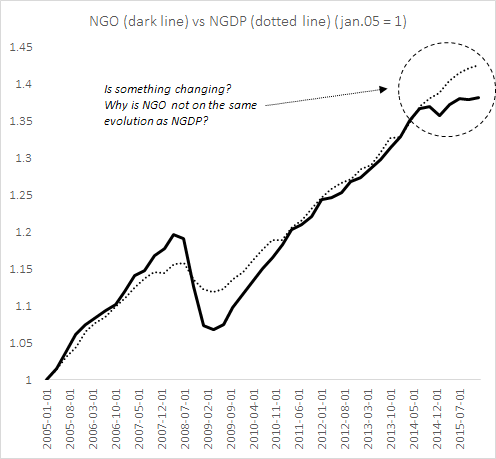
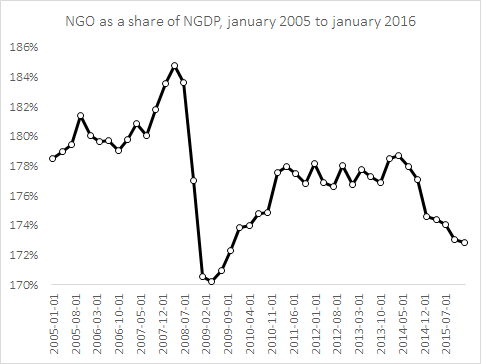
NGDP 3% per year; NGO much less!

A few days ago, Scott Sumner blogged about the “new normal” of NGDP trend (3% a year) (here and here). Overall, I tend to agree with him that the aggregate nominal expenditures are now at a new and historically low trend growth rate. I think that he is way too optimistic! 

As readers of this blog are aware, I am not convinced that NGDP is the proper proxy for nominal expenditures. I believe that Nominal Gross Output (NGO) is a better proxy as it captures more goods and services traded at the intermediate level (see blog posts herehere and here).  The core of my argument is that NGO will capture many “time to build” problems that will not appear in GDP as well as capture intangible investments which are now classified otherwise (see literature on intangible investment as capital goods here).  Thus, my claim that NGO captures more expenditures (especially between businesses). (Note: I am in the process with some colleagues of finalizing a paper on the superior case for NGO – more on this later.)

Are we at a new normal point where growth in nominal expenditures is slower than in the past? Yes! But according to Sumner and others, this is 3%. If we use NGO we are much lower! Again, using the FRED dataset, here is the evolution of NGO and NGDP since January 2005 (the start date of the NGO series in a quarterly form). The graph shows something odd starting in mid-2014 : NGO is growing much more slowly.

NGDPNGOaug2016geloso

To see this better, let’s plot the evolution of NGO as a percentage of NGDP in the graph below. If the ratio remains stable, then the trend is similar for both. As one can see, the recession saw a much more pronounced fall of NGO than NGDP with a failure to return to the initial levels. And since 2014, the ratio has started to fall again (indicating slower growth of NGO than NGDP).

NGDPoverNGOgeloso2016aug

So what is happening? Why is there such a difference? I am not one hundred percent sure about the causes of this difference. However, I am willing to contend that NGO is fitting better than NGDP with other indicators indicating a tepid recovery. If we look at the labor force participation rate in the US, it continues to fall in a nearly mechanical manner. Fewer and fewer workers are at work (or looking for work) in comparison to the population that could be working while investments are disappointing.

CivilianLaborForceParticipation

Maybe Scott Sumner is being overly optimistic. The new trend might simply be substantially lower than he believes.*


*Readers should note that I believe that monetary policy is, at present, too restrictive. However, I believe the culprit is not the Federal Reserve but financial regulations that restrict the circulation of “private money” (the other components of broad money found in divisia indices – see my blog post here). 

A Note on Trump, Immigration, and Healthcare Reform

Hopefully, the US election will start getting out of the he-said-she-said of assassination attempts and badmouthing parents of military personnel and start being about actual policy issues. Unfortunately, that isn’t going to happen at all, but in a minuscule and futile attempt to help get us there, I’m going to blog about some policy issues for a minute.

Trump’s campaign released a brief memo about his healthcare positions recently. For the most part the positions—though not quite detailed enough to really call a “plan”—are fairly decent. They contain most of the reforms free-market analysts have been proposing for decades such as opening insurance competition across states, allowing for Health Savings Accounts, and streamlining Medicaid funding. Notably missing was abolishing the employer mandate to reduce price fragmentation, as Milton Friedman proposed, although Trump proposes taking steps in that direction by introducing a tax deduction for individual insurance plans.

But what stuck out to me was that Trump, surprise, surprise, made xenophobia an element of his health care proposal by furthering the myth that immigrants are a further drain on our healthcare and welfare programs:

Providing healthcare to illegal immigrants costs us some $11 billion annually. If we were to simply enforce the current immigration laws and restrict the unbridled granting of visas to this country, we could relieve healthcare cost pressures on state and local governments.

Meanwhile in reality, undocumented immigrants actually contribute more to Medicare than they withdraw. It is unclear where Trump is getting his $11 billion figure, but he is ignoring the increased payroll taxes undocumented immigrants pay into these programs. A 2015 study found that, in fact, between 2000 and 2011 immigrants paid up to $3.8 billion more into Medicare than they took out. From the results of the study:

From 2000 to 2011, unauthorized immigrants contributed $2.2 to $3.8 billion more than they withdrew annually (a total surplus of $35.1 billion). Had unauthorized immigrants neither contributed to nor withdrawn from the Trust Fund during those 11 years, it would become insolvent in 2029—1 year earlier than currently predicted. If 10 % of unauthorized immigrants became authorized annually for the subsequent 7 years, Trust Fund surpluses contributed by unauthorized immigrants would total $45.7 billion.

Poor immigrant children, both legal and illegal, are also less likely to be enrolled in Medicaid or CHIP than citizens.

Thus Trump’s campaign is being factually dishonest by claiming that restricting immigration will help fund government healthcare systems, it will actually make Medicare go insolvent sooner. Which is especially concerning given that, until this memo, Trump has shown no interest in any meaningful entitlement reform.

This refrain—that immigrants are a fiscal drag on America’s welfare programs—has been among the most common refrains from Trump, and has even been popular among libertarians who are otherwise sympathetic towards immigration. But, as I’ve argued extensively in the past, it is completely false. Almost every major study shows that immigrants, at worst, pay as much into welfare programs as they get out of them.