On Nancy MacLean’s Thesis

Nancy MacLean’s Democracy in Chains continues to yield surprises. Just a few days ago, Phil Magness now shows a “typo” that plays a significant role in MacLean’s thesis.

Despite all these detailed scrutiny of her work, it is not clear that MacLean understand the type of error is being pointed out about her book. There are two types of errors regarding a thesis: (1) the thesis is correctly defined, but the proof is flawed, or (2) the thesis is incorrectly defined, in which case there is no need to test the thesis. What MacLean and her supporters don’t seem to realize is that Democracy in Chains is built on the second error, not on the first one. Instead of ignoring her critics, MacLean should be up to the academic game and engage accordingly. Her behavior is very telling. If her research is so solid, what’s the problem?

Consider he following example. Let’s say you find a book built on the thesis that Milton Friedman was a french communist who lived in the 18th century. You don’t need to read this book to know that the author is wrong on her argument. This book on Friedman is both factually (Friedman did not live in the 18th century and was not French) and theoretically (Friedman was not a communist) wrong. This is how wrong MacLean’s thesis on Buchanan is for anyone with some minimal exposure to his work and Public Choice.

There a few reasons why someone would still read Democracy in Chains. For instance, if the book is a preach to the choir To try to understand how such a misguided thesis can actually be supported by by an author with so little knowledge and expertise on Buchanan and Public Choice. Etc. But a reason why MacLean thinks that their critics are unwilling to consider her thesis is because she is unaware her error is the second one mentioned above. Her thesis is just wrong from the go.

White Supremacists

“White supremacy” has become a central part of the left’s narrative. In an hour and a half of casual news watching on television in early October 2017, for example, I heard three references to white supremacy. That’s more than I did in the decade 2005 to 2015, I believe.

One utterance came from the sports channel ESPN’s African-American commentator Jemele Hill who called president Trump a “white supremacist.” She added that he surrounded himself with white supremacists. Perhaps, by implication of the term “surround,” she meant several millions of his 63 million voters, or even all of them. This kind of verbal hysteria is not new and neither are intemperate television commentators but, in the recent past, such breathless declarations would have been laughed out of the park or negatively sanctioned, or both. Not anymore. Ms Hill’s statement was not exactly an isolated incident either.

In the first two weeks of October 2017, I hear the word “supremacist” on radio or television at least once a day. I am sure it has not happened before in my fifty years in this country (as an immigrant). This new tolerance makes some sense in political context.

For the inconsolable of Pres. Trump’s election, I suspect – but I don’t know for a fact – that the claim is by way of passing the baton at a time when the investigation on “Russian collusion” to elect him, now in its thirteenth month, is going nowhere. If he did not betray the country, what can we accuse him of that’s difficult for decent minded people to forgive, they ask? Digging into this country’s complex and troubled past is always a good bet if you are looking for dirt to throw at an American.

Mr Trump’s own intemperate comments – although never directed at the usual African-Americans targets of real supremacists – helped identify a valuable, superficially semi-plausible charge. The sudden emergence in the collective consciousness of unhappy young white Americans on the occasion of the 2016 election also contributed. (“…in the collective consciousness…;” they were around before that.) Unhappy young whites can but with little effort be turned into the racist rednecks of countless movies. Thus, the white supremacy narrative may be part of a half-blind collective endeavor to discredit for the long term the social forces thought to be associated with the sensational defeat in 2016 of a moderate liberal (and a feminist to boot; more on this below).

My first impression of the reality of a white supremacist movement, based on reading and listening to radio – including National Public Radio – about five days a week, besides watching television, is that there isn’t actually much going on nationwide in this respect. Yet, I am mindful of the fact that I live in “progressive” Santa Cruz, in liberal California. In neither place would one expect to bump casually into white supremacists. And if there were one, he would probably just clench his teeth and keep his mouth shut. In lily-white Santa Cruz, on the contrary, a black supremacist would probably be elected mayor on the first try without really campaigning. (OK, I may be exaggerating a little, here.)

I realize also that my reading habits as a conservative may not lead to chance encounters with supremacist tripe.* So, I wonder: What’s the actual situation? To try and explore this question more deeply, I use a two-step strategy. I look first for existing credible empirical reports on the topic. Second, I look for what should be the products of white supremacist groups, the tracks they should logically be expected to leave on the internet and elsewhere. But first, a brief historical detour. Continue reading

North Korea at the North Sea?

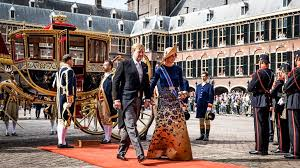
Yesterday, both Houses of Dutch Parliament jointly opened the parliamentary year, which is always held on the third Tuesday in September, and is known as “Budget Day.” Normally, there is not much pomp and glory in the Low Lands, but on “Little Princes Day” (as the day is literally called), we go all-out: the King and Queen are driven in a horse-pulled carriage to the Hall of Knights, the oldest part of the parliamentary buildings (built around 1250), surrounded by military troops in full ceremonial dress. The King reads his speech (actually written by and under full political responsibility of the Prime Minister and cabinet) from a huge throne, announcing the government’s plans for the next year. Male ministers in morning coats, ladies in dresses and hats, with the powerful elites also assembled.

king and queen
King Willem-Alexander and Queen Maxima entering the Hall of Knights (source)

After the reading, the Royal couple make their way back to one of their palaces in the centre of The Hague, returning once to greet the masses from the balcony.

Meanwhile, the Minister of Finance officially presents the 2018 budget to the Lower House. The separate budgets of all departments are laws, which will have to pass both Houses before 31 December. This process is normally preceded by a two day debate on “the general state of the country,” but this year it is skipped because there is only a caretaker government in office. It awaits the finalization of negotiations for a new government, which started right after the elections on 15 March. Still no government is formed, although it is widely expected that a four-party coalition will be presented within a few weeks, consisting of small Christian left wingers, centre Christian Democrats, and two social liberal parties, D66, and Prime Minister Mark Rutte’s VVD.

Although much improved since the low point of the Great Recession, around 2011-2012, the public finances are still shocking from a classical liberal perspective. The income of the national government is 285 billion Euro (around 338.5 billion USD), which is 43% of GDP.

It consists mainly of several mandatory insurance premiums for collective arrangements (112.2 billion Euro), income tax (55.4 billion; the highest bracket of 51.5% tax applies to all personal income over 68.507 Euro), and VAT (52.8 billion). The rest are mainly specific taxes, related to companies, the environment, excises, dividends, et cetera. In 2011, the public share of GDP was still 47%, while in the 1980s it reached peaks of around 60%. Not exactly anywhere near an ideal liberal situation, no matter what liberal persuasion you are. Personally, I would argue that 25% should be the max for a decent set of state tasks, but I am sure that makes me some weird Northern European commie in some American libertarian eyes!

The situation is even more dire if we see where that money is spent. Health care (80.4 billion euro) and social security (79 billion) are always in competition as the largest spending departments. So that is 56% of the budget already and both increase annually, no matter the economic circumstances. The third post is public education (35.4 billion), followed by funds for provinces and municipalities (24.4 billion), foreign affairs and foreign aid (12), police and judiciary (10.3), defense (8.4), and infrastructure and environment (also 8.4), with the other departments taking parts of the rest. Despite a very rare expected budgetary surplus of 7.8 billion in 2018, the national debt is still 53.7% of GDP. Perhaps not bad in international comparison, still not good for any liberal.

These numbers are only part of the story, because there are also numerous local taxes, and the number of liberty-inhibiting regulations, from European, national, provincial and local origin are staggering. There is not one really free market, and there are hardly parts of individual life not regulated or influenced by the state. A comparison with North Korea is of course still far-fetched, yet socialism is alive and kicking on the North Sea shores.

In my view it is evidence of the remarkable power of capitalism that The Netherlands is still one of the richest countries on earth, a global top 15 economy (GDP per capita), with only 17 million inhabitants. No matter how hard you curb it, the capitalist system still delivers amazing results. Of course, the opportunity costs of the Dutch regulatory state are very high. In terms of personal liberty there are not many better places on the planet. Yet in other fields it is a different story. Economic freedom is a mess, which means that the material aspects of personal freedom are seriously restricted. Yet the worst is the mentality. Sadly, most Dutch have traveled the whole Hayekian Road to Serfdom, making a shift to classical liberalism highly unlikely.

The Dreamers and Me

President Trump just announced that he was rolling back an Obama executive order intended to give respite to illegal immigrants brought to the US by their parents when they were minors. I know what I feel about this action. I have to figure out what I think.  (I can cry with the best of them! Left-wing liars are having a field day right now. One just said on NPR that the purpose of the decision is to make America “white again,” N. S.!)

I am an immigrant. I immigrated into this country at 21. I was a high school dropout from France. I had no marketable skill but I knew English pretty well. I had no money. (That’s “Not any.”) I carried a small suitcase containing mostly some Navy clothing from my recent service. The Unites States did not need me.* No one had invited me except the late George and Rose-Marie McDaniel of Novato, California. (They had met me during my stint as a high school exchange student three years earlier, financed by others.) Don’t worry, I am not going to cram down your throat yet another heroic story of hard immigrant work and well deserved achievement.

I prospered in this country for more than fifty years. I had a very good American life. I lived well and I thrived unexpectedly from an intellectual standpoint. My wife, an artist and also an immigrant, was able to paint as we raised our children. All of this because many individuals and several institutions gave me a push and a pull, an encouraging word, and downright gifts along the way (including free tuition at both a community college and a major university). If I were given only two words to describe American society, they would be: “generous, fair.”

The American society I know does not visit upon the sons the sins of the fathers. It especially does not do so when the sins of the fathers were mostly misdemeanors at the time they were committed – entering the country illegally was only a misdemeanor. The American society I know would not throw over the fence its young neighbors to somehow manage in a foreign country they know little or not at all, in a language they may know badly or, again, not at all. Those among us who would do either must be blinded by anger. (And there are good reasons to be angry about immigration.)

In his announcement, President Trump did not throw out anybody, as the Left-leaning media made it sound. First, he gave Congress six months to do what Congress should have done in the first place: Solve through legislation the human and ethical problem posed by the presence in our country of hundreds of thousands of immigrants who are technically illegal through no fault of theirs. The president is playing chicken with Congress: If you do nothing, you will be collectively responsible for a gross, un-American injustice. Keep in mind that the president retains the right to promulgate his own royal reprieve it Congress fails to act.

Second, the president is using this opportunity to prod Congress, Republicans and Democrats alike, to begin instituting wholesale immigration reform. It’s a reform just about everyone agrees must take place. It has not begun because it’s a political hot, hot potato for both parties. For the Republicans, there is the honest realization that our borders must, in the end, be under control lest our cherished institutions end up dissolving. Let me give you an example. How many people can we admit who believe that separation of church and state is anathema, an insult to the face of God, and still live in our constitutional republic? (And, if you think the question is Islamophobic, you are just afraid of questions!)

For the Democrats the issue is how to stem the rising anger of many of their troops about immigration without turning off the spigot of automatic Democratic voters that immigrants mostly are. (The Democratic Party is vanishing, I think. That’s why it’s so mean. Without a steady flow of poor immigrants, its death will be hastened. The Republican Party has different problems which also threaten it existence, possibly.)

Notice what I did not say here: I did not say anything about any kind of immigrants having rights as immigrants. I don’t think we do.


* Nevertheless, I have a document somewhere that certifies that my continued presence in the US serves the welfare of the country. It was earned 12 years later, another story, obviously. If I could find it, I would frame it and put it online to enrage “progressives.”

Declare Peace on North Korea!

The United States should offer a peace treaty with North Korea and offer diplomatic relations. The Korean War did not officially end. Let’s end it now.

The chiefs of North Korea have feared an invasion by the USA. They recognize that several heads of countries without nuclear weapons, such as in Lybia and Iraq, were overthrown. It is recognized that nuclear weapons that can be sent to the USA provide a deterrent against an overthrow of the state and even against an assassination of the Korean head of state.

The government of North Korea has evidently convinced the people there that the USA is their enemy and a threat. That propaganda would be less effective if there were a peace treaty.

So the US government should, together with South Korea, China, Russia, and the United Nations, offer to negotiate a peace treaty with North Korea.

The USA has negotiated with North Korea on a stoppage of its nuclear weapons project, but North Korea will not give up its weapons, and negotiations along with economic pressure will not be effective, since their greatest accomplishment has been their nuclear achievements, and the Chinese leaders seek to avoid an economic collapse.

Therefore a peace treaty with North Korea should not seek to end the nuclear status of the regime, but eliminate the deeper problem of mutual fears. The peace treaty would state that the U.S. recognizes North Korea as a sovereign country, and that there will be no invasion.

If the government of North Korea refuses to negotiate a peace treaty, then it will be seen that the hostility is being generated by North Korea, not the USA. The USA should then declare peace unilaterally. With the governments of South Korea and China, the USA would write a peace treaty and they would declare unilateral peace. The US would offer diplomatic relations, and if refused, would appoint an ambassador anyway, who would reside in China.

The US government would then broadcast to the people of North Korea, and send them messages via leaflets and computer files, that the USA has declared peace.

The opponents of a peace treaty could argue that this would leave North Korea with weapons that could reach US territory. But if the North Koreans will refuse to give up their nuclear capability, the peace treaty does not increase the danger. Indeed, the treaty, when agreed to by North Korea, would increase safety by prohibiting North Korea from providing nuclear materials and technology to others.

If North Korea accepts the peace treaty, the US would withdraw its troops from South Korea. Their presence is antiquated, since the threat would be from missiles rather than from an invasion by North Korean troops.

North Korea would gain four advantages from a peace treaty. First, assurance that the US is no longer a potential threat. Second, global diplomatic recognition. Third, removal of US troops from Korea. Fourth, the ability to trade freely with the rest of the world.

If the North Korean regime is not suicidal and seeks to maximize its well being, it would accept a peace treaty. But even if it does not accept a treaty, a unilateral offering would deflate its fears and propaganda.

———————————

This article also appears in http://www.progress.org

No, natural disasters are not good for the economy.

Every time there is a natural disaster old economic fallacies make their appearance. And they are usually always the same. In particular, the argument that a natural disaster is good for the economy. This should make little sense. Wealth is not created by destroying things. A natural disaster destroys wealth, doesn’t create it. I doubt anyone affected by a hurricane would argue that he is better off after the natural disaster than before.

The argument that an event such as a natural disaster is good for the economy rests in the positive impact seen in GDP (as is argued) after the natural event. If GDP increases, then the economy is doing better. But this is a misreading of GDP. This variable is a flow of wealth, it is not a stock of accumulated wealth. It is possible that wealth creation (flow) increases at the same time the stock of wealth is decreasing. And this is what happens during a natural disaster.

Imagine that someone’s house caught fire and burns down. Because of this situation, this person decides to start working extra hours to increase his income and be able to buy a new one. The extra hours makes his income (GDP) increase. But his situation is considerable worst because he lost his stock of wealth (remember Bastiat’s broken window fallacy…?). Arguing that a natural disaster (or a war, etc…) is good for the economy is like arguing that this person is better of because he has to work extra hours to recover his loss.

This is just another case of a too common fallacy in economics. We know that if the economy is doing better the result will be better GDP and unemployment indicators. But from observing a better GDP and unemployment indicators we cannot, and should not, conclude that the economy is doing better. More important than observing what is happening to GDP is understanding why is changing its behavior.

It could be argued that one of the problem of the Keynesian view of the world is the focus on what happens to output and unemployment rather than why these variables are moving. Not surprisingly, we get to the conclusion that going to war (or having a natural disaster) would be a good way to achieve full employment.

What is going on in Brazil

I’ve been thinking about writing a short essay about some of the things going on in Brazil right now, especially concerning politics and economics, for my English speaking friends. I guess one can get really lost in the middle of so much news, and to the best of my knowledge, some left-leaning journalists are saying quite some nonsense already. So here we go!

President Dilma Rousseff was impeached over a year ago. Her party, the Workers Party (Partido dos Trabalhadores, or PT in Portuguese) is officially a social democrat party, close to the European social democracy tradition, i.e., socialists who want to attain power through a non violent, non revolutionary path. In the end, as it happens with so many big parties, PT has many internal tendencies and in-fighting, but I believe the party can be summarized especially in two tendencies.

On one hand you have cultural Marxists, in the Frankfurt School but even more in the Antonio Gramsci tradition. Many people in PT and other Brazilian socialist parties understood long ago that they had to win a cultural war before they won the political war. And so, these factions are much more interested in feminism, gay rights, and minority rights in general than in anything else. To the best of my knowledge, this is a strategy that backfires somewhat: cultural Leftism is a self defeating philosophy, and so, cultural Marxists are more and more into a witch hunt that damages even themselves. They make a lot of noise, to be sure, but they can’t run a country.

On the other hand, many Brazilian socialists are almost entirely pragmatic. It seems that they forgot about Marxism long ago, and are somehow even convinced of the Washington Consensus. They know basic economics, such as money doesn’t grow on trees and there’s no such thing as free lunch. But they also don’t want to lose face, and most importantly, don’t want to lose position. So, they surely won’t take measures that really shrink the size of the state to a healthy degree.

Dilma’s supporters still say she was the victim of a coup. Of course, she wasn’t. She was impeached with overwhelming evidence of her wrongdoings according to Brazilian law. Other than that, it is hard to believe in a coup where all branches of government agree and the military are not involved in any way. Eventually her supporters sophisticated the argument by saying she was the victim of a “parliamentary coup.” It is nonsense, but if we take it with a grain of salt we can be reminded of something important in Brazilian politics – or politics in general. Dilma was not impeached because of her wrongdoings. Many politicians in Brazil have done similar or worse things than her. She was impeached because she lost support, mostly in the legislative branch. For the wrong reasons (opposition to Dilma), the representatives did the right thing.

One of the problems that Brazil faces today is that the same congress that impeached Dilma for the wrong reasons expects from her successor, Michel Temer, the political favors they used to get from Dilma’s predecessor, Luis Inacio Lula da Silva. But these favors are not cheap. Other than that, even if he is a crook, Temer seems to realize that Brazil can’t suffer any more socialism. In the end Brazil is facing some (sort of) free market reforms, but without really shaking the basis of a state too big to function properly.

The Political is about to disrupt the crypto-currency scene -or at least they say so.

According to this Financial Times report, Bitcoin is at the verge of a critical decision.

The implications of the chosen terms (“existential crisis,” “decisive leadership,” “political flaw”) are not casual. It looks like the market that crypto-currency had carried from the beginning contain the germ of its own destruction. As in an Escher’s drawing, Bitcoin has unraveled its political strand and its whole existence is, now, dependent upon a moment of decision of the sovereign: the assembly of miners. The decisionist narrative would be fulfilled if the political decision had to be taken by acclamatio instead of voting.

Nevertheless, the decision by acclamation would be still possible: the ones who want “Bitcoin Core” might follow one direction and the other ones, who choose “Bitcoin Unlimited,” might follow their own way. After all, no existential crisis can be solved by voting.

So, which is inside of which? Is the market framed in a system depending upon a political decision of the sovereign? Or does every decision need to be taken inside a spontaneous framework of rules?

We are used to praising Bitcoin for its independence from any political factor: Bitcoin supply depends on a set of rules which allows the public to form expectations about its value with a high degree of probability of proving to be correct.

Taken in isolation, Bitcoin emulates the market. Nevertheless, being independent of political institutions is not enough for being “the market.” The attractiveness of Bitcoin is that it operates in an open system of competition of currencies. In this system, there are many other crypto-currencies, and there might be several variances of Bitcoins as well –in esse or in posse.

Imagine, for example, that Bitcoin effectively splits into Bitcoin Core and Bitcoin Unlimited. Which of the two will prevail over the other? It does not matter. What really matters is that there will be several variances of currencies in competition. The factors that determine the selection of the prevailing currency depends upon a higher level of abstraction that impose an absolute limit to our knowledge.

So, is Bitcoin in an existential crisis? Does a political decision need to be made? Maybe.

But that does not imply that “The Political” will take over the reins of the crypto-currency market. Moreover, opposite political decisions are the linkages which the spontaneous selection process -in this case, of currencies- is made of. In this sense, “Bitcoin Core” and “Bitcoin Unlimited” are attributes of a competitive system and the final prevalence of one variance among other alternatives will not be the result of a deliberate decision but of an abstract process of evolution.

Nazism: left or right?

One of the greatest controversies on the Brazilian internet these last few days was to define Nazism as either left-wing or right-wing. I even wrote something about it in Portuguese, and although I really tried my best not to be controversial, I was amazed by how divisive the issue seems to be. So here is my view on this issue, now in English.

Is Nazism a left or right wing political movement? The first thing I believe we need to consider to answer this question is what is right and left? The answer (surprisingly simple in my view) is that right and left are words. Words are signs we use to describe things, but as (I guess) most linguists will say, words don’t have any objective connection to the things they describe. For example, there’s no special connection between the word “cat” and that fluffy animal that drinks milk and chases rats. It is just a convention that in the English language we call that animal “cat,” and not “alligator” or “hot dog.”

However, when we say that there is no objective connection between words and stuff, that doesn’t mean that words are simply random. Words only work in a linguistic context, so there is no use calling a cat anything else if you want to communicate properly. The English language (as any other language, except for Esperanto) was not invented by any specific person. Languages are actually a spontaneous order, something that economists in the Austrian School really enjoy talking about. So, if you want to communicate well, you have to join the party (or the conversation).

With all that said, we need to admit that the word most often used to describe Nazism politically is right-wing. Actually, far-right. The point in discussion (that so many people in Brazil just don’t seem to get) is if this description makes any sense. You see, other groups classified as right-wing are conservatives and liberals (classical liberals, to be more precise). So the question is: why are conservatives, liberals and Nazis all classified as right-wing? What do all these groups have in common? Going back to the example of the cat, there is a reason why you can call both a lion and a tiger a cat (or a feline): they both share several characteristics. It may be just at the eye of the beholder (although evolutionary biologists will say something different), but a lion has much more to do with a tiger than with a frog. So it seems fair to include lions and tigers in a small group where frogs don’t belong. So, the question is: is it fair to include conservatives, classical liberals and Nazis in the same group? Why?

I know there are reasons why all these groups are generally classified together. I know that left and right are terms that go back to the French Revolution. I know how these terms are generally used. All I’m saying (with Friedrich Hayek, David Nolan, and many others) is that we should reconsider the way we typically classify political groups.

Dinosaurs were classified as reptiles. And then people realized they were closer to birds. I guess it was a shock when someone first said that a Velociraptor has more to do with a chicken than with a Komodo dragon, but it seems to me (as an outsider of paleontology) that this is common wisdom now. Similarly, maybe we should have the courage to reconsider the way we classify Nazis. Leftists, of course, won’t like this. But neither do conservatives like being called fascists. Are leftists tasting their bitter medicine? Maybe. But I believe they should give us a good explanation why Nazis should be considered right-wing. I haven’t heard any.

Make neo-Nazis flop off Broadway: public choice and Tina Fey’s sheetcaking

tumblr_n2evlqgunn1sbf1mqo4_500

A week ago a white supremacist rally in Charlottesville protesting the taking down of Confederate Memorial statues turned fatally violent. Other protests were due to take place this weekend in multiple U.S. cities, including New York (now postponed). How should citizens and public authorities deal with this upsurge in violent neo-Nazi protest? I am with Tina Fey on this one: don’t show up, have some cake, and encourage the NYPD to prevent violence.

Some on the left have tried opportunistically and mistakenly to associate Virginian school public choice scholarship with the far-right. This is a sadly missed opportunity because James Buchanan’s theory of club goods helps explain how far-right street protests emerge and suggest how authorities might best subdue them. I draw on John Meadowcroft’s and Elizabeth Morrow’s analysis of the far-right English Defence League (EDL).

Continue reading

The case of James Damore: defending the Google engineer who was fired over a ‘controversial memo’

Yesterday, news broke out that Google had fired their engineer James Damore for disseminating a memo which was meant to be an invitation for open and honest discussion on Google’s left bias. CEO Sundar Pichai said the engineer had violated Google’s code of conduct by ‘advancing harmful gender stereotypes’.

DasKapital calls Damore a ‘diversity hater’, and Metro News calls him ‘anti-women’. The Guardian calls the memo ‘sexist’ and shamelessly maintains that the memo argues for the “biological inferiority of his female colleagues, and how this made them less suitable for tech.”

Reading through the 10-page memo myself, I find the memo very reasonable and I stand behind it 100%. Like Damore, I believe that we should stop assuming that gender gaps imply sexism.

What is Damore arguing against?

Damore argues that “Google’s left bias has created a politically correct monoculture that maintains its hold by shaming dissenters into silence.”

The several discriminatory practices that Google has instituted as a result of their left bias are:

  • Programs, mentoring, and classes only for people with a certain gender or race.
  • A high priority queue and special treatment for “diversity” candidates.
  • Hiring practices which can effectively lower the bar for “diversity” candidates by decreasing the false negative rate.
  • Reconsidering any set of people if it’s not “diverse” enough, but not showing that same scrutiny in the reverse direction (clear confirmation bias).
  • Setting org level OKRs for increased representation which can incentivize illegal discrimination.

In short, Damore argues that:

  • Google’s political bias has equated the freedom from offense with psychological safety, but shaming into silence is the antithesis of psychological safety.
  • This silencing has created an ideological echo chamber where some ideas are too sacred to be honestly discussed.
  • The lack of discussion fosters the most extreme and authoritarian elements of this ideology.
  • Extreme: all disparities in representation are due to oppression.
  • Authoritarian: we should discriminate to correct for this oppression.
  • Differences in distributions of traits between men and women may in part explain why we don’t have 50% representation of women in tech and leadership. Discrimination to reach equal representation is unfair, divisive, and bad for business.

What did Damore write about women?

Damore writes that women and men differ biologically and that this results in different personality traits, preferences they hold, and the career choices they make.

On biological differences

Damore writes that men and women differ biologically in many ways and that not all differences are socially constructed:

I’m simply stating that the distribution of preferences and abilities of men and women differ in part due to biological causes and that these differences may explain why we don’t see equal representation of women in tech and leadership. Many of these differences are small and there’s significant overlap between men and women, so you can’t say anything about an individual given these population level distributions.

On personality differences

Damore writes that women, on average, have more openness directed towards feelings and aesthetics rather than ideas. This makes them have a stronger interest in people rather than things and explains in part why women relatively prefer jobs in social or artistic areas.

In addition, women express their extraversion as gregariousness and agreeableness rather than assertiveness.

Women, on average, also have higher anxiety, and lower stress tolerance which makes high stress jobs less attractive to women.

Compared to men, women on average also look for more work-life balance.

Damore’s overall message

Damore explains his overall message as follows:

I hope it’s clear that I’m not saying that diversity is bad, that Google or society is 100% fair, that we shouldn’t try to correct for existing biases, or that minorities have the same experience of those in the majority. My larger point is that we have an intolerance for ideas and evidence that don’t fit a certain ideology. I’m also not saying that we should restrict people to certain gender roles; I’m advocating for quite the opposite: treat people as individuals, not as just another member of their group (tribalism).

Again, I think this is extremely reasonable. Unfortunately, in a world driven by irrational and zealous egalitarians, those who use logic and reason are easily labeled bigots.

Reference

Damore, J. (2017). Google’s Ideological Echo Chamber

Mea Culpa: Israel and Palestine

So, I let myself be captured by Irfan’s cultured, bright, well-spoken, and fact-studded critique. He is right, on the main. My short essay is loose on many facts. I did not know what I did not know. And where it’s not completely wrong, it’s often sloppy. So, for example, I shouldn’t have said that Jews were not allowed on the mosque’s esplanade. I should have said (and the damned thing is that I knew it) that they were not allowed to pray there – but then, what if a Jew takes a walk on the esplanade and prays inside his head, and what if, unbeknownst to him, his lips move a little? As they say in French: “Irfan m’a mené en bateau.” At any rate, I will simply confess that nearly all my facts are wrong so I can recover my purpose, at last. Don’t worry, I won’t take much of your time. Here are a handful of real real facts and their obvious implications:

  • Palestinian Muslims (or a single one) assassinated two Israeli police officers a few weeks ago on the mosques esplanade or near it.
  • The assassin or assassins used a gun or guns.
  • Israeli authorities – that exercise de facto control over the area- responded by setting up metal detectors on entrances to the mosque’s esplanade.
  • Metal detectors are useful to alert to the presence of most firearms and of some bombs.
  • Palestinian Muslims protested this measure in several ways, including with riots.
  • The people whose safety could have been improved by the existence of the metal detectors were both Israeli security forces in the area and the great many Palestinian Muslims who constitute the bulk of the visitors to the same area.
  • Thus, Palestinian Muslims protested -including with rioting – security measures that were likely to benefit them most (in terms of numbers).*

That is collective irrationality.

I suppose that Irfan, or another subtle defender of irrationality, will argue that the installation of metal detectors at those sites is another step in Palestinians’ loss of sovereignty over the Holy Places, and thus the violent reaction. Sure thing! This defense implies that Palestinian Muslims have to be ready to be assassinated by other Palestinian Muslims in order to enforce a shred of Palestinian Muslim sovereignty over that small area.

That is insane.


*I ignore, of course, the idiotic view that Muslim terrorists could not possibly kill other Muslims at a sacred site of Islam. Muslims have been killing tens of thousands of Muslims, specifically, for the past twenty years. Some terrorists, who called themselves Muslims, chose to engage precisely in mass killing at Muslim religious sites such as mosques. And then, there are Jewish terrorists, and even the occasional dangerous illuminated Christian.

From the Comments: Israel and Palestine

Irfan and Jacques are going the rounds on Israel and Palestine (Canaan?). The dialogue, so far, is excellent. Jacques started things off and Dr Khawaja responded with this fine piece of pop-ethnography:

I just spent three weeks in Jerusalem, about a hundred yards from the scene of the action Jacques describes in this post, and spent hours observing the events Jacques describes (and many he doesn’t describe) at first hand. I described this post on Facebook as “factually challenged,” and promised to set it straight. So here I am. (A different version of this comment included about a dozen links substantiating my claims, but the post didn’t go through that way, so I’ll send the links separately.)

I had originally wanted to divide my post into two sections, first laying lay out the number of sheer inaccuracies Jacques has crammed into this post, and then identifying what I would call handwaving claims–large claims made without substantiation, or misleading claims made without clarification. It turns out to be impossible to do this, because Jacques has managed to combine inaccuracy with handwaving in a way that makes it impossible to disentangle the two. In any case, my claim is that when we add the sheer inaccuracies to the handwaving in his post, a rational reader would conclude that the post tells us nothing of value about recent events in Jerusalem.

1. Jacques tells us that there were violent riots in Jerusalem. Correct. He doesn’t mention that despite the outbreaks of violence, the demonstrations were largely peaceful. Nor does he venture to tell us who started the violence, or under what circumstances. The word “riot” seems to imply a series of violent disturbances caused or initiated by rioters, but alas, one word can’t stand in for real-world observation of what actually happened. Nothing in Jacques’s account settles the crucial issue: who started the violence?

I have read almost all of the press coverage on recent events in Jerusalem, and saw the events themselves up close–at a few yards’ distance, for hours, in real time. I can’t easily summarize what I saw. There were at least four different demonstrations taking place simultaneously, within a few “blocks” of each other, and different things happened at different places at different times. On some occasions, I saw Israeli police officers either initiating or provoking violence. In other cases, Palestinians did so. There are also questions worth asking about what counts as an initiation of force under these circumstances. Typically, pointing a gun at someone without cause is regarded as a form of assault. But Israeli police officers and soldiers do this all the time. An Israeli border police officer played chicken with me with her M-16 for no reason other than her amusement. If I’d been armed and shot her, would my shooting have been an initiation or a retaliation? Nothing in Jacques’s account settles or even deals with this, but one can’t understand events in Jerusalem without settling issues like this.

Suffice it to say that the press coverage of relevant events, especially the American press coverage, was either non-existent or extremely defective. It is very easy to claim that what took place in Jerusalem consisted of riots if all you do is wait for violence to break out, film it, and then declare that “the event” you just covered was a “riot.” It doesn’t follow, and isn’t true, that that’s what really happened. And I can assert, categorically, that it wasn’t. In short, there is a lot more to the story than “riots.” For a starters, there were all those events that took place when no one was rioting.

(I’ve discussed some of the micro-level issues involved here on Facebook, some on public and some on private settings.)

2. Jacques tells us that “all of Jerusalem” is under Israeli control. He doesn’t mention that “Jerusalem” is a moving and expanding target that lacks an eastern boundary, as does the “Israeli control” he mentions. He also neglects to mention that the phrase “under Israeli control” is an equivocal claim: Shuafat refugee camp is technically within the jurisdiction of Jerusalem, but it is run by the UNRWA; it is not de facto governed by the Jerusalem Municipality or by Israel. Something similar is true of the “Haram Sharif” complex that is the subject of Jacques’ post: it is technically within the boundaries of the Jerusalem municipality, but (as Jacques himself admits) it is managed or administered by the waqf under the auspices of the Jordanian government. Oddly, having told us that “all of Jerusalem” is under Israeli control, and then noting himself that Haram Sharif (in Jerusalem) is administered by Jordan, Jacques fails to draw the obvious inference: sovereignty over Jerusalem is contested, not settled. Israel claims sovereignty over “it,” as do the Palestinians, but claiming sovereignty and having sovereignty are two different things. (Many people have asserted sovereignty over Texas, but it doesn’t follow that their say-so resolves the issue.) I put the word “it” in scare quotes because in calling “it” the “Temple Mount,” Jacques manages to confuse a further set of issues that I’ll discuss below (in [4]).

3. Jacques: “In addition, most Palestinians from the adjacent West Bank are allowed to visit on a controlled basis, for religious purposes only.”

Two problems here. First, does Jacques mean to say that most Palestinians are in fact allowed into Jerusalem? This would imply that 51% or more of West Bank Palestinians are permitted into Jerusalem. I’d like to see a source for that claim. There are roughly 2.5 million Palestinians in the West Bank. Jacques’s “most Palestinians” claim implies that something like 1.25 million West Bank Palestinians have entry permits for Jerusalem, which strikes me as implausible in the extreme. It’s unclear how many permits are in fact given, but the usual figure is in the thousands. Not a representative sample, but: I know a few dozen Palestinian West Bankers; only one of them has an entry permit for Jerusalem. The rest are consigned to remain indefinitely in the West Bank.

In any case, permits are not given “for religious purposes only.” Permits are given for entry into Jerusalem/Israel, full stop. They’re checked at checkpoints into Jerusalem, but not thereafter, and what is checked is simply whether you have a permit or not, and whether you’re carrying contraband or not (unless a given soldier decides to initiate his own “investigation,” which sometimes happens). Once past the checkpoint, there is no mechanism in place to determine whether someone entering Jerusalem is doing so to pray at Al Aqsa or to score chicks on the beaches of Jaffa (or both). Further, permits are given for a variety of reasons, including medical care, family unification, and work. But they are given far more stingily than Jacques’s description would imply.

I raise both points (one favorable to the Palestinians, the other to the Israelis) to raise questions about the sources of Jacques’ information on the subject. His description of facts on the ground is unrecognizable to anyone who’s actually had to deal with those facts, as I have.

4. Jacques: “At the center of the preoccupations of the three monotheistic religions is a place called the Temple Mount.”

This paragraph of Jacques’ repeats the conventional wisdom on the subject, at least in the United States. Unfortunately, the conventional wisdom reflects total ignorance of even basic facts of geography, which is hard to convey to those who haven’t been to the place in question.

Let’s start from scratch. The contested location is a big rectangle located in the Old City of Jerusalem. The western end of the rectangle contains what Jews call the Western Wall and its plaza. The eastern part of the rectangle contains a large complex housing the Dome of the Rock, Al Aqsa mosque, a few auxiliary religious facilities, and a large plaza connecting them. Parts of the rectangle are declared off-limits to civilians by the Israeli authorities.

Jews refer to the *whole* rectangle, including the Muslim shrines, as the “Temple Mount” and claim it (all of it) for their own. Particularly hard core Zionists want to expropriate the Muslims altogether, claim the whole site for their own, destroy the Muslim shrines on it, build a temple on their ruins, and exclude Muslims from entering. Such people have grown increasingly powerful over the years.

Muslims refer to the *eastern part* of the rectangle as “Haram Sharif,” or the Noble Sanctuary, and claim it, in its entirety, for Islam. Hard core Muslims want to exclude Jews from this area altogether.

It is worth noting, however, that not even hard core fundamentalist Muslims wish to expropriate Jews of the Western Wall, much less build a mosque there, despite the fact that the Western Wall Plaza was built on the ruins of the so-called Mughrabi neighborhood–an Arab neighborhood expropriated and destroyed after Israel’s conquest of East Jerusalem in 1967.

It is also worth noting that though Israel divides the Old City into quarters, including the Jewish and Muslim Quarters, it permits Jewish settlement of the Muslim Quarter, but not the reverse. The “Jewish Quarter” is conveniently defined to include the Western Wall–though its plaza was built on a Muslim neighborhood, and you have to pass through Muslim neighborhoods to reach it–but no mosque within the Jewish Quarter is permitted to operate at all. Nor has “the Muslim Quarter” been re-defined to include the mosques that happen to lie in the “Jewish Quarter.”Indeed, a passerby would have no idea that these mosques are in fact mosques at all: they’re shut down and deliberately being left to fall into decay. The same is true of mosques in Jerusalem but in neighborhoods where Muslim entry would be deemed undesirable, e.g., the mosque of Mary in Ein Kerem.

Finally, Jacques’s claim that Jews are forbidden to enter Haram Sharif, whether on rabbinical or secular grounds, is laughably preposterous: they do it all the time, and are encouraged to. Indeed, the Israeli settler group Ateret Cohanim advertises tours that it conducts into Haram Sharif.

Of all of the claims Jacques makes in this post, this last one suggests (with all due respect) that he has no idea what he’s talking about. The whole controversy over the “Temple Mount” arises precisely because Jews ARE allowed into the mosque complex (and take advantage of that right), and Muslims suspect their intentions in doing so. Contrary to what one reads in the American press, these suspicions have a credible basis. Muslims suspect Jewish intentions in Jerusalem because of the example of Jewish settlement activity in Hebron, where apparently innocuous Jewish entry into a religious shrine led, gradually, to the wholesale expropriation and depopulation of the Palestinian neighborhoods of the Old City. Today, Hebron is (for Palestinians) partly an open-air prison and partly a ghost town. The case of Hebron H2 zone has been amply documented. Jacques follows American convention in ignoring this documentation, and proceeding to talk about Jerusalem as though the two things had nothing to do with each other. Jacques also wonders out loud why Muslims would take issue with what he regards as ordinary security measures.

Even setting aside what “ordinary security measures” have done in Hebron (or Nablus, Qalqilya, Tulkarem, Silwan, or Issawiya), he assumes that the measures would be deployed in good faith. No one who has actually dealt with Israeli police officers or soldiers would believe this. It may not occur to Jacques, but occurs to them, that security measures can be abused so as to treat the people covered by them as playthings. Jacques’s post shows literally zero awareness of a fact known to just about anyone who has dealt with Israeli security: most border police officers and soldiers are bored, immature, and heavily armed but lightly supervised children between the ages of 18-28 who will do just about anything to relieve their boredom–up to and including murder, battery, and torture. The Israelis may talk up a propaganda storm about their security needs, but once one sees what these “needs” look like on the ground, one’s sympathy for them begins to evaporate.

Further, Muslims and Jews do not “pray within a stone’s throw of each other,” whether literally or metaphorically. Though adjacent to the mosque complex, the Western Wall is separated from it by huge stone walls. Entry into the Western Wall plaza is entirely separate from entry into the mosque complex. Informally (the place is heavily policed, and the police often make their own rules), Arabs are discouraged from entering the plaza, and seldom do. Muslims and Jews only come into contact when Jews enter the mosque area, or when Jews walk (or march) through Muslim neighborhoods en route to the Kotel. I have never seen or even heard of a case in which Muslims entered the Western Wall plaza en masse in the way that Jews enter Haram Sharif. Indeed, doing so would be almost physically impossible. (Put it this way: Muslims would have to be very, very determined to do it.)

Contrary to Jacques’s assertion, Christians do visit both the Western Wall Plaza and the mosques. That they visit the Western Wall should be obvious. If you want a pleasant confirmation of Christians visiting the mosques, I’d suggest searching “Visit Al Aqsa Mosque with Me!” on You Tube. You’ll be taken on a delightful tour of the area with a perky Christian Palestinian woman named Maha who can also teach you how to make hummus or say “Merry Christmas” in Arabic. (Her Old City tour also goes to the Western Wall.)

I wonder whether Jacques has gotten his information from the Wikipedia entry on “Temple Mount Entry Restrictions.” Much of what he says dutifully parrots what is said there. That was a mistake, to put it mildly. Wikipedia is often useful, but not here.

5. Jacques mentions the shooting of July 14, and then mentions Israel’s security measures, wondering why they should be thought so controversial. I have a challenge for him. The shooting of July 14 took place outside of the Temple Mount/Al Aqsa complex, not within it. The attackers came from a neighborhood of Um al Fahm, a city about an hour or so to the north of Jerusalem. As should be self-evident, in order to bring weapons near the Temple Mount complex (which is in the Old City), these attackers had to bring those weapons into the Old City itself. The Old City is a walled structure that can only be entered by a series of gates (seven of them). The gates are easily identifiable, easily guarded, and it’s easily possible to put metal detectors in front of each of them.

If security were the paramount consideration Jacques takes it to be, why didn’t the Israeli authorities install the metal detectors at each of the gates of the Old City? Doing so would have prevented the July 14 attack, and would prevent any similar attack. But installing them in front of Al Aqsa would not have prevented the attackers from bringing weapons into the Old City and shooting someone outside of Al Aqsa, correct? Which is exactly what they did. Why then install security measures in front of Al Aqsa rather than at the entrance to the Old City itself? A common sense question for a person who claims to possess it.

6. While I’m posing questions about “common sense” security measures, here is another. After the July 14 shooting, and in advance of any rioting, the Israeli authorities shut down whole neighborhoods of East Jerusalem–something they do as a matter of course in Jerusalemite neighborhoods like Issawiya, and as a matter of course in the West Bank. I got to see these closures in a tediously microscopic way, and could probably write a couple of thousand words on them alone. But just to make things clear: large swatches of Jerusalem as well as the West Bank are under a semi-permanent state of lockdown, a lockdown imposed by the Israelis on its Palestinian population.

Now, remarkable as this information may be, shootings take place in the United States just as they do in Israel. Indeed, on average, a shooting takes place just about every other day in my county, often just a mile or two from where I live. Yet, no one regards it as legitimate to close down whole neighborhoods over any given shooting, or to institute curfews over them–and to do so simply on the basis of the ethnicity of the presumed shooter. To put the matter as simply as I can: a black person may well shoot and kill someone in a nearby neighborhood in north Jersey, but that doesn’t imply that every black neighborhood in the vicinity of the shooting will be locked down and put under curfew as a result. But that is what routinely happens in Arab Jerusalem, and what Jacques appears to be defending as a matter of “common sense.”

Is it, really? If so, why not try it right here in the States? If we did, would it be any surprise that the people locked down might eventually fight back? Would they be wrong to? The undiscussed issue here is what the police can permissibly do, on ethnic grounds, in the name of collective punishment of what it regards as an unruly population. Suffice it to say that it’s not obvious that collective punishment is a legitimate mode of law enforcement.

Jacques refers to Israel as a “garrison state,” treating its Jewish population as the besieged. The claim is utterly preposterous. Israeli Jews not only aren’t besieged in Israel, but generally don’t feel besieged. Spend some time in the streets of Haifa, Tel Aviv, or Jerusalem and ask yourself whether the people around you are operating with a siege mentality. What Jacques seems not to have grasped is that it is not Israeli Jews who are garrisoned by Israel, but its Palestinian Arab population.

A “garrison” is a body of troops stationed to defend a piece of territory. Typically, a garrison defends an “inside” against outsiders. But in this case, the garrison consists of Israeli troops treating insiders as though they were outsiders–and then complaining about the result. Well, that’s the price of creating a sectarian state in a place where a significant part of the population doesn’t belong to your sect. The more I visit Israel, the more I see of Israel; the more I see of it, the less sympathy I have for Israelis and their supporters. And, I might add, the less patience I have for Americans who defend Israel from afar without knowing what things look like on the ground.

And:

the views he expresses on Jerusalem are well within the boundaries of conventional, mainstream American opinion, which is why I took the time to respond to them. Most American defenders of Israel believe most of the things Jacques asserts, and many would go much farther than he has. American discourse on Israel is just wildly skewed, and French as he may be, Jacques’ views are just an instance of that all-American phenomenon.

More here, including links.

In general I am inclined to side, if I must, with Irfan’s argument, but Jacques, as usual, presents a case, in the threads, that can not so easily be dismissed or debunked:

The fact that, in this case, two Palestinians (with Israeli citizenship) tried to assassinate members of Israeli forces counts for nothing, explains nothing [in Irfan’s argument]. Palestinians live under military occupation, have for the longest time. I am sure it’s really unpleasant. It should stop. Stopping it, of course, requires negotiations between rational, motivated people.

Here’s a bunch of stuff at NOL on rationality (or rather, irrationality). And here is Barry’s long, somewhat famous, essay on Israel, Palestine, and rational debate.

A short note on the riots in Jerusalem

Big, violent riots in Jerusalem (July 22-23 2017). Last week, three Arabs Muslims with Israeli nationality killed two Israeli policemen in Jerusalem. Reminder: All of Jerusalem is under the control of Israel, has been since 1967. Before that, under Jordanian rule, Jews were banned from the Old City. The broader city today has a diverse population that includes Jewish Israelis, Muslim Israelis, a few Christian Israelis, Palestinian Muslims, a handful of Palestinian Christians, plus a constant flow of visitors from abroad. In addition, most Palestinians from the adjacent West Bank are allowed to visit on a controlled basis, for religious purposes only.

Israel gained control of Jerusalem in 1967 the same way the Muslims did in the seventh century: Military conquest legitimized by Sacred Scriptures.

As we all know, Jerusalem is a sacred city to several religions including Judaism, Christianity and Islam (by order of historical appearance). At the center of the preoccupations of the three monotheistic religions is a place called the Temple Mount. It’s the spot known as the last Jewish temple, destroyed by the Romans in 70 AD (or “Common Era”). The supposed last vestige of the Jewish Temple standing is the Western Wall (also, “Wall of Lamentations” for Jews) where Jews from everywhere, including Israel come to pray. The Christian Gospels show Jesus visiting the same temple several times including shortly before his crucifixion. Muslims revere the area because the Prophet Muhammad is said to have started there his whirlwind “Night Visit” to Heaven. It’s so important to Muslims that they built there not one but two mosques after they conquered the city in 630. One of the two mosques, the Dome of the Rock, is supposed to have been established over the place where Abraham sacrificed his son (one of his sons, not the same son, depending on which religious tradition).

Now, Jews are forbidden by Israeli law as a well as by some rabbinical religious decisions to visit the area occupied by the mosques. It is administered jointly by a Muslim clerical organization and by Jordan (Reminder: Jordan is an Arab country with a peace treaty with Israel.) Two consequences. First, frictions between Jewish worshipers and Muslim worshipers in the area are rare although they pray within a stone throw of each other. (Metaphor not chose at random.) Second, the top of the Temple Mount, the largest part of the area where the two mosques stand, is very seldom visited by Jews at all. It’s overwhelmingly used by Muslims, day in and day out. Repeating: If you threw a stone in the air on an average day while standing in that area, it would fall down on a Muslim or on no one at all. (Christians seem to not be much interested in visiting that particular spot.)

Following the assassination of two of its policemen last week, Israel took common sense security measures against repeated acts of terrorism in the Temple Mount mosques area. By the way, the two Israeli policemen assassinated were not Jews. They were Druze, people whom some Muslims consider Muslim and many not. No one, at any rate, thinks Druze are Jewish. The fact is that the assassinated police officers were working security in or near an area frequented by devout Muslims, rather that one of the many more numerous Israeli Jewish policemen (or worse, policewomen). This suggests to me that official Israeli policy was reasonably alert to Muslim faithful’s sensitivities.

The Israeli authorities took two new security measures (amazingly late in the game, if you consider the volatility of the area). They installed both surveillance cameras and metal detectors on the access points to the mosques esplanade. That’s was precipitated the rioting and yet more deaths, plus, the formal declaration of the Palestinian Authority that it was stopping all contacts with Israel (of which, more later). Now, I can sort of understand the Palestinians’ objection to the cameras. Many must imagine that Israel will use the film to spy on them further although it’s difficult to see how or what that would accomplish beside identifying criminals after the fact. The metal detectors are the same tools in place in almost every airport in the world. They can help intercept guns and knives.

Refer back up to the description of who spends time in the mosques area: Muslims. So here you have it: Palestinians, who have to be almost all Muslims, are rioting violently to protest security measures that will protect…Muslims. What serves as their government, the Palestinian Authority, cuts off contact with Israel also in protest. But Israel acts as a customs office for the said Authority. It collects monies on its behalf and faithfully hands them over. Palestinians protest common sense Israeli action that protect them by making it even more difficult for their government to do its job. By doing so, they create more of a vacuum, that Israel will, of necessity, have to fill.

Some Palestinian leaders think that if they force others to shed Palestinian blood very publicly, the world is going to take pity and come and impose the kind of settlement they want. The calculus is going on seventy years old. If you keep doing the same thing over and over again and it never works….

A personal note. I have had several Palestinian friends; they were easy to like for their warmth, for their courtesy, for their generosity. That’s on the one hand. I also think Palestinians are victims of history; that they have been paying for seventy years for the crimes of others. On the other hand, I have not much appreciated the Israelis I have known. They tend to have the smoothness of raw alligator skin, pretty much what you would expect of people reared in a garrison state. Politically, however, it’s very hard to be a friend of Palestinians. You try  and try, and then, they go and do something insane like this.

In case you wonder: I am not Jewish, never have been. I was raised a Catholic and I have been religiously indifferent as far back as I remember. I know my Bible pretty well (Old and New Testament). I try to study the Koran. It’s tough going because I am usually told that the translation I can understand is not legitimate. I am familiar with the Hadith second-hand (like most Muslims actually because few know Arabic).  I listen to Tariq Ramadan, a cleric or a philosopher connected to the Muslim brotherhood who speaks beautiful French and who seems to have made it his mission to explain Islam to intelligent and educated infidels. (That would be me, for example.)

Trump Jr.

Last school year I had to deal with a pair of students (Tweedledee and Tweedledum) I caught cheating on a takehome final. When confronted with the evidence, each insisted that it was the other’s fault, and that only that other student should face any consequences.

Bear in mind that if they complete their degrees, they would be in the top 30% of the population in terms of educational attainment. In today’s world, that basically means they’re among the best and brightest, they’re high status, and they’re “the future”. If we could meaure status on a linear scale, getting a college degree still pushes you high up on that scale. 

At the time I figured that they were at least towards the bottom of that top 30%. Certainly, I still hope they’ll grow out of it. Unfortunately, Draco Malfoy’s Junior’s latest scandal shows that being bad at cheating isn’t the social hinderance we might have hoped for.

Related link: http://reason.com/blog/2017/07/13/how-trump-apologists-will-defend-the-ind