Three Lessons on Institutions and Incentives (Part 1): Introduction

There are books that are aimed at a spectrum of readers that are counted within the “well-informed public.” They are not books confined to academic circles, they are not for mass consumption, but they do concern problems that involve entire countries and are written in a register that involves certain intellectual training. In this genre, there are three works that have much to say about the relationship between institutions and incentives. The first of them dates from 1990 and was published by a Nobel Prize winner in Economics, Douglass C. North: Institutions, Institutional Change and Economic Performance, which elaborates the distinction between formal and informal institutions and incremental and disruptive institutional change, ending with a historical analysis that seeks to explain the differences in economic performance between the United States and Latin America. It is an academic book that can be approached by the said well-informed public.

Eleven years later, in 2001, William Easterly published The Elusive Quest for Growth: Economists’ Adventures and Misadventures in the Tropics. It is proposed as a political essay in which an economist interprets his own professional experience as a member of international teams for the development of Third World countries. To do this, drawing on the theoretical notions of other leading economists, such as Paul Romer (who later, in 2018, received the Nobel Prize in Economics), he makes an assessment on the development plans for the Third World that were implemented since the end of World War II. The central thesis of Easterly stresses that, in order to have an empirical relevance, every theory of development -or of the absence of it- must carry the following behavioral postulate: “people respond to incentives.” If this reality is not taken into account, there is no public policy that can be successful. The main lessons that can be drawn come from the theoretical instruments deployed to explain the political dynamics of most of these countries, particularly in regard to the phenomenon of polarized societies.

The third book to consider is also the more recent publication. Why Nations Fail, by Daron Acemoglu & James A. Robinson, was published in 2012 and reached the global debate on the realm of the well-informed public. The proportions achieved by the population of academics and professionals, in addition to the extension of the internet, allowed the aforementioned book to generate varied opinions along both traditional and digital media throughout the world. Acemoglu & Robinson dedicate their pages to those countries that were successful, as well as those that were not, but also here, in the case of this book, the most juicy lessons truly comes from the conceptual structure that articulates the whole book. Among such notions, we find those of inclusive and extractive institutions, which in turn are divided into political and economic institutions. The worst of the institutions are preferable to the total lack of institutions. Thus, a country organized around a closed political and economic system will be preferable to a failed state. However, once a certain degree of centralization and institutionality has been achieved, it is preferable to move towards a pluralist democracy and a competitive economy. The challenge is how to accomplish such transitions.

Since there are still four years left until the year 2023 – following the periodicity of the selected works – we are still in time to make a brief synthesis of the ideas that can be applied to the analysis of the impact of the institutions on economic and political incentives.

[Editor’s note: this is the first part of a rich series on institutions and incentives. You can find the full, Longform Essay here.]

Persecution & Toleration

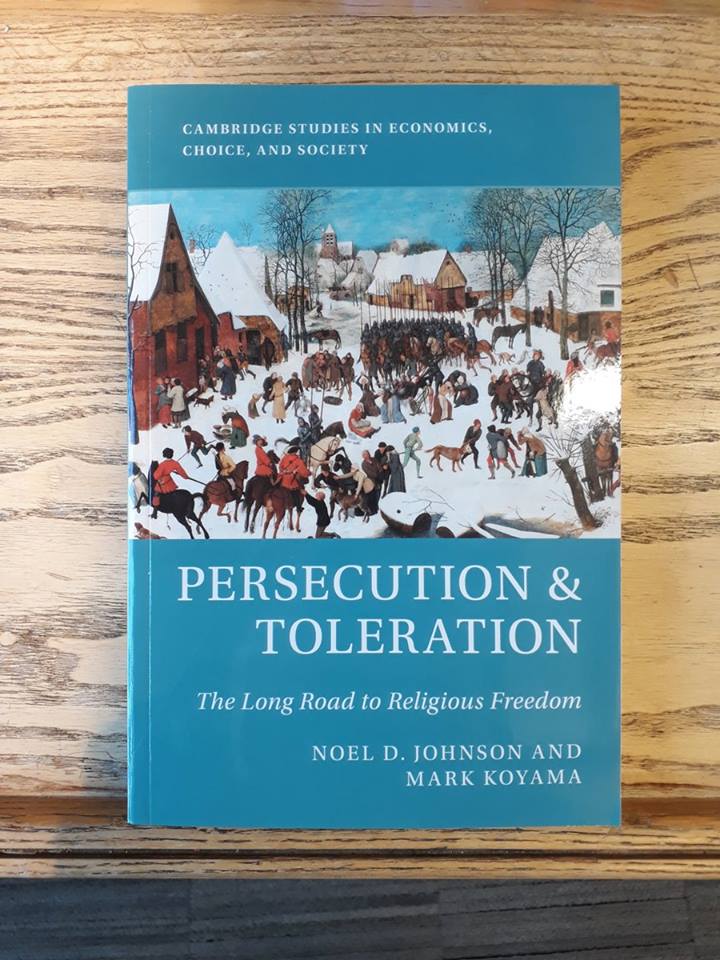
I’m glad to announce that my new book, Persecution & Toleration (with my colleague Noel Johnson) is now available in the UK.  I’m hoping to receive copies next week. The book is available at CUP, although Amazon still has a US release date of April (you can preorder it).

The blurb is below:

Religious freedom has become an emblematic value in the West. Embedded in constitutions and championed by politicians and thinkers across the political spectrum, it is to many an absolute value, something beyond question. Yet how it emerged, and why, remains widely misunderstood. Tracing the history of religious persecution from the Fall of Rome to the present-day, Noel D. Johnson and Mark Koyama provide a novel explanation of the birth of religious liberty. This book treats the subject in an integrative way by combining economic reasoning with historical evidence from medieval and early modern Europe. The authors elucidate the economic and political incentives that shaped the actions of political leaders during periods of state building and economic growth.

‘A profound new argument about the relationship between political power and religion in the making of the modern world. If you want to know where the liberty you currently enjoy, for now, came from, this is the book to read.’ James Robinson, Richard L. Pearson Professor of Global Conflict, University of Chicago

‘Johnson and Koyama investigate the fascinating intersection of the state and religion in late medieval and early modern Europe. Rather than enduring patterns of religious toleration or persecution, of liberty or tyranny, they tell a rich history of change and variation in rules, institutions, and societies. This is an important and persuasive book.’ John Joseph Wallis, Mancur Olson Professor of Economics, University of Maryland, College Park

‘Lucidly written, incisively argued, this book shows how religious toleration emerged not only from ideas, but also from institutions which motivated people – especially the powerful – to accept and act on those ideas. A brilliant account of early modern Europe’s transition from identity-based privileges to open markets and impartial governance.’ Sheilagh Ogilvie, University of Cambridge

‘This analysis of the historical process underlying the modern state formation is a fantastic scholarly accomplishment. The implications for the present, in terms of the risks associated to the loss of the core liberal values of modern western states, will not be lost to the careful reader.’ Alberto Bisin, New York University


The Gandalf Test

The two dominant American political parties have one defining trait in common, and it’s the trait that makes them both undeserving to hold the power they seek to wield. Both parties fail the Gandalf test.

I derive the Gandalf test from one of my favorite conversations in the Lord of the Rings. Gandalf pays a visit to Frodo Baggins after concluding that Bilbo’s old ring is in fact the One Ring–the single most dangerous and powerful object in Middle-earth. Once the full enormity of the ring dawns on Frodo, he tries to thrust it upon Gandalf. Gandalf flatly refuses. “With that power I should have power too great and terrible.” He recognized that he cannot embrace so much power even though he would want to do good with it. “Yet the way of the Ring to my heart is by pity, pity for weakness and the desire of strength to do good. Do not tempt me!”

The Gandalf test is simple: a righteous cause and a genuine desire to save the world do not qualify anyone for the exercise of extensive unilateral power. The Republican and Democratic Parties both have recently failed this test, and not for the first time. On one side, President Trump has turned to emergency powers to barge through constitutional barriers, so convinced he is that his cause is just. On the other side, the Green New Deal proposes to remake the United States economy. We tend to too often squabble over the merits of these policies instead of stepping back to apply the Gandalf test. Even if the policies themselves are good ones, even urgent ones, we must ask whether any person or cadre should wield the extraordinary power to put them into action. The “desire of strength to do good” is not enough.

A clear message of Gandalf’s and the Lord of the Rings generally is that progress toward the good and worthy comes through the everyday courage and goodness of ordinary people, not a few great souls on gilded thrones. Elsewhere, Gandalf points out: “Saruman believes it is only great power that can hold evil in check, but that is not what I have found. It is the small everyday deeds of ordinary folk that keeps the darkness at bay.” And in the Return of the King: “It is not our part to master all the tides of the world, but to do what is in us for the succour of those years wherein we are set, uprooting the evil in the fields that we know, so that those who live after may have clean earth to till. What weather they shall have is not ours to rule.” What a wonderfully apt response to the Green New Deal’s attempt to rule with an iron fist today in order to literally rule the weather that others might have tomorrow. That kind of hubris is poison to a republic.

We need to subject our leaders to the Gandalf test. We need to know if they are the type to vainly “master all the tides of the world,” or whether they will lead in humility by quietly empowering the everyday deeds of everyday people. If they can’t pass the test, I couldn’t care less whether they’re proposing a wall, a tax hike, or a clean energy revolution.

John Rawls had good reason to be a reticent socialist and political liberal

31u2bmz6ytl._sx312_bo1,204,203,200_

John Rawls: Reticent Socialist by William A. Edmundson has provoked a renewed attempt, written up in Jacobin and Catalyst, to link the totemic American liberal political philosopher with an explicitly socialist program to fix the problems of 21st century capitalism, and especially the domination of the political process by the super-rich. I found the book a powerful and enlightening read. But I think it ultimately shows that Rawls was right not to weigh his philosophy down with an explicit political program, and that socialists have yet to respond effectively to James Buchanan’s exploration of the challenges of non-market decision-making – challenges that bite more when states take on more explicit economic tasks. The large-scale public ownership of industry at the core of Edmundson’s democratic socialism is plausibly compatible with a stable, liberal political community in some circumstances but it is unclear how such a regime is supposed to reduce the scope of social domination compared with a private-property market economy in similar circumstances once we look at public institutions with the same skeptical attention normally reserved for private enterprise. A draft review is below.

Continue reading

Fantasy and politics

I wish fantasy novels offered more political diversity. I adore fantasy, but I’ve begun to chafe at the ironic lack of creativity when it comes to political regimes. The genre may be missing a great opportunity. Or maybe I’m reading the wrong books.

While I don’t really mean this as a criticism so much as an observation, monarchy and feudalism abound in most other-world fantasies. Or the politics are indistinct. Despite my deep love for Tolkien, he falls into this category as well–either political control is unclear in regions like the Shire, or the region is ruled by an absolute ruler. His most well-known series culminates with the return of the benevolent dictator to the throne, Aragorn King of all the Dunedain (granted, there is intentional Christian symbolism here).

Modern fantasists follow a similar trend. Brandon Sanderson’s books, while wonderful, tend to involve worlds replete with absolute rulers. In fact, in the original Mistborn trilogy, a naive emperor tries to impose a more representative system of government, fails, and then decides that a firm hand is what’s called for. He and other authors like Robert Jordan dabble with some interesting political ideas and do provide a great deal of political detail, but they ultimately tend toward absolutism of some variety. Terry Pratchett’s main city-state on Discworld, Ankh-Morkpork, is ruled over by an absolute ruler, but Pratchett at least takes plenty of opportunity to poke fun at the masses’ constant yearning for a noble king to tell them what to do. Really, all these books are splendid, and politics are typically not their centerpiece–I just think some more variety may be valuable to the genre. (I’m not pointing fingers, as I’m guilty of the same problem–my forthcoming fantasy novel takes place in an empire with an absolute ruler and a largely meaningless parliament).

Fantasists could perhaps take a page from their science fiction comrades, where experiments with politics seem more common. Fantasy authors could do more than tinker with small tweaks to the monarchy and mercantilism of a pre-enlightenment age.  I can’t help but roll my eyes when I hear Tyrion Lannister on Game of Thrones gushing about how Daenaerys Targaryen is the only person who can swoop in and save the Seven Kingdoms from itself. That’s remedial polisci–surely we can do better. Who wouldn’t want to read about an anarcho-capitalist Iron Islands or a post-communist King’s Landing?

If you have any good recommendations for other-world fantasies that take up this challenge, I’d love to hear them!

Rent isn’t a four-letter word

download (3)

Inspired by the publication this week of NYU scholar Alain Bertaud‘s critical new book Order without Design: How Markets Shape Cities (MIT press), Sandy Ikeda‘s pre-book development series Culture of Congestion over at Market Urbanism, and London YIMBY, here is a note on housing reform.

Classical liberals see the economic solution to housing as relatively simple: increase supply to better meet demand. By contrast, the political economy of housing is almost intractably complex. The reason for this is that there are endless externalities associated with new housing: access to light, picturesque landscape, open space and uncongested roads just for starters. These gripes and grievances are the bread and butter of local politics. Unlike consumer product markets, housing cannot be disentangled from these social, political and legal controversies. A successful market-based housing policy must establish institutions that not only encourage housing supply growth but navigate around these problems while doing so.

Policy reform proposals that deliberately favour increasing owner-occupied single-family homes, as tends to be the focus among market liberals in the UK (and to some extent in the US), are currently self-defeating. As justified as they were in the past to achieve a more market-friendly political settlement, they are now a barrier to achieving plentiful, affordable housing. This is because every new homeowner becomes an entrenched interest, a potential opponent to subsequent housing development in their area. They impose more political externalities than renters. I propose we cut the link between support for home ownership and housing supply policies. This would free up policymaking to focus on expanding provision by all available market-compatible means.

This should include greater encouragement of institutional landlords, especially commercial enterprises. Commercial landlords have more incentive and capability to expand supply on estates that they own, while long-term renters (unlike homeowners) have an interest in keeping rental costs low. The lack of private firms dedicated to supplying housing in England compared to much of the rest of the world is startling and yet often overlooked even by friends of free enterprise.

Continue reading

Populism versus Constitutional Democracy

What is the difference between a conservative and a reactionary? A conservative knows when she has lost.

A conservative respects the status quo for the sake of stability. The reactionary rebels against it. Unfortunately, it is the reactionary impulse within Brexit that now threatens to hem in the liberties of British citizens, and threaten the rights of foreign residents, for a long time to come. A looser but productive relationship that Britain could have had with the European Union was lost, first at Maastricht in 1992, then again at Lisbon in 2007. A conservative recognizes this loss and adapts her politics to the new landscape. The reactionary tries to reconstruct those lost pasts in vain as the chaotic debates in Britain and the increasingly disappointing outcome illustrates.

Does this mean that referendums are bad? Do they only embolden radicals and reactionaries? It depends. If referendums are used to rubberstamp the decisions of a party in power, or as a way of deferring political judgement, then they are useless at best, dangerous at worst. By contrast, if they are part of the fabric of a democracy, and act as a real veto on constitutional change, rather than a populist rallying point, then they can be enormously valuable. They act as an additional check on the political establishment that might be irrationally fixated on some new governance structure. It ensures that every major change carries with it some level of majority support.

Ten years ago, I wrote a monograph Total Recall: How direct democracy can improve Britain. I advocated supplementing representative democracy with a norm or statutory requirement for referendums on constitutional issues and new local initiative powers. I focused on direct democracy in US states that mean that US state elections often involve both voting for representatives and on propositions. Referendums are required for state constitutional changes. In some states, citizens can initiate new legislation through propositions.

There are parallel constitutional requirements in force in parts of Europe, particularly in Switzerland, Norway and Ireland. It is hardly a coincidence that direct democratic mechanisms have slowed down European integration wherever they have had statutory rather than merely advisory force. Ireland had to go to the polls several times to get the ‘right’ answer but at least this meant that a majority of Irish eventually accepted the new EU arrangements. By contrast, Switzerland and Norway, against the wishes of their political establishments, took European integration only so far before settling with generous trade relations and much more limited political integration. The cost-benefit calculus of their arrangements are up for debate, but few would deny their legitimacy. Britain’s future position, by contrast, may turn out to look much worse and all because its people never had the chance to say ‘no’ until long after the facts on the ground changed.

It’s the ability to say ‘no’ that’s important, with the implication that the status quo must still be a viable option. A people cannot be legislators. Mass votes can’t add up to complex judgements to inform actionable law. Hence the Brexit referendum for leaving the EU for an unknown alternative was bound to lead to chaos which, in the long run, may undermine the legitimacy of representative government, let alone popular democracy, rather than strengthen it. There is no status quo ante to return to.

At the time I was writing Total Recall, the spirits of referendums never voted on haunted British politics. Referendums were promised on adopting the Euro and the European Constitution. Both were abandoned when the Government realized they would almost certainly lose. So we stayed out of the Euro but signed what became the Lisbon Treaty. This turned out to be a deadly combination that eventually led to Brexit. The Euro is quite badly managed as an economic scheme. As a political mechanism, however, it binds members of the Euro much closer together. Leaving the European Union, as Britain is doing, is perilous and costly. Leaving the Eurozone would be even more difficult as it would involve establishing a new currency from scratch. If New Labour had been serious about putting Britain in a federal united states of Europe, it should have gone all in with the Euro from the beginning.

So Brexit could have been avoided but not by ignoring majority sentiments. If British referendums were constitutionally mandated rather than the random outcome of internal (in this case, Conservative) party politics; if referendums were required to change the status quo rather than a mechanism for a belligerent minority to relitigate past losses, then, like Switzerland and Norway, we would be in a much better position now.

Will our political leaders learn this lesson for the future? That I doubt.

New Books: Philosophy of the Novel, French conquests

Just wanted to call your attention to Barry‘s newest book, Philosophy of the Novel. Here’s a description:

This book explores the aesthetics of the novel from the perspective of Continental European philosophy, presenting a theory on the philosophical definition and importance of the novel as a literary genre. It analyses a variety of individuals whose work is reflected in both theoretical literary criticism and Continental European aesthetics, including Mikhail Bakhtin, Georg Lukács, Theodor Adorno, and Walter Benjamin. Moving through material from eighteenth century and ancient Greek philosophy and aesthetics, the book provides comprehensive coverage of the major positions on the philosophy of the novel. Distinctive features include the importance of Vico’s view of the epic to understanding the novel, the importance of Kierkegaard’s view of the novel and irony along with his other aesthetic views, the different possibilities associated with seeing the novel as ‘mimetic’ and the importance of Proust in understanding the genre in all its philosophical aspects, relating the issue of the philosophical aesthetics of the novel with the issue of philosophy written as a novel and the interaction between these two alternative positions.

Barry has more on liberty and the novel here and here.

Jacques has a new book out, too, titled Indecent Stories by Decent Women. It’s under a pen name, John René Adolph, for obvious reasons. Here is a 2014 essay by Jacques titled “Why Young Women Are Stupid (If They Are): A Scientific Inquiry.”

Books I’ve been reading (and elections I’ve been watching)

The elections were pretty decent overall. The GOP actually picked up some seats in the Senate, the Democrats picked up some seats in the House. It was a draw, and now Trump is weaker than he was in 2016 and so are the Democrats. It’s a win-win for libertarians.

Speaking of libertarians, we have a political party here in the States, and it didn’t do too bad in the elections. It looks as if the Libertarian Party has started to run candidates in districts where a representative usually goes unchallenged. So, in heavily Democratic areas like urban Dallas or suburban Denver, or in heavily Republican areas like Wyoming, Libertarians have begun running legitimate campaigns. Jennifer Nakerud won 4% of the vote in suburban Denver, and Shawn Jones got nearly 9% of the vote in urban Dallas. In West Virginia, Rusty Hollen took 4% of the vote in the Senate race. Gary Johnson didn’t do too bad, either, finishing with almost 15% of the vote in New Mexico. He was running for Senate, and he was a very successful governor there, so his losing success was somewhat assured, but still, it’s encouraging. Also encouraging is the re-election of Clint Bolick, a libertarian judge in Arizona (Damon Root reports on Bolick’s victory at Reason, here).

I’ve plowed through a bunch of books recently: Sinclair Lewis’ Main Street (1920), Francis Spufford’s Red Plenty (2010), Nicolai Gogol’s Dead Souls (1842), the Three-Body Problem trilogy (2014-2016), and Prador Moon (2006), the first book in a long, 15-part science fiction series. They’ve all been richly rewarding, and I’ll be blogging my thoughts about them sporadically throughout the next few months, so be sure to keep checkin’ in on NOL!

Halliday’s ‘The World’s Twelve Worst Ideas’

I came across a collection of essays and blogs by the late Fred Halliday, entitled Political Journeys (2007), published in the last few years of his life. Halliday, who died in 2010 at only 64 years of age, was one of my professors in the International Relations Department at the London School of Economics in the mid-nineties. By some standards he was the big departmental star, not only as a researcher, but also as a public intellectual.

Like most professors he was firmly left wing, a former communist who moved somewhat to the centre. To his credit, his teaching was immaculate: you could not tell his political ideas from his lecturing or the extensive international political theory reading list he gave. He was known for his expertise of the Middle East, revolutions, and his feminism. But he was also a good theorist, and his book Rethinking International Relations (1994) is especially a real treat.

While going through Political Journeys my eyes fell on a piece about ‘the world’s twelve worst ideas in 2007’. Most of them still stand, also from a classical liberal and libertarian viewpoint, and warrant a full discussion by themselves. Yet for now I just list them here, in descending order, with short explanations between parentheses when not self-explanatory:

12. human behaviour can be predicted (against the scientific fallacy in the social sciences)

11. the world is speeding up (large areas I human life still consume the same amount of time as ever before, despite acceleration in other areas)

10. we have no need for history

9. we live in a ‘post-feminist epoch’ (still a need for feminism, given the position of women in most parts of the world)

8. markets are a natural phenomenon, which allow for the efficient allocation of resources and preferences (clearly I strongly disagree with Halliday here, although he seems to mix up real free markets and those characterised by government interference)

7. religion should again be allowed, when not encouraged, to play a role in political and social life (points to the fight against the influence of religion on public life)

6. in the modern world we do not need utopias (aspiration to a better world as necessary part of the human condition)

5. we should welcome the spread of English as a world language (while practical it comes with cultural arrogance by the Anglo-Saxons)

4. the world is divided into comparable moral blocs or civilisations (there is indeed a set of common values shared across the world)

3. diasporas have a legitimate role to play in national and international politics (refutes the idea that diaspora have a special insight into their homeland, and Halliday then points to the negative and backward role in the resolution of the conflicts in their countries of origin)

2. the only thing ‘they’ understand is force (plain colonial and hegemonic thinking)

1. the world’s population problems and the spread of AIDS can be solved by ‘natural’ means (against those who oppose condoms use and other contraceptives)

From the Comments: What’s worth reading from Karl Marx?

Given all the time I wasted reading Marx, I’d say I lost big time. If I had it to do over again I’d read Grundrisse and stop.

This is from Terry Amburgey, a now-retired Professor of Management from the University of Toronto’s business school. He got his PhD from the same sociology program as Jacques.

Here is a link to Grundrisse (pdf), and note that Marx spends a good deal of time near the end of his manuscript on “the Frenchman,” Frédéric Bastiat. Oh, and Grundrisse has over 800 pages of reading in it.

Pinker wrote a nice rejoinder

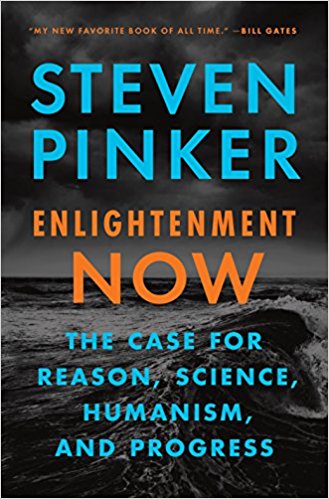
Steven Pinker, the Harvard professor, recently published Enlightenment Now. The Case for Reason, Science, Humanism, and Progress.

NOL Pinker Edwin
Buy it

It is a fine book that basically sets out to do what its subtitle promises. It does so covering a wide range of ideas and topics, and discusses and rejects most arguments often used against Enlightenment thought, which Pinker equates with classical liberalism.

Those who know the work of Johan Norberg of the Cato Institute, the late Julian Simon’s writings, Jagdish Bhagwati’s magisterial In Defense of Globalization, or last but not least, Deirdre McCloskey’s Bourgeois Trilogy will be updated on the latest figures, but will not learn much in terms of arguments.

Those new to the debate, or searching for material to defend classical liberal ideas and values, will find this a very helpful book.

2018 Hayek Essay Contest

The 2018 General Meeting of the Mont Pelerin Society will take place from September 30 – October 6, 2018 at ExpoMeloneras and Lopesan Hotels in Meloneras, Gran Canaria, Canary Islands. As with past general meetings, the Mont Pelerin Society is currently soliciting submissions for Friedrich A. Hayek Fellowships. The fellowships will be awarded through the Hayek Essay Contest.

The Hayek Essay Contest is open to all individuals 36 years old or younger. Entrants should write a 5,000 word (maximum) essay that addresses the quotation(s) and question(s) detailed on the contest announcement (available at the above link). The deadline for submissions is May 31, 2018. The winners will be announced on July 31, 2018. Essays must be submitted in English only. Electronic submissions should be sent in PDF format to this email address (mps.youngscholars@ttu.edu). Authors of winning essays must present their papers at the General Meeting to receive their award. The essays will be judged by an international panel of three members of the Society.

Please feel free to share this announcement with any individuals who may have an interest in submitting an essay for consideration of a fellowship award. All questions may be directed to the MPS Young Scholars Program Committee by email at mps.youngscholars@ttu.edu or phone at +1.806.742.7138.

MPS Young Scholars Program Committee

On the popularity of economic history

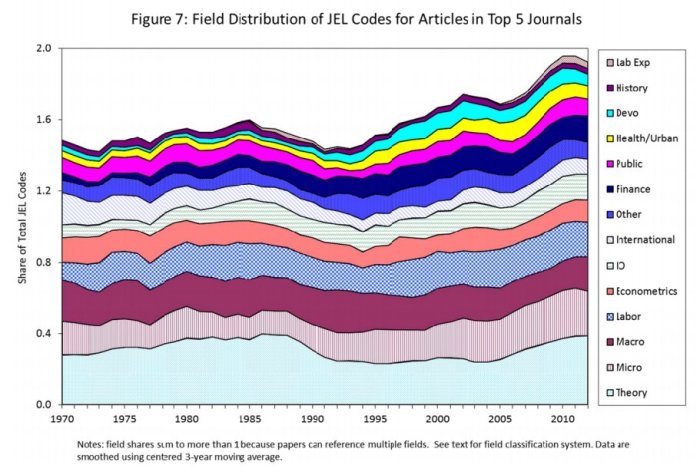
I recently engaged in a discussion (a twittercussion) with Leah Boustan of Princeton over the “popularity” of economic history within economics (depicted below).  As one can see from the purple section, it is as popular as those hard candies that grandparents give out on Halloween (to be fair, I like those candies just like I do economic history). More importantly, the share seems to be smaller than at the peak of 1980s. It also seems like the Nobel prize going to Fogel and North had literally no effects on the subfield’s popularity. Yet, I keep hearing that “economic history is back”. After all, the Bates Clark medal went to Donaldson of Stanford this year which should confirm that economic history is a big deal.  How can this be reconciled with the figure depicted below?

EconomicHIstoryData

As I explained in my twittercussion with Leah, I think that there is a popularity for using historical data. Economists have realized that if some time is spent in archives to collect historical data, great datasets can be assembled. However, they do not necessarily consider themselves “economic historians” and as such they do not use the JEL code associated with history.  This is an improvement over a field where Arthur Burns (former Fed Chair) supposedly said during the 1970s that we needed to look at history to better shape monetary policy. And by history, he meant the 1950s. However, while there are advantages, there is an important danger which is left aside.

The creation of a good dataset has several advantages. The main one is that it increases time coverage. By increasing the time coverage, you can “tackle” the big questions and go for the “big answers” through the generation of stylized facts. Another advantage (and this is the one that summarizes my whole approach) is that historical episodes can provide neat testing grounds that give us a window to important economic issues. My favorite example of that is the work of Petra Moser at NYU-Stern. Without going into too much details (because her work was my big discovery of 2017), she used a few historical examples which she painstakingly detailed in order to analyze the effect of copyright laws. Her results have important ramifications to debates regarding “science as a public good” and “science as a contribution good” (see the debates between Paul David and Terence Kealey on this in Research Policy for this point).

But these two advantages must be weighted against an important disadvantage which Robert Margo has warned against in a recent piece in Cliometrica.  When one studies economic history, one must keep in mind that two things must be accomplished simultaneously: to explain history through theory and bring theory to life through history (this is not my phrase, but rather that of Douglass North). To do so, one must study a painstaking amount of details to ascertain the quality of the sources used and their reliability.  In considering so many details, one can easily get lost or even fall prey to his own prior (i.e. I expect to see one thing and upon seeing it I ask no question). To avoid this trap, there must be a “northern star” to act as a guide. That star, as I explained in an earlier piece, is a strong and general understanding of theory (or a strong intuition for economics). To create that star and give attention to details is an incredibly hard task and which is why I argued in the past that “great” economic historians (Douglass North, Deirdre McCloskey, Robert Fogel, Nathan Rosenberg, Joel Mokyr, Ronald Coase (because of the lighthouse piece), Stephen Broadberry, Gregory Clark etc.) take a longer time to mature. In other words, good economic historians are projects that have have a long “time to build problem” (sorry, bad economics joke).  However, the downside is that when this is not the case, there are risks of ending up with invalid results that are costly and hard to contest.

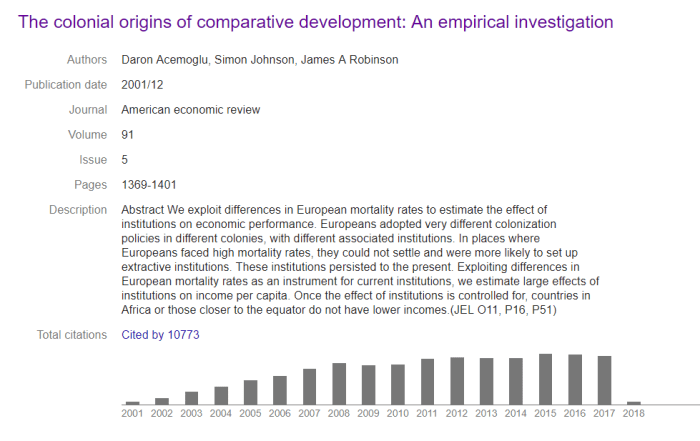
Just think about the debate between Daron Acemoglu and David Albouy on the colonial origins of development. It took more than five years to Albouy to get his results that threw doubts on Acemoglu’s 1999 paper. Albouy clearly expended valuable resources to get the “details” behind the variables. There was miscoding of Niger and Nigeria, and misunderstandings of what type of mortalities were used.  This was hard work and it was probably only deemed a valuable undertaking because Acemoglu’s paper was such a big deal (i.e. the net gains were pretty big if they paid off). Yet, to this day, many people are entirely unaware of the Albouy rebuttal.  This can be very well seen in the image below regarding the number of cites of the Acemoglu-Johnson-Robinson paper on an annual basis. There seems to be no effect from the massive rebuttal (disclaimer: Albouy convinced me that he was right) from the Albouy piece.

AcemogluPaperCites

And it really does come down to small details like those underlined by Albouy. Let me give you another example taken from my work. Within Canada, the French minority is significantly poorer than the rest of Canada. From my cliometric work, we now know that there were poorer than the rest of Canada and North America as far as the colonial era. This is a stylized fact underlying a crucial question today (i.e. Why are French-Canadians relatively poor).  That stylized fact requires an explanation. Obviously, institutions are a great place to look. One of the institution that is most interesting is seigneurial tenure which was basically a “lite” version of feudalism in North America that was present only in the French settled colonies. Some historians and economic historians argued that there were no effects of the institutions on variables like farm efficiency.  However, some historians noticed that in censuses the French reported different units that the English settlers within the colony of Quebec. To correct for this metrological problem, historians made county-level corrections. With those corrections, the aforementioned has no statistically significant effect on yields or output per farm. However, as I note in this piece that got a revise and resubmit from Social Science Quarterly (revised version not yet online), county-level corrections mask the fact that the French were more willing to move to predominantly English areas than the English were willing to predominantly French areas. In short, there was a skewed distribution. However, once you correct the data on an ethnic composition basis rather than on the county-level (i.e. the same correction for the whole county), you end with a statistically significant negative effect on both output per farm and yields per acre. In short, we were “measuring away” the effect of institutions. All from a very small detail about distributions. Yet, that small detail has supported a stylized fact that the institution did not matter.

This is the risk that Margo speaks about illustrated in two examples. Economists who use history merely as a tool may end up making dramatic mistakes that will lead to incorrect conclusions. I take this “juicy” quote from Margo (which Pseudoerasmus) highlighted for me:

[EH] could become subsumed entirely into other fields… the demand for specialists in economic history might dry up, to the point where obscure but critical knowledge becomes difficult to access or is even lost. In this case, it becomes harder to ‘get the history right’

Indeed, unfortunately.

Tocqueville on the Russians

There was a winter storm that blew through Austin last night. The entire city, which isn’t big population-wise (1.5 million give or take) but large geographically, shut down and I have the day off. So, I am working hard on my weekly column for RealClearHistory, and came across this sociological gem of Alexis de Tocqueville, who wrote the best book on America, ever:

The American struggles against the natural obstacles which oppose him; the adversaries of the Russian are men; the former combats the wilderness and savage life; the latter, civilization with all its weapons and its arts: the conquests of the one are therefore gained by the ploughshare; those of the other by the sword. The Anglo-American relies upon personal interest to accomplish his ends, and gives free scope to the unguided exertions and common-sense of the citizens; the Russian centres all the authority of society in a single arm: the principal instrument of the former is freedom; of the latter servitude.

Keep in mind that Tocqueville’s book was published in 1835. During the Cold War, this passage, which is the last paragraph in Volume 1 of Tocqueville’s 2-volume treatise, this passage was almost a necessary introduction to anything related to Soviet-American interactions.

Now, I fear, my generation must also heed Tocqueville’s prophecy about Russian and American society. Trump is a loudmouthed demagogue, but he is restrained by the people, most of all his base, which, for all its many faults, is democratic in its mores. Free-thinking Russians left Russia en masse while they could, after the collapse of the Soviet Union, for the West and their children and their children’s children will grow up free. The Russian people will continue to serve a despotism they think they need to survive. There is a conspiratorial, somber, and pessimistic tone in the voice of most Russian authors, even those who have managed to make a life for themselves in the West, and I get it.

When I think of Russia, with all its beautiful biodiversity, its people, and its potential, I brood.