You vote is your voice–but actions speak louder than words

On voting day, with everyone tweeting and yelling and spam-calling you to vote, I want to offer some perspective. Sure, ‘your vote is your voice,’ and those who skip the election will remain unheard by political leaders. Sure, these leaders probably determine much more of your life than we probably would like them to. And if you don’t vote, or ‘waste’ your vote on a third party or write in Kim Jong Un, you are excluded from the discussion of how these leaders control you.

But damn, if that is such a limited perspective. It’s like the voting booth has blinders that conceal what is truly meaningful. I’m not going to throw the traditional counter-arguments to ‘vote or die’ at you, though my favorites are Arrow’s Impossibility Theorem and South Park’s Douche and Turd episode. Instead, I just want to say, compared to how you conduct your life, shouting into the political winds is simply not that important.

The wisdom of the stoics resonates greatly with me on this. Seneca, a Roman philosopher, tutor, and businessman, had the following to say on actions, on knowledge, on trust, on fear, and on self-improvement:

  • Lay hold of today’s task, and you will not need to depend so much upon tomorrow’s. While we are postponing, life speeds by. Nothing is ours, except time. On Time
  • Each day acquire something that will fortify you against poverty, against death, indeed against other misfortunes as well; and after you have run over many thoughts, select one to be thoroughly digested that day. This is my own custom; from the many things which I have read, I claim some one part for myself. On Reading
  • If you consider any man a friend whom you do not trust as you trust yourself, you are mightily mistaken and you do not sufficiently understand what true friendship means. On Friendship
  • Reflect that any criminal or stranger may cut your throat; and, though he is not your master, every lowlife wields the power of life and death over you… What matter, therefore, how powerful he be whom you fear, when every one possesses the power which inspires your fear? On Death
  • I commend you and rejoice in the fact that you are persistent in your studies, and that, putting all else aside, you make it each day your endeavour to become a better man. I do not merely exhort you to keep at it; I actually beg you to do so. On the Philosopher’s Lifestyle

Seneca goes on, in this fifth letter, to repeat the stoic refrain of ‘change what you can, accept what you cannot.’ But he expands, reflecting that your mind is “disturbed by looking forward to the future. But the chief cause of [this disease] is that we do not adapt ourselves to the present, but send our thoughts a long way ahead. And so foresight, the noblest blessing of the human race, becomes perverted.”

Good leadership requires good foresight, but panic over futures out of our control pervert this foresight into madness. So, whether you think that Biden’s green promises will destroy the economy or Trump’s tweets will incite racial violence, your actions should be defined by what you can do to improve the world–and this is the only scale against which you should be judged.

So, set aside voting as a concern. Your voice will be drowned out, and then forgotten. But your actions could push humanity forward, in your own way, and if you fail in that endeavor, then no vote will save you from the self-knowledge of a wasted life. If you succeed, then you did the only thing that matters.

The Seldon Fallacy

Like some of my role models, I am inspired by Isaac Asimov’s vision. However, for years, the central ability at the heart of the Foundation series–‘psychohistory,’ which enables Hari Seldon, the protagonist, to predict broad social trends across thousands of galaxies over thousands of years–has bothered me. Not so much because of its impact in the fictional universe of Foundation, but for how closely it matches the real-life ideas of predictive modeling. I truly fear that the Seldon Fallacy is spreading, building up society’s exposure to negative, unpredictable shocks.

The Seldon Fallacy: 1) It is possible to model complex, chaotic systems with simplified, non-chaotic models; 2) Combining chaotic elements makes the whole more predictable.

The first part of the Seldon Fallacy is the mistake of assuming reducibility, or more poetically, of NNT’s Procustean Bed. As F.A. Hayek asserted, no predictive model can be less complex than the model it predicts, because of second-order effects and accumulation of errors of approximation. Isaac Asimov’s central character, Hari Seldon, fictionally ‘proves’ the ludicrous fallacy that chaotic systems can be reduced to ‘psychohistorical’ mathematics. I hope you, reader, don’t believe that…so you don’t blow up the economy by betting a fortune on an economic prediction. Two famous thought experiments disprove this: the three-body problem and the damped, driven oscillator. If we can’t even model a system with three ‘movers’, because of second-order effects, how can we model interactions between millions of people? Basically, with no way to know which reductions in complexity are meaningful, Seldon cannot know whether, in laying his living system into a Procustean bed, he has accidentally decapitated it. Using this special ability, while unable to predict individuals’ actions precisely, Seldon can map out social forces with such clarity that he correctly predicts the fall of a 10,000-year empire. Now, to turn to the ‘we can predict social, though not individual futures’ portion of the fallacy: that big things are predictable even if their consituent elements are not.

The second part of the Seldon Fallacy is the mistake of ‘the marble jar.’ Not all randomnesses are equal: drawing white and black marbles from a jar (with replacement) is fundamentally predictable, and the more marbles drawn, the more predictable the mix of marbles in the jar. Many models depend on this assumption or similar ones–that random events distribute normally (in the Gaussian sense) in a way that increases the certainty of the model as the number of samples increases. But what if we are not observing independent events? What if they are not Gaussian? What if someone tricked you, and tied some marbles together so you can’t take out only one? What if one of them is attached to the jar, and by picking it up, you inadvertently break the jar, spilling the marbles? Effectively, what if you are not working with a finite, reducible, Gaussian random system, but an infinite, Mandelbrotian, real-world random system? What if the jar contains not marbles, but living things?

I apologize if I lean too heavily on fiction to make my points, but another amazing author answers this question much more poetically than I could. Just in the ‘quotes’ from wise leaders in the introductions to his historical-fantasy series, Jim Butcher tells stories of the rise and fall of civilizations. First, on cumulative meaning:

“If the beginning of wisdom is in realizing that one knows nothing, then the beginning of understanding is in realizing that all things exist in accord with a single truth: Large things are made of smaller things.

Drops of ink are shaped into letters, letters form words, words form sentences, and sentences combine to express thought. So it is with the growth of plants that spring from seeds, as well as with walls built from many stones. So it is with mankind, as the customs and traditions of our progenitors blend together to form the foundation for our own cities, history, and way of life.

Be they dead stone, living flesh, or rolling sea; be they idle times or events of world-shattering proportion, market days or desperate battles, to this law, all things hold: Large things are made from small things. Significance is cumulative–but not always obvious.”

–Gaius Secundus, Academ’s Fury

Second, on the importance of individuals as causes:

“The course of history is determined not by battles, by sieges, or usurpations, but by the actions of the individual. The strongest city, the largest army is, at its most basic level, a collection of individuals. Their decisions, their passions, their foolishness, and their dreams shape the years to come. If there is any lesson to be learned from history, it is that all too often the fate of armies, of cities, of entire realms rests upon the actions of one person. In that dire moment of uncertainty, that person’s decision, good or bad, right or wrong, big or small, can unwittingly change the world.

But history can be quite the slattern. One never knows who that person is, where he might be, or what decision he might make.

It is almost enough to make me believe in Destiny.”

–Gaius Primus, Furies of Calderon

If you are not convinced by the wisdom of fiction, put down your marble jar, and do a real-world experiment. Take 100 people from your community, and measure their heights. Then, predict the mean and distribution of height. While doing so, ask each of the 100 people for their net worth. Predict a mean and distribution from that as well. Then, take a gun, and shoot the tallest person and the richest person. Run your model again. Before you look at the results, tell me: which one do you expect shifted more?

I seriously hope you bet on the wealth model. Height, like marble-jar samples, is normally distributed. Wealth follows a power law, meaning that individual datapoints at the extremes have outsized impact. If you happen to live in Seattle and shot a tech CEO, you may have lowered the mean income in the group by more than the average income of the other 99 people!

So, unlike the Procustean Bed (part 1 of the Seldon Fallacy), the Marble Jar (part 2 of the Seldon Fallacy) is not always a fallacy. There are systems that follow the Gaussian distribution, and thus the Marble Jar is not a fallacy. However, many consequential systems–including earnings, wars, governmental spending, economic crashes, bacterial resistance, inventions’ impacts, species survival, and climate shocks–are non-Gaussian, and thus the impact of a single individual action could blow up the model.

The crazy thing is, Asimov himself contradicts his own protagonist in his magnum opus (in my opinion). While the Foundation Series keeps alive the myth of the predictive simulation, my favorite of his books–The End of Eternity (spoilers)–is a magnificent destruction of the concept of a ‘controlled’ world. For large systems, this book is also a death knell even of predictability itself. The Seldon Fallacy–that a simplified, non-chaotic model can predict a complex, chaotic reality, and that size enhances predictability–is shown, through the adventures of Andrew Harlan, to be riddled with hubris and catastrophic risk. I cannot reduce his complex ideas into a simple summary, for I may decapitate his central model. Please read the book yourself. I will say, I hope that as part of your reading, I hope you take to heart the larger lesson of Asimov on predictability: it is not only impossible, but undesirable. And please, let’s avoid staking any of our futures on today’s false prophets of predictable randomness.

The Blind Entrepreneur

Entrepreneurs usually make decisions with incomplete information, in disciplines where we lack expertise, and where time is vital. How, then, can we be expected to make decisions that lead to our success, and how can other people judge our startups on our potential value? And even if there are heuristics for startup value, how can they cross fields?

The answer, to me, comes from a generalizable system for improvement and growth that has proven itself– the blind watchmaker of evolution. In this, the crucial method by which genes promulgate themselves is not by predicting their environments, but by promiscuity and opportunism in a random, dog-eat-dog-world. By this, I mean that successful genes free-ride on or resonate with other genes that promote reproductive success (promiscuity) and select winning strategies by experimenting in the environment and letting reality be the determinant of what gene-pairings to try more often (opportunism). Strategies that are either robust or anti-fragile usually outperform fragile and deleterious strategies, and strategies that exist within an evolutionary framework that enables rapid testing, learning, mixing, and sharing (such as sexual reproduction or lateral gene transfer paired with fast generations) outperform those that do not (such as cloning), as shown by the Red Queen hypothesis.

OK, so startups are survival/reproductive vehicles and startup traits/methods are genes (or memes, in the Selfish Gene paradigm). With analogies, we should throw out what is different and keep what is useful, so what do we need from evolution?

First, one quick note: we can’t borrow the payout calculator exactly. Reproductive success is where a gene makes more of itself, but startups dont make more of themselves. For startups the best metric is probably money. Other than that, what adaptations are best to adopt? Or, in the evolutionary frame, what memes should we imbue in our survival vehicles?

Traits to borrow:

  • Short lives: long generations mean the time between trial and error is too long. Short projects, short-term goals, and concrete exits.
  • Laziness: energy efficiency is far more important than #5 on your priority list.
  • Optionality: when all things are equal, more choices = more chances at success.
  • Evolutionarily Stable Strategies: also called “don’t be a sucker.”
  • React, don’t plan: prediction is difficult or even impossible, but being quick to jump into the breach has the same outcome. Could also be called “prepare, but don’t predict.”
  • Small and many: big investments take a lot of energy and effectively become walking targets. Make small and many bets on try-outs and then feed those that get traction. Note– this is also how to run a military!
  • Auftragstaktik: should be obvious, central planning never works. Entrepreneurs should probably not make any more decisions than they have to.
  • Resonance: I used to call this “endogenous positive feedback loops,” but that doesn’t roll off the tongue. In short, pick traits that make your other traits more powerful–and even better if all of your central traits magnify your other actions.
  • Taking is better than inventing: Its not a better startup if its all yours. Its a better startup if you ruthlessly pick the best idea.
  • Pareto distributions (or really, power laws): Most things don’t really matter. Things that matter, matter a lot.
  • Finite downside, infinite upside: Taleb calls this “convexity”. Whenever presented with a choice that has one finite and one infinite potential, forget about predicting what will happen– focus on the impact’s upper bound in both directions. It goes without saying– avoid infinite downsides!
  • Don’t fall behind (debt): The economy is a Red Queen, anyone carrying anything heavy will continually fall behind. Debt is also the most likely way companies die.
  • Pay it forward to your future self: squirrels bury nuts; you should build generic resources as well.
  • Don’t change things: Intervening takes energy and hurts diversity.
  • Survive: You can’t win if you’re not in the game. More important than being successful is being not-dead.

When following these guidelines, there are two other differences between entrepreneurs and genes: One, genes largely exist in an amoral state, whereas your business is vital to your own life, and if you picked a worthwhile idea, society. Two, unlike evolution, you actually have goals and are trying to achieve something beyond replication, beyond even money. Therefore, you do not need to take your values from evolution. However, if you ignore its lessons, you close your eyes to reality and are truly blind.

Our “blind” entrepreneur, then, can still pick goals and construct what she sees as her utility. But to achieve the highest utility, once defined, she will create unknowable and unpredictable risk of her idea’s demise if she does not learn to grow the way that the blind watchmaker does.

Pathologies in higher education: a book, a review, and a comment

Cracks in the Ivory Tower, by Jason Brennan and Phillip Magness, brings a much needed discussion of the pathologies of US higher education to the table. Brennan and Magness are two well-known classical liberals with a strong record of thoughtful interaction with Public Choice political economy.

Public Choice is an application of mainstream economic concepts to political situations. One of the key points of Public Choice is that people are self-interested and rational. This drives the choices they make. But people also act within formal and informal institutional environments. This constrains and enables some of their choices to a large degree. In other words, people react to incentives.

The Public Choice approach is not so much a normative handbook, but rather an attempt to explain how politics operate. The application of this theory to understand higher education in the US is a welcome addition to a growing literature on the economics of higher education.

It is perhaps surprising how the subtitle of the book stresses an aspect that tends to be extraneous to Public Choice scholarship: “The Moral Mess of Higher Education”. Of course we all draw on moral reasoning and assumptions in order to pass judgment on economic and political phenomena, but normally the descriptive side is kept separate – at least by economists – from explicit value judgment.

John Staddon, from Duke University, has reviewed Brennan’s and Magness’ book. In his review, he focuses on three main key issues. First, colleges and universities act on distorted incentives created, for example, by college rankings, to recruit students in ways that are not necessarily related to maintaining or expanding the academic prestige of the institution.

Second, teaching in higher education, at least in the US, is poorly evaluated. Historically, it has shifted from student evaluation to administrative assessment.

So why the shift from student-run to administration-enforced?  And why did faculty agree to give these mandated evaluations to their students? Faculty acquiescence — naiveté — is relatively easy to understand. Who can object to more information? Who can object to a new, formal system that is bound to be more accurate than any informal student-run one? And besides, for most faculty at elite schools, research, not teaching, is the driver. Faculty often just care less about teaching; some may even regard it as a chore.

The incentives for college administrations are much clearer. Informal, student-run evaluations are assumed to be unreliable, hence cannot be used to evaluate faculty for tenure and promotion. But once the process is formalized, mandatory, and supposedly valid, it becomes a useful disciplinary tool, a way for administrators to control faculty, especially junior and untenured faculty.

This is not necessarily conducive to improvement in the quality of teaching. Perhaps colleges fare better than universities here, given that their faculty is not expected to allocate a large amount of hours per week to research and writing.

Third, Brennan and Magness offer a critique of what is known in the US system as “general education” courses. In their view, it is clear that those courses are unhelpful in a world where academic disciplines are increasingly more specialized. However, offering those courses is a good excuse for universities to grab more money from the students.

This is where Staddon begs to differ:

Cracks in the Ivory Tower usefully emphasizes the economic costs and benefits of university practices. But absent from the book is any consideration of the intrinsic value of the academic endeavor. Remaining is a vacuum that is filled by two things: the university as a business; and the university as a social activist.  Both are destructive of the proper purpose of a university.

I tend to agree with this point, and I do not think it is a minor point. We can do colleges and universities without football, without gigantic administrative bureaucracies, and without the gimmicks to game the college ranking system. I could even go further and argue that we should do colleges and universities without dorms and an artificial second and worse version of teenage years right when students are supposed and expected to behave like adults. Getting rid of those tangential features of US higher education should help refocus on knowledge and reduce the cost.

Colleges and universities in the US are also expensive and unnecessarily inflated because of the structure of the student loans system, which also generates perverse incentives. But this point has been explained and described to exhaustion in the economic literature. This also has to change.

However, I am not convinced that making universities focus on professionalizing their students would be the best way to go. Brennan and Magness raise some important issues and concerns, some of which also apply outside the US, but the Staddon highlights in his review an important counterpoint: higher education, at least on the undergraduate level, shouldn’t be seen 100% as an investment good, but also as a consumer good:

Higher education does not exist for economic reasons. It exists (in the famous words of Matthew Arnold) to transmit “the best that has been thought and said,” in other words the ‘high culture’ of our civilization. Job-related, practical training is not unimportant. Universities, and much else of society, could not exist without a functioning economy. But — and this point is increasingly ignored on the modern campus and by the authors of CIT — these things are not the purpose, the telos if you like, of a university.

Undergraduate education is there to hand over knowledge to the next generation. It can be small and cheap. You need an adequate building, a small library with the best classic books, electronic access to journals, and faculty that excels at teaching. Courses would be general, comprehensive, and interdisciplinary by definition. The program could last only three years. An optional additional year could be offered to those with an academic profile, where they could pursue more specialization as a bridge to graduate education.

This is more or less the mediaeval model. I am not sure we need to reinvent the wheel in order to deal with the crisis of higher education. What we need is to get back on track – back to the bread and butter of college education. This is a reflection that both sides of the story – those who demand education and those that offer it – need to make.


Read more:

In a recent contribution to Notes on Liberty, Mary Lucia Darst has recently commented on the status of higher education during the 2020 pandemic and prospects for the future.

I also wrote about the college trap in the US a few years ago.

From Class to Identity: The Cultural Turn in the Left Thought Collective (1950s-1980s)

Class to Culture


This is a draft of a book chapter that has been published as Andrei Znamenski, “From Class to Culture: Ideological Landscapes of the Left Thought Collective in the West, 1950s–1980s.” In Bolgov R. et al. (eds) Proceedings of Topical Issues in International Political Geography. Cham, Switzerland: Springer, 2021, pp. 337-354.


Ideologies never die, they metamorphose and are reborn in a new form just when they are thought buried forever.

– Pascal Bruckner, French philosopher and writer (2006)

In 2010, sociology professor Rick Fantasia, a member of the Democratic Socialists of America, struggled to explain the results of US Congress elections that were disastrous to democrats and that, at that time, brought a majority to the republicans.  Fantasia was part of a Social Forum, a 15,000-strong army of left activists who gathered in Detroit, Michigan.  Observing this convention, he noted that most people who arrived at this convention mostly represented various minority organizations that were either involved into identity politics or represented immigrant workers.  Fantasia also noted a heavy presence of countercultural and environmentalist elements, including New Age seekers.  At the same time, the activist scholar pointed out that one important element was missing: working-class people, especially white workers.  With frustration, Fantasia noted that there were only a few white working-class people: “The whites were mostly educated members of the middle class, organizers, activists, representatives of philanthropic organizations and academics.” The described gathering and the expressed concern were a microcosm that reflected the shift in the entire ideology and the social base of the current Western left for the past fifty years.

What worried Fantasia was not some aberration or a temporary flaw in the left strategy and tactics. In fact, this was the result of a natural evolution of the left mainstream.  Since the 1960s, it drifted away from concerns about an economic growth and class-based politics, which were associated with the old left.  Instead, the left began shifting toward culture, race, and identity issues as well as environmentalism.  This metamorphosis is sometimes labeled by a loose umbrella expression the “cultural turn.” On the level of ideas, this turn is usually associated with the emergence of the often-mentioned post-modernism and includes several intellectual trends and political practices that developed in the wake of traditional socialism that was heavily informed by Marxism.  The most important among these trends are post-colonial studies, critical theory, feminism, multiculturalism, and political correctness.   Some authors on the right refer to all this by an umbrella term “Cultural Marxism” – a pejorative expression that serves to point to genetic links between the current cultural left and the old Marxism-driven left.

This essay explores the sources of the cultural turn among the left and the development of their passion for identity matters, which resulted in the phenomenon pinpointed by Fantasia.  Although there have been tons of writings about the cultural left and the origin of their woke culture, our intellectual mainstream is still dominated by the following popular notions.  On the right, it is a widespread conviction that evil “Cultural Marxism,” primarily through the malicious activities of the Frankfurt School, set out to erode the Western civilization.  In the meantime, the easily triggered left have been ascribing any critique of PC thought collective and its “sacred cows” of race and gender to the evil forces of fascism and racism. If we “deconstruct” the history of the left’s gradual evolution toward culture and identity, we might problematize both approaches and tone down the heated debates around that issue.  Moreover, the understanding of the gradual evolution of the contemporary left from economic determinism and fixation on the proletariat to the privileging of culture, identity, and lifestyles will help us understand better how and why literally every aspect of human life became politicized in the eyes of the current left.  In other words, the history of the cultural turn will shed more light on the origin of the popular left meme that personal is political. 

The goal of this essay is to paint a bigger picture by showing that, besides the often-mentioned Frankfurt School, there were other essential sources that fomented the cultural or identitarian turn on the left.  Thus, to understand the formation of this turn, on needs to address the significance of the year 1956 and celebrity sociology W. Right Mills’ crusade against “Victorian Marxism.”  We also need to bring up the writings of C.L.R. James, William Dubois, France Fanon who were the first to refurbish popular Marxism’s memes (the proletariat, class domination and oppression, the new man, false consciousness, and center-periphery) and its Eurocentric nature along racial and non-Western lines.  Most important, one needs to examine the activities of British group of communist historians, Birmingham Institute of Cultural Studies, and New Left Review.  Without them, it will be hard to understand the historical role of the 1960s-1970s’ New Left, which acted as an intellectual bridge between old economic- and class-based Marxism and current cultural left that is heavily steeped in identity politics.

How Do We Call It? Critical Cultural Theory, Cultural Marxism, and the Identitarian Left

In existing debates about the cultural turn, the term “Cultural Marxism” has aroused most controversy.  Current identity-oriented progressive writers and scholars do not like this expression. Their favorite term of choice is Critical Theory and the host of expressions derived from it: Critical Cultural Theory, Critical Racial Theory, Critical Legal Studies and so forth.  However, earlier left authors did not see any problems with “Cultural Marxism.”  In fact, between the 1970s and the 1990s, they pointed that this very expression captured well the essence of the socialist ideology that was undergoing an adjustment to the new times. For example, in his “British Cultural Marxism”(1991) Ioan Davis and Dennis Dworkin in his Cultural Marxism in Postwar Britain: History, the New Left, and the Origins of Cultural Studies (1997) did not see any problems in using that expression.  Moreover, from about 2004 to as late as 2021, progressive social scholar Douglas Kellner did not find it problematic to generalize about “Cultural Marxism and Cultural Studies.”
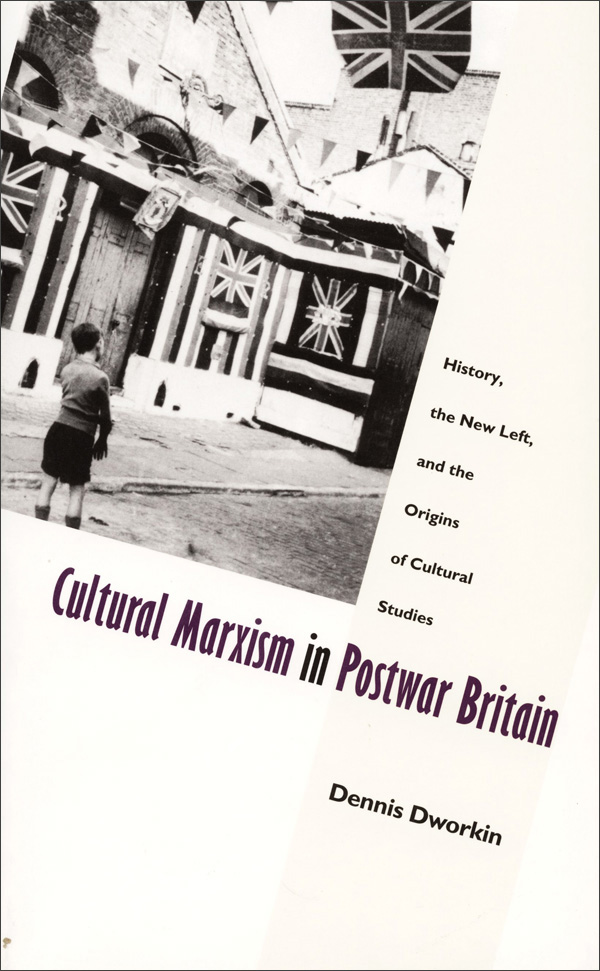
dworkin

The most aggressive among current cultural left, especially journalists who did not take time to explore the history of Marxism and neo-Marxism, have been quick to label Cultural Marxism as a hate taboo term that promotes fascist, Nazi, and anti-Semitic ideas.  Using such smear metaphors, they want to intellectually link all critics of the identitarian left on the right to Hitler’s propaganda workers who had talked about “Cultural Bolshevism.”  Moreover, downplaying the historical links between pre-1960s “scientific socialism” and the current cultural left, some identity-oriented left authors have claimed that they in fact moved beyond Marxism and that they are not Marxists anymore.
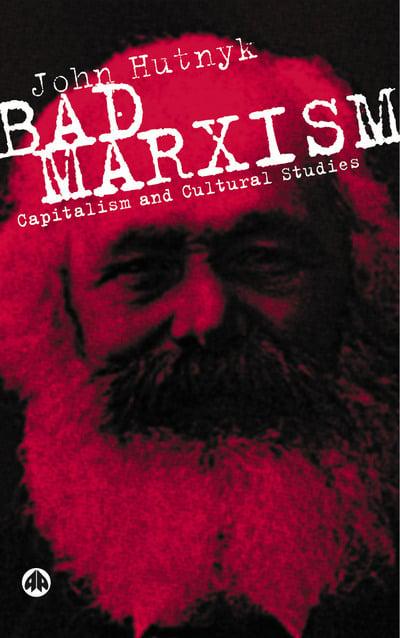
bad marxism

In their turn, many among traditional Marxist leftists, who still try to stick to the class-based approach, agree that the cultural left have nothing to do with Marxism.  These “traditionalists” label their wayward cultural comrades as traitors to the cause and dismiss them as “bad Marxists”. Several scholars (historian Paul Gottfried and philosopher Helen Pluckrose), who are critical of both traditional Marxism and the current identitarian left, too have argued against using the expression Cultural Marxism.  Correctly stressing that the post-Marxist left stopped prioritizing economic determinism and class and assimilated ideas from outside of Marxism, Gottfried and Pluckrose have stressed that the current cultural left hardly have any links to Marxism.

Several conservative authors (e. g. Kerry Bolton and Jeffrey D. Breshears), who generalized about Cultural Marxism, have come to view it as a grand conspiracy on the part of the left.  They have portrayed it to as a sinister plan masterminded by the so-called Frankfurt School that allegedly sought to uproot Western civilization and Christianity.  The most grotesque versions of the Cultural Marxism conspiracy theory link it exclusively to the activities of German-Jewish scholars (who had indeed dominated the Frankfurt School (see Benjamin Ivry, Deconstructing the Jewishness of the Frankfurt School (2015). That theory goes as follows. A group of mostly Jewish intellectuals, who were part of radical socialist and communist forces in the 1920s’ Germany, were upset about the failure of the 1917 Communist revolution in Europe and decided to modify the Marxist-Leninist project of world revolution by mixing Marx and Freud.

FrankfurtSchool

Their goal was to smash capitalism not through the cultivation of the working-class indignation but through undermining Western culture and civilization (traditional family, gender hierarchies, and sexual norms).  In the 1930s, being kicked out by national socialists from Germany, the Frankfurt School cabal moved to the United States, where it became the “Trojan horses” of the radical left, setting out to undermine the culture and values of the United States – the economic and political hub of the Western civilization. One of the major proponents of this view has been writer William Lind (“The Roots of Political Correctness,” 2009), who in fact was instrumental in popularizing the expression “Cultural Marxism.” It is mostly by drawing on his writings that the left journalists came up with the argument that this expression serves as an anti-Semitic dog whistle.

While authors like Lind singled out the Frankfurt School to be demonized as the major intellectual culprit, left authors, who have been peddling so-called neoliberalism, became similarly obsessed with searching for the shadow of the Mont Perelin society in any movement that advocated free market and individual liberty.  The irony of the situation is that both pejorative memes “Cultural Marxism” and “neoliberalism” do describe social trends that have been unfolding in society.  They are not the products of the grand conspiracies but reflect what has been going on in the intellectual culture and on the ground among various segments of society.  Incidentally, several scholars (Keith PrestonAlexander Zubatov, Allen Mendenhall, and Dominic Green) have recently explored the content of Cultural Marxism, trying to separate the conspiracy elements from actual intellectual links between Marxism of old and the current cultural left. Although I believe that this term can be useful especially when we need to stress the continuity between the old Marxian socialism and the present day cultural left, who operate with many ideological pillars inherited from the old creed (e.g. oppression/domination narrative, false consciousness and so forth), it indeed might be too narrow. So, I personally prefer to use such broad definitions as the “cultural left” and “identitarian left.”

Behind the rise of the cultural left, there stood a large thought collective that did reflect genuine concerns of various segments of the left and social movements.  The writings of the Frankfurt scholars, who both analyzed Western society and did issue utopian suggestions about how to transform it, were marginal until the 1960s.  Their scholarship, which helped to shift the left’s priorities from class to identity and culture, would have remained marginal had it not been for wide and vocal audiences that for various reasons picked up and consumed them. To summarize, the “Frankfurters” were not a sinister alien cabal that was preying on Judeo-Christian civilization with the sole purpose to destroy it.  One can describe their effect on society by an old saying: when a student is ready, a teacher comes.  In the 1960s and the 1970s, their ideas, which had earlier been marginal, suddenly began to resonate with thousands of progressives in the West and beyond.  Such “Frankfurters” as Herbert Marcuse (1898-1979), Theodore Adorno (1903-1969), and Erich Fromm (1900-1980) described the development of mass consumer society, patriarchic family, the effects of propaganda on masses, criticized industrial society, and Western mass culture, frequently issuing sweeping condemnation of the entire “soulless” Western civilization.

The reason these ideas came in vogue was simply because, by the 1960s, the West and the rest of the world experienced profound socio-economic changes: the decline of traditional working class and the rise of intellectual professions, the massive involvement of women into all spheres of life and the end of the male-oriented societal ethic, which until the 1960s had been considered normal, the emergence of new technologies, an industrial pollution, and concerns about how to better handle an economic growth.  Furthermore, the world saw the rise of Third World national liberation movements, the collapse of old colonial empires, and the emergence of minority movements in Western countries. Finally, the Soviet Union, which for a large portion of the left earlier had been the great new hope, lost its image as the ultimate socialist utopia.  Facing those changes, the old left began to crumble. There was a need to refurbish the left ideology and identity. In the 1960s and the 1970s, during student antiwar movements, the rise of Third World national liberation movements, civil rights protests among the people of “color,” the expansion of women and gays rights movements, the ideas disseminated by the above-mentioned intellectual “power centers” of the left resonated well with thousands of protesters. One cannot simply dismiss these collectives and their ideas as something imposed from above on the “innocent populace.” 

Toward “Socialist Humanism” and Away from Traditional Marxism (1956 and beyond)

1956 was a pivotal year for the socialist thought collective.  This was the year when the Soviet nomenklatura elite partially exposed Stalinism, trying to polish the tainted image of socialism.  The communist bureaucracy was tired of living in a constant fear, and, after the death of Stalin, it sought to secure its privileges and to somehow reform communism to make it more appealing.  During the same year, taking advantage of the limited destalinization, people of Hungary openly rose in an anti-communist revolt against the Soviets.  The suppression of the Budapest rebels by the Soviet tanks was a devastating blow at the moral of the millions of left idealists around the world who still believed that the Soviet Union was acting on the side of the forces of light.  There was a growing frustration with the Soviet model of socialism that was tied to a total nationalization and centralized planning. Moscow was rapidly losing its status as the utopian place.  It was natural that the year of 1956 signaled the emergence of the so-called New Left who sought to disentangle themselves from the Soviet experience.

In the meantime, the working-class people in the West dramatically improved their living conditions and did nor express any desire to go to barricades to battle capitalism.  Social democrats were shedding the last vestiges of Marxism, and communist parties were increasingly losing their membership.  For example, the French Communist Party, one of the largest pro-Soviet left movements in the West, which had 320,000 members in 1956, by 1962 shrank down to 225,000.  Similarly, pro-Soviet Communist Party USA, which had between 75,000 to 80,000 members in 1945, declined to fewer than 3,000 in 1958. It was not the expected immiseration of working-class masses but an increased prosperity, bourgeois culture, and boredom that became a great challenge.  The left, especially their radical wing, were poised to turn into rebels without a cause.  The major character from John Osborn play (1956) expressed it best when he uttered a phrase that became classic: “There aren’t any good, brave causes left.” In 1960, Raymond Williams (1921-1988), an influential UK socialist novelist and theoretician,  admitted that not only the Marxist prophecy about the immanent collapse of capitalism failed but also the entire hubris of traditional Marxism was under threat: “The Marxist claim to special insight into these matters of life and death of an economic system makes concessions of error less easy.”

There was not much to gain for the left by sticking to the economic playing field, where “rotten” capitalism was improving people’s living standards and securing an economic growth. Those who wanted to keep radical left agenda alive had to rekindle the traditional left subculture. The Trotskyites, cosmopolitan Marxist-Leninist heretics, who were the victims of vicious political assaults from their Stalinist rivals, did arouse a sympathy among dissident communists who were seeking a socialist alternative beyond the Soviet experience.  After all, the Trotskyites were the first to struggle to preserve the radical elan of the Marxist creed, while simultaneously attacking both capitalism and Stalinism.  Yet, with their old and worn out mantra about the primacy of an economic basis, vanguard party, and false claims about an increasing misery of the industrial working class, they were out of touch with reality.  The Trotskyites simply appeared as reenactors of the bygone era and could not generate any visible support among workers, quickly degenerating into an esoteric intellectual sect.

Cornelius Castoriadis, a prominent left theoretician, captured well the whole dilemma faced by the left who were frustrated about the proletariat that failed to fulfill its prophetic mission: “The proof of the truth of the Scriptures is Revelation; and the proof that there has been Revelation is that the Scriptures say so.  This is a self-confirming system. In fact, it is true that Marx’s work, in its spirit and its very intention, stands and falls along with the following assertion: The proletariat, as it manifests itself as the revolutionary class that is on the point of changing the world. If such is not the case – as it is not – Marx’s work becomes again what in reality it always was, a (difficult, obscure, and deeply ambiguous) attempt to think society and history from the perspective of their revolutionary transformation – and we have to resume everything starting from our own situation, which certainly includes both Marx himself and the history of the proletariat as a component.”  Issues that became more relevant by the 1960s were the US war in Vietnam, the rise of Third World anticolonial movements, civil rights struggle, and women liberation.  Traditional working-class issues became less irrelevant, whereas the issues of race, gender, and culture that earlier had occupied a marginal place on the left’s agenda, now were coming to the forefront.  The mainstream radical left had to rethink their creed and agenda and customize it to the changes.

In contrast, by the 1960s, Moscow, which had billed itself as Red Jerusalem and the vital center of left radicals appeared as conservative, oppressive and ideologically suffocating.  In the 1930s and the 1940s, the sympathetic left somehow could excuse Stalin’s socialism along with its police state, terror, and labor concentration camps as a temporary mobilization scheme that was needed to successfully fight fascism and railroad backward Russia into the radiant world of modernity.  Yet, after 1956, it became harder to justify the continuation of that politically correct line.  For example, in response to Soviet defector Victor Kravchenko’s revelations of Stalin’s crimes in 1946, European communists and their fellow travelers still felt no shame in dismissing the existence of  GULAG concentration camps as fake news, and large segments of public swallowed it. Yet, ten years later, when Stalin’s heir Nikita Khrushchev himself indirectly revealed the brutal reality of Soviet communism, the cannibalistic nature of the Bolshevik-made regime was impossible to deny.  Without wishing this, the Soviets, who themselves denounced Stalin, the “red pope” of communism, made a huge crack in the entire building of the socialist faith. 1956 produced thousands of apostates.  Several of them released a volume of their testimonies with a revealing title God That Failed.

The-God-That-Failed

Since 1956, to dissociate themselves from the Soviet brand of socialism, the Western left sought to humanize Marxism. Hence, a natural shift away from economic determinism and economic efficiency toward the issues of culture and identity. Later, this trend manifested itself in the emergence of such contemporary memes as “socialism with a human face,” “democratic socialism,” “socialist humanism,” and “Marxism-Humanism.”   A Jamaican-born UK Marxist sociologist Stuart Hall, one of the fountainheads of the cultural turn on the left, remembered that he and his comrades wanted to find a new political space through the rejection of both Western social democracy and Stalinism. The expression “Stalinism” became an important euphemism for those among the radical left, who wished to exorcise Stalin from communism and socialism, but who simultaneously wanted to preserve the reputation of these two sacred words untarnished.

“Sense of Classlessness” and British Cultural Studies, 1950s-1970s

One of the major trailblazers of the drift toward humanized Marxism and culture and away from economic determinism was a dissident group of British Marxist intellectuals who were later labelled as the New Left. Several of them came from so-called Communist Party Historians Group that was set up within the British Communist Party in 1946. Others were communist fellow travelers or independent Marxists.  At the end of the 1950s, when the Moscow commanding heights began to question Stalin’s infallibility, these historians, sociologists, and literary scholars either quit on the party or drifted away from traditional Marxism-Leninism, challenging its Stalinist theory and practice.  These dissident intellectuals included such prominent figures as E. P. Thompson (1924-1993), Herbert Hoggart (1918-2014), Christopher Hill (1912-1996), Raymond Williams (1921-1988), Christopher Hill (1912-2003) Stuart Hall (1932-2014), Raphael Samuel, (1934-1996), John Saville (1916-2009), Eric Hobsbawm (1917-2012), George Rudé (1910-1993) Rodney Hilton (1916-2002).  Several of them (Hall, Hobsbawm, Hoggart, Thompson, and Williams) had a profound impact on Western social scholarship, especially in English-speaking countries. For example, Hall and Williams literally laid the foundations of current cultural studies. In their turn, Thompson and Hobsbawm had a huge impact on history scholarship, helping to shift its mainstream direction toward writing about the past “from below.”

These New Left dissidents began to question the old Marxist notion that the end of capitalism was linked to the increasing immiseration and economic degradation of the proletariat.  Instead, they started arguing that the need for socialism was arising from the bourgeois affluence and consumerism. Furthermore, these ex-communists cracked the traditional Marxist conviction that economic class interests conditioned politics, social life, people mindsets, and culture.  Gradually shedding off economic determinism, these left scholars who had invested their whole careers into “scientific socialism,” found a new outlet to continue their intellectual pursuits – retrieval of the popular culture of working-class people.

Their intellectual quest eventually gave rise to New Left Review.  Launched in 1960, it became the major periodical of the Western New Left.  In fact, the very expression “the New Left” originated from a collective that congregated around this journal and that was hanging in and around the Partisan Coffee House in Soho, a bohemian area of London, and the Birmingham Institute of Cultural Studies. Searching for a new identity, the New Left changed the very concept of political, moving away from the traditional left “sacred sites” such a factory and a trade union to the realm of labor culture, folklore, lifestyles, and individual behavior.  Hall, who was part of this ideological collective, noted that he and his comrades were looking for a better place to ground their radical socialism. Incidentally, one of his speculative essays carried a characteristic title “A Sense of Classlessness.” Hall specified that the major way for him and his comrades to anchor themselves was politicizing various issues surrounding college life, high schools, movie theaters, art and other walks of life and institutions.  Jumping ahead, I want to stress that for the current cultural left politicizing the issues of lifestyle is one of the major ways of sustaining their identity.  Hall defined the New Left ideological search as “the proliferation of potential sites of social conflict and constituencies for change.” The famous slogan of radical feminism “the personal is political” captured well the essence of that quest.  Overall, as Hall stressed, all kinds of issues, including personal troubles and complaints could be amplified and opened to politicization.

Screenshot (3)

Trying to downplay the old mantra about how economy conditioned the minds of proletarians, these anti-Stalinist dissidents shifted attention to learning about the wisdom of working class by exploring its culture and folklore.  One of the first timid steps was made by Thompson, a professional historian and one of those communist dissidents.  Although Thompson continued to romanticize the labor as the ultimate savior of humankind from capitalism, the scholar nevertheless admitted that the cause of the intellectual bankruptcy of Marxism-Leninism was its economic determinism.  Drawing on Marx’s The Eighteenth Brumaire of Louis Napoleon (1852)one of a few foundational texts in classical Marxism that did recognize a relative autonomy of political culture, Thompson invited to pay more attention to the spontaneous agency of people over the working of invisible natural laws.  Simultaneously, he criticized contemporary Marxism for downplaying moral and ethical issues. Thompson is mostly known for multiple editions of his The Making of the English Working Class (1963) that became a staple reading in history and humanities courses throughout English-speaking world.  In this book, he drew attention to the radical culture of English labor.

Williams, political scientist and literary scholar who belonged to the same collective, moved far further toward embracing a cultural approach to the proletarian “chosen people.”  Formally remaining a member of the British Communist Party, in the 1950s, Williams gradually drifted away from it toward the Labour (social democratic) platform.  Unlike Thompson, who was still trapped within the old Marxist bubble, Williams went full ahead in fomenting the cultural shift in Western Marxism and one of the most influential thinkers for the entire Anglo-American left social scholarship community. Moreover, to dramatize his opposition to the economic materialism and determinism of traditional Marxism, Williams labelled his method as “cultural materialism”; because of Williams’ aggressive media presence, his ideas about the working-class culture and group identity trickled down into Western humanities, where later they were used as a methodological blueprint for feminist, racial, gay, and queer theories.

To legitimize the cultural shift, the dissidents had to appeal to the authority of foundational Marxist texts and use relevant quotes from its founders.   Just as their Soviet counterparts who, when partially cleansing the house of Stalinism, turned to Marx and Lenin, the Western New Left had their intellectual “Reformation” by invoking the early writings of Marx.  Besides such writings as The Eighteenth Brumaire of Louis Napoleon, they particularly became interested in so-called Economic and Philosophic Manuscripts (1844), vague and abstract notes made by young Marx about humanism and alienation.  Excavated and published by Bolshevik scholars in Moscow in the 1920s, those notes appeared to contemporary radical socialists as irrelevant: they did not yet contain the famous pillars of Marxist “science” such as surplus value, the primacy of economic basis, socio-economic formations, and the salvational role of working class.  In the wake of the 1917 revolution, being busy with class battles and ready to harness the “laws of history” in order to usher in the radiant communist future, Bolsheviks and their radical left allies in other countries did not pay much attention to those manuscripts, considering them raw speculations of the great mind in its infancy.  Yet, during the unfolding New Left revisionism, which aimed to mute economic determinism and the Stalinist totalitarianism, amplifying instead the significance of the human being, culture, and identity, those vague notes suddenly became relevant and “mature.” What especially resonated with the British dissident Marxists and the New Left in general was Marx’s generalizations about alienation of human beings in modern Western society.

The ultimate task was to revise the traditional Marxist canon, which preached that economic basis conditioned political and cultural “superstructure,” and to place instead an emphasis on the “superstructure.” In his Culture and Society (1960), Williams furnished relevant quotations from the writings of Marx and Engels to make a case that the cultural superstructure should not be reduced to the economic basis.  Instead of old speculations about the economic conditions of the working class in England, the historian was on the quest for the traditional working-class culture, which he romanticized as organic, wholesome, and authentic.  Moreover, Williams sought to separate it from “artificial” bourgeois mass culture.  A sympathetic contemporary aptly remarked that the intellectual quest of Williams and his New Left colleagues who sought to pinpoint an “authentic” proletarian culture was an attempt to merge “imaginative literature and socialist humanism.”

cuture and society

Marxist sociologist Hoggart, who founded the Birmingham Center for Contemporary Cultural Studies in 1964, too portrayed the idealized working-class culture as organic and natural, contrasting it to the “non-authentic” bourgeois culture.  According to Hoggart, mass bourgeois culture was undermining and phasing traditional and wholesome working-class ways.  It was natural that Williams and Hoggart, who celebrated the bygone traditional labor culture, became drawn to Romantic poets and writers who celebrated Merry Ole England.  In fact, their intellectual speculations surprisingly resembled dismissive rants of conservative critics regarding modern British culture.  Irving How, a walk away American Trotskyite and socialist sceptic who was observing these cultural speculations of his English  comrades, could not resist making a comment: “I suspect that in their stress upon the working-class neighborhood and its indigenous culture men like Williams and Hoggart are turning to something that is fast slipping away.”

Another prominent member the same group of dissident Marxists historian Hobsbawm, whose books became must read in many history and anthropology courses, gives us an example of a true-believer who was literally tormented by the idea of how and where to find a “class-savior” at that age of “classlessness.” Unlike his wayward comrades such as Thompson, Hobsbawm, chose to remain in the British Communist party.  Moreover, at the turn of the 1950s, still infested with the idealism about the proletariat as the ultimate victim-savior, the historian put his two cents in the famous debate about the effect of the Industrial Revolution on the living conditions of the working class in England.  In the spirit of classical Marxism, Hobsbawm was trying to argue that by 1800 the life of the factory laborer had become miserable if compared with the preindustrial Britain.  By the way, it was the very same debate that also produced collective volume Capitalism and Historians (1954), in which F. A. Hayek and his colleagues challenged arguments of Hobsbawm, Thompson and the like, arguing that the living condition of workers had significantly improved.  In the end of the 1950s, being unable to operate on the familiar economic playground of classical Marxism, Hobsbawm slowly began to drift toward new “pastures” in the Third World.  At the turn of the 1960s, he took several trips to Latin America, exploring revolutionary movements in that part of the world, falling for Cuba and engaging Peruvian peasants into talks about the level of their oppression.  At some point, Hobsbawm became so excited about the revolutionary potential of Latin America that he defined it as the engine of the future socialist revolution.

In 1959, he published Primitive Rebels.  This book that became a runaway bestseller in the English-speaking world was also translated in all major European and Asian languages.  In fact, the enthusiastic reception of the text demonstrated that he did tap in the popular longing among the left to find new “chosen ones” to letch on.  Although the current identitarian left will find that title too patronizing and Eurocentric, Primitive Rebels did clear the ground for the cultural turn in the general shift away from the proletariat.  The book represented a history account that romanticized people whom Hobsbawm defined as social and noble bandits, from English Robin Hood types and Sicilian mafia to peasant communism in Italy and Ukraine and Spanish anarchists of the 1910s-1930s.  The indirect message of the book was that all those segments fomented a spontaneous social justice by undermining oppressive systems.  In fact, the most recent American paperback edition of the book has been advertised as a timeless text that would be relevant to Black Lives Matter activists who sought to protect black ghettos from alleged police brutality.

Those independent New Left, who were not constrained by ties to the communist movement like Hobsbawm, went further and began to completely debunk the role of workers as the “chosen people” destined to save the world from capitalism. In 1960, American sociologist C. Wright Mills (1916-1962), an emerging intellectual guru of the New Left, openly challenged the “labor metaphysic” of the old comrades.  He scorned the romancing of the proletariat as “Victorian Marxism” and a survival of the past. Trying to fill the old Marxist clichés with a new content, the sociologist insisted that in the new “post-industrial” conditions, the true catalyst of revolutionary changes would be the intellectuals in the West, Soviet bloc countries, and the Third World.  People like Thompson, who continued to believe in the proletarian class struggle, were confused and upset about such flamboyant attack on the sacred pillar of Marxism.  On the one hand, they wanted to exorcise Stalinism and economic determinism from “scientific socialism.” Yet, on the other hand, they were too attached to the old ideological meme of proletarians as the “chosen people” to simply cast aside this foundational stone of the Marxist theology. Still, blended with “racialized Marxism” of Dubois, James, and Fanon, Mills’ heretical ideas, Thompson, Hoggart, and Williams and Hobsbawm scholarship opened doors to the emergence of the identitarian left.
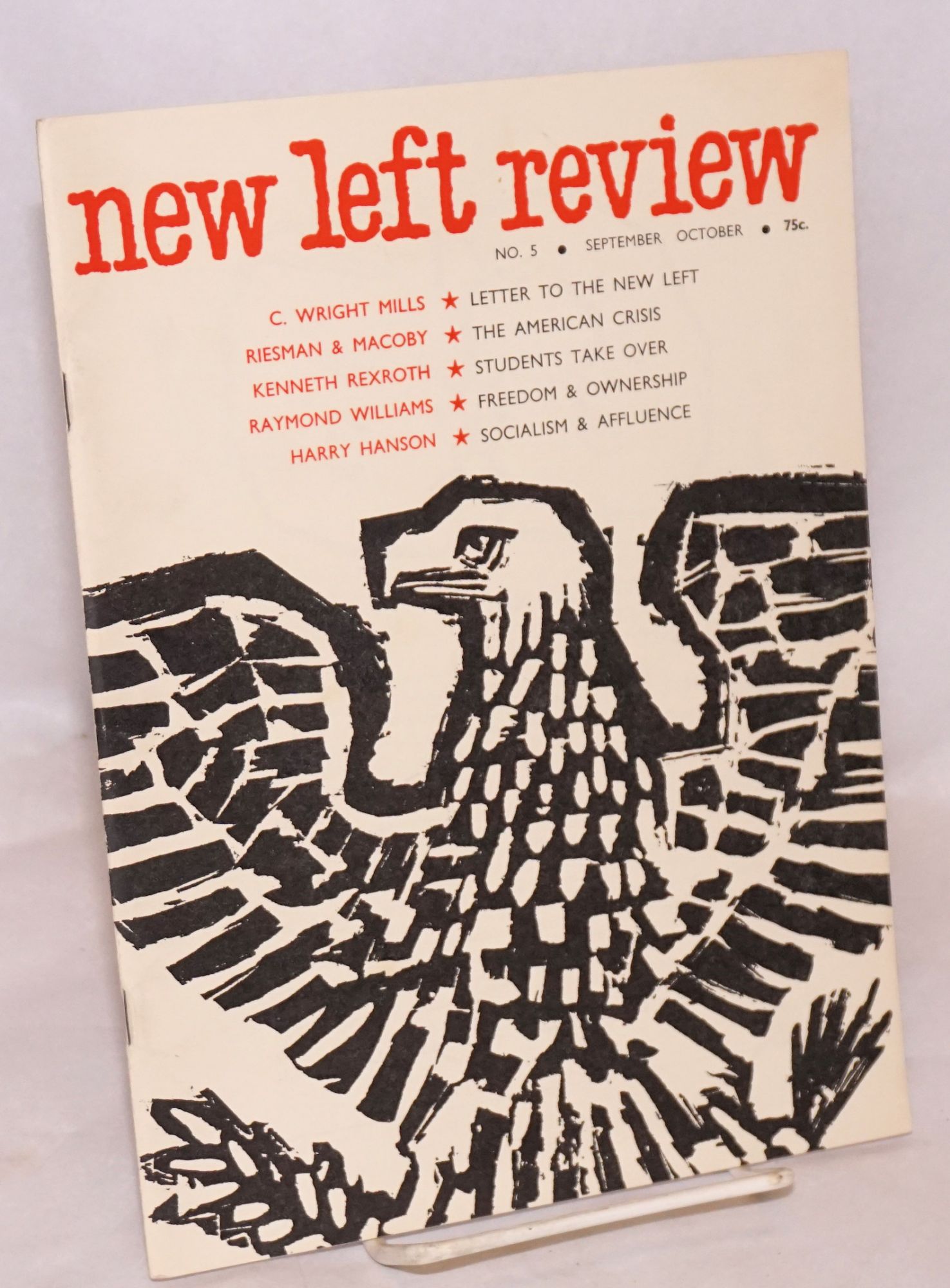
letter

C.L.R. James, William Dubois, Frantz Fanon, and the “Curse” of the Western Civilization

Moving further away from the sacred pillars and sites of traditional Marxism (a factory, economic growth, the working class, and the Soviet Union), such activist intellectuals as Hall became known as the New Left.  From the economic critique of capitalism, which did not make sense at the time when this very capitalism improved workers’ living standards, the New Left gradually began to take on the Western civilization in general, bourgeois life-styles and culture, embracing the Third World and non-Western cultures.  The slowdown of class battles and sluggish radical socialist activism in the West contrasted with the great awakening in the Third World, where emerging national liberation movements challenged European colonialism. Cast against the “dormant” and “corrupted” Western working-class, the Third World appeared to the New Left as the potential hub revolutionary activism.
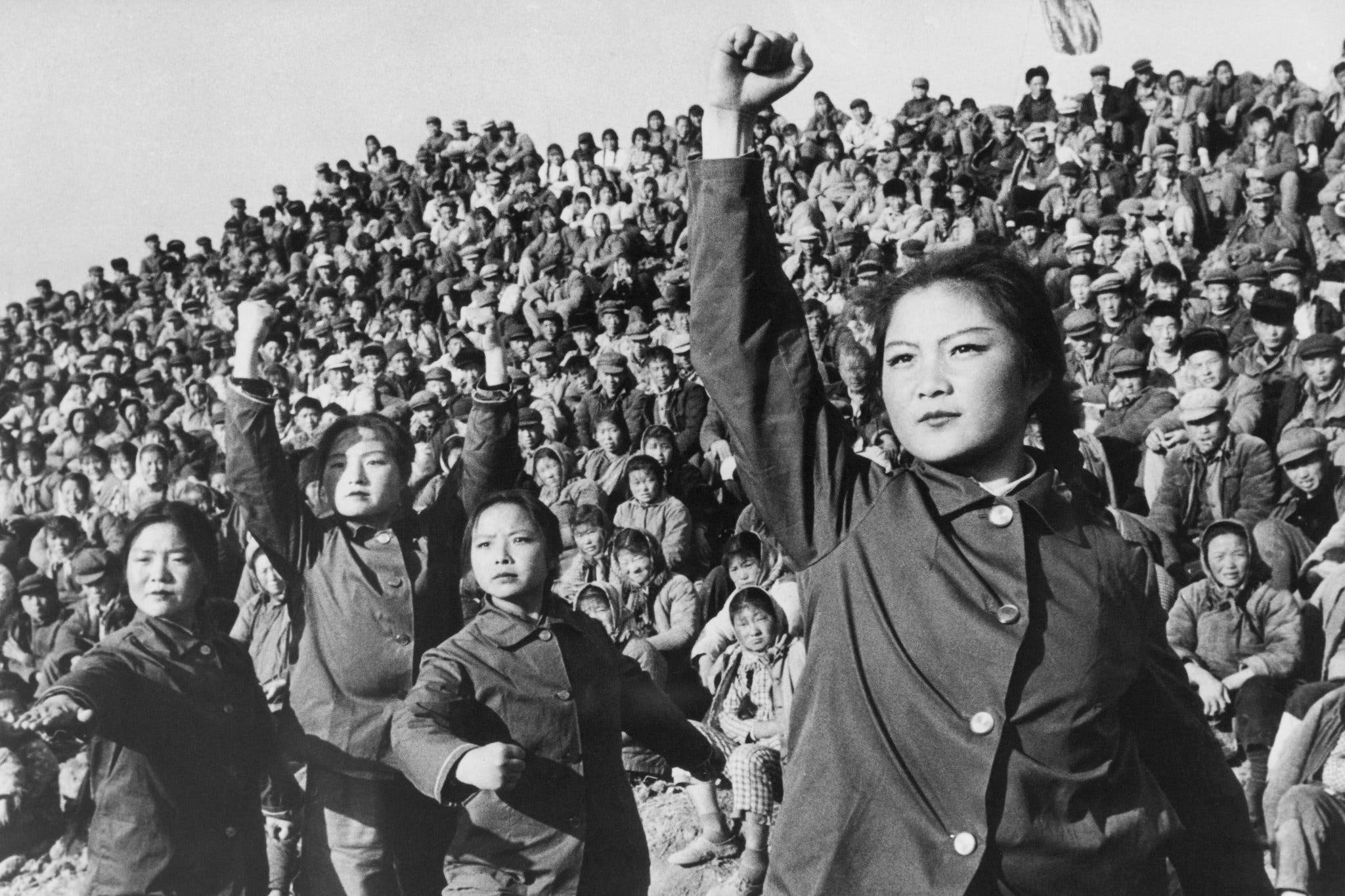
fanatic chnse youth

It was increasingly clear that the Europe-centered old left hardly had anything to offer in the new socio-political circumstances. Hall remembered, “I was troubled by the failure of Orthodox Marxism to deal adequately with either ‘Third World’ issues of race and ethnicity, and questions of racism, or with literature and culture.” Another Caribbean expat and his French counterpart Aime Cesaire, a budding New Left intellectual from Martinique, declared his resignation from the French Communist Party, rebuking Eurocentric paternalism of the communists.

To be exact, there were already several major writers on the left who had inaugurated this drift away from the West toward the Third World, culture, and identity matters.  In fact, Vladimir Lenin, one of the giants of the radical left, had opened a space for the cultural rereading of Marxism by endorsing the anti-colonial resistance as the European proletariat’s ally and pointing to the commonality of interests between the European “wretched of the earth” and the colonized people.  Moreover, feeling the need to placate various local nationalisms in the emerging Soviet Union and to win allies in the non-Western colonial periphery, Lenin drew a distinction between “bad” regressive nationalism of the bourgeois West and “good” progressive nationalism of the colonial periphery. Without wishing it, Lenin made a crack in classical Marxism that had taught that colonialism had been progressive because it had brought industry to the undeveloped parts of the world.  Earlier, it was assumed that boosting the expansion of capitalism sped up the formation of the proletariat – capitalism’s gravedigger – and the movement toward the radiant communist future.

Among the influential early voices that triggered the identitarian revision of Marxism was W. E. B. Dubois (1868-1963), an African American social scholar, nationalist, Soviet fellow-traveler, and a convert to communism at the end of his life.  The other one was C.L. R. James (1901-1989), an independent Marxist novelist and theoretician from a British Caribbean colony of Trinidad. The third was Frantz Fanon (1925-1961), yet another Caribbean-born black intellectual from the French-owned island of Martinique, who was instrumental in merging Marxism, Pan-Africanism, and Third World nationalism.  Since the 1960s, the New Left and their successors among the cultural left have been holding all three in a high esteem.  In fact, in academia there grew entire publication industry around those personalities.

Early in his career, along with socialism, Dubois absorbed then popular race and “folk soul” ideas when he was studying in Germany between 1892-1894, applying them to his budding Black nationalism.  In his 1897 “The Conservation of Races,” Dubois called for the cultural unity of the “Black race” to replicate the efforts of the Teutons, Slavs, Anglo-Saxons, Latins, Semites, Hindu, and Mongolians who were busy, as he explained, consolidating their own civilizations.  Dubois viewed the American blacks as the enlightened vanguard of the black race that was to perform that job of consolidation.  He envisioned such racial solidarity as a counterweight to the contemporary domination of the “whiteness of the Teutonic” and their soulless civilization that was fixated on individualism and economic enterprise. Very much like his racially-conscious Germanic contemporaries, who lamented the degradation of the Aryan soul by corrupt forces of modern industry and commerce, Dubois generalized about the bourgeois civilization of the West corrupting Africa – the primal and vital center of the black race.

In his Souls of Black Folk (1903) and Negro (1915), he spoke in favor of segregating “black culture” from “white civilization” and speculated about an abstract black soul, race, and culture devoid of any local and linguistic differences.  In fact, later in 1934, Dubois severed his connections with the National Association for the Advancement of Colored People that was working to eliminate racial segregation in the United States because the organization’s activities contradicted the racial utopia he contemplated. Interestingly, in his novel Dark Princess (1928), Dubois portrayed the Atlas Shrugged-type society of non-white expatriates who formed the Great Council of the Darker Peoples.  Represented by “dark” superheroes, that society was planning to take over and engineer a happy future on the planet after white institutions collapsed.

Dubois relied on European romantic memes of the noble savage (collectivist, generous, wholesome, happy, simple), which he applied to all blacks as a race.  Also, drawing on his parochial experience as a black American, the writer singled out race as the central factor in the world history, and slavery as the experience that defined not only the past history but also conditioned future behavior of his “tribe.”  Dubois assumed that the sheer presence of “black blood” in an American automatically made such a person a carrier of the “soul experience” of being a slave; incidentally, none of Dubois ancestors had been in bondage.  Dubois welcomed the 1917 Bolshevik Revolution that he considered as a scorching wind that was to cleanse the modern world, washing away bourgeois civilization.  Since the Soviet Union crusaded against the West, he automatically viewed that country as an ally: the enemy of my enemy is my friend.  By 1935, Dubois came to conclusion that the Soviets would destroy the “rotten” Western civilization and help to construct a new non-Western cultural order.  The writer praised Stalin as a great liberator, and the 1956 revelations of the Soviet crimes did not shatter this conviction.   Reflecting contemporary political preferences of Third World anti-colonial leaders and spokespeople, he called the Soviet Union and China the shining models of the future.  His conversion to communism and subsequent move to Ghana in 1961, where he became a senior advisor to Kwame Nkrumah, the head of the country who claimed building socialism, was symbolic. Here on the African soil, his black nationalism, which was saturated with romantic memes of European primitivism, met Marxian socialism. There is no need to stress that Dubois writings has been a must read in many humanities and social science courses across Western academia since at least the 1970s.

The evolution of C.L.R James, who became another must reference for Western social scholarship, moved in a reverse direction, although the result was essentially the same.  From early on, in the 1930s and the 1940s, he prophesized his loyalty to Marxism. Yet, gradually, James began to play down class exploitation, amplifying the significance of racial and colonial oppression.  It was natural because these issues were personally more relevant to him than far-away class battles in distant and alien Europe.  James at first embraced anti-Stalinist Trotskyite version of communism and its prophecy of the world revolution.  Yet, later, driven by anti-colonial concerns and by a desire to identify a new reliable revolutionary force to act as a surrogate proletariat, he shifted his attention to the Third World.

clrjames

Essentially, both Dubois and James were refurbishing the classic Eurocentric prophecy of Marxism along the Third World lines. Marx had welcomed colonialism as a progressive system that was sucking underdeveloped areas into the global commodity economy, pushing the world closer to capitalism and creating an economic basis for a leap into the radiant communist future.  For him, slavery was an archaic mode of production that, at the dawn of human history, had boosted economic development and then perished, giving rise to more progressive stages of human evolution such as feudalism and then capitalism. According to the founder, slavery survived in some backward areas of the globe (US South, Latin America, Africa) that did not catch up yet with the industrial West.  In contrast, James and Dubois argued that slavery was not a vestige of the bygone socio-economic formation, but, more than the exploitation of European proletariat, was an essential part of modern capitalism.

They insisted that slavery and exploitation of colonies were the vital resource that made possible the rise of capitalism.  Moreover, they became convinced that the entire Western prosperity was accomplished at the expense of non-Western people.  Again, in contrast to Marx who viewed capitalism as a progressive stage on the way to communism, James and Dubois began to argue that capitalism was not a progressive but a regressive system – a European cultural institution imposed on the rest of the world for the purposes of exploitation.  It is notable that, when singling out two pivotal books that had affected his worldview, besides Leon Trotsky’s History of the Russian Revolution (1932) James mentioned The Decline of the West (1918) by Oswald Spengler. The latter text, which was saturated with a deep pessimism, prophesized the decline of the Western civilization.  Incidentally, Spengler too greatly affected Dubois who began taking for granted that the West was in perpetual decline.  Both found in the German philosopher’s text what they were looking for: a radical criticism of the entire Western civilization.

The crucial role in shifting Marxism toward race and identity issues belonged to Fanon, a popular anticolonial writer whose landmark text The Wretched of the Earth (1961) became a book of choice for the whole generation of the Third World national liberation activists in the 1960s-1970s.  Fanon’s bashing of the West also won him numerous disciples in the countercultural circles and among the New Left in Europe and the United States.  As Kalter reminds to us, since the 1980s, assimilated by the academic left (post-colonial studies and critical race theory) into educational system and media, his writings later became an important intellectual fountainhead for identity studies and identity politics.

A psychotherapist by profession, Fanon was a French-speaking intellectual who took part in the Second World War and then in the Algerian War of independence (1954-1962).  In his writings, he focused not on economic liberation but on the cultural and psychological decolonization of the Third World.  Drawing on Marxist class clichés, Fanon revised them along racial lines: “You are rich because you are white, you are white because you are rich.” Fanon insisted that the colonial periphery became the mentally  imperiled by Western values, which natives needed to shed off because these were “white values”: “Come, comrades, the European game is finally over, we must look for something else. Let is not imitate Europe. Let us endeavor to invent a man in full, something which Europe has been incapable of achieving.” In his view, Europe was deadly sick and the keys to the  liberation of humanity were in the hands of the Third World that was destined to shape the New Man; incidentally, the latter meme also originated from Marxism.  Fanon’s friend Jean-Paul Sartre, a famous French philosopher and Soviet apologist, felt happy that “the most ardent poets of negritude are at the same time militant Marxists.” Yet, repeating the mantra of the old left, Sartre said that the mingling race with that class was “not a conclusion” but a transitional stop on the way to a greater color-blind commonwealth.  When Fanon read these Sartre’s words, he felt utterly offended as if he was robbed of his identity.  Contrary to what his philosopher friend believed, for Fanon, “racialized Marxism” was the conclusion.
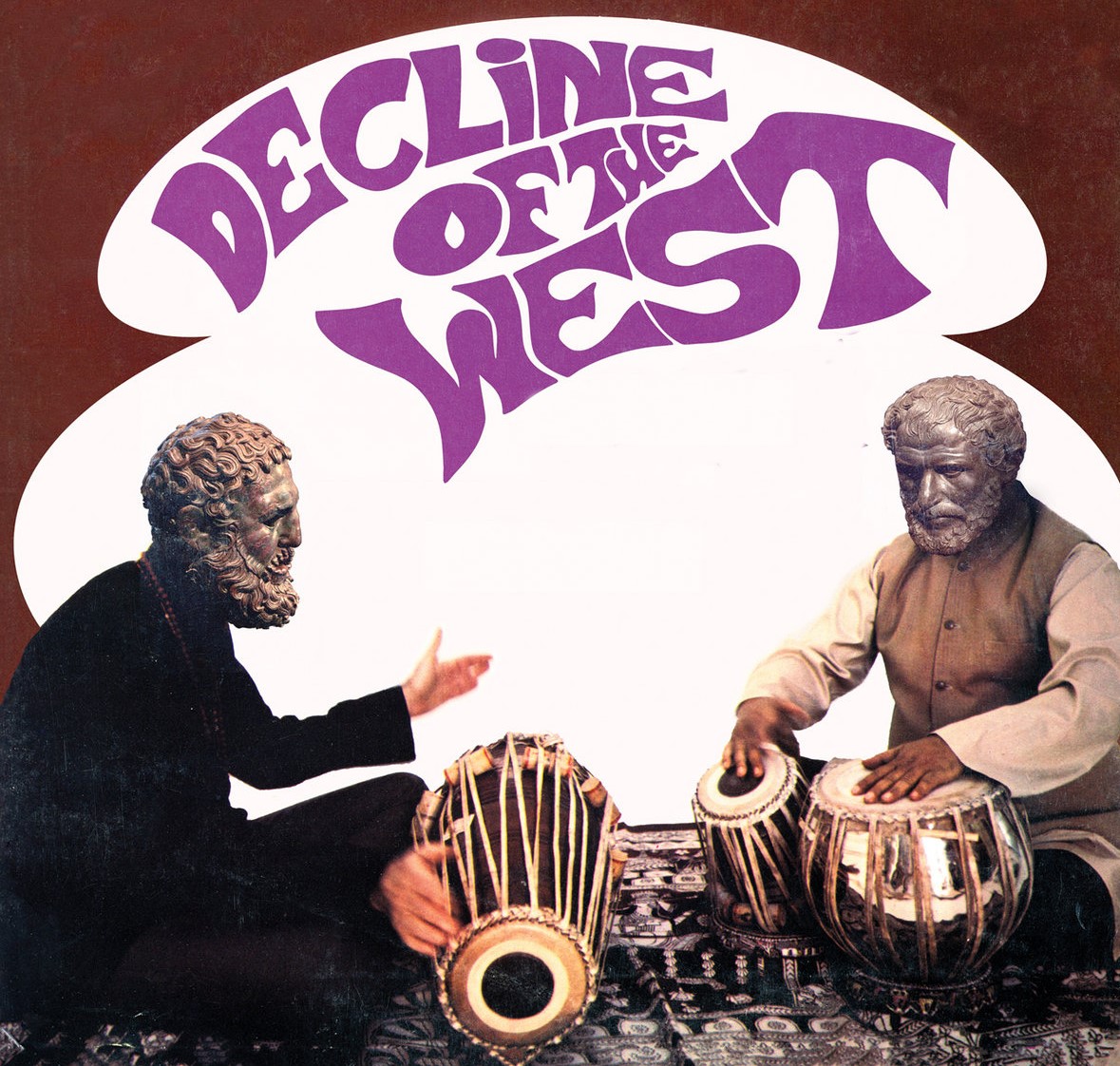
declne of the west

Traumatized by the brutalities of the French he witnessed during the Algerian liberation war, Fanon insisted that nothing connected the colonizers and the colonized except racist violence. Ignoring the multitude of social, economic, and cultural relations in the contemporary colonial and post-colonial periphery, he argued that “the colonial world is a Manichean world.”  In his irreconcilable “black and white” world, oppressed victims held the ultimate truth because of their sheer status of being colonized people.  To Fanon, morality and truth were relative.  They depended on how well these two things served a liberation cause.  This included lying and committing violence, provided these vices served a good cause.  Stressing that truth was a matter of political expediency, he wrote, “Truth is that which hurries on the break-up of the colonialist regime; it is that which promotes the emergence of the nation; it is all that protects natives, and ruins foreigners.  In this colonialist context there is not truthful behavior: and the good is quite simply that which is evil to ‘them’.”

28976

To overcome their oppressive state, the colonized had to take the place of their masters by resorting to a redemptive violence.  The natives, who wasted their energy in mutual tribal conflicts and indulged into ecstatic tribal dances, were to channel their energy into the anti-colonial violence against whites. In fact, violence occupied an important place in the entire Fanon’s liberation philosophy.  In The Wretched of the Earth (1961), he romanticized violence and attributed to it pedagogical value: “Violence alone, violence committed by the people, violence organized and educated by its leaders, makes it possible for the masses to understand social truths and gives the key to them.””  Fanon viewed violence not only as a tool of liberation and education but also as a powerful vehicle of a nation-building and racial consolidation.  In the process of their struggle, oppressed natives were expected to nourish the sense of a unified collective: “Individualism is the first to disappear,” and “the community triumphs.”

Using Marxist class categories and simultaneously filling them with a new content, Fanon argued that in undeveloped colonial countries the only revolutionary class was peasants. These rural masses carried armed struggle from the countryside into cities.  This meant that the class that was to liberate the colonial periphery and the rest of humankind from capitalism was not industrial workers (proletarians) but the Third World peasantry.  With such a view, Fanon naturally came to idealize Third World peasant collectives as the cradle of the ideal human commonwealth.  Invoking the romantic meme of European primitivism, he contrasted “evil” Western individualism with the “noble” African culture of collectivism represented by village councils, people’s committees.  According to Fanon, the anti-colonial struggle was to rekindle and strengthen those collectives.  Moreover, a solidarity nourished during an anti-colonial war was to heal a corrupt indigenous bourgeoise – the creature of the West. Through its involvement into the common anti-colonial movement, this bourgeoise would reunite itself with its indigenous soil, merging with common into a united Gemeinschaft-type people’s community.

noble savage

Out of anti-colonial sentiments of such Third World intellectuals as Fanon and their colleagues from Western countries, there grew natural animosity to the West, which was responsible for colonialism, and the idealization of non-Western societies as the holders of a revolutionary potential and better forms of life. The fact that in the 1950s and the 1960s, the West was involved into two bloody colonial wars (France in Algeria, and the United States in Vietnam) amplified those sentiments.  As a result, since the 1960s, for the left, the major existential enemy was shifting from capitalism as an economic system to Western civilization that was associated with colonialism, consumerism, and moral decay.  In 1966, writer Susan Sontag conveyed well that negative attitude, which was becoming part of the intellectual mainstream, by saying that the white West was the “cancer of human history.”

cancer


There was now much talk on the left about humans being enslaved and alienated by the technology-driven individualistic civilization of the West and less talk about an economic growth, progress, and capitalism robbing workers of a surplus value.  In fact, economic progress became a curse phrase.  The idealization of the non-Western, tribal, and the primitive became a natural intellectual offshoot of such ideological pursuits.  Reflecting on the cultural turn that was launched in the 1960s, Marxist sociologist Harold Bershady stressed that this trend carried obvious reactionary notions: “It was a kind of left-wing conservatism.” Gradually ditching the failed argument of the old left, who had insisted that capitalism had been profoundly inefficient and could not provide material affluence, the New Left were switching to the moral and cultural critique of that very affluence that now was declared a major vice.  Sontag again spelled out this message in her flamboyant style: “America is a cancerous society with a runaway rate of productivity which inundates the country with increasingly unnecessary commodities”; in an ironic twist, such utterances turned out to be Freudian slips: the writer died from cancer.

Ayn Rand, a rising countercultural icon on the right who, in contrast to the Marxist ultimate proletarian “savior,” invented her own version of a “noble savage” in a form of heroic capitalist “savior” entrepreneur, responded to those sentiments with a loaded sarcasm: “The old-line Marxists used to claim that a single modern factory could produce enough shoes to provide for the whole population of the world and that nothing but capitalism prevented it. When they discovered the facts of reality involved, they declared that going barefoot is superior to wearing shoes.” Among others, unnecessary commodities included TV sets, comics magazines, soap operas, the variety of household items. Incidentally, in the 1970s and the 1980s, such romantic neo-primitivist attitudes helped the left to find a common ground with environmentalists who began to preach an apocalyptic vision of the global collapse of natural habitat if not arrested by massive government regulations.

Conclusions

The frustration with the economic growth and the incorporation of the non-Western ones and radical environmentalism into the socialist agenda was a natural offshoot of the “going primitive” trend that looked beyond Europe and North America for major revolutionary hubs.  Exorcising the proletarian messiah class from the popular Marxian socialism and moving toward identity and the idealization of non-Western “others” was not a straight-forward process. In the 1960s-1970s, among the New Left, communist dissidents, and Trotskyite fossils, there was still a desire lingering on to somehow continue the revolutionary elan of the proletariat.  At the same time, among those elements one could detect the growing trend toward romancing the working-class culture and its “organic” anti-bourgeois ways.   The Birmingham School of Cultural Studies and dissenting communist historians such as E. P. Thompson, who aspired to cleanse Marxist theory from economic determinism and who elevated the proletarian culture and consciousness, prepared a fertile intellectual ground for the later cultural turn in the left thought collective. 

Before the current left completely ditched the working class from the pedestal and developed a an “acute identity syndrome,” the New Left segment acted as an intellectual bridge between classical Marxian socialists and the current identitarian left.  In the 1960s and the 1970s, the New Left gradually transferred the metaphysical characteristics ascribed to the proletariat to the non-Western “others,” domestic people of “color,” chronically unemployed, social deviants, women, and gays. Communist bohemian historian Hobsbawm with his bookish “social bandits” and his attempts to probe Latin American peasants for their revolutionary potential is an excellent snapshot of how that process was unfolding.

Just like the proletariat of the old, the new victim groups were thought to become the oppressed redeemers – the new “noble savages” of the left.  On the one hand, such revision of traditional Marxism gave an opportunity to the New Left to disentangle themselves from the Old Left.  Yet, on the other hand, this very revisionism allowed them to continue the familiar Marxist tradition in the new intellectual garb. The new groups designated to the role of the oppressed ones were lumped together in an abstract category of the poor and disadvantaged.  In the same manner, old Marxism generalized about the proletariat as a homogenous impoverished class, downplaying ethnic, religious, and economic differences within this group.

In the 1960s, the most passionate New Left revisionists who became hooked on the Mills’ message of bashing the “Victorian Marxism” cast the newly found surrogates into authentic, uncorrupt and holistic people, the caretakers of the egalitarian ethics and natural goodness. Thus, in a religious-like manner, New Left activist Casey Hayden, the spouse of famous Tom Hayden, described her feelings about the new “chosen ones”: “We believed that the last should be the first, and not only should be the first, but in fact were first in our value system. They were first because they were redeemed already, purified by their suffering, and they could therefore take the lead in the redemption of us all.” Another New Left writer characteristically titled his book about “unspoiled” and “authentic” rural blacks in Mississippi A Prophetic Minority (1966).

Those conservative and libertarian authors who are fixated on the Frankfurt School have failed to pinpoint the variety of intellectual fountainheads that contributed to the cultural turn.  So have those in the current left mainstream who downplay their genetic links with Marxian socialism. Besides the Frankfurt School, there were other essential intellectual sources on which the left heavily drew when refurbishing their political religion in the 1960s and the 1970s.  This essay has highlighted the role of the British “cultural Marxists” as well as their intellectual predecessors and contemporaries who “racialized” Marxism.  Moreover, because of the worldwide hegemony of English language, the writings of C.L.R. James and William Dubois, popular translations of Frantz Fanon, and British Cultural Studies along with New Left Review played more important role in fomenting the cultural turn than the often-spoken Frankfurt School.  In fact, it was NLR that popularized “frankfurters’” writings that regular educated readers had a hard time to digest. 

The names and schools profiled in this essay do not exhaust other potent sources of the cultural left, which still await their comprehensive study.  For example, a future researcher cannot bypass secularized Protestantism of northern Europe and North America and its links with the current woke culture.  It is impossible to reduce the virulent and aggressive moralism of the current secular social justice warriors, the Unitarian Universalist movement, and several other progressive Protestant denominations in the United States to the intellectual evolution of Marxian socialism in the direction of identity matters.  Although many of the above-mentioned elements have been feeding on the New Left neo-Marxist writings, they obviously drew too on the secularized Puritan tradition that, according to famous H. L. Mencken, had been always haunted by the “fear that someone, somewhere, may be happy.”  In Multiculturalism and the Politics of Guilt: Towards a Secular Theocracy (1992), Paul Gottfried briefly outlined how via the social gospel tradition, radical Puritanism of some Protestant denominations gradually mutated into virulent cultural moralism and how in the current “theology” of the left, the old Christian concept of sin and salvation became replaced with sensitivity training and social therapy sessions. Most important, we need to keep in mind that British Cultural Studies, dissenting Marxist intellectuals who idealized working class anti-bourgeois culture, Mills and the American New Left, the Frankfurt School, and the latter-day social justice “evangelicals” cross-fertilized each other, spearheading what later produced the identitarian woke tradition, which currently represents the progressive mainstream.
Elinor Ostrom debunked

I recently picked up “Governing the Commons” by Elinor Ostrom from the library. The main message from the first chapter to me was that individuals can overcome the dilemma of overusing common pool resources through institutionalized individual cooperation. Ironically, the condition of the relatively new book (which is from a public library btw) tells me otherwise. These are not my notes by the way.

IMG_5220 (1)

That’s it. That’s the blogpost. 😉

A PPE pandemic reading list

I haven’t written for a while – other duties get in the way – but I’d like to suggest this reading list in Philosophy, Politics, and Economics for the present time of crisis and perplexity. The main reason is that everyone seems to be an expert in Economics, Epidemiology, and Political Philosophy these days, assuming that from “facts” we can easily derive “values” and answer the question, “what is to be done?” I think this is at best a naïve attitude and at worst the same rationalistic hubris we experience everytime a political issue is simplified and reduced to a matter of “science”. Yes, there are facts and they shouldn’t be ignored, but it’s not easy to decide what is to be done, morally and politically, in light of those facts.

The first item on the list is Leviathan by Thomas Hobbes. A classic, and a reminder that people choose all the time to sacrifice some degree of liberty in the altar of survival (or a chance to survive), but also a reminder that Leviathan may turn from friend to foe, from protector to persecutor – and there is very little we can do about it. The second item is John Locke’s Second Treatise of Government, which then explores this topic in light of the fact that civil government shouldn’t have absolute power. It makes an attempt to show us how that power can, or should, be limited within a certain sphere of responsibility. Though it’s still there to protect us.

In this time of pandemic, people feel tempted to panic. People and politicians are calling for dramatic measures, and one reason is that the use of government coercion – which, according to Locke, ought to be limited – might be necessary to force people to cooperate, for example, by staying home. This is a proposed solution to the dilemmas of collective action posed by the problem that some may “free-ride” on the rest, and, as a result, the disease will keep spreading, frustrating any attempt to slow it down. Against dramatic, desperate and, perhaps, arrogant, use of political power, and in favor of prudence and wisdom, Edmund Burke’s collection of writings from the period of the French Revolution can be a beacon of light. On the other hand, explaining the dilemmas of collective action and suggesting ways of solving them, Mancur Olson offers an insightful look at incentives and group behavior in The Logic of Collective Action.

However, the idea that government coercion is the only solution to dilemmas of collective action (such as imposing a quarantine, for example) doesn’t hold water. In fact, other economists follow Olson in saying the problem is real and challenges a strict individualist way of thinking, but, adding to Olson’s point, they also acknowledge the role of private action and sanctions in fostering cooperation. Elinor Ostrom’s Governing the Commons is a wonderful study that opens up a number of possibilities for private enforcing of collective action to preserve and promote the frugal allocation of common goods. This can be complemented by The Quest for Community, an overlooked work by sociologist Robert Nisbet, where it becomes clear that, between individuals, the state, and the market, there’s room for other associations and communities that strengthen civil society – particularly in this challenging time. Nisbet’s lesson invites liberty-loving people to reflect on whether a hyper-individualistic view of the world ends up pitting helpess individuals against Leviathan instead of offering the buffer zone of community in between. This is something Alexis de Tocqueville discussed in the 19th century.

And just for the sake of dealing with the issue that “is” doesn’t easily lead to “ought”, and that science might have facts and an explanation for them, but does not easily conduce to a proper discussion on values policy, I must finish this PPE pandemic reading list with F. A. Hayek’s The Constitution of Liberty. On Chapter 4, for example, Hayek introduces a constrast between “rationalist liberalism” and “anti-rationalist liberalism”. Rationalist liberals assume too easily that knowledge of the facts on the ground will give them what they need to re-design a society governed by reason. Hayek warns us against this technocratic assumption and offers a defence of “anti-rationalist liberalism”. Anti-rationalist liberals understand the importance of spontaneous order and of constraining power (even at a time of crisis) while prudently balancing the values of liberty and safety in light of past experience and tradition.


Three Additional readings:

Buzan, Waever and De Wilde, Security: A New Framework for Analysis (1997). In a liberal democracy, the state steps in suspending some civil liberties only if it can persuade citizens that there’s a threat that justifies it. This book offers a framework to interpret how such threats are constructed in official and non-official discourse, and to what extent this construction of a threat can be effective.

Robert Higgs, Crisis and Leviathan (2013). 25th anniversary edition. Looks at US history and how government employed crises to its advantage and the advantage of the ruling elites. In particular, security and economy related issues are dealt with.

Sanford Ikeda, Dynamics of the Mixed Economy (2002). Shows that a time of crisis might be a time for further interventionism in the economy, as Higgs (see above) suggests, but might also be a time for disintervention, as seems to be the case with part of the agenda today (FDA deregulation, etc.) This is based on Ludwig von Mises’ view that interventionist economies are not very stable and are always swinging as a pendulum between socialism and capitalism.


13 Books for 2020 – What A Year!

2020 is turning into quite the publishing year.

Perhaps every year is like this and I just haven’t been paying attention before. Now, as I actively scan publisher sites and newsletters for upcoming books, there seems to be an abundance of super-interesting new stuff: how is anybody – even someone like me who does this for a living – supposed to keep up?

#1: The year began at full (or stagnating…?) speed with University of Houston professor Dietrich Vollrath‘s Fully Grown: Why a Stagnant Economy is a Sign of Success, With praise by Tyler Cowen and reviews in The Economist and the Wall Street Journaland actually a lot of good discussions on Twitter – I’m sad that I haven’t taken time to read it. Later, perhaps, on the off-chance that nothing else on this incredible lists comes in the way.

#2: Next up was Diane Coyle‘s Markets, State, and People. Coyle, the endlessly interesting public intellectual/economist and newly(-ish) appointed Professor of Public Policy at Cambridge, is someone we all should read: she manages to be controversial and still balanced, provocative but still interesting. This book, however, seems to be in line with all the other “Third Way” books of last year: Acemoglu and Robinson’s The Narrow Corridor; Raghuram Rajan’s The Third Pillar; Branko Milanovic’s Capitalism, Alone. Crowded field. As I haven’t even gotten around to her previous book on GDP yet, I imagine I’ll read that one first whenever I carve out some time for Coyle.

The curse of modernity is quickly adding up.

#3: Changing gears somewhat at least in terms of topics I have started reading Charles Murray‘s Human Diversity: The Biology of Gender, Race, and Class and it’s exactly as provocative as you might think. Delivered, however, with the seriousness of scientific investigation and a massive chip on his shoulder. Still, exactly the kind of antidote to madness that fuels a lot of my priors. I’ll write up a comment or two whenever I finish this 528-page tome.

#4: In a similar vein is the Dutch writer and historian Rutger Bregman‘s Humankind: a Hopeful History, scheduled to be released in June. As Bregman isn’t somebody that I usually agree with, I’m very excited to read this take of his, which is hopefully a mix of Paul Bloom’s End of Empathy, Ruth DeFries’ The Big Ratchet and Paul Seabright’s The Company of StrangersSort of like Yuval Harari’s Sapiens but better (and no, I’m not on Team Harari despite this excellent long-read in The New Yorker).

#5: Going back a little bit to what I think is chronologically the next book to be released (on Tuesday March 10 in the U.S., but not until April in the U.K.) is Robert Bryce’s A Question of Power: Electricity and the Wealth of NationsHaving recently written a piece on electricity generation and being into the weeds about climate change and emissions, I’m very curious about this take on electricity as a critical source for our prosperity. I hope it reads a little like an improved version of Zubrin’s best chapters in Merchants of Despair.

#6: March is also the month for Angus Deaton and Anne Case‘s Deaths of Despair and the Future of Capitalism (Amazon says it’s already out in the U.K.) Their hugely successful and highly relevant pet project for the last few years, Deaton and Case’s case(!) for how rising morbidity rates indicate a collapse of the fabric of society is a pretty standard one by now: globalization, economic inequality, the hollowing-out of tight-knit communities and the various forces that may have fueled this.

The reviews are already popping up left and right (WSJ, Financial Times) and their session was the most exciting and most talked-about at the ASSA meeting in San Diego. As I understand it, the latest findings is that American life expectancy that pesky ever-increasing number that fell in recent years, in no small part due to overdoses and opioids has recovered and is now again on the up-tick. Maybe Deaton and Case’s book will be one for an odd historic event rather than foreshadowing “The Future of Capitalism” (also, what’s up with shoving ‘Future of Capitalism’ into your titles?!).

#7: In a similar topic, Robert Putnam yes, the Harvard professor famous for Bowling Alone and the idea of social capital is back with another sweeping analysis of what’s gone wrong with American society. The Upswing: How America Came Together a Century Ago and How We Can Do It Again, coming out in June, is bound to make a lot of waves and receive a lot of attention by social commentators.

#8: Officially published just yesterday is John Kay and former Bank of England Governor Mervyn King‘s Radical Uncertainty: Decision-Making for an Unknowable Future. Admittedly, this is the book I’m least excited about on this list. Reviewing King’s 2016 End of Alchemy where King discussed his experiences of the financial crisis and the global banking system for the Financial Times, John Kay discussed exactly that: the title? “The Enduring Certainty of Radical Uncertainty.” Somebody please press the snooze button. Paul Krugman’s 4000 word review of End of Alchemy ought to be enough; I’d be surprised if Kay and King brings something new to the table in thus poorly-titled release (though, of course the fringe already loves it).

The Really Good Stuff

While the above eight titles are surely worth at least some of your time, the next five are worth all of it.

#9: I’ll begin with my two biggest hypes: Matt Ridley‘s How Innovation Works: And Why It Flourishes in Freedom, coming out May 14th in the U.K. and May 19th in the U.S. The author of The Rational Optimist and The Evolution of Everything is back with another 400-page rundown of a deep-seated and hyper-relevant topic: how do societies innovate and progress? What conditions assist it, and which obstacles prevent it? 

I expect a lot of spontaneous order-type arguments, debunked Great Man fallacies, and some Mariana Mazzucato take-downs.

#10: The second hype, William Quinn and John Turner‘s Book and Bust: A Global History of Financial BubblesSince John first told me about this book over a year-and-a-half ago, I’ve been super excited – I’m a big fan of his work and I’m looking forward to receiving my review copy in the next couple of weeks. Publication date: August.

#11: For somebody who writes about bubbles and financial markets more than most people think healthy, I’m gonna get a warm-up in MIT professor Thomas Levenson‘s Money for Nothing: The South Sea Bubble & The Invention of Modern CapitalismWhat’s with all these books on historical financial bubbles? Yes, you’re right: 2020 marks the three-hundred year anniversary of the South Sea Bubble, that iconic period of John Law in France and the similar government funding scheme in England will surely receive a lot of attention this year.

#12: Some environmental stuff at last: Bjørn Lomborg, the outspoken author and voice of reason in the climate change space announced that his False Alarm: How Climate CHange Panic Costs Us Trillions, Hurts The Poor, and Fails To Fix the Planet will be published in June this year! While possibly the least boring book on this list, the title receives lowest possible marks. What overworked publisher decided that this page-long subtitle was a good idea?!

#13: Also, Alex Epstein of the Centre for Industrial Progress and host of Power Hour (one of my all-time favorite podcasts) has been working on an update to his hugely popular The Moral Case for Fossil Fuels. As far as I understand, we’re to receive an updated and revised version in August the Moral Case for Fossil Fuels 2.0!


So. The next six months have at least thirteen pretty interesting books coming up. I imagine there are a bunch more for the rest of the year and a few I have completely overlooked.

Also, after this burst of links, Amazon should probably offer Notes On Liberty an affiliate program.

In sum: you can see my fields of interests overlapping here: (1) financial history and financial markets; (2) environment, climate change, and its solutions; (3) Big Picture society stories, preferably by interesting or quantitatively savvy authors. Not enough on the fourth big interest of mine: (4) money and monetary economics – particularly in historical contexts. Perhaps not, as David Birch’s Before Babylon, Beyond Bitcoin is on my desk, and I’m currently re-reading William Goetzmann’s Money Changes Everything both first released in 2017.

Also: the absence or underrepresentation of women (or ethnic minorities or any other trait you care a lot about) might disturb you: 2 out of 17 authors women (4 out of 27 authors mentioned) Needless to say, it must be because I’m sexist.

Post-script: Ha! As I just heard about Stephanie Kelton‘s upcoming book The Deficit Myth: Modern Monetary Theory and the Birth of the People’s Economy, I’m gonna quickly add it to the list and satisfy both of my qualms above: not enough women (now: 3/18 authors!), and not enough monetary economics. Splendid!

Happy reading, everyone!

The Least Empathic Lot

On standard tests of empathy, libertarians score very low. Yet, the world’s “well-known libertarian bias” coupled with many people’s unwarranted pessimism makes us seem like starry-eyed optimists (“how could you possibly believe things will just work themselves out?!”).

Under the Moral Foundations framework developed and popularized by Jonathan Haidt, he and his colleagues analyzed thousands of responses through their YourMorals.org tool. Mostly focused on what distinguishes liberals from conservatives, there are enough self-reported libertarians answering that the questionnaire to draw meaningful conclusions. The results, as presented in TED-talks, podcast interviews and Haidt’s book The Righteous Mind: Why Good People Are Divided by Politics and Religion contains a whole lot of interesting stuff.

First, some Moral Foundations basics: self-reported liberals attach almost all their moral value to two major categories – “fairness” and “care/harm.” Some examples include striving for equal (“fair”) outcomes and concern for those in need. No surprises there.

Conservatives, on the other hand, draw fairly evenly on all five of Haidt’s different moralities, markedly placing weight on the other three foundations as well – Authority (respect tradition and your superiors), Loyalty (stand with your group, family or nation) and Sanctity (revulsion towards disgusting things); liberals largely shun these three, which explains why the major political ideologies in America usually talk past one another.

Interestingly enough, In The Righteous Mind, Haidt discusses experiments where liberals and conservatives were asked to answer the questionnaire as the other would have. Conservatives and moderate liberals could represent the case of the other fairly well, whereas those self-identifying as “very liberal” were the least accurate. Indeed, the

biggest errors in the whole study came when liberals answered the Care and Fairness questions while pretending to be conservatives.

Within the Moral Foundations framework, this makes perfect sense. Conservatives have, in a sense, a wider array of moral senses to draw from – pretending to be liberal merely means downplaying some senses and exaggerating others. For progressives who usually lack any conception of the other values, it’s hard to just invent them:

if your moral matrix encompasses nothing more than Care and Fairness, then to imagine a political opponent is to reverse one’s own position for those foundations – that Conservatives act primarily on other frequencies, on other foundations, wouldn’t even occur to them.

Libertarians, always the odd one out, look like conservatives on the traits most favoured by liberals (Fairness and Care/Harm); and are indistinguishable from liberals on the traits most characteristic of conservatives (Authority, Loyalty, and Sanctity). Not occupying some fuzzy middle-ground between them, but an entirely different beast.

Empathy, being captured by the ‘Care’ foundation, lines up well with political persuasion, argues Yale psychologist Paul Bloom in his Against Empathy: The Case for Rational Compassion. Liberals care the most; conservatives some; and libertarians almost none at all. Liberals are the most empathic; conservatives are somewhat empathic; and libertarians the least empathic of all. No wonder libertarians seem odd or positively callous from the point of view of mainstream American politics.

Compared to others, libertarians are more educated and less religious – even so than liberals. Libertarians have “a relatively cerebral as opposed to emotional cognitive style,” concluded Haidt and co-authors in another study; they are the “most cerebral, most rational, and least emotional,” allowing them more than any others to “have the capacity to reason their way to their ideology.”

Where libertarians really do place their moral worth is on “liberty” (a sixth foundation that Haidt and his colleagues added in later studies).  Shocking, I know. Libertarians are, in terms of moral philosophy, the most unidimensional and uncomplicated creatures you can imagine – a well-taught parrot might pass a libertarian Turing test if you teach it enough phrases like “property rights” or “don’t hurt people and don’t take their stuff.”

The low-empathy result accounts for another striking observation to anyone who’s ever attended an even vaguely libertarian event: there are very few women around. As libertarians also tend to be ruthlessly logical and untroubled by differential outcomes along lines of gender or ethnicity – specifically in small, self-selected samples like conferences – they are usually not very bothered by the composition of their group (other than to lament the potential mating opportunities). The head rules, not the heart – or in this case, not even the phallus.

One of the most well-established (and under-appreciated) facts in the scientific community is the male-female divide along Simon Baron-Cohen’s Empathizing-Systemizing scale. The observation here is that males more often have an innate desire to understand entire systems rather than individual components – or the actions or fates of those components: “the variables in a system and how those variables govern the behaviour of that system,” as Haidt put it in a lecture at Cato. Examples include subway maps, strategy games, spreadsheets, or chess (for instance, there has never been a female world champion). Women, stereotypically, are much more inclined to discover, understand, mirror and even validate others’ feelings. Men are more interested in things while women are more concerned with people, I argued in my 2018 Notes post ‘The Factual Basis of Political Opinion’, paraphrasing Jordan Peterson.

The same reason that make men disproportionately interested in engineering – much more so than women – also make men more inclined towards libertarianism. A systemizing brain is more predisposed to libertarian ideology than is the empathizing brain – not to mention the ungoverned structure of free markets, and the bottom-up decentralized solutions offered to widespread societal ills.

Thus, we really shouldn’t be surprised about the lack of women in the libertarian ranks: libertarians are the least empathic bunch, which means that women, being more inclined towards empathy, are probably more appalled by an ideology that so ruthlessly favours predominantly male traits.

As I’ve learned from reading Bloom’s book, empathy – while occasionally laudable and desirable among friends and loved ones – usually drives us towards very poor decisions. It blinds us and biases us to preferring those we already like over those far away or those we cannot see. The “spotlight effect” that empathy provides makes us hone in on the individual event, overlooking the bigger picture or long-term effects. Bloom’s general argument lays out the case for why empathy involves in-group bias and clouds our moral judgements. It makes our actions “innumerate and myopic” and “insensitive to statistical data.” Empathy, writes Bloom:

does poorly in a world where there are many people in need and where the effects of one’s actions are diffuse, often delayed, and difficult to compute, a world in which an act that helps one person in the here and now can lead to greater suffering in the future.

In experiments, truly empathizing with individuals make us, for instance, more likely to move a patient higher on a donation list – even when knowing that some other (objectively-speaking) more-deserving recipient is thereby being moved down. Empathy implores us to save a visible harm, but ignore an even larger (and later) but statistically-disbursed harm.

Perhaps libertarians are the “the least empathic people on earth.” But after reading Bloom’s Against Empathy, I’m not so sure that’s a bad thing. Perhaps – shocker! – what the world needs is a little bit more libertarian values.

Sunday Poetry: Hermann Hesse’s Stages

Not much to say about this one. Helps me to take the edge off stressful times.

Phases

As every flower fades and as all youth
Departs, so life at every stage,
So every virtue, so our grasp of truth,
Blooms in its day and may not last forever.
Since life may summon us at every age
Be ready, heart, for parting, new endeavour,
Be ready bravely and without remorse
To find new light that old ties cannot give.
In all beginnings dwells a magic force
For guarding us and helping us to live.
 
Serenely let us move to distant places
And let no sentiments of home detain us.
The Cosmic Spirit seeks not to restrain us
But lifts us stage by stage to wider spaces.
If we accept a home of our own making,
Familiar habit makes for indolence.
We must prepare for parting and leave-taking
Or else remain the slaves of permanence.
 
Even the hour of our death may send
Us speeding on to fresh and newer spaces,
And life may summon us to newer races.
So be it, heart: bid farewell without end.
 
I wish you all a pleasant Sunday.

The Blockchain Basics Book has been published and is available for free

Our Blockchain Basics book (Blockchain Basisboek in Dutch) has just been published on January 17th. You can download it here for free. The book will be used in classrooms across more than 8 local universities in the Netherlands. Hopefully, other universities will follow soon.

In this post, I’d like to discuss why I started the initiative to write the ±550 pages book, and what other project I have in mind to further improve blockchain education in the Netherlands.

Blockchain_Basisboek_voor

The current state of blockchain education in the Netherlands

After two months of teaching blockchain at a local Dutch university, October 2018, I realized that blockchain education in the Netherlands (probably in most parts of the world) is still lacking.

I have identified the following 7 issues with our blockchain education in the Netherlands.

Blockchain education in Netherlands
Issues in the Dutch blockchain education space.

  1. Few Dutch class material. Good blockchain content is mostly written in the English language. My required reading list therefore consists mainly of English material, which proves to be a high barrier for Dutch-speaking students that are not at all familiar with (a) the technology and (b) the technical jargon used in the blockchain space.
  2. Dutch content is dispersed. Good content in Dutch is very dispersed among many different websites.
  3. Current Dutch books are not very useful for educational purposes. The books available on the Dutch market are not comprehensive enough and are not suitable for students.
  4. There is no standard for good blockchain education. Most universities are developing curricula on their own and there’s no standard on what good blockchain education consists of.
  5. Few sparring partners. Most universities don’t share their class materials or experiences teaching blockchain. Fortunately, the Dutch Blockchain Coalition is trying to change this, but we need to put much more effort to do cross-institutional sharing. Many universities also want to develop blockchain education, but lack the expertise. It would be good if these universities jointly develop their blockchain curriculum with other universities and share teachers.
  6. Knowledge is dispersed. Different faculties within a university are developing blockchain education in isolation and have their own blockchain experts who don’t know that some of their colleagues are also working on blockchain. Someone who’s working on the legal side of blockchain may not know that there’s someone at another faculty who is working on the technical or ethical side of blockchain. Bringing knowledge from different people together can lead to interesting and surprising new perspectives.
  7. Not enough diversity in perspectives. Blockchain can be approached from many different perspectives. Most classes only focus on a limited number of perspectives. A business department may heavily focus on blockchain applications and little on the technical side. Not knowing the technical side of blockchain, a business teacher may talk about potential blockchain applications and develop business models that are technically unfeasible.

I wrote the Blockchain Basics book, together with my colleague Arthur Janse, to tackle the first 3 issues (in green).

Main topics of the book

The book comprises three parts:

  1. Part I contains the technical side of blockchain and relevant innovations. Topics that we discuss are Bitcoin, current payment systems, consensus protocols, mining, nodes, forks, cryptography, smart contracts, governance, cryptoeconomics, and self-sovereign identities.
  2. Part II contains the economic and philosophical background of the Bitcoin blockchain. It discusses the different economic schools and in particular how the Austrian School of Economics and libertarianism, crypto-anarchism and cypherpunk have influenced Bitcoin.
  3. Part III contains topics revolving around enterprise blockchain. It discusses decentralized business models and enterprise applications.

What’s next?

While writing the book, I came up with the idea to create an organic community based open access digital knowledge platform that anyone can join for free. I pitched the idea in September 2019 at a Dutch Blockchain Coalition (DBC) event for all universities in the Netherlands. The DBC and other universities responded enthusiastically. Four months later, we have a proposal ready to develop the platform with 6 universities and the DBC.

We would like to use the Blockchain Basics book as the foundation of the platform, and – acknowledging that knowledge is decentralized – give all users the right to add new or revise already existing content. A public reviewing feature and a reputation system will be put in place to make sure that wrong content becomes corrected and to incentivize users to add good content. Students can also submit their Bachelor, Master and PhD dissertations and researchers can submit their papers on the platform. 

I think that the multidisciplinary and cross-institutional cooperation will structurally improve blockchain education in the Netherlands. Doing so, I think we can tackle all the other issues (issues number 4 – 7).

Sunday Poetry: Gender Equality where it matters? The Scandinavian Unexceptionalism

Deja-Vu! Social Democrats once again bring up the topic of “Democratic Socialism” to cure all of the evils of the world. Once again, the Scandinavian countries (Sweden, Finnland, Denmark and Norway) are used as an example of how “a third way Socialism” can work. Although I still would consider myself young, I have already lost all of my stamina to engage in the same debates all over again until they pop up again a few months after.

So, instead of pointing out the fallacy in labelling the Scandinavian countries moderately socialist (Nima Sanandaji, for example, does an excellent job in doing so), I want to look at one aspect in particular: The myth of peak emancipation of woman in the labour market in these countries. So apologies for neglecting Poetry once again for the sake of interesting information. Have a look at the following graphic and the remarks by Sanandaji:

“Some boards in Nordic nations are actively engaged in how the companies they represent are run. Others have a more supervisory nature, meeting a few times a year to oversee the work of the management. The select few individuals who occupy board positions – many of whom reach this position after careers in politics, academia and other non-business sectors – have prestigious jobs. They are, however, not representative of those taking the main decisions in the business sector. The important decisions are instead taken by executives and directors. Typically individuals only reach a high managerial position in the private sector after having worked for a long time in that sector or successfully started or expanded a firm as an entrepreneur. The share of women to reach executive and director positions is the best proxy for women’s success in the business world. Eurostat has gathered data for the share of women among ‘directors and chief executives’ in various European countries between 2008 and 2010. The data show that Nordic nations all have low levels of women at the top of businesses. In Denmark and Sweden, only one out of ten directors and chief executives in the business world are women. Finland and the UK fare slightly better. Those Central and Eastern European countries for which data exist have much higher representation.

sanandaji.png

[…]

A key explanation lies in the nature of the welfare state. In Scandinavia, female-dominated sectors such as health care and education are mainly run by the public sector.
A study from the Nordic Innovation Centre (2007: 12–13) concludes: Nearly 50 per cent of all women employees in Denmark are employed in the public sector. Compared to the male counterpart where just above 15 per cent are employed in the public sector. This difference alone can explain some of the gender gap with respect to entrepreneurship. The same story is prevalent in Sweden. The lack of competition reduces long-term productivity growth and overall levels of pay in the female-dominated public sector. It also combines with union wage-setting to create a situation where individual hard work is not rewarded significantly: wages are flat and wage rises follow seniority, according to labour union contracts, rather than individual achievement. Women in Scandinavia can, of course, become managers within the public sector, but the opportunities for individual career paths, and certainly for entrepreneurship, are typically more limited compared within the private sector.

If you are interested in the whole book, it is completely available online for free.

I wish you all a pleasant Sunday.

Sunday Poetry: Halal Cookery by the SS

First of all: Happy New Year Peeps!

I am trying my best to get some routine in blogging by sticking to this series. However, I do not know if I can still pull it off during the upcoming finals. We will see.

This week’s Poetry is less poetic yet very much informative (at least to me). David Motadel in his book “Islam and Nazi Germany’s War” reconstructs the bizarre relationship between Nazi Germany and Islam (and thus sheds light on another Myth of the Nazi Regime). What sounded completely counterintuitive to me, was this short passage on the halal cookery courses organized by the SS:

“In the end, both the Wehrmacht and the SS also took Islamic food regulations into consideration. In his instructions of 1942, Niedermayer ordered to ensure that the dietary requirements of Muslim soldiers, especially the ban on pork, were respected. Similar instructions were issued for Arab Wehrmacht soldiers. The SS went even further here. In July 1943, Himmler personally instructed Berger to find out “what Islam prescribes to its soldiers with regard to food” and added that he wanted to ensure that religious rules were observed. Shortly afterwards, Berger informed Himmler that the soldiers were not allowed to eat pork or drink alcohol. The Reichsführer-SS reacted promptly and ordered: “All Islamic members of the Waffen-SS and the police are granted as an unbreakable special right that, in accordance with their religious rules, they are never given pork as well as sausage containing pork and never alcohol to drink. An equally valuable diet is guaranteed in any case.” The SS even organized halal cookery courses near Graz.”

I wish you all a pleasant Sunday.

Sunday Poetry: Junger’s War Observations

Without noticing it, I heavily built my reading schedule this year around of what one might call a “post-liberal reading list”. The idea, that the demise of social institutions might be the inevitable consequence of an ongoing individualization of society struck me as initially convincing. I am currently in search of good examinations on the ultimate effect Liberalism has on the development of social institutions. Hopefully, Steven Horwitz’ “Hayek’s Modern Family” will provide me with some compelling arguments to refute the post-liberal agenda.

Not directly being post-liberal, but pointing towards the importance of “homecoming and belonging”, Sebastian Junger’s book “Tribe” has had a lasting influence on me. I found the following observations of a war refugee voluntary reentering Sarajevo during its siege both fascinating and devastating.

“What catastrophes seem to do – sometimes in the span of a few minutes – is to turn back the clock on ten thousand years of social evolution. […]

“‘I missed being that close to people. I missed being loved in that way’, she told me. ‘In Bosnia – as it is now – we don’t trust each other anymore; we became really bad people. We didn’t learn the lesson of the war, which is how important it is to share everything you have with humans being close to you. The best way to explain it is that the war makes you an animal. We were animals. It’s insane – but that’s the basic human instinct, to help another human being who is sitting or standing or lying close to you.’

I asked Ahmetašević if people had ultimately been happier during the war. 
‘We were the happiest,’ Ahmetašević said. Then she added: “And we laughed more.'”

I wish you all a pleasant Sunday.

Sunday Poetry: Camus about Europe

Albert Camus is the most influential writers to me (See here why). This passage is from his third “Letter to a German Friend” (1944), depicting his unbroken love for European culture in the dark times of the second world war.

“Sometimes on a street corner, in the brief intervals of the long struggle that involves us all, I happen to think of all those places in Europe I know well. It is a magnificent land moulded by suffering and history. I relive those pilgrimages I once made with all the men of the West: the roses in the cloisters of Florence, the gilded bulbous domes of Krakow, the Hradschin and its dead palaces, the contorted statues of the Charles Bridge over the Vltava, the delicate gardens of Salzburg. All those flowers and stones, those hills and those landscapes where men’s time and the world’s time have mingled old trees and monuments! My memories have fused together such superimposed images to make a single face, which is the face of my true native land. … It never occurred to me that someday we should have to liberate them from you. And even now, at certain moments of rage and despair, I am occasionally sorry that the roses continue to grow in the cloister of San Marco and the pigeons drop clusters from the Cathedral of Salzburg, and the red geraniums grow tirelessly in the little cemeteries of Silesia.”

I wish you all a pleasant Sunday.