- Parents are heroes Rachel Lu, the Week
- Echoes of Reagan in Trump’s Clashes With Allies Ira Stoll, Reason
- Trump should pardon Obama-era whistle blower Bruce Fein, the American Conservative
- (Natural) Historical Haircuts Jonathan Saha, Colonizing Animals
Author: Brandon Christensen
Nightcap
- The man who went to the North Korean place that ‘doesn’t exist’ Megha Mohan, BBC
- Assessing Our Frayed Society with (German-Korean philosopher) Byung-Chul Han Scott Beauchamp, Law & Liberty
- Baxter Street & Jury Duty, Summer of 2016 Edward Miller, Coldnoon
- Ta-Nehisi Coates & the Afro-Pessimist Temptation Darryl Pinckney, New York Review of Books
Nightcap
- Why a State typically promotes its own official language Pierre Lemieux, EconLog
- Foreign languages and self-delusion in America Jacques Delacroix, NOL
- Islam’s new ‘Native Informants’ Nesrine Malik, NY Review of Books
- The khipu code: the knotty mystery of the Inkas’ 3D records Manuel Medrano, Aeon
RCH: the Cherokee Nation and the US Civil War
That’s the topic of my Tuesday column over at RealClearHistory. An excerpt:
Ross was critical of the success of the death warrants against the Treaty Party Men, but the most interesting aspect of the two mens’ rivalry was the fact that they used the rule of law to fight their battles. Now, the rule of law in the 19th century meant the use of violence between factions (think here about Tombstone, Ariz., where Wyatt Earp and his friends were U.S. Marshals and the friends of the Clantons were Sheriffs), but there was a belief held at the time that violence could only be used by civilized men if the law was on their side. Ross and Watie were both firm believers in this form of rule of law.
Please, read the rest and share it with your friends.
Nightcap
- Conservatives in academia Fabio Rojas, orgtheory
- Cuba’s lack of literature Nick Caistor, Times Literary Supplement
- The Democratic Party’s identity crisis William Voegeli, Claremont Review of Books
- How Fortress Europe was built Kenan Malik, Guardian
Nightcap
- Canada’s Dark Side Susan Neylan, Origins
- The ethics of looted art Ian Johnson, NY Times
- Van Gogh and Japan Alastair Sooke, BBC
- How Chinese students exercise free speech abroad Fran Martin, Economist
Eye Candy: 2026 World Cup votes, by country
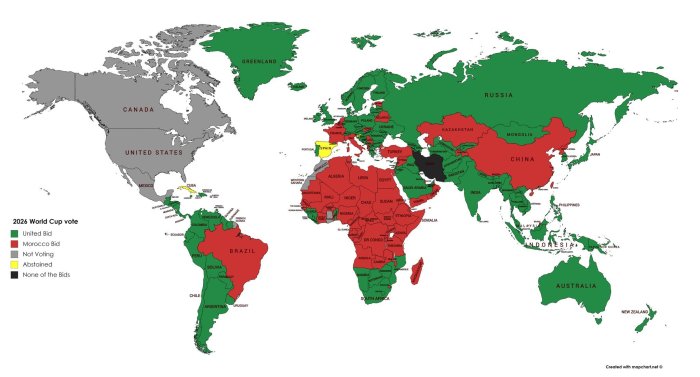
My only question is why did 3 countries that could easily (and have, in the past) host the World Cup on their own gang together? Mexico, Canada, and the United States are wealthy countries. Why gang up?
My guess is that wealthier countries are going to have to do a lot more cooperating if they want to host world-level events from now on, due to the fact that the selection process for these types of events has become democratized. Economist Branko Milanovic has a thoughtful piece on FIFA (the governing body for world-level soccer events) and corruption that ties in to all of this.
Nightcap
- The Market Police (Neoliberalism) JW Mason, Boston Review
- Libertarians should stop focusing on rent capture Henry Farrell, Cato Unbound
- Libertarians should *really* stop focusing on rent capture Mike Konczal, RortyBomb
- Nationalism is an essential bulwark against imperialism Sumantra Maitra, Claremont Review of Books
Nightcap
- Icelandic fiction: a family affair Fríða Ísberg, Times Literary Supplement
- Icelandic sagas of the middle ages Barry Stocker, NOL
- Identity politics and patchwork Xenogoth
- Keeping it cool: worshipping the goddess Shitala Amrapali Saha, Coldnoon
Nightcap
- An election day parable Irfan Khawaja, Policy of Truth
- Unrevolutionary bastardy Hannah Farber, The Junto
- Voting for a lesser evil Ilya Somin, Volokh Conspiracy
- Max Weber’s ‘spirit’ of capitalism Peter Ghosh, Aeon
Nightcap
- The underbelly of state capacity Bryan Caplan, EconLog
- Realities and uncertainties of American Empire AG Hopkins, Defense-In-Depth
- Emancipation and representation in 1848 Senegal Jenna Nigro, Age of Revolutions
- The Koreas are moving ahead Ramon Pacheco Pardo, the Hill
Nightcap
- The rule of robots in Stiglitz and Marx Branko Milanovic, globalinequality
- Freud and property rights Bill Rein, NOL
- China at its limits: beyond its borders Joshua Bird, Asian Review of Books
- Who’s Afraid of Tribalism Blake Smith, Quillette
Nightcap
- Why did Israel attack the USS Liberty? Rick Brownell, Historiat
- Slouching toward Bethlehem Joyce Chaplin, Times Literary Supplement
- Looking back on the festivals of the Revolution Mike Follert, Age of Revolutions
- Beasts of Rebellion Jonathan Saha, Colonizing Animals
Nightcap
- The case against deporting immigrants convicted of crimes Ilya Somin, Volokh Conspiracy
- What happens when photographers turn their cameras on society’s outcasts? Joe Lloyd, 1843
- Trump’s dangerous game David Henderson, EconLog
- Indonesia clamps down on independence effort in Papua Joe Cochrane, NY Times
Eye Candy: the Arab world’s administrative divisions
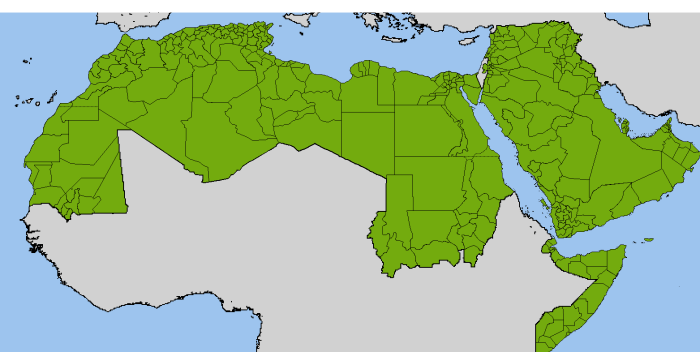
Imagine if these divisions were all states in a federal republic. Myself, I think some of them,maybe even half of them, could be combined, but if that ever happened, and the resulting combined administrative divisions of the Arab world federated, the region would be in much better shape. (The federation of Arabia would need a Senate, of course.)
What if the OECD did the same? Or simply the US and it’s closest allies?
 Notes On Liberty