RCH: the Christmas Battles in Latvia

That’s the subject of this weekend’s column over at RealClearHistory. An excerpt:

9. The battles didn’t actually take place on Christmas Day. They actually occurred in early January. However, under the old czarist Julian calendar, the battles occurred over the Christmas season, from Dec. 23-29. The Germans were caught by surprise because even though it was January in the West, it was Christmas season in Russia and the Germans believed the Russians would be celebrating their Christmas rather launching a major counter-offensive.

And

3. The Siberians were eventually slaughtered. The Siberians who refused to fight were not necessarily betraying their Latvian brothers-in-imperium. They knew they were cannon fodder. And, indeed, when the Siberians finally went to reinforce the Russian gains made, they were greeted with a massive German counter-offensive. The Siberians (and others) were left for dead. They received no food, no weapons, and no good tidings of comfort and joy.

Please, read the rest (and tell your friends about it). It’s my last post at RCH for the year, so there’s lots of links to other World War I-themed articles I wrote throughout 2018.
Nightcap

  1. Against dogma Henry Hardy, Footnotes to Plato
  2. How “collective self-defense” leads to more war Bryce Farabaugh, Niskanen Center
  3. English language and American solipsism Branko Milanovic, globalinequality
  4. Towards a new internationalism David Hendrickson, the Nation

Nightcap

  1. How does emigration impact institutions? Michelangelo Landgrave, NOL
  2. How Can Crypto-currencies Democratize Society? Chhay Lin Lim, NOL
  3. The Political is about to disrupt the crypto-currency scene -or at least they say so. Federico Sosa Valle, NOL
  4. A few further remarks on foreign policy and libertarianism Edwin van de Haar, NOL

RCH: Playing catch-up (Churchill, Rosa Parks, and Christmas in the New World)

I hope y’all have been enjoying my “nightcaps.” I have a wife, a toddler, and another little one due next month so life is too hectic to write much, but I have been plugging away at RealClearHistory and here are a few of the ones I’ve done over the past 14 days or so:

We’re still here. We still love blogging. Thanks for stickin’ around. The year ain’t over yet, and 2019 at NOL figures to be the best one ever. I’ll be back soon with my end of the year posts, one for most popular notes and one highlighting my personal favorites.


*for copyright reasons RCH had to use a different photo for the piece, but I submitted this one. It’s waaaaay cooler.

Nightcap

  1. Collective psychiatry (communist psychiatry) Emily Baum, Aeon
  2. The virtue of judicial self-restraint William Haun, National Affairs
  3. Two roads for the new French Right Mark Lilla, New York Review of Books
  4. Where politics and theology are hard to disentangle Bruce Clark, Erasmus

Nightcap

  1. Welcome back, American nationalism Francis Buckley, Cato Unbound
  2. When belief makes reality David Riesbeck, Policy of Truth
  3. The slave holders on the border Melchisedek Chétima, Africa is a Country
  4. Yes, The Black Hole is Legit Sci-fi Rick Brownell, Medium Cosgrrrl

Nightcap

  1. Trump still trying to squelch media’s left-wing slant Robbie Soave, Hit & Run
  2. People, there’a a whole wide world out there Scott Sumner, EconLog
  3. The painted towns of Rajasthan (India) John Butler, Asian Review of Books
  4. Beyond the SETI paradigm Nick Nielsen, Grand Strategy Annex

Nightcap

  1. Hanukkah’s Celebration of Assimilation Michael Koplow, Ottomans & Zionists
  2. How apartheid poisoned the world Peter Hain, Spectator
  3. A new understanding of human fragility and wholeness Stefanos Geroulanos, Aeon
  4. GM vs. Tariff Man Shikha Dalmia, the Week

Nightcap

  1. The original meaning of the 14th Amendment Damon Root, Reason
  2. Understanding politics today Stephen Davies, Cato Unbound
  3. It sometimes begins with Emerson Irfan Khawaja, Policy of Truth
  4. RealClearHistory‘s 10 best history films of 2018

Nightcap

  1. Haiti > Cuba David Henderson, EconLog
  2. When bad government matters Chris Dillow, Stumbling & Mumbling
  3. The future of American foreign policy Ashford & Thrall, War on the Rocks
  4. Sheep without shepherds Ross Douthat, NY Times

Nightcap

  1. Against HIPPster regulation Irfan Khawaja, Policy of Truth
  2. Is the “culture of poverty” functional? Bryan Caplan, EconLog
  3. A sex fiend Jacques Delacroix, NOL
  4. Do we have the historians we deserve? Branko Milanovic, globalinequality

Nightcap

  1. Cultural Marxism and the New Right Neuffer & Paul, Eurozine
  2. Black soldiers in European wars, 18th century edition Elena Schneider, Age of Revolutions
  3. A forgotten Indian hero TR Vivek, Pragati
  4. The treason prosecution of Jefferson Davis Will Baude, Volokh Conspiracy

Nightcap

  1. Parmesan cheese and Sunbucks Coffee Scott Sumner, EconLog
  2. In search of the true Dao Ian Johnson, ChinaFile
  3. The ‘flower men’ of Saudi Arabia Molly Oringer, BBC
  4. French anti-tax revolts are nothing new Murray Rothbard, Free Market

Nightcap

  1. Reflections on totalitarianism’s greatest critic Daniel Mahoney, City Journal
  2. Ralph Nader’s weird novel predicted the future Jeff Greenfield, Politico
  3. Hack gaps and noble lies John Holbo, Crooked Timber
  4. Social noble lies Bill Rein, NOL

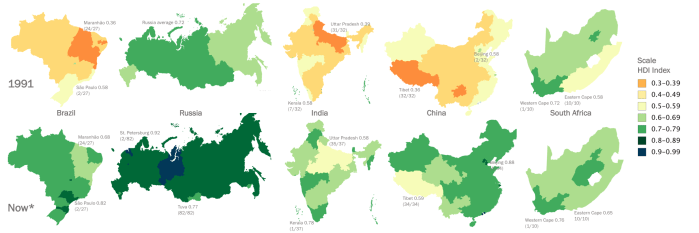
Eye Candy: The HDI of BRICS

Phew, that’s a lot of acronyms. But this is a great map:

NOL map BRICS subunits
Click here to zoom

Orange and yellow is bad, green and blue is good. HDI stands for “Human Development Index,” which is a measurement that’s not nearly as good, in my opinion, for understanding how wealthy and happy a population is. Nevertheless, HDI is still one of the better measurements (Top 5, again in my opinion) out there. Here’s the wiki on HDI.

The maps are colored according to “subunits,” or provinces (which are like American states, such as Nebraska).

Brazil, India, and South Africa are multi-party democracies, while the other two are not. So what do all five have in common?