I’m thinking of starting a new project of putting up maps that I think will help to enhance my own perception of history and the struggle between power and liberty. Hopefully it catches on. I’ll probably have a small vignette to go along with some of the maps, some of the time. At least I hope to. This’ll help me clarify my own thoughts and perhaps even help to clarify the thoughts of others. So without further adieu: Continue reading
Author: Brandon Christensen
Porn Preferences in China
I’ve always said you can tell a lot about a culture by their sexual mores (Montesquieu would agree!). From Shanghaiist:
That Japanese porn, both gay and straight, is more popular than anything else is perhaps not surprising. Very little pornography is produced within mainland China (though some is), and China’s obsession with AV stars is well known. What’s interesting is the racial homogeneity of the top 10. Chinese porn watchers don’t appear to be very interested in anyone not of asian heritage, a mild xenophobia that’s shared with Korea and Japan, both of which also prefer to watch asians getting fucked or doing the fucking.
Pardon their French. There is more:
Of China’s neighbours, only India and Kazakhstan search for members of other races getting their sex on.
Do read the whole thing. There is a link at the end to a Buzzfeed article showing the top porn searches for all countries.
NotesOnLiberty featured on RealClearHistory
Last month NotesOnLiberty was featured on the RealClearHistory website. Forgot to mention it here before. Thanks for all your thoughts and participation folks! You can find the week we were featured (1st week of February) here.
Around the Web
- Rumors of Chavez’s importance have been greatly exaggerated.
- Central banking: doomed to fail?
- Carl Menger and the Nature of Value.
- Truth, treachery, and genetically modified foods.
- The Law of Demand is a Bummer and The Myopic Empiricism of the Minimum Wage (the minimum wage debate).
- The Man Who Sells the Moon.
Glenn Greenwald on the Hypocrisy of the Left
Writing in the Guardian:
Meanwhile, a large bulk of the Democratic and liberal commentariat – led, as usual, by the highly-paid DNC spokesmen called “MSNBC hosts” and echoed, as usual, by various liberal blogs, which still amusingly fancy themselves as edgy and insurgent checks on political power rather than faithful servants to it – degraded all of the weighty issues raised by this episode by processing it through their stunted, trivial prism of partisan loyalty. They thus dutifully devoted themselves to reading from the only script they know: Democrats Good, GOP Bad.
Greenwald, a Leftist himself, is of course writing about the vitriolic attacks from the Left on Rand Paul’s filibuster the other day. There is more (it’s Greenwald after all):
That phrase – “engaged in combat” – does not only include people who are engaged in violence at the time you detain or kill them. It includes a huge array of people who we would not normally think of, using common language, as being “engaged in combat”.
Indeed, the whole point of the Paul filibuster was to ask whether the Obama administration believes that it has the power to target a US citizen for assassination on US soil the way it did to Anwar Awlaki in Yemen. The Awlaki assassination was justified on the ground that Awlaki was a “combatant”, that he was “engaged in combat”, even though he was killed not while making bombs or shooting at anyone but after he had left a cafe where he had breakfast. If the Obama administration believes that Awlaki was “engaged in combat” at the time he was killed – and it clearly does – then Holder’s letter is meaningless at best, and menacing at worst, because that standard is so broad as to vest the president with exactly the power his supporters now insist he disclaimed.
The World of the Inuktitut
Check out this sweet map of the Eskimo world today. It is broken down by linguistic groups. I wonder if these linguistic groups consider themselves ethnically distinct as well as linguistically distinct.
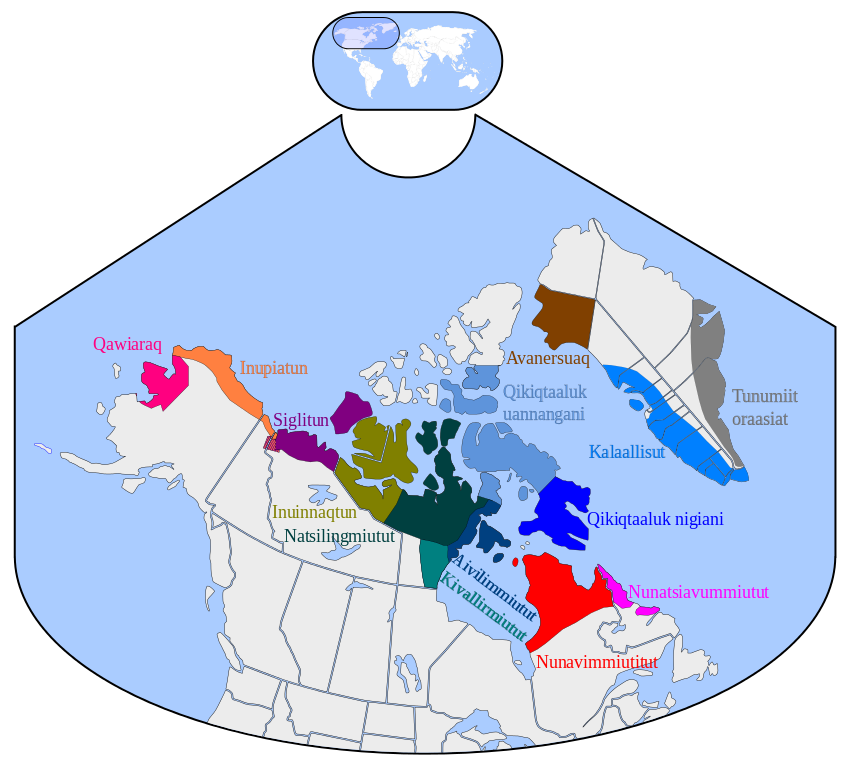
Here is a Wiki article on Nunavut, an experiment in Canada with indigenous self-governance (don’t get me started!).
And an article on Danish colonialism in Greenland (possibly gated).
Updated: I changed the title from ‘Eskimo’ to ‘Inuktitut’ because I just learned that the former is used as a pejorative term in Canada and Greenland (like the n-word here in the States). Inuktitut is term preferred by those highlighted in the map above. I’m not politically correct by any means, and in the US the term ‘Eskimo’ doesn’t carry any negative connotations, but being polite and being politically correct are two very different things.
Religion or Institutions? An Ongoing Dialogue
Dr. Delacroix and I are continuing our back-and-forth over at Facts Matter. My latest volley:
Religion is often such an important part of a given culture that it is commonly treated separately giving the false impression that it’s a different subject in its own right [Dr. Delacroix]
This is true up to a point. Once a society adopts one of the “great religions” as their own, though, the cultural-religious blend disappears and two distinct categories arise. Small tribes with their parochial animist beliefs are one thing, but large nations sharing a holy book are quite another.
As it stands, the stonings of women in Saudi Arabia are political acts, not cultural ones. Thus the Saudis (or their enemies) are using religious undertones to their political advantage. The violence and backwardness of the region – which I readily admit is prevalent – goes back to institutions and their political and economic ramifications.
The lack of books in the Arab world is another case in point. During the late Ottoman era, and during the era of European imperialism, Arabs gobbled up books left and right. Once Arab socialism and other anti-colonial movements began to isolate their societies, the demand for books was severed.
What do you think would happen if the states of Iraq and Egypt, for example, suddenly lifted their controls on trade, universities, the press and the internet? Would Arab culture or Islam hinder the thirst for knowledge in the citizens of these countries?
Research Readings
I’m trying to get through the rest of Eugene Rogan’s The Arabs: A History and Steven Gregory’s Devil Behind the Mirror for classes, but I’ve also stumbled across what looks to be a pretty fascinating research paper on neoliberalism by a political scientist at a university in Canada. The abstract:
This article examines and theorizes neoliberal ideas related to the scale as pects of multilevel governance. It argues that neoliberalism contains a self conscious normative project for multilevel governance which is consistent across the federal, regional and global levels. It further argues that the underlying logic of this project can be usefully theorized through various critical understandings of the separation of the economic and the political in neoliberalism and, in particular, through Stephen Gill’s concept of new constitutionalism. To demonstrate these points, the article draws on the normative work of neoliberal organic intellectuals – including Hayek, Friedman, Buchanan and various neoliberal think tanks – on ‘market-preserving federalism’ and the more recent extrapolation of these ideas to the regional and global levels.
The full article is here, but it is probably gated. *sigh* It’ll be interesting to see what the author comes up with. I’ll keep y’all posted.
Seeking Recommendations
I recently figured out how to download academic journal articles from a number of databases. I’m NOT interested in selling them, copying them, or making them available to the general public, but I would like any recommendations you’d have on reading over Spring Break.
Right now I’ve got a bunch of stuff by Frank Knight and James Buchanan I’m trying to get through. Wallerstein, Wolf and Wilmsen are next on my list.
I’d appreciate it!
Update: I’ve linked to a bunch of different sites that have open access to a number of libertarian-ish journal articles over the years. Hope you enjoy! (h/t Patrick Peterson)
- Quarterly Journal of Austrian Economics
- Review of Austrian Economics
- Eric Mack’s personal website (a libertarian-ish philosopher)
- The Independent Review (from the Independent Institute)
- Deirdre McCloskey’s work
- Cato Journal (from the Cato Institute)
All of the work is generously available for the public to read and even download, so get to it folks!
From the Comments: Islam’s “Violent Penchant”; Shooting Rampages and Stonings
Dr. Delacroix takes me to task over my dismissal of Islam’s inherently violent penchant. I think violence on grand scales, including war and terrorism, are always and everywhere a product of politics and institutions. Dr. Delacroix argues that Islam itself provokes violence. He writes:
A French citizen with a Muslim name goes on vacation to the tribal areas of Pakistan and to Afghanistan. Latter on he goes on a shooting rampage. The probabilities are such that he has to have sought his victims. The first set of victims were Muslim soldiers in the French army. Of course, for a jihadist such soldiers are traitors. The second set of victims were Jewish children and an adult in a Jewish school. You have to look for a Jewish school in France. I wouldn’t know how to find one. It’s not as if the killer wanted to kill children and then he went to as school that happened to be Jewish.
None of this means anything according to Brandon. Of course, this anecdote is only one of of several I presented in support of the idea that Islam has a violent penchant. Brandon dismisses “anecdotes” as evidence. He seems to say that if I had presented a thousand anecdotes, I would have accomplished nothing. I imagine he believes it’s enough to say “not so” for his negative thesis (no violent penchant) to be considered true.
Strange mental world!
I did not say anything about what is responsible for terrorism in the Middle East. I only took exception to a small statement of faith of Brandon’s in a larger development.
Why was the French citizen in Afghanistan and Pakistan? I ask because both states are in the middle of an international conflict (along with France, I might add). Continue reading
Hugo Chavez, Fascist/Socialist (Same Thing) Dead at 58
Hugo Chavez, the portly, socialist dictator from Venezuela, died from cancer at the ripe old age of 58. My only lament is that I will probably never get to piss on his grave.
His rule was fairly typical for a Leftist regime: assaults on free speech and the free press, diminished civil liberties, picking and choosing winners and losers in the private sector, strong ties to the military, etc. etc. From the New York Times:
At the same time, he was determined to hold onto and enhance his power. He grew obsessed with changing Venezuela’s laws and regulations to ensure that he could be re-elected indefinitely and become, indeed, a caudillo, able to rule by decree at times. He stacked his government with generals, colonels and majors, drawing inspiration from the leftist military officers who ruled Peru and Panama in the 1970s.
[…]
He began describing his critics as “golpistas,” or putschists, while recasting his own failed 1992 coup as a patriotic uprising. He purged opponents from the national oil company, expropriated the land of others and imprisoned retired military officials who had dared to stand against him. The country’s political debate became increasingly poisonous, and it took its toll on the country.
Private investors, unhinged over Mr. Chávez’s nationalizations and expropriation threats, halted projects. Hundreds of thousands of scientists, doctors, entrepreneurs and others in the middle class left Venezuela, even as large numbers of immigrants from Haiti, China and Lebanon put down stakes here.
The homicide rate soared under his rule, turning Caracas into one of the world’s most dangerous cities. Armed gangs lorded over prisons, as they did in previous governments, challenging the state’s authority. Simple tasks, like transferring the title of a car, remained nightmarish odysseys eased only by paying bribes to churlish bureaucrats.
Other branches of government often bent to his will. He fired about 19,000 employees of Petróleos de Venezuela, the national oil company, in response to a strike in 2002 and 2003. In 2004, he stripped the Supreme Court of its autonomy. In legislative elections in 2010, his supporters preserved a majority in the National Assembly by gerrymandering.
All the while, Mr. Chávez rewrote the rule book on using the media to enhance his power. With “Aló Presidente” (“Hello, President”), his Sunday television program, he would speak to viewers in his booming voice for hours on end. His government ordered privately controlled television stations to broadcast his speeches.
Again, nothing too surprising here. This is what socialism will bring your society, every single time. It’s a conversation that doesn’t happen enough around the world.
What I find most surprising about his death is not that so few on the Left are willing to condemn him for his brutality (Leftists are – by and large – authoritarians who believe that the ends justify the means), but that so many Leftists really believed Chavez’s fascism represented a threat to US interests in the region.
Nothing could be further from the truth. For one thing, American policy in the region has changed markedly since the end of the Cold War. American interests in the region have largely faded into obscurity, even when it comes to the drug war (which should end tomorrow). Afghanistan, Mexico and West Africa and the Caribbean are the new fronts in the war on drugs, and overthrowing democratically-elected governments to prevent communism was sooooo 1980s. Nowadays Washington sees democratically-elected socialists coming to power as good for democracy, so long as the fascists don’t try to rewrite the rules to fit their fancies and eliminate democracy (like they’ve done in Honduras, Venezuela and, to a lesser extent, Argentina).
Chavez was nothing to Washington. Not even a pain in the ass. That uninformed Leftists continue to lie to themselves, and the like-minded tools they hang out with, should not surprise me, but alas…
Latin America has thrived since Washington has taken a softer, more respectable approach to the region. States that come under socialist influence – like Venezuela and Cuba – become pariahs on their own. Most of this has to do with the fact that militaries are involved in one way or another. Socialism has never come to power democratically.
I’m not too fond of memes, but here is one that often pops into my head when I read a Leftist’s defense of some dictator or other in some part of the world: Continue reading
Rand Paul: Filibusterer Extraordinaire
Rand Paul’s filibuster of John Brennan is now going on 8 hours.
Mr. Brennan thinks that the use of drone strikes to kill enemies of the republic is perfectly legal, even on American soil.
No word – yet – on whether Mr. Brennan thinks it would be perfectly legal for a Republican to use drone strikes to kill American citizens.
Origins of Terrorism in the Middle East
I just recently came across a very, very good book on the history of the Middle East. As far as theory goes, it is lacking, but it is readable enough that the intelligent layman can pick it up and learn new things from it. Written by historian Eugene Rogan, it’s titled The Arabs: A History and it has won numerous awards. Be sure to check it out. One new fact that I learned is that while terrorism as a tactic in the Middle East did not appear on the radar until the 1920s, it was undertaken on behalf of Jewish interests, not Muslim ones. Rogan explains:
The terrorists had achieved their first objective: they had forced the British to withdraw from Palestine. Though their methods were publicly denounced by the leaders of the Jewish Agency [the pre-state government], the Irgun and Lehi [terrorist organizations] had played a key role in removing a major impediment to Jewish statehood. By using terror tactics to achieve political objectives, they also set a dangerous precedent in Middle Eastern history-one that plagues the region down to the present day.
Now, I am not “blaming the Jews” for terrorism in the Middle East, nor is the historian. What I would like to do is point out that the theories and excuses about Islam’s violent penchant produced by Western analysts are horribly wrong. In a similar vein, Arab culture is not to blame for the violence in the region, either. Terrorism is entirely a product of politics.
What we have in the Middle East is simply a problem of statecraft. A conceptual turn away from cultural and religious explanations for the violence in the Middle East and towards one that looks at political and legal institutions and the economic consequences that arise from them would do wonders for the region (and the world). If we cannot even agree on the fundamentals of what is wrong with the Middle East institutionally, we sure as hell are not going to agree upon anything else. This goes for domestic and regional factions in the Middle East as well as for Western ones.
Israel exists. It is a state in the Middle East, and a highly successful one at that. This may well explain why terrorism has been used so often, as a political tactic, for almost a century in the Middle East. It also helps to explain – conceptually – why terrorist attack rates were so high in Sri Lanka until the defeat of the guerrilla insurgency a few years ago, and why Latin America has suffered from chronic terrorism. Arab culture and Islam, on the other hand, do not explain terrorism in other parts of the world. I see no reason why we should make an exception to the rule for terrorism in Middle East. This is an institutional problem, not a cultural one.
Justice for Bangladesh?
From the New York Times:
The year 1971 was seminal for Bangladesh. We had been denied our right to self-rule since the Indian subcontinent was partitioned in 1947. In March of ’71, the Pakistani military, supported by China and the United States, initiated a bloody suppression of 75 million Bangladeshis. Millions fled the murderous onslaught and sought refuge in India.
Militias affiliated with the Islamist party Jamaat-e-Islami collaborated with the Pakistani military. They informed on, hunted out, and participated in the rape, killing and torture of ordinary citizens. They targeted hundreds of intellectuals, who were killed in cold blood.
Bangladesh is one of the poorest states on the planet. Here’s why:
Bangladesh’s original Constitution had four basic principles: nationalism, democracy, socialism and secularism.
Can you guess what happened after independence? Go ahead: guess. Or just read the whole thing (it’s short).
As of now there are massive protests going on in Bangladesh calling for revenge. While I support justice, and the Bangladeshis have suffered innumerable injustices over the past five decades, I don’t think calls for blood bodes well for the rule of law.
In other, more local, news here is a good account of the shootout that recently happened in Santa Cruz. I’m going to turn in my guns tomorrow.

