- Bohumil Hrabal: the life, times, letters and politics of a Czech novelist
- What Davos Missed by Excluding North Korea
- The Rise and Fall of the Soviet ‘Death Star’
- Searching for Vadim Kozin, the Soviet tango king
- Are we likely to see new nation-states emerge this century?
- Historical Methodology and the Believer (of Islam)
Author: Brandon Christensen
Is government decentralization the right answer to differences across regions?
That’s the main question being asked by Federico Boffa, Amedeo Piolatto, and Giacomo A. M. Ponzetto, all economists. I cruised through the whole paper (pdf) and have some superficial thoughts. One snippet:
Western California is more liberal, even among Republican voters and politicians; Eastern California considerably more conservative […] At a first glance, such a political divide might suggest that a break up of coastal and inland California would be optimal on preference-matching grounds […]
[H]owever [this is a] superficial assessment. [Eastern California] contain[s] a large Hispanic population that overwhelmingly prefers the Democratic party. This group is much less educated, less politically knowledgeable, and less likely to vote than Republican supporters in the region, who are on average older, whiter, and wealthier. At the same time, the left-wing Hispanic working class in the Valley shares the political leanings of highly educated liberals on the coast. This ideological alignment goes beyond mere partisanship and includes shared preferences over policies.
As a consequence, our model suggests that the political integration of California is welfare maximizing. For relatively uneducated inland minorities to have a government corresponding to their preferences, it is essential that they share a state with ideologically aligned liberal elites in the Bay area. Right-wing Californians, instead, are sufficiently educated and influential to have a voice in state-wide politics, despite being in the minority: California had a Republican governor for twenty-one of the past thirty years.
[This lesson] applies more broadly. Disadvantaged ethnic minorities— which are less educated and often politically underrepresented— should belong whenever possible to the same polity as better educated and higher-status voters having similar political preferences. Only then are politicians effectively held accountable to both groups. (29-30)
California is “welfare maximizing”? Somebody help me out here. Isn’t it also possible that poor Hispanics and rich liberals form a voting bloc in California as it is because of how the GOP is patched together? If California split into an East/West, current coalitions would be shattered and it doesn’t follow that rich liberals and poor Hispanics would share the same voting preferences in the new arrangement. It doesn’t follow that rich conservatives and poor Hispanics in a hypothetical East would be at odds, either.
The biggest weakness in the paper, if you can call it that, is that the authors are focused on the fiscal aspects of federalism rather than the diplomatic, cultural, and political aspects. Federalism binds people together and forces them to at least try to come to an agreement about some issues. That’s a big deal, though it’s obviously not sexy.
The paper is focused on the EU and the US. There are lots of interesting insights into the European Union but the US angle is kinda boring (I’m sure is vice-versa for readers living and working in Europe). (h/t Mark Koyama)
What’s the difference between Saudi Arabia and Islamic State?
One has captured the rent associated with being a state in the post-World War II world order. This means that one of these polities gets to build embassies in other states. It gets to participate in congresses. It gets to fly its flag at the United Nations and has access to the World Bank, military hardware markets (“for defense”), and FIFA tournaments.
Rent capture isn’t all good, of course. There are still costs. When Saudi Arabia beheads people, for example, it gets condemned internationally. Its reputation suffers. It has to repair relationships and launch rigorous public relations campaigns. Saudi Arabia has to do these things because if it looks intransigent to enough of its fellow states, there might be official repercussions for its actions. Saudi Arabia can’t just go around killing and looting and raping at will. It has to formalize its killing, looting, and raping through the international order by coming up with a national interest. (A national interest is also important for shoring up domestic support for such activities.)
But incorporating Islamic State into the international order is unfathomable. It’s an immoral action rewarding an immoral pseudo-polity. Besides, the sovereignty of the states of Iraq and Syria would be violated and their borders destroyed. It’s better to just keep bombing the region Islamic State claims to govern and arming the factions that claim to be its enemies. That’s been our policy towards the post-colonial world since 1945 and, while imperfect, it’s been working out well so far…
From the Comments: Military intervention, democracy, and stability
Longtime reader (and excellent blogger in his own right) Tam has an interesting response to Chhay Lin’s thoughts on the Paris terrorist attacks:
It is an interesting read indeed but there are two or even more sides to every story. What we are also noting is that many of these groups that hate Western interventionist policies also hate their own people for being different in one way or the other. However, I agree that the misplaced perception of democracy as the superior form of governance overlooks the essential internal historical and socio-political factors behind the politics of the different countries that have become victims of Western ‘sanctification’ processes fronted by bombs after daring to opt not to embrace democracy. Libya and Iraq were stable before Western intervention.
Tam’s point strikes at the heart of the difference between military interventionists and non-interventionists, I think. Libya and Iraq were indeed stable, but not everybody was free. In Iraq, Shias, Kurds, liberals, and religious Sunnis were all brutally suppressed, and this oppression stood in stark contrast to the freedoms that secularists, women, union members, some socialists, and the politically apathetic enjoyed. The sociopolitical dynamics in Libya were the same, though with different local actors.
This reality is something that both sides of the interventionist debate recognize, though the interventionist side seems to place much more faith in government when it comes to “doing something.” Jacques and Edwin, for example, have both argued that bombing ambiguous factions in Iraq, Syria, and Libya would contribute to the freedoms of the oppressed factions in those countries. Looking back on the debate makes it clear that they weren’t wrong, but look at what those freedoms have produced. Those freedoms have come at the expense of the freedoms of the factions that the dictators were protecting.
What this situation shows me is that the states of the post-colonial world are unviable. Stability comes at too steep a price (dictatorship), and democracy’s unpredictability only leads to predictably violent results in the post-colonial world.
This impasse, which I cannot be the only one in the world who recognizes, has led me to take a hard glance at two specific peace processes in the Western world: The diplomatic efforts of Europeans after the Napoleonic Wars (“Concert of Europe”) and the founding of the American republic, which is, in my mind, the most successful endeavor in the history of international relations. Neither of these efforts led to the complete abolition of war, but both have helped to maintain a relatively peaceful co-existence between large numbers of factions for long periods of time.
The Concert of Europe bought time for factions in the region to solidify their legitimacy at home, culminating in both the creation of Germany and Italy in the late nineteenth century and the infamous overseas imperial domains of France, the UK, and the Netherlands (among a few others). While this peace process brought about prosperity for Western Europe, it was not inclusive and it still adhered to the Westphalian notion of state sovereignty. What state sovereignty means is that each state, in the context of international affairs, has a right to do whatever it pleases within the confines of its own borders (such as massacre hundreds of thousands of people in the name of stability). The Concert of Europe was also the precursor to the post-1945 peace process that created the state system that we all live with today, though I would argue that there are some elements that could be republican, such as the IMF and World Bank, provided some changes in mindset.
Aside from the problems produced by the notion of state sovereignty, the states of the post-colonial world today suffer from an issue of legitimacy, both from domestic populations and from foreign ones. Domestically, all of the factions that stability-inducing dictatorships oppress do not buy in to the argument that the states purporting to govern them are legitimate. In foreign affairs, many factions do not believe that these post-colonial states are legitimate either. Hence the calls for bombing campaigns, proxy wars, or outright invasions and occupations of states like Iraq and Libya by states like the US or France (even if these invasions come at the expense of domestic and international rule of law).
This situation, where post-colonial states claim to have sovereignty within an international state system but where domestic and international factions ignore such claims, is where we’re at today. It’s the status quo, and while it worked relatively well in a small part of the world for about hundred years or so, it’s obviously failing today.
Enter the founding of the American republic. Unlike the Concert of Europe, self-determination à la breaking away from the UK was a guiding principle of the federal system, rather than state sovereignty. Like the Concert of Europe, the statesmen who crafted the American republic were concerned about invasion, hegemony, and all of the other bad stuff that happens in the international arena. So they set up an inclusive, republican system of states rather than attempt to balance power off on each other, like they did in Europe. The republican, or federal, system tied each state up into the affairs of the other states, whereas the balance of power system contributed to the formation of rival blocs within the system. This is why Europe switched from trying to maintain yet another balancing act to building an actual confederation (though one that is far too complex than it has to be) after World War II.
From a strictly war and peace view, the republican state system has led to one war so far (dating from 1789). From the end of the Napoleonic Wars, in 1815, to today, the balance of power state system has led to numerous wars.
Now, I know what you’re thinking: Woodrow Wilson’s foreign policy was based on self-determination, and his foreign policy was a disaster. This is true, though I would argue that Wilson was simply confused about what self-determination actually implied. For Wilson, recognizing the self-determination of various groups within empires would lead to state sovereignty for these groups, and that this state sovereignty would then be protected by the institutions trying to maintain a balance of power. Wilson never entertained the notion of republicanism when it came to recognizing the self-determination of peoples living in empires, he simply thought empires were undemocratic. Thus, he was actually a proponent of state sovereignty rather than self-determination.
What I am not arguing for here is a Concert of Europe-type effort for Middle Eastern actors. I think it would be a disaster, largely because regional efforts at peace-building (rather than, say, trade agreements) are useless in today’s globalized world. The Middle East needs the West, and vice-versa. Peace will only be achieved if self-determination is embraced (by not only large swathes of Mideast factions, but Western ones as well) and the new polities can be incorporated into existing republican-esque institutions. This way, more factions have a voice, and bad actors can be more easily isolated. I am not necessarily arguing that the US or EU should welcome burgeoning Mideast states into their federations, but policymakers and statesmen from these countries should at least start thinking about how to encourage and embrace the notion of a Middle East that looks a lot like our own republican world and less like the one we gave them following the destruction of the Ottoman Empire.
Stability is overrated, especially if the notion of creative destruction is taken into account.
BC’s weekend reads
- The Criminalization of Curiosity
- Britain needs Christianity – just ask Alan Partridge
- Libertarians have nowhere to turn
- In light of ongoing events in Poland, this October piece by Dr Stocker here at NOL is worth reading again
- The West in the Arab world, between ennui and ecstasy
From the Comments: What is a “National Interest”? (Why not federalism?)
I sympathize with your pro-federation views, but it is admittedly a difficult position to argue from a purist libertarian view. I would support offering statehood to Japan and South Korea, as I mentioned earlier this week.* I would not however offer the same deal to Ukraine or the Baltic states. If pressed why I would be okay with federation with one group of countries but not another is because I consider the Ukraine/Baltic region to have little value to American interests. I can see Japan/South Korea federation helping economic growth and military might to the US and therefore in our interests. Note my use of plural pronouns.
From a purely libertarian basis what regions would you offer federation with? Or, if you’d offer federation to all of them, which regions would you offer federation with first? Taiwan might entertain an offer to join the federation tomorrow, but I suspect the PRC or Russia wouldn’t.
*I imagine they’d join as multiple states in practice. I wouldn’t offer Japan 114 seats in the senate, but I would entertain giving them 10 senators.
Why only ten? Michelangelo’s quibble about the number senators can illustrate why federation is more libertarian than isolationism (I’ll get to his question in just a minute).
The Japanese would never accept any sort of union where they give up some sovereignty for other benefits and only have ten representatives in the senate. That wouldn’t be a bargain for the Japanese; it’d be highway robbery. The key conceptual point to keep in mind in this scenario is that there are two sides bargaining and cooperating with each other in order to arrive at a mutually beneficial deal. Japan and the US cease to exist as sovereign political units but become more secure militarily, economically, and politically through a federation with each other.
Contrast this view with what, say, isolationists such as Doug Bandow or Daniel McAdams argue; they want much less cooperation and, by implication, much less choice. Cooperation would be limited to negotiating trade details, arming factions, and coordinating responses to natural disasters. This is radically different from the status quo, but not in a beneficial way. Think of all the things isolationism and the status quo exclude from their policies. People in Japan and the US are overwhelmingly in favor of a continued US presence in Japan. The reasons for this are clear, but as it stands the Japanese are taking the US for a ride. Isolationist arguments are arguably worse, as they’d remove US troops (angering vast swathes of both societies in the process), which would put Japan in a position to fend for itself. Isolationism is “doing something,” and it’s doing something uncooperative.
I agree wholeheartedly with mainstream libertarians about the unfair nature of the status quo. I just think their proposals are equally unfair (if not worse). A libertarian position should emphasize cooperation, choice, and trade-offs above all else. The current stable of libertarian foreign policy experts don’t do this, despite their pertinent critiques of the status quo.
Now, before I get to Michelangelo’s question of who (I promise it’s coming), I want to spend a little time on his proposal for 10 senators, and tie it into the concept of “national interest,” which is a fuzzy concept and hence popular to wield in public discourse.
What is the national interest (or US interest)?
Think it through and write down your answer on a piece of scratch paper you have lying around.
Go ahead. I’ll wait patiently.
Is your answer really the national interest, though? Why is your definition of the national interest true and Walter Russell Mead’s not? Here is how I defined the concept of a national interest back in 2014:
…the national interest is an excuse [scholars and activists use] for a policy or set of policies that [they believe] should be taken in order to strengthen a state and its citizens (but not necessarily strengthen a state relative to other states…)
Now go back and look at what you wrote down as “the national interest.” Am I right or am I right? There’s no such thing as a national interest. Cooperation, choice, and trade-offs do exist, though, and I think they can walk us through a hypothetical federation between Japan and the US.
Michelangelo rightly decries the fact that Japan, a country with 126 million people in it (California has 40 million) should get 114 senators. Yet 10 senators seems far too few to give up sovereignty for federation. This appears to be a stubborn impasse, right? Wrong! One of the great benefits of cooperation is having to learn new things.
The 47+ prefectures of Japan, for example, have been in use since 1888. The prefectures had steadily been declining in number as the Meiji oligarchy began in earnest to nation-build in what is now Japan. Up until the surrender of Japan to the US, these prefectures were not representative and had little say in how each prefect was to be governed. MacArthur’s constitution gave these 47+ prefectures some autonomy in 1947, but recent attempts at reforming the administrative units of Japan have called for the abolition of these prefectures in favor of fewer administrative units that will also have much more independence from Tokyo. The policymakers who want to take this track are not creating these fewer administrative units out of thin air, either. Rather, reformists are calling for representative units to be based on the unofficial cultural areas of the country that have been around for centuries. Check out the map:
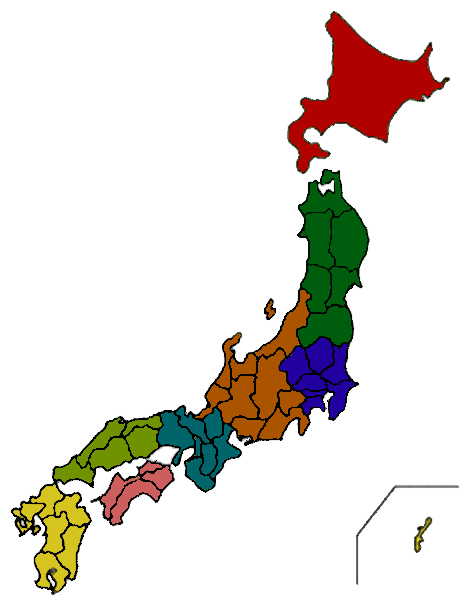
A cooperative approach to tackling free-riding and imperial expenses would be to reach out to the factions that want fewer administrative states with more autonomy. Adding anywhere from 8 to 14 administrative units into the Madisionian system is much more doable than, say, trying to incorporate 47 administrative units, especially since the latter units have little experience with the autonomous governance that federalism requires of its “states.” At most, there would be 28 additional members of the Senate. The costs associated with free-riding would be gone, and the Japanese people would get the benefits of being a part of the most powerful military the world has ever seen.
Would 28 Senate seats be enough to give up sovereignty? I don’t know, but I do know that the status quo is unsustainable and so, too, are current alternatives.
To finally answer Michelangelo’s question (“From a purely libertarian basis what regions would you offer federation with? Or, if you’d offer federation to all of them, which regions would you offer federation with first?”), I’d start with the Canadian provinces and Mexican states (though I would make it clear that any region is welcome to apply for membership). Then I’d approach the Caribbean islands, the administrative units in Western Europe (including the Baltic states but excluding Ukraine), and the administrative units in Japan and South Korea. Good neighbors and military allies.
My reasoning behind this approach is simply that 1) most of these regions are almost as rich as the United States, 2) they have a good history of actually being representative of their constituents, 3) they have a long history of either interacting with the Madisonian system or acknowledging its tremendous benefits, and 4) they have experience with being somewhat autonomous in a federal system (a federal system that is much less liberal than the one found in the US, but a federal system nonetheless).
Again, I’m not opposed to allowing poor regions to apply and join such a federation, but I think they would be less inclined to do so. Why? Because poorer states are more parochial, more protectionist, and more likely to be uncooperative than rich ones. If regions within these poorer states wanted to apply for membership, we should be open to it, but we’d have to recognize that these poorer regions have a long, hard slog ahead of them. They would, for example, have to market reasons for why they should no longer be a part of a poor state, and they’d have to do it under the harsh watch of the said poor state. Not an easy task, to be sure, but it can be done and the Madisonian federation should be open to the idea of picking apart post-colonial states if it means federating with an oppressed (or poorly governed) region.
Why “post-colonial”? Because of Realpolitik. Entertaining applications from the likes of Tibet or Chechnya is too risky. Entertaining applications from Baluchistan or Biafra? I’d have no problem risking the ire of Pakistan or Nigeria if it meant partnering up with people who want a better life and are willing to cooperate in order to get it.
PS: I think the dialogue in the ‘comments’ thread of this 2014 piece is also worth reading in tandem with my thoughts on Michelangelo’s comment here.
A Very Merry Christmas, from India
Dr Ranjan sent me the following email:
Dear Brandon and gang
I wish you and to your family members a merry Christmas in advance. Hope you will have a great time this Christmas.Have fun

Thanks for the thoughtful card, Dr Ranjan. (And a Merry Christmas to all of you!)
A Warm Welcome
Folks, NOL is coming up on 5 years as a cooperative venture. It’s been a lot of fun and it wouldn’t have the feel it has without your continued support and encouragement. I’d like to extend a warm welcome to two new members of the consortium: Dr Vincent Geloso and William Rein. Behold:
Vincent Geloso has recently completed his PhD dissertation at the London School of Economics and Political Science in the field of economic history. He specializes in law and economics, development economics, and economic demography. He has published articles in Journal of Population Research, Essays in Economic and Business History and Economic Affairs.
Vincent was my roommate at a FEE summer seminar back in 2009 (the same summer I met Rick at an IHS summer seminar). He’s from Quebec but is a Canadian first and foremost. You can start checking out his non-NOL work here. If you are considering a non-profit to give to for this holiday season, I highly recommend IHS and FEE. Just look at what their work has done in regards to NOL. And:
William Rein is a sophomore studying Philosophy and Criminal Justice at Chico State University. He married jurisprudence a long time ago, starting seeing modern physics on the side, and just recently has been hooking up with phenomenology. Every now and then he gets caught up in journalism and opinion writing.
You can start checking out his non-NOL work here. I have many a fond memory of Chico State (and some not-so-fond ones too). Please, be on your best behavior for at least their first couple of posts!
A quick update on NOL’s art project
Chhay Lin sent me this email detailing a rough timeline for the NOL art project he initiated:
I met my friend about the art project last weekend. He told me that he is experimenting with an Escher-esque logo/banner for NOL. He doesn’t know how long it will take, and is not working on it full-time. In the meantime he is busy moving out from the city of Breda to Rotterdam, opening his own workshop, and making portraits for a book that he and I are working on. 🙂 I’ll keep you up to date if I hear anything new about the NOL artsy project.
His friend, Cheerted Keo, has a website that you can check out here.
BC’s weekend reads
- A rifle’s journey from Belgium to Gaza
- No Libertarian Case for Empire (this is the piece that sparked my little tirade yesterday)
- A dust-up over dissenting views at Ohio State law
- What really happened on Thanksgiving (le duh; this screams “why Econ 101 is so important”)
A Quick PSA: Putting “boots on the ground” in Syria is still a dumb idea
Readers might be mistaken into thinking that I am some kind of statist or rabid interventionist because I often put forth arguments that are nowhere to be found at the Cato Institute or the Mises Institute when it comes to American foreign policy.
I have argued that the federation of countries would be a good idea. I have argued that multilateralism is of the utmost importance when it comes to solving problems. I have no problem using IGOs like the UN or the IMF to bolster diplomacy. I have entertained the notion that the US should take a back seat in hot spots in order to better bait autocratic states into committing blood and treasure to the said hot spot, and then unleashing hell. Sanctions are dumb and never work, but building closer trading ties with an adversary’s enemies is a underdeveloped path.
Statist AF, right?
Wrong!
I am trying to put forth alternatives to “boots on the ground.” I understand that military interventions are a bad thing. I don’t want “boots on the ground.” I understand that the costs far outweigh the benefits. I understand that war is the health of the state. What I don’t understand is how “doing nothing” is a libertarian position. Dogmatic slogans made us lazy a century ago. We lost our claim to the title “liberal” because of it. Dogmatic slogans made us lazy a century and a half ago, and we lost our claim to the title “internationalist” because of it. What will our laziness cost us today?
Boots on the ground? We should be so lucky.
From the Comments: Why did Cambodians trade foreign terror for domestic horror?
John Cyberome pitches the question to Chhay Lin on his post about the terrorist attacks in Paris. Chhay Lin’s response (which I have broken up into smaller paragraphs) deserves a closer look:
I don’t understand why Cambodians traded foreign terror for native horror. It’s something I’ve always wanted to understand. I don’t remember a time when I did not have such questions as: how can people be so cruel to each other or would they (the friends I had) be able to commit such horrendous acts to me if they would live during the Khmer Rouge period? It seems like there is a terrible part of human nature that is called upon in certain circumstances. I think the Milgram Experiment and the Stanford Prison Experiment have been examples of how peaceful people can move to extremely horrifying acts. I also think that the Khmer Rouge had good intentions. In their eyes, they were saving the nation from corruption, from immorality, from foreign invaders and from domestic traitors.
Cambodia by the way, is a country that is quite paranoid. Until this day, they still fear that the Thai or the Vietnamese will one day take over the country. Some already believe that the country only exists by name, but that it’s actually under Vietnamese rule. According to them, after the Vietnamese occupation from 1979-1989, they have installed a pro-Vietnamese ‘puppet’. This paranoia feeds nationalism – a sentiment, I believe, that can be easily manipulated into hatred towards foreign Khmer like Sino-khmer or Vietnamese-khmer.
Besides that, I also think that the poorer people were envious of the wealthy class. When the Khmer Rouge came into power and turned the social hierarchy upside down by installing the poor people into higher social positions, they may have been especially cruel to those fellow Cambodians who they believed were better off.
I also think that we can partly blame it on the Cambodian culture. The culture is very hierarchical. People of status look down on poorer people and treat them like crap. The poor don’t even dare to look the better-off in their eyes. It’s a culture that breeds envy and discontents between classes. I think these are a few reasons why the Cambodians had traded foreign terror for native horror. In all honesty, I find the culture quite backward 😛.
This is a whole lotta insight packed into one short ‘comment’.
For starters, I would be comfortable in suggesting that land is the crucial factor of production in Cambodia, rather than capital. (I am not as confident as Rick in arguing that land, labor, and capital are basically obsolete tools, in large part because there are big swathes of the world that don’t share the institutions that have created the West.) Land-based societies that I have read about all share the same general cultural characteristics as those mentioned by Chhay Lin (though none would dare call these characteristics ‘backward’!).
Trade has, in my reading of history, been the traditional arbiter of destruction for land-based interests. Does anybody have any good information on international trade and Cambodia? I’ve looked in to a few sources (World Bank, OECD, Heritage) and it looks like the volume of trade has been increasing since at least 2010, but that there are institutional problems which have yet to be addressed.
‘Creative destruction’ is such a strange concept, especially to a libertarian like me.
Fretting over Christmas gifts?
Fret no longer! Dr Amburgey smugly reports:
My daughter is a political science major at Queen’s University. She’s putting together her applications for grad school right now [she’s interested in political theory]. Last summer she went to a Libertarian student conference in Montreal [I enthusiastically funded her travel]. At any rate I was doing my annual struggle to come up with good Christmas presents when a visual cue from NOL made the proverbial light bulb light up. She will be tickled when she discovers that Santa Claus gave her a copy of Degrees of Freedom: Liberal Political Philosophy and Ideology by Edwin van de Haar. 😀
I hope I don’t spoil anything here! If political philosophy isn’t your target’s cup of tea, there are plenty of other books by the Notewriters to check out in the book pile to your right (Dr Gibson’s new book comes out in January, but that’s no excuse not to pre-order it now!).
I realize, too, that there’s a way to work with amazon so that when you buy a Notewriter’s book from an NOL account a portion of the money goes back to us (meaning me), or something like that, but I’m lazy and this is a labor of love. Lazy love is the best kind of love.
Happy Holidays.
From the Comments: So what should the US do with Syrian refugees?
There have been a number of excellent discussions in the ‘comments’ threads recently. I have been following them all, but I’m trying to space out, for beauty’s sweet sake, what I think are especially good insights here (my fellow Notewriters are welcome to do the same).
Dr Khawaja’s answer to Dr Delacroix’s question about what he would do “with respect to the Syrian refugees coming to this country” is worth another look:
I would do exactly what the Obama Administration is doing. Let the Syrian refugees in, vet them, and accept the risks. I more or less said that in one of the links I posted [here – BC]. Here’s the vetting procedure, by the way:
http://time.com/4116619/syrian-refugees-screening-process/
I haven’t heard anyone explain what’s wrong with it. Its rigor far exceeds anything applied to student visas or tourist visas.
As for the “Zionist extremists who helped during the war of independence,” the Irgun and Lehi were by all accounts terrorist organizations. They began a campaign of terror well before the war of independence. Their doing so was instrumental to bringing about the mass exodus of Palestinians from what was to become Israel. The Irgun was led by Menachem Begin, who was later to become Prime Minister of Israel. In other words, Israel was not only founded by terrorists, but the Israelis had no compunction electing the self same terrorists to lead their country in subsequent years (Shamir and Sharon being the other two).
I don’t know where you get the idea that “the Jews that the US failed to take in before WWII were German Jews.” Why couldn’t they have been, say, Polish or Russian? And where is the difficulty in imagining militantly communist or fascist Polish or Russian Jews?
“I think it’s not difficult separating Muslims from Christians. Boko Haram does it all the time.”
Well, if we’re going to use arguments like that, why don’t I just say that it’s not difficult separating terrorists from non-terrorists. The TSA does it all the time. Now, if you’d like to propose that we start hiring members of Boko Haram for positions in the TSA, I’m skeptical, but all ears.
I should point out that in one of the posts I pasted up there, I was the one pointing out to someone at my blog that there is no eliminating the risks if we allow the Syrian refugees in. The risks are ineliminable. But I live in the New York City area. I go in to Manhattan whenever I get the chance. If there is a terrorist attack, it’s likely to take place right here. It’s not as though I’m merely imposing risks on other people and cowering somewhere else in safety.
Well? Is the vetting process as it stands good enough? Without reading the link Dr Khawaja provided, I feel confident claiming that it is. Violent criminals shouldn’t be allowed into this country (unless the crimes were committed a long, long time ago), of course. Sex offenders is too tricky a topic to deal with right now (think about getting in trouble for mooning in Russia or something like that), but if the crimes weren’t violent I’d opt for a let ’em in and wait approach. Terrorists of the Islamist variety that come from failed Arab states tend to be good boys at home. What about people with military backgrounds? What about the fact that states in the Arab world have laughable bureaucracies and that records should be taken with a big ole’ dose of salt?
Irfan hasn’t had the pleasure of knowing Jacques as long as me or Dr Terry, so his responses are bit more polite and more serious than what we tend to throw at him now. I forget sometimes just how important obstinate, bellicose ignorance can be for igniting important dialogues (Donald Trump, anyone? Bernie Sanders?).
On a slightly different note: I wonder if the uncomfortable fact that some of Israel’s founders were terrorists, coupled with the fact that Israel is the most successful state in the post-Ottoman world today, is an unacknowledged reason why Arabs have turned to the same tactics today. Why would anybody want to copy a failure, after all?
*The World’s Your Stage* New book by our own Warren Gibson!
The subtitle is How Performing Artists Can Make a Living While Still Doing What They Love.
Here is the link to amazon. You can also find it in the book pile to your right. Hopefully Dr Gibson will be able to blog a bit about the book in the next few weeks or so…
 Notes On Liberty