How much more progressive is the corporate world than academia?

Academia is a hotbed of leftism and has been for centuries. At the same time, it’s also one of the most conservative institutions in the Western world. I don’t think this is a coincidence. Leftists are conservative.

The recent writings of Lucas, Mary, and Rick have highlighted well not only academia’s shortcomings but also some great alternatives, but what about stuff like this? The link is an in-depth story on how senior professors use their seniority to procure sexual favors from their junior colleagues. There is, apparently, not much universities can do about it either.

If a manager within a corporation tried any of the stuff listed in the report, he or she would be fired immediately. Sexual harassment is still an issue in the corporate world, but it is much, much easier to confront than it is in academia. The same goes for government work. The President of the United States couldn’t even get away with a blow job from a teenage intern without dire consequences in the 1990s.

What makes academia so different from corporate and government work? Is it tenure? Is it incentives? In the corporate world profits matter most. In government, “the public” matters most. In academia, it’s publish or perish. I don’t think this has always been the case. I think the publish-or-perish model has only been around since the end of World War II. Something is horribly wrong in academia.

In the mean time: corporations, churches, governments (it pains me to say this, but it’s true, especially when compared with academia), and all sorts of other organizations continue to experiment with social arrangements that attempt to make life better and better.

What will a post-pandemic British foreign policy look like?

Introduction

The United Kingdom’s post-corona foreign policy is likely to be driven by some crucial economic factors. On the one hand, it will continue to work closely with countries like the United States, Japan, Australia, and India to reduce its dependence upon China. On the other hand, the UK cannot totally bank on the US for achieving its economic goals, given the unpredictability of US President Donald Trump.

The UK needs to look at new Free Trade Agreements (FTA’s) and also be part of multilateral arrangements, such as the Trans Pacific Partnership, which will enable it to diversify its supply chains.

Important upcoming economic decisions

Given the changing environment of the post-corona world, London now has an eye on enhancing self-sufficiency and reducing reliance on China.

The Boris Johnson government has set up a committee — ‘Project Defend’ — which seeks to study the UK’s economic dependence with hostile countries (with a specific thrust on China), especially for sensitive imports. Based on the findings of Project Defend’s report, for example, the UK will work towards the relocation of pharmaceutical companies. While changing supply chains overnight may not be an easy task, the Boris Johnson Administration has made an important decision.

The UK’s recent decision on Huawei

The Boris Johnson Administration has also recently decided to reduce Huawei’s participation in the 5G network to zero by 2023. In January 2020, Boris Johnson had given a go ahead to Huawei’s participation in the ‘non-core’ element of the 5G network, with important restrictions, as well as a 35% market share cap. This decision drew flak from a section of Conservative Party politicians, who for long have been arguing that the UK needs to be cautious with regard to close economic ties with China, since this has serious security implications. The Trump administration had also expressed its displeasure with the Boris Johnson administration. The US President and senior officials in his administration have publicly expressed their unhappiness, saying that this decision could have an impact on security cooperation between both countries.

In the aftermath of the coronavirus pandemic, ties between the UK and China have gone downhill (senior officials of the Johnson administration have criticized China for suppressing information with regard to the outbreak of the pandemic), and Johnson’s decision was driven by two factors: 1) increasing pressure from Conservative MP’s who had threatened to vote against the government’s decision, and 2) the fact, that the UK is keen to go ahead with an FTA with the US (there have been differences between the US and UK, however, on the issue of the FTA, with the US urging the UK to make a choice between China and the US).

Apart from this, the recent US sanctions imposed on Huawei have also played a role in Johnson’s decision of reducing Huawei’s participation by 2023 (the Trump administration has made it compulsory for foreign manufacturers using U.S. chipmaking equipment to obtain a license before being able to sell chips to Huawei).

D10 network

Interestingly, the UK has also proposed that a group of 10 countries, dubbed as D10, joins hands to provide an alternative to Huawei’s 5G network and other technologies with the aim of reducing dependence upon China. The proposed grouping would consist of the US, Italy, Japan, the UK, South Korea, India, Germany, France, Canada, and Australia.

The UK has thus taken the lead in providing an alternative to the now bipolar status quo. Significantly, Trump has also stated that he is keen to expand the G7 and include not only India and South Korea but Russia as well.

UK also keen to play an important role in the TPP

While on the one hand the UK is trying to reduce its dependence upon China by joining hands with the US and like-minded countries, on the other the UK is also seeking membership within the Comprehensive and Progressive Agreement for Trans Pacific Partnership (TPP), which consists of 11 members (Australia, Brunei, Canada, Chile, Japan, Malaysia, Mexico, New Zealand, Peru, Singapore, and Vietnam).

While the idea of the TPP was proposed by former US President Barack Obama, the first decision taken by Trump after his electoral triumph in 2016 was to withdraw from the agreement. Japan has been playing an important role in the TPP, and efforts are being made to expand its membership so that democratic dependence on China is still further reduced.

The UK faces numerous challenges and while it does need to reshape its economic relationship with China, London recognizes that this cannot be done overnight, so enhancing FTAs and joining the TPP are important steps in geopolitical context.

From a purely strategic perspective, the UK-US relationship has been important and with Johnson and Trump at the helm, and increasing convergence on attitudes vis-à-vis China, this is likely to get further strengthened (though of course there will be differences on both economic and geopolitical issues). The idea of the D10 grouping mooted by the UK has also sent a clear message that in spite of numerous economic challenges, the UK is keen to emerge as an important player, in its own right, in the post-corona world order.

Nightcap

  1. Are the liberal internationalists wrong? Peter Henne, Duck of Minerva
  2. Order and the wealth of nations Arnold Kling, Econlib
  3. How libertarians plan to profit from Covid-19 Quinn Slobodian, Guardian
  4. Teaching my daughter to read in self-isolation Ryu Spaeth, New Republic

Brazil’s economy after the pandemic

I wrote an article on the path to economic recovery in Brazil after the pandemic. The article was published by Instituto Monte Castelo, a Brasilia-based think tank, and it is in Portuguese. Here is a summary of the key points.

Brazil’s economy is overwhelmingly interventionist, as shown by its progress (or lack thereof) in data compiled by the World Bank in its Doing Business studies, or Heritage’s Foundation Index of Economic Freedom, or the World Economic Forum’s Global Competitiveness Report. As predicted by theories of economic interventionism (more recently, Robert Higgs and Sanford Ikeda; but, classically, Ludwig von Mises), a time of crisis invites more government intervention or, remarkably at certain historical junctures, disintervention.

From a free market perspective, what can be done?

Brazil’s situation is, to a certain extent, a reflection of the global scenario. A global crisis was bound to happen, given the unrealistic inflation of asset prices in global financial markets, reflecting the artificial propping up of the major economies around the world by injections of money and credit, as well as increased public spending after 2009. COVID-19 triggered it, but it was the tip of the iceberg. Brazil suffered from capital outflows and its currency devalued sharply against the US dollar.

In terms of how the external scenario reflects on Brazil, the only thing that can be done is decrease the level of risk in Brazil’s economy, or maintain interest rates on a level that reflects the amount of risk in the economy (given that Brazil’s Central Bank has been cutting rates throughout the year). The fact that the President is fighting with his cabinet and with the other branches of the government also reflects poorly in terms of political risk.

However, there is a lot that can be done in terms of the domestic scenario. The economic crisis resulting from the pandemic also reflects, in part, a change in consumer preferences and in how things will have to be done safely to avoid contamination. This means that some businesses will not thrive as much (restaurants, for example) and that other industries will incur in much higher costs to operate more safely. This disequilibrium would have happened regardless of government-mandated restrictions, and alert entrepreneurs will spot a chance to obtain gain by creating value for their consumers and clients.

However, it’s much harder to shut down inefficient companies, fire people, and open new ones, and hire people, in a heavily interventionist economy such as Brazil’s.

Shutdowns and other government imposed restrictions, especially on the local level, are making things worse. Brazil’s case is one of a milder shutdown. The government is offering a small compensation package for the trouble, but not much compared to the “stimulus” packages in Europe and the US. This probably reflects a more sober approach by Brazil’s Central Bank. However, on the one hand small businesses struggle to get access to credit due to the red tape, so this favors large companies and will concentrate the market in the long run. There’s also an idea of propping up airline companies and other inefficient businesses. This, in my view, would be a mistake. But lobbyists will line up to get their share of the cake.

The path to economic recovery in Brazil will necessarily have to involve local and federal deregulation, cutting lots of red tape, and major tax reforms. Labor laws have been made more flexible a few years ago, and the current administration managed to pass a massive pension reform that will reconfigure some of the public debt. However, this is not enough. Deeper reforms to cut public spending on a more permanent basis will have to be proposed, and the federal government will have to work harder to signal institutional and political stability and predictability.

The challenge is that the current administration can’t get reelected in 2022 with very little to show in terms of the economy, and the effects of the reforms proposed above will only become clearer in the long term. The temptation is to do just what the US seems to be doing – anti-trade nationalism to punish a foreign scapegoat, or the abstract scapegoat of ‘globalism’, appease some of the cronies with monetary and fiscal populism, red herrings making the population and the media focus on culture wars, etc. But this temptation is to be expected according to the economic theory of interventionism. Whether it will be overcome, only time can tell.

Nightcap

  1. Making economic predictions is useless Branko Milanovic, globalinequality
  2. In praise of “austerity” Alberto Alesina, City Journal
  3. Suicidal tendencies Irfan Khawaja, Policy of Truth
  4. The study of history, strategic culture, and geopolitical conflict still matters Francis Sempa, ARB

Cyclical History

An interesting result from behavioral/experimental economics is that bubbles can happen even with smart people who should know better. But once those people go through a bubble, they do a better job of avoiding bubbles in the future.

I think this result has major implications for society more broadly and I think we’re seeing it play out in the news. In the ’70s people learned a lot of hard lessons about things like stagflation (and racism–but ask a sociologist about that) that made the following decades easier. But those people gradually retired and were replaced with people who weren’t inoculated to certain ideas (like the idea of inflating your way out of a supply-side recession).

We’re now living in a world where the median voter and her elected representatives have unlearned those hard lessons. And so we’re going to live through the 1970’s again. Hopefully. If we’re not so lucky we might live through the 1930’s again.

Nightcap

  1. Public and private pleasures (the coffeehouse) Phil Withington, History Today
  2. The historical state and economic development in Vietnam Dell, Lane, & Querubin, Econometrica
  3. The liberal world order was built with blood Vincent Blevins, New York Times
  4. Bowling alone with robots Kori Schake, War on the Rocks

Nightcap

  1. On the new conservative movement in the United States C Bradley Thompson, American Mind
  2. The sense of shame and the politics of humiliation Thomas Laqueur, Literary Review
  3. Money, modern life, and the city Daniel Lopez, Aeon
  4. Space exploration, and comparative coranavirus lockdowns Scott Sumner, MoneyIllusion

Nightcap

  1. Alesina was one of the most creative economists of his time Guido Tabellini, Il Foglio
  2. Alberto Alesina. A free-spirited economist Papaioannou & Stantcheva, VOXEU
  3. Nation-Building, Nationalism, and Wars” Alesina, Reich, & Riboni, NBER
  4. The case against Mars Byron Williston, Boston Review

Broken incentives in medical research

Last week, I sat down with Scott Johnson of the Device Alliance to discuss how medical research is communicated only through archaic and disorganized methods, and how the root of this is the “economy” of Impact Factor, citations, and tenure-seeking as opposed to an exercise in scientific communication.

We also discussed a vision of the future of medical publishing, where the basic method of communicating knowledge was no longer uploading a PDF but contributing structured data to a living, growing database.

You can listen here: https://www.devicealliance.org/medtech_radio_podcast/

As background, I recommend the recent work by Patrick Collison and Tyler Cowen on broken incentives in medical research funding (as opposed to publishing), as I think their research on funding shows that a great slow-down in medical innovation has resulted from systematic errors in organizing knowledge gathering. Mark Zuckerberg actually interviewed them about it here: https://conversationswithtyler.com/episodes/mark-zuckerberg-interviews-patrick-collison-and-tyler-cowen/.

Nightcap

  1. The humbling of Dominic Cummings Harry Lambert, New Statesman
  2. Pandemic futarchy design Robin Hanson, Overcoming Bias
  3. Quite the IR controversy has broken out Jarrod Hayes, Duck of Minerva
  4. Republics, Extended and Multicultural William Voegeli, Claremont Review of Books

Nightcap

  1. The optimistic case for Hong Kong Anka Lee, Politico
  2. Taking political and economic frictions seriously Kevin Bryan, A Fine Theorem
  3. Patriarchy, fascism, and Dominic Cummings Maria Farrell, Crooked Timber
  4. Manga Soviet Union World War II Bunna Takizawa, Asahi Shimbun

Launching our COVID-19 visualization

I know everyone is buried in COVID-19 news, updates, and theories. To me, that makes it difficult to cut through the opinions and see the evidence that should actually guide physicians, policymakers, and the public.

To me, the most important thing is the ability to find the answer to my research question easily and to know that this answer is reasonably complete and evidence-driven. That means getting organized access to the scientific literature. Many sources (including a National Library of Medicine database) present thousands of articles, but the organization is the piece that is missing.

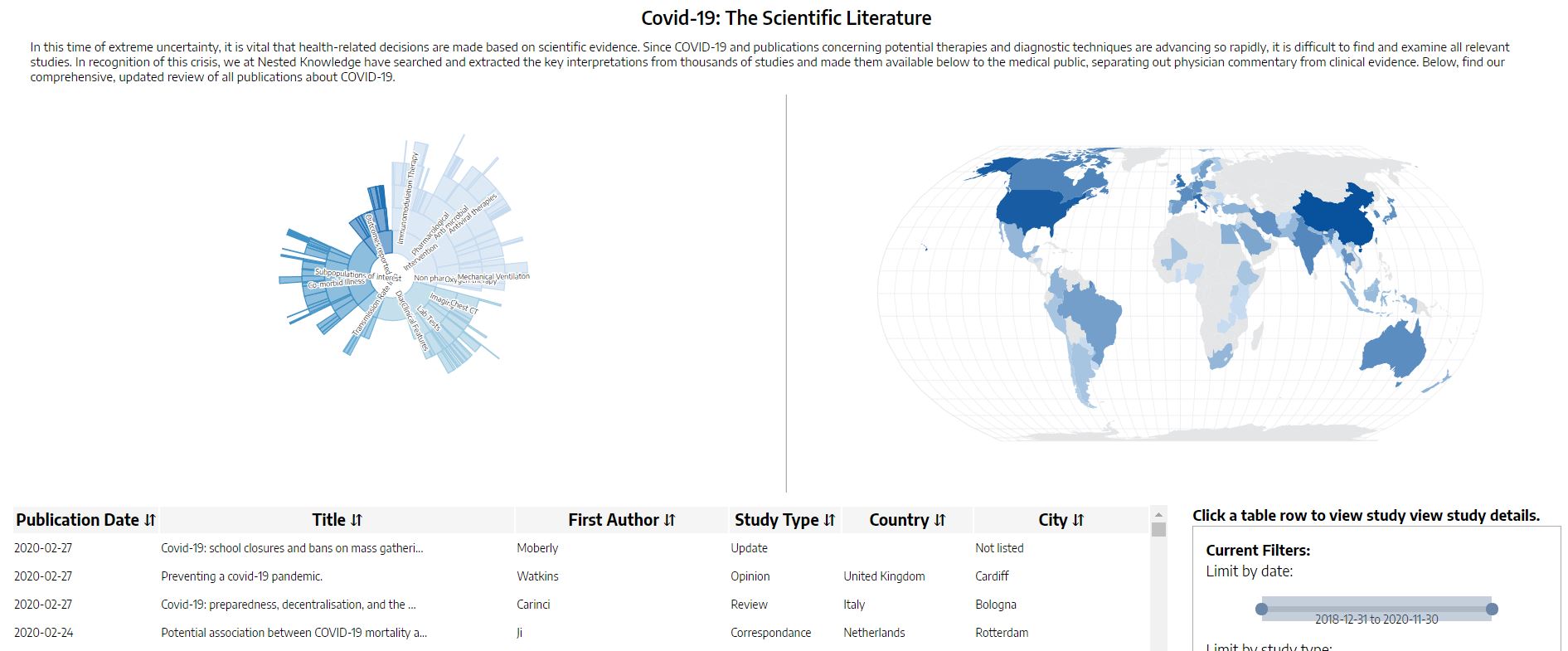
That is why I launched StudyViz, a new product that enables physicians to build an updatable visualization of all studies related to a topic of interest. Then, my physician collaborators built just such a visual for COVID-19 research, presenting a sunburst diagram that users can select to identify their research question of interest.

Studyviz sunburst

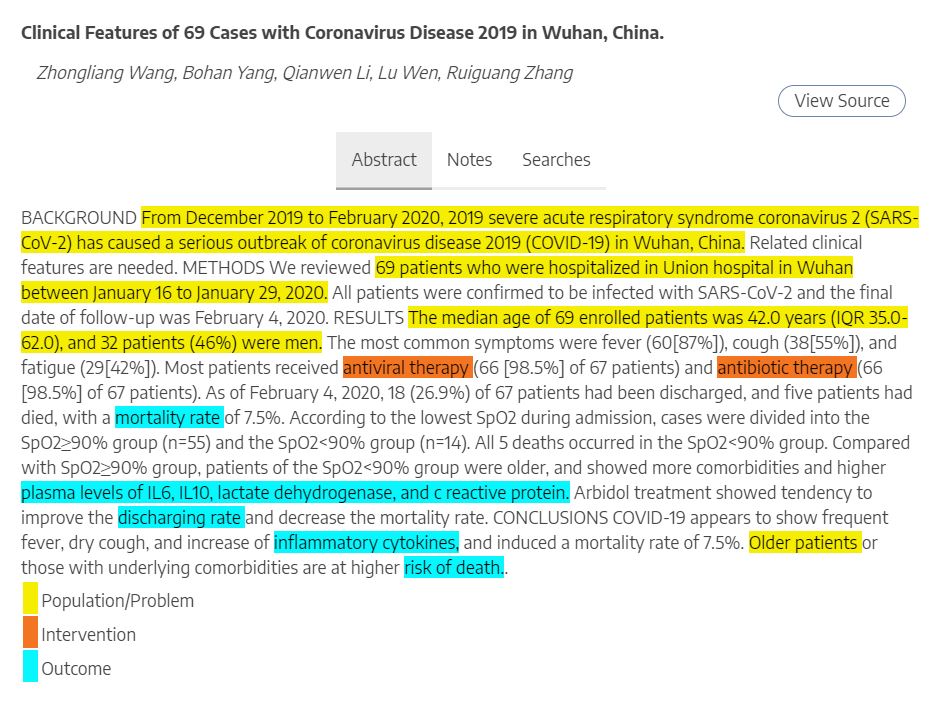
For instance, if you are interested in the impact of COVID-19 on pregnant patients, just go to “Subpopulations” and find “Pregnancy” (or neonates, if that is your concern). We nested the tags so that you can “drill down” on your question, and so that related concepts are close to each other. Then, to view the studies themselves, just click on them to see an abstract with the key info (patients, interventions, and outcomes) highlighted:

Abstract

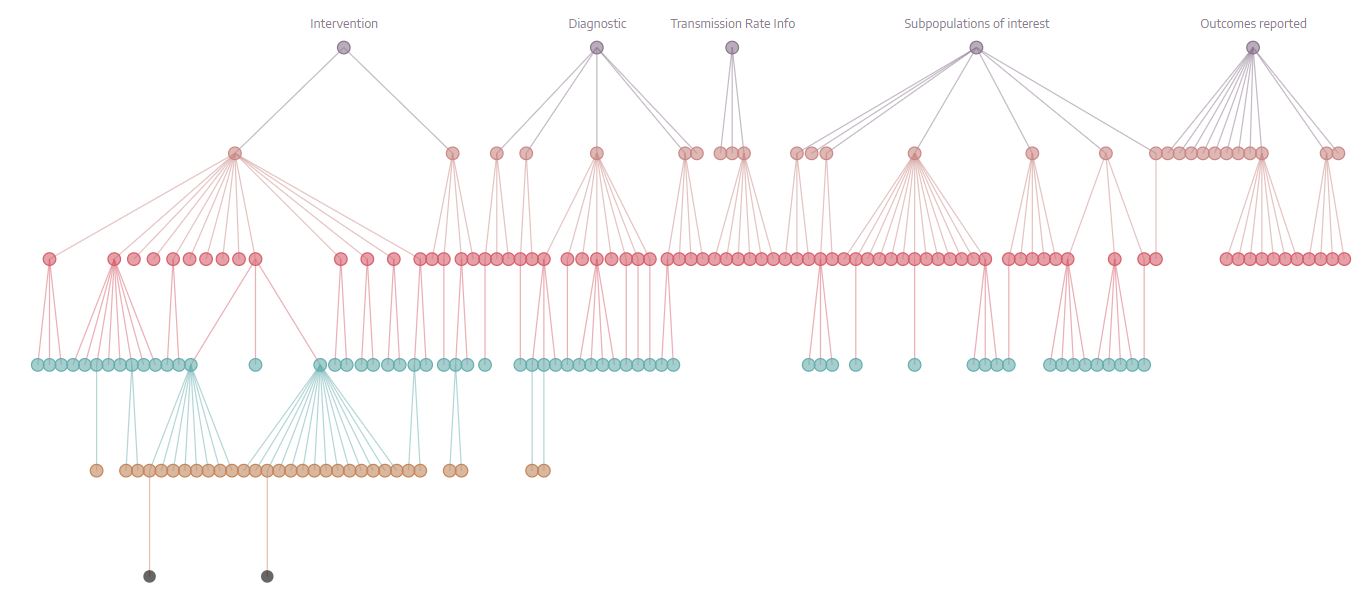
This is based on a complex concept hierarchy built by our collaborators and that is constantly evolving as the literature does:

Hierarchy

Even beyond that, we opened up our software to let any researchers who are interested build similar visuals on any disease state, as COVID-19 is not the only disease for which organizing and accessing the scientific literature is important!

We are seeking medical coinvestigators–any physician interested in working with us, simply email contact@nested-knowledge.com or contact us on our website!

Pathologies in higher education: a book, a review, and a comment

Cracks in the Ivory Tower, by Jason Brennan and Phillip Magness, brings a much needed discussion of the pathologies of US higher education to the table. Brennan and Magness are two well-known classical liberals with a strong record of thoughtful interaction with Public Choice political economy.

Public Choice is an application of mainstream economic concepts to political situations. One of the key points of Public Choice is that people are self-interested and rational. This drives the choices they make. But people also act within formal and informal institutional environments. This constrains and enables some of their choices to a large degree. In other words, people react to incentives.

The Public Choice approach is not so much a normative handbook, but rather an attempt to explain how politics operate. The application of this theory to understand higher education in the US is a welcome addition to a growing literature on the economics of higher education.

It is perhaps surprising how the subtitle of the book stresses an aspect that tends to be extraneous to Public Choice scholarship: “The Moral Mess of Higher Education”. Of course we all draw on moral reasoning and assumptions in order to pass judgment on economic and political phenomena, but normally the descriptive side is kept separate – at least by economists – from explicit value judgment.

John Staddon, from Duke University, has reviewed Brennan’s and Magness’ book. In his review, he focuses on three main key issues. First, colleges and universities act on distorted incentives created, for example, by college rankings, to recruit students in ways that are not necessarily related to maintaining or expanding the academic prestige of the institution.

Second, teaching in higher education, at least in the US, is poorly evaluated. Historically, it has shifted from student evaluation to administrative assessment.

So why the shift from student-run to administration-enforced?  And why did faculty agree to give these mandated evaluations to their students? Faculty acquiescence — naiveté — is relatively easy to understand. Who can object to more information? Who can object to a new, formal system that is bound to be more accurate than any informal student-run one? And besides, for most faculty at elite schools, research, not teaching, is the driver. Faculty often just care less about teaching; some may even regard it as a chore.

The incentives for college administrations are much clearer. Informal, student-run evaluations are assumed to be unreliable, hence cannot be used to evaluate faculty for tenure and promotion. But once the process is formalized, mandatory, and supposedly valid, it becomes a useful disciplinary tool, a way for administrators to control faculty, especially junior and untenured faculty.

This is not necessarily conducive to improvement in the quality of teaching. Perhaps colleges fare better than universities here, given that their faculty is not expected to allocate a large amount of hours per week to research and writing.

Third, Brennan and Magness offer a critique of what is known in the US system as “general education” courses. In their view, it is clear that those courses are unhelpful in a world where academic disciplines are increasingly more specialized. However, offering those courses is a good excuse for universities to grab more money from the students.

This is where Staddon begs to differ:

Cracks in the Ivory Tower usefully emphasizes the economic costs and benefits of university practices. But absent from the book is any consideration of the intrinsic value of the academic endeavor. Remaining is a vacuum that is filled by two things: the university as a business; and the university as a social activist.  Both are destructive of the proper purpose of a university.

I tend to agree with this point, and I do not think it is a minor point. We can do colleges and universities without football, without gigantic administrative bureaucracies, and without the gimmicks to game the college ranking system. I could even go further and argue that we should do colleges and universities without dorms and an artificial second and worse version of teenage years right when students are supposed and expected to behave like adults. Getting rid of those tangential features of US higher education should help refocus on knowledge and reduce the cost.

Colleges and universities in the US are also expensive and unnecessarily inflated because of the structure of the student loans system, which also generates perverse incentives. But this point has been explained and described to exhaustion in the economic literature. This also has to change.

However, I am not convinced that making universities focus on professionalizing their students would be the best way to go. Brennan and Magness raise some important issues and concerns, some of which also apply outside the US, but the Staddon highlights in his review an important counterpoint: higher education, at least on the undergraduate level, shouldn’t be seen 100% as an investment good, but also as a consumer good:

Higher education does not exist for economic reasons. It exists (in the famous words of Matthew Arnold) to transmit “the best that has been thought and said,” in other words the ‘high culture’ of our civilization. Job-related, practical training is not unimportant. Universities, and much else of society, could not exist without a functioning economy. But — and this point is increasingly ignored on the modern campus and by the authors of CIT — these things are not the purpose, the telos if you like, of a university.

Undergraduate education is there to hand over knowledge to the next generation. It can be small and cheap. You need an adequate building, a small library with the best classic books, electronic access to journals, and faculty that excels at teaching. Courses would be general, comprehensive, and interdisciplinary by definition. The program could last only three years. An optional additional year could be offered to those with an academic profile, where they could pursue more specialization as a bridge to graduate education.

This is more or less the mediaeval model. I am not sure we need to reinvent the wheel in order to deal with the crisis of higher education. What we need is to get back on track – back to the bread and butter of college education. This is a reflection that both sides of the story – those who demand education and those that offer it – need to make.


Read more:

In a recent contribution to Notes on Liberty, Mary Lucia Darst has recently commented on the status of higher education during the 2020 pandemic and prospects for the future.

I also wrote about the college trap in the US a few years ago.
Nightcap (again)

(Ooops, lol. I hope all of NOL‘s American readers had a good Memorial Day, and that everybody else had a good Monday. The Glasner piece is an excellent discussion of the Austrian School of Economics.)

  1. An Austrian (School) tragedy David Glasner, Uneasy Money