- A murder in outer space? What about the Arctic? Sam Kean, Slate
- Russians, racism, and international relations Lisa Gaufman, Duck of Minerva
- Implicit and structural witchery Bryan Caplan, EconLog
- An anthropology of childhood The Whole Sky
Year: 2020
Nightcap
- Gold buggers Nathan Lane, Los Angeles Review of Books
- The fractured land hypothesis (pdf) Koyama et al, NBER
- Territoriality and beyond (pdf) John Gerard Ruggie, Int’l Org
- Revenge of the nation-state Helen Thompson, New Statesman
Nightcap
- Cancel Culture and the discourse of Ad Hoc-ery Irfan Khawaja, Policy of Truth
- Should we admire the Vikings? Rebecca Onion, Slate
- A new theory of Western civilization Judith Shulevitz, Atlantic
- Our brave new remote work world Robin Hanson, Overcoming Bias
A short note on great journalism
I recently linked to an excellent piece on colonial history the other day that I thought was worth your time. Not because it was going to blow you away with facts or knowledge, but because it represented what I think good journalism is.
Now, the fact that good journalism is difficult to find in the Anglo-American press is noteworthy. It’s not that we don’t have great public intellectuals, or even a great media ecology and access to all of the knowledge in the world. We do. It’s that our traditional media institutions have thought of themselves as truth-tellers and centrists since World War II. This conceit has allowed journalists to move steadily to the Left without having to qualm morally about doing so. The problem with Anglo-American journalists is that they think their worldview represents the center of everything.
Nightcap
- David Graeber, 1961–2020 New York Review of Books
- Eat the Buddha: China & Tibet Rana Mitter, Literary Review
- Understanding the path to Iraq Joseph Stieb, WOTR
- Against space exploration Andrew Szarejko, Law & Liberty
Casey Peterson, Cultural Marxism, and the Goliath of the Diversity Industry
For the past several weeks, Casey Peterson, an electrical engineer in prestigious Sandia Labs (one of the hubs of the federal military industry) has been risking his career to fight mandated ideological training that promotes the systemic racism conspiracy theory and requires from white employees to exorcise their “whiteness.” Pushed by “diversity” commissars from equity/diversity departments, this reeducation campaign based on the Critical Race Theory (Cultural Marxism) spreads like fire over our federal, state, and corporate institutions. Any objections to the mandated indoctrination are considered insubordination and involve disciplinary actions. Many intimidated employees of the Labs secretly showed Peterson their support. But the “diversity” commissars retaliated, putting him on an administrative leave and removing his security clearance. Peterson does not give up. Will he become an American Andrei Sakharov? This Soviet nuclear physicist put his career and elite privileges on line to challenge the suffocating communist ideology in the 1970s-1980s; the Soviets retaliated by removing Sakharov from his job, stripping him of his awards, and putting him under a house arrest.

Politically Incorrect Research: What Scholars Have to Say about the Diversity Propaganda Industry
The recent critical research of the diversity industry, which was conducted by Frank Dobbin and Alexandra Kalev (2016), American and Israeli sociologists, has confirmed existing concerns about the corrosive effects of mandating this industry. These scholars, who explored the mandatory diversity programs in 816 companies, came to conclusion that command-and-control diversity quota-oriented programs were counterproductive. Set to reward, discipline, and punish managers and employees, these programs were in fact breeding fear, animosity, and distrust. The scholars also stressed that, neglecting an individual merit approach, such mandated diversity amplified gender, ethnic, and racial “tribalism.” The ultimate verdict Dobbin and Kalev issued was quite devastating for the whole multi-million diversity industry in the United States.
Particularly, they stressed that, contrary to rosy mainstream perceptions, American experience in enforcing diversity miserably failed, and it could not serve as a policy blueprint for other countries. The researchers have also suggested that the best possible option in this situation would be to “decentralize” the whole diversity machine and let people on the ground decide for themselves how they wanted to reach its goals. My assumption is that in each university, corporation, school, and institution people should be free to choose and vote (by a secret ballot) on whether they want and need the “diversity” training. From what we saw in the Sandia Labs, the employees had no say about the reeducation campaign the corporate diversity commissars arbitrarily imposed on them.
Although wrapped into a cautious academic prose, research conducted by a group of social psychologists headed by Leigh Wilton (Wilton 2018; Jacobs 2018; Good 2018) produced even more devastating conclusions, which in fact had been obvious to any critical-minded person. For the first time targeting the entire multiculturalism ideology, the Wilton research team set out to explore whether the promotion of “diversity” reduced or enhanced a fixation on race on a popular level. Exploring two large groups of people (students and adult non-students), Wilton and her colleagues found out that making people think about racial and cultural differences on a permanent basis hammered in their minds the idea that these differences were central, vital, and crucial. Obviously, to safeguard themselves, Wilton (2018) and her team included such disclaimers as “We do not mean to imply that multiculturalism should be universally discarded” and “Neither multiculturalism nor color blindness offers a simple panacea for improving diversity.” Still, they have been adamant in their conclusion that, as an unintended consequence, the engineering “diversity” from above enhanced racial essentialism and that “the primacy of Multiculturalism as a mechanism for prejudice reduction or racial inequality is not without question.” They also stressed that, in contrast to a color-blind approach that mutes the fixation on race, the whole “diversity” message amplifies group differences and may lead to negative inter-group outcomes.
One of the natural political side effects of the persistent cultivation of “non-White” identity, attempt to impose it on the rest of society, aggressive rhetoric against “white privilege,” and the promotion of the systemic racism conspiracy theory was the emergence of so-called alt-right White Power movement – a mirror image of the Black Power, Latino Power and similar identity movements among the people of “color.” Left writer Anis Shivani stressed that by inflaming and empowering the racial and ethnic identity of the “underprivileged,” the cultural left opened the identitarian Pandora’s box, which naturally leads to legitimization of “blood,” “soul,” and “soil” agenda in American politics. Shivani, who became upset about the identitarian turn of his comrades, has stressed that under those circumstances, it is quite natural that “the rise of each group in terms of recognition encourages countervailing reactions amongst other groups, so that recognition becomes simultaneously self-inflating (breeding reactionism and irrationality) and an impossible ideal to attain. Again, the rise of white nationalism recently is a testament to this tendency, a natural corollary to the very logic of identity politics.”
Intellectual Sources of the Diversity Industry
One of the major intellectual sources of the mandated “diversity,” which has been superimposed on our society, go back to the frustration of the left about traditional class-based socialism that had occupied the dominant position in the old intellectual mainstream. The ole left privileged the industrial working class (or proletariat, according to the traditional Marxist jargon) as the primary victim of and simultaneously the humankind’s redeemer from capitalism. To the dismay of the left, Marx’s prophecy about the skyrocketing misery of the proletariat under capitalism miserably failed. On the contrary, the Western labor dramatically improved its living conditions and lost its revolutionary vitality.
For this reason, in the 1960s and the 1970s, the Western left were gradually ditching the industrial working class, finding instead new kinds of “noble savages” in the Third World and at home among such groups as people of “color,” women, gays, and later in the alphabet soup of newly emerging groups that too claimed a victimhood status. Along with the Third World, these segments of population were singled out as the new victims of and simultaneously redeemers from the capitalist oppression. To be exact, since the 1960s, for the New Left it was not so much capitalism but rather the entire Western civilization that became the major culprit. In contrast to the old left who were fixated on material progress, the New Left, on the contrary, came to criticize progress and materialism as spiritually corrupt to authentic and progressive lifestyles. Such new attitude helped make an ideological switch from the class-based economic agenda to cultural issues.
Conservatives and libertarians have referred to that cultural turn among the Western progressives as Cultural Marxism. The current mainstream left, who are frequently not aware of or do not want to be reminded of their genetic links with classical Marxism, object to the use of this term. Instead, they prefer to operate with such broad expression as “Critical Theory” or with more specific definitions such as “Critical Cultural Studies,” “Critical Racial Studies,” “Critical Legal Studies,” and so forth. For the best critical review of the Critical Theory, its rise, and the present-day state of the woke left, see Helen Pluckrose and Jack Lindsay, Cynical Theories: How Activist Scholarship Made Everything about Race, Gender, and Identity-and Why This Harms Everybody (2020). The Critical Theory, which claims the supreme knowledge, is notoriously uncritical toward itself; this brings to mind Vladimir Lenin, the chief of the Bolsheviks who once uttered, “The Marxist doctrine is omnipotent because it is true.”
Since in the past the domestic people of “color” in Western countries and the Third World people were the objects of Euro-American racism and colonialism, progressive proponents of the Critical Theory (Cultural Marxism) take it for granted that such things as bigotry, racism, oppression are “white” Western phenomena. As designated victims, the emerging Third World nations, domestic people of “color” along with sexual minorities are thought to be on the righteous side incapable of any wrongdoing. In other words, the cultural left created the “aristocracy of the outcasts.” This explains, for example, why the left frequently downplay the brutal treatment of women and gays in Islamic societies and so-called hate crimes (and crimes in general) perpetrated by the representatives of the “victim” groups inside Western countries (for example, Muslim immigrants in France and Sweden or blacks in the United States). To the most ardent proponents of “diversity,” non-Western societies serve as carriers of profound spiritual wisdom and collectivism that serve to educate “rotten” and “materialist” West about better forms of life.

The Rise of the Diversity Industry and the Multiculturalism Ideology
By the end of the 1970s, American administrative and judicial system saw the emergence of “commissars of diversity” – a network of federal, state, and educational bureaucracies that were empowered by laws, institutions, and media outlets to police racial, ethnic, and gender representation both in public and private sector. The regime of the racial segregation that had existed in the South prior to the 1950s offended American sensibilities to such an extent that both the congress and the “white” majority, driven by the profound guilt feelings, voluntarily accepted special measures designated to correct historical injustice and uplift people of “color.” Little thought was given to the fact that to fight racism and sexism with racism and sexism was a flawed strategy and that well-meant and benevolent measures did not necessarily produce benevolent outcomes.
The system of job, business contract, and education quotas and preferences introduced in the 1970s through affirmative action programs were thought to be temporary measures that were to “upgrade” selected minorities. Yet, as it frequently happens, the temporary measures were institutionalized and eventually became a permanent part of American polity, producing an overall corruptive effect on society. It not only led to the emergence of the alphabet list of new groups that were eager to claim a victimhood status to secure moral, political, and economic benefits, but it also resulted in mass economic and educational fraud. For example, thousands of dark-skinned immigrants began posing as “black” to fit in the officially established “ethno-racial pentagon” classification that was introduced by the Office of Budget and Management (OBM) in 1977 for policy goals.

This OBM Statistical Policy Directive No. 15 (“Race and Ethnic Standards for Federal Statistics and Administrative Reporting”) pigeonholed Americans into specific racial categories, which people were encouraged to fit themselves in: white (WASPs), black (African-Americans), brown (Hispanics), yellow (Asians), and red (Native Americans). The official goal was to standardize available statistics to conduct efficiently affirmative action and other race-conscious policies. One can consider the year of 1977, when this directive was introduced, a symbolic landmark when “diversity” became the guiding light for the entire political and economic establishment in US. Eventually, this ethno-racial “pentagon” system became so entrenched into American polity that it came to play the role of standard lenses through which both Democratic and Republican elites began to screen their decisions on all kinds of economic and social issues.
At this point of our history, we already can talk about the existence of the mainstream multicultural ideology that crusades against Western values, and that is fixated on promoting group identity at an expense of an individual. This ideology uses the slogan of toleration to maintain itself as the hegemonic force (pardon my leftist jargon) in our society. Consequently, those who object that ideology and call for the treatment of people as individuals based on their merit are labeled as racist and intolerant people. This explains the reticence and fear both in society and especially among bureaucrats to question the dubious nature of the whole project. By the way, that was precisely the niche that Cultural Marxists from BLM were able to use to wiggle themselves into the mainstream and to successfully intimidate a large part of American society into submission.
The “diversity” machine and the multicultural ideology created by that machine by now acquired a life of their own. It is a vivid an example of how seemingly benign initiatives, which had been originally established to resolve an specific urgent problem, lead to unanticipated consequences. As such, the whole situation serves as the illustration of the old wisdom: the road to hell is paved with good intentions.
In addition to influential racial and ethnic lobby groups, this machine now includes a large apparatus in federal, state, university, and corporate institutions. For example, by 2018, at the University of California, Berkeley, the number of diversity bureaucrats increased up to 175 people. Many of them generate high salaries. Thus, a diversity chief at the University of Michigan makes $385,000 a year (“The Rise of Universities’ Diversity Bureaucrats”). For this omnipotent bureaucracy, amplifying identity politics and dramatizing ethnic, racial, and gender issues became one of the major ways to stay in power and secure the continuing flow of finances both from government and private donors.
One can divide the institutions that promote the “diversity” creed in the United States into three large units. The first is represented by watchdog institutions (Human Resources (HR) and Office of Economic Opportunity (OEO) or equity departments) that gather statistics on how well major racial, ethnic and gender groups are represented in all walks of life. HRs and equity offices are weaponized institutions that not only collect relevant data and set codes of behavior but also police and penalize bureaucrats and individuals who do not comply with prescribed ideological regulations and imposed quotas (Jeb Kinnison, Death by HR (2016). The HR and equity/OEO desks share the job of supervision over personnel and its activities. Like HR, equity desks and offices exist in all American federal, state, educational, and in many corporate institutions.
The second group of institutions is represented by various Multicultural desks and offices that are specialized in popularizing non-Western cultures and lifestyles by organizing, for example, various ethnic, racial, and gender festivals and fairs. These cultural events are usually focused on the valorization of selected cultures and their representatives, which are frequently set into the context of victimhood, oppression, and resistance. For example, my first introduction to one of such festivals, which took place in Ohio in 1994, was a visit to a Latin American multicultural festival that was celebrating generic Latino legacy. At the entrance, visitors were welcomed by a huge banner with the following phase, “Latin America: 400 Years of Resistance.” To this, my Puerto-Rican colleague sarcastically remarked, “Why resistance? Resistance to what and against whom?” A small example of cultural activism supported by those desks is a campaign of moral shaming of people for so-called cultural appropriation. For those who are not yet familiar with this most recent meme of the cultural left, I want to explain that any “white” person who publicly dons “non-Western” garb or attire (e.g. Mexican sombrero, Japanese kimono, Afro-American dreadlocks) automatically becomes a racist “colonizer” who “steals” and “appropriates” from the victims of “color.”
The third component of the multicultural “diversity” ideological machine is represented by various identity studies departments such as Black, Hispanic, Native American, and Women Studies (Bruce Bawer, The The Victims’ Revolution: The Rise of Identity Studies and the Closing of the Liberal Mind (2012). Pioneered in the 1960s as special university-based programs that were expected to inject existing college curricula with non-Western and female perspectives, many of them eventually acquired not only the status of regular university departments but turned into ideological units. These programs openly declare that their major goal is not traditional academic pursuits but rather activist scholarship. The latter heavily relies on the above-mentioned Critical Theory methods, which had been pioneered by Herbert Marcuse and like-minded post-Marxist writers

In other words, identity studies are focused on providing an ideological back up to specific racial, ethnic, and gender agendas. The practitioners of identity studies are preoccupied with the critique of what they define as “white” Western civilization and hegemony. Simultaneously, they valorize non-Western cultures and lifestyles that they define as progressive and spiritually enhancing. From the partisan “diversity” perspective, the cultivation of ethno-racial consciousness and solidarity for designated “non-White” and “non-Western” groups is progressive and desirable, whereas a color-blind individualistic approach is treated as racist and reactionary.
Moreover, for the past fifty years, mainstream humanities disciplines such as sociology, literary studies, American studies, geography, anthropology, social work, and especially education acquired a similar ideological “diversity” bent that one can find in abundance in the identity studies. The social scholarship too heavily assimilated Critical Theory into its methodology and became fixated on searching for the signs of racial, ethnic, and gender oppression both in the past and in the present in all walks of surrounding life.
The threat to our liberty comes from the fact that the greater part of the cadre, which now works in our government, law firms, and corporate world, are former college graduates who internalized memes and precepts propagated by the Critical Theory scholarship and made them the new normal. Many of them are sincerely convinced that they must change the surrounding life according to the ideological prescriptions of “multiculturalism” by promoting the group (racial, gender, ethnic) justice and arbitrarily dividing our society into the classes of the “oppressed” and “oppressors.” The latter, according to Marcuse who was one of the founders of the Critical Theory, must be shut down and canceled by all means available. This means that the core values of the Western civilization are now at stake (the rule of law, freedom of speech, checks and balances, and the very institute of elections).

On a final note, responding to the rising tide of mandated “diversity” reeducation programs, on September 4, the US Office of Budget and Management issued a memorandum to stop wasting tax dollars for all race-bating “training” that is based on the ideology of the Critical Theory and that is focused on bashing “whiteness” and Western values. Of course, it is ridiculous to assume that one can simply ban an ideology; it will take years and years to dismantle the “diversity” industry and its ideological apparatus. Yet, as a first step, that measure is essential for our entire political and economic system. The current administration has sent a clear signal to the “deep state” bureaucrats, who are opportunistic by their very nature, that the woke “repressive tolerance” of the cultural left will not be tolerated anymore. If we push further in this direction, there is a hope that we shall overcome.
Nightcap
- Race is front and center in French elections Méheut & Onishi, NY Times
- Japan’s new PM is libertarianish Scott Sumner, EconLog
- The values of democracy, and a vote Chris Freiman, 200-Proof Liberals
- Objective fouls and the rule of law Tyler Cowen, MR
Game theory in the wild
Game theory is an amazing way to simulate reality, and I strongly recommend any business leader to educate herself on underlying concepts. However, I have found that the way that it is constructed in economic and political science papers has limited connection to the real world–apart from nuclear weapons strategies, of course.
If you are not a mathematician or economist, you don’t really have time to assign exact payoffs to outcomes or calculate an optimal strategy. Instead, you can either guess, or you can use the framework of game theory–but none of the math–to make rapid decisions that cohere to its principles, and thus avoid being a sucker (at least some of the time).
As Yogi Berra didn’t say, “In theory, there is no difference between practice and theory. In practice, there is.” As a daily practitioner of game theory, here are some of its assumptions that I literally had to throw out to make it actually work:
- Established/certain boundaries on utility: Lots of games bound utility (often from 0 to 1, or -1 to 1, etc. for each individual). Throw away those games, as they preferenced easier math over representation of random, infinite realities, where the outcomes are always more uncertain and tend to be unbounded.
- Equating participants: Similar to the above, most games have the same utility boundaries for all participants, when in reality it literally always varies. I honestly think that game theorists would model out the benefits of technology based on the assumption that a Sumerian peasant in 3000 BC and an American member of the service economy in 2020 can have equivalent utility. That is dumb.
- Unchanging calculations: In part because of the uncertainty and asymmetries mentioned above, no exact representation of a game sticks around–instead, the equation constantly shifts as participants change, and utility boundaries move (up with new tech, down with new regs, etc). That is why the math is subordinate to structure: if you are right about the participants, the pathways, and have an OK gut estimate of the payoff magnitudes, you can decide rapidly and then shift your equation as the world changes.
- Minimal feedback/second order effects: Some games have signal-response, but it is hard to abstract the concept that all decisions enter a complex milieu of interacting causes and effects where the direction arrow is hard to map. Since you can’t model them, just try to guess–what with the response to the game outcome be? Focus on feedback loops–they hold secrets to unbounded long-term utilities.
- The game ends: Obviously, since games are abstractions, it makes sense to tie them up nicely in one set of inputs and then a final set of outputs. In reality, there is really only one game, and each little representation is a snapshot of life. That means that many games forget that the real goal of the game is to stay in it.
These examples–good rules of thumb to practitioners, certain to be subject to quibbling by any academic reader–remind me of how wrong even the history of game theory is. As with many oversights by historians of science, the attribution of game theory’s invention credits the first theoretician (John von Neumann, who was smart enough to both practice and theorize), not the first practitioner (probably lost to history–but certainly by the 1600’s, as Pascal’s Wager actually lines up better with “game theory in the wild” in that he used infinite payoffs and actually did become religious). Practitioners, I would ignore the conventional history, theory, actual math, and long papers. Focus on easily used principles and heuristics that capture uncertainty, unboundedness, and asymmetries. Some examples:
- Principle: Prediction is hard. Don’t do it if you can help it.
- Heuristic: Bounded vs. Unbounded. Magnitude is easier to measure (or at least cap) than likelihood is.
- Principle: Every variable introduces more complexity and uncertainty.
- Heuristic: Make decisions for one really good reason. If your best reason is not enough, don’t depend on accumulation.
- Principle: One-time experiments don’t optimize.
- Heuristic: If you actually want to find useful methods, iterate.
- Principle: Anything that matters (power, utility, etc.) tends to be unequally distributed.
- Heuristic: Ignore the middle. Either make one very rich person very happy (preferred) or make most people at least a little happier. Or pull a barbell strategy if you can.
- The Academic Certainty Principle: Mere observation of reality by academics inevitably means they don’t get it. (Actually a riff on observer effects, not Hiesenberg, but the name is catchier this way).
- Heuristic: In game theory as in all academic ideas, if you think an academic stumbled upon a good practice, try it–but assume you will need trial and error to get it right.
- Principle: Since any action has costs, ‘infinite’ payoffs, in reality, come from dividing by zero.
- The via negativa: Your base assumption should be inaction, followed by action to eliminate cost. Be very skeptical of “why not” arguments.
So, in summary, most specific game theories are broken because they preference math (finite, tidy, linear) over practice (interconnected, guess-based, asymmetric). That does not mean you can’t use game theory in the wild, it just means that you should focus on structure over math, unbounded/infinite payoffs over solvable games, feedback loops over causal arrows, inaction over action, extremes over moderates, and rules of thumb over quibbles.
Good luck!
Nightcap
- How David Graeber changed the way we see money Matthew Zeitlin, New Republic
- What’s wrong with “cancel culture,” again? Irfan Khawaja, Policy of Truth
- Why socialists should care about about American federalism Chris Maisano, Jacobin
- In loving memory of David Graeber Andrej Grubačić, PM Press
Nightcap
- The iron wall versus the villa in the jungle Michael Koplow, Ottomans & Zionists
- The pragmatic case for a unitary executive John McGinnis, Law & Liberty
- Catholic Social Teaching in the West today Bernard Prusak, Commonweal
- Ayn Rand’s philosophy might be questionable – but what about her prose? Sam Leith, TLS
Nightcap
- William T. Sherman’s reputation precedes him Susan-Mary Grant, History Today
- The urgency of racial disparities Arnold Kling, askblog
- On Marxist Tories Chris Dillow, Stumbling & Mumbling
- The theological roots of the secular world order Nathaniel Peters, Law & Liberty
Nightcap
- Adele and the local nature of social norms Lauren Hall, RCL
- The evolution of a legal rule (pdf) Niblett, et al, Journal of Legal Studies
- Covid and the counterfactual, and the longer term Eric Crampton, Offsetting Behaviour
- The last great theorist of history Stefan-Ludwig Hoffmann, Aeon
Why the US is behind in FinTech, in two charts
The US is frankly terrible at innovation in banking. When Kenya (and its neighbors) has faster adoption of mobile banking–as they have since at least 2012–it is time to reconsider our approach.
Here is the problem: we made new ideas in banking de facto illegal. Especially since the 2008 financial crisis, regulatory bodies (especially the CFPB) has piled on a huge amount of potential liability that scares away any new entrant. Don’t believe me? Let’s look at the data:

Notice anything about new bank creation in the US after 2008?
A possible explanation, in a “helpful resource” provided to banking regulators and lawyers for banks:
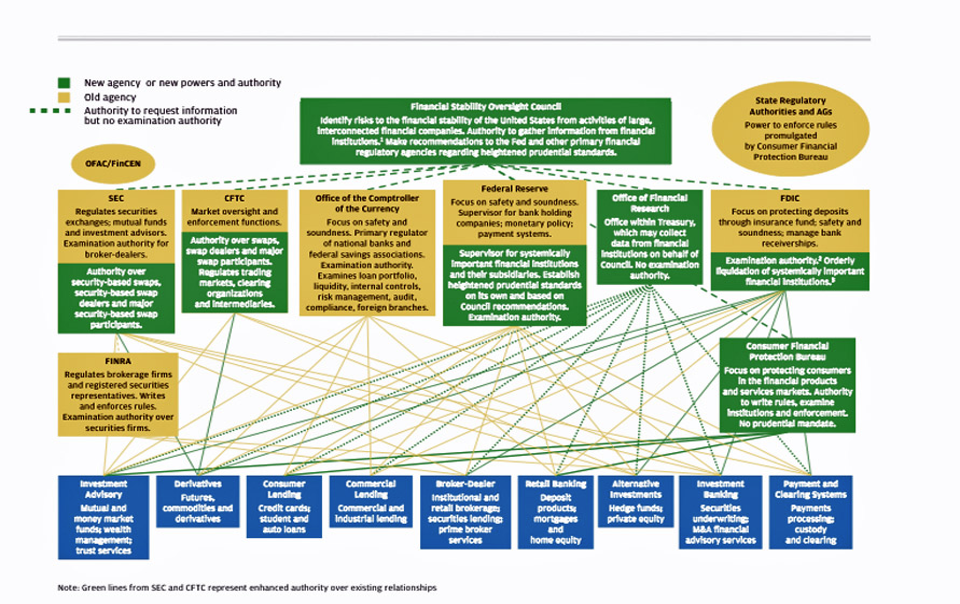
This shows: 8 federal agencies reporting to the FSOC, plus another independent regulatory body for fintech (OFAC/FinCEN). Also, the “helpful” chart notes state regulations just as an addendum in a circle…probably because it would take 50 more, possibly complex and contradictory charts.
So, my fellow citizens, don’t innovate in banking. No one else is, but they are probably right.
Nightcap
- On cancel culture Irfan Khawaja, Policy of Truth
- Why I lean libertarian Arnold Kling, askblog
- Colonialism and economic development Lipton Matthews, Mises Wire
- Speculation about Greece and Turkey Koert Debeuf, EUObserver
Nightcap
- New York’s second “Drop Dead” moment is here Yves Smith, Naked Capitalism
- Modi takes another step towards a ‘Hindu India’ Mohamed Zeeshan, Haaretz
- Prospects for an independent Kurdistan Mohammad Kareem, LSE
- No sex please, this is Korea Colin Marshall, Los Angeles Review of Books
 Notes On Liberty