RCH: the Ottoman Empire

My subject for this weekend’s RealClearHistory column is battles that shaped the Ottoman Empire. Here is an excerpt:

On June 4, 1915, the Third Battle of Krithia was fought between the Ottoman Empire and its Allied enemies, composed of mostly French and British troops. The Ottomans won, handily and somewhat surprisingly. The Allies had to retreat and regroup as a result, and the Balkans campaign had to go through a more careful re-think by Allied strategists.

World War I marked the end of the Ottoman Empire, of course, but the “sick man of Europe” had more fight in it than many Western historians give it credit for. Scholarship on the Ottoman Empire has improved over the years, but there is still plenty of opportunity to do more. The Ottoman Empire spanned three continents, after all, and lasted for 623 years.

The Ottoman Empire was actually one of three multi-ethnic, multi-religious empires in Europe that perished as a result of World War I, along with Austria-Hungary and tsarist Russia. To the east of the Ottomans were two other, long-lasting empires, the Persian empire ruled by the Qajar dynasty (which perished in 1925) and the Mughal empire of India (which perished in 1857). These eastern empires are referred to by many historians as “gunpowder empires” and they controlled the Eurasian trade routes that Chinese and especially European merchants used for exchanging goods and ideas. Here are 10 battles that shaped the Ottoman Empire:

Please, read the rest. And have a good weekend.

Nightcap

  1. Tech platforms and the knowledge problem Frank Pasquale, American Affairs
  2. Exploring the New Science of Psychedelics Mick Brown, Literary Review
  3. A new history of Islamic mysticism Kamal Gasimov, Voices on Central Asia
  4. Within the triangle of politics, philosophy, and religion Aurelian Craiutu, Law & Liberty

Nightcap

  1. Britain’s Open Doors Policy Chris Dillow, Stumbling and Mumbling
  2. About those Ancestry dot com commercials… Ryan Anderson, Anthro{dendum}
  3. The Unfinished World Nick Nielsen, The View from Oregon
  4. “State Capacity” is Sleight of Hand Bryan Caplan, EconLog

Nightcap

  1. The secrets of Katyn Louis Proyect, CounterPunch
  2. Europe’s curse of wealth Branko Milanovic, globalinequality
  3. The new Europeans Christopher de Bellaigue, NY Review of Books
  4. Nuclear diplomacy between Brazil and Argentina Sara Kutchesfahani, War on the Rocks

Turkey elections: Elections, Rappers, Media, Micro-Party, Rigging, Iraq

The Turkish State’s War On Rap

The election campaign has not slowed down the Erdoğanist state in its efforts to punish anyone who deviates from Erdoğan’s ideal of obedient, socially conservative, and conformist citizens. One of the best known Turkish rappers, Ezhel, with very leftist and counter culture lyrics, has been arrested recently for ‘encouraging drug use’. A prosecutor ordered his detention, which was implemented after he voluntarily went to the police station to answer a ‘complaint’, with no warning about detention. Onur Dinç (known as Khontkar), and Young Bego have also been detained. They can all be found on Spotify and YouTube. Listening on Spotify generates a little income for people who deserve a bit of solidarity at the moment.

İnce’s Presidential Campaign

An interview on HaberTürk TV with the leading opposition candidate for President of Turkey, Muharrem İnce (from the secularist, centre-left Republican People’s Party), has gone down very well. The interviewers let İnce express his views and had a selfie with him afterwards. HaberTürk TV is a private channel but, like all commercial private channels, accepts (and has no real choice) the biases and silences imposed by the Erdoğanist-AKP regime.

It is normal for Erdoğan himself to phone media groups and complain about coverage, demanding firings of journalists, where the bias is not as complete as he requires. So how long are these journalists, and the responsible manager, going to survive? A manager on another private channel was fired (officially ‘left for personal reasons’, ha ha ha) after allowing a very brief segment on the second most popular opposition, and more right wing, candidate, Meral Akşener. Will these HaberTürk people survive until the election? Are they more willing to push the limits because the opposition is doing better than expected?

On recent polls (leaving aside companies who enjoy close relations with the Erdoğanists) only rigging (or some extreme situation) can now stop 1. the opposition winning a majority in the National Assembly (could be stopped on current polling by stealing/losing about 2/3% points from HDP, a Kurdish rights-leftist party which appears to be between 1 and 3% points above the 10% election threshold). The main left-right opposition list seems to be about 3 points behind the right wing government list 2. the presidential election going to a second round, i.e. Erdoğan cannot get 50%+ of the vote in a several-candidate field (except by rigging at least 7% points of votes cast) and might lose in the run off.

I can only presume the interviewers of İnce will be out of a job if Erdoğan and the AKP-dominated electoral list do win by some means, and HaberTürk will suffer other penalties. Yes, polls can be wrong and they don’t all show the same thing, but those most favourable to the government tend to be run by cronies and there is widespread suspicion that in the current atmosphere in Turkey, some voters would prefer not to tell a stranger they are voting for an opposition party, particularly HDP. This is confirmed by the relation between opinion polls and the final result in last year’s referendum on moving to a presidential system (in which the final result itself may have been affected by losing and faking ballots, and by the difficulty that many voters in the Kurdish southeast had with getting to polling stations, a tactic the regime is setting up for this time as well).

The AKP-Erdoğanist Media Strategy: Why Turkish Media promotes an ex-terrorist micro-party.

Presenting the Opposition

Following on from the above, though İnce gets a lot less coverage on all media, including state media which is legally required to provide balanced coverage, than Erdoğan for the Presidential campaign, he gets far more than the more nationalist-conservative opposition candidate Meral Akşener (who would be the first female President of the Republic). She is polling behind İnce, but mostly by a moderate margin. She receives almost no coverage, her campaign is in fact a completely banned subject in the Erdoğan-controlled media (that is all state media and all the major private media groups).

Clearly the Erdoğan strategy (and we can be sure that he dictates it, without any delegation of overall strategy to campaign organisers) is to promote İnce as the only opposition candidate, in the belief that Akşener is a more of a threat to conservative support for himself. I used to believe this, but as far as we can tell from polls, İnce is leading in the first round and would do as well as Akşener in a second round play-off, both going down to very narrow defeat. This strategy has a high chance of backfiring by enabling someone further from Erdoğan in politics to become President.

The media manipulations may not make much difference since people open to voting for the opposition are going to treat the Erdoğanist media with scepticism and seek other news sources, but it is at least worth noting what the strategy is. It might be that the main aim is to make electors forget that Akşener’s party İYİ (Good) exists, on a common list with İnce’s party, but voters for the list can choose between them. It is unlikely that many voters are unaware of Akşener, the İYİ party, and the common list, and those that are unaware must be hardcore Erdoğanists who will not switch support to anyone in this election for any reason.

Promoting a Micro-Party

The most bizarre aspect of Erdoğanist coverage of the elections is that Hür Dava Partisi receives a great deal more coverage than İYİ. Hür Dava Partisi means Free Cause Party and the Turkish name is usually contracted to Hürda Partisi or Hüda Par. It was founded by people who had supported the Kurdish religious terrorist group Hizbollah. This is nothing to do with Hizbollah in Lebanon, which is a Shi’a group. Hizbollah in Turkey is defunct and was Sunni Muslim, as is Hüda Par.

It advocates religious law in Turkey and operates only in southeastern provinces where ethnic Kurds are in a majority, and has no more than 5% support in any individual province, giving it overall less than 5% in the whole region and less than 1% in the whole country. For it to receive much election coverage is of course absurd. The reason this happens is in the hope that the more religious Kurdish voters who are dissatisfied with the AKP after voting for it in the past (AKP is the second party in the region) will vote for Hüda Par instead of the secular-leftist HDP, which is the leading party in the region. The aim is to keep the HDP vote below 10% nationally, the electoral threshold for the National Assembly.

I don’t think it is possible that Hüda Par can soak up those votes sufficiently, but from the Erdoğanist point of view, it is worth trying and might just keep HDP below 10% in conjunction with electoral trickery such as moving polling stations away from HDP areas to make it less easy for them to vote and the possibility of outright electoral fraud, particularly in those polling stations where opposition observers may not turn up, in remote very pro-AKP areas. Electoral law has been changed recently to make removal of ballot boxes by the police easier and to legalise the illegal decision of the Supreme Election Council to count unstamped ballot papers in last year’s referendum.

On current polling, the opposition electoral list is a few percentage points behind the Erdoğanist list, so keeping the HDP out of the National Assembly would give his list an overall majority. This is why a micro-party of extreme religious conservative Kurds gets a high level of coverage in the Turkish media compared with conservative nationalists in İYİ who oppose Erdoğan and have created the third largest party in Turkey in terms of opinion polling.

Resisting Electoral Fraud

The possibility of electoral fraud and the use of fraud to keep HDP out of the National Assembly to the advantage of the Erdoğanists has of course been noted by the opposition and they are co-operating to work against this. The electoral list which comprises the second, third, and fourth parties in Turkey (secular centre-left CHP, nationalist conservative İP, and religious conservative SP) is cooperating with the HDP in a platform to ensure a fair and accurate count of votes. That the more nationalist parts of the opposition list and the Kurdish autonomy leftist people are able to work together on this is itself a good sign. There are no guarantees that the platform can prevent decisive fraud, but at least it will make fraud more difficult and shows there is unity in a very diverse opposition against the AKP-Erdoğan abuse of power.

Iraq Surprise?

I’ve seen a report that Turkish army units in the Kurdistan Regional Government of Northern Iraq, which have been stationed in a mountainous border part of the region for some years by ‘invitation’ (or possibly in reality extreme pressure), are moving closer to the PKK (Kurdish separatist and extreme left terrorists of Turkey) base in Kandil. Kandil is in the mountains and provides obvious difficulties for an army aiming to destroy the PKK. It is inherently difficult to observe, fire on, occupy, and completely control a mountainous region. It is a certainty that the PKK has contingency plans to move its base through the mountain, dispersing it if necessary.

I cannot predict if the Turkish Armed Forces will attack the Kandil base soon, or if it can succeed in a mixture of eradication and control. The PKK is a dangerous terrorist organisation and should be eliminated, but whether it can be eliminated in practice, without lessening the reasons some Turkish Kurds want to fight for it (very misguided people in my view) is another matter.

What I can say at the moment is I won’t be surprised if there is an offensive against Kandil before the election on June 24th, particularly if polling shifts against Erdoğan and his electoral list, or if the Turkish lira resumes its decline against foreign currencies. The consequences, militarily and political, are not matters I can think through at present.

Nightcap

  1. When New York became a global metropolis Francis Morrone, City Journal
  2. Asia everywhere Peter Miller, Views
  3. The artist who was too empathic Kito Nedo, artnet
  4. Berlin’s Jewish revival Matthew Engel, New Statesman

The Why of Religious Freedom

The blogosphere has exploded over wedding cake. The Supreme Court has splattered the internet with fondant and rage. Baker Jack Phillips, who refused to bake a cake for a same-sex wedding, has achieved a modest win: human rights commissions cannot exhibit a hostility toward religion when enforcing anti-discrimination laws.

When a major religious-rights case hits the news, I’ve noticed a pattern. The outrage extends not to just the individual case but to the concept of religious freedom generally. Angry bloggers and tweeters love to insert scare quotes around the phrase “religious freedom,” as if donning latex gloves to handle toxic sludge. And the Colorado judge below certainly showed deep disdain for Mr. Phillips’ religious beliefs, which is perhaps the major reason that Phillips won. This pattern of skepticism toward religious freedom writ large signals that we should perhaps retreat to first principles. Why do religious practices and beliefs receive special treatment? Continue reading

Latest thoughts on Brexit: Its Decay, Italy (and Ireland), Cars, and Giving up British Citizenship

The slow decay of Brexit: a Rule-Taking Country

I don’t mean that the UK will stay in the EU. I fully expect it to formally depart next year. If the poor performance of the UK economy compared with the Eurozone continues, I also expect the UK to rejoin in a few decades, when the growth divergence is not just in figures, but felt in everyday life, such as when people find it too expensive to travel in Europe or buy goods from Europe; if they do travel they notice that everything seems expensive and there are more nice things abroad than at home, while European tourists will seem to have huge amounts of money to throw around.

It might or might not work out like that, but the point here is that the UK, behind headlines about soft versus hard Brexit, is moving towards an ‘alignment’ with the single market and the customs union: not formal membership but keeping nearly all the rules. The short term losses in trade from leaving both the single market and the customs union, along with the Republic of Ireland/Northern Ireland border question, have combined to make de facto membership of the single market and the customs union inevitable. Hardening the border at all between the two parts of the island of Ireland is economically disruptive and very threatening to a Northern Ireland peace settlement, in which the Irish nationalist-republican side in NI can live with being part of the UK as long as the North and the Republic are unified via the EU and associated commercial agreements.

This is what I get from following Eurosceptic sources when they get round to proper conversation and analysis, rather than fighting the remain-leave battle. Brexit outbursts of premature triumphalism over Italy, or demands to abolish the upper House of Parliament because the Lords uses its constitutional rights to pass amendments they don’t agree with back to the Commons for the final decision, are a distraction from the collapse of full Brexit.

The idea of a ‘no deal’ walk-away from the EU has been abandoned and inevitably the UK will accept single market/customs union rules while the government makes a show of leaving everything. Because the UK very probably will not be a formal member of the single market (though there is a possibility of joining the EEA which would mean formally staying in the single market), it will be able to reduce migration from the EU (not a great thing to my mind), which will bring joy to a large part of the population (particularly the Brexit-voting part). No doubt the reality of moving to what Jacob Rees-Mogg (a well known, hard-Brexit Conservative MP) calls ‘vassal state’ status will be covered over with that issue, but the reality is the UK will accept rules for customs and economic regulation made by the EU indefinitely.

‘Indefinitely’ means ‘permanent’ though this is being covered up by talk of ‘transitional periods’. Alternatives to this have collapsed with the failure of ‘no deal’. The New Hard Brexit is to accept aligned rules on goods, but not on services, with the UK’s exceptional role in financial services in mind. However, there is no indication that the EU will give this kind of deal, despite the Brexiteer posturing about the UK being too powerful to push around, which has clearly been shown as empty by negotiations so far.

Over-excited Brexiteers getting Italy wrong (and Ireland)

So a new government formed without anti-Euro currency finance minister. 5 Star and the League (the coalition partners) are not impeaching President Sergio Mattarella. The idea they would is a bit of a joke anyway, as it would require the agreement of the Supreme Court and a vote of both chambers of the Italian parliament to achieve an impeachment. The issue behind the non-impeachment was that Mattarella had vetoed an anti-Euro candidate for finance minister: Paolo Savona (who now has another post in the government).

Some relevant facts here. 1. Italian presidents have the constitutional right to veto ministerial nominations and have frequently done so before 2. Recent Italian opinion polls show support for the Euro at over 60% 3. Neither coalition party ran on an anti-Euro manifesto.

Claims that Mattarella is some pathetic weak instrument of the European institutions who ordered him to keep Savona out are themselves absurd. 1. There is a shared preference of Mattarella, the Italian public, and European institutions for staying in the Euro 2. Mattarella is from a political family in Sicily, which went anti-mafia and Sergio Materall’s brother, Piersanti, who was head of the regional government, was assassinated by the mafia as a result. I think we can say Sergio is a character of substance to stay in politics after that.

Regarding constitutions and democracy, constitutions establish limits on the power of temporary majorities through rules and institutions designed to embed basic rules about rights and the use of power. This is why democracy of a kind worth having is referred to as ‘constitutional liberal democracy’. You cannot both be in favour of constitutional democracy and complain when constitutional constraints express themselves in the action that Mattarella took, which is well within his formal powers and previous precedent.

Many of the triumphalist Brexiteers in the UK, who were shouting about Mattarella as an enemy of democracy who was about to be punished, are admirers of the US ‘constitutional conservatism’ which, on the face of it, advocates very strict restraints on the actions of elected bodies according to the supposed original meaning of the constitution. You can’t have it both ways. And even if you think democracy means the unrestrained right of a majority, there is no majority support for leaving the Euro in Italy and no manifesto mandate for the coalition to leave the Euro.

You could argue that Mattarella made a mistake about perceptions and had been outplayed, that had some plausibility for a few days but does not look so correct now. Mattarella has got what he wanted and will not be impeached. It’s true that the League has strongly increased its support since the election in opinion polls, but that mostly precedes the ministerial crisis. Brexiteers are still clinging to an attempted triumphalism over Italy. The Italians are standing up to Brussels, which supposedly is a lesson to Britain to be tougher in Brexit negotiations. Well it is a bit soon to say whether the Coalition in Italy represents Eurosceptic triumph and hard to see what this has to do with Brexit negotiations.

What loud mouthed Brexiteers in the UK say about Italy is in some ways not very important, but what is important is the presumption to know more than they do and circulate false assumptions about European politics in the UK, which in turn distorts our debates and assumptions, and which can then pop up amongst Proper centre-right journalists and commentators Who Should Know Better.

Something similar has emerged with Brexiteer attitudes towards Ireland’s attempts to keep an open border with Northern Ireland. Manipulated by the EU institutions with naive and incompetent leaders (rather reminiscent of old prejudices about the Irish being stupid) has been standard opinion, and then there was the claim by a senior Conservative politician, Iain Duncan-Smith, that the Irish position is to do with a forthcoming presidential election. 1. The Irish president has no political powers whatsoever 2. There may not be an election, since no one has announced a wish to run against the incumbent so far and it may suit the major parties in Ireland to leave it like that. Funnily enough all those stupid naive Irish leaders manipulated by the EU have given Ireland much greater economic growth than the UK. What an economic miracle there would be in Ireland if they were as clever as Brexiteers!

It’s difficult to stop Brexiteers from 1. using simplistic rhetoric about majorities and Will of the People to suit their immediate anti-EU goals without concern for consistency and the values of liberal democracy 2. Living in an imagined world where European politicians they disagree with are stupid and/or slaves of the European Commission, conspiring against democracy. These views should be challenged and left with the true believers, away from informed debate.

Brexiteers and German car companies

UK enthusiasts for leaving the EU have a strange obsession with German car makers. They export so many cars to the UK, they will MAKE the German government which will MAKE the European Commission give us the exit deal we want. This has been going on from all kinds of people ever since the Leave Referendum (maybe during the campaign as well, but I missed that). It is an expectation that has obviously been falsified by the course of negotiations in which the EU has got 10s of billions of Euros from the UK to even start negotiations (though the UK tries to pretend otherwise) and has refused the kind of market access the Brexiteer enthusiasts assumed they would get automatically thanks to Volkswagen, BMW, and Mercedes (!).

Even today, listening to the Telegraph Brexit podcast, I heard Christopher Hope (the highly affable and mostly reasonable chair) keep on about how German carmakers were going to make Brussels gives the UK what it wants. The guests, pro-Brexit people from the Telegraph, were clearly bemused as they had been explaining how the UK was going to remain ‘aligned’ with the single market. Clearly if the UK is already de facto accepting the ‘indefinite’ (i.e. permanent) application of single market rules, German car makers have no incentive to MAKE Merkel give the UK another deal preferable to hardcore Brexiteers.

Of course the saddest expression of this muddled thinking came from Boris Johnson (the notoriously attention seeking and inconsistent foreign minister) when he claimed Italian prosecco wine manufacturers would make Rome/Brussels give the UK a Brexiteer-friendly trade deal. It turns out demand for prosecco in Italy is greater than supply and the makers can easily live with reduced demand in the UK.

The German car industry is of course much larger and not dependent on the supply of a particular kind of grape. Still, just one seventh of German cars are sold in the UK. Now obviously it would be very bad news to lose one seventh of the market, but there are no circumstances in which German manufacturers would sell no cars in the UK, the drop would never be as great as one seventh. Sales of German cars are already declining in the UK and given weak UK economic performance compared with Germany, the decline is likely to continue. Anyway, it should now just be really bloody obvious that German car manufacturers have not united to force Berlin/Brussels to accept a hardcore Brexit agenda! There is clearly a very big stream of reality distorting national self-obsession amongst Brexiteers who believe this kind of thing. Well it has now been shown to be thoroughly incorrect, let go now!

Brexit Bureaucracy and Renouncing UK Citizenship

UK nationals living outside the UK in the EU are applying for citizenship abroad to retain rights they lose after Brexit. Some of these countries forbid dual citizenship so UK citizens are renouncing UK citizenship. The Home Office takes the opportunity to raise fees for renouncing citizenship, though evidently its revenue is already increasing because of charges for renouncing citizenship. Didn’t Brexiteers tell us Brexit would reduce state bureaucracy?
Nightcap

  1. How Alan Shepard Became First American in Space Rick Brownell, Historiat
  2. Public Debt: a global perspective Livio di Matteo, Worthwhile Canadian Initiative
  3. Italian voters head for euro showdown Alberto Mingardi, Politico EU
  4. What good is religion? Manini Sheker, Aeon

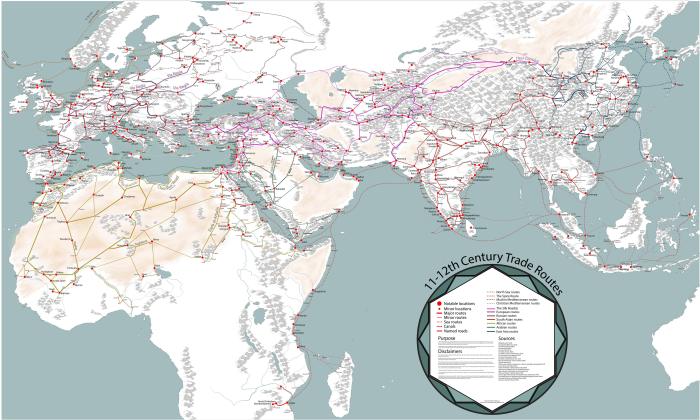
Eye Candy: medieval trade networks

NOL map medieval trade networks
Click here to zoom

‘Nuff said, and don’t forget to zoom in!

Nightcap

  1. Are the “educated elite” even educated, or elite? David French, National Review
  2. Fired anti-Trump employee might have a First Amendment case Ken White, Popehat
  3. Just enough tears for Jean-Michel Basquiat Stuart Klawans, the Nation
  4. Indifferently Spacefaring Civilizations Nick Nielsen, Centauri Dreams

Nightcap

  1. Neo- and other liberalisms David Glasner, Uneasy Money
  2. How neoliberalism seeks to limit the power of democracies Patrick Iber, New Republic
  3. The Unacknowledged Success of Neoliberalism Scott Sumner, Econlib
  4. From oligarchy to republic: Lessons from the American South James H. Read, Law & Liberty

Nightcap

  1. Notes on Frantz Fanon Branko Milanovic, globalinequality
  2. Why some countries come together and others fall apart Andreas Wimmer, Aeon
  3. Ethiopia is already “the China of Africa” Tyler Cowen, Bloomberg View
  4. Israel and the parable of Samson the Weakling Michael Koplow, Ottomans and Zionists

On “strawmanning” some people and inequality

For some years now, I have been interested in the topic of inequality. One of the angles that I have pursued is a purely empirical one in which I attempt to improvement measurements. This angle has yielded two papers (one of which is still in progress while the other is still in want of a home) that reconsider the shape of the U-curve of income inequality in the United States since circa 1900.

The other angle that I have pursued is more theoretical and is a spawn of the work of Gordon Tullock on income redistribution. That line of research makes a simple point: there are some inequalities that are, in normative terms, worrisome while others are not. The income inequality stemming from the career choices of a benedictine monk and a hedge fund banker are not worrisome. The income inequality stemming from being a prisoner of one’s birth or from rent-seekers shaping rules in their favor is worrisome.  Moreover, some interventions meant to remedy inequalities might actually make things worse in the long-run (some articles even find that taxing income for the sake of redistribution may increase inequality if certain conditions are present – see here).  I have two articles on this (one forthcoming, the other already published) and a paper still in progress (with Rosolino Candela), but they are merely an extension of the aforementioned Gordon Tullock and some other economists like Randall Holcombe, William Watson and Vito Tanzi. After all, the point that a “first, do no harm” policy to inequality might be more productive is not novel (all that it needs is a deep exploration and a robust exposition).

Notice that there is an implicit assumption in this line of research: inequality is a topic worth studying. This is why I am annoyed by statements like those that Gabriel Zucman made to ProMarket. When asked if he was getting pushback for his research on inequality (which is novel and very important), Zucman answers the following:

Of course, yes. I get pushback, let’s say not as much on the substance oftentimes as on the approach. Some people in economics feel that economics should be only about efficiency, and that talking about distributional issues and inequality is not what economists should be doing, that it’s something that politicians should be doing.

This is “strawmanning“. There is no economist who thinks inequality is not a worthwhile topic. Literally none. True, economists may have waned in their interest towards the topic for some years but it never became a secondary topic. Major articles were published in major journals throughout the 1990s (which is often identified as a low point in the literature) – most of them groundbreaking enough to propel the topic forward a mere decade later. This should not be surprising given the heavy ideological and normative ramifications of studying inequality. The topic is so important to all social sciences that no one disregards it. As such, who are these “some people” that Zucman alludes too?

I assume that “some people” are strawmen substitutes for those who, while agreeing that inequality is an important topic, disagree with the policy prescriptions and the normative implications that Zucman draws from his work. The group most “hostile” to the arguments of Zucman (and others such as Piketty, Saez, Atkinson and Stiglitz) is the one that stems from the public choice tradition. Yet, economists in the public-choice tradition probably give distributional issues a more central role in their research than Zucman does. They care about institutional arrangements and the rules of the game in determining outcomes. The very concept of rent-seeking, so essential to public choice theory, relates to how distributional coalitions can emerge to shape the rules of the game in a way that redistribute wealth from X to Y in ways that are socially counterproductive. As such, rent-seeking is essentially a concept that relates to distributional issues in a way that is intimately related to efficiency.

The argument by Zucman to bolster his own claim is one of the reason why I am cynical towards the times we live in. It denotes a certain tribalism that demonizes the “other side” in order to avoid engaging in them. That tribalism, I believe (but I may be wrong), is more prevalent than in the not-so-distant past. Strawmanning only makes the problem worse.

On Household Size and Economic Convergence

A few days ago, one of my papers was accepted for publication at the Scottish Journal of Political Economy (working paper version here). Co-authored with Vadim Kufenko and Klaus Prettner, this paper makes a simple point which I think should be heeded by economists: household size matter. To be fair, economists are aware of this when they study inequality or poverty. After all, the point is pretty straightforward: larger households command economies of scale so that each dollar goes further than in smaller households. As such, adjustments are necessary to make households comparable.

Yet, economists seem to forget it when times come to consider paths of economic growth and convergence across countries. In the paper, we try to remedy this flaw. We do so because there was a wide heterogeneity of household size throughout history – even within more homogeneous clubs such as the countries composing the OECD.  If we admit, as the economists who study poverty and inequality do, that income per person adjusted for household size is preferable to income per person, then we must recognize that our figures of income per capita will misstate the actual differences between countries. In addition, if households grew homogeneously smaller over a long period of time, figures of income per capita will overstate the actual improvements in living standards. As such, we argue there is value in modifying the figures to reflect changing household sizes.

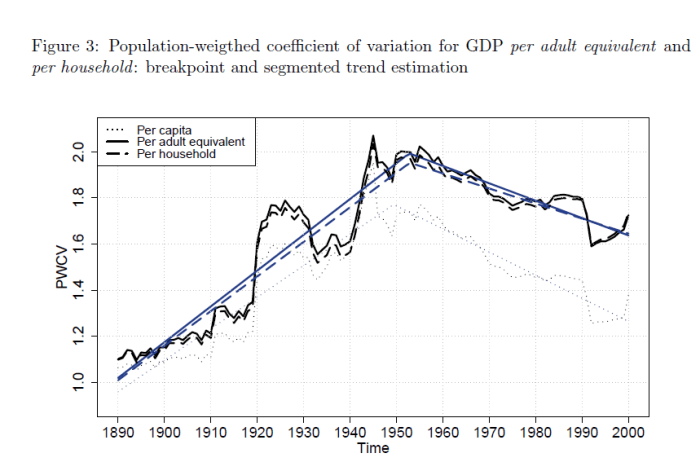
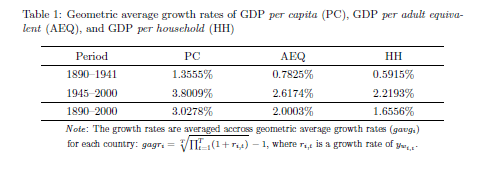
For OECD countries, we find that the adjusted income figures increased a third less than the unadjusted per capita figures (see table below). This suggests a more modest growth trend. In addition, we also find that up to the structural break in variations between countries (NDLR: divergence between OECD countries increased to around 1950) there was more divergence with the adjusted figures than with the unadjusted figures (see figure below). We also find that since the break point, there has been less convergence than previously estimated.

While the paper is presented as a note, the point is simple and suggests that those who study convergence between regions or countries should consider the role of demography more carefully in their work.

GrowthHouseholdSize

ConvergenceHouseholdSize.png