- Parents are heroes Rachel Lu, the Week
- Echoes of Reagan in Trump’s Clashes With Allies Ira Stoll, Reason
- Trump should pardon Obama-era whistle blower Bruce Fein, the American Conservative
- (Natural) Historical Haircuts Jonathan Saha, Colonizing Animals
Year: 2018
Debating a Marxist: An invitation
This week, I thought it might be fun to take a break from the series on the state and education and instead to introduce the topic of up-close and personal encounters with some very interesting people: Marxists. My reason for writing on this topic is simply that I’m curious to see if other people have had similar experiences and what the Notes on Liberty community thinks of this breed.
In my experience, there are two archetypes of modern Marxist. The first is the “cultural” one. This one is to my mind the more preferable of the two. This one conscientiously reads all the literature associated with Marxism and its derivatives, normally discards much of the economic aspects, and embraces the social and intellectual pieces. They tend to not think too highly of The Communist Manifesto but are crazy about Marx’s The Eighteenth Brumaire of Louis Napoléon. The result is that they cerebrally focus on class struggle, disenfranchisement, social inequality, etc., all while happily stipulating to all of the horrible famines, massacres, breadlines, general deprivation, etc. that occurred under Marxism. Their attitude is similar to a person who uses an old, long unpracticed religion as a form of social identification, e.g. “I’m Catholic (though I haven’t been to Mass in 40 years and support causes frowned upon by the Church).”
The standard response when asked about the fruits of Marxism tends to be a variant of “That wasn’t true Marxism; Marxism done right wouldn’t have caused that,” or “it just wasn’t implemented properly.” I have even heard one along the lines of “That was communism, not Marxism.” The cultural Marxist is easy to get along with. Because he tends to be a genuine intellectual and honest academic, when faced with reputable sources, he will graciously concede the point. Since this type respects skill and knowledge, there is a shared framework in which to debate. He is happy to debate anything and never views any author or source as particularly sacrosanct.
As a result, the cultural Marxist is reasonably open-minded and eager to find some common ground. My personal encounters with this type tend to be positive and normally end with everyone buying everyone else coffee and leaving the meeting as friends. They also tend to be pragmatic; during my time at Columbia (it’s reputation should be well known vis-à-vis Marxism), there was one faculty member who could only be described as fiscally capitalist and socially Marxist. Dovetailing with debates on class structure, we also received exhortations to secure our financial futures and received step-by-step instructions on how to invest in Vanguard mutual funds! It was slightly surreal, but I later discovered that this hybrid attitude is fairly typical among cultural Marxists. For them, it’s not about the money; it’s about the ideas. But because they mix and match ideas to create a personal worldview, they are neither invested in any particular aspect of Marxism, nor overly interested in practicing it.
The other archetype is the rabid ideologue who believes everything from Karl Marx, Vladimir Lenin, and, variably, Ivan Trotsky, Josef Stalin, or Mao Tse-tung is gospel. Unlike the cultural Marxist, the knowledge of ideologue tends to be constrained to a limited number of sources and works. The existence of The Eighteenth Brumaire can come as a surprise to these people, though they can quote The Communist Manifesto practically verbatim. Encounters with this type disintegrate to name calling and ad hominem attacks within a matter of minutes, in my case usually when their source foundations have been abolished in debate. The hallmark of their mentality is a fixed belief that if they personally are incapable of something, then no one else can do it either.
As an example, a group of students, including myself, went to a performance of La Traviata at Opéra Bastille in Paris. One of our number turned out to be a Marxist ideologue who spent the evening denigrating the entire affair. I recall one particularly embarrassing moment during an intermission when the person loudly ranted about how none of the attendees were there through love of music, being only drawn through an affected desire to show off and appear cultured. All attempts to inveigle the person to return quietly to our seats failed. Never once did it occur to the person to observe that evidence of genuine music appreciation was present just within the student group.
Recently, I tangled with a self-identified Marxist-Leninist ideologue online. Somehow the conversation careened from the original topic to his insistence that I couldn’t possibly have functional fluency in six languages (classical musicians have to be able to read and work in the five languages of music – English, French, German, Italian, and Latin – and I studied Ancient Greek through college). The only justification for his doubts appeared to be that he only had knowledge of three languages. The pivot and then ad hominem doubt is all par for the course in dealing with this type of person, but what struck me is that in all my history of engagements only ideologue Marxists have used the “you can’t possibly be or do X because I’m not or can’t” argument. This is where there is a real divergence between ideologue Marxists and cultural Marxists: all of the latter I have interacted with are highly capable people who go to the opposite extreme and assume that others are informed and thoughtful as well. On a side note, there is nothing quite as entertaining as watching a cultural Marxist debate an ideologue; it inevitably ends with a scorched earth defeat of the ideologue.
Since all of these interactions are anecdotal, they may be sheer personal experience and could very well be due to ideological ignorance. At this point, I invite members of the NOL community to relate their personal stories of brushes with Marxists and what most struck them about their mentality and approach. What is the most irrational thing you have heard on this topic? Were you able to reach a state of détente? Did the discussion end in a draw, or a meltdown? Are there any archetypes you might add?
Notā bene: I am entering an intensive language course in preparation for doctoral studies. As a result, I may not be very present on NOL for the summer. I will do my best, though, to monitor comments and to be part of the conversation.
Nightcap
- The man who went to the North Korean place that ‘doesn’t exist’ Megha Mohan, BBC
- Assessing Our Frayed Society with (German-Korean philosopher) Byung-Chul Han Scott Beauchamp, Law & Liberty
- Baxter Street & Jury Duty, Summer of 2016 Edward Miller, Coldnoon
- Ta-Nehisi Coates & the Afro-Pessimist Temptation Darryl Pinckney, New York Review of Books
Red Lobsters and Black Swans
Back In 2007 Nassim Nicholas Taleb had estimated that, in the following years, the rate of irruption of highly improbable events that change our way to perceive reality would be on the increase. Using his terminology, we would swiftly drift from Mediocristan out to Extremistan. People would have to deal with black swans more often and adapt to the new scenario.
The sudden spreading of Jordan Peterson’s lobsters might be a confirmation of Taleb’s surmise (in Extremistan, the term “surmise” has not any derogatory connotation). “Stand up straight with your shoulders back” is a piece of advice aimed at people who feel overwhelmed by a state of affairs, both personal and public, whose complexity they can hardly grasp. In Taleb’s terms, Jordan Peterson wants to prepare you for a world in which the Black Swans are the underlying reality.
Our quantitative patterns about reality -both physical and social- contribute to preserve fixed relationships among the terms that build up our world and subjectivity -while every now and then the “untimely” burst into our sense of reality. The Nietzschean “untimely” had always been there, out of the reach of our horizon of perception, but ready to appear suddenly and unexpectedly, like the plague in Thebes.
Nevertheless, perhaps there is no underlying chaotic reality, but a Hofstadter’s braid, where Apollo and Dionysus are intertwined: simple and complex phenomena, back to back, the beauty and the sublime. Upon one side, the train of events represented by a correlative train of thoughts; on the reverse, a plane of unarticulated notions that are inherent to those representations.
In this sense, the matrix of Taleb’s Black Swans might not inhabit the undertow of our perceptions, but stand above them, in a plane of a higher degree of complexity. Each new event triggers our brain to readjust our system of classifications. But this readjustment, at its time, triggers off a reconfiguration in the said plane of unarticulated notions that give support to our set of representations. In principle, an arrangement of such events would remain stable, but sometimes some unintended consequences could arise. That is the dynamic of events that Friedrich Hayek had once tried to convey with his concept of spontaneous or abstract order.
Peterson’s Red Lobsters try to make us reflect on the edge of our common patterns of conduct, whereas Taleb’s Black Swans incite us to perform the speculative activity of throwing hypothesis over the singularity of the abstract order, so that to anticipate any unintended consequences of our individual or collective behaviour. Notwithstanding the huge differences that there might be between them, what deserves our main attention is the acknowledgement of that the unplanned, the unexpected, the uncertain, are not alien forces, but the inherent articulation of the patterns of events that constitute the matter we are face to deal with.
Nightcap
- Why a State typically promotes its own official language Pierre Lemieux, EconLog
- Foreign languages and self-delusion in America Jacques Delacroix, NOL
- Islam’s new ‘Native Informants’ Nesrine Malik, NY Review of Books
- The khipu code: the knotty mystery of the Inkas’ 3D records Manuel Medrano, Aeon
Separation of Children: an American Tradition
Many Americans deplore the forced separation of children from their parents when they attempt an unauthorized entry into the USA. The recorded crying of children traumatized from having their parents taken away is terrible to hear for anyone with empathy. Administrations excuse this by claiming that they are only enforcing a legally mandated zero tolerance, that this separation acts as a useful deterrent to immigration, and that the law is ordained by God.
The claim by those opposing this policy is that this cruel separation is un-American. But in fact, the forced separation of children is an American tradition. Under slavery prior to the end of the Civil War, children were sold separately from their parents. This action too was presumably a law ordained by God.
The separation of children from their parents was also imposed on native American Indians. Children were forcibly removed from their homes and put into boarding schools, the aim being the assimilation of Indians into Euro-American culture. Indian children were not allowed to speak in their native languages. Rather than being un-American, this physical and cultural separation was seen as an Americanization. Canada had a similar program for its Indians.
This separation continued the genocide of Indians by having a high rate of death. The misery that children felt in their familial and cultural separation was compounded by abusive treatment and a high mortality rate.
Since the current child separation is a continuation of past policies, we can expect similar outcomes: abuse, death, and suicides. Feeling no hope of ever seeing their parents again, confined to small cages, suffering from boredom, and constantly hearing other children crying, there could be substantial illness and even suicide in these detention camps. It would at first be covered up, and then exposed, and denied as “fake news.”
This anti-family policy is supported by many Republicans and conservatives. The conservative claim of supporting “family values” has now been shown to be fake. The real conservative stance is the imposition of traditional European culture and supremacy. Most of the migrants from Central America and Mexico are of native Indian ancestry. When they are rejected and sent back to their home countries to get killed by the violence from which they fled, this is in accord with the American tradition of European racial supremacy over native American Indians. If those seeking to immigrate were Norwegians, those families would not be split up.
Indeed, those subjected to forced family separation were races that were conquered and regarded as inferior. A large immigration from Mexico and Central America would repopulate the USA with native Indian “blood,” unacceptable to Euro-American supremacists.
Therefore the forced separation of native Indians from their parents and the rejection of further immigration is as American as one could get.
RCH: the Cherokee Nation and the US Civil War
That’s the topic of my Tuesday column over at RealClearHistory. An excerpt:
Ross was critical of the success of the death warrants against the Treaty Party Men, but the most interesting aspect of the two mens’ rivalry was the fact that they used the rule of law to fight their battles. Now, the rule of law in the 19th century meant the use of violence between factions (think here about Tombstone, Ariz., where Wyatt Earp and his friends were U.S. Marshals and the friends of the Clantons were Sheriffs), but there was a belief held at the time that violence could only be used by civilized men if the law was on their side. Ross and Watie were both firm believers in this form of rule of law.
Please, read the rest and share it with your friends.
Nightcap
- Conservatives in academia Fabio Rojas, orgtheory
- Cuba’s lack of literature Nick Caistor, Times Literary Supplement
- The Democratic Party’s identity crisis William Voegeli, Claremont Review of Books
- How Fortress Europe was built Kenan Malik, Guardian
Why protect speech?
The U.S. Supreme Court has extended more protection for speech than other major courts that adjudicate rights, such as the European Court of Human of Rights. Nonetheless, the Supreme Court is frequently wrong about why speech deserves constitutional protection. That error has undermined the First Amendment that the Court purports to protect. Continue reading
Nightcap
- Canada’s Dark Side Susan Neylan, Origins
- The ethics of looted art Ian Johnson, NY Times
- Van Gogh and Japan Alastair Sooke, BBC
- How Chinese students exercise free speech abroad Fran Martin, Economist
The TSA Wins
Since 2012 I have been a semi-frequent flyer making about five cross continental round trip flights a year, plus several shorter flights within the Pacific coast. Between now and then I would make it a point to ‘opt out’ of the standard TSA procedure and receive the pat down. I did it for a variety of reasons. For one, don’t like being exposed to radiation and don’t trust the government on the issue.
More than that though, I wanted to resist and encourage my fellow citizens to resist, however small, the security theater the government has us go through in exchange for our freedom to travel. I would not encourage people to resist the police or any armed agent of the state, but by opting out I was taking a stand against government and hoped others would join me.
In five plus years, no one did. The only people I ever had join me in the opt out process was ‘randomly selected’ individals, often Muslims or mis-identified Sikhs. I never saw someone else voluntarily opt out. In retrospect, I suspect noone else saw my actions as a form of protest.
When I took a flight earlier today I went through the standard procedure.* My will to resist, at least in this form, has gone away. In the coming year the TSA rules will become stricter as real ID is finally implemented. I like to think this will lead to popular opposition, but I wouldn’t wager on it. As a nation we’ve given up on asserting our freedom to travel with minimal intrusion.
When I arrived at my final destination I found the below containers blocking me from the entrance. To leave the airport I had to get checked one last time. They don’t seem to be scanners, but when you enter them you are held up for ten or so seconds before being let free. Are they just trying to see what we will put up with before unveiling the next wave of security theater antics?
Thoughts? Have a story about your flying experience(s) to share? Post in the comments below.
___
*Funnily enough I ended up being “randomly” choosen to have my luggage physically inspected anyway.

Eye Candy: 2026 World Cup votes, by country
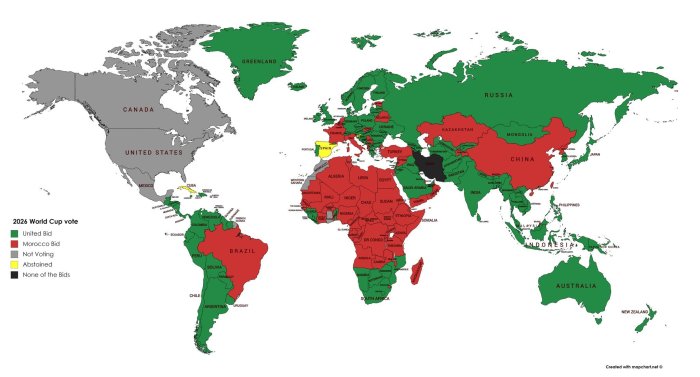
My only question is why did 3 countries that could easily (and have, in the past) host the World Cup on their own gang together? Mexico, Canada, and the United States are wealthy countries. Why gang up?
My guess is that wealthier countries are going to have to do a lot more cooperating if they want to host world-level events from now on, due to the fact that the selection process for these types of events has become democratized. Economist Branko Milanovic has a thoughtful piece on FIFA (the governing body for world-level soccer events) and corruption that ties in to all of this.
Nightcap
- The Market Police (Neoliberalism) JW Mason, Boston Review
- Libertarians should stop focusing on rent capture Henry Farrell, Cato Unbound
- Libertarians should *really* stop focusing on rent capture Mike Konczal, RortyBomb
- Nationalism is an essential bulwark against imperialism Sumantra Maitra, Claremont Review of Books
Meat-y Twitter Spat: Choice, Vegetarianism and Caste in India
A couple of weeks ago I was in the middle of submission week (when am I not?). Obviously, an otherwise mundane tweet piqued my supremely scattered mind’s ever-shifting interest. The series of tweets argued that unless one had actually tasted meat, she was not a vegetarian by choice but a vegetarian by caste. It seemed a silly proposition to me. It seemed as silly as claiming that unless one has lived off meat for a year, she is a meat eater by caste, not by choice. Urban Indian Vegetarians (towards whom the tweets were directed) do not live in an either-or world; their individual judgments, howsoever influenced by the household they were born in, do not flicker between ‘my caste dictates I must not eat meat’ and ‘my taste buds like/dislike meat’. Between the orthodox social and the over simplified gustatory lies an ocean of personal judgments.
In response to my tweets, I was told I was missing the context, that upper caste Hindus were vegetarians because of a puranical belief in the impurity of meat. Sure, I said. If I look down upon a meat eater from some ill-founded moral high ground, I am nothing but a bigot who deserves to be called out. If, however, I chose to stick to my greens without ever experiencing the delight that is a chicken butter masala but have no qualms with you eating pork, what seems to be the problem?
Like a number of judgments we make (moral or otherwise), food preferences are also influenced by the environment we grow up in. But does mean that a child’s food preferences are motivated by the same reasons as her ancestors? People from coastal areas prefer seafood. While their ancestors might have preferred a healthy diet of fish over okra for any number of reasons (Religion? Caste? Sheer affordability?), could the children, as individuals capable of making free-standing judgments exposed to very different environments, take a liking for fish for completely different reasons, unaware and independent of their ancestors’?
Can contextualizing discount generalisations? We have consensus on contextualizing not working out well for Trump and his feelings for Mexicans how much ever the Mexican drug lords might have contributed to the law and order situation in America. Mexicans do not become rapists because of their identity. Muslims do not turn into terrorists because of their identity. The logic of it seems pretty clear. Can we then derive a principle from this consensus? Context does not justify identity based generalisations. Casteism is a very real problem in India. But no matter what the context, you are wrong if you think you have the qualification to approve of someone’s personal choices. Calls for contextualization seem like an attempt to sweep social-identity-based generalisations under the rug – the very thing that brought about casteism in the first place.
Identity based stratification is a very real problem across the world. The trick is not to demonize the identity but call out the dehumanizing ideology that is functioning in that group. My Jewish friends can choose to go Kosher for any number of reasons, as long as they don’t demonize the rest of us. My white friends are not racists if they are attracted towards other white people. And my gay friend need not sleep with a person of the opposite gender to prove that his choice of life partner is not influenced by his lesbian moms. Choice, by definition, means having an alternative option. Not exercising all the alternatives is a prerogative and it does not take away from the legitimacy of your choice.
But this forms only a minuscule percentage of the replies I got to my tweets. Most just called me an Upper Caste {insert abuse}. I soon realized this was not a debate on what prompts vegetarianism in India. This was a statement. And I, by virtue of my social identity, was not eligible to comment on it. Makes me wonder – the politics of identity is like an hourglass. One side will always lose as long as you continue to use something as tricky as sand as a parameter. I will turn more academic in my series on Arendt where I evaluate her take on identity (because I was also told that Arendt would want us to contextualize and I humbly disagree). I will discuss Arendt on collective identity, her idea of what it meant to separate ‘the political’ from ‘the social’, and finally, identity politics.
P.S: Stepping out of your echo chamber is really bad for your twitter notification bar. Excellent for the follower count though.
Nightcap
- Icelandic fiction: a family affair Fríða Ísberg, Times Literary Supplement
- Icelandic sagas of the middle ages Barry Stocker, NOL
- Identity politics and patchwork Xenogoth
- Keeping it cool: worshipping the goddess Shitala Amrapali Saha, Coldnoon
 Notes On Liberty