Production bias in economic intervention

When an intervention is proposed, it’s usually offered that it will create jobs, or somehow otherwise create work. In Clash of Economic Ideas I’m reading about Indian economic planning and how in the early 5-year plans they proposed to subsidize low-scale labor-intensive cloth making. Otherwise power looms could take their jerbs! On the face of it, it looks like a policy where home weavers get more money (and maybe the price of cloth goes up… but people will be richer because of jobs, right?), but if we strip away the monetary veil, things look different.

What would this policy look like on Gilligan’s Island? The professor comes up with a way to harness the tide so that Gilligan doesn’t have to ride a stationary bike to generate power (bankrolled by Thurston Howell III). But the Skipper can’t let them take Gilligan’s job! So he forbids the professor from using his labor saving invention and there’s no costly transition from the status quo. Essentially the Skipper is consigning Gilligan to work harder than he otherwise would. For his own good!

Okay, that example is too easy, so let’s take it a step further. The Skipper decides they need a bridge (to where? Never mind, it’ll create jobs!) and sets Gilligan to work collecting materials while the professor draws up plans. This time the jobs created will actually result in something new, which is good. But is it good enough? If the discounted present value of the bridge is less than the present value of the costs they will have to incur, then a bridge building policy is like forcing or tricking Gilligan to work at a low wage when he would rather relax on the beach. Or if he pays Gilligan a good wage, then it’s like forcing the island’s tax payers to buy overpriced goods they don’t want; If I make you buy a Hyundai for $200,000, it hardly matters that you ended up with a reliable and efficient car because you got ripped off! The only alternative is that the person who decides to build the bridge eats the loss.

Entrepreneurs make mistakes, and that’s part of the learning process of the market. These sorts of mistakes are not just economically superior than poor policy, but they are ethically superior to state intervention or full-blown socialism. Let’s imagine that a government policy is passed with the expectation that it will be a net gain for the economy (tough, right?). This project is financed by either forcing/tricking someone to pay for it (taxes or inflation), or directly forcing someone’s hand (regulation or conscription). Even if the project turns a profit and the financiers are paid back, there’s something unsettling about the use of coercion. Contrast that with an honest mistake made by an entrepreneur. The financiers make a loss, but by their own volition. Nobody forced their hand, but they learned something and they can use what they learn to guide their actions in the future. Not so with a government failure.

tl;dr: Focusing on a policy’s effects on producers (“the seen“) overlooks what’s going on behind the veil of money: more work for producers without a commensurate gain is simply making them work harder than they need to, and it’s cruel. If (as is more often the case) it’s really a matter of making taxpayers buy something they don’t want for the price, it’s a ripoff and equally cruel. Even the ethical standing of “good” policies is questionable because it removes the element of choice from the individuals forced into backing the project.

The Tyranny of Darth Obama

Commentary by LA Repucci

 November 14th, Washington DC

President Obama spoke from the White House this morning regarding a proposed ‘fix’ to his failed health care policy in an effort to edify his fellow democrats through the next election cycle.

After publicly promising the American people that they could keep their insurance plans 30 times, the president has received flack due to the fact that millions are losing their insurance policies due to the Affordable Healthcare Act, commonly referred to as Obamacare.

In his address this morning, the president announced a ‘delay’ of the portions of the law to enable insurers to re-instate individual policies purchased on the “old individual market” to avoid losing their coverage…presumably, for another year.  Obama offered no details or legal explanation as to how this radical change in the law of the land would be implemented.

Okay — let’s suspend the fact that our Constitution very clearly states the government is prohibited from compelling the people to purchase a product or service.  Let’s pretend that the government, having betrayed this constitutional provision time and again (Social Security comes to mind), may simply call a compulsion to purchase a ‘tax’ as chief justice Roberts ruled regarding the health insurance mandate, circumvent one of the clearest directives of the US Constitution, and may compel the people to purchase a product or service. Even with this egregious transgression of the sovereignty of the people as a given, the State seems unable to obey its own new laws these days.  The federal government has been exposed time and again in the last few months (and decades) as the primary and frequent transgressor of our laws – the confirmed reports of illegal mass warrant-less surveillance are only the latest example of complete disregard for and perversion of the law to come from this administration.

There is a single mechanism by which our federal government transgresses the will of the people; one over-arching distortion of sanity by which the administration, law-makers and courts continue to exploit (at accelerating pace) and abridge the will of the people.  President Obama is merely the culmination of this singular corruption of constitutionality that transforms our nation from the rule of law toward the rule of tyrants.  As a student of constitutional law, Mr. Obama must know precisely what he is doing. Even if he didn’t, ignorance would not save his neck from the block that is the US constitution.

The truth is this:  all three branches of the federal government disregard the rule of law.  They are all traitors to the republic, and as such, should be tried, convicted, and sentenced for high treason.

How can a president (and constitutional scholar) mandate the people’s purchase of a product in clear violation of our supreme law, then claim the power to arbitrarily change his own law simply by decree?  The answer is two-fold.  First, a legitimate president cannot – a tyrant can and will do anything they please.  Second; as a tyrant by definition does not respect law in any case, once abridged, law may be changed without the legislative process or will of the governed, by decree.

Obamacare is unconstitutional – the state-appointed high-priests of the Supreme Court aren’t required to understand that simple point.  As an unconstitutional law issued by the fiat of a tyrant, supported by a false legislative process of ‘democracy’, it should be taken as given that law will now be dictated from the executive office out of hand, as the now impotent legislative and judicial bodies meekly question ‘can the president make law by decree? Law, by definition, is the littoral antipode of decree.

Dictation is the province of dictators – those who would destroy the rule of law and institute the rule of decree.  Ayn Rand prophesied this exact eventuality for American politics in her opus Atlas Shrugged, within the pages of characters decry ‘pragmatic, relative flexibility’ to be superior to principle.  When the state abandons duty to the law of the people, then it is the duty of the people to abandon the state.  A state that represents not the interest of the people, is anathema to the rule of law. According to Rand’s prophecy, this perversion of the very concept of law will accelerate dramatically as more ad-hoc tyrannical declarations are needed to patch the tower of babel created by the abomination that is the rule of man.  If Rand is right, this will all get much more absurd and destructive before it gets any better.

Obama’s decree this morning illustrates the now obvious point that the Affordable Health Care Act is HIS law, and not the law of the people.  The people change laws through the legislative process and the ballot — a tyrant changes his laws by decree.

Gravity is a law.  It needs no paper legislation, no judicial review, no vote of democratic tyranny to ‘be’ a law. It is a natural force acting upon reality whether people consent to it or not.  Markets are the same – they are a natural law.  They exist whether or not they are acknowledged by the state — and will continue to exist so long as there is a society within which to emerge and operate.  ‘Regulating’ an economy or market is akin to regulating gravity.  Paper law — Obama’s law, is not law at all. In fact, it is now specifically the opposite of law – it is the whim and decree of a despotic megalomaniac — it is Canute ordering the tides back.  Let’s all hope this tyrant drowns quickly so that our nation may once again be ruled by the laws of the natural universe, and the US government may return to performing its sole legitimate function – safeguarding the liberty of the people against tyrants like Obama.

Image

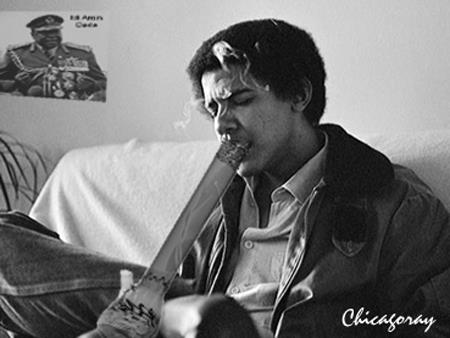
Our President minored in bong rips, honoring his predecessors’ commitment to cocaine and drunk driving.

I am considering sending Mr. Obama a copy of Bastiat’s “The Law” – apparently, this foundational primer, along with Locke and Jefferson aren’t required reading in the Columbia University constitutional law curriculum.  Is it intellectually honest to assume that the nations’ chief executive is ignorant of the school of thought that is the genesis of our nations’ supreme law?  Likely not – either Mr. Obama is ignorant of the very nature and definition of law itself, or he is openly perverting its’ mechanisms in an effort to destroy the liberty of the people and supremacy of the Constitution.  Darth Sidious, evidently, trained another apprentice after the death of Vader.

Oh Jedi, where art thou?


Disgusted and Furious,

LA Repucci

Liberty & Productivity

Statists routinely suggest their distrust of human initiative. This is why they keep advocating government stimuli instead of free markets.

In a free market, one which prohibits government intrusions, regulations and regimentation, it is understood that when men and women are free of such intrusions, they will most likely – though never certainly – engage in entrepreneurial initiative, the main result of which is productivity. No guarantee exists that free men and women will innovate and produce but that is most likely. Indeed, while slaves can be scared into work, free men and women will usually see the point of work and engage in it with gusto.

Statists, of course, deny this and claim that only if government creates artificial incentives or issues threats will citizens become productive. That is the basic theory behind stimulus packages, tax breaks, subsidies and so on.

But notice that all this omits the issue of why bureaucrats and politicians would be motivated to work. Why are they exceptions to the rule that statists assume, namely, a lethargic citizenry? How can we trust government agents to go to work, to produce, to innovate, etc., but not free men and women? Statists never address this as they advocate pushing citizens around, nudging them, stimulating them, etc. Who will nudge the nudgers?

At the heart of this issue lies a basic philosophical dispute: Are free men and women capable of initiative, of getting to think and work on their own or must they be dealt with like barnyard beasts that need to be driven to work by masters? Statists see people as such animals, incapable of innovation, of initiative, of creativity, so they need to be pushed around by bureaucrats and politicians. Yet this is completely inconsistent with the powers they grant to themselves. Why would only those running government possess the power to undertake productive, creative projects while the citizenry is deemed too passive?

Actually, a better way of understanding this is to realize that statists want to reserve to themselves the prerogative of spending resources on various projects – public works, they like to call them – and rob the rest of the citizenry of their resources to do as they judge sensible, prudent and wise.

In short, the statist wants to be in charge of what projects get to be undertaken, use everyone’s labor or property for these and not permit the rest of us to allocate our resources, including our labor, to projects of our own.

Криминализация средств массовой информации

Сравнивая Россию и Европу, я в своих мыслях залез в такие заповедные дебри, что потом долго думал, зачем я вообще эту затею начал воплощать. Кое-какими своими выводами хочу поделиться с вами. Я пришел к выводу, что сравнивать две культуры и соответственно страны вообще никак нельзя, и мы никогда не придем к взаимопониманию с Америкой. Это как пытаться добиться дружбы между китом и медведем. Те, кто в Америке либералисты, – в России почти автоматически становятся врагами народа. Из любого дела пытаются раздуть политический сюжет, будь то рядовая авария на дороге с парой жертв. Ассоциативный ряд уводит комментаторов так глубоко вглубь “корня зла”, что в конечном итоге как-то забывается, что водитель был пьян и непристегнут: во всем виноват Навальный, Путин, ZOG и прочие “плохие ребята” по мнению комментаторов.

В большей степени этому причиной является повышенная криминализация средств массовой информации в России, которая оказывает на людей все большее и большее влияние. Не стоит, однако, говорить, что Россия – это криминальная страна. С давних времен у нас всячески романтизировался образ бандита (телевизионные сериалы, новости и радио, газеты), чему немало способствовала напряженная обстановка в стране в 1990-х годах. И сейчас, когда, казалось бы, лихие времена прошли, эти воспоминания якорем тянут нас назад. Новости по инерции отдают предпочтение криминальным сюжетам, за счет чего у окружающего мира формируется стойкое мнение, что Россия – это страна, где воруют и убивают. Да. У нас воруют и убивают. Если воруют – то миллиарды из бюджета. Если убивают – то массово, как в любой другой стране. Да что говорить, в Америке регулярно устраиваются бойни в школах – это явление немыслимо для России в принципе! Другой вопрос в том, какой процент из криминальных новостей освещается в зарубежных СМИ. Крупные кражи и откаты, теракты, взрывы и катастрофы – это “само собой разумеющееся”. Так и в России. Правда помимо этого у нас регулярно рассказывают как в мелких городах пьяные мужики убивают по пьяни своих жен. Зачем нам это знать? Причем рассказывают федеральные каналы! Россия – такая же страна как и другие (может, немного другая в силу менталитета и развития), и криминала у нас столько же (может немного побольше). Но из-за “особого пути развития” складывается впечатление, что газетам просто больше не о чем писать. Лучше бы о театрах и культуре рассказывали…

Around the Web

  1. College football metrics: machines say the Pac-12 is the strongest football conference, humans erroneously believe the SEC is stronger
  2. Ken White on the cultural implications of the War on Drugs
  3. Orin Kerr on the case that sparked Ken White’s analysis I linked to above
  4. Ali Ezzatyar, a lawyer at UC Berkeley’s Program on Entrepreneurship and Development in the Middle East, makes The Case for Kurdistan
  5. A Barton Hinkle, echoing Dr Delacroix’s recent work, advises us to ‘cheer up’ because things are getting better (thanks to capitalism)

The Meaning of Social Science: Ideology, Private Life, and the Internet

[Note: This is a guest essay by Dr Peter Miller, who is a sociologist (PhD, Berkeley), a longtime resident of Japan, a non-participant observer of the American scene, and (since 1991) one of the world’s few practitioners of original photogravure etching, whose semi-abstract Japan-influenced prints are in private and museum collections in Japan, Europe, Russia, and the United States. His websites can be found here & here]

Social-science expertise has been missing from current discussions of government-led spying on private citizens and the proper role of government in general. Ideologies, which is to say gut reactions, have corrupted the public debate; but there is nevertheless a role for sociological analysis of these phenomena.

Social science in its modern form started as a mostly European effort to explain the origins of the horrible totalitarianism that engulfed Europe, and to deduce the structure of institutions that would prevent it from arising again. The Nazi, Soviet, and Fascist systems were all characterized by total State-control of all aspects of life, including the most private aspects of life. Whether the ostensible purpose was re-casting human nature into the ‘new Soviet man’ or an embodiment of the German ‘volk’, they quickly evolved into an apparatus for murdering large numbers of their citizenry. Of course the prospective victims had to be identified before they could be murdered. For this purpose a State apparatus of domestic spying and information-gathering was devised. Primitive by today’s standards, the forced wearing of Jewish stars and the forced confessions by purported enemies of the State were crudely effective in generating large numbers of victims. Social scientists asked ‘How did this happen? What can be done to prevent its recurrence?’

The essential answer to the first question, distilled from reams of scholarship, is: De-legitimization of private life. All the social space traditionally separating individuals from the State was systematically removed. Private enterprise was abolished. All universities and schools in Nazi Germany and the Soviet Union were taken over by government, run by political appointees, and staffed exclusively by those who would do their bidding. The same for the media, the churches (co-opted in Germany, eliminated in the Soviet Union), youth groups (Hitler Youth, Young Pioneers), and welfare organizations. All intermediary organizations that had previously functioned autonomously were either taken over by government, co-opted, intimidated into conformity, or forced out of existence. The sequence from privacy-deflation to total State control to mass murder progressed in roughly 15 years in the Soviet Union. In Nazi Germany, with more intensive propaganda and ‘education’, this sequence took only five years.

From this historical record, social scientists deduced that properly functioning democracies require lively intermediary organizations — churches, labor unions, 4-H clubs, PTAs, bowling clubs, whatever. Re-reading Tocqueville and Madison, social scientists re-discovered with these sages a high regard for such humble institutions (not that there were bowling clubs in Madison’s day, but you get the idea). The Austrian School (Hayek et al) added private enterprise to this list of freedom-enhancing entities. And from Vienna also came Lazarsfeld who posited ‘cross-pressures’ — conflicting loyalties — as the essential building-blocks of democracy. His big idea was that a healthy democracy needed unpredictability, where a person’s ethnicity, race, religion, education, or social class did not necessarily determine his voting preferences or consumer choices.

Since the 1970s, American and Western European societies have tolerated and even encouraged a progressive tribalization of their societies. Race, ethnicity, and sexual-identity have become increasingly salient in the distribution of government largesse, and consequently in the determination of political and consumer choices. Both public and private universities rely increasingly on government funding, and thus take their orders from the State, in research priorities, curricula, staffing, and extra-curricular activities. With some exceptions and counter-trends, the period since the 1970s has witnessed a progressive weakening of the autonomous mediating organizations that sociologists identified as essential to the working of democracy.

Separately, the growth of the Internet has deflated the private sphere, at first due in large part to the apparently voluntary choices of Internet users themselves. Only a few years ago the fad of the moment was 24/7 live webcams turned on oneself for the world to see. Now security cameras that do the same thing outdoors are all-pervasive. The collective mantra, highly promoted by the giant Internet companies, is ‘If you have nothing to hide, why be concerned?’ This is the tradeoff for ‘serving you better’. Mobile phones with geo-tracking are surely a great improvement in the quality of life, as is the proliferation of answers to life’s unanswered questions, and the blessings of instant communication. In return for all that, what does the loss of privacy matter?

I always doubted the business model of Internet-tracking. It never seemed plausible to me that a teen-ager with zits who happens to be in a drugstore is any more likely to buy zit-off after getting zapped with an ad on his geo-tracked mobile at that moment than if he weren’t zapped. The whole business of click-tracking, Web-tracking, and the like never made commercial sense to me. It was always hype — good for securing VC funding and not much else. But investors in these large-scale personal-data-gathering companies were not stupid. Behind our backs, these companies were getting paid by governments to sell users’ data. Their business model was not based on the supposed commercial utility of precise ad-targeting, but on secret NSA demands for indiscriminate personal data. Governments, under the banner of fighting terror, and shielded from Congressional or public scrutiny, have unlimited taxpayer funds to finance these transactions.

With the Snowden revelations, we now have a better understanding of the extent of Internet and telecom surveillance. Of course, this cannot have been a complete surprise. Nevertheless the near-universal scale of the surveillance, plus the technological capacity to sort and search the data, make for a real game-changer. As one security expert said in a recent interview:

The most shocking aspects of Edward Snowden’s courageous revelations is the scale of surveillance. Every one of us involved in this field, I think it’s fair to say, has not been surprised by what is possible but had assumed perhaps out of hope or fear that they were limited in what they did and were proportionate, and that although we didn’t believe they would just stick to terrorism they would not try to reach for everything.

But every single document, speech and slideshow shows that a bunch of juvenile lunatics have taken over the asylum and are drunk and exuberant on their capabilities to spy on everything all the time and that is what they want to do. They have lost every sort of moral compass and respect for civic values.

The problem is that many European countries, notably Britain but not exclusively Britain, have been complicit in these activities as a result of favours, trade or encouragement. Basically the NSA has, over years with Britain’s assistance, essentially tried to subvert companies and governments into a surveillance empire which is almost a supranational enterprise of their own.

The question is, to what end? As we know in sociology, not everything is what it seems. Just as the indiscriminate sweeping-up of personal data lacked a plausible commercial basis, though it still made business sense if the data were sold to government spy agencies, it is likewise implausible that all that data has much utility in fighting terror. What then is it good for?

I think that question has yet to be answered; that the answer will depend on what use the new owners of that data make of it. The meaning of the massive loss of privacy that has occurred is immanent, it will emerge as further events unfold. As far as I am aware, the central-conspiracy model does not fit the case. What we have is a set of disparate elements that as yet have not coalesced into any coherent order. Among these elements are the increasing tribalization of society, de-legitimizing of autonomous intermediary organizations, and deflation of the private sphere. These are exactly the conditions that gave rise to the totalitarian horrors of the mid-20th century. It does not appear that any current Western leader has it in him to become another Hitler or Stalin. But the elements are there, awaiting a moment — perhaps another terrorist attack or financial crisis — that will call forth a charismatic savior.

Yet one must be especially careful with historical analogies to avoid the ‘generals-fighting-the-last-war’ syndrome. Things are very different now, compared with analogous conditions 80 years ago. The greatly expanded human freedom, communication, and educational prospects empowered by the Internet may overwhelm the efforts of governments to use it as an instrument of State control. This will be a titanic struggle, with the outcome still unclear. And that’s where I’ll leave it for now, pending further sociological inquiry into what-all this may portend.

From the Comments: Populism, Big Banks and the Tyranny of Ambiguity

Andrew takes time to elaborate upon his support for Senator Elizabeth Warren, a Native American law professor from Harvard who often pines for the “little guy” in public forums. I loathe populism/fascism precisely because it is short on specifics and very, very long on generalities and emotional appeal. This ambiguity is precisely why fascist/populist movements lead societies down the road to cultural, economic and political stagnation. Andrew begins his defense of populism/fascism with this:

For example, I still have more trust in Warren than in almost anyone else in Congress to hold banks accountable to the rule of law.

Banks have been following the rule of law. This is the problem libertarians have been trying to point out for hundreds of years. See Dr Gibson on bank regulations and Dr Gibson again, along with Dr Foldvaryon alternatives. This is why you see so few bankers in jail. Libertarians point to institutional barriers that are put in place by legislators at the behest of a myriad of lobbying groups. Populists/fascists decry the results of the legislation and seek a faction to blame.

If you wanted to be thought of as an open-minded, fairly intelligent individual, which framework would you present to those who you wished to impress: the institutional one that libertarians identify as the culprit for the 2008 financial crisis or the ambiguous one that the populists wield?

And populism=fascism=nationalism is a daft oversimplification. I’ll grant that there’s often overlap between the three, but it’s far from total or inevitable overlap. Populists target their own countries’ elites all the time.

Sometimes oversimplification is a good thing, especially if it helps to clarify something (see, for example, Dr Delacroix’s work on free trade and the Law of Comparative Advantage). One of the hallmarks of fascism is its anti-elitism. Fascists tend to target elites in their own countries because they are a) easy and highly visible targets, b) usually employed in professions that require a great amount of technical know-how or traditional education and c) very open to foreign cultures and as such are often perceived as being connected to elites of foreign societies.

The anti-elitism of fascists/populists is something that libertarians don’t think about enough. Anti-elitism is by its very nature anti-individualistic, anti-education and anti-cooperative. You can tell it is all of these “antis” not because of the historical results that populism/fascism has bred, but because of its ambiguous arguments. Ambiguity, of course, is a populist’s greatest weapon. There is never any substance to be found in the arguments of the populist. No details. No clarity. Only easily identifiable problems (at best) or ad hominem attacks (at worst). Senator Warren is telling in this regard. She is known for her very public attacks on banks and the rich, but when pressed for details she never elaborates. And why should she? To do so would expose her public attacks to argument. It would create a spectacle out of the sacred. For example, Andrew writes:

Still, I’d rather have people like Warren establish a fuzzy and imperfect starting point for reform than let courtiers to the wealthy and affluent dictate policy because there’s no remotely viable counterpoint to their stances […] These doctrinaire free-market orthodoxies are where the libertarian movement loses me. There are just too many untrustworthy characters attached to that ship for me to jump on board.

Ambiguity is a better alternative than plainly stated and publicly published goals simply because there are “untrustworthy characters” associated with the latter? Why not seek plainly stated and publicly published alternatives rather than “fuzzy and imperfect starting points for reform”?

Andrew quotes a man in the street that happens to be made entirely of straw:

“Social Security has gone into the red, but instead of increasing the contribution ceiling and thoughtfully trimming benefits, let’s privatize the whole thing and encourage people to invest in my company’s private retirement accounts.”

Does the libertarian really argue that phasing out a government program implemented in the 1930s is good because it would force people to invest in his company’s private retirement accounts? I’ve never heard of such an example, but I may just be reading all the wrong stuff. Andrew could prove me wrong with a lead or two. There is more:

This ilk of concern trolls (think Megan McArdle: somewhat different emphasis, same general worldview) is one that I find thoroughly disgusting and untrustworthy and that I want absolutely no part in engaging in civil debate. Their positions are just too corrupt and outlandish to dignify with direct responses; I consider it better to marginalize them and instead engage adversaries who aren’t pushing the Overton Window to extremes that I consider bizarre and self-serving. They’re often operating from premises that a supermajority of Americans would find absurd or unconscionable, so I see no point to inviting shills and nutters into a debate […].

Megan McArdle is so “disgusting and untrustworthy” that her arguments are not even worth discussing? Her name is worth bringing up, of course, but her arguments are not? Ambiguity is the weapon of the majority’s tyranny, and our readers deserve better. They are not idiots (our readership is still too small!), and I think they deserve an explanation for why McArdle is not worthy of their time (aside from being a shill for the rich, of course).

I think populism/fascism is often attractive to dissatisfied and otherwise intelligent individuals largely because its ambiguous nature seems to provide people with answers to tough questions that they cannot (or will not) answer themselves. Elizabeth Warren’s own tough questions, on the Senate Banking Committee, revolve around pestering banks for supposedly (supposedly) laundering money to drug lords and terrorists:

“What does it take, how many billions of dollars do you have to launder from drug lords and how many economic sanctions do you have to violate before someone will consider shutting down a financial institution?” Warren asked at a Banking Committee hearing on money laundering.

Notice how the populist/fascist simply takes the laws in place for granted (so long as they serve her desires)? The libertarian would ask not if the banks were doing something illegally, but why there are laws in place that prohibit individuals and organizations from making monetary transactions in the first place.

Senator Warren’s assumptions highlight well the difference between the ideologies of populism/fascism and libertarianism: One ideology thinks bludgeoning unpopular factions is perfectly acceptable. The other would defend an unpopular faction as if it were its own; indeed, as if its own freedom were tied up to the freedom of the faction under attack.

French Musings on Veterans’ Day

France was one of the least ill-treated countries in Nazi occupied Europe for reasons that are mostly too shameful to recall. In August 1944, in my mother’s arms, I saw one of the first, large contingents of American troops enter Paris. Their presence put an end to the slow process of starvation of most French people. You can see in side by side photographs that my parents, then in their early thirties, looked older in 1943 than they looked in 1946. Before the liberation of Paris, malnutrition was written all over their faces. Keep in mind that slowly starving people was one of the least objectionable actions of the Nazis in Europe.

American soldiers, and behind them, American might, American willingness to get involved, though late, probably saved me from starvation. Today just as it was then, just as it was during the Cold War, American military power is the main guarantee of common decency in the world. I only deplore that it’s not used as often as it should be. After many years of unrelenting leftist propaganda, many otherwise intelligent Americans are vaguely embarrassed about the same American military power.

Immigrants like me and other who have some real experience of other countries, rarely share in this prejudice, I think. And, as I always say, it’s possible to make the argument that Finland, for example, is more virtuous than the US. Alas, alas, the Finns and their neighbors in Scandinavia are nowhere near to proposing to replace the US as guarantors of humanity! On the other hand, Iran is about to volunteer (arguing that the frequency of stoning of adulterous women there a has been greatly exaggerated by Islamophobic media).

Speaking of Iran, this weekend, it seems the French alone saved the free world from a big mistake of accommodation with its cruel, expansionist, inhumane regime. Perhaps, Pres. Hollande very low ratings give him superior freedom of action. (He has little to lose.) Yet, even lower ratings are not about to help Pres. Obama grow a backbone. Fortitude is not his problem. He really thinks that there is something evil about America’s strength. And his Secretary of State often pretends to be French but he remains an unreconstructed peacenick whose sole recognized talent is in marrying rich women.

PS The media are full of references to an “epidemic” of military suicides. I suspect there is no such thing either in the active military or in t veterans of Iraq and Afghanistan. Will someone direct me to real data?

How China could Conquer the US

The US owes big money to China. And sooner or later, the Chinese are going to come collect it. And they will conquer the US. But the question is, how will they do it? There will not be a military invasion, nor an armed war between the US and China. Chinese troops will not land in the United States. Unless, of course, they are invited by the US government. So how will this happen? It will likely be a slippery slope. This article draws upon real things that have already happened in history, and compares them to things that could easily happen today.

Disclaimer: This article is about the government of the People’s Republic of China, and its affiliated state-owned corporations, not Chinese people in China, nor Chinese-Americans.

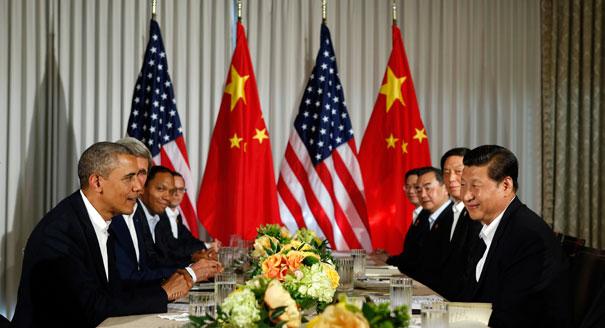
obama and chinese

Step One. The Chinese will take the private sector.

While young American professionals are often underemployed after majoring in liberal arts, students in China focus on training in the STEM (science, technology, engineering, math) fields. Many Chinese professionals are already being invited over in droves to work at American companies. Many end up becoming naturalized citizens, many do not. The Chinese are stereotypically a very stern, serious and hardworking people. They are known to not shirk tasks, and not to complain. Many  cultures in the Far East teach their youth to show limited emotion, and keep the collective of society in mind. The same cannot be said about Americans, who are often narcissistically individualist.

As more and more American businesses are vacuumed into conglomerates, they will focus on the international market. There will be capitalism with no borders. The Chinese have already begun to buy some American companies, such as Smithfield Pork. They will buy more and more. Americans will not see dozens of Chinese employees walking around big companies, but the top corporate executives of the major international companies will be from China. Americans will remain in management. Eventually, the Chinese executives will begin planting fellow Chinese in management, until it becomes obviously noticeable.

Step Two. The Chinese Raj in America.

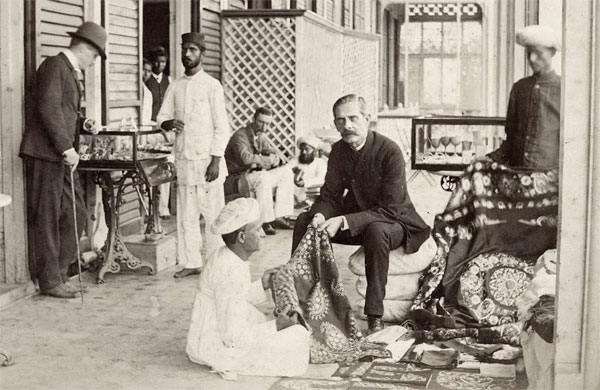
On April 13, 1919, in Amrtisar, India, hundreds of Indian men women and children were shot dead. The officer who yelled, “FIRE!” was a British colonel named Reginald Dyer. But he was born in India. And every finger that pulled a trigger that day was one that belonged to an Indian native. The British did not land in India with guns blazing. They arrived as merchants. And were welcomed by the rich Brahmins ruling India at the time. Britons and Brahmin Indians lived side by side. The Indians were not slaves to the British, they were slaves to other Indians. Some Britons grew up in India and never even saw Great Britain (covered in films the Secret Garden and the King and I).

The British Raj was corporate first, government second. And that is exactly what the Chinese could do to Americans. Also, notice that the British did not start converting to Hinduism and assimilating with the Indians (at least not until the days of the Beatles). They remained 100 percent British. Because they considered themselves superior, and the Chinese corporate executives will act in a similar way. Keep in mind, these are not poor immigrants coming to a work a low-wage labor job; they will arrive with a position of corporate power waiting for them. A new generation of Americans, thirty years down the road, could grow up speaking Chinese as second language, and adopting some aspects of Chinese culture.  Yes, it can happen, as that is what it may take for Americans to succeed in business, especially international business. We are fully aware that most American politicians would sell Americans to a foreign government for profit. That much is perfectly clear.

british raj

Step Three. The Chinese take the International Military.

It is highly unlikely that Chinese and American soldiers will ever shoot at each other with guns. But a peaceful, quiet, military takeover is possible and probable in the long-term. To those who believe this is an out-in-space idea: it is not when you realize that the US did to Great Britain in 1917, and sealed the deal by 1944. US troops joined UK troops in the trenches, and General Pershing and General Haig co-commanded. By the Second World War, there were many UK marshals and generals, but most accept that General Ike wore the trousers in that relationship.

The US troops never packed up and went home after WWII. The base in Germany is still there, protecting Europeans. It is likely that China will act as a neutral mediator as things get gradually more aggressive in the Middle East between the USA and Russia. China has a shoe in each door. China does not need to make one military threat, but they can pull financial plugs. The Middle Eastern foreign policy will continue in a more UN-overseen way, with cooperation between the US and China.

The Chinese Army has three million soldiers. Although few Americans would ever entertain this, it is possible that China could have better soldiers. In the same way as the stereotypical Far Eastern work ethic, their use of pure logic and their hidden strength behind humility makes them the most ruthless of soldiers. A cool, calculating, collectivist mentality is the backbone of a powerful military. Add to that the fact that they have ample bodies to throw. This is what won the war for the Soviets on the Eastern Front, and the Union Army in the Civil War.

Step Four. Robots, Technocracy, and the New Age future.

Much of the ideas of Chinese nationalism or American nationalism will fade into obscurity as the Chinese corporatist government will begin building rapidly advanced technology, push towards technological singularity, and become the ultimate technocratic progressives. When the main business language becomes programming language, the linguistic differences between Chinese and English will matter very little. The STEM-oriented Americans (future versions of people such as Bill Gates and Mark Zuckerberg) will unite with the Chinese to move forward in the Space Race. The cultures will be indistinguishable because everyone will think in a technological mindset. Of all the world’s peoples, the Chinese certainly need what they call “living space” and space is the last frontier.

bill gates and jinping

Unequal Poverty: Tricks (Part Two of two)

In the previous installment:

I explained how the general standard of living in America, denoted by real income, grew a great deal between 1975 and a recent date, specifically, 2007. This, in spite of a widespread rumor to the contrary. The first installment touched only a little on the following problem: It’s possible for overall growth to be accompanied by some immobility and even by some regress. Here is a made-up example:

Between the first and the second semester, grades in my class have, on the average, moved up from C to B. Yet, little Mary Steady’s grade did not change at all. It remained stuck at C. And Johnny Bad’s grade slipped from C to D.

Flummoxed by the sturdiness, the blinding obviousness of the evidence regarding general progress in the standard of living, liberal advocates like to take refuge in more or less mysterious statements about how general progress does not cover everybody. Or not everybody equally, which is a completely different statement. They are right either way and it’s trivial that they are right. Let’s look at this issue of unequally distributed economic progress in a skeptical but fair manner.

It’s awfully hard to prevent the poor, women and minorities from benefiting

I begin by repeating myself. As I noted in Part One, it’s too easy to take the issue of distribution of income growth too seriously. Some forms of improvements in living standard simply cannot practically be withheld from a any subgroup, couldn’t be if you tried. Here is another example: Since 1950, mortality from myocardial infarctus fell from 30-40% to 5-8%. (from a book review by A. Verghese in Wall Street Journal 10/26 and 10/27 2013). When you begin looking at these sort of things, unexpected facts immediately jump at you.

Fishing expeditions

The US population of 260 millions to over 300 million during the period of interest 1975-2007 can be divided in an infinity of segment, like this: Mr 1 plus Mr 2; Mr 2 plus Mrs 3; Mr 2 and Mrs 3 plus Mr 332; Mr 226 plus Mrs 1,000,0001; and so forth.

Similarly, the period of interest 1975 to 2007 can be divided in an infinity of subperiods, like this: Year 1 plus year 2; year 1 plus year 3; years 1, 2, 3 plus year 27; and so forth. You get the idea.

So, to the question: Is there a subset of the US population which did not share in the general progress in the American standard of living during some subperiod between 1975 and 2007?

The prudent response is “No.” It’s even difficult to imagine a version of reality where you would be right to affirm:

“There is no subset of the US population that was left behind by general economic progress at any time during the period 1975- 2007.”

Let me say the same thing in a different way: Given time and good access to info, what’s the chance that I will not find some Americans whose lot failed to improve during the period 1975 to 2007? The answer is zero or close to it.

This is one fishing expedition you can join and never come back empty-handed, if you have a little time.

Thus, liberal dyspeptics, people who hate improvement, are always on solid ground when they affirm, “Yes, but some people are not better off than they were in 1975 (or in _____ -Fill in the blank.)” The possibilities for cherry-picking are endless (literally).

Everyone therefore has to decide for himself what exception to the general fact of improvement is meaningful, which trivial. This simple task is made more difficult by the liberals’ tendency to play games with numbers and sometimes even to confuse themselves in this matter. I will develop both issues below.

To illustrate the idea that you have to decide for yourself, here is a fictitious but realistic example of a category of Americans who were absolutely poorer in 2007 that they were in 1975. You have to decide whether this is something worth worrying about. You might wonder why liberals never, but never lament my subjects’ fate.

Consider any number of stock exchange crises since 1975. There were people who, that year, possessed inherited wealth of $200 million each, generating a modest income of $600,000 annually. Among those people there were a number of stubborn, risk-seeking and plain bad investors who lost half of their wealth during the period of observation. By 2007, they were only receiving an annual income of $300,000. (Forget the fact that this income was in inflation shrunk dollars.) Any way you look at it, this is a category of the population that became poorer in spite of the general (average) rise in in American incomes. Right?

Or, I could refer to the thousands of women who were making a living in 1975 by typing. (My doctoral dissertation was handwritten, believe it or not. Finding money to pay to get it typed was the hardest part of the whole doctoral project.) One of the many improvements brought about by computers is that they induced ordinary people to learn to do their own typing. Nevertheless, there was one older lady who insisted all along on making her living typing and she even brought her daughter into the trade. Both ladies starved to death in 2005. OK, I made them up and no one starved to death but you get my point: The imaginary typists fell behind, did not share in the general (average) improvement and their story is trivial.

So, I repeat, given some time resources, I could always come up with a category of the US population whose economic progress was below average. I could even find some segment of the population that is poorer, in an absolute sense, than it was at the beginning of the period of observation. Note that those are two different finds. Within both categories, I could even locate segments that would make the liberal heart twitch. It would be a little tougher to find people who both were poorer than before the period observation and that would be deserving of liberal sympathy. It would be a little tough but I am confident it could be done.

So, the implication here is that when it comes to the unequal distribution or real economic growth you have to do two things:

A You have to slow down and make sure you understand what’s being said; it’s not always easy. Examples below.

B You have to decide whether the inequality being described is a moral problem for you or, otherwise a political issue. (I, for one, would not lose sleep over the increased poverty of the stock exchange players in my fictitious example above. As for the lady typists, I am sorry but I can’t be held responsible for people who live under a rock on purpose.)

Naively blatant misrepresentations

A hostile liberal commenter on this blog once said the following:

“Extreme poverty in the United States, meaning households living on less than $2 per day before government benefits, doubled from 1996 to 1.5 million households in 2011, including 2.8 million children.”

That was a rebuttal of my assertion that there had been general (average) income growth.

Two problems: first, I doubt there are any American “households” of more than one person that lives on less than $2 /day. If there were then, they must all be dead now, from starvation. I think someone stretched the truth a little by choosing a misleading word. Of maybe here is an explanation. The commenter’s alleged fact will provide it, I hope.

Second, and more importantly, as far as real income is concerned, government benefits (“welfare”) matter a great deal. Including food stamps, they can easily triple the pitiful amount of $2 a day mentioned. That would mean that a person (not a multiple person- household ) would live on $1080 a month. I doubt free medical care, available through Medicaid, is included in the $2/day. I wonder what else is included in “government benefits.”

The author of the statement above is trying to mislead us in a crude way. I would be eager to discuss the drawbacks of income received as benefits in- instead of income earned. As a conservative, I also prefer the second to the first. Yet, income is income whatever its source, including government benefits.

The $2/day mention is intended for our guts, not for our brains. Again, this is crude deception.

Pay attention to what the other guy asserts sincerely about economic growth.

Often, it implies pretty much the reverse of what he intends. In an October 2013 discussion on this blog about alleged increasing poverty in the US, asked the following rhetorical question:

“Or have Americans’ standard of living only improved as the gap [between other countries and the US] closed?“

I meant to smite the other guy because the American standard of living has only increased, in general, as we have seen (in Part One of this essay posted). A habitual liberal commenter on my blog had flung this in my face:

“….Since 1975, practically all the gains in household income have gone to the top 20% of households…” (posted 10/23/13)

(He means in the US. And that’s from a source I am not sure the commenter identified but I believe it exists.)

Now, suppose the statement is totally true. (It’s not; it ignores several things described in Part One.) The statement says that something like roughly 60 million Americans are richer than they, or their high income equivalents were in 1975. It also says that other households may have had almost stationary incomes (“practically”). The statement does not say in any way that anyone has a lower income in 1975. At best, the statement taken literally, should cause me to restate my position as follows:

“American standards of living have remained stationary or they have improved….”

You may not like the description of income gains in my translation of the liberal real statement above. It’s your choice. But the statement fails to invalidate my overall assertion: Americans’ standard of living improved between 1975 and 2007.

What the liberal commenter did is typical. Liberals always do it. They change the subject from economic improvement to something else they don’t name. I, for one, think they should be outed and forced to speak clearly about what they want to talk about.

Big fallacies in plain sight

Pay attention to seemingly straightforward, common liberal, statist assertions. They often conceal big fallacies, sometimes several fallacies at once.

Here is such an assertion that is double-wrong.

“In the past fifteen years the 20% of the population who receive the lowest income have seen their share of national income decrease by ten percentage points.” (Posted as a comment on my blog on 10/21/13)

Again, two – not merely one – strongly misleading things about this assertion. (The liberal commenter who sent it will assure us that he had no intention to mislead; that it’s the readers’ fault because, if…. Freaking reader!)

A The lowest 20% of the population of today are not the same as those of fifteen years ago, nor should you assume that they are their children. They may be but there is a great deal of vertical mobility in this country, up and down. (Just look at me!) The statement does not logically imply that any single, one recognizable group of social category became poorer in the interval. The statement in no way says that there are people in America who are poor and that those same people became poorer either relatively or in an absolute sense. Here is a example to think about: The month that I was finishing my doctoral program, I was easily among the 20% poorest in America. Hell, I probably qualified for the 5% poorest! Two months later, I had decisively left both groups behind; I probably immediately qualified for the top half of income earners. Yet, my progress would not have falsified the above statement. It’s misleading if you don’t think about it slowly, the way I just did.

I once tried to make the left-liberal vice-president of a Jesuit university understand this simple logical matter and I failed. He had a doctorate from a good university in other than theology. Bad mental habits are sticky.

B Percentages are routinely abused

There is yet another mislead in the single sentence above. Bear with me and ignore the first fallacy described above. The statement is intended to imply that the poorer became poorer. In reality, it implies nothing of the sort. Suppose that there are only two people: JD and my neighbor. I earn $40, neighbor earns $60. In total, we earn $100. Thus my share of our joint income is 40%, neighbor’s is 60%. Then neighbor goes into business for himself and his income shoots up to $140. Meanwhile, I get a raise and my income is now $60.

In the new situation, my share of our joint income has gone down to 30% (60/60+140), from 40%. (Is this correct? Yes, or No; decide now.) Yet, I have enjoyed a fifty percent raise in income. That’s a raise most unions would kill for. I am not poorer, I am much richer than I was before. Yet the statement we started with stands; it’s true. And it’s misleading unless you pay attention to percentages. Many people don’t. I think that perhaps few people do.

My liberal critic was perhaps under the impression that his statement could convince readers that some Americans had become poorer in spite of a general (average rise) in real American income. I just showed you that his statement logically implies no such thing at all. If he want to demonstrate that Americans, some Americans, have become poorer, he has to try something else. The question unavoidably arises: Why didn’t he do it?

Was he using his inadequate statement to change the subject without letting you know? If you find yourself fixating on the fact that my neighbor has become even richer than I did because he more than doubled his income, the critic succeeded in changing the subject. It means you are not concerned with income growth anymore but with something else, a separate issue. That other issue is income distribution. Keep in mind when you think of this new issue that, in my illustration of percentages above, I did become considerably richer.

Liberals love the topic of unequal progress for the following reason:

They fail to show that, contrary to their best wish, Americans have become poorer. They fail almost completely to show that some people have become absolutely poorer. They are left with their last-best. It’s not very risky because, as I have already stated, it’s almost always true: Some people have become not as richer as some other people who became richer!

Policy implications of mis-direction about income growth

The topic matter because, in the hands of modern liberals any level of income inequality can be used to call for government interventions in the economy that decrease individual liberty.

Here are a very few practical, policy consequences:

A Income re-distribution nearly always involves government action that is, force. (That’s what government does: It forces one to do what one wouldn’t do out of own inclination.) That’s true for democratic constitutional governments as well as it is for pure tyrannies. In most countries, to enact a program to distribute the fruits of economic growth more equally it to organize intimidation and, in the end, violence against a part of the population. (For a few exceptions, see my old but still current journal article: “The Distributive State in the World System.“ Google it.) This is a mild description pertaining to a world familiar to Americans. In the 1920s, in Russia, many people (“kulaks”) were murdered because they had two cows instead of one.

Conservatives tend to take seriously even moderate-seeming violations of individual liberty, including slow-moving ones.

B Conservatives generally believe that redistribution of income undermines future economic growth. With this belief, you have to decide between more equality or more income for all, or nearly all (see above) tomorrow?

It’s possible to favor one thing at the cost of bearing the travails the other brings. It’s possible to favor the first over the second. This choice is actually at the heart of the liberal/conservative split. It deserves to be discussed in its own right; “Do your prefer more prosperity or more equality?” The topic should not be swept under the rug or be made to masquerade as something else.

If you are going to die for a hill, make sure it’s the right hill.

PS: There is no “income gap.”
Update; a Woman

I am mostly absent from this blog because I am fine-tuning the manuscript, “I Used to Be French: an Immature Autobiography.

It’s very time consuming. It’s like when my mother would inspect the boys room on Thursday AM (no school day) around 11:30:

A small grain of dust would jump into her eyes  and have disproportionate consequences on your subsequent happiness.

Speaking of the women we love, my wife said two memorable things before ten this morning:

“I don’t care about the truth.”

” I wish Somerset Maugham were alive so I could marry him instead of you.” (She is a woman of culture. I am flattered to be cuckolded in her mind by a great writer. It’s better  than some Harlequin bodice-bursting novel author.)

I am also working on a part two to my essay on poverty (“Growing Poverty…“).  It will deal with the favorite liberal myths of inequality.

What was the world’s reaction to Kristallnacht?

Der Spiegel has a fascinating article on the reaction of European diplomats to Kristallnacht. Among the gems:

The diplomats almost unanimously condemned the murders and acts of violence and destructions […] Many diplomatic missions were already in contact with victims because men from the SS and the SA, Nazi Party officials and members of the Hitler Youth were also harassing foreign Jews who lived in Germany […] Although there was some looting, many diplomats, like Finnish representative Aarne Wuorimaa, reported on “withering criticism” from members of the public. According to Wuorimaa, “As a German, I am ashamed” was a “remark that was heard very frequently.” However, the reports generally do not delve into whether the critics fundamentally rejected the disenfranchisement of the Jews in general or just the Nazis’ brutal methods.

Again, read the whole article. It’s absolutely fascinating. One thing the article just barely touches on, but highlights well (if you know what to look for) is what foreign governments didn’t do. Der Spiegel, a center-Left publication, highlights the lack of sanctions and other diplomatic posturing, but this is, in true center-Left fashion, complete garbage. If you read the article closely you can see what the world should have done. Indeed, you can see what the world should have been doing all along. It is a testament to not only libertarianism’s moral clarity but also the creed’s humility. Observe:

Most of all, however, the borders of almost all countries remained largely closed for the roughly 400,000 Jewish Germans.

This is an important fact. Der Spiegel implicitly recognizes it, too, but the article fails to elaborate any further upon it, as if the benefits of open borders and their ability to ward off tyranny speaks for itself. The lack of open borders, of course, coincides nicely with the policies of Franklin D Roosevelt and his fellow fascists. Closing off the borders to immigration and arbitrary numbers of goods and services is a cookie cutter example of authoritarianism.

This brings me to my Tuesday morning rant: I can’t stand the fact that libertarians are proud of their ignorance in regards to what they read. I can’t count the number of times a libertarian has disparaged a center-Left outfit (to name one example) because he doesn’t agree with it. Libertarians should be reading everything and looking for the libertarianism inherent in it. When the libertarianism is found, point it out. If it cannot be found, point out the inherent authoritarianism in it (Dr Gibson always provides excellent examples in this regard). But do not avoid reading it simply because you do not agree with it. Ignorance, after all, is no strength.

Around the Web

  1. When governments go after witches
  2. Borders, Ethnicity and Trade [pdf]
  3. A Lonely Passion. Libertarians in China
  4. Halloween in Germany: read this with globalization and its critics in mind
  5. Should Japan take the lead in mediating US-Iranian talks? Props to Obama, by the way
  6. Another excellent Free Speech blurb from Ken White
  7. Culture in a Cage

Wake up the People.

Draconian laws not only deserve lampoonery, they require it. Alert your community to the truth and drive a dialogue of liberty amongst the people. The NSA is directly assaulting free speech, attempting to silence the voice of the people — exercise your rights or lose them!

A Warm Welcome, and other assorted editorial duties

Hello all. I’m proud to announce and introduce Jesper Ahlin to the blogging team here at NOL:

Jesper Ahlin received his B.A. in philosophy from Linköping University and is now a graduate student in philosophy at Uppsala University. He has conducted Stureakademin, a study program run by the classical liberal think tank Timbro, and is the local coordinator for European Students For Liberty in Sweden. As a right-libertarianish thinker he enjoys reading Mises and Rothbard as well as Hayek and Nozick. He also likes ice hockey, music and traveling.

Jesper’s debut post can be found here. He’s currently hanging out in Washington and New York City, but do look for more of his posts in the near future. I, for one, am very excited to be blogging alongside Jesper.

In other news around the blog, Andrew is shocked – SHOCKED! – to find Senator Elizabeth Warren in the company of other rich, white (class-wise, of course) liberals. What would a “sincere and credible populist” be doing rubbing elbows with rich, white (class-wise, of course) Leftists? After all, Senator Warren, a Native American, was a law professor at Harvard. Think of all the glass ceilings she shattered. Do read the whole thing. As always, it’s very well-written.

‘Populism’ is just a quaint term for ‘fascism’ and ‘fascism’ is just a fancy term for ‘nationalism’. All three terms are useful if you want a society to be culturally, economically and politically stagnant. What, for example, is the criteria for being an ‘American worker’ (one segment of society that Senator Warren holds especially close to her heart)?

The guy who works twelve hours a day at a hospital, four days a week?

The guy who works twenty hours a week at a deli slicing pastrami?

And what, for example, characterizes an ‘American worker’ from, say, a ‘German worker’?

Nobody in Warren’s populist camp ever really defines what it means to be an ‘American worker.’ Policy matters, and policies targeting certain segments of society – whether for good or for ill – will only guarantee stagnation, especially if the certain segment of society is only vaguely defined. Not everybody can drive a BMW to work and, more importantly, not everybody wants to.

Elsewhere, Hank and NEO and Edmund argue about political power. It seems to me that they are simply arguing about how this power should be shared, rather than how it should be shorn. This is a dangerous precedent, in my opinion. Read Edmund’s whole piece, and the exchange that follows.

Personally, I don’t care which party is in office, as long as laws that are anathema to libertarianism can be repealed. Conservatives are often an embarrassment to themselves and to their countrymen. They rarely travel, are often less educated than their Leftist peers and usually possess a deep belief in the power of magic and sorcery to solve the social and personal problems that they inevitably come to face in life.

For all this, at least they aren’t Leftists.

Thanks for reading and, more importantly, for sharing your thoughts in the ‘comments’ section. Together, through arguing, we are doing the fine-stitching of democracy.