Afternoon Tea: “Confucian Constitutionalism in Imperial Vietnam”

The phantasm of “Oriental despotism” dominating our conventional views of East Asian imperial government has been recently challenged by the scholarship of “Confucian constitutionalism.” To contribute to our full discovery of the manifestations of Confucian constitutionalism in diverse Confucian areas, this paper considers the case of imperial Vietnam with a focus on the early Nguyễn dynasty. The investigation reveals numerous constitutional norms as the embodiment of the Confucian li used to restrain the royal authority, namely the models of ancient kings, the political norms in the Confucian classics, the ancestral precedents, and the institutions of the precedent dynasties. In addition, the paper discovers structuralized forums enabling the scholar-officials to use the norms to limit the royal power, including the royal examination system, the deliberative institutions, the educative institution, the remonstrative institution, and the historical institution. In practical dimension, the paper demonstrates the limitations of these norms and institutions in controlling the ruler due to the lack of necessary institutional independence. At the same time, it also suggests that the relative effectiveness of these norms and institutions could be achieved thanks to the power of tradition. The study finally points out several implications. First, the availability of the constitutional norms and institutions in the tradition is the cultural foundation for the promotion of modern constitutionalism in the present-day Vietnam. Second, the factual material concerning the Vietnamese experiences can hopefully be used for further study of the practice of Confucian constitutionalism in East Asia and further revision of the “Oriental despotism” - based understanding of imperial polity in the region. Third, the findings may also be useful for a more general reflection on pre-modern constitutionalism.

That is from Son Ngoc Bui, a legal scholar at the Chinese University of Hong Kong’s law school. Here is a link.

Nightcap

  1. Mia Love, Trump, and abortion Rachael Larimore, Weekly Standard
  2. Presidents and the Press — A Brief Modern History Rick Brownell, Medium
  3. The gatekeeper of Israeli democracy and rule of law Mazal Mualem, Al-Monitor
  4. Contrarians in public life Chris Dillow, Stumbling & Mumbling

Afternoon Tea: “‘Chief Princes and Owners of All’: Native American Appeals to the Crown in the Early Modern British Atlantic”

This paper uncovers these indigenous norms by looking at a little-studied legal genre: the appeals made by Native Americans to the British Crown in the seventeenth and eighteenth centuries. These appeals show that they were aware of (and able to exploit) the complicated politics of the British Atlantic world for their own ends, turning the Crown against the settlers in ways they hoped would preserve their rights, and in the process becoming trans-Atlantic political actors. Focusing on three such appeals – the Narragansetts’ in the mid-seventeenth-century; the Mohegans’ which spanned the first three quarters of the eighteenth; and the Mashpee’s on the eve of the American Revolution – this paper explores the way that these Native peoples in eastern North America were able to resist the depredations of the settlers by appealing to royal authority, in the process articulating a powerful conception of their legal status in a world transformed by the arrival of the English. In doing so, it brings an indigenous voice to the debates about the legalities of empire in the early modern Atlantic world.

This is from Craig Yirush, a historian at UCLA. Here is a link.

Islamophobia!

Thousands of Islamists have pressured the Pakistani government to keep in jail a woman who was just acquitted by the Pakistani Supreme Court. Two European countries have offered to take her in.

Her lawyer has fled the country in fear for his life.

She was acquitted of blasphemy. Yes, speaking ill of the Prophet… or something. In Pakistan, they kill you for this.

The woman is a frail mother of several in her fifties. She is a landless agricultural worker by trade. She is a Christian in a country that is 98% Muslim.

If she did anything resembling blasphemy, she should be released for reason of insanity anyway. How could such a person so provoke her bloodthirsty neighbors and not be mad?

The silence of “moderate Muslims” on this case is making me deaf.

Yes, much of Western public opinion is Islamophobic. Perhaps the spectacle of thousands of bearded adult males demanding that a slight woman who has been declared not guilty of this grotesque “crime” be hanged, perhaps, it does not help.

Nightcap

  1. How to democratize the US Supreme Court Henry Farrell, Crooked Timber
  2. How to democratize the US Supreme Court Samuel Moyn, Boston Review
  3. How to democratize the American political system Corey Robin, Jacobin
  4. The Hébertists, or Exaggerators, went to the guillotine in March of 1794 Wikipedia

Christine Blasey Ford trivializes rape; the Left’s Orwellian doublespeak

I listened to NPR this Sunday morning. (I make myself do it every day or nearly so.) The commentators sounded as if they believe that but for a small sliver of testimony lacking, it would have been definitely proven that Justice Kavanaugh was a rapist at seventeen. There was no hint of recognition that Ms Ford is a proven public liar. (I distinguish carefully between hazy, confused, or artificial memory on the one hand, and lies, which are deliberate conscious constructions, on the other.) Ms Ford lied about being claustrophobic and she lied about her fear of flying.

She should not have been believed at all because a person who tells untruths about yesterday cannot be treated seriously about what she said happened thirty-five years ago. These lies are treated by the media as insignificant inaccuracies and Justice’s Kavanaugh’s six previous FBI investigations as unimportant. We should have been spared the whole undignified circus except for the mendacity, the bad faith of the Dems, beginning with Sen. Feinstein. By the way, Feinstein used to be my model of an honest elected liberal. Finished; I don’t have such a model anymore.

We will soon know if I am wrong. As I have said before, if Ms Ford is telling the truth, she won’t let the outrage of Kavanaugh’s confirmation go unpunished. She will use the million-dollar war chest she was gifted, her notoriety, and her good team of lying attorneys to sue Mr Kavanaugh. I am told there is no statute of limitation for attempted rape where the imaginary event took place. If she does not sue, what are we supposed to think, that the rape wasn’t that bad after all?

I don’t rejoice much in the ultimate victory. Much damage has been done, including a degree of legitimation of the idea that the presumption of innocence is not actually central to civilization. And the rage of the fascist hordes we saw displayed in the Capitol is not going to dissipate. Those people are going away sincerely convinced that not only did a rapist get away with it (as usual!), but that he is going to be the deciding vote on the elimination of women “reproductive rights.” In fact, Roe and Wade is nowhere high on the Republican agenda. In fact, the Supreme Court does not reach out for cases; a relevant case would have to come up. In fact, in the unlikely case Roe and Wade were reversed, the issue would go back to the individual states where it belongs, constitutionally speaking.

It’s hard to tell whether those people are genuine imbeciles, or fooling themselves, or simply lying. Incidentally, note the Orwellian language we have come to accept: “Reproductive Rights” refers to the right to terminate a pregnancy surgically, like my driver’s license gives me the right to not drive! (In case you are wondering, I am for keeping abortion legal by virtue of the ethical principle that we must accept big evils to avoid even bigger evils.)

Of course, predictably, I will be accused of making light of gang rape. No, Ms, YOU are trivializing the violent crime of rape. Even if we took Ms Ford’s words for granted, at 15, after “one beer,” a 17-year old boy groped her through her clothes but fortunately she happened to be wearing a one piece bathing suit! In the meantime, thousands of women suffer real rape in war zones and American feminists keep shamefully silent. The probable idea here is that if you are a woman violently raped by soldiers who are black or brown skinned, it does not really count as rape.

I hope the next partial elections, a month away, turns from a referendum on Mr Trump to one on the Democratic Party’s new fascism.

Please, think of sharing this.

RCH: 10 most divisive Supreme Court justices in American history

It turns out that SCOTUS appointments have had a long history of dividing American society. An excerpt:

9. Roger Taney (1836-64). Taney rose up the political ranks as Andrew Jackson’s right-hand man. Jackson tried to get him on the Supreme Court in 1835 but his nomination was rejected by anti-Jacksonian Whigs in the Senate. After the Whigs were swept away in the 1836 election campaign, Jackson renominated Taney, but this time for the position of Chief Justice, and he was confirmed 21-15 after a bitter debate in the Senate. The Taney court is responsible for the Dred Scott case that tore the fledgling republic apart, and for helping Jackson abolish the national bank. Taney and Lincoln clashed often, too, as Taney ruled that Lincoln’s suspension of habeas corpus was unconstitutional, but Taney never did go home during the Civil War and served out his term as Chief Justice until his death in 1864. He holds the second-longest tenure of any Chief Justice.

Please, read the rest, and try to remember: this divisiveness is a feature of the system, not a bug.

Nightcap

  1. Neoliberalism is making the world much more equal Scott Sumner, EconLog
  2. How effective are Islamic states at satisfying the religious needs of their citizens? Nile Green, Los Angeles Review of Books
  3. Socialism won’t get rid of bosses, either Christopher Freiman, Bleeding Heart Libertarians
  4. Hayekian communism Branko Milanovic, globalinequality

Rule of Law: the case of open texture of language and complexity

This article by Matt McManus (@MattPolProff) recently published at Quillette made me remember H.L.A. Hart’s theory of law and the problems derived from the open texture of language, a concept borrowed by him from Friedrich Waismann, an Austrian Mathematician and philosopher of the Vienna Circle. Many authors would rather distinguish “open texture” from vagueness: being the latter a proper linguistic matter, the former is related to the dynamic of the experience. As Kyle Wallace summarized the problem: “certain expressions are open textured simply because there is always the possibility that in some new experience we may be uncertain whether or not the new expression is applicable.”

However, Brian Bix, in his “H.L.A. Hart and the ‘open texture’ of language,” argues that, despite the concept of “open texture” being a loan from Waismann’s philosophy, the use gave to the term by Hart is not derogatory at all. With respect to Hart’s point of view, the “open texture” of the law is rather an advantage, since it endows the judges with a discretionary power to adjust the text of the law to the changing experience.

Concerning individual liberty, the laudatory qualification of the open texture of the law made by Hart and Bix might be shared by the jurists of the Common Law tradition, but it hardly would be accepted by anyone from the Civil Law System. According to the former, every discretionary power enabled to the judges helps to prevent the political power from menacing individual liberties, while, following the latter, the written word of the law, passed by a legislative assembly according to constitutional proceedings, is the main guarantee of individual rights.

But the subject of the open texture of the language of the law acquires a new dimension when it is related to the coordination problem derived from the limits to knowledge in society. As it was distinguished by F. A. Hayek in the last chapter of Sensory Order, we could talk about two types of limits to knowledge: the relative and the absolute. The relative limit to knowledge depends upon the sharpness of our instruments used to gather information, whereas the absolute limit to knowledge is sealed by the increasing degrees of abstraction that constitute every classification system. Since every new experience demands the rearrangement of the current system of classification we use to order our perception of reality, the description of this feedback process requires a supplementary system of classification of a higher level of complexity. The progress of the subject of knowledge into higher levels of abstraction reaches an unconquerable limit when he is tasked with the full study of himself.

Thus, we could ascertain that the judiciary function would be enough to fulfill the problems that could arise from the open texture of law, since the judge pronounces the content of the law not in general terms, but in concrete definitions in order to solve a case. In this labour, the judge not only applies the positive law, but he might “discover” abstract principles that become relevant in order to the given new experiences that begot the controversy over the content of the law he is due to solve. This function of “immanent critique” of the positive law by the judiciary system is well discussed by F. A. Hayek in the fifth chapter of his Law, Legislation and Liberty. Since the judiciary function solves in every concrete case the coordination problem derived from the fragmentation of knowledge in society, the open texture of the law does not make it opaque to the citizens.

That notwithstanding, the open texture of the law remains as a systemic limit to the legislative assemblies to define the whole content of the law. Thus, since the whole content of the law can only be achieved in a given concrete case by a judge solving a particular controversy, every central planner would have to accomplish his model of society not through decisions based on principles, but on expediency. Central planning and rule of law will be always set to collide. In this sense, the concept of open texture of the law might work as a powerful argument for the impossibility of every central planning to be performed, sooner or later, under the rule of law.

Vox on Puerto Rican statehood

Vox, a left-wing publication founded by a fellow Bruin (Ezra Klein), has a pretty good piece up on Puerto Rico’s inability to “gain statehood,” i.e. to become a full-fledged member of the American federation. I say “pretty good” instead of great because the author, Alexia Fernández Campbell, does too much Trump-bashing and not enough focusing on the issue at hand.

Look, I didn’t vote for Trump. I don’t like Trump. But the Left’s infatuation with him is unhealthy, the way the Right’s infatuation with Obama was unhealthy. When Obama was president, I wanted so badly to rely on the right-leaning press for excellent opposition coverage of the Obama administration but, with few exceptions, all I got was garbage. The experience jaded me, and I expect less of the press, so the Left’s inability to look at the Trump administration’s many wrongdoings with clear-eyed sobriety is annoying rather than disheartening.

For instance, Campbell points out many problems facing the pro-statehood faction in Puerto Rico: a century-old racist SCOTUS ruling, the lack of a clearly-defined process for gaining statehood, anti-statehood factions in Puerto Rico, Washington’s lack of interest in adding another state, and Donald Trump being A Very Bad Man. One of these problems doesn’t fit into Puerto Rico’s decades-long campaign to gain statehood. Can you guess which one? Annoying!

At any rate, Campbell misses one of the problems facing pro-statehood factions: Puerto Rico would be a “blue” state (overseas readers: “blue state” means a reliable vote for the Democratic Party). If Puerto Rico really wants to become a member of the American federation, its policymakers would do well to start looking for a “red” state (reliable vote for the Republican Party) lobbying partner.

Nightcap

  1. The renewed relevance of neoconservatism Rachel Lu, the Week
  2. The idea of a Muslim world is both modern and misleading Cemil Aydin, Aeon
  3. Democratic socialism threatens minorities Conor Friedersdorf, the Atlantic
  4. The world economy’s urban future Parag Khanna, Project Syndicate

Nightcap

  1. Violent Conflict and Political Development Over the Long Run: China Versus Europe Dincecco & Wang, Annual Review of Political Science
  2. Why was the 20th century not a “Chinese Century”? Brad DeLong, Grasping Reality
  3. Law and border Jacob Levy, Niskanen
  4. The story of Indian magic John Butler, Asian Review of Books

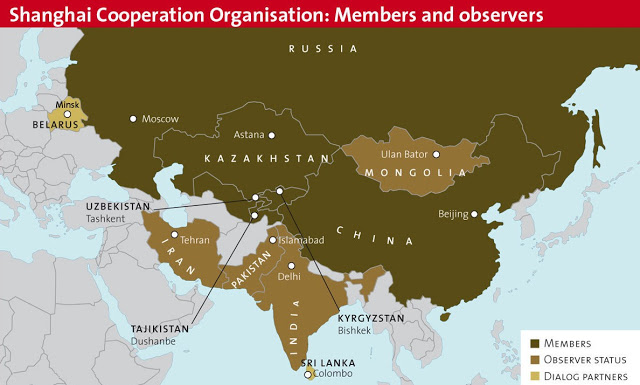
Eye Candy: Shanghai Cooperation Organization

NOL map SCO 2018
Source

First off, Shanghai and Warsaw are two very different cities, and because of that I think the SCO is a different animal than the Warsaw Pact. For one thing (aside from the difference in the two cities, one being selected for its geographical prominence, the other for its commercial acumen), the Warsaw Pact was a military alliance led by the Soviet Union, while the SCO is dedicated to political and economic cooperation as well as military security. Notably, the security aspect of the SCO is dedicated to coordinating state-led efforts against terrorism and separatism rather than against a rival alliance.

I don’t see anything wrong with multilateral efforts undertaken by states other than the US. I don’t see any need to worry, fret, or otherwise suspect the SCO of undermining world peace and prosperity. The fact that the SCO is made up of cooperating autocratic regimes rather than democratic ones does not faze me. The SCO has been making overtures to the democracies of India, Iran, and Sri Lanka (be sure to check out Tridivesh’s excellent take on India and the SCO), and multilateral cooperation among states is in itself an exercise in political participation among equals, albeit not at an individual level.

There is also cause to be happy that China and Russia have bound themselves up in such a prominent cooperative venture, too, given the two powers’ history of fighting each other. The SCO is contributing to peace and prosperity, and while it appears on the surface that the venture is designed to be a rival of the Western-built world order, the Shanghai Cooperation Organization actually contributes to it.

(h/t Nick)

Law, Judgement, Republicanism

Draft material for a joint conference paper/Work in Progress on a long term project

This paper comes out of a long term project to work on ideas of liberty in relation to republicanism in political thought, along with issues of law and sovereignty. The paper in question here comes out of collaborative work on questions of law, judgement, and republicanism in relation to Turkey’s history and its current politics. Though this comes from collaborative work, I take sole responsibility for this iteration of draft material towards a joint conference paper, drafted with the needs of a blog with a broad audience in mind.

The starting point is in Immanuel Kant with regard to his view of law and judgement. His jurisprudence, mostly to be found in the first part of the Metaphysics of Morals on ‘The Doctrine of Right’, is that of law based on morality, so is an alternative to legal positivism. The argument here is not to take his explicit jurisprudence as the foundation of legal philosophy. There is another way of looking at Kant’s jurisprudence which will be discussed soon. 

What is particularly valuable at this point is that Kant suggests an alternative to legal positivism and the Utilitarian ethics with which is has affinities, particularly in Jeremy Bentham. Legal positivism refers to a position in which laws are commands understood only as commands, with regard to some broader principles of justice. It is historically rooted in the idea of the political sovereign as the author of laws. Historically such a way of thinking about law was embedded in what is known to us as natural law, that is, ideas of universal rules of justice. This began with a very sacralised view of law as coming from the cosmos and divine, in which the sovereign is part of the divinely ordained laws. Over time this conception develops more into the idea of law as an autonomous institution resting on sovereign will. Positivism develops from such an idea of legal sovereignty, leaving no impediment to the sovereign will.

Kant’s understanding of morality leaves law rooted in ideas of rationality, universality, human community, autonomy, and individual ends which are central to Kant’s moral philosophy. The critique of legal positivism is necessary to understanding law in relation to politics and citizenship in ways which don’t leave a sovereign will with unlimited power over law. Kant’s view of judgement suggests a way of taking Kant’s morality and jurisprudence out of the idealist abstraction he tends towards. His philosophy of judgement can be found in the Critique of Judgement Power, divided into parts on aesthetic judgments of beauty and teleological judgments of nature.

The important aspect here is the aesthetic judgement, given political significance through the interpretation of Hannah Arendt. From Arendt we can take an understanding of Kant’s attempts at a moral basis for law, something that takes political judgement as an autonomous, though related, area. On this basis it can be said that the judgement necessary for there to be legal process, bringing particular cases under a universal rule, according to a non-deterministic subjective activity, on the model of Kant’s aesthetic judgement is at the root of politics.

Politics is a process of public judgement about particular cases in relation to the moral principles at the basis of politics. The making of laws is at the centre of the political process and the application of law in court should also have a public aspect. We can see a model of a kind in antiquity with regard to the minor citizen assembly, selected by lottery, serving as a jury in the law courts of ancient Athens. It is Roman law that tends to impose a state oriented view of law, in which the will of the sovereign is applied in a very absolutist way, so that in the end the Emperor is highest law maker and highest judge of the laws.

As Michel Foucault argues, and Montesquieu before him, the German tribes which took over Roman lands had more communal and less rigidly defined forms of court judgement, and were more concerned with negotiating social peace than applying laws rigidly to cases. Foucault showed how law always has some political significance with regard to the ways in which sovereignty works and power is felt. That is the law and the work of the courts is a demonstration of sovereignty, while punishment is concerned with the ways that sovereignty is embedded in power, and how that power is exercised on the body to form a kind of model subjugation to sovereignty. The Foucauldian perspective should not be one in which everything to do with the laws, the courts, and methods of punishment is an expression of politics narrowly understood.

The point is to understand sovereignty as whole, including the inseparability of institutions of justice from the political state. The accountability of the state and the accountability of justice must be taken together. Both should work in the context of public accessibility and public discussion. The ways in which laws, courts, and judges can be accountable to ideas of autonomy must be declared and debate. Courts should be understood as ways of addressing social harms and finding reconciliation rather than as the imposition of state-centric declarations of law.
Nightcap

  1. Trump’s ‘Great Chemistry’ With Murderous Strongmen Conor Friedersdorf, the Atlantic
  2. A Little-Noticed Legal Ruling That Is Bad News for Trump Damon Root, Volokh Conspiracy
  3. Will the Pause in South Asian Conflicts Last? Arif Rafiq, the National Interest
  4. The changing shape of Britain’s mosques Burhan Wazir, New Statesman