The Cruel, Conceited Follies of Trump’s Foreign Policy: 2026 Edition

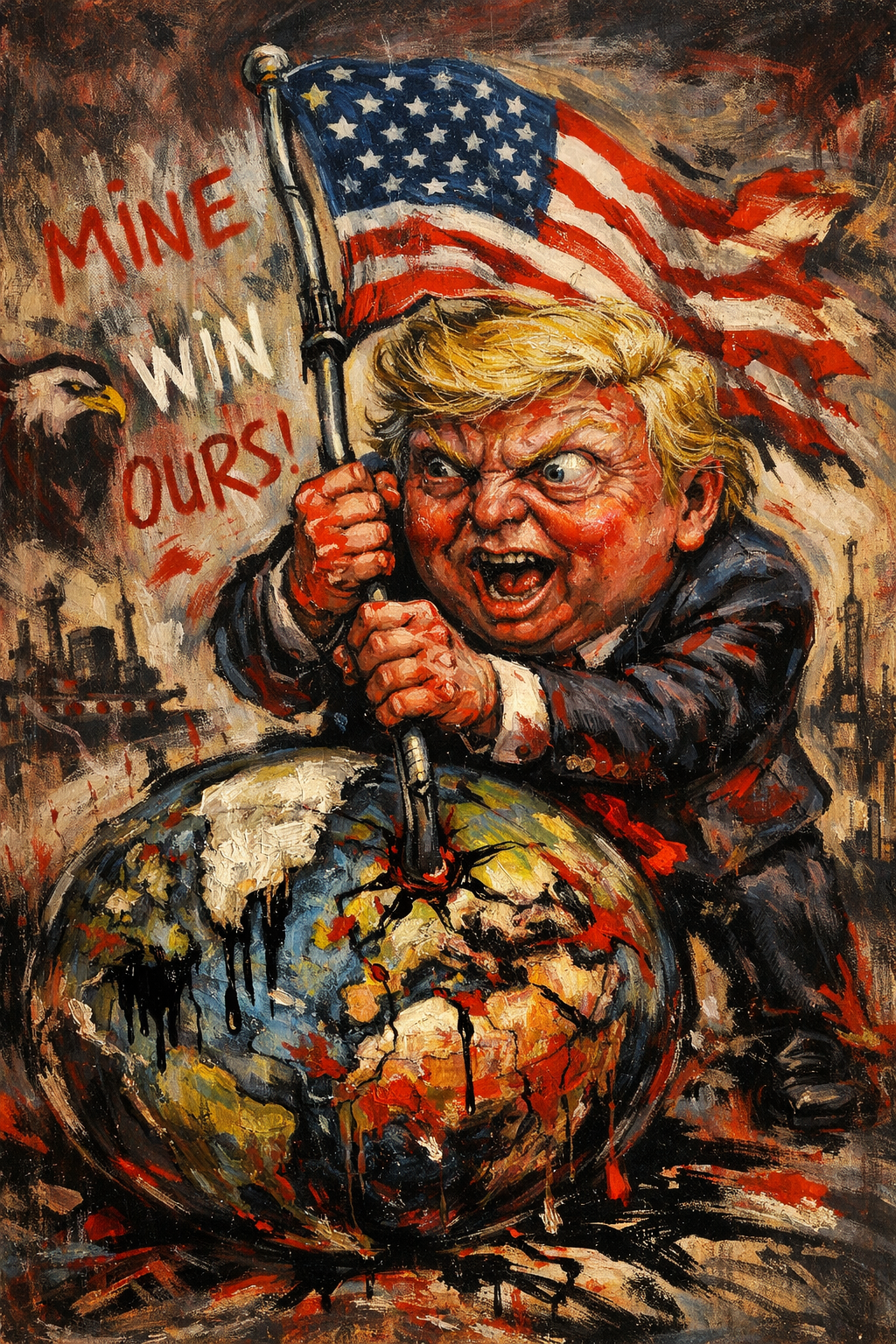
A neo-expressionist painting of Trump jamming an American Flag into the Globe with "Yours Win Ours" written in blood in the background, a bald eagle, and pastiches of factories and oil refineries.

Trump has now taken extralegal military action in Venezuela. Trump is strongly considering such action in Iran. And Trump keeps flirting with aggressive globally destabilizing military annexation of Greenland, a NATO ally. Many people are acting perplexed. After all, didn’t libertarian “genius” and totally-not-delusional-reactionary Walter Block tell us back in 2016 that libertarians should vote for Trump because he is anti-war? After this proved to be false the first term, didn’t totally-not-delusional-reactionary Walter Block then tell us again case for libertarianism was that he was anti-war and anti-foreign intervention, and that he was super cereal this time?

Sarcasm aside, I think it is worth revisiting why Trump’s foreign policy turn towards a radical sort of imperialist interventionism is so evil and unsurprising. I was confident back in 2016 that he was always going to be an old-school imperialist who uses US military conquest purely for resource extraction in a way that would be far worse than neocon warmongering. I wrote at the time, following Zach Beauchamp (who continues to emphasize this point), that Trump’s foreign policy was neither the neo-conservative interventionism of the Clintons and Bushes of the world, nor the principled anti-interventionism of libertarian scholars like Christopher Coyne and Abigail Hall, nor even the nationalist isolationism of paleoconservatives like James Buchanan. Instead, Trump’s foreign policy has always (quite consistently, since he was still a pro-choice democrat in the 90s) been about advancing inchoate national economic and political interestswhich really just means the interests of the politically connected.

This connection between Trump’s completely crankish economic nationalism and his imperialist foreign policy is even tighter now than it was then. It seems Trump is likely facing a rejection of his unconstitutional overreach of unilaterally applying economically suicidal tariffs from SCOTUS. The tariffs, which originally, might I add, were based on perhaps the single dumbest attempt to do economics I have ever seen, appeared to be lifted straight from ChatGPT, given that his main economic advisor on these matters, Peter Navarro, is literally a fraudster. As a result, he now seems to be manufacturing a national security crisis so he can impose tariffs without congress’ blessing.

But I do not want to revisit Trump’s imperialist foreign policy just to gloat. I also want to revisit and restate why this foreign policy is unbelievably unjust and self-destructive. What I wrote back in 2016 is still worth reposting at length:

First, Trump’s style of Jacksonian foreign policy is largely responsible for most of the humanitarian atrocities committed by the American government. Second, Trump’s economic foreign policy is antithetical to the entire spirit of the liberal tradition; it undermines the dignity and freedom of the individual and instead treats the highest good as for the all-powerful nation-state (meaning mostly the politicians and their special interests) as the end of foreign policy, rather than peace and liberty. Finally, Trump’s foreign policy fails for the same reasons that socialism fails. If the goals of foreign policy are to represent “national interest,” then the policymaker must know what that “national interest” even is and we have little reason to think that is the case, akin to the knowledge problem in economic coordination.

… This is because the Jacksonian view dictates that we should use full force in war to advance our interests and the reasons for waging war are for selfish rather than humanitarian purposes. We have good reason to think human rights under Trump will be abused to an alarming degree, as his comments that we should “bomb the hell out of” Syria, kill the noncombatant families of suspected terrorists, and torture detainees indicate. Trump is literally calling for the US to commit inhumane war crimes in the campaign, it is daunting to think just how dark his foreign policy could get in practice.

To reiterate: Trump’s foreign policy views are just a particularly nasty version of imperialism and colonialism. Mises dedicated two entire sections of his chapter on foreign policy in Liberalism: The Classical Tradition to critiquing colonialism and revealing just how contrary these views are to liberalism’s commitment to peace and liberty. In direct opposition to Trump’s assertions that we should go to war to gain another country’s wealth and resources and that we should expand military spending greatly, Mises argues:

“Wealth cannot be won by the annexation of new provinces since the “revenue” deprived from a territory must be used to defray the necessary costs of its administration. For a liberal state, which entertains no aggressive plans, a strengthening of its military power is unimportant.”

Mises’ comments on the colonial policy in his time are extremely pertinent considering Trump’s calls to wage ruthlessly violent wars and commit humanitarian crises. “No chapter of history is steeped further in blood than the history of colonialism,” Mises argued. “Blood was shed uselessly and senselessly. Flourishing lands were laid waste; whole peoples destroyed and exterminated. All this can in no way be extenuated or justified.”

Trump says the ends of foreign policy are to aggressively promote “our” national interests, Mises says “[t]he goal of the domestic policy of liberalism is the same as that of its foreign policy: peace.” Trump views the world as nations competing in a zero-sum game and there must be one winner that can only be brought about through military conquest and economic protectionism, Mises says liberalism “aims at the peaceful cooperation between nations as within each nation” and specifically attacks “chauvinistic nationalists” who “maintain that irreconcilable conflicts of interest exist among the various nations[.]” Trump is rabidly opposed to free trade and is horrifically xenophobic on immigration, the cornerstone of Mises’ foreign policy is free movement of capital and labor over borders. There is no “congruence” between Trump and any classically liberal view on foreign policy matters in any sense; to argue otherwise is to argue from a position of ignorance, delusion, or to abandon the very spirit of classical liberalism in the first place.

…Additionally, even if we take Trump’s nationalist ends as given, the policy means Trump prefers of violent military intervention likely will not be successful for similar reasons to why socialism fails. Christopher Coyne has argued convincingly that many foreign interventions in general fail for very similar reasons to why attempts at economic intervention fail, complications pertaining to the Hayekian knowledge problem. How can a government ill-equipped to solve the economic problems of domestic policy design and control the political institutions and culture of nations abroad?  Coyne mainly has the interventionism of neoconservatives and liberals in mind, but many of his insights apply just as well to Trump’s Jacksonian vision for foreign policy.

The knowledge problem also applies on another level to Trump’s brand of interventionism. Trump assumes that he, in all his wisdom as president, can know what the “national interest” of the American people actually is, just like socialist central planners assume they know the underlying value scales or utility functions of consumers in society. We have little reason to assume this is the case.

Let’s take a more concrete example: Trump seems to think one example of intervention in the name of national interest is to take the resource of another country that our country needs, most commonly oil. However, how is he supposed to know which resources need to be pillaged for the national interest? There’s a fundamental calculation problem here. A government acting without a profit signal cannot know the answer to such a problem and lacks the incentive to properly answer it in the first place as the consequences failure falls upon the taxpayers, not the policy makers. Even if Trump and his advisors could figure out that the US needs a resource, like oil, and successfully loots it from another country, like Libya, there is always the possibility that this artificial influx of resources, this crony capitalist welfare for one resource at the expense of others, is crowding out potentially more efficient substitutes.

For an example, if the government through foreign policy expands the supply of oil, this may stifle entrepreneurial innovations for potentially more efficient resources in certain applications, such as natural gas, solar, wind, or nuclear in energy, for the same reasons artificially subsidizing these industries domestically stifle innovation. They artificially reduce the relative scarcity of the favored resource, reducing the incentive for entrepreneurs to find innovative means of using other resources or more efficient production methods. At the very least, Trump and his advisors would have little clue how to judge the opportunity cost of pillaging various resources and so would not know how much oil to steal from Libya. Even ignoring all those problems, it’s very probable that it would be cheaper and morally superior to simply peaceably trade with another country for oil (or any other resource) rather than waging a costly, violent, inhumane war in the first place.

Having said all that, there is plenty I got wrong in picturing Trump as an old-school imperialist. During Trump’s first term, I underestimated the extent to which institutional constraints would stop him from acting on his worst nationalist and imperialist impulses. But this term, those constraints are gone. The Mattises, Tillersons, Boltons, and Pences of the world have been replaced with the Vances, Noems, Rubios, and Hegseths. As a result, thinking of Trump as an old-school imperialist and nationalist is becoming more accurate since he is allowed to act on his irrational, deranged impulses.

Second, I failed to distinguish sufficiently between resource extraction through indirect means of violent regime change, tariffs, weapons supply, and 19th-century colonialist-style direct annexation versions of it. I do still think that if Trump really did what he most consistently wants he would do quite a bit of annexation and old school colonialism (see his comments on Greenland and Canada), but he seems a bit more content than I projected back then to use military force to install stooges and puppet regimes for resource extraction (as he has sought to do in both Gaza and now Venezuela). Which, to your point, is not as different from the Nixon/Bush/Clinton/Reagan type intervention as reactionary centrists would have you believe, but the nakedness of the extractive nationalist motivation does mark a difference that encourages even more brazenly cruel, more illegal, and more strategically incoherent and unpredictable interventionist warmongering.

Thirdly, and most obviously, I greatly overestimated his coherence on foreign policy. Whether it is him handicapping US influence in the Pacific by withdrawing from the TPP while implementing tariffs on Chinese goods to seem tough in the first term, which just gave China more leverage in the region. Or whether it’s his delusional flip-flopping on Russia and Ukraine based on who he talked to last, constantly this term. Or whether it’shis random provocation against Iran in 2019 by killing one of their generals. Or whether it’s his insane flip-flopping between Nuclear War talk and sychophancy with North Korea. Or the total randomness of his attacking Venezuela for more domestic than foreign policy reasons now. He is simply far more impulsive and deranged than I would have predicted in 2016. This part of that old article seems especially stale now:

After all, it doesn’t matter so much the character of public officials as the institutional incentives they face. But in matters of foreign policy problems of temperament and character do matter because the social situation between foreign leaders in diplomacy can often make a huge difference.

I did hedge that by allowing that Trump may be a uniquely unfit person so as to constitute a sui-generis case. But I should have been more emphatic about that: Trump really is a uniquely world-historically dangerous monster, and he has gotten more and more incoherent and impulsive over the years with his cognitive decline.

Finally, the biggest miss in my analysis of Trump’s foreign policy back then is that I put far too much emphasis on Trump’s focus on material goods, thinking he really just thought of geopolitics like a 12-year-old approaches a turn-based strategy game like Risk in just accruing more stuff. But in reality, his approach is far more disturbing and vile than even that. It is not simply about getting oil for US oil companies. In the case of Venezuela, oil execs do not seem so gun-ho. As one private equity investor told the Financial Times last week, “No one wants to go in there when a random fucking tweet can change the entire foreign policy of the country.” Indeed, the political risk is so big there Exonn’s CEO has called Venezuela “uninvestable” and Trump is trying to force oil companies to misallocate capital to Venezuela.

Narrow left-wing materialists’ critiques like mine misfire because they treat material resources as the main thing. It is not the oil per se that Trump wants, but what the oil represents. He is instead approaching international geo-politics like an 8-year-old driven by malignant narcissism: he wants symbols of nationalist masculine domination. Indeed, when asked why he wanted Greenland, Trump was quoted as saying:

Because that’s what I feel is psychologically needed for success. I think that ownership gives you a thing that you can’t do, whether you’re talking about a lease or a treaty. Ownership gives you things and elements that you can’t get from just signing a document.

Indeed, the fact that Greenland looks big on a Mercator projection of the earth has as much to do with why Trump wants it as the oil. As Trump continues his authoritarian assaults on individual liberty domestically and pursues semiotic nationalist domination internationally, one can only vainly pray that something keeps his dark, demonic, twisted sadist fantasies in check without devolving into a true civilization-level threat.

Nightcap

  1. Locksley Hall (19th century poem) by Alfred, Lord Tennyson
  2. India, China, and the future of Christianity George Weigel, First Things
  3. The quiet part about Russia and NATO Branko Marcetic, RS
  4. Did life exist on Mars? Other planets? With AI’s help, we may know soon

Nightcap

  1. Where is the most fertile region of Europe? Lisa Abend, New Lines
  2. California’s war on parents Mark Schneider, City Journal
  3. Stations. Abigail Stewart, Isonomia Quarterly
  4. It’s okay to be gay Irfan Khawaja, Policy of Truth

I Don’t Want to Fight to the Last Ukrainian

I hope the brave Ukrainians will soon decide to stop dying. I seems to me they have to. The Russians have demonstrated that their armed forces are too incompetent to conquer Ukraine and to reduce it to a satellite. Their capacity to bomb and pound whole cites into a fields of rubble, however, is not in doubt. Even if the Ukrainians managed to expel all Russian troops from all of their country, the Russians could still destroy most Ukrainian cities from their own territory. It does not take much talent if you don’t mind the expense of throwing the same missiles over and over against the same large targets. And the expense may not matter so much while several NATO countries are still paying their fossil fuel bills to the Kremlin. And, if the Ukrainians succeeded in bringing the war to Russia itself to make the attacks cease, they would immediately face a measure of abandonment by world public opinion, including by NATO countries. In addition, even a slight invasion of Russia would probably trigger a wave of self-righteous Russian patriotism. The reluctant Russian soldiers and sailors we have seen in largely pathetic action thus far might soon be replaced by enthusiasts eager to sacrifice themselves for the motherland.

It seems to me the Ukrainians have established they are able to preserve their independence and their recently earned democracy. Yet, it appears that Pres. Zelenskyy has announced his government’s determination to boot every armed Russian from every square inch of Ukrainian soil. Such a project involves going on the offensive against an entrenched enemy because the Russians have been present in the Dombas eastern region, in some guise or other, since 2014. Attacking an entrenched enemy is always very costly in lives as the Russian military’s own failed attempt to take the Ukrainian capital showed anew. I hear in the mass media military experts of diverse nationalities assert that it takes many tanks, among other equipment, and mastery of the skies. The Ukrainians have few of the first and little hold over the other. So, the Ukrainian president’s inflexibility is a signal that many more Ukrainians will die. I can’t help but wonder why it should be so, or what for, except that Zelenskyy may be making the bet that the Russian invaders will soon fold and retreat from every area that was Ukrainian in 2013. Zelenskyy may know things I don’t know, of course but from where I sit, in the calm, his attitude seems unnecessarily dangerous. Let me explain.

After eight years of war – even if most was low intensity war – a good half of the Donbas region, most of its cities, including the puppet “people’s republics” of Donetsk and Luhansk, is probably inhabited almost entirely by Russian speakers who are pro-Russians. The others must have left long ago or been driven out. Making the existing pro-Russia population of Donbas submit would place the current elected Ukrainian government in the same situation as the Russians now are in some other parts of Ukraine: occupiers, hated, unable to reduce the local population’s resistance, liable to commit atrocities out of sheer frustration. The currently virtuous Ukraine Republic could quickly be transformed into the kind of vicious monster it is now facing on the rest of its territory.

The prized Crimean peninsula was annexed outright by Russia in 2014, soon after it was seized, and following a questionable referendum. However, since its annexation there have been few protests there against Russia. I don’t think there is a pro-Ukrainian popular movement in the Crimea. (I believe that if there were, I would have heard of it. Correct me if I have been inattentive.) It’s also good to remember that the ties between Crimea and Ukraine may well be historically shallow. Khrushchev gave it to the Ukraine Soviet Republic in 1954 (yes, 1954) pretty much as a gift. In the 2001 count, the last conducted under Ukrainian rule, only 24% of Crimeans were identified as Ukrainians. It’s notable that in the several years between the Russian annexation and the current invasion of Ukraine, it seems there have been few serious statements by any country, including Ukraine, to the effect that the latter had to be reversed. (Correct me if I am wrong.)

As I write (4/26/22) Ukraine’s military position appears strong but it’s facing an offensive where Russia’s military inferiority may not compensate for Ukraine’s smaller numbers and lack of heavy materiel and airplanes. This is the right time to make peace proposals. It appears that Putin is not the kind of person who will admit defeat or even that his project was ill-thought out and ill-planned. Even if he is not actually insane – which have has been suggested by several credible sources – an oblique approach seems well advised here This might be done, perhaps by asking various Russian oligarchs – who stand to lose even more by continued hostilities – to contact Russian general officers who are probably not eager to be dragged further in a reputational mud hole, or who might want to save what’s left of their army.

I think a peace agreement would grant Russia control of all of the Donbas which again – it had already mostly under its control – and an extension south through devastated Mariupol to form a land bridge between Russia proper and Crimea. Some of the arguments against such a resolution smack of the 19th century. First, President Zelenskyy speaks of the territorial integrity of his country as if it were a sacred concept. Yet, we know of a number of countries that lost territory and subsequently did well in every way. At the end of WWII, for example, Germany was amputated of about ¼ of its territory. Yet, it emerged in insolent health ten years later.

A main objection to Ukraine relinquishing the Donbas is that it’s its most industrialized section. This sounds like more 19th century thinking. The Donbas has a considerable steel industry and a heavy metallurgical industry because it also possesses coal mines (with coal difficult and expensive to mine). This raise the question of whether the country should exchange the lives of many of its young men again an energy source that seems to be on its way out anyway and the kind of associated heavy manufacturing favored by Stalin. The examples of Singapore and of geographically nearer Switzerland come to mind. Both countries maintain a superior standard of living without the benefit of either rich energy sources or of conventional metal-based manufacturing. These examples make it easy to argue that the real riches of a country may be its people rather than so many million tons of coals. One more reason to be stingy with Ukrainians’ lives.

If the Ukrainian government made what it probably now thinks of as the sacrifice to sue for peace immediately or soon, it would gain a big prize. I mean that it would be able to keep the big port city of Odesa which is now almost intact. With Odesa, the Ukraine would retain a single access to the sea which is probably more important economically than any coal mines. Odesa was about 2/3 Ukrainian in the last count with Russians making up less than one third. It does not pose the same kind of retention problems as Donbas.

One last but major consideration. The Ukrainian government is fond of affirming that its country is fighting for all of us, not just for itself, against Russian totalitarianism and aggression. This is an almost necessary argument to prime the military and economic pump from the West. It may even be partially true. Yet, right now, – and paradoxically not a little thanks to Putin’s wake-up call- it’s pretty clear NATO can take care of its own. I mean this, even given the lightly brandished nuclear threat. I am pretty sure the Russian General Staff has in its possession a list of its military installations that would be wiped out in the first round of riposte to a nuclear event, a second list of fossil fuel extraction and transformation sites that would be gone on the second round, and a list of Russian cities that would suffer the fate of Mariupol on the third.

I think NATO has the means to return Russia to the Third World status it ever only barely escaped. I also think the Russian military knows this. So, I am very much against the possibility of the West fighting for its freedom and for its prosperity to the last Ukrainian. That’s so, even if the Ukrainians insist they would like too. I am filled with horror at the thought of being even a smidgen responsible for making even more Ukrainian orphans and widows.

And yes, the peace I envision would be another form of rewarding aggression. However, in this case, there is a good trade-off. Russia would acquire some industrial territory in the old mold at the cost of having demonstrated to the world a surprising degree of military incompetence. We, in the US, should keep supporting the Ukrainian war effort just to say “Thanks” for this demonstration.

Nightcap

  1. Putin’s “Century of Betrayal” speech Branko Milanovic, globalinequality
  2. Religious discrimination in late imperial Russia Volha Charnysh, Broadstreet
  3. The future of NATO Jason Davidson, War on the Rocks
  4. Secession and international alliances go together Edwin van de Haar, NOL

The Russian-American-Chinese Triangle: A Changing Global Landscape

Introduction

Chinese President Xi Jinping and Russian President Vladimir Putin met on February 4, 2022 (this was the 38th meeting between both of them after 2013). Putin and Xi met hours before the opening ceremony of the Beijing Winter Olympics. Putin was in China to attend the Olympics and his presence was important in symbolism given that a number of countries – including the US, the UK, Australia, and India announced a diplomatic boycott of the games.

Both sides forcefully pitched for further enhancing their bilateral relationship and referred to the need for a ‘no limits partnership.’ Putin and Xi are also supposed to have agreed on the need for finding common ground in areas like artificial intelligence, technology, and climate change. A statement issued by the Kremlin after the meeting between Xi and Putin said that Beijing was opposed to the US aim of expansion of NATO in Eastern Europe (both Xi and Putin argued that NATO was promoting a ‘cold war’ ideology). During the meeting, Putin also made it clear that Russia endorsed China’s stand on Taiwan and opposed Taiwanese independence in any form. The Russian President was critical of the US for creating blocs in the Indo Pacific. Both sides expressed concern with regard to the Australia-UK-US (AUKUS) security partnership.

The joint statement made two interesting points; first, that the China-Russia relationship is ‘superior to political and military alliances of the cold war era’ and second, that both Moscow and Beijing were firmly committed to multilateralism. 

US-Russia-China triangle 

The steady deterioration between the US and both Russia and China have resulted in Moscow-Beijing relations further strengthening in recent years.

A number of US strategic analysts have argued that Washington needs to work with Moscow and find common ground on certain global issues, and to ensure that Moscow is not compelled to move closer to Beijing. 

There has been high level engagement between both sides in recent months, and they have found some common ground on the Iran nuclear issue/JCPOA (Joint Comprehensive Plan of Action). After his meeting with Russian Foreign Minister Sergey Lavrov in Geneva last month, US Secretary of State Antony Blinken had said that Iran nuclear deal was an example of how Washington and Moscow could work together. The threat of a Russian invasion of Ukraine have ensured that ties between US and Russia remain strained in spite of high level interactions between both sides.

Russia-China ties and the impact of US sanctions

A day before the meeting between Xi and Putin, Russian Foreign Minister Sergey Lavrov and his Chinese counterpart had met and are supposed to have discussed a number of issues, including Ukraine and Afghanistan. In response to the meeting, officials in the Biden administration had stated that a close economic relationship with China would not be enough for Russia to face the impact of US sanctions. Ned Price, Spokesperson of the US State Department, also warned Chinese companies in case attempts were made to circumvent US sanctions:

We have an array of tools that we can deploy If we see foreign companies, including those in China, doing their best to backfill U.S. export control actions, to evade them, to get around them.

Russia-China economic relations 

There has been a growing thrust in both Moscow and Beijing on strengthening economic relations. After the meeting between Xi and Putin a number of trade and energy related deals were signed. Russia’s Rosneft also signed a 10-year deal with China’s state-owned CNPC to continue supplying 200,000 b/d of crude to China via Kazakhstan (shipments will flow from Kazakhstan’s Atasu-Alashankou pipeline to refineries in northwest China).

Will China support Ukraine at the cost of economic ties with the EU?

While it is true that in the current global world order, Russia-China relations are likely to further strengthen, there is also a belief that China may extend support to Russia on the Ukraine issue – only to a certain point — because Beijing shares close economic links with Europe and the US. While trade between China and the EU and US account for a significant percentage of China’s total trade, trade with Russia accounts for only 2% of China’s total trade. At a time when China’s growth rate is slowing down considerably due to a number of reasons – such as some of Xi Jinping’s economic policies seeking to prevent ‘disorderly expansion of capital,’ a serious real estate crisis, and a drop in consumer spending – China would not like its economic links with the EU to be adversely affected. Apart from this, as mentioned earlier, the US has warned China that it will be affected by the economic and security challenges arising out of any further Russian aggression vis-à-vis Ukraine.

In conclusion, while there is no doubt that Russia-China bilateral ties, which are already robust, are likely to expand in a number of areas. And in a changing global world order there is likely to be growing convergence on important geopolitical issues.  It is important, however, to bear in mind that interests are not always identical and China’s economic interests – especially its economic links with the EU – are important in this context. 

UK-Turkey Free Trade Agreement: Beyond the Economics

Introduction

On December 29, 2020, the UK and Turkey signed a Free Trade Agreement (FTA) which will become effective January 1, 2021, after the UK leaves the EU. Turkey’s Trade Minister, Rushkar Pekcan, and the British Ambassador to Turkey, Dominick Chilcott, signed the agreement. 

The timing of the agreement was interesting, since the FTA was signed days after the UK and EU had managed to clinch a Brexit trade deal, with great difficulty, and after the US imposition of sanctions on Turkey for the purchase of S400 missiles from Russia (the decision to impose sanctions is likely to have its impact not just on Turkey-US ties, but also between Turkey and other NATO member states).

Commenting on the importance of the deal, Pekcan said:

The free trade agreement is a new and special milestone in the relationship between Turkey and United Kingdom.

President Recep Erdogan, while referring to the significance of the FTA a day before it was signed, had said that it would create a win-win situation for both Turkey and the UK. He also said that the deal is crucial, and dubbed it as Turkey’s most important economic agreement after the 1995 Customs Union.

Economic importance of the FTA 

If one were to look at the economic significance of the deal, it is dubbed to be the fifth largest trade deal for Britain. The UK-Turkey FTA is also likely to give a significant boost to the bilateral trade between both countries. The UK is Turkey’s second largest export market (for commodities including vehicles, textiles, and electrical equipment). The agreement is also important from Turkey’s point of view because without a deal well over 75% of Turkey’s exports to the UK would have been subject to tariffs. The FTA will also ensure existing preferential tariffs for 7,600 British businesses that exported goods to Turkey in 2019.

According to estimates, the potential for bilateral trade between Turkey and Britain is up to $20 billion. Britain is Turkey’s fifth largest investor (investment is estimated at $11.6 billion) and a total of 2,500 British companies are based in Turkey. 

UK Trade Secretary Elizabeth Truss, while commenting on the deal, said ‘[…it] provide[s] certainty for thousands of jobs across the UK in the manufacturing, automotive, and steel industries.’

While the key features of the deal are known (it seeks to prevent supply chains in automotive and manufacturing sectors, and also covers all agricultural and industrial goods), the FTA could also give a fillip to deeper defense cooperation between the UK and Turkey (in November 2020, Turkey and the UK held defence exercises for the first time).

Geopolitical context

The FTA also has geopolitical significance, because the UK is one of the few Western countries with which Turkey has a cordial relationship. While all eyes have been on the imposition of US sanctions, and its impact on the Washington-Istanbul relationship, Turkey’s ties with the EU have also witnessed a steady deterioration due to a multitude of factors in recent years. Turkey has also not been on the same page as the Western world on a number of geopolitical issues. This includes the Syria issue, as well as the dispute between Azerbaijan and Armenia over Nagorno-Karabakh.

Turkey’s military operation in Syria and reactions

Turkey’s military offensive against Kurdish forces in Northern Syria in 2019 received strong responses from EU member states and the US. While the EU was critical of the action, US policy makers had urged Donald Trump to freeze assets belonging to Turkish leaders and block the sale of arms to Istanbul. Trump had written to Erdogan to refrain from such an action, but the Turkish President paid no heed to the same. It would be pertinent to point out that after Turkey’s October 2019 invasion of Syria, Britain had stopped sales of arms, but said it would not be providing new export licences for weapons which may be used in military operations in Syria.

If one were to look at the Azerbaijan-Armenia issue, France has been vocal in supporting international supervision of the ceasefire and has also expressed apprehension that Turkey and Russia may exclude Western countries. 

The EU has also been uncomfortable with Turkey’s policy in the Mediteranean. Only recently, the EU imposed sanctions against Turkish companies and individuals for oil drilling. Greece had wanted sectoral sanctions but this was resisted by German Chancellor Angela Merkel and Bulgarian Prime Minister Boyko Borissov, who shares a close rapport with Erdogan.

Russia-Turkey relationship

While it is believed that the main reason for the rift between Turkey and the West is the former’s growing proximity to Russia, Istanbul and Moscow too have divergences over geopolitical issues (be it Syria, Libya, or Azerbaijan). Only recently, the presence of the Turkish President at Azerbaijan’s military parade on December 10, 2020, to mark Azerbaijan’s victory over Russian ally Armenia with Turkish assistance, would not have gone down well with Moscow. Yet in public, Russia has refrained from criticizing Turkey. In an interaction with the media in December 2018, Russian President Vladimir Putin stated that sometimes Russian and Turkish interests do not ‘coincide,’ yet he also praised Turkey for pursuing an ‘independent foreign policy’ in spite of being a member of NATO and honoring its commitments. 

He has also stated that Moscow needs to be ‘patient’ and adopt a more compromising stance vis-à-vis Turkey. 

Erdogan does realize that he cannot afford a sudden deterioration of ties with the US, and his reconciliatory statements vis-à-vis Israel, and the Turkish decision to appoint an envoy after more than two and a half years, is being viewed as a step towards mending ties with the incoming Biden Administration.

Conclusion 

The Britain-Turkey FTA is important not just for economics but also for geopolitical reasons. While Britain will deal with the realities of a post-Brexit world, and such FTA’s will be important in navigating the same, for Turkey the deal is important in the context of the geopolitics of the Middle East and beyond.

Nightcap

  1. Mormonism and the culture war McKay Coppins, Atlantic
  2. Europe outspends Russia on defense Barry Posen, Survival
  3. The onion bomb and Hindu nationalism Rohit Inani, Newlines
  4. The revolt of the baristas Jacques Delacroix, NOL

Nightcap

  1. A sovereignty full of holes Daniel Treisman, LARB
  2. NATO’s new role in the Pacific Shannon Tiezzi, Diplomat
  3. In memory of Ruth Klüger Jonathon Catlin, JHIBlog
  4. Rules for honest conversation Andrew J Cohen, RCL

Nightcap

  1. On cancel culture Irfan Khawaja, Policy of Truth
  2. Why I lean libertarian Arnold Kling, askblog
  3. Colonialism and economic development Lipton Matthews, Mises Wire
  4. Speculation about Greece and Turkey Koert Debeuf, EUObserver

Nightcap

  1. Trump and the liberal international order (pdf) Doug Stokes, IA
  2. Goodbye — sort of — to Germany? Victor Davis Hanson, National Review
  3. The failure of global liberal hegemony David Gordon, The Austrian
  4. Liberty displaced Daniel McCarthy, Modern Age

Nightcap

  1. A great primer on Derrida’s “deconstruction” David Gunkel, MIT Press Review
  2. Is feudalism going to make a comeback? Adam Wakeling, Quillette
  3. Yet another reason why libertarians should embrace federation as a foreign policy War on the Rocks
  4. Hunter-gatherers in outer space Nick Nielsen, The View from Oregon

Nightcap

  1. Collecting the dreams of imperial subjects Erik Linstrum, Aeon
  2. On NATO’s open door policy Emma Ashford, War on the Rocks
  3. Stalin’s Danish mystery Caroline Kennedy-Pipe, History Today
  4. Taleb’s distinction between “complicated” and “complex” Mark Cancellieri, askblog (comments)

Nightcap

  1. Giving the Devil his due (in praise of Trump) Irfan Khawaja, Policy of Truth
  2. Turkey (a NATO ally) launches Syrian offensive Amberin Zaman, Al-Monitor
  3. The case for Amy Klobuchar in 2020 David Leonhardt, New York Times
  4. The only gaijin in the village Kris Kosaka, Japan Times

Nightcap

  1. In defense of Democratic war socialism Irfan Khawaja, Policy of Truth
  2. China brought NATO closer together Ringsmose & Rynning, WOTR
  3. In praise of trade frictions Chris Dillow, Stumbling & Mumbling
  4. “We are in Soviet times again” Tara Burton, City Journal